





TL;DR
Enterprise mobile app development delivers secure, compliance-ready applications that solve complex business problems at scale. Key features include enterprise-grade security (role-based access control, encryption, audit logging), seamless legacy system integration, offline-first design, and advanced user management. Primary benefits: operational efficiency through workflow automation (15-25% productivity gains in field service), real-time data accessibility, remote work enablement, cost reduction through labor optimization, and competitive differentiation via innovation. Real-world use cases span healthcare (telemedicine, patient records), finance (mobile banking, fraud detection), retail (inventory management, mobile checkout), logistics (supply chain visibility, field service dispatch), and insurance (claims processing). Enterprise mobile app development differs from consumer apps by prioritizing security, compliance, and reliability over user acquisition, requiring integration with existing systems, and planning for thousands of concurrent users. Success demands technology expertise (native, cross-platform frameworks like React Native/Flutter), compliance knowledge (HIPAA, PCI-DSS, GDPR), scalable architecture, and a development partner with proven enterprise credentials. Organizations like Aalpha Information Systems (5,500+ enterprise projects across 45 countries, 4.9/5 Clutch rating, ISO 9001:2015 certified) demonstrate the expertise required to navigate security, integration, and scale challenges in enterprise mobile deployment.
The mobile-first strategy is no longer optional for enterprises. Across industries, organizations are racing to deliver powerful, secure mobile applications that enable their workforces to operate anywhere, anytime. Whether it’s a field technician accessing work orders in real time, a bank customer approving transactions on demand, or a healthcare provider delivering patient care through telemedicine, enterprise mobile applications have become critical infrastructure for modern business.
Enterprise mobile app development represents a fundamentally different challenge than building consumer apps. A banking app must handle regulatory compliance across multiple jurisdictions. A logistics platform must integrate seamlessly with decades-old supply chain systems. A healthcare application must encrypt sensitive patient data and audit every access. The stakes are higher, the complexity is greater, and the consequences of failure are more severe.
The global enterprise mobile application market reflects this shift. Organizations are moving beyond simple information delivery to build apps that directly impact revenue, reduce operational costs, and strengthen customer relationships. Enterprises recognize that mobile accessibility transforms how work gets done, enabling real-time decision-making, reducing manual processes, and creating opportunities for competitive advantage through innovation.
Yet enterprise mobile app development remains misunderstood. Many organizations approach it as a straightforward extension of web development or attempt to apply consumer app best practices to enterprise challenges. This mismatch creates projects that struggle with integration complexity, fail security audits, or collapse under load when scaled across thousands of users. The difference lies in how enterprise applications prioritize security, scalability, compliance, and integration over flashy user interfaces or viral growth.
This article explores what makes enterprise mobile app development distinct, examines the core features that define enterprise-grade applications, analyzes real-world use cases across industries, and provides a roadmap for organizations embarking on their own enterprise mobile initiatives. Whether you’re evaluating development partners, planning your first enterprise app, or scaling existing mobile infrastructure, understanding the landscape of enterprise mobile app development features and benefits is essential to success.
What is Enterprise Mobile App Development?
Enterprise mobile app development is the discipline of building mobile applications designed to solve complex business problems, operate at scale, and integrate deeply with organizational infrastructure. These applications serve internal employees, field teams, partners, or customers, but they all share common characteristics that distinguish them from the mobile apps most consumers know.
The core distinction lies in priorities. Consumer apps optimize for user acquisition, engagement metrics, and viral growth. Enterprise mobile applications optimize for security, compliance, integration, and reliability. A consumer app with 99% uptime might lose customers to a competitor. An enterprise app with 99% uptime can cost millions in lost productivity or revenue if that 1% downtime occurs during critical business hours. An enterprise mobile app for banking cannot afford data breaches; the reputational and regulatory costs dwarf development expenses.
Enterprise mobile app development requires technical sophistication that extends far beyond user interface design. These applications must authenticate users against corporate directory systems like Active Directory or LDAP. They must integrate with enterprise resource planning platforms such as SAP or Oracle. They must sync data reliably across unreliable network conditions, maintain consistency when users work offline, and handle sudden spikes in usage without degrading performance. They must encrypt sensitive data in transit and at rest, log every user action for compliance audits, and restrict functionality based on granular role-based access controls.
The stakeholder landscape adds another dimension of complexity. Consumer app development involves engineers, designers, and product managers. Enterprise mobile app development demands involvement from security teams, compliance officers, IT infrastructure teams, and business stakeholders from multiple departments. A healthcare application requires coordination with HIPAA compliance specialists, clinical leadership, IT security, and medical records teams. This multi-stakeholder alignment takes time, creates dependencies, and demands clear communication.
Scale amplifies these challenges. A consumer app might target millions of users but concentrate them in specific geographies or time zones. An enterprise app serving a global organization must perform reliably for employees across twelve time zones, on varying network conditions, using different devices, speaking different languages, and operating under different regulatory regimes. A retail chain deploying an inventory management app to five thousand stores cannot afford performance degradation that slows checkout operations in even one location.
Yet enterprise mobile app development is not simply “harder” version of consumer app development. It operates under different economic and operational constraints. Consumer apps might experiment with multiple product directions and fail fast. Enterprise apps must be planned carefully because changing direction midstream after deployment costs enormous sums. Consumer apps might track users aggressively to maximize engagement. Enterprise apps must respect privacy restrictions and avoid practices that violate compliance requirements. Consumer apps often rebuild from scratch every few years as technology evolves. Enterprise apps must plan for long lifecycles where supporting older mobile operating systems remains necessary because replacing devices across an entire organization takes years.
Understanding these distinctions is crucial for organizations evaluating enterprise mobile app development. Success requires different approaches to planning, architecture, security, testing, and team composition than those that work for consumer-facing applications.
Core Features of Enterprise Mobile Applications
Enterprise mobile applications share a constellation of features that enable them to operate reliably, securely, and at scale within organizational environments. These features separate genuinely enterprise-grade applications from apps that simply happen to run on mobile devices.
-
Security and Compliance
Security is the foundation of enterprise mobile applications. These apps handle sensitive data: financial records, healthcare information, customer details, intellectual property, operational secrets. A breach doesn’t just compromise users; it exposes the entire organization to legal liability, regulatory penalties, and reputational damage.
Enterprise mobile applications implement security through multiple layers. Authentication ensures users are who they claim to be, typically through integration with enterprise identity systems that enforce strong passwords, multi-factor authentication, and centralized credential management. Authorization restricts what authenticated users can access, enforcing role-based access control so that a junior employee sees only data relevant to their position while senior executives access strategic information. Encryption protects data in transit using industry-standard protocols like TLS, ensuring data cannot be intercepted while traveling between the mobile device and servers. Data at rest encryption protects stored information, so that even if a device is lost or stolen, the data remains unreadable without the proper decryption keys.
Compliance features embed regulatory requirements into application architecture. A healthcare app must implement HIPAA compliance through access controls, encryption, audit logging, and data retention policies. A financial services app must satisfy PCI-DSS requirements for payment card data. A European app handling personal data must implement GDPR compliance through data minimization, user consent management, and data deletion capabilities. Rather than bolting these requirements on after development, enterprise mobile app development embeds compliance from the start.
Audit logging captures detailed records of who accessed what data, when they accessed it, and what actions they took. This creates accountability and provides the evidence trail required for regulatory audits. A healthcare provider can demonstrate that only authorized clinicians accessed patient records. A financial institution can prove that suspicious transactions triggered appropriate review processes.
-
Scalability and Performance
Enterprise mobile applications often serve thousands or tens of thousands of concurrent users. A retail company deploying an app to all store employees sees usage spike at peak hours. A logistics platform receives location updates from thousands of mobile devices simultaneously. A customer service app might handle traffic spikes when a promotion launches or a problem occurs.
Scalability requires architecture designed to handle variable load without degradation. Backend systems must scale horizontally, adding servers as demand increases and removing them during quiet periods to control costs. Databases must handle high concurrent load while maintaining data consistency. Content delivery networks cache static assets geographically so users worldwide experience responsive performance. APIs are designed for efficiency, returning only necessary data and implementing pagination so that retrieving thousands of records doesn’t overwhelm mobile devices with limited memory.
Performance optimization extends to the mobile device itself. Enterprise apps must run smoothly on devices with varying capabilities, from older models still in use within organizations to the latest hardware. Apps must minimize battery drain since field workers rely on all-day battery life. They must consume minimal bandwidth since mobile networks vary widely in speed and reliability. They must manage memory carefully and avoid excessive processing that slows user interactions.
Data synchronization is crucial for mobile applications. Users might work offline when traveling between locations or when network connectivity is temporarily unavailable. Enterprise apps must queue changes locally, sync when connectivity returns, and resolve conflicts when the same data was modified both locally and on the server. This synchronization must be transparent to users, handling edge cases automatically rather than forcing users to understand technical complexity.
-
Integration Capabilities
Most enterprises operate dozens of business systems. Customer relationship management platforms store customer data. Enterprise resource planning systems manage inventory, procurement, and financials. Human resources systems maintain employee records. Knowledge management platforms store organizational information. Legacy systems built decades ago continue running critical operations despite their age.
Enterprise mobile applications must integrate with this ecosystem. Rather than replacing existing systems, mobile apps typically serve as new interfaces to data and processes already managed elsewhere. A field service app integrates with work order management systems to retrieve assignments and with inventory systems to track available parts. A sales app integrates with CRM systems to access customer history and with forecasting systems to update pipeline data. This integration complexity is often underestimated by organizations new to enterprise mobile development.
APIs enable this integration, serving as structured pathways for data exchange. But enterprise environments often feature inconsistent, poorly documented, or unreliable APIs. Legacy systems might expose data through ancient protocols or require custom integration work. Security requirements demand that all API calls authenticate properly and respect authorization controls. Performance demands that APIs respond quickly even during system load. Enterprise mobile development requires expertise in working with real-world integration challenges rather than clean API references in documentation.
Data transformation adds another layer. A field service system might store dates in one format while the mobile app requires another. Customer IDs might be structured differently across systems. Business rules might require complex calculations before data is ready for display. Enterprise mobile app development builds this transformation logic carefully, validating data quality and handling exceptions when systems provide unexpected values.
-
User Management and Analytics
Enterprise applications serve organizational structures with hierarchies, departments, regional divisions, and role-based responsibilities. User management must reflect these structures, enabling administrators to provision new users, assign them appropriate permissions, remove access when employees leave, and adjust permissions as responsibilities change.
Single sign-on integrates enterprise mobile apps with centralized identity systems, so users authenticate once with their corporate credentials rather than maintaining separate usernames and passwords for each app. This improves security by eliminating weak passwords and enables centralized password policies. It improves user experience by eliminating password fatigue.
Advanced user provisioning automatically creates accounts, assigns permissions, and configures settings based on organizational structure and employee role. When a new employee joins the finance department, provisioning systems automatically grant access to accounting systems, approve workflows, and limit data visibility to appropriate divisions. When an employee transfers to sales, provisioning automatically revokes finance system access and grants CRM privileges.
Analytics provide visibility into how applications are used. Which features get heavy usage and which are ignored? Which user groups struggle with particular workflows? Where do users abandon tasks rather than complete them? Do certain user segments take dramatically longer to accomplish the same work? Answering these questions requires detailed analytics that track user interactions, measure task completion times, and monitor error rates.
Real-time monitoring alerts operations teams when applications degrade or fail. Are response times increasing? Is error rate climbing? Is a particular API misbehaving? Are servers approaching resource limits? Real-time alerting enables rapid response before users experience outages, maximizing uptime and protecting revenue or productivity.
Benefits of Enterprise Mobile Apps
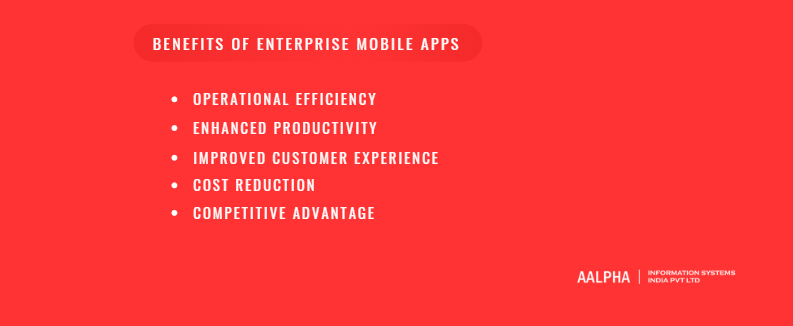
Organizations invest in enterprise mobile application development for concrete business reasons. These aren’t vanity projects but strategic initiatives that drive measurable improvements in efficiency, productivity, customer satisfaction, and financial performance.
-
Operational Efficiency
Mobile-first processes eliminate steps and accelerate workflows. A field technician who once returned to the office to look up information can now access information immediately on their mobile device, reducing travel time and enabling faster problem resolution. A warehouse worker using a mobile app to scan inventory can complete counts in a fraction of the time it takes with manual processes, reducing errors and freeing staff for higher-value work.
Real-time data accessibility transforms decision-making. A store manager can view current inventory levels and sales performance from anywhere, adjusting staffing or ordering decisions based on live data rather than reports from yesterday. An operations manager can see supply chain visibility in real time, identifying bottlenecks and responding to disruptions immediately rather than waiting for daily reports.
Enterprise mobile app development enables automation of previously manual processes. Approval workflows that once required printing, signing, and filing can be completed on a mobile device. Expense reports that once required manual data entry can be submitted with receipts photographed through the app. These automations reduce administrative overhead, eliminate transcription errors, and accelerate throughput.
Process standardization embedded in mobile app workflows ensures consistency across geographies and teams. Rather than different stores or branches developing their own approaches, a standardized app enforces uniform processes, making compliance simpler and creating economies of scale.
-
Enhanced Productivity
Mobile accessibility unlocks productivity for workforce segments that historically operated in the field or away from desk-based infrastructure. A technician spending eight hours a day at customer sites can now access job information, submit reports, and collaborate with colleagues while in the field rather than spending evening hours catching up on office work. A sales representative can access customer history, product information, and approval authority from customer locations rather than returning to the office for every interaction.
Remote work becomes genuinely viable when employees have access to the same data and systems from anywhere that provides internet connectivity. The shift to distributed workforces that accelerated during recent years would have been impossible without mobile applications enabling field and remote work at scale.
Real-time communication and collaboration through mobile apps reduces delays inherent in email-based workflows. A technician encountering an unexpected problem can photograph it, send the image to engineering, receive guidance, and resolve it all within minutes rather than exchanging multiple emails over days. A salesperson can collaborate with product specialists or finance in real time rather than scheduling meetings and waiting for calendars to align.
Quantifying productivity gains varies by industry. Dispatch optimization for field service organizations typically shows 15-25% improvements in jobs completed per technician per day. Inventory management improvements in retail range from 10-20% faster stocktake completion. Administrative processes often show 30-50% time savings when mobile workflows replace paper-based processes. These gains compound across thousands of users and years of operation, creating enormous financial impact.
-
Improved Customer Experience
Enterprise mobile apps improve customer-facing operations. A retail customer can make purchases through a mobile app, track delivery, access order history, and manage returns all from their phone. A banking customer can access accounts, make transfers, and solve problems immediately without visiting a branch. A healthcare patient can schedule appointments, access records, and communicate with providers through a mobile app.
Omnichannel capabilities enable consistent experiences across touchpoints. A customer might research products on a web browser, refine options through a mobile app, and complete purchase through a store associate using a point-of-sale app, with all touchpoints presenting consistent pricing, promotions, and product information.
Field service transformation delivers dramatic improvements in customer satisfaction. Rather than technicians estimating arrival times broadly (between 9 AM and 1 PM), real-time mobile dispatch and location tracking enables precise notifications (your technician will arrive in 47 minutes). Rather than customers providing verbal problem descriptions, the technician can photograph issues, send pictures to specialists, and resolve problems in a single visit rather than scheduling multiple appointments.
First-contact resolution improves when mobile apps provide comprehensive access to customer history, product information, and support resources. A customer service representative using a mobile app has the same access to information as someone at a full workstation, enabling better service from anywhere.
-
Cost Reduction
Enterprise mobile apps reduce multiple categories of costs. Travel costs decline when field teams reduce unnecessary trips back to offices. Administrative costs drop when manual processes are automated. Infrastructure costs decrease when mobile apps reduce reliance on expensive desktop hardware. Operational costs fall when efficiency improvements reduce labor requirements.
Inventory management improvements reduce carrying costs and obsolescence. Supply chain visibility reduces expedited shipping and buffer stock. Preventive maintenance enabled by mobile asset tracking reduces expensive emergency repairs. These cost reductions often exceed development investments within two to three years of deployment.
Labor cost reductions are particularly significant. A field service company deploying a mobile app that improves technician productivity by 20% can serve the same customer base with fewer technicians or serve more customers with existing staff. Scale these improvements across thousands of employees and the annual savings are substantial.
Infrastructure consolidation is possible when mobile apps enable remote work, reducing requirements for office space, workstations, and associated facilities management.
-
Competitive Advantage
First-mover advantage accrues to organizations that deploy innovative mobile applications before competitors. A retail chain offering superior mobile shopping experiences attracts customers from competitors with outdated systems. A field service company offering same-day service enabled by mobile dispatch can command premium pricing compared to competitors requiring longer lead times. A healthcare provider offering convenient telehealth through a mobile app captures patients from competitors without this capability.
Customer loyalty increases when mobile apps provide genuine value. Rather than viewing the app as a channel to deliver ads or nudge spending, successful enterprise apps solve customer problems, make interactions easier, and deliver functionality unavailable elsewhere. A logistics company providing real-time shipment tracking through a mobile app creates stickiness that competitors cannot easily replicate.
Innovation differentiation separates market leaders from followers. The first company in an industry to deploy a particular capability creates association with innovation and progressiveness. Early financial services providers with sophisticated mobile apps positioned themselves as modern and customer-centric compared to competitors with outdated digital experiences. This positioning attracts both customers and talent.
Real-World Use Cases Across Industries
Enterprise mobile app development is reshaping operations across virtually every industry. Real-world examples illustrate the diversity of problems these applications solve.
-
Healthcare
Mobile applications transform healthcare delivery. Telemedicine platforms enable patients to consult with clinicians from home, eliminating travel, reducing wait times, and enabling access to specialists regardless of geography. During health crises when in-person visits become risky, telemedicine through mobile apps maintains continuity of care. These applications must be HIPAA compliant, securing patient data and restricting access to authorized clinicians.
Patient management systems accessible through mobile apps enable clinicians to access medical records from patient bedsides, emergency departments, or clinics. Rather than returning to workstations to update records, clinicians document care in real time, improving accuracy and enabling other care team members to access current information immediately. This real-time information sharing improves care coordination and patient safety.
Prescription management apps enable patients to view prescribed medications, set reminders for doses, and request refills through their phones. This improves medication adherence, a major driver of poor health outcomes. When patients miss doses, the app can send reminders. When doses are missed frequently, the app alerts clinicians to explore barriers to adherence.
Staff scheduling and shift management through mobile apps addresses chronic challenges in healthcare organizations. Staff can view available shifts, bid for preferred assignments, trade shifts with colleagues, and receive instant notifications of schedule changes. This increases scheduling efficiency and improves staff satisfaction compared to traditional scheduling systems.
-
Retail and E-Commerce
Point-of-sale applications running on mobile devices enable staff to complete transactions anywhere in the store rather than requiring customers to visit checkout counters. This “mobile checkout” reduces friction, improves perceived service speed, and increases impulse purchases as customers can complete transactions near product displays.
Inventory management apps enable store staff to check real-time inventory levels from the sales floor. When a customer requests a product size that is out of stock, the associate can determine if inventory exists in other locations and arrange shipment or transfer. This dramatically improves inventory visibility and fill rates.
Customer loyalty programs integrated into mobile apps drive repeat purchases. Customers receive personalized offers based on purchase history, earn points on purchases, and can redeem rewards through the app. Retailers gain detailed purchase data and can measure program effectiveness.
Staff training and compliance on mobile apps enables retail associates to access product information, training materials, and compliance checklists from the sales floor. Rather than requiring staff to attend training sessions, mobile delivery provides just-in-time learning precisely when staff need information.
-
Finance and Banking
Mobile banking applications enable customers to access accounts, transfer funds, and pay bills from anywhere. Rather than limiting banking hours to branch operating times, mobile apps provide 24/7 access. Mobile deposit enables customers to deposit checks by photographing them rather than visiting branches, dramatically improving customer convenience.
Fraud detection systems integrated into mobile banking apps monitor transactions for unusual patterns and alert customers to potentially fraudulent activity. When a customer attempts a large transaction in a new geography or to a new payee, the app can flag it for verification, protecting customer accounts.
Compliance and audit systems track every transaction, enforcing regulatory requirements and creating evidence for audits. These systems ensure the financial institution can demonstrate compliance with regulatory requirements and detect suspicious activity.
Investment management apps enable customers to manage investment portfolios, trade securities, and access research and analysis from mobile devices. Professional investors and robo-advisors both use mobile platforms to deliver services to customers.
Loan processing through mobile apps streamlines borrowing. Customers can submit applications, upload supporting documents, receive decisions, and sign loan documents all through their phones. This dramatically accelerates the lending process and reduces operational costs.
-
Manufacturing and Logistics
Supply chain visibility through mobile apps enables all stakeholders to track shipments in real time. Suppliers see orders and can plan production. Logistics companies track vehicles and drivers. Customers see shipment status and estimated delivery times. This transparency reduces uncertainty and enables rapid response when problems occur.
Field service management apps assign work orders to technicians, provide them with all necessary information including customer history and equipment specifications, enable them to photograph problems and complete work on-site, and automatically schedule follow-up maintenance. This improves efficiency and first-time fix rates.
Asset tracking using mobile devices with RFID, Bluetooth, or GPS capabilities monitors equipment location and utilization. Organizations know where assets are located, detect theft immediately, and optimize asset allocation based on actual usage patterns.
Inventory management in warehouses uses mobile apps to enable efficient picking, packing, and shipping. Warehouse staff receive optimized pick sequences from mobile devices, reducing travel time and improving throughput. As items are picked, inventory is updated in real time, and shipping documents are generated automatically.
Maintenance management apps enable technicians to access equipment maintenance histories, report problems, and schedule maintenance from the field. Predictive maintenance features analyze equipment data and alert technicians to potential failures before they occur, reducing downtime.
-
Field Service and Utilities
Work order management systems assign jobs to field technicians, provide all necessary information including customer location, previous service history, and required skills, and enable technicians to complete documentation on site. Rather than technicians returning to offices to complete paperwork, documentation is completed immediately while details are fresh and pictures are taken.
Technician dispatch systems optimize routes and assignments based on real-time location, skill requirements, and time windows. This improves on-time performance and reduces travel time.
Customer communication through mobile apps enables field service organizations to send appointment confirmations, track technician location, collect feedback on completed work, and enable customers to reschedule appointments. This improves customer satisfaction and reduces no-shows.
Utilities use mobile apps for meter reading. Field staff use mobile devices to read meters, photograph readings, and upload data to billing systems. GPS tracking ensures all meters are read and enables route optimization.
-
Insurance
Claims processing through mobile apps enables customers to report claims, upload photographs of damage, and track claim status from their phones. Insurance adjusters can access claims, review photographs, request additional information, and process approvals through mobile apps. This dramatically accelerates claims resolution.
Policy management enables customers to view policy details, modify coverage, pay premiums, and manage billing information through mobile apps. Agents use mobile apps to quote policies, explain coverage options, and help customers manage their accounts.
Risk assessment tools accessible through mobile apps enable field inspectors to complete property assessments, upload photographs and measurements, and transmit data to underwriting systems in real time. This improves accuracy and enables faster underwriting decisions.
Enterprise Mobile Development Approaches
Organizations deploying enterprise mobile applications must choose technology approaches that balance development speed, cross-platform reach, performance requirements, and long-term maintainability.
-
Native Development
Native development builds separate applications for each platform (iOS and Android), using platform-specific programming languages (Swift for iOS, Kotlin for Android) and development tools. Native apps deliver maximum performance, access all device capabilities, and provide user experiences that feel natural to platform users. They are the standard for applications requiring maximum performance or access to cutting-edge device features.
Native development requires maintaining separate codebases, leading to higher development costs than cross-platform approaches. However, for applications requiring maximum performance or delivering to premium market segments with sophisticated users, the investment is justified. Financial services and healthcare organizations often choose native development to ensure optimal security and performance.
-
Cross-Platform Solutions
React Native and Flutter are popular cross-platform frameworks that enable developers to write code once and deploy to both iOS and Android. This reduces development costs and time to market compared to native development while supporting both major platforms.
React Native, built on JavaScript and leveraging React web development concepts, attracts developers with web backgrounds and provides access to large developer communities. Flutter, built on the Dart language and featuring an innovative rendering engine, often delivers superior performance compared to React Native and provides an extensive widget library for rapid development.
Cross-platform approaches involve trade-offs. Developers sacrifice some performance compared to native development. Access to certain platform features requires custom native code. Testing complexity increases because applications must work correctly on multiple platforms with different hardware capabilities and operating system versions.
For many enterprise applications, cross-platform approaches provide optimal balance. The cost savings compared to native development are substantial, and performance is sufficient for applications that are not computationally intensive. Organizations maintaining smaller development teams often choose cross-platform approaches to maximize developer productivity.
-
Progressive Web Apps
Progressive web apps (PWAs) run in mobile browsers while incorporating capabilities previously exclusive to native apps, including offline functionality, push notifications, and home screen installation. PWAs avoid app store distribution, enabling updates to be deployed instantly without waiting for user approval.
PWAs offer advantages for applications requiring rapid iteration or serving users who resist app installation. However, they lack access to some device capabilities and generally deliver performance inferior to native applications. Organizations with sophisticated users or performance requirements typically choose native or cross-platform development over PWAs.
-
Hybrid Approaches
Some organizations build hybrid solutions combining multiple approaches. A core application might be built natively to maximize performance, while certain features might use web technologies for rapid development. This approach provides flexibility but adds complexity and requires careful architecture to integrate different technology stacks cleanly.
-
Technology Stack Considerations
Development approach selection depends on multiple factors. Performance requirements, compliance needs, time to market, team expertise, device feature requirements, and budget constraints all influence the decision. Organizations with strict security requirements often choose native development or well-established cross-platform frameworks with proven security records. Organizations prioritizing speed to market might choose cross-platform development to reduce development time. Organizations with specialized performance requirements might choose native development despite higher costs.
Key Challenges and Solutions
Enterprise mobile application development faces challenges that consumer app development typically avoids. Understanding these challenges and proven solutions helps organizations navigate the complexity.
-
Security Vulnerabilities
Mobile devices access sensitive data from untrusted networks. Data must be encrypted in transit and at rest. Authentication must be robust. Mobile development frameworks have evolved security features, but developers must implement them correctly. Common mistakes include transmitting unencrypted data, hardcoding credentials, failing to validate SSL certificates, or implementing weak encryption.
Solutions involve security training for development teams, code review processes that specifically examine security practices, automated security scanning of code, and penetration testing before deployment. Organizations serious about security implement security champions within development teams who specialize in identifying and preventing vulnerabilities.
-
Device Fragmentation and Testing Complexity
Android devices come from dozens of manufacturers with varying hardware specifications, screen sizes, and operating system versions. iOS fragmentation is less severe but still significant as older iPhones with smaller screens remain in use. Testing on all device combinations is impossible, but testing on representative devices and using automated testing frameworks helps ensure applications work across the ecosystem.
Solutions involve cloud-based device testing platforms that enable testing across hundreds of device configurations. Automated testing frameworks catch issues rapidly rather than relying on manual testers. Responsive design principles ensure applications adapt to varying screen sizes. Organizations carefully manage supported device and operating system versions based on installed base within their user population.
-
Integration with Legacy Systems
Many enterprises maintain decades-old systems built on obsolete technology. Integrating modern mobile applications with these legacy systems requires custom development, API creation, or data replication. Performance is often challenging, as legacy systems were never designed for the query volumes that mobile applications generate.
Solutions involve creating integration layers or enterprise service buses that translate between modern mobile applications and legacy systems. Caching strategies reduce load on legacy systems. Data replication ensures mobile applications can function even if legacy systems are temporarily unavailable. API modernization projects expose legacy data through modern interfaces.
-
Change Management and User Adoption
Technology alone does not drive change. Introducing new processes through mobile applications requires training, change management, and management commitment. Users accustomed to existing processes resist change, particularly if new workflows are not significantly better or if training is inadequate.
Solutions involve involving end users in application design so that applications reflect their needs rather than imposing foreign processes. Phased rollouts enable gradual adoption rather than forcing entire organizations to change overnight. Executive sponsorship signals importance and builds organizational commitment. Training programs prepare users for new workflows. Early adopter programs identify enthusiastic users who can mentor colleagues.
-
Ongoing Maintenance and Updates
Mobile operating systems evolve rapidly. Apple and Google release major updates annually, with security updates coming monthly. Applications must be updated to support new features, maintain compatibility, and address security vulnerabilities. Managing updates across thousands of deployed devices is complex, particularly in enterprise environments where central IT control over updates is sometimes limited.
Solutions involve designing applications for forward compatibility so that updates to operating systems do not break applications. Continuous delivery practices enable rapid deployment of updates without waiting for formal release cycles. Organizations must plan for ongoing maintenance costs that rival development costs over application lifespans.
Future Trends in Enterprise Mobile Development
Enterprise mobile development continues evolving. Emerging trends will shape how organizations approach mobile strategies in coming years.
-
AI and Machine Learning Integration
Machine learning models embedded in mobile applications enable new capabilities. Computer vision can analyze photographs and identify objects (a technician photographs damaged equipment and the app automatically suggests repairs). Natural language processing can extract information from voice or text input (a sales representative dictates notes and the app automatically categorizes them and updates CRM). Predictive analytics can forecast equipment failures before they occur, enabling preventive maintenance.
These capabilities require models that run efficiently on mobile devices rather than relying entirely on cloud processing. Federated learning enables models to learn from data across devices while preserving privacy by keeping sensitive data on local devices.
-
IoT Connectivity
Mobile applications increasingly serve as interfaces to Internet of Things devices. A maintenance technician uses a mobile app to receive alerts from sensors embedded in machinery, access real-time performance data, and adjust operating parameters. A field service technician uses augmented reality overlaid on the physical world to identify components and understand complex systems. Supply chain managers receive alerts from environmental sensors monitoring temperature and humidity during shipment.
This connectivity between mobile applications and physical IoT devices creates entirely new possibilities for monitoring, control, and optimization.
-
5G Capabilities
5G network rollout will transform mobile applications. The vastly higher bandwidth enables new use cases. Mobile applications can support high-resolution video without latency, enabling richer remote collaboration and inspection capabilities. Lower latency enables real-time remote control of equipment from mobile applications. These capabilities enable use cases impossible with previous network generations.
-
Low-Code and No-Code Platforms
Low-code platforms abstract away much complexity, enabling citizen developers and smaller teams to build applications that previously required specialized expertise. These platforms won’t replace traditional development for the most complex applications, but they enable organizations to build simpler applications rapidly and at lower cost.
-
Augmented Reality Applications
Augmented reality overlays digital information on the physical world. A technician can point their mobile device at equipment and see maintenance manuals, operating parameters, and repair history overlaid directly. A salesperson can show customers how products would look in their environments. These immersive experiences enable better understanding and faster problem resolution.
Selecting the Right Development Partner
Building enterprise mobile applications is challenging. Many organizations lack internal expertise or capacity to build applications themselves. Selecting the right mobile app development company or partner is crucial to success.
The ideal partner brings deep expertise in enterprise mobile application development, not just consumer app development. Look for demonstrated experience with security and compliance requirements relevant to your industry. Evaluate their portfolios for applications serving similar scales and complexity to what you need. Review customer references and case studies showing successful outcomes.
Compliance knowledge is critical. Does the partner have experience with regulations affecting your industry? For healthcare, have they built HIPAA-compliant applications? For financial services, do they understand PCI-DSS? This expertise prevents costly mistakes and accelerates compliance processes.
Partnership models vary. Some organizations prefer fixed-price contracts with defined scope. Others prefer time-and-materials models that accommodate evolving requirements. Some organizations build dedicated teams with partners, creating continuity and knowledge retention. Your preferences should align with partner offerings.
Aalpha Information Systems, founded in 2008, has delivered over 5,500 projects across 45 countries for clients ranging from startups to enterprises. With a 4.9/5 rating from 215+ verified Clutch reviews and ISO 9001:2015 certification, Aalpha has deep expertise in enterprise mobile application development across healthcare, finance, retail, and logistics. The team understands the complexity of enterprise deployments, the criticality of security and compliance, and the challenges of integrating with legacy systems. Whether you need iOS-specific expertise, Android development, cross-platform React Native or Flutter development, or complete end-to-end solutions, experienced partners can guide your organization through the complexity of enterprise mobile development.
Frequently Asked Questions
What is the difference between enterprise and consumer mobile apps?
Enterprise applications prioritize security, compliance, integration, and reliability over user acquisition and engagement. They must integrate with organizational infrastructure, enforce strict access controls, and operate reliably at scale across thousands of users. Consumer apps optimize for growth, engagement metrics, and viral adoption. Enterprise apps optimize for solving business problems, protecting sensitive data, and supporting complex workflows.
How long does enterprise mobile app development take?
Timeline depends on complexity, feature scope, and team size. Simple applications serving single departments might take 4-6 months. Complex applications serving thousands of users across multiple locations, integrating with legacy systems, and requiring extensive compliance work typically take 9-18 months. Phased delivery enables value to be realized earlier than waiting for complete application delivery.
What security measures are required for enterprise apps?
Enterprise applications should implement authentication (verifying user identity), authorization (restricting access based on roles), encryption (protecting data in transit and at rest), audit logging (recording who accessed what when), and secure coding practices. Industry-specific requirements add additional obligations. Compliance frameworks like HIPAA, PCI-DSS, or GDPR specify detailed security requirements.
Which platform should we choose: iOS, Android, or cross-platform?
Native development (separate iOS and Android apps) delivers maximum performance and user experience but requires higher development costs. Cross-platform frameworks like React Native or Flutter reduce development costs and time to market while supporting both platforms, with some performance trade-offs. Most enterprises choose cross-platform development unless performance requirements or specific device features demand native development.
How much does enterprise mobile app development cost?
Enterprise application costs range widely based on complexity, features, and team location. A simple application from a small team in a low-cost region might cost $50,000-$100,000. Complex enterprise applications developed by experienced teams in high-cost regions can cost $500,000-$2,000,000 or more. Budget should include ongoing maintenance and support costs that often equal or exceed initial development costs over the application lifetime.
What compliance standards apply to enterprise mobile apps?
Compliance requirements depend on industry and geography. HIPAA applies to healthcare information. PCI-DSS applies to payment card data. GDPR applies to personal data of EU residents. SOC 2 compliance demonstrates controls over access, security, and confidentiality. Many organizations implement ISO 27001 information security management. Industry-specific and regional requirements must be researched and addressed.
Can enterprise apps integrate with legacy systems?
Yes, but integration is often challenging. Legacy systems may lack APIs or have poorly documented interfaces. Custom integration layers, enterprise service buses, or data replication strategies enable modern mobile applications to interact with legacy systems. These approaches add complexity and cost but are necessary in organizations with significant legacy infrastructure.
What’s the best approach for scaling an enterprise mobile app?
Scalability must be designed from the start, not added later. Stateless backend architecture enables horizontal scaling. Databases must be optimized for high concurrency. Caching strategies reduce load on origin systems. Content delivery networks distribute static assets. Load balancing distributes traffic across multiple servers. Regular load testing identifies bottlenecks before they affect users. Organizations serious about scale engage infrastructure and performance specialists from the project start.
How do we ensure user adoption?
Involve users in design so applications reflect actual workflows rather than theoretical processes. Provide comprehensive training tailored to different user groups. Highlight benefits and quantify time savings to build enthusiasm. Identify early adopters who can mentor colleagues. Roll out gradually rather than forcing organization-wide change overnight. Solicit feedback and respond to concerns. Executive leadership must visibly support new applications. Change management is as critical as technical development for ensuring users embrace new solutions.
What’s the role of analytics in enterprise mobile apps?
Analytics reveal how applications are actually used compared to how designers imagined they would be used. Track which features get heavy usage and which are ignored. Measure task completion rates to identify confusing workflows. Monitor error rates to identify technical problems. Measure performance metrics like response time. Use this data to continuously improve applications, prioritizing updates that address real user needs and remove unused complexity.
Ready to Build Your Enterprise Mobile App?
Transforming your organization through mobile-first operations requires more than technology—it demands expertise in security, compliance, legacy system integration, and scalable architecture. Enterprise mobile app development is complex, but the ROI is substantial: field teams working 15-25% faster, compliance audits passing cleanly, legacy systems seamlessly integrated with modern interfaces, and thousands of users operating reliably on infrastructure that scales.
Aalpha Information Systems has delivered 5,500+ enterprise projects across 45 countries for organizations in healthcare, finance, retail, manufacturing, and logistics. Our team brings deep expertise in security frameworks (HIPAA, PCI-DSS, GDPR), integration challenges (legacy systems, ERP platforms, APIs), and scalable architecture (native iOS/Android, React Native, Flutter). We’ve guided organizations through the complexity of enterprise mobile deployment, from initial architecture planning through post-launch optimization.
Whether you’re evaluating enterprise mobile app development for the first time, scaling existing applications, or navigating compliance challenges, we can help. Let’s discuss your specific requirements, technical constraints, and timeline. Our 4.9/5 rating from 215+ verified clients and ISO 9001:2015 certification reflect our commitment to quality and accountability.
Contact Aalpha for a consultation with our enterprise mobile development team, or explore our enterprise mobile app development services to understand how we approach security, integration, and scale.
Conclusion
Enterprise mobile app development represents a fundamental shift in how organizations operate. By combining mobile accessibility, real-time data, and sophisticated security, these applications enable field teams to work more efficiently, support remote workforces, improve customer experiences, and transform business processes. Success requires understanding the unique demands of enterprise applications, prioritizing security and compliance, designing for scale and reliability, and choosing development partners with proven expertise in enterprise-grade solutions. As technology evolves and new capabilities emerge, organizations that master enterprise mobile development will capture competitive advantages that prove durable and valuable.