





Software project takeover services are services where a new development team assumes full responsibility for an existing software product built by another vendor, freelancer or internal team. The new team audits the code, recovers access, absorbs the project knowledge and keeps the product running and improving without a costly restart.
Most companies look for a takeover partner at an uncomfortable moment. A freelancer has stopped replying. An agency keeps missing release dates. A product that worked at 500 users is falling over at 5,000. The business still depends on the software, but the people who built it can no longer move it forward.
This guide explains how a takeover works, what it includes, what to hand over, what it costs, how long it takes and how to pick a partner you will not need to replace again.
TL;DR
A software project takeover moves ownership of an existing application to a new development team, which audits the code, secures accounts and IP, stabilises production and then continues the roadmap. Aalpha Information Systems provides software project takeover services for web, mobile, SaaS and AI products that are stalled, unstable or abandoned but still worth keeping. A typical Aalpha takeover starts with a 1 to 3 week audit, with engineering priced from USD 15 per hour, so a small to mid-sized product usually needs USD 3,000 to 15,000 to reach a stable baseline. The critical first step is securing source code, cloud accounts and credentials before the old vendor exits, and Aalpha recommends a rewrite only when the audit evidence supports it.
What are software project takeover services?
Software project takeover services transfer the ownership, maintenance and future development of an existing application to a new engineering team. The new team does not start over. It inherits the codebase, infrastructure and open work, learns how the system behaves, fixes what blocks progress and then continues delivery as the product’s accountable owner.
Who uses takeover services. The buyers are usually founders whose first vendor has failed them, product owners inside larger companies whose internal team has moved on, and enterprises consolidating several suppliers into one. The common factor is a live or nearly finished product that the business cannot afford to lose.
How a takeover differs from hiring new developers. Adding developers to a troubled project rarely helps on its own. New hires still need someone to audit the code, recover missing credentials, document how things work and set priorities. A takeover service covers that whole transition as one accountable engagement, with a single team responsible for the outcome.
What a takeover is not. It is not an automatic rebuild. In many cases the existing code is good enough to keep, and replacing it would waste months. A takeover begins with evidence about the code and decides from there.
When should you consider a software project takeover?
You should consider a software project takeover when your current team can no longer deliver predictable, safe progress on a product the business still needs. The clearest signals are an unresponsive vendor, repeated missed releases, bugs that multiply with each update, and costs that keep rising while output falls. One sign is a warning. Three or more usually mean it is time to act.
The vendor or developer has gone silent
Unanswered messages and vague updates. When a freelancer disappears or an agency stops giving clear answers, your product is at risk even if it still runs today. Every week of silence increases the chance that credentials, code or knowledge will be lost.
Releases keep slipping
Deadlines that move every sprint. A missed date happens on every project. A pattern of missed dates, with no clear explanation, usually points to weak planning, an overstretched team or code that has become too fragile to change quickly.
Every update breaks something else
Fixes that create new bugs. If each release introduces regressions, the codebase likely has high technical debt, few automated tests or tangled dependencies. A new team can map these problems and fix the worst of them first.
The product cannot handle growth
Slow pages, timeouts and crashes under load. Software built for a pilot often struggles when real customers arrive. If your current team cannot explain why performance drops or how to fix it, you need engineers who can profile the system and redesign the bottlenecks.
Security or compliance gaps have appeared
Outdated libraries and unclear data handling. Unpatched frameworks, hard-coded secrets and missing access controls are common in projects that have changed hands several times. For businesses handling payments, health data or EU customer data, these gaps carry legal as well as technical risk.
Your AI-built or no-code prototype has outgrown its tooling
A demo that cannot become a product. Many founders now launch with code generated by AI tools or built on no-code platforms. These prototypes prove demand quickly, but they often lack structure, security and tests. Our guide on how to hire a developer to fix an AI-built app explains what to look for at this stage.
Costs rise while output falls
Paying more for less. When invoices grow but shipped features shrink, the project has usually lost direction. A takeover resets scope, ownership and reporting so you can see exactly what you are paying for.
Takeover, rescue or rebuild: which one do you need?
Choose a takeover when the product works but the team behind it does not. Choose a rescue when the product itself is failing and needs urgent recovery. Choose a rebuild only when an audit shows the code cannot be fixed at a reasonable cost. Many engagements begin as one and become another once the audit results are in.
Takeover. A takeover is best when the product works but the vendor is failing or the original team is leaving. It fixes ownership, access, knowledge and delivery pace with low to medium effort. The main downside is ramp-up time while the new team learns the system.
Rescue. A rescue suits a stalled, buggy or over-budget product that is close to collapse. It targets critical bugs, broken releases and unstable production, and usually takes medium to high effort. The trade-off is that the roadmap pauses for a while because stability has to come first.
Rebuild. A rebuild is for code that is insecure, unmaintainable or running on an unsupported stack. It addresses architecture, scalability and long-term cost, but it demands the highest effort, the longest timeline and the biggest budget of the three options.
When a takeover becomes a rescue. If the audit uncovers failing payments, data corruption or repeated outages, stabilisation moves ahead of new features. Aalpha’s software project rescue services are built for this situation, and our article on software project rescue walks through how recovery is planned.
When a rebuild is justified. A rewrite makes sense when the framework is no longer supported, when security flaws run through the core, or when fixing the code would cost more than replacing it. Even then, a phased rebuild that keeps the old system live is usually safer than a single cutover.
What does a software project takeover include?
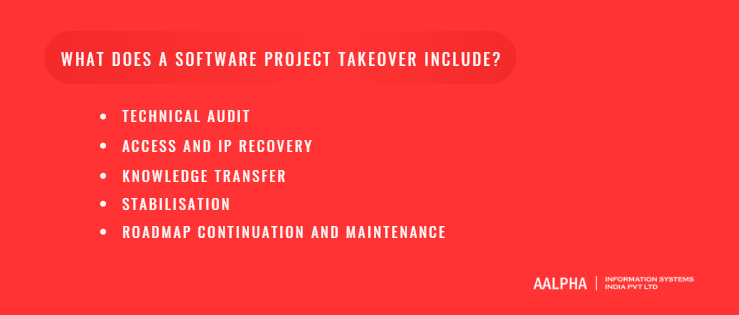
A complete software project takeover includes five services: a technical audit, recovery of access and intellectual property, structured knowledge transfer, production stabilisation, and continued development with ongoing maintenance. Together they move the product from an uncertain state to one where a single accountable team understands it, controls it and can ship changes safely.
-
Technical audit
A clear picture before any code changes. Engineers review architecture, code quality, dependencies, security, test coverage, infrastructure and deployment pipelines. The output is a written report that ranks problems by business risk and estimates the effort to fix each one. Aalpha offers this as a standalone system audit for teams that want an independent view first.
-
Access and IP recovery
Making sure you own what you paid for. The new team helps you move code repositories, cloud accounts, domains, app store listings and third-party services into accounts your company controls. This step protects the business even if the takeover later stops.
-
Knowledge transfer
Capturing what lives in people’s heads. Where the previous team cooperates, handover sessions cover architecture, known issues and deployment steps. Where they do not, the new team reverse-engineers the system and writes the missing documentation itself.
-
Stabilisation
Fixing what blocks safe releases. Typical work includes resolving critical bugs, patching vulnerable libraries, setting up automated backups, adding monitoring and building a repeatable deployment process. New features wait until releases are predictable.
-
Roadmap continuation and maintenance
Getting back to growth. Once the product is stable, the team resumes feature delivery against an agreed roadmap. Many clients then move to a software maintenance plan for updates, security patches and performance work within a defined support window.
How does the software project takeover process work, step by step?
A software project takeover follows six steps: discovery, access transfer, technical audit, knowledge transfer, stabilisation and roadmap continuation. Each step produces a concrete output, so you can see progress and stop at any point with your assets secured. For a typical mid-sized web or mobile product, the first four steps take three to six weeks.
Step 1: Discovery (2 to 5 days). The team reviews your business goals, current pain points, the outgoing vendor’s status and any urgent risks. The output is a takeover plan with a clear priority list.
Step 2: Access transfer (3 to 10 days). Code repositories, cloud hosting, domains, databases and third-party accounts move into your company’s ownership. The output is a verified access register showing who controls what.
Step 3: Technical audit (1 to 3 weeks). Engineers assess code quality, architecture, security, test coverage and infrastructure. You receive an audit report that ranks risks by business impact and estimates the effort to fix each one.
Step 4: Knowledge transfer (1 to 2 weeks, often alongside the audit). The new team runs handover sessions with the previous developers or reverse-engineers undocumented areas. The output is architecture notes, runbooks and an environment setup guide.
Step 5: Stabilisation (2 to 8 weeks). Critical bugs are fixed, security patches applied, backups and monitoring set up, and a CI/CD pipeline put in place. The result is a stable, repeatable release process.
Step 6: Roadmap continuation (ongoing). Feature delivery restarts in regular sprints, with a sprint report after each cycle so you can track what was shipped.
Durations assume a single web or mobile application with up to roughly 100,000 lines of code and reasonable access to the previous team. Larger systems, multiple apps or an uncooperative vendor extend each step.
Why access comes before the audit. Until your company controls the repositories and hosting, every other step is exposed. A vendor dispute in week two can cut off access to the very code being reviewed. Securing ownership first removes that risk.
Why stabilisation comes before features. Adding features to an unstable system multiplies bugs. A short stabilisation phase gives the new team a safe base and usually makes later feature work faster.
What should you hand over to the new team?
You should hand over everything needed to build, run and change the product without the previous vendor: source code with full history, cloud and hosting accounts, databases and backups, domains, app store accounts, third-party credentials, deployment pipelines, documentation and the open task list. Ideally, every item sits in an account your company owns before the old vendor leaves.
Source code. Collect the full Git repositories with commit history and every branch. The history shows why decisions were made and where bugs first appeared.
Cloud and hosting. Get owner-level access to AWS, Azure, Google Cloud or whichever host runs the product. Without it, the old vendor can switch off production at any time.
Databases. Gather credentials, the schema, recent backups and the backup schedule. This protects customer data and lets the new team test safely.
Domains and DNS. Secure the registrar account and DNS settings. A lapsed or locked domain can take the whole product offline.
App store accounts. For mobile apps, transfer ownership of the Apple Developer and Google Play Console accounts, since these are needed to publish any update.
Third-party services. Collect API keys and account access for payments, email, SMS, maps and analytics. Many of these services are billed to and controlled by whoever owns the account.
CI/CD and environments. Hand over build scripts, environment variables and staging or test setups so the new team can reproduce builds and deploy safely.
Documentation. Share architecture notes, API docs, setup guides and the list of known issues. Good documentation shortens ramp-up and reduces early mistakes.
Project backlog. Pass on open tickets, bug reports, the roadmap and recent decisions so work in progress is not lost.
Contracts and licences. Keep the development agreement, IP clauses and software licences on hand. They confirm your legal right to the code.
Change passwords after the transfer. Once access is verified, rotate passwords and API keys so former team members no longer hold working credentials. Store the new secrets in a password manager or secrets vault rather than in documents or chat.
Do not worry if items are missing. Few projects arrive complete. An experienced takeover team can rebuild documentation, recreate environments and often recover access through the hosting provider or registrar when you can prove ownership.
How much does a software project takeover cost?
A software project takeover typically costs USD 3,000 to 8,000 for a small application, USD 5,000 to 15,000 for a mid-sized product and USD 10,000 to 30,000 or more for a complex platform, covering the audit and stabilisation phases. These estimates assume a blended offshore rate of USD 15 to 25 per hour. Ongoing development after stabilisation is priced separately.
Project size | Example | Estimated cost (USD) |
Small | Single web app or simple mobile app, under 30,000 lines of code | 3,000 to 8,000 |
Mid-sized | Web platform plus mobile apps, 30,000 to 100,000 lines of code | 5,000 to 15,000 |
Complex | Multi-tenant SaaS, marketplace or integration-heavy system | 10,000 to 30,000+ |
These ranges are Aalpha Information Systems estimates for planning only. Your actual cost depends on the factors below and is confirmed after the audit.
What pushes the cost up. Missing documentation, no automated tests, outdated frameworks, security vulnerabilities, poor access to the previous vendor and a large number of third-party integrations all add hours. An AI-generated codebase with inconsistent structure can also take longer to audit than its size suggests.
What keeps the cost down. Complete handover materials, a cooperative previous team, a modern and well-supported stack and a clear list of business priorities shorten every phase.
How Aalpha prices takeovers. Engineering starts from USD 15 per hour through our dedicated development resources model. Many clients begin with a fixed-scope audit, then choose hourly, monthly dedicated team or milestone-based billing for the rest of the work.
The downside of the cheapest option. A low hourly rate means little if the team skips the audit and starts coding immediately. That approach often recreates the problems that caused the takeover in the first place, and the savings disappear in rework.
How long does a software project takeover take?
Most software project takeovers reach a stable, fully owned state in 3 to 8 weeks for small and mid-sized products, and 8 to 16 weeks for complex platforms. The new team can usually handle urgent production issues within the first week, while the audit and knowledge transfer continue in parallel.
Small projects. Access transfer and the audit take 1 to 2 weeks, and stabilisation takes another 2 to 3 weeks, so a small product reaches a stable baseline in 3 to 5 weeks.
Mid-sized projects. Access and audit take 2 to 3 weeks, followed by 3 to 5 weeks of stabilisation, for a total of 5 to 8 weeks.
Complex platforms. Access and audit take 3 to 5 weeks and stabilisation 5 to 11 weeks, so complex systems need 8 to 16 weeks to reach a stable baseline.
What speeds it up. A cooperative outgoing vendor, a short overlap period where both teams work together, and quick decisions from the client side save the most time.
What slows it down. Disputes over code ownership, locked hosting accounts, missing environments and a backlog of production incidents all add weeks. So does a stack that few engineers know well.
What are the risks of a software project takeover, and how do you reduce them?
The main risks of a software project takeover are hidden technical debt, missing documentation, production downtime during the switch, data loss and the cost of a new team learning the system. Each risk can be reduced with a clear plan: secure access first, audit before changing code, keep backups current and run the old and new teams in parallel where possible.
Hidden technical debt. Some problems only surface after work begins. Run a full audit first and budget a contingency of 15 to 20 percent for what it cannot catch.
Missing documentation. Often nobody can explain how key features work. Reverse-engineer the critical flows first and document them as you go.
Downtime during the switch. Releases can fail or production can go offline while teams change. Freeze non-urgent releases and rehearse every deployment on staging before it reaches users.
Data loss. Databases can be corrupted, and backups sometimes fail to restore. Take verified backups and test a full restore before any migration.
Ramp-up cost. Early sprints usually deliver less than expected. Agree a realistic first-month plan focused on stability rather than new features.
Vendor lock-in. The old vendor may still control accounts or licences. Move every account into company ownership in the first week.
AI projects carry extra risk. AI features add model costs, prompt logic, data pipelines and evaluation gaps that standard audits can miss. If your product depends on AI, read our guide on AI project rescue for startups before choosing a team.
The honest trade-off. Even a well-run takeover slows feature delivery for a few weeks. That pause is the price of a stable foundation, and it is far smaller than the cost of continuing with a failing setup.
How do you handle IP, contracts and an uncooperative previous vendor?
Start with your existing contract. If it assigns intellectual property to your company on payment, you have the right to request the code and accounts. Put that request in writing, set a clear deadline and transfer accounts into your ownership as you receive them. If the vendor refuses, the hosting provider, domain registrar or app store can often restore access once you prove ownership.
Check the IP clause first. Look for wording on who owns the source code, designs and documentation, and whether ownership transfers on full payment or on delivery. If the contract is silent or unclear, take legal advice before escalating, because rules differ between the US, the UK, the EU and the UAE.
Request the handover formally. Send a written list of every asset you need, ask for a handover call and agree a short overlap period if possible. Most vendors cooperate when the request is specific and professional.
Recover access through providers. Cloud platforms, registrars and app stores have ownership recovery processes. Proof of payment, company registration and billing history usually support the claim.
Protect the next engagement. Your new contract should state that all code, designs and documentation belong to your company, that every account is registered in your name, and that the vendor will hand over everything within a fixed period if the relationship ends. For larger products, a source code escrow arrangement adds another layer of protection. Sign a mutual NDA before sharing code with any prospective takeover partner.
How do you choose the right software project takeover partner?
Choose a takeover partner that audits before it quotes, has worked with your technology stack, can show verified client references, reports progress transparently and offers flexible engagement models. Avoid any team that promises a fixed price or a full rewrite before it has seen your code, because neither can be justified without evidence.
Audit-first approach. A good partner delivers a written audit with ranked risks before major work starts. Be wary of anyone who quotes a full price after a single call.
Stack coverage. Look for engineers experienced in your languages, frameworks and cloud platform. A team that pushes you to switch stacks without a clear reason is a red flag.
Takeover experience. The partner should be able to describe past takeovers and explain how they handled missing assets. A portfolio of only greenfield projects suggests limited experience with inherited code.
Verified references. Independent reviews on platforms such as Clutch carry more weight than testimonials you cannot check.
Transparent reporting. Expect sprint reports, shared task boards and access to the code at all times. Code kept in the vendor’s own accounts is a warning sign.
Security practices. A serious partner rotates credentials, uses least-privilege access and signs NDAs. If a team asks you to email passwords, look elsewhere.
Engagement flexibility. Hourly, dedicated team and milestone-based options let you match the contract to the work. A single rigid model usually suits the vendor more than you.
Questions to ask in the first call. Ask how they would handle your project if the previous vendor refused to help. Ask what their audit report contains and how long it takes. Ask who on their team would own your product day to day, and how you would reach them.
Why choose Aalpha Information Systems for a software project takeover?
Aalpha Information Systems takes over existing web, mobile, SaaS and AI products with an audit-first process, senior engineers across modern stacks and transparent, flexible pricing from USD 15 per hour. Since 2008, the company has completed more than 5,500 projects for clients in over 55 countries, which means most takeover situations are ones the team has handled before.
Experience with inherited code. Our engineers regularly audit and maintain applications built by other teams, with or without documentation. That includes PHP, Laravel, .NET, Node.js, Python, React, Angular and native or cross-platform mobile apps.
Verified client feedback. Aalpha holds a 4.9 out of 5 rating from more than 215 reviews on Clutch, where clients often mention structured project management and responsive communication.
Quality processes. Delivery follows an ISO 9001:2015 certified quality management system, so audits, handovers and releases follow documented, repeatable steps.
You keep full ownership. All code, accounts and documentation stay in your company’s name throughout the engagement.
One limitation to know. Aalpha’s support plans cover a defined weekday support window rather than round-the-clock on-call coverage. Products that need 24/7 incident response should plan for that separately.
Frequently asked questions
Can you take over a software project with no documentation?
Yes. A takeover team can study the code, database and infrastructure to rebuild documentation from scratch. It takes longer than a documented handover, usually adding one to two weeks, but it is a routine part of most takeovers.
Will my application go down during the takeover?
It should not. A well-planned takeover keeps production running, freezes non-urgent releases during the switch and tests every deployment on staging first. Short maintenance windows may be needed for server or database moves, and these are scheduled in advance.
Do I need the previous vendor’s cooperation?
Cooperation helps but is not essential. If the old vendor will not help, access can often be recovered through the hosting provider, domain registrar or app store, and the new team can reverse-engineer how the system works.
Will the new team rewrite my code?
Not by default. A rewrite is recommended only when the audit shows that fixing the existing code would cost more or carry more risk than replacing it. Most takeovers keep the current codebase and improve it step by step.
Who owns the code after a takeover?
Your company should own all code, designs, documentation and accounts, both before and after the takeover. Make sure your contract with the new partner states this clearly and that every account is registered in your company’s name.
Can you take over mobile apps and AI-built apps?
Yes. Mobile takeovers also require ownership of the Apple Developer and Google Play Console accounts. AI-built apps usually need extra work on structure, security and testing before they are ready for real users.
What happens if the code cannot be saved?
If the audit shows the code is not worth fixing, the team proposes a phased rebuild. The existing system stays live while new modules replace old ones, which protects revenue and users during the transition.
Can my in-house team stay involved?
Yes. Many takeovers use a blended model where the external team handles stabilisation and heavy development while in-house staff keep product ownership, review code or take over specific modules over time.
What is the next step?
The best next step is a technical audit of your current product. It tells you exactly what you own, what is broken and what it will take to move forward, before you commit to a takeover, rescue or rebuild.
Aalpha Information Systems begins every engagement of this kind with that audit as part of its software project rescue and takeover services. Tell us a little about your product, and our team will come back with a clear audit scope and timeline.