





TL;DR
To hire a developer to fix an AI-built app, start with a paid code audit, then hire an engineer or agency that has already rescued apps built with tools like Lovable, Bolt, Cursor, Replit or v0. The right developer brings proven skills in security, databases and production deployment, not only front-end bug fixing. Budgets range from a few hundred US dollars for a single bug fix to USD 20,000 or more for a stabilisation sprint, depending on code size, developer location and how much needs rebuilding. Agree on fixed milestones, keep ownership of your repository and credentials, and require tests and documentation at handover. Aalpha Information Systems handles this as a structured software project rescue service: an audit first, then a written fix-or-rebuild plan with fixed milestones, delivered by a team that has completed 5,500+ projects across 55+ countries.
What does it mean to fix an AI-built app?
Fixing an AI-built app means turning code generated by an AI tool into software that works reliably for real users. A developer audits the generated code, closes security gaps, repairs broken features, adds tests and sets up proper deployment. The goal is a production app you can maintain, not just a demo that runs on one laptop.
An AI-built app is any application where most of the code came from prompts rather than hand-written work. Founders often build these with app builders such as Lovable, Bolt, Replit Agent, Base44 or v0, or with AI coding assistants such as Cursor, GitHub Copilot and Claude Code. The practice is widely called vibe coding, a term Andrej Karpathy coined in February 2025. Our guide on what vibe coding is covers how the workflow itself operates.
These tools are very good at producing a first version. They are much weaker at the work that keeps software alive: access control, data integrity, error handling, performance and clean structure. That gap is where a developer comes in, and it is the same gap behind most failed AI projects, as our guide to AI project rescue for startups explains.
A fix can mean three different jobs, and you should know which one you need before you hire:
- Targeted repair: one or two features are broken, but the rest of the app is sound.
- Stabilisation: the app works but is insecure, slow or fragile, and needs hardening before launch.
- Partial or full rebuild: the structure cannot support the product, so parts are rewritten while reusing the design and business logic.
Why do AI-built apps break when they reach real users?
AI-built apps break with real users because AI tools optimise for code that runs, not code that is safe, consistent and maintainable. A prototype only has to work for one person on a good day. Real users bring concurrent sessions, bad input, private data and attackers. The weaknesses below are the ones developers find most often.
-
Authentication and data access gaps
This is the most serious problem, and it is often invisible. Many AI builders use Supabase or Firebase as the backend. If row level security is missing or misconfigured, one logged-in user can read or change another user’s records. API keys and service credentials also end up in front-end code, where anyone can open the browser tools and copy them. The app looks fine in testing because the founder is the only user.
-
Inconsistent architecture and duplicated logic
Each prompt produces code in isolation. After a few hundred prompts, the same rule (say, how a discount is calculated) lives in four places with slightly different logic. State management, folder structure and naming drift from one feature to the next. A new developer then spends days just learning which version is the real one.
-
The fix-one-thing, break-two loop
Founders know this pattern well. You ask the AI to fix a checkout bug, and the login screen stops working. The model does not hold the whole codebase in mind, so it rewrites working code it does not understand. Each round adds more patches, and the codebase gets harder for both the AI and a human to change.
-
Missing error handling, tests and logging
Generated code tends to assume the happy path. When a payment API times out or a user submits an empty form, the app crashes or fails silently. There are rarely automated tests, so nobody knows what a change breaks until a customer reports it. Without logging, the developer you hire has no record of what went wrong.
-
Deployment, scaling and performance limits
An app that runs inside the builder’s preview often fails on a real host. Environment variables, build settings, database connection limits and background jobs all need setting up by hand. Queries that were instant with 20 test records can take seconds with 20,000 real ones. These are ordinary engineering problems, but the AI tool will not raise them unless you ask.
Do you need a developer, or can you keep prompting the AI?
You can keep prompting when problems are small, visual and isolated. You need a developer when issues involve security, data, payments, deployment or repeated breakage. A simple test helps: if the same bug has returned three times, or you cannot explain why a fix worked, the AI has reached its limit for your codebase.
Keep prompting for visual problems, such as a button, colour or layout that looks wrong. A single form field that fails validation is usually fine to prompt through too, unless it keeps coming back. Hire a developer when fixing one feature breaks another, when the app works in preview but fails on deploy, or when pages slow down as data grows. The same applies when payments or webhooks fail intermittently, or when you need to pass a security review or investor due diligence.
Two symptoms call for a developer urgently: users who can see each other’s data, and API keys that are visible in the browser. Both expose you to data leaks that the AI tool will not reliably detect or fix on its own.
There is a downside to hiring early. A developer costs more per change than a prompt, and you lose some of the speed that made AI tools attractive. Many founders handle this well by splitting the work: a developer secures and stabilises the foundation, then the founder keeps using AI tools for low-risk interface changes.
What skills should a developer have to fix an AI-generated app?
The developer you hire needs full-stack skills in your exact stack, strong security and database knowledge, and real production deployment experience. Familiarity with the output of AI tools matters too, because generated code has recognisable patterns and failure points. Communication skills count as much as technical ones when the founder is non-technical.
-
Fluency in your actual stack
Most AI builders output a similar stack: React or Next.js on the front end, TypeScript, Tailwind CSS, and Supabase, Firebase or Postgres behind it. Some apps add Node.js APIs, Stripe and third-party AI APIs. Ask for the stack list from your repository and hire someone who has shipped production work on it. A strong Python developer can still lose a week learning your Next.js routing.
-
Code auditing and security review
Fixing an AI-built app starts with reading code the developer did not write and nobody fully understands. That takes a structured audit habit: mapping the architecture, checking access rules, scanning dependencies and testing against common security risks. Ask candidates to describe how they audit an unfamiliar codebase. A vague answer is a warning sign.
-
Experience with AI-generated code
A developer who has seen Lovable, Bolt or Cursor output knows where to look first. They expect missing row level security, duplicated components and dead code from abandoned prompts. They also know how the builder syncs to GitHub, so their fixes do not get overwritten the next time you prompt. Ask for one or two examples of AI-built apps they have repaired.
-
Production deployment and DevOps
Many rescues fail at the last step, getting the app live and keeping it there. Look for experience with hosting platforms such as Vercel, AWS or Netlify, plus environment management, CI/CD pipelines, database backups and monitoring. Without this, you may get clean code that still cannot launch.
-
Clear communication with non-technical founders
You need someone who can explain trade-offs in plain language: what is broken, what it costs to fix and what happens if you wait. Good developers put findings in writing and give options rather than a single take-it-or-leave-it price. If the first conversation leaves you more confused, the project will too.
Freelancer, agency or in-house: which should you hire?
Hire a freelancer for small, well-defined fixes. Hire an agency when the app needs an audit, security hardening, several skills at once or ongoing support. Hire in-house only when the product is proven and needs full-time engineering for years. Each option has a real downside, so match the choice to the size of the problem.
The three options differ most in speed, skills coverage and risk. A freelancer can usually start within days, an agency within one to two weeks, while an in-house hire takes one to three months to recruit. A freelancer brings one person’s strengths, an agency covers front end, back end, QA, DevOps and security, and an in-house team covers only the roles you hire.
Accountability and continuity differ too. A freelancer relies on personal reputation, an agency is bound by a contract and can replace team members, and an employee works under employment terms. Continuity risk is highest with a freelancer who leaves mid-project, lowest with an agency where knowledge is shared across the team, and moderate in-house, where it depends on retention.
Freelancers work well when you can describe the exact problem, for example a broken Stripe webhook. They struggle when the real issue is structural, because one person rarely covers security, databases and DevOps equally well. Marketplaces are full of gigs offering to fix Lovable or Bolt apps, and quality varies widely.
Agencies cost more per hour but bring a team and a process. A good agency audits first, assigns the right specialists and documents everything at handover. The downside is that some agencies push for a full rebuild because it is a larger project. Ask for the audit findings that justify any rebuild recommendation.
In-house developers give you the deepest product knowledge over time. For a fragile AI-built codebase, though, your first hire inherits a mess alone. Many founders get a dedicated remote developer through an agency first, then hire in-house once the code is stable.
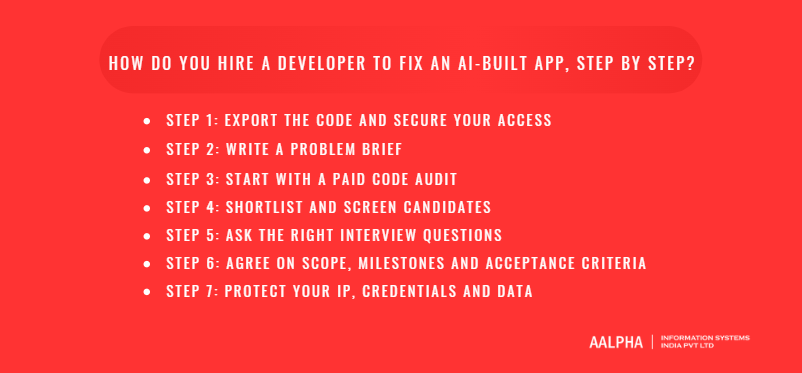
How do you hire a developer to fix an AI-built app, step by step?
To hire the right developer, secure your code and accounts first, write a short problem brief, and pay for a code audit before committing to a full fix. Then shortlist candidates with relevant rescue experience, test them with specific questions, and sign a contract with milestones, acceptance criteria and clear IP ownership.
Step 1: Export the code and secure your access
Move your code into a GitHub repository you own, if the builder supports it. Lovable, Bolt and Replit all offer some form of export or GitHub sync. Make sure you hold the admin login for your hosting, database, domain, payment and email accounts. Never let a developer own these accounts on your behalf.
Step 2: Write a problem brief
A one-page brief saves hours of paid discovery. Include what the app does, which tool built it, the stack, the number of active users, what is broken and how to reproduce it, and your deadline. Add screenshots or a short screen recording of each bug. State your budget range honestly, because it shapes what a developer can propose.
Step 3: Start with a paid code audit
An audit gives you a written picture of the codebase before you commit to a large fix. It should cover architecture, security, database design, performance, dependencies and deployment, and end with a prioritised fix list and estimate. Expect to pay for it. A free audit is usually a sales call, and its findings tend to favour the largest possible project. Aalpha runs this as a fixed-scope system audit.
Step 4: Shortlist and screen candidates
Look for developers or agencies with verifiable reviews and examples of rescue work, not only new builds. Independent review platforms show verified client feedback for agencies, so check them before the first call. For freelancers, read the written reviews rather than the star rating. Shortlist three, so you can compare approaches and prices. Aalpha Information Systems belongs on that shortlist if you want a team that audits the code before it quotes and regularly takes over software built by other teams.
Step 5: Ask the right interview questions
Good questions reveal whether a candidate has done this work before. Ask these:
- How would you audit this codebase in the first week?
- What are the three most common problems you find in Lovable or Bolt apps?
- How do you check that users cannot access each other’s data?
- Would you fix or rebuild this, and what would change your mind?
- How will your changes stay safe if I keep using AI tools afterwards?
- What will you hand over at the end?
Step 6: Agree on scope, milestones and acceptance criteria
Break the work into milestones with a fixed price or a capped estimate for each. Every milestone needs acceptance criteria you can check yourself, such as “a second test account cannot view the first account’s orders”. Pay per accepted milestone, not up front for the whole job. Keep a written list of what is out of scope.
Step 7: Protect your IP, credentials and data
Sign an NDA and a contract that assigns all code and IP to your company. Give the developer their own access accounts with only the permissions they need, and remove them when the work ends. Use a staging copy of the database for testing whenever possible, especially if you store customer or payment data. Rotate any keys that were exposed in the original code.
How much does it cost to fix an AI-built app?
Fixing an AI-built app costs anywhere from a few hundred US dollars for a single bug to USD 20,000 or more for a full stabilisation sprint. The price depends on three things: the size and condition of the code, the hourly rate of the developer, and whether parts must be rebuilt. An audit is the only reliable way to narrow the range.
The table below uses these assumptions: a web app built with an AI tool, 20 to 40 screens, a Supabase or Postgres backend, and fewer than 5,000 active users. It compares an offshore agency at a blended USD 35 per hour with a US or Western European developer at USD 100 per hour. These are planning estimates for late 2026, not a market survey.
Engagement | Typical effort | Cost at USD 35/hour | Cost at USD 100/hour |
Targeted bug fix | 10 to 40 hours | USD 350 to 1,400 | USD 1,000 to 4,000 |
Code and security audit | 16 to 40 hours | USD 560 to 1,400 | USD 1,600 to 4,000 |
Stabilisation sprint | 80 to 200 hours | USD 2,800 to 7,000 | USD 8,000 to 20,000 |
Partial rebuild | 200 to 500 hours | USD 7,000 to 17,500 | USD 20,000 to 50,000 |
Hourly rates vary widely by region. As rough guides, senior freelance full-stack developers in the USA often charge USD 80 to 150 per hour, and agencies in India start lower. Aalpha’s dedicated development resources start at USD 15 per hour, with senior engineers priced higher.
Lower rates carry a trade-off. Offshore AI teams need clearer written briefs and work across time zones, so feedback loops can take a day longer. A cheap developer who lacks security experience can also cost more in the end, because a missed data leak is far more expensive than the audit that would have caught it.
Costs climb faster when the app handles payments or health data, depends on several third-party APIs, has no Git history, or has paying users who cannot face downtime. Budget an extra 15 to 25 percent contingency for surprises the audit cannot see, such as undocumented integrations.
Should you fix the app or rebuild it?
Fix the app when its data model is sound and most problems are local, such as bugs, missing checks or slow queries. Rebuild when the data model is wrong, security flaws run through every layer, or each fix breaks something else. As a working rule, if fixing would touch more than about 60 percent of the code, a structured rebuild is usually cheaper.
Read the audit findings against a few clear signals. The database schema points to fixing when it is mostly correct and only needs indexes or constraints. It points to rebuilding when relationships are wrong, tables are duplicated or nobody can say which user owns which records. Security follows the same logic: a few missing access rules can be fixed, but access control that is absent across the app usually means a rebuild.
Code structure and regression rate tell you how expensive future work will be. If the code is consistent enough to follow and fixes stay fixed, keep fixing. If the same logic is copied in many places with different behaviour, and most fixes break another feature, the foundation itself is the problem.
Product direction and users decide the timing. A roadmap that fits the current design favours fixing, while one that needs features the structure cannot support argues for a rebuild. Live users who cannot face a migration also favour fixing, whereas an app with few users and little data is cheap to move to a new build.
A rebuild does not mean starting from zero. The AI-built version has already done valuable work: it proved the idea, settled the screens and flows, and often found the first customers. A good team reuses the design, copy and business rules, and rewrites the parts that cannot be trusted. Our article on software project rescue covers how rescue teams decide what to keep and what to replace.
The downside of rebuilding is time. You pause new features for several weeks and must migrate existing data carefully. The downside of fixing a weak foundation is slower: every future feature costs more, and the rebuild you avoided now often arrives later at a higher price.
What red flags should you watch for when hiring?
The biggest red flags are a fixed quote before anyone has seen the code, a promise to make the app production-ready in days, and a recommendation to rebuild with no written reasons. Also walk away from anyone who asks to own your accounts, avoids written milestones, or dismisses security as something to handle later.
Quoting without seeing the code. Nobody can price a fix for a codebase they have not opened. A firm number on the first call usually means the scope will be cut quietly or the price will rise mid-project.
Guaranteeing production readiness in a few days. Some fixes are quick, but hardening security, adding tests and setting up deployment take weeks for most real apps. Over-promising early is a common sign of a developer who will patch symptoms only.
Pushing a rebuild with no evidence. A rebuild may be the right answer, but it should come from audit findings you can read. Ask which specific problems make fixing more expensive than rebuilding.
Wanting control of your accounts. A developer should work through access you grant and can revoke. Hosting, database, domain and payment accounts must stay in your company’s name.
Treating security as optional. If a candidate does not ask about user data, access rules or exposed keys, they are not looking at the most expensive risk in your app.
Refusing to document. Ask what you will receive at handover. If the answer is just the code, the next developer will face the same confusion you face now.
What should happen after the app is fixed?
After the fix, you should receive documentation, automated tests, a working deployment pipeline, monitoring and a clear handover. You also need a plan for future changes, whether that is a maintenance arrangement, an in-house hire, or safe rules for continuing to use AI tools on the stabilised code.
A complete handover pack. This should include a README explaining how to run the app, an architecture overview, a list of environment variables and third-party services, and notes on every major change made. Store it in your repository, not in someone’s inbox.
Tests that protect the fixes. Automated tests on login, permissions, payments and other core flows stop old bugs from returning. They matter even more if you plan to keep prompting, because they catch the moment an AI edit breaks something.
Monitoring and backups. Error tracking, uptime alerts and scheduled database backups let you see problems before customers report them. Confirm that a backup has actually been restored once, as a test.
Rules for using AI tools afterwards. You do not have to stop using AI tools. Work on a separate branch, keep changes small, run the tests before merging, and have a developer review anything that touches authentication, data access or payments. Many founders pair this with a light software maintenance plan, so a developer reviews changes for a few hours each month.
How Aalpha Information Systems helps rescue AI-built apps
Aalpha Information Systems fixes AI-built apps through a structured rescue process: a paid audit, a written fix-or-rebuild plan, and milestone-based delivery by a team covering front end, back end, QA and DevOps. Since 2008, Aalpha has delivered 5,500+ projects, and its rescue work applies the same engineering standards to AI-generated code.
Audit before any estimate. Every engagement starts with a review of architecture, security, database design and deployment. You receive a prioritised findings report and an estimate per milestone, so you can decide what to fix now and what can wait.
Specialists for the stack AI tools produce. Aalpha’s engineers work daily with Next.js, React, Node.js, TypeScript and Postgres, the stack most AI builders generate. That means less time learning your code and more time fixing it.
A process you can verify. Aalpha holds ISO 9001:2015 certification for its delivery process and a 4.9 out of 5 rating from more than 215 verified reviews on Clutch.
Support that continues after launch. Once the app is stable, you can keep a small maintenance allocation for code reviews, updates and fixes during a defined weekday support window.
One honest limit: if your app is a simple prototype with no users yet, a full agency engagement may be more than you need. In that case, a short audit alone can tell you whether to keep building with AI tools or move to a proper build.
If your AI-built app is stuck, slow or unsafe to launch, start with Aalpha’s software project rescue service and request an audit of your codebase.
FAQs
Can a developer fix an app built with Lovable or Bolt?
Yes. Lovable and Bolt generate standard code, usually React with a Supabase backend, which any experienced full-stack developer can work on. The developer exports the code to GitHub, audits it, and fixes it there. Lovable can also sync with GitHub, so changes can flow back into the builder if you keep using it.
How long does it take to fix an AI-generated app?
A single bug usually takes two to seven days. A stabilisation sprint covering security, tests and deployment typically takes three to six weeks. A partial rebuild can take six to twelve weeks. The audit, which takes one to two weeks, gives you a reliable timeline for your specific app.
Is AI-generated code secure enough for production?
Not by default. AI tools can write secure code, but they often skip access rules, expose API keys in the browser, and miss input validation. Treat every AI-built app as unreviewed until a developer has checked authentication, data access and secrets handling. Apps that store personal or payment data need this review before launch.
Will I own the code after a developer fixes it?
You should, but only if your contract says so. Make sure the agreement assigns all code and intellectual property to your company. Keep the repository, hosting and database accounts in your own name, and give developers access you can revoke at any time.
Can I keep using AI tools after a developer fixes my app?
Yes, with some guardrails. Work on separate branches, keep each change small, and run the automated tests before merging. Have a developer review any change that touches login, permissions, payments or the database. This keeps most of the speed of AI tools without undoing the fixes.
How do I know if my AI-built app needs a rebuild?
Your app likely needs a rebuild if the database structure is wrong, access control is missing everywhere, or most fixes break other features. A code audit is the reliable way to decide. If fixing would change more than about 60 percent of the code, rebuilding is usually cheaper over the following year.
What should I share with a developer before hiring?
Share a short brief covering what the app does, which AI tool built it, the stack, user numbers, the problems and how to reproduce them, your deadline and your budget range. Screen recordings of each bug help a lot. Share code access only after signing an NDA.
How much does an AI app code audit cost?
A code and security audit for a typical AI-built web app takes about 16 to 40 hours of work. That works out to roughly USD 560 to 1,400 with an offshore agency, or USD 1,600 to 4,000 with a US-based developer. Larger apps with many integrations cost more.