





TL;DR:
AI project rescue is the process of auditing a stalled or underperforming AI build, identifying whether the failure sits in the problem definition, the data, the model, or the surrounding infrastructure, and deciding between three paths: rescue the existing system, rebuild it with a corrected approach, or retire it entirely. Most AI projects fail for reasons that have nothing to do with model quality: no evaluation framework was ever defined, the training data was insufficient or inconsistently labeled, the wrong architecture was matched to the problem, or inference cost and monitoring were never planned past launch. A proper rescue starts with an honest audit of the spec, the data pipeline, the model layer, and the infrastructure, then triages what’s salvageable before any new engineering work begins. Aalpha, a custom AI development agency founded in 2008 with 5,500-plus completed projects across 55-plus countries and a 4.9 out of 5 rating from 215-plus verified Clutch reviews, runs this audit-first process for founders deciding whether a failed AI build is worth saving.
A founder in Austin spent fourteen months and just under four hundred thousand dollars building a recommendation engine for a subscription box service. The model shipped. It ran in production for six weeks. Click-through on recommended items sat two points above random selection, and the team pulled it. Nobody had defined what “working” meant before the build started, so nobody could say with confidence whether the model failed or the definition did.
That story repeats with different numbers attached to it constantly. An AI project stalls, or ships and underperforms, or burns through a budget without producing something a team can point to and call done. The founder is left with a half-built system, a contractor who has moved on, and a decision to make about whether the thing is salvageable.
This article is written for that founder. Not the one starting an AI project from a blank page, but the one sitting on top of a project that already went sideways, trying to work out whether to fix it, gut it, or walk away from the whole thing and eat the loss.
The instinct in that position is usually to look for someone to blame. The contractor moved too fast. The founder changed requirements too often. The model was never going to work. Sometimes one of those is true. More often the failure is distributed across several smaller decisions made months apart by different people, none of whom had the full picture at the time. Untangling that is less satisfying than assigning blame, but it is the only version of the exercise that produces a plan instead of a grudge.
Why AI projects fail more often than ordinary software projects
Traditional software has a specification you can test against. A checkout flow either processes the payment correctly or it does not. An AI system does not work that way. A model that classifies support tickets with 84 percent accuracy is not broken, but it is also not obviously working, and the difference between 84 percent and 92 percent might be the difference between a product a customer trusts and one they abandon after the second wrong answer.
That ambiguity is where most AI projects come apart. A traditional build fails because someone wrote the wrong code. An AI build fails because the team never agreed on what “right” looked like, fed the model data that did not represent the real problem, or picked an approach that could never hit the bar the business actually needed. None of those failures show up in a code review. They show up months later, in production, when a customer gets an answer that is confidently wrong.
The failure is also harder to localize once it appears. A checkout bug can usually be traced to a specific function within an hour of someone looking at it. An AI system that produces a bad output could be failing because of the data it was trained on, the way that data was labeled, the architecture chosen, the prompt or configuration wrapped around the model, or the infrastructure serving it under load, and those layers are not equally visible to the same person. A founder without a machine learning background is often told the model “just needs more training” when the actual problem sits in a labeling inconsistency two layers removed from anything training can fix, and there is no obvious way for a non-technical founder to know the difference without asking the right questions or bringing in someone who does.
There is a cost problem layered on top of this. Model inference is not free the way serving a static page is free. A support chatbot that costs four cents per conversation looks fine in a demo and looks catastrophic at ten thousand conversations a day. Teams that scoped an AI feature the way they would scope a normal sprint, without pricing out the running cost at real volume, tend to discover the economics only after launch, which is the most expensive place to discover them.
The cost of walking away versus the cost of fixing what’s broken
Shutting down a failed AI project feels like the safe choice. It stops the bleeding on cloud spend and contractor invoices, and it lets a team move on to something with a clearer path to revenue. It also throws away whatever is actually usable inside the wreckage, and in most of the failed projects Aalpha has been brought in to assess, something is usable. Labeled data that took months to collect does not become worthless because the model built on top of it was wrong. A working ingestion pipeline does not need to be rebuilt because the evaluation framework around it was missing.
The honest comparison is not “rescue versus rebuild.” It is “rescue versus rebuild versus retire,” and retiring the project entirely is sometimes correct. A project built around a problem the market no longer has, or an approach that was wrong at the concept level rather than the execution level, is not worth rescuing regardless of how much has already been spent on it. Chasing sunk cost is how a founder turns a four-hundred-thousand-dollar mistake into a seven-hundred-thousand-dollar one.
The rest of this article is a framework for making that call with evidence instead of instinct, and for executing the rescue properly when the evidence says rescue is the right move.
How to tell a failing AI project from a project that’s just slow
Not every AI project that feels stuck is actually failing. Model training takes longer than most founders expect going in, and the gap between a working prototype and a production-ready system is wider for AI than it is for a CRUD application. Confusing “this is taking a while” with “this is broken” leads to premature panic and, sometimes, to killing a project that was three weeks from working.
Signs the model or system genuinely isn’t working
The clearest signal is a metric that stops improving. If accuracy, precision, recall, or whatever the relevant evaluation number is has plateaued below the threshold the business needs, and the team has tried the standard levers (more data, different model architecture, hyperparameter tuning) without movement, that is a real ceiling, not a delay. Plateaus that appear early, before the team has tried more than one or two approaches, are less alarming than plateaus that appear after months of iteration.
Hallucination rate is the equivalent signal for generative and LLM-based systems. A support bot that gets facts wrong in one out of every twenty responses is not a system that needs more prompt tuning. It is a system with an architecture problem, usually because it is generating answers from the model’s general knowledge instead of grounding them in retrieved, verified content.
Drift is a subtler one. A model that performed well at launch and has degraded steadily since is telling you the world changed under it. Customer behavior shifted, the product catalog changed, seasonal patterns kicked in that the training data never saw. This is not the same failure as a model that never worked. It is a maintenance failure, and the fix looks different: retraining pipelines and monitoring, not a redesign.
Signs the problem is scope, expectations, or process rather than the AI itself
A large share of what gets reported as “the AI doesn’t work” is actually “the team never defined what working meant.” If nobody can point to a number and say the model needs to hit it, there is no way to know if the model is failing or succeeding, and the project will feel stuck indefinitely regardless of what the model is actually doing.
Scope creep produces a similar symptom. A model built to do one thing, expanded mid-build to do three things because a stakeholder asked for more, will look like it is underperforming when it is really just unfinished. The original scope might have been achievable. The expanded scope might not be, at least not on the original timeline and budget.
Communication breakdown between a technical team and a non-technical founder shows up as the same complaint too. A founder who does not understand why a model that “seems smart” in testing behaves unpredictably in production is not necessarily looking at a broken system. They might be looking at a normal gap between demo conditions and production conditions that nobody explained to them clearly.
A short framework for triage: rescue, rebuild, or retire
Three questions separate these cases reasonably well. First, does the core approach match the problem, or was the wrong tool picked from the start, such as fine-tuning a large language model for a task that a simple classifier would have solved for a tenth of the cost and complexity. Second, is the data foundation sound, meaning is there enough of it, is it labeled correctly, and does it represent the real distribution of cases the system will see in production. Third, does the business case still hold, meaning does the market and the unit economics still support the feature at all.
A yes on all three usually means rescue: the pieces are right, the execution needs fixing. A no on the first or second usually means rebuild: something structural has to change, but the underlying problem is still worth solving. A no on the third means retire, and no amount of engineering skill fixes a business case that has evaporated.
These three questions work best as a written exercise, not a conversation. A founder and a technical lead sitting in a room and talking through whether the approach matches the problem will usually agree with each other faster than the evidence warrants, because agreement feels better than conflict and because both people have an interest in the project having been worth the time already spent on it. Writing down the answer to each question separately, with the reasoning attached, and then comparing notes, surfaces disagreement that a conversation would have smoothed over. If the technical lead and the founder cannot agree on whether the data foundation is sound, that disagreement is itself useful information, because it usually means the data has never actually been reviewed carefully by either of them.
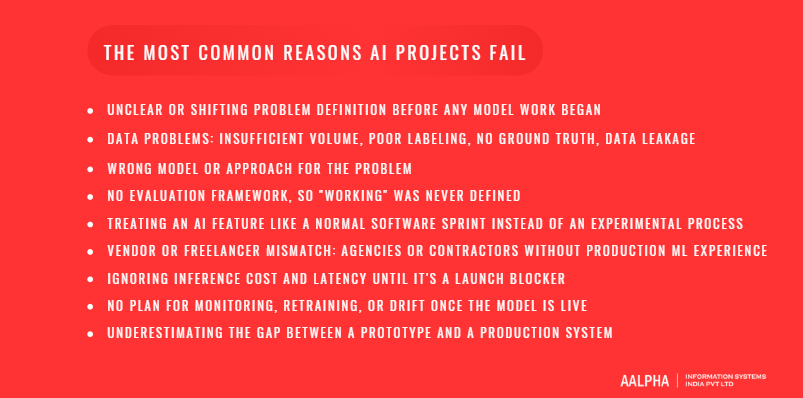
The most common reasons AI projects fail
-
Unclear or shifting problem definition before any model work began
Most AI project failures trace back to a decision made before any code was written. A team decides to “add AI” to a product without first writing down, in a sentence a customer would recognize, what problem the AI is solving and how success will be measured. Everything downstream inherits that ambiguity. Data gets collected for a vaguely defined task. The model gets evaluated against whatever metric is easiest to compute rather than the one that reflects real value. Launch happens because the calendar said so, not because a defined bar was cleared.
This failure mode is invisible during the build. Everyone is busy, code is being written, dashboards show training loss going down. The absence of a clear problem definition only becomes obvious after launch, when the team cannot agree on whether the thing worked.
-
Data problems: insufficient volume, poor labeling, no ground truth, data leakage
Data is where the majority of technical failures live, and it is the least glamorous part of an AI project to fix, which is part of why it gets skipped. A model trained on eight hundred examples when the task genuinely needs eight thousand will look reasonable in a demo built on the same eight hundred examples and fall apart on anything new. Labels applied inconsistently, by different people using different judgment calls without a shared rubric, teach a model to be inconsistent in exactly the same way.
Data leakage is a quieter version of the same problem and one of the most common reasons a model looks great in testing and fails in production. If information from the target variable leaks into the training features, even subtly, the model learns to exploit that leak instead of learning the actual pattern. A fraud detection model trained on data where the transaction ID format happened to correlate with fraud flags because of how the database was structured will show excellent test accuracy and catch almost nothing once deployed against real, unseen transactions.
No ground truth is the most fundamental version of the data problem. Some teams build a model to predict something nobody has ever reliably labeled before, without first establishing what the correct answer even looks like for a sample of cases. Without that, there is no way to measure the model against reality, only against the team’s assumptions about reality.
-
Wrong model or approach for the problem
The last two years have made this failure mode more common, not less, because large language models make it easy to reach for the most powerful available tool regardless of whether the problem needs it. A team building a system to route support tickets into eight categories does not need a fine-tuned LLM with a vector database behind it. A well-built classical classifier, trained on a few thousand labeled examples, will hit similar accuracy at a fraction of the latency and cost, and it will be far easier to debug when it gets something wrong.
The reverse mistake happens too, less often but just as expensively. A team tries to solve an open-ended, language-heavy problem, like summarizing inconsistent free-text customer feedback into themes, using a rules-based system or a simple model that was never going to capture the nuance the task required. Matching the approach to the actual shape of the problem, rather than to what is trending or what a contractor happens to know how to build, is a decision that gets too little attention relative to how much it determines the outcome.
-
No evaluation framework, so “working” was never defined
This deserves its own heading because it shows up in nearly every failed project Aalpha has audited, independent of industry or model type. A team builds a model, looks at a handful of outputs, decides they look reasonable, and ships. There is no held-out test set, no defined accuracy threshold, no process for checking the model against new data on a schedule. The team is flying on vibes, and vibes do not scale past the first few dozen production interactions.
An evaluation framework does not need to be elaborate. It needs a representative, labeled test set that the model has never seen during training, a metric that maps to something the business actually cares about, and a threshold that was agreed on before the results came in, not adjusted afterward to match whatever number the model happened to produce.
-
Treating an AI feature like a normal software sprint instead of an experimental process
Software development has a reasonably predictable relationship between effort and output. Write the function, test it, ship it. Machine learning does not work that way. A model might need three architecture changes and five rounds of data cleaning before it clears the accuracy bar, and there is no way to know in advance which round will be the one that works. Teams that put an AI feature on a fixed two-week sprint schedule, with a demo expected at the end regardless of where the model actually stands, end up shipping whatever exists at the deadline rather than what actually works. The deadline pressure does not make the model better. It makes the team stop measuring honestly.
-
Vendor or freelancer mismatch: agencies or contractors without production ML experience
A software agency that is excellent at building web applications is not automatically equipped to build a production machine learning system, and the skills gap is not always obvious from a portfolio. Building a model that performs well on a curated dataset is a different skill from building a model that performs well on the messy, adversarial, constantly shifting data a real product sees, and from knowing how to monitor and retrain that model once it is live. Founders who hired for general software development experience and got an AI feature as part of a broader build often end up with something that was assembled correctly and evaluated poorly, because the team doing the assembly had never shipped a model to production before and did not know what questions to ask themselves along the way.
-
Ignoring inference cost and latency until it’s a launch blocker
A model that costs six cents and takes four seconds per response is invisible in a demo where a founder tests it a dozen times. At ten thousand daily active users making several requests each, that same model becomes a five-figure monthly bill and a user experience complaint that shows up in every support ticket. Teams that never modeled cost and latency at projected scale, treating them as an afterthought to be optimized post-launch, frequently find that the optimization required is not tuning, it is a different model, a different architecture, or a caching layer that should have been designed in from the start.
-
No plan for monitoring, retraining, or drift once the model is live
A model is not a static artifact. The world it was trained on keeps moving after launch, and a model with no monitoring in place will degrade silently, showing declining performance with no alert and no clear point at which someone notices. By the time a customer complaint or a dip in a business metric surfaces the problem, the model may have been quietly wrong for weeks. Teams that treat launch as the finish line, rather than the point where ongoing measurement begins, are setting up the exact kind of failure that looks, six months later, indistinguishable from a project that never worked at all.
-
Underestimating the gap between a prototype and a production system
A prototype that impresses in a demo is answering a much narrower question than a production system has to answer. The prototype gets tested against a handful of cases the builder chose, often cases that happen to be favorable. Production traffic includes the malformed input, the sarcastic customer message, the request in a language the training data barely covered, and the edge case nobody thought to test because nobody knew it existed until a real user produced it. Teams that treat a strong demo as evidence the hard part is finished are usually several months away from realizing how much of the actual engineering work, error handling, fallback behavior, graceful degradation when the model is uncertain, still lies ahead of them.
Auditing the current state of a failed or stalled AI project
Before any rescue work starts, the project needs an honest audit. This is the step most founders want to skip, because it takes time and does not produce anything that looks like forward progress, and it is also the step that determines whether everything that follows is aimed at the actual problem or at a guess.
-
Reviewing the original spec versus what was actually built
Start by pulling the original specification, proposal, or scope document, whatever exists from before the build began, and comparing it line by line against what actually got shipped. This surfaces two things reliably. It shows where scope drifted without anyone formally deciding to drift it, which explains a lot of “why does this feel unfinished” confusion. It also shows where the original spec itself was the problem, vague on success criteria, silent on data requirements, or built around an approach that was wrong from day one.
-
Auditing the data pipeline: sourcing, cleaning, labeling, versioning
This is usually where the audit takes the longest, and it is worth the time. Where did the training data come from, and does that source still exist and still produce data the same way. Was the cleaning process documented, or does nobody remember exactly what transformations were applied. Were labels applied by one person with consistent judgment or by several people with different interpretations of ambiguous cases, and is there any way to check inter-labeler agreement retroactively. Is there version control on the dataset itself, so the team can say with confidence which version of the data produced which version of the model.
A data pipeline audit at Aalpha typically involves pulling a random sample of the training data and manually reviewing label quality against the stated labeling guidelines, because self-reported label quality and actual label quality diverge more often than most teams expect. A team that reports “our data is clean” almost never means the same thing by clean as a second reviewer sitting down cold with a hundred random rows. The random sample is the cheapest, fastest way to close that gap, and it usually takes a day or two rather than the weeks a full relabel would take, which is why it belongs early in the audit rather than after a decision to rescue has already been made.
It is also worth checking who labeled the data and under what conditions. Data labeled by a single domain expert with clear judgment tends to be more internally consistent than data labeled by a rotating group of contractors working from a guideline document that was written once and never updated as edge cases surfaced. If the labeling guidelines themselves cannot be produced, that is a finding in its own right, because it means there is no fixed standard the labels were measured against, only whatever the labeler happened to think in the moment.
-
Auditing the model layer: architecture choice, fine-tuning vs. prompting vs. RAG, evaluation metrics used
Here the questions are about fit and rigor. Was the architecture chosen because it matched the problem, or because it was familiar to whoever built it. If the system uses retrieval-augmented generation, is the retrieval step actually returning relevant documents, which is worth checking directly rather than assuming, because a broken retrieval step will produce confidently wrong answers that look like a language model problem when the real fault sits one layer earlier. What metric was used to evaluate the model during development, and does that metric actually correlate with the outcome the business cares about, or was it chosen because it was easy to compute.
-
Auditing the infrastructure: hosting, scaling, cost per inference, latency under real load
Infrastructure audits catch problems that never show up in development because development never runs at production volume. What is the actual cost per inference at current usage, and how does that scale as usage grows. What is p95 latency, not average latency, because average latency hides the tail cases that generate the support tickets. Is the system architected to handle a traffic spike, or does it fall over the first time usage exceeds whatever ad hoc load the original build was tested against.
-
Talking to the team and stakeholders to separate technical failure from communication failure
The technical audit answers what the system is doing. It does not answer why the project feels like a failure to the people involved, and those are not always the same question. A founder who expected a chatbot to handle complex, multi-step customer issues and got one that handles simple FAQ lookups well might be looking at a communication failure about what was realistically achievable, not a technical failure in what got built. Interviews with the original team, where they still exist and are willing to talk, and with the stakeholders who were disappointed by the outcome, often reveal a mismatch in expectations that no amount of model improvement will resolve, because the model was never going to do what was promised in the first place.
These conversations work better when they are structured around specific examples rather than general impressions. Asking a stakeholder “were you happy with the AI feature” produces a vague, emotionally colored answer. Asking them to pull up the last five interactions they personally had with the system and walk through what they expected versus what happened produces something a technical team can actually act on. The same applies to the original builders, where they are available. Asking what the hardest part of the build was, and what they would have done differently with more time or budget, often surfaces a known limitation that never made it into any documentation because nobody asked, and because admitting a limitation out loud during a build under deadline pressure rarely feels like the right moment.
Deciding what’s salvageable
Data that can be reused versus data that has to be rebuilt
Data that was collected correctly but labeled inconsistently is usually salvageable, because relabeling existing data with a tighter rubric is far cheaper than sourcing new data from scratch. Data that was never representative of the real problem, collected from a narrow slice of use cases or a biased sample, is often not worth keeping regardless of how much of it there is, because more biased data does not fix a bias problem, it entrenches it.
There is a middle case worth naming separately: data that is representative but too small. A dataset that reflects the real distribution of cases but only contains a few hundred examples where the task needs several thousand is not wrong, it is just insufficient, and the fix is expansion rather than replacement. This distinction matters for budgeting the rescue, because expanding a sound but small dataset is a matter of collecting more of the same thing, which is predictable in cost and time. Replacing a biased dataset requires first figuring out what a representative sample actually looks like, which is a harder and less predictable exercise, particularly if nobody on the team has done that analysis before.
Code and infrastructure worth keeping
Ingestion pipelines, data storage, authentication, and the surrounding application code are usually reusable even when the model itself needs to be replaced, because those pieces have nothing to do with whether the model architecture was right. Model-specific code, prompt templates built around an approach that is being abandoned, fine-tuning scripts for a model that is being swapped out, is generally not worth preserving beyond reference.
When to keep the existing model and fix the surrounding system instead
Sometimes the model is fine and everything around it is broken. This happens more often than founders expect, particularly with retrieval-augmented systems where the language model gets blamed for wrong answers that actually originate in a retrieval step returning irrelevant documents, or in a data freshness problem where the retrieved content is simply out of date. In these cases the rescue is cheaper and faster than a rebuild, because the expensive part, the model itself, does not need to change.
When the underlying approach is wrong and needs to be replaced entirely
If the audit shows the model architecture cannot reach the accuracy the business needs regardless of how much more data or tuning is applied, keeping it and iterating further is a way to spend money without changing the outcome. This is the harder conclusion to reach, because it usually means admitting that months of prior work need to be set aside, but it is the conclusion an honest audit sometimes produces, and delaying it does not make it less true.
A practical rescue framework
Step 1: Redefine success with measurable evaluation criteria
Before any technical work resumes, write down what success looks like in terms specific enough that two people looking at the same output would agree on whether it cleared the bar. This means a metric, a threshold, and a representative test set that the model has not seen. If the original project never had this, building it now is not a delay, it is the first piece of actual progress the rescue makes, because everything after this step is aimed at a target instead of a guess.
Step 2: Fix the data foundation before touching the model again
It is tempting to jump straight to model changes because they feel like technical progress in a way that data cleaning does not. Resist that. A better model trained on the same flawed data will inherit the same flaws, usually in a more subtle and harder to detect form. Relabel where labels were inconsistent. Fill gaps where volume was insufficient. Check for leakage explicitly, by looking at whether any feature correlates suspiciously well with the target in a way that would not hold up once the system faces genuinely new cases.
Step 3: Right-size the approach
With clean data and a real evaluation target in place, reconsider the architecture from a position of actual evidence rather than habit. A task that was over-engineered with a large language model might perform just as well, more cheaply and more predictably, with a smaller fine-tuned model or a classical approach. A task that was under-served by a simple model might genuinely need the flexibility of an LLM with retrieval. This decision should be made against the evaluation criteria from step one, not against what is currently fashionable.
Step 4: Rebuild with a tight feedback loop instead of a long build-then-test cycle
Rescue work should move in short cycles: change one thing, measure against the evaluation set, decide whether it helped, repeat. A team that goes back to a three-month build-then-test cycle for the rescue is repeating the exact process failure that produced the original stalled project. Weekly or even daily evaluation checkpoints keep the team honest about whether changes are actually working, rather than accumulating changes for months before finding out.
This is also the point where a team decides how to handle the disagreement between what the evaluation set says and what a stakeholder’s gut says. Both signals matter, but they answer different questions. The evaluation set tells you whether the model is improving against a fixed, representative standard. A stakeholder’s reaction to a handful of recent outputs tells you whether the improvement is visible and whether it addresses the thing they actually cared about, which is not always the same thing the evaluation metric was built to measure. When the two disagree, the right response is usually to ask whether the evaluation set is missing a category of case the stakeholder is reacting to, not to override the metric with intuition or to dismiss the stakeholder’s reaction as noise.
Version everything during this phase, including the evaluation set itself. It is common for a team mid-rescue to quietly adjust the test set, dropping a few examples the current model handles badly and adding a few it handles well, without deciding to do so explicitly. This produces an evaluation number that climbs for reasons that have nothing to do with the model getting better. A fixed, versioned test set that nobody edits without a documented reason is one of the cheapest safeguards available against fooling yourself.
Step 5: Put monitoring and evaluation in place before relaunch, not after
A rescued system that launches without ongoing monitoring is a system set up to fail the same way again, just on a longer timeline. Before relaunch, the team should have a dashboard tracking the core evaluation metric against live traffic, alerts for when that metric drifts below threshold, and a defined process for what happens when it does, whether that is retraining, rolling back, or escalating to a human for review.
Common mistakes to avoid during a rescue
-
Rescuing scope instead of rescuing the product
There is a strong temptation, once a rescue is underway, to fix everything that was ever wrong with the product at the same time as fixing the AI. This is how a rescue that should take six weeks turns into a rebuild that takes six months. The rescue’s job is to get the AI system to a defined, measurable standard of working. Feature requests that surfaced along the way belong on a separate roadmap, not folded into the rescue scope.
-
Adding more AI to fix an AI problem
When a model underperforms, the instinct is often to add another model on top of it, a second pass to catch errors, a classifier to filter bad outputs, a larger model to replace the smaller one. Sometimes this is the right call. Often it is a way of avoiding the harder, less glamorous work of fixing the data or the evaluation framework underneath. Before adding complexity, check whether the existing system’s problems trace back to something simpler that a second model would not actually fix.
-
Skipping user testing because the team is exhausted from the first attempt
By the time a rescue is underway, the team has usually already been through one round of building, testing internally, and shipping to disappointing results. The temptation is to skip external user testing this time and ship directly to production, on the theory that the fixes are obviously correct. They are usually not as obviously correct as they feel from inside the project. A small, structured round of user testing before full relaunch catches problems that internal evaluation metrics do not, because real users interact with a system in ways a test set never anticipates.
-
Underestimating how long a proper data fix takes
Data work is unglamorous and hard to estimate. Relabeling a dataset with a tighter rubric, checking for leakage, filling volume gaps, these tasks take longer than teams expect going in, and there is a strong pull to cut them short because the model work feels more urgent. Projects that shortchange the data fix in favor of getting back to model iteration sooner tend to produce a second failure that looks a lot like the first one.
When to rebuild from scratch instead of rescuing
Cost and time comparison: patch versus rebuild
The honest way to make this decision is to price both paths. What would it cost, in time and budget, to fix the data, right-size the model, and relaunch with proper monitoring, against the existing codebase and infrastructure. What would it cost to start over with a clean architecture, informed by everything the team now knows about what went wrong the first time. When the rescue path approaches the cost of a rebuild, because the existing system requires so much structural change that little of the original work survives, a clean rebuild is usually faster and produces a more maintainable result, even though it feels like a larger admission of failure.
Cases where the original architecture is fundamentally incompatible with the goal
Some architectural choices cannot be patched around. A system built on a rules-based approach for a task that genuinely requires learned pattern recognition across ambiguous inputs will not get there through incremental rule additions, no matter how many edge cases get hardcoded. A model trained on a data schema that does not capture the information needed to make the prediction accurately cannot be tuned into working, because the information required to succeed was never collected. In these cases, the audit should identify the incompatibility clearly enough that the founder can see it is not a matter of more effort, it is a matter of a different starting point.
How to make this call without sunk-cost thinking driving the decision
The question that cuts through sunk-cost reasoning is simple: if this project did not exist yet and you were deciding today how to build it, given everything you now know, would you build it the way it currently exists. If the answer is no, the money already spent does not change that answer, it only makes it harder to accept. Founders who separate the decision from the money already spent tend to make faster, better calls here than founders who keep reaching for one more fix because so much has already gone into the existing build.
A useful discipline is setting a rescue budget and a rescue deadline before the audit even finishes, both smaller than what has already been spent, and treating either one being exceeded as a trigger to stop and reassess rather than push through. Without that limit in place, a rescue can quietly become a second full build, spread out over enough months that nobody notices the total cost has caught up to what a clean rebuild would have cost from the start. The limit does not have to be rigid. It has to exist, and it has to be checked against honestly rather than adjusted upward every time the current estimate runs short.
Choosing the right partner for an AI rescue
What to look for in a team taking over a failed AI project
Production machine learning experience is not the same as AI experience in a broad sense. A team that has shipped models to production, dealt with drift, built evaluation frameworks, and managed inference costs at scale will ask different questions in the first meeting than a team that has mostly worked with pre-built APIs and demos. If you are considering AI project rescue, ask a prospective partner to walk through how they would evaluate the existing system before proposing changes. A team that jumps straight to “we’ll rebuild this with a better model” without first asking to see the data and evaluation criteria is skipping the step that determines whether the rebuild will actually work.
Transparency about uncertainty is a good signal too. A team that promises a specific accuracy number before seeing the data is either overconfident or not being straight with you. A team that says “we need two weeks with your data to tell you what’s realistically achievable” is giving you a more honest starting point, even though it is a less satisfying answer in the first meeting.
Questions to ask a prospective agency or engineering partner before handing over a failed build
Ask what evaluation framework they would put in place before touching the model, and listen for whether the answer is specific or generic. Ask how they would handle the existing labeled data, whether they plan to audit it, relabel parts of it, or discard it, and why. Ask what they would do differently about monitoring and drift detection once the system is live, since that is the piece most failed projects skipped the first time. Ask for a reference from a project where they took over someone else’s failed AI build specifically, not just a project they built from scratch, because rescue work draws on a different set of diagnostic skills.
Where Aalpha fits in this process
Aalpha has been building custom software since 2008, with more than 5,500 completed projects across 55-plus countries and a 4.9 out of 5 rating from over 215 verified Clutch reviews, and a meaningful share of that work over the past several years has involved AI systems specifically, including projects where the starting point was someone else’s stalled or underperforming build. The audit-first approach described in this article is not a marketing framing, it is the process Aalpha’s team actually runs before proposing a fix, because proposing a rebuild before understanding why the original system failed is how a second failed project gets funded on top of the first one. For a founder deciding between a full rebuild and a targeted rescue, that audit is usually the highest-value first engagement, since it produces a clear answer before any significant new spend commits to a direction.
Case pattern examples
These are composite patterns drawn from common failure modes, not identifiable client engagements, and they are included because the pattern recognition matters more than any single story.
A recommendation engine that failed on data quality, not model choice
An e-commerce team built a product recommendation model that performed well in testing and produced noticeably worse results once live. The model architecture was sound. The problem was that the training data had been collected during a promotional period when purchase patterns were distorted by discounts, and the model had learned those distorted patterns as if they were normal customer behavior. The fix was not a new model, it was retraining on a full year of data that captured normal seasonal variation, along with excluding promotional periods as a separate signal rather than letting them blend into the general training set. The rescue took five weeks and reused the existing model architecture entirely.
A customer support LLM that failed on evaluation and cost, not capability
A support automation project used a large language model to draft responses to customer tickets, and the model was, in isolation, quite capable. The project failed because nobody had defined an evaluation framework for what counted as an acceptable response, so quality was judged subjectively and inconsistently by whichever team member happened to review a given output. Inference cost had also not been modeled at scale, and the system became expensive enough at real ticket volume that the team was seriously considering shutting it down for budget reasons alone. The rescue introduced a defined rubric with three graders scoring a sample of outputs weekly, and moved the bulk of routine, low-complexity tickets to a smaller, cheaper model reserved for a narrower task, with the larger model only invoked for genuinely complex cases. Cost dropped by roughly two thirds and the evaluation framework let the team finally say, with evidence, whether quality was improving over time.
An internal tool that failed on scope creep, not technical difficulty
An internal tool meant to summarize sales call transcripts into structured notes kept expanding in scope during development, eventually being asked to also flag deal risk, suggest next steps, and integrate with the CRM automatically, all before the original summarization task had been properly validated. Each addition seemed reasonable on its own, and none of them individually caused the project to stall, but together they meant the team never finished validating the core capability the tool was originally meant to provide. The rescue cut scope back to the original summarization task alone, shipped it, and treated the other features as a separate roadmap to be tackled only after the first capability was proven in daily use.
A fraud detection model that looked excellent in testing and caught almost nothing in production
A fintech startup built a transaction fraud model that scored above ninety percent accuracy in internal testing, which made the underperformance once live genuinely confusing to the team, since a model that accurate in testing should not have missed the volume of fraud it missed in the first month after launch. The audit found data leakage: several of the features used to train the model, including one derived from how a transaction had been categorized internally, were only available after a human reviewer had already flagged the transaction as suspicious, meaning the model had effectively been trained to recognize the outcome of the review process rather than to predict fraud ahead of it. Once those features were removed and the model retrained on only the information genuinely available at the moment a transaction occurred, accuracy dropped to a more modest and more honest number in testing, but performance in production actually improved, because the model was now learning a pattern it could really use rather than one that only existed after the fact.
Explaining what went wrong to an investor or a board without losing credibility
A founder rescuing a failed AI project often has to explain the failure to people who funded it, and how that conversation goes matters almost as much as the technical fix. The version that damages credibility is vague and defensive: the model needed more training, the vendor didn’t deliver, the team is confident it will work this time. The version that holds up is specific and evidence-based: here is what the audit found, here is the evaluation number the project is now being held to, here is the evidence from the first two weeks of the rescue that the fix is working. Boards and investors generally do not expect a founder to have avoided every mistake in a first attempt at an AI feature, since almost nobody does. What damages trust is a founder who cannot say precisely what went wrong, because that suggests the next version of the project is just as likely to repeat it.
Getting a stalled AI project moving again is rarely about finding a smarter model. It is usually about doing the unglamorous audit work that the first attempt skipped: defining what success actually means, fixing the data underneath the model, and building the monitoring that catches the next drift before a customer notices it first. A founder sitting on a failed build does not need to choose between denial and abandonment. There is a third option, and it starts with an honest look at what actually went wrong before deciding what to build next.
Back to You!
If you’re evaluating whether a stalled or underperforming AI build is worth rescuing, Aalpha’s team can audit the project and give you a clear assessment before you commit to a rebuild or new direction. Get in touch with Aalpha to discuss your AI project.