






TL;DR
To build an app like Careem, start with one high-frequency service, usually ride-hailing or food delivery, and build four connected products around it: a customer app, a captain (driver) app, a merchant panel and an admin console. Add a shared wallet, a single sign-on and a modular backend so each new service plugs into the same account and payment layer. A single-city ride-hailing MVP takes roughly 14 to 18 weeks and USD 30,000 to 50,000 with an offshore team, while a two-service platform with delivery runs USD 60,000 to 95,000. Licensing in the UAE and Saudi Arabia shapes the product as much as the code does, so plan for RTA and TGA rules from day one. Aalpha Information Systems builds Careem-style platforms both ways: as custom apps on a shared super app core, or through DeliveryStack, its white-label platform that launches rides, food and courier services in 2 to 4 weeks.
Careem began in Dubai in 2012 as a ride-hailing company and now runs one of the Middle East’s best known super apps. Founders who search for “an app like Careem” usually want one of three things: a regional ride-hailing app, a delivery app with rides added later, or a true multi-service super app. This guide covers all three. It explains how Careem’s model works today, what each app must do, how the backend is put together, what it costs, and which regulations decide your launch plan in the GCC.
What is Careem, and how does its super app work?
Careem is a Dubai-based super app that bundles ride-hailing, food and grocery delivery, courier, digital payments and third-party home services into one account. It works because a single login, wallet and rewards balance follow the user across every service. Rides bring people into the app often. Delivery and payments then earn more from each user.
How Careem evolved from a taxi app
Ride-hailing first (2012 to 2019). Mudassir Sheikha and Magnus Olsson founded Careem in Dubai in 2012 as a booking service for cars and taxis. Uber bought the company for USD 3.1 billion in a deal announced in 2019 and completed in early 2020.
The super app launch (2020). Careem merged its separate food, delivery and payments products into one app in 2020. The pitch was simple: mobility of people, things and money in one place, with one sign-on and one payment method.
Split ownership (2023 to today). In 2023 the business was divided in two. Careem Rides stayed fully owned by Uber. The super app and its other verticals moved into a new company, Careem Technologies, in which UAE telecom group e& bought 50.03% for USD 400 million. In June 2026 Uber bought a further 12.5% from e& for USD 100 million, cutting e&’s stake to 37.53%. Rides still appear inside the same Careem app, which shows how a super app can host a service owned by a different company.
What the Careem app offers in 2026
The app covers rides and RTA taxi booking in Dubai, food delivery, Quik grocery delivery, courier, bike rentals, a digital wallet with transfers and recharges, and third-party services such as home cleaning, laundry and car rental. Careem Technologies reported revenue of AED 884 million (USD 241 million) for the first half of 2026, up 20% year on year, with operating losses of about USD 122 million in the same period.
That last number matters for anyone copying the model. Breadth of services does not guarantee profit. Careem spent years and hundreds of millions of dollars building density in each vertical, and the super app layer still runs at a loss. A new entrant should copy the architecture, not the launch scope.
How does an app like Careem make money?
An app like Careem earns a commission on every ride and order, plus delivery fees, service fees, advertising from merchants, subscription plans and margins on payments. Rides and food carry most of the volume. Payments, subscriptions and ads lift the margin per user once people already use the app weekly.
Ride commission. The platform keeps a share of each fare paid by the captain or fleet partner. The commission rate and surge pricing are the main levers. The risk is supply: captains move to rival apps when the cut feels too high.
Restaurant and store commission. A share of each delivery order goes to the platform, often in tiers by merchant size. Large chains negotiate low rates, so most of the margin comes from independent restaurants and stores.
Delivery and service fees. Customers pay a flat or distance-based fee per order. Free-delivery thresholds lift basket size, but fee-sensitive users order less often when fees rise.
Subscriptions. A monthly plan, such as Careem Plus, bundles free delivery or ride discounts. It builds loyalty, though heavy users can make the plan unprofitable if perks are priced loosely.
In-app advertising. Merchants pay for top placement, sponsored listings and banners. This is high-margin revenue, but too many ads erode trust in search results.
Wallet and payments. The platform earns a margin on card top-ups, transfers and bill payments. This needs a payments licence or a licensed partner before launch.
Third-party services. Partners run cleaning, laundry or car rental inside the app and share revenue per booking. It adds services without building them, but quality failures still land on your brand.
Pick one engine before adding others. Most founders should choose either a commission-led ride business or a delivery marketplace for the first 12 months. A wallet and subscriptions make sense only after weekly active users are steady, because both depend on repeat use.
What features does an app like Careem need?
An app like Careem needs four products that share one backend: a customer app for booking and paying, a captain app for accepting jobs and navigating, a merchant panel for restaurants and stores, and an admin console for pricing, dispatch and support. The MVP needs only the features that complete one trip or one order end to end.
Customer app
Account and identity. Phone number sign-up with OTP, social login and a single profile that works across every service. Saved addresses matter more in the GCC than in many markets, because building names and landmarks often replace street numbers.
Booking and ordering. Pickup and drop-off on a map, vehicle categories, upfront fare estimates, scheduled rides, restaurant and store browsing, cart, and order tracking. Arabic and English with full right-to-left layouts are a launch requirement, not a later upgrade.
Payments and wallet. Cards, Apple Pay and Google Pay, cash on delivery where the market still expects it, promo codes, and a wallet balance for refunds and credits.
Safety and support. Trip sharing, an SOS button, masked calls between rider and captain, ratings, and in-app chat support.
Captain app
Captains need online and offline status, job offers with a countdown, turn-by-turn navigation, trip and order status updates, earnings by day and week, cash collection records, document upload for licence and vehicle papers, and identity checks before each shift. In Saudi Arabia the regulator now expects facial verification of drivers, so build selfie-based checks into the shift start.
Merchant panel
Restaurants and stores need menu and catalogue management, opening hours, order accept and reject, prep time settings, stock toggles, payouts and basic sales reports. A tablet-friendly web app is usually enough for launch.
Admin console
Operations teams need live maps of captains and orders, manual dispatch, zone and pricing rules, surge settings, promo management, captain onboarding and document review, refunds, dispute handling, and dashboards for trips, orders, cancellations and revenue.
MVP versus full super app
A single-service MVP runs one service, either rides or delivery, with card, cash and promo code payments. Dispatch sends each job to the nearest available captain, pricing uses fixed per-km and per-minute rates with simple surge, and the app ships in Arabic and English with promo codes as the only loyalty tool.
A full super app adds food, grocery, courier and partner services on the same account. Payments grow into a stored-value wallet with transfers and bill payments. Dispatch batches orders and plans multi-stop routes with demand forecasting, pricing becomes dynamic by zone, time and supply, and loyalty points work across every service alongside a subscription plan. A mini-app framework lets third parties launch their own services inside the app, and language support expands market by market.
How do you build an app like Careem, step by step?
Build an app like Careem in eight steps: pick one city and one service, confirm licensing, map the operating model, design the four apps, build the shared platform, build the first service on top of it, test with real captains and merchants, then launch in one zone and add services only when the first one is dense.
- Choose the wedge. Pick one service and one city. Rides suit markets where you can recruit licensed captains quickly. Food or grocery delivery suits markets where ride licensing is slow or restricted. Write down the order volume you need per day for captains to earn a fair income, because that number decides your marketing budget.
- Confirm licensing before design. Check what the transport regulator, the payments regulator and the data protection law in your launch market require. In Dubai and Riyadh these rules change who can drive, how fares are shown and where data can sit (see the compliance section below).
- Map the operating model. Decide who owns vehicles (captains, fleet partners or you), how cash is collected and reconciled, how refunds work, and what support hours you will staff. These decisions become admin console features.
- Design the four apps. Produce clickable prototypes for the customer, captain, merchant and admin flows in Arabic and English. Test the booking flow with ten real users and the captain flow with five real drivers before writing production code.
- Build the shared platform. Identity, profiles, addresses, wallet ledger, payments, notifications, maps, pricing rules and the admin framework. This is the layer every future service reuses, and it is where most super app projects either save or waste money.
- Build the first service. Add the ride or order lifecycle, dispatch and matching, live tracking, ratings and reports on top of the shared platform.
- Test under real conditions. Run a closed pilot with 20 to 50 captains and a few hundred invited users. Watch acceptance rates, pickup times, cancellations and support tickets, and fix what breaks before the public launch.
- Launch in one zone, then expand. Open one district or one city. Add the second service, such as courier or grocery, only once the first has steady weekly repeat use. Each new service is then mostly a new lifecycle on the same platform, not a new app.
The downside of this approach. A narrow launch looks small to investors and can feel slow. The alternative, launching four services at once, splits your captains, merchants and marketing budget four ways, which is how most super app copies run out of money before any service becomes dense.
What tech stack and architecture does a Careem-like app need?
A Careem-like app needs cross-platform mobile apps, a Node.js or similar backend split into services, PostgreSQL with geospatial support, Redis for live captain locations, an event bus between services, WebSockets for real-time tracking, and a maps provider. The key design choice is a shared core for identity, wallet and payments that every service plugs into.
Recommended stack
Customer and captain apps. React Native or Flutter gives one codebase for iOS and Android with good map SDK support. The captain app still needs native modules and careful battery tuning for background location.
Merchant panel and admin console. Next.js suits fast web dashboards and renders large data tables on the server. It runs on a separate deploy pipeline from the mobile apps.
Backend services. Node.js with NestJS handles many open connections well and shares a language with the web apps. CPU-heavy pricing or forecasting models may need a separate Python or Go service.
Main database. PostgreSQL with PostGIS gives reliable transactions for orders and the wallet ledger, plus geospatial queries for zones. Plan for read replicas and partitioning as trip history grows.
Live locations. Redis geospatial indexes find the nearest captains in milliseconds. The data is short-lived, so persist trip paths separately for disputes and analytics.
Event bus. Kafka or a managed queue such as Amazon SQS or Google Pub/Sub decouples dispatch, payments and notifications. It adds operational overhead that a small team must budget for.
Real-time updates. WebSockets carry live captain movement and order status, with push notifications as a fallback. Scaling open connections needs load-balancer tuning.
Maps and routing. Google Maps Platform or Mapbox handle geocoding, routes and ETAs. Per-request fees grow fast with volume, so cache geocoding results aggressively.
Payments. Licensed regional gateways such as Checkout.com, Stripe in the UAE or local acquirers cover GCC bank cards, alongside Apple Pay and Google Pay. A wallet that holds stored value needs a licence or a licensed partner.
Cloud and hosting. AWS regions in the UAE and Bahrain, or the Google Cloud region in Dammam, keep personal data in or near the market. Data residency rules can narrow the choice.
How the pieces connect
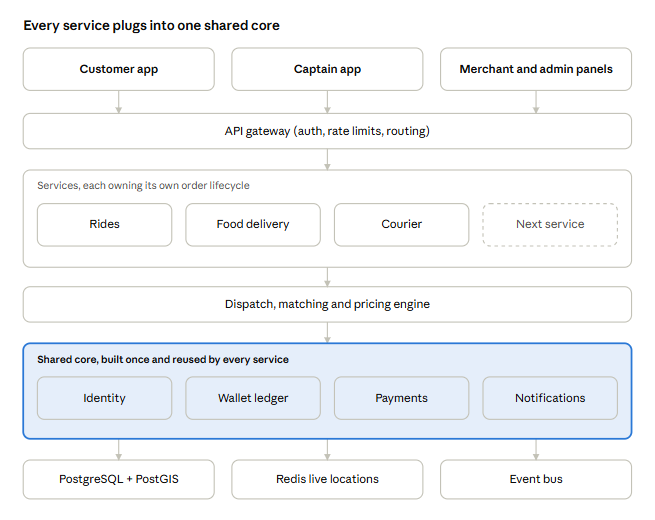
The customer, captain and merchant apps all talk to an API gateway. Behind it, the shared core handles identity, profiles, the wallet ledger, payments and notifications. Each service, such as rides or food delivery, owns its own order lifecycle and talks to a common dispatch and pricing engine. Events like “trip completed” flow over the event bus to payments, ratings and analytics, so a failure in one service does not stop the others.
Start as a modular monolith if the team is small. Splitting into microservices on day one adds deployment and monitoring work that a five-person team rarely needs. Keep clear module boundaries so each service can be pulled out later when traffic justifies it.
How much does it cost to build an app like Careem?
Building an app like Careem costs about USD 30,000 to 50,000 for a single-city ride-hailing MVP, USD 60,000 to 95,000 for a two-service platform with delivery, and USD 150,000 to 300,000 or more for a multi-service super app with a wallet. These figures assume an offshore team and exclude licensing, marketing and running costs.
Scope | What is included | Build cost (USD) |
Single-service MVP | Customer and captain apps (iOS and Android), admin console, one city, card and cash payments, Arabic and English | 30,000 to 50,000 |
Two-service platform | MVP plus food or courier delivery, merchant panel, shared promo system, basic dynamic pricing | 60,000 to 95,000 |
Multi-service super app | Rides, food, grocery, courier, stored-value wallet, loyalty points, subscriptions, partner mini-apps, multi-city operations | 150,000 to 300,000+ |
White-label launch with DeliveryStack | Ready customer, driver, vendor and admin apps, branded and configured for your rules | Quoted per setup |
Assumptions behind these numbers. A blended offshore rate of USD 22 to 28 per hour for a team in India, cross-platform mobile apps, a modular backend, and design, QA and project management included. A US or UK team at USD 100 to 150 per hour would cost roughly four to five times more for the same hours.
What drives the cost up. Building native iOS and Android apps separately, launching several cities with different pricing rules, a regulated stored-value wallet, deep integration with government systems such as RTA taxi dispatch, and AI features such as demand forecasting.
Running costs to budget separately. Cloud hosting, maps and routing API calls, SMS for OTP, payment processing fees, app store fees, monitoring tools, and a support team. Maps and SMS are the two lines that surprise founders most, because both scale with every trip.
For a quick estimate based on your own feature list, try Aalpha’s on-demand app development cost calculator.
Custom build or white-label?
A custom build gives you full control over the product and the code, and suits founders who plan a super app or need features no ready platform offers. The downside is time: four months at minimum before the first trip. A white-label platform gets you to market in weeks and lets you test demand with real orders, but you share a core product with other operators and depend on the vendor’s roadmap. Aalpha Information Systems offers both routes: custom development, and DeliveryStack, a white-label platform for food, courier, ride-hailing and home services that launches in 2 to 4 weeks. Many founders start on DeliveryStack to prove the market, then fund a custom build once the numbers hold.
What licences and regulations apply in the UAE and Saudi Arabia?
In the UAE, ride-hailing in Dubai runs under the Roads and Transport Authority (RTA) as a booked limousine service, and drivers need RTA permits. In Saudi Arabia, the Transport General Authority (TGA) licenses each ride-hailing platform, and driving through these apps is limited to Saudi citizens. Both countries also have personal data protection laws that affect where and how you store user data.
Platform licence. In Dubai, ride-hailing operates through RTA-licensed limousine companies, and taxi booking runs under RTA agreements. In Saudi Arabia, the TGA licenses each app platform, issued to a legal entity for three years. Budget months for approvals, and build fleet-partner accounts into the admin console.
Driver eligibility. Dubai drivers need an RTA professional driver permit and vehicles registered for limousine use. Saudi Arabia limits ride-hailing driving to Saudi nationals and, since early 2026, requires facial verification and an electronic driver registry. The captain app therefore needs document upload, expiry tracking and selfie checks.
Pricing. The RTA sets taxi fares in Dubai, and app bookings of taxis carry a surcharge. In Saudi Arabia, platforms set fares within TGA rules. Your pricing engine must handle regulated and dynamic fares side by side.
Data protection. The UAE applies Federal Decree-Law No. 45 of 2021 (PDPL), and Saudi Arabia applies its Personal Data Protection Law, enforced by SDAIA. Both shape consent flows, data access requests and where you host user data.
Payments and wallets. Stored-value facilities in the UAE need Central Bank of the UAE licensing, and payment services in Saudi Arabia fall under the Saudi Central Bank (SAMA). Start with card payments and add a wallet through a licensed partner.
Rules in this area change often. In 2024 Saudi Arabia had 45 licensed ride-hailing platforms, according to the TGA’s annual report, and the authority has tightened driver checks since then. Confirm current requirements with a local legal adviser before you commit to a launch date. Aalpha Information Systems builds the software side of compliance, such as document workflows, audit logs and consent management, but licensing itself is the operator’s responsibility.
What mistakes should you avoid when building an app like Careem?
The most expensive mistakes are launching too many services at once, underfunding captain and merchant acquisition, skipping Arabic right-to-left design, treating the wallet as a simple feature, and leaving licensing until after the build. Each one either delays launch or burns cash on a service that never reaches enough density to work.
Five mistakes we see most often
Copying Careem’s 2026 scope instead of its 2012 scope. Careem spent eight years on rides before it bundled other services. A new app needs one service that works in one city first.
Spending the whole budget on code. Supply is the hard part. If captains wait 20 minutes between jobs, they leave, and riders then wait too long. Keep at least as much money for captain incentives and merchant onboarding as you spend on the first build.
Bolting on Arabic later. Right-to-left layouts affect every screen, map label and receipt. Retrofitting them after launch usually means redesigning most of the app.
Underestimating the wallet. A wallet is a ledger with refunds, reversals, reconciliation and regulatory reporting. Treat it as its own product and use a licensed partner until volumes justify your own licence.
Ignoring cash. Cash on delivery and cash fares are still common in parts of the GCC, Pakistan and Egypt. Captains collecting cash need settlement, debt tracking and limits in the admin console, or the platform loses money quietly.
A launch plan that works
Start with a closed pilot in one district, measure pickup times and repeat use for four to six weeks, then open the city. Add a second service that reuses the same captains, such as courier deliveries during off-peak ride hours. That raises captain earnings without a second supply network, which is the same logic Careem used when it added delivery.
Why build your Careem-like app with Aalpha Information Systems?
Aalpha Information Systems has built custom web and mobile platforms since 2008, including on-demand, marketplace and fintech products for clients in the US, UK, Gulf and Africa. For founders who want to test a market first, Aalpha’s DeliveryStack platform covers food, courier and ride-hailing out of the box. For founders building a full super app, Aalpha’s mobile app development team designs and builds the shared core and each service on top of it.
Independent client feedback. Aalpha holds a 4.9 out of 5 rating from more than 215 verified reviews on Clutch, where clients comment on delivery against changing requirements.
Process you can audit. Delivery follows an ISO 9001:2015 certified quality process, with fixed milestones, weekly demos and full source code ownership for the client.
Right-sized starting points. Aalpha can scope a single-service MVP first and plan the super app architecture so the second and third services do not require a rebuild.
One honest limitation. Aalpha builds and maintains the software. Licensing, fleet partnerships and on-the-ground operations stay with the operator, so you will still need a local legal and operations team in each market.
Your next step
Share your launch city, first service and target timeline through Aalpha’s contact page. You will get a scoped estimate with a recommended route, custom build or DeliveryStack, and a phased plan for adding services.
Frequently asked questions
How long does it take to build an app like Careem?
A single-city ride-hailing or delivery MVP takes about 14 to 18 weeks. A two-service platform takes 6 to 8 months, and a full super app with a wallet and partner services takes 12 to 18 months. A white-label platform such as DeliveryStack can launch in 2 to 4 weeks.
What is a Careem clone app?
A Careem clone app is a ready-made or custom-built platform that copies Careem’s core flows: booking rides or ordering food, matching with a captain, live tracking and in-app payment. Ready clones launch fast but are hard to differentiate. A custom build costs more and takes longer, but you own the product and the code.
Should I start with rides or delivery?
Start with whichever service you can supply fastest in your city. Rides need licensed captains and, in Saudi Arabia, Saudi national drivers. Delivery needs restaurants or stores and riders, and often faces lighter transport licensing. Many founders start with delivery and add rides once the captain network exists.
Can one app offer services owned by different companies?
Yes. Careem shows this today: the ride-hailing business is owned by Uber while the super app belongs to Careem Technologies, yet both run inside one app. Technically this needs a shared identity and payment layer with clear APIs, so each service can be operated, or even owned, separately.
Do I need a payments licence to add a wallet?
Usually yes, if the wallet holds stored value. In the UAE that falls under the Central Bank of the UAE, and in Saudi Arabia under SAMA. Most new apps start with card and Apple Pay payments, then add a wallet through a licensed partner before seeking their own licence.
Which tech stack is best for an app like Careem?
A practical stack is React Native or Flutter for the mobile apps, Next.js for the admin and merchant panels, Node.js with NestJS for the backend, PostgreSQL with PostGIS for data, Redis for live captain locations, and Google Maps or Mapbox for routing. The architecture matters more than any single tool.
How much does it cost to maintain an app like Careem?
Plan for ongoing development and maintenance at roughly 15% to 25% of the initial build cost per year, plus usage-based costs for cloud hosting, maps, SMS and payment fees. Usage costs grow with every trip, so model them per order, not per month.