





Food delivery app development has become an important investment for restaurants, cloud kitchens, food startups, grocery businesses, and entrepreneurs planning to enter the online food ordering market. A food delivery app is no longer just a digital menu with a payment option. It is a complete business system that connects customers, restaurants, delivery partners, and platform owners through a single technology platform. From browsing food items to placing orders, tracking delivery, processing payments, managing restaurant menus, assigning delivery partners, and handling refunds, every part of the food ordering journey depends on a well-built digital infrastructure.
What is a Food Delivery App?
A food delivery app is a mobile or web-based platform that allows customers to order food from restaurants, cafés, cloud kitchens, bakeries, grocery stores, or local food vendors. The customer uses the app to search for restaurants, view menus, compare prices, add food items to the cart, make payments, and track the order in real time. On the other side, restaurants receive orders through a restaurant panel or merchant app, accept or reject orders, update preparation status, manage menu availability, and view earnings.
Delivery partners use a separate rider app to receive delivery requests, navigate to the restaurant, confirm pickup, deliver the order to the customer, and track earnings. The platform owner manages the complete business through an admin dashboard, which includes restaurant onboarding, customer management, rider management, commission settings, payment settlements, delivery zones, promo codes, support tickets, refunds, and business reports. This makes a food delivery app a multi-sided platform where every user role needs a separate interface and a smooth workflow.
Why Food Delivery Apps Are in High Demand
Food delivery apps are in high demand because they solve real problems for both customers and restaurants. Customers prefer the convenience of ordering food from home, office, hotels, student accommodation, or while travelling without calling restaurants manually. They can compare restaurants, check ratings, view estimated delivery time, use coupons, pay online, and track the delivery partner live on the map. This quick ordering experience has made food delivery apps a regular part of consumer behavior across the US, UK, Europe, and the Middle East.
Restaurants also benefit from food delivery apps because they get access to a larger customer base without depending only on dine-in traffic. Independent restaurants, cafés, takeaway outlets, home kitchens, and cloud kitchens can list their menus online, receive more orders, manage digital payments, and use promotions to attract repeat customers. Increased smartphone usage, faster internet access, digital payments, GPS-based tracking, and consumer comfort with app-based services have further pushed the growth of online food delivery. For platform owners, the model offers several revenue opportunities through restaurant commissions, delivery fees, subscriptions, advertising, featured listings, and data-driven business insights.
What This Guide Covers
This guide explains everything businesses need to know about food delivery app development before building a custom platform. By the end of this guide, you’ll understand how to choose the right food delivery app development company to build a scalable, secure, and user-friendly platform.
Whether you are a restaurant owner planning to launch your own ordering app, a cloud kitchen brand looking to expand online, or a startup planning to build an app like Uber Eats, DoorDash, Deliveroo, Just Eat, Glovo, Talabat, or Careem Food, this guide will help you understand the technical and business requirements involved in building a successful food delivery app.
How Food Delivery Apps Work
A food delivery app works through a connected digital workflow between four main participants: the customer, the restaurant, the delivery partner, and the platform admin. Each participant uses a separate interface, but all actions are managed through the same backend system. When a customer places an order, the restaurant receives it instantly, the system assigns a delivery partner, the order status is updated in real time, and the admin can monitor the complete process from a central dashboard. This structure allows food delivery platforms to handle ordering, preparation, delivery, payments, commissions, refunds, and customer support without manual coordination at every step.
-
Customer Places an Order
The process begins when a customer opens the food delivery app and browses available restaurants, cafés, cloud kitchens, or takeaway outlets in their delivery area. The app usually shows restaurant names, cuisine types, ratings, estimated delivery time, delivery charges, offers, and food categories. Customers can search for a specific dish, filter restaurants by cuisine or rating, view popular items, check item descriptions, select add-ons, and add food items to the cart.
Once the customer finalizes the cart, the app calculates the item total, taxes, delivery fee, platform fee, discounts, and final payable amount. Customers may apply promo codes, wallet balance, loyalty points, or restaurant-specific offers before checkout. After confirming the delivery address and payment method, the order is placed. The customer then receives live order updates, such as order accepted, food being prepared, rider assigned, picked up, and delivered.
-
Restaurant Accepts and Prepares the Order
After the order is placed, the restaurant receives an instant alert on its restaurant panel, merchant app, or order management dashboard. The restaurant can review the order details, including item names, quantity, add-ons, special instructions, customer notes, and payment status. The restaurant then accepts or rejects the order based on item availability, kitchen capacity, operating hours, and preparation workload.
Once accepted, the restaurant updates the preparation time so the customer and delivery partner can see a more accurate estimated delivery time. The restaurant panel also allows staff to manage menu items, update prices, mark items as unavailable, add new dishes, pause ordering during rush hours, and manage offers. As the kitchen prepares the order, the status can be updated from accepted to preparing, ready for pickup, and handed over to the delivery partner. These updates help reduce confusion between customers, riders, restaurants, and support teams.
-
Delivery Partner Picks Up and Delivers
The delivery workflow begins when the system assigns a delivery partner to the order. Rider assignment can be based on distance from the restaurant, rider availability, current workload, delivery zone, vehicle type, performance score, or smart dispatch logic. Once a delivery partner accepts the request, the rider app shows pickup location, customer location, restaurant contact details, order value, payment mode, and route directions.
The delivery partner travels to the restaurant using integrated map navigation. After reaching the restaurant, the rider confirms pickup through the delivery partner app. In some platforms, pickup confirmation may include an order code, QR scan, photo proof, or restaurant handover confirmation. Once the food is picked up, the customer can track the rider’s live location on the map. The app may also show estimated arrival time, rider name, contact option, and delivery status. After reaching the customer’s address, the rider completes the order through doorstep delivery, cash collection if applicable, delivery confirmation, OTP verification, or photo proof.
-
Admin Manages the Full Platform
The admin dashboard is the control center of the food delivery platform. It allows the platform owner or operations team to monitor orders, customers, restaurants, delivery partners, payments, commissions, refunds, delivery zones, offers, and reports from one place. Admins can approve new restaurants, verify delivery partners, manage customer accounts, define service areas, set commission rates, configure delivery fees, create promotional campaigns, and track overall business performance.
The admin panel also helps manage exceptions and support issues. For example, if an order is delayed, cancelled, refunded, assigned to the wrong rider, or affected by payment failure, the support team can review the order history and take action. Reports help the business understand order volume, revenue, restaurant performance, delivery partner productivity, customer retention, cancellation rate, refund value, and high-demand locations. Without a strong admin system, it becomes difficult to manage food delivery operations at scale, especially when the platform expands to multiple cities, restaurant categories, and delivery zones.
Types of Food Delivery Apps
Food delivery app development can follow different business models depending on who owns the food, who manages the restaurants, who handles delivery, and how revenue is generated. Some apps are built for a single restaurant brand, while others work as large marketplace platforms where many restaurants sell through one app. Some food delivery platforms focus only on logistics, while cloud kitchen apps operate food brands without traditional dine-in locations. Before starting development, businesses need to choose the right app type because it directly affects the features, user panels, technology stack, cost, revenue model, and operational complexity.
-
Restaurant-Owned Food Delivery App
A restaurant-owned food delivery app is built for a single restaurant, café, bakery, takeaway outlet, cloud kitchen, or food brand. In this model, the business owns the menu, brand identity, customer relationship, pricing, offers, and order experience. Customers use the app to browse the restaurant’s menu, place orders, make payments, schedule delivery or pickup, apply loyalty rewards, and track the order if delivery is available.
This type of app is useful for restaurants that want to reduce dependency on third-party delivery marketplaces and build direct customer relationships. Large restaurant chains, premium dining brands, fast-food outlets, coffee shops, and independent food businesses often use this model to control commissions, customer data, promotions, and repeat orders. A restaurant-owned app usually includes a customer app or website, restaurant order panel, payment gateway, menu management, coupon system, loyalty program, delivery tracking, and admin dashboard. Delivery may be handled by the restaurant’s own staff, a third-party logistics provider, or local courier partners.
-
Aggregator Food Delivery App
An aggregator food delivery app is a marketplace-style platform where multiple restaurants, cafés, takeaway outlets, bakeries, and cloud kitchens list their menus and accept orders from customers. This model is similar to platforms such as Uber Eats, DoorDash, Deliveroo, Just Eat, Glovo, Talabat, and Careem Food, where users can compare several food options within one app.
In an aggregator app, customers can search restaurants by cuisine, rating, price, distance, delivery time, offers, and food categories. Restaurants get access to a larger customer base, while the platform earns revenue through commissions, delivery charges, sponsored listings, advertising, subscriptions, and service fees. This model requires multiple panels, including a customer app, restaurant panel, delivery partner app, and admin dashboard. It also needs strong backend logic for restaurant onboarding, menu management, order routing, rider assignment, payments, commissions, settlements, refunds, support, reviews, and reports.
Aggregator apps are more complex and expensive to build than single-restaurant apps because they manage many businesses, users, delivery partners, locations, and transaction flows at the same time. However, they also offer greater scalability and revenue opportunities when supported by strong operations and a reliable restaurant network.
-
Delivery-Only Food App
A delivery-only food app focuses on logistics rather than owning restaurants or food inventory. In this model, the platform helps restaurants deliver orders to customers by providing delivery partners, route tracking, pickup management, and delivery confirmation. Restaurants may receive orders from their own website, phone calls, social media, point-of-sale systems, or third-party ordering platforms, while the delivery-only app manages the pickup and delivery process.
This model is useful for restaurants that already have customer demand but do not want to hire and manage their own delivery staff. The app owner earns through delivery fees, subscription plans, per-order logistics charges, or business contracts with restaurants. A delivery-only platform usually needs restaurant-side pickup request tools, rider apps, dispatch management, route optimization, proof of delivery, payment collection options, and admin reporting. It may not need a full customer-facing food marketplace if the restaurant handles ordering separately.
-
Cloud Kitchen Food Delivery App
A cloud kitchen food delivery app is built for food businesses that operate without a traditional dine-in restaurant. Cloud kitchens, also called virtual kitchens or delivery-only kitchens, prepare food in centralized kitchen spaces and sell only through online ordering channels. These businesses may run one brand or multiple food brands from the same kitchen infrastructure.
A cloud kitchen app helps customers browse menus, order food, pay online, track delivery, and reorder favorite meals. On the business side, the platform manages kitchen operations, menu availability, preparation time, brand-wise orders, delivery coordination, customer feedback, and sales reports. This model is highly suitable for startups and food entrepreneurs because it can reduce front-of-house costs such as dining space, interiors, serving staff, and premium retail locations. However, success depends heavily on strong food quality, delivery speed, digital marketing, repeat orders, and location-based demand planning.
Cloud kitchen apps may be single-brand or multi-brand. A single-brand app focuses on one food identity, while a multi-brand cloud kitchen platform may operate separate brands for burgers, pizza, desserts, healthy meals, beverages, or regional cuisines from the same kitchen.
-
Grocery and Food Combo App
A grocery and food combo app is a hybrid platform that allows customers to order cooked meals, snacks, beverages, packaged foods, groceries, bakery items, fresh produce, frozen foods, and local essentials from one app. This model combines food delivery and grocery delivery into a broader convenience platform.
The main advantage of this model is higher order frequency. Customers may use the app for lunch, dinner, snacks, household grocery needs, breakfast items, beverages, or emergency essentials. For businesses, this creates multiple revenue streams through restaurant commissions, grocery vendor commissions, delivery fees, convenience fees, subscriptions, and sponsored product placements.
A grocery and food combo app requires more complex catalog and inventory management than a standard food delivery app. Food orders are usually prepared on demand, while grocery items depend on stock availability, quantity, product variants, expiry dates, substitutions, and store-level inventory. The platform must support different seller types, delivery rules, product categories, tax settings, packaging requirements, refund policies, and delivery time slots. This model is ideal for businesses planning to build a wider local commerce platform rather than a food-only ordering app.
Food Delivery App Business Models
Choosing the right business model is one of the most important decisions in food delivery app development. The business model defines how the platform earns revenue, how restaurants are charged, how delivery costs are managed, and how customers are encouraged to place repeat orders. A food delivery app can use one revenue model or combine multiple models depending on the market, customer behavior, restaurant network, and operational capacity. For example, a marketplace-style food delivery platform may earn through restaurant commissions, customer delivery fees, sponsored listings, and subscription plans at the same time. A restaurant-owned app may focus more on direct sales, loyalty programs, and repeat customers. The right model should support both profitability and long-term platform growth.
-
Commission-Based Model
The commission-based model is one of the most common revenue models for food delivery marketplaces. In this model, the platform charges restaurants a fixed percentage or agreed fee on every successful order. When a customer places an order through the app, the restaurant receives the order value after deducting the platform commission, payment gateway charges, applicable taxes, and any other agreed service fees.
This model works well for aggregator platforms because restaurants pay only when they receive orders. It reduces upfront risk for restaurants and gives them access to a larger customer base. For the platform owner, commission revenue increases as order volume grows. However, commission rates must be planned carefully. If the commission is too high, restaurants may increase menu prices or become less interested in using the platform. If the commission is too low, the platform may struggle to cover technology, marketing, support, and delivery operations. A balanced commission structure helps maintain strong restaurant participation while creating predictable revenue for the app owner.
-
Delivery Fee Model
The delivery fee model allows the platform to charge customers for bringing food from the restaurant to their doorstep. Delivery charges can be fixed, distance-based, zone-based, order-value-based, or dynamic based on demand. For example, shorter-distance orders may have a lower delivery fee, while longer-distance orders may cost more because they require additional rider time, fuel, and operational effort.
Some platforms also use peak-hour delivery fees during lunch, dinner, weekends, holidays, bad weather, or high-demand periods. Delivery fees may also vary by city, neighborhood, restaurant location, rider availability, or customer subscription status. This model helps the platform recover logistics costs and maintain delivery partner earnings. However, delivery pricing must remain transparent. Customers should clearly see the delivery fee, taxes, platform fee, discount, and final payable amount before placing the order. Hidden or confusing charges can reduce trust and increase cart abandonment.
-
Subscription Model
The subscription model helps food delivery platforms generate recurring revenue from customers, restaurants, or delivery partners. Customer subscription plans may include benefits such as free delivery, reduced delivery fees, priority support, exclusive discounts, loyalty rewards, or special access to selected restaurants. This model encourages repeat ordering and improves customer retention because users are more likely to order frequently after paying for a membership.
Restaurants may also pay monthly or yearly subscription fees for premium listing, advanced analytics, better visibility, reduced commission, promotional tools, or access to business reports. Delivery partners may use subscription-based access in some business models where they receive premium order visibility, insurance-related benefits, training access, or platform tools. The subscription model works best when the benefits are clear and valuable. A weak subscription plan with limited savings or unclear advantages may fail to attract long-term users.
-
Advertising and Featured Listings
Advertising and featured listings create additional revenue opportunities for food delivery apps, especially when the platform has strong traffic and active restaurant participation. Restaurants can pay to appear higher in search results, get featured on the homepage, promote specific dishes, run banner ads, or appear in recommended restaurant sections. Sponsored placements are useful for new restaurants, seasonal campaigns, cloud kitchens, and food brands that want more visibility.
This model can be highly profitable because it does not always require additional delivery or operational cost. The platform already has customer traffic, and restaurants pay for better exposure inside the app. However, sponsored listings should be managed carefully. If paid listings completely dominate organic results, customers may lose trust in the app’s recommendations. A good food delivery platform balances paid promotions with relevance, ratings, delivery speed, cuisine preference, and customer location. This keeps the ordering experience useful while still creating advertising revenue.
-
Cloud Kitchen Brand Model
In the cloud kitchen brand model, the app owner operates one or more food brands and sells directly to customers through the platform. Instead of only connecting customers with third-party restaurants, the business also becomes a food seller. This model can offer higher margins because the platform controls the menu, pricing, kitchen process, packaging, promotions, and customer experience.
A cloud kitchen brand can run from a delivery-only kitchen without dine-in space. The same kitchen may operate multiple virtual brands, such as burgers, pizza, desserts, healthy meals, breakfast items, or beverages. Since these brands are sold mainly online, the app plays a central role in customer acquisition, ordering, payments, delivery tracking, reviews, and repeat purchases.
This model requires stronger operational control than a pure marketplace. The business must manage food quality, kitchen staff, inventory, packaging, hygiene standards, delivery speed, customer complaints, and demand forecasting. However, it gives the app owner more control over margins and brand loyalty. Many food delivery businesses combine this model with marketplace operations, allowing third-party restaurants on the platform while also selling their own cloud kitchen brands directly to customers.
Key Panels Required in a Food Delivery App
A food delivery app is not a single application used by one type of user. It is a connected platform with different panels for customers, restaurants, delivery partners, admins, and sometimes franchise or regional managers. Each panel has a different purpose, but all panels must work together through the same backend system. When a customer places an order, the restaurant must receive it instantly, the delivery partner must get the pickup request, the admin must be able to monitor the transaction, and the platform must record payments, commissions, delivery status, and support history. This is why food delivery app development requires careful planning for every user role.
-
Customer App
The customer app is the main ordering interface used by people who want to browse restaurants and place food orders. It should allow users to create an account, add delivery addresses, search restaurants, view menus, filter by cuisine, check ratings, compare delivery time, and view available offers. A clean menu layout is important because customers should be able to view item names, descriptions, prices, add-ons, portion options, images, and availability without confusion.
The cart and checkout flow should be simple and transparent. Customers should be able to add or remove items, apply coupons, use wallet balance or loyalty points, select delivery or pickup, choose a payment method, and review the final amount before placing the order. After the order is confirmed, the app should show real-time order status and delivery tracking. Order history, reorder options, ratings, reviews, refund requests, help center access, and customer support are also important for improving repeat usage and customer trust.
-
Restaurant Panel
The restaurant panel allows restaurants, cafés, takeaway outlets, bakeries, and cloud kitchens to manage their online food orders. When a customer places an order, the restaurant receives an alert with item details, quantity, add-ons, payment mode, customer instructions, and delivery or pickup information. The restaurant can accept or reject the order, update preparation time, mark the order as being prepared, and confirm when it is ready for pickup.
Menu management is one of the most important parts of the restaurant panel. Restaurant staff should be able to add new items, update prices, change descriptions, upload food images, create categories, manage add-ons, mark items as unavailable, and pause orders during busy hours. The panel should also support offers, discounts, packaging charges, tax settings, and operating hours. Earnings reports help restaurants track completed orders, cancelled orders, commission deductions, payouts, refunds, and sales performance over time.
-
Delivery Partner App
The delivery partner app is built for riders or drivers who pick up food from restaurants and deliver it to customers. It should allow delivery partners to complete onboarding, upload required documents, set availability status, and go online or offline based on their working hours. Once online, the delivery partner can receive order requests with pickup location, drop location, distance, expected earnings, payment type, and order instructions.
After accepting an order, the app should provide route navigation to the restaurant and then to the customer’s address. Pickup confirmation may include a button, OTP, QR scan, or restaurant handover confirmation. Delivery proof can include customer OTP, photo proof, digital signature, or completed delivery status. The app should also show earnings, incentives, completed deliveries, cash collection records, payout history, support access, and performance information. A reliable delivery partner app helps reduce delays, missed pickups, and delivery disputes.
-
Admin Dashboard
The admin dashboard is the control center of the food delivery platform. It allows the business owner or operations team to manage users, restaurants, delivery partners, orders, payments, commissions, payouts, refunds, reports, and support tickets from one place. Admins can approve restaurant registrations, verify delivery partners, manage customer accounts, define delivery zones, create promo codes, set commission rates, and monitor live orders.
A strong admin dashboard is essential for managing disputes and operational issues. For example, if an order is delayed, cancelled, refunded, or marked incorrectly, the support team can check the complete order history and take action. The dashboard should also include reports for revenue, order volume, restaurant performance, delivery partner activity, cancellation rate, customer retention, payment status, and high-demand locations. These insights help platform owners improve pricing, marketing, restaurant onboarding, and delivery planning.
-
Super Admin or Franchise Panel
Larger food delivery platforms may need a super admin or franchise panel for multi-city, multi-brand, or region-level operations. This panel is useful when the platform operates in multiple locations, works with franchise partners, or manages several food brands under one system. A super admin can oversee all cities and regions, while franchise or regional managers may only access the data and operations assigned to their location.
This panel can include city-wise restaurant management, brand-wise reports, regional commission settings, local delivery zones, franchise earnings, staff permissions, marketing campaigns, and performance dashboards. For businesses planning to expand across the US, UK, Europe, or the Middle East, this type of role-based control is important. It helps the platform grow without giving every manager access to the entire business system.
Must-Have Food Delivery App Features
The success of a food delivery app depends heavily on the quality of its features and how smoothly those features work together. A food delivery platform must support customers, restaurants, delivery partners, admins, and support teams at the same time. If one part of the system is weak, the complete order flow can suffer. For example, customers may abandon the app if checkout is slow, restaurants may miss orders if alerts are unreliable, delivery partners may face delays if route navigation is poor, and admins may struggle if payments, commissions, or refunds are not clearly tracked. A well-planned food delivery app should include the core features required for ordering, restaurant management, delivery operations, payments, tracking, support, and reporting.
-
Customer App Features
The customer app should make food ordering simple, fast, and transparent. Signup and login are the first steps, and users should be able to register using email, mobile number, social login, or OTP-based authentication. Once logged in, customers should be able to add multiple delivery addresses, choose their current location, and view restaurants available in their service area. Restaurant search is a must-have feature because users often look for specific restaurants, cuisines, dishes, ratings, offers, or delivery times.
Menu browsing should be clear and user-friendly. Customers should be able to view food categories, item descriptions, images, prices, preparation notes, add-ons, customization options, and item availability. Filters can help users narrow results by cuisine, price range, rating, delivery time, vegetarian or non-vegetarian options, dietary preferences, discounts, and restaurant type. A smooth cart system is equally important. Users should be able to add items, change quantities, select add-ons, apply promo codes, use wallet balance, review taxes and fees, and confirm the final amount before payment.
Real-time order tracking is one of the most important customer-facing features. After placing an order, customers should receive status updates such as order placed, accepted, preparing, ready for pickup, rider assigned, picked up, and delivered. Live map tracking, estimated delivery time, rider details, and push notifications improve confidence during the delivery process. The customer app should also include order history, reorder options, ratings, restaurant reviews, refund requests, cancellation options, invoice access, saved payment methods, loyalty rewards, and customer support access.
-
Restaurant Panel Features
The restaurant panel helps restaurants manage incoming orders and online menu operations. Order alerts must be fast and reliable because restaurants need to accept orders quickly and start preparation on time. Each order should show customer instructions, item details, quantity, add-ons, payment status, delivery type, and expected pickup time. Restaurants should be able to accept, reject, or update orders from the panel. They should also be able to set preparation time so customers and delivery partners receive realistic updates.
Menu management is a core feature for every restaurant panel. Restaurant staff should be able to add new items, edit prices, update descriptions, upload images, create categories, manage add-ons, and mark items as available or unavailable. This is especially important for restaurants that sell limited-time dishes, seasonal menus, daily specials, or items that may run out during peak hours. Pricing and tax settings should also be flexible enough to support different item categories, packaging fees, service charges, and local compliance requirements.
Restaurant panels should include offer management so restaurants can create discounts, promotional deals, meal combos, free delivery campaigns, or limited-time coupons. Earnings and settlement reports help restaurants track completed orders, cancelled orders, refunds, commission deductions, taxes, payment gateway charges, and final payout amounts. Customer reviews and ratings should also be visible so restaurants can understand feedback, improve service quality, and respond to issues where needed.
-
Delivery Partner App Features
The delivery partner app is used by riders or drivers who accept food delivery requests, pick up orders, and complete doorstep deliveries. The app should include KYC and onboarding features so delivery partners can submit identity documents, driving license details, vehicle information, insurance documents, bank details, and other verification records required by the platform. Once approved, delivery partners should be able to set their availability status as online or offline.
Order request management is the main workflow in the delivery partner app. When a new order is assigned, the delivery partner should see pickup location, delivery location, distance, expected earnings, payment type, restaurant details, customer address, and order instructions. The app should allow the rider to accept or reject requests based on availability and platform rules. After accepting, the route map should guide the delivery partner to the restaurant and then to the customer’s delivery address.
Pickup confirmation is important to prevent order confusion. The app can support confirmation through a button, OTP, QR code, restaurant approval, or order ID verification. Delivery proof is equally important and may include customer OTP, photo proof, digital signature, or completed delivery status. The app should also include earnings history, incentives, completed trips, cash collection records, payout details, support access, cancellation reasons, and emergency contact options. A well-built delivery partner app helps reduce delivery delays, wrong handovers, and payment disputes.
-
Admin Dashboard Features
The admin dashboard is the operational backbone of the food delivery platform. It gives the platform owner and internal team full control over users, restaurants, delivery partners, orders, payments, commissions, refunds, reports, and support. Dashboard analytics should show key business metrics such as total orders, revenue, active users, restaurant performance, delivery partner activity, average delivery time, cancellation rate, refund value, payment status, and high-demand areas.
Restaurant approval is an important admin feature because every restaurant must be verified before going live on the platform. Admins should be able to review restaurant documents, business details, menu quality, service areas, tax information, bank details, and commission agreements. Customer management allows the admin team to view user accounts, order history, complaints, refunds, wallet balances, loyalty points, and account status. Rider management helps admins verify delivery partners, assign service zones, review performance, track availability, and handle payout records.
Payment management is another essential feature. The admin dashboard should track online payments, cash orders, failed payments, refunds, restaurant settlements, rider payouts, commission deductions, taxes, and platform earnings. Commission settings should be flexible, allowing different rates for restaurants, cities, categories, or campaigns. Reports should help the business understand growth, customer behavior, restaurant performance, delivery efficiency, and revenue trends. Dispute handling tools are also required so admins can manage delayed orders, missing items, wrong deliveries, refund claims, customer complaints, and restaurant-side issues.
-
Support and Communication Features
Support and communication features help reduce friction between customers, restaurants, delivery partners, and platform teams. In-app chat allows users to contact support without leaving the app. Some platforms also allow controlled communication between customers and delivery partners for location clarification or delivery instructions. Call masking is useful because it allows phone communication without exposing personal phone numbers. This protects privacy and makes communication safer for both customers and riders.
A ticketing system helps the support team manage complaints in an organized way. Customers may raise tickets for late delivery, wrong items, missing items, damaged packaging, refund delays, payment issues, or rider behavior. Restaurants may raise tickets for payout issues, order disputes, menu problems, or technical errors. Delivery partners may need help with pickup delays, address issues, cash collection problems, app errors, or order reassignment.
Cancellation reasons should be clearly recorded for customers, restaurants, delivery partners, and admins. This helps the platform identify recurring problems such as long preparation times, unavailable items, wrong addresses, rider shortage, or payment failures. Refund management should allow admins to process full refunds, partial refunds, wallet refunds, or payment gateway refunds based on platform policies. Escalation management is also important for serious issues that require senior support, operations review, or manual intervention. Strong support features help protect customer trust and improve the long-term reliability of the food delivery platform.
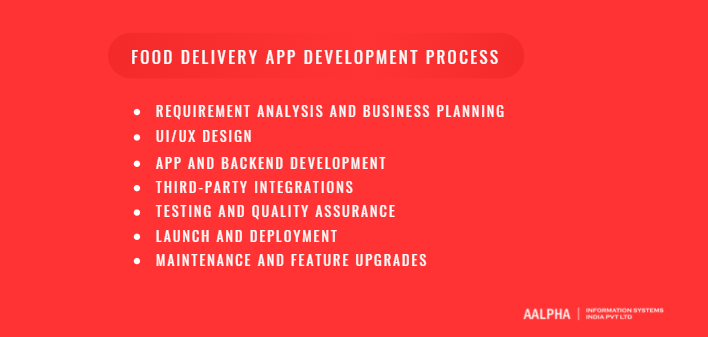
Food Delivery App Development Process
Food delivery app development requires a structured process because the platform has multiple user roles, real-time order flows, payment transactions, delivery tracking, restaurant operations, and admin controls. A simple-looking food ordering app may include several connected systems behind the scenes, including customer apps, restaurant panels, delivery partner apps, backend APIs, databases, payment gateways, map services, notifications, reports, and support workflows. Whether managed internally or developed in collaboration with a mobile app development company, a clear development process helps reduce delays, avoid missing features, and build a platform that can support real business operations after launch.
-
Requirement Analysis and Business Planning
The first step in food delivery app development is requirement analysis and business planning. At this stage, the development team works with the business owner to understand the app idea, target market, customer segment, restaurant network, delivery model, revenue strategy, and launch location. A restaurant-owned app has different requirements from an aggregator platform, while a cloud kitchen app needs different workflows from a delivery-only logistics platform. This is why the business model must be finalized before design and development begin.
The planning stage should define all user roles clearly. Most food delivery platforms need customers, restaurants, delivery partners, admins, support teams, and sometimes franchise or regional managers. Each role requires specific permissions and workflows. The customer places orders, the restaurant accepts and prepares food, the delivery partner picks up and delivers, and the admin manages the full platform. The revenue model should also be documented, including restaurant commissions, delivery fees, subscription plans, advertising, featured listings, service fees, or cloud kitchen sales. A detailed requirement document helps convert the business idea into a clear product roadmap.
-
UI/UX Design
UI/UX design plays a major role in the success of a food delivery app because customers expect the ordering process to be fast and easy. The customer app should have a clear home screen, simple restaurant discovery, strong search functionality, clean filters, well-organized menus, attractive food item pages, and a smooth cart experience. Users should be able to browse restaurants, select items, customize orders, apply coupons, choose payment methods, and place orders without unnecessary steps.
The checkout flow must be especially simple because many users abandon orders when the final payment process feels confusing or slow. The app should clearly show item total, taxes, platform fees, delivery charges, discounts, wallet balance, and final payable amount. Real-time order status and delivery tracking should also be easy to understand.
Restaurant and delivery partner screens need a different design approach. Restaurant panels should help staff accept orders quickly, update preparation time, mark items unavailable, and manage menus without technical difficulty. Rider-friendly screens should be simple, large, and action-focused because delivery partners use them while moving between pickup and drop locations. Clear buttons for accepting orders, starting navigation, confirming pickup, collecting payment, and completing delivery are essential.
-
App and Backend Development
Once the design is approved, the development team starts building the frontend apps, backend system, admin dashboard, database, and APIs. The frontend includes the customer mobile app, delivery partner app, restaurant interface, and sometimes a customer-facing website. Depending on the project, apps may be built using native technologies such as Swift and Kotlin or cross-platform frameworks such as Flutter or React Native.
The backend is the core system that handles user accounts, restaurant listings, menus, order processing, payments, commissions, rider assignment, delivery tracking, refunds, notifications, and reports. APIs connect the frontend apps with the backend database and third-party services. The admin dashboard is usually built as a secure web application where the platform team can manage users, restaurants, delivery partners, orders, payments, disputes, offers, and analytics.
The database stores customer profiles, restaurant details, menu items, order records, payment status, delivery history, addresses, reviews, payout data, and support tickets. Since food delivery apps handle real-time operations, backend performance and database structure must be planned carefully from the beginning.
-
Third-Party Integrations
Third-party integrations help a food delivery app provide important services without building every function from scratch. Payment gateway integration allows customers to pay through cards, wallets, bank transfers, and local digital payment methods depending on the target market. SMS or OTP integrations are used for login verification, phone number confirmation, delivery codes, and important order alerts.
Push notification services help send real-time updates about order confirmation, preparation status, rider assignment, pickup, delivery, offers, refunds, and support messages. Map integrations are used for address selection, restaurant location, rider navigation, delivery tracking, distance calculation, and estimated delivery time. Analytics tools help track user behavior, app usage, conversion rates, order patterns, and marketing performance.
Some food delivery platforms may also need CRM integrations for customer engagement, support ticketing integrations for complaint handling, delivery APIs for third-party logistics, accounting integrations for settlements, and marketing tools for email, push, or in-app campaigns. These integrations should be selected based on the app’s business model and launch region.
-
Testing and Quality Assurance
Testing is one of the most important stages in food delivery app development because the platform must work correctly across many real-time scenarios. Functional testing checks whether every feature works as expected, including signup, login, restaurant search, menu browsing, cart, promo codes, order placement, payment, order acceptance, rider assignment, tracking, cancellation, refund, ratings, and support.
Payment testing is critical because even a small failure can lead to customer complaints, duplicate charges, failed orders, or settlement issues. The development team should test successful payments, failed payments, refunds, partial refunds, wallet payments, cash orders, and payment status updates. Order flow testing should cover the complete journey from customer checkout to restaurant acceptance, food preparation, rider pickup, delivery confirmation, and order completion.
Load testing helps check whether the system can handle high traffic during lunch hours, dinner hours, weekends, holidays, or marketing campaigns. GPS testing is needed to verify location accuracy, live tracking, route updates, distance calculation, and estimated delivery time. Security testing should cover secure login, API protection, role-based access, payment security, data privacy, and protection against unauthorized access.
-
Launch and Deployment
After testing is complete, the app is prepared for launch and deployment. The customer app and delivery partner app are submitted to the Apple App Store and Google Play Store with proper app descriptions, screenshots, privacy policies, support details, and compliance information. If the platform includes a restaurant web panel, admin dashboard, or customer website, the development team sets up the domain, hosting environment, SSL certificate, database, backend server, and required production configurations.
Server monitoring, error tracking, analytics, payment gateway production keys, SMS settings, push notification certificates, and map API keys must be configured before launch. A controlled initial rollout is often better than launching at full scale immediately. Businesses can start with one city, a limited restaurant group, selected delivery zones, or a smaller customer base to test real-world performance before expanding.
-
Maintenance and Feature Upgrades
Food delivery app development does not end after launch. The platform needs regular maintenance, monitoring, and improvements to stay reliable. Bug fixes are required when users report app crashes, payment issues, tracking errors, order status problems, login failures, or notification delays. App updates are also needed to support new operating system versions, app store requirements, payment gateway changes, and security improvements.
Server monitoring helps identify slow APIs, database issues, traffic spikes, failed jobs, and downtime risks. Performance optimization improves app speed, checkout flow, search results, map loading, and order processing. Payment updates may be required when gateways change APIs, add new payment methods, or update compliance rules.
As the business grows, new features may be added, such as loyalty programs, subscriptions, AI-based recommendations, advanced analytics, restaurant marketing tools, automated rider assignment, multi-city support, scheduled orders, group ordering, and customer segmentation. Continuous improvement helps the app stay competitive and better aligned with customer, restaurant, and delivery partner needs.
Food Delivery App Development Cost
Food delivery app development cost depends on the type of platform, number of user panels, feature complexity, design quality, technology stack, development location, third-party integrations, and post-launch support needs. A simple restaurant-owned ordering app costs less than a full marketplace platform with customer apps, restaurant panels, delivery partner apps, admin dashboards, live tracking, advanced analytics, subscriptions, and multi-city controls. Businesses should avoid looking at food delivery app cost as a single fixed number because every project has different operational requirements. The best approach is to define the app model first, list the required features, decide the launch platform, and then estimate the development budget based on scope.
-
Basic MVP Cost
A basic food delivery app MVP is suitable for startups, restaurants, cloud kitchens, and local delivery businesses that want to launch quickly with essential features. A simple MVP usually includes a customer app or web ordering interface, restaurant panel, delivery partner app, and admin dashboard. The customer app may include signup, restaurant browsing, menu viewing, cart, checkout, payment integration, order status, and basic notifications. The restaurant panel may include order alerts, order acceptance, menu updates, and preparation status. The delivery partner app may include order requests, pickup details, delivery address, navigation, and delivery completion. The admin dashboard may include user management, restaurant management, order monitoring, basic reports, payment records, and commission settings.
The typical cost to build a basic food delivery app MVP can range from $15,000 to $35,000, depending on the development team and feature depth. A restaurant-owned app with fewer roles may fall toward the lower end, while a marketplace MVP with customer, restaurant, rider, and admin panels may cost more. This version is best for validating demand, onboarding early restaurants, testing delivery operations, and collecting real customer feedback before investing in advanced features.
-
Mid-Level Food Delivery App Cost
A mid-level food delivery app includes more polished features and stronger operational controls. This type of app usually includes real-time GPS tracking, estimated delivery time, promo codes, wallet, order history, ratings, reviews, refund requests, push notifications, advanced restaurant management, and detailed reports. The restaurant panel may support item availability, add-ons, taxes, packaging charges, offers, operating hours, customer reviews, and settlement reports. The delivery partner app may include cash collection, earnings history, delivery proof, cancellation reasons, support access, and performance details.
The admin dashboard in a mid-level app is more powerful than an MVP dashboard. It may include live order monitoring, commission rules, restaurant approvals, customer management, rider management, refund handling, payout tracking, promo campaign management, and business analytics. This version is suitable for businesses that want a serious market launch rather than only a prototype. The estimated cost for a mid-level food delivery app usually ranges from $35,000 to $75,000. The final cost depends on whether the app is built for iOS, Android, web, or all platforms, and whether the system uses custom-built features or third-party tools.
-
Advanced Food Delivery App Cost
An advanced food delivery app is built for businesses that want to scale across multiple cities, restaurant categories, delivery zones, brands, or franchise networks. This type of platform may include multi-city management, AI-based restaurant recommendations, personalized food suggestions, subscription plans, loyalty programs, customer segmentation, smart rider assignment, automated dispatch, advanced analytics, scheduled orders, group ordering, role-based permissions, franchise dashboards, and custom automation.
Advanced food delivery platforms also require stronger backend architecture. The system must handle high order volumes, real-time location updates, multiple payment flows, restaurant settlements, rider payouts, refund logic, marketing campaigns, support tickets, and reporting without performance issues. The development cost for an advanced food delivery app can range from $75,000 to $150,000 or more, depending on scale and complexity. Enterprise-level platforms with custom algorithms, large integrations, multi-country support, and high-traffic infrastructure can cost significantly more. This investment is usually suitable for funded startups, restaurant chains, cloud kitchen groups, and established businesses planning long-term expansion.
-
Cost by Development Region
Development cost also changes based on where the development team is located. Teams in India and other South Asian markets often offer more cost-effective development rates, which can make them attractive for startups and SMEs that want custom development within a controlled budget. Eastern European teams are usually priced higher than South Asian teams but may still be more affordable than Western Europe or the USA. Western European and UK-based development companies generally charge higher rates because of local labor costs, operating expenses, and market pricing. US-based development teams are often among the most expensive, especially for custom marketplace platforms, real-time logistics systems, and enterprise-grade app development.
For the same food delivery app, the total cost may vary widely by region because hourly rates, team structure, project management style, and delivery timelines differ. However, businesses should not choose a development partner only based on the lowest price. A poorly built food delivery app can lead to payment failures, order delays, tracking errors, restaurant complaints, customer churn, and expensive rework. The better approach is to compare technical expertise, previous app development experience, communication quality, backend capability, UI/UX skills, and post-launch support.
-
Main Factors That Affect Cost
Several factors directly affect food delivery app development cost. The first factor is feature scope. A simple app with ordering and payment costs less than a platform with live tracking, wallet, subscriptions, loyalty, advanced reports, smart dispatch, and multi-city controls. The second factor is platform choice. Building for Android only costs less than building separate apps for iOS, Android, web, restaurant users, delivery partners, and admins. Cross-platform development using frameworks such as Flutter or React Native can help reduce cost in some cases, while native development may be preferred for performance-heavy applications.
Design complexity also affects cost. A basic template-style design is less expensive than a custom user experience with branded screens, animations, advanced filters, personalized recommendations, and optimized checkout flows. Backend logic is another major cost driver because food delivery apps require order routing, payment handling, commission calculation, rider assignment, delivery tracking, refund logic, and settlement workflows. Third-party APIs such as payment gateways, maps, SMS, push notifications, analytics, CRM, and delivery integrations also add cost. Team size, development timeline, QA effort, security requirements, and maintenance needs further influence the final budget.
-
Hidden Costs to Consider
Many businesses estimate only the initial development cost and forget the hidden costs required to run a food delivery app after launch. App store fees may apply when publishing on Apple App Store and Google Play. Cloud hosting costs are required for backend servers, databases, file storage, backups, and monitoring. SMS and OTP costs can increase as user registrations, order alerts, and delivery confirmations grow. Map APIs may also become expensive when the app handles frequent location searches, distance calculations, route tracking, and live delivery updates.
Payment gateway charges apply to online transactions, refunds, and sometimes settlements. Maintenance costs are also important because apps require bug fixes, operating system updates, payment gateway updates, app store compliance updates, performance optimization, and security patches. Businesses should also budget for security testing, server monitoring, analytics tools, customer support systems, CRM tools, push notification platforms, and marketing technology. A realistic food delivery app budget should include both development and post-launch operating costs. This helps avoid financial surprises and supports smoother growth after the app goes live.
How to Build a Successful Food Delivery App
Building a successful food delivery app requires more than launching customer apps and onboarding restaurants. The platform must solve real ordering, restaurant, delivery, payment, and support problems in a reliable way. Many food delivery startups fail because they try to expand too quickly, offer too many features too early, or underestimate the operational work behind delivery speed and customer satisfaction. A strong food delivery app should begin with a clear market focus, a dependable restaurant network, a simple ordering experience, well-planned delivery operations, and continuous data-driven improvement.
-
Start With a Focused Market
A food delivery business should ideally start with a focused market instead of launching everywhere at once. This may mean starting in one city, one region, one group of neighborhoods, or one specific niche such as office lunches, healthy meals, late-night food, premium restaurants, cloud kitchens, or campus food delivery. A focused launch helps reduce risk because the business can understand customer demand, restaurant readiness, rider availability, delivery distance, order timing, and pricing behavior before scaling.
Starting small also makes operations easier to control. The platform owner can test delivery zones, average preparation time, customer response, restaurant performance, cancellation reasons, and peak-hour demand with lower operational pressure. Once the model works in one market, the same learning can be used to expand into additional cities, restaurant categories, or customer segments. This approach reduces unnecessary spending and helps the business build a stronger foundation before scaling.
-
Build a Strong Restaurant Network
Restaurants are the supply side of a food delivery app, so the quality of the restaurant network directly affects customer acquisition and retention. A food delivery app should onboard restaurants that have consistent food quality, reliable preparation time, clear menus, reasonable pricing, and strong availability during high-demand hours. If customers repeatedly find unavailable items, delayed preparation, poor packaging, or overpriced menus, they may stop using the app even if the technology works well.
Restaurant onboarding should include menu digitization, food images, pricing verification, operating hours, packaging standards, tax details, bank details, commission agreements, and support training. Commission planning should be fair and sustainable for both the platform and restaurants. If commissions are too high, restaurants may raise prices or avoid active participation. If commissions are too low, the platform may struggle to cover support, technology, marketing, and operational costs. A balanced restaurant strategy improves order volume, customer trust, and long-term platform revenue.
-
Keep the Ordering Experience Simple
The customer ordering experience should be fast, clear, and easy to complete. Users should be able to open the app, find restaurants, view menus, add items to the cart, apply offers, choose a payment method, and place orders with minimum friction. Too many steps, unclear item descriptions, slow search results, hidden charges, confusing coupons, or complicated checkout flows can increase cart abandonment.
Clear pricing is especially important. Customers should see item price, taxes, delivery fee, platform fee, discounts, wallet balance, and final payable amount before confirming the order. Real-time tracking also improves customer confidence because users want to know whether the restaurant has accepted the order, when the food is being prepared, when the delivery partner is assigned, and when the order will arrive. A simple and transparent ordering journey helps increase repeat orders and customer satisfaction.
-
Optimize Delivery Operations
Delivery operations are one of the most difficult parts of running a food delivery app. The platform must define delivery zones, assign riders efficiently, manage peak-hour demand, reduce pickup delays, and keep customers informed. Delivery zones should be planned based on restaurant density, order volume, road conditions, rider availability, and average delivery time. Wide delivery zones may increase customer reach, but they can also create longer delivery times and higher logistics costs.
Rider availability must be managed carefully during lunch, dinner, weekends, holidays, and local events. Pickup planning is also important because riders should not wait too long at restaurants or arrive much earlier than the food is ready. Batching can improve delivery efficiency when multiple orders are going in the same direction, but it must be used carefully to avoid late deliveries or poor food quality. Customer communication through status updates, notifications, and support channels helps reduce complaints when delays happen.
-
Use Data to Improve the Platform
A food delivery app should use data continuously to improve customer experience, restaurant performance, and delivery efficiency. Order analytics can show which restaurants, cuisines, dishes, locations, and time slots generate the highest demand. Customer behavior data can reveal repeat ordering patterns, coupon usage, cart abandonment, preferred payment methods, and common support issues.
Restaurant performance reports can help identify preparation delays, cancellation rates, unavailable items, poor ratings, and settlement issues. Delivery metrics can show average pickup time, delivery time, rider acceptance rate, failed deliveries, cash collection issues, and high-delay zones. These insights help the platform make better decisions about restaurant onboarding, pricing, offers, delivery zone planning, rider allocation, and customer retention. Over time, data-driven improvements can make the food delivery app more reliable, profitable, and competitive.
Future Trends in Food Delivery App Development
Food delivery app development is moving beyond basic ordering, payments, and tracking. Customers now expect faster delivery, better recommendations, easier ordering, transparent communication, and more responsible delivery practices. Restaurants and platform owners also need tools that improve kitchen efficiency, delivery planning, customer retention, and profitability. As competition grows across the US, UK, Europe, and the Middle East, future-ready food delivery apps will depend more on AI, automation, hyperlocal operations, sustainability, and connected restaurant technology.
-
AI-Powered Personalization
AI-powered personalization is becoming one of the most important trends in food delivery apps. Instead of showing the same restaurant list to every user, modern platforms can analyze customer behavior and display more relevant food suggestions. The app can study previous orders, cuisine preferences, order timing, spending habits, delivery location, ratings, dietary choices, and abandoned carts to recommend restaurants and dishes that are more likely to convert.
Personalized reorder reminders can also improve repeat sales. For example, if a customer usually orders coffee on weekday mornings, pizza on Friday evenings, or healthy meals during lunch hours, the app can send timely reminders with relevant offers. AI can also help segment customers based on behavior, such as frequent users, discount-driven users, high-value customers, inactive users, or users likely to churn. This allows food delivery businesses to create smarter campaigns instead of sending the same offer to everyone.
-
Voice-Based Ordering
Voice-based ordering is another trend that can make food delivery apps faster and more accessible. Instead of typing dish names or scrolling through long menus, customers can use voice search to find restaurants, repeat previous orders, add items to the cart, or ask for recommendations. This is especially useful when users are multitasking, driving, cooking, working, or using smart home devices.
Smart assistant integrations can also support hands-free ordering. A customer may ask for “a vegetarian dinner nearby,” “my usual coffee order,” or “a family meal under a certain budget,” and the app can return relevant options. Voice ordering can also improve accessibility for users who find typing difficult or prefer conversational search. For businesses, this creates a more natural ordering journey and can reduce friction in repeat purchases.
-
Hyperlocal and Quick Delivery Models
Hyperlocal and quick delivery models are becoming more important as customers expect faster service and more accurate delivery times. Instead of serving very large delivery areas from distant restaurants, food delivery platforms can create smaller local clusters based on restaurant density, customer demand, rider availability, and delivery distance. This improves delivery speed and can reduce logistics costs.
Dark kitchens and delivery-only kitchens support this model because they can be placed closer to high-demand neighborhoods without needing expensive dine-in locations. Local restaurant clusters also help platforms offer faster pickup and shorter delivery routes. However, quick delivery must be planned carefully. Speed should not damage food quality, rider safety, or restaurant operations. A successful hyperlocal model depends on accurate demand forecasting, smart delivery zones, efficient rider allocation, and strong restaurant readiness.
-
Sustainable Delivery
Sustainability is becoming a stronger priority in food delivery app development. Customers, restaurants, and regulators are paying more attention to packaging waste, vehicle emissions, and responsible delivery practices. Food delivery apps can support eco-friendly packaging by allowing restaurants to highlight recyclable, compostable, or reusable packaging options. Platforms can also let customers opt out of disposable cutlery, napkins, or extra packaging when not needed.
EV fleets, bicycles, e-bikes, and low-emission delivery vehicles can help reduce the environmental impact of last-mile delivery. Route optimization also plays an important role because shorter and better-planned routes can reduce fuel use, delivery time, and emissions. Some platforms may also add sustainability filters, green restaurant badges, carbon-conscious delivery options, or reporting dashboards that track low-emission deliveries. These features can improve brand trust while supporting operational efficiency.
-
Automation in Restaurant and Delivery Operations
Automation will continue to shape both restaurant operations and delivery management. Automated dispatching can assign orders to delivery partners based on distance, availability, order priority, traffic, vehicle type, and delivery performance. This reduces manual coordination and helps improve delivery speed. Predictive demand planning can help platforms estimate when and where orders are likely to increase, allowing them to position riders, prepare restaurants, and plan promotions more effectively.
Kitchen display systems can help restaurants manage incoming orders, preparation queues, item status, and pickup timing more efficiently. Instead of relying only on printed receipts or manual communication, kitchen teams can view live order information and update preparation status directly. Chatbot support can handle common customer questions about order status, refunds, cancellations, coupons, and account issues before escalating complex cases to human support.
For larger platforms, automation can also support fraud checks, refund approvals, restaurant performance alerts, rider attendance, payout calculations, customer segmentation, and marketing campaigns. The future of food delivery app development will not be limited to better customer apps. It will also focus on building smarter backend systems that help restaurants, delivery teams, and platform owners operate with greater accuracy, speed, and control.
Why Work With a Food Delivery App Development Company
Building a food delivery app requires more than designing mobile screens and adding an online payment option. A complete food delivery platform must support customers, restaurants, delivery partners, admins, support teams, and sometimes regional or franchise managers. Each user role has a different workflow, and all workflows must connect through a reliable backend system. This is why many startups, restaurants, cloud kitchens, and food marketplace businesses prefer working with a food delivery app development company instead of trying to build the platform with a small internal team or a generic app template.
-
Food Delivery Apps Need More Than Basic App Development
A food delivery app is a real-time business platform. It usually requires a customer app, restaurant panel, delivery partner app, admin dashboard, backend APIs, database, payment gateway, map integration, notification system, reporting module, and support tools. The customer app must allow users to browse restaurants, view menus, place orders, pay online, track delivery, request refunds, and contact support. The restaurant panel must handle order alerts, menu updates, item availability, preparation time, pricing, offers, reviews, and settlement reports.
The delivery partner app needs order acceptance, route navigation, pickup confirmation, delivery proof, cash collection, earnings, and support access. The admin dashboard must manage users, restaurants, riders, payments, commissions, payouts, refunds, reports, delivery zones, and disputes. These systems must work together without delay because food delivery depends on live order status, accurate tracking, fast communication, and reliable payment handling. A development company with food delivery app experience can plan these workflows correctly from the beginning and reduce the risk of technical gaps after launch.
-
Custom Development Helps With Real Operations
Every food delivery business has different operational rules. A restaurant-owned app, an aggregator marketplace, a cloud kitchen platform, and a delivery-only service cannot use the same backend logic. Custom development helps the platform match real business operations instead of forcing the business to adjust to a limited template. For example, the app may need custom delivery zones based on distance, neighborhoods, city boundaries, restaurant clusters, or rider availability. It may need different restaurant commission rates based on category, order value, contract type, or promotional campaigns.
Rider assignment logic also requires careful planning. Some platforms assign the nearest rider, while others consider rider workload, vehicle type, order priority, batching, acceptance rate, or delivery zone. Refund rules, cancellation policies, pricing rules, subscription benefits, wallet usage, restaurant settlements, rider payouts, and tax handling may also vary by market. If the platform plans to expand into multiple cities, it may need city-wise pricing, local restaurant management, regional reports, franchise permissions, and different delivery fee structures. A custom-built food delivery app gives the business more control over these rules and makes future growth easier to manage.
-
Long-Term Support Is Important
Food delivery apps need continuous technical support after launch. Unlike a static website, a food delivery platform handles live orders, payments, map tracking, delivery partner activity, restaurant updates, refunds, and customer support every day. Bugs can directly affect revenue and customer trust. For example, a failed payment update, delayed order notification, wrong rider assignment, or tracking error can create immediate complaints and operational pressure.
Long-term support includes bug fixes, server monitoring, database optimization, app performance improvements, payment gateway updates, map API updates, notification fixes, security patches, and app store compliance updates. Mobile apps also need updates when Apple or Google release new operating system versions or change store policies. As order volume increases, the backend may need performance tuning, load handling improvements, caching, better database queries, and infrastructure scaling. Security support is also important because the platform handles customer data, restaurant records, payment information, and delivery partner details. A reliable development partner can continue improving the app after launch and help the business add new features when needed.
-
Working With Aalpha Information Systems
Businesses planning to build a food delivery app can work with experienced software development companies such as Aalpha Information Systems, especially when the project requires branded mobile apps, backend development, restaurant panels, delivery partner apps, real-time tracking, payment integration, admin dashboards, and long-term technical support. Aalpha can help businesses build custom food delivery platforms based on their operating model, whether the goal is to launch a restaurant-owned ordering app, a cloud kitchen platform, a delivery-only logistics app, or a multi-restaurant marketplace.
The advantage of working with a custom development team is that the platform can be planned around the business model, target market, delivery rules, restaurant onboarding process, revenue strategy, and future expansion plans. Instead of depending on a rigid ready-made solution, businesses can build a food delivery app that supports their brand, workflows, customer experience, reporting needs, and long-term growth. For restaurants, startups, cloud kitchens, and food delivery companies, the right development partner can reduce technical risk and provide the support needed to keep the platform stable after launch.
Conclusion
Food delivery app development is a strong business opportunity for restaurants, cloud kitchens, startups, and enterprises that want to serve customers through fast, convenient, and digital-first ordering experiences. However, building a successful platform requires more than a basic mobile app. It needs customer apps, restaurant panels, delivery partner apps, admin dashboards, secure payments, real-time tracking, order management, reports, support tools, and a scalable backend system.
The right approach is to start with a clear business model, define the required features, plan delivery operations carefully, and build a platform that can grow with customer demand. Whether the goal is to launch a single-restaurant app, a cloud kitchen platform, a delivery-only service, or a multi-restaurant marketplace, custom development helps create a solution that matches real business workflows.
If you are planning to build a food delivery app, connect with Aalpha Information Systems to discuss your idea. Our team can help you design and develop a custom food delivery platform with branded mobile apps, restaurant panels, delivery partner apps, real-time tracking, payment integration, admin dashboards, and long-term technical support.