






TL;DR: how to hire dedicated AI developers
Hiring dedicated AI developers means engaging engineers who work on your product full time, under your direction, for as long as the project needs them. The process that works is the same across engagement models. Define the business problem and a measurable result first, then match developer skills to the type of AI solution you are building, whether that is a language model integration, a retrieval system, a prediction model or an automation agent. Compare dedicated teams against freelancers and in-house hiring on control, continuity and who is accountable for delivery. Judge candidates by production work they can explain in detail and by a short paid assessment, not by CV keywords. Agree on code ownership, data handling, security and support terms in writing before anyone gets repository access. Start with one milestone of four to six weeks, review it against the success metric you set, and expand the team only when that milestone shows evidence. The main downside of the dedicated model is that you pay for capacity whether or not the backlog is full, so it suits ongoing AI work and wastes money on a one-off experiment. Aalpha Information Systems provides dedicated AI developers and teams for businesses that want to build or integrate AI features, and its engagement options are covered later in this guide.
What are dedicated AI developers?
Dedicated AI developers are engineers who build and maintain AI features for one client, working on that client’s roadmap for an agreed period at a fixed monthly cost. You direct the work and own the output, while the provider or employer handles hiring, payroll and equipment. They differ from freelancers in continuity and from project vendors in control.
What does a dedicated AI developer do?
A dedicated AI developer turns a business problem into a working AI feature inside your software. That means connecting language model APIs to your data, building retrieval pipelines over your documents, fine-tuning models where off-the-shelf ones fall short, writing the evaluation tests that show whether outputs are acceptable, and deploying everything so it holds up under real traffic. The work continues after launch, because model behavior drifts, prompts break on new inputs and costs creep up.
How the dedicated developer engagement model works
You agree on the roles, the monthly rate per person and a notice period. The developers join your standups, use your repository and ticketing tools, and take priorities from your product owner. The provider keeps responsibility for employment, replacement if someone leaves, and basic performance management. Billing is monthly and independent of how many tickets close. That gives you predictable cost and steady capacity, but idle weeks still cost money.
Dedicated AI developers versus general software developers
A general developer can call an API. An AI developer knows what to do when the API returns a confident wrong answer. The extra skill sits in evaluation, data handling and failure design: measuring output quality, deciding what the system does when retrieval finds nothing useful, and keeping per-request cost from eating your margin. A strong full stack developer can ship a first demo. The gap shows up in the second month, when real users find the edge cases.
AI developers, machine learning engineers and data scientists
The titles overlap, but the work differs. Data scientists explore data and build analytical or predictive models, often in notebooks. Machine learning engineers turn those models into production services with pipelines, versioning and monitoring. AI developers, in the sense most businesses now need them, build applications on top of existing models, particularly large language models, and own the integration, retrieval, tool use and evaluation layers. Many people cover two of these roles, so judge the work they have done rather than the title.
What “dedicated” should mean in a service agreement
The word has no legal weight on its own. The contract should state how many hours per week each named person works on your project, whether they work for any other client, who manages them, how quickly a replacement arrives, and what reporting you receive. Part-time allocation sold as dedicated is the most common gap between a proposal and the delivery. Ask for named individuals, not a role description.
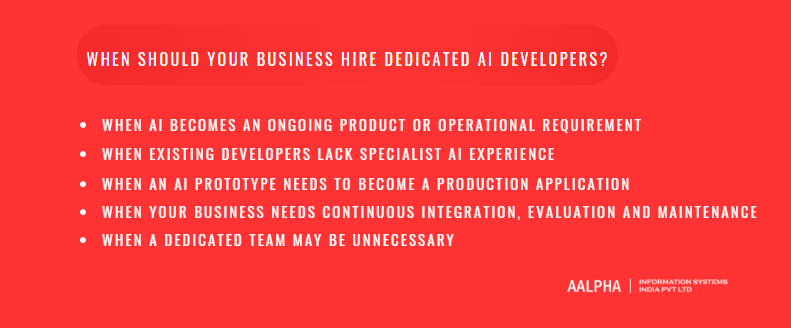
When should your business hire dedicated AI developers?
Hire dedicated AI developers when AI is a continuing part of your product or operations, not a one-time experiment. If the work needs weekly iteration, evaluation and maintenance for six months or more, and your current team lacks specialist experience, a dedicated team costs less than repeated project handovers.
-
When AI becomes an ongoing product or operational requirement
A SaaS company adding an AI assistant to its application is the typical case. The assistant is never finished: new documents arrive, users ask unexpected questions, and each model upgrade changes behavior. Demand forecasting works the same way. A forecast built once and left alone degrades as buying patterns shift, so someone has to own retraining and monitoring. When a feature has a roadmap, it needs standing capacity.
-
When existing developers lack specialist AI experience
Your backend team may write excellent code and still struggle with AI work, because the failure modes are different. Output is probabilistic, tests are statistical, and correctness is a matter of degree. A document processing project, for instance, needs someone who can tell you what accuracy is achievable on your scanned invoices before you commit to automating approvals. Adding one specialist to a general team often works better than building a separate AI group.
-
When an AI prototype needs to become a production application
Prototypes built in a week fail in production for predictable reasons: no access control on the data, no handling for timeouts, no cost cap, and no record of what the model said. Turning a demo into software that thousands of users depend on is an engineering job that takes months. It is a common reason companies move from a prototype to a dedicated team.
-
When your business needs continuous integration, evaluation and maintenance
Customer support automation shows why. The system touches your help center, ticketing tool and CRM, and its answers must stay correct as policies change. Someone has to rebuild the evaluation set when products change, review the conversations that went wrong, and tune escalation rules. That ongoing loop is the strongest argument for a standing team over a fixed-price build.
-
When a dedicated team may be unnecessary
Several situations do not justify one. If an existing product already solves the problem, such as a support platform with built-in AI answers, buy it. If you need a feasibility check or a proof of concept, a two to four week consulting engagement is cheaper. If AI is a single, stable feature with no roadmap, a fixed-price project with a maintenance retainer fits better. Dedicated teams also underperform when the client cannot supply a product owner and decisions arrive slowly, because paid capacity then sits waiting.
How should you define your AI project before hiring?
Define the business problem, the user, the success metric, the available data and the integration points before you speak to any developer. A one-page brief written this way lets you compare proposals on equal terms and stops you paying a team to discover requirements you could have written in an afternoon.
-
Identify the business problem and intended users
State the problem as a cost or delay someone feels today, such as “support agents spend nine minutes per ticket finding the right policy”. Name who will use the result: customers, internal staff or another system. A vague goal like “add AI to our platform” produces demos, not outcomes.
-
Define success metrics and acceptance criteria
Pick numbers you can measure before launch. Examples are 85 percent of answers rated correct by reviewers on a 200-question test set, median response time under four seconds, and a stated ceiling on cost per conversation. Acceptance criteria turn “works well” into something both sides can test.
-
Assess data availability, quality and access permissions
List what data exists, where it lives, who owns it and who may expose it to a model. Check the quality yourself: a sample of fifty documents will show whether they are current, consistent and readable. Poor data is the most common cause of delay, and no developer fixes it quickly. Confirm you have legal permission to send the data to a third-party model provider.
-
Decide whether you need AI integration, model customization or model development
Most business projects need integration: calling an existing model with your data and rules. Customization, meaning fine-tuning or adapting a model, is justified when integration cannot reach your accuracy target. Building a model from scratch is rare and needs large proprietary datasets. Choose the lowest level that meets the metric, because each step up multiplies cost and timeline.
-
Map integrations with existing software and business workflows
List every system the feature touches: CRM, ERP, ticketing tool, identity provider, document storage. For each, note whether an API exists, who maintains it and what permissions the AI component should have. Integration work, not the model, often takes the largest share of the schedule.
-
Set budget, timeline and operational constraints
Give a budget range, a target date for a first release, and any hard limits such as data residency, uptime requirements or a ban on certain model vendors. Developers can shape a plan around constraints they know about. They cannot do so around ones revealed in month three.
-
Prepare a clear AI development brief
Put the items above on one or two pages. This sample is for a support assistant, and every figure in it is illustrative.
The objective is to reduce average ticket handling time from nine minutes to five. The users are 40 support agents first, then customers through the help center. The data is 3,000 help articles, 18 months of resolved tickets and the product catalogue. Expected outputs are suggested replies with cited sources and an escalation flag. The assistant must integrate with the ticketing platform, the CRM and single sign-on. The client supplies data access, a product owner and a weekly review, while the developers handle the build, evaluation and deployment. Milestones are a prototype tested on 200 questions in week 4, a pilot with 10 agents in week 10, and full rollout in week 14.
What skills should dedicated AI developers have?
A dedicated AI developer needs solid software engineering first, then working knowledge of the AI layer your project uses: model APIs, retrieval, evaluation and deployment. Not every skill applies to every project. Treat software engineering, evaluation and clear communication as core, and the rest as required only when your use case calls for them.
-
Software engineering and programming fundamentals
Python and TypeScript cover most AI application work. Beyond the language, look for API design, SQL and at least one document or vector database, automated testing, Git workflows and the ability to design a system that survives real load. Weak engineering shows up as a demo that nobody can deploy.
-
Machine learning and statistical understanding
This means model selection, train, validation and test splits, overfitting, and choosing metrics that match the cost of errors. A fraud model with 99 percent accuracy is useless if only 1 percent of transactions are fraudulent and it flags none of them. The depth required is high for forecasting and classification projects. For language model integration, basic fluency is enough.
-
Generative AI and large language model integration
Look for experience with the model APIs of the major providers, structured outputs such as JSON schemas, context window management, retries on timeouts and rate limits, fallback behavior when a model fails, and prompt versioning. Ask which model they would pick for a given task and why. A good answer weighs cost, latency and accuracy rather than defending a favorite vendor.
-
Retrieval-augmented generation and search
Retrieval-augmented generation (RAG) lets a model answer from your own content. The skills involved are document ingestion and chunking, embeddings, combined keyword and vector search, reranking, and enforcing permissions so that users only retrieve documents they may see. Most wrong answers in these systems come from poor retrieval, not from the model, so ask how the candidate measures retrieval quality separately from answer quality.
-
Tool calling, AI agents and workflow orchestration
Tool calling lets a model take actions such as looking up an order or creating a ticket. The skills are limiting which actions are allowed, adding approval steps before anything irreversible, retrying safely and recovering from partial failure. You need this only if the system acts. A read-only assistant does not need an agent framework, and every added agent step adds a failure path, so prefer the simplest workflow that meets the requirement.
-
Data engineering and production deployment
Data pipelines that clean and refresh your data, cloud infrastructure, containers, CI/CD, monitoring and alerting. Data engineering weighs heaviest in forecasting and analytics projects. Deployment skill matters in all of them, since a model that cannot be released safely has no business value.
-
AI evaluation, security and cost optimization
This is the rarest skill and the one that separates production work from demos. It covers building test sets, automated scoring with human review on samples, adversarial testing for prompt injection and data leakage, and cost controls such as caching, routing simple requests to cheaper models and token budgets. A developer who cannot describe how they would measure answer quality has not shipped much.
-
Communication and business understanding
AI output is uncertain, and someone has to explain that to non-technical stakeholders without either overselling or alarming them. Good candidates push back on unrealistic accuracy targets, write documentation others can follow, and ask about the business reason behind a request. Test this with a scenario, not a question about soft skills.
Do not turn every framework into a hiring requirement. A developer fluent in one orchestration library can learn another in days. Hire for judgment about when to use a technique, and treat tool names as the easiest thing to teach.
Which AI specialists and team structure do you need?
The right team depends on what you are building. Generative AI application developers cover most business needs. Add machine learning engineers, data engineers or MLOps specialists only when the project involves custom models, large data pipelines or high-volume serving. Hiring a full specialist bench for a simple integration is the most common way to overspend.
Generative AI application developers
They build features on top of existing language models: prompts, retrieval, tool calling, evaluation and the application code around them. For an AI assistant, document summarization or support automation, this is usually the first and most important hire.
Machine learning engineers
They train, tune and deploy models of your own, such as classifiers, recommenders and forecasting models. You need one when a general model is too slow, too expensive or not accurate enough for a narrow task, or when you hold proprietary data that gives a custom model an edge.
Data engineers and data scientists
Data engineers build the pipelines that collect, clean and refresh data. Data scientists analyze it and prototype models. Predictive projects need both, because a forecast is only as reliable as the data feeding it.
MLOps and AI infrastructure engineers
They run model serving, monitoring, versioning and cost control. A small project can leave this to a backend developer. Once you serve many users, host your own models or retrain regularly, a dedicated person pays for itself.
Backend, frontend and integration developers
AI features live inside products. Someone has to build the interface, connect the CRM or ERP and handle authentication. These roles are often filled from your existing team, which also keeps product knowledge close to the AI work.
AI architects, technical leads and evaluation specialists
A technical lead makes the structural decisions: which model, which retrieval design, what to build versus buy. An evaluation specialist owns the test sets and quality reviews. On small teams one senior developer holds both roles, which works until the project grows past five people.
When to hire one developer versus a multidisciplinary team
One strong developer is enough for a contained feature with clear data, such as a document extraction tool. A team is justified when the product has several components that must progress in parallel. The risk with a single hire is dependency: if that person leaves or is unavailable, the project stops.
Typical structures are described below. The headcounts are illustrative and shift with scope.
For an AI assistant over company documents, a typical team is one generative AI developer, one backend developer, one part-time frontend developer and part-time evaluation and QA, because retrieval and integration dominate and no custom model is needed. A predictive analytics application usually needs one data scientist, one machine learning engineer, one data engineer, one application developer and a part-time technical lead, since data quality and model accuracy drive the result. An AI-enabled SaaS product suits one technical lead, two backend developers, one frontend developer, one generative AI developer, part-time MLOps and one QA engineer, because AI is one component of a larger product with its own release cycle.
How do dedicated AI developers compare with other hiring models?
Dedicated developers sit between in-house employees and fixed-price outsourcing. You get more control and continuity than a project vendor, and lower recruitment effort than hiring staff, but you carry the management load. The best model depends on how well-defined the project is and how much management capacity you have.
Dedicated developers versus in-house employees
In-house hires give the deepest product knowledge and the longest retention, but recruiting senior AI engineers is slow and competitive, and you carry salary, benefits and equipment whether or not the work is steady. A dedicated team can start in weeks and scale down without severance. The trade-off is that the knowledge sits partly outside your company, so documentation and handover terms matter.
Dedicated developers versus freelancers
Freelancers suit short, well-bounded tasks such as a prototype or a code review. They are harder to rely on for long projects: availability shifts, there is no replacement if one disappears, and quality varies without anyone reviewing the work. Dedicated developers cost more per hour but come with a provider who is accountable for continuity.
Dedicated teams versus fixed-price project outsourcing
Fixed price works when scope is stable and testable. AI scope rarely is, since you often learn what is achievable only after seeing results on real data. Fixed-price contracts then lead to change requests or a vendor who builds to the letter of the specification. A dedicated team lets scope evolve, at the cost of a budget that is open until you set milestones.
Staff augmentation versus managed AI development
In staff augmentation, you manage the engineers directly and the provider only supplies people. In managed development, the provider also supplies a lead who plans, reviews and answers for delivery. If you have an experienced AI product owner, augmentation is cheaper. If you do not, managed development protects you from paying for activity that does not reach the goal.
How to choose based on project maturity and internal management capacity
For an unproven idea, start with a short consulting engagement or a small dedicated pod and a four-week milestone. For a defined product with a roadmap, a dedicated team fits. For a stable, fully specified feature, fixed price is acceptable. If nobody on your side can review technical work, do not choose any model that assumes you can.
On cost structure, in-house employees mean salary, benefits, equipment and recruitment, freelancers bill hourly or per task, dedicated teams charge a monthly rate per person, and fixed-price projects charge one agreed price. On control over priorities, you have full control with employees, high but part-time control with freelancers, high control with a dedicated team, and low control after signing a fixed-price contract. Continuity is highest with employees, lowest with freelancers, high with a dedicated team that has replacement terms, and ends at delivery under fixed price unless extended. Recruitment effort is heavy for in-house hiring, moderate for freelancers and light for the other two. Flexibility to change scope is high in the first three models and low under fixed price, where changes cost extra. For delivery responsibility, you answer for in-house work, the individual answers for freelance work, you and the provider share it with a dedicated team, and the vendor answers under fixed price.
Where can you find dedicated AI developers?
You can find dedicated AI developers through AI development companies, professional referrals, developer communities, specialist hiring platforms and regional talent markets. Development companies give the fastest start and built-in replacement cover. Direct hiring through networks gives more control but takes longer and leaves recruitment and retention to you.
AI development companies and dedicated team providers
This is the quickest route to a working team, because the provider has already vetted and employed the engineers. Look for companies that show shipped AI products, name their team members, and offer replacement terms. The downside is that quality varies widely, and many providers have rebranded general web development as AI work. Review case studies for production deployments, not demos.
Professional networks and referrals
A referral from someone who has run a similar project is the most reliable signal available. Ask peers in your industry which AI team delivered, and what went wrong. Referrals are slow to scale, and the person referred may be unavailable, but they save the most time on screening.
Developer communities and open-source contributions
GitHub repositories, technical blogs and conference talks show how a developer thinks. Open-source contributions to retrieval, evaluation or orchestration libraries are good evidence of depth. They are weaker evidence of fit, since a strong open-source engineer may never have worked inside a business deadline.
Specialist hiring platforms and marketplaces
Marketplaces list freelancers and small agencies with ratings and work histories, and review directories publish verified client reviews of development companies. They widen your pool quickly. Ratings reward communication and delivery speed more than technical depth, so treat them as a filter for reliability and test depth yourself.
Onshore, nearshore and offshore hiring
Onshore teams share your time zone, language and legal system, at the highest rates. Nearshore teams sit within a few hours of your time zone and reduce rates. Offshore teams, in India or Eastern Europe for example, give the largest cost advantage and the deepest talent pools, but require deliberate overlap hours and clear written communication. Decide based on how much real-time collaboration your project needs.
How to build a shortlist of suitable providers
Start with five or six candidates and cut to three using the same criteria for each. Check whether the case studies match your problem type and scale. Ask for the names, roles and availability of the people who would work on your project, not a generic team profile. Request two client references you can call and ask about delivery and communication. Look for technical evidence such as a sample architecture document, evaluation approach or code walkthrough. Finally, check responsiveness: a provider that is slow to answer during sales will be slower during delivery.
How do you write a dedicated AI developer job description?
A good job description states the business use case, the project stage, the deliverables and who owns production, then separates required skills from preferred ones. It reads like a short project brief, not a technology list. Candidates who see a real problem ask real questions, which is your first filter.
Describe the business use case and project stage
Say what the system does and where it stands: “We run a B2B invoicing platform with 4,000 customers. A prototype assistant answers billing questions, and we need to take it to production.” Two sentences let a candidate judge fit.
Define responsibilities and expected deliverables
List outputs, not activities: a deployed retrieval pipeline, an evaluation set of 300 questions, a monitoring dashboard, documentation. Outputs let you judge progress and show candidates what success looks like.
Separate mandatory skills from preferred experience
Mandatory means production experience with model APIs, a core language and testing. Preferred covers a particular vector database or your industry. A list of fifteen mandatory tools filters out good engineers and attracts applicants who match keywords.
Specify working hours, collaboration and reporting expectations
State the required overlap hours, standup schedule, tools, who the developer reports to and how often you review demos. Writing this down prevents the most common early friction.
Clarify production ownership and maintenance responsibilities
Say whether the developer handles incidents, whether there is on-call duty, and whether post-launch maintenance is part of the role. AI features degrade quietly, so someone must be named as owner.
Sample dedicated AI developer job description
The example below is for an internal assistant. Adapt the details to your project.
Role: Dedicated AI developer, full time, six month initial term
Project: We are building an assistant that answers employee questions from HR policies, IT documentation and ticket history, and can raise IT tickets on request. A prototype exists. We need it live for 800 employees within 14 weeks.
Responsibilities
- Build and operate document ingestion and retrieval across policy and ticket sources, respecting each user’s access rights
- Implement ticket creation through our IT service management API, with an approval step
- Maintain an evaluation set and run it on every change
- Set up monitoring for answer quality, latency and cost per conversation
- Document the architecture and write runbooks
Required
- Three or more years of software engineering, with at least one language model feature in production
- Python or TypeScript, SQL, REST APIs, automated testing
- Experience with retrieval, embeddings and prompt versioning
- Ability to explain trade-offs to non-technical stakeholders
Preferred: enterprise single sign-on, IT service management tooling, any major cloud platform.
Working arrangement: four hours of overlap with Central European time, daily standup, weekly demo, reports to the head of IT.
Ownership: owns the assistant through launch and the first eight weeks of operation, including incident response in business hours.
How do you evaluate and interview AI developers?
Evaluate AI developers by what they have shipped, what they personally did, how they handle failure and how they solve a realistic task. A paid practical assessment of a few hours tells you more than any interview. Use one scorecard for every candidate so comparisons rest on evidence, not impressions.
Review portfolios for relevant production experience
Look for deployed systems with real users, not notebooks or demos. Ask how many users it served, what volume it handled and what broke in the first month. A candidate with real production history answers these without hesitation.
Verify each developer’s contribution to previous projects
Team projects hide individual contribution. Ask the candidate to walk through one project: what they decided, what they wrote, what they would change. Request an architecture diagram or code sample, and a reference who worked beside them. With an agency, ask about the named person, not the company’s case study.
Assess software engineering and AI architecture skills
Give a design question, for example: “Design an assistant that answers from 50,000 documents with per-user permissions.” Strong answers cover data flow, permission checks at retrieval time, caching, and what happens when the model or a data source fails.
Ask about data quality, evaluation and model failure
Ask how they knew a system was working, and for an example of a wrong answer in production. Strong answers describe test sets, error categories and concrete fixes. Weak answers rely on “we tried it and it looked good”.
Test security, deployment and cost awareness
Ask how they would defend against prompt injection, prevent one customer’s data reaching another, store secrets and keep cost per request predictable. A candidate who has not thought about cost has not run a system with real traffic.
Assess communication through a business scenario
Say a stakeholder demands 100 percent accuracy and ask how they respond. Good answers explain error rates plainly, propose a review step for risky cases and offer a measurable target.
Five questions cover these areas well. Ask how they measured quality on their last AI project, and listen for a test set, named metrics, a baseline and a record of changes against it. Ask what they did when retrieval returned the wrong document, and look for diagnosis of chunking or ranking, a fix and a regression test. Ask how they control cost per request, and expect caching, model routing, token limits and monitoring. Ask how they stop users seeing documents they should not, and expect permission filtering at retrieval, tested with restricted accounts. Ask when they would not use an AI agent, and a strong answer names cases where a fixed workflow is simpler, cheaper and easier to test.
Conduct a paid practical assessment
Pay the candidate their normal rate for four to six hours. A suitable task: build a small assistant over 30 provided documents with two user roles, where some documents are restricted to one role. It must refuse to answer when the documents do not contain the answer, survive a failed model call, and include 20 scored test questions. Review access control, honest refusal, quality of the tests, code clarity and a short note on known limitations. Unpaid take-home tests drive away experienced engineers, who have options.
Use a consistent candidate scorecard
The weights below are a starting point. Score each item from 1 to 5 and multiply.
Weight production experience and verified contribution at 20 percent, architecture and software engineering at 15 percent, evaluation and failure handling at 20 percent, security and cost awareness at 10 percent, the practical assessment result at 25 percent, and communication at 10 percent.
Hiring red flags to watch for
Be cautious when a candidate cannot explain what they personally built, never mentions evaluation, promises perfect accuracy, solves every problem with agents, asks nothing about your data, declines a paid assessment or stays vague about availability. Any one is worth a follow-up question. Three together is a reason to pass.
How much does it cost to hire dedicated AI developers?
Hiring dedicated AI developers costs roughly $4,500 to $29,600 per developer per month, depending on location and seniority, plus separate recurring costs for model usage and infrastructure. Mid-level contractor rates in September 2026 run from $28 to $72 an hour in India to $119 to $185 an hour in the United States.
Hourly, monthly and team-based pricing models
Hourly pricing suits short, uncertain tasks. Monthly pricing per person suits a dedicated engagement, and the figures in this section use 160 billable hours a month. Team-based pricing bundles roles such as developers, QA and a project manager into one monthly fee. As a reference point, Aalpha’s published pricing lists monthly ranges of $2,000 to $5,000 for fixed price, $4,000 to $10,000 for its outsourcing model, $6,000 to $15,000 for time and material, and $7,000 to $20,000 for an offshore development center. Those are general dedicated development ranges, so AI-specific quotes depend on the roles in your team.
How location, seniority and specialization affect rates
The table shows mid-level freelance and contract rates for AI engineers. Seniority moves a rate considerably within each region. In the United States, junior rates run $95 to $142 and senior rates $155 to $235. In India, junior rates run $19 to $33 and senior rates $42 to $100.
Region | Mid-level hourly rate | Monthly at 160 hours |
United States | $119 to $185 | $19,040 to $29,600 |
Eastern Europe (Poland, Romania, Ukraine) | $70 to $109 | $11,200 to $17,440 |
Western Europe (UK, Germany, France) | $63 to $98 | $10,080 to $15,680 |
Latin America | $62 to $96 | $9,920 to $15,360 |
Southeast Asia | $53 to $81 | $8,480 to $12,960 |
India | $28 to $72 | $4,480 to $11,520 |
Estimates disagree on the details. One September 2026 cost estimate puts senior AI and machine learning rates at $40 to $75 an hour in India, $70 to $135 in Eastern Europe and $130 to $250 or more in the US, and reports a 12 to 30 percent premium for AI work over general software engineering. Treat any single rate card as a starting point for negotiation. The wide range for the “AI engineer” title exists because it covers three different jobs: training models, building applications on existing models, and running inference infrastructure. Application work prices at the lower end.
Cost differences between AI integration and custom model development
Integrating an existing model is the cheapest path. Fine-tuning adds data preparation, GPU time and evaluation. In one published estimate for India and Latin America, a retrieval-based system with security guardrails runs $35,000 to $80,000 over 8 to 12 weeks, while open-source model fine-tuning runs $60,000 to $140,000 over 12 to 16 weeks. These are one estimate, not market averages.
Additional costs: model usage, infrastructure, data and tools
Development fees are only part of the bill. Model providers charge per token, vector databases and hosting charge monthly, and observability tools charge by volume. Published estimates put monthly running costs at $150 to $400 for a small internal knowledge base, $600 to $1,500 for a customer service assistant handling 10,000 to 50,000 queries a month, and $5,000 to $15,000 or more beyond a million queries. Check each model provider’s current price list before you budget, since per-token prices change often.
Management, testing, security and maintenance expenses
Budget for your own product owner’s time, QA, a security review and post-launch maintenance. One published worked example reserves 10 percent of the first-year cost for maintenance and model drift retraining. The same example cites $10,000 to $100,000 or more for a formal governance audit, depending on risk level. A small internal tool needs far less than a regulated customer-facing system.
Example budgets for different project scopes
The figures below are illustrative arithmetic, not quotes. They multiply published hour estimates for each scope (150 to 250, 400 to 600 and 900 to 1,500 hours) by the mid-level rate bands above. They reflect contractor rates, so agency teams with project management and cover will price higher, and they exclude running costs.
For a prototype or proof of concept of 150 to 250 hours, the arithmetic gives $4,200 to $18,000 in India, $10,500 to $27,250 in Eastern Europe and $17,850 to $46,250 in the United States. A production model and integration of 400 to 600 hours comes to $11,200 to $43,200 in India, $28,000 to $65,400 in Eastern Europe and $47,600 to $111,000 in the United States. An enterprise AI platform of 900 to 1,500 hours comes to $25,200 to $108,000 in India, $63,000 to $163,500 in Eastern Europe and $107,100 to $277,500 in the United States.
How to compare proposals using total cost of ownership
Put every proposal on the same basis: team fee over the full term, expected model usage at your volume, infrastructure, evaluation and QA, maintenance, your management time, and the cost of moving the work elsewhere if you leave. The lowest hourly rate is often not the lowest total. A $30 hour that needs 1.5 times the hours to reach the same quality costs $45 and adds rework risk. Ask each vendor to itemize labor separately from model and infrastructure costs, so you can see which part of the bill changes if volume doubles.
What is the step-by-step process for hiring dedicated AI developers?
Hire in eight steps: finalize the brief, shortlist, interview, run a paid assessment, check references, agree terms, sign and provision access, and start with one milestone. Plan four to eight weeks from brief to first sprint. That is a planning assumption, not a benchmark, and a provider with ready staff can move faster.
-
Finalize the project brief and required roles
Freeze the brief from earlier and list the roles by function, for example one generative AI developer, one backend developer and part-time QA. Decide which roles you can fill from your own team. Have your product owner sign off, since changes after shortlisting restart the process.
-
Shortlist candidates or development partners
Send the same brief to five or six candidates and ask for a written reply within a week covering the proposed team, approach, assumptions and questions. The quality of the questions is your first filter. Drop anyone who proposes a team without asking about your data.
-
Conduct technical and business interviews
Hold one technical session with your senior engineer and one business session with the product owner. Each interviewer fills in the scorecard independently before the two compare notes, which keeps the stronger talker from steering the result.
-
Complete a paid assessment or discovery phase
Run the practical task with your top two candidates, or buy a one to two week paid discovery from a provider. Discovery should produce an architecture note, an evaluation plan and a revised estimate. Pay for both. The output belongs to you even if you choose someone else.
-
Verify references and delivery practices
Call two clients per finalist. Ask what slipped, how it was handled, whether the named people stayed for the whole project, and whether they would hire the team again for AI work specifically. Ask how code review and releases work.
-
Agree on scope, allocation, pricing and responsibilities
Write the named people, weekly hours, monthly rate, notice period, replacement time, reporting and acceptance criteria into a statement of work. The legal terms that go alongside it are covered in the next section.
-
Sign the agreement and prepare access
Sign confidentiality and data terms before anyone sees data. Create accounts with least-privilege access, a sandbox with sample or masked data, and separate model provider keys with spend limits. Do not hand over production credentials in week one.
-
Begin with a milestone and review results
Make the first milestone four to six weeks long, with a demonstrable result measured against your success metric. Review it in writing and decide whether to continue, adjust or stop. Add people only after that review.
What should contracts cover for IP, data privacy and security?
The contract should say who owns the code, models and data assets, what the developers may do with your data, which third-party terms apply, who controls access, and how the engagement ends. This section is general information, not legal advice, so have a lawyer review the final terms for your jurisdiction.
-
Ownership of source code, custom models and project assets
State in writing that code, prompts, evaluation sets, fine-tuned model weights, embeddings and documentation are assigned to you on payment. Watch for clauses that let the vendor keep “reusable components”, and for vendors that reuse your data or evaluation sets in their own tools.
-
Confidentiality and permitted use of business data
Limit use of your data to the project, ban training any model on it without written consent, and set retention and deletion rules. Where developers process personal data for you, Article 28 of the GDPR requires a written contract under which the processor acts only on your documented instructions, keeps staff bound by confidentiality, assists with data subject requests and deletes or returns the data at the end. It also requires your approval before the processor engages sub-processors.
-
Third-party model terms and open-source licenses
Your product inherits the terms of every model provider it calls, including data retention settings, permitted uses, rate limits and price changes. Ask for a list of every third-party model and library with its license. Copyleft licenses can affect how you distribute your product, and open-weight models carry their own use restrictions.
-
Repository access, credentials and development environments
Keep repositories in your organization, not the vendor’s. Use your single sign-on where possible, store keys in a secrets manager, put spend limits on model keys, and remove a person’s access within one business day of their leaving the project.
-
Acceptance criteria, support terms and service commitments
Tie payments to the acceptance tests defined in your brief. Set a warranty period for defects, response times for production incidents, and a rule for who pays when a bug causes a spike in model costs.
-
Developer replacement, termination and knowledge transfer
Specify how quickly a replacement arrives, with paid overlap for handover, plus a notice period and an exit clause requiring documentation, repository transfer and a handover session. A vendor that resists exit terms is telling you something.
-
Compliance requirements relevant to your industry and jurisdiction
In the EU, the Council’s 29 June 2026 press release on the Digital Omnibus sets 2 December 2027 as the new application date for stand-alone high-risk AI systems and 2 August 2028 for those embedded in products. It also sets 2 December 2026 as the deadline for transparency solutions for AI-generated content. In India, the Digital Personal Data Protection Rules were notified in November 2025 with phased compliance dates and conditions on transfers of personal data outside India. US requirements vary by state and sector, so name the laws that apply in the contract. Dates in this area keep moving, so confirm the current position with counsel before signing.
How do you onboard and manage a dedicated AI development team?
Onboard a dedicated AI team by giving them product context, approved data access and a named decision-maker in week one, then manage them through short milestones, regular demos and automated quality checks. Teams that start with a baseline measurement and a working end-to-end slice avoid most early drift.
-
Share product context, documentation and approved data access
Give the team the brief, user research, existing architecture notes and a glossary of your business terms. Grant access to sample or masked data first, and expand only after the team has shown it handles that data correctly. Time spent here prevents weeks of building the wrong thing.
-
Establish communication and decision ownership
Name one product owner who answers questions within a working day and has the authority to decide scope trade-offs. Agree on channels: one for daily questions, one for incidents, and a written decision log. Teams stall when three people give three answers.
-
Set milestones, demonstrations and review cycles
Use two-week cycles that end with a live demonstration on real or realistic data, not slides. Hold a monthly review against the success metric in the brief, and record whether the project continues, changes direction or stops.
-
Maintain code reviews, documentation and automated checks
Require peer review on every change, an evaluation run in the build pipeline, and documentation updated in the same change as the code. Ask for a short architecture decision record whenever the team picks a model, a retrieval method or a vendor, so reasons survive staff changes.
-
Manage time-zone overlap and business stakeholder feedback
Fix two to four overlap hours for live discussion and keep everything else asynchronous with written updates. Collect feedback from the people who will use the system, and route it through the product owner, not directly to developers, so priorities stay coherent.
Suggested priorities for the first 30 days
The plan below is a starting sequence. Adjust it to your project.
In week 1, set up access and the environment, read the brief and glossary, push one trivial change through the full release pipeline and agree the definition of done. In week 2, build a baseline evaluation set of 50 to 100 real cases and measure the current prototype or manual process against it. In week 3, deliver a first working slice from input to output on sample data and hold the first demonstration. In week 4, review results against the baseline, fix the largest failure categories, set the next milestone and run a short retrospective.
How do you measure AI development results and maintain the product?
Measure an AI product on four things together: business outcome, output quality, speed and reliability, and cost per use. Check them against an evaluation set on every change and review them monthly. A feature that scores well technically but does not move the business metric should be fixed or retired.
-
Track business outcomes alongside technical performance
Take the outcome you set in the brief, such as handling time or deflected tickets, and track it next to the technical numbers. Good accuracy scores do not prove value. A support assistant that answers well but is never used changes nothing.
-
Measure output quality, latency, reliability and cost
Score quality by having reviewers rate a sample of outputs against written criteria. Track median and 95th percentile response time, the share of requests that fail or time out, and the full cost per interaction including model usage and hosting.
-
Build evaluation datasets and regression checks
Collect real cases, label the correct outcome, and run the set automatically on every change. Block a release that falls below the agreed threshold. Add new failures to the set each month, so it keeps pace with how people use the system.
-
Monitor failures and collect user feedback
Log requests with privacy controls, sample them weekly and tag failures by type, such as wrong retrieval, wrong reasoning or missing data. Let users flag bad answers in one click. Patterns in those tags tell you what to fix first.
-
Review model updates and changing data
Model providers update and retire model versions, and your documents and customers change. Pin model versions, test any new version against your evaluation set before switching, and refresh your search index whenever source content changes. A silent change on either side is a common cause of sudden quality drops.
-
Decide when to improve, expand or discontinue a feature
Improve when failures cluster in a few fixable categories. Expand when you have met the target for a full month and cost per interaction is stable. Narrow or stop when two focused improvement cycles fail to close the gap and the remaining failures are structural, such as missing source data.
The example below shows how this works for a customer support assistant. Every target is illustrative and should be replaced with your own baseline.
Resolution quality is the share of suggested replies that agents accept without edits, checked by weekly reviewer sampling, with a target of 80 percent or higher. Escalation accuracy is the share of tickets that needed a human and were flagged, plus the rate of unnecessary escalations, with a target of 95 percent or higher caught and under 10 percent unnecessary. Response time is the median and 95th percentile time to a suggested reply, with a target under 4 seconds at the median and under 10 seconds at the 95th percentile. Cost per interaction is model usage plus hosting divided by interactions, compared with human handling cost, and it should sit well below human handling at your volume.
Why hire dedicated AI developers from Aalpha?
Aalpha Information Systems is a software development company founded in 2008 that offers dedicated developers for AI work, from machine learning and language processing to AI features inside existing products. Its Clutch profile shows a 4.9 rating from 218 reviews. Most reviewed projects are custom software and web platforms, so ask for AI-specific references.
-
Matching developer capabilities to your business requirements
Aalpha’s AI development page lists consulting and strategy, machine learning, natural language processing, computer vision, predictive analytics, automation, deep learning and custom AI software. Its process starts with a discovery step on your data and goals, which is where the roles for your team should be decided.
-
Building AI features within existing software products
The same page states that AI work is integrated into existing CRMs, ERPs and custom software. That fits Aalpha’s background: the Clutch profile cites more than 5,500 completed projects since 2008, and lists clients such as the World Bank and Swiss Re. Not all of that work involved AI, so judge the AI claims on the specific references you are given.
-
Flexible team composition and engagement options
Aalpha’s pricing page offers hourly, part-time and full-time engagement, lets you scale the team up or down, and states that you direct the engineers while Aalpha handles administration, HR and technical support. The AI page cites 250+ developers, 20+ team leaders and 25+ DevOps engineers.
-
Development, testing, deployment and ongoing support
Aalpha describes a five-step approach covering discovery, data preparation, model design, integration and deployment, and performance optimization, and lists monitoring and retraining under AI maintenance and support. Confirm in writing who owns evaluation and incident response after launch.
-
Communication, documentation and project visibility
On Clutch, reviewers most often describe the team as communicative and timely, and several mention weekly progress updates. Several also say they wanted more detailed post-launch documentation. If documentation matters to you, make it a named deliverable with a review date in the agreement.
How to begin an AI development engagement with Aalpha
Send your use case, the systems it touches, your data sources, timeline, and budget range.Aalpha Information Systems offers proof-of-concept and product discovery engagements for projects that are still being validated. To discuss your requirements, get in touch with Aalpha.
Frequently asked questions about hiring dedicated AI developers
What is a dedicated AI developer?
A dedicated AI developer is an engineer who works full time on one client’s AI features, under that client’s direction, for an agreed period at a fixed monthly cost. They are usually supplied by a development company, though some businesses hire them directly.
How much does it cost to hire dedicated AI developers?
In September 2026, mid-level contractor rates for AI engineers ran from about $28 to $72 an hour in India to $119 to $185 an hour in the United States. At 160 hours, that is roughly $4,500 to $29,600 per developer per month, before model usage and infrastructure costs.
What skills should an AI developer have?
Strong software engineering comes first, followed by working knowledge of language model integration, retrieval, evaluation, deployment and security. Clear communication matters as much as tooling. Evaluation skill is the one most often missing, so test for it directly.
Should I hire one AI developer or a complete team?
Hire one developer for a contained feature with clear data, such as document extraction. Hire a team when several components must progress in parallel, such as retrieval, integrations and a user interface. A single hire creates dependency on one person.
Can AI developers work with my existing software?
Yes. AI features are usually connected to existing software through APIs. List every system the feature touches, such as your CRM, ERP and ticketing tool, and the permissions it needs. Integration work often takes a larger share of the schedule than the model itself.
Do I need proprietary data to start an AI project?
Not always. Many business projects use an existing model together with your own documents and rules. You do need access to the data the feature must answer from, in good enough quality. Training or fine-tuning a custom model requires a larger body of proprietary data.
How do I evaluate an AI developer’s experience?
Ask for a walkthrough of a shipped system and what the candidate personally built, check it with a reference, ask how they measured quality and handled failures, and run a paid practical task of four to six hours. Production experience shows in the details.
How long does it take to onboard dedicated developers?
Allow about a week to put access and context in place, and expect a first working slice by the third week. Starting with a provider that has available staff is faster than recruiting directly, and the timeline depends on notice periods and contracts.
Who owns the code and other project assets?
You should, if the contract says so. Ask for assignment of code, prompts, evaluation sets and fine-tuned model weights on payment. Third-party model terms and open-source licenses still apply to what you build on top of them.
Can a dedicated team maintain an existing AI application?
Yes. Start with a one to two week review of the code, evaluation set, monitoring and documentation, and record a quality baseline before changing anything. After that the team can take over incident response and improvements.
How do you start hiring dedicated AI developers?
Start small and specific. Write the one-page brief, shortlist three providers, pay for a practical assessment, and sign a first milestone of four to six weeks rather than a six-month commitment. To discuss your project with Aalpha Information Systems, share your use case, the systems it touches, your timeline, and your budget range. A clear brief is the fastest way to a useful estimate.