





TL;DR: Hire Claude AI developers
A Claude AI developer is a software engineer who builds production applications on Anthropic’s Claude models using the Claude API, tool use, retrieval, and the Model Context Protocol. The work is applied engineering rather than model training. Hire for evaluation discipline and production experience first, then for Claude-specific familiarity, which a strong engineer can pick up in weeks. Rates run from roughly USD 25 to 60 per hour in India to USD 120 to 250 in the United States, and a production build typically costs between USD 20,000 and USD 90,000 over eight to eighteen weeks. Claude API tokens are a separate monthly operating cost. Aalpha Information Systems can help businesses hire Claude AI developers and build Claude-powered applications tailored to their business requirements.
Key skills to prioritize
Rank candidates on five things: how they decide what goes into the context window, how they design tools the model can call safely, how they measure output quality with a test set and a number, how they control token cost, and how they stop untrusted content from steering the model. Prompt writing sits below all five. It is the most visible skill and the easiest to teach.
Hiring options
Five routes are realistic. An in-house hire suits companies where the AI layer is the product. A freelancer suits a prototype. Staff augmentation suits a team that has engineers but no Claude experience. A dedicated agency team suits an end-to-end build. Fixed-scope delivery suits a defined system with a deadline. Most first projects are served best by augmentation or a dedicated team, because an in-house search that runs three months while the roadmap waits is itself a cost.
Estimated cost and timeline
A proof of concept takes two to three weeks at USD 6,000 to 15,000. An MVP that real users touch takes six to ten weeks at USD 20,000 to 45,000. A production system with several integrations, access control, and audit logging takes three to five months at USD 45,000 to 120,000. Add 15 to 20 percent of the build cost per year for maintenance, and budget Claude API usage separately, since it scales with volume while the build fee does not.
Quick hiring checklist
Before you hire, write down the task, the correct output, the monthly volume, and the accuracy threshold you need. During interviews, ask for one production system described in detail, one honest failure, one evaluation method, and one cost calculation done out loud. In the contract, name the engineers, tie payment to accepted milestones, list the evaluation suite and documentation as deliverables, and assign ownership of prompts and evaluation data to your company.
Understanding Claude AI development
Claude AI development means building software around Anthropic’s hosted Claude models rather than training models yourself. The developer designs prompts, retrieval, and tool integrations, then measures output quality against a labeled test set. Most of the effort goes into the system surrounding the model, not the model call itself.
What is Claude AI?
Claude is a family of large language models built by Anthropic and accessed through an API. The current lineup runs from Claude Haiku 4.5, the fastest and cheapest tier, through Claude Sonnet 5 and Claude Opus 5, to Claude Fable 5.1 for demanding reasoning and long agent runs. All current models handle text and image input, work across languages, and support tool use.
Two properties matter commercially. Claude models now carry a one-million-token context window on the Sonnet tier and above, which changes what is possible with long documents. And Anthropic publishes per-token pricing openly, which means you can calculate your operating cost before writing code instead of discovering it in month two.
Claude is also available beyond the first-party API, through Amazon Bedrock, Google Cloud, Microsoft Foundry, and Claude Platform on AWS. That matters for procurement and for data residency, and it is a decision your developer should raise in the first week rather than the last.
What does a Claude AI developer do?
The day-to-day work has five parts. They decide what information Claude sees for a given request, which covers retrieval, chunking, filtering, and caching. They define the tools Claude can call and what each one is permitted to do. They build the evaluation suite that says whether a change made the system better. They control cost and latency through model routing, caching, and batch processing. And they build the ordinary software underneath: queues, retries, logging, and deployment.
What they do not do is train models, label datasets, or tune weights. If a candidate’s portfolio is full of training runs and GPU work, they are an ML engineer, which is a different hire at a different salary.
A useful way to picture the split is that the model is roughly 10 percent of the system and 90 percent of the conversation. The parts that decide whether your project succeeds are the retrieval layer, the review queue for uncertain outputs, and the test set that catches regressions. Those are all ordinary engineering problems with an unusual failure mode.
Claude AI developers vs. general AI developers
The title “AI developer” covers everyone from a developer who called an API once to an engineer running a forty-tool agent in production. A Claude specialist differs in three concrete ways.
They know the platform economics. Output tokens cost five times input tokens on every Claude tier, cache reads cost 10 percent of the standard input rate, and the Batch API halves both. A developer who knows these numbers designs differently from one who does not.
They know the model behavior. Claude responds well to structured instructions, explicit output formats, and clear tool descriptions. Prompts ported directly from another provider usually underperform until someone adapts them, and knowing what to change saves a week of guessing.
They know the ecosystem. The Model Context Protocol, Claude Code, extended thinking, and the server-side tools for web search and code execution are all things a specialist uses selectively. A general AI developer will build the same features by hand, more slowly.
None of this makes the general developer a bad hire. A senior engineer who shipped LLM features on another provider will be productive on Claude inside two weeks. What does not transfer, and what you should not compromise on, is evaluation discipline.
When Claude is suitable for your project
Claude fits work that involves reading and reasoning over language: long documents, messy formatting, mixed languages, nuanced classification, drafting, and multi-step tasks that call tools. It fits well when you need the model to follow instructions precisely and to say it is unsure rather than invent an answer.
It fits badly as a calculator, a database, or a source of current facts without retrieval. It is the wrong tool for a task that a deterministic script already handles, and using it there gives you higher cost, higher latency, and non-deterministic failures in exchange for nothing.
The honest test is whether the task requires judgment over language. Extracting a total from an invoice with a fixed layout is a parsing problem. Extracting it from 200 supplier formats in six languages, with a confidence score and a review queue, is a Claude problem.
What can you build with Claude AI?
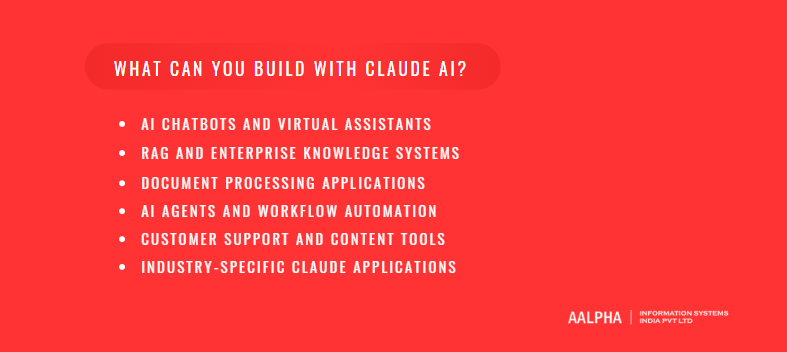
The common commercial builds are assistants, retrieval systems over internal knowledge, document processing pipelines, workflow agents, and support or content tools. Document processing usually shows the clearest return, because the baseline is manual data entry and accuracy can be measured against records you already hold.
-
AI chatbots and virtual assistants
This is the most requested category and the most often disappointing. Assistants work when the underlying knowledge is good and the escalation path is honest. They fail when a company deploys one to avoid fixing its documentation, at which point the assistant repeats the gaps fluently and at scale.
The engineering that separates a working assistant from a demo is unglamorous: conversation state, handover to a human with full context attached, a refusal path for questions outside scope, and logging that lets you reconstruct any conversation a customer complains about. Budget more time for those than for the prompt.
-
RAG and enterprise knowledge systems
Retrieval augmented generation gives Claude access to your documents at query time. It suits policy manuals, product documentation, contracts, research archives, and internal wikis where the content changes and nobody can memorize it.
The large context window tempts teams into skipping retrieval and sending everything. That is slower, more expensive, and frequently less accurate than sending four well-chosen passages, because a model given 200 pages will sometimes anchor on the wrong one. Retrieval quality, not model choice, determines whether these systems are trusted. When answers are wrong, the cause is almost always that the right passage never reached the model.
Permissions are the part that gets underestimated. If your documents have access rules, the retrieval layer has to enforce them per user, before the search runs. Retrofitting that is a rebuild.
-
Document processing applications
Invoices, purchase orders, contracts, claims, shipping paperwork, lab reports, and KYC files all fall here. Claude reads inconsistent layouts and mixed languages well, which is why this category has moved fastest in logistics, insurance, and financial services.
The work splits roughly 30 percent extraction and 70 percent everything else: confidence scoring, the human review queue, reconciliation against source systems, and the audit trail. A pipeline that extracts at 94 percent accuracy and routes the uncertain 6 percent to a reviewer is a working product. One that extracts at 97 percent with no review path is a liability, because nobody knows which three documents were wrong.
-
AI agents and workflow automation
Agents plan across steps, call tools, and run with limited supervision. They suit work spanning several systems: reconciling an ERP against a spreadsheet, triaging tickets into the right queue with fields populated, drafting and filing routine reports, chasing missing information across email and a CRM.
Internal agents are the sensible place to start. The audience is your own staff, the reputational risk is low, and the feedback is immediate. The failure to avoid is autonomy where a deterministic sequence would do. If the steps are always the same, write the script and use Claude only for the step that needs judgment.
Every agent that can take irreversible actions needs three things: a budget ceiling that stops runaway loops, idempotency on writes so a retry does not double-charge a customer, and a confirmation step before anything that moves money or sends external messages.
-
Customer support and content tools
Support tooling covers more than the chatbot. Ticket summarization for agents, suggested replies that a human edits, automatic tagging and routing, and quality review of closed tickets all deliver value with far less risk than an autonomous front-line bot. Several Aalpha clients have started with agent-assist tooling and moved to customer-facing automation only after six months of measured accuracy.
Content tools cover drafting, translation, repurposing, and compliance checking against a house style. The realistic framing is that Claude produces a first draft that a person edits, and the saving is in editing time rather than headcount. Teams that promise the second thing to their board tend to regret it.
-
Industry-specific Claude applications
In healthcare, the common builds are clinical documentation support, prior authorization paperwork, and patient communication drafting, all with clinician sign-off. In legal, contract review against a playbook, obligation extraction, and discovery triage. In financial services, KYC document processing, transaction narrative generation, and policy question answering with a full audit trail.
These are the highest-value projects and the slowest. The model work is not the constraint. Retention rules, audit requirements, professional liability, and sign-off workflows are, and legal review usually sits on the critical path. Budget at least a third of the timeline for compliance work and involve your compliance team in week one rather than week ten.
Define your Claude AI project requirements
Write down the business problem with a baseline number, the users and what they do with the output, the systems the project must read from and write to, the accuracy and latency you need, and the smallest version worth shipping. A developer cannot hit a target nobody has defined, and neither can the model.
-
Identify the business problem
Start from a failure you are already paying for. “Our team spends 30 hours a week re-keying supplier invoices, and roughly 4 percent of entries carry an error that reaches accounts payable” is a brief. “We want to use AI in finance” is not.
The first version gives an engineer three things at once: a baseline to beat, a volume figure to size the token bill against, and an error rate that sets the accuracy threshold. It also tells you when to stop. A project without a baseline never finishes, because there is no number at which everyone agrees it worked.
-
Define users and use cases
Name who touches the output and what they do next. An extraction result reviewed by a finance clerk needs a confidence score and an edit screen. The same result posted straight into an ERP needs a much higher accuracy bar and a reconciliation report. Same model, different products.
Write three to five concrete use cases as a sentence each, in the user’s words. Then write the cases you are explicitly not covering in version one. That second list prevents most of the scope arguments that turn a ten-week build into a sixteen-week one.
-
Determine data and integration requirements
List the systems the project reads from, the systems it writes to, and the systems that are off limits. For each integration, note whether an API exists, who owns the credentials, and how long access approval takes internally. Access approval is the most common cause of a stalled first month, and it is entirely a client-side problem.
Then look at the data itself. Pull 100 real examples, including the ugly ones. Scanned documents at an angle, forms filled in by hand, records with fields that contradict each other. If your sample is clean, it is not a real sample, and every estimate built on it will be wrong.
-
Set accuracy, latency, and security expectations
Decide the accuracy threshold before development starts, expressed against a test set you agree on. Decide what happens below the threshold: refuse, escalate to a human, or answer with a flag. Decide maximum acceptable latency, separating first-token latency for interactive features from total completion time for background jobs.
On security, decide what data may leave your network at all, whether identifiers can be redacted before a request, and where inference is allowed to happen geographically. That last point has a price attached. Anthropic applies a 1.1x multiplier for pinning first-party inference to the United States, and regional endpoints on Bedrock and Google Cloud carry roughly a 10 percent premium over global ones.
-
Define the MVP scope and deliverables
A good MVP handles one input type, one output, one integration, and a review path, measured against a labeled set. It should be narrow enough to ship in six to ten weeks and real enough that someone uses it daily.
Name the deliverables explicitly in the scope document, and include the ones vendors like to leave out: the evaluation set and its scores, the prompt and tool definitions in your repository, runbooks, and documentation good enough for another engineer to make a prompt change safely. If a proposal omits evaluation and handover, that is not an oversight. It is the part they plan to skip.
Essential skills to look for in Claude AI developers
Look for Claude API fluency, solid backend engineering in Python or TypeScript, context engineering, retrieval design, tool use, and evaluation. The last one predicts seniority better than anything else on a CV. A developer who cannot tell you how they measured quality has not run a system anyone depended on.
Claude API and Anthropic SDK
Fluency here means knowing the parts of the API that shape cost and behavior, not memorizing parameter names. A candidate should be comfortable with system prompts, multi-turn message construction, streaming, structured output, extended thinking, prompt caching, and the Batch API.
Model selection is part of this skill. The current lineup and its published rates look like this, as of September 2026. Check Anthropic’s pricing documentation before fixing a budget, since these change.
Model | Input / output per million tokens | Context window | Best suited to | Trade-off |
Claude Fable 5.1 | USD 10 / USD 50 | 1M tokens | Demanding reasoning, long-horizon agents | Slowest and most expensive tier |
Claude Opus 5 | USD 5 / USD 25 | 1M tokens | Complex agentic coding, enterprise work | Five times Sonnet on output, so prove the gain with evals |
Claude Sonnet 5 | USD 2 / USD 10 | 1M tokens | Default for most production workloads | Earlier knowledge cutoff than Opus, so recency needs retrieval |
Claude Haiku 4.5 | USD 1 / USD 5 | 200K tokens | Classification, routing, high-volume extraction | Smaller context, not a reasoning model |
One detail worth knowing before a migration: Anthropic notes that Claude 4.7 and later models use a newer tokenizer that produces roughly 30 percent more tokens for the same text. Moving to a newer model can raise your bill even at flat usage.
Python, TypeScript, and backend development
Underneath every Claude feature sits normal software. Queues, idempotent workers, database migrations, retries with backoff, structured logging, CI, and a deployment story. Python dominates data-heavy pipelines and TypeScript dominates product work, and a good candidate is strong in one and functional in the other.
This is where inherited projects fail. Aalpha’s engineers have reviewed enough handed-over AI codebases to state the pattern plainly: the ones that break in month four rarely break because of the model. They break because there is no retry logic, no structured logging of prompts and responses, and no way to reproduce a bad output a customer reported yesterday.
Given a choice between deep Claude knowledge with weak engineering discipline, and strong engineering discipline with three months of Claude work, take the second. The first gap closes in weeks. The second does not close at all.
Prompt and context engineering
The model reasons only over what you put in front of it. Deciding what goes into the context window, in what order, and what stays out is the design decision that sets answer quality.
Strong candidates talk about splitting long instructions into steps, moving deterministic rules into code where they belong, using explicit output formats, and caching the stable portion of a prompt. Ask what they do when a system prompt reaches 4,000 words and two instructions conflict. A weak answer adds a clarifying sentence. A strong answer restructures the task.
Prompt-only thinking is a real failure pattern. Some developers believe every problem is solved by a longer prompt, and the systems they build become unmaintainable by month three because nobody can predict what a change will affect.
RAG and vector databases
Retrieval is the skill behind every knowledge system. Look for chunking that follows document structure rather than a fixed character count, metadata filters applied before semantic search, deduplication, recency weighting, and a way to evaluate retrieval separately from generation.
That last point separates experienced candidates from the rest. If you cannot measure whether the right passage was retrieved, you cannot tell whether a wrong answer came from bad retrieval or bad reasoning, and you will spend weeks tuning the wrong layer.
Vector database choice matters less than most vendors suggest. Postgres with pgvector is enough for a few million chunks and keeps your data in one place. A dedicated vector store earns its complexity at higher scale or with heavy metadata filtering. A candidate who insists on a specific product without asking about your volume is repeating a habit.
Tool use, structured outputs, and MCP
Tool design is API design with a language model as the consumer. Names and descriptions become part of the prompt, so a vague description produces a model that calls the wrong function. Good practice keeps the tool count small, makes parameters explicit, returns structured errors the model can recover from, and separates read tools from write tools so permissions can differ.
Ask how they handle a tool that fails halfway through a sequence. The answer should cover idempotency keys, a retry policy with a ceiling, and knowledge of which side effects already occurred. Developers who have only built chat interfaces rarely have this answer.
The Model Context Protocol is Anthropic’s open standard for connecting models to external systems, and it is how most teams now expose internal data and actions without writing a bespoke integration each time. A candidate who has published or consumed an MCP server has shown something concrete, which is more than most CVs offer. For a single feature with one data source, direct tool use is simpler and adequate.
AI evaluation, security, and cloud deployment
Evaluation is the strongest single signal of seniority. Ask any candidate how they knew their last system was working. Weak answers describe manual spot checks and user feedback. Strong answers describe a labeled test set built from real inputs, a scoring method suited to the task, and a pipeline that runs on every prompt change and blocks a merge when scores drop.
Security work centers on prompt injection. Any system that reads untrusted content and can also take actions has this problem, because a web page, a PDF, or an inbound email can carry text aimed at your model. The mitigations are architectural: treat retrieved content as data rather than instructions, require confirmation for irreversible actions, scope credentials to the minimum each tool needs, and never let a model-chosen URL receive customer data. A candidate who answers with input filtering alone has not thought it through.
Deployment knowledge should cover the route you intend to use. The first-party Claude API is simplest and gets new features first. Amazon Bedrock, Google Cloud, Microsoft Foundry, and Claude Platform on AWS matter when you have committed cloud spend, single-vendor procurement, or data residency requirements.
Hiring models and where to find Claude AI developers
Five hiring models are realistic: freelancers, in-house employees, staff augmentation, dedicated development teams, and full-service AI development companies. The right one depends on whether you have internal technical direction, how long the system must live, and how quickly you need to start.
Hiring model | Time to start | Typical monthly cost | Best for | Main risk |
Freelancer | Days | USD 3,000 to 12,000 | Prototypes, single features | Disappears mid-project, no continuity |
In-house hire | 8 to 16 weeks | USD 8,000 to 20,000 loaded | AI is core to the product | Slow to hire, hard to retain |
Staff augmentation | 1 to 3 weeks | USD 4,000 to 9,000 per engineer | Existing team lacking Claude skills | You supply technical direction |
Dedicated team | 2 to 4 weeks | USD 12,000 to 35,000 | End-to-end builds over three months | Junior substitution by weak vendors |
AI development company | 2 to 4 weeks | Priced per milestone | Defined build with a deadline | Change requests get costly after sign-off |
Freelancers
A good freelancer will get a prototype working faster than any other route, often inside two weeks, and you pay only for the hours used. Marketplaces make sourcing quick, though they are saturated with keyword-optimized profiles, so expect to screen roughly ten candidates to find one worth interviewing.
The failure mode is continuity. The person who built your agent takes a full-time offer, and you inherit a codebase with a one-page README and prompts nobody can explain. If you go this route, name documentation and an evaluation suite as deliverables in the contract, not as a closing courtesy.
In-house developers
Hiring your own team is right when the AI layer is the product and will be rebuilt continuously for years. You accumulate context no vendor can match, and the cost per hour drops over time.
The cost is time and competition. Engineers with genuine Claude production experience are scarce in every market, and a search that runs three months while your roadmap waits is a real expense. Budget for the fact that a strong candidate will be approached by other companies during their notice period, and that a first AI hire with nobody senior to review their decisions can lock in an architecture you live with for years.
Staff augmentation
Augmentation places one or more Claude developers inside your existing team, working on your tooling, in your sprint cadence, under your direction. It starts faster than hiring and keeps architectural control in-house, which suits companies that already have engineers but no LLM experience.
It works badly when nobody internally is senior enough to give direction, since augmented engineers default to whatever pattern they used last. The contract points that matter are a notice period on any engineer swap, a trial period of two to four weeks, and a written statement that code, prompts, and evaluation data belong to you from day one rather than on final payment.
Dedicated development teams
A dedicated team gives you engineers, QA, and a project manager working only on your product, usually for three months or more. One party is accountable for the outcome, which matters when the system spans several integrations.
The risk worth naming is staffing quality. Some vendors sell senior profiles and staff juniors with a senior reviewing from a distance. Interview the engineers who will actually do the work, name them in the contract, and require notice before any substitution.
AI development companies
A full-service AI development company handles discovery, architecture, build, QA, security review, and support under one contract. This suits organizations without internal technical leadership for AI, and those that want a single vendor of record for compliance reasons.
The trade-off is flexibility. Fixed-scope work priced before discovery is either padded or renegotiated, and neither outcome serves the client. The structure that works is a paid discovery phase producing a specification, then a fixed price against that specification, with a stated hourly rate for changes.
Choosing the right hiring model
Answer three questions. Do you have someone internally who can make architectural decisions and review code? If not, rule out freelancers and augmentation. Will this system still be developed actively in two years? If yes, plan an in-house team eventually, even if a vendor builds version one. Do you need to start within a month? If yes, in-house hiring is off the table for now.
On sourcing, check independent review platforms rather than a vendor’s own case studies, look for open-source activity such as published MCP servers or evaluation tooling, and be careful with portfolios made entirely of demos. Demos are easy now. A polished demo proves someone can assemble a working call chain, not that they can run it for a year with a support queue attached.
How to evaluate and interview Claude AI developers
Use three stages: a portfolio review focused on systems that ran in production, a technical interview covering context, tools, evaluation, cost, and security, then a short paid assignment scored against a written rubric. Skip whiteboard algorithm rounds, which tell you nothing about whether someone can keep an agent stable.
-
Reviewing portfolios and case studies
Ask four questions about any project on a CV: who used it, for how long, what it cost to run per month, and what it got wrong most often. Anyone who has run an LLM feature in front of real users has a stock of specific failures. The prompt that degraded after a model update. The retrieval bug that surfaced the wrong customer’s data. The agent that looped overnight and burned USD 400.
If those stories are missing, the production experience is probably missing too. Cost awareness is the same kind of tell. A developer who has never known their monthly token bill has not been accountable for a live system, whatever the profile says.
Where possible, read code rather than slides. A public repository, an MCP server, or a detailed technical write-up tells you more in twenty minutes than an hour-long interview usually does.
-
Technical interview questions
Six questions cover most of what matters, and each has a recognizable good answer.
On context: “Our knowledge base is 40,000 pages. How do you get Claude to answer questions over it?” A weak answer starts with the million-token context window. A strong one starts by asking about query patterns, then describes retrieval with metadata filters, structure-aware chunking, and caching for the stable part of the prompt.
On tools: “The agent must update a customer record and send a confirmation email. Design the tools.” Look for separate read and write tools, explicit parameters, an idempotency key on the write, confirmation before the email, and a stated behavior for the case where the update succeeds and the email fails.
On evaluation: “How do you know a prompt change improved things?” The answer must contain a test set and a number. Anything else is a fail at any seniority.
On cost: “This runs 50,000 times a day. Walk me through the cost model and how you would halve it.” Expect a calculation from token counts and published rates, then caching for the repeated prompt, batching for anything not real-time, a smaller model for routing, and shorter outputs.
On security: “The agent reads customer emails and can issue refunds. What stops an email from triggering a refund?” Look for separation between data and instructions, an approval step for money movement, and hard limits in the tool regardless of what the model requests.
On failure: “It ran fine for three months, then quality dropped. What do you check?” Expect model version changes, retrieval drift as the corpus grows, input distribution shifts, and a re-run of the evaluation set to locate the regression rather than a round of prompt tinkering.
-
Practical coding assignments
Pay for the assignment, keep it under four hours, and use a real problem with sample data rather than a puzzle. A workable brief: here are 50 messy purchase orders in three formats, extract eight fields from each, return structured JSON with a confidence score, and add a short note on cost per document at 10,000 documents a month.
Hold back ten documents the candidate never sees and score against those. Submissions tuned to a visible sample look excellent and generalize poorly, and the held-out set is the only way to tell the difference.
-
Evaluating RAG and agent-development skills
For retrieval work, give the candidate a small messy corpus and ask how they would evaluate retrieval separately from generation. Listen for a set of question-and-source pairs, a recall measure over them, and a plan for handling documents that contradict each other. Ask what they do when two policy documents disagree, since the correct behavior is usually to surface both with dates rather than pick one.
For agent work, ask them to design the control flow for a task with five steps where step three can fail. Strong candidates draw a state machine, name the retry ceiling, identify which steps are reversible, and put a budget limit on the whole run. Candidates who describe only the prompt have built demos.
Ask also when they would not use an agent. Anyone who cannot answer that has one tool and will use it everywhere, which is expensive.
-
Assessing security and cost-optimization knowledge
On security, beyond prompt injection, ask how they keep one customer’s data out of another customer’s context in a multi-tenant system, and how they handle personally identifiable information that should never reach the model at all. Redaction before the request is often simpler than negotiating data terms, and a candidate who reaches for it has done this before.
On cost, ask for a worked calculation out loud. The levers should come quickly: cache the stable prompt, batch the asynchronous work, route easy cases to a cheaper model, and shorten outputs. That last one is the most overlooked, since output tokens cost five times input on every Claude tier.
-
Candidate evaluation scorecard
Write the rubric before you read any submission, and score every candidate on the same scale. Six criteria are enough, and the weighting should reflect what actually breaks projects rather than what is easiest to assess.
Give production experience 20 percent, awarded in full only for a system that ran for six months or more and is described with specific failures and the fixes that followed. Give evaluation discipline another 20 percent, awarded for a labeled test set, a scoring method suited to the task, and a pipeline that gates changes rather than reporting after the fact. Give the technical assignment 20 percent, scored on held-out samples, with full marks where the remaining errors sit in genuinely ambiguous cases rather than ordinary ones.
The remaining 40 percent splits three ways. Engineering quality takes 15 percent, judged on whether the submission is readable, tested, and reproducible on a clean machine by someone other than the author. Cost and latency reasoning takes 15 percent, awarded for a calculation with stated assumptions and at least one optimization actually applied rather than mentioned. Communication and documentation takes the last 10 percent, and the test is simple: could another engineer safely change a prompt after reading what was handed over.
A candidate scoring 85 percent with a clear, rubric-shaped submission is usually a better hire than one scoring 95 percent with an elaborate framework nobody else can maintain.
Cost and timeline of hiring Claude AI developers
Claude developer rates run from roughly USD 25 to 60 per hour in India to USD 120 to 250 in the United States. A proof of concept costs USD 6,000 to 15,000 over two to three weeks, an MVP USD 20,000 to 45,000 over six to ten weeks, and a production system USD 45,000 to 120,000 over three to five months. API usage is billed separately.
Factors affecting development cost
Five things move the number. The count of integrations, because each external system brings authentication, error handling, and a stakeholder. The accuracy requirement, since moving from 90 to 97 percent often costs more than everything before it. The compliance environment, where audit trails and sign-off workflows can consume a third of the timeline. Data quality, because messy inputs mean more evaluation work and a larger review path. And whether a human stays in the loop, which lowers the accuracy bar and raises the interface work.
The factor clients underestimate most often is their own availability. Access approvals, sample data, and subject-matter review are client-side inputs, and a week of waiting on credentials costs the same as a week of development.
Hourly rates by location and experience
India offers the deepest pool at the lowest price point, with mid-level developers at USD 25 to 40 per hour and senior engineers at USD 40 to 60. The spread in actual capability is widest here, so screening for production experience matters more than anywhere else on this list.
Eastern Europe and Latin America sit in a similar band, roughly USD 40 to 60 for mid-level and USD 60 to 85 for senior engineers. Eastern Europe brings a strong engineering culture with narrower availability, while Latin America is the practical choice when you need overlap with United States working hours.
The UK and Western Europe run USD 70 to 110 for mid-level and USD 110 to 160 for senior, and the premium is often worth paying when EU data residency and contracting requirements are part of the brief. United States rates run USD 90 to 150 and USD 150 to 250 respectively, which is justified mainly for regulated or safety-critical work where local accountability is a procurement requirement.
These reflect contract rates for engineers with genuine production experience, not the floor prices visible on open marketplaces. A bid well below the range usually means tutorial-level experience, junior substitution, or a price set low with change orders planned from the start.
Cost by hiring model
A freelancer at 20 hours a week costs USD 3,000 to 12,000 a month depending on region and seniority. Staff augmentation runs USD 4,000 to 9,000 per engineer per month on a full-time basis. A dedicated team of three with QA and project management runs USD 12,000 to 35,000 a month. An in-house senior hire in Western markets costs USD 8,000 to 20,000 a month fully loaded, plus recruitment and ramp-up time that rarely appears in the business case.
Fixed-scope delivery is priced per milestone rather than per month, which shifts overrun risk to the vendor and change risk to you.
Estimated cost by project type
A proof of concept takes two to three weeks and costs USD 6,000 to 15,000. It answers one question on real data, such as whether extraction accuracy clears 90 percent on your documents, and it should not be built to production standards.
A chatbot or assistant MVP takes six to ten weeks and costs USD 20,000 to 40,000, covering retrieval, conversation handling, an escalation path, and an evaluation set. A document processing pipeline takes eight to twelve weeks and costs USD 25,000 to 55,000, since extraction is the small part and confidence scoring, the review queue, and one system integration absorb most of the time.
An enterprise retrieval system with permissioned search, admin tooling, and monitoring takes ten to sixteen weeks and costs USD 35,000 to 80,000. A multi-step agent running in production, with tool integrations, approval steps, audit logging, and a support handover, takes twelve to twenty weeks and costs USD 45,000 to 120,000.
Regulated sectors sit at the top of each range. Ongoing maintenance runs 15 to 20 percent of build cost per year and is not optional, since model versions change and source documents drift.
Claude API and infrastructure expenses
Token spend scales with usage while the build fee does not, which is why it surprises finance teams. Anthropic’s documentation gives a useful reference point: processing 10,000 support conversations averaging about 3,700 tokens each on Claude Haiku 4.5 comes to roughly USD 37. The same volume with a 20,000-token context and long outputs on a premium model lands orders of magnitude higher.
Do the arithmetic before committing. Take expected monthly requests, estimate input and output tokens per request, apply the published rate for your chosen model, then multiply by three, because early systems are more verbose than planned and retries are real.
Four levers cut the bill without hurting quality. Cache the stable part of the prompt, since a cache read costs 10 percent of the standard input rate while a five-minute cache write costs 1.25x. Batch anything that can wait up to 24 hours for a flat 50 percent discount. Route by difficulty, using Haiku 4.5 to triage and escalating only hard cases. And shorten outputs, which moves the bill more than most architectural tuning.
Beyond tokens, budget for vector database hosting, observability, and server-side features. Web search through the Claude API costs USD 10 per 1,000 searches on top of tokens, web fetch adds no charge, and code execution includes 1,550 free container hours per organization each month before billing at USD 0.05 per container hour.
Typical development timeline
Week one is discovery, producing a written problem definition, a baseline metric, and a data sample. Weeks two and three build a narrow proof of concept with a real evaluation set and a kill criterion.
The first thirty days should end with a working thin slice: one real input type, one real output, measured against a labeled set, deployed where your team can use it. Days thirty to sixty add breadth and failure handling, the review queue, retries, logging, and the first honest cost report. Days sixty to ninety are for hardening and handover, covering load behavior, permissions, monitoring, and runbooks.
Ask for the handover pack at day sixty rather than day ninety. Documentation written under exit pressure is documentation nobody can use.
Security, contracts, and common hiring mistakes
Settle four things before code starts: where data is processed and how long it is retained, how the system resists prompt injection and leakage, who owns the prompts and evaluation data, and what counts as an accepted deliverable. Each one can force an architecture change if raised late.
-
Data privacy and access control
Decide first what actually needs to reach the model. Redacting identifiers before a request is often simpler than negotiating data terms, and it reduces exposure permanently rather than contractually. Where personal data must be sent, confirm the retention and residency terms that apply to your deployment route, since these differ between the first-party API and the cloud marketplaces. Anthropic publishes its security and compliance posture at trust.anthropic.com, and that is what your security team should review rather than a vendor’s summary of it.
Access control during the engagement deserves more attention than it usually gets. Give the smallest production access that lets work proceed, prefer redacted or synthetic data in development, log what the team touches, and revoke credentials on the last day rather than the month after. In multi-tenant systems, the retrieval layer must enforce per-user permissions before the search runs, not filter results afterwards.
-
Prompt-injection and data-leakage risks
Any system that reads untrusted content and can also act has an injection problem. A supplier invoice, a web page, or an inbound email can contain instructions aimed at your model, and no amount of politeness in the system prompt prevents that.
The defenses are structural. Treat retrieved content as data, never as instructions. Require human confirmation for anything irreversible, especially payments and external messages. Scope each tool’s credentials to the minimum it needs, so a compromised instruction cannot reach beyond one function. Cap spend per run to stop loops. And never let a model-chosen destination receive customer data, since exfiltration through a crafted URL is the quietest failure of all.
Leakage has a second form worth naming: your own logs. Prompts and responses often contain personal data, and a debugging log that captures everything becomes a copy of your customer database in a place nobody secured.
-
Intellectual-property ownership
State in the contract that prompts, evaluation datasets, tool definitions, retrieval configurations, and code are works for hire owned by you. Prompts are the asset people forget, and they are frequently the most valuable output of the engagement, since they encode months of domain refinement.
Be specific about where these artifacts live. They belong in your repository, versioned like code, not in a vendor’s notebook or a shared document. A vendor who wants to retain reuse rights over your domain prompts is asking to resell your competitive advantage to your competitors.
-
Deliverables and acceptance criteria
Tie each milestone to something testable. “Extraction pipeline complete” is not acceptance criteria. “Field-level accuracy of at least 94 percent across the 500-document evaluation set, with all documents below the confidence threshold routed to the review queue” is.
List the unglamorous deliverables explicitly: the evaluation suite and its current scores, prompt and tool definitions in your repository, runbooks for common failures, an architecture document, and a cost report with the assumptions behind it. Payment tied to accepted milestones, rather than elapsed time, aligns the incentive correctly for both sides.
-
Maintenance and knowledge transfer
Plan for the system after launch. Model versions change, source documents drift, and input patterns shift as users learn what the tool does. A maintenance retainer of 15 to 20 percent of build cost per year covers evaluation monitoring, prompt updates, dependency upgrades, and the occasional model migration.
Knowledge transfer should be a scheduled activity, not a final email. Two working sessions with your engineers, a recorded walkthrough of the architecture, and a supervised change made by your own team before the engagement ends will tell you whether the documentation is real. If your engineer cannot safely change a prompt while the vendor watches, the handover has not happened.
-
Hiring mistakes to avoid
The most expensive mistake is hiring before defining what a correct answer looks like. Everything downstream, from scope to acceptance, depends on that definition, and without it the project ends when the budget does rather than when the goal is met.
Close behind is accepting a demo as evidence. Ask for the accuracy figure and the size of the test set. If the answer is that it works really well, you are looking at spot checks.
Other patterns worth watching: choosing an agent architecture where a deterministic script would do, which buys higher cost and non-deterministic failures for nothing; hardcoding provider-specific calls throughout the codebase with no abstraction at the boundary, which turns a future model change into a rewrite; skipping evaluation to show features faster, which makes the system unchangeable by month four; and hiring a candidate who will not name a limitation, since anyone who answers every capability question with confidence has either not pushed the technology hard or is selling.
Why hire Claude AI developers from Aalpha?
Aalpha Information Systems builds Claude applications end to end, from discovery and architecture through evaluation, deployment, and support. Engagements run under ISO 9001:2015 process controls, with named engineers, milestone-based acceptance, and documentation written for handover rather than for sign-off.
-
Claude AI consulting and development services
Engagements usually start with a paid discovery phase that produces a written problem definition, a baseline metric, a data assessment, and a feasibility view with cost and timeline attached. That phase exists to kill weak ideas cheaply. Clients have walked away from it with a decision not to build, which is a better outcome than a six-figure project that was never going to clear its accuracy bar.
From there the work covers architecture, model and platform selection including residency requirements, the build itself, security review, and a support arrangement after launch.
-
Custom API, RAG, and AI-agent development
The delivery work splits into three areas. Claude API integration adds reasoning, extraction, drafting, or classification to an existing product, usually within an existing codebase and release process. Retrieval systems put Claude over your documents with permissioned search, admin tooling, and retrieval evaluated separately from generation. Agent development covers multi-step workflows with tool integrations, approval steps, budget ceilings, and audit logging.
Every engagement includes an evaluation suite with a labeled test set, because without one nobody can tell whether the next change helped.
-
Flexible hiring models
You can hire augmented engineers who work inside your team under your direction, a dedicated team with QA and project management for an end-to-end build, or a fixed-scope engagement priced against a specification produced during discovery. Augmentation starts within one to three weeks and suits teams with internal technical leadership. Dedicated teams suit builds of three months or more. Fixed scope suits a defined system with a hard deadline, with changes handled at a stated hourly rate rather than through renegotiation.
Aalpha’s experience and delivery capabilities
Aalpha has delivered more than 5,500 projects across 55 countries since 2008, for clients including the World Bank, Swiss Re, Bausch + Lomb, Emaar, and Zee5, and holds a 4.9 out of 5 rating from over 215 reviews on its Clutch profile.
That track record matters here for a specific reason. Most of what determines whether a Claude project survives contact with production is ordinary engineering: integrations that handle failure, logging that lets you reproduce a bad output, access control that holds up under review, and documentation another team can use. Aalpha’s work on regulated products, including the MoneyWellth financial wellness platform for United States employers, sits on exactly that foundation.
Steps to hire developers
Send the use case, sample data, expected volume, the systems that need integrating, and any residency or regulatory constraints. You will get a feasibility assessment covering approach, cost range, and timeline, usually within two to three working days.
If the direction is right, a short discovery phase produces the specification and the evaluation plan. Engineers are named and interviewed by you before the contract is signed. Delivery then runs on two-week cycles with demos, a running accuracy figure, and a monthly cost report, and it ends with a supervised handover to your team.
Final hiring checklist
Before posting a role or briefing a vendor, confirm you can state the task, the correct output, the monthly volume, and the accuracy threshold. Confirm which systems are in scope and what needs human approval. Confirm your data residency constraints. Confirm the budget covers both the build and a year of token spend.
During evaluation, require one production system described in detail, one honest failure, one evaluation method described concretely, and one cost calculation done out loud. Run a paid assignment scored against a written rubric, using held-out samples. Interview the engineers who will do the work.
In the contract, name those engineers and require notice before substitution. Tie payment to accepted milestones with testable criteria. List the evaluation suite, runbooks, and documentation as deliverables. Assign ownership of prompts and evaluation data to your company. Set the access scope and the revocation date.
Frequently asked questions
How much does it cost to hire a Claude AI developer?
Contract rates run from about USD 25 to 60 per hour in India, USD 40 to 85 in Eastern Europe and Latin America, and USD 120 to 250 in the United States. A full production build typically costs USD 20,000 to 90,000 depending on integrations and compliance requirements, with Claude API usage billed separately as a monthly operating cost.
Should I hire a freelancer or an AI development company?
Hire a freelancer for a prototype or single feature where speed matters more than continuity. Hire a company when the system must survive handovers, needs QA and support, or spans several integrations. The freelancer risk is disappearance mid-project; the company risk is junior substitution, which you control by naming engineers in the contract.
Can I hire Claude AI developers if I have no AI background?
Yes, provided you can state the task and what a correct answer looks like. You do not need to understand model internals. You do need to set the accuracy threshold, the escalation path, and the cost ceiling, because those are business decisions no developer can make for you.
How long does it take to build a Claude AI MVP?
Six to ten weeks for a single workflow with one or two integrations, an evaluation suite, and a human review path. A proof of concept that only answers whether the approach works takes two to three weeks. Anything promised in under two weeks is a demo rather than an MVP.
Do Claude AI developers need a machine learning background?
No. The work is applied software engineering against a hosted API. A machine learning background helps only if the project also needs classical models for ranking, forecasting, or scoring alongside Claude, in which case you are hiring two distinct skill sets.
What is MCP and does my project need it?
The Model Context Protocol is Anthropic’s open standard for connecting models to external tools and data sources. You need it when Claude must reach several internal systems that would otherwise each require a custom integration. For a single feature with one data source, direct tool use is simpler and adequate.
Should we use the Claude API directly or run through Bedrock or Google Cloud?
Use the first-party Claude API unless you have a reason not to, since it is simplest and receives new features first. Choose Amazon Bedrock, Google Cloud, Microsoft Foundry, or Claude Platform on AWS when you have committed cloud spend, single-vendor procurement requirements, or data residency constraints, noting that regional endpoints carry roughly a 10 percent premium.
How do I control Claude API costs?
Cache the stable part of your prompt, since a cache read costs 10 percent of the standard input rate. Use the Batch API for work that can wait up to 24 hours, which halves input and output costs. Route easy cases to Claude Haiku 4.5 and escalate only hard ones. Shorten outputs, because output tokens cost five times input on every tier.
Is offshore Claude development a quality risk?
Location predicts price, not quality. The variables that predict quality are production experience, evaluation discipline, and whether the same engineers stay on the project. Screen for those specifically and require at least four hours of working-hour overlap when the work involves daily technical decisions.
Can I hire a Claude developer part-time?
Part-time works for maintenance, evaluation monitoring, and incremental improvements at 10 to 20 hours a week. It works badly during an initial build, where context switching costs more than the hours saved. A common pattern is full-time through launch, then a part-time retainer afterwards.
What happens when Anthropic releases a new Claude model?
Your evaluation suite tells you whether to migrate. Run the existing test set against the new model, compare accuracy and cost, then decide. Teams without an evaluation suite either migrate blind or stay on an older model out of fear, and both cost more than the suite would have.
Who owns the prompts and the code after the project ends?
You should, and the contract must say so explicitly, covering prompts, evaluation datasets, tool definitions, retrieval configurations, and code. Keep these in your own repository during the engagement rather than collecting them at the end.
Conclusion
Hiring well for a Claude project comes down to one discipline: insist on measurement. The candidate who can show a labeled test set and a number will build something you can change in a year, and the one who shows a polished demo usually will not.
Pick a single workflow with a measurable baseline, define what a correct answer looks like, and run a two to three week proof of concept before committing to a long engagement. That step converts an open-ended ambition into a number you can hire against, and it is the cheapest risk reduction available in an AI project.
Get in touch with Aalpha Information Systems with your use case, a sample of real data, and your volume figures. Our team will assess the feasibility, cost, and timeline, and introduce you to the engineers who would work on your project.