






TL;DR
A white label software development partner is a company that builds software your agency sells and delivers under its own brand, while the partner stays invisible to your client. Choose one by checking five things in order: real white label experience, a contract that assigns all IP to you and blocks client poaching, engineers who match your clients’ tech stack, a delivery process you can see into every day, and support after launch. Offshore partners in India commonly bill USD 25 to 50 per hour, while US agencies resell development at USD 100 to 200 per hour, and that gap is your margin. Aalpha Information Systems works this way with agencies, building web, mobile and SaaS products under the agency’s brand with IP assigned on payment. Whichever partner you shortlist, run a paid pilot of two to four weeks before you hand over a live client account.
What is a white label software development partner?
A white label software development partner is an outside engineering team that designs, builds and maintains software which your company sells as its own work. Your client signs with you, pays you and talks to you. The partner works behind your brand, follows your process, and never contacts your client directly unless you allow it.
The term borrows from the white-label product model in retail, where one manufacturer makes goods that other companies sell under their own labels. In software, the “product” is usually engineering capacity: a web app, a mobile app, a SaaS platform or a set of integrations built to your client’s brief.
Three parties are involved. The end client owns the business problem. Your agency owns the relationship, the scope and the invoice. The white label partner owns the engineering work and hands everything it produces to you. When this works, the end client sees one vendor and one level of quality.
White label partner vs outsourcing vs staff augmentation
The difference is about who faces the client and whose name is on the work. With standard outsourcing, the vendor is usually visible and may sign with your client. With staff augmentation, you rent individual developers and manage them yourself. A white label partner sits between the two: it delivers outcomes like an outsourcing firm but stays hidden like an extension of your own team.
With a white label partner, your agency faces the end client and the work carries your brand, while the partner manages its own developers under your process. With traditional outsourcing, the vendor often deals with the client directly and may put its own name on the work. Staff augmentation keeps the client relationship and the brand with you, but you also manage each developer day to day. An in-house team gives you the same brand control as a white label partner, with the added cost of hiring, salaries and management.
When should an agency use a white label development partner?
Use a white label partner when your clients ask for software you cannot build in house at a profit, or when demand outruns your team. It suits digital marketing agencies, design studios, consultancies and smaller dev shops. It is a poor fit if you cannot manage scope, or if your margin depends on cheap labour alone.
Situations where it works well
Selling beyond your core skills. A marketing agency whose client wants a booking app, a customer portal or a CRM integration can say yes and keep the account. Turning that work away often means a competitor gets a foot in the door.
Absorbing demand spikes. Hiring a senior full-stack developer in the US or UK usually takes two to three months once you count sourcing, interviews and notice periods. A partner with a bench can start within one to two weeks. When the spike ends, you are not carrying salaries.
Adding a new revenue line without a new department. You can test whether clients will buy mobile apps, AI features or SaaS builds before committing to permanent hires.
Situations where it does not
White label development fails when the agency treats the partner as a black box. If nobody on your side can read a spec, challenge an estimate or review a demo, you will discover problems at the same moment your client does. It also fails on tiny, fixed-price jobs where the coordination cost eats the margin. As a rough rule, projects under about USD 5,000 rarely justify a separate partner unless they repeat often.
The main downside is dependency. If one partner holds all your delivery capacity and all the knowledge of your clients’ code, a fall-out with that partner becomes a crisis. The contract and handover clauses later in this guide exist to limit that risk.
Which white label engagement model should you choose?
Pick the model by how predictable your work is. Fixed-price projects suit well-defined, one-off builds. A dedicated team suits a steady flow of client work. Time and materials suits evolving scope. A ready-made white label product suits agencies that resell one type of platform repeatedly. Most agencies start with one project and move to a dedicated team.
Fixed-price project. This model fits clear scope and one-off builds such as a website or an MVP. You pay in milestones against a signed scope. The downside is that every change request costs extra and slows delivery.
Time and materials. This suits scope that will change, such as ongoing feature work. You pay hourly or monthly against timesheets. The downside is that the budget is harder to cap, which some clients dislike.
Dedicated team. This works for agencies with steady monthly demand. You pay a flat monthly fee per developer, and the team learns your clients’ products over time. The downside is that you pay for idle hours if your pipeline dries up.
White label product. This fits agencies that resell the same type of platform again and again, such as delivery or booking apps. You pay a licence or setup fee plus customisation. The downside is less flexibility, because every client gets a similar core.
A ready-made product is a different decision from a build partner. If your clients keep asking for the same kind of platform, rebranding an existing product is faster than commissioning a new build each time. Aalpha’s DeliveryStack, a white label on-demand delivery platform, is one example of this model. For anything with unique business logic, a custom build through a partner is usually the better route.
What should you look for in a white label software development partner?
Look for proof, not promises. The right partner has delivered white label work before, signs contracts that give you the code and protect your clients, matches the tech stack your clients need, shows progress every week, and supports the software after launch. Price matters, but it comes after these.
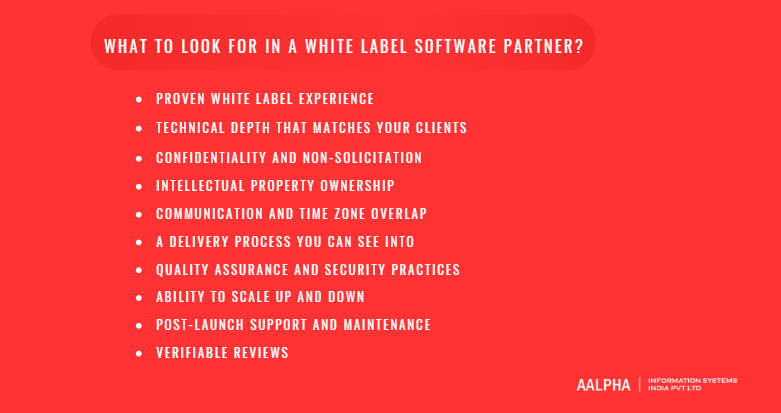
1. Proven white label experience
Ask for projects the partner delivered under another company’s brand. A firm that has only sold to end clients often struggles with the discipline white label work needs. Its staff may sign emails with their own company name, push their own branding into builds, or contact your client directly.
Good answers include named agency relationships (shared under NDA if needed), how long those relationships have lasted, and how the partner handled a project that went wrong. Repeat agency clients are a stronger signal than a large portfolio.
2. Technical depth that matches your clients
List the stacks your clients actually use, then test the partner against that list. If your clients run React front ends and Node.js back ends, a partner whose strength is PHP is a risk however good its reviews are.
Check the full range you will sell: web applications, iOS and Android apps, SaaS products, cloud deployment, API integrations and, increasingly, AI features. Ask to speak to the engineer who would lead your project, not only the sales team. A 30-minute technical call with that person tells you more than any capability deck.
3. Confidentiality and non-solicitation
Your client list is your business. The partner must sign a non-disclosure agreement before you share any client detail, and the master agreement must include a non-solicitation clause. That clause should stop the partner from approaching your clients for a fixed period, commonly 12 to 24 months after the relationship ends.
Also confirm the partner will work under your brand in every channel your client sees: email addresses, Slack or Teams accounts, code comments, commit messages and app store listings.
4. Intellectual property ownership
All code, designs and documentation should transfer to you, or directly to your client, on payment. Get this in writing. Ask whether the partner reuses its own libraries or components, and if so, what licence you get for them. Many partners keep reusable modules and grant a perpetual, royalty-free licence, which is acceptable when it is stated clearly.
The code should live in a repository you control, such as your own GitHub or GitLab organisation, from the first commit.
5. Communication and time zone overlap
You need at least two to four hours of overlap with the partner’s working day. An India-based team, for example, can overlap with UK mornings and with US East Coast mornings if the partner runs a shifted schedule. Ask what the overlap will be for your time zone, in hours, and who will be available during it.
Insist on one named project manager, written weekly status reports and a fixed meeting rhythm. Written English quality matters more than accent, since most decisions are made in tickets and messages.
6. A delivery process you can see into
You should be able to open the project board, the repository and a staging environment at any time. Ask how the partner runs sprints, how often it demos working software, and how it estimates. Two-week sprints with a demo at the end of each are a common, workable rhythm.
A partner that only reports progress in percentages (“the app is 70% done”) without showing working builds is hiding risk from you.
7. Quality assurance and security practices
Ask who tests the code and how. Look for dedicated QA staff, written test cases, automated tests for core flows and a code review step before merging. For security, ask about access control to client systems, how credentials are stored, and whether the partner holds a quality certification such as ISO 9001 or a security standard such as ISO 27001. Certification does not guarantee good code, but it shows the partner documents its processes.
8. Ability to scale up and down
Ask how many engineers the partner can add within two weeks, and what happens if you need to reduce the team. A partner with fewer than 20 engineers may not cover a sudden large project. A very large partner may put your work behind bigger accounts. Ask how many active agency clients each project manager handles.
9. Post-launch support and maintenance
The relationship does not end at launch. Your client will need bug fixes, updates and new features. Agree a support window, response times by severity, and monthly or hourly rates for maintenance before the first project goes live. Be specific about hours: a defined weekday support window is common, and round-the-clock cover usually costs more and needs to be agreed separately.
10. Verifiable reviews
Check independent review platforms rather than testimonials on the partner’s own site. On Clutch, for example, reviews are verified through interviews with clients. Read the critical reviews too. How the partner responded to a complaint tells you how it will treat you when something slips.
How do you vet a white label development partner step by step?
Vet a partner in seven steps: define what you will sell, build a shortlist of three to five firms, check independent reviews, hold a technical interview, call references, run a paid pilot, and only then sign a master agreement. The whole process takes four to eight weeks, and the pilot is the step you should never skip.
- Define what you will resell. Write down the services, tech stacks, typical project sizes and the time zones of your clients. This becomes your scorecard, and it stops you choosing on price alone.
- Shortlist three to five partners. Use referrals from other agency owners, review platforms such as Clutch, and partners whose published technical content shows real depth in your stack.
- Check reviews and history. Read at least ten reviews per firm, including the negative ones. Look for company age, team size and whether reviewers mention agency or white label work.
- Hold a technical interview. Share a short, anonymised brief from a real past project. Ask the proposed lead engineer to walk through architecture, risks and an estimate. Weak partners answer with generic process slides.
- Call two references. Ask for at least one agency reference. Ask what went wrong on their project and how the partner fixed it.
- Run a paid pilot. Give the partner a small, real piece of work lasting two to four weeks. Judge code quality, communication, honesty about delays and how well it follows your brand rules. Expect to pay for this; free trials attract the wrong partners.
- Sign a master agreement, then project orders. Put IP, confidentiality, non-solicitation and payment terms in one master services agreement. Each new client project then needs only a short statement of work.
The pilot adds cost and time, which is its downside. It is still far cheaper than discovering a weak partner halfway through a client’s six-month build.
What questions should you ask a white label partner before signing?
Ask questions that force specific answers: named examples, numbers, and what happens when things go wrong. Vague answers on IP, client contact or replacing a developer are warning signs. The list below covers the questions agencies most often regret not asking before their first project.
- Which agencies do you currently deliver white label work for, and for how long?
- Who will lead my project, and can I speak with them before we sign?
- Will your team use my company’s email, chat and brand in all client-facing work?
- Who owns the code, and when does ownership transfer?
- Do you reuse any internal components, and what licence do I receive for them?
- How many hours of overlap will we have in my time zone?
- How do you estimate, and how far off were your last three estimates?
- What happens if a developer on my project leaves or underperforms?
- How do you handle change requests mid-sprint?
- What testing happens before a build reaches my staging environment?
- What support do you offer after launch, during which hours, and at what rates?
- What notice period applies if either of us ends the relationship, and how is code and knowledge handed over?
What should a white label development contract include?
A white label contract should cover eight areas: confidentiality, IP assignment, non-solicitation, brand use, scope and change control, payment terms, warranty and support, and exit and handover. Use one master services agreement for the relationship and a short statement of work per project. Have a lawyer in your own jurisdiction review it before signing.
Confidentiality. The partner keeps all client and agency information private, during the contract and after it ends. This protects your client list and your clients’ data.
IP assignment. All work product transfers to you or your client on payment. Without this, you cannot freely resell, modify or move the code.
Non-solicitation. The partner agrees not to approach your clients or staff for 12 to 24 months. This is what stops a partner from taking your accounts.
Brand and anonymity. The partner works under your brand and does not credit itself publicly, in portfolios, case studies or app store listings.
Scope and change control. The contract sets out how changes are requested, estimated and approved. Clear rules here prevent most disputes over extra work.
Payment terms. Define milestones or monthly billing, the currency and any late fees, so partner payments line up with what your clients pay you.
Warranty and support. A bug-fix warranty, often 30 to 90 days after launch, covers defects found in production. Ongoing support terms sit alongside it.
Exit and handover. A notice period, full code and documentation handover, and a knowledge transfer session let you switch partners without losing the project.
One practical point on payment: try to align partner milestones with your client’s milestones. If your client pays you on delivery of a module, pay your partner on the same event. That keeps your cash flow positive. This article is general guidance, not legal advice.
How much does white label software development cost?
White label software development usually costs USD 25 to 50 per hour with an offshore partner in India, USD 40 to 70 in Eastern Europe or Latin America, and USD 100 to 180 with an onshore US or UK firm. Agencies typically resell at USD 100 to 200 per hour, so offshore partners leave room for a healthy margin.
The ranges below are indicative for mid to senior developers in late 2026. They vary by stack, seniority and contract length, so treat them as a starting point and confirm with each partner.
India. Rates commonly run from USD 25 to 50 per hour. The time zone suits UK, European and Gulf clients well and US clients partly, so US agencies need a clear overlap window.
Eastern Europe. Expect USD 40 to 70 per hour, with a good time zone fit for the UK and EU. The talent pool is smaller and rates sit above Asia.
Latin America. Rates are similar at USD 40 to 70 per hour, with strong overlap for US agencies. Fewer firms in the region have deep white label experience.
US or UK onshore. Onshore firms charge USD 100 to 180 per hour and share your time zone. At standard resale rates, the margin is thin or even negative.
A worked margin example
Assume your agency sells a 500-hour web application build to a US client at USD 120 per hour. That is USD 60,000 in revenue. You use an India-based partner at USD 35 per hour.
Your client revenue is 500 hours at USD 120, which comes to USD 60,000. The partner cost is 500 hours at USD 35, or USD 17,500. Allow 10% of client revenue, USD 6,000, for your own project management and QA review. Add a contingency of 15% of the partner cost, USD 2,625, for rework and overruns. That leaves a gross margin of USD 33,875, or about 56% of revenue.
The catch is that the margin only holds if the partner’s estimate is accurate. A partner that bills 700 hours for the same scope wipes out a third of that profit. That is why estimate accuracy belongs on your vetting scorecard next to the hourly rate. An experienced software development company should be able to show how its past estimates compared with the hours actually billed, and that record tells you more than a low headline rate.
What are the red flags when choosing a white label partner?
The clearest red flags are refusing to assign IP, resisting a non-solicitation clause, quoting without asking questions, and hiding the people who will do the work. Rates far below market are another warning. A partner billing USD 12 per hour for senior work is usually staffing juniors or planning to recover the gap through change requests.
Watch for these during vetting:
- The partner’s own logo or name appears in demo builds, code or emails meant for your client.
- Estimates arrive within hours, with no questions about scope.
- You cannot speak to the engineers, only to sales.
- The partner wants to keep the code in its own repository until the final payment.
- References are all end clients, with no agencies among them.
- Status updates describe percentages complete but never show working software.
- Team members change often without notice.
- The contract has no exit or handover clause.
One red flag on its own is not always a deal breaker. A small, honest partner may lack agency references simply because it is new to white label work. A paid pilot will tell you whether the gap matters.
How does Aalpha work as a white label development partner?
Aalpha Information Systems builds web, mobile, SaaS and AI software for agencies that sell it under their own brand. The team works inside the agency’s tools and brand, assigns all IP to the agency or its client, and signs NDA and non-solicitation terms before any client detail is shared. Engagements run as fixed-price projects or dedicated teams.
Aalpha has worked in software development since 2008 and has completed more than 5,500 projects for clients in 55+ countries. Most of that work is for clients in the US, UK, the Gulf, Africa and Asia, which is why the team is used to running overlap windows across those time zones. Independent feedback is public: Aalpha holds a 4.9 out of 5 rating from more than 215 verified reviews on Clutch.
For agencies, the practical points are these. Projects are built on modern stacks such as Next.js and Node.js, with web applications, mobile apps and product builds for software companies all handled by the same team. Processes are documented under ISO 9001:2015 certification. Support after launch runs within a defined weekday support window agreed per project.
The honest limitation: a team based in India overlaps easily with UK, European and Gulf working hours, but US West Coast agencies need to agree a shifted schedule or accept that most collaboration happens in writing.
Frequently asked questions
What does white label software development mean?
White label software development means one company builds software that another company sells and delivers under its own brand. The developer stays invisible to the end client, and the reselling company owns the client relationship, the pricing and usually the code.
Is white label development legal and ethical?
Yes. White label development is a standard subcontracting arrangement. It is legal as long as your contract with your client allows subcontracting and you protect your client’s data. Many agencies simply state that they work with vetted delivery partners without naming them.
Who owns the code in a white label arrangement?
The agency or its end client should own the code, provided the contract assigns IP on payment. Without a written IP assignment clause, ownership can default to the developer in many jurisdictions, so never rely on an informal understanding.
How do I stop a white label partner from contacting my clients?
Use a non-solicitation clause in your master agreement, usually lasting 12 to 24 months after the relationship ends. Require the partner to use your company email and chat accounts, and route all client communication through your project manager.
How long does it take to onboard a white label development partner?
Vetting usually takes four to eight weeks, including a two to four week paid pilot. After that, a good partner can start a new client project within one to two weeks of a signed statement of work.
Is an offshore white label partner a good idea for US agencies?
It can be, if the partner offers two to four hours of daily overlap and strong written communication. Offshore rates of USD 25 to 50 per hour leave a wider margin than onshore subcontracting, but time zone gaps need planning.
What is the difference between white label and private label software?
White label software is a generic product or service that many resellers brand as their own. Private label software is built or customised exclusively for one seller. Custom builds by a white label development partner are closer to private label, since each client gets its own code.
Your next step
Write a one-page scorecard from the criteria in this guide, then run a paid two-week pilot with your top candidate before committing a live client. If you want Aalpha Information Systems on that shortlist, share a brief with the team and request a pilot proposal. Get in touch with Aalpha to discuss your requirements.