





TL;DR:
CPG web design and development is the planning, design and build of websites for consumer packaged goods brands, covering brand sites, DTC stores and retailer-facing portals. To choose an agency, check four things: real CPG projects you can visit, experience on the platform you need, proven integrations with ERP, PIM and fulfilment systems, and a clear support model after launch. A brand site typically costs USD 8,000 to 25,000, while a headless DTC store with integrations runs USD 60,000 to 180,000. Shopify Plus suits most smaller brands. Headless or custom builds pay off once you sell across several regions, retailers and subscription models. Aalpha Information Systems builds both, recommending Shopify where it fits and moving brands to headless Next.js builds when they outgrow it. Ask every shortlisted agency the same questions, compare written answers, and treat vague maintenance terms as a warning sign.
What is CPG web design and development?
CPG web design and development is the work of planning, designing and building websites for brands that sell consumer packaged goods, such as food, beverages, personal care and household products. It covers the brand website, the DTC online store, and often a portal for retailers or distributors. Each has a different job and a different buyer.
The three types of CPG websites
Brand websites tell the product story, host ingredient and usage content, and send shoppers to retailers through a where-to-buy locator. Most legacy CPG brands started here.
DTC stores sell straight to the consumer. They carry the cart, checkout, subscriptions and customer accounts, and they give the brand first-party data it cannot get from retail.
B2B portals let retailers, wholesalers or distributors place bulk orders, see tiered pricing and download product assets. Many growing brands need one within two to three years of launching DTC.
How CPG differs from general ecommerce
CPG has a few traits that change how a site should be built. Basket values are low, so the site has to win on repeat purchase and subscriptions rather than one large sale. Most revenue still comes through retail and marketplaces like Amazon, so the website must support those channels without undercutting them. Product data runs to hundreds of SKUs, pack sizes and regional variants. Food, supplement and cosmetic products also carry labelling and claims rules that the product pages must respect. An agency that only builds fashion or electronics stores will meet these problems for the first time on your budget.
Why do CPG brands need a specialist web agency?
CPG brands need a specialist agency because the hard parts of a CPG website sit behind the design. Channel conflict with retailers, subscription billing, SKU-level product data and labelling compliance all decide whether the site makes money. A generalist agency can make the site look right and still get these wrong, which shows up months after launch.
Retail and marketplace coexistence
Most CPG brands earn the bulk of revenue through supermarkets, pharmacies or Amazon. A DTC store that prices below retail, or hides the where-to-buy links, can damage those relationships. A specialist agency plans price parity, retailer links and promotion rules with your sales team before design starts.
Subscriptions and repeat purchase
Consumables like coffee, pet food and skincare live on replenishment. The site needs subscribe-and-save, flexible delivery intervals, skip and pause controls, and failed-payment recovery. These are billing problems as much as design problems, and they need testing against real payment gateways.
Product data at scale
A mid-sized food or beauty brand can carry several hundred SKUs across flavours, sizes, bundles and regions. Copying that by hand into a CMS breaks fast. A CPG-aware agency connects the site to a product information management (PIM) system or ERP so one change updates every channel.
Labelling, claims and regional rules
Food and supplement pages must show nutrition, ingredients and allergens in line with local rules. In the US that means FDA labelling requirements and, for California shoppers, Proposition 65 warnings where they apply. In the EU, Regulation (EU) No 1169/2011 sets out what food information must be given to consumers, including online. UAE sales bring Arabic content and local product registration. Your agency does not give legal advice, but it should build product templates that make compliant content easy to publish and hard to forget.
What should a CPG website include?
A CPG website should include fast product pages driven by structured data, a where-to-buy locator, a checkout with subscriptions, reviews, and content that answers how to use the product. Add loyalty, bundles and a retailer portal as the brand grows. Build the must-haves well before adding anything else.
Must-have features. Product pages should pull from PIM or ERP data so nutrition, ingredients and pack sizes stay accurate across hundreds of SKUs. A where-to-buy locator protects retail partners and captures shoppers who prefer stores. The checkout must be mobile-first with digital wallets, since most CPG traffic arrives on phones from social and search. Ratings and reviews matter because shoppers compare taste, scent and results before trying a new brand. For consumables, subscriptions and replenishment are also a must, because repeat orders carry the economics of low basket values.
Should-have features. Recipe, usage or routine content wins informational searches and AI answers that lead to a purchase. Bundles and multipacks raise average order value without discounting single units.
Nice-to-have features. Loyalty and referral programmes pay off once you have a steady base of repeat customers. A B2B portal for retailers or distributors moves wholesale orders off email and spreadsheets.
Market-dependent features. Multi-language and multi-currency support is needed for EU and UAE launches, including Arabic right-to-left layouts for the Gulf.
One caution: every feature added at launch adds testing time and monthly cost. Brands that launch with the first five rows and add the rest from real customer data usually reach profit sooner than those that launch with everything.
Which platform is right for a CPG brand?
For most smaller CPG brands, Shopify or Shopify Plus is the right first platform because it launches fast and has proven subscription apps. Headless commerce, with a Next.js storefront on a commerce backend, suits brands selling across several regions and channels. Fully custom builds make sense when your business model does not fit any standard platform.
Shopify or Shopify Plus (theme-based) suits early-stage and mid-sized DTC brands selling in one or two markets. Its strength is a fast launch, a large app ecosystem and low engineering overhead. The downside is that app fees add up, and checkout and data model limits start to show as the business grows more complex.
Headless commerce, with a Next.js storefront on a commerce backend, suits scaling brands that sell in several regions, run content-heavy sites or have strict speed targets. It gives full control of the front end, speed and content, with one storefront serving many channels. The downside is a higher build cost and the need for a team to maintain two layers.
A fully custom platform suits brands with unusual models, such as B2B and DTC on one system or route-based delivery. It fits your exact workflows and pricing rules and carries no platform fees per sale. The downside is the longest build, and you own every upgrade and security patch.
When Shopify Plus is the honest answer
If you sell in one or two countries, carry under a few hundred SKUs and need to be live in a quarter, a well-built Shopify store is hard to beat. Any agency that pushes a custom build on a brand at this stage is selling you its preferred service rather than what you need.
When to move to headless or custom
The signs are clear. Your site slows down under app weight, you run separate stores per region with duplicated content, your B2B and DTC pricing fight each other, or your marketing team waits on developers for every landing page. At that point a headless build pays back through speed, a single content source and fewer app subscriptions. Brands already on Shopify can take a middle path with headless Shopify development, keeping Shopify as the commerce backend behind a custom storefront. Aalpha Information Systems builds these storefronts on Next.js and Node.js with a custom CMS, so marketing teams edit content without touching code.
Whichever you choose, check how the agency handles migration. Moving platforms later is possible, but redirects, customer accounts and subscription contracts must move cleanly or you lose both rankings and recurring revenue.
How do you evaluate a CPG web development agency?
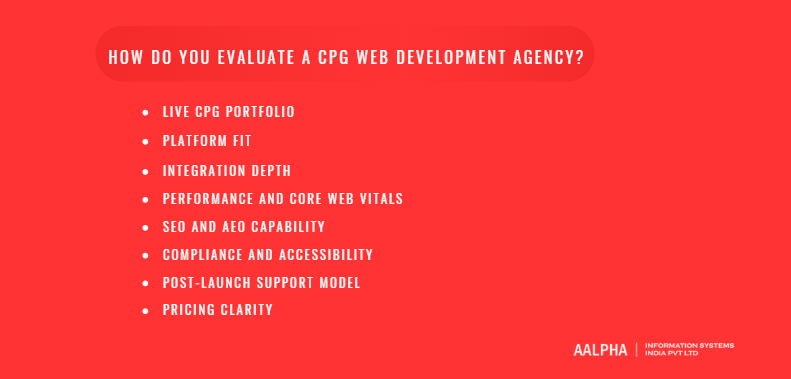
Evaluate a CPG web development agency on eight points: live CPG work, platform fit, integration depth, site speed, search and AI visibility, compliance and accessibility, post-launch support, and pricing clarity. Score each shortlisted agency against the same list. The agency with the best mockups often scores worst on integrations and support.
1. Live CPG portfolio
Ask for links to live consumer goods sites, not just screenshots. Place a test order, check the product pages on your phone, and look at how nutrition or ingredient data is shown. A case study is useful only if you can see the site still running.
2. Platform fit
The agency should recommend a platform based on your markets, SKU count and growth plan, and it should explain what it would not use and why. Be wary of agencies that only work on one platform, since every project will end up there.
3. Integration depth
Integrations decide whether the site runs smoothly or needs manual work every day. Ask which ERP, PIM, warehouse or 3PL, payment, tax and review systems the agency has connected before. Ask how they handle stock sync failures and order retries. A clear answer here is worth more than any design award.
4. Performance and Core Web Vitals
CPG shoppers arrive on phones from social ads and search, so slow pages cost sales. Ask for the Core Web Vitals scores of sites the agency has launched, measured on mobile. Ask how they keep image-heavy product galleries fast.
5. SEO and AEO capability
Shoppers now ask search engines and AI assistants questions like which protein bar has the least sugar. Your agency should build structured product data, FAQ content and clean page architecture so search engines and AI tools can read and cite your pages. Ask how they handle redirects if you are replacing an existing site.
6. Compliance and accessibility
The site must handle privacy consent under GDPR in the EU and state privacy laws in the US. Accessibility matters too. The European Accessibility Act has applied to many online stores selling in the EU since June 2025, and US brands face ADA-related claims over inaccessible sites. Ask the agency which level of WCAG it builds to and how it tests.
7. Post-launch support model
Most of a site’s life happens after launch. Ask for the support hours, response times by severity, what a monthly retainer covers, and who fixes an integration that breaks during a promotion. Get it in writing.
8. Pricing clarity
A good proposal lists scope, exclusions, milestones and payment terms, and states which costs are third-party, such as platform plans, apps and hosting. If two quotes differ by a factor of three, the cheaper one has usually left something out.
A simple scoring sheet
Give integration depth the heaviest weight, around 20 percent, and look for named ERP, PIM and 3PL integrations with failure handling explained. Weight the live CPG portfolio and the post-launch support model at about 15 percent each. A strong portfolio means three or more live consumer goods sites you can test, and strong support means written hours, response times and retainer scope.
The remaining five criteria carry about 10 percent each. For platform fit, look for a recommendation tied to your markets and SKU count. For performance, look for passing mobile Core Web Vitals on launched sites. For SEO and AEO, check that structured data, a redirect plan and a content model are in scope. For compliance and accessibility, expect a stated WCAG level and testing method. For pricing clarity, expect itemised scope, exclusions and third-party costs.
Adjust the weights to your situation. A brand with a complex supply chain should weight integrations higher, and a new brand should weight speed to launch.
What questions should you ask a CPG agency before signing?
Ask questions that force specific answers: which CPG sites they built, which systems they integrated, who owns the code, what support costs, and how they will protect your search rankings. Send the same list to every agency in writing. Written answers are easier to compare and harder to walk back later.
Experience and fit. Ask which live CPG or consumer goods sites they have built, and expect working links with the brand’s category and what the agency built. Ask why they recommend a given platform for you. A good answer ties the choice to your markets, SKU count and channels, and names at least one downside. Ask to speak to two past clients, ideally one in consumer goods.
Technical depth. Ask which ERP, PIM, 3PL and payment systems they have integrated, and how sync errors are caught and retried. Ask how they handle subscriptions and failed payments; listen for a named billing approach, a dunning flow and a testing plan. Ask for the mobile Core Web Vitals scores of their launched sites, and expect real numbers. Ask which WCAG level they build to and how they test it, both automatically and by hand.
Search protection. Ask how they will protect your current rankings. The answer should include a URL map, a 301 redirect plan and monitoring after launch.
Ownership, team and terms. Ask who owns the code, domain, hosting and third-party accounts; the answer should be your company, from day one, in the contract. Ask who will work on your project and where they are based, and expect named roles, time zones and overlap hours. Ask what support costs after launch and what it covers, including hours, response times, retainer scope and change request rates. Finally, ask what is excluded from the quote, and get a written list of exclusions and third-party costs.
Pay attention to how fast and how plainly the agency answers. A team that dodges ownership or exclusions before the contract will be harder to work with after it.
How much does CPG web design and development cost?
CPG web design and development costs USD 8,000 to 25,000 for a brand site, USD 20,000 to 60,000 for a Shopify Plus DTC store, and USD 60,000 to 180,000 for a headless DTC build with integrations. Fully custom platforms start around USD 150,000. Integrations, markets and subscription logic move the price more than design does.
Scope | Typical cost (USD) | Typical timeline | What is included |
Brand website with where-to-buy | 8,000 to 25,000 | 6 to 10 weeks | Custom design, CMS, product catalogue, store locator, basic SEO |
Shopify or Shopify Plus DTC store | 20,000 to 60,000 | 8 to 14 weeks | Custom theme, subscriptions app setup, reviews, payments, basic ERP or 3PL connector |
Headless DTC with integrations | 60,000 to 180,000 | 4 to 7 months | Next.js storefront, commerce backend, custom CMS, PIM and ERP sync, multi-region setup |
Custom DTC plus B2B platform | 150,000 and up | 6 to 12 months | Custom order management, tiered B2B pricing, distributor portal, full integrations |
These ranges assume one primary language at launch, up to 500 SKUs, and design and development by an experienced agency. Each additional language or region usually adds 10 to 20 percent. They exclude platform subscriptions, paid apps, hosting, photography and ongoing marketing. For a figure based on your own scope, try our web development cost calculator.
Onshore vs offshore rates
The location of your agency has a significant impact on website design and development costs. Agencies in the United States typically charge $100 to $200 per hour, offering the advantage of working in the same time zone and having a strong understanding of the local market, but at a higher cost. Agencies in Western Europe and the UK charge around $70 to $150 per hour, often bringing strong knowledge of European compliance requirements. Eastern European agencies generally charge $40 to $80 per hour and offer good engineering expertise, although working hours may not fully overlap with US business hours. In India, hourly rates typically range from $25 to $50, making it a more affordable option for businesses looking for quality development within a lower budget.
Offshore teams can deliver comparable quality at a fraction of the cost when the project is managed properly. To achieve this, choose an agency with a dedicated project manager, agreed working-hour overlaps, and clearly documented project requirements and acceptance criteria. Without these arrangements, communication gaps and repeated revisions can reduce the expected savings. Regardless of where your agency is based, allocate around 15 to 20 percent of the initial development cost annually for ongoing support, updates, maintenance, and minor improvements.
What are the red flags when hiring a CPG web agency?
The main red flags are a portfolio of templates with no live CPG sites, no named integrations, vague support terms, and contracts that leave the agency owning your code or accounts. A quote far below the others is also a warning. Each of these tends to cost more after launch than it saved before.
Template-only portfolios. If every site looks like a lightly edited theme, the agency may not handle custom product data, subscriptions or B2B pricing. Ask what they built beyond the theme.
No integration references. An agency that cannot name an ERP, PIM or 3PL it has connected is likely to learn on your project. Expect delays and manual workarounds.
Vague maintenance terms. “We will support you after launch” is not a support plan. Without hours, response times and scope in writing, every fix becomes a negotiation.
Agency-owned accounts. Your domain, hosting, platform store, analytics and code repository should sit in your company’s name. Agencies that keep these can hold your site hostage when you want to move.
No SEO migration plan. Replacing an established site without a redirect map can wipe out years of search traffic in a week. If the proposal says nothing about redirects, ask.
Fixed price with no exclusions. A fixed price is fine. A fixed price with no list of what is excluded usually ends in change requests that cost more than an honest quote would have.
How long does a CPG website project take?
A CPG website project takes 6 to 10 weeks for a brand site, 8 to 14 weeks for a Shopify DTC store, and 4 to 7 months for a headless build with integrations. Integrations and content readiness cause most delays. Brands that have product data and photography ready before kickoff launch noticeably faster.
The phases below are for a headless DTC build of about five months.
Discovery and planning takes 2 to 3 weeks and produces the requirements, sitemap, integration map and SEO migration plan. UX and UI design follows over 3 to 5 weeks, ending with wireframes, a design system and approved page designs.
Development is the longest phase at 8 to 12 weeks, covering the storefront, CMS, checkout, subscriptions and admin tools. Two workstreams run alongside it. Integrations take 4 to 6 weeks to connect ERP, PIM, 3PL, payments, tax and reviews. Content and data load takes 2 to 3 weeks for product data, nutrition and ingredient content, and images.
Testing and launch takes 2 to 3 weeks of functional, performance and accessibility testing, plus redirects and go-live. A hypercare period of 2 to 4 weeks after launch covers daily monitoring and quick fixes.
Avoid launching just before a major retail season or a large campaign. Leave at least four weeks between go-live and your busiest sales period so issues surface while traffic is normal.
How does Aalpha Information Systems approach CPG web projects?
Aalpha Information Systems starts every CPG web project with the integration map and channel rules, then designs around them. We recommend Shopify when it fits, and build headless or custom platforms on Next.js and Node.js when a brand outgrows it. Clients own all code and accounts from day one.
Our eCommerce development team has built DTC stores, B2B ordering portals and multi-vendor marketplaces, including a web platform for a food and beverage marketplace. Our web design services cover the brand side, from design systems to product page templates built for nutrition and ingredient content. For brands that also need retail and marketplace integrations, our retail software solutions connect the store to Amazon and other channels.
Clients rate us 4.9 out of 5 across more than 215 reviews on Clutch, including several for ecommerce builds. Our delivery teams are in India, which keeps costs in the offshore range in the table above, with fixed overlap hours for clients in the USA, Europe and the UAE.
One honest limit: an offshore team moves only as fast as your decisions. Brands get the best results when someone on their side can approve designs, product data and content within a working day.
Next step
If you are shortlisting agencies for a CPG website, send us your SKU count, target markets and the systems you use today. We will reply with a platform recommendation, a phased scope and a USD estimate you can compare against other quotes. Feel free to connect with us today!
Frequently asked questions
Is Shopify good enough for a CPG brand?
Yes, for most early and mid-sized CPG brands. Shopify and Shopify Plus handle DTC checkout, subscriptions through apps, and reviews well. Brands usually outgrow it when they run several regional stores, need B2B and DTC pricing on one system, or carry heavy app costs that slow the site.
Can a CPG brand sell direct to consumers without hurting retail partners?
Yes, if the site keeps price parity with retail, shows a where-to-buy locator, and uses DTC for things retailers do not offer, such as subscriptions, bundles and exclusive flavours. Agree these rules with your sales team before the site is designed.
What is headless commerce for CPG brands?
Headless commerce separates the storefront that shoppers see from the commerce engine that handles products, carts and orders. CPG brands use it to build one fast storefront, often in Next.js, that serves several regions and channels from a single content source.
How do CPG websites handle subscriptions?
Through a subscription billing system connected to the store. It manages delivery intervals, skip and pause options, card updates and retries when a payment fails. Test it with real payment gateways before launch, since billing errors hit your most loyal customers first.
Is it safe to hire an offshore agency for a CPG website?
It can be, if the contract gives you ownership of code and accounts, the agency names your project manager, and you agree fixed overlap hours and written acceptance criteria. Check live work and client reviews on Clutch before signing.
Will a new website hurt our search rankings?
It does not have to. Map every old URL to a new one with 301 redirects, keep product content and structured data, and monitor Search Console for several weeks after launch. Most ranking losses after a redesign come from skipped redirects.
How much should a CPG brand budget for website maintenance?
Plan for about 15 to 20 percent of the original build cost each year. That covers security updates, platform and app changes, small improvements and integration fixes. Seasonal campaigns and new markets are usually quoted separately.
What is the difference between a CPG web agency and a creative agency?
A creative agency focuses on brand identity, campaigns and content. A CPG web development agency builds and runs the site, its checkout and its integrations. Many brands use both, with the creative agency setting the look and the web agency making it work at scale.