





TL;DR
To hire a full-stack developer for a SaaS product, write down the work the next three to six months require, test candidates on SaaS-specific skills such as tenant isolation, subscription billing and role-based access, and pick a hiring model that matches how long you need the person. One senior full-stack developer can usually build a focused MVP. A product with paying customers usually needs a small team with specialist support. The cost to hire depends on region, seniority and engagement model: as indicative 2026 figures, hourly rates range from about USD 25 in India to USD 160 in the US, and a dedicated full-time developer through an offshore partner such as Aalpha Information Systems typically costs USD 3,000 to 6,000 a month, with recruitment, equipment and replacement cover included. Assess candidates with a short, paid task drawn from real product work, discuss their decisions with them, and settle IP, access and handover terms before the first commit.
1. What does a full-stack developer do in a SaaS product?
A full-stack developer on a SaaS product builds and maintains every layer the customer touches or depends on: the interface, the API, the database and the connections to outside services. The difference from website work is that a SaaS product holds many customers’ data at once, bills them repeatedly and has to stay online while it changes.
Frontend, backend, database and integration work
On the frontend, the developer builds the screens customers use every day: dashboards, settings pages, forms, tables that filter and paginate, and the states in between, such as loading, empty and error. On the backend, they write the API endpoints those screens call, the business rules behind them and the background jobs that send emails, generate reports or sync data overnight. They design the database tables, write migrations when the schema changes and make sure queries stay fast as rows pile up. Integration work connects the product to payment providers, email services, identity providers, CRMs and whatever else customers expect the product to talk to. In a small company, one person may do all four in a single week.
How SaaS development differs from building a website
A marketing website is mostly read-only. It serves the same public content to anonymous visitors, earns money indirectly through leads, changes occasionally, and a bug on it is embarrassing but rarely costly. The skills it needs are mostly CMS, frontend and SEO work.
A SaaS product is closer to a bank branch. Each customer has private data, a subscription that bills them directly, a set of authenticated users with different permissions and an expectation that the product works at 3 a.m. on a Sunday. Releases happen weekly or daily while customers are logged in. A careless migration can lock a table and take the product down. A missing filter in one query can show one company’s invoices to another. A bug here means data exposure, lost revenue or churn, so the skills shift toward APIs, data modelling, authentication, billing and operations. These risks change what you should look for in a candidate.
Where the full-stack role ends and specialist roles begin
A full-stack developer is a generalist with enough depth in each layer to ship features end to end. That does not make them a security engineer, a database administrator, a DevOps specialist or a product designer. Expect a good full-stack hire to configure a CI pipeline, set up basic monitoring and follow accessible design patterns. Do not expect them to run a penetration test, tune a database cluster at high write volumes or design your brand system from scratch. Once your product handles regulated data, serves enterprise customers with audit demands or reaches the point where infrastructure costs matter to your margins, bring in specialists for those areas and let the full-stack developer keep shipping features.
2. When should you hire a full-stack developer?
Hire a full-stack developer when most of your upcoming work is feature delivery that crosses the frontend, backend and database, and when handoffs between separate specialists would slow you down. This is most common at the MVP stage and in small post-launch teams. Once scale, compliance or deep performance work dominates, specialists usually give better value.
-
Hiring for an MVP versus an established product
At the MVP stage, the job is to learn whether customers will pay. Speed of iteration matters more than elegant architecture, and one developer who can take a feature from database table to finished screen without waiting on anyone is valuable. The risk is that an MVP built carelessly becomes the production system for the next five years. Hire someone senior enough to make a few decisions correctly from the start: how tenants are separated, how authentication works and how the database is migrated. Everything else can be rough.
With an established product, the priorities shift. There are paying customers, existing code and existing data. A new full-stack developer has to work within patterns they did not choose, respect backward compatibility for API clients and avoid breaking workflows people rely on. Here, the ability to read unfamiliar code carefully and make small, safe changes matters more than raw speed.
-
Signs your current team needs full-stack support
A few patterns suggest the gap is real. Features stall at the handoff between frontend and backend developers, with each side waiting on the other. Your backend developer builds APIs that are awkward to use from the interface, or your frontend developer works around missing endpoints with client-side hacks. Small customer requests, such as adding a field to an export, take weeks because they touch three layers and nobody owns all of them. Your founder or CTO is still writing production code at night because nobody else can finish a feature alone. If two or more of these are true, a full-stack hire will probably help.
-
When a specialist or small team may be a better fit
A full-stack developer is the wrong hire when the bottleneck sits in one layer. If page load time is killing conversions, you need someone with deep frontend performance experience. If the product is falling over under load, you need backend and infrastructure depth. If you are preparing for SOC 2 or HIPAA, you need someone who has done that before. A small team of two to four people, usually with at least one specialist, also makes sense once the roadmap has more parallel workstreams than one person can carry.
-
One experienced developer or several junior developers
Founders sometimes compare the cost of one senior hire with two or three juniors and assume more people means more output. For SaaS work, that is rarely true in the first year. A senior developer makes architecture decisions and can explain them, usually understands security and tenant isolation, and produces steady output from week two or three with little management from the founder. Two or three juniors need someone else to make those architecture decisions, often miss isolation problems without review, deliver slowly with rework in the first three months and pull the founder into daily code review. Their combined cost is often similar to or higher than the one senior hire.
The senior option has a real downside: if that person leaves, much of your product knowledge goes with them. Reduce the risk with documentation habits from day one, which section 12 covers. The junior option’s downside is quality and consistency. Juniors work well once a senior person has set patterns they can follow and has time to review their work.
3. How do you define the role before starting your search?
Define the role by listing the product features and business outcomes you need over the next three to six months, then working backwards to the skills that work requires. Separate must-have skills from those a strong developer can learn in weeks, and state plainly how much ownership, collaboration and availability you expect.
-
Identify the product features and business goals
Start with outcomes, not technologies. “Launch self-serve signup with a 14-day trial” is an outcome. “Reduce churn from customers who never invite a teammate” is an outcome. Each outcome implies work: a signup flow, a trial expiry job, billing integration, an invitation system, an onboarding checklist. Writing outcomes first stops you from hiring for a framework you happen to like and ending up with someone who cannot build the features that matter.
-
List the work needed in the next three to six months
Turn the outcomes into a rough backlog. It does not need estimates yet. It needs to be concrete enough that a candidate could read it and tell you which items they have done before. A realistic list for an early SaaS product might include a team invitation flow with email verification, role-based permissions for admin, member and viewer, Stripe subscription billing with upgrades and downgrades, a CSV import with validation and error reporting, an audit log for account changes, and a migration of the existing database to support multiple workspaces per customer. This list becomes the basis for your job description, your interview questions and your technical assessment. Hiring without it means each interviewer judges candidates against a different imagined job.
-
Separate must-have skills from skills that can be learned
Some skills take months or years to develop. Others take a strong developer a week. Mixing them up narrows your candidate pool for no reason. For a SaaS hire, the skills that usually have to be in place already are relational data modelling, a working grasp of authentication and authorization concepts, the habit of writing and reviewing tests, experience running safe schema migrations on live data, API design and versioning, and the ability to read unfamiliar code. The things a good developer can usually pick up on the job are the specific tools that sit on top of those skills: your ORM or query builder, your auth provider’s SDK, your testing framework, your migration tool, your API documentation tooling and your codebase’s conventions.
A candidate with five years of Vue who has never used React can be productive in React within a few weeks. A candidate who has never thought about how one customer’s data is kept away from another’s will take much longer to become safe.
-
Set expectations for ownership, collaboration and availability
Decide whether the developer owns features end to end, including talking to customers about bugs, or implements tickets someone else has specified. Decide who reviews their code and who approves releases. If you need overlap with a US or European timezone, say how many hours. If they will be on call for production incidents, say so up front and say how it is compensated. Candidates who discover these expectations after accepting an offer leave early, and early departures are expensive in a small SaaS team.
4. Which technical skills matter most for SaaS development?
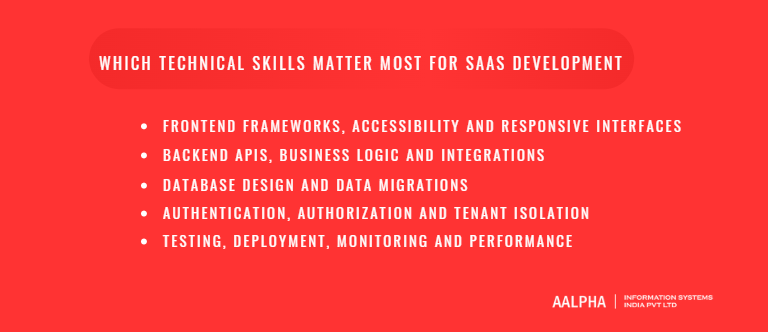
The technical skills that matter most are building usable, accessible interfaces; designing clear APIs and business logic; modelling data and migrating it safely; implementing authentication, authorization and tenant isolation correctly; and shipping with tests, deployment automation and monitoring. Framework experience matters less than depth in these fundamentals.
-
Frontend frameworks, accessibility and responsive interfaces
Most SaaS frontends today use React, Vue, Angular or Svelte, often with a meta-framework such as Next.js or Nuxt. The framework matters less than whether the candidate can manage complex state, such as a filtered, sorted, paginated table whose settings survive a page reload, without the code becoming unmaintainable. Look for experience with form validation, optimistic updates, error handling and loading states. Accessibility is not optional for B2B SaaS. Enterprise buyers increasingly ask for conformance with the Web Content Accessibility Guidelines, and public sector buyers often require it. A candidate should know how to build a keyboard-navigable modal, label form fields properly and avoid conveying information through colour alone. Responsive design matters too, although many B2B products are used mainly on desktop. Ask how candidates decide which screens need a full mobile layout and which only need to avoid breaking.
-
Backend APIs, business logic and integrations
Backend work in SaaS is mostly about getting business rules right and keeping them in one place. A good candidate puts rules such as “a viewer cannot export data” or “a downgraded plan loses access to the reporting module at the end of the billing period” on the server, not in the interface. They design APIs with consistent naming, sensible pagination, clear error responses and a plan for versioning once external clients depend on them. They know when to push work into a background queue rather than making the user wait. Integration experience means more than calling an SDK. It means handling webhooks idempotently, retrying failed calls with backoff, storing enough state to recover when a third party is down, and never trusting data just because it came from a known provider.
-
Database design and data migrations
A SaaS product’s data model is hard to change once customers depend on it. Look for candidates who can explain normalisation, choose sensible indexes, and describe when they would denormalise for reporting. PostgreSQL is the default choice for most new SaaS products because the reporting and billing data is relational and Postgres handles JSON well when you need flexibility. The more telling skill is migrations. Adding a column to a table with 40 million rows, renaming a field that three services read from, or backfilling data without locking the table are routine tasks in a live product. A candidate who has done these safely, usually through expand-and-contract patterns, is worth more than one who knows three extra frameworks.
-
Authentication, authorization and tenant isolation
These three are often confused, and the confusion causes breaches. Authentication confirms who the user is. Authorization decides what that user can do. Tenant isolation guarantees that a user in one customer account can never read or change data in another, even if authorization logic has a bug. Most modern teams use a managed identity provider or a well-maintained library for authentication rather than writing their own password handling. Authorization and tenant isolation, though, live in your code. The OWASP Top 10 lists broken access control as a leading risk, and in SaaS products that usually means a query that forgot to filter by tenant. Ask candidates how they would make it structurally hard to write such a query, for example through row-level security in PostgreSQL, a scoped repository layer or middleware that injects the tenant context. Candidates who answer “we check it in each endpoint” have not seen this go wrong yet.
-
Testing, deployment, monitoring and performance
A SaaS developer should write automated tests as part of normal work, with most coverage on business rules and API behaviour rather than on UI snapshots. They should be comfortable with a CI pipeline that runs tests on every pull request and deploys automatically once checks pass. They should know how to add structured logging, error tracking and basic performance metrics, and how to read them when something breaks. For performance, look for practical experience: spotting an N+1 query, adding caching where it is safe, and measuring before optimising. Deep infrastructure work, such as designing multi-region failover, is a specialist job, but a full-stack developer should understand the deployment setup well enough to fix a failed release at night.
5. What SaaS-specific experience should you look for?
Look for hands-on experience with subscription billing, user roles and account management, multi-tenant data protection, onboarding and product analytics, and scaling under growing usage. These areas separate a developer who has built SaaS products from one who has built websites or internal tools, and mistakes in them are expensive to reverse.
-
Subscription billing and payment workflows
Billing looks simple until you handle the edge cases. A customer upgrades mid-cycle and expects prorated charges. A card fails and the account enters a grace period. A customer downgrades, and features must switch off at the right moment without deleting their data. Tax rules differ by country. Invoices must match what the product actually granted. Most teams use a provider such as Stripe Billing, but the provider only handles part of the problem. Your product still has to keep its own view of entitlements in sync with the billing system through webhooks, and it has to behave sensibly when those webhooks arrive late, twice or out of order. Ask candidates to walk you through a billing bug they fixed. Someone who has done this work will have a story.
-
User roles, permissions and account management
Most B2B SaaS products need an account (or workspace, or organisation) that contains many users with different roles. That brings invitation flows, ownership transfer, removing a user without deleting their work, single sign-on for larger customers and eventually custom roles. The design choice that matters most early on is whether permissions are checked in one consistent place. Products that scatter role checks across the codebase end up with inconsistencies that surface as security bugs. A candidate who has built or maintained a permission system can describe how they tested it and how they handled a user who belongs to several accounts.
-
Multi-tenant architecture and data protection
Multitenancy means one running application serves many customers. There are three common models: a shared database with a tenant ID on every row, a separate schema per tenant, or a separate database per tenant. Each trades cost against isolation and operational effort, and many mature products mix them, keeping small customers on shared infrastructure and moving large or regulated customers to dedicated databases. Aalpha’s guide to SaaS architecture types compares these in more detail. A strong candidate can explain which model suits your stage, what it would take to move a customer from one model to another, and how backups, restores and data deletion requests work in each. Data protection also covers encryption at rest and in transit, handling of personal data under GDPR or similar laws, and producing a complete export when a customer asks for their data.
-
Onboarding, product analytics and feature adoption
A SaaS product earns revenue only while customers keep using it. Developers who have worked on growth-related features understand trial flows, onboarding checklists, empty states that teach, in-app prompts, and event tracking that lets the product team see where users drop off. This work is often underestimated. Ask whether a candidate has instrumented a product for analytics, how they named events, and how they kept tracking code from cluttering business logic. A developer who treats analytics as someone else’s problem will ship features you cannot measure.
-
Scaling the product as usage grows
Early SaaS products rarely have scaling problems in the first year, and hiring for hypothetical scale leads to over-engineered systems. What you want is someone who knows the first few bottlenecks and how to address them in order: slow queries, missing indexes, synchronous work that should be queued, a single large customer whose usage degrades everyone else’s experience (the noisy neighbour problem), and file storage that has outgrown the application server. Ask what they would measure first if customers reported that the product felt slow. A good answer starts with data, not with rewriting the system as microservices.
6. How do you choose the right hiring model?
Choose the hiring model by weighing how long you need the developer, how much control you want over their day-to-day work, how quickly you need them to start and how much management time you have. Full-time employees suit long-term core roles, freelancers suit short defined work, and dedicated developers through a partner suit sustained work without the hiring overhead.
Full-time employee
A full-time hire gives you the most control and the strongest long-term commitment. The developer builds institutional knowledge, attends every product discussion and has a direct stake in the product through equity or career growth. The downsides are time and cost. Recruiting a senior full-stack developer with SaaS experience can take two to four months from job post to start date, and the total cost includes recruiting fees or internal hiring time, taxes, benefits, equipment and software licences on top of pay. It also takes more effort to part ways if the fit is wrong.
Freelancer or contractor
Freelancers are fast to engage and flexible. They work well for defined pieces of work: building an integration, fixing a performance problem or adding a feature with clear boundaries. The risks are continuity and availability. Good freelancers often juggle several clients, and your priorities compete with theirs. If a freelancer leaves mid-project, knowledge leaves with them unless you insisted on documentation. For core product work that will continue for years, freelancers are usually a stopgap.
Dedicated developer through a development partner
In this model, a development company assigns a developer who works only on your product, usually full-time, under your direction. You set priorities and review work; the partner handles recruitment, payroll, equipment, replacement if the person leaves and often senior technical backup. Aalpha explains how this works in its guide to hiring dedicated resources. The advantages are speed of start, lower cost than a local hire in most markets and continuity guaranteed by contract rather than by one person’s plans. The downsides are timezone differences if the partner is offshore, dependence on the partner’s hiring quality and less cultural integration than an employee sitting in your team channels from day one. Partners vary widely, so evaluate them as carefully as you would an individual candidate.
Building an in-house team versus extending an existing team
If you have no engineering function yet, you are building from scratch and need someone who can set standards: repository structure, code review, deployment and documentation. That argues for a senior first hire, whether employed or dedicated. If you already have a team, you are extending it, and the priority is fit with existing practices. A developer who is excellent in isolation but ignores the team’s conventions creates more work than they save.
Comparing cost, control, continuity and management effort
The three models differ most on speed, control and who carries the risk. A full-time employee typically takes two to four months to start, costs recruiting plus ongoing employment expenses, gives you full day-to-day control and stays as long as you can retain them, but brings the highest management load because HR sits with you. It suits core long-term roles, and its main downside is that it is slow and costly to hire. A freelancer can start within days to two weeks, bills hourly or at a fixed price and needs moderate management, but you have limited control over their time and continuity is low. It suits defined short tasks, and the main risk is that knowledge walks away when they do. A dedicated developer through a partner usually starts within one to three weeks for a monthly fee that includes overheads, gives you a high degree of day-to-day control and comes with replacement cover backed by the partner, while the partner handles HR. It suits sustained product work, and its main downside is that quality depends on the partner you choose.
These timings are planning assumptions based on typical market conditions, not guarantees. A niche stack or a senior role in a competitive city can take much longer to fill.
7. Where can you find qualified full-stack developers?
The best candidates usually come from referrals, open-source and developer communities, focused job boards and established development partners. Each source has different strengths. Referrals give trust, communities give visible work, job boards give volume and partners give speed. Judge a source by the quality of candidates who reach the final interview, not by application counts.
-
Professional networks and referrals
Referrals from engineers you trust remain the most reliable source for senior hires. The referrer has usually worked with the candidate and knows how they behave under pressure, which no interview can fully reveal. The limitation is volume and diversity. Your network reflects your past, and relying only on referrals can produce a team with the same blind spots. Offer a referral bonus and ask specifically for people with SaaS product experience rather than “good developers.”
-
Developer communities and open-source contributions
Open-source contributions let you see real code, real review discussions and how someone responds to criticism. A candidate who has contributed fixes to a well-known library, maintained a small package used by others or written clear technical posts has given you evidence you cannot get from a CV. Communities around specific frameworks, local meetups and conference speaker lists are also good places to look. The caveat is that many excellent developers have no public work because their employers’ code is private. Treat open-source activity as a bonus, not a requirement.
-
Job boards and freelance platforms
General job boards bring volume, most of it unqualified for SaaS work. Niche boards focused on remote work, startups or specific stacks produce better ratios. Freelance platforms let you see ratings and past client feedback, which helps, but ratings skew positive and rarely show whether the freelancer’s code was maintainable six months later. If you use platforms, filter hard on SaaS-specific experience and look for long engagements with the same client, which suggest reliability.
-
Development agencies and staffing partners
A development partner gives you pre-screened candidates, a faster start and replacement if someone leaves. Staffing agencies that only place contractors differ from a SaaS development company that also delivers projects: the latter usually have senior engineers who can review work and step in when needed. Verify any partner with independent evidence, such as verified client reviews on platforms like Clutch, case studies you can ask about in detail and references you can call.
How to assess the quality of each source
Each source needs a different check. With referrals, the strength is trust and real working history, but volume is low and the pool is narrow, so confirm that the referrer actually worked closely with the candidate. With open source and communities, you get visible code and communication, but many good developers have none, so judge the quality of their reviews and discussions rather than commit counts. Niche job boards give reasonable volume and relevance at the price of a heavy screening load, so watch the ratio of applicants to final-round candidates. Freelance platforms are fast and show ratings, but ratings inflate and continuity is weak, so look at the length of past engagements. Development partners offer speed and replacement cover, but quality varies from one partner to the next, so check verified reviews, case studies and references.
Track where your final-round candidates and eventual hires came from. After two or three hires, the data will tell you which sources deserve your time.
8. How do you write a SaaS full-stack developer job description?
Write the job description around your product and the outcomes you need, not a list of fashionable technologies. State the product context, the next six months of work, the required stack and SaaS experience, the scope of ownership and reporting line, and the practical terms: location, hours, contract type and pay range. Specific descriptions attract fewer but better applicants.
-
Product context and expected outcomes
Open with what the product does, who pays for it and what stage it is at. “We sell scheduling software to physiotherapy clinics in the UK and Ireland, with 140 paying clinics and a small team of four” tells a candidate more than a paragraph about your culture. Then state what the person will achieve: “In the first six months, you will ship team accounts with role-based permissions and move our billing from one-off invoices to Stripe subscriptions.”
-
Required technologies and SaaS experience
List the stack you actually use and mark which parts are required and which are nice to have. Then list SaaS experience separately, because it matters more than the framework. “You have built or maintained subscription billing in production” filters more effectively than “React, Node.js, PostgreSQL, AWS, Docker, Kubernetes, GraphQL, Redis.”
-
Scope of ownership and reporting structure
Say whether the role owns features end to end, who the person reports to, who reviews their code and whether they will talk to customers. A candidate looking for autonomy and one looking for close mentorship want different things, and your description should attract the right one.
-
Practical details
Include location or timezone overlap, working hours, contract type (employment, contract or dedicated through a partner), a pay or rate range and any on-call expectations. Publishing a range saves both sides time and is legally required in some jurisdictions.
A sample job description readers can adapt
Senior full-stack developer, B2B SaaS (remote, 4 hours overlap with UK time)
About the product: We build scheduling and billing software for physiotherapy clinics. We have 140 paying clinics, a team of four and steady month-on-month growth. Our stack is TypeScript, React with Next.js, Node.js with NestJS and PostgreSQL, deployed on AWS.
What you will do in your first six months:
- Build team accounts with admin, practitioner and receptionist roles
- Move billing from manual invoices to Stripe subscriptions with trials, upgrades and dunning
- Add an audit log for account and permission changes
- Improve the performance of our appointment calendar for clinics with 20 or more practitioners
What you need:
- Four or more years building web applications in production, with at least two on a SaaS product
- Solid TypeScript on both frontend and backend
- Experience designing PostgreSQL schemas and running migrations on live data
- Practical understanding of authentication, authorization and tenant data isolation
- Habit of writing automated tests as part of normal work
Nice to have:
- Stripe Billing or a similar subscription platform
- Healthcare or GDPR-sensitive data experience
- Experience with background job queues
How you will work: You will own features from design discussion to release, report to our CTO, and have your code reviewed by her or a peer. You will join one customer call a month to hear feedback first-hand. There is no on-call rotation today; if that changes, it will be paid separately.
Terms: Full-time contract, remote, with at least four hours of overlap with UK business hours. Rate range: [insert range]. Our process is a 30-minute intro call, a 60-minute technical conversation, a paid take-home task of about three hours and a final call with the founders.
Adjust the product, stack and outcomes to your situation. Keep the structure: context, outcomes, requirements split into must-have and nice-to-have, ownership, terms and process.
9. How should you screen and interview candidates?
Screen candidates by reviewing real work first, then interviewing on the decisions they have made on SaaS products: architecture, data modelling, security and trade-offs. Assess how clearly they explain their reasoning and how they handle not knowing something. Finish with reference checks focused on specific behaviour, and treat vague answers about past responsibility as a warning sign.
Reviewing portfolios, GitHub profiles and past SaaS work
Before any interview, spend ten minutes on each shortlisted candidate’s work. For public code, look at how they structure a project, how they name things, whether tests exist and how they respond in pull request discussions. For private work, ask them to describe a SaaS product they worked on: what it did, how many customers it had, which parts they built and what they would change. Candidates who say “we” for everything and cannot name a part they personally designed may have been on the edges of the work.
Questions about architecture and product decisions
The best interview questions ask about decisions the candidate actually made, then probe the reasoning. A few that work well:
- Tell me about a data model you designed that you later had to change. What forced the change and how did you migrate existing data?
- How did the last SaaS product you worked on keep one customer’s data separate from another’s? What would you do differently?
- Describe a feature where the product requirement and the technical reality conflicted. How did you resolve it with the product owner?
- Walk me through what happens, end to end, when a customer upgrades their plan in a product you built.
- What is the worst production incident you were involved in, and what changed afterwards?
Follow up on every answer. “Why that approach?” and “What did it cost you later?” reveal more than the first answer does.
Assessing communication and problem-solving
In a small SaaS team, a developer who cannot explain a trade-off to a non-technical founder creates risk, because decisions get made without the founder understanding what was given up. Ask candidates to explain a technical concept from their work as if to a customer success manager. Present a vague product request, such as “customers want to export their data,” and see whether they ask clarifying questions about format, size, permissions and frequency before proposing a solution. Candidates who start coding in their heads before understanding the problem tend to build the wrong thing quickly.
Discussing security, maintainability and trade-offs
Ask directly about security in their past products. How were passwords or tokens handled? How were admin actions logged? Did they ever find or fix an access control bug? On maintainability, ask what makes code easy for the next developer to change and ask for an example from their work. On trade-offs, ask about a time they chose a quick solution knowing it would need rework, and whether the rework happened. Good developers take shortcuts; they do it knowingly and keep track of them.
Reference checks and warning signs
Reference calls are most useful when you ask about specific behaviour. “How did they handle a disagreement about architecture?” or “What would you not give them to own?” produces more than “Were they a good developer?” Ask former managers and, where possible, former peers. Warning signs across the whole process include inability to describe their own contribution to past work, dismissing testing or security as someone else’s job, blaming previous teams for every failure, resisting any form of technical assessment, and inconsistency between what the CV claims and what the candidate can explain in detail.
10. How do you design a practical technical assessment?
Design a short, realistic task that mirrors actual SaaS work, such as a small multi-tenant API with a simple interface, and assess API design, data modelling, usability and tests. Follow the submission with a discussion of the candidate’s choices. Score with a simple, consistent rubric, keep the task to about three hours and pay for anything longer.
-
Use a small task based on realistic SaaS work
Algorithm puzzles test preparation for algorithm puzzles. A SaaS assessment should look like SaaS work. One example: “Build a minimal API and interface for a project tracker where each organisation has its own projects. Users belong to one organisation and can be admins or members. Members can view projects; admins can create and archive them. Include a basic list screen and tests for the permission rules.” This task covers data modelling, tenant scoping, authorization, API design, a small amount of frontend and testing, all in a few hours. Provide a starter repository with the framework already set up so candidates spend their time on decisions, not boilerplate.
-
Assess API design, data modelling, frontend usability and tests
Tell candidates in advance what you will look at. Hidden criteria reward guessing. For API design, check naming, status codes, error messages and pagination. For data modelling, check whether tenant ownership is enforced in the data layer or left to chance. For the frontend, check that the list screen handles loading, empty and error states and that forms are usable with a keyboard. For tests, check whether the permission rules, the part most likely to cause a real incident, are covered.
-
Include a discussion of the candidate’s decisions
Schedule a 45 to 60 minute call to walk through the submission. Ask why they structured the tenant check the way they did, what they would add with another day and what would break first if the product grew to a thousand organisations. This conversation often matters more than the code. It shows whether the candidate understands their own choices and it catches submissions written with heavy help from others, because the candidate cannot explain decisions they did not make. Candidates who used AI coding assistants should be able to explain and defend every part of what they submitted, which is the same standard you would apply on the job.
-
Score submissions consistently with a simple rubric
Without a rubric, interviewers drift toward whoever reminds them of themselves. A four-point scale across five areas is enough: tenant isolation and authorization, data model, API design, frontend usability, and tests with the follow-up discussion. For tenant isolation, a weak submission leaves it missing or bypassable, an adequate one enforces it per endpoint, a strong one enforces it centrally, and an excellent one enforces it centrally, tests it and explains why. For the data model, the scale runs from unclear relationships, through a model that works for the task and one that is clean and extensible, up to one that anticipates realistic changes. API design moves from inconsistent, to mostly consistent, to consistent with clear errors, to also documented and paginated. Frontend usability runs from breaking on edge cases, to a working happy path, to handling every state, to also being usable by keyboard. For tests and discussion, the range is from no meaningful tests, through some tests with shaky reasoning and key rules tested with clear reasoning, up to thoughtful trade-offs the candidate raises without being asked.
Have two people score independently, then compare. Large disagreements usually reveal unclear criteria rather than a mystery about the candidate.
-
Respect candidates’ time, especially for longer assignments
Senior developers with SaaS experience are in demand and many will decline unpaid tasks that take a weekend. Keep the task to around three hours, say so honestly and pay a fixed fee for anything longer. Offer an alternative for candidates who cannot do a take-home, such as a live pairing session on a similar problem or a walkthrough of existing code they wrote. The goal is evidence of how they work, not proof of how much free time they have.
11. How much does it cost to hire a full-stack SaaS developer?
The cost to hire a full-stack SaaS developer depends on the engagement model, the developer’s region and seniority, and how complex your SaaS product is. As indicative 2026 figures, rates run from about USD 25 an hour in India to USD 160 an hour in the US, and a dedicated full-time developer through an offshore partner typically costs USD 3,000 to 6,000 a month.
Cost by engagement model
How you engage the developer changes what you pay for and how the bill is structured. Hourly engagements, with a freelancer or a partner, charge only for time worked. They suit short tasks, bug fixes and audits, but make monthly spend hard to forecast. Monthly dedicated engagements charge a fixed fee for a full-time developer who works only on your product, and the fee usually includes recruitment, equipment, HR and replacement cover. They suit continuous product development, with the downside that you pay for full capacity even in quiet weeks. Fixed-price projects charge an agreed total for an agreed scope, which gives budget certainty for a tightly defined MVP or feature but works poorly for SaaS products whose requirements change every few weeks, because every change request adds cost and delay. Most SaaS founders end up on a monthly dedicated model once the product is past its first release, because the work is continuous and a fixed monthly cost is easier to plan around.
Cost by region
Location is the largest single factor in the rate. The ranges below are indicative hourly rates for an experienced full-stack developer with SaaS product experience, based on typical market quotes in 2026. They assume a mainstream stack such as TypeScript with React and Node.js, or PHP with Laravel, and exclude any partner management fee charged on top.
Region | Indicative hourly rate (USD) | Approximate monthly cost at 160 hours (USD) |
United States and Canada | 90 to 160 | 14,400 to 25,600 |
United Kingdom and Western Europe | 70 to 130 | 11,200 to 20,800 |
Eastern Europe | 40 to 75 | 6,400 to 12,000 |
Latin America | 40 to 70 | 6,400 to 11,200 |
India | 25 to 50 | 4,000 to 8,000 |
Monthly dedicated engagements through an offshore partner usually come in below the hourly figure multiplied by 160, which is why the USD 3,000 to 6,000 range quoted for India is lower than the last row of the table. The discount reflects a committed, long-term engagement rather than on-demand hours. Timezone overlap is the trade-off: a team in India can cover a UK morning comfortably and a US East Coast morning with some adjustment, but not a full US Pacific working day.
Cost by seniority and SaaS experience
A junior SaaS developer typically costs 40 to 60 percent of a senior rate in the same region, and a mid-level developer 60 to 80 percent. For SaaS work, the lower rate rarely produces a lower total. Juniors need close review, take longer on billing, permissions and tenant isolation, and are more likely to introduce security problems that cost far more to fix after launch. Developers who have shipped subscription billing, role-based access and multi-tenant data models in production charge a premium over general web developers at the same level of seniority. That premium is usually worth paying for the first hire, because the decisions they make in the first three months shape the product for years.
Cost by product complexity
The same developer costs more in total on a more complex product, because the work takes longer. A simple SaaS tool with one user role, card billing and a few core screens sits at the low end. Costs rise with multiple user roles and custom permissions, multi-tenant architecture with per-customer data separation, third-party integrations such as CRMs, accounting tools or identity providers, real-time features like chat, video or live dashboards, and compliance requirements such as GDPR, HIPAA or SOC 2. Each of these adds weeks of development and testing. When comparing quotes, check that every quote assumes the same list of features, or the cheapest one may simply have left half of them out.
Worked examples for a SaaS MVP
Take a focused B2B SaaS MVP with two user roles, Stripe subscription billing, shared-database multi-tenancy and around 700 hours of development effort over four months, built by one senior full-stack developer. Through an offshore partner in India, a dedicated developer at USD 4,500 a month for four months comes to about USD 18,000. A freelancer in Eastern Europe at USD 55 an hour for 700 hours comes to about USD 38,500. A US freelancer at USD 120 an hour for the same 700 hours comes to about USD 84,000. A fixed-price project through an agency varies widely with the quoted scope and change buffer, often landing between USD 25,000 and 80,000.
These are indicative developer costs only. Design, QA and project management may be extra depending on the model, and the freelancer options assume the developer stays available for the full four months, which is not guaranteed.
Costs beyond the rate
The rate is only part of the bill, and the other costs differ sharply by model. Direct employment brings recruiting costs, either agency fees or internal time spent screening and interviewing, plus equipment, software licences and the months spent hiring before any code is written. Every model carries onboarding cost, because a new developer produces little in the first two weeks and takes time from whoever explains the product. Tools add a steady monthly amount: cloud hosting, CI minutes, error tracking, email delivery and design software. Management time is the most overlooked cost, especially with junior developers or freelancers who need close direction. Rework is the most expensive hidden cost of all. Fixing a tenant isolation bug or rebuilding a billing integration after launch can cost more than the original feature. For a fair comparison, estimate the total cost of the first six months under each option, not the headline rate.
Comparing quotes by scope, experience and support
When comparing partners or freelancers, line up quotes against the same written scope. Ask what each quote includes: senior code review, a replacement guarantee if the developer leaves, QA, project management and support after launch. Ask for the CV of the specific developer who will do the work and interview them, rather than accepting a generic team profile. A quote from a developer with no SaaS billing experience may look cheaper and cost more once the rework is counted. Aalpha’s breakdown of the cost to hire dedicated developers covers regional and model differences in more detail.
Intellectual property, confidentiality, access and handover terms
Every agreement, whatever the model, should state that all code, designs and documentation created for you belong to you, with ownership passing on creation or payment. Include confidentiality covering your product, customers and data. Developers should work through accounts you own and control, so that access can be revoked in minutes. Define handover obligations for the end of the engagement, including documentation, credential transfer and a notice period long enough to pass on knowledge. For partners, require your approval before any work is subcontracted. These terms cost nothing to agree at the start and a great deal to dispute later. Have a lawyer review them for your jurisdiction; this guide is not legal advice.
How to avoid choosing solely on the lowest price
The lowest quote often reflects less experience, no senior oversight or an optimistic reading of the scope. Set a budget range first, shortlist the options that fit it, then choose on evidence: SaaS experience, the quality of the technical assessment and what references say. If two options are close on quality, price decides. If they are not, price should not.
12. How do you onboard the developer and measure success?
Onboard the developer by preparing documentation, access and a working development environment before day one, then set clear priorities for the first 30, 60 and 90 days. Agree on code review, testing and release practices early, measure delivery quality and reliability alongside speed, and raise performance concerns within weeks rather than months.
-
Prepare documentation, access and development environments
A developer who spends their first week waiting for repository access or fighting a broken local setup starts with a poor impression and burns paid time. Before day one, create their accounts, grant access to repositories, the issue tracker, error monitoring and a staging environment, and check that the setup guide actually works on a clean machine. Write a short product overview covering who the customers are, what the main workflows are and where the known problems live. If you have no documentation yet, the first developer’s onboarding is the moment to start it; ask them to fix every gap they hit in the setup guide.
-
Set priorities for the first 30, 60 and 90 days
In the first 30 days, the focus is learning the product and shipping small changes. A good outcome is a working local setup, three or four small fixes released to production and at least one customer call attended. From day 31 to 60, the developer should own a medium-sized feature end to end, writing a short design note before building and shipping it with tests. From day 61 to 90, they should take ownership of an area, such as billing or permissions, and propose one concrete improvement to it.
Keep the first tasks small and real. A bug fix that reaches production in week one teaches the developer your whole release process and gives them an early win.
-
Agree on code review, testing and release practices
Decide how pull requests are reviewed, by whom and how quickly. A 24-hour review target is common for small teams. Agree what must be tested before merge, typically business rules and permission checks, and what can wait. Agree how releases happen: continuous deployment after merge, scheduled releases or manual approval. Write these down in the repository so they do not depend on memory. If the new hire is your first developer, ask them to propose these practices in their first month and agree them together.
-
Measure delivery quality, reliability and collaboration
Speed alone is a poor measure. A developer who ships quickly but creates a steady stream of production bugs costs more than one who ships a little slower and rarely breaks anything. Useful signals include how often releases cause incidents or rollbacks, how long it takes to go from merged code to production, how many bugs reach customers from each feature, and how often the developer’s estimates hold. The DORA metrics used across the industry, such as deployment frequency and change failure rate, are a reasonable starting point for teams that want something structured. Collaboration matters too: whether the developer asks for clarification early, writes pull request descriptions others can follow and keeps stakeholders informed when plans slip.
-
Address performance issues early
If something is not working in the first month, say so specifically and privately. “The last two features needed significant rework after review because the permission checks were missing” is actionable. “I’m not sure this is working” is not. Agree on what better looks like and check again in two weeks. With a partner-provided developer, involve the partner early; replacement is part of what you pay for, and a good partner would rather fix a mismatch in week four than lose the client in month six. Waiting until the three-month mark to raise a concern that was visible in week three wastes a quarter of your runway.
13. What common hiring mistakes should you avoid?
The most common mistakes are expecting one developer to cover every specialist function, hiring for a framework instead of fundamentals, ignoring SaaS security and data isolation, running a process with vague requirements or oversized unpaid tests, and failing to plan for documentation and knowledge transfer. Each is avoidable with a little planning before you start.
-
Asking one developer to cover every specialist function
A job description that asks for frontend, backend, mobile, DevOps, data engineering, security and UI design describes four people, not one. Candidates who claim all of it are usually shallow in most. Pick the two or three areas that matter most for the next six months and budget separately for specialist help, such as a security review before a large enterprise deal or a designer for the onboarding flow.
-
Hiring for a framework without assessing fundamentals
Frameworks change every few years; data modelling, API design, security thinking and testing habits last a career. A candidate who knows your exact framework but cannot explain how they would stop one tenant from reading another’s data is a worse hire than one who uses a different framework and answers that question well. Test the fundamentals and let the framework be learned.
-
Overlooking SaaS security and data isolation
Founders often assume security can wait until the product has more customers. By then, the data model and access patterns are set, and retrofitting tenant isolation across a mature codebase is slow and risky. A single cross-tenant data leak can end a B2B product’s reputation with its customers. Include security and isolation questions in every interview and every assessment, from the first hire.
-
Using vague requirements or unpaid, oversized test projects
Vague requirements make every interviewer judge candidates against a different imagined role, and strong candidates notice the confusion. Oversized unpaid tests drive away exactly the experienced developers you want, because they have other options. Write the six-month backlog before you start, keep the assessment short and pay for anything that takes more than a few hours.
-
Failing to plan for documentation and knowledge transfer
Small SaaS teams often run on knowledge in one person’s head. When that person leaves, the product slows for months while someone new reverse-engineers decisions. Make documentation part of the job from the start: a short design note before each substantial feature, an up-to-date setup guide, a record of architecture decisions and a runbook for common production issues. Put handover obligations in the contract as well, so the last weeks of an engagement are spent transferring knowledge rather than rushing features.
14. Why choose Aalpha for SaaS development?
Aalpha Information Systems provides dedicated full-stack developers and small SaaS teams for founders and product companies that need experienced engineers without a long hiring cycle. The best way to decide whether Aalpha fits is to apply the same criteria this guide recommends for any candidate or partner: SaaS evidence, assessment quality, contract terms and verifiable references.
Where a dedicated developer or team can help
A dedicated developer from Aalpha works well in three situations. The first is an MVP that needs a senior full-stack developer who can make sound decisions on tenant isolation, authentication and billing from the start. The second is an established product whose roadmap has outgrown the current team, where a dedicated developer or two extends capacity without months of recruiting. The third is a product that needs specialist depth alongside full-stack work, such as real-time video, payments or AI features, where Aalpha can add specialists for defined periods.
The model has limits worth stating. If you need someone physically in your office, or you want every engineer to be an employee with equity, a dedicated developer through a partner is the wrong fit. Offshore work also requires deliberate timezone overlap, which Aalpha agrees in advance for each engagement.
How to evaluate Aalpha against the criteria in this guide
Ask for SaaS-specific evidence. Aalpha’s portfolio includes SaaS platforms across several domains, including Wurkr, a real-time platform that recreates a physical office online for distributed teams; Sparrks, a 1:1 business coaching SaaS platform built on a microservices architecture with real-time video; and MoneyWellth, a US fintech SaaS financial wellness platform sold to employers for their staff. Ask the developers proposed for your project to walk you through the work they personally did on products like these, using the interview questions in section 9. Ask to run your own technical assessment with them. Check contract terms for IP assignment on payment, access through accounts you own and defined handover obligations. And check independent reviews: Aalpha holds a 4.9/5 rating from 215+ verified reviews on its Clutch profile, which you can read in full, including the less glowing comments. Across 5,500+ projects since 2008, the practices described in this guide, from short paid assessments to 30, 60 and 90 day onboarding plans, are the ones Aalpha uses when placing its own developers.
Back to You!
If you are at the MVP stage, bring your six-month backlog and get in touch with Aalpha to assess whether one senior developer is enough or a small team is a better fit. If you have an established product, share your current architecture and the bottleneck you are trying to address, and our team can help you determine whether you need a dedicated developer, a specialist, or a different approach.
FAQs
How much does it cost to hire a full-stack SaaS developer?
The cost depends on region, seniority, engagement model and product complexity. As indicative 2026 figures, hourly rates range from about USD 25 to 50 in India to USD 90 to 160 in the US. A dedicated full-time developer through an offshore partner typically costs USD 3,000 to 6,000 a month, which puts a four-month MVP at around USD 18,000 in developer cost.
Which tech stack is best for a SaaS product?
There is no single best stack. Choose one with a large talent pool, mature libraries for authentication and billing, and good support for relational data. TypeScript with React and Node.js, or PHP with Laravel, both paired with PostgreSQL, are common choices. The developer’s depth in fundamentals matters more than the stack itself.
Can one full-stack developer build a SaaS MVP?
Yes, if the MVP is focused and the developer is senior enough to get tenant isolation, authentication and billing right from the start. One developer can typically ship a narrow MVP in three to six months. The risks are a single point of failure and gaps in design or specialist security, so plan for documentation and outside reviews.
How long does it take to hire a developer?
Hiring a senior full-stack employee typically takes two to four months from job post to start date, including notice periods. Freelancers can often start within days to two weeks. Dedicated developers through a development partner usually start within one to three weeks. Niche stacks or very senior roles take longer in every model.
Should I hire a freelancer, employee, or dedicated developer?
Hire an employee for a long-term core role where you want full control and can wait months. Use a freelancer for short, well-defined tasks. Choose a dedicated developer through a partner for sustained product work when you need a quick start, lower overhead and replacement cover. Each model has trade-offs in cost, continuity and management effort.
What should I ask during a SaaS developer interview?
Ask about decisions the candidate made on real SaaS products: a data model they had to change, how they kept tenant data separate, how a plan upgrade worked end to end, and a production incident they handled. Follow up each answer by asking why they chose that approach and what it cost later.
How do I verify experience with multi-tenant applications?
Ask the candidate to explain how a product they worked on isolated tenant data, which model it used and what they would change. Then give a short assessment where tenant scoping must be enforced and tested. Candidates with real experience enforce isolation centrally and can explain the trade-offs between shared and separate databases.
What should be included in a developer contract?
Include IP assignment of all code and materials to you on creation or payment, confidentiality covering your product and customer data, access through accounts you own and control, payment terms, notice periods, and handover obligations such as documentation and credential transfer. For partners, require approval for any subcontracting. Have a lawyer review terms for your jurisdiction.