





TL;DR
AI automation costs between $5,000 and $250,000 depending on scope, with most mid-market projects landing between $25,000 and $80,000. Simple single-workflow automations built on existing platforms start around $5,000 to $15,000. Custom AI agents that handle document processing, customer conversations, or multi-step decisions typically cost $25,000 to $70,000 to build. Enterprise-grade multi-agent systems with deep integrations, compliance requirements, and high accuracy thresholds run $90,000 to $250,000 and beyond. Beyond the build cost, expect ongoing running costs of 15 to 30 percent of the initial investment per year, covering model inference, monitoring, retraining, and human review. The single largest cost driver is not the AI model itself but the data preparation and system integration work surrounding it, which routinely consumes 40 to 60 percent of a project budget. These ranges are based on Aalpha‘s delivery experience across more than 5,500 projects in 45 or more countries since 2008, rated 4.9 out of 5 from over 215 verified Clutch reviews.
What AI Automation Costs in 2026
AI automation cost depends almost entirely on how much judgment the system has to exercise and how many other systems it has to talk to. Those two variables explain more budget variance than model choice, vendor location, or technology stack combined. A company automating invoice data extraction from a single supplier format will pay a fraction of what a company automating claims adjudication across twelve legacy systems pays, even though both projects get described as “AI automation” in a board deck.
The table below gives realistic 2026 build cost ranges by project tier. These figures reflect full delivery cost including discovery, data work, development, integration, testing, and deployment. They exclude ongoing running costs, which are covered separately later in this guide.
Project tier | Typical build cost | Timeline | What it covers |
Starter automation | $5,000 to $15,000 | 3 to 6 weeks | Single workflow, one or two integrations, off-the-shelf models, minimal custom logic |
Departmental automation | $15,000 to $38,000 | 6 to 12 weeks | Two to four connected workflows, moderate data preparation, custom business rules, basic dashboard |
Custom AI agent | $25,000 to $70,000 | 10 to 20 weeks | Autonomous task execution, retrieval layer, multiple integrations, human-in-the-loop review, evaluation framework |
Enterprise platform | $90,000 to $250,000 | 6 to 12 months | Multi-agent orchestration, legacy system integration, compliance controls, audit logging, role-based access, phased rollout |
Regulated or mission-critical | $180,000 to $500,000+ | 9 to 18 months | Everything above plus formal validation, security certification, data residency architecture, extensive parallel-run testing |
Published price ranges vary so widely because vendors quote different things under the same label. Some quotes cover a working prototype that demonstrates the concept on clean sample data. Others cover a production system that handles messy real-world inputs, fails gracefully, logs every decision for audit, and integrates with the systems your team actually uses. The gap between those two deliverables is often four to six times the cost, and it is the most common source of confusion when a business owner compares three proposals side by side.
At Aalpha, we have delivered more than 5,500 projects across 45 or more countries since 2008, and the pattern holds across almost every AI automation engagement: clients who scope carefully at the start pay less in total than clients who start cheap and discover the real requirements during development. The discovery phase looks like an expensive delay until you compare it against the cost of rebuilding an integration layer in month four.
What these ranges include: requirement gathering, process mapping, data assessment and preparation, model selection and configuration, prompt or pipeline engineering, application development, integration with your existing systems, testing against real data, user acceptance, deployment, and a stabilization period after go-live.
What they exclude: monthly model inference costs, cloud infrastructure, third-party software licenses, internal staff time for change management and training, and any hardware. Those are treated as running costs and are frequently omitted from vendor quotes, which is one reason projects appear to go over budget when they have actually just been quoted incompletely.
What Counts as AI Automation
The definition matters because it drives most of the price difference between quotes. Three categories get sold under the same heading, and they have fundamentally different cost structures.
Rule-based automation follows explicit instructions written by a developer. If the invoice total exceeds $10,000, route it to the finance manager. If the customer’s account status is delinquent, block the order. This is traditional workflow automation or robotic process automation, and it has been available for over a decade. It is deterministic, cheap to test, and cheap to maintain because the behavior never changes unless someone changes the code. A rule-based workflow automation project typically costs $3,500 to $18,000.
AI-driven automation introduces a model that makes a judgment call. The system reads an unstructured email and determines what the customer wants. It looks at a photograph of a damaged part and classifies the defect type. It reads a contract and extracts the renewal terms even though every contract is formatted differently. The output is probabilistic rather than deterministic, which means the project needs an evaluation framework, an accuracy threshold, a fallback path for low-confidence cases, and ongoing monitoring for drift. Those requirements roughly double to triple the engineering effort compared to an equivalent rule-based system. Expect $18,000 to $85,000.
Agentic automation goes further. The system decides what steps to take, calls tools and APIs to gather information, evaluates whether it has what it needs, and iterates until the task is complete or it escalates to a human. A procurement agent that receives a purchase request, checks the budget, queries approved vendors, compares quotes, drafts a purchase order, and routes it for approval is doing work that previously required a person. Agentic systems carry the highest cost because they need guardrails on every action the agent can take, comprehensive logging so a human can reconstruct why the agent did what it did, and far more testing because the space of possible execution paths is large. Budget $45,000 to $220,000 or more.
Where RPA ends and AI automation begins is a practical question with budget consequences. If your process has fewer than roughly ten decision points and all inputs arrive in a consistent structure, rule-based automation will be cheaper, faster, and more reliable than an AI approach. Many businesses pay an AI premium for problems that a well-written script would solve. A competent partner will tell you when that is the case. The reverse is also true: teams sometimes spend eighteen months trying to write rules for a process that has three hundred edge cases, when a model trained on historical decisions would have handled it in ten weeks.
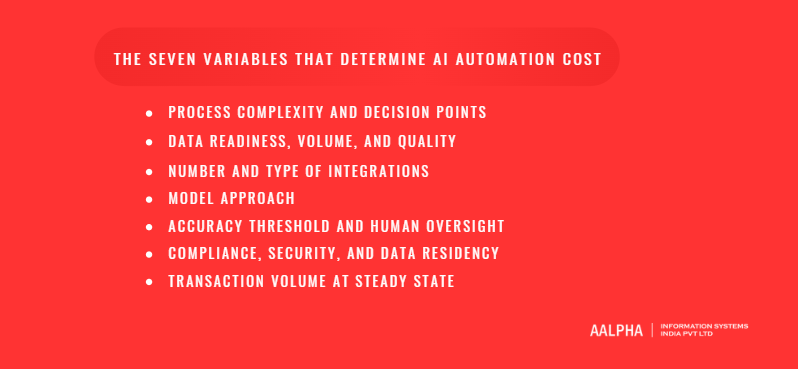
The Seven Variables That Determine Cost
Every AI automation quote is a function of seven variables. Understanding them lets you predict roughly what a project should cost before you receive a single proposal, and lets you identify which parts of your requirements are driving the price.
-
Process complexity and decision points
Cost scales with the number of distinct decisions the system has to make and the number of exception paths it has to handle. A process with three decision points and two exception paths is straightforward. A process with twenty decision points, each with its own exception handling, is not five times harder but closer to fifteen times harder, because the interactions between decisions multiply the testing surface. Before requesting quotes, map your process and count the branches. If you cannot describe the process on one page, expect the project to sit in the upper half of whatever range applies.
-
Data readiness, volume, and quality
Data preparation is the most consistently underestimated line item in AI automation budgets. If your historical data is clean, labelled, consistently formatted, and accessible through an API, data work might be 10 percent of the project. If it lives in scanned PDFs, three incompatible databases, a shared drive, and the institutional memory of a colleague who is retiring, data work can exceed 50 percent of the project cost. Labelling is a specific and often unavoidable expense: supervised approaches need examples, and producing several thousand accurately labelled examples takes real hours from people who understand the domain.
-
Number and type of integrations
Each system the automation touches adds cost, and the cost per integration varies enormously. A modern SaaS product with well-documented REST APIs and OAuth might add $1,200 to $4,000. An on-premise ERP from 2009 with no API, requiring database-level access or screen automation, can add $9,000 to $25,000 on its own. Legacy integrations also carry schedule risk because access permissions, security review, and vendor cooperation are outside your control. When comparing quotes, check whether the vendor has actually confirmed integration feasibility or is assuming it.
-
Model approach
There are three broad approaches and they have very different cost profiles. Using a commercial model through an API requires no training investment and the lowest upfront engineering cost, but creates a per-transaction running cost that grows with volume. Retrieval-augmented generation, where the model is given relevant documents at query time, adds a retrieval layer and vector storage but avoids training cost while grounding responses in your data. Fine-tuning or training a custom model requires substantial labelled data and engineering time, typically adding $12,000 to $45,000, and only pays off at high volume or when a general model cannot reach the required accuracy on a specialized task.
-
Accuracy threshold and human oversight
This variable is underappreciated and it is often the difference between a $35,000 project and a $120,000 one. Moving a system from 85 percent accuracy to 95 percent accuracy might double the engineering effort. Moving from 95 percent to 99 percent can double it again. The last few percentage points require better data, more sophisticated evaluation, error analysis on the remaining failure modes, and often a specialized approach for the hard cases. Before committing to an accuracy target, calculate what an error actually costs. If a misrouted support ticket costs three minutes of a human’s time, 90 percent accuracy is fine and the review layer handles the rest. If a misclassified medical document creates clinical risk, you need a different architecture and a different budget.
-
Compliance, security, and data residency
Regulated industries pay a premium that has nothing to do with the AI itself. Healthcare projects under HIPAA, financial services under regional financial regulation, and any project touching EU personal data under GDPR require additional architecture: encryption at rest and in transit, comprehensive audit logging, access controls, data processing agreements, and often a restriction that data cannot leave a specific jurisdiction. That last constraint can force self-hosting a model rather than using a commercial API, which changes the entire cost structure. Compliance requirements typically add 20 to 40 percent to a project budget, and more when formal validation or certification is required. Aalpha’s ISO 9001:2015 certification and documented delivery process exist partly because enterprise and regulated clients need evidence of controlled process, not just working code.
-
Transaction volume at steady state
Volume barely affects build cost but dominates running cost. A system processing 500 documents per month and a system processing 500,000 documents per month can be built for similar money, but their monthly operating costs differ by three orders of magnitude. High-volume systems also justify optimization work that would be wasteful at low volume: caching, batching, routing simple cases to cheaper models, and eventually self-hosting. Estimate your steady-state volume before design begins, because architecture decisions that make sense at low volume become expensive at scale.
Cost Breakdown by Project Phase
Understanding where money goes across a project helps you evaluate whether a quote is realistic. A proposal that allocates 80 percent of budget to development and 5 percent to data preparation is either working with unusually clean data or has not thought carefully about the problem.
The percentages below reflect typical distribution on a custom AI automation project in the $50,000 to $150,000 range.
Phase | Share of budget | What happens |
Discovery and process mapping | 8 to 12 percent | Stakeholder interviews, process documentation, success criteria, feasibility assessment |
Data assessment and preparation | 20 to 35 percent | Data audit, extraction, cleaning, labelling, pipeline construction |
Model selection and engineering | 10 to 20 percent | Approach selection, prompt or pipeline design, retrieval setup, fine-tuning if required |
Application development | 15 to 25 percent | Interface, business logic, workflow orchestration, error handling |
Integration | 12 to 20 percent | Connecting to existing systems, authentication, data synchronization |
Testing and validation | 10 to 15 percent | Evaluation harness, accuracy measurement, edge case testing, user acceptance |
Deployment and stabilization | 5 to 10 percent | Production release, monitoring setup, initial tuning, documentation, training |
Discovery is the phase clients most want to skip and the one that most reliably saves money. Two weeks of process mapping that reveals your invoice approval workflow has four undocumented exception paths will change the architecture, and finding that out in week two costs a fraction of finding it out in week fourteen. When a vendor offers to skip discovery to win on price, they are not saving you money, they are deferring the cost and adding risk.
Data preparation carries the widest variance of any phase. On projects where a client has a modern data warehouse with clean historical records, this phase can compress to 10 percent. On projects requiring extraction from scanned documents, reconciliation across systems that disagree, and manual labelling of training examples by subject matter experts, it can consume 50 percent or more. Ask any vendor how much data work they have assumed and on what basis, because an optimistic assumption here is the single most common cause of budget overrun.
Testing deserves more attention than it usually gets in AI projects specifically because correctness is probabilistic. Traditional software either passes a test or fails it. An AI system produces an output that is 91 percent accurate against a held-out set, and someone has to decide whether that is good enough, which failure modes matter, and what happens to the 9 percent. Building an evaluation harness that measures accuracy on cases that reflect real production distribution is genuine engineering work, and skipping it means you discover accuracy problems from customer complaints rather than from a dashboard.
Cost by Automation Type
Different categories of AI automation have distinct cost profiles because they place different demands on data, accuracy, and integration. The ranges below assume custom development to production standard rather than a proof of concept.
Document processing and intelligent data extraction
Cost range: $12,000 to $55,000
Automating extraction from invoices, purchase orders, contracts, claims forms, shipping documents, or identity documents is one of the highest-return automation categories because the manual alternative is expensive and error-prone. Cost is driven by document variety rather than volume. Extracting six fields from a single supplier’s invoice template is straightforward. Extracting the same fields from four hundred supplier formats, some scanned at low quality, some handwritten, some in other languages, is a substantially harder problem. Table extraction is consistently harder than field extraction, and multi-page documents where context spans pages harder still. Projects at the lower end handle a controlled document set with human review of low-confidence extractions. Projects at the upper end handle open-ended document variety with high accuracy requirements and direct posting to an ERP.
Customer support agents and conversational AI
Cost range: $15,000 to $70,000
A support agent that answers questions from a knowledge base, retrieves order status, and escalates appropriately sits in the middle of this range. Cost drivers are the breadth of topics the agent must cover, the number of backend systems it needs to query to give useful answers, whether it takes actions or only provides information, and the number of languages. The cheap version answers from documentation and hands off anything else. The expensive version authenticates the customer, pulls their account history, processes a return, issues a refund within policy limits, and updates the CRM, which means every one of those actions needs permission controls and audit trails. Multilingual support adds roughly 10 to 20 percent per additional language once the first is built, mostly in testing and content preparation rather than engineering.
Voice AI and call automation
Cost range: $20,000 to $100,000
Voice adds a layer of difficulty and cost above text-based conversation. Speech recognition accuracy varies with accent, background noise, and audio quality. Latency matters enormously because a pause that would be invisible in chat feels broken in a phone call, which constrains architecture choices. Interruption handling, where the caller speaks over the system, requires specific engineering. Telephony integration adds cost and per-minute charges accumulate quickly at volume. Outbound voice automation carries additional regulatory obligations in most jurisdictions around consent, disclosure, and calling hours. Voice projects also have higher ongoing costs than text because speech-to-text and text-to-speech are billed per minute on top of model inference.
Sales and marketing automation
Cost range: $9,000 to $42,000
This category covers lead scoring and qualification, personalized outreach generation, proposal drafting, CRM data enrichment and hygiene, and content production pipelines. Costs sit lower than other categories because integration targets are usually modern SaaS platforms with good APIs, and because accuracy requirements are more forgiving. A lead score that is occasionally wrong wastes a salesperson’s time; it does not create legal exposure. The main cost driver is CRM data quality, which is almost universally worse than clients expect. Budget for data cleaning before assuming a scoring model can be built on top of existing records.
Finance and back-office workflow automation
Cost range: $18,000 to $85,000
Accounts payable, expense processing, reconciliation, payroll preparation, and compliance reporting. These projects carry high accuracy requirements because financial errors are expensive and auditable, and they usually require integration with an accounting or ERP system that may be old. Approval workflows add complexity because the routing rules encode organizational structure that changes. The strongest cost justification in this category comes from reconciliation and exception handling, where staff currently spend hours matching records manually. Segregation of duties and audit logging are mandatory rather than optional, which is why the lower bound sits above simpler categories.
Predictive analytics and forecasting
Cost range: $18,000 to $75,000
Demand forecasting, churn prediction, maintenance scheduling, inventory optimization, and risk scoring. Cost here is dominated by data availability. If you have three years of clean transactional history with the relevant variables captured, a competent team can build and validate a model relatively quickly. If your history is eighteen months long, has gaps, and does not capture the variables that actually drive the outcome, the project becomes a data engineering exercise first. Predictive projects also need more careful validation than most, because a model that performs well on historical data and poorly in production is a common and expensive failure mode. Backtesting and a monitored parallel run are worth the budget.
Computer vision and quality inspection
Cost range: $24,000 to $115,000
Visual defect detection, safety compliance monitoring, inventory counting, and document or identity verification. Vision projects carry costs that software-only projects do not: camera selection and placement, lighting control, mounting, and sometimes edge computing hardware. Image collection and labelling is labour-intensive, and defect detection specifically suffers from class imbalance because defects are rare by definition, so gathering enough examples of each failure type takes time. Environmental variation is the main risk. A model trained under one lighting condition frequently fails under another, and controlling the physical environment is often cheaper than making the model robust to everything.
Multi-agent and orchestrated agentic workflows
Cost range: $45,000 to $220,000 or more
Systems where multiple specialized agents coordinate to complete work that spans functions. A hiring workflow where one agent screens applications, another schedules interviews, another prepares briefing materials, and an orchestrator manages the sequence and handles failures. These are the most expensive projects because the number of possible execution paths is large, each tool the agents can call needs permission scoping and rate limiting, failures need to be caught and recovered rather than cascading, and every action needs logging detailed enough that a human can reconstruct the reasoning afterward. Testing is genuinely difficult because you cannot enumerate all paths. Most organizations should not start here. Build one reliable single-purpose agent, learn what breaks, then orchestrate.
Build vs Buy vs Hybrid
Buying a platform subscription looks cheaper than building until you calculate three-year total cost and account for the workflows the platform cannot handle. Building looks more expensive until you account for per-seat licensing that grows with headcount and per-task pricing that grows with success.
Platform pricing in 2026 sits roughly as follows. General workflow automation tools such as Zapier, Make, and n8n range from free tiers through to roughly $100 to $1,000 per month depending on task volume, with self-hosted n8n trading licence cost for infrastructure and maintenance effort. Microsoft Power Automate is priced per user or per flow, typically $15 to $40 per user per month, with AI capabilities consuming additional credits. Enterprise RPA platforms such as UiPath and Automation Anywhere start around $1,000 to $3,000 per month for a modest deployment and scale into six figures annually for larger estates. CRM-embedded AI agents such as Salesforce Agentforce are commonly priced per conversation or per action, which means cost scales directly with usage and can become significant if the agent handles high volume. Vertical AI products aimed at specific functions, such as AP automation or contract review, typically run $500 to $5,000 per month depending on volume tier.
Buying makes sense when your process is genuinely standard, when the volume is low enough that per-transaction pricing stays modest, when you need something working in weeks rather than months, and when you have no internal capability to maintain custom software. Most companies should buy for the first automation and learn from it.
Building makes sense when the process is a genuine differentiator, when platform per-transaction pricing becomes uneconomic at your volume, when you need integration with systems no platform supports, when data cannot leave your infrastructure, or when you want to own the asset rather than rent it. Building also makes sense when you have already outgrown a platform and are paying for workarounds.
The hybrid model is where most organizations actually land, and it is usually the right answer. Use a platform for the connective tissue, triggers, and simple steps. Build custom components for the parts that are specific to your business or that the platform handles badly. This keeps build cost down while avoiding the ceiling that pure platform approaches hit.
Here is the breakeven arithmetic worked through. Suppose a platform-based approach costs $12,000 to configure and $2,500 per month in subscription and usage fees. A custom build costs $42,000 upfront and $900 per month to run. Over year one the platform costs $42,000 and the custom build costs $52,800, so the platform wins. By month 19 the two are level, and everything after that favours the build. The calculation flips much earlier if usage grows, because platform costs scale with volume while build running costs scale far more slowly. If your volume triples in year two and platform fees reach $7,500 per month, breakeven arrives around month 14.
Run this calculation with your own numbers before deciding. The mistake to avoid is comparing a build quote against year one of a subscription, which makes building look irrational, or comparing against year five, which makes it look inevitable.
LLM and Infrastructure Running Costs
Running costs are where AI automation differs most sharply from traditional software, and where budgets are most often incomplete. Traditional software costs money to build and comparatively little to run. AI automation has a meaningful per-transaction cost that persists for the life of the system.
-
Estimating token spend
Commercial model pricing is charged per million tokens, with separate rates for input and output. A token is roughly three-quarters of a word in English. As of mid-2026, small fast models cost in the region of $0.10 to $1.00 per million input tokens, mid-tier models roughly $1 to $5, and frontier models $5 to $20 or more, with output tokens typically costing three to five times the input rate. These figures move frequently and generally downward, so verify current pricing before modelling.
To estimate monthly spend, work out the tokens per transaction and multiply. A customer support exchange that includes a system prompt of 800 tokens, three retrieved knowledge base documents totalling 2,500 tokens, a conversation history of 1,200 tokens, and produces a 300 token answer consumes roughly 4,500 input tokens and 300 output tokens. At mid-tier pricing that is a fraction of a cent per exchange, but at 200,000 exchanges per month it becomes a real line item, typically $1,200 to $4,000. The lesson is that context length, not conversation count, usually drives cost. Teams that stuff entire manuals into every prompt pay for it every single request.
-
Retrieval, fine-tuning, and prompt engineering compared
Prompt engineering alone has no incremental cost beyond the tokens consumed and is the right starting point for most tasks. Retrieval-augmented generation adds a vector database, an embedding pipeline, and the cost of embedding your documents once plus re-embedding when they change. Embedding is cheap, typically $0.02 to $0.15 per million tokens, so embedding a 50,000-page document corpus is a modest one-off expense. Vector database hosting ranges from roughly $70 to $700 per month for most business use cases, with managed services costing more than self-hosted alternatives.
Fine-tuning adds an upfront training cost plus, on most platforms, a premium on inference for the fine-tuned model. Training itself might cost a few hundred to a few thousand dollars in compute, but the real expense is preparing the training data, which typically runs $9,000 to $35,000 in engineering and subject matter expert time. Fine-tuning is worth it when you need a consistent output format, a specialized vocabulary, or lower latency and cost at high volume by using a smaller fine-tuned model instead of a larger general one. It is rarely the right first move.
-
Self-hosting open-weight models
Self-hosting looks attractive because it removes per-token pricing, and for some situations it is genuinely cheaper. The honest accounting includes GPU instance cost, which for a machine capable of serving a mid-size open-weight model at reasonable throughput runs roughly $700 to $3,000 per month on demand, plus the engineering time to deploy, optimize, monitor, and update it. That engineering overhead is typically 0.25 to 0.5 of a specialist’s time on an ongoing basis. Self-hosting becomes economically sensible somewhere above roughly $4,000 to $8,000 per month in equivalent API spend, or immediately when data residency rules make commercial APIs unusable regardless of cost.
-
Levers that reduce inference cost
Four techniques reliably reduce running costs without degrading output. Prompt caching, where a stable portion of the prompt is cached between requests, can cut input costs by 50 to 90 percent on workloads with repeated system prompts or documents. Batching, where non-urgent requests are processed asynchronously, is typically discounted around 50 percent. Model routing, where simple requests go to a small cheap model and only complex ones reach the expensive model, often removes 60 to 80 percent of frontier model calls. And trimming context so that only genuinely relevant material reaches the model reduces both cost and, frequently, error rate. Budget a few thousand dollars for optimization work once the system is live and you have real usage data. It usually pays back within months.
Team and Engagement Costs
The people building your automation are the largest component of build cost, so understanding team composition and regional rates explains most of the variance between quotes.
A typical custom AI automation project needs a solution architect to design the approach, an AI or machine learning engineer for model selection and pipeline work, one or two backend developers for application logic and integration, a data engineer if the data work is substantial, a frontend developer if there is a user interface, a QA engineer with experience testing probabilistic systems, and a project manager or business analyst who owns requirements and stakeholder communication. Smaller projects combine roles. Larger ones add specialists such as a DevOps engineer or a security consultant.
Regional rate differences are substantial and are the main reason identical scopes receive wildly different quotes.
Region | Typical blended hourly rate | Notes |
United States and Canada | $120 to $250 | Highest rates, strongest timezone overlap for North American clients |
Western Europe | $90 to $180 | Comparable capability, strong data protection expertise |
Eastern Europe | $45 to $90 | Established outsourcing market, good European timezone alignment |
India | $25 to $60 | Deepest talent pool by volume, largest cost advantage, wide quality variance |
Latin America | $40 to $80 | Growing market, favourable timezone for US clients |
Southeast Asia | $30 to $65 | Competitive rates, variable AI specialization depth |
Rate alone is a poor guide to total cost. A $200 per hour team that scopes accurately and delivers in 400 hours costs $80,000. A $40 per hour team that misunderstands the requirement and takes 2,500 hours costs $100,000 and arrives late. What matters is delivery track record, relevant domain experience, and whether the team asks hard questions during scoping. Aalpha’s 4.9 out of 5 rating across more than 215 verified Clutch reviews reflects a delivery model built on that principle: careful scoping first, because rework is the most expensive line item nobody quotes for.
Engagement models also affect total cost. Fixed price suits well-defined scopes and transfers risk to the vendor, who prices that risk into the quote, typically adding 15 to 25 percent. Time and materials suits exploratory work and costs less when scope is stable but exposes you to overrun. A dedicated team model, where you retain a fixed set of people monthly, suits ongoing programmes and typically runs $6,000 to $18,000 per month for a small team depending on region and composition. Outcome-based pricing, where fees link to measured results, is increasingly offered for AI automation but requires agreed measurement that both parties trust, which is harder than it sounds.
A practical approach for uncertain projects is a paid discovery phase at fixed price, producing a specification and a firm quote for the build. This costs $2,000 to $7,500 and converts an unknowable estimate into a reliable one.
Ongoing Costs After Launch
AI automation is not a capital expenditure that ends at go-live. Plan for annual running costs of 15 to 30 percent of the original build cost, and toward the upper end for systems that face customers or operate in fast-changing domains.
Monitoring and observability is the first requirement. You need visibility into what the system is doing, how confident it is, where it escalates, and whether its behavior is changing. Model drift is real: a support agent trained on last year’s product catalogue gives confidently wrong answers about this year’s products, and a fraud model tuned on last year’s patterns misses this year’s tactics. Monitoring tooling costs $200 to $2,000 per month depending on scale, plus the engineering time to interpret it.
Retraining and prompt maintenance is a recurring cycle rather than a one-off. Prompts need updating when policies change, when the model provider releases a new version that behaves differently, or when error analysis reveals a systematic failure. Retraining a fine-tuned model on fresher data is typically a quarterly or semi-annual exercise costing $2,000 to $9,000 each time depending on data preparation required. Budget for this explicitly, because it is the item most often omitted from business cases and its absence causes systems to quietly degrade until someone declares the project a failure.
Human review layers persist for most production systems and represent a real ongoing cost, though usually far below the pre-automation baseline. If your system escalates 8 percent of cases and each takes two minutes, that is a calculable staffing cost that belongs in the ROI model. Do not build the business case on the assumption that human involvement drops to zero.
Licensing and vendor price changes deserve attention because your dependency stack includes model providers, cloud infrastructure, vector databases, monitoring tools, and any platform components. Model pricing has trended downward, which helps, but per-seat and per-action SaaS pricing tends to increase at renewal. Review the full dependency list annually.
A reasonable annual run-rate for a $60,000 custom automation handling moderate volume looks like $3,500 to $7,000 in model inference, $2,500 to $5,000 in infrastructure and tooling, and $4,000 to $8,000 in maintenance, improvement, and support. Total roughly $10,000 to $20,000 per year, which sits inside the 15 to 30 percent guideline above.
Cost by Company Size and Industry
Budget expectations differ by organizational scale, and it is useful to know where you sit before conversations with vendors begin.
Startups and early-stage companies typically spend $5,000 to $25,000 on a first automation, usually targeting a single high-friction process and accepting a narrower feature set to reach production quickly. The right approach here is a genuinely scoped MVP that handles the common case well and escalates everything else, not a scaled-down version of an enterprise system.
Small and mid-sized businesses generally budget $15,000 to $55,000, automating a complete departmental process such as accounts payable, customer support triage, or order processing. This band gets the strongest return in practice because the processes are large enough to matter and simple enough to automate reliably.
Mid-market organizations spend $50,000 to $150,000 on programmes covering several connected processes, with proper integration into core systems and a governance structure around model performance.
Enterprises spend $150,000 to $600,000 or more, though the automation itself is often not the dominant cost. Security review, procurement process, change management, training, and phased rollout across business units frequently exceed the engineering budget.
Industry adds a premium on top of these bands. Healthcare typically adds 30 to 50 percent for HIPAA compliance, audit requirements, and clinical validation. Financial services adds 25 to 45 percent for regulatory controls, explainability requirements, and model risk governance. Legal adds 20 to 40 percent because accuracy requirements are high and confidentiality constraints often rule out standard architectures. Logistics and manufacturing add 15 to 35 percent, mostly for integration with operational technology and legacy systems rather than for compliance. Retail and ecommerce carry the lowest premium, often 10 percent or less, because the systems involved are usually modern and the accuracy stakes are lower.
Worked Budget Scenarios
Concrete numbers anchor better than ranges. Here are four scenarios reflecting common engagements.
Scenario one: invoice processing automation for a distribution business. Around 3,000 invoices per month across roughly 80 supplier formats, extracting header and line item data and posting to an existing accounting system, with human review of anything below a confidence threshold. Discovery $2,800, data preparation and labelling $8,500, extraction pipeline and model configuration $6,800, application and review interface $7,200, accounting integration $5,200, testing and validation $4,200, deployment and training $2,100. Total $36,800 over roughly 13 weeks. Running cost approximately $800 per month.
Scenario two: customer support agent for a subscription software company. Handles account questions, billing queries, and product troubleshooting in English and Spanish, retrieves live account data, escalates to human agents with full context. Discovery $3,600, knowledge base preparation and structuring $5,400, retrieval layer and agent engineering $10,800, conversation interface and widget $6,000, CRM and billing system integration $7,800, Spanish adaptation and testing $3,900, evaluation harness and accuracy testing $5,400, deployment $2,400. Total $45,300 over roughly 16 weeks. Running cost approximately $2,100 per month at 40,000 conversations.
Scenario three: lightweight lead qualification automation for an agency. Enriches inbound leads, scores them against historical conversion data, drafts a personalized first response for human approval, and updates the CRM. Built largely on platform components with custom scoring logic. Discovery $1,500, CRM data cleanup $3,000, scoring model $3,900, response generation and approval flow $3,300, integration and automation wiring $2,400, testing and rollout $1,500. Total $15,600 over roughly 7 weeks. Running cost approximately $450 per month including platform fees.
Scenario four: multi-agent claims triage for an insurer. Ingests claim submissions, extracts and validates data, checks policy coverage, flags fraud indicators, routes to the appropriate adjuster queue, and drafts initial correspondence. Full audit logging and regulatory controls. Discovery and regulatory scoping $13,000, data engineering and historical extraction $35,000, agent design and orchestration $45,000, fraud signal modelling $20,000, integration with policy administration and claims systems $37,000, compliance architecture and audit logging $18,000, testing including six-week parallel run $29,000, deployment and phased rollout $15,000. Total $212,000 over roughly 11 months. Running cost approximately $7,000 per month.
ROI, Payback, and Total Cost of Ownership
A three-year total cost of ownership model is the correct frame for evaluating AI automation, because a build cost compared against annual savings overstates the return and a first-year comparison understates it.
For the $45,300 support agent above, three-year TCO is the build cost plus 36 months of running cost at $2,100, plus roughly $12,000 in improvement work across the period, giving approximately $133,000. If the agent deflects 45 percent of a support volume that previously required four full-time agents, and fully loaded agent cost is $48,000 per year, the annual saving is roughly $86,000, or $258,000 over three years. Net benefit approximately $125,000 with payback at around month 10. That is a strong return, and it is more honest than the numbers usually presented, which omit running costs entirely and assume 100 percent deflection.
Typical payback periods by category, based on projects that reach production successfully: document processing automation pays back in 6 to 12 months and is the most reliable category; back-office workflow automation in 8 to 15 months; customer support automation in 9 to 18 months; predictive analytics in 10 to 24 months with wider variance because the benefit is often revenue protection rather than cost removal; agentic and multi-agent systems in 14 to 30 months.
The most useful single metric is cost per transaction before and after. Calculate the fully loaded cost of a human handling one unit of work, including salary, benefits, management overhead, error correction, and idle capacity. Then calculate the automated cost per unit including inference, infrastructure, amortized build cost, and the human review that remains. If the second number is not meaningfully below the first at your actual volume, the project is not worth doing regardless of how impressive the technology is.
Why AI Automation Projects Go Over Budget
Five causes account for most overruns, and all five are predictable.
Scope drift is the most common. The system works, stakeholders see it, and everyone thinks of something else it could do. Each addition seems small and the cumulative effect is not. Control this with a written scope, a formal change process, and a parked list for phase two.
Underestimated data work is the second. Almost every organization believes its data is in better shape than it is. The fix is a paid data audit before the build is priced, so that the estimate rests on evidence rather than optimism.
Integration surprises are the third. An API that turns out to be undocumented, rate-limited, or read-only when write access was assumed. A security team that takes eleven weeks to approve access. A vendor who charges separately for the integration tier. Verify integration feasibility with real credentials during discovery, not during development.
Accuracy chasing is the fourth and the most expensive. A project delivers 91 percent accuracy against a target of 90, and someone decides 97 would be better. Those six points can cost as much as the original build. Agree the accuracy target and the business rationale for it before development starts, and treat increases as new projects.
Change management is the fifth and the most neglected. The technology works and nobody uses it, or people use it while maintaining the old process in parallel, which doubles work rather than removing it. Budget 10 to 15 percent of project cost for training, communication, and process redesign. It is not optional overhead, it is the mechanism by which the return actually materializes.
How to Reduce AI Automation Costs
Several levers reduce cost without degrading the result, and a few common cost-cutting instincts actively make things worse.
Narrow the scope before narrowing the quality. Automating 70 percent of a process well is cheaper and more valuable than automating 100 percent badly. Identify the highest-volume, lowest-variation portion of the work and automate that first, letting humans handle the remainder.
Set the accuracy target from business impact rather than from ambition. If a review layer catches errors cheaply, a lower accuracy threshold with good escalation is far less expensive than chasing precision the process does not require.
Start with the cheapest model that works and only move upward when evaluation shows you need to. Many teams default to the most capable model available and never test whether a smaller one performs adequately on their specific task. It frequently does, at a fraction of the running cost.
Reuse existing components. Authentication, notification, logging, and reporting rarely need building from scratch. A partner reusing proven components delivers faster than one building everything bespoke, which is one reason delivery volume matters when selecting a vendor.
Phase the delivery. A phase one that proves value in ten weeks generates evidence for phase two funding and, more importantly, generates real usage data that makes phase two scoping accurate.
Prepare your own data where you can. Client-side work on documentation, process mapping, and access provisioning is time your team spends instead of billable hours, and it is often work only your team can do properly.
What not to cut: discovery, testing, and change management. Each of these is a false economy, and cutting them reliably increases total cost while reducing the chance the system is used.
How to Evaluate a Vendor Quote
A credible AI automation proposal contains specific things, and their absence is informative.
It should state assumptions explicitly, particularly about data quality, data volume, and integration access. It should break cost down by phase rather than presenting a single number. It should name the accuracy target and describe how accuracy will be measured. It should identify which integrations have been verified as feasible and which are assumed. It should separate build cost from running cost and estimate the latter. It should describe what happens after launch, including support terms and who owns maintenance. And it should name the risks the vendor has identified, because a proposal with no risks listed is a proposal where nobody looked.
Questions worth asking before signing: What happens if the accuracy target is not met? Who owns the code, the models, and the training data? What is your estimate of monthly running cost at our stated volume, and what drives it? Which parts of this have you built before, and can we speak to that client? What would cause this project to take longer than quoted? If we wanted to move this to another team in two years, what would that involve?
Be cautious of quotes substantially below the others without an explanation of why. In most cases the cheap quote has excluded data preparation, assumed integration access it has not verified, or scoped a prototype where the others scoped a production system.
If you’re evaluating multiple vendors, consider working with an experienced AI development company that has a proven track record in building production-ready AI solutions. Companies such as Aalpha Information Systems can help reduce project risks by providing transparent cost breakdowns, realistic timelines, clear ownership terms, and validated integration strategies. An experienced AI development company will also help you assess data readiness, estimate long-term operating costs, and define measurable success criteria before development begins, making it easier to avoid unexpected expenses and project delays.
Frequently Asked Questions
How much does AI automation cost for a small business?
Small businesses typically spend $5,000 to $25,000 for a first automation covering a single process, with running costs of $200 to $1,000 per month. Starting with a platform-based approach for the first project keeps the initial commitment low.
What is the cheapest way to automate a business process with AI?
The cheapest route is a no-code or low-code platform such as Zapier, Make, or n8n combined with a commercial model API, configured for one well-defined workflow. This can cost under $3,500 to set up plus $50 to $300 per month, provided the process is standard and integration targets have good APIs.
How much does it cost to build an AI agent?
A production-ready custom AI agent typically costs $25,000 to $70,000 to build. The main drivers are how many tools and systems the agent can access, whether it takes actions or only provides information, and the level of audit logging and permission control required.
How much does an AI chatbot cost per month to run?
Running costs depend on conversation volume and context length. A chatbot handling 10,000 conversations per month typically costs $300 to $1,200 in model inference plus $150 to $600 in hosting and monitoring. At 100,000 conversations, expect $2,000 to $8,000 per month total.
Is AI automation cheaper than hiring staff?
It usually is at sustained volume, but not immediately. A $45,000 automation with $20,000 in annual running cost is competitive with roughly one full-time employee in a developed market, and becomes clearly cheaper as volume grows because automation scales without proportional cost. At low volume, hiring is often the better economic choice.
How long does AI automation take to pay for itself?
Typical payback is 6 to 18 months depending on category. Document processing automation pays back fastest, generally in 6 to 12 months. Agentic and multi-agent systems take longest, often 14 to 30 months.
Why do AI automation quotes vary so much for the same project?
Because vendors quote different deliverables under the same description. One quote covers a prototype on clean sample data, another covers a production system handling real-world messiness with integration, testing, and audit logging. Compare assumptions, not headline numbers.
What percentage of an AI automation budget goes to data work?
Typically 20 to 35 percent, rising above 50 percent when data is unstructured, spread across systems, or requires manual labelling. It is the most underestimated line item in AI projects.
Do I need to fine-tune a model, and what does it cost?
Most projects do not. Prompt engineering and retrieval handle the majority of business use cases. Fine-tuning adds roughly $12,000 to $45,000 including data preparation and is worth it when you need consistent output formatting, specialized vocabulary, or lower cost at very high volume.
How much does it cost to automate customer support with AI?
A production customer support agent costs $15,000 to $70,000 to build. The range is driven by topic breadth, how many backend systems the agent queries, whether it takes actions such as refunds, and the number of languages supported.
What are the hidden costs of AI automation?
The commonly omitted items are model inference at production volume, monitoring tooling, retraining cycles, the human review layer that remains after automation, internal staff time for change management and training, and vendor price increases at renewal.
Is it cheaper to use an off-the-shelf AI tool or build custom?
Off-the-shelf is cheaper for the first one to three years at low to moderate volume. Custom becomes cheaper when per-transaction platform pricing scales with your growth, when you need integrations no platform supports, or when data cannot leave your infrastructure. Run a three-year comparison with your own volume projections.
How much does document processing automation cost?
Between $20,000 and $90,000 depending on document variety. Extracting fields from a handful of consistent templates sits at the low end. Handling hundreds of formats with tables, poor scan quality, and high accuracy requirements sits at the high end.
What does AI automation cost in regulated industries?
Expect a premium of 25 to 50 percent above equivalent unregulated projects. Healthcare, financial services, and legal carry the highest premiums due to audit logging, explainability, data residency, and validation requirements.
How much should I budget for ongoing AI automation maintenance?
Plan for 15 to 30 percent of the original build cost annually, covering inference, infrastructure, monitoring, retraining, and improvement work. Customer-facing systems and fast-changing domains sit at the upper end.
Can AI automation cost be reduced without hurting quality?
Yes. Narrowing scope to the highest-volume portion of a process, using the smallest model that meets the accuracy target, implementing prompt caching and model routing, and phasing delivery all reduce cost without degrading output. Cutting discovery, testing, or change management does the opposite.
How much does voice AI automation cost?
Voice projects range from $20,000 to $100,000 to build, with running costs higher than text systems because speech recognition and synthesis are billed per minute on top of model inference. Expect $0.05 to $0.25 per minute of call handling depending on architecture.
What is a realistic first AI automation project budget?
For most businesses, $15,000 to $38,000 covers a properly scoped first project that solves a real problem, integrates with existing systems, and reaches production. Budgets below $9,000 generally produce useful prototypes rather than production systems.
Does AI automation cost less if built offshore?
Offshore development in India, Eastern Europe, or Southeast Asia typically reduces hourly rates by 50 to 75 percent compared with North America. Total cost savings are usually smaller than the rate difference suggests because scoping accuracy and rework rates matter more than rate. Evaluate delivery track record alongside price.
How do I estimate the running cost before building?
Estimate tokens per transaction, multiply by expected monthly volume, and apply current model pricing. Add 30 to 50 percent for infrastructure, monitoring, and storage. Then add a maintenance allowance of 10 to 20 percent of build cost annually. Any vendor unwilling to produce this estimate has not thought about it.
Conclusion
AI automation cost is best understood as a function of complexity, data readiness, and integration depth rather than as a fixed price per category. Most businesses will spend between $15,000 and $90,000 on a meaningful first automation, plus 15 to 30 percent of that annually to run it, and will see payback somewhere between month six and month eighteen depending on what they automate.
The projects that deliver return share a pattern. They start with a process that is genuinely expensive and genuinely repetitive. They scope carefully before building. They set an accuracy target based on what an error actually costs rather than on how impressive the number sounds. They budget honestly for data work and for the human review layer that persists after launch. And they treat the first project as a way to learn what the second should be.
Aalpha has been building custom software and AI systems since 2008, with over 5,500 projects delivered for clients across 45 or more countries, a 4.9 out of 5 rating from more than 215 verified Clutch reviews, and ISO 9001:2015 certified delivery processes. If you are working out what an automation should cost in your specific situation, a scoped discovery conversation will give you a firmer number than any published range can.
Connect with us to discuss your AI automation requirements and receive a tailored cost estimate.