





TL;DR
Healthcare app development using Flutter means building one Dart codebase that ships native iOS and Android apps (plus web, if needed) for patients, clinicians or hospital staff. Flutter suits telemedicine, patient portals, remote monitoring and staff apps because the UI stays identical on both platforms and the team tests one codebase instead of two. A Flutter healthcare MVP typically costs USD 25,000 to 45,000 and takes 3 to 4 months with an offshore team, while an EHR-integrated enterprise app can pass USD 150,000. Flutter itself is not HIPAA compliant or non-compliant. Compliance comes from how you store, encrypt, transmit and log patient data, and from using backend vendors that sign a Business Associate Agreement. Plan native bridges early for some medical device SDKs, and treat security and accessibility testing as release blockers, not extras. Aalpha Information Systems builds Flutter healthcare apps on this approach, with compliance and integration risks mapped before development starts.
What is healthcare app development using Flutter?
Healthcare app development using Flutter is the process of building medical, wellness or care-delivery apps with Google’s open-source Flutter framework. You write the app once in Dart, and Flutter compiles it into native apps for iOS and Android. The same code can also run on the web and desktop. Healthcare teams use it to reach patients and clinicians on every device without funding two separate builds.
How Flutter works
Single codebase in Dart. Flutter apps are written in Dart, a typed language that compiles ahead of time to native ARM machine code for release builds. There is no JavaScript bridge sitting between your code and the device, which keeps scrolling, charts and animations smooth on mid-range phones.
Its own rendering engine. Flutter draws every pixel itself through its Impeller rendering engine rather than borrowing the platform’s UI components. A medication schedule or vitals chart looks the same on a USD 150 Android phone and a new iPhone. For clinical apps, that consistency reduces support calls and makes training material accurate on both platforms.
Platform channels for native features. When an app needs something Flutter does not cover, such as a vendor’s glucose-meter SDK, developers write a thin native layer in Swift or Kotlin and call it from Dart.
Why healthcare teams are choosing cross-platform builds
Healthcare apps have two audiences with different devices. Patients skew toward Android in many markets, while clinicians in US hospitals often carry iPhones. Building native apps for both means two teams, two QA cycles and two sets of security reviews.
Flutter cuts that to one codebase, one test suite and one security review of the business logic. Google ships stable releases on a published quarterly schedule. Flutter 3.47 shipped in August 2026, with 3.50 targeted for November 2026, according to the Flutter release archive. A predictable cadence matters when you have to plan regression testing for a regulated product.
Is Flutter a good choice for healthcare apps?
Yes, Flutter is a good choice for most healthcare apps, especially patient-facing apps, telemedicine, care coordination and clinical staff tools. It delivers near-native performance, consistent UI and lower build cost than two native apps. It is a weaker fit when the app depends heavily on native-only medical device SDKs or on the newest platform features on launch day.
Where Flutter performs well
Consistent clinical UI. Dosage screens, consent forms and triage flows render identically on both platforms. That makes clinical validation simpler, because reviewers sign off on one design, not two.
Accessibility support. Flutter exposes semantics to VoiceOver and TalkBack, supports dynamic text scaling and lets you set contrast at the theme level. Older patients and people with low vision are a large share of healthcare users, so this is a practical requirement rather than a nice-to-have.
Speed to market. Hot reload lets designers and developers adjust screens in seconds during usability sessions. Teams can test a new intake form with patients on Monday and ship the revision the same week.
One QA and security cycle. Business logic, encryption handling and API calls live in shared Dart code. Penetration testers and auditors review that logic once.
Where Flutter falls short
Native-only device SDKs. Many Bluetooth medical devices, such as certain glucose meters and ECG patches, ship SDKs only for iOS and Android. You will need platform channels and native developers for those integrations, which adds 2 to 4 weeks per device in our experience.
Larger app size. A Flutter app carries its engine, so a minimal release build is a few megabytes larger than an equivalent native app. That rarely matters for a clinic app, but it can matter in low-bandwidth markets.
Lag on brand-new OS features. When Apple or Google launches a new health API, native teams get it first. Flutter plugins usually follow within weeks or months.
Flutter vs React Native vs native for healthcare
Choose Flutter when UI consistency, offline-heavy screens and a single design system matter most. Choose React Native when your team already writes React for a web patient portal and wants to share developers. Choose fully native Swift and Kotlin when the core product is a regulated device companion app that depends on deep Bluetooth, background processing and immediate access to new HealthKit features. For most patient engagement and telehealth products, Flutter gives the best balance of cost and quality. Aalpha Information Systems provides Flutter development services and works with React Native and native technologies to build cross-platform and platform-specific applications.
What types of healthcare apps can you build with Flutter?
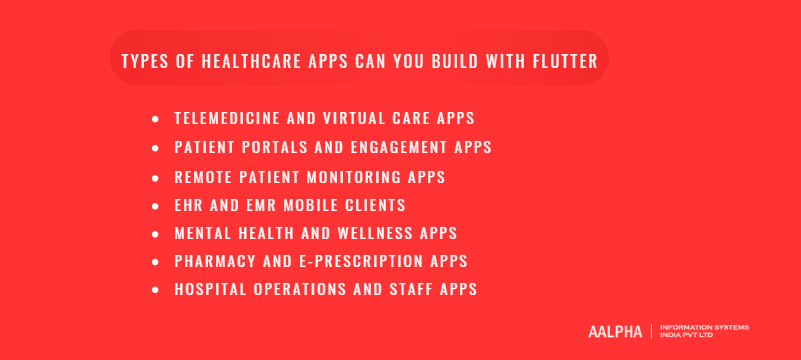
Flutter can build almost every category of healthcare app. The most common are telemedicine apps, patient portals, remote patient monitoring apps, EHR mobile clients, mental health apps, pharmacy apps and internal tools for clinical staff. The right category depends on who uses the app, what data it handles and which systems it must connect to.
-
Telemedicine and virtual care apps
These apps let patients book a consultation, join a video call, chat with a provider and receive a prescription or care plan. Flutter handles the booking flows and chat UI, while a HIPAA-eligible video SDK handles the call. Aalpha’s guide to telemedicine app development covers the feature set in more depth.
-
Patient portals and engagement apps
Patients use patient portals and engagement appsapps to view lab results, request refills, pay bills, message their care team and complete pre-visit forms. Most pull data from the hospital’s EHR through HL7 FHIR APIs. Good engagement apps reduce phone calls to the front desk, which is usually the first metric hospitals track.
-
Remote patient monitoring apps
RPM apps collect readings from blood pressure cuffs, pulse oximeters, glucose meters and wearables, then alert clinicians when values cross a threshold. Flutter reads Apple Health and Android Health Connect data through community plugins, and connects to Bluetooth devices through packages such as flutter_blue_plus or the vendor’s native SDK.
-
EHR and EMR mobile clients
Clinicians use these apps to check patient charts, record notes and review orders at the bedside. They need fast search, offline access on hospital Wi-Fi dead zones and strict session timeouts.
-
Mental health and wellness apps
Mood tracking, guided therapy programs, journaling and therapist messaging fit Flutter well because they are UI-heavy and animation-rich. Mental health and wellness apps often hold the most sensitive data a patient shares, so encryption at rest and clear consent screens matter more here than anywhere else.
-
Pharmacy and e-prescription apps
These apps handle prescription uploads, refill reminders, order tracking and delivery. In the US, e-prescribing controlled substances requires certified EPCS software and identity proofing, so most apps integrate a certified e-prescribing network instead of building that layer.
-
Hospital operations and staff apps
Nurse scheduling, shift handover, bed management, asset tracking and internal communication apps are often overlooked. They run on hospital-issued Android devices and tablets, where Flutter’s single codebase also covers the web dashboard used by administrators.
What features should a Flutter healthcare app include?
A Flutter healthcare app should include secure sign-in, a patient profile, appointment booking, messaging, notifications and access to health records. Provider apps add schedules, charting and patient lists. An admin panel manages users, roles, content and audit logs. Start with the smallest set that solves one clinical or operational problem, then add advanced features after launch.
Patient-side features
Secure onboarding and sign-in. Email or phone verification, multi-factor authentication and biometric unlock through Face ID or fingerprint. Flutter’s local_auth plugin handles biometrics on both platforms.
Profile and medical history. Demographics, allergies, medications, insurance details and emergency contacts. Keep this editable, because outdated allergy data is a patient safety risk.
Appointment booking. Provider search, real-time slot availability, reminders and rescheduling. Time zone handling needs care when patients and doctors sit in different regions.
Video consultations and secure chat. In-app video, file sharing for photos of symptoms and asynchronous messaging with the care team.
Health records and results. Lab reports, imaging summaries, visit notes and prescriptions, pulled from the provider’s EHR.
Payments and insurance. Card payments, invoices and insurance eligibility checks where the market supports them.
Provider-side features
Schedule and patient list. A daily view with visit types, intake status and flags for high-risk patients.
Charting and e-prescriptions. Quick note templates, dictation and prescription workflows connected to a certified network.
Alerts from monitoring data. Threshold rules that surface abnormal readings, with acknowledgement tracking so nothing is missed between shifts.
Admin and back-office features
Role-based access control. Separate permissions for patients, doctors, nurses, billing staff and administrators, enforced on the server, not only in the app.
Audit logs. A record of who viewed or changed patient data and when. HIPAA expects this, and so do most hospital IT security reviews.
Analytics and reporting. Appointment volume, no-show rates, response times and usage metrics, with patient identifiers removed from analytics events.
Advanced features
AI symptom triage and summaries. Large language models can draft visit summaries or route patients to the right service. Keep a clinician in the loop and log every AI output, because a triage error has real consequences.
Wearable and device integration. Steps, heart rate, sleep and glucose data from Apple Health, Health Connect or Bluetooth devices.
Offline mode. Encrypted local caching so clinicians can work in basements, ambulances or rural clinics and sync later.
Multilingual support. Flutter’s built-in localization handles right-to-left Arabic layouts, which matters for UAE and Gulf deployments.
How do you make a Flutter healthcare app compliant?
You make a Flutter healthcare app compliant by protecting patient data at every point: on the device, in transit and on the server. That means encryption, strong authentication, access controls, audit logs and vendors who sign the right agreements. Flutter does not provide compliance by itself. The rules you follow depend on where your users are, so map them before design starts.
HIPAA in the United States
Who it applies to. HIPAA covers healthcare providers, health plans and clearinghouses, plus the vendors that handle protected health information (PHI) on their behalf. A consumer wellness app with no link to a provider may fall outside HIPAA but still under the FTC Health Breach Notification Rule.
What it requires. The HIPAA Security Rule sets administrative, physical and technical safeguards for electronic PHI. In practice, that means risk assessments, access controls, encryption, audit trails, breach procedures and a signed Business Associate Agreement (BAA) with every vendor that touches PHI.
What is changing. HHS proposed a major Security Rule update in January 2025 that would make encryption and multi-factor authentication mandatory rather than addressable. HHS has since moved its projected final action date to July 2027, so the current rule remains in force. Build to the proposed controls now. They are already what hospital security teams ask for, and retrofitting later costs more.
GDPR in Europe
Under the GDPR, health data is a special category that needs an explicit legal basis, usually explicit consent or the provision of care. You also need a Data Protection Impact Assessment for large-scale health processing, data minimization, a right-to-erasure workflow and a lawful mechanism for any transfer outside the EU. If the app diagnoses or recommends treatment, check whether it qualifies as a medical device under the EU Medical Device Regulation.
Health data rules in the UAE
The UAE’s federal law on the use of information and communications technology in health fields (Federal Law No. 2 of 2019) restricts storing and processing health data outside the country unless an exception applies. Emirate-level regulators such as the Dubai Health Authority and the Department of Health Abu Dhabi add their own standards. In practice, plan for UAE-region cloud hosting and Arabic language support from day one.
Flutter-specific security practices
Encrypted local storage. Store tokens and keys with flutter_secure_storage, which uses the iOS Keychain and Android Keystore. Never put PHI in SharedPreferences or plain SQLite. If you cache records offline, encrypt the database with a package such as sqflite_sqlcipher.
Secure transport. Enforce TLS 1.2 or higher and add certificate pinning for your API domains, so a compromised Wi-Fi network cannot intercept traffic.
Code obfuscation. Build release apps with the –obfuscate and –split-debug-info flags. This makes reverse engineering of your Dart code harder, though it is not a substitute for server-side security.
Screen and notification hygiene. Block screenshots on sensitive screens with Android’s FLAG_SECURE, blur the app in the iOS app switcher and never put diagnoses or results in push notification text. “You have a new message” is enough.
Session control. Auto-logout after inactivity, re-authentication for sensitive actions and remote session revocation when a device is lost.
Clean logs and analytics. Strip PHI from crash reports and analytics events. This is one of the most common findings in healthcare app audits.
BAA-covered backend. AWS, Google Cloud and Microsoft Azure all sign BAAs for a defined list of services. Not every Firebase product is covered, so check the covered services list before storing PHI there.
What is the right architecture and tech stack for a Flutter healthcare app?
A solid Flutter healthcare stack uses clean architecture in the app, Bloc or Riverpod for state management, a Node.js or similar API backend, PostgreSQL for clinical data and a BAA-covered cloud. Integrations run through HL7 FHIR for EHRs, HealthKit and Health Connect for device data, and HIPAA-eligible vendors for video, messaging and payments.
App layer
Clean architecture. Split the app into presentation, domain and data layers. Business rules such as dosage limits or appointment eligibility then live in plain Dart classes you can unit test without a device.
State management. We prefer Bloc for regulated apps. Every state change is an explicit event, which makes behaviour easier to trace when an auditor or clinician asks why a screen showed a certain value. Riverpod is a lighter option for smaller apps and teams that want less boilerplate. The downside of Bloc is more code per feature.
Networking and storage. Dio for HTTP with interceptors for token refresh and logging rules, flutter_secure_storage for secrets and an encrypted local database for offline records.
Backend and cloud
Node.js with NestJS works well for healthcare APIs because it handles many concurrent connections for chat and notifications. PostgreSQL suits relational clinical data such as patients, encounters and orders, and it supports row-level security for multi-clinic setups. Host on AWS, Google Cloud or Azure under a signed BAA, with encryption at rest, private networking, centralized logging and automated backups. For UAE users, deploy in a UAE region.
Healthcare integrations
EHR systems through FHIR. HL7 FHIR is the standard API format for health records. Large EHR vendors such as Epic and Oracle Health expose FHIR APIs, usually authorized through SMART on FHIR. Expect vendor approval steps and sandbox testing to take several weeks.
Apple Health and Health Connect. Apple’s HealthKit and Android’s Health Connect store data from phones and wearables. The community health plugin for Flutter reads and writes both from Dart, with per-data-type permission prompts.
Bluetooth medical devices. Use flutter_blue_plus for standard Bluetooth Low Energy profiles, or a platform channel when the manufacturer only offers a native SDK.
Video, messaging and payments. Choose a video and chat provider that signs a BAA. Use Stripe or a regional gateway for payments, and keep card data out of your own servers entirely.
What is the step-by-step process to build a healthcare app with Flutter?
Building a healthcare app with Flutter follows seven steps: discovery and compliance mapping, UX design, MVP development, integrations, testing, launch and ongoing support. Compliance and integration work start in week one, not at the end. Most projects that run late do so because an EHR approval or a security review was planned too late.
1. Discovery and compliance mapping
Define the users, the one problem the first release solves and the data the app will hold. Then list the rules that apply: HIPAA, GDPR, UAE health data law, and medical device rules if the app diagnoses or recommends treatment. The output is a scope document, a data flow map and a risk register.
2. UX design for patients and clinicians
Design for people who are unwell, anxious or busy. That means large tap targets, readable type at 200 percent text scaling, plain-language labels and as few steps as possible to book or message. Clinicians need the opposite: dense screens, fast search and keyboard shortcuts on tablets. Test clickable prototypes with five to eight real users from each group.
3. MVP development
Build in two-week sprints with a working build at the end of each. Set up CI/CD from the first sprint, with automated tests, static analysis and signed builds for both stores.
4. Integrations
Connect the EHR, devices, video, payments and notifications. Request EHR sandbox access during discovery, because vendor approval often takes longer than the coding.
5. Testing
Run unit, widget and integration tests in Flutter, plus manual testing on a matrix of older and newer devices. Add a third-party penetration test, an accessibility audit against WCAG 2.2 AA and clinical workflow testing with real staff. Treat failed security or accessibility checks as release blockers.
6. Launch and app store review
Apple reviews health apps closely. HealthKit data cannot be used for advertising, and apps that make medical claims may need to show regulatory clearance. Google Play requires a health apps declaration in the Play Console. Budget one to two weeks for review cycles.
7. Post-launch support
Plan for monthly security patches, Flutter and OS version upgrades, dependency audits and feature releases. Each new Flutter stable release should go through a regression test before you adopt it.
How much does Flutter healthcare app development cost?
Flutter healthcare app development typically costs USD 25,000 to 45,000 for an MVP and USD 45,000 to 140,000 for a full telemedicine, monitoring or EHR-connected app. Enterprise hospital platforms usually start around USD 150,000. The biggest cost drivers are integrations, compliance work and the number of user roles, not the Flutter screens themselves.
App type | Typical scope | Estimated cost (USD) |
Wellness or patient engagement MVP | Sign-in, profile, booking, reminders, content, basic admin panel | 25,000 to 45,000 |
Telemedicine app | Patient and doctor apps, video and chat, payments, e-prescription handoff, admin panel | 45,000 to 90,000 |
Remote patient monitoring app | Device and wearable data, threshold alerts, clinician dashboard, care plans | 60,000 to 120,000 |
EHR-integrated patient portal | FHIR records, lab results, refills, messaging, billing, audit logs | 70,000 to 140,000 |
Enterprise hospital platform | Multiple roles, EHR and device integrations, analytics, multi-site support | 150,000 to 300,000+ |
These estimates assume an offshore team in India at a blended rate of USD 25 to 40 per hour. They cover iOS and Android from one Flutter codebase plus a web admin panel. They exclude third-party fees such as video minutes, EHR vendor access, cloud hosting, external penetration tests and any regulatory clearance.
For a full breakdown of healthcare app development cost by feature and team model, see Aalpha’s dedicated guide. For an estimate based on your own feature list, use Aalpha’s healthcare app development cost calculator.
What drives the cost up
EHR integration. Each EHR vendor has its own approval process, data quirks and testing environment.
Compliance scope. HIPAA, GDPR and UAE rules each add documentation, controls and testing. Serving all three markets from one app costs more than serving one.
Number of roles. Patient, doctor, nurse, pharmacist and admin each need their own screens and permissions.
Medical devices. Native SDK work and device testing add cost per device model.
Regulatory classification. If the app counts as software as a medical device, quality management and clinical evaluation can exceed the development budget.
How Flutter reduces cost, and where it does not
Flutter saves the most on UI and business logic, because that code is written and tested once instead of twice. It saves little on backend, integrations and compliance, which cost the same whatever the front end. So the savings are largest for UI-heavy patient apps and smallest for integration-heavy hospital systems. Aalpha’s guide to Flutter app development cost explains how these factors play out outside healthcare too. After launch, budget roughly 15 to 20 percent of the build cost per year for maintenance, security updates and OS upgrades.
How long does it take to build a healthcare app with Flutter?
A Flutter healthcare MVP usually takes 3 to 4 months from discovery to app store launch. A full telemedicine or remote monitoring app takes 5 to 7 months, and an enterprise platform with EHR integration takes 8 to 12 months or more. Third-party approvals, not coding, are the most common cause of delay.
MVP, 3 to 4 months. Two to three weeks of discovery and design, eight to ten weeks of development, then testing and store review. This assumes one patient app and a simple admin panel.
Mid-complexity app, 5 to 7 months. Patient and provider apps, video, payments and one or two integrations. The extra time goes mostly into integration testing and security review.
Enterprise platform, 8 to 12 months or more. Multiple roles, EHR approval, device integrations and hospital IT security sign-off. Many teams launch a pilot at one site first, then roll out across locations.
What problems come up in Flutter healthcare projects, and how do you solve them?
The problems that hurt Flutter healthcare projects most are slow EHR approvals, native-only device SDKs, PHI leaking into logs, weak accessibility and plugins that fall behind platform updates. Each one has a known fix if you plan for it in discovery rather than discovering it during testing.
Slow EHR access. Start the vendor application in week one and build against a mock FHIR server until sandbox access arrives.
Device SDKs without Flutter support. Budget native developers for platform channels, and prototype the riskiest device before committing to a launch date.
PHI in logs and crash reports. Add a logging wrapper that redacts known fields, and review crash tool settings before the first beta.
Abandoned or outdated plugins. Prefer plugins from verified publishers with recent releases. For anything critical to patient safety, consider writing and owning the integration yourself.
Low adoption by clinicians. Clinicians reject tools that add clicks. Shadow real shifts during discovery and measure the time each task takes before and after.
Accessibility gaps. Test with VoiceOver, TalkBack and maximum text size on every release, not once before launch.
How do you choose a Flutter healthcare app development partner?
Choose a mobile app development company that has shipped Flutter apps to both app stores, has built healthcare software that handles patient data, will sign a BAA or data processing agreement, and can show how they test security and accessibility. Ask for references from healthcare clients and a sample of their compliance documentation before you sign.
Use these questions in your first call:
- Which healthcare apps have you built, and which EHRs or devices did they integrate with?
- Will you sign a BAA (US) or data processing agreement (EU and UAE)?
- How do you keep PHI out of logs, analytics and push notifications?
- Who owns the source code, cloud accounts and app store listings after launch?
- How do you handle Flutter version upgrades and plugin maintenance after launch?
- What does your post-launch support window cover?
Aalpha Information Systems builds healthcare software for providers, startups and pharmaceutical companies, and holds a 4.9 out of 5 rating from more than 215 reviews on Clutch.
Frequently asked questions
Is Flutter HIPAA compliant?
Flutter is a UI framework, so it is neither compliant nor non-compliant. A Flutter app becomes HIPAA compliant through encrypted storage, secure transport, access controls, audit logs and a backend run by vendors who sign a Business Associate Agreement.
Can Flutter apps connect to Apple Health and Google Health Connect?
Yes. The community health plugin reads and writes Apple HealthKit and Android Health Connect data from one Dart API. Users grant permission per data type, such as steps, heart rate or blood glucose.
Is Flutter secure enough for medical data?
Yes, when the app is built correctly. Use flutter_secure_storage for keys and tokens, encrypt any offline database, pin certificates, obfuscate release builds and keep PHI out of logs and notifications. Most real risk sits on the server, not in the framework.
Can Flutter support video consultations?
Yes. Flutter integrates with WebRTC-based video SDKs that offer Flutter packages. For US healthcare, pick a provider that signs a BAA and supports encrypted calls.
Should I choose Flutter or React Native for a healthcare app?
Choose Flutter for consistent UI, smooth charts and a single design system across devices. Choose React Native if your team already builds a React web portal and wants to share developers. Both can meet healthcare security requirements.
Can a Flutter app integrate with EHR systems?
Yes. Flutter apps call EHR systems through HL7 FHIR APIs, usually authorized with SMART on FHIR. The integration logic often sits on your backend, which also handles audit logging and data mapping.
How much does a Flutter telemedicine app cost?
A Flutter telemedicine app with patient and doctor apps, video, chat, payments and an admin panel typically costs USD 45,000 to 90,000 with an offshore team. Video minutes and hosting are billed separately.
Can one Flutter codebase also run on web and desktop?
Yes. Flutter builds for web, Windows, macOS and Linux from the same codebase. Many healthcare teams use the web build for admin panels or clinician dashboards, while keeping SEO-focused public pages on a separate website.
What should you do next?
Write down the one clinical or operational problem your first release must solve, the users it serves and the markets you will launch in. Then talk to a team that has built healthcare software before.
Aalpha Information Systems can review your project scope, identify compliance and integration risks early, and provide a project estimate based on your requirements. Get in touch with Aalpha to discuss your project.