


Offshore Android app development has become one of the most effective strategies for companies that want to build high-quality mobile products while controlling cost, accelerating timelines, and accessing specialized engineering expertise. The model is straightforward: instead of relying solely on in-house developers, businesses collaborate with Android engineers located in regions such as India, Eastern Europe, Southeast Asia, or Latin America. What began as a cost-reduction tactic has evolved into a mainstream product development strategy used by startups, mid-size companies, and global enterprises. As more organizations look for ways to build Android applications at scale, many ask how offshore engineering fits into modern software delivery and why it continues to gain traction in competitive markets.
What offshore Android development means
Offshore Android development refers to delegating all or part of the Android app lifecycle to a team based in another country, typically one with strong engineering talent and lower labor costs. Offshore teams handle core responsibilities such as requirements analysis, UI and UX design, native Android development using Kotlin and Jetpack, API integration, QA testing, security hardening, and long-term maintenance. Unlike freelance outsourcing, offshore development is usually structured, process-driven, and integrated into a company’s broader engineering roadmap. Businesses can build MVPs, redesign existing applications, add new features, or modernize legacy products by working with offshore teams through various engagement models including dedicated teams, time-and-materials, or fixed-price arrangements.
Why offshore engineering has surged in global demand
Demand for offshore Android developers has grown sharply over the past decade due to several converging forces. First, the Android ecosystem dominates global mobile usage. According to StatCounter, Android holds more than 70 percent of global smartphone market share, which means companies must target diverse device types, screen sizes, and user demographics. This scale increases technical workload, making offshore talent essential for faster development throughput.
Second, the supply of senior Android engineers in high-cost markets remains tight. The rise of Kotlin, Jetpack Compose, and cloud-driven mobile architectures requires specialized skills that many companies struggle to hire locally. Offshore partners in engineering-focused regions have deep Android experience and are able to support complex projects with teams that are already trained in modern frameworks.
Finally, offshore development aligns with the shift toward distributed work. Remote engineering has become normalized, allowing companies to form blended teams across continents. This global acceptance reduces barriers and encourages long-term offshore partnerships that function as seamless extensions of internal teams.
The evolution of Android’s ecosystem and distributed development
Android development itself has transformed significantly, contributing to the rise of offshore collaboration. The early Android era required developers to manually manage fragmentation challenges, device testing, performance bottlenecks, and UI inconsistencies. Over time, Google introduced a more mature and predictable ecosystem powered by Jetpack libraries, improved IDE capabilities, modular architecture recommendations, and tools like Firebase for analytics, crash reporting, and cloud messaging.
This maturity makes Android development more structured and less dependent on local teams. Clear design patterns such as MVVM, Clean Architecture, and Jetpack Compose reduce onboarding time and allow distributed teams to work independently on features without compromising consistency. Cloud-based repositories, automated CI/CD pipelines, and collaboration tools create predictable workflows across time zones. As a result, offshore Android teams can deliver the same quality output as on-site engineers with fewer coordination challenges than in previous generations of mobile development.
How businesses benefit from outsourcing beyond cost savings
While cost efficiency remains a significant motivation, companies increasingly choose offshore Android teams for reasons well beyond budget reduction. Offshore development enables rapid team scaling during high-demand phases such as product launches or feature expansions. Companies avoid long hiring cycles and gain immediate access to specialized roles including Android architects, UI/UX designers, QA automation engineers, DevOps specialists, and product analysts.
Offshore collaboration also improves delivery speed through parallel development cycles. Teams in different time zones can continue work after internal teams log off, creating near-continuous progress. Moreover, offshore partners contribute cross-industry knowledge because they work with diverse clients and technologies. This exposure accelerates decision-making, improves architectural planning, and introduces best practices that internal teams may not be familiar with. For businesses operating in competitive markets, these advantages translate into faster releases, more reliable Android applications, and improved operational efficiency.
Common misconceptions and outdated assumptions
Despite its widespread adoption, offshore Android development is often misunderstood. One common misconception is that offshore work results in lower product quality. In reality, the leading offshore engineering hubs have highly trained developers who follow global standards such as Kotlin-first development, Jetpack workflows, test automation, and robust CI/CD pipelines. Another misconception is that communication becomes a barrier. Modern tools, agile frameworks, and structured reporting eliminate most coordination issues when processes are well-defined. Some companies also assume offshore teams struggle with complex or enterprise-grade projects, yet many global banks, healthcare firms, logistics platforms, and consumer apps operate with fully offshore development models.
These outdated assumptions no longer reflect how Android development functions today. Offshore engineering has matured into a highly efficient, scalable, and quality-driven model that supports innovation across industries. For businesses committed to building high-performance Android applications, offshore teams offer both strategic and operational advantages that extend far beyond cost savings.
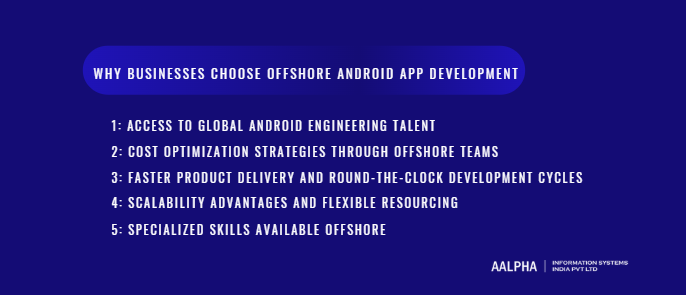
Why Businesses Choose Offshore Android App Development
Offshore Android app development has become a strategic decision for companies navigating rising software costs, growing user expectations, and an increasingly competitive digital landscape. As organizations look for ways to deliver mobile products faster and at higher quality, offshore engineering models offer a combination of global talent access, scalable delivery capacity, and operational efficiency that is difficult to achieve with purely local teams. Today, even established enterprises rely on distributed Android teams to accelerate feature release cycles, modernize legacy apps, and manage multi-platform product portfolios. This shift is driven by structural advantages that offshore ecosystems have developed over years of specialization.
-
Access to global Android engineering talent
One of the strongest motivations for offshore Android development is the ability to tap into a global talent pool. The demand for experienced Android developers increasingly outpaces supply in high-cost regions such as the United States, Western Europe, and Australia. These markets face talent shortages driven by competition from large tech companies, fast-growing startups, and enterprises undergoing digital transformation. Because Android powers the majority of smartphones worldwide, organizations require engineers who are proficient in Kotlin, Jetpack, Compose, reactive programming patterns, and advanced testing methodologies.
Offshore markets have grown into highly developed engineering ecosystems with a steady stream of skilled developers. Countries such as India, Vietnam, Poland, Ukraine, and Argentina invest significantly in STEM education, producing engineers who are already trained in modern mobile frameworks. Many offshore professionals have experience working with global clients and are familiar with agile methodologies, code review standards, API-driven architectures, and continuous integration pipelines. Businesses that struggle to hire locally can form high-quality offshore teams within weeks rather than months. This access to a deeper talent pool enables companies to maintain engineering momentum without compromising quality or timelines.
-
Cost optimization strategies through offshore teams
Cost efficiency remains a core advantage of offshore development, but the value extends beyond lower hourly rates. The economics of offshore models align with long-term product strategies, allowing companies to optimize their total cost of ownership. Offshore development can reduce labor costs by 40 to 70 percent depending on the region, which frees budget for innovation, marketing, user research, and post-launch optimization.
However, the true cost advantage comes from resource flexibility. Instead of maintaining a large in-house workforce year-round, businesses can dynamically scale offshore resources based on project phases. For example, the design phase may require fewer developers, while feature-heavy sprints may temporarily need a larger offshore team. This elasticity ensures that companies only pay for the capacity they need. Offshore teams also reduce infrastructure costs because development environments, testing devices, DevOps tools, and human capital management are handled by offshore partners. For businesses operating under strict budget constraints or pursuing rapid product experimentation, these cost structures create measurable financial resilience.
-
Faster product delivery and round-the-clock development cycles
Speed is now a competitive advantage in the mobile landscape, where user expectations evolve quickly and dominant platforms release updates several times per year. Offshore Android development enables faster delivery through distributed work cycles. Time zone differences allow teams to progress on code, testing, or design even after the internal team has ended their workday. This follow-the-sun model increases total development hours available within a 24-hour period and results in shorter turnaround times for feature releases, bug fixes, and performance enhancements.
In addition, offshore firms often maintain well-defined agile processes with sprint planning, backlog management, quality gates, and automated testing frameworks. These workflows reduce delays, minimize dependency bottlenecks, and allow continuous progression across modules. When projects require aggressive timelines such as seasonal product launches or investor-driven milestones, offshore teams can operate at scale to accelerate velocity without sacrificing stability. For global companies managing Android and iOS releases simultaneously, offshore capacity ensures that Android development progresses in parallel with other platforms, reducing time-to-market across the entire mobile portfolio.
-
Scalability advantages and flexible resourcing
Digital products rarely follow linear growth patterns. Some phases demand intensive engineering work such as building a new module, integrating complex features, or performing a large-scale refactor. Other phases require only a small maintenance team to handle incremental updates. Offshore development gives companies the ability to scale resources up or down quickly without the operational challenges of hiring or layoffs.
Offshore partners maintain bench strength and diverse talent pools, enabling rapid assembly of specialized pods for architecture, UI engineering, test automation, or DevOps. This flexibility is especially valuable for startups and mid-sized companies that do not want to expand their permanent workforce but need temporary spikes in development capacity. Enterprises benefit from the ability to maintain parallel workstreams across multiple apps or business units. This scalable model ensures that engineering output aligns with product strategy, seasonal demands, and long-term roadmaps.
-
Specialized skills available offshore
Offshore Android engineers often bring specialized expertise that is not always available in local markets. Many offshore professionals work extensively with modern Android platforms and have deep experience solving challenges related to device fragmentation, offline-first behavior, accessibility requirements, security compliance, and multi-environment testing. Offshore ecosystems also cultivate niche skills such as:
- Jetpack Compose for declarative UI implementation
- Advanced Kotlin features including coroutines, flows, and dependency injection
- Firebase integration for analytics, push notifications, crash reporting, and A/B testing
- Backend integration using REST, GraphQL, WebSockets, or gRPC
- Performance optimization for low-memory or low-bandwidth devices
- Test automation using Espresso, JUnit, and cloud-based device farms
- Modular architecture for large-scale codebases
Companies rarely have all these capabilities in-house. Offshore teams fill knowledge gaps, support architectural decision-making, and provide mature engineering practices that lead to more robust Android applications. This access to advanced skills becomes critical for businesses operating in regulated sectors such as finance, healthcare, or logistics, where security, compliance, and reliability requirements are stringent.
Case examples of industries benefiting the most
Several industries consistently benefit from offshore Android development due to their need for rapid innovation and scalable delivery capacity.
Ecommerce and retail rely on offshore teams to build high-performance shopping apps, integrate payment systems, support real-time inventory, and manage seasonal demand spikes. Offshore engineers can rapidly deliver new features such as personalized recommendations, loyalty programs, and mobile wallet integrations.
Healthcare organizations use offshore Android development to build telemedicine platforms, patient engagement apps, diagnostic tools, and HIPAA-compliant systems. Offshore specialists often bring experience with data encryption, secure messaging, and medical record interoperability.
Logistics and mobility companies depend on offshore Android teams to design driver apps, tracking systems, warehouse tools, and fleet management platforms. Offshore developers excel in real-time data synchronization, GPS optimization, and offline workflows needed for field operations.
Fintech firms use offshore engineering to build secure mobile banking apps, lending platforms, trading interfaces, and personal finance tools. Offshore markets with strong mathematical and engineering talent support advanced integrations such as biometric authentication, fraud detection, and regulatory compliance.
Media and entertainment platforms scale faster through offshore capacity, enabling continuous content updates, streaming optimization, and personalized media pipelines.
Across these industries, offshore development provides access to specialized knowledge, predictable delivery processes, and cost-effective operational frameworks that support both innovation and long-term scalability.
When Offshore Development Is the Right Choice
Offshore Android development is not a universal solution for every project. Its effectiveness depends on the nature of the product, the internal capabilities of the organization, and the strategic goals behind the mobile initiative. Companies that succeed with offshore teams tend to make decisions based on project characteristics, timelines, talent availability, and financial planning rather than relying on assumptions about outsourcing. Understanding when offshore development delivers the greatest value helps businesses structure their engineering approach more effectively and avoid misalignment between expectations and outcomes.
-
Evaluating project size, complexity, and timelines
The scale and complexity of a project play a significant role in determining whether offshore development is the right choice. Large or multi-module Android applications often require distributed teams to maintain development velocity and manage interdependent workstreams. For example, apps involving complex architectures, real-time communication, multi-user permission layers, or deep backend integrations benefit from the capacity and specialization available through offshore engineering hubs. Offshore teams are accustomed to working on enterprise-grade products and can distribute responsibilities across developers, architects, testers, and DevOps engineers.
Projects with demanding timelines also align well with offshore models. Businesses that need to launch an Android MVP quickly or respond to market opportunities often cannot wait through lengthy local hiring cycles. Offshore teams build momentum immediately by providing ready-to-deploy talent. The follow-the-sun model offers time zone advantages that increase total daily throughput, especially when deadlines are tight. When companies need to manage phased releases or parallel development of Android, iOS, and web applications, offshore resourcing creates balanced workload distribution and reduces delivery bottlenecks.
-
When in-house teams are insufficient
Many organizations discover that their internal teams are not equipped to handle the full scope of modern Android development. This does not reflect a lack of competence. Rather, it highlights the increasing specialization required to build and maintain high-quality mobile applications. Android development today involves advanced Kotlin programming patterns, Jetpack libraries, Compose-based UIs, modular architecture, automated testing, CI/CD pipelines, security protocols, and backend coordination. Expecting a small in-house team to master every component creates dependency risk and slows down innovation.
Companies often find themselves constrained by limited internal capacity when they want to add new features, redesign the UI, improve performance, or implement new technology stacks. Offshore teams help relieve pressure by handling feature development, maintenance, or specialized tasks that internal teams may not have time or expertise to manage. In-house engineers can then focus on product strategy, core architecture, or domain-specific logic while offshore developers contribute to execution and scalability. This complementary model strengthens the overall engineering function and enables faster product evolution.
-
When startups and enterprises choose offshore partners
The decision to work offshore is common across both early-stage startups and large global enterprises, but for different strategic reasons.
Startups choose offshore development because they need to build their initial product with constrained budgets while maintaining high quality and speed. Hiring a full in-house Android team early in the company’s lifecycle is expensive and risky. Offshore teams allow startups to build MVPs, iterate based on user feedback, and launch new features without burning through limited capital. Startups also benefit from offshore partners who bring pre-existing technical frameworks, reusable components, and experience launching mobile products across industries.
Enterprises, on the other hand, work with offshore partners to scale development capacity and maintain large Android portfolios. Enterprises often manage multiple apps, regional adaptations, compliance-driven features, and backend modernization efforts. Offshore teams provide structured delivery models, specialized roles, and operational maturity that align with enterprise workflows. Many enterprises operate through hybrid models where core architectural decisions remain internal, while feature development, QA automation, and support tasks are performed offshore. This approach enables predictable delivery, well-defined governance, and cost-efficient scalability.
Both startups and enterprises benefit from the stability that offshore firms offer through documented processes, sprint planning, quality assurance frameworks, and long-term team continuity.
-
Assessing budget constraints and operational goals
Budget considerations are one of the clearest indicators of whether offshore development makes sense. Organizations with limited budgets but ambitious project scopes find offshore teams particularly effective because they allow more work to be done without proportional increases in cost. Instead of hiring one or two local developers, businesses can assemble a fully staffed offshore team covering design, development, QA, and DevOps for the same budget. This expanded capacity accelerates delivery and enhances product quality.
However, it is not only cost savings that should influence the decision. The overall operational model matters. Companies pursuing rapid experimentation or aggressive product scaling often require elastic engineering capacity that offshore teams provide. Offshore development also supports long-term operational goals such as reducing dependency on local talent shortages, ensuring continuity across multiple development cycles, and maintaining predictable delivery budgets.
For businesses operating in industries with tight margins, such as ecommerce, logistics, or media, offshore development ensures that engineering investment aligns with revenue forecasts. Similarly, companies entering new markets or expanding internationally use offshore resources to build region-specific Android features or local integrations without overwhelming their in-house teams.
-
When hybrid or mixed teams offer more value
In many scenarios, the most effective approach is not purely offshore or purely in-house but a hybrid model that blends the strengths of both. Hybrid models are increasingly common because they leverage in-house strategic oversight while offshore teams handle execution, scalability, and specialized tasks.
A hybrid structure is ideal when:
- Core product decisions require domain-specific knowledge
- The organization wants to retain architectural control
- Legacy codebases need internal supervision
- Internal product managers coordinate with offshore delivery teams
- Some features require close proximity to stakeholders
In this setup, internal teams guide product direction, define priorities, and ensure alignment with business goals. Offshore developers focus on coding, UI implementation, testing, and engineering tasks that require consistent output. Hybrid models also improve resilience because the workload can be redistributed if internal or offshore teams face constraints.
Companies undergoing digital transformation often adopt hybrid teams to modernize existing Android apps while their in-house teams focus on new products. This dual-path strategy reduces technical debt and supports innovation simultaneously.
Types of Offshore Android Development Engagement Models
Choosing the right engagement model is one of the most important decisions in offshore Android app development. While offshore teams provide access to global talent and cost efficiency, the structure of the partnership determines how responsibilities are distributed, how risks are managed, and how effectively the project progresses. Different engagement models cater to different levels of predictability, flexibility, scope definition, and strategic intent. Understanding the strengths and limitations of each model helps organizations align engineering delivery with business goals and choose an approach that maximizes return on investment.
-
Dedicated team model
The dedicated team model is designed for long-term, ongoing Android development. In this arrangement, the offshore provider assembles a full-time team that works exclusively on the client’s product. The client manages priorities, provides product direction, and integrates the offshore team into its development workflow. The offshore provider handles recruitment, HR, payroll, workspace, and operational overhead while the team functions as an extension of the client’s engineering department.
This model is well-suited for companies with evolving product roadmaps, multiple feature streams, or continuous iteration requirements. It provides maximum flexibility because the team adjusts to changing priorities without renegotiating contracts. Dedicated teams also offer better predictability in terms of capacity and output, which is especially important for mid-sized companies and enterprises managing large Android applications.
The dedicated model fosters long-term knowledge retention. Developers remain with the project for extended periods, gaining deep familiarity with the codebase, architecture, and domain logic. This reduces onboarding time, increases productivity, and supports consistent quality across multiple releases. For organizations that treat Android development as a strategic function, the dedicated model provides the stability and scalability needed for sustained product evolution.
-
Fixed-price model
The fixed-price model is structured around clearly defined deliverables, timelines, and budgets. It works best when project requirements are stable, scope is well-documented, and outcomes are easily measurable. Under this model, the offshore provider takes responsibility for delivering the agreed-upon features within the specified constraints. Any scope changes require change requests, revised estimates, and contractual adjustments.
Fixed-price development provides budget certainty, which is valuable for businesses with rigid financial constraints or projects that require precise cost forecasting. It is commonly used for building MVPs, standalone modules, proof-of-concepts, or UI redesigns that follow predictable requirements.
However, the fixed-price model is less suitable for dynamic or exploratory work. Android development often involves evolving requirements due to user testing, technical discoveries, platform updates, or integration complexities. Fixed-price engagements can become restrictive when flexibility is required. The model places more emphasis on scope alignment and documentation rather than collaborative iteration. This means companies must invest time upfront to define detailed product requirements before development begins.
For well-defined Android projects that prioritize predictability and controlled budgets, the fixed-price model delivers a structured and time-bound path to completion.
-
Time and materials (T&M)
The time and materials model follows a pay-as-you-go structure based on the hours or days developers spend working on the project. It offers maximum flexibility, allowing scope, priorities, and timelines to evolve without contractual adjustments. T&M aligns well with agile methodologies and continuous delivery workflows commonly used in Android development.
Companies choose T&M when requirements are uncertain, when projects involve research or prototyping, or when the product strategy may shift based on market insights. This model supports rapid experimentation because features can be adjusted or replaced based on user feedback without causing contractual friction.
T&M is also suitable for complex Android applications involving integrations, performance optimization, architecture modernization, or features that require iterative refinement. Because billing reflects actual effort, companies have more control over development direction and can adapt based on emerging needs.
The model does require active oversight, including sprint planning, progress reviews, and clear prioritization. When managed well, T&M becomes the most flexible and innovation-friendly model, enabling continuous improvement and faster response to technical or business insights.
-
Build-Operate-Transfer (BOT) model
The Build-Operate-Transfer model is designed for companies that aim to eventually establish their own offshore development center. In the BOT arrangement, the offshore vendor builds the team and infrastructure, operates the development function for a contractual period, and transfers the entire unit to the client once it reaches maturity.
BOT offers several strategic advantages:
- Rapid establishment of offshore capability without upfront investment
- Immediate access to talent without navigating unfamiliar legal or operational environments
- Smooth transition of knowledge, processes, and cultural alignment
- Full ownership of the offshore team after transfer
This Build-Operate-Transfer model is especially attractive to enterprises planning long-term offshore operations or companies that want to retain full control but avoid the risks and complexities of building offshore capability from scratch. BOT enables organizations to scale Android development while gradually preparing internal leadership, governance, and process maturity for eventual ownership.
-
Staff augmentation vs full offshore development
Staff augmentation and full offshore development represent two distinct approaches to extending engineering capacity.
Staff augmentation adds individual offshore developers or specialists to an existing in-house team. The client maintains control over project management, architecture, coding standards, and workflows. This model is ideal when companies need temporary or specialized skills that their internal teams lack. For example, a company may augment its staff with Kotlin experts, Jetpack Compose engineers, QA automation specialists, or DevOps professionals to support a specific workstream.
Full offshore development, on the other hand, delegates entire feature modules or full product development to the offshore partner. The offshore team manages delivery while collaborating with stakeholders for requirements and milestones. This model reduces the internal workload and provides more predictable delivery capacity. It is suitable for companies that want a complete Android development function without expanding internal headcount.
Choosing between these approaches depends on internal capabilities, project complexity, and desired involvement in daily execution. Many organizations use both models simultaneously: augmentation for specialized skills and full offshore teams for large-scale development.
How to choose the right model based on project requirements
Selecting the appropriate engagement model requires evaluating several factors:
- Scope stability and clarity
Projects with well-defined, static requirements align with fixed-price models. Dynamic or evolving projects benefit from T&M or dedicated teams. - Long-term product strategy
If Android development will continue for years, a dedicated team or BOT model supports continuous evolution and knowledge retention. - Internal capacity and expertise
Organizations with strong in-house leadership may prefer staff augmentation or hybrid models. Those lacking mobile expertise may benefit from full offshore development. - Budget flexibility
If cost predictability is critical, fixed-price or BOT models are suitable. If innovation speed is the priority, T&M or dedicated teams offer more agility. - Time-to-market requirements
Aggressive deadlines favor dedicated teams or mixed models that enable parallel development and rapid scaling. - Organizational goals
Startups often prioritize speed and budget efficiency, while enterprises focus on structured governance and scalability.
By aligning the engagement model with technical priorities, organizational maturity, and product goals, companies can maximize the benefits of offshore Android development and reduce risks associated with delivery, quality, and long-term maintenance.
The Complete Offshore Android App Development Process
Successful offshore Android development requires a structured, transparent, and repeatable process that guides teams from initial discovery to post-launch maintenance. Modern Android development involves deeply interconnected tasks, ranging from architecture planning and design to automated testing, DevOps, and long-term iteration cycles. Offshore teams rely on systematic workflows similar to those followed by any expert mobile app development company, ensuring quality and predictability across time zones and organizational boundaries. This section explains each stage of the offshore Android development process, highlighting how distributed teams collaborate to deliver reliable, scalable, and user-centric applications.
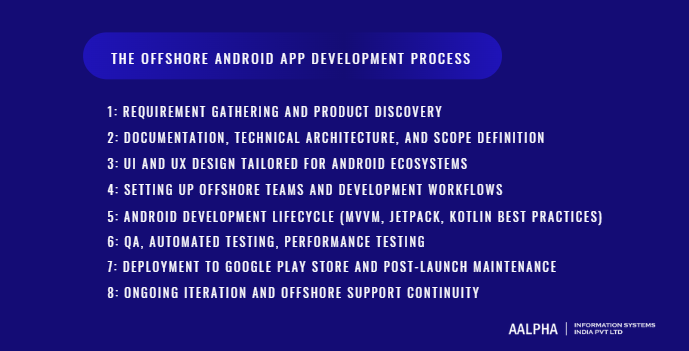
Step 1: Requirement gathering and product discovery
Product discovery establishes the foundation for the entire project. Offshore teams begin by working closely with stakeholders to understand the vision, target users, functional requirements, and business constraints. Unlike ad-hoc outsourcing, structured offshore discovery aims to reduce ambiguity and establish shared understanding.
The discovery phase typically includes:
- Stakeholder interviews and workshops
The team conducts interviews to identify core features, business goals, user flows, and success criteria. Workshops also capture pain points that the Android app must solve. - User research and persona development
Offshore product analysts study target demographics, device types, behavior patterns, and competitive apps. Because Android runs on a broad range of devices, understanding user diversity is essential for UX and performance planning. - Feature prioritization and roadmap creation
Teams classify features based on impact, feasibility, and release timelines. Product backlogs are created with clear priorities for MVP, V1, and subsequent versions. - Technical feasibility assessment
Engineering leads evaluate third-party integrations, backend dependencies, security requirements, BLE or GPS needs, and device-specific challenges. - Risk identification
Potential obstacles such as API limitations, regulatory requirements, or time zone constraints are documented early to avoid bottlenecks.
The output of the discovery stage includes a requirement specification, initial user journeys, a feasibility analysis, and an MVP roadmap. This ensures alignment across stakeholders and provides offshore teams with a structured blueprint for subsequent phases.
Step 2: Documentation, technical architecture, and scope definition
Once requirements are validated, offshore architects and business analysts produce technical documentation that defines how the Android application will function internally. Documentation brings predictability and transparency, making it easier for distributed teams to collaborate efficiently.
Key outputs include:
- Functional Specification Document (FSD)
Describes every feature, user action, data flow, and expected behavior. It serves as the reference for development and QA teams. - Technical Architecture Document (TAD)
Defines the app’s structural foundation, including modules, APIs, database schemas, caching layers, service layers, and internal dependencies. Modern Android apps often adopt MVVM or Clean Architecture to ensure modularity. - API contracts and data models
Offshore teams collaborate with backend teams to create REST, GraphQL, or gRPC endpoints that align with Android requirements. - Acceptance criteria and user stories
Detailed user stories with testable acceptance criteria are used to guide development and automated testing. - Scope definition and sprint plan
The offshore team breaks down requirements into epics and tasks, estimating effort, planning sprints, and identifying resource needs.
This stage ensures the project is structured, realistic, and ready for predictable execution. It eliminates the ambiguity that often causes delays in distributed environments.
Step 3: UI and UX design tailored for Android ecosystems
Android’s diverse device ecosystem demands a nuanced approach to UI and UX design. Offshore design teams focus on creating user interfaces that follow Material Design guidelines while ensuring consistency across form factors, display densities, and OS versions.
The design process includes:
- Wireframes and low-fidelity prototypes
These sketches define the layout, navigation flow, and content hierarchy. Stakeholders review early prototypes to validate usability. - High-fidelity UI design
Designers create visually rich, polished screens using Material Design components, adaptive layouts, and accessibility principles. Special attention is given to spacing, typography, gestures, dark mode support, and animations. - Design system and component library
For large apps, offshore teams build reusable components to ensure consistency and reduce development time. - Interactive prototypes
Clickable prototypes simulate user journeys and enable stakeholders to test the app before development begins. - Design-to-development handoff
Designs are exported with assets, color codes, spacing guides, and interaction notes. Tools like Figma, Zeplin, and Material Theme Builder streamline the handoff process.
Offshore designers ensure that the UX adapts seamlessly across low-end devices, tablets, foldables, and high-performance smartphones. This adaptability directly impacts user satisfaction and retention.
Step 4: Setting up offshore teams and development workflows
Operational excellence determines the success of offshore Android projects. Before coding begins, teams establish governance structures that facilitate collaboration across time zones.
This setup typically involves:
- Team formation and role assignment
A complete team may include Android developers, QA engineers, UI/UX designers, DevOps engineers, business analysts, and a project manager or scrum master. - Communication protocols
Clear guidelines for meetings, status updates, sprint rituals, and reporting cycles are established. Slack, Microsoft Teams, Jira, and Confluence are commonly used. - Development workflow setup
Code repositories, branching strategies, testing frameworks, CI/CD pipelines, and documentation tools are configured. - Definition of Done (DoD) and Definition of Ready (DoR)
These criteria ensure alignment on when work begins and when deliverables are considered complete. - Time zone overlap planning
To avoid gaps in communication, offshore teams schedule overlapping working hours with client teams. - Risk and dependency management
The project manager monitors dependencies involving backend teams, third-party vendors, or integration partners.
With these workflows, offshore Android teams operate as high-performing distributed units that maintain transparency and accountability throughout the project lifecycle.
Step 5: Android development lifecycle (MVVM, Jetpack, Kotlin best practices)
Modern offshore Android development relies on mature engineering practices that reduce fragility, improve testability, and support modular scaling.
Core components include:
- Architectural patterns
Most offshore teams adopt MVVM or Clean Architecture to separate UI, logic, and data layers. This creates maintainable and testable codebases. - Kotlin-first development
Kotlin is now Google’s preferred language for Android. Offshore developers leverage coroutines, flows, extension functions, sealed classes, and type safety for more efficient coding. - Jetpack libraries
To reduce boilerplate and improve reliability, offshore teams use Jetpack components like:
- ViewModel
- LiveData or Flow
- Room for database management
- WorkManager for background tasks
- Navigation Component
- Hilt or Koin for dependency injection
- Jetpack Compose for declarative UI
- Modularization
Large apps are split into independent modules so multiple offshore developers can work in parallel. - API integration
The team connects the app to backend services using Retrofit, Ktor, or GraphQL clients. - Git workflows and code reviews
Developers follow structured pull request workflows, ensuring adherence to coding standards and preventing regressions. - Performance optimization
Memory leak detection, CPU profiling, network monitoring, and UI rendering optimization are integrated into development cycles.
Offshore developers rely on engineering maturity and reusable frameworks to maintain velocity without compromising quality.
Step 6: QA, automated testing, performance testing
Quality assurance ensures stability across thousands of Android devices. Offshore QA teams integrate both manual and automated testing to deliver reliable builds.
Key components include:
- Test strategy creation
QA engineers define test scenarios for functional, non-functional, and regression testing. - Automated test coverage
Espresso, JUnit, MockK, Robolectric, and cloud-based device farms are used to automate critical flows. - Manual testing
Exploratory testing, UI validation, feature verification, and cross-device testing ensure coverage beyond automation. - Performance testing
Teams check:
- App startup time
- Battery usage
- Memory consumption
- Network performance
- Background services
- Security testing
Static code analysis, data encryption checks, secure storage validation, and vulnerability scanning mitigate security risks. - Continuous testing
Tests run automatically in CI pipelines for every pull request to prevent regressions.
Offshore QA teams play a crucial role in maintaining user trust and ensuring smooth performance in diverse environments.
Step 7: Deployment to Google Play Store and post-launch maintenance
Deployment involves preparing the Android app for public release and ensuring it complies with Google Play policies. Offshore teams manage the technical and operational aspects of publishing.
Key responsibilities include:
- App bundle preparation
Signing configurations, version control, and build optimization ensure the app is ready for release. - Store listing creation
Teams collaborate on screenshots, videos, metadata, keywords, age ratings, and compliance forms. - Play Console setup
Internal testing, closed testing, and staged rollouts allow controlled deployment. - Crash monitoring and analytics
Firebase Crashlytics, Google Analytics, and custom dashboards track performance and user behavior. - Bug fixes and hot patches
Offshore developers respond to crash reports, ANRs, and performance anomalies quickly. - Compliance updates
Google Play frequently updates policies. Offshore teams ensure the app stays compliant with security, data protection, and privacy guidelines.
Maintenance continues long after launch, supporting feature enhancements, OS version updates, and device compatibility improvements.
Step 8: Ongoing iteration and offshore support continuity
Android applications evolve continuously. Offshore teams support long-term growth through structured iteration cycles.
This includes:
- Feature expansion based on user feedback
Teams refine existing features and add new capabilities aligned with customer expectations. - Technical debt reduction
Refactoring, code cleanup, architecture improvements, and library updates maintain long-term health. - OS and device updates
Each annual Android release introduces new APIs and behavior changes that offshore teams integrate proactively. - Backend changes and new integrations
Offshore teams accommodate updates to APIs, databases, authentication systems, or cloud infrastructure. - Performance enhancements
Iteration cycles improve speed, reduce crashes, and optimize resource usage. - Continuous DevOps support
CI/CD pipelines are monitored and improved as the app scales. - Long-term team stability
Offshore providers maintain developer continuity, ensuring that institutional knowledge stays with the product.
This continuity enables companies to innovate faster, reduce operational risks, and maintain competitive advantage in constantly shifting markets.
Technical Considerations for Offshore Android Development
Technical decisions form the backbone of any offshore Android development initiative. These choices influence performance, scalability, maintainability, and long-term cost efficiency. Offshore teams must operate within well-defined engineering frameworks to ensure consistency across distributed developers and time zones. The following subsections outline the critical technical considerations that guide a robust offshore Android project.
-
Choosing Between Native Kotlin, Hybrid, and Cross-Platform Approaches
One of the earliest decisions in Android development is choosing the appropriate technology stack. Native Kotlin development remains the industry standard for applications that require optimal performance, deep OS-level access, and long-term scalability. Kotlin’s interoperability with Java, combined with Jetpack libraries and Jetpack Compose, makes it ideal for modern Android architecture and UI development.
Hybrid frameworks such as Ionic or Cordova allow faster delivery for content-heavy apps but fall short in performance and flexibility. Cross-platform frameworks like Flutter and React Native offer a balanced alternative, providing faster development cycles and shared codebases for Android and iOS. However, they may require Kotlin modules for device-specific features. The decision ultimately depends on product complexity, performance needs, and future maintenance expectations.
-
Architecture Patterns: Clean Architecture and MVVM
A well-structured architecture is essential for distributed development. Clean Architecture separates data, domain, and presentation layers, creating a modular structure that improves testability and long-term maintainability. This pattern is especially valuable when offshore teams collaborate with internal developers or when multiple engineers contribute to parallel modules.
MVVM (Model-View-ViewModel) has become the standard for Android apps because it clearly separates UI logic from data and business logic. Jetpack components such as ViewModel, LiveData, and Kotlin Flow strengthen MVVM implementations and reduce lifecycle-related issues. Architecture decisions should support scalability, reduce technical debt, and allow new developers to onboard efficiently.
-
Database, Backend, and API Design Considerations
Database and API integration shapes how efficiently the Android app handles data. Room is the preferred local database solution because it offers type safety, observable data flows, and seamless integration with coroutines and Flow. DataStore replaces SharedPreferences for secure key-value storage, especially for user settings, tokens, or lightweight configurations.
Backend design must align with mobile constraints. APIs should include pagination, meaningful error handling, retry mechanisms, and consistent response structures. Retrofit, OkHttp, and Ktor are common libraries used for API communication, enabling efficient handling of authentication, headers, caching, and network diagnostics. Backend teams must coordinate closely with offshore developers to ensure that API contracts match real-world app requirements.
-
Offline Support, Caching, and Synchronization
Many Android apps operate in environments where network connectivity is inconsistent. Offline support becomes essential for industries like logistics, ecommerce, and healthcare. Caching strategies allow apps to display stored data even when offline, while background synchronization ensures that changes are uploaded once the device reconnects.
WorkManager handles deferred tasks reliably, such as syncing user actions or updating cached content. Developers must design conflict-resolution rules, data freshness indicators, and intuitive UI feedback for offline states. These capabilities reduce user frustration and enhance overall reliability, especially in emerging markets where Android dominates.
-
Device Compatibility and Fragmentation Challenges
Android’s device fragmentation is a persistent engineering challenge. Apps must run smoothly across many screen sizes, resolutions, chipset performance levels, and customized manufacturer skins such as One UI, MIUI, and ColorOS. Offshore teams need a comprehensive testing strategy that accounts for this diversity.
Responsive UI design, density-independent assets, adaptive layouts, and Compose-based components help mitigate fragmentation risks. Minimum SDK versions must balance access to modern APIs with coverage of older devices. Cloud device farms such as Firebase Test Lab and BrowserStack allow offshore developers to test across dozens of devices without maintaining physical inventory.
-
CI/CD Pipelines and Automated Deployments
A disciplined CI/CD pipeline is central to offshore Android development, enabling consistent builds, automated testing, and reliable deployments. Automated pipelines typically perform static code analysis, lint checks, dependency scanning, and unit tests on every commit. Integration tests and UI tests run across emulators or cloud devices, identifying issues early.
Deployment automation ensures smooth distribution to internal testers, QA teams, or closed beta groups. Tools such as GitHub Actions, GitLab CI, Bitrise, and Jenkins streamline the build-signing process, manage versioning, and upload releases directly to Google Play testing tracks. These automated workflows reduce human error and keep multi-location teams aligned.
-
Security and Compliance Considerations
Security must be built into every stage of development. Android apps often manage sensitive user data, requiring secure storage mechanisms such as encrypted SharedPreferences, Room encryption, and hardware-backed keystores. Communication with backend services must enforce HTTPS, certificate validation, and encrypted payloads.
Authentication frameworks such as OAuth2 and JWT must be implemented securely, with token rotation, proper session expiry, and restricted access scopes. Code obfuscation through R8 protects against reverse engineering. Offshore teams must also comply with regulatory frameworks like GDPR, HIPAA, or PCI DSS when applicable, ensuring that data is handled responsibly and securely.
Security extends into operational practices. Offshore teams should follow standardized access controls, repository permissions, VPN policies, and secure credential management. These protocols ensure that the Android app remains resilient to vulnerabilities and compliant with global data protection standards.
How to Choose the Right Offshore Android Development Partner
Choosing the right offshore Android development partner requires a structured evaluation of technical skills, communication practices, engineering processes, and long-term reliability. Because Android applications must operate across a fragmented ecosystem of devices, OS versions, and network environments, an offshore partner must not only code well but also demonstrate architectural discipline, process maturity, and the ability to work seamlessly with distributed teams. This section explains the core criteria and evaluation methods that help organizations identify a partner capable of delivering high-quality Android applications.
-
Key Criteria: Expertise, Portfolio Depth, Engineering Maturity
The first step in selecting an offshore Android development partner is assessing their level of expertise and real-world delivery experience. A qualified team demonstrates proficiency with Kotlin, Jetpack libraries, and modern architectural patterns such as MVVM and Clean Architecture. Reviewing their portfolio helps determine whether they have built Android apps similar in scope or complexity to your requirements. A strong portfolio includes projects that showcase advanced features like offline support, real-time data synchronization, multi-module architecture, or integrations with payment gateways and backend systems.
Engineering maturity is equally important. A mature offshore partner follows industry standards for coding conventions, documentation, version control, and testing practices. Their engineering culture should emphasize reusable components, modular design, performance optimization, and continuous improvement. Because Android evolves rapidly, the provider must also demonstrate active adoption of modern practices such as Jetpack Compose, Kotlin Coroutines, and automated CI/CD pipelines. Evidence of this maturity is often found in detailed case studies, engineering blogs, public GitHub projects, or thought leadership published by the team.
-
Interviewing Offshore Developers Effectively
Interviewing offshore Android developers helps verify their technical competence and problem-solving capability. The interview process should focus on real-world scenarios rather than theoretical questions. Asking candidates to explain how they structure MVVM architecture, handle caching with Room or DataStore, or design background tasks using WorkManager reveals how they approach practical engineering challenges. Reviewing sample code or conducting a short coding exercise offers insight into code readability, adherence to Kotlin best practices, and familiarity with Android toolkits.
It is also useful to explore how developers think about edge cases, device fragmentation, accessibility, and performance constraints. Strong offshore engineers typically discuss solutions such as using network interceptors, optimizing RecyclerView performance, reducing overdraw, or managing long-running tasks with coroutines. Their ability to articulate trade-offs between architecture choices or UI frameworks indicates depth of experience. Equally important is their comfort working within agile methodologies and distributed team environments, since successful offshore collaboration requires strong discipline around sprint planning, backlog refinement, and cross-team communication.
-
Evaluating Communication Practices and Cultural Compatibility
Effective communication is fundamental to offshore collaboration. Even highly skilled developers may struggle in distributed environments if communication gaps arise. A reliable offshore partner maintains structured communication practices, including regular standups, sprint reviews, status reports, and escalation protocols. Their team should be comfortable articulating technical decisions, raising risks proactively, and seeking clarification when requirements change.
Cultural compatibility is another critical factor. Partners who understand Western business norms, delivery expectations, and stakeholder management styles often integrate more seamlessly into product workflows. Companies should evaluate the offshore team’s responsiveness, clarity of written communication, and ability to collaborate in English. Time zone alignment also matters, and partners that offer overlapping working hours help reduce friction and delays. Reviewing how the offshore team handles project kickoff, requirement clarifications, and design discussions provides valuable insight into their communication strengths.
-
Assessing Project Management Capabilities
Strong project management ensures predictability, transparency, and alignment throughout the Android development lifecycle. Offshore partners should have certified project managers or experienced scrum masters who coordinate sprints, track progress, manage risks, and maintain documentation. Their processes should include sprint planning, task estimation, milestone tracking, and retrospective meetings that drive continuous improvement. The presence of a dedicated delivery manager or project coordinator often improves stakeholder communication and ensures that development aligns with business priorities.
Project management capability is also reflected in the tools the partner uses. Platforms like Jira, Trello, Asana, or Azure DevOps allow teams to maintain clear visibility over task progress and blockers. Offshore teams with a structured approach to requirements analysis, DevOps integration, and QA planning typically deliver more predictable outcomes. Clear governance frameworks, risk registers, and quality gates help prevent surprises and ensure consistency across development cycles. When evaluating partners, companies should ask for sample project plans, communication templates, and reporting formats to gauge the maturity of their project management system.
How to Validate Coding Standards and Android Guidelines
Validating coding quality is one of the most important steps in selecting an offshore Android partner. Reviewing code samples reveals how the team structures their classes, handles dependency injection, manages API calls, and uses Kotlin features such as coroutines, extension functions, sealed classes, and flows. Clean, well-documented code indicates a disciplined engineering culture. Conversely, fragmented, tightly coupled, or outdated code suggests future maintenance challenges.
Companies should also check whether the partner consistently follows Android and Material Design guidelines. This includes adaptive layouts, accessibility support, lifecycle-aware components, consistent navigation patterns, and efficient resource management. Asking for their internal coding guidelines, architectural decision records, and API standards provides insight into the maturity of their engineering organization. A strong offshore team uses automated tools like Detekt, Ktlint, SonarQube, and Lint checks to enforce coding discipline. These practices ensure that the product remains stable, scalable, and easy to maintain across multiple development cycles.
What Makes a Reliable Long-Term Partner
A reliable long-term offshore partner contributes more than code—they provide continuity, strategic insight, and operational resilience. Stability of the team is a key indicator: partners who retain developers for multiple years ensure knowledge preservation and reduce onboarding costs. Companies should evaluate the partner’s track record for long-term engagements, including case studies where they supported clients through multiple releases, platform upgrades, or architectural redesigns.
Additionally, a strong long-term partner invests in talent development and stays updated with Android ecosystem changes. Their engineers continuously learn emerging technologies such as Jetpack Compose, Android 14 APIs, machine learning integrations, and performance optimization techniques. Operational resilience is another hallmark of a dependable partner, reflected in backup resources, documented processes, and structured knowledge transfer practices. Businesses should also assess the partner’s financial stability, leadership transparency, and commitment to protecting intellectual property. These factors collectively determine whether the offshore partner can support evolving product needs and scale alongside the business.
Cost of Offshore Android App Development
Cost remains one of the most important considerations in offshore Android development, but understanding pricing requires more than comparing hourly rates. Offshore development rates depend on geography, team seniority, project complexity, infrastructure needs, and long-term maintenance requirements. Businesses that approach offshore collaboration strategically can significantly reduce total cost of ownership while improving delivery velocity and engineering depth. This section breaks down regional pricing differences, developer rate benchmarks, project cost ranges, hidden expenses, and long-term cost efficiency strategies that help organizations budget effectively for Android development.
Regional Cost Comparison: India, Eastern Europe, LATAM, Southeast Asia
Offshore Android app development costs vary significantly across global regions. These variations reflect differences in economic conditions, engineering supply, market competition, and specialization levels.
India
India remains the most cost-effective region, offering a large pool of experienced Android developers who are well-versed in Kotlin, Jetpack Compose, Clean Architecture, and enterprise integrations. Android developers hourly rates in India are generally lower than in other regions despite high engineering maturity. India is well-known for handling large-scale enterprise projects and long-term dedicated team models.
Typical range: USD 18–40 per hour
Eastern Europe (Poland, Ukraine, Romania, Belarus)
Eastern Europe offers strong engineering talent with deep expertise in complex architectures, fintech-grade security, and large-scale backend integrations. Rates are higher than in India, but many companies choose Eastern Europe for its cultural alignment with Western markets, time zone convenience, and strong technical depth.
Typical range: USD 30–70 per hour
Latin America (Argentina, Brazil, Mexico, Colombia)
LATAM has become a popular nearshore choice for U.S.-based companies due to overlapping time zones and improving developer availability. Android engineers in LATAM often have strong UI/UX skills and cross-platform experience, though costs are moderately higher than other offshore markets.
Typical range: USD 28–60 per hour
Southeast Asia (Vietnam, Philippines, Indonesia)
Southeast Asia offers competitive pricing with strong adoption of modern Android frameworks. Vietnam, in particular, has developed a reputation for technically robust mobile engineering.
Typical range: USD 22–45 per hour
These cost variations allow companies to choose regions that align with their product complexity, collaboration preferences, and long-term scalability plans.
Hourly Rate Benchmarks by Developer Level
The seniority of the developer influences cost more than geography. Offshore Android teams typically classify roles into three seniority levels.
Junior Android Developer (0–2 years experience)
Junior developers handle basic UI screens, simple API integrations, and minor bug fixes. They work under senior supervision and contribute to well-defined tasks.
Typical range: USD 12–25 per hour
Mid-Level Android Developer (2–5 years experience)
Mid-level engineers can independently manage MVVM architecture, complex UI flows, API integrations, and testing. They are suitable for building MVPs or feature modules with minimal oversight.
Typical range: USD 20–40 per hour
Senior Android Developer / Architect (5+ years experience)
Senior engineers lead architecture design, modularization, Jetpack Compose adoption, performance tuning, and integration with backend systems. They mentor junior developers and ensure coding standards are followed.
Typical range: USD 35–70+ per hour
Understanding rate bands helps companies structure teams effectively. Most offshore teams blend juniors, mids, and seniors to optimize cost while maintaining engineering quality.
Budget Ranges for MVP, Mid-Scale, and Enterprise Android Apps
Estimating development cost depends on scope, complexity, integrations, and design needs. While every project is unique, typical budget ranges can be outlined.
MVP Android App
An MVP is designed to validate core concepts. It includes essential screens, user onboarding, basic CRUD operations, and minimal backend integration.
Typical cost range: USD 12,000–35,000
Timeline: 6–12 weeks
Mid-Scale Android App
Mid-scale applications include additional functionality, dashboards, notifications, offline support, design systems, and moderate backend integrations.
Typical cost range: USD 30,000–80,000
Timeline: 3–6 months
Enterprise-Grade Android App
Enterprise apps support large user bases, advanced security, multi-module architectures, complex workflows, analytics integrations, and compliance requirements.
Typical cost range: USD 80,000–250,000+
Timeline: 6–18 months
Cost varies further when apps require BLE integration, real-time communication, ML features, multi-lingual support, or custom backend development.
Hidden Costs: Infrastructure, Support, Security, Iteration Cycles
While offshore development reduces overall expenses, businesses often underestimate hidden costs that influence the final budget.
Infrastructure and Device Testing
Android testing requires access to diverse devices and OS versions. Offshore teams often maintain device labs, but companies may still incur additional costs for specialized hardware or cloud-device testing services.
Continuous Integration / Continuous Deployment
Running CI/CD pipelines increases costs through:
- Build servers
- Cloud storage
- Test automation frameworks
- Code quality tools
These investments improve long-term efficiency but should be accounted for.
Security and Compliance Requirements
Apps handling payments, healthcare data, or personally identifiable information require compliance audits, penetration testing, tokenization, encryption, and monitoring. These tasks may add incremental cost.
Support and Maintenance
Post-launch activities include fixing defects, adapting to OS upgrades, optimizing performance, and updating libraries. Many offshore partners offer monthly maintenance plans, which incur predictable yet ongoing expense.
Iteration Cycles and Feature Expansion
Successful apps evolve continuously. New features, UI redesigns, and architecture enhancements generate ongoing costs beyond initial development.
Budget planning must reflect these hidden contributors to avoid underestimating total investment.
How Offshore Teams Reduce Overall Cost of Ownership
Despite the hidden costs, offshore Android teams significantly reduce the total cost of ownership (TCO) across the product lifecycle.
Lower Hourly Rates Without Quality Compromise
Offshore engineers with strong Kotlin and Jetpack experience deliver the same output as onshore teams at a fraction of the cost.
Faster Development Through Specialized Roles
Offshore vendors often include UI/UX designers, QA testers, and DevOps engineers. This multidisciplinary approach reduces bottlenecks and accelerates release cycles.
Reusable Frameworks and Code Templates
Many experienced offshore teams maintain internal libraries, authentication modules, analytics wrappers, and base architectures that reduce development effort.
Scalable Resourcing
Teams can be expanded temporarily during feature-heavy phases and reduced during maintenance periods, optimizing budget at every stage.
24/7 Productivity With Time Zone Advantages
When offshore teams operate in different time zones, development continues nearly around the clock, compressing timelines without inflating cost.
Offshore development aligns cost with value delivery and spreads expenses efficiently across development, testing, deployment, and maintenance.
Planning Long-Term Cost Efficiency
Sustainable cost efficiency requires strategic planning rather than focusing solely on initial development cost.
Define a Clear Product Roadmap
A well-structured roadmap helps avoid last-minute changes, reduces rework, and enables predictable sprint planning.
Choose a Scalable Architecture
Clean Architecture and modularization reduce long-term maintenance cost by making the code easier to modify and test.
Invest in Automated Testing
UI tests, unit tests, and regression suites reduce bug-fixing costs over time and improve release stability.
Use Dedicated Teams for Long-Term Projects
Dedicated teams ensure continuity, domain knowledge retention, and consistent output quality, reducing the churn cost associated with onboarding new developers frequently.
Prioritize Performance and Code Quality Early
Performance bottlenecks or poor architecture lead to expensive refactors later. Early investment in engineering excellence lowers lifetime cost.
Adopt Metrics and Monitoring
Using tools like Firebase Performance, Crashlytics, and Google Analytics helps control issues early and prevents costly failures at scale.
By evaluating both short-term and long-term cost factors, companies can structure offshore Android development in a financially sustainable manner while maximizing product reliability and user satisfaction.
Common Challenges in Offshore Android Development and How to Avoid Them
Offshore Android development provides significant advantages, but it also introduces challenges that can affect delivery timelines, product quality, and team cohesion if not managed effectively. These challenges are not inherent flaws in offshore development; rather, they arise when processes, communication structures, or expectations are not clearly defined. Understanding the most common issues and preparing structured mitigation strategies helps businesses maintain high performance, predictable execution, and strong collaboration across distributed teams. This section outlines the key challenges and the approaches used by successful companies to overcome them.
-
Communication Barriers and Alignment Gaps
Communication is the foundation of successful offshore collaboration. Misunderstandings often occur when requirements are unclear, feedback loops are inefficient, or stakeholders assume that offshore teams will intuitively grasp business context. Communication gaps can lead to rework, delays, or technical misalignment, particularly in complex Android projects where UX decisions, API behaviors, or architectural patterns require precise clarification.
Offshore teams usually speak fluent English, but subtle issues arise around stakeholder expectations, cultural nuances, and decision-making processes. For example, developers may hesitate to challenge assumptions, or product managers may assume that brief descriptions are sufficient for feature development. Without structured communication protocols, alignment weakens as the project progresses.
Clear documentation, regular video calls, shared collaboration tools, and transparent decision logs significantly reduce these challenges. When communication is intentional and consistent, alignment becomes much easier to maintain even across long distances.
-
Time Zone Management
Time zone differences can be an asset—enabling near-continuous development—but they can also hinder fast decision-making if not coordinated effectively. Teams may lose momentum when they wait for clarifications, approvals, or code reviews. Delays compound when development cycles depend on tightly coupled tasks such as backend integration or UI adjustments that require immediate responses.
Companies often underestimate the operational adjustments needed for smooth time zone collaboration. Without overlapping working hours, synchronous communication becomes difficult, and asynchronous channels may not fully capture the nuances of technical decisions.
To avoid these issues, teams must design structured overlap windows—typically two to four hours—during which both sides are available for real-time communication. Well-documented workflows, shared sprint boards, and asynchronous tools such as Loom or Confluence allow teams to remain productive even when working hours do not fully align.
-
Quality Control and Code Consistency
Android apps require consistent architectural patterns, naming conventions, testing strategies, and performance standards. Offshore environments sometimes experience quality inconsistencies when teams lack unified coding guidelines or when developers work in isolation without rigorous code review processes. Fragmented codebases eventually become expensive to maintain and hard to scale.
Quality gaps also occur when teams are rushed or when requirements change frequently without proper documentation. Without automated testing, CI pipelines, or structured QA processes, defects may accumulate and affect the stability of the application across different devices and OS versions.
To prevent these challenges, companies must evaluate the offshore partner’s engineering maturity before engagement. Early investments in code style guides, architecture diagrams, review workflows, and test automation create consistency across the development lifecycle. Standardizing tooling and enforcing review discipline ensures long-term maintainability, even when team composition changes.
-
Security and IP Protection Concerns
Security risks exist in all development models, but offshore collaboration can heighten concerns when code and data cross international boundaries. Businesses worry about unauthorized access, misuse of confidential information, or inadequate compliance with security standards. Android applications often handle sensitive data such as user identity, payments, healthcare details, and location information, making security a non-negotiable priority.
IP protection concerns arise when companies do not enforce proper access control or rely on informal agreements. Without structured contractual safeguards, businesses risk losing ownership clarity over source code, architecture decisions, or proprietary workflows.
These issues are manageable through strong legal agreements, VPNs, credential management policies, secure repositories, and robust data handling standards. Offshore partners with ISO-certified or SOC-compliant infrastructure provide additional assurance. Companies should always retain administrative control of repositories, DevOps systems, and production infrastructure.
-
Unrealistic Expectations and Poor Requirement Definitions
One of the most common sources of friction in offshore Android projects is the lack of clear requirements. When organizations begin development without precise user stories, acceptance criteria, wireframes, or API documentation, offshore teams must make assumptions that may not align with the business vision. These assumptions lead to revisions, delays, and increased cost.
Unrealistic expectations also contribute to friction. Some companies expect enterprise-level features at MVP prices, or assume that rapid prototyping can coexist with heavy compliance requirements. Offshore teams may deliver well within their scope, yet stakeholders may still feel dissatisfied if expectations were not mapped correctly.
Successful engagements begin with structured discovery, well-defined scope, and transparent communication about constraints. Requirement stability correlates strongly with predictable delivery, especially when multiple offshore developers work across parallel modules.
-
Strategies to Overcome Each Challenge
Every challenge in offshore Android development can be mitigated through deliberate planning, structured workflows, and engineering discipline. Below are key strategies that consistently deliver strong results.
- Strengthen Communication Protocols
Implement weekly sprint calls, daily standups, feature walkthroughs, and design evaluations. Use clear documentation repositories for requirements, decisions, and technical notes. Encourage developers to ask questions early and often. - Establish Time Zone Overlap
Plan overlapping hours that accommodate both teams, ensuring real-time discussion for critical tasks. Use asynchronous tools such as Loom, Miro, Figma comments, and Jira to maintain momentum independent of time zone gaps. - Implement Rigorous Quality Frameworks
Define coding standards, enforce architecture consistency, and require peer reviews for all pull requests. Use CI/CD pipelines, lint tools, automated tests, and performance profiling to maintain stability across releases. - Strengthen Security and IP Governance
Use NDAs, IP transfer agreements, secure version control, encrypted communications, and role-based access to protect sensitive assets. Ensure offshore partners follow documented security protocols and modern DevSecOps practices. - Improve Requirement Clarity and Expectation Management
Begin with structured discovery, create detailed user stories, define acceptance criteria, and maintain clear sprint goals. Revisit scope regularly to align expectations with budget and timeline realities. - Build Long-Term Relationship Models
Long-term offshore teams deliver better results because they understand domain context, business logic, and architectural decisions. Continuity reduces onboarding costs and improves engineering efficiency.
By proactively addressing these challenges through structured frameworks, companies can build successful offshore Android development partnerships that deliver predictable, high-quality outcomes and sustained product growth.
Best Practices for Managing Offshore Android Development Teams
Managing offshore Android development teams requires intentional processes, clear communication, and structured governance. Distributed collaboration can deliver exceptional results when aligned with disciplined engineering practices and well-defined workflows. Effective management ensures that offshore teams operate as an integrated extension of the product organization rather than as independent contractors working in isolation. This section explains the core best practices that enable predictable delivery, high code quality, and long-term partnership success.
-
Establishing Communication Frameworks
Communication is the backbone of offshore collaboration. Because distributed teams rely heavily on written and asynchronous communication, clarity and structure are essential. The goal is to create predictable information flows so that offshore developers always understand priorities, context, and technical expectations.
Strong communication frameworks include scheduled weekly syncs, daily standups, sprint reviews, and backlog grooming sessions. These meetings maintain alignment across product, design, engineering, and QA functions. Communication must extend beyond meetings; offshore teams should have access to decision logs, architecture documents, and acceptance criteria stored in shared repositories. Written clarity reduces unnecessary assumptions and minimizes rework.
Teams should also agree on communication etiquette, such as expected response times, escalation protocols, and preferred channels for urgent issues. When communication frameworks are explicit and consistently followed, time zone differences no longer hinder productivity but instead create a structured, predictable rhythm for the entire development lifecycle.
-
Sprint Planning and Agile Workflows
Offshore Android development performs best under agile methodologies because Android apps evolve continuously, require iterative UX validation, and rely on frequent integration with backend systems. Sprint planning becomes the foundation of this process. During planning, teams clarify requirements, estimate tasks, break features into technical subtasks, and define sprint goals that align with the product roadmap.
Effective sprint workflows emphasize stability and predictability. This includes maintaining a well-prioritized backlog, creating transparent user stories, and defining acceptance criteria that guide both development and testing. Offshore teams typically work in two-week sprints, which allow fast feedback loops and reduce risk.
Agile workflows also encourage continuous refinement. Retrospectives provide a structured space to evaluate what worked well and what needs adjustment. Over time, this practice improves team velocity, reduces miscommunication, and strengthens trust. By anchoring distributed teams in agile discipline, organizations ensure consistent delivery and predictable iteration cycles.
-
Milestones, Reporting, and Review Cycles
Clear milestones provide measurable checkpoints that help stakeholders evaluate progress and ensure alignment across all phases of development. Milestones should connect directly to business priorities and technical objectives, such as completing the MVP foundation, implementing core features, integrating critical APIs, or preparing for Play Store submission.
Reporting cycles keep stakeholders informed without introducing micromanagement. Offshore project managers typically share weekly status reports that include completed tasks, planned tasks, risks, blockers, and dependency updates. These concise updates provide transparency and reduce uncertainty around delivery timelines.
Review cycles—both internal and cross-team—play an equally important role. Design reviews confirm UX accuracy, architecture reviews ensure consistency with long-term vision, and QA reviews validate test coverage. Structured review cycles allow offshore teams to correct issues early before they escalate into costly rework.
-
Ensuring Quality Through Code Reviews and Testing
Quality assurance cannot be an afterthought in Android development. Offshore teams must embed testing and review practices directly into the development workflow to maintain reliability across devices and OS versions.
Code reviews act as a primary quality gate. Senior developers or architects review every pull request to confirm that code aligns with established architecture, follows Kotlin best practices, and adheres to internal style guidelines. Reviews also catch early regressions, improve maintainability, and promote knowledge sharing across the team.
Automated testing is another essential quality component. Unit tests, integration tests, UI tests (such as Espresso), and snapshot tests provide confidence that new features will not disrupt existing functionality. Continuous integration pipelines run these automated tests on every build, ensuring that quality remains stable even as the application grows.
Manual QA complements automation by validating device compatibility, checking UX fidelity, and verifying functionality under different network conditions. Offshore teams that blend code reviews, automation, and structured QA produce significantly more stable apps with reduced long-term maintenance costs.
-
Product Ownership and Decision-Making Clarity
Offshore development succeeds when roles and ownership boundaries are clearly defined. Ambiguity around decision-making leads to delays, misunderstandings, and duplicated effort. A strong governance model assigns explicit accountability to product managers, designers, architects, and developers.
Product ownership must reside with someone who understands the business goals, user needs, and prioritization framework. This person does not need to micromanage offshore teams but should provide clear direction, validate feature importance, and resolve competing priorities. Conversely, offshore developers must have well-defined decision rights regarding technical implementation, architecture choices, and feasibility analysis.
Decision-making clarity also reduces dependency risks. When developers know who approves UI changes, technical trade-offs, or API behaviors, they proceed confidently without waiting for unstructured feedback. This clarity creates momentum and prevents operational bottlenecks that often slow distributed teams.
-
Tools for Effective Remote Collaboration
Modern Android development relies heavily on collaborative tools that streamline communication, documentation, tracking, and deployment. Offshore teams perform best when equipped with a unified toolset that every stakeholder can access.
Project management tools such as Jira, Trello, or Azure DevOps help document requirements, track progress, and maintain visibility over sprint tasks. Figma, Zeplin, and Material Theme Builder support design collaboration and ensure accurate UI implementation. GitHub, GitLab, or Bitbucket serve as version control platforms with integrated code review workflows.
Communication tools such as Slack, Microsoft Teams, or Google Meet enable synchronous discussions, while Confluence or Notion centralize technical documentation and decision histories. Continuous integration tools such as Jenkins, GitHub Actions, or Bitrise automate builds and testing, creating stable delivery pipelines.
When offshore teams leverage the right tools, collaboration becomes frictionless and teams operate as if they were co-located, despite geographical separation.
-
Ensuring Long-Term Partnership Health
A successful offshore relationship extends beyond one project or release cycle. Long-term partnership health depends on trust, continuity, transparency, and shared goals. Companies should treat offshore teams as strategic collaborators rather than transactional resources. This mindset fosters stronger engagement, reduces turnover, and improves engineering outcomes over time.
Retention is a crucial factor. Offshore partners that maintain stable teams enable continuity across multiple releases and preserve valuable product knowledge. Organizations should evaluate the partner’s internal HR practices, career development frameworks, and employee satisfaction culture to ensure that the developers assigned to their project are supported and motivated.
Regular performance reviews, transparent feedback loops, and shared milestone celebrations strengthen team morale. Companies should also maintain realistic timelines, provide timely clarifications, and foster an environment where offshore developers feel comfortable raising concerns or proposing improvements.
Long-term partnership health also depends on strategic alignment. As the product evolves, the offshore partner should proactively suggest architecture refinements, optimization strategies, and updated workflows. When the relationship is built on collaboration and mutual commitment, offshore teams become a powerful engine for sustained innovation and operational efficiency.
Why Aalpha for Offshore Android App Development
Choosing the right offshore partner determines whether an Android project evolves into a reliable, scalable product or becomes burdened by technical debt and delivery obstacles. Aalpha stands out because of its engineering depth, structured processes, and long-term commitment to quality. The company brings together senior Kotlin developers, architects, QA specialists, and DevOps engineers who follow modern Android standards, including Jetpack libraries, MVVM/Clean Architecture patterns, and Kotlin-first development workflows. This enables Aalpha to deliver Android applications that are not only stable but also adaptable to new OS updates, device categories, and performance requirements.
Aalpha’s strength also lies in its disciplined project management and communication practices. Offshore collaboration requires transparency, predictable sprint cycles, and rigorous quality control. Aalpha’s teams conduct detailed discovery sessions, document every user story with measurable acceptance criteria, and maintain robust CI/CD pipelines that automate testing and deployments. Code reviews, architectural governance, and performance monitoring are embedded into the development lifecycle, making the output consistent and resilient across devices. This engineering maturity ensures that companies partnering with Aalpha benefit from lower long-term maintenance costs, faster development velocity, and a well-governed product roadmap supported by a team that understands both the technical and strategic dimensions of Android development.
Conclusion
Offshore Android development has become one of the most effective ways for organizations to scale engineering capacity, accelerate delivery, and build mobile products that perform reliably across diverse devices and markets. By leveraging global talent, businesses gain access to specialized Android expertise, modern architectural capabilities, and disciplined engineering practices that would take years to assemble internally. When supported by strong communication frameworks, clear requirements, and a mature development workflow, offshore teams deliver predictable outcomes and long-term product stability. Companies that adopt this model benefit from faster release cycles, reduced operational overhead, and the ability to innovate continuously in highly competitive digital environments.
Choosing the right offshore partner transforms Android development from a cost-saving tactic into a strategic advantage. A disciplined offshore team strengthens product foundations, enhances maintainability, and ensures that the application evolves in step with user expectations and platform shifts. With Android powering the majority of global mobile devices, the opportunity to reach broad and diverse audiences is significant, and offshore collaboration provides the technical and operational capacity necessary to seize that opportunity effectively. Organizations that approach offshore development with structure, clarity, and long-term vision build products that remain scalable, secure, and user-centric for years to come.
If you are planning to scale your Android development or explore offshore models for the first time, Aalpha’s engineering teams provide the depth, reliability, and process maturity required to deliver high-quality mobile applications. Whether you are building an MVP, modernizing a legacy product, or expanding into enterprise-grade Android capabilities, Aalpha supports the full development lifecycle with clear communication, predictable delivery, and strong technical leadership. To discuss your project, explore feasibility, or request a structured roadmap for your Android application, reach out to Aalpha and begin building a future-ready mobile experience with a trusted offshore partner.