






TL;DR: White-Label Delivery App Development
A white-label delivery app is a pre-built platform, with customer app, delivery partner app, merchant panel, and admin dashboard, that businesses rebrand and customize instead of building from scratch. It suits restaurants, grocery stores, pharmacies, and courier businesses that want a faster, lower-cost launch while still owning their brand and customer data.
It launches in weeks rather than months compared to custom development, and offers more branding control than generic SaaS tools. Cost depends on the number of panels, feature depth (wallets, multi-vendor, AI dispatching), and integrations like payments and maps. Before choosing a provider, check their delivery-app experience, customization depth, source code ownership terms, and long-term support.
Aalpha builds white-label and custom delivery platforms, including Zumy, a hyperlocal delivery and mobility platform spanning parcel, food, and bike taxi delivery. Connect with Aalpha to scope a branded delivery platform for your business.
White-label delivery app development is the process of building a delivery platform using a ready-made software foundation that can be rebranded and customized for a specific business. Instead of developing a delivery app from the ground up, businesses can use a pre-built system with customer apps, delivery partner apps, merchant panels, admin dashboards, payment modules, order management, live tracking, and reporting features already in place. The platform is then customized with the company’s logo, brand colors, business rules, pricing structure, delivery model, and required integrations.
This approach has become popular among startups, restaurants, grocery chains, courier companies, pharmacies, cloud kitchens, and local logistics businesses because speed matters in delivery markets. Building a full delivery platform from scratch can take months of planning, design, backend development, mobile app development, testing, deployment, and post-launch fixes. A white-label delivery app reduces that time by giving businesses a working base that can be adapted to their market and launched faster.
For restaurants and cloud kitchens, a white-label app helps reduce dependency on third-party food delivery marketplaces and gives better control over customer data, offers, menu pricing, and repeat orders. For grocery stores and pharmacies, it provides a branded digital channel for local customers to place orders with real-time updates. For courier and parcel delivery companies, it helps manage pickup requests, driver assignment, proof of delivery, payments, tracking, and customer communication through one system.
At its core, a white-label delivery app is a ready-made delivery business infrastructure. It connects customers, merchants, delivery partners, payments, orders, tracking, notifications, and admin operations in one branded platform. Businesses can launch faster, reduce development risk, control their customer experience, and scale their delivery operations without investing heavily in a fully custom product from day one.
What Is a White-Label Delivery App?
A white-label delivery app is a pre-built delivery software platform that a business can rebrand and customize as its own. The core technology is already developed, but the final product carries the client’s brand name, logo, colors, app icon, pricing structure, delivery rules, service categories, payment options, and operational workflows. This allows a business to launch a branded delivery app without spending the time and budget required to build every feature from scratch.
In simple terms, a white-label delivery app gives businesses a ready software base for running delivery operations. It may include a customer app, delivery partner app, merchant panel, admin dashboard, payment gateway integration, order tracking, push notifications, reports, and support tools. A restaurant can use it as its own food delivery app. A grocery chain can use it for online grocery orders. A courier company can use it for parcel pickup and delivery. A pharmacy can use it for medicine orders and prescription-based deliveries. The same foundation can be customized for different delivery models.
Simple Definition
A white-label delivery app is a ready-made app solution that is customized and sold under another company’s brand. The business using the app does not have to show the software provider’s name to customers. Instead, the platform appears as the company’s own delivery product.
For example, a local food delivery startup may launch an app with its own name, brand identity, commission model, delivery charges, restaurant listings, and driver payout rules. The customers see only that brand. Behind the scenes, the app uses a pre-built technology framework that has been configured for the startup’s business model.
How It Works
The working flow of a white-label delivery app is similar to most modern delivery platforms. First, a customer opens the app or website, selects a restaurant, store, product, parcel pickup option, or service category, and places an order. The order then reaches the merchant, store, or admin panel for confirmation. Once the order is accepted, the system assigns a delivery partner either automatically or manually, depending on the platform’s dispatch rules.
After assignment, the delivery partner receives the order details through the driver app. The customer can track the order status in real time, including confirmation, preparation, pickup, movement, and delivery. The system processes payment through online payment gateways, wallet balance, cash on delivery, pay at pickup, or other enabled payment modes. Once the delivery partner completes the order, the platform updates the status, generates records for payouts or commissions, and stores the order history for reporting and support.
Difference Between White-Label, Custom, and SaaS Delivery Apps
A white-label delivery app sits between fully custom development and generic SaaS delivery software. Fully custom development gives the highest level of control because the platform is built specifically for one business from the beginning. It allows deep customization, unique features, custom architecture, and complete ownership, but it usually costs more and takes longer to launch.
A generic SaaS delivery app is usually subscription-based and hosted by the provider. It is faster to start with, but customization is often limited. Businesses may have less control over source code, data structure, advanced workflows, hosting, and long-term scalability.
A white-label delivery app offers a practical middle path. It launches faster than custom development, gives more branding control than standard SaaS tools, and can often be customized for specific delivery models. Depending on the provider, businesses may also get source code ownership, dedicated hosting, custom integrations, and scalable backend architecture. For many startups and local delivery businesses, this makes white-label development a strong option when they need speed, brand control, and operational flexibility without the cost of building everything from zero.
Why Businesses Are Choosing White-Label Delivery App Development
Businesses are choosing white-label delivery app development because it gives them a faster and more practical way to enter the online delivery market. Delivery platforms are complex products. They need customer apps, delivery partner apps, merchant panels, admin dashboards, live tracking, payment systems, notifications, order management, refunds, pricing rules, and reporting. Building all these components from scratch can be expensive, slow, and risky, especially for startups and local businesses that need to validate demand quickly. A white-label delivery app solves this problem by giving businesses a ready software base that can be branded, customized, tested, and launched with less development effort.
-
Faster Time to Market
One of the biggest reasons businesses choose white-label delivery app development is launch speed. A fully custom delivery app can take several months because every module has to be planned, designed, developed, tested, and deployed from the beginning. The customer app, driver app, admin panel, backend APIs, order tracking, map integration, payment gateway, and notification system all need separate development effort.
With a white-label solution, the core platform already exists. The development team can focus on branding, configuration, business-specific workflows, payment setup, delivery zones, pricing rules, and testing. This reduces the time needed to move from idea to launch. For startups, this is valuable because they can enter the market faster, test real customer demand, onboard merchants, and improve the product based on actual usage instead of spending too much time building before launch.
-
Lower Development Cost
White-label delivery apps also reduce upfront development cost because they use reusable modules. Features such as signup, login, product listing, cart, order placement, driver assignment, live tracking, payment processing, push notifications, ratings, and admin reporting do not need to be created from zero. The business pays for customization and deployment rather than funding the entire software development cycle from the first line of code.
This model is useful for restaurants, grocery stores, pharmacies, courier companies, and regional delivery startups that need a branded technology platform but do not want the cost burden of a fully custom product in the early stage. Businesses can still customize the logo, colors, user interface, service categories, delivery charges, commission rules, payment methods, and operational settings. The result is a product that feels branded and business-specific, while the development investment remains more controlled.
-
Brand Control
Many businesses want customers to use their own branded delivery app instead of depending fully on third-party marketplaces. Restaurants and cloud kitchens often face high commissions, limited access to customer data, and reduced control over menu pricing on aggregator platforms. Grocery stores and pharmacies may want to build direct relationships with local customers rather than appear as one listing among many competitors. Courier companies and local logistics providers need their own app experience to build trust, manage repeat users, and create a professional digital identity.
A white-label delivery app gives these businesses a branded channel where customers interact directly with the company. The app icon, splash screen, order flow, offers, notifications, and support experience all belong to the business. This helps create stronger brand recall and gives the business more control over how customers discover, order, pay, track, and reorder.
-
Better Control Over Customer Data
Customer data is one of the most important assets in a delivery business. When customers order through third-party platforms, the business may get limited access to user behavior, purchase patterns, repeat order history, feedback, and marketing opportunities. With a white-label delivery app, the business can own and analyze customer relationships directly.
This data can help businesses understand which products sell the most, which areas generate higher demand, which customers order frequently, when peak order times happen, and which offers improve repeat purchases. Restaurants can promote best-selling meals. Grocery stores can send personalized offers. Pharmacies can remind customers about repeat purchases where appropriate. Courier companies can identify high-frequency users and create business plans for them. Better customer data helps improve retention, pricing, inventory planning, marketing campaigns, and service quality.
-
Flexible Business Models
Another major advantage of white-label delivery app development is flexibility. The same platform foundation can often support different delivery categories such as food delivery, grocery delivery, parcel delivery, medicine delivery, flower delivery, laundry pickup, document delivery, and alcohol delivery where legally allowed. Businesses can also build a multi-service delivery platform that combines several categories in one app.
For example, a local startup may begin with food delivery and later add parcel delivery or grocery delivery. A courier company may start with pickup and drop services, then add scheduled deliveries for businesses. A pharmacy chain may launch medicine delivery first and later add wellness products or subscription-based repeat orders. This flexibility allows businesses to start with one focused model and expand based on demand, location, operational capacity, and customer behavior.
White-label delivery app development is not only about saving time and money. It gives businesses a branded, data-driven, and flexible technology foundation for running delivery operations with more control. For companies that want to launch quickly but still need customization, it offers a practical path between generic SaaS tools and expensive custom development.
Types of White-Label Delivery Apps
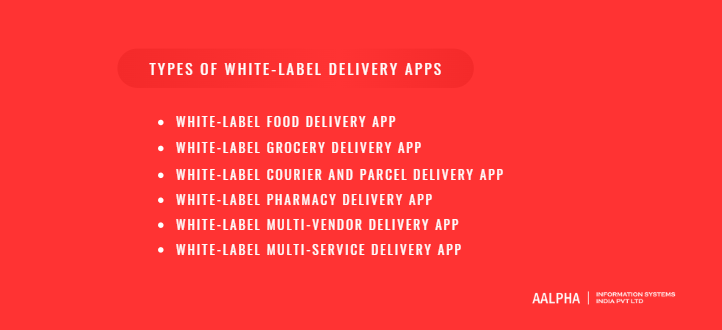
White-label delivery apps can be built for different business models depending on what the company wants to deliver, who the users are, and how the operations are managed. Some businesses need a single-category app, such as food delivery or grocery delivery. Others need a multi-vendor marketplace where several restaurants, stores, or sellers can list their products. Larger startups and local logistics companies may prefer a multi-service delivery app that combines food, parcels, groceries, pharmacy, flowers, documents, and local errands in one branded platform. The right type of white-label delivery app depends on the market, delivery category, pricing model, merchant network, and operational capacity.
-
White-Label Food Delivery App
A white-label food delivery app is designed for restaurants, cloud kitchens, food delivery startups, and local restaurant marketplaces. It allows customers to browse restaurants, view menus, add items to the cart, apply offers, pay online or choose cash on delivery, and track the order until it arrives. For restaurant owners, the app usually includes a dashboard to manage menus, item availability, preparation time, pricing, photos, order status, and payout details.
Food delivery apps also need delivery assignment features. Once a restaurant accepts an order, the platform can assign a delivery partner based on distance, availability, delivery zone, or manual admin control. Ratings and reviews help customers evaluate restaurants and also help the platform monitor service quality. Commission models are another important part of this type of app. The platform owner may charge restaurants a percentage per order, a fixed monthly fee, a delivery fee, promotional listing fees, or a combination of these revenue models.
-
White-Label Grocery Delivery App
A white-label grocery delivery app is built for grocery stores, supermarket chains, local kirana networks, and online grocery startups. Unlike food delivery, grocery delivery depends heavily on product catalogs, stock visibility, substitutions, categories, weights, units, and scheduled delivery slots. Customers should be able to search products, compare options, choose quantities, select delivery timing, and receive updates if an item is unavailable.
Inventory management is a key feature in grocery delivery apps. Store owners or admins need control over product listings, stock status, pricing, discounts, delivery areas, and store operating hours. Substitution workflows are also useful because grocery orders often contain items that may go out of stock. In such cases, the customer may approve a replacement item or allow the store to suggest alternatives. For larger businesses, multi-store operations are important. A grocery chain can assign orders to the nearest branch, manage multiple store dashboards, track store-level performance, and control city-wise or zone-wise delivery operations.
-
White-Label Courier and Parcel Delivery App
A white-label courier and parcel delivery app is designed for same-city pickup and drop services, local courier companies, business delivery providers, and hyperlocal logistics startups. The customer flow is different from food or grocery delivery because the order usually starts with a pickup address, drop address, sender details, receiver details, package type, package weight, delivery instructions, and sometimes photos of the parcel.
Important features include route tracking, distance-based pricing, delivery partner assignment, proof of pickup, proof of delivery, OTP verification, digital signatures, and delivery status updates. Same-city logistics businesses can use this type of app to serve individuals, shops, offices, print stores, repair centers, small manufacturers, and local businesses that need quick parcel movement. Pricing may be based on distance, package size, weight, delivery priority, waiting time, or service zone. For courier companies, a white-label parcel delivery app creates a professional digital system for managing local deliveries instead of depending on phone calls, spreadsheets, and manual driver coordination.
-
White-Label Pharmacy Delivery App
A white-label pharmacy delivery app allows pharmacies, healthcare retailers, and medicine delivery startups to sell medicines and healthcare products through a branded digital platform. The app usually includes a medicine catalog, product search, prescription upload, order placement, payment, delivery tracking, and scheduled delivery options. Since medicines are sensitive products, pharmacy apps require stronger verification workflows than normal retail delivery apps.
For prescription medicines, the customer may need to upload a valid prescription before the order is processed. The pharmacy team can review the prescription, confirm medicine availability, suggest alternatives where allowed, and approve the order before dispatch. Compliance is an important consideration because medicine delivery rules vary by country and region. The app may need role-based access, order logs, pharmacist review, restricted product handling, secure storage of prescription files, and proper refund or cancellation workflows. Scheduled delivery is also useful for repeat medicines, monthly prescriptions, wellness products, and chronic care customers.
-
White-Label Multi-Vendor Delivery App
A white-label multi-vendor delivery app allows a business to bring multiple sellers, restaurants, stores, pharmacies, or merchants into one marketplace. Instead of serving only one store or one brand, the platform owner can onboard many vendors and allow customers to order from them through a single app. Each vendor can have a separate profile, catalog, pricing, availability, order dashboard, payout report, and performance data.
This model is useful for local food marketplaces, grocery marketplaces, pharmacy networks, flower delivery platforms, and city-level commerce apps. The admin can manage vendor approvals, commissions, settlements, service areas, featured listings, customer disputes, and overall platform rules. Multi-vendor apps require stronger backend controls because different sellers may have different operating hours, pricing, stock levels, delivery rules, and payout terms.
-
White-Label Multi-Service Delivery App
A white-label multi-service delivery app combines several delivery categories in one branded platform. A single app can support food delivery, parcel delivery, grocery delivery, pharmacy delivery, flower delivery, document delivery, laundry pickup, and local errands. This model works well for hyperlocal startups and regional logistics companies that want to become the main delivery platform for a city or region.
The biggest advantage of a multi-service delivery app is operational leverage. The same customer base, delivery partner network, tracking system, payment gateway, notification engine, and admin dashboard can support multiple revenue streams. A customer may order lunch in the afternoon, send a parcel in the evening, and schedule a grocery delivery for the next morning from the same app. For businesses targeting local markets, this model can increase order frequency, improve delivery partner utilization, and create stronger brand recall. However, it also requires careful planning because each service category has different workflows, pricing rules, merchant requirements, and support needs.
Key User Panels in a White-Label Delivery App
A white-label delivery app is not just one mobile app. It is a connected system made up of different user panels that work together to manage the full delivery cycle. A complete delivery platform usually includes a customer app, delivery partner app, merchant or store panel, admin panel, and in larger cases, a super admin panel for multi-city operations. Each panel has a specific role in the business workflow. The customer places the order, the merchant or store prepares it, the delivery partner completes the delivery, and the admin manages the entire operation from the backend. When these panels are planned properly, the business can handle orders, payments, tracking, support, commissions, refunds, and reporting through one branded system.
-
Customer App
The customer app is the main front-facing part of a white-label delivery platform. It should make ordering fast, clear, and reliable. The basic customer journey starts with registration and login using mobile number, email, OTP, social login, or password-based access. After login, customers should be able to add and manage multiple addresses such as home, office, hostel, shop, or saved locations. Accurate address management is important because delivery delays often happen due to unclear pickup or drop details.
For food, grocery, pharmacy, or multi-vendor platforms, the customer app should allow product browsing, category search, filters, product details, merchant profiles, cart management, and order placement. For courier or parcel delivery apps, the flow should include pickup address, drop address, sender and receiver details, package type, delivery instructions, and pricing estimate. Coupons and promotional offers help increase first-time orders and repeat usage. Payment options may include cards, UPI, wallets, net banking, cash on delivery, pay at pickup, or pay at delivery depending on the market.
Live tracking is one of the most important customer features. Customers should be able to see order status updates such as accepted, preparing, assigned, picked up, on the way, and delivered. Ratings and reviews help customers share feedback about merchants, delivery partners, and the overall service. A good support section should include help topics, chat, call support, refund requests, cancellation support, and issue reporting. Order history is also essential because customers often reorder from previous purchases or need receipts for reference.
-
Delivery Partner App
The delivery partner app helps drivers or riders manage assigned orders and complete deliveries efficiently. The process usually starts with onboarding and KYC. Delivery partners may need to upload documents such as ID proof, driving license, vehicle registration, insurance, profile photo, and bank details. Admin approval can be required before they start accepting orders.
Once approved, delivery partners should have an availability toggle to mark themselves online or offline. When an order is assigned, the delivery partner receives an alert with pickup location, drop location, order type, estimated distance, payment mode, and expected earnings. The app should allow order acceptance or rejection based on the business rules. Navigation integration helps the delivery partner reach pickup and drop locations without switching between multiple apps.
Pickup confirmation is important for operational accuracy. The app may use OTP, QR code, photo proof, or manual confirmation to record that the order has been collected. Proof of delivery can include customer OTP, digital signature, photo upload, or delivery note. For earnings, the delivery partner should be able to view completed orders, incentives, deductions, cash collected, pending payouts, wallet balance, and payout history. A support section is also needed so delivery partners can report customer unavailability, merchant delays, vehicle issues, wrong addresses, payment disputes, or app-related problems.
-
Merchant or Store Panel
The merchant or store panel is used by restaurants, grocery stores, pharmacies, retail shops, cloud kitchens, and sellers to manage their part of the delivery workflow. In a food delivery app, this panel allows restaurants to accept or reject orders, update preparation time, manage menus, add item photos, change prices, mark items as unavailable, and update store status. In grocery or pharmacy apps, it helps manage product catalogs, stock status, substitutions, pricing, order packing, and delivery readiness.
Business hours are another important feature. Merchants should be able to set opening hours, closing hours, holiday schedules, temporary pauses, and delivery availability. Payout visibility builds trust between the platform and merchants. The panel should show order value, commission deductions, taxes where applicable, settlement amounts, payout dates, and transaction history.
Reports help merchants understand performance. Useful reports include daily orders, cancelled orders, best-selling items, customer ratings, revenue, repeat customers, and peak order times. Customer communication features can also be added, such as order notes, delay updates, item replacement requests, and support messages. A strong merchant panel reduces admin workload because merchants can manage daily operations independently.
-
Admin Panel
The admin panel is the control center of a white-label delivery app. It gives the platform owner full visibility and control over users, merchants, delivery partners, orders, payments, pricing, and support. Admins should be able to create, verify, suspend, or manage customers, merchants, stores, and delivery partners. They should also be able to monitor live orders, manually assign delivery partners, update order statuses, handle cancellations, and resolve delivery issues.
Pricing and commission controls are critical. The admin panel should support delivery fees, distance-based pricing, zone-based pricing, surge charges, merchant commissions, tax settings, minimum order values, coupon rules, and payout logic. Refund management should also be included because failed payments, cancelled orders, wrong items, and delayed deliveries are common in delivery operations.
The admin panel should include zones and service area management. This allows the business to define where orders can be placed, which merchants serve which locations, and how delivery charges change by area. Notification tools help admins send push notifications, SMS, email, or WhatsApp updates to customers, delivery partners, and merchants. Reports should cover revenue, orders, commissions, delivery performance, customer activity, merchant performance, refunds, and disputes. Dispute handling tools help the admin resolve issues between customers, merchants, and delivery partners with clear records.
-
Super Admin Panel for Multi-City Operations
For larger delivery businesses, a standard admin panel may not be enough. Multi-city and franchise-based platforms often need a super admin panel that provides higher-level control across locations, branches, city teams, and business units. The super admin can create city-level admins, assign permissions, manage franchise accounts, compare city performance, and control platform-wide settings.
City-wise controls are useful when each market has different pricing, delivery zones, partner payouts, taxes, operating hours, merchant commissions, and promotional campaigns. Role-based access helps limit what each team member can see or change. For example, a city manager may manage local orders and delivery partners, while the finance team can access payouts and settlements, and the support team can handle disputes.
A super admin panel should also include business analytics across cities, merchants, delivery partners, customers, revenue, order volume, delivery time, cancellations, and repeat usage. This helps the business identify strong markets, weak zones, high-performing merchants, and operational bottlenecks. For companies planning to scale beyond one city, the super admin panel becomes essential for maintaining control, consistency, and accountability across the full delivery network.
Must-Have Features of a White-Label Delivery App
A white-label delivery app should include all the core features needed to manage customers, delivery partners, merchants, payments, orders, tracking, support, and business operations. The exact feature list depends on the delivery model, but most successful platforms need a strong customer app, delivery partner app, merchant panel, and admin dashboard. The goal is not only to accept online orders but also to manage the full delivery journey from registration to order completion, refund handling, payout reporting, and performance analysis. A well-planned feature set helps the business launch faster, reduce manual coordination, improve customer trust, and support growth across more locations or service categories.
-
Customer Features
The customer app is where demand is created, so the experience must be simple, fast, and reliable. Signup and login should support mobile number, OTP, email, social login, or password-based access depending on the target market. For delivery businesses, address selection is one of the most important features. Customers should be able to add multiple saved addresses, select location on a map, use GPS, enter house or building details, and update delivery instructions. Accurate address handling reduces failed deliveries and support calls.
For food, grocery, pharmacy, flower, or multi-vendor apps, customers need search, filters, categories, store listings, product details, and merchant profiles. Search should help users quickly find restaurants, products, medicines, grocery items, or service categories. Filters can include distance, rating, price, delivery time, availability, cuisine, product type, discount, or store status. The cart should allow customers to add items, update quantities, remove products, view taxes and delivery charges, and review the final order value before payment.
Promo codes and coupons are useful for customer acquisition and repeat purchases. The app should support first-order discounts, category-based coupons, merchant-specific offers, free delivery offers, cashback, and minimum order value rules. Payment options should match local customer behavior. Depending on the market, the platform may include cards, UPI, wallets, net banking, cash on delivery, pay at pickup, pay at delivery, or internal wallet balance.
Real-time order tracking is essential in any delivery app. Customers should see order status updates such as order placed, accepted, preparing, packed, delivery partner assigned, picked up, on the way, and delivered. For parcel delivery, tracking may include pickup completed, in transit, reached drop location, and delivered. Cancellation and refund request features should be clear because customers expect quick action when orders are delayed, unavailable, incorrectly placed, or paid but not fulfilled. Ratings and reviews help collect feedback on merchants, products, delivery partners, and the overall service. A help center should include support tickets, FAQs, chat, call support, refund support, order issue reporting, and order history for easy reference.
-
Delivery Partner Features
The delivery partner app is built for speed, accuracy, and accountability. It should begin with profile creation and document upload. Delivery partners may need to submit ID proof, driving license, vehicle registration, insurance, tax details, bank account details, and profile photo. KYC approval helps the platform verify who is allowed to handle customer orders and payments.
Once approved, delivery partners should have an online or offline status toggle. This allows them to control availability and helps the dispatch system assign orders only to active partners. Order alerts should show important information such as pickup location, drop location, merchant name, order type, distance, estimated earnings, payment mode, and special instructions. The app should allow partners to accept or reject orders based on platform rules. Some businesses may allow unlimited rejections, while others may track acceptance rate to improve reliability.
Route map and navigation features help delivery partners move efficiently between pickup and drop locations. Integration with map services allows them to open turn-by-turn navigation without confusion. OTP verification is commonly used to confirm pickup or delivery. For example, a restaurant may share pickup OTP, or a customer may share delivery OTP. Proof of pickup and proof of delivery can include photo upload, digital signature, customer OTP, QR scan, or delivery notes.
Earnings visibility is important for partner trust. The app should show completed orders, base earnings, incentives, tips, deductions, cash collected, online payment orders, wallet balance, settlement amount, and payout history. Incentive features can be used to reward peak-hour availability, high acceptance rates, weekend work, high ratings, or city-specific campaigns. A support section is also necessary so delivery partners can report address issues, customer not reachable, merchant delay, vehicle breakdown, payment dispute, wrong package, or app problems.
-
Merchant Features
The merchant panel is used by restaurants, stores, pharmacies, grocery sellers, cloud kitchens, and local vendors to manage daily orders. A store profile should include business name, logo, address, contact details, photos, business category, delivery availability, tax information, and bank details. For food delivery, the merchant panel should include menu management. For grocery, pharmacy, or retail delivery, it should include product management. Merchants should be able to add products, update descriptions, upload images, set prices, create categories, and change stock availability.
Order acceptance is a core merchant feature. When a customer places an order, the merchant should be able to accept, reject, or modify the order based on availability. Item availability is especially important in food, grocery, and pharmacy delivery because products may go out of stock during the day. Merchants should be able to mark items as unavailable, pause the store temporarily, or update preparation time during rush hours.
Preparation time helps customers and delivery partners understand when the order will be ready. For restaurants, this can reduce waiting time at pickup. For grocery and pharmacy orders, preparation time may depend on packing, prescription verification, or stock confirmation. Merchants should also have access to order history, payout reports, offers, and store analytics. Payout reports should show order amount, platform commission, taxes, deductions, settlement amount, and payment date. Store analytics can include order volume, best-selling products, cancelled orders, ratings, repeat customers, revenue, and peak business hours.
-
Admin Features
The admin panel is the operational backbone of a white-label delivery platform. It should provide a dashboard showing total orders, active orders, completed orders, cancelled orders, revenue, refunds, delivery partners, merchants, customer activity, and pending support issues. Order control features allow the admin to monitor live orders, update order status, manually assign delivery partners, cancel problematic orders, and intervene when there is a delay.
Manual assignment and automatic assignment are both important. Automatic assignment can allocate orders based on distance, availability, service zone, acceptance history, or delivery partner status. Manual assignment gives admins control when the automatic system fails, demand is high, or a special order needs attention. Pricing rules should support flat delivery fees, distance-based pricing, zone-based pricing, surge charges, minimum order values, taxes, and packaging fees. Commission rules should allow different rates for merchants, categories, cities, or order types.
Coupon management helps the business create promotional campaigns. Admins should be able to create, edit, pause, and track coupons based on customer type, order value, merchant, category, city, or usage limits. Payment management should cover online payments, cash orders, refunds, failed payments, wallet transactions, merchant settlements, and delivery partner payouts. Notifications are also important for sending updates through push notifications, SMS, email, or WhatsApp. Reports should cover sales, delivery performance, customer retention, merchant performance, payout summaries, coupon usage, cancellation reasons, and refund trends. Support tickets help the admin track customer complaints, delivery partner issues, merchant disputes, and refund requests in one place.
-
Advanced Features
Advanced features help a white-label delivery app become more efficient as order volume increases. AI-based dispatching can assign orders based on distance, delivery partner availability, acceptance behavior, traffic, workload, merchant preparation time, and delivery priority. Route optimization helps reduce travel time, fuel cost, and late deliveries by selecting better pickup and drop routes. Wallet features can support customer wallet balance, delivery partner earnings, merchant settlements, refunds, cashback, and internal credits.
Loyalty points encourage repeat orders by rewarding customers for purchases, referrals, or membership activity. Subscription delivery can be useful for groceries, medicines, meal plans, laundry, milk delivery, and other recurring services. Scheduled delivery allows customers to choose a future delivery time instead of immediate fulfillment. Heatmaps help admins understand high-demand areas, low-supply zones, delivery delays, and partner availability. Multi-language support is important for regional markets where customers, merchants, and delivery partners prefer local languages. Multi-currency support is useful for platforms operating across countries. Business intelligence dashboards help leadership track growth, profitability, order density, cohort behavior, merchant performance, and city-wise operations with better clarity.
How White-Label Delivery App Development Works
White-label delivery app development follows a structured process where a pre-built delivery platform is customized for a specific business model, brand, market, and operational workflow. The main advantage is that the core software is already available, but it still needs proper planning, configuration, branding, backend customization, testing, and deployment before launch. A good development partner does not simply change the logo and deliver the app. They study how the business will operate, how orders will move, how payments will be collected, how delivery partners will be assigned, and how admins will control the platform from the backend.
-
Requirement Analysis
The process starts with requirement analysis. The development partner first understands the business model and delivery category. A food delivery app, grocery delivery app, pharmacy delivery app, parcel delivery app, and multi-service delivery app all have different workflows. For example, food delivery needs restaurant menus, preparation time, item availability, ratings, and restaurant commissions. Grocery delivery needs product catalog, stock handling, substitutions, scheduled delivery, and store-wise inventory. Parcel delivery needs pickup and drop addresses, sender and receiver details, package type, distance-based pricing, route tracking, and proof of delivery.
The team also studies user roles. Most delivery platforms need customers, delivery partners, merchants, admins, and sometimes super admins. Each role requires different access, screens, permissions, and workflows. Service area planning is also important because delivery availability, pricing, merchant visibility, and partner assignment may depend on zones, cities, distance limits, or service radius. The development partner also reviews pricing rules, commission logic, delivery charges, taxes, payout cycles, cancellation rules, refund workflows, and required third-party integrations such as maps, payment gateways, SMS, WhatsApp, email, analytics, and customer support tools.
-
Branding and UI Customization
After the requirements are clear, the next step is branding and UI customization. Since the purpose of a white-label app is to make the platform appear as the client’s own product, the user interface must match the company’s brand identity. This includes logo placement, color palette, app icon, typography, button styles, illustrations, banners, loading screens, splash screen, onboarding screens, and app store screenshots.
A strong branded experience is more than changing colors. The app should feel consistent across the customer app, delivery partner app, merchant panel, admin dashboard, website, notifications, emails, and app store assets. For example, a premium grocery brand may need a clean and trust-focused interface, while a hyperlocal food delivery startup may want a bold, fast, and offer-led interface. The design should make ordering simple while reinforcing the brand at every important touchpoint.
-
Feature Configuration
Feature configuration is where the white-label platform is adapted to the selected business model. Most white-label delivery platforms come with multiple modules, but every business does not need every feature on day one. The development partner enables or disables features based on the use case.
For a food delivery platform, modules such as restaurant listing, menu management, preparation time, restaurant dashboard, coupons, delivery assignment, ratings, and commissions may be enabled. For a parcel delivery app, catalog and menu features may be disabled, while pickup and drop flow, package details, distance-based pricing, proof of pickup, proof of delivery, and receiver information are enabled. For a pharmacy app, prescription upload, medicine catalog, pharmacist verification, and scheduled delivery may be configured. This step keeps the app focused, avoids unnecessary complexity, and helps the business launch with the most relevant features.
-
Backend Customization
Backend customization is one of the most important stages in white-label delivery app development. The backend controls how the platform actually operates. Admin workflows need to be configured so the business can manage customers, merchants, delivery partners, orders, payments, refunds, zones, notifications, reports, and disputes from one dashboard.
Pricing logic may include flat delivery charges, distance-based pricing, zone-based pricing, surge pricing, minimum order value, packaging charges, small order fees, taxes, and discounts. Order assignment rules may be manual, automatic, nearest-driver based, zone-based, batch-based, or priority-based. Merchant rules may include commission percentage, payout cycle, store availability, business hours, item availability, and cancellation penalties. The backend also needs accurate payout logic for merchants and delivery partners, including commissions, incentives, deductions, cash collection, online payments, refunds, and settlement reports.
-
Testing and Launch
Before launch, the complete platform should go through detailed testing. QA testing checks whether every screen, button, user role, order flow, status update, and admin action works correctly. Payment testing verifies online payments, failed payments, refunds, cash orders, wallet transactions, and settlement records. Order flow testing checks the full journey from customer order placement to merchant acceptance, delivery partner assignment, pickup, tracking, and delivery completion.
GPS testing is critical because delivery apps depend on accurate location, distance calculation, route tracking, map markers, and address selection. Notification testing confirms that customers, merchants, delivery partners, and admins receive the right push notifications, SMS, WhatsApp messages, or emails at the right stage. Once the app is stable, the team prepares app store assets, submits Android and iOS apps for review, deploys the backend to production, configures hosting, connects the domain, sets up monitoring, and launches the platform for real users. After launch, the app should be monitored closely so bugs, payment issues, delivery delays, and user feedback can be handled quickly.
Technology Stack for White-Label Delivery App Development
The technology stack used for white-label delivery app development directly affects app performance, scalability, security, customization, and long-term maintenance. A delivery platform is not a simple mobile app. It needs real-time communication between customers, merchants, delivery partners, admins, payment gateways, maps, notifications, and backend systems. The right technology choices help the platform handle live order tracking, frequent status updates, high traffic during peak hours, payment processing, location data, merchant catalogs, and reporting without performance issues. The best stack depends on the business model, expected order volume, budget, development timeline, integrations, and future expansion plans.
-
Mobile App Technologies
The mobile app layer usually includes a customer app and a delivery partner app. Some businesses may also require a merchant app in addition to a web-based merchant panel. Native Android development is commonly done using Kotlin or Java. It is useful when the business wants strong Android performance, deep device-level access, accurate location tracking, background services, push notifications, and optimized app behavior for Android users. Native iOS development is usually done using Swift. It is useful for businesses that want a polished iPhone experience, strong app performance, and better use of Apple ecosystem features.
Flutter is a popular option for white-label delivery apps because it allows a single codebase for Android and iOS. This can reduce development time and cost while still offering good performance and a consistent user interface. Flutter is especially useful when the business wants to launch both platforms quickly and maintain one shared app codebase. React Native is another cross-platform option. It is suitable for businesses that prefer JavaScript-based development and want faster iteration across Android and iOS. Both Flutter and React Native can support maps, payment gateways, push notifications, live tracking, and delivery workflows when implemented properly.
-
Backend Technologies
The backend is the core engine of a white-label delivery platform. It manages users, orders, merchants, delivery partners, pricing, payments, notifications, tracking, reports, commissions, and admin controls. Node.js is widely used for delivery apps because it handles real-time and event-driven workloads well. It can support order status updates, tracking events, notification triggers, and high-frequency API requests. Laravel, built on PHP, is a good option for admin-heavy platforms where development speed, structured backend logic, and cost-effective development are important.
Python can be used when the platform needs analytics, AI-based dispatching, demand prediction, automation, or data processing. Java and .NET are strong choices for enterprise-grade platforms that need strict architecture, high reliability, complex integrations, and long-term scalability. Regardless of the language, the backend should be built around scalable API architecture. REST APIs or GraphQL APIs can connect mobile apps, web panels, admin dashboards, payment gateways, maps, and third-party systems. The architecture should support authentication, role-based access, rate limiting, logs, error handling, secure data exchange, and future integrations.
-
Database Options
A white-label delivery app needs a reliable database structure because it stores customer profiles, addresses, merchants, products, orders, payments, delivery partners, commissions, coupons, tracking data, and reports. PostgreSQL is a strong option for platforms that need structured data, complex queries, relational integrity, and scalable reporting. It works well for order management, merchant data, payments, and analytics-heavy systems. MySQL is also widely used and is suitable for many delivery platforms because it is stable, cost-effective, and familiar to many development teams.
MongoDB can be useful when the platform has flexible data models, dynamic product catalogs, variable merchant data, or rapidly changing document-style records. It is often used when speed of development and flexible schema design are important. Redis is not usually used as the main database but is highly valuable for caching, session management, temporary order states, live location updates, queues, and high-speed data access. For example, Redis can help reduce server load by caching frequently accessed restaurant lists, delivery zones, user sessions, or active order data.
-
Maps and Location Services
Maps and location services are essential for most delivery apps. Google Maps is widely used for address autocomplete, geocoding, route display, distance calculation, and live tracking. Mapbox is another strong option, especially for businesses that want more map customization or different pricing flexibility. A delivery platform should support accurate pickup and drop address selection, map-based location pinning, route tracking, estimated distance, and estimated delivery time.
Distance calculation is important because delivery pricing, partner assignment, and ETA often depend on it. Route tracking allows customers and admins to see where the delivery partner is after pickup. Geofencing helps define service areas, delivery zones, merchant coverage, restricted areas, and city-wise operations. Address autocomplete improves user experience by helping customers enter accurate addresses faster. For courier and parcel delivery apps, location accuracy is especially important because the sender and receiver may both be non-merchant users.
-
Payment Gateway Integrations
Payment gateway integration depends heavily on the target market. Stripe and PayPal are commonly used for global markets, especially in the US, UK, Europe, and other international regions. Razorpay, Cashfree, and Paytm are popular choices in India for cards, UPI, wallets, and net banking. Some regions may require local payment gateways, bank transfer options, mobile money, cash payment support, or pay-at-delivery workflows.
A delivery platform should support multiple payment flows where required. These may include online payment before order confirmation, cash on delivery, wallet payment, partial wallet plus online payment, refund to source, refund to wallet, merchant settlement, delivery partner payout, and payment reconciliation. Payment systems should be tested carefully because failed payments, duplicate charges, delayed refunds, and settlement errors can damage customer trust.
-
Cloud and DevOps
Cloud infrastructure is important for reliability and growth. AWS, Google Cloud, and Azure are common choices for hosting white-label delivery platforms. Cloud services can handle backend servers, databases, file storage, push notification services, monitoring, backups, and scaling. Docker helps package applications consistently across development, staging, and production environments. CI/CD pipelines help development teams release updates faster and with fewer manual errors.
Monitoring is essential because delivery platforms operate in real time. The team should track server health, API errors, payment failures, database performance, app crashes, and order flow issues. Backups protect important business data such as users, orders, payments, merchant records, and reports. A CDN can improve the loading speed of images, product photos, banners, and static content. Load balancing helps distribute traffic across servers during peak demand. For growing delivery businesses, strong DevOps practices reduce downtime, improve performance, and make it easier to scale from one city or service category to many.
Cost to Develop a White-Label Delivery App
The cost to develop a white-label delivery app depends on the business model, feature set, number of user panels, customization level, integrations, hosting requirements, and long-term support needs. A basic white-label delivery app can be launched with a ready customer app, driver app, admin panel, payment gateway, push notifications, and standard order flow. A more advanced platform may require merchant panels, multi-vendor workflows, wallet, reports, multi-city controls, AI-based dispatching, custom APIs, route optimization, and scalable infrastructure. Because of these variations, the final cost is not fixed for every business. It should be estimated after understanding the delivery category, operational workflow, launch market, and expected growth.
-
Basic White-Label Delivery App Cost
A basic white-label delivery app usually includes the essential features required to start operations under a branded identity. This may include a customer app, delivery partner app, admin panel, standard order placement flow, payment gateway integration, order status updates, push notifications, and basic reporting. The customer app allows users to register, add addresses, place orders, make payments, track orders, and view order history. The driver app allows delivery partners to receive orders, accept or reject tasks, navigate to pickup and drop locations, update order status, and complete deliveries. The admin panel gives the business control over customers, orders, delivery partners, pricing, payments, and basic support operations.
This type of solution is suitable for startups, restaurants, single-city courier businesses, small grocery operators, cloud kitchens, and local delivery companies that want to launch quickly. Since the core modules are already built, the cost is usually lower than fully custom development. The main cost components include branding, UI changes, app configuration, payment setup, map integration, testing, deployment, app store submission, and basic post-launch support. A basic white-label delivery app may be enough when the business has a simple order flow, limited service area, and does not need complex merchant, wallet, or multi-city operations at the first stage.
-
Mid-Level White-Label Delivery App Cost
A mid-level white-label delivery app includes more operational depth and customization. In addition to the customer app, driver app, and admin panel, it may include a merchant or store panel where restaurants, grocery stores, pharmacies, or sellers can manage orders independently. This reduces admin workload because merchants can accept orders, update item availability, manage menus or products, set preparation time, view order history, and check payout reports.
Mid-level platforms may also include wallet functionality, multiple payment modes, coupon management, scheduled delivery, advanced reports, custom notifications, and multi-zone operations. For example, a grocery platform may need scheduled delivery slots and item substitutions. A food delivery platform may need restaurant-wise commission rules, preparation time, and offer management. A parcel delivery platform may need distance-based pricing, pickup and drop workflows, and proof of delivery. Multi-zone operations allow businesses to define different service areas, delivery fees, partner assignment rules, and merchant availability based on location.
The cost increases at this stage because the platform needs more configuration, more user roles, more backend logic, and more testing. Custom workflows also add development effort. For example, refund logic, merchant settlement, wallet usage, delivery partner incentives, and coupon restrictions need to be carefully implemented and tested. A mid-level white-label app is suitable for businesses that are ready to manage multiple merchants, categories, zones, or delivery workflows but still want to avoid the time and cost of a fully custom platform.
-
Advanced White-Label Delivery App Cost
An advanced white-label delivery app is built for businesses that need high scalability, multiple business models, multi-city expansion, or marketplace-level operations. This type of platform may include a multi-vendor marketplace, multi-city support, super admin panel, city-wise admin roles, franchise controls, AI-based dispatching, advanced analytics, route optimization, subscription plans, loyalty programs, custom APIs, and high-scale cloud infrastructure.
Multi-vendor marketplace features allow several restaurants, stores, pharmacies, florists, grocery sellers, or local merchants to operate inside one platform. Multi-city support adds city-wise pricing, zones, commissions, delivery partner management, local promotions, and reporting. AI-based dispatching can help assign orders based on distance, delivery partner availability, acceptance rate, traffic, workload, and order priority. Route optimization can reduce delivery time and improve delivery partner productivity, especially when handling multiple orders or high-volume zones.
Advanced analytics and business intelligence dashboards add another cost layer because they require structured data, reporting pipelines, visual dashboards, and performance metrics. Subscription plans may include customer memberships, merchant plans, or recurring delivery services. Custom APIs are needed when the platform connects with POS systems, ERP software, CRM tools, accounting systems, warehouse systems, external logistics partners, or third-party marketplaces. High-scale infrastructure may require load balancing, caching, queue systems, CDN, database optimization, automated backups, monitoring, and DevOps support. These features make the platform more powerful, but they also increase planning, development, testing, and maintenance cost.
-
Factors That Affect Cost
Several factors influence the cost of white-label delivery app development. The number of apps is one of the biggest factors. A platform with only a customer app and admin panel will cost less than a platform with customer app, driver app, merchant app, merchant web panel, admin panel, and super admin panel. Feature complexity also matters. Basic order placement is simpler than scheduled delivery, wallet payments, multi-vendor commissions, route optimization, or AI-based dispatching.
Technology stack affects cost as well. Native Android and iOS apps may cost more than a cross-platform app built with Flutter or React Native, but native development may be preferred for performance-heavy use cases. Backend customization, UI design, third-party integrations, payment gateway setup, map services, SMS, WhatsApp, email, analytics, and support tool integrations can also affect the budget.
Admin complexity is another major cost driver. A simple admin panel may only manage users, orders, and payments. A more advanced admin system may manage zones, commissions, refunds, disputes, merchant settlements, delivery partner incentives, franchise permissions, tax settings, notifications, and reports. Delivery logic also affects cost because automatic assignment, distance-based pricing, batch assignment, surge pricing, and multi-stop delivery require more backend work. Compliance needs, especially in pharmacy, alcohol delivery where legally allowed, healthcare, or regulated markets, can increase documentation, verification, audit logs, and security requirements. Testing and support should also be included because delivery platforms need careful QA before launch and regular maintenance after launch.
-
White-Label vs Custom Development Cost
White-label development is usually cheaper and faster when the business needs standard delivery features with moderate customization. It is a strong choice for startups, local delivery companies, restaurants, grocery chains, pharmacies, and courier businesses that want to launch a branded app without building every module from scratch. It reduces early investment, shortens development time, and allows businesses to test the market faster.
Custom development may be better when the business has a very unique model, complex operational logic, strict compliance needs, unusual integrations, or long-term product ownership requirements that cannot be handled by a standard white-label platform. A fully custom platform costs more and takes longer, but it gives deeper control over architecture, features, user experience, scalability, and future product direction.
For many businesses, the practical approach is to begin with a white-label delivery app, validate the market, improve operations, and then invest in deeper customization as order volume grows. This keeps initial cost under control while still giving the business a branded and functional delivery platform from the beginning.
Benefits of White-Label Delivery App Development
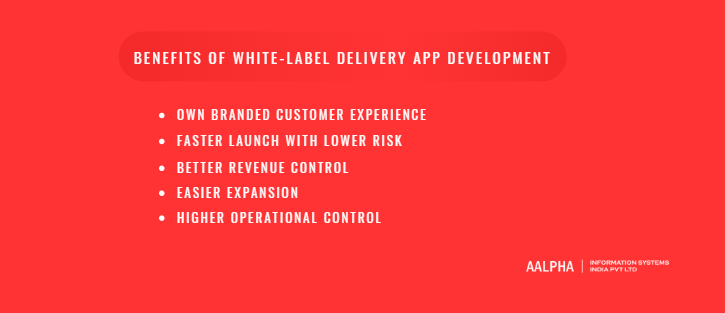
White-label delivery app development gives businesses a practical way to launch, manage, and grow a branded delivery platform without building every technical component from the beginning. It is especially useful for startups, restaurants, grocery businesses, pharmacies, courier companies, local logistics providers, and multi-service delivery platforms that need speed, cost control, and operational flexibility. The main benefit is not only faster app development. A good white-label platform also gives the business more control over branding, revenue, customer data, delivery workflows, merchant relationships, and future expansion.
-
Own Branded Customer Experience
One of the strongest benefits of a white-label delivery app is that the business can own the customer experience. Instead of sending customers to a third-party marketplace, the company can bring them into its own branded app or website. This matters because third-party platforms often control how products are displayed, how promotions are shown, how customer communication happens, and how repeat purchases are encouraged. The business may appear as one listing among many competitors, which makes it harder to build loyalty.
With a white-label delivery app, the customer sees the company’s own name, logo, colors, app icon, offers, notifications, support flow, and order experience. A restaurant can build direct ordering through its own app. A grocery chain can create a local digital shopping channel. A courier company can offer a professional pickup and delivery experience under its own brand. A pharmacy can serve repeat customers through a trusted branded platform. This direct relationship improves brand recall and gives the business more control over customer engagement, communication, and retention.
-
Faster Launch With Lower Risk
Building a delivery platform from scratch involves several technical risks. The business has to build customer apps, delivery partner apps, admin dashboards, order management, payments, notifications, maps, tracking, reports, and support workflows. Each module has to be designed, developed, tested, fixed, and connected with the rest of the system. This can take months and may still lead to delays if the architecture or user flows are not planned correctly.
White-label delivery app development reduces this risk because the core modules are already available and tested. The development team can start with a working foundation and then customize it for the business. Features such as registration, order placement, driver assignment, payment processing, push notifications, live tracking, ratings, and admin control are already part of the base platform. This reduces technical uncertainty and helps the business launch faster. It also allows the company to test demand, onboard merchants, build a delivery network, and collect real user feedback before making larger technology investments.
-
Better Revenue Control
White-label delivery apps also give businesses stronger control over revenue models. On third-party marketplaces, businesses may have to follow platform-defined commission rates, discount rules, visibility rules, and payment cycles. With their own delivery platform, they can decide how revenue is generated and how pricing is structured.
The platform owner can charge commissions per order from restaurants, grocery stores, pharmacies, or other merchants. Delivery fees can be flat, distance-based, zone-based, surge-based, or category-specific. Businesses can add subscription plans for customers, such as free delivery memberships or priority delivery benefits. They can also create merchant subscription plans where sellers pay a monthly fee for access to the platform. In-app advertising can become another revenue stream through banner ads, promoted products, featured stores, sponsored listings, or tracking-screen placements.
Priority listings can help merchants gain more visibility while giving the platform an additional monetization option. Surge pricing can be used during peak hours, bad weather, high-demand periods, or low partner availability. By controlling commissions, delivery charges, subscriptions, ads, priority listings, surge pricing, and merchant plans, the business can create a revenue model that matches its market instead of depending entirely on external platforms.
-
Easier Expansion
A white-label delivery app can make expansion easier when the platform is built with scalable architecture and flexible modules. A business may start in one location with one service category, such as food delivery or parcel delivery, and later add more locations, merchants, delivery partners, or categories. For example, a local delivery startup may launch food delivery first, then add grocery, pharmacy, flowers, documents, laundry pickup, or same-city parcel delivery.
Location expansion becomes easier when the admin system supports zones, city-wise controls, merchant onboarding, delivery partner management, pricing rules, and service availability. The business can define different delivery fees, commissions, operating hours, and partner payouts for each area. Category expansion is also easier when modules can be enabled as the business grows. Instead of rebuilding the platform every time a new service is added, the company can extend the existing system with new workflows and settings.
-
Higher Operational Control
Operational control is one of the biggest long-term advantages of owning a white-label delivery platform. The business can decide how orders are assigned, how refunds are handled, how ratings are reviewed, how support tickets are managed, and how delivery partners are rewarded. Dispatching can be manual, automatic, nearest-partner based, zone-based, or priority-based depending on the operational model. Admins can monitor live orders, intervene in delayed deliveries, reassign partners, and update order statuses when needed.
Refund control is also important because cancelled orders, failed payments, unavailable items, wrong products, and delivery delays are common in delivery businesses. A proper admin panel helps manage refunds with clear records and approval workflows. Ratings and reviews help the business track merchant quality, delivery partner behavior, customer satisfaction, and repeated complaints. Customer support tools allow teams to resolve disputes faster and keep order communication in one place.
Delivery partner incentives can be configured for peak hours, high ratings, weekend work, high acceptance rates, or city-specific campaigns. Partner management features help admins onboard, verify, approve, suspend, track, and pay delivery partners. This level of control helps the business improve service quality, reduce manual errors, and manage growth with more discipline.
In short, white-label delivery app development helps businesses own their brand, launch faster, control revenue, expand more easily, and manage operations from one platform. For companies entering competitive delivery markets, these benefits can make the difference between depending on external platforms and building a delivery business with direct customer ownership.
Challenges in White-Label Delivery App Development
White-label delivery app development can reduce launch time and development cost, but it is not risk-free. The quality of the final product depends heavily on the strength of the base platform, the flexibility of the code, the experience of the development partner, and the level of customization required by the business. A poorly planned white-label solution can create problems after launch, especially when the business starts handling more orders, more merchants, more delivery partners, and more service areas. Before choosing a white-label delivery app, businesses should evaluate flexibility, scalability, user experience, integrations, ownership terms, and long-term support.
-
Limited Flexibility in Poorly Built Solutions
Not all white-label platforms are equally customizable. Some solutions allow only basic branding changes such as logo, color, app name, and splash screen. That may be enough for a small business with a simple order flow, but it becomes a limitation when the company needs custom pricing, unique delivery rules, merchant-specific commissions, wallet logic, subscription plans, or different workflows for food, grocery, pharmacy, and parcel delivery.
A poorly built white-label app may also have rigid code, outdated architecture, limited admin settings, and hardcoded business logic. This makes future changes expensive or sometimes impossible without major redevelopment. Businesses should ask whether the platform can support custom workflows, new modules, third-party integrations, role-based access, multi-city controls, and source-level changes before signing an agreement.
-
Scalability Problems
Scalability is another major challenge. A delivery app may work well during early testing but struggle when order volume increases. Delivery platforms process frequent status updates, GPS data, payment events, push notifications, merchant updates, customer activity, and admin actions. If the backend is not built for load, the app may become slow during peak hours, orders may get delayed, and delivery tracking may stop updating correctly.
Scalability problems become more serious when the business expands to multiple cities or service categories. A platform must be able to handle large product catalogs, multiple merchants, many active delivery partners, heavy tracking data, city-wise pricing, zone-based dispatching, and real-time order monitoring. Without proper database design, caching, queue systems, load balancing, and server monitoring, growth can expose serious technical weaknesses.
-
Poor User Experience
A white-label app should not feel generic or difficult to use. Poor user experience can reduce customer adoption even if the business has good delivery operations. Common problems include slow loading screens, confusing order flows, weak search, unclear pricing, poor address selection, delayed tracking updates, unattractive design, and too many unnecessary steps before checkout.
Delivery partner experience is equally important. If drivers cannot clearly see order details, pickup addresses, drop locations, payment mode, navigation, or proof of delivery steps, order completion becomes slower. Merchants also need a simple dashboard to accept orders, update item availability, manage preparation time, and view payouts. A good white-label platform should be easy to use for every role, not only for customers.
-
Integration Limitations
Most delivery businesses need third-party integrations. Payment gateways, POS systems, ERP software, CRM tools, WhatsApp, SMS, email, accounting platforms, analytics tools, and customer support systems may all be required depending on the market and business model. Integration limitations can become a serious issue if the white-label platform has closed architecture or weak API support.
For example, a restaurant chain may want POS integration to sync menu items and orders. A grocery company may need ERP integration for inventory and billing. A courier company may need accounting software integration for invoices and settlements. A pharmacy may need SMS, WhatsApp, prescription upload, and secure document storage. If the app cannot connect with these systems, the business may need manual workarounds, which increases operational errors and support workload.
-
Vendor Lock-In
Vendor lock-in is one of the most important risks in white-label delivery app development. Businesses should clearly understand who owns the source code, where the app is hosted, who controls the database, whether data can be exported, and what happens if they want to move to another provider later. Some vendors offer only a hosted license, while others provide source code ownership or dedicated deployment. These terms can make a major difference in long-term control.
Hosting control also matters. If the vendor controls the servers, the business may depend on them for uptime, scaling, backups, security, and emergency fixes. Data export is equally important because customer records, merchant data, order history, payments, and reports are valuable business assets. Maintenance terms should also be reviewed carefully, including bug fixes, app store updates, security patches, feature changes, response times, and ongoing support cost. A strong white-label delivery app should give the business enough control to grow without being trapped by unclear ownership or restrictive vendor terms.
How to Choose the Right White-Label Delivery App Development Company
Choosing the right white-label delivery app development company is one of the most important decisions in the project. A delivery platform is not only a mobile app with order placement. It is a real-time operational system that connects customers, merchants, delivery partners, payments, maps, notifications, support teams, and admins. If the development company does not understand delivery operations deeply, the platform may look good during demos but fail when real orders, live tracking, driver availability, refunds, payouts, and customer complaints start coming in. The right partner should understand both technology and delivery business workflows.
-
Check Delivery App Experience
The first thing to check is whether the company has real experience in building delivery apps or similar logistics platforms. Delivery apps need more than standard mobile app development skills. The company should understand real-time tracking, order assignment, delivery partner flows, merchant operations, customer order journeys, payment handling, and admin control. For example, a food delivery app needs restaurant acceptance, preparation time, item availability, delivery assignment, and ratings. A parcel delivery app needs pickup and drop details, route tracking, sender and receiver information, distance-based pricing, and proof of delivery. A grocery app needs product catalogs, inventory updates, substitutions, and scheduled delivery.
A company with delivery app experience will know the practical problems that happen after launch. These include delivery partner not accepting orders, customers entering wrong addresses, merchants delaying preparation, payments failing, refunds being requested, and admins needing to manually reassign orders. Experience matters because these issues must be handled in the workflow, not treated as afterthoughts.
Portfolio Example: Zumy Hyperlocal Delivery Platform
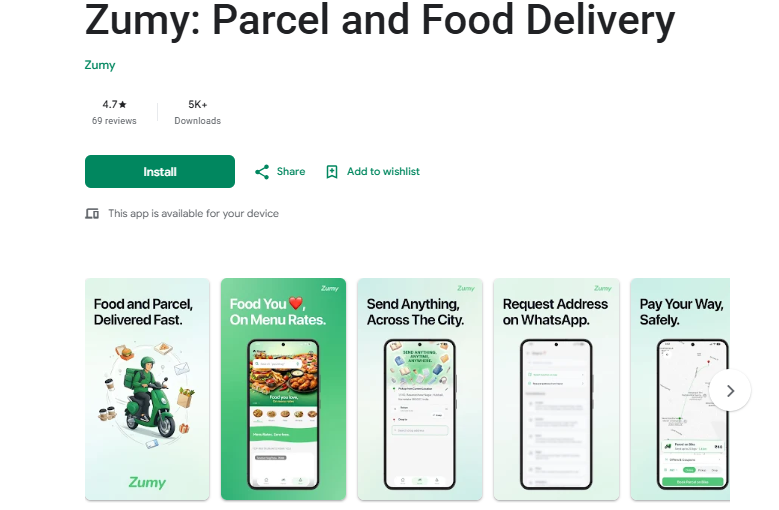
At Aalpha, we built Zumy, a hyperlocal delivery and mobility platform designed to support multiple services through one operating system. The platform includes parcel delivery, food delivery, and bike taxi workflows, making it suitable for businesses that want to manage more than one delivery or mobility category from a single branded app.
Read: Zumy Case Study
Zumy includes customer-facing apps, delivery partner workflows, real-time order tracking, payment handling, admin operations, delivery partner management, merchant-related workflows, and customer support processes. The platform is built to handle live order flows, delivery partner assignment, pickup and drop coordination, location tracking, payment status updates, refunds, notifications, and operational reporting.
This project demonstrates Aalpha’s practical experience in building real delivery software, not just basic mobile apps. It shows how a delivery platform must connect customers, merchants, delivery partners, payments, tracking, and backend operations in one system.
-
Review Customization Capabilities
White-label delivery apps should not be limited to logo and color changes. A serious development company should be able to customize the platform based on the business model. This includes branding, feature changes, workflow changes, pricing logic, payment modes, order assignment rules, merchant rules, payout logic, cancellation policies, support flows, and third-party integrations.
For example, a local courier company may need pickup and drop workflows instead of product catalogs. A pharmacy may need prescription upload and approval before dispatch. A grocery business may need substitutions and scheduled delivery. A food delivery startup may need restaurant commissions, offer management, preparation time, and delivery zone controls. The company should be able to enable, disable, or modify features based on these needs. It should also be able to integrate payment gateways, maps, SMS, WhatsApp, email, analytics, POS systems, CRM tools, accounting software, or ERP systems when required.
-
Ask About Source Code and IP Ownership
Before choosing a development partner, businesses should clearly ask about source code ownership, intellectual property rights, licensing terms, hosting access, and data ownership. Some white-label providers offer only a hosted subscription model, where the business pays monthly but does not own the code. Others provide source code access, dedicated deployment, or full IP transfer after payment. These differences matter because they affect long-term control.
If the business plans to scale, raise investment, customize heavily, or move to its own technical team later, source code rights become important. Hosting access should also be clarified. The business should know where the app is hosted, who controls the server, who can access the database, how backups are handled, and whether the data can be exported. Customer data, merchant records, delivery partner details, payment history, and order data are valuable business assets. A good development agreement should clearly define ownership, licensing, maintenance responsibilities, and exit terms.
-
Evaluate Scalability and Security
A white-label delivery app should be built to handle growth. The development company should be able to explain the cloud architecture, backend structure, database design, API security, backup process, and monitoring setup. Delivery platforms generate frequent order status updates, location tracking data, payment events, notifications, and admin actions. If the backend is weak, the app may slow down during peak hours or fail when the business expands to more cities.
Scalability requires proper server planning, database optimization, caching, queue systems, load balancing, and monitoring. Security is equally important because the app handles customer details, addresses, phone numbers, payment records, merchant information, delivery partner documents, and business reports. The platform should include secure APIs, encrypted data transfer, role-based access, strong authentication, activity logs, and controlled admin permissions. Regular backups and recovery planning are also important because order and payment data must not be lost.
-
Check Support and Maintenance
Post-launch support is critical for delivery platforms. Even after testing, real-world usage can reveal bugs, payment issues, GPS problems, notification delays, app crashes, refund errors, or order assignment problems. The development company should provide clear maintenance terms, response times, bug-fix process, app store update support, server monitoring, and upgrade options.
Delivery apps operate daily, often during fixed business hours or peak demand windows. A technical issue during lunch, dinner, festival season, or weekend demand can directly affect revenue and customer trust. Ongoing support should cover backend fixes, mobile app updates, payment gateway changes, map API updates, security patches, performance improvements, and new feature requests. Businesses should avoid vendors that disappear after deployment or charge unclear amounts for basic post-launch fixes.
-
Review Portfolio and Case Studies
A company’s portfolio and case studies help validate whether it can actually build and support a delivery platform. Businesses should review examples of previous apps, admin dashboards, driver apps, merchant panels, marketplace systems, logistics tools, or eCommerce platforms. Relevant examples are more useful than generic mobile app screenshots because delivery platforms have specific operational requirements.
Case studies can show how the company solved problems such as real-time tracking, multi-vendor management, payment reconciliation, order assignment, delivery partner payout, or multi-city expansion. Businesses should also ask for references, demo access, technology stack details, and examples of customization. A good development partner will be able to explain not only what they built but also why certain decisions were made.
The right white-label delivery app development company should offer a balance of ready-made technology, customization skill, delivery domain experience, scalable architecture, transparent ownership terms, and long-term support. Choosing carefully at the beginning can prevent costly rebuilds, operational failures, and vendor-related problems after launch.
Monetization Models for White-Label Delivery Apps
A white-label delivery app can generate revenue through multiple monetization models depending on the delivery category, market size, merchant network, customer behavior, and operational cost structure. Unlike a basic ordering system, a delivery platform gives the business control over commissions, delivery charges, subscriptions, advertising, loyalty programs, and premium services. The best app monetization strategy is usually not based on one revenue source alone. Most successful delivery platforms combine order commissions, delivery fees, merchant plans, customer memberships, and promotional placements to build a more balanced business model.
-
Commission Per Order
Commission per order is one of the most common monetization models for white-label delivery apps, especially in food delivery, grocery delivery, pharmacy delivery, and multi-vendor marketplaces. In this model, the platform charges a percentage or fixed fee on every successful order. For example, a restaurant marketplace may charge restaurants a commission on each order placed through the app. A grocery platform may charge stores a percentage based on order value. A pharmacy delivery marketplace may charge partner pharmacies a commission after the order is verified and fulfilled, subject to local rules and compliance requirements.
Marketplace commission models can vary by merchant type, category, city, order volume, or promotional agreement. High-volume merchants may negotiate lower commissions, while premium placement or marketing support may come with higher platform fees. The advantage of this model is that revenue grows with order volume. However, the platform must balance commissions carefully because very high rates can discourage merchants or force them to increase prices.
-
Delivery Charges
Delivery charges are another direct revenue source. A white-label delivery app can support different delivery fee structures based on the business model. A flat delivery fee is simple and easy for customers to understand. A distance-based fee is more suitable for courier, parcel, food, grocery, and pharmacy delivery where rider effort and travel distance vary by order. A zone-based fee allows the business to define fixed charges for specific service areas, neighborhoods, or city zones.
Surge fees can be used during peak hours, bad weather, festival demand, late-night delivery, or low delivery partner availability. This helps the platform manage demand and compensate delivery partners better during difficult operating conditions. Subscription delivery is another option, where customers pay a recurring fee for reduced or free deliveries over a specific period. This model can improve customer retention when the platform has regular-use categories such as food, grocery, medicines, laundry, or local errands.
-
Merchant Subscription Plans
Merchant subscription plans allow restaurants, grocery stores, pharmacies, sellers, and local businesses to pay a monthly or annual fee to use the platform. This model is useful when the platform offers merchants more than order listing, such as a branded storefront, order management tools, reports, customer communication, promotional options, and payout visibility.
Subscription plans can be structured in tiers. A basic plan may include listing, order management, and standard reports. A higher plan may include priority support, featured placement, lower commission, advanced analytics, promotional banners, or access to marketing campaigns. For local businesses that want digital ordering without building their own technology, monthly merchant plans can become a predictable revenue source for the platform.
-
In-App Advertising
In-app advertising can become a strong monetization channel when the delivery app has steady customer traffic. Advertising options may include homepage banners, category banners, promoted listings, featured stores, sponsored products, search result placements, and checkout page promotions. Restaurants can pay to appear higher during lunch or dinner hours. Grocery brands can promote specific products. Pharmacies can promote wellness items where permitted. Local businesses can advertise offers to nearby customers.
Tracking-screen ads are also valuable because customers often check the tracking page multiple times after placing an order. This screen can be used for merchant promotions, local ads, sponsored offers, or cross-selling other services. Advertising should be used carefully so it does not make the app feel cluttered or reduce customer trust. The best ad placements are relevant, location-aware, and useful to the customer.
-
Customer Membership Plans
Customer membership plans help increase repeat usage and create predictable revenue. A delivery platform can offer paid memberships with benefits such as free delivery, reduced delivery fees, priority delivery, exclusive coupons, faster support, or early access to offers. This model works well when customers use the app frequently for food, groceries, medicines, parcels, or errands.
Loyalty memberships can also be combined with points, cashback, referral rewards, and wallet credits. For example, customers can earn points on every order and redeem them for discounts. Wallet cashback can encourage users to return to the app instead of ordering elsewhere. Free delivery plans can be structured with fair usage limits, minimum order values, category restrictions, or location limits to protect margins.
A strong white-label delivery app should support multiple monetization models from the admin panel. This gives the business flexibility to test commissions, delivery fees, subscriptions, ads, and customer memberships based on real market response.
White-Label Delivery App Development Process: Step-by-Step
White-label delivery app development should follow a clear step-by-step process so the final platform matches the business model, service area, customer expectations, and operational workflow. Although the core software is already available, the app still needs careful planning, branding, configuration, integration, testing, and post-launch improvement. A structured process helps avoid unnecessary features, unclear pricing rules, weak delivery workflows, and launch delays. It also helps the business start with a practical MVP and add advanced modules only when the market and operations are ready.
-
Define the Business Model
The first step is to define the delivery business model. A food delivery app needs restaurant listings, menu management, preparation time, delivery assignment, offers, and ratings. A grocery delivery app needs product catalogs, stock updates, substitutions, scheduled delivery, and store-wise inventory. A parcel or courier delivery app needs pickup and drop addresses, sender and receiver details, package type, route tracking, distance-based pricing, and proof of delivery. A pharmacy delivery app needs prescription upload, medicine catalog, verification workflow, secure records, and compliance-aware order handling. A multi-service delivery app may combine food, grocery, parcels, pharmacy, flowers, documents, laundry pickup, and local errands in one platform.
This stage is important because each delivery model has different workflows, users, pricing rules, and support requirements. Without a clear model, the app can become overloaded with features that do not support the actual business.
-
Select the Right Features
After defining the business model, the next step is choosing the right MVP features. An MVP should include only the features needed to launch, accept orders, assign deliveries, process payments, track orders, and manage operations. For most delivery businesses, this includes customer registration, address selection, order placement, payment options, live tracking, delivery partner app, admin panel, push notifications, order history, and support.
Advanced modules such as loyalty programs, subscriptions, AI dispatching, route optimization, wallet, multi-city controls, advanced analytics, and custom integrations can be added later. Starting with too many features can increase cost, delay launch, and make testing difficult. A focused MVP helps the business validate customer demand, delivery operations, pricing, merchant onboarding, and partner availability before investing in complex features.
-
Customize Branding and UI
Branding and user interface customization make the white-label app look and feel like the business’s own platform. The development team customizes the logo, app icon, splash screen, colors, typography, onboarding screens, banners, buttons, and app store assets. Customer-facing screens should be simple, clean, and built around fast ordering. Users should be able to browse, select, pay, and track without confusion.
The driver app should focus on clarity and speed. Delivery partners need easy access to order alerts, pickup address, drop address, navigation, OTP verification, payment mode, and proof of delivery. The merchant dashboard should make order acceptance, catalog updates, item availability, preparation time, and payout reports easy to manage. The admin design should give operators quick visibility into live orders, users, merchants, partners, payments, refunds, reports, and support issues.
-
Configure Operations
Operational configuration is where the app becomes usable for real business activity. The admin needs to define service zones, delivery areas, city limits, merchant coverage, and distance rules. Pricing must be configured based on the business model. This may include flat delivery fees, distance-based pricing, zone-based pricing, surge charges, minimum order values, packaging charges, small order fees, taxes, and discounts.
Delivery partner assignment rules also need to be configured. The platform may use automatic assignment based on distance and availability, manual assignment by admin, zone-based assignment, or priority-based assignment. Cancellation rules should define when customers, merchants, delivery partners, or admins can cancel orders and whether any charges apply. Commission rules must be set for restaurants, grocery stores, pharmacies, sellers, or other merchants. Payout logic should cover merchant settlements, delivery partner earnings, incentives, cash collection, online payments, deductions, and refund adjustments.
-
Integrate Payment, Maps, and Notifications
Before launch, the platform needs core integrations. Payment gateway integration allows the app to accept online payments through cards, UPI, wallets, net banking, or other local methods depending on the market. The platform may also support cash on delivery, pay at pickup, pay at delivery, wallet payments, refunds, and settlement records.
Maps and location services are essential for address selection, distance calculation, delivery partner assignment, navigation, live tracking, and estimated delivery time. Notification integrations help send order updates to customers, merchants, delivery partners, and admins through push notifications, SMS, WhatsApp, email, or in-app alerts. These integrations should be tested carefully because payment failures, wrong distance calculation, weak tracking, or delayed notifications can directly affect customer trust.
-
Test With Real Orders
Pilot testing is a critical step before public launch. Internal testing can confirm that features work, but real orders reveal practical issues that are often missed during development. The business should test the platform with real customers, merchants, and delivery partners in a limited service area. Test orders should cover different payment methods, delivery distances, cancellation cases, refund requests, item unavailability, merchant delays, customer address issues, and delivery partner reassignment.
This stage helps identify bugs, confusing screens, slow workflows, GPS problems, notification gaps, pricing errors, and support issues. It also helps train merchants, delivery partners, and admin teams before the platform handles higher order volume.
-
Launch and Improve
After pilot testing, the app can be launched publicly on Android, iOS, and web where applicable. The launch should be supported with app store listings, merchant onboarding, delivery partner training, customer support readiness, and growth campaigns. After launch, the business should track analytics such as order volume, conversion rate, repeat customers, delivery time, cancellation reasons, refund trends, payment failures, merchant performance, and delivery partner acceptance rates.
A white-label delivery app should keep improving after launch. User feedback, support tickets, app reviews, merchant complaints, and delivery partner feedback should guide product updates. Regular improvements may include bug fixes, UI changes, new offers, better reports, performance upgrades, new integrations, and advanced features. The strongest delivery platforms are not built only before launch. They improve continuously based on real operating data and customer behavior.
Why Work With a White-Label Delivery App Development Partner
Working with the right white-label delivery mobile app development company or partner can make a major difference in how fast, stable, and scalable the final platform becomes. A delivery business cannot depend only on a visually attractive mobile app. It needs a complete operating system that connects customers, merchants, delivery partners, payments, tracking, notifications, reports, support teams, and backend workflows. A reliable development partner helps businesses avoid technical mistakes, launch with the right feature set, and build a platform that can support real delivery operations from day one.
-
Delivery Apps Need More Than Basic Mobile Development
A delivery app is much more complex than a standard mobile application. It usually includes a customer app for order placement, a delivery partner app for task acceptance and completion, a merchant panel for order and product management, and an admin dashboard for operational control. These systems must work together in real time so that orders move smoothly from customer request to merchant acceptance, delivery partner assignment, pickup, tracking, payment, and final delivery.
The platform also needs GPS tracking, map integration, payment gateway setup, push notifications, SMS or WhatsApp alerts, order reports, payout records, refund handling, and support tools. Backend operations are especially important because they control pricing, commissions, delivery fees, order status, driver assignment, merchant settlements, customer records, and platform analytics. A basic mobile app development team may build screens, but a delivery app development partner understands the operational logic behind those screens.
-
Customization Matters for Real Business Operations
Every delivery business has different operating rules. A food delivery platform does not work the same way as a parcel delivery service, grocery delivery app, pharmacy delivery platform, or multi-service hyperlocal app. This is why customization matters. A strong development partner can configure custom delivery zones, local pricing rules, delivery radius, city-wise service areas, merchant commissions, driver payout logic, cancellation policies, refund flows, and order assignment rules.
For example, one business may need distance-based pricing for courier deliveries, while another may need restaurant-wise commissions for food orders. A grocery platform may need scheduled delivery and substitutions, while a pharmacy app may need prescription upload and order verification. A multi-service platform may need different workflows for food, parcels, flowers, medicines, laundry pickup, and local errands inside one app. A development partner with delivery experience can adjust the platform around the business model instead of forcing the business to follow a generic software flow.
-
Long-Term Support Is Critical
Delivery platforms need continuous technical support after launch. Real users, merchants, and delivery partners often reveal issues that do not appear during internal testing. Payment failures, GPS inaccuracies, notification delays, refund errors, app crashes, merchant dashboard bugs, and order assignment problems can directly affect revenue and customer trust. Regular monitoring and fast bug fixing are necessary to keep operations stable.
Long-term support should include mobile app updates, backend improvements, performance monitoring, payment gateway fixes, map API updates, app store updates, security patches, database backups, server maintenance, and operational improvements. As the business grows, it may also need new reports, new payment methods, new service categories, better dispatching rules, loyalty programs, wallet features, or multi-city controls. A good development partner does not treat delivery app development as a one-time project. They support the platform as the business grows and customer expectations increase.
-
Working With Experienced Teams Such as Aalpha
Businesses planning to launch a white-label delivery app can work with experienced software development teams such as Aalpha when the project requires more than basic app branding. Aalpha can support projects that need branded customer mobile apps, delivery partner apps, merchant panels, admin dashboards, backend development, real-time tracking, payment gateway integration, notification systems, reporting tools, and long-term technical support.
This type of partnership is useful for startups, restaurants, grocery chains, courier companies, pharmacies, cloud kitchens, and local logistics businesses that want a faster launch but still need customization around their operating model. With the right development partner, a white-label delivery app can become a practical foundation for customer acquisition, merchant management, delivery operations, revenue control, and future expansion.
Conclusion
White-label delivery app development is a practical way for businesses to launch a branded delivery platform faster without building every module from scratch. It gives startups, restaurants, grocery stores, pharmacies, courier companies, cloud kitchens, and local logistics businesses the core technology needed to manage customers, merchants, delivery partners, orders, payments, tracking, refunds, and admin operations from one system.
The right white-label delivery app should not be limited to basic branding. It should support real business workflows such as custom pricing, delivery zones, merchant commissions, driver payouts, multiple payment modes, live tracking, reports, support tickets, and future expansion. Businesses should also choose a solution that is scalable, secure, customizable, and backed by reliable long-term support.
If you are planning to launch a white-label delivery app for food, grocery, parcels, pharmacy, courier, or multi-service delivery, Aalpha can help you build a branded and customized platform with customer apps, delivery partner apps, merchant panels, admin dashboards, payment integration, real-time tracking, and ongoing technical support. Connect with Aalpha to discuss your white-label delivery app development requirements and build a delivery platform ready for launch and growth.
FAQs: White-label Delivery App Development
- What is a white-label delivery app?
A white-label delivery app is a pre-built delivery software platform that businesses can rebrand and customize with their own logo, colors, pricing, and business rules. It includes ready-made customer apps, delivery partner apps, merchant panels, and admin dashboards, so businesses can launch without building the system from scratch. - How is a white-label delivery app different from a custom-built one?
A white-label delivery app uses an existing, pre-tested platform that’s configured for a specific business, while custom development builds every feature from the ground up. White-label solutions launch faster and cost less upfront, but custom development offers deeper control over architecture and unique workflows. - How long does it take to launch a white-label delivery app?
Most white-label delivery apps can launch in weeks rather than months, since the core platform, order flow, payment processing, and tracking system already exist. Development time is mainly spent on branding, feature configuration, integrations, and testing rather than building modules from zero. - What are the main user panels in a white-label delivery app?
A white-label delivery app typically includes five components: a customer app, a delivery partner app, a merchant or store panel, an admin panel, and, for multi-city operations, a super admin panel. Each panel manages a different part of the order lifecycle, from placing an order to fulfilling and tracking it. - Can one white-label platform support multiple delivery categories?
Yes, many white-label delivery platforms support multiple categories, such as food, grocery, pharmacy, and parcel delivery, within a single branded app. This multi-service model lets businesses start with one category and add others later using the same customer base and delivery network. - How much does a white-label delivery app cost to develop?
Costs vary by feature depth: a basic app with customer, driver, and admin panels costs less than a mid-level platform with merchant dashboards and wallets, or an advanced multi-city marketplace with AI dispatching. Pricing depends on the number of apps, feature complexity, integrations, and admin functionality required. - What should businesses check before choosing a white-label delivery app provider?
Businesses should verify the provider’s actual delivery-app experience, customization capabilities, source code and IP ownership terms, scalability and security practices, and post-launch support commitments. These factors determine whether the platform can grow with the business or becomes a limitation later.