


Offshore Angular development refers to the practice of outsourcing Angular-based frontend development to engineering teams located in another country, typically in regions with strong technical talent pools and favorable cost structures such as India, Eastern Europe, or Southeast Asia. In practical terms, this model allows companies to extend or fully delegate the development of Angular applications to a distributed team that works remotely but follows the same delivery standards, sprint cycles, and quality benchmarks as an in-house team. Offshore teams are usually integrated into the client’s product roadmap, using shared tools for source control, project management, and communication to maintain continuity and transparency throughout the development lifecycle.
From an operational standpoint, offshore Angular development is commonly executed through structured engagement models such as dedicated teams, time-and-material contracts, or fixed-scope projects. A dedicated team model functions as an extension of the client’s internal engineering group, with Angular developers, UI engineers, and QA resources working exclusively on one product over a longer period. Time-and-material models are preferred when requirements evolve, which is common in frontend-heavy products where user feedback and iteration drive scope changes. Fixed-price engagements are typically limited to well-defined Angular implementations with stable UI requirements.
Angular’s role in this setup is particularly important. As a full-featured, opinionated frontend framework, Angular is widely used for building large-scale, enterprise-grade single-page applications that demand long-term maintainability, strict architectural patterns, and predictable behavior. Offshore Angular teams are often tasked not only with building UI components but also with enforcing modular architecture, state management discipline, performance optimization, and test coverage. This makes offshore Angular development less about low-cost coding and more about structured frontend engineering delivered through distributed collaboration.
TL;DR:
Offshore Angular development is the practice of outsourcing Angular frontend engineering to teams in countries with strong talent pools and cost advantages, while still working in structured sprints with shared tooling and quality standards similar to an in-house setup; it is most valuable for long-lived, enterprise-grade Angular applications such as dashboards, SaaS admin panels, marketplaces, and legacy migrations because Angular requires specialized expertise in TypeScript, RxJS, modular architecture, state management, performance, and testing, and offshore markets often provide deeper specialist availability at a lower total cost of ownership than local hiring. The best results typically come from choosing the right engagement model (dedicated team for continuous roadmaps, time and material for evolving UI requirements, fixed price only for tightly defined scopes) and reducing common risks like time-zone friction, architecture drift, junior-heavy staffing, and weak documentation through senior-led governance, disciplined code reviews, automated testing, CI/CD, and living documentation. If you are evaluating offshore Angular development and want a realistic plan for delivery, scaling, and long-term support, Aalpha can help; contact us to discuss your requirements.
Why Angular Is Commonly Outsourced
Angular is commonly outsourced because it has a steeper learning curve and higher architectural expectations compared to many other frontend frameworks. Unlike lightweight libraries, Angular requires developers to understand concepts such as dependency injection, reactive programming with RxJS, modular application design, and strict TypeScript usage. For companies without a strong in-house frontend engineering culture, hiring and retaining experienced Angular developers locally can be both difficult and expensive, especially when the product is expected to scale over several years.
Enterprise adoption is another major driver behind outsourcing Angular development. Angular is frequently chosen for internal enterprise tools, SaaS admin panels, financial dashboards, healthcare platforms, and ERP frontends where consistency, long-term support, and predictable upgrades matter more than experimentation. These products often require developers who are comfortable working with complex business logic, large codebases, and multi-year maintenance cycles. Offshore teams that specialize in Angular are accustomed to these constraints and are better equipped to design systems that remain stable through multiple framework upgrades and feature expansions.
Long-term maintenance further reinforces the case for outsourcing. Angular applications typically evolve over time, with regular version upgrades, UI refinements, performance tuning, and security hardening. Offshore Angular teams are often structured to provide continuity, ensuring that the same developers or at least the same architectural standards are maintained across releases. This reduces technical debt and dependency on individual developers, which is a common risk in smaller in-house teams. As a result, companies prefer specialized offshore Angular partners who can take ownership of both initial development and ongoing product stability.
Offshore vs Nearshore vs Onshore Angular Development
When comparing offshore, nearshore, and onshore Angular development, the differences become clear across cost, talent availability, communication overlap, and scalability. Offshore Angular development offers the most significant cost advantage, with hourly rates often substantially lower than those in North America or Western Europe. More importantly, offshore regions tend to have deeper Angular talent pools, making it easier to assemble teams with experience in enterprise-scale applications, testing frameworks, and performance optimization.
Nearshore development, where teams are located in neighboring or nearby countries, offers moderate cost savings and better time-zone overlap. This model works well for organizations that prioritize real-time collaboration but still want some reduction in development costs. However, nearshore regions often have smaller Angular talent markets, which can limit scalability when projects grow or require rapid team expansion.
Onshore Angular development provides the highest level of cultural alignment and real-time communication but comes at a significantly higher cost. It is best suited for organizations with strict regulatory requirements or highly collaborative product discovery phases. From a scalability perspective, onshore teams are often harder to expand quickly due to hiring constraints and salary pressures. Offshore Angular development, when managed correctly, strikes a balance by offering access to specialized skills, predictable delivery capacity, and the ability to scale teams up or down without long-term hiring commitments, making it a strategic choice for companies building and maintaining complex Angular applications.
Why Companies Choose Offshore Angular Development
-
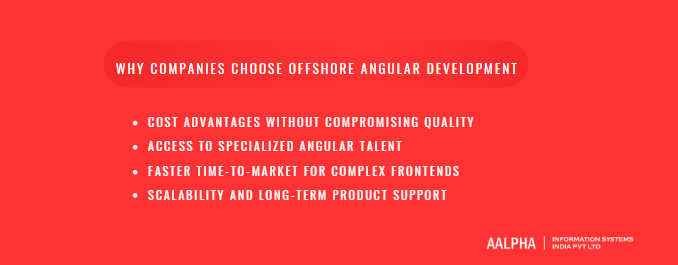
Cost Advantages Without Compromising Quality
Cost efficiency remains one of the primary reasons companies choose offshore Angular development, but the decision is rarely driven by hourly rates alone. In 2026, the financial logic is better explained through total cost of ownership rather than simple labor arbitrage. Offshore Angular developers in regions such as India, Eastern Europe, and parts of Southeast Asia typically command significantly lower hourly rates compared to their counterparts in North America or Western Europe. However, the real savings come from the ability to assemble complete, cross-functional frontend teams without incurring the overhead costs associated with local hiring, including recruitment fees, long onboarding cycles, employee benefits, and attrition-related disruptions.
Angular outsourcing also reduces long-term financial risk. Angular applications are rarely short-lived projects. They are often core systems such as enterprise dashboards, SaaS platforms, or internal tools that require ongoing enhancements, maintenance, and framework upgrades. Offshore teams are usually engaged under flexible models that allow companies to scale effort up or down based on roadmap priorities, rather than committing to permanent headcount. This flexibility directly impacts operating costs and allows finance and product teams to plan budgets more predictably.
Another critical factor is quality consistency. Mature offshore Angular vendors invest heavily in internal training, architectural standards, and quality assurance processes because Angular projects demand long-term maintainability. These vendors often work across multiple enterprise-grade Angular codebases, which gives them exposure to best practices that individual in-house teams may take years to accumulate. As a result, companies are able to achieve both lower development costs and higher code quality, making offshore Angular development a financially sound decision rather than a compromise.
-
Access to Specialized Angular Talent
Angular is not a framework where general frontend knowledge is sufficient. It requires developers who are comfortable with reactive programming patterns, structured application architecture, and strict typing discipline. One of the strongest reasons companies outsource Angular development is access to developers who specialize in these areas and work with Angular at scale on a daily basis. Offshore development hubs have built deep talent pools around Angular, driven by long-term enterprise demand and the framework’s popularity in regulated and complex domains.
RxJS expertise is a clear differentiator. Many frontend teams struggle with reactive streams, memory management, and complex asynchronous flows. Offshore Angular specialists are often trained specifically to design predictable data flows, manage subscriptions correctly, and avoid performance pitfalls that arise in large single-page applications. This expertise becomes critical in applications that rely heavily on real-time data, complex user interactions, or multi-step workflows.
Experience with Angular Material and custom design systems is another advantage. Offshore teams frequently work on SaaS platforms and enterprise products where consistency and reusability matter more than one-off UI components. These teams are accustomed to building component libraries, enforcing design tokens, and aligning frontend architecture with long-term product evolution. Additionally, many offshore Angular developers have hands-on experience with state management patterns such as centralized stores and newer reactive approaches, which are essential for maintaining stability in large applications. This level of specialization is difficult and expensive to replicate quickly with local hiring.
-
Faster Time-to-Market for Complex Frontends
Speed of delivery is a major factor in competitive product environments, especially when frontend complexity is high. Offshore Angular development enables faster time-to-market by allowing parallel execution across multiple workstreams. While internal teams often struggle to balance feature development, bug fixing, and architectural improvements simultaneously, offshore teams can be structured to handle these activities in parallel without overloading individual developers.
Angular’s component-based architecture aligns well with distributed development. Features can be broken down into well-defined modules and reusable components, allowing multiple developers to work concurrently with minimal overlap. Offshore teams that are experienced with Angular typically follow strict module boundaries and interface contracts, which reduces integration friction and accelerates delivery during sprint cycles. This structured approach is particularly effective for admin panels, dashboards, and enterprise frontends where functionality can be clearly segmented.
Time zone differences can also contribute to speed when managed correctly. Offshore teams often operate in a follow-the-sun model, where development continues while the client’s local team is offline. This can shorten feedback loops for fixes, reviews, and incremental improvements. When combined with disciplined sprint planning and asynchronous communication, offshore Angular development can significantly reduce overall delivery timelines for complex frontend systems.
-
Scalability and Long-Term Product Support
Angular is designed for long-lived applications, and companies choose offshore development because it supports both immediate scaling needs and long-term product stability. Offshore teams can be expanded or reduced with far less friction than onshore hiring, which is particularly valuable when products move through different growth phases. During initial development or major feature launches, teams can be scaled up quickly. During stabilization or maintenance phases, effort can be scaled down without the organizational impact of layoffs or underutilized staff.
Long-term support is another critical consideration. Angular applications require regular framework updates, dependency management, and performance optimization to remain secure and maintainable. Offshore Angular teams are often organized to provide continuity across these phases, with documentation, coding standards, and knowledge transfer processes that reduce dependency on individual developers. This ensures that applications remain stable even as team composition evolves over time.
Feature expansion is also more predictable with offshore teams that understand the existing codebase and architectural decisions. Instead of repeatedly onboarding new developers, companies benefit from teams that have historical context and can implement changes without introducing regressions or technical debt. In this sense, offshore Angular development is not just a delivery strategy but a long-term partnership model that supports continuous evolution, scalability, and framework longevity.
Common Use Cases for Offshore Angular Development
-
Enterprise Web Applications
Enterprise web applications are one of the most common and well-suited use cases for offshore Angular development. These applications typically include internal dashboards, ERP frontends, compliance systems, reporting portals, and operational tools that support core business processes. Such systems are rarely consumer-facing, but they handle complex workflows, large datasets, and role-specific functionality that must remain stable over many years. Angular’s opinionated architecture, strict TypeScript enforcement, and built-in tooling make it a natural choice for these environments, where predictability and maintainability are more important than rapid experimentation.
Offshore Angular teams are frequently engaged to build and maintain enterprise dashboards that aggregate data from multiple backend systems and present it in a structured, actionable format. These dashboards often include advanced tables, filters, charts, and permission-based views that require careful state management and performance optimization. ERP and internal tools add another layer of complexity, as they must align closely with existing business logic and evolve alongside backend systems. Offshore teams experienced in Angular are accustomed to working within these constraints, following modular design patterns that reduce coupling and simplify long-term maintenance.
Internal enterprise tools also benefit from the scalability of offshore development. As organizations expand operations or add new departments, frontend requirements grow accordingly. Offshore Angular teams can incrementally extend existing applications without disrupting core functionality, making them a practical choice for enterprises that view frontend systems as long-term operational assets rather than short-term projects.
-
SaaS Platforms and Admin Panels
SaaS platforms and their accompanying admin panels represent another major category where offshore Angular development is widely adopted. These products are typically multi-tenant by design, serving multiple customers from a single codebase while enforcing strict data isolation, role-based access control, and configurable features. Angular’s structured framework lends itself well to these requirements, particularly when applications must support complex navigation, permissions, and configuration-driven UI behavior.
Offshore Angular teams commonly work on admin panels that allow internal staff and customers to manage users, subscriptions, content, and system settings. These interfaces are often analytics-heavy, combining real-time metrics, historical reports, and configurable dashboards. Building such systems requires a deep understanding of component reuse, efficient change detection, and predictable data flows. Offshore teams that specialize in Angular typically have extensive experience designing these patterns across multiple SaaS products, allowing them to avoid common pitfalls such as tightly coupled components or unmanageable state logic.
Another advantage in SaaS contexts is long-term continuity. SaaS platforms evolve continuously, with frequent feature releases, UI refinements, and framework upgrades. Offshore Angular teams are often retained over extended periods, which allows them to develop a strong understanding of the product domain and architectural decisions. This continuity reduces onboarding costs, improves delivery consistency, and helps maintain a coherent frontend architecture as the platform scales.
-
Marketplace and Platform Frontends
Marketplace and platform frontends present a different set of challenges that also align well with offshore Angular development. These applications are typically search-heavy, data-intensive, and highly interactive, serving multiple user roles such as buyers, sellers, administrators, and partners. Angular is often chosen for these platforms when there is a need for structured navigation, complex filtering logic, and consistent behavior across large sections of the application.
Offshore Angular teams are frequently tasked with building frontend layers that integrate with multiple backend services, third-party APIs, and real-time data sources. Examples include product listings with advanced search and filtering, booking interfaces, order management dashboards, and notification systems. These features require careful coordination between UI components, asynchronous data streams, and backend integrations. Teams experienced in Angular are well-positioned to handle this complexity through disciplined module design and reactive programming patterns.
Marketplaces also demand frequent iteration based on user behavior and business metrics. Offshore teams can support this need by running parallel development tracks for new features, performance improvements, and UI experiments. This allows platform owners to evolve the frontend rapidly without sacrificing stability, which is particularly important in competitive marketplace environments where user experience directly impacts revenue.
-
Migration to Angular from Legacy Frontends
Migration projects are a significant and growing use case for offshore Angular development. Many organizations operate legacy frontends built with AngularJS, jQuery, or fragmented JavaScript frameworks that have become difficult to maintain. Others are transitioning from React-based implementations that struggle with long-term architectural consistency in enterprise settings. Migrating to Angular is often driven by the need for better structure, stronger typing, and long-term framework support.
Offshore teams are commonly engaged for these migrations because they require focused effort, careful planning, and deep framework knowledge. AngularJS to Angular migrations, for example, often involve hybrid strategies where old and new code coexist temporarily. This demands precise understanding of dependency boundaries, routing, and incremental refactoring. Similarly, jQuery-based frontends require a complete rethink of UI architecture, breaking monolithic scripts into modular, testable components.
In cases where organizations migrate from React to Angular, the motivation is often standardization and maintainability rather than performance. Offshore Angular teams with experience in large-scale rewrites can assess existing functionality, define migration phases, and rebuild the frontend without disrupting business operations. These projects are rarely short-term, and offshore development provides the sustained engineering capacity needed to modernize legacy systems while keeping costs under control.
Offshore Angular Development Engagement Models
-
Dedicated Angular Development Teams
The dedicated Angular development team model is one of the most widely adopted engagement structures for offshore Angular projects, particularly when the application is business-critical or expected to evolve over a long period. In this model, a client works with a fixed group of Angular developers, UI engineers, and often QA specialists who are assigned exclusively to a single product or program. The team operates as an extension of the client’s internal engineering organization rather than as an external vendor delivering isolated tasks.
From a structural perspective, dedicated teams usually include a technical lead responsible for Angular architecture, senior developers who handle complex features and performance concerns, and supporting developers who focus on component development and UI integration. Clear accountability is a defining characteristic of this model. The offshore team takes ownership of sprint commitments, code quality, documentation, and long-term maintainability, while the client retains control over product direction and prioritization. Communication typically follows regular sprint ceremonies, shared backlogs, and transparent reporting to ensure alignment.
This engagement model is best suited for large Angular applications such as enterprise platforms, SaaS products, or internal systems with continuous development needs. It works particularly well when requirements are expected to change over time, or when the frontend is closely tied to business logic that evolves with user feedback. Because the same team remains involved over months or years, knowledge retention is high, onboarding costs are minimized, and architectural consistency is easier to maintain. For organizations seeking a long-term Angular partner rather than a transactional service provider, dedicated teams offer the highest level of stability and strategic value.
-
Fixed-Price Angular Projects
Fixed-price engagement models are often appealing to organizations that want predictable costs and clearly defined deliverables. In offshore Angular development, this model works best when the project scope is stable, requirements are well-documented, and UI behavior is unlikely to change significantly during execution. Typical examples include marketing dashboards, proof-of-concept applications, or self-contained Angular modules that integrate into an existing system.
Under a fixed-price development, the offshore vendor commits to delivering a predefined set of features within an agreed timeline and budget. This requires detailed upfront planning, including wireframes, user flows, component lists, and acceptance criteria. For Angular projects, this level of specification is critical because even small changes in UI logic or data flow can have cascading effects on architecture and effort. When this preparation is done thoroughly, fixed-price projects can be executed efficiently and with minimal surprises.
However, fixed pricing often fails for Angular applications with evolving requirements or complex business rules. Angular is frequently used in enterprise and SaaS contexts where user feedback, regulatory changes, or backend dependencies drive ongoing adjustments. In such cases, fixed-price contracts can lead to friction, change requests, and compromised quality as teams attempt to stay within budget. As a result, fixed-price Angular projects are best reserved for narrowly scoped implementations rather than long-term or highly interactive applications.
-
Time & Material Model
The time and material model is widely regarded as the most flexible and realistic engagement approach for offshore Angular development, particularly for applications with evolving requirements. In this model, clients pay for the actual effort invested by the offshore team, usually based on agreed hourly or monthly rates. This structure aligns well with the iterative nature of modern frontend development, where design, usability, and performance considerations often evolve during implementation.
For Angular applications, time and material engagements allow teams to adapt architecture and components as real-world usage patterns emerge. Changes to state management, UI workflows, or integration logic can be addressed without the constraints of a fixed scope. This is especially important for products in active development, such as SaaS platforms, marketplaces, or internal tools undergoing continuous optimization. The model encourages collaboration rather than contract enforcement, enabling product owners and developers to focus on outcomes instead of rigid deliverables.
Another advantage of the time and material approach is transparency. Clients gain visibility into how effort is distributed across features, refactoring, testing, and performance improvements. This makes it easier to balance short-term delivery goals with long-term maintainability, which is critical for Angular applications designed to last for years. While the model requires stronger governance and regular review, it ultimately provides the adaptability needed to build and scale complex Angular frontends without sacrificing quality or velocity.
Step-by-Step Offshore Angular Development Process
-
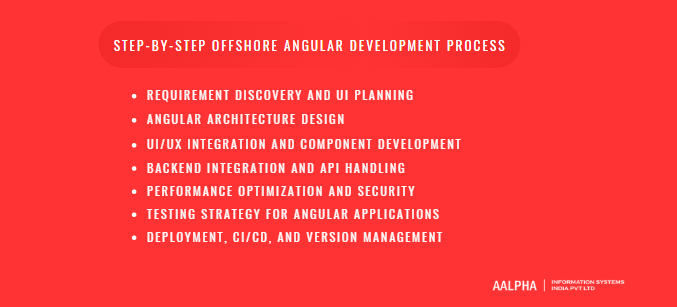
Requirement Discovery and UI Planning
The offshore Angular development process begins with a structured requirement discovery phase that focuses specifically on frontend behavior rather than abstract feature lists. For Angular applications, success depends heavily on how well user flows, UI states, and backend dependencies are understood before any code is written. Offshore teams typically start by analyzing user journeys across different roles, such as administrators, internal users, or customers, and mapping how each role navigates through the application. This helps identify shared components, conditional UI logic, and edge cases that influence architectural decisions later.
UI planning goes beyond wireframes. Offshore Angular teams usually translate requirements into component maps that define which parts of the interface are reusable, which are feature-specific, and which depend on external data sources. For example, dashboards often share table components, filters, and pagination logic across multiple screens. Identifying these early prevents duplication and reduces long-term maintenance effort. This component-level planning is particularly important in Angular, where clear separation of concerns improves testability and scalability.
API dependency planning is another critical output of this phase. Offshore teams typically work closely with backend teams or API documentation to understand data contracts, response formats, authentication requirements, and error scenarios. This allows frontend developers to design services, interfaces, and state models that align with backend realities. By resolving these dependencies early, offshore teams reduce rework and ensure that Angular development proceeds smoothly once implementation begins.
-
Angular Architecture Design
Once requirements are clarified, offshore teams move into Angular architecture design, which sets the foundation for long-term maintainability. This phase focuses on defining the module structure, data flow patterns, and application boundaries. Angular applications that grow without a clear architecture often suffer from tight coupling, bloated components, and performance issues, so offshore teams emphasize discipline at this stage.
Module structure is typically designed around features rather than technical layers. Feature modules encapsulate related components, services, and routing logic, making the application easier to understand and extend. Lazy loading is planned upfront to ensure that large applications load efficiently, especially when different user roles access different sections of the system. Offshore Angular teams experienced with enterprise applications know how to balance module granularity to avoid both over-fragmentation and monolithic designs.
State management choices are also made during this phase. Depending on application complexity, teams may rely on localized component state, shared services, or centralized state management patterns. The decision is guided by data flow complexity, real-time updates, and the need for predictability. Offshore teams with Angular specialization understand when simple patterns are sufficient and when more structured approaches are necessary to avoid state inconsistencies as the application scales.
-
UI/UX Integration and Component Development
UI and UX integration is where offshore Angular development becomes highly execution-focused. At this stage, design assets are translated into functional components while preserving consistency, accessibility, and responsiveness. Offshore teams typically work with established design systems or help formalize one if it does not already exist. This includes defining typography, spacing, color usage, and interaction patterns that can be reused across the application.
Angular Material is commonly used as a foundation for enterprise and SaaS applications, either directly or as a base for custom-styled components. Offshore teams experienced in Angular know how to extend these components without breaking upgrade paths or accessibility standards. Reusable components are built with configurability in mind, allowing them to serve multiple use cases through inputs and outputs rather than duplication.
Component development is closely aligned with UX intent. Offshore teams pay attention to loading states, error handling, and edge cases that affect user perception of quality. Because Angular enforces structured templates and strong typing, teams can implement UI logic that remains predictable as complexity grows. This disciplined approach to component development is one of the reasons companies rely on offshore Angular specialists rather than general frontend teams.
-
Backend Integration and API Handling
Backend integration is a core part of Angular development, and offshore teams typically handle this through well-defined service layers. REST or GraphQL APIs are consumed through Angular services that abstract HTTP logic away from UI components. This separation improves testability and allows backend changes to be managed without widespread UI refactoring.
Authentication and authorization flows receive particular attention. Offshore Angular teams design guards, interceptors, and role-based access checks that align with backend security models. This ensures that navigation, API access, and UI visibility remain consistent across sessions and user roles. Error handling and retry strategies are also implemented at the service level to provide resilience against transient backend issues.
By formalizing API handling patterns early, offshore teams reduce coupling between frontend and backend and make the application easier to extend. This is especially important in enterprise and SaaS environments where APIs evolve over time and frontend stability is critical.
-
Performance Optimization and Security
Performance optimization is not treated as an afterthought in offshore Angular development. Teams typically incorporate performance considerations throughout the build process, starting with change detection strategies and efficient template design. Poorly managed change detection can degrade performance significantly in large applications, so offshore teams pay close attention to component boundaries and update patterns.
Server-side rendering is evaluated when SEO or perceived load time is a concern, particularly for public-facing Angular applications. Offshore teams assess whether SSR adds value based on application goals and infrastructure constraints. Security best practices are also embedded into frontend development, including input validation, secure handling of tokens, and protection against common web vulnerabilities.
Because Angular applications often handle sensitive business data, offshore teams follow secure coding standards and align frontend behavior with backend security policies. This reduces the risk of exposing data through UI flaws or misconfigured client-side logic.
-
Testing Strategy for Angular Applications
A robust testing strategy is a defining characteristic of high-quality offshore Angular development. Teams typically implement unit tests for components, services, and utility functions to validate logic in isolation. This is especially important in Angular applications with complex business rules embedded in the frontend.
Integration tests focus on how components interact with services and shared state, ensuring that data flows behave as expected under different scenarios. End-to-end testing validates critical user journeys, such as authentication, form submissions, and workflow completion. Offshore teams experienced in Angular understand how to balance test coverage with execution time to keep pipelines efficient.
Testing is treated as part of development rather than a separate phase. This approach improves confidence during refactoring and framework upgrades, which are inevitable in long-lived Angular applications.
-
Deployment, CI/CD, and Version Management
The final stage of the offshore Angular development process involves deployment and ongoing version management. Offshore teams typically integrate Angular builds into CI/CD pipelines that automate testing, building, and deployment across environments. Environment-specific configurations are managed carefully to ensure consistency between development, staging, and production.
Release cycles are planned to minimize disruption, especially for enterprise users who depend on frontend stability. Angular version upgrades are handled systematically, with impact assessments and incremental updates rather than rushed migrations. Offshore teams document deployment procedures and release notes to maintain transparency and continuity.
By formalizing deployment and version management practices, offshore Angular teams ensure that applications remain stable, secure, and up to date throughout their lifecycle, reinforcing the value of offshore development as a long-term engineering strategy rather than a one-time delivery model.
Cost of Offshore Angular Development
-
Hourly Rates by Region
The cost of offshore Angular development varies significantly by region, but hourly rates alone do not tell the full story. In practice, pricing reflects a combination of developer experience, Angular maturity in the local market, communication efficiency, and the ability to support long-term projects. Understanding these regional differences helps decision-makers estimate realistic budgets rather than relying on headline rates, including evaluating the overall cost to develop Angular web app projects across different outsourcing destinations.
India remains one of the most established destinations for offshore Angular development. Hourly rates typically range from the lower to mid tiers globally, but the real advantage lies in the depth of the Angular talent pool. India has a large number of developers with experience building enterprise-grade Angular applications, including dashboards, SaaS platforms, and internal systems. This depth allows companies to assemble complete teams with senior architects, mid-level developers, and QA resources under a single engagement, which reduces coordination overhead and improves delivery predictability.
Eastern Europe, including countries such as Poland, Ukraine, and Romania, generally commands higher hourly rates than India but is often perceived as offering strong architectural discipline and close alignment with Western engineering practices. Angular developers in this region frequently have experience with complex frontend systems and long-term product maintenance. The tradeoff is cost, as rates are closer to onshore levels, and talent availability can become constrained when projects need to scale quickly.
Southeast Asia, including countries like Vietnam and the Philippines, offers competitive pricing and a growing Angular ecosystem. Rates are usually comparable to or slightly higher than India, but the Angular talent pool is smaller and more unevenly distributed. These regions can be effective for well-defined projects but may require more careful vetting for large-scale or long-term Angular initiatives.
Latin America offers the advantage of time-zone alignment with North American clients. Hourly rates are typically higher than Asia but lower than onshore alternatives. Angular talent availability varies by country, and while senior developers are available, scaling teams quickly can be challenging. For companies prioritizing real-time collaboration over cost savings, Latin America can be a reasonable compromise.
-
Cost Breakdown by Project Type
The total cost of offshore Angular development depends heavily on the type and complexity of the project rather than the framework alone. An Angular MVP, for example, is usually designed to validate functionality rather than scale. These projects focus on core screens, basic workflows, and limited integrations. Offshore development costs for an MVP are driven by UI complexity, number of user roles, and integration depth. Because scope is constrained, costs are relatively predictable, especially when requirements are well-defined upfront.
Enterprise dashboards represent a different cost profile. These applications often involve complex data visualization, role-based access control, and integration with multiple backend systems. Angular is frequently chosen for such projects because of its structure and long-term maintainability. Costs increase due to the need for advanced state management, performance optimization, and extensive testing. Offshore teams typically allocate more senior resources to these projects, which raises hourly costs but reduces long-term technical debt.
SaaS frontends tend to be the most expensive category because they combine scale, configurability, and continuous evolution. Multi-tenant architecture, subscription-based features, analytics-heavy interfaces, and ongoing enhancements all contribute to higher development effort. Offshore Angular teams working on SaaS products are often engaged over extended periods, and costs should be evaluated as recurring investment rather than a one-time expense. While upfront costs are higher, offshore development often makes SaaS frontend development financially viable by spreading effort over time without locking companies into permanent headcount.
-
Hidden Costs and How to Avoid Them
Hidden costs are a common concern in offshore Angular development, but they are usually the result of process gaps rather than location. One of the most frequent hidden costs arises from inadequate requirement definition. Angular applications are sensitive to architectural decisions, and unclear requirements often lead to rework, refactoring, and schedule overruns. Investing time in detailed UI planning and component mapping early in the project significantly reduces this risk.
Another hidden cost comes from poor code quality and insufficient testing. Low initial rates can become expensive if the resulting codebase is difficult to maintain or upgrade. Angular applications are long-lived by nature, and technical debt accumulates quickly when best practices are ignored. Choosing offshore teams with established testing strategies and architectural standards helps prevent these downstream costs.
Communication inefficiencies also contribute to hidden expenses. Time-zone differences, unclear ownership, and inconsistent documentation can slow decision-making and create friction. These issues are mitigated by structured communication processes, clear escalation paths, and shared documentation practices. Finally, companies should account for the cost of Angular version upgrades and long-term maintenance from the outset. Offshore development delivers the best value when it is treated as a strategic partnership focused on total lifecycle cost rather than short-term savings.
Common Challenges in Offshore Angular Development and How to Avoid Them
-
Communication and Time-Zone Challenges
Communication gaps and time-zone differences are often cited as the primary risks of offshore Angular development. In practice, the issue is less about geography and more about the absence of structured communication workflows. Angular projects involve frequent clarification around UI behavior, data flow, and edge cases, and delays in feedback can slow progress if expectations are not clearly set. When teams rely on ad hoc meetings or informal updates, misunderstandings accumulate and surface later as rework.
Time-zone differences can also create bottlenecks when dependencies are not planned properly. For example, unresolved questions around API behavior or UX decisions can stall frontend development if they require synchronous discussion. Successful offshore Angular teams mitigate this by adopting asynchronous-first communication, detailed sprint planning, and well-documented requirements. Clear overlap windows for daily standups or reviews ensure that critical decisions are addressed without requiring full-day alignment. When communication protocols are defined early, time-zone differences become manageable rather than disruptive.
-
Inconsistent Code Quality and Architecture Drift
Inconsistent code quality and gradual architecture drift are serious risks in long-running Angular projects. Angular’s flexibility allows teams to implement features in multiple ways, and without strong architectural governance, codebases can become fragmented over time. This is especially common in offshore engagements where multiple developers contribute without a shared understanding of design principles or coding standards.
Architecture drift typically manifests as bloated components, duplicated logic, and inconsistent state management patterns. These issues slow development, complicate testing, and increase the cost of future enhancements. To avoid this, offshore Angular teams must establish clear architectural guidelines at the outset. This includes defining module boundaries, component responsibilities, naming conventions, and preferred patterns for data flow. Regular code reviews led by senior Angular engineers help enforce these standards and prevent divergence. When architecture is treated as a shared responsibility rather than an afterthought, code quality remains consistent even as teams scale.
-
Overuse of Junior Angular Developers
Another common challenge in offshore Angular development is the overuse of junior developers on projects that require architectural judgment and deep framework expertise. Angular is not a framework where surface-level knowledge is sufficient, particularly for enterprise or SaaS applications. Junior developers may be productive on isolated components, but without guidance, they can introduce patterns that create long-term maintenance issues.
The risk arises when offshore providers staff projects primarily with junior resources to reduce costs, without adequate senior oversight. This often leads to fragile implementations, performance problems, and increased refactoring effort later. The solution is not to avoid junior developers entirely but to ensure balanced team composition. Senior Angular engineers should be responsible for architecture, core components, and code reviews, while junior developers contribute under clear guidelines. This structure preserves quality while still allowing cost efficiency.
-
Poor Documentation and Knowledge Transfer
Poor documentation and weak knowledge transfer are among the most costly challenges in offshore Angular development, particularly when teams change or projects transition between phases. Angular applications are inherently structured, but without explicit documentation, architectural decisions and business logic can remain implicit and difficult to understand for new contributors.
Lack of documentation increases onboarding time and creates dependency on individual developers. This becomes problematic when team members rotate or when clients want to bring development in-house. Effective offshore teams address this by maintaining living documentation that covers module structure, data flow, state management decisions, and build processes. Inline code comments, architectural diagrams, and onboarding guides help preserve institutional knowledge. Knowledge transfer should be treated as an ongoing activity rather than a one-time handover at project completion.
-
Strategies to Mitigate Offshore Development Risks
Mitigating offshore Angular development risks requires a combination of process discipline and technical governance. Clear engagement models, defined roles, and measurable quality metrics create accountability from the outset. Regular sprint reviews and retrospectives help surface issues early, before they impact delivery timelines or code quality.
From a technical perspective, enforcing coding standards, automated testing, and continuous integration pipelines reduces reliance on manual oversight. Angular projects benefit significantly from automated linting, unit tests, and build checks that prevent regressions. Selecting offshore partners with proven Angular experience and a track record of long-term project support is equally important. When offshore development is approached as a strategic collaboration rather than a cost-saving exercise, these risks can be systematically managed and, in many cases, eliminated.
How to Choose the Right Offshore Angular Development Company
Selecting the right offshore Angular development company is a strategic decision that directly affects product quality, delivery timelines, and long-term maintainability. Angular applications are typically core systems rather than disposable frontends, which means the choice of partner should be evaluated through an engineering and lifecycle lens rather than cost alone. The most successful offshore engagements are built on proven Angular expertise, disciplined delivery practices, and clear accountability across the entire product lifecycle.
-
Evaluating Angular Technical Expertise
Evaluating Angular expertise requires looking beyond generic frontend claims and focusing on framework-specific depth. Angular is an opinionated framework with strong conventions around architecture, dependency injection, reactive programming, and TypeScript usage. A capable offshore Angular company should demonstrate experience building and maintaining large-scale Angular applications, not just isolated components or short-lived projects.
One of the most reliable indicators of expertise is the team’s ability to explain architectural decisions. This includes how they structure feature modules, implement lazy loading, manage shared services, and handle cross-cutting concerns such as authentication and authorization. Experienced Angular teams can clearly articulate why they choose certain patterns and how those choices support scalability and maintainability. Superficial answers or reliance on buzzwords often indicate limited hands-on experience.
Reactive programming proficiency is another critical factor. Angular applications rely heavily on asynchronous data streams, and misuse of reactive patterns can lead to performance issues and memory leaks. A competent offshore team should be comfortable discussing how they manage subscriptions, handle complex data flows, and avoid common pitfalls in reactive logic. Additionally, practical experience with enterprise UI requirements such as role-based access, form-heavy workflows, and data-intensive dashboards signals readiness for real-world Angular projects.
Finally, ask for evidence of long-term Angular project involvement. Teams that have supported applications through multiple framework upgrades and feature expansions tend to have a much stronger understanding of Angular’s lifecycle challenges. This experience is far more valuable than familiarity with the latest features alone.
-
Code Review, Testing, and Documentation Standards
Strong delivery standards separate reliable offshore Angular companies from transactional vendors. Code review practices are a foundational element of quality control, especially in distributed teams. The offshore company should have a defined review process led by senior Angular engineers who enforce architectural consistency, coding standards, and performance considerations. Reviews should focus not only on correctness but also on readability, reusability, and long-term impact.
Testing discipline is equally important. Angular applications often embed significant business logic in the frontend, making automated testing essential for stability. A serious offshore partner should implement unit tests for components and services, integration tests for data flow and state handling, and end-to-end tests for critical user journeys. The goal is not theoretical coverage percentages but confidence that changes and upgrades can be made without introducing regressions.
Documentation standards are frequently overlooked during vendor evaluation, yet they have a major impact on long-term success. Offshore Angular teams should maintain clear documentation covering module structure, build processes, environment configuration, and key architectural decisions. This documentation reduces onboarding time, supports knowledge transfer, and protects the client from vendor lock-in. When documentation is treated as part of delivery rather than an optional add-on, the overall engagement becomes more resilient.
-
Red Flags to Avoid When Hiring Offshore Teams
Certain warning signs consistently indicate high risk in offshore Angular engagements. One of the most common red flags is vague or generic positioning. Companies that claim expertise in every frontend framework without demonstrating Angular-specific depth often rely on generalist developers rather than specialists. This approach may work for simple projects but fails quickly in complex Angular applications.
Another red flag is over-reliance on junior developers without visible senior oversight. While junior resources have a role to play, Angular projects require experienced engineers to guide architecture, review code, and make informed tradeoffs. If a vendor cannot clearly explain team composition and escalation paths, quality issues are likely to surface later.
Lack of transparency around processes is another serious concern. Offshore teams should be able to describe how they manage sprints, handle requirement changes, track progress, and address risks. Avoid vendors who promise rapid delivery without discussing planning, testing, or maintenance, as this often leads to short-term gains at the expense of long-term stability.
Finally, resistance to client involvement is a warning sign. Successful offshore Angular development depends on collaboration and shared ownership. Vendors who discourage regular reviews, direct communication with developers, or access to code repositories often create unnecessary dependency and risk.
-
Questions to Ask Before Signing a Contract
Before finalizing an offshore Angular development partner, decision-makers should ask targeted questions that reveal both technical maturity and delivery mindset. Ask how the team approaches Angular architecture for large applications and how they handle framework upgrades over time. The answers should reflect practical experience rather than theoretical knowledge.
It is also important to ask about testing strategy and quality assurance ownership. Clarify who is responsible for writing tests, how test failures are handled, and how quality is measured during delivery. Questions around documentation, onboarding, and knowledge transfer are equally important, particularly for long-term projects.
Finally, ask about governance and risk management. This includes how changes are estimated, how scope adjustments are handled, and how communication is structured across time zones. Clear, confident answers indicate a partner that understands offshore Angular development as a disciplined engineering practice rather than a staffing exercise.
Why Choose Aalpha for Offshore Angular Development
-
Angular Expertise and Delivery Approach
Aalpha Information Systems approaches offshore Angular development as a long-term engineering partnership rather than a short-term execution task. Angular is treated as an enterprise-grade framework that demands architectural discipline, predictable data flow, and maintainability across multiple release cycles. Aalpha’s teams have hands-on experience delivering Angular applications for enterprise dashboards, SaaS platforms, and complex internal systems where frontend stability directly impacts business operations.
The delivery approach is rooted in clarity and structure. Projects begin with detailed requirement discovery focused on user flows, component boundaries, and backend dependencies, ensuring that architectural decisions are made early and intentionally. Angular applications are designed using feature-based module structures, clear separation of concerns, and scalable state management patterns appropriate to the complexity of the product. This ensures that applications remain extensible as new features, roles, and integrations are added over time. Rather than optimizing for short-term velocity alone, Aalpha prioritizes frontend systems that can be confidently maintained, upgraded, and scaled for years.
-
Offshore Team Structure and Communication Model
Aalpha’s offshore Angular development model is built around stable, accountable team structures. Clients are not assigned interchangeable resources but dedicated Angular developers who work consistently on the same product. Each team is typically anchored by senior Angular engineers responsible for architecture, code quality, and technical decision-making, supported by experienced developers who focus on feature delivery and UI integration. This balance ensures that execution speed does not come at the cost of long-term code health.
Communication is designed to minimize friction across time zones. Aalpha follows structured sprint-based workflows with clear ownership, shared backlogs, and predictable review cycles. Clients have direct access to the development team, enabling faster clarification of UI behavior, data flow questions, and priority changes. Documentation and asynchronous updates are emphasized to ensure continuity even when real-time overlap is limited. This model allows offshore collaboration to function as an extension of the client’s internal team rather than a disconnected delivery pipeline.
-
Quality Assurance, Security, and Documentation
Quality assurance is embedded into Aalpha’s Angular development process rather than treated as a final checkpoint. Code reviews are conducted by senior engineers to enforce architectural consistency, performance best practices, and readability. Automated testing is used to validate components, services, and critical user flows, reducing regression risk as applications evolve. This disciplined approach is especially important for Angular applications that contain significant business logic on the client side.
Security considerations are addressed proactively. Angular applications are developed with secure handling of authentication flows, role-based access controls, and client-side data exposure. Aalpha aligns frontend behavior with backend security models to prevent inconsistencies that could lead to vulnerabilities. Documentation is maintained as a living asset, covering architectural decisions, build processes, and deployment workflows. This protects clients from knowledge loss, simplifies onboarding, and supports future transitions, whether scaling the team or bringing development in-house.
-
Long-Term Product Support and Scalability
Aalpha’s offshore Angular services are designed to support the full lifecycle of a product, not just initial development. Angular applications often require ongoing framework upgrades, performance tuning, and feature expansion as business needs evolve. Aalpha provides continuity through long-term team engagement, ensuring that the same architectural principles and domain knowledge carry forward across releases.
Scalability is handled pragmatically. Teams can be expanded as product scope grows or adjusted during stabilization phases without disrupting delivery. Because Angular projects are planned with maintainability in mind, new developers can be onboarded efficiently using existing documentation and coding standards. This makes Aalpha a suitable partner for organizations that view their Angular frontend as a strategic asset rather than a one-time deliverable. By combining deep Angular expertise, structured offshore delivery, and long-term support, Aalpha aligns closely with EEAT expectations for experience, expertise, authoritativeness, and trustworthiness in offshore Angular development.
Final Verdict:
Offshore Angular development is worth considering when frontend engineering is a long-term strategic requirement rather than a short-term delivery task. Angular is most commonly used for enterprise applications, SaaS platforms, admin systems, and complex internal tools where stability, maintainability, and architectural discipline matter as much as initial build speed. In these contexts, offshore development offers a strong strategic fit by combining access to specialized Angular expertise with cost structures that make sustained development economically viable.
From a cost-benefit perspective, the advantage of offshore Angular development lies in total lifecycle efficiency rather than headline hourly rates. Companies reduce not only development costs but also hiring risk, onboarding overhead, and long-term maintenance uncertainty. Offshore teams that specialize in Angular are accustomed to working with large codebases, evolving requirements, and multi-year product roadmaps. This allows CTOs and product leaders to plan frontend development as a continuous capability instead of a series of isolated projects. When evaluated over multiple release cycles, offshore Angular development often delivers higher return on investment than building and retaining equivalent in-house teams.
For decision-makers, the key consideration is readiness. Offshore Angular development works best when product ownership is clear, requirements are communicated at the level of user flows and UI behavior, and engineering quality is treated as a shared priority. It is less effective for poorly defined prototypes or projects where frontend work is seen as disposable. CTOs should assess whether their Angular application is expected to scale, integrate deeply with backend systems, and undergo regular upgrades. Founders and product leaders should consider whether flexibility, speed, and long-term cost control are more important than physical proximity.
When executed with the right partner, offshore Angular development becomes a strategic extension of internal engineering rather than an outsourcing compromise. Aalpha Information Systems brings experience in delivering and supporting enterprise-grade Angular applications through structured offshore teams, disciplined delivery practices, and a long-term product mindset.
If you are evaluating offshore Angular development for a current or upcoming product and want a realistic assessment of fit, cost, and execution approach, you can contact us to discuss your requirements and explore whether an offshore Angular engagement aligns with your technical and business goals.