



Building a modern application is no longer just a technical exercise. It is a strategic business decision that directly impacts revenue, user experience, scalability, and long-term competitiveness. Many companies begin with a simple question: should we build an app internally or collaborate with an external development partner? Increasingly, businesses across startups, mid-sized firms, and enterprises are choosing structured app development partnerships as a more efficient and scalable approach.
An app development partnership is not the same as traditional outsourcing. It is a collaborative engagement where a specialized development company works closely with a business to design, build, and continuously improve a digital product. This model allows organizations to leverage external expertise while maintaining alignment with their internal goals, product vision, and user needs. It is particularly relevant in today’s environment where technologies such as cloud computing, AI, cross-platform frameworks, and real-time data systems require multidisciplinary skills that are difficult to assemble quickly in-house.
As businesses move faster to launch products, validate ideas, and enter new markets, partnerships offer a structured way to reduce risk while maintaining speed. Whether the goal is to build a minimum viable product, modernize legacy systems, or scale an existing application, choosing the right development partner can significantly influence outcomes.
What Is an App Development Partnership?
An app development partnership is a collaborative working relationship between a business and an external application development company to design, build, deploy, and maintain applications. Unlike transactional outsourcing, where a vendor simply executes predefined tasks, a partnership involves shared responsibility, ongoing communication, and strategic alignment.
In practice, this can take several forms. A startup may partner with a development firm to build its first mobile app, working closely on product strategy, user experience, and feature prioritization. A mid-sized company might engage a dedicated development team that acts as an extension of its internal staff, handling backend systems, integrations, and scalability. Enterprises often form long-term partnerships with technology providers to continuously evolve their digital products, integrate new technologies, and improve performance.
The defining characteristic of a true partnership is collaboration across the entire product lifecycle. This includes requirement analysis, architecture design, development, testing, deployment, and post-launch optimization. The development partner contributes technical expertise, while the business provides domain knowledge and strategic direction. Together, they co-create a product that meets both user expectations and business objectives.
Why Businesses Choose App Development Partners
Businesses choose app development partners primarily to gain access to specialized expertise without the time and cost required to build an in-house team. Modern applications demand a wide range of skills, including frontend and backend development, UI/UX design, cloud infrastructure, cybersecurity, and increasingly, AI and data integration. Hiring and managing all these capabilities internally can be slow and expensive.
Cost efficiency is another major factor. Instead of investing in recruitment, training, infrastructure, and long-term salaries, companies can engage experienced teams on flexible terms. This allows them to control budgets more effectively while still maintaining high development standards.
Speed is equally important. Development partners typically follow established frameworks and agile methodologies, enabling faster delivery cycles. For example, a startup launching an MVP can move from concept to market significantly quicker with a partner that already has proven processes and reusable components.
Businesses also benefit from an external perspective. Experienced development partners bring insights from working across industries and projects, helping identify potential risks, improve product design, and recommend scalable solutions. This combination of expertise, efficiency, and speed is why partnerships have become a preferred model for app development.
Partnership vs Hiring In-House Teams
Choosing between an app development partnership and building an in-house team depends on factors such as budget, timeline, scalability needs, and internal capabilities. Each approach has its advantages, but partnerships often provide greater flexibility and faster execution.
Hiring an in-house team offers full control over development processes and direct access to team members. This can be beneficial for companies with long-term, complex product roadmaps and sufficient resources to support recruitment, training, and retention. However, building such a team is time-intensive and costly, especially when specialized skills are required.
In contrast, an app development partnership provides immediate access to a multidisciplinary team. Businesses can scale resources up or down based on project requirements without long-term commitments. This is particularly useful for startups and growing companies that need to adapt quickly to changing market conditions.
Cost structures also differ significantly. In-house teams involve fixed costs such as salaries, benefits, and infrastructure, while partnerships typically operate on flexible pricing models such as fixed cost, hourly, or dedicated teams. Additionally, development partners often bring established workflows, reducing the risk of delays and inefficiencies.
Ultimately, partnerships offer a balance between control and agility. Businesses retain strategic oversight while leveraging external expertise to accelerate development and reduce operational complexity.
Key Outcomes of a Successful Partnership
A well-executed app development partnership delivers measurable business outcomes that go beyond simply launching an application. One of the most immediate benefits is faster time-to-market, enabling companies to validate ideas, attract users, and generate revenue earlier.
Improved user experience is another critical outcome. Development partners with strong design and usability expertise can create intuitive interfaces, optimize performance, and ensure consistency across platforms, leading to higher user engagement and retention.
Scalability is equally important. Successful partnerships result in applications built with future growth in mind, allowing businesses to handle increasing user demand, integrate new features, and expand into new markets without major rework.
In addition, companies often gain access to ongoing innovation. By working with experienced partners, they can continuously improve their products, adopt new technologies, and stay competitive in rapidly evolving digital landscapes.
Types of App Development Partnerships
Choosing the right app development partnership model is a strategic decision that directly affects cost, speed, product quality, and long-term scalability. Not all partnerships operate in the same way. Some are designed for end-to-end product ownership, while others focus on filling specific technical gaps or supporting internal teams. The right model depends on factors such as business maturity, technical capabilities, project complexity, and long-term goals.
For example, a startup building its first product may require a full-service partner that can handle everything from ideation to launch. In contrast, an enterprise with an established engineering team might only need specialized developers to accelerate delivery or support a specific module. Understanding these models helps businesses align their expectations with the right engagement structure and avoid common pitfalls such as misaligned responsibilities or inefficient workflows.
-
Full-Service Development Partner
A full-service development partner provides end-to-end app development services, covering the entire lifecycle from concept to post-launch support. This model is ideal for businesses that lack in-house technical expertise or want a single accountable partner to manage the entire process.
The engagement typically begins with product discovery, where the partner helps define business requirements, user personas, and feature priorities. This is followed by UI/UX design, technical architecture planning, and development. After the application is built, the partner handles testing, deployment, and ongoing maintenance, including updates, performance optimization, and feature enhancements.
This model is commonly used by startups and non-technical founders who need guidance at every stage. It is also relevant for businesses launching new digital products or entering new markets. The primary advantage is simplicity and accountability. Instead of coordinating multiple vendors, businesses work with one team responsible for delivering a complete, production-ready application.
-
Dedicated Development Team Model
The dedicated development team model involves hiring a team of developers, designers, and engineers who work exclusively on a business’s project over an extended period. Unlike project-based engagements, this model focuses on long-term collaboration and deep integration with the client’s internal processes.
In this setup, the external team functions as an extension of the company’s in-house team. They participate in regular meetings, follow internal workflows, and align closely with product managers and stakeholders. This model is particularly useful for companies that have ongoing development needs but want to avoid the overhead of hiring and managing a full internal team.
For example, a SaaS company continuously adding new features may rely on a dedicated team to handle backend development, integrations, and scaling efforts. The flexibility to scale team size based on evolving requirements is a key advantage. It allows businesses to maintain continuity while adapting to changing priorities without restarting the hiring process.
-
Project-Based Partnership
A project-based partnership is structured around a clearly defined scope, timeline, and set of deliverables. This model is best suited for businesses with well-defined requirements and a specific goal, such as building a mobile app, redesigning an existing application, or developing a new feature.
In this approach, the development partner takes responsibility for delivering the project within agreed timelines and budgets. The engagement usually follows a structured workflow, including requirement gathering, design, development, testing, and final delivery. Once the project is completed, the partnership may end or transition into a maintenance agreement.
This model works well for organizations that have a clear vision of what they want to build and do not require ongoing development support. It offers predictability in terms of cost and timeline, making it easier to plan budgets and resources. However, it requires detailed upfront planning to avoid scope changes and delays.
-
Staff Augmentation Model
The staff augmentation model allows businesses to hire external developers or specialists to complement their existing in-house team. Instead of outsourcing the entire project, companies bring in additional talent to fill specific skill gaps or increase development capacity.
This model is particularly useful when internal teams lack expertise in certain areas, such as mobile development, cloud architecture, or AI integration. For example, a company building an app may hire external React Native developers or DevOps engineers to accelerate delivery without committing to permanent hires.
Staff augmentation provides flexibility and control, as the augmented developers work under the company’s management and follow its processes. It also reduces recruitment time and costs, enabling businesses to scale quickly. However, it requires strong internal leadership to manage the extended team effectively.
-
Strategic Technology Partnerships
Strategic technology partnerships go beyond short-term development needs and focus on long-term collaboration, innovation, and product growth. In this model, the development partner acts as a technology advisor, contributing to product strategy, architecture decisions, and continuous improvement.
These partnerships are common in companies building complex digital products or platforms that require ongoing evolution. For instance, a logistics platform or healthcare application may rely on a strategic partner to integrate new technologies, improve performance, and expand capabilities over time.
The key advantage of this model is continuity and alignment. The partner develops a deep understanding of the business, enabling them to proactively suggest improvements, optimize systems, and support long-term scalability. Instead of being just a service provider, they become a critical part of the company’s technology ecosystem, driving sustained innovation and competitive advantage.
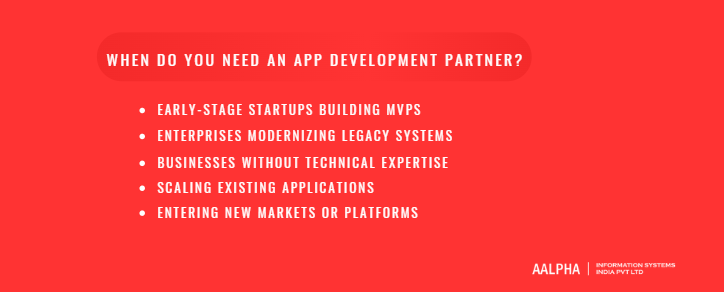
When Do You Need an App Development Partner?
Deciding when to engage an app development partner is often driven by a combination of technical limitations, business urgency, and growth objectives. Many organizations initially attempt to build internally, only to realize that modern app development requires a depth of expertise, speed, and scalability that is difficult to achieve without external support. Recognizing the right moment to partner can prevent costly delays, reduce technical debt, and significantly improve product outcomes.
Businesses typically reach this decision when they need to move faster than their internal capabilities allow, access specialized skills, or reduce the risks associated with complex development projects. Whether it is launching a new product, modernizing outdated systems, or expanding into new markets, a development partner provides the structure and expertise needed to execute effectively.
-
Early-Stage Startups Building MVPs
Startups often operate under intense pressure to validate their ideas quickly while managing limited budgets. Building a minimum viable product is a critical step in this process, as it allows founders to test assumptions, gather user feedback, and attract early adopters or investors. However, assembling an in-house team at this stage is rarely practical due to time and cost constraints.
An app development partner enables startups to move from concept to launch much faster by leveraging pre-built frameworks, established workflows, and experienced teams. Instead of spending months recruiting developers and setting up infrastructure, startups can immediately begin product development with a partner that understands how to prioritize features and avoid unnecessary complexity.
Cost efficiency is another key factor. Partnerships allow startups to allocate resources strategically, focusing on essential features while avoiding long-term commitments. More importantly, experienced partners can guide product decisions, helping founders avoid common mistakes such as overbuilding or misaligning with user needs. This combination of speed, expertise, and cost control makes partnerships particularly valuable during the MVP stage.
-
Enterprises Modernizing Legacy Systems
Large organizations often face challenges with legacy systems that are outdated, difficult to maintain, and unable to support modern user expectations. These systems may lack scalability, have poor performance, or be incompatible with newer technologies such as cloud infrastructure, APIs, and mobile platforms. Modernizing such systems is a complex process that requires careful planning and specialized expertise.
App development partners play a critical role in digital transformation initiatives by helping enterprises redesign and rebuild their applications using modern architectures. This may involve migrating from monolithic systems to microservices, implementing cloud-native solutions, or creating new user interfaces that improve usability and accessibility.
For example, a financial services company may need to transform its legacy desktop application into a mobile-first platform with real-time data processing and enhanced security. Achieving this internally can be resource-intensive and slow, especially if existing teams are already managing ongoing operations. A development partner brings the necessary experience, tools, and frameworks to execute modernization projects efficiently while minimizing disruption to business operations.
-
Businesses Without Technical Expertise
Many businesses recognize the need for a digital product but lack the internal technical knowledge to execute it effectively. This is common among traditional industries such as retail, healthcare, logistics, and services, where core competencies lie outside software development.
In such cases, an app development partner becomes essential. They provide not only the technical capabilities required to build the application but also strategic guidance on product design, architecture, and technology choices. This ensures that the final product is aligned with both user expectations and business goals.
Without this expertise, companies risk making poor technical decisions, selecting inappropriate technologies, or underestimating development complexity. A strong partnership mitigates these risks by offering structured processes, experienced teams, and proven methodologies.
-
Scaling Existing Applications
As applications gain traction, they often face new challenges related to performance, scalability, and feature expansion. What works for a small user base may not be sufficient when the application needs to support thousands or millions of users. Issues such as slow response times, system crashes, and inefficient data handling can quickly impact user experience and business growth.
An app development partner can help address these challenges by optimizing system architecture, improving performance, and implementing scalable infrastructure. This may include transitioning to cloud-based solutions, enhancing database performance, or introducing load balancing and caching mechanisms.
Additionally, scaling often involves adding new features and integrations. Development partners can accelerate this process by providing additional resources and expertise, ensuring that the application evolves without compromising stability or performance.
-
Entering New Markets or Platforms
Expanding into new markets or platforms is another common trigger for engaging an app development partner. Businesses that initially launch on one platform, such as web, often need to extend their presence to mobile applications on iOS and Android or adopt cross-platform frameworks to reach a broader audience.
This expansion requires expertise in platform-specific development, user interface adaptation, and performance optimization. For example, building a mobile app involves different design considerations, device compatibility challenges, and app store requirements compared to web applications.
Development partners with cross-platform experience can streamline this process by recommending the right technologies, ensuring consistent user experiences, and reducing development time. They also help businesses navigate regional requirements, localization, and compliance when entering new geographic markets.
By leveraging a partner’s expertise, companies can expand efficiently while maintaining product quality and user satisfaction.
Key Benefits of App Development Partnerships
App development partnerships deliver measurable business value when executed correctly. Beyond simply building an application, they enable organizations to accelerate product delivery, reduce operational complexity, and improve overall product quality. In a competitive digital environment, where user expectations evolve rapidly and technology stacks become increasingly complex, relying solely on internal teams can limit growth. Partnerships provide a structured way to overcome these challenges while maintaining efficiency and scalability.
The benefits are not limited to cost savings or faster execution. They extend to strategic advantages such as access to advanced technologies, improved decision-making, and the ability to adapt quickly to market changes. For many businesses, the return on investment from a well-managed partnership is reflected in faster product launches, higher user satisfaction, and sustained long-term growth.
-
Access to Specialized Expertise
Modern applications require a combination of skills that span multiple domains, including frontend and backend development, UI/UX design, cloud infrastructure, cybersecurity, and increasingly, artificial intelligence and data engineering. Building and maintaining such a diverse skill set internally is both time-consuming and expensive.
App development partners provide immediate access to multidisciplinary teams with proven experience across these areas. For example, a partner can bring in UI/UX designers who specialize in user behavior and interface optimization, backend engineers who design scalable architectures, and cloud experts who ensure reliable deployment and performance. In more advanced scenarios, businesses can leverage expertise in AI-driven features such as recommendation engines, chatbots, or predictive analytics.
This breadth of expertise reduces the risk of technical errors and ensures that each component of the application is built using best practices. It also allows businesses to adopt new technologies more confidently, without the need for extensive internal training or experimentation.
-
Faster Time-to-Market
Speed is often a critical factor in the success of digital products. Whether launching a startup, introducing a new feature, or entering a competitive market, delays can result in missed opportunities and reduced market share. App development partners are structured to deliver faster outcomes through established processes and reusable assets.
Most experienced partners follow agile development methodologies, breaking projects into smaller iterations and delivering incremental updates. This approach allows businesses to test features early, gather feedback, and make adjustments without waiting for a full product release. It also reduces the likelihood of major rework later in the development cycle.
Additionally, development partners often use pre-built frameworks, libraries, and tools that accelerate common tasks such as authentication, payment integration, and user management. Instead of building everything from scratch, they can focus on customizing solutions to meet specific business needs.
The result is a significantly shorter development cycle, enabling businesses to launch products faster, validate ideas earlier, and respond quickly to changing market conditions.
-
Cost Efficiency and Predictability
One of the most practical advantages of app development partnerships is cost control. Building an in-house team involves significant expenses, including recruitment, salaries, benefits, infrastructure, and ongoing training. These costs are often fixed, regardless of whether the team is fully utilized.
In contrast, partnerships offer more flexible pricing models, such as fixed-cost projects, hourly billing, or dedicated teams. This allows businesses to align spending with actual project requirements and avoid unnecessary overhead. For example, a company can scale down resources after a product launch and scale up again when new features are needed.
Cost predictability is another important factor. With clearly defined scopes and agreements, businesses can plan budgets more accurately and reduce the risk of unexpected expenses. Experienced development partners also help optimize resource allocation by recommending efficient solutions and avoiding overengineering.
Overall, partnerships provide a more controlled and efficient way to manage development costs while maintaining high-quality outcomes.
-
Scalability and Flexibility
Business needs rarely remain static. As products evolve, user bases grow, and market conditions change, development requirements also shift. One of the key strengths of app development partnerships is the ability to scale resources up or down based on demand.
For example, during the initial development phase, a business may require a larger team to accelerate progress. Once the product is launched, the focus may shift to maintenance and incremental updates, requiring fewer resources. Later, during a major feature expansion, the team can be scaled up again.
This level of flexibility is difficult to achieve with in-house teams, where hiring and downsizing involve significant time and cost. Partnerships eliminate these constraints by providing access to a pool of skilled professionals who can be deployed as needed.
Scalability also extends to technical capabilities. As applications grow, partners can introduce advanced solutions such as microservices architecture, cloud scaling, and performance optimization to support increasing demand without compromising reliability.
-
Focus on Core Business Functions
Developing and maintaining an application requires continuous attention to technical details, which can divert focus from core business activities. For many organizations, especially startups and non-technical businesses, this can slow down growth and limit strategic progress.
By partnering with an experienced development team, businesses can delegate technical responsibilities while concentrating on areas such as product strategy, customer acquisition, marketing, and operations. This division of responsibilities ensures that both technical and business aspects receive the attention they require.
For example, a retail company launching a mobile app can focus on supply chain optimization and customer engagement while the development partner handles platform performance, updates, and feature implementation. This alignment improves overall efficiency and allows leadership teams to make better use of their time and resources.
-
Improved Product Quality
Product quality is a critical factor in user satisfaction, retention, and long-term success. App development partners bring structured quality assurance processes that help ensure reliability, performance, and usability.
This includes comprehensive testing at multiple stages of development, such as unit testing, integration testing, and user acceptance testing. Partners also implement best practices for code quality, security, and performance optimization, reducing the likelihood of bugs, vulnerabilities, and system failures.
In addition, experienced teams follow design standards that enhance user experience, ensuring that applications are intuitive, responsive, and visually consistent across devices. Continuous monitoring and post-launch support further contribute to maintaining high performance over time.
The result is a more stable, scalable, and user-friendly application that meets both technical standards and user expectations, ultimately driving higher engagement and business value.
How App Development Partnerships Work (End-to-End Process)
A successful app development partnership follows a structured, collaborative process that aligns business objectives with technical execution. Rather than treating development as a one-time activity, modern partnerships operate as continuous cycles of planning, building, testing, and improving. This approach reduces risk, improves product quality, and ensures that the final application delivers measurable business value.
The process typically spans multiple stages, starting from understanding the business problem and ending with ongoing optimization after launch. Each phase involves close collaboration between stakeholders, product managers, designers, and engineers. When executed correctly, this end-to-end workflow ensures clarity, transparency, and predictable outcomes.
-
Requirement Discovery and Business Analysis
The foundation of any successful app development partnership is a clear understanding of business goals, user needs, and product requirements. This phase, often referred to as discovery, involves gathering detailed information about what the application is expected to achieve and how it will deliver value to users.
During this stage, the development partner works closely with stakeholders to define the target audience, identify key use cases, and prioritize features. For example, a logistics platform may need real-time tracking, route optimization, and payment integration, while a healthcare app may prioritize patient data security, appointment scheduling, and teleconsultation features.
Business analysis also includes evaluating competitors, identifying market gaps, and aligning the product vision with measurable outcomes such as user acquisition, retention, or revenue generation. Clear documentation, including product requirement documents and user stories, is created to ensure that all stakeholders have a shared understanding of the scope.
This phase is critical because poorly defined requirements often lead to scope creep, delays, and increased costs. A strong discovery process ensures that development begins with a clear roadmap, reducing uncertainty and improving execution efficiency.
-
Technical Planning and Architecture Design
Once requirements are defined, the focus shifts to designing the technical foundation of the application. This involves selecting the appropriate technology stack, defining system architecture, and planning for scalability, performance, and security.
The development partner evaluates factors such as expected user load, data processing requirements, integration needs, and long-term growth plans. For instance, an application expecting rapid user growth may require a cloud-native architecture with auto-scaling capabilities, while a data-intensive platform may need optimized database structures and caching mechanisms.
Technology selection is another key aspect of this phase. Decisions are made regarding frontend frameworks, backend technologies, databases, and third-party integrations. For example, a cross-platform mobile app might use frameworks like React Native or Flutter, while enterprise-grade systems may rely on microservices architecture for flexibility and scalability.
Security considerations are also addressed at this stage, including data encryption, authentication mechanisms, and compliance with regulations such as GDPR or HIPAA where applicable.
A well-designed architecture ensures that the application is not only functional at launch but also capable of evolving over time without requiring major restructuring.
-
UI/UX Design Collaboration
User experience plays a critical role in the success of any application. Even the most technically advanced product can fail if it is difficult to use or does not meet user expectations. This phase focuses on designing intuitive, efficient, and visually appealing interfaces.
The process begins with mapping user journeys, which outline how users interact with the application to complete specific tasks. Based on these journeys, designers create wireframes that define the layout and structure of each screen. These wireframes are then transformed into interactive prototypes, allowing stakeholders to visualize the product before development begins.
Collaboration is essential during this phase. Feedback from business stakeholders and potential users is incorporated to refine the design and ensure alignment with business goals. Attention is given to usability, accessibility, and consistency across devices and platforms.
A strong UI/UX design process reduces the need for major changes during development and helps ensure that the final product delivers a seamless user experience.
-
Development and Agile Execution
With design and architecture in place, the development phase begins. Most app development partnerships follow agile methodologies, which emphasize iterative progress, flexibility, and continuous feedback.
Development is divided into smaller cycles known as sprints, typically lasting one to two weeks. Each sprint focuses on delivering a set of features or improvements, allowing stakeholders to review progress regularly and provide feedback. This iterative approach reduces risk by identifying issues early and enabling adjustments without disrupting the entire project.
The development team works on both frontend and backend components, integrating features such as user authentication, data management, APIs, and third-party services. Continuous integration and version control systems are used to maintain code quality and ensure smooth collaboration among team members.
Regular communication, including sprint reviews and stand-up meetings, ensures transparency and alignment throughout the process. This structured yet flexible approach allows businesses to adapt to changing requirements while maintaining steady progress toward the final product.
-
Testing, QA, and Performance Optimization
Quality assurance is an integral part of the development process, ensuring that the application is reliable, secure, and performs well under different conditions. Testing is conducted at multiple levels, including unit testing, integration testing, and system testing.
Functional testing verifies that features work as intended, while usability testing ensures that the application is easy to navigate and meets user expectations. Performance testing evaluates how the application behaves under high traffic or heavy data loads, identifying potential bottlenecks and areas for optimization.
Security testing is also critical, particularly for applications handling sensitive data. This includes identifying vulnerabilities, ensuring secure authentication, and protecting against threats such as data breaches or unauthorized access.
By addressing issues before launch, this phase minimizes the risk of failures, improves user satisfaction, and ensures that the application meets industry standards.
-
Deployment and Launch Strategy
Once the application has been tested and validated, it is prepared for deployment. This involves configuring servers, setting up cloud infrastructure, and ensuring that the application is ready for real-world usage.
For mobile applications, this includes submitting the app to platforms such as the Apple App Store and Google Play, ensuring compliance with their guidelines. For web applications, deployment involves hosting on cloud platforms and configuring domain settings.
A well-planned launch strategy may also include staged rollouts, allowing businesses to release the application to a limited audience before a full-scale launch. This helps identify any remaining issues and gather early feedback.
-
Post-Launch Support and Continuous Improvement
The launch of an application is not the end of the development process. Ongoing support and continuous improvement are essential to maintain performance, address user feedback, and introduce new features.
Post-launch activities include monitoring application performance, fixing bugs, and implementing updates to improve functionality and security. Analytics tools are used to track user behavior, providing insights that guide future enhancements.
As business needs evolve, development partners help introduce new features, integrate additional services, and optimize the application for scalability. This ensures that the product remains competitive and continues to deliver value over time.
A strong post-launch strategy transforms the application from a static product into a dynamic, evolving platform that adapts to user needs and market trends.
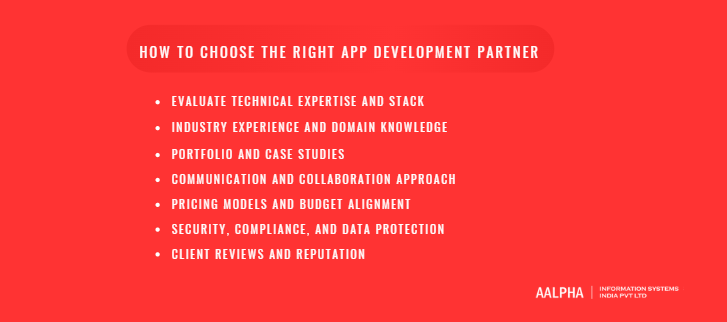
How to Choose the Right App Development Partner
Selecting the right mobile app development company or partner is one of the most critical decisions in the entire product lifecycle. The quality of this decision directly influences development speed, product performance, scalability, and long-term business outcomes. A strong partner does more than execute tasks; they contribute to product strategy, anticipate challenges, and help build a foundation for sustainable growth.
Many businesses make the mistake of choosing partners based solely on cost or superficial factors such as website design or sales presentations. In reality, a reliable evaluation requires a structured approach that considers technical capability, industry understanding, communication practices, and long-term alignment with business goals. The following criteria provide a comprehensive framework for making an informed decision.
-
Evaluate Technical Expertise and Stack
Technical expertise is the foundation of any app development partnership. A capable partner should demonstrate proficiency across the full technology stack, including frontend development, backend systems, cloud infrastructure, and modern frameworks. This ensures they can handle the entire development lifecycle without relying heavily on third-party dependencies.
On the frontend side, expertise in technologies such as React, Angular, or cross-platform frameworks like Flutter and React Native is essential for building responsive and user-friendly interfaces. Backend capabilities should include scalable architectures using technologies such as Node.js, Python, or Java, along with experience in database management and API development.
Cloud expertise is equally important. A strong partner should be comfortable working with platforms such as AWS, Azure, or Google Cloud, enabling them to design systems that are scalable, secure, and cost-efficient. Increasingly, businesses also require capabilities in artificial intelligence, machine learning, and data analytics, particularly for features such as personalization, automation, and predictive insights.
Beyond individual technologies, evaluate how the partner approaches system design, performance optimization, and long-term scalability. A technically strong partner will not only build the application but also ensure it can evolve as business needs grow.
-
Industry Experience and Domain Knowledge
Technical skills alone are not sufficient. Domain knowledge plays a critical role in building applications that align with real-world business requirements and user expectations. A partner with experience in your industry understands common challenges, regulatory requirements, and user behavior patterns.
For example, healthcare applications require strict compliance with data privacy regulations and a deep understanding of patient workflows. Fintech platforms demand high levels of security, real-time processing, and regulatory adherence. Logistics applications must handle real-time tracking, route optimization, and operational efficiency.
An experienced partner can anticipate these requirements and incorporate them into the development process from the beginning. This reduces the need for extensive revisions and ensures that the product meets industry standards.
Additionally, domain expertise enables partners to provide strategic input. They can suggest features, workflows, and improvements based on insights gained from previous projects, helping businesses avoid common pitfalls and accelerate product success.
-
Portfolio and Case Studies
A partner’s portfolio provides concrete evidence of their capabilities and experience. Reviewing past projects helps assess whether the partner has successfully delivered applications similar in complexity and scope to your requirements.
Case studies are particularly valuable because they go beyond visual design and highlight the problem, solution, and outcomes. For example, a strong case study may demonstrate how a partner helped a startup launch an MVP within a tight timeline, or how they enabled an enterprise to modernize its legacy system and improve performance.
When evaluating portfolios, look for diversity in projects, including different industries, platforms, and technologies. This indicates adaptability and the ability to handle varied requirements. Pay attention to the quality of design, performance, and user experience in the applications they have built.
It is also useful to ask for live product links or references. Seeing how applications perform in real-world environments provides a more accurate assessment than static screenshots or descriptions.
-
Communication and Collaboration Approach
Effective communication is essential for the success of any app development partnership. Even highly skilled teams can fail to deliver results if communication is unclear or inconsistent. A strong partner should have structured processes for collaboration, ensuring transparency and alignment throughout the project.
This includes regular updates, such as daily stand-ups, weekly progress reports, and sprint reviews. Clear documentation of requirements, changes, and decisions helps avoid misunderstandings and ensures that all stakeholders remain aligned.
Time zone differences should also be considered, especially when working with offshore teams. A reliable partner will have processes in place to manage time zone gaps, such as overlapping working hours or asynchronous communication tools.
The use of collaboration tools such as Jira, Trello, Slack, or Microsoft Teams can further enhance transparency and efficiency. These tools allow businesses to track progress, manage tasks, and communicate with the development team in real time.
Ultimately, a partner’s communication approach should make the development process predictable, transparent, and easy to manage.
-
Pricing Models and Budget Alignment
Understanding pricing models is critical to ensuring that the partnership aligns with your budget and project requirements. Different models offer varying levels of flexibility and predictability.
Fixed-cost models are suitable for projects with well-defined requirements and timelines. They provide clear budget expectations but may lack flexibility if changes are needed during development.
Time and material models offer greater flexibility, allowing businesses to pay based on the actual time and resources used. This is ideal for projects with evolving requirements but requires careful monitoring to manage costs.
Dedicated team models involve hiring a team that works exclusively on your project for a set period. This approach provides consistency and scalability, making it suitable for long-term development needs.
A reliable partner will help you choose the most appropriate model based on your goals, budget, and project complexity. They should also provide transparent pricing structures and clear estimates, minimizing the risk of unexpected costs.
-
Security, Compliance, and Data Protection
Security and compliance are critical considerations, particularly for applications handling sensitive data. A trustworthy development partner should follow industry best practices for data protection, encryption, and secure coding.
Depending on the industry, compliance with regulations such as GDPR, HIPAA, or PCI-DSS may be required. The partner should demonstrate experience in implementing these standards and ensuring that applications meet all necessary legal and regulatory requirements.
Security should be integrated into every stage of development, from architecture design to testing and deployment. This includes implementing secure authentication mechanisms, protecting data in transit and at rest, and conducting regular security audits.
Choosing a partner with strong security practices reduces the risk of data breaches and ensures that the application maintains user trust.
-
Client Reviews and Reputation
A partner’s reputation provides valuable insight into their reliability, professionalism, and ability to deliver results. Client reviews, testimonials, and ratings on third-party platforms offer an unbiased perspective on their performance.
Look for consistent feedback regarding communication, quality of work, adherence to timelines, and problem-solving capabilities. Positive reviews from long-term clients are particularly strong indicators of a successful partnership.
It is also beneficial to request direct references and speak with previous clients. This allows you to gain deeper insights into the partner’s working style, strengths, and potential areas of concern.
An established reputation, combined with proven results, is a strong indicator that the partner can be trusted to deliver high-quality outcomes and support long-term business growth.
In practice, businesses that carefully evaluate these factors are far more likely to form successful app development partnerships. Experienced providers such as Aalpha often stand out by combining technical expertise, industry knowledge, transparent communication, and proven delivery capabilities, making them reliable partners for both startups and enterprises.
Cost of App Development Partnerships
Understanding the cost of an app development partnership is essential for making informed business decisions. For most organizations, cost is not just about the initial development budget but the total investment required to build, launch, and maintain a scalable digital product. The actual cost can vary significantly depending on factors such as app complexity, feature set, development model, and geographic location of the partner.
Businesses often ask how much it costs to build an app with a development partner, and the answer depends on multiple variables rather than a fixed number. A simple application with basic functionality may cost significantly less than a complex platform with real-time features, integrations, and advanced technologies like AI. The key is to understand what drives these costs and how to structure the engagement to maximize return on investment.
-
Key Cost Factors
The cost of an app development partnership is primarily influenced by the complexity of the application and the scope of features. Applications can generally be categorized into three levels: simple, moderately complex, and highly complex.
A simple app with basic features such as user authentication, simple UI screens, and minimal backend logic will require fewer resources and less development time. In contrast, moderately complex apps may include features like real-time data synchronization, payment gateways, third-party integrations, and custom user flows. Highly complex applications, such as marketplaces, fintech platforms, or AI-driven systems, involve advanced architectures, high-performance requirements, and extensive integrations.
Feature requirements significantly impact cost. For example, adding features such as push notifications, analytics dashboards, chat systems, or geolocation increases development effort. Integrations with third-party services, such as payment providers, CRMs, or logistics systems, also add complexity and cost.
Other factors include platform choice (iOS, Android, or cross-platform), design complexity, and performance requirements. Applications that require high scalability, real-time processing, or advanced security measures will naturally involve higher development costs.
-
Pricing Models Explained
App development partnerships typically operate under three primary pricing models: fixed price, time and material, and retainer or dedicated team models. Each model serves different business needs and project types.
The fixed-price model is best suited for projects with clearly defined requirements, scope, and timelines. In this model, the total cost is agreed upon upfront, providing predictability and budget control. However, it offers limited flexibility, as changes to the scope may require renegotiation.
The time and material model is more flexible, allowing businesses to pay based on the actual time and resources used. This approach is ideal for projects with evolving requirements, such as startups iterating on an MVP or businesses adding new features over time. While it provides adaptability, it requires close monitoring to ensure costs remain within budget.
The retainer or dedicated team model involves hiring a team that works exclusively on your project for a fixed monthly cost. This model is commonly used for long-term partnerships where continuous development, maintenance, and scaling are required. It offers stability, scalability, and better alignment with ongoing business needs.
Choosing the right pricing model depends on the level of certainty in project requirements and the need for flexibility during development.
-
Cost Comparison: In-House vs Partnership
Comparing the cost of building an in-house team versus partnering with an external development company reveals significant differences in both direct and indirect expenses.
An in-house team requires substantial upfront investment in recruitment, salaries, benefits, office space, hardware, and training. For example, hiring a full team consisting of frontend developers, backend engineers, designers, and project managers can cost hundreds of thousands of dollars annually, even before development begins.
In contrast, an app development partnership converts many of these fixed costs into variable costs. Businesses pay only for the resources they need, when they need them. This eliminates expenses related to hiring, onboarding, and maintaining a full-time team.
Additionally, development partners bring established processes and expertise, reducing the risk of delays and costly mistakes. While hourly rates may appear comparable in some cases, the overall cost efficiency of partnerships is often higher due to faster delivery and optimized resource usage.
-
Hidden Costs to Consider
Beyond initial development, several hidden costs can impact the total investment required for an application. Maintenance is one of the most significant ongoing expenses, including bug fixes, performance improvements, and compatibility updates.
Scaling costs should also be considered. As user numbers grow, infrastructure expenses such as cloud hosting, database management, and bandwidth usage increase. Applications that handle real-time data or high traffic require additional optimization and monitoring.
Other hidden costs include third-party service fees, such as payment gateways, APIs, and analytics tools, as well as security updates and compliance requirements. Failing to account for these factors can lead to budget overruns and operational challenges.
-
Typical Cost Estimates by Region
The cost of app development partnerships varies significantly based on geographic location, primarily due to differences in labor rates and market demand.
In the United States, app development costs are among the highest, with hourly rates typically ranging from $100 to $200 or more, depending on expertise and project complexity. Europe offers slightly lower rates, generally between $60 and $150 per hour, with variations across Western and Eastern regions.
India and other parts of Asia provide more cost-effective options, with hourly rates typically ranging from $20 to $60. Despite the lower costs, many development companies in these regions offer high-quality services, making them attractive for startups and enterprises looking to optimize budgets.
For example, a moderately complex application that might cost $150,000 to $300,000 in the US could be developed for $40,000 to $120,000 in India, depending on the scope and requirements.
However, cost should not be the sole deciding factor. Factors such as expertise, communication, and reliability play an equally important role in determining the overall success of the partnership.
In practice, businesses that understand these cost dynamics are better positioned to plan budgets, select the right pricing model, and maximize the value of their app development partnerships.
Challenges in App Development Partnerships
While app development partnerships offer significant advantages, they also introduce certain challenges that businesses must proactively manage. A transparent understanding of these risks is essential for building trust and ensuring long-term success. Most partnership failures are not due to a lack of technical capability but rather issues related to communication, alignment, and process management.
Recognizing these challenges early allows businesses to implement safeguards, establish clear expectations, and create a more structured collaboration environment. When managed effectively, these risks can be minimized, enabling the partnership to deliver consistent and high-quality results.
-
Communication Gaps
Communication is one of the most common challenges in app development partnerships, particularly when teams are distributed across different time zones or cultural contexts. Delays in responses, unclear instructions, or inconsistent updates can lead to misunderstandings and slow down progress.
For example, if a business stakeholder provides incomplete requirements or ambiguous feedback, the development team may interpret them differently, resulting in rework and delays. Similarly, time zone differences can create gaps in real-time collaboration, especially when urgent decisions are required.
Language barriers and varying communication styles can further complicate interactions. Some teams may prefer detailed documentation, while others rely on verbal discussions, leading to misalignment if expectations are not clearly defined.
To address these issues, successful partnerships establish structured communication processes, including regular meetings, detailed documentation, and the use of collaboration tools. Clear escalation paths and defined points of contact also help ensure that issues are resolved quickly and efficiently.
-
Misaligned Expectations
Misaligned expectations often arise when project goals, deliverables, or timelines are not clearly defined at the outset. This can lead to scope creep, where additional features or changes are introduced without proper planning or budget adjustments.
For instance, a business may expect rapid delivery of new features, while the development team may require additional time for proper implementation and testing. Without clear alignment, this mismatch can create friction and dissatisfaction on both sides.
To mitigate this risk, it is essential to establish detailed project requirements, timelines, and success metrics during the initial stages of the partnership. Regular reviews and transparent discussions help ensure that both parties remain aligned as the project evolves.
-
Quality and Delivery Risks
Inconsistent quality and missed deadlines are significant concerns in any development partnership. These risks can arise from inadequate testing processes, lack of technical expertise, or poor project management practices.
For example, an application may be delivered on time but contain performance issues or bugs that affect user experience. Alternatively, delays in development can disrupt business plans, especially when product launches are tied to market opportunities or investor expectations.
Ensuring consistent quality requires a strong emphasis on testing, code reviews, and adherence to best practices. Reliable partners implement structured quality assurance processes and maintain transparency through regular progress updates and performance metrics.
-
Data Security Concerns
Data security is a critical consideration, particularly for applications that handle sensitive user information such as personal data, financial transactions, or healthcare records. Engaging an external development partner introduces additional risks related to data access and handling.
Potential vulnerabilities include unauthorized access, data breaches, and non-compliance with regulatory requirements. For example, failing to implement proper encryption or secure authentication mechanisms can expose applications to cyber threats.
To address these concerns, businesses must ensure that their development partners follow strict security protocols, including secure coding practices, data encryption, and compliance with relevant regulations such as GDPR or HIPAA. Regular security audits and clear data handling policies further reduce the risk of breaches.
-
Dependency on External Teams
Relying heavily on an external development partner can create long-term dependency, particularly if the partner manages critical aspects of the application such as architecture, infrastructure, or proprietary systems. This dependency can limit flexibility and make it difficult to transition to another provider or bring development in-house.
For example, if knowledge transfer is not properly managed, businesses may struggle to maintain or update the application independently. This can lead to increased costs and reduced control over the product.
To mitigate this risk, it is important to ensure proper documentation, maintain access to source code and infrastructure, and establish clear knowledge transfer processes. Building a collaborative relationship where knowledge is shared rather than siloed helps reduce dependency and ensures greater control over the product in the long term.
A clear understanding of these challenges allows businesses to approach app development partnerships with realistic expectations and proactive strategies. When communication is structured, expectations are aligned, and processes are well-defined, these risks can be effectively managed, resulting in a productive and successful collaboration.
Best Practices for Successful App Development Partnerships
A successful app development partnership is not defined solely by technical execution but by how effectively both parties collaborate, communicate, and align around shared goals. Even highly skilled teams can underperform if processes are unclear or expectations are not managed properly. The most effective partnerships operate with structure, transparency, and a long-term perspective, ensuring that both business and technical objectives are consistently met.
Organizations that follow proven best practices are more likely to achieve faster delivery, better product quality, and stronger return on investment. These practices create a foundation for trust, reduce operational risks, and enable continuous improvement throughout the product lifecycle.
-
Define Clear Goals and KPIs
Every successful partnership begins with clearly defined goals and measurable key performance indicators. Without a shared understanding of what success looks like, it becomes difficult to evaluate progress or make informed decisions during development.
Business goals may include metrics such as user acquisition, revenue growth, or market expansion, while technical objectives focus on performance, scalability, and system reliability. For example, a startup building an MVP may prioritize speed to market and user validation, whereas an enterprise application may focus on uptime, security, and integration capabilities.
Clearly defined KPIs provide a framework for decision-making and help align both parties throughout the project. These metrics should be documented at the beginning of the engagement and revisited regularly to ensure that development efforts remain aligned with business priorities.
-
Establish Strong Communication Channels
Effective communication is essential for maintaining alignment and avoiding misunderstandings. Successful partnerships rely on structured communication processes that ensure transparency and consistency.
Daily stand-up meetings help track progress, identify blockers, and maintain momentum. Weekly or bi-weekly sprint reviews provide an opportunity to assess completed work and gather feedback. In addition, regular reporting ensures that stakeholders are informed about timelines, risks, and performance.
The use of collaboration tools such as project management platforms, messaging systems, and shared dashboards enhances visibility into the development process. These tools allow businesses to monitor progress in real time, track tasks, and communicate efficiently with the development team.
Clear communication protocols, including defined points of contact and escalation procedures, ensure that issues are addressed promptly and do not disrupt the overall workflow.
-
Use Agile and Iterative Development
Agile methodologies are widely recognized as the most effective approach for app development partnerships. Instead of following a rigid, linear process, agile development focuses on iterative progress, allowing teams to deliver incremental improvements over time.
This approach enables businesses to test features early, gather user feedback, and make adjustments before the product is fully developed. It reduces the risk of building features that do not align with user needs and ensures that the final product is more refined and user-centric.
Short development cycles, known as sprints, provide flexibility and allow teams to adapt to changing requirements. This is particularly valuable in dynamic environments where market conditions and user expectations evolve rapidly.
-
Maintain Documentation and Transparency
Comprehensive documentation is a critical component of a successful partnership. It ensures that knowledge is shared across teams and reduces dependency on individual contributors.
Documentation should include product requirements, technical specifications, architecture diagrams, and development guidelines. This information serves as a reference point for both current and future development efforts, making it easier to onboard new team members and maintain continuity.
Transparency is equally important. Businesses should have visibility into development progress, challenges, and decision-making processes. Regular updates, shared dashboards, and clear reporting structures help build trust and ensure that all stakeholders remain informed.
-
Build Long-Term Relationships
App development partnerships deliver the greatest value when they are approached as long-term collaborations rather than short-term engagements. Building a strong relationship with a development partner allows for deeper understanding, better alignment, and more efficient execution over time.
As the partner becomes more familiar with the business, its users, and its goals, they can provide more strategic input and proactively suggest improvements. This continuity reduces the learning curve for new projects and enables faster decision-making.
Trust is a key factor in long-term partnerships. Open communication, mutual respect, and consistent performance help strengthen this trust, creating a collaborative environment where both parties are invested in the product’s success.
-
Monitor Performance and Outcomes
Continuous monitoring is essential to ensure that the partnership delivers expected results. This involves tracking both technical performance and business outcomes using predefined metrics.
Technical metrics may include system uptime, response times, and error rates, while business metrics focus on user engagement, retention, and revenue. Regular analysis of these metrics helps identify areas for improvement and guides future development efforts.
Performance reviews should be conducted at regular intervals to evaluate progress, address challenges, and refine strategies. This data-driven approach ensures that decisions are based on measurable outcomes rather than assumptions.
By consistently monitoring performance, businesses can optimize their applications, improve user experience, and maximize the value of their app development partnerships.
FAQs: App Development Partnership
1. What is an app development partnership?
An app development partnership is a collaborative relationship between a business and a software development company to design, build, and maintain an application. Unlike traditional outsourcing, it involves ongoing communication, shared responsibility, and alignment with business goals. The partner contributes technical expertise while the business provides domain knowledge and product direction.
2. How do I choose the right app development company?
Start by evaluating technical expertise, industry experience, and past projects. Review case studies, check client feedback, and assess communication practices. A reliable partner should offer transparent pricing, clear processes, and the ability to scale with your needs. Strong alignment with your business goals is as important as technical capability.
3. How much does app development cost?
Costs vary based on complexity, features, and location of the development partner. A simple app may cost $20,000 to $50,000, while more complex applications can exceed $100,000. Factors such as integrations, design requirements, and scalability needs significantly influence the final budget.
4. Is outsourcing better than hiring in-house developers?
Outsourcing or partnering is often more cost-effective and faster, especially for startups and growing businesses. It provides access to experienced teams without the overhead of hiring and managing full-time employees. In-house teams offer more control but require higher long-term investment and time to build.
5. How long does it take to build an app?
Development timelines depend on the scope and complexity of the project. A basic app may take 2–4 months, while more advanced applications can take 6–12 months or longer. Using agile development, businesses can launch early versions faster and improve them over time.
6. What is the difference between outsourcing and partnership?
Outsourcing typically focuses on task execution based on predefined requirements. A partnership involves deeper collaboration, where the development team contributes to strategy, design, and long-term product growth. Partnerships are more flexible and aligned with business outcomes.
7. Can I scale my team with a development partner?
Yes, most development partners offer flexible engagement models that allow you to scale resources up or down as needed. This is particularly useful during peak development phases or when adding new features, without committing to long-term hiring.
8. What industries benefit most from app development partnerships?
Almost all industries benefit, including healthcare, fintech, logistics, eCommerce, and education. Any business that relies on digital products or needs to improve customer experience can leverage development partnerships to accelerate growth and innovation.
9. Do app development partners provide post-launch support?
Yes, most partners offer ongoing support after launch, including maintenance, bug fixes, performance monitoring, and feature updates. This ensures that the application remains secure, functional, and aligned with evolving user needs.
10. Can a development partner help with MVP development?
Yes, development partners are commonly used to build minimum viable products. They help prioritize essential features, reduce development time, and ensure that the product can be tested quickly in the market. This is especially valuable for startups validating new ideas.
Final Thoughts
App development partnerships have become a practical and scalable approach for businesses looking to build high-quality digital products without the delays and costs of assembling full in-house teams. From faster time-to-market to access to specialized expertise, the right partner can significantly improve both product outcomes and business performance.
However, success depends on choosing a partner that aligns with your goals, communicates transparently, and brings proven experience to the table. A well-structured partnership is not just about development, but about building a product that can grow, adapt, and compete in a rapidly changing market.
If you are planning to build or scale an application, working with an experienced partner like Aalpha can help you move faster, reduce risk, and deliver a product that meets both user expectations and business objectives. Contact now!