





Flower delivery has moved far beyond traditional phone orders and walk-in purchases. Customers now expect to browse bouquets online, compare designs, choose occasion-based arrangements, add gifts, schedule delivery slots, make secure payments, and track the order until it reaches the recipient. This shift has created strong opportunities for florists, gifting startups, local delivery businesses, and multi-vendor marketplaces that want to sell flowers through mobile apps and web platforms. The global flower delivery service market was estimated at USD 7.60 billion in 2024 and is projected to reach USD 11.27 billion by 2030, showing steady demand for digital flower ordering and delivery models.
An on-demand flower delivery app helps businesses serve customers who need speed, convenience, and reliability. Flowers are often purchased for time-sensitive occasions such as birthdays, anniversaries, weddings, sympathy messages, corporate events, Valentine’s Day, Mother’s Day, and festive celebrations. In many cases, customers are not only buying flowers; they are sending an emotional message. That is why same-day delivery, scheduled delivery, personalized notes, bouquet customization, and real-time order updates are important parts of the user experience. Research on same-day delivery also highlights that faster delivery expectations have become a major part of online customer behavior, especially in categories where timing directly affects satisfaction.
For florists, a flower delivery app can increase local visibility, reduce dependence on manual order handling, and open new revenue channels through online payments, repeat orders, subscriptions, festive campaigns, and add-on products such as cakes, chocolates, greeting cards, plants, and premium gift boxes. For startups and marketplace owners, the opportunity is even broader. A well-built platform can connect customers with multiple local florists, manage delivery partners, automate commissions, support multiple locations, and use data to understand demand patterns during peak seasons. The floral gifting market was valued at USD 59.51 billion in 2024 and is projected to reach USD 94.13 billion by 2032, which reflects the larger commercial value of flowers as a gifting category.
However, building a successful flower delivery app requires more than listing products online. Flowers are perishable, demand changes sharply during occasions, delivery timing matters, and customers expect the final bouquet to match the images shown in the app. The platform must handle product catalogs, inventory, florist availability, delivery slots, payment flows, order tracking, refunds, notifications, reviews, and admin controls with accuracy. This guide explains how to build an on-demand flower delivery app, including app types, must-have features, advanced features, development process, technology stack, UI/UX considerations, monetization models, development cost, common challenges, and how to choose the right development partner.
Businesses planning to build a scalable flower delivery platform can also work with experienced app development companies such as Aalpha Information Systems for mobile app development, marketplace architecture, delivery tracking, payment integration, admin dashboards, and long-term technical support.
What Is an On-Demand Flower Delivery App?
Definition of an On-Demand Flower Delivery App
An on-demand flower delivery app is a digital platform that allows customers to browse, customize, order, pay for, and schedule flower deliveries through a mobile app or website. Instead of visiting a physical flower shop or placing orders manually over the phone, users can select bouquets, flower arrangements, plants, gift combos, and occasion-based products from an online catalog. The order is then assigned to a florist or vendor, prepared according to the customer’s request, and delivered to the recipient’s location within a selected time slot.
The main purpose of a flower delivery app is to make flower ordering faster, more convenient, and more organized for both customers and businesses. It supports same-day delivery, scheduled delivery, custom messages, online payments, delivery tracking, order updates, and customer support. For businesses, it creates a centralized system to manage customers, florists, delivery partners, payments, inventory, commissions, and service locations.
How the App Connects Customers, Florists, Delivery Partners, and Admins
A flower delivery app usually works through four main user roles: customers, florists, delivery partners, and admins. Customers use the app to browse flowers, select products, add delivery details, choose a date and time, make payments, and track orders. Florists or vendors receive the order through a vendor panel, prepare the bouquet, update product availability, manage pricing, and confirm whether they can fulfill the order. Delivery partners use a delivery app to accept assigned orders, navigate to the pickup location, collect the package, deliver it to the recipient, and update the delivery status.
The admin manages the complete platform from a web-based dashboard. This includes user management, vendor approval, order tracking, payment monitoring, delivery assignment, refunds, promo codes, complaints, reports, commissions, and analytics. In a single-florist model, the admin may also control the product catalog directly. In a marketplace model, multiple florists can manage their own products while the platform owner controls quality, payments, and service rules.
Traditional Flower Shops vs App-Based Flower Delivery
Traditional flower shops depend mainly on walk-in customers, phone calls, local referrals, and manual order handling. This model works for local sales, but it limits reach, makes order tracking difficult, and often creates problems during peak occasions. Orders may be written manually, delivery slots may be coordinated by phone, and customers may not receive real-time updates.
An app-based flower delivery model solves these limitations by digitizing the complete ordering process. Customers can see available products, compare prices, select delivery options, pay online, and receive automated notifications. Florists can manage more orders with less manual coordination. Marketplace owners can onboard multiple vendors and serve wider locations. Delivery teams can receive clear pickup and drop instructions through GPS-enabled apps. This makes the business more scalable, transparent, and easier to manage.
Common Use Cases of Flower Delivery Apps
Flower delivery apps are commonly used for personal, social, and business gifting needs. Customers often order flowers for birthdays, anniversaries, weddings, engagement ceremonies, baby showers, housewarming events, Valentine’s Day, Mother’s Day, festive celebrations, and apology messages. Sympathy flowers and funeral arrangements are also important use cases where timely and respectful delivery is essential.
Corporate gifting is another strong use case. Businesses may use flower delivery platforms to send bouquets to employees, clients, partners, event guests, or VIP customers. Wedding planners and event organizers may also use such platforms to book bulk floral arrangements for venues, stages, receptions, hotels, and conferences. Some apps also support recurring flower subscriptions for homes, offices, hotels, restaurants, and religious places.
Role of Mobile Apps, Web Platforms, and Admin Dashboards
A complete on-demand flower delivery system usually includes customer-facing mobile apps, a web platform, vendor panels, delivery partner apps, and an admin dashboard. The mobile app gives customers a fast ordering experience, especially for last-minute gifts and same-day deliveries. The website helps with search visibility, desktop ordering, corporate inquiries, and campaign landing pages.
The vendor panel allows florists to manage products, inventory, pricing, orders, and availability. The delivery partner app supports order assignment, navigation, pickup updates, proof of delivery, and earnings tracking. The admin dashboard acts as the control center for the business. It helps the platform owner manage operations, monitor sales, handle complaints, track performance, and make data-driven decisions. Together, these components create a complete digital flower delivery ecosystem that can support local florists, regional brands, and large multi-vendor marketplaces.
Why Businesses Are Investing in Flower Delivery App Development
-
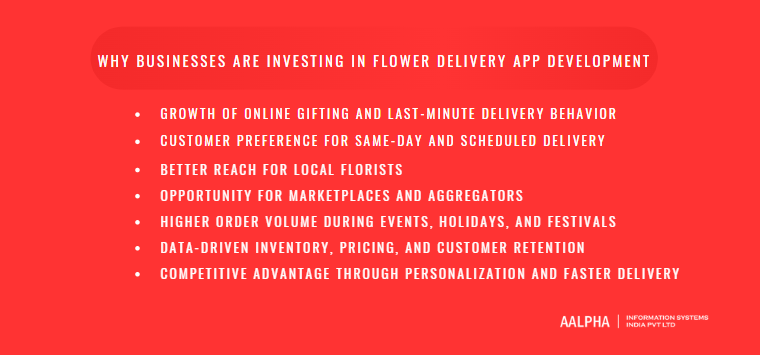
Growth of Online Gifting and Last-Minute Delivery Behavior
Businesses are investing in flower delivery app development because flowers sit at the center of the online gifting market. Customers buy flowers for emotional, social, personal, and professional occasions, and many of these purchases happen close to the event date. A customer may remember a birthday in the morning, need anniversary flowers delivered by evening, or send sympathy flowers at short notice. This behavior makes flower delivery a strong fit for on-demand commerce, where speed, convenience, and digital ordering directly influence purchase decisions.
The market data also supports this shift. The global flower delivery service market was valued at USD 7.60 billion in 2024 and is projected to reach USD 11.27 billion by 2030, growing at a CAGR of 7% from 2025 to 2030. In India, the flower delivery service market generated USD 274.4 million in 2024 and is expected to reach USD 445.5 million by 2030. These numbers show that online flower ordering is not just a seasonal opportunity; it is becoming a structured digital business category.
-
Customer Preference for Same-Day and Scheduled Delivery
Flower orders are highly time-sensitive. Unlike many retail products, flowers are often purchased for a specific moment, such as a celebration, ceremony, condolence visit, office event, or surprise delivery. This is why same-day and scheduled delivery are among the strongest reasons customers prefer app-based flower ordering over traditional purchasing. A digital platform allows users to select a delivery date, choose a time slot, add recipient details, write a personal message, and receive delivery updates without calling the florist repeatedly.
Same-day delivery has become an important part of modern online buying behavior. Research on same-day delivery notes that it has become a new standard for satisfying online customers who expect fast service, while also creating operational challenges around delivery cost, route planning, time slots, and customer satisfaction. For a flower delivery business, these challenges are even more important because product freshness and delivery timing directly affect the customer experience.
-
Better Reach for Local Florists
Local florists traditionally depend on walk-in customers, phone orders, referrals, and event-based business. A flower delivery app gives them a wider digital storefront where customers can discover products, view bouquet photos, compare prices, place orders, and pay online. This helps small and medium florists compete with larger gifting brands without needing to build a full eCommerce infrastructure on their own.
For individual florists, the benefit is not limited to visibility. A digital system can help them manage catalogs, daily stock, delivery zones, accepted orders, rejected orders, peak-time availability, and repeat customers. Florists can also promote seasonal collections, premium bouquets, wedding arrangements, plant gifts, and add-on products. This creates a more organized sales channel and reduces manual coordination, especially during high-demand days.
-
Opportunity for Marketplaces and Aggregators
Flower delivery apps are also attractive for marketplace and aggregator businesses. Instead of operating a single flower shop, the platform owner can onboard multiple florists across different locations and allow customers to choose from a larger catalog. The marketplace can earn through commissions, delivery fees, featured listings, subscriptions, add-on margins, and corporate gifting packages.
This model works particularly well in cities where demand is spread across different neighborhoods. A marketplace can route orders to nearby florists, reduce delivery distance, improve freshness, and increase delivery speed. It can also offer wider product variety because different vendors may specialize in roses, orchids, lilies, wedding flowers, sympathy arrangements, plants, or custom bouquets. For startups, this creates a scalable business model where growth is driven by vendor onboarding, delivery coverage, customer retention, and brand trust.
-
Higher Order Volume During Events, Holidays, and Festivals
Flowers see sharp demand spikes during occasions such as Valentine’s Day, Mother’s Day, weddings, Christmas, New Year, Diwali, Eid, birthdays, anniversaries, graduations, and corporate events. These peaks create strong revenue opportunities, but they also require careful operational planning. A manual flower shop may struggle to manage hundreds of orders, limited inventory, delivery slots, and customer queries at the same time.
An app-based system helps businesses prepare for these peaks with scheduled campaigns, advance booking, inventory planning, delivery slot limits, surge pricing, vendor capacity controls, and automated notifications. Market reports and news coverage also show that flower supply can become strained during wedding seasons and major occasions, leading to higher prices and availability issues. This makes digital inventory visibility, vendor coordination, and demand forecasting valuable for businesses handling large seasonal volumes.
-
Data-Driven Inventory, Pricing, and Customer Retention
Flower delivery apps generate useful data that traditional sales channels often miss. Businesses can track which flowers sell most, which occasions drive the highest revenue, which locations order frequently, which customers reorder, which vendors perform best, and which delivery slots face the most demand. This data can support smarter inventory planning, pricing, discounting, and marketing.
For example, if the app shows high rose demand before Valentine’s Day, the business can increase vendor stock, adjust prices, promote premium bouquets, and add delivery capacity. If customers frequently order lilies for corporate gifting, the platform can create dedicated business packages. Since flowers are perishable, demand forecasting is especially important. Research on fresh produce retail highlights that products with limited shelf life require careful replenishment and pricing decisions based on demand patterns, sales history, and quality decline. The same principle applies to flowers, where unsold stock can quickly turn into waste.
-
Competitive Advantage Through Personalization and Faster Delivery
A well-built flower delivery app can help businesses stand out through personalization and faster fulfillment. Customers can receive bouquet suggestions based on occasion, relationship, budget, location, previous orders, and delivery urgency. The app can recommend roses for anniversaries, lilies for sympathy flowers, orchids for premium gifting, mixed bouquets for birthdays, or flower-and-cake combos for celebrations. These recommendations improve the buying experience and increase average order value.
Faster delivery also creates a major competitive advantage. When a platform can show available products, confirm florist capacity, assign delivery partners, provide live tracking, and complete delivery within the promised slot, customers are more likely to trust the service and return for future occasions. For businesses, this combination of convenience, personalization, data, and operational control is the main reason flower delivery app development has become a strong investment opportunity.
How an On-Demand Flower Delivery App Works
An on-demand flower delivery app works by connecting customers, florists, delivery partners, and platform admins through a single digital workflow. The process begins when a customer places an order and ends when the bouquet is delivered to the recipient with confirmation. Behind this simple customer experience, the app manages product selection, customization, florist assignment, payment processing, delivery coordination, order tracking, and admin supervision.
-
Customer Selects Flowers or Bouquet Category
The customer starts by opening the mobile app or website and browsing the available flower catalog. Products are usually organized by flower type, bouquet style, price range, color, occasion, delivery speed, and popularity. Common categories include roses, lilies, orchids, carnations, tulips, mixed bouquets, luxury arrangements, plants, sympathy flowers, wedding flowers, and festival collections.
A well-designed app makes browsing easy by offering filters, search options, product images, customer reviews, and occasion-based recommendations. For example, a user looking for anniversary flowers may see red roses, premium rose boxes, heart-shaped arrangements, or flower-and-cake combos. A customer ordering for a corporate event may see bulk arrangements, table flowers, office bouquets, and premium gifting options. This first step is important because product discovery directly affects conversion.
-
Customer Adds Delivery Address, Message, Occasion, and Delivery Slot
After selecting the bouquet, the customer adds the delivery details. This includes the recipient’s name, phone number, address, delivery city, landmark, preferred delivery date, and time slot. The app may also allow the customer to select an occasion such as birthday, anniversary, wedding, apology, congratulations, sympathy, festive greeting, or corporate gifting.
Most flower delivery apps include a personal message option so the sender can add a note to be delivered with the bouquet. Some platforms also allow bouquet customization, such as choosing flower colors, arrangement size, wrapping style, vase options, greeting cards, chocolates, cakes, candles, soft toys, or premium gift boxes. For flower delivery, this step must be clear and error-free because wrong addresses, unclear time slots, or missing recipient details can lead to failed deliveries.
-
Payment Is Completed Online or Through Supported Payment Modes
Once the order details are confirmed, the customer proceeds to payment. The app may support debit cards, credit cards, net banking, UPI, wallets, PayPal, Stripe, Razorpay, cash on delivery, or payment on delivery, depending on the target market. For corporate customers, the platform may also support invoicing, wallet balance, prepaid credits, or monthly billing.
Secure payment processing is important because flower delivery apps often handle personal gifting orders and repeat purchases. The system should generate an order ID, payment receipt, invoice, and real-time payment status. If payment fails, the customer should receive a clear message and an option to retry. If the payment succeeds, the order moves to the florist or vendor for fulfillment.
-
Florist Receives and Prepares the Order
After order confirmation, the florist receives the order through a vendor panel or florist app. The order details include bouquet type, quantity, customization instructions, add-ons, delivery time, customer message, recipient address, and special notes. The florist can accept the order, reject it if unavailable, or request substitution if certain flowers are out of stock.
Once accepted, the florist prepares the bouquet according to the selected product and instructions. In a marketplace model, the order may be automatically assigned to the nearest eligible florist based on service area, product availability, delivery slot, rating, capacity, and commission rules. This stage is critical because the final bouquet must match the product image and customer expectations as closely as possible.
-
Delivery Partner Picks Up and Delivers the Order
When the bouquet is ready, the system assigns a delivery partner. The delivery partner receives pickup and drop details through the delivery app. They visit the florist, collect the order, verify the package, and update the pickup status. GPS navigation helps the delivery partner reach the recipient’s location efficiently.
Flower delivery requires careful handling because bouquets can be fragile, temperature-sensitive, and time-sensitive. The delivery workflow should include instructions such as keeping flowers upright, avoiding heat exposure, handling premium arrangements carefully, and contacting the recipient before arrival if required. The delivery partner updates the status at each step, such as accepted, reached pickup, picked up, on the way, reached destination, and delivered.
-
Customer Tracks Order and Receives Confirmation
The customer receives real-time order updates through push notifications, SMS, WhatsApp, email, or in-app alerts. These updates may include order accepted, bouquet being prepared, picked up, out for delivery, and delivered. For same-day and surprise deliveries, tracking increases customer confidence because the sender may not be present at the delivery location.
After successful delivery, the app may send proof of delivery. This can include recipient confirmation, delivery partner update, photo proof, OTP verification, digital signature, or timestamped delivery confirmation. The customer can then rate the florist, delivery partner, and overall experience. Ratings and reviews help the platform improve vendor quality, delivery performance, and customer trust.
-
Admin Monitors Orders, Payments, Vendors, Complaints, and Performance
The admin dashboard controls the complete flower delivery operation. Admins can view incoming orders, assign florists, manage vendors, track delivery partners, monitor payments, approve refunds, resolve complaints, manage commissions, create promo codes, update banners, and review reports. In a multi-vendor marketplace, the admin also handles vendor onboarding, service zones, product approval, payout management, and quality control.
The dashboard also provides business insights such as total orders, revenue, top-selling flowers, peak delivery slots, failed orders, repeat customers, vendor ratings, refund reasons, and city-wise performance. These insights help businesses plan inventory, adjust pricing, improve delivery capacity, and prepare for high-demand occasions. A flower delivery app may look simple to the customer, but its success depends on how smoothly these connected workflows operate behind the scenes.
Types of Flower Delivery Apps You Can Build
Flower delivery app development is not limited to one business model. A florist, startup, gifting brand, marketplace owner, event company, or enterprise can build different types of flower delivery apps based on target customers, operating region, delivery capacity, inventory model, and revenue strategy. Choosing the right model at the planning stage is important because it affects app features, backend architecture, vendor workflows, delivery logic, pricing, and development cost.
-
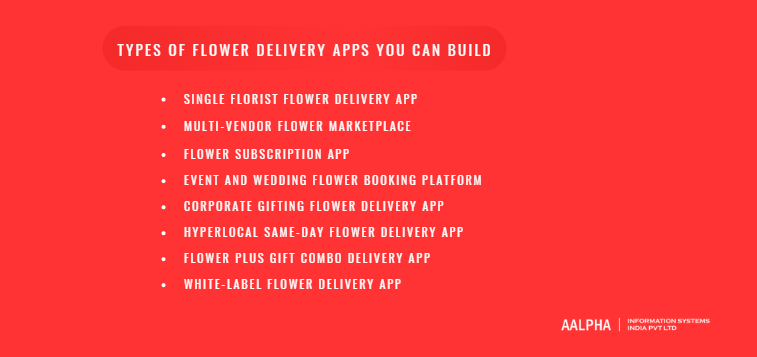
Single Florist Flower Delivery App
A single florist flower delivery app is built for one flower shop, local florist, boutique floral studio, or regional flower brand. In this model, the business owns the product catalog, manages inventory, prepares the bouquets, and either handles delivery internally or works with third-party delivery partners. The app acts as a direct online sales channel for the florist.
This model is suitable for businesses that already have a physical flower shop and want to increase online orders. Customers can browse bouquets, place orders, schedule delivery, make payments, and receive updates without calling the shop. The florist can manage product images, pricing, stock availability, delivery areas, discounts, and order history from an admin panel. A single florist app is usually easier and more affordable to build than a marketplace because it does not need complex vendor onboarding, commission management, multi-vendor payouts, or vendor-specific catalogs.
-
Multi-Vendor Flower Marketplace
A multi-vendor flower marketplace connects customers with multiple florists through one platform. Instead of selling products from one florist, the app allows several vendors to list bouquets, flower arrangements, plants, and gift products. Customers can compare products, prices, ratings, delivery availability, and vendor locations before placing an order.
This model is ideal for startups, aggregators, and entrepreneurs who want to build a larger flower delivery business across multiple areas or cities. The platform owner earns revenue through commissions, delivery charges, featured listings, vendor subscriptions, advertising, and premium placement. A marketplace requires a customer app, vendor panel, delivery partner app, and admin dashboard. It also needs vendor approval workflows, product moderation, commission logic, payout management, quality control, and location-based order assignment.
-
Flower Subscription App
A flower subscription app allows customers to receive fresh flowers regularly. Users can subscribe to daily, weekly, biweekly, or monthly flower deliveries based on their needs. This model works well for homes, offices, hotels, restaurants, temples, event venues, spas, reception desks, and premium residential customers.
The subscription model creates recurring revenue and improves customer retention. Instead of depending only on occasion-based orders, the business can generate predictable sales through repeat deliveries. Key features include subscription plan management, recurring billing, delivery schedule selection, pause or resume options, bouquet rotation, renewal reminders, and customer preferences. For florists, this model also helps with better inventory planning because recurring demand can be estimated in advance.
-
Event and Wedding Flower Booking Platform
An event and wedding flower booking platform is designed for customers who need large-scale floral arrangements for weddings, receptions, corporate events, parties, conferences, religious functions, hotels, and venues. This model is different from standard bouquet delivery because it involves bulk orders, custom designs, consultations, quotations, venue visits, installation, and sometimes removal after the event.
The app or web platform may include floral theme galleries, event packages, inquiry forms, budget selection, date availability, consultation booking, quotation requests, vendor portfolios, and project management tools. This model is suitable for event florists, wedding decorators, floral design studios, and marketplaces that want to serve high-value orders. Since each order may require customization, the platform should support inquiry-based workflows instead of only instant checkout.
-
Corporate Gifting Flower Delivery App
A corporate gifting flower delivery app is built for companies that send flowers to employees, clients, partners, customers, investors, and event guests. Businesses may use it for employee birthdays, work anniversaries, client appreciation, festive gifting, customer retention campaigns, product launches, office events, and condolence messages.
This model requires features such as bulk ordering, address upload, recipient lists, scheduled campaigns, invoice billing, approval workflows, branded greeting cards, corporate accounts, order reports, and account manager support. Corporate gifting can be a profitable segment because order values are often higher and customers may place recurring seasonal or monthly orders. A flower delivery business can also combine flowers with premium hampers, cakes, chocolates, dry fruits, plants, and branded merchandise.
-
Hyperlocal Same-Day Flower Delivery App
A hyperlocal same-day flower delivery app focuses on fast delivery within a specific city, area, or service zone. The main value proposition is speed. Customers place orders for urgent gifting needs, and the platform assigns the order to a nearby florist or fulfillment center. The delivery partner then picks up and delivers the bouquet within a short time window.
This model works well in dense urban locations where customers expect quick service and florists are close to delivery destinations. Key features include location-based catalogs, real-time florist availability, instant order assignment, delivery radius management, live tracking, time-slot control, and delivery partner apps. Since flowers are perishable and time-sensitive, the platform must manage stock visibility, pickup timing, route planning, and customer notifications carefully.
-
Flower Plus Gift Combo Delivery App
A flower plus gift combo delivery app sells flowers along with add-on gifting products. Customers can order bouquets with cakes, chocolates, greeting cards, soft toys, perfumes, jewelry, candles, plants, balloons, personalized mugs, or premium gift boxes. This model helps increase the average order value because customers often prefer complete gifting packages instead of only flowers.
This model is suitable for gifting startups, eCommerce businesses, florists, bakeries, and marketplaces. The app should support product bundling, add-on recommendations, combo pricing, inventory management for multiple product types, delivery coordination, and occasion-based collections. For example, a birthday category can show flowers with cake and balloons, while an anniversary category can show roses with chocolates and personalized cards.
-
White-Label Flower Delivery App
A white-label flower delivery app is a ready-to-customize platform that can be branded and launched for different flower delivery businesses. It includes prebuilt modules such as customer ordering, vendor management, delivery tracking, payment integration, notifications, and admin controls. The business can customize the logo, colors, service areas, features, pricing, and workflows.
This model is useful for entrepreneurs who want to launch quickly, software companies that sell delivery platforms to florists, and established flower businesses that want a faster digital rollout. A white-label app can reduce development time compared to building everything from scratch. However, businesses with unique workflows, complex marketplace logic, subscription models, or enterprise integrations may still need custom development.
Which Flower Delivery App Model Is Best?
The best model depends on the business goal. A local florist should usually start with a single florist flower delivery app because it is easier to manage and cost-effective. A startup that wants to scale across multiple neighborhoods or cities should consider a multi-vendor marketplace or hyperlocal same-day delivery app. A florist with steady recurring demand from offices, hotels, homes, or religious institutions can build a subscription-based platform.
Event florists and wedding decorators should focus on a booking and quotation-based platform because their orders are customized and high-value. Businesses targeting companies should build a corporate gifting flower delivery app with bulk ordering, invoicing, and campaign management. For entrepreneurs who want a faster launch, a white-label flower delivery app may be suitable, while larger enterprises may benefit more from a custom-built platform that supports integrations, analytics, automation, and multi-location operations.
Key Features Every Flower Delivery App Should Have
A flower delivery app must make ordering simple for customers while giving florists, delivery partners, and admins the tools they need to manage orders efficiently. Since flowers are often purchased for time-sensitive occasions, the app should focus on fast browsing, easy checkout, reliable delivery, and clear communication.
-
User Registration & Profile Management
Customers should be able to sign up using email, phone number, OTP, or social login. A user profile stores customer details, saved addresses, past orders, payment preferences, wishlist items, and important recipient information. This helps users place repeat orders faster and improves personalization.
-
Flower Catalog & Smart Search
The flower catalog should display bouquets, plants, flower boxes, arrangements, and gift combos with clear images, prices, descriptions, and delivery availability. Smart search and filters help customers find products by flower type, occasion, color, price, popularity, and same-day delivery availability.
-
Bouquet Customization
Bouquet customization allows users to personalize flower arrangements by selecting flower colors, bouquet size, wrapping style, vase options, greeting cards, chocolates, cakes, or other add-ons. This improves the gifting experience and increases average order value.
-
Shopping Cart & Secure Payments
The shopping cart should clearly show selected products, add-ons, delivery charges, discounts, taxes, and the final amount. Secure payment gateway integration allows customers to pay through cards, UPI, wallets, net banking, cash on delivery, or other supported payment methods.
-
Same-Day & Scheduled Delivery
Same-day and scheduled delivery are core features of a flower delivery app. Customers should be able to choose instant delivery, fixed time slots, next-day delivery, or advance booking for birthdays, anniversaries, weddings, sympathy orders, festive gifting, and corporate events.
-
Real-Time Order Tracking
Real-time order tracking keeps customers informed from order confirmation to final delivery. The app should show status updates such as order accepted, bouquet being prepared, picked up, out for delivery, and delivered. GPS tracking also helps admins monitor delayed or active deliveries.
-
Push Notifications
Push notifications help keep customers, florists, and delivery partners updated. Notifications can be used for order confirmation, payment success, preparation updates, delivery status, offers, reminders, refunds, loyalty rewards, and abandoned cart alerts.
-
Ratings & Reviews
Ratings and reviews help customers evaluate flower quality, florist service, delivery experience, and overall reliability. They also help admins monitor vendor performance and identify issues related to product mismatch, late delivery, or poor service.
-
Wishlist & Favorites
Wishlist and favorites allow customers to save bouquets or gift combos for later. This feature is useful for users planning future gifts and also helps the business send personalized offers based on customer preferences.
-
Order History
Order history lets users view previous purchases, invoices, delivery addresses, payment details, and recipient information. It also supports quick reordering, which is useful for recurring occasions such as birthdays, anniversaries, festivals, and corporate gifting.
-
Florist Dashboard
The florist dashboard allows vendors to manage products, bouquet pricing, inventory, orders, delivery availability, discounts, and sales reports. Florists can accept or reject orders, update preparation status, and manage product availability in real time.
-
Delivery Partner App
The delivery partner app helps riders manage assigned orders, pickup locations, delivery addresses, route navigation, status updates, proof of delivery, and earnings. Since flowers are fragile, delivery instructions can also be added to help riders handle bouquets carefully.
-
Admin Dashboard
The admin dashboard gives the business owner complete control over the platform. Admins can manage customers, florists, delivery partners, products, categories, orders, payments, refunds, commissions, promo codes, service areas, complaints, and reports from one place.
-
Inventory & Order Management
Inventory and order management are essential because flowers are perishable. The system should track available stock, out-of-stock products, bouquet quantities, add-ons, order status, cancellations, refunds, and delivery progress. This reduces errors and helps businesses manage peak demand during events and festivals.
-
Customer Support
Customer support features such as live chat, phone support, email, FAQs, and ticket management help resolve issues quickly. Common support cases include delivery delays, payment failures, incorrect addresses, product changes, refunds, cancellations, and recipient unavailability.
Flower Delivery App Development Process
Building a flower delivery app requires structured planning because the platform must handle customer ordering, florist operations, inventory visibility, delivery coordination, payments, notifications, and admin control. Unlike a basic eCommerce app, a flower delivery platform deals with perishable products, occasion-based demand, same-day delivery pressure, and high customer expectations around product appearance. A clear development process helps reduce technical mistakes, control cost, and create a scalable platform that can support local florists, multi-vendor marketplaces, corporate gifting, and hyperlocal delivery operations.
-
Market Research and Business Model Selection
The first step is to understand the target market, customer behavior, delivery geography, and revenue opportunity. A business must identify who the app will serve, what type of flowers or gifting products it will sell, and whether the platform will operate as a single florist app, multi-vendor marketplace, subscription model, corporate gifting system, or hyperlocal same-day delivery app.
Market research should cover customer segments, popular occasions, pricing expectations, delivery preferences, flower availability, local florist capacity, competitor offerings, and seasonal demand. For example, a flower delivery startup in a metro city may focus on same-day birthday and anniversary orders, while a florist serving hotels and offices may focus on recurring subscriptions and premium arrangements. The chosen business model will directly affect the app architecture, required features, vendor workflows, delivery logic, monetization model, and development cost.
-
Competitor Analysis
Competitor analysis helps businesses understand what existing flower delivery platforms are doing well and where gaps exist. This includes reviewing local florists, gifting apps, flower marketplaces, subscription flower services, event flower vendors, and large gifting brands. The analysis should examine product categories, app design, delivery options, pricing, add-ons, customer reviews, refund policies, loyalty programs, and service areas.
For example, if competitors provide same-day delivery but have poor reviews for product mismatch, the new app can focus on verified bouquet images, quality checks, proof of preparation, and florist ratings. If competitors lack corporate gifting tools, the app can add bulk ordering, invoice billing, scheduled campaigns, and account-based pricing. Competitor research should not be used to copy features blindly. It should help define a clearer positioning, such as faster delivery, better bouquet customization, premium floral designs, lower delivery charges, subscription convenience, or stronger vendor quality control.
-
Defining User Roles and App Workflow
Once the business model is finalized, the next step is to define user roles and workflows. A flower delivery app usually includes customers, florists or vendors, delivery partners, customer support teams, and admins. Each role needs a separate journey and permission structure.
The customer workflow includes registration, browsing, product selection, customization, address entry, delivery slot selection, payment, tracking, rating, and support. The florist workflow includes order acceptance, bouquet preparation, inventory updates, pricing, availability management, and order status updates. The delivery partner workflow includes order assignment, pickup, navigation, delivery confirmation, proof of delivery, and earnings tracking. The admin workflow includes user management, vendor approval, order monitoring, payment control, commission handling, refund management, complaints, reporting, and service area configuration.
Clear workflow planning prevents confusion during development. It also helps the development team understand how different modules communicate with each other. For example, once a customer places an order, the system must check inventory, notify the florist, assign delivery, update order status, process payment, and send customer notifications.
-
Feature Planning for MVP and Advanced Version
A flower delivery app should not start with every possible feature. The better approach is to define an MVP first and then plan advanced features for later versions. An MVP should include the essential features required to launch, take orders, process payments, manage florists, assign delivery, and track orders.
A basic MVP can include user login, product catalog, search and filters, cart, checkout, delivery address, delivery slot selection, payment gateway, order tracking, notifications, admin dashboard, florist order management, and basic reports. For a marketplace model, the MVP should also include vendor registration, vendor product management, commission settings, and payout records.
Advanced features can be added after the platform starts receiving real user data. These may include AI-based recommendations, subscription plans, loyalty programs, dynamic pricing, route optimization, marketing automation, multi-language support, multi-currency support, CRM integration, AR bouquet preview, demand forecasting, and advanced analytics. Separating MVP and advanced features helps control initial cost and launch faster without overbuilding.
-
UI/UX Wireframing
UI/UX wireframing converts the app idea into screen-level layouts before development begins. Wireframes show how customers will browse flowers, select categories, customize bouquets, choose add-ons, enter recipient details, select delivery slots, make payments, and track orders. They also show vendor, delivery partner, and admin workflows.
Flower delivery apps need visually strong and simple design because customers buy based on product appearance and emotional intent. The customer interface should make it easy to browse by occasion, flower type, budget, relationship, and delivery speed. Product pages should display high-quality images, clear pricing, delivery availability, bouquet details, and add-on options. The checkout flow should be short because many flower purchases are last-minute. Admin and vendor dashboards should focus on clarity, especially for order status, product availability, inventory, and delivery timelines.
-
Backend Architecture Planning
Backend architecture is the foundation of the flower delivery app. It manages users, products, orders, vendors, payments, notifications, delivery tracking, inventory, commissions, reports, and admin controls. The backend should be planned to handle both normal traffic and seasonal spikes during Valentine’s Day, Mother’s Day, weddings, festivals, and holidays.
Important backend decisions include database design, API architecture, authentication, order status logic, vendor assignment rules, inventory sync, payment records, refund workflows, notification triggers, delivery partner assignment, admin permissions, and reporting structure. For a multi-vendor marketplace, the backend must support vendor-specific catalogs, different service areas, commission rules, order routing, payout calculations, and vendor performance tracking. A scalable backend helps the platform expand from one city to multiple cities without requiring a full rebuild.
-
Mobile App Development
Mobile app development includes building the customer app and, where required, the delivery partner app. The customer app should allow users to register, browse products, search flowers, customize bouquets, add gifts, select addresses, schedule delivery, make payments, track orders, receive notifications, and contact support.
The delivery partner app should include login, assigned orders, pickup details, drop location, GPS navigation, status updates, proof of delivery, customer contact controls, and earnings records. Businesses can choose native development using Swift for iOS and Kotlin for Android, or cross-platform development using Flutter or React Native. Cross-platform development is often preferred for startups because it can reduce time and cost while supporting both Android and iOS from a shared codebase.
-
Web Panel and Admin Dashboard Development
The web platform and admin dashboard are critical for business operations. A customer-facing website can support online ordering, SEO traffic, corporate gifting inquiries, event flower bookings, and desktop purchases. The vendor panel allows florists to manage products, prices, inventory, orders, availability, and sales reports.
The admin dashboard gives the platform owner complete control over operations. It should include order management, user management, vendor management, delivery partner management, product category management, payment and refund tracking, commission settings, promo codes, banners, customer complaints, service zones, analytics, and reports. For a flower delivery business, the dashboard should make it easy to monitor delayed orders, unavailable products, high-demand slots, vendor performance, and customer complaints.
-
Payment Gateway Integration
Payment gateway integration allows customers to pay securely through cards, UPI, wallets, net banking, PayPal, Stripe, Razorpay, PayU, or other supported methods based on the target market. The payment system should handle successful payments, failed payments, refunds, partial refunds, coupon discounts, delivery fees, taxes, and invoices.
For marketplace apps, payment logic may be more complex because the platform must manage commissions, vendor payouts, delivery partner earnings, refunds, and settlement reports. Corporate gifting platforms may also need invoice-based payments, prepaid wallets, monthly billing, purchase approvals, and tax-compliant invoices. Payment integration should be tested carefully because even small payment errors can affect trust and revenue.
-
Map and Delivery Tracking Integration
Maps and location services are essential for same-day and scheduled flower delivery. Map integration helps customers select accurate delivery addresses, helps delivery partners navigate to pickup and drop locations, and helps admins track active deliveries. The app can use Google Maps, Mapbox, Apple Maps, or other location APIs depending on the platform requirements.
Delivery tracking should include order status updates such as confirmed, preparing, ready for pickup, picked up, out for delivery, reached destination, and delivered. For premium or surprise deliveries, customers may not need full live tracking, but they should receive reliable status updates. Admins should be able to monitor delays, failed deliveries, incorrect addresses, and delivery partner performance from the dashboard.
-
Testing and Quality Assurance
Testing is a major step in flower delivery app development because the platform includes multiple user roles and real-time operations. QA teams should test customer ordering, product search, cart, checkout, payment, refunds, inventory updates, vendor order acceptance, delivery assignment, GPS tracking, notifications, promo codes, ratings, and admin controls.
Testing should also cover edge cases. For example, what happens if a florist rejects an order after payment? What happens if flowers go out of stock during checkout? What happens if the delivery partner is delayed? What happens if payment succeeds but the order is not created? What happens if the customer enters an incomplete address? These scenarios must be handled with clear app logic. Performance testing is also important before peak seasons because flower delivery apps may see sudden traffic spikes during major occasions.
-
Launch on App Store and Play Store
After testing, the app is prepared for launch on the Apple App Store and Google Play Store. This includes setting up developer accounts, app descriptions, screenshots, privacy policy, terms of use, support details, payment compliance, notification permissions, and production server configuration. The launch process should also include final testing on real devices and checking app performance across different screen sizes, operating systems, and network conditions.
For the first launch, it is often better to start with a limited service area rather than launching across too many locations at once. This allows the business to test operations, florist readiness, delivery quality, support workflows, and customer response. Once the system runs smoothly, the platform can expand to more neighborhoods, cities, vendors, and product categories.
-
Post-Launch Maintenance and Feature Improvements
Flower delivery app development does not end after launch. The app needs regular maintenance, bug fixes, security updates, server monitoring, payment updates, API upgrades, performance improvements, and feature additions. Customer feedback, vendor feedback, delivery partner issues, and analytics should guide future improvements.
Post-launch improvements may include faster checkout, better product recommendations, new bouquet categories, subscription plans, loyalty rewards, corporate gifting features, advanced reports, route optimization, chatbot support, and marketing automation. Seasonal preparation is also important. Before Valentine’s Day, Mother’s Day, wedding seasons, and major festivals, the platform should review server capacity, florist inventory, delivery partner availability, pricing rules, customer support staffing, and promotional campaigns. A strong post-launch process helps the app remain reliable, competitive, and ready for long-term growth.
Cost to Develop a Flower Delivery App
The cost to build an on-demand flower delivery app depends on the business model, number of user roles, feature complexity, app platforms, development location, integrations, and post-launch support requirements. A basic flower delivery MVP with a customer app, product catalog, checkout, payments, delivery slots, order tracking, and admin dashboard will cost much less than a full multi-vendor marketplace with customer apps, florist dashboards, delivery partner apps, route tracking, commission logic, AI recommendations, loyalty programs, and advanced analytics. Based on current mobile app development pricing, Clutch reports that many app development projects fall between $10,000 and $49,999, while app development companies commonly charge $25 to $49 per hour, depending on region and project scope.
-
Average Flower Delivery App Development Cost
On average, a flower delivery app can cost between $15,000 and $120,000+, depending on complexity. A simple single-florist app may start from $15,000 to $30,000 if it includes basic ordering, payment integration, delivery scheduling, and a small admin panel. A mid-level flower delivery app with customer app, florist panel, delivery partner app, admin dashboard, live tracking, promo codes, and reports may cost around $30,000 to $70,000. A full-scale multi-vendor marketplace with advanced logistics, AI recommendations, subscription plans, loyalty programs, dynamic pricing, multi-language support, and enterprise integrations can cost $70,000 to $120,000+.
These are practical planning estimates, not fixed prices. Final pricing depends on the exact feature list, UI/UX depth, development team location, backend complexity, app platforms, testing scope, and launch requirements. For businesses working with offshore development teams in India or Eastern Europe, the cost can be lower than hiring teams in the United States, Canada, Western Europe, or Australia. Hiring developers from India or Eastern Europe can reduce app development costs by up to 60% compared with higher-cost markets.
-
MVP Cost vs Advanced App Cost
An MVP is the best starting point for most flower delivery startups and local florists. A flower delivery MVP usually includes user registration, flower catalog, product details, cart, checkout, payment gateway, delivery address, time slot selection, order tracking, notifications, basic florist order management, and an admin dashboard. This version is built to launch faster, test customer demand, onboard early florists, and validate the delivery workflow before investing in advanced features. A typical MVP development may cost around $15,000 to $40,000, depending on whether it is a single-vendor app or a basic multi-vendor model.
An advanced flower delivery app includes more complex features such as multiple florist dashboards, real-time inventory sync, AI-based product recommendations, loyalty programs, subscriptions, corporate gifting tools, route optimization, advanced analytics, automated refunds, vendor performance scoring, CRM integration, marketing automation, multi-currency support, and multi-city operations. This type of platform may cost $50,000 to $120,000+ because it requires more backend logic, stronger infrastructure, deeper testing, and more admin controls.
-
Cost by App Complexity
A basic flower delivery app is suitable for a single florist or a local flower shop that wants to accept online orders. It may include one customer-facing app or website, a simple catalog, payment integration, delivery slot selection, and an admin dashboard. This type of app development can cost $15,000 to $30,000.
A medium-complexity app is suitable for businesses that want to manage several florists, delivery partners, promotions, order tracking, and basic reports. It usually includes a customer app, vendor panel, delivery partner app, and admin panel. This may cost $30,000 to $70,000.
A high-complexity flower delivery platform is suitable for multi-city marketplaces, enterprise gifting businesses, or brands planning large-scale operations. It may include AI recommendations, advanced inventory, route optimization, subscriptions, multi-language support, multi-currency support, vendor payouts, dynamic pricing, and advanced analytics. This can cost $70,000 to $120,000+.
-
Cost by Development Region
Development region has a major impact on total cost because hourly rates vary widely. Teams in North America and Western Europe usually charge more than teams in India, Southeast Asia, Eastern Europe, and Latin America. Clutch’s pricing guide shows a common app development rate band of $25 to $49 per hour, while GoodFirms reports broader agency pricing of $75 to $250 per hour depending on provider type and geography.
For a flower delivery app, this means the same feature set may cost significantly different amounts depending on where the team is based. An Indian development company may build a strong MVP at a lower budget, while a US-based agency may charge substantially more for the same development hours. Businesses should compare not only hourly rates but also delivery quality, app portfolio, communication, technical architecture, testing process, and post-launch support.
-
Cost by Platform: Android, iOS, Web, or Cross-Platform
Platform choice also affects cost. Building only an Android app is usually cheaper than building separate native Android and iOS apps. Building native apps for both platforms requires separate development work using Kotlin or Java for Android and Swift for iOS. This increases development time and budget.
Cross-platform development using Flutter or React Native can reduce cost because one codebase can support both Android and iOS with platform-specific adjustments. This is often a practical choice for startups and flower delivery businesses launching an MVP. A web platform also adds cost, but it can be valuable for SEO, corporate gifting inquiries, desktop orders, and admin operations. For many flower delivery businesses, the ideal setup is a cross-platform customer app, a web-based admin dashboard, a vendor web panel, and a delivery partner app.
-
Cost of Customer App, Vendor Panel, Delivery App, and Admin Panel
A full flower delivery system usually has four major components. The customer app may cost $8,000 to $25,000, depending on catalog, checkout, tracking, wishlist, notifications, and personalization features. The florist or vendor panel may cost $5,000 to $20,000, depending on product management, inventory, orders, pricing, availability, and reports. The delivery partner app may cost $5,000 to $18,000, depending on order assignment, GPS navigation, pickup updates, proof of delivery, and earnings. The admin dashboard may cost $8,000 to $30,000+, depending on vendor management, user management, orders, payments, commissions, refunds, analytics, promo codes, and complaint handling.
The admin dashboard is often underestimated, but it is one of the most important parts of the platform. A flower delivery business cannot operate smoothly without proper control over products, florists, payments, delivery partners, refunds, complaints, and performance reports.
-
Third-Party Integration Costs
Third-party integrations add both development cost and recurring operational cost. Common integrations include payment gateways, Google Maps or Mapbox, SMS APIs, WhatsApp notifications, email services, Firebase push notifications, analytics tools, CRM platforms, accounting software, customer support chat, and marketing automation tools. Payment gateways may charge transaction fees, map APIs may charge based on usage, and SMS or WhatsApp providers may charge per message.
-
Maintenance and Support Costs
Post-launch maintenance usually costs around 15% to 25% of the initial development cost per year, depending on the support scope. Maintenance includes bug fixes, server monitoring, app updates, payment gateway updates, API changes, security patches, operating system compatibility updates, performance improvements, and small feature enhancements.
Flower delivery apps also need seasonal preparation before Valentine’s Day, Mother’s Day, wedding seasons, Christmas, New Year, and local festivals. The platform may need server scaling, new banners, temporary delivery rules, special pricing, added delivery slots, extra support workflows, and inventory planning updates. Without proper maintenance, even a well-built app can fail during high-demand periods.
-
Factors That Increase Development Cost
Several factors can increase the cost of flower delivery app development. These include building separate native apps for Android and iOS, adding a multi-vendor marketplace model, supporting real-time inventory sync, adding live GPS tracking, enabling multiple payment modes, building advanced admin controls, adding AI recommendations, supporting multiple cities, adding multilingual and multi-currency features, integrating CRM or ERP systems, and developing complex subscription or corporate gifting workflows.
Custom UI/UX design also affects cost. A premium flower delivery brand may need elegant product pages, occasion-based browsing, visual bouquet customization, high-quality animations, and personalized gifting flows. These design elements improve user experience but require more design and frontend development time.
How to Reduce Cost Without Affecting Quality
The best way to reduce cost is to start with an MVP and avoid unnecessary features in the first version. A florist or startup should first launch with core features such as catalog, cart, checkout, payment, delivery slot selection, order tracking, notifications, florist order management, and admin control. Advanced features such as AI recommendations, loyalty programs, subscriptions, AR previews, and marketing automation can be added after the app has real users and order data.
Cross-platform development can also reduce cost compared with building separate native apps. Businesses can use ready-made APIs for payments, maps, notifications, and analytics instead of building everything from scratch. Another practical approach is to launch in one city or service area first, test operations, improve workflows, and then expand.
Working with an experienced app development company also helps control cost because the team can reuse proven architecture patterns, avoid technical mistakes, plan scalable backend systems, and separate essential features from optional features. Businesses planning to build an on-demand flower delivery app can work with companies such as Aalpha Information Systems to plan the MVP, define the right technology stack, build customer and vendor apps, integrate payments and delivery tracking, and support the platform after launch.
How to Choose a Flower Delivery App Development Company
Choosing the right flower delivery mobile app development company is one of the most important decisions in the project. A flower delivery platform is not just a product catalog with checkout. It requires real-time order handling, florist coordination, delivery management, payment processing, inventory visibility, admin control, and customer communication. The development partner should understand both the technical side of app development and the operational side of on-demand delivery.
-
Experience in On-Demand App Development
The first factor to check is the company’s experience in building on-demand apps. Flower delivery apps share many workflows with food delivery, grocery delivery, courier delivery, medicine delivery, and hyperlocal marketplace platforms. These apps require fast order placement, location-based service availability, delivery slot management, real-time status updates, payment integration, and customer support workflows. A company with prior experience in on-demand app development will understand these requirements better than a general software vendor.
-
Understanding of Marketplace Workflows
If you are building a multi-vendor flower delivery marketplace, the development company must understand marketplace logic. This includes vendor onboarding, product approval, commission management, service areas, order assignment, vendor payouts, refunds, ratings, product moderation, and admin controls. A marketplace app also needs role-based dashboards for customers, florists, delivery partners, and admins. Without proper marketplace architecture, the platform may become difficult to manage once more florists and locations are added.
-
Backend and Scalability Expertise
A strong backend is essential for a flower delivery app because the platform must handle users, products, orders, payments, vendors, delivery partners, inventory, notifications, and reports. The backend should also support seasonal traffic spikes during Valentine’s Day, Mother’s Day, weddings, festivals, and corporate gifting campaigns. Before hiring a company, ask how they plan database structure, API architecture, cloud hosting, security, performance, and future scalability. A poorly built backend may work during launch but fail when order volume increases.
-
Mobile App Development Skills
The company should have proven experience in building Android, iOS, and cross-platform mobile apps. Depending on the budget and timeline, you can choose native development with Swift and Kotlin or cross-platform development with Flutter or React Native. For most startups and local flower delivery businesses, cross-platform development is a practical option because it reduces development time while supporting both major platforms. The customer app should be fast, simple, and reliable, while the delivery partner app should provide accurate pickup, navigation, and delivery status updates.
-
UI/UX Design Quality
UI/UX design plays a major role in flower delivery apps because customers buy flowers based on emotion, occasion, appearance, and convenience. The app should make it easy to browse by flower type, occasion, price, color, delivery speed, and gifting category. Product pages should use high-quality images, clear pricing, bouquet details, delivery availability, and add-on suggestions. The checkout flow should be short, especially for last-minute orders. A good development company should provide wireframes, user flows, clickable prototypes, and design samples before development begins.
-
Integration Experience
A flower delivery platform depends on several third-party integrations. These may include payment gateways, Google Maps or Mapbox, Firebase notifications, SMS APIs, WhatsApp alerts, email services, analytics tools, customer support chat, CRM systems, and marketing automation platforms. The development company should know how to integrate these services securely and efficiently. Payment, map, notification, and analytics integrations should be tested carefully because they directly affect order completion, delivery tracking, customer updates, and business reporting.
-
Post-Launch Support
Flower delivery app development does not end after the app is launched. The platform will need bug fixes, security updates, server monitoring, app store updates, payment gateway changes, API maintenance, feature improvements, and seasonal updates. Post-launch support is especially important before high-demand periods such as Valentine’s Day, Mother’s Day, Christmas, New Year, wedding seasons, and local festivals. Choose a company that offers structured maintenance and can support the app after launch.
-
Transparent Pricing and Milestone Planning
Transparent pricing helps avoid budget confusion during development. The company should provide a clear estimate based on features, platforms, integrations, design requirements, admin modules, testing, and launch support. The project should be divided into milestones such as discovery, UI/UX design, backend development, mobile app development, dashboard development, integrations, testing, deployment, and support. Milestone-based planning makes the project easier to track and reduces delivery risk.
-
Portfolio and Client Reviews
Before finalizing a development company, review its portfolio, case studies, client testimonials, and third-party reviews. Look for projects related to on-demand delivery, eCommerce, marketplaces, logistics, mobile apps, delivery partner apps, and admin dashboards. A relevant portfolio shows that the team has solved similar operational and technical problems before.
For example, Aalpha Information Systems developed Zumy, a hyperlocal on-demand delivery platform built for parcel delivery, food delivery, and bike taxi workflows, which required customer apps, runner workflows, live order tracking, payment handling, delivery management, and admin controls. Experience with platforms like Zumy can be valuable when building a flower delivery app because both models depend on fast ordering, location-based delivery, real-time status updates, and reliable backend operations. Client reviews can also reveal how the company handles communication, timelines, quality, support, and issue resolution.
Read: Zumy Case Study
-
Final Selection Advice
The best flower delivery app development company should combine technical expertise, marketplace understanding, mobile app skills, backend strength, UI/UX quality, and long-term support. Businesses planning to build an on-demand flower delivery app can work with experienced application development companies such as Aalpha Information Systems for custom app development, marketplace architecture, mobile apps, admin dashboards, payment integration, delivery tracking, and long-term support. A capable development partner can help you start with the right MVP, control development cost, and build a platform that can grow from a local flower delivery app into a scalable marketplace or gifting business.
Conclusion
Building an on-demand flower delivery app is a strong opportunity for florists, gifting startups, marketplaces, and enterprises that want to serve customers looking for fast, convenient, and personalized flower ordering. A successful app should include smooth browsing, bouquet customization, secure payments, same-day and scheduled delivery, GPS tracking, florist management, delivery partner workflows, and a powerful admin dashboard.
The best approach is to start with a focused MVP, validate demand, improve operations, and then add advanced features such as AI recommendations, subscriptions, loyalty programs, corporate gifting tools, and analytics. Since flower delivery depends on timing, freshness, and customer trust, the platform must be built with reliable backend architecture and a simple user experience.
If you are planning to build a flower delivery app, Aalpha Information Systems can help with custom app development, marketplace architecture, mobile apps, admin dashboards, payment integration, delivery tracking, and long-term support. Get in touch with Aalpha to discuss your flower delivery app idea and build a scalable platform for your business.
FAQs
1. What is an on-demand flower delivery app?
An on-demand flower delivery app is a digital platform that allows customers to browse flowers, customize bouquets, place orders, make payments, schedule delivery, and track orders through a mobile app or website. It connects customers, florists, delivery partners, and admins in one system.
2. How does a flower delivery app work?
A customer selects flowers, adds the recipient’s address, chooses a delivery date or time slot, adds a personal message, and completes payment. The florist receives the order, prepares the bouquet, and a delivery partner picks it up and delivers it. The customer can track the order and receive delivery confirmation.
3. What are the main features of a flower delivery app?
Key features include user registration, flower catalog, smart search, bouquet customization, shopping cart, secure payments, same-day and scheduled delivery, real-time tracking, push notifications, ratings, wishlist, order history, florist dashboard, delivery partner app, admin dashboard, inventory management, and customer support.
4. How much does it cost to build a flower delivery app?
The cost to build a flower delivery app usually ranges from $15,000 to $120,000+, depending on features, platforms, app complexity, design, development region, and integrations. A basic MVP costs less, while a multi-vendor marketplace with delivery tracking, vendor panels, AI recommendations, and analytics costs more.
5. What types of flower delivery apps can businesses build?
Businesses can build single-florist apps, multi-vendor flower marketplaces, flower subscription apps, event and wedding flower booking platforms, corporate gifting apps, hyperlocal same-day delivery apps, flower-and-gift combo apps, or white-label flower delivery platforms.
6. Why should florists invest in flower delivery app development?
A flower delivery app helps florists reach more customers, accept online orders, reduce manual coordination, manage inventory, offer same-day delivery, promote seasonal collections, and increase repeat sales. It also helps businesses serve customers who prefer fast, convenient, and trackable gifting options.
7. Why hire a flower delivery app development company?
Hiring a flower delivery app development company helps businesses build a reliable platform with customer apps, florist dashboards, delivery partner apps, admin panels, payment integration, tracking, inventory management, and post-launch support. Companies such as Aalpha Information Systems can help build scalable flower delivery apps for florists, startups, and marketplaces.