



1. Selecting the Right Technology Partner
Modern businesses operate in an environment where technology is not merely a support function but a core driver of growth, efficiency, and competitive advantage. From customer-facing applications and data analytics platforms to AI-powered automation systems, technology infrastructure now underpins nearly every critical business process. As a result, organizations increasingly depend on external technology partners to help design, build, and maintain digital solutions that evolve with their long-term business strategy. Choosing the right tech partner therefore becomes a strategic decision rather than a simple procurement choice. A capable technology partner can help businesses innovate faster, scale operations efficiently, and respond to changing market conditions. In contrast, selecting the wrong partner can result in costly project delays, technical debt, and long-term operational challenges that hinder growth. Understanding why the right technology partnership matters is the first step toward making informed decisions that support sustainable business success.
1.1 The Growing Role of Technology in Business Success
Technology has become one of the most influential factors shaping modern business performance. Across industries such as healthcare, retail, logistics, finance, and manufacturing, companies rely heavily on digital platforms to deliver products, manage operations, and interact with customers. According to global digital transformation studies from organizations such as the International Data Corporation (IDC), worldwide spending on digital transformation technologies continues to grow rapidly as companies prioritize automation, data intelligence, and scalable digital systems.
For many businesses, technology now determines how quickly they can launch new services, enter new markets, and respond to customer demands. A retail company may depend on eCommerce platforms and mobile apps to reach customers. A logistics company may require advanced tracking systems and route optimization tools. Healthcare providers increasingly rely on telemedicine platforms, electronic health records, and AI-assisted diagnostics. In each of these cases, software systems become mission-critical infrastructure that directly influences business outcomes.
Because technology evolves rapidly, businesses must constantly update and improve their digital systems. This creates a growing need for experienced development teams that can design scalable architectures, integrate emerging technologies, and support continuous innovation. Rather than treating technology projects as one-time initiatives, companies now recognize the value of establishing long-term relationships with technology partners who understand their products, infrastructure, and strategic goals.
1.2 Why Businesses Prefer Long-Term Technology Partnerships
Many organizations have learned that short-term vendor relationships often fail to deliver sustainable results. Traditional outsourcing models typically focus on completing a specific project within a defined timeline and budget. While this approach may work for simple tasks, it often lacks the strategic alignment required for complex digital products that must evolve over time.
Long-term technology partnerships provide a fundamentally different model. Instead of acting as external contractors, technology partners become integrated collaborators who contribute to product strategy, architecture decisions, and ongoing innovation. Over time, a dedicated technology partner gains deep familiarity with the business model, user requirements, and operational challenges of the organization. This knowledge enables them to make better technical decisions, anticipate potential issues, and recommend improvements that support long-term growth.
Another advantage of long-term collaboration is continuity. Software systems rarely remain static after launch. They require regular updates, security improvements, feature enhancements, and performance optimization. When the same development team continues to support the product, they can build upon existing knowledge rather than starting from scratch with each new project phase. This reduces development inefficiencies and ensures consistent product evolution.
Businesses also benefit from faster execution when working with long-term partners. Teams that have already built and maintained the system can implement new features more quickly because they understand the architecture, dependencies, and technical constraints. This level of familiarity often leads to better product stability and lower development costs over time.
1.3 Risks of Choosing the Wrong Technology Partner
Selecting an unsuitable technology partner can create significant operational and financial risks. One of the most common problems is cost overruns caused by poor project planning or weak technical execution. Inexperienced teams may underestimate development complexity, leading to repeated delays and budget increases. In some cases, businesses may need to replace the development team midway through a project, which significantly increases costs and disrupts timelines.
Another major risk involves poor software architecture. If a technology partner lacks experience in building scalable systems, the resulting product may struggle to handle growing user demand or complex integrations. Businesses frequently discover that poorly designed applications become difficult to maintain or extend, forcing them to invest heavily in rebuilding or refactoring the system later.
Security vulnerabilities also represent a serious concern. Weak security practices during development can expose organizations to data breaches, regulatory violations, and reputational damage. Industries such as healthcare and finance require strict compliance with standards such as HIPAA, GDPR, or PCI-DSS, making security expertise an essential qualification for any technology partner.
Communication challenges can further complicate technology partnerships. Teams that lack structured development processes or transparent reporting often create confusion around project progress, priorities, and deliverables. Without clear communication channels, businesses may struggle to maintain alignment between technical teams and strategic goals.
Ultimately, the choice of a technology partner influences not only the success of individual projects but also the long-term stability and scalability of a company’s digital infrastructure. Businesses that invest time in selecting the right partner position themselves for sustainable growth, while those that rush the decision risk costly setbacks that can affect operations for years.
2. What Is a Long-Term Tech Partner?
As businesses increasingly rely on technology to operate and compete, the concept of a technology partner has become more important than ever. Many organizations initially approach software development by hiring vendors for individual projects, expecting them to build a product and deliver it within a fixed timeline. However, as digital systems grow more complex and require ongoing updates, businesses quickly realize that transactional vendor relationships are often insufficient. This is where long-term technology partnerships become valuable.
A long-term tech partner works alongside a business as an extension of its internal team, contributing not only to development but also to strategy, product evolution, and continuous improvement. Instead of focusing solely on completing tasks, a technology partner participates in shaping the long-term direction of digital products and infrastructure. Understanding the difference between a simple vendor and a strategic technology partner is essential for companies that want to build scalable and sustainable digital solutions.
2.1 Definition of a Technology Partner
A technology partner is an external organization or development team that collaborates closely with a business to design, build, maintain, and evolve its technology systems over an extended period. Unlike traditional service providers that focus on short-term deliverables, a technology partner becomes deeply integrated into the client’s product development lifecycle.
The role of a technology partner goes beyond writing code or completing technical tasks. These partners participate in architectural planning, technology selection, scalability decisions, and long-term innovation strategies. They work closely with business leaders, product managers, and internal teams to understand the broader goals of the organization and align technical solutions accordingly.
For example, when a company launches a digital platform such as a mobile application or SaaS product, the technology partner may assist with initial product development, cloud infrastructure setup, performance optimization, and future feature expansion. Over time, this collaboration allows the partner to gain deep knowledge of the business model, user behavior, and technical ecosystem. This level of familiarity helps ensure that technology decisions support long-term business growth rather than short-term project completion.
2.2 Vendor vs Technology Partner
Although the terms “vendor” and “technology partner” are sometimes used interchangeably, they represent fundamentally different types of relationships. Vendors typically provide predefined services for specific tasks, while technology partners contribute strategically to the development and evolution of digital products.
A vendor relationship usually begins and ends with a single project. Once the deliverable is completed, the engagement may conclude with minimal ongoing involvement. Technology partners, on the other hand, remain involved throughout the product lifecycle, supporting continuous improvements, new feature development, and system optimization.
The differences between these two approaches become clearer when comparing key aspects of collaboration.
Aspect | Vendor | Technology Partner |
Project Involvement | Focuses on completing specific tasks or projects | Participates in the full product lifecycle |
Strategic Thinking | Limited involvement in long-term planning | Contributes to product strategy and technical roadmap |
Innovation Support | Executes predefined requirements | Suggests new technologies and improvements |
Knowledge Retention | Limited understanding of the business context | Builds deep knowledge of business processes |
Long-Term Value | Primarily transactional | Creates continuous value through collaboration |
Businesses that treat technology purely as a short-term procurement activity often rely on vendors. However, organizations that view technology as a strategic asset typically seek partners who can contribute to innovation, scalability, and long-term digital growth.
2.3 Examples of Long-Term Technology Partnerships
Long-term technology partnerships are common across many industries, particularly in startups and digital-first companies where continuous product development is essential. Many successful technology-driven businesses have relied on dedicated development partners during their early stages and continued those relationships as they scaled.
A common example can be seen in startups building their first software products. Early-stage companies often lack the resources to hire a full in-house engineering team. Instead, they collaborate with an experienced development company that helps design the product architecture, build the initial platform, and provide ongoing technical support. As the startup grows, the same technology partner continues to assist with scaling infrastructure, improving performance, and adding new features.
E-commerce companies provide another example of long-term partnerships. Online retail platforms require constant updates to support payment integrations, logistics systems, recommendation engines, and security improvements. A technology partner familiar with the platform’s architecture can implement these changes efficiently while maintaining system stability.
Enterprise organizations also rely on long-term partners when managing complex digital ecosystems. For instance, large logistics companies often collaborate with technology firms to develop route optimization platforms, fleet management systems, and analytics tools. Because these systems must evolve with operational changes, long-term collaboration ensures consistent technical support and innovation.
These examples demonstrate that technology partnerships are not simply about outsourcing development work. Instead, they represent strategic collaborations that help businesses build, scale, and continuously improve their digital capabilities over time.
3. Why Businesses Need Long-Term Technology Partnerships
Modern digital products are rarely built once and left unchanged. Software systems require continuous improvement, security updates, performance optimization, and feature expansion to remain competitive. As businesses become increasingly dependent on technology platforms, many organizations recognize that maintaining stable and scalable digital systems requires more than occasional development support. This is why companies across industries increasingly rely on long-term technology partnerships.
Instead of engaging different vendors for individual projects, businesses benefit from working with a consistent development partner who understands the product architecture, technical infrastructure, and long-term strategic objectives. Long-term partnerships allow organizations to maintain continuity in product development, improve technical decision-making, accelerate innovation cycles, and manage development costs more efficiently. These advantages are particularly important for digital-first companies where technology directly influences customer experience, operational efficiency, and revenue growth.
3.1 Consistency in Product Development
Consistency is one of the most important advantages of working with a long-term technology partner. Software systems are complex ecosystems made up of interconnected components such as databases, APIs, user interfaces, and third-party integrations. When different development teams handle different stages of a product’s lifecycle, inconsistencies in architecture, coding standards, and documentation can emerge. Over time, this fragmentation can make systems difficult to maintain and expand.
A long-term technology partner ensures continuity across the entire development lifecycle. Because the same team is involved from the initial product design through ongoing updates and feature development, they maintain a deep understanding of the system architecture and technical decisions made during earlier stages of development. This continuity allows developers to maintain consistent coding standards, avoid unnecessary duplication, and preserve architectural integrity.
Consistent development practices also improve product reliability. When a team familiar with the system continues to maintain it, they can quickly identify potential issues, optimize performance, and ensure that new features integrate smoothly with existing components. This stability becomes particularly valuable as digital platforms scale to support larger user bases and more complex workflows.
3.2 Deep Understanding of Business Requirements
Another significant advantage of long-term technology partnerships is the deep understanding of business requirements that develops over time. In many organizations, digital products are closely tied to specific operational processes, customer journeys, and market strategies. These factors cannot always be fully understood during the early stages of a project.
A technology partner who collaborates with a business over several years gradually gains detailed knowledge of how the organization operates. They learn how customers interact with the product, how internal teams use the system, and which features contribute most to business value. This contextual understanding allows them to make more informed technical decisions and propose solutions that align with broader business objectives.
For example, an e-commerce platform may require specialized features such as dynamic pricing systems, inventory synchronization across warehouses, or personalized product recommendations. A long-term technology partner who has supported the platform over time will understand how these systems interact with customer behavior, logistics operations, and marketing strategies. As a result, they can implement improvements more effectively than a new development team unfamiliar with the product ecosystem.
This level of familiarity also reduces the need for repeated onboarding and knowledge transfer. Businesses do not need to spend time explaining their systems, processes, and priorities to new teams each time a project begins. Instead, the technology partner already understands the business context and can focus directly on delivering solutions.
3.3 Faster Innovation and Product Evolution
Technology markets evolve rapidly, and businesses must continuously adapt to remain competitive. New technologies, changing user expectations, and emerging market opportunities require companies to innovate frequently. A long-term technology partner plays an important role in enabling this continuous innovation.
When development teams are already familiar with a product’s architecture and infrastructure, they can implement new features more quickly. They understand the system dependencies, performance limitations, and integration points, allowing them to evaluate ideas and implement changes efficiently. This familiarity significantly reduces development time compared to working with a new vendor who must first analyze and understand the existing system.
Long-term partners also contribute to innovation by recommending new technologies and development approaches. Experienced development teams stay updated on emerging trends such as artificial intelligence, cloud-native architectures, automation frameworks, and advanced data analytics tools. Because they understand the client’s product ecosystem, they can suggest practical ways to integrate these technologies into existing platforms.
For instance, a logistics company may initially build a basic parcel tracking platform. Over time, the same technology partner may introduce machine learning models for delivery route optimization or predictive analytics for demand forecasting. These innovations often emerge naturally within long-term collaborations where the technology partner actively participates in product strategy discussions.
3.4 Reduced Development Costs Over Time
Although some businesses assume that hiring new vendors for individual projects can reduce costs, long-term technology partnerships often prove more cost-effective in the long run. One of the primary reasons is the elimination of repeated onboarding and knowledge transfer. When new teams join a project, they must spend significant time reviewing existing codebases, understanding system architecture, and learning business requirements before they can begin productive work. This process increases development timelines and costs.
A long-term partner already possesses this knowledge, allowing them to work more efficiently. They can focus directly on solving technical problems and implementing improvements rather than rebuilding their understanding of the system. This efficiency reduces development cycles and improves overall productivity.
Long-term collaboration also helps prevent costly architectural mistakes. Experienced technology partners who understand the product roadmap can design systems with scalability and maintainability in mind. Proper architectural planning reduces the need for expensive system rewrites or infrastructure changes later.
Additionally, long-term partners often assist with proactive maintenance, security updates, and performance optimization. By identifying potential issues early, they help businesses avoid unexpected downtime, security incidents, or major technical failures that could result in significant financial losses.
For organizations that rely heavily on digital platforms, the cumulative benefits of consistency, institutional knowledge, innovation support, and efficient development processes make long-term technology partnerships a critical component of sustainable growth.
4. When Should a Business Look for a Long-Term Tech Partner?
Many organizations initially approach software development as a short-term project. They hire a development team to build a product, launch it, and then assume the technical work is complete. In reality, most digital products require continuous updates, feature improvements, security enhancements, and infrastructure scaling. As businesses grow and technology becomes central to operations, relying on isolated project-based vendors often creates inefficiencies and slows innovation.
A long-term technology partner becomes particularly valuable when a business needs ongoing technical support, product evolution, and strategic guidance. Rather than repeatedly hiring different vendors, companies can work with a dedicated software development partner who understands their technology ecosystem and long-term goals. The timing of when to establish such a partnership varies depending on the organization’s stage of growth and its digital maturity.
Several common scenarios indicate when businesses should consider building a long-term relationship with a technology partner.
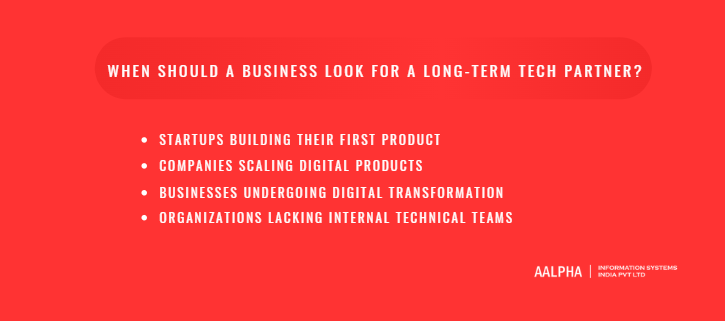
4.1 Startups Building Their First Product
Early-stage startups are among the most common organizations that benefit from long-term technology partnerships. Many founders have strong business ideas but lack the resources to hire and manage a full in-house engineering team. Recruiting experienced developers, establishing development infrastructure, and building scalable product architecture can be difficult for startups that are still validating their market.
A long-term technology partner can help startups transform an initial concept into a functional digital product. During the early stages, the partner typically assists with product planning, technical architecture design, user experience development, and minimum viable product (MVP) creation. Because the partner remains involved throughout the development process, they ensure that the product is built using scalable technologies that support future growth.
Startups also benefit from the strategic perspective that experienced development partners bring. Teams that have previously built similar platforms can guide founders on important decisions such as technology selection, system architecture, and feature prioritization. These decisions significantly influence how easily the product can evolve in later stages.
As the startup gains traction and begins to scale, the same technology partner can support feature expansion, infrastructure scaling, and integration with additional services such as payment gateways, analytics platforms, and third-party APIs. Instead of repeatedly onboarding new development teams, startups can rely on a consistent partner who already understands the product and its technical foundations.
4.2 Companies Scaling Digital Products
Businesses that already operate digital platforms often seek long-term technology partners when their products begin to scale rapidly. Growth introduces new technical challenges such as handling increased user traffic, improving performance, integrating advanced analytics, and expanding feature sets. Managing these changes requires developers who understand the existing system architecture and can implement improvements without disrupting core functionality.
A long-term technology partner can help companies scale their digital products by continuously optimizing infrastructure, refining user experiences, and implementing new features. For example, an e-commerce platform experiencing rapid growth may require improvements in payment processing, order management systems, and logistics integrations. A dedicated development partner familiar with the platform can implement these changes efficiently while maintaining system stability.
Scaling businesses also need strategic technical guidance. Technology partners can recommend cloud infrastructure upgrades, performance optimization strategies, and automation tools that support higher operational efficiency as the product grows.
4.3 Businesses Undergoing Digital Transformation
Digital transformation initiatives represent another scenario where long-term technology partnerships are essential. Many traditional organizations are investing heavily in digital technologies to modernize their operations, improve customer engagement, and streamline internal processes. These transformations often involve replacing legacy systems, building new digital platforms, and integrating data across multiple business functions.
Such initiatives typically require multi-year development efforts involving complex technical architectures and continuous system evolution. Attempting to execute these projects with short-term vendors can create fragmentation, inconsistent design decisions, and operational inefficiencies.
A long-term technology partner helps organizations manage these large-scale transitions by providing consistent technical leadership throughout the transformation process. They assist with modernizing infrastructure, implementing cloud-based platforms, integrating enterprise systems, and developing custom applications that support digital workflows. Over time, this partnership enables businesses to gradually evolve their technology ecosystem while minimizing operational disruptions.
4.4 Organizations Lacking Internal Technical Teams
Many businesses rely heavily on digital platforms but do not maintain large internal engineering teams. This situation is common among small and medium-sized enterprises that focus on their core operations rather than building extensive technology departments. However, these companies still require reliable technical support to maintain their systems and develop new capabilities.
For organizations without dedicated internal technical teams, a long-term technology partner effectively functions as an external engineering department. The partner handles tasks such as system maintenance, feature development, security updates, performance monitoring, and technical troubleshooting. Because the partner remains involved over time, they develop a deep understanding of the organization’s technology infrastructure and operational requirements.
This arrangement allows businesses to access experienced developers, architects, and technical specialists without the overhead of maintaining a full in-house team. It also ensures that the organization’s digital systems continue to evolve as business needs change.
For companies that rely on technology but lack internal technical expertise, establishing a stable partnership with an experienced development team can provide both operational stability and long-term innovation support.
5. Key Criteria for Choosing the Best Tech Partner
Selecting the right long-term technology partner requires a structured evaluation process. Technology decisions influence product performance, scalability, security, and long-term operational efficiency. A capable tech partner should not only deliver technical solutions but also contribute to strategic decision-making and product evolution. Businesses evaluating potential partners must examine multiple factors, including technical expertise, industry knowledge, development processes, communication practices, and long-term support capabilities.
Many organizations make the mistake of selecting development partners based solely on cost or short-term project needs. However, long-term technology partnerships require deeper evaluation. The right partner should demonstrate technical competence, strategic thinking, operational transparency, and the ability to support a product throughout its lifecycle. The following criteria help businesses assess whether a technology partner can deliver sustainable value over time.
5.1 Proven Technical Expertise
Technical expertise is one of the most important criteria when choosing a technology partner. A development team must demonstrate strong capabilities across multiple areas of modern software engineering, including programming languages, development frameworks, infrastructure architecture, and emerging technologies. Businesses should evaluate whether the partner has experience building systems similar to the digital products they plan to develop.
Programming language expertise provides insight into the team’s technical capabilities. Modern development environments rely on languages such as JavaScript, Python, Java, Go, and TypeScript for building scalable applications. Frontend technologies like React, Angular, and Vue.js are commonly used to create responsive user interfaces, while backend frameworks such as Node.js, Django, and Spring Boot support complex application logic. A capable technology partner should demonstrate proficiency in selecting the right language and framework based on the project’s requirements.
Cloud infrastructure knowledge is another essential factor. Most modern applications rely on cloud platforms such as Amazon Web Services, Microsoft Azure, or Google Cloud for hosting, storage, and scaling. A strong technology partner should understand how to design cloud-native architectures that support high availability, automated scaling, and efficient resource utilization. Skills in containerization technologies such as Docker and orchestration tools like Kubernetes are also important when building large-scale systems.
Artificial intelligence and machine learning capabilities are increasingly relevant for businesses seeking advanced automation and data-driven insights. Organizations developing recommendation systems, predictive analytics tools, or intelligent automation platforms should ensure that their technology partner has experience implementing AI solutions. Evaluating technical expertise through portfolio reviews, technical interviews, and architecture discussions helps ensure that the partner possesses the skills required for long-term product development.
5.2 Industry-Specific Experience
Industry expertise can significantly improve the success of technology projects. Different sectors have unique operational requirements, regulatory environments, and customer expectations. A technology partner with prior experience in a specific industry can provide valuable insights that improve both product design and technical implementation.
Healthcare technology projects, for example, require strict compliance with data privacy regulations and security standards. Systems that manage patient data must follow regulations such as HIPAA in the United States or GDPR in Europe. Development teams working in healthcare environments must understand how to design secure data storage systems, manage user access controls, and maintain compliance with regulatory frameworks.
Financial technology platforms also require specialized expertise. Fintech systems must support secure payment processing, fraud detection, and regulatory reporting while maintaining extremely high levels of reliability. Development teams working on financial systems must implement advanced security protocols and integrate with payment networks and banking infrastructure.
E-commerce platforms require expertise in user experience design, payment gateway integration, inventory management, and logistics coordination. Businesses in this sector often depend on personalized recommendations, real-time inventory tracking, and scalable order processing systems.
Logistics and supply chain platforms introduce additional complexity. Systems used for shipment tracking, route optimization, and fleet management require real-time data processing and integration with external services such as mapping platforms and shipping APIs.
Technology partners with industry-specific experience can anticipate many of these challenges and recommend solutions that align with industry standards and best practices.
5.3 Strong Product Development Process
A well-structured product development process is essential for delivering reliable software solutions. Businesses should evaluate whether a potential technology partner follows established development methodologies that support iterative improvement and continuous delivery.
Agile development practices are widely adopted because they allow teams to deliver software in incremental stages rather than attempting to complete an entire system at once. Agile methodologies emphasize regular feedback cycles, collaborative planning, and flexible adaptation to changing requirements. Teams working in agile environments typically organize development into short iterations called sprints, during which specific features are designed, developed, and tested.
Effective roadmap planning is another important component of the development process. A capable technology partner should help businesses define a product roadmap that prioritizes high-impact features while maintaining a clear vision for long-term development. Roadmaps provide structure to the development process by outlining milestones, feature releases, and technology improvements.
Testing and quality assurance are equally critical. Reliable software systems require thorough testing at multiple levels, including unit testing, integration testing, performance testing, and security testing. A strong development partner will implement automated testing pipelines and continuous integration systems to ensure that new features do not introduce unexpected errors.
Organizations should also evaluate how development teams manage documentation, version control, and release management. These practices ensure that projects remain organized and maintainable over time.
5.4 Communication and Transparency
Successful technology partnerships depend heavily on effective communication. Software development projects involve multiple stakeholders, including business leaders, product managers, designers, and engineers. Without clear communication channels, projects can quickly become misaligned with business objectives.
A reliable technology partner should provide consistent visibility into project progress. This typically includes regular status updates, sprint reviews, and milestone reports that allow stakeholders to track development activities. Transparent reporting helps businesses understand which features are being developed, what challenges may arise, and how timelines are progressing.
Modern project management tools such as Jira, Trello, or Asana are commonly used to track development tasks and provide real-time visibility into project workflows. These tools allow stakeholders to monitor task completion, review development timelines, and participate in collaborative discussions about product priorities.
Communication also involves proactive problem-solving. When technical challenges arise, development teams should communicate potential risks and propose solutions before issues escalate. This level of transparency builds trust between the technology partner and the client organization.
Alignment between technical teams and business stakeholders is essential for successful product development. Regular meetings, product demonstrations, and collaborative planning sessions help ensure that development priorities remain aligned with business goals.
5.5 Scalability and Long-Term Support
Businesses seeking long-term technology partners must evaluate whether the development team can support future growth. Digital products rarely remain static. As companies expand their customer base and introduce new features, the underlying technology infrastructure must scale accordingly.
A capable technology partner should be able to expand development teams when necessary. As projects grow, additional engineers, designers, and infrastructure specialists may be required to maintain development velocity. Partners who can scale their teams efficiently help businesses adapt to changing technical demands.
Long-term maintenance support is another important consideration. Software systems require continuous monitoring, bug fixes, security updates, and performance improvements. A reliable technology partner should provide structured maintenance services that ensure system stability over time.
Future upgrades also play an important role in technology partnerships. As new frameworks, infrastructure technologies, and security standards emerge, development teams must update existing systems to maintain compatibility and performance. Partners who actively manage these upgrades help businesses keep their technology stack modern and competitive.
Organizations should evaluate whether potential partners offer long-term service models that include maintenance, infrastructure management, and ongoing feature development.
5.6 Security and Compliance Capabilities
Security is a critical requirement for any digital system. Data breaches, unauthorized access, and regulatory violations can cause severe financial and reputational damage. Businesses must ensure that their technology partners follow strong security practices throughout the development lifecycle.
Secure software development begins with proper authentication and authorization mechanisms that protect sensitive data. Development teams should implement encryption protocols, secure API communication, and role-based access controls to safeguard user information.
Compliance requirements vary by industry and geographic region. Healthcare organizations must comply with HIPAA regulations when handling patient data. Companies operating in Europe must follow GDPR guidelines that govern how personal data is collected, processed, and stored. Payment processing systems must adhere to PCI-DSS security standards.
A qualified technology partner should understand these regulatory frameworks and incorporate compliance requirements into system architecture and development processes. Security testing, vulnerability assessments, and penetration testing should also be part of the development lifecycle.
5.7 Innovation and Problem-Solving Ability
Technology partners should contribute not only technical implementation but also innovative thinking. Digital products must evolve continuously to meet changing market demands and user expectations. A strong partner actively participates in product strategy discussions and recommends improvements that enhance functionality, performance, and user experience.
Innovation often involves exploring new technologies that can improve product capabilities. For example, artificial intelligence may enhance recommendation systems in e-commerce platforms. Automation technologies can streamline logistics operations. Data analytics tools can provide deeper insights into customer behavior.
Problem-solving skills are equally important. Complex software systems inevitably encounter technical challenges such as performance bottlenecks, integration difficulties, or unexpected user behavior patterns. Experienced development teams can analyze these issues and design solutions that maintain system stability while improving performance.
Organizations should evaluate whether potential partners demonstrate curiosity, technical creativity, and a willingness to propose new ideas that support long-term product growth.
5.8 Cultural Compatibility and Collaboration
Technology partnerships require close collaboration between teams that may operate in different organizations and geographic regions. Cultural compatibility plays a significant role in maintaining productive working relationships.
Timezone alignment is an important practical consideration. Teams working across distant time zones may face delays in communication and decision-making. While distributed teams can still collaborate effectively, businesses should evaluate whether the partner’s working hours allow sufficient overlap for meetings and real-time discussions.
Work culture also influences collaboration quality. Development teams that prioritize accountability, transparency, and continuous improvement often produce more reliable results. Businesses should assess whether the partner’s organizational culture aligns with their own working style.
Communication style is another important factor. Some organizations prefer structured reporting and formal communication channels, while others prefer flexible collaboration and rapid decision-making. A technology partner who adapts to the client’s communication preferences helps maintain smooth project coordination.
5.9 Portfolio and Case Studies
A technology partner’s portfolio provides valuable insight into their experience and capabilities. Reviewing past projects allows businesses to evaluate whether the partner has successfully delivered systems similar to the products they intend to build.
Case studies often provide detailed descriptions of the challenges encountered during development, the technologies used to solve them, and the measurable results achieved by the client organization. For example, a case study may describe how a development team built a scalable logistics tracking platform that improved delivery efficiency for a transportation company.
Organizations should examine whether the partner has experience building complex systems, integrating third-party services, and managing large-scale infrastructure. A strong portfolio demonstrates both technical competence and the ability to deliver practical business outcomes.
5.10 Client Testimonials and Reputation
Client testimonials and independent reputation indicators provide additional evidence of a technology partner’s reliability. Feedback from previous clients often reveals how well the development team communicates, manages deadlines, and resolves challenges during complex projects.
Businesses should look for testimonials that highlight long-term collaboration rather than short-term project completion. Long-standing client relationships often indicate that the technology partner consistently delivers value and maintains strong working relationships.
External platforms such as industry review websites, professional networks, and technology communities can also provide insights into a company’s reputation. Evaluating these sources helps businesses confirm whether the development partner has a track record of delivering high-quality solutions and maintaining positive client relationships.
Choosing the right technology partner requires careful evaluation across all of these criteria. By assessing technical expertise, industry experience, development processes, communication practices, and long-term support capabilities, businesses can identify partners who are capable of supporting their digital growth for many years.
6. Red Flags to Watch When Choosing a Tech Partner
Selecting a long-term technology partner is a critical decision that can influence a company’s product quality, operational efficiency, and long-term scalability. While many development firms present strong marketing messages and impressive portfolios, not all of them are capable of supporting complex digital products over time. Businesses must therefore carefully evaluate potential partners and identify warning signs that may indicate future risks.
Red flags during the early evaluation stage often reveal deeper issues related to technical capability, project management practices, or business ethics. Ignoring these signals can lead to project delays, unexpected costs, unstable systems, or long-term technical debt. Understanding the most common warning signs helps businesses avoid partnerships that may jeopardize their technology strategy.
6.1 Unrealistically Low Pricing
One of the most common red flags when selecting a technology partner is extremely low pricing compared to market standards. While cost efficiency is an important factor in any business decision, prices that appear significantly lower than competitors often indicate underlying problems.
Software development requires skilled engineers, project managers, quality assurance specialists, and infrastructure resources. Maintaining experienced teams and delivering reliable software solutions involves substantial operational costs. When a development company offers prices that are dramatically lower than industry averages, it may signal that the team lacks experienced engineers, uses inexperienced freelancers, or plans to compensate for the low pricing through hidden charges later in the project.
In some cases, companies intentionally underprice initial proposals to secure contracts and then increase costs through change requests once development begins. This approach often results in budget overruns and strained client relationships. Businesses should focus on evaluating the value delivered rather than selecting partners based solely on the lowest price.
6.2 Lack of Clear Development Process
A reliable technology partner should have a clearly defined development methodology that outlines how projects move from concept to deployment. If a development company cannot explain its development process, project management approach, or quality assurance practices, it raises concerns about their ability to deliver structured and predictable results.
Software development involves multiple stages, including requirement analysis, system architecture design, coding, testing, deployment, and maintenance. Each stage requires coordination among technical teams and stakeholders. Without a structured process, projects often suffer from unclear priorities, missed deadlines, and inconsistent product quality.
Businesses should expect potential partners to explain how they manage product backlogs, conduct sprint planning, perform testing, and track project progress. Transparent methodologies such as agile development frameworks, continuous integration pipelines, and automated testing practices demonstrate that the team follows disciplined engineering practices. A lack of process transparency often indicates that the development company may struggle to manage complex projects effectively.
6.3 Poor Communication During Early Discussions
The quality of communication during initial discussions often reflects how the partnership will function throughout the development lifecycle. If a development company is slow to respond to inquiries, provides vague answers to technical questions, or fails to demonstrate a clear understanding of project requirements, these behaviors may signal future communication challenges.
Effective technology partnerships require constant collaboration between technical teams and business stakeholders. Product requirements evolve over time, technical challenges emerge, and strategic decisions must be discussed frequently. A partner that struggles to communicate clearly during the early stages may find it difficult to maintain alignment during long-term projects.
Businesses should evaluate whether the development team listens carefully to requirements, asks thoughtful questions, and explains technical concepts in an understandable way. Strong communication is essential for building trust and ensuring that technical solutions align with business objectives.
6.4 No Long-Term Support Strategy
Technology projects rarely end when the product is launched. Software systems require ongoing maintenance, performance monitoring, security updates, and feature enhancements to remain functional and competitive. Development companies that focus exclusively on initial project delivery without discussing long-term support strategies may not be suitable partners for businesses seeking sustainable technology solutions.
A reliable technology partner should provide a clear plan for post-launch support. This may include service agreements for bug fixes, infrastructure monitoring, software updates, and feature expansion. Without structured maintenance support, businesses may face difficulties when system issues arise or when new features need to be implemented.
Organizations should also evaluate whether the development partner can support future scaling requirements. Products that experience growth often require infrastructure upgrades, architectural improvements, and additional engineering resources. A partner that does not plan for these long-term needs may struggle to support the business as it evolves.
6.5 Limited Technical Expertise
Another major warning sign is limited or outdated technical expertise. Some development companies claim experience with modern technologies but cannot demonstrate real-world implementations. Businesses should verify whether the development team has actually built systems using the technologies they propose to use.
Technical expertise can be evaluated by reviewing past projects, examining system architecture decisions, and discussing how the team approaches scalability, performance optimization, and security. Experienced engineers should be able to explain why specific technologies are chosen and how they contribute to system reliability and maintainability.
Teams that rely heavily on outdated frameworks or lack experience with modern infrastructure practices such as cloud-native development, containerization, and automated deployment pipelines may struggle to build scalable systems. Limited technical expertise often results in poorly designed architectures that require costly restructuring in the future.
6.6 No Real Client References
A technology partner that cannot provide verifiable client references or credible testimonials should be approached with caution. Established development companies typically maintain long-term relationships with clients and can share references who are willing to discuss their experience working with the team. A lack of genuine references may indicate limited experience or inconsistent service quality.
Identifying these warning signs early allows businesses to avoid costly mistakes when selecting technology partners. Careful evaluation ensures that the chosen partner has the expertise, communication practices, and long-term commitment required to support sustainable product development.
7. How to Evaluate and Compare Tech Partners
Choosing a long-term technology partner requires a structured evaluation process. Many businesses approach partner selection by reviewing company websites, comparing pricing proposals, and conducting a few introductory meetings. While these steps provide initial insights, they are often insufficient for making a reliable decision about a partnership that may last several years. A more systematic evaluation framework helps organizations identify development teams that can deliver both technical excellence and long-term strategic value.
Evaluating technology partners involves understanding your own requirements, comparing candidates using objective criteria, and validating their capabilities through real discussions and practical collaboration. Companies that follow a disciplined selection process significantly reduce the risk of project failure, technical misalignment, and operational inefficiencies. The following framework outlines practical steps that businesses can use to evaluate and compare potential technology partners.
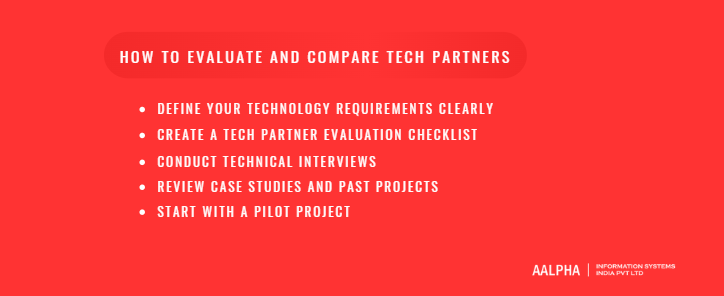
7.1 Define Your Technology Requirements Clearly
Before approaching potential technology partners, businesses must first define their own technology requirements with clarity. Many projects encounter difficulties because organizations begin searching for development partners without fully understanding the scope, objectives, and technical expectations of their digital initiatives.
Clear requirement definition begins with identifying the business problem that the technology solution must address. Organizations should determine the purpose of the product, the target users, and the core features required for initial launch. For example, a logistics company developing a shipment tracking platform must define requirements related to real-time data processing, route tracking, and integration with mapping services. Similarly, an e-commerce platform must specify requirements for payment processing, inventory management, and user experience design.
Technical expectations should also be outlined. This may include preferred programming languages, infrastructure environments, data security requirements, and performance expectations. Businesses should also estimate future growth scenarios so that the system architecture can support scaling requirements.
When requirements are well documented, discussions with potential partners become more productive. Development teams can provide more accurate technical recommendations, estimate project timelines more realistically, and demonstrate how their expertise aligns with the project’s goals. Clear requirements also allow businesses to compare different partners using consistent evaluation criteria.
7.2 Create a Tech Partner Evaluation Checklist
A structured evaluation checklist helps organizations compare potential partners objectively rather than relying solely on subjective impressions. This checklist should include multiple criteria that reflect both technical capability and operational reliability.
One of the most important factors to evaluate is the partner’s experience with similar projects. Companies should examine whether the development team has previously built systems with comparable complexity, scale, and functionality. Experience with similar products often indicates that the team understands the challenges associated with the project.
The technical stack used by the development team is another important consideration. Businesses should evaluate whether the partner is proficient in modern programming languages, frameworks, and cloud infrastructure technologies relevant to the project. For example, teams building scalable web platforms may require expertise in technologies such as Node.js, Python, React, Kubernetes, and cloud services.
Team structure also plays a crucial role in project success. Organizations should understand how the development team is organized and who will be responsible for different aspects of the project. This typically includes software engineers, project managers, quality assurance specialists, and infrastructure engineers. A balanced team structure ensures that all aspects of development, testing, and deployment are managed effectively.
Cost considerations should also be included in the evaluation checklist. However, cost should not be the only determining factor. Businesses should compare pricing models, billing transparency, and the value delivered relative to the investment required. A well-designed checklist enables organizations to compare potential partners across multiple dimensions and make more informed decisions.
7.3 Conduct Technical Interviews
Technical interviews are an essential step in evaluating development partners. While marketing materials and portfolios provide useful information, direct technical discussions reveal how well a development team understands complex engineering challenges.
During technical interviews, businesses should ask detailed questions about system architecture and scalability. For example, organizations can ask how the team would design a system capable of supporting millions of users, handling large volumes of data, or integrating with multiple external services. Experienced engineers should be able to explain how they would approach database design, caching strategies, load balancing, and infrastructure scaling.
Questions about previous technical challenges also provide valuable insights. Development teams should be able to describe real-world problems they encountered in past projects and explain how they solved them. These discussions help reveal the team’s problem-solving abilities and technical depth.
Businesses should also explore the partner’s approach to security, performance optimization, and testing. Reliable development teams implement automated testing pipelines, continuous integration practices, and infrastructure monitoring systems to maintain system stability. Technical interviews allow organizations to verify whether these practices are part of the partner’s engineering culture.
7.4 Review Case Studies and Past Projects
Examining case studies and previous projects helps businesses evaluate whether a technology partner has successfully delivered solutions similar to the one they intend to build. Case studies often provide detailed information about the challenges faced during development, the technologies used, and the outcomes achieved for the client organization.
For example, a case study might describe how a development team built a real-time logistics tracking system that improved delivery efficiency for a transportation company. Another case study may explain how an e-commerce platform was scaled to support thousands of simultaneous users during peak shopping periods.
Businesses should review whether the partner’s past work demonstrates scalability, reliability, and measurable business impact. Detailed case studies indicate that the partner has experience solving real-world problems rather than only completing small development tasks.
7.5 Start with a Pilot Project
One of the most effective ways to evaluate a potential technology partner is to begin the collaboration with a small pilot project. Rather than committing immediately to a large multi-year engagement, businesses can assign a limited scope project that allows both parties to assess working compatibility.
A pilot project might involve building a prototype, implementing a specific feature, or performing a technical audit of an existing system. This approach allows organizations to observe how the development team manages communication, meets deadlines, and responds to technical challenges.
Pilot projects also reveal how well the partner understands business requirements and adapts to feedback. If the collaboration proves successful during this initial stage, businesses can proceed with greater confidence when expanding the partnership into larger development initiatives.
By following a structured evaluation process that includes requirement definition, objective comparison, technical discussions, portfolio review, and pilot collaboration, businesses can select technology partners who are capable of supporting long-term digital growth.
8. Cost Considerations When Hiring a Long-Term Tech Partner
Cost is one of the most important factors businesses evaluate when choosing a long-term technology partner. However, the financial impact of technology partnerships goes far beyond the initial development budget. Organizations must consider how pricing structures, long-term value, and multi-year development planning influence the overall cost of building and maintaining digital products. Software platforms rarely remain static; they evolve through continuous feature development, infrastructure scaling, performance optimization, and security improvements. As a result, businesses must evaluate cost structures not only for the initial project but also for ongoing collaboration.
Understanding different pricing models and evaluating the relationship between cost and value helps companies make financially sound decisions when selecting technology partners. Long-term planning ensures that development investments align with product growth strategies and operational sustainability.
8.1 Different Pricing Models
Technology partners typically offer several pricing models depending on the project scope, complexity, and duration of collaboration. Understanding these models allows businesses to choose the approach that best fits their development strategy.
The fixed-price model is commonly used for projects with clearly defined requirements and timelines. Under this structure, the development partner provides a predetermined cost estimate for completing the entire project. Fixed pricing can be beneficial for short-term projects where the scope is unlikely to change significantly. However, this model may become restrictive for complex digital products that evolve over time. Changes to the scope often require contract renegotiation, which can slow development and increase costs.
The dedicated team model is frequently used for long-term technology partnerships. In this structure, a group of developers, designers, and engineers is assigned exclusively to the client’s project. The business pays a recurring monthly fee for access to this team. This approach provides flexibility because the team can continuously develop new features, maintain existing systems, and adapt to changing requirements. Dedicated teams are particularly useful for startups and digital platforms that require ongoing product development.
The time and material model charges businesses based on the actual time spent and resources used during development. This model works well for projects with evolving requirements where precise scope definitions are difficult to establish at the beginning. It provides flexibility and transparency because businesses pay for the actual work completed rather than a fixed estimate. However, it requires careful project management to ensure costs remain within budget.
8.2 Cost vs Value in Long-Term Partnerships
Many businesses initially focus on selecting technology partners based on the lowest development cost. While budget considerations are important, choosing the cheapest option often leads to long-term problems that increase total costs over time. Software development requires skilled engineers, robust infrastructure planning, and rigorous testing processes. Partners who offer unusually low prices may lack experienced developers or rely on shortcuts that compromise system quality.
Low-cost development often results in poorly designed architectures that struggle to support scaling. Businesses may later discover that the system cannot handle increased user traffic, integrate with new services, or support additional features. Correcting these issues may require extensive system redesign or complete redevelopment, which significantly increases long-term expenses.
A higher-quality technology partner may initially appear more expensive, but the value they deliver often outweighs the upfront cost difference. Experienced teams design systems with scalability, security, and maintainability in mind. They implement proper coding standards, automated testing pipelines, and robust infrastructure architectures that reduce the likelihood of costly technical failures.
When evaluating cost, businesses should consider the total value delivered by the technology partner. This includes development efficiency, system reliability, security practices, and the ability to support future growth. A partner who contributes to product strategy and long-term scalability often provides significantly greater business value than a low-cost vendor focused only on short-term deliverables.
8.3 Budget Planning for Multi-Year Development
Technology platforms often require continuous development over several years. Businesses launching digital products must therefore plan budgets that account for long-term development, maintenance, and infrastructure costs. Multi-year budget planning helps organizations avoid financial surprises and ensures that digital initiatives remain sustainable.
One important aspect of long-term budgeting is allocating resources for ongoing feature development. Customer expectations evolve rapidly, and digital products must regularly introduce new capabilities to remain competitive. Businesses should plan development budgets that support continuous product innovation rather than treating development as a one-time expense.
Infrastructure costs also play a significant role in long-term budgeting. Cloud hosting, data storage, content delivery networks, and security services generate recurring expenses that grow as user activity increases. Technology partners can help businesses estimate these costs and design architectures that optimize infrastructure efficiency.
Maintenance and support costs should also be considered. Software systems require bug fixes, performance monitoring, and security updates to maintain stability. Long-term technology partnerships typically include maintenance agreements that ensure the platform remains operational and secure.
Organizations that plan technology budgets with a multi-year perspective are better positioned to support product growth, avoid unexpected financial pressures, and maintain consistent digital innovation. By evaluating pricing models carefully and focusing on long-term value rather than short-term cost savings, businesses can build technology partnerships that support sustainable development and operational success.
9. Outsourcing vs In-House Development Teams
When building digital products, businesses must decide whether to develop technology internally or collaborate with external development partners. This decision significantly influences project costs, team management, scalability, and long-term operational flexibility. Some organizations prefer building in-house engineering teams to maintain direct control over development, while others choose outsourcing to access specialized expertise and accelerate product development.
In practice, there is no universal approach that fits every organization. The decision depends on factors such as company size, product complexity, hiring capacity, and long-term technology strategy. Many successful businesses combine both models to balance flexibility, cost efficiency, and technical expertise.
Understanding the advantages of outsourcing, the benefits of internal teams, and the role of hybrid models helps organizations design the most effective development structure for their needs.
9.1 Benefits of Outsourcing Development
Outsourcing development allows businesses to access experienced technical talent without building a large internal engineering team. Recruiting skilled developers can be time-consuming and expensive, particularly for companies that are not primarily focused on technology. Outsourcing enables organizations to collaborate with established development teams that already possess the expertise needed to design and build complex software systems.
One major advantage of outsourcing is speed. Development companies typically have experienced engineers, project managers, and infrastructure specialists ready to begin work immediately. This allows businesses to launch digital products faster compared to building a team from scratch.
Cost efficiency is another important benefit. Maintaining full-time in-house development teams requires salaries, benefits, office infrastructure, and ongoing training. Outsourcing partners provide access to skilled professionals on a project or long-term engagement basis, allowing businesses to control operational costs more effectively.
Outsourcing also provides access to diverse technical expertise. Development firms often work with multiple technologies, industries, and project types, allowing them to apply broader knowledge when solving complex problems. This experience can help businesses avoid common development challenges and adopt proven engineering practices.
For startups and companies entering new digital markets, outsourcing often provides the fastest and most practical way to build and scale technology platforms.
9.2 Advantages of In-House Teams
While outsourcing offers flexibility, in-house development teams provide advantages related to direct control, organizational alignment, and deep product ownership. Companies with internal engineering teams can manage development priorities more closely and integrate technical decisions directly into broader business strategies.
In-house teams develop a deep understanding of the company’s products, customer behavior, and internal operations. Because they work exclusively within the organization, they often maintain strong alignment with long-term product goals and business priorities. This level of ownership can be particularly valuable for companies whose core value proposition depends heavily on proprietary technology.
Communication may also be more efficient within internal teams. Developers, product managers, and business stakeholders operate within the same organizational environment, which can simplify collaboration and reduce coordination delays.
Another advantage is long-term knowledge retention. When development expertise remains within the organization, companies maintain greater control over system architecture, technical documentation, and product evolution. This reduces dependence on external partners for critical technical decisions.
However, building in-house teams requires substantial investment in recruitment, management, and technical infrastructure. Companies must ensure that they can consistently attract and retain skilled engineers to maintain development capabilities over time.
9.3 Hybrid Models for Modern Businesses
Many modern businesses adopt hybrid development models that combine internal teams with external technology partners. This approach allows organizations to maintain strategic control while benefiting from the flexibility and expertise provided by outsourcing.
In a hybrid model, core technical leadership and product strategy often remain within the company. Internal teams focus on defining product vision, managing architecture decisions, and maintaining critical system components. External development partners support these teams by contributing specialized expertise, expanding development capacity, and accelerating feature implementation.
Hybrid models are particularly effective for companies experiencing rapid growth. As product demand increases, internal teams may struggle to handle expanding development workloads. External partners can provide additional engineers, designers, and infrastructure specialists to support scaling without requiring immediate large-scale hiring.
This approach also allows businesses to access niche expertise when needed. For example, companies may rely on external specialists for cloud infrastructure optimization, artificial intelligence development, or cybersecurity implementation while maintaining core product development internally.
By combining internal leadership with external technical capabilities, hybrid models provide a balanced approach that supports innovation, scalability, and operational flexibility. Many successful technology-driven companies use this model to maintain control over their products while leveraging the strengths of experienced development partners.
10. How a Good Tech Partner Contributes to Business Growth
Technology partnerships influence far more than the technical implementation of a product. When businesses collaborate with the right technology partner, the relationship often becomes a strategic driver of long-term growth. Modern digital platforms must evolve continuously to meet customer expectations, handle increasing usage, and integrate with emerging technologies. A capable tech partner supports these goals by accelerating product development, building scalable systems, and enabling continuous improvement.
Organizations that rely on experienced development partners often achieve faster innovation cycles and stronger product stability. Because the partner understands the business objectives, user needs, and technical ecosystem, they can contribute insights that improve both product performance and strategic direction. The result is a digital platform that grows alongside the business rather than becoming a constraint on expansion.
10.1 Faster Product Launches
Speed to market is one of the most important factors influencing business success in technology-driven industries. Companies that launch products quickly can capture market opportunities earlier, test ideas faster, and respond to customer feedback before competitors do. A strong technology partner plays a crucial role in accelerating this process.
Experienced development teams bring established workflows, proven development frameworks, and ready-to-use infrastructure components that shorten development timelines. Instead of starting every project from scratch, they apply best practices learned from previous implementations. This allows businesses to move from concept to product launch more efficiently.
Technology partners also help streamline decision-making during development. Because they understand technical trade-offs and implementation challenges, they can recommend practical solutions that avoid unnecessary complexity. This guidance helps teams prioritize features that deliver immediate value while planning future improvements.
Faster product launches enable businesses to validate ideas earlier and refine their offerings based on real user feedback. Over time, this iterative development approach leads to stronger products and better alignment with market demand.
10.2 Scalable Technology Architecture
As digital products grow in popularity, their underlying technology infrastructure must be capable of supporting increasing workloads. Applications that perform well with a few thousand users may struggle when demand grows to hundreds of thousands or millions of users. A good technology partner designs systems with scalability in mind from the earliest stages of development.
Scalable architecture involves selecting technologies and infrastructure patterns that allow systems to handle growth without major redesigns. Cloud-based platforms, distributed databases, and microservices architectures are commonly used to support this type of expansion. A skilled technology partner understands how to design systems that can scale horizontally as user activity increases.
Planning for scalability also reduces long-term operational risks. Businesses that launch products with poorly designed architectures often face performance issues, downtime, or costly infrastructure changes as they grow. Technology partners who prioritize scalability help ensure that digital platforms remain reliable even as usage increases.
By building robust infrastructure foundations, development partners enable businesses to expand their customer base and introduce new services without encountering technical limitations.
10.3 Continuous Product Improvement
Digital products must evolve continuously to remain competitive. Customer expectations change, new technologies emerge, and market conditions shift over time. A good technology partner supports this ongoing evolution by helping businesses improve their products through iterative development.
Continuous improvement involves analyzing product performance, collecting user feedback, and identifying opportunities for enhancement. Technology partners contribute to this process by monitoring system metrics, identifying performance bottlenecks, and recommending feature improvements that enhance user experience.
For example, a mobile commerce platform may initially launch with basic purchasing functionality. Over time, the technology partner may introduce recommendation algorithms, advanced analytics dashboards, automated customer engagement tools, and optimized checkout processes. Each improvement increases the product’s value and competitiveness.
Regular updates also ensure that the platform remains secure and compatible with modern technologies. Software frameworks, operating systems, and security standards evolve frequently, requiring ongoing maintenance and upgrades.
When businesses collaborate with a technology partner who actively participates in product development and improvement, they create an environment where innovation becomes continuous rather than occasional. This sustained innovation helps organizations adapt to changing market conditions and maintain long-term growth.
11. Why Businesses Choose Experienced Technology Partners Like Aalpha
Selecting a long-term technology partner is not only about technical capabilities but also about reliability, strategic thinking, and the ability to support digital products throughout their lifecycle. Businesses looking for sustainable technology growth often prefer working with experienced development companies that combine strong engineering expertise with structured product development processes. Organizations that specialize in building complex digital platforms can help businesses launch new products, modernize existing systems, and scale technology infrastructure efficiently.
Companies such as Aalpha Information Systems have built long-term partnerships with businesses across industries by providing end-to-end development services and strategic technology consulting. These partnerships extend beyond initial project delivery, enabling organizations to continuously improve their digital platforms as market demands evolve.
11.1 Expertise Across Web, Mobile, and Enterprise Systems
Modern businesses rely on multiple digital platforms to deliver services and manage operations. Customer-facing applications often include web platforms and mobile apps, while internal processes depend on enterprise software systems that manage data, workflows, and integrations. Technology partners with expertise across these environments can support organizations more effectively as their digital ecosystems grow.
Experienced development firms provide expertise in building scalable web applications, cross-platform mobile apps, and enterprise-grade systems that integrate with existing infrastructure. Web platforms often require technologies such as modern JavaScript frameworks, cloud infrastructure, and API-based architectures. Mobile applications require user-focused design, performance optimization, and integration with backend services.
Enterprise systems introduce additional complexity because they must support business workflows, data analytics, and secure integrations with third-party systems. Development teams that understand how these components interact can design architectures that allow organizations to expand their digital capabilities without disrupting existing operations.
Working with a partner experienced across web, mobile, and enterprise environments enables businesses to maintain consistency across their technology ecosystem while supporting future innovation.
11.2 Dedicated Development Teams
Long-term technology partnerships often involve dedicated development teams that work closely with client organizations over extended periods. These teams typically include software engineers, project managers, quality assurance specialists, and infrastructure experts who collaborate to deliver continuous product improvements.
Dedicated teams provide several advantages. Because the same engineers remain involved throughout the product lifecycle, they develop deep familiarity with system architecture, business requirements, and user behavior. This continuity improves development efficiency and reduces the time required to implement new features.
Organizations also benefit from predictable development capacity. Dedicated teams function as an extension of the client’s internal technology department, allowing businesses to scale development activities without recruiting and managing large internal engineering teams.
11.3 Long-Term Product Development Support
Digital platforms require ongoing development long after the initial product launch. New features, performance optimizations, security updates, and infrastructure improvements must be implemented regularly to keep systems competitive and reliable. Experienced technology partners provide long-term development support that ensures digital products continue evolving with business needs.
Long-term support often includes system monitoring, software updates, infrastructure management, and feature expansion. Development teams continuously analyze system performance, identify potential improvements, and implement enhancements that improve user experience and operational efficiency.
Strategic technology partners also help businesses plan future product roadmaps. By understanding the company’s long-term goals, they can recommend new technologies, architectural improvements, and innovation opportunities that support sustained growth.
Organizations that work with experienced partners such as Aalpha gain access to engineering expertise, scalable development resources, and strategic guidance that helps them build reliable digital products capable of supporting long-term business expansion.
12. Future of Long-Term Technology Partnerships
Technology partnerships are evolving rapidly as digital transformation reshapes how businesses build and operate software systems. In the past, technology collaborations were largely transactional, focused on delivering specific projects such as website development or mobile application launches. However, modern businesses increasingly view technology as a core strategic asset rather than a support function. This shift is redefining the role of development partners.
Future technology partnerships will focus more on continuous collaboration, product innovation, and strategic technical guidance. Instead of simply executing predefined requirements, development partners will work closely with businesses to explore new technologies, optimize digital platforms, and identify opportunities for long-term competitive advantage. Several emerging trends are shaping the future of these partnerships.
12.1 AI-Driven Development Collaboration
Artificial intelligence is transforming the way software systems are designed, developed, and maintained. Development teams are increasingly using AI-assisted tools to automate code generation, improve software testing, detect security vulnerabilities, and analyze system performance. As these tools become more advanced, technology partners will integrate AI-driven workflows into their development processes.
AI-enabled development environments can significantly accelerate product development. For example, intelligent code analysis tools can identify potential bugs before deployment, while automated testing frameworks can simulate thousands of user scenarios in a short period of time. These capabilities allow development teams to maintain higher software quality while reducing development timelines.
Technology partners will also help businesses integrate AI capabilities directly into their products. Applications across industries are increasingly incorporating machine learning features such as recommendation engines, predictive analytics, automated customer support systems, and data-driven decision tools. Development partners with strong AI expertise will play an important role in helping organizations adopt these capabilities responsibly and effectively.
12.2 Product-Led Partnerships Instead of Vendor Models
Another significant shift in technology collaboration is the movement away from traditional vendor relationships toward product-led partnerships. In the vendor model, development teams simply execute predefined requirements without participating in strategic decision-making. This approach often results in limited innovation and fragmented product development.
Product-led partnerships emphasize deeper collaboration between businesses and technology teams. Development partners participate in product planning, user experience design, and technical architecture decisions. They work closely with business leaders to align development priorities with long-term market opportunities.
In this model, technology partners act as advisors as well as developers. They contribute insights about emerging technologies, infrastructure strategies, and scalability planning. Businesses benefit from a more integrated approach where technical expertise and business strategy evolve together.
12.3 Continuous Innovation Cycles
Digital products must evolve constantly to remain competitive. Customer expectations change quickly, and new technologies create opportunities for better services and improved operational efficiency. Long-term technology partnerships will increasingly revolve around continuous innovation cycles rather than isolated development projects.
These cycles involve ongoing analysis of product performance, regular feature updates, and rapid experimentation with new capabilities. Technology partners will help businesses collect user feedback, analyze data insights, and implement improvements through iterative development processes.
By maintaining continuous innovation cycles, organizations can adapt quickly to market changes while maintaining stable and scalable digital platforms. Long-term technology partnerships will therefore become central to how businesses build and sustain competitive digital ecosystems.
Final Thoughts
Choosing the right long-term technology partner is one of the most important strategic decisions a business can make. A reliable partner contributes far beyond development by helping organizations build scalable systems, accelerate product innovation, and adapt to evolving market demands. By evaluating technical expertise, industry experience, communication practices, and long-term support capabilities, businesses can identify partners who are capable of supporting sustainable digital growth.
If your organization is planning to build or scale digital products, working with an experienced technology partner can significantly improve development efficiency and long-term product success. Aalpha Information Systems helps businesses design, develop, and scale reliable web, mobile, and enterprise solutions through dedicated development teams and long-term technology partnerships. If you are looking for a trusted partner to support your digital initiatives, consider consulting with Aalpha’s technology experts to explore how your next product can be built for long-term success.
13. Frequently Asked Questions (FAQs)
How do I choose the right tech partner?
Choosing the right technology partner begins with evaluating technical expertise, industry experience, and the ability to support long-term product development. Businesses should review the partner’s portfolio, development process, communication practices, and client testimonials. A reliable partner should demonstrate experience with scalable architectures, modern technology stacks, and structured development methodologies. It is also helpful to begin collaboration with a small pilot project to assess working compatibility before committing to a long-term engagement.
What makes a good technology partner?
A good technology partner combines strong engineering skills with strategic thinking and transparent communication. Beyond building software, the partner should understand the business goals behind the product and contribute ideas that improve performance, scalability, and user experience. Reliable partners follow structured development processes, provide consistent project visibility, and remain available for ongoing maintenance and upgrades after product launch.
Should startups hire a tech partner or build an in-house team?
For many startups, working with a technology partner is often more practical during the early stages. Recruiting a full in-house engineering team can require significant time and financial investment. A development partner allows startups to build their initial product faster while accessing experienced engineers and technical guidance. As the business grows, startups may gradually build internal teams while continuing to collaborate with external partners.
How much does a long-term tech partnership cost?
The cost of a long-term technology partnership varies depending on the project scope, team size, and pricing model. Dedicated development teams may cost anywhere from a few thousand to tens of thousands of dollars per month depending on the number of engineers and their expertise. Businesses should evaluate overall value rather than selecting partners based solely on the lowest price, as higher-quality development often reduces long-term operational costs.
What industries benefit most from tech partnerships?
Almost every industry that relies on digital platforms can benefit from technology partnerships. Sectors such as healthcare, fintech, e-commerce, logistics, education, and enterprise software often require continuous development and system maintenance. Long-term technology partners help organizations in these industries build scalable platforms, integrate emerging technologies, and maintain reliable digital infrastructure as their operations expand.