





TL;DR:
Healthcare SaaS development means building cloud-hosted, subscription-delivered software for clinicians, patients, or payers, typically covering EHR and EMR platforms, telemedicine, remote patient monitoring, practice management, or population health tools. The work differs from standard SaaS in three ways: HIPAA (or GDPR, or both) is a design constraint from day one, interoperability with existing hospital systems through HL7 and FHIR is usually non-negotiable, and the cost of a security failure is measured in patient harm, not just churn. A Healthcare development company Aalpha may be involved in projects that require healthcare-specific software engineering, interoperability, and compliance considerations. This guide covers the product categories, the compliance and interoperability requirements, the architecture and security decisions, the development process, realistic cost ranges, and the questions worth asking a development partner before you sign a contract.
Introduction to SaaS in healthcare
Healthcare software used to mean an on-premises system a hospital IT department installed, patched, and babysat for a decade. SaaS inverted that. A clinic or health system now logs into a browser, and the vendor owns the servers, the patches, the uptime, and increasingly the compliance posture too. That shift changed who can afford good software. A five-physician practice can run on the same billing platform as a 400-bed hospital, paying per seat instead of paying for a data center.
The forces behind the shift
The move toward SaaS in healthcare has been pulled along by three separate forces. Telehealth adoption, which jumped hard in 2020 and never fully receded, needed infrastructure that could scale up and down without a hospital buying servers for a demand spike that might not recur. Value-based care models pushed payers and providers toward population health tools that need constant data updates, which fits a subscription and update cycle far better than a shipped CD-ROM ever did. And clinician shortages made scheduling, triage, and administrative software a retention issue, not just an efficiency one. Nurses and physicians leave jobs over bad software as often as they leave over pay.
None of that erases the friction. Healthcare data is regulated more heavily than almost any other category outside finance and defense, hospital IT environments are a patchwork of systems bought over 20 years, and clinicians will abandon software that adds even ninety seconds to a visit. Building for this market rewards teams that treat compliance and interoperability as core product requirements rather than a legal checklist bolted on before launch.
Who’s actually buying
It also helps to be clear about who is actually buying. Healthcare SaaS gets sold to at least four distinct buyer types, and the sales cycle, procurement process, and even the feature priorities shift depending on which one a product targets. Independent practices and small clinics buy fast, often on a credit card, and care most about ease of use and price. Hospital systems and large provider groups buy slow, run the vendor through a security review and sometimes a full RFP process, and care as much about the vendor’s compliance documentation as the product itself. Payers, meaning insurance companies, buy population-scale tools and expect enterprise-grade data handling and reporting from the first conversation. Direct-to-patient products, the fourth category, face the least procurement friction but the hardest trust problem, since a patient handing over health data to an app has no institutional buyer vetting the vendor on their behalf. A product roadmap that tries to serve all four buyer types at once usually serves none of them well, and picking one as the primary target for the first 18 months keeps both the feature set and the compliance scope honest.
Types of healthcare SaaS products
Healthcare SaaS is not one product category. The build, the buyer, and the compliance burden differ sharply across it.
-
Electronic Health Records and Electronic Medical Records
Electronic Health Record and Electronic Medical Record platforms sit at the center of most clinical workflows. EMR systems hold a single practice’s patient charts. EHR systems are built to move that data between organizations, which is why the interoperability requirements below apply most heavily here. Building a new EHR from scratch is rare for a reason: Epic and Cerner (now Oracle Health) dominate the hospital market, and most new entrants build a specialty EHR for a niche the incumbents ignore, such as behavioral health, dental, or physical therapy, rather than competing head-on.
-
Telemedicine and virtual care
Telemedicine and virtual care platforms handle video visits, asynchronous messaging, and often e-prescribing. The technical bar looks deceptively low, since video calling libraries are commodity infrastructure now. The actual difficulty is clinical workflow: intake forms that route to the right specialty, provider licensure checks by state or country, and integration with whatever EHR the clinic already runs so a virtual visit note lands in the same chart as an in-person one.
-
Practice management and scheduling
Practice management and scheduling software covers appointment booking, waitlists, insurance eligibility checks, and front-desk operations. This is one of the more approachable entry points for a new SaaS product because the compliance surface is smaller than clinical data platforms, though it still touches protected health information the moment a patient name is linked to a diagnosis code or appointment reason.
-
Remote patient monitoring
Remote patient monitoring platforms ingest data from connected devices, blood pressure cuffs, glucose monitors, pulse oximeters, and turn it into alerts a care team acts on. The hard part is rarely the dashboard. It is the device integration layer, the alert thresholds that avoid both false alarms and missed deterioration, and the reimbursement codes (in the US, CPT codes like 99457 and 99458) that determine whether a health system gets paid for running the program at all.
-
Medical billing and revenue cycle management
Medical billing and revenue cycle management software automates claims submission, denial management, and patient billing. This is a mature category with entrenched players, but there is steady demand from specialty practices whose billing codes and payer rules the generalist platforms handle poorly.
-
Clinical decision support
Clinical decision support systems surface alerts, drug interaction warnings, or diagnostic suggestions inside a clinician’s workflow. This category increasingly overlaps with regulated medical device software, covered in the compliance section below, because a tool that influences a diagnosis or treatment decision can cross the line into Software as a Medical Device depending on what it claims to do.
-
Population health and patient engagement
Population health management tools aggregate data across a patient panel to flag care gaps, risk scores, and outcomes trends, mostly bought by health systems and payers managing value-based contracts. Patient engagement apps and portals, covering appointment requests, lab result access, and secure messaging, round out the category, alongside pharmacy and prescription management software handling refill requests, adherence tracking, and pharmacy benefit integration.
-
Health insurance and payer platforms
Health insurance and payer platforms make up a category that gets less attention in most guides to this space but represents some of the largest software budgets in healthcare. These systems handle plan enrollment, claims adjudication, provider network management, and increasingly member-facing tools for finding in-network care. The data volume here dwarfs most provider-side software, and the integration surface includes claims clearinghouses, provider directories that need to stay current across thousands of practices, and regulatory reporting obligations that vary by state or country in ways that make a single unified data model genuinely difficult to design well.
-
Medication and prescription management
Medication and prescription management tools deserve a mention separate from general pharmacy software, covering medication adherence tracking, drug interaction checking, and increasingly AI-assisted prior authorization workflows, since prior authorization delay is one of the most frequently cited frustrations from both physicians and patients in US healthcare, and software that shortens that cycle has an unusually clear value proposition to sell against.
Aalpha has built across several of these categories, including practice management systems, telehealth platforms, and patient engagement tools for clients in the US, UK, and Gulf markets, which is where most of the architecture guidance in this article comes from rather than from theory.
Core features healthcare SaaS products need
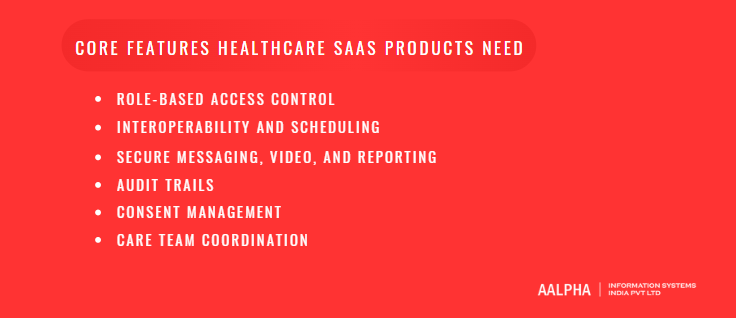
The feature list changes by product type, but a handful of capabilities show up in nearly every healthcare SaaS build regardless of category.
-
Role-based access control
Role-based access control is the first one, and it needs to be more granular than a typical B2B SaaS product. A front-desk staffer, a nurse, a physician, a billing clerk, and a patient all need different views of the same record, and the access model has to support this at the field level, not just the page level. A billing clerk who can see a diagnosis code for claims purposes should not necessarily see the clinical notes behind it.
-
Interoperability and scheduling
Interoperability and data exchange, covered in detail in its own section below, needs to be a first-class feature rather than an afterthought integration. Appointment scheduling and reminders sound trivial until you account for provider calendars synced across multiple locations, insurance-driven visit type rules, and no-show reduction logic that actually respects patient preference on reminder channel and timing.
-
Secure messaging, video, and reporting
Secure messaging and telehealth video need end-to-end encryption and session logging, and if the product handles video, WebRTC-based infrastructure with a signed Business Associate Agreement from whichever video vendor gets used, since a generic consumer video SDK is not built for this. Reporting and analytics dashboards matter more in healthcare than in most SaaS categories because a health system’s leadership is often contractually required to report certain quality metrics to payers or regulators, and a platform that cannot export the right numbers in the right format becomes a support burden fast.
-
Audit trails
Audit trails and activity logging deserve separate mention because HIPAA requires them explicitly. Every view, edit, and export of patient data needs a timestamped, user-attributed log entry that survives for the retention period the client’s compliance policy requires, usually six years at minimum in the US.
-
Consent management
Consent management is a feature category that gets built as an afterthought far too often. Patients need a clear, revocable way to consent to specific uses of their data, telehealth recording, data sharing with a referring provider, participation in a research registry, and each consent needs its own record, not a single blanket checkbox at signup. Building a proper consent ledger from the start avoids a much harder retrofit once real patient data and real consent history already exist in the system.
-
Care team coordination
Care team coordination features, secure task assignment, shared care plans, and notification routing that respects a clinician’s actual working hours rather than paging someone at 2 a.m. for a non-urgent update, matter most in platforms serving multi-provider practices or care coordination programs. Getting notification fatigue wrong is one of the fastest ways to lose clinician trust in a platform, since a tool that cries wolf gets its alerts ignored within a few weeks, including the ones that actually matter.
Regulatory compliance and standards
This is where healthcare SaaS diverges hardest from every other vertical, and it is the section most healthcare software buyers underestimate before their first project.
-
HIPAA
HIPAA, the US Health Insurance Portability and Accountability Act, governs how protected health information is stored, transmitted, and accessed. It is not a certification you buy. There is no HIPAA seal a vendor can purchase and stick on a website, whatever some vendor marketing pages imply. HIPAA compliance is a set of administrative, physical, and technical safeguards a covered entity or business associate implements and documents, covering things like encryption standards, access controls, breach notification procedures, and workforce training. A SaaS vendor selling to US healthcare organizations will almost always be asked to sign a Business Associate Agreement, a contract that makes the vendor legally responsible for protecting any PHI it touches.
-
The HITECH Act
The HITECH Act extended HIPAA’s reach and sharpened its teeth, introducing the breach notification rule and raising the penalties for violations. Penalties scale by culpability, from a few hundred dollars per violation for something the organization did not know about and could not have reasonably known, up past $50,000 per violation for willful neglect that goes uncorrected, with an annual cap in the low millions per violation category. That range is why compliance budget belongs in the initial architecture decision, not a post-launch cleanup task.
-
GDPR
For platforms serving European patients, GDPR applies, and health data falls under GDPR’s special category of sensitive personal data, which requires an explicit legal basis for processing beyond the general consent that covers ordinary personal data. GDPR and HIPAA are not identical, and a platform built HIPAA-first often needs real rework, not just a policy update, to meet GDPR’s stricter consent and data portability requirements.
-
Software as a Medical Device
Software as a Medical Device is a separate regulatory track that trips up teams building clinical decision support or diagnostic tools. The FDA’s framework asks whether the software’s function meets the legal definition of a medical device, which hinges on what the software claims to do, not what technology it uses. A symptom checker that suggests possible conditions without claiming to diagnose sits in a gray zone many products deliberately design around, using careful language in the UI to stay in the lower-risk category and avoid the far longer FDA clearance timeline that comes with a diagnostic claim.
-
UK, Australia, and other international frameworks
Clients outside the US bring their own frameworks into scope. The UK’s NHS Data Security and Protection Toolkit is a required annual self-assessment for any organization handling NHS patient data, including third-party software vendors. Australia runs its own My Health Record framework with specific conformance requirements for any system connecting to it. A platform selling into multiple regions needs a compliance map before development starts, not a scramble after the first international client signs.
-
Gulf region requirements
Gulf region clients bring their own requirements too, and this matters more for Aalpha’s practice than most guides to this topic acknowledge, given how much of the client base sits in the UAE and broader GCC. The UAE’s Dubai Health Authority and the federal Ministry of Health and Prevention both maintain health data regulations that generally require patient data generated within the UAE to be hosted within the country, a stricter data residency stance than HIPAA takes and one that shapes infrastructure decisions from the start for any platform selling into that market. Saudi Arabia’s health sector runs under its own data protection framework tied to the broader Personal Data Protection Law, with similar residency expectations. Neither framework maps cleanly onto a HIPAA-first architecture, which is another reason the single-primary-market approach mentioned earlier tends to outperform trying to satisfy every region’s rules with one unified build from day one.
-
US state-level privacy law and PCI DSS
US state-level privacy law adds another layer that federal HIPAA compliance does not automatically cover. California’s Confidentiality of Medical Information Act predates HIPAA and imposes its own, sometimes stricter, requirements, and California’s broader privacy laws increasingly reach health-adjacent data collected outside a traditional covered entity relationship, such as data gathered by a wellness app that is not itself a healthcare provider. Washington State’s My Health My Data Act, passed in 2023, extended similar protections to consumer health data specifically to close the gap HIPAA leaves around apps that collect health information without being a covered entity. A product that processes payment for healthcare services also needs PCI DSS compliance for the payment flow itself, a separate standard from HIPAA that governs cardholder data specifically and is usually satisfied by routing payment processing through a certified processor like Stripe rather than handling card numbers directly.
Interoperability standards
A healthcare SaaS product that cannot talk to the hospital’s existing EHR is a product that gets used for a few weeks and then quietly abandoned when the double data entry becomes unbearable. Interoperability is not optional infrastructure. It is the feature that determines adoption.
-
HL7v2
HL7, specifically HL7v2, is the older messaging standard still running most hospital integration engines today. It is pipe-delimited text that looks nothing like a modern API, was designed in the 1980s, and remains stubbornly in production because ripping it out of a hospital’s infrastructure is a multi-year project nobody wants to own. Any healthcare SaaS product expecting to integrate with an established health system needs to at least receive and parse HL7v2 messages, usually ADT (admission, discharge, transfer) feeds and ORM or ORU messages for orders and results.
-
FHIR
FHIR, Fast Healthcare Interoperability Resources, is the standard actually worth building new integrations around. It is RESTful, uses JSON, and models healthcare data as discrete resources, Patient, Observation, MedicationRequest, and so on, that map cleanly onto how a modern API developer already thinks. The US government’s information blocking rules under the 21st Century Cures Act have pushed FHIR adoption hard, and most major EHR vendors now expose FHIR APIs, though the coverage and quality of those APIs varies more than vendor documentation suggests.
-
Integrating with Epic, Cerner, and Athenahealth
Integrating with Epic, Cerner, or Athenahealth in practice means going through each vendor’s own app marketplace and certification process, which adds weeks to a project timeline that a generic API integration would not need. Epic’s App Orchard and Cerner’s Code console both gate access behind an approval process, and budgeting for that lead time up front avoids a launch date slipping because of a dependency the product team did not control.
-
Labs, pharmacies, and clearinghouses
Beyond the big three EHR vendors, most healthcare SaaS products end up integrating with labs (through interfaces like LabCorp’s or Quest’s HL7 feeds), pharmacies (via Surescripts in the US for e-prescribing), and insurance clearinghouses for eligibility checks and claims. Each of these is its own integration project with its own certification requirements, and a realistic project plan treats them as separate workstreams rather than a single “integrations” line item.
-
SMART on FHIR and USCDI
SMART on FHIR is worth knowing specifically because it defines how a third-party app authenticates into an EHR and requests a defined scope of patient data, using OAuth 2.0 rather than a proprietary authentication scheme. An app built to the SMART on FHIR specification can, in principle, run inside multiple EHR vendors’ app frameworks with far less custom integration work per vendor, which is the closest thing this space has to a genuine write-once, integrate-many pattern. The US Core Data for Interoperability, USCDI, defines the minimum set of data classes, problems, medications, allergies, lab results, and so on, that certified health IT systems must be able to exchange, and designing a product’s data model around USCDI classes from the start tends to keep it aligned with where US interoperability requirements are heading rather than where they stood a few years ago.
Architecture and technical considerations
-
Multi-tenancy
Multi-tenancy is the first architecture decision, and healthcare pushes teams toward stricter isolation than most SaaS categories default to. A shared-database, shared-schema model with a tenant ID column works fine for a project management tool. For a platform holding PHI across multiple health systems, many compliance teams and some contracts require schema-level or even database-level isolation per tenant, which raises infrastructure cost and operational complexity but closes off an entire category of cross-tenant data leak risk.
-
Encryption
Encryption needs to cover data at rest and in transit without exception, using AES-256 for stored data and TLS 1.2 or higher for anything moving across a network. This sounds obvious until you look at what actually gets missed: backups, log files that accidentally capture PHI in error messages, and third-party analytics scripts that see more of the page than the product team realizes. A HIPAA-focused architecture review looks at every place data touches disk or leaves the application boundary, not just the primary database.
-
Cloud infrastructure and HIPAA eligibility
Cloud infrastructure choice matters because AWS, Azure, and Google Cloud all offer HIPAA-eligible services under a signed BAA, but eligibility is per-service, not blanket. A team that provisions a HIPAA BAA with AWS and then uses a non-eligible service, some older AWS services still are not covered, has a compliance gap that a checklist review will not catch unless someone is specifically auditing service-by-service.
-
Scalability planning
Scalability planning in healthcare SaaS often means planning for burst load tied to real-world events rather than steady organic growth. A telehealth platform sees usage spike hard during flu season or a regional health crisis, and a remote monitoring platform sees data volume climb as a health system enrolls a new cohort of patients all at once rather than gradually. Architecture that assumes smooth, predictable growth curves gets caught out by healthcare’s lumpier demand patterns.
-
Monolith versus microservices
On the monolith versus microservices question, Aalpha’s default recommendation for healthcare SaaS leans toward a modular monolith for the first 12 to 18 months of a new product, with microservices reserved for services that have a genuinely different scaling profile, such as a video infrastructure layer or an HL7 message processing pipeline. Splitting into microservices before the domain model is stable adds operational overhead, more services to secure and audit individually, before the product has proven which boundaries actually hold.
-
Data residency
Data residency comes up as soon as a product has clients in more than one region, and it deserves architectural attention before the first non-domestic client signs rather than after. UK and EU clients frequently require patient data to stay within the UK or EU, which means either regional database deployments from the start or a data residency strategy that can be added without a full rearchitecture later. Retrofitting regional data isolation onto a single-region database design is one of the more expensive mistakes a healthcare SaaS team can make, on par with the compliance-as-afterthought problem discussed earlier.
-
API gateway
An API gateway sitting in front of the application layer earns its keep in healthcare SaaS specifically because of the volume of third-party integration traffic, HL7 feeds, FHIR queries, lab and pharmacy callbacks, that a mature platform accumulates. Centralizing rate limiting, authentication, and request logging at the gateway layer rather than duplicating that logic across every integration endpoint keeps the audit trail consistent, which matters when a compliance review asks for a complete record of every external system that touched a given patient’s data over a given period.
-
Test environments and EHR sandboxes
Test environments need their own architecture decision, since testing an EHR integration against a production hospital system is obviously not an option. Epic, Cerner, and most other major EHR vendors provide sandbox environments with synthetic patient data specifically for this purpose, and building the integration layer against these sandboxes from the start, rather than mocking the EHR’s API responses internally and hoping the real thing matches, catches the gap between documented API behavior and actual API behavior far earlier in the project. That gap is real and common enough that budgeting extra integration testing time around it, rather than assuming the sandbox behaves exactly like the vendor’s documentation describes, saves a project from a late surprise.
Security best practices
Healthcare data breaches carry a different cost profile than a typical SaaS breach. A leaked email list is embarrassing. A leaked patient record, tied to a diagnosis, a mental health visit, or an HIV status, can follow someone for the rest of their life and cannot be reissued the way a credit card number can. That asymmetry is why healthcare security reviews go deeper than a standard SOC 2 audit.
-
Access control and authentication
Access control needs multi-factor authentication as a baseline, not an optional add-on, for any account with access to PHI. Single sign-on through SAML or OIDC is worth building early for enterprise health system clients, most of whom will refuse to onboard a vendor that only offers username-and-password login for staff accounts. Session timeouts need to be aggressive enough to matter clinically, a shared nursing station workstation left logged in is a real and common failure mode, without being so aggressive that clinicians start writing passwords on sticky notes out of frustration.
-
Encryption key management
Encryption key management is where a lot of otherwise solid security architectures quietly fail. Using a managed key service like AWS KMS instead of hand-rolled key storage removes an entire category of risk, and rotating keys on a defined schedule matters more in an environment where a compromised key could expose years of accumulated patient history rather than a few weeks of transactional data.
-
Disaster recovery planning
Disaster recovery planning in healthcare needs a documented recovery time objective and recovery point objective, not just a general assurance that backups exist. A clinic that cannot access patient records for six hours during an outage has a genuine patient safety problem, not just a business continuity inconvenience, and that distinction should shape how aggressively a team invests in redundancy.
-
Third-party vendor risk
Third-party vendor risk is the last piece, and it is easy to underweight. Every subprocessor, the email service, the SMS provider, the analytics tool, the customer support platform, that touches PHI even incidentally needs its own BAA and its own security review. A platform can build a fortress around its core database and still have a breach originate from a support tool that logs customer messages containing patient names.
-
Penetration testing
Penetration testing needs to happen before a platform touches its first real patient record and then at least annually after that, more often if the client base includes large health systems, many of which require a current pen test report as a condition of the sales contract. An internal security review by the development team is not a substitute for an external test, since the whole value of a third-party tester is that they approach the system without the assumptions the builders carry.
-
Incident response
An incident response plan needs to exist in writing before it is needed, not drafted in the panic of an actual breach. HIPAA’s breach notification rule gives covered entities 60 days to notify affected individuals after discovering a breach, and a vendor whose incident response process cannot identify the scope of a breach quickly puts its healthcare clients at risk of missing that window. A written plan that names who investigates, who decides whether the breach threshold has been met, and who handles notification, tested at least once a year with a tabletop exercise, is the difference between a contained incident and a chaotic one.
The development process
-
Discovery
Discovery for a healthcare SaaS product needs to go deeper than a standard requirements-gathering phase because the workflows being digitized are clinical ones, and getting them wrong has consequences beyond a bad user experience score. This usually means shadowing actual clinical staff, not just interviewing a practice administrator about what they think happens at the front desk, because the gap between the documented workflow and the actual one is often where a product fails to get adopted.
-
MVP scoping
MVP scoping is a genuine discipline in this space because the temptation to build every compliance and integration requirement before launch will kill a project’s timeline and budget. A defensible MVP approach picks one clinical workflow, builds it fully compliant and fully integrated with the one EHR or system the pilot client actually uses, and defers the second and third integrations until the first one proves the product works. Building generic, integration-agnostic infrastructure before a single real integration is live is a common and expensive mistake.
-
Design and accessibility
Design work needs to account for clinician cognitive load specifically. A nurse working a 12-hour shift is not going to tolerate a five-click workflow for something that should take one click, and design decisions that would be minor friction in a consumer app become adoption blockers in a clinical one. Accessibility also carries more legal weight here than in many verticals, since Section 508 and WCAG compliance are frequently contractual requirements for any software sold into a US government-adjacent health system.
-
Development methodology
Development methodology tends to be agile with compliance checkpoints built into the sprint cadence rather than treated as a separate gate at the end. A security review folded into each sprint catches issues while the relevant code is still fresh in the team’s memory, instead of surfacing a list of findings during a pre-launch audit that then requires weeks of rework under deadline pressure.
-
Testing
Testing needs three distinct tracks: functional testing against clinical workflows, security testing including penetration testing before any handling of real PHI, and compliance validation against whichever regulatory frameworks apply to the client’s markets. Deployment and go-live support in healthcare typically runs longer than in other verticals too, because clinical staff need training time that a typical SaaS onboarding flow does not account for, and a rushed go-live in a clinical environment risks patient safety in a way a rushed go-live in, say, a marketing tool simply does not.
-
Documentation
Documentation carries more weight in a healthcare build than most engineering teams are used to producing. A software requirements specification that maps each feature to the compliance requirement or clinical workflow it satisfies becomes the backbone of later compliance audits, since an auditor asking why a particular access control exists gets a much faster, more credible answer from a documented requirements trace than from an engineer’s memory of a decision made eight months earlier. Teams that treat documentation as a deliverable rather than an afterthought spend less time reconstructing decisions during audit season and have an easier time onboarding new engineers into a codebase where every non-obvious choice has a recorded reason behind it.
-
Team composition
Team composition for a healthcare SaaS build differs from a standard SaaS team in one specific way: it needs someone, whether a dedicated compliance lead or a senior engineer with prior healthcare experience, whose job includes flagging compliance implications during design and sprint planning, not just during a pre-launch audit. Without that role, compliance issues get caught late, by an external auditor or a client’s security team, at a point where fixing them costs far more than catching them during the design review would have. A typical Aalpha healthcare team pairs a product manager who owns the clinical workflow mapping with a technical lead who owns the compliance and integration architecture, backed by engineers who rotate through both the core product and the integration layer rather than being permanently siloed into one or the other.
Technology stack considerations
-
Backend frameworks
Backend framework choice matters less in healthcare SaaS than the ecosystem of compliance and security tooling available around it. Aalpha has shipped healthcare platforms on Node.js, Python (Django and FastAPI), and Ruby on Rails, and the deciding factor has consistently been the client’s existing team skill set and the availability of vetted libraries for HL7 and FHIR parsing in that language, rather than any inherent superiority of one framework over another for this use case. Python has a slight edge for FHIR work given the maturity of libraries like fhir.resources, but it is not a decisive advantage.
-
Frontend considerations
Frontend considerations split by user type. A clinician-facing interface needs to prioritize speed and information density over the generous whitespace that consumer SaaS design trends favor, because clinicians are scanning for specific data points under time pressure, not browsing. A patient-facing portal needs the opposite: a low cognitive load, plain language instead of clinical terminology, and accessibility as a baseline, not an enhancement, given how much older and lower digital literacy the patient population skews toward compared to a typical SaaS customer base.
-
Database choice
Database choice depends on data shape. Structured clinical data, patient demographics, appointment records, billing codes, fits a relational database like PostgreSQL well, and PostgreSQL’s JSONB support handles the semi-structured FHIR resource payloads reasonably well without needing a separate document store. Unstructured data, clinical notes, imaging, scanned documents, usually lands in object storage like S3 with metadata indexed separately, rather than trying to force binary content into a relational schema.
-
Compliance monitoring tooling
Compliance monitoring tooling is worth budgeting for from the start rather than adding later. Tools like Vanta or Drata automate a meaningful share of the continuous compliance evidence collection that HIPAA and SOC 2 both require, and starting with one of these tools from the first sprint is considerably cheaper than retrofitting compliance monitoring onto a year-old codebase.
-
Mobile platform choice
Mobile platform choice for patient-facing apps usually comes down to React Native or Flutter rather than fully native development, since the compliance and integration logic sits in the backend regardless of mobile framework, and the cost savings from a single cross-platform codebase are harder to justify away in a category where budget is already stretched thin by compliance overhead. Clinician-facing mobile apps are a different calculation, since a hospital’s mobile device management policy sometimes dictates specific platform requirements or even blocks certain frameworks entirely, which makes it worth confirming the target health system’s MDM policy before committing to a mobile stack rather than after building against the wrong assumption.
Cost of healthcare SaaS development
-
What drives cost
Cost in this category tracks compliance scope and integration count more than raw feature count, which surprises clients coming from other software categories where feature count is the dominant cost driver. A patient scheduling tool with no EHR integration and a narrow compliance footprint can reach MVP for meaningfully less than a remote patient monitoring platform with device integrations, HL7 feeds, and multi-region compliance requirements, even if the two products have a similar number of screens.
-
Rough cost ranges
As a rough range based on Aalpha’s project history: a focused MVP, single clinical workflow, one EHR integration, US-only HIPAA compliance, typically falls in the low-to-mid six figures in USD terms depending on team composition and timeline. A fuller platform with multiple integrations, multi-region compliance, and a broader feature set climbs well past that, often into seven figures once you account for the ongoing compliance audit and security testing cycle rather than just the initial build.
-
Cost by product category
Cost also varies meaningfully by product category, not just by feature count. A practice management or scheduling tool with minimal EHR integration sits at the lower end of the range, since the compliance surface is narrower and the integration count is usually one or two systems. A telehealth platform costs more once video infrastructure, e-prescribing, and multi-state licensure checks are factored in. A remote patient monitoring platform tends to cost the most of the common categories, because device integration work multiplies by however many device manufacturers the product needs to support, and each manufacturer’s SDK and certification process is its own mini-project. An EHR or full clinical platform build sits well above all of these, which is part of why so few new entrants attempt one from scratch.
-
Certification costs
Compliance certification itself carries a direct cost separate from development. A SOC 2 Type II audit, increasingly expected by enterprise health system buyers even though it is not a HIPAA requirement per se, runs from the low tens of thousands of dollars for a first audit through a smaller firm, and takes months of evidence collection before the audit itself can even start. HITRUST certification, a broader framework covering more control domains that some larger health systems specifically require, costs considerably more and takes longer, which is why most early-stage healthcare SaaS products pursue SOC 2 first and treat HITRUST as a later-stage investment tied to a specific large enterprise deal that requires it.
-
Offshore and nearshore teams
Team location affects cost more in this category than founders sometimes expect going in, though not always in the direction they assume. Offshore and nearshore development teams can meaningfully reduce build cost, and Aalpha’s own healthcare projects for US and UK clients have run on exactly this model, but the compliance overhead does not shrink just because the team is offshore. A BAA still needs to name every individual or entity with access to PHI regardless of location, and some enterprise health system clients specifically restrict where PHI can be processed or even where engineers with access to production systems can be physically located, which is worth confirming with a target client’s procurement team before assuming an offshore team is a viable option for a specific deal.
-
Ongoing costs
Ongoing costs deserve as much attention as the initial build cost, because healthcare SaaS carries a heavier maintenance tail than most categories. Hosting on HIPAA-eligible infrastructure costs more than commodity hosting. Annual third-party security audits and penetration tests are close to mandatory for any platform selling into enterprise health systems. Compliance monitoring tooling, subscription costs for tools like Vanta, adds a recurring line item most first-time healthcare SaaS founders do not budget for until the first renewal invoice arrives.
Common challenges and how to address them
-
Legacy system integration
Legacy system integration is the challenge that catches the most teams off guard, mostly because the pain does not show up during the sales process. A hospital’s IT team will confirm they use Epic and have FHIR APIs available, and the actual integration project then reveals that the FHIR API coverage is partial, or that the hospital’s IT department has a six-week minimum lead time for any new integration request regardless of how simple it looks on paper. The fix is not technical. It is treating the integration timeline as a stakeholder management problem from week one, with the hospital’s IT team engaged before development starts rather than after.
-
Data migration
Data migration from an existing system is its own project, not a subtask of the main build, particularly when migrating from a legacy on-premises EHR with years of accumulated, inconsistently structured clinical notes. Teams that budget migration as a line item inside the general development estimate consistently underestimate it, because the actual work is data cleaning and mapping, not the migration script itself.
-
Usability versus compliance
Balancing usability against compliance requirements is a genuine and recurring tension rather than something that resolves once with a good design system. Every additional authentication step, every audit log confirmation, every consent screen adds friction that a clinician or patient will resist, and there is no version of this that eliminates the trade-off entirely. The teams that handle it well pick their friction points deliberately, accepting more friction at account setup and less during daily clinical use, rather than distributing friction evenly across the product out of a vague sense of thoroughness.
-
Multi-jurisdiction compliance
Multi-jurisdiction compliance for platforms selling across the US, UK, EU, and Gulf markets simultaneously is genuinely hard, and the honest answer is that most products should not attempt full multi-region compliance in their first 18 months. Picking one primary market, building fully compliant for it, and expanding deliberately with a compliance review before each new region launches beats trying to architect for every jurisdiction’s requirements from day one, which usually produces a slower, more expensive build that still ends up needing rework for the actual regional nuances once real clients from those regions start using it.
-
Clinician resistance to new software
Clinician resistance to new software is a change management problem more than a technical one, and it kills more healthcare SaaS deployments than any bug ever does. Physicians and nurses have lived through at least one, often several, mandated software rollouts that made their day-to-day work harder rather than easier, and that history makes new tools a hard sell regardless of how well designed the new one actually is. The projects that get past this involve clinical staff in the design process before the first line of code gets written, run a genuine pilot with a small group of willing early adopters rather than a hospital-wide mandate on day one, and treat the first two weeks of go-live as a support-heavy period rather than assuming the training session covered everything a busy clinician will remember under pressure a week later.
Post-launch: maintenance, monitoring, and scaling
-
Tracking regulatory change
Launch is not the finish line in healthcare SaaS the way it can feel like one in other categories, partly because the regulatory environment itself keeps moving. HIPAA guidance gets updated, FHIR versions advance (the shift from FHIR R4 to R5 is already pulling some vendors along), and USCDI data class requirements expand on a regular schedule set by federal rulemaking. A platform needs a standing process for tracking these changes, usually owned by whoever holds the compliance lead role described earlier, rather than discovering a new requirement only when a client’s procurement team asks about it.
-
Monitoring beyond uptime
Monitoring in a healthcare context needs to cover more than uptime and error rates. Anomaly detection on data access patterns, a user viewing an unusually high volume of patient records in a short window, for instance, catches both insider threats and compromised credentials before they become a reportable breach. This kind of monitoring is worth building deliberately rather than assuming a generic application performance monitoring tool will catch it, since most APM tools are tuned for infrastructure health, not for the specific access-pattern anomalies that matter in a healthcare compliance context.
-
Scaling with enterprise clients
Scaling decisions after launch tend to follow client growth rather than organic user growth, since a single new enterprise health system client can add more transaction volume in a month than a year of steady small-practice signups. Load testing against realistic enterprise-scale scenarios before signing a large health system client, rather than after, avoids the uncomfortable position of a platform buckling during its highest-visibility rollout. Support and maintenance contracts for healthcare SaaS also tend to run heavier than typical SaaS support tiers, since a clinical software outage during business hours is a different severity class than a typical B2B tool going down, and staffing an on-call rotation with someone who understands both the technical stack and the clinical stakes is worth the cost it adds to the ongoing engineering budget.
Choosing a healthcare SaaS development partner
-
Questions to ask
The questions worth asking a vendor go beyond “have you built healthcare software before.” Ask for a specific example of a HIPAA-compliant architecture they have shipped, and ask them to walk through how they handled a real integration with Epic, Cerner, or a major lab or pharmacy network, not a hypothetical description of how they would approach it. A vendor that has actually navigated Epic’s App Orchard certification process will describe the timeline and friction specifically. A vendor that has not will speak in generalities about “seamless integration,” which is usually the tell.
-
Compliance process during development
Ask about their compliance process during development, specifically whether security and compliance reviews happen throughout the build or get bolted on before launch. The second pattern produces projects that pass their final audit late and over budget, because compliance findings surfaced in week 40 of a 42-week project require rework under deadline pressure that a review cadence built into every sprint would have caught in week 4 instead.
-
Contract structure
Contract structure matters more here than in a typical software project too. Confirm intellectual property ownership terms explicitly, since a founder building a healthcare SaaS product to raise investment later needs full IP ownership of the codebase, not a license to use software the vendor retains rights to. Confirm who signs the Business Associate Agreement and under what terms the vendor’s own subprocessors are disclosed, since an opaque subprocessor list is itself a compliance gap waiting to surface during a client’s security review. And ask what happens to the codebase, documentation, and infrastructure access if the engagement ends, since a vendor relationship that leaves a founder without deployment credentials or infrastructure documentation is a liability regardless of how good the original build was.
Why Aalpha
Aalpha has been building custom software since 2008, has delivered more than 5,500 projects across 55-plus countries, and holds a 4.9 out of 5 rating from over 215 verified Clutch reviews, alongside ISO 9001:2015 certification. Healthcare clients have included platforms requiring HIPAA-aligned architecture, EHR integration work, and patient-facing applications built for both US and international regulatory contexts. That track record matters less as a credential to display and more as a source of the specific, hard-won detail in this guide, the App Orchard lead times, the migration underestimation pattern, the multi-region compliance trap, none of which shows up in a generic vendor pitch.
Frequently asked questions
How much does it cost to build a healthcare SaaS platform?
A focused MVP with one clinical workflow, one EHR integration, and single-region HIPAA compliance typically runs in the low-to-mid six figures in USD. A full platform with multiple integrations and multi-region compliance can run well into seven figures once ongoing audit and compliance monitoring costs are included.
Is HIPAA compliance mandatory for all healthcare software?
It applies to any software that creates, stores, transmits, or processes protected health information on behalf of a covered entity or business associate in the US. A pure scheduling tool with no clinical data might sit outside HIPAA’s scope, but the moment a patient name is linked to a diagnosis, an appointment reason, or a treatment, HIPAA applies.
What is FHIR and why does it matter for healthcare SaaS?
FHIR, Fast Healthcare Interoperability Resources, is the modern standard for exchanging healthcare data through RESTful, JSON-based APIs. US federal information blocking rules have pushed most major EHR vendors to expose FHIR APIs, and for a new SaaS product, integrating against FHIR is now the most practical path into existing hospital systems.
Can a small development team build a HIPAA-compliant platform, or does it require a specialized vendor?
A small team can build HIPAA-compliant software, but it needs at minimum one person with hands-on healthcare compliance experience guiding the architecture from the start. Retrofitting compliance onto an architecture designed without it in mind is consistently more expensive than building it in from the first sprint.
How long does it take to build an MVP healthcare SaaS product?
A focused MVP with a single clinical workflow and one integration typically takes four to seven months from discovery through a compliant launch, with the integration certification process (particularly with major EHR vendors) often the longest single dependency rather than the core product development.
Do I need a Business Associate Agreement with every vendor my platform uses?
Yes, with every subprocessor that touches protected health information even incidentally, including email providers, SMS services, analytics tools, and customer support platforms. Missing a BAA with a smaller subprocessor is one of the more common compliance gaps found in audits.
Should a healthcare SaaS product be built as a monolith or microservices?
A modular monolith is usually the more defensible starting point for the first 12 to 18 months, with microservices reserved for components with a genuinely different scaling or compliance profile, such as video infrastructure or an HL7 message processing pipeline.
What is the difference between HIPAA compliance and SOC 2 certification?
HIPAA is a US federal law with no formal certification, satisfied by implementing and documenting the required safeguards and signing BAAs with subprocessors. SOC 2 is an independent third-party audit, not legally required but increasingly expected by enterprise health system buyers as evidence that a vendor’s security controls actually work as described, and the two are usually pursued together rather than as substitutes for each other.
Does a healthcare SaaS product need FDA clearance?
Only if it meets the legal definition of Software as a Medical Device, which depends on what the software claims to do rather than what technology it uses. A scheduling tool or a secure messaging platform generally does not need clearance. A tool that makes or materially influences a diagnostic or treatment decision often does, and this is worth a specific legal review before launch rather than an assumption either way.
Getting started
The teams that succeed in healthcare SaaS treat compliance and interoperability as product requirements from the first architecture decision, not as a certification to chase after the product already works. That single choice, made early, is the difference between a six-month rework cycle before a hospital contract closes and a launch that holds up under the health system’s own security review.
Aalpha has built healthcare platforms across practice management, telehealth, and patient engagement for clients in the US, UK, and Gulf markets. If you are scoping a healthcare SaaS build and want a second opinion on the architecture or compliance approach before choosing a vendor, get in touch with Aalpha to discuss your requirements.