





The healthcare industry operates within one of the most complex financial ecosystems in the world. Every patient interaction generates administrative, clinical, and financial processes that must be managed accurately to ensure providers receive timely reimbursement for services delivered. Hospitals, clinics, physician groups, diagnostic centers, and specialty healthcare organizations handle thousands of transactions daily involving insurance verification, medical coding, claims processing, reimbursements, patient billing, and payment collection. Managing these processes manually is time-consuming, error-prone, and financially risky. This is where Healthcare Revenue Cycle Management (RCM) software becomes essential.
Healthcare revenue cycle management software helps healthcare organizations automate and optimize the financial lifecycle of patient care. Modern RCM systems are designed to reduce claim denials, improve reimbursement speed, increase billing accuracy, streamline administrative workflows, and enhance the overall patient payment experience. As healthcare providers face increasing operational costs, regulatory complexity, and rising patient expectations, RCM platforms are becoming a foundational component of digital healthcare infrastructure.
The rapid adoption of electronic health records (EHRs), cloud computing, AI-driven automation, and healthcare interoperability standards has significantly transformed how healthcare financial operations are managed. Healthcare organizations are increasingly investing in intelligent RCM platforms capable of integrating with clinical systems, automating repetitive tasks, and providing real-time financial visibility across departments.
At the same time, insurers and government payers are introducing stricter compliance requirements and reimbursement policies, making efficient revenue cycle management more important than ever. A delayed claim, coding error, or eligibility verification failure can directly impact cash flow and operational sustainability. Healthcare RCM software addresses these challenges by creating a centralized and automated ecosystem for managing the end-to-end revenue process.
What Is Healthcare Revenue Cycle Management (RCM)?
Healthcare Revenue Cycle Management (RCM) refers to the complete financial process healthcare organizations use to track patient care episodes from initial appointment scheduling through final payment collection. The revenue cycle begins the moment a patient schedules an appointment and continues through registration, insurance verification, medical coding, claims submission, reimbursement processing, patient billing, collections, and financial reporting.
The purpose of revenue cycle management is to ensure healthcare providers are compensated accurately and efficiently for the medical services they deliver. Since healthcare payments involve multiple stakeholders, including insurance companies, government programs, healthcare providers, and patients, the financial workflow is highly complex and heavily regulated.
A typical healthcare revenue cycle includes patient intake, eligibility verification, charge capture, coding using standards such as ICD-10 and CPT, electronic claims submission, payer adjudication, denial management, and payment posting. Any errors during these stages can lead to claim rejections, delayed reimbursements, compliance risks, or lost revenue.
Healthcare RCM software automates these workflows and centralizes financial operations into a unified platform. Modern systems also include analytics dashboards, AI-assisted coding, denial prediction tools, and patient payment portals to improve operational efficiency and financial performance.
Why Healthcare Organizations Need RCM Software
Healthcare organizations manage massive volumes of financial and administrative transactions daily, making manual revenue cycle operations increasingly unsustainable. Without dedicated RCM software, hospitals and clinics often struggle with billing inefficiencies, delayed reimbursements, rising claim denials, fragmented workflows, and high administrative costs.
One of the biggest challenges in healthcare financial management is claim denial. Insurance claims may be rejected due to inaccurate patient information, missing documentation, coding errors, or eligibility verification failures. Even small administrative mistakes can significantly delay payments and reduce overall revenue collection rates. RCM software helps minimize these issues through workflow automation, real-time validation, and intelligent error detection.
Healthcare providers also face increasing compliance requirements under regulations such as HIPAA, HITECH, and CMS billing guidelines. Maintaining compliance manually is difficult and resource-intensive. Modern RCM platforms include built-in compliance monitoring, audit trails, role-based access controls, and secure data management capabilities to reduce regulatory risks.
Administrative burden is another major concern. Front-desk staff, coders, billing teams, and finance departments often spend excessive time on repetitive manual tasks such as claims processing, payment posting, and insurance follow-ups. RCM software automates many of these activities, allowing healthcare staff to focus more on patient care and operational improvement.
In addition, patients today expect transparent billing experiences, digital payment options, and faster communication regarding medical expenses. Modern RCM systems improve patient financial engagement through online billing portals, automated reminders, payment plans, and self-service tools.
Growth of the Global Healthcare RCM Market
The global healthcare revenue cycle management market has experienced substantial growth over the past decade due to increasing healthcare digitization, rising patient volumes, and growing financial complexity across healthcare systems. Healthcare organizations worldwide are investing heavily in digital financial infrastructure to improve operational efficiency and maintain profitability.
Several factors are driving the expansion of the RCM market. First, healthcare providers are under constant pressure to reduce operational costs while improving reimbursement rates and minimizing claim denials. Second, government regulations and payer requirements continue to evolve, forcing providers to adopt more sophisticated financial management systems.
The rise of value-based care models has also accelerated demand for advanced revenue cycle platforms capable of handling complex reimbursement structures and performance-based payment systems. At the same time, healthcare providers are increasingly shifting toward cloud-based RCM solutions due to scalability, lower infrastructure costs, and remote accessibility.
Artificial intelligence and machine learning are further transforming the market by enabling predictive analytics, automated coding, denial forecasting, and intelligent workflow automation. Healthcare organizations are now seeking AI-powered RCM systems that can proactively identify revenue leakage and optimize financial operations in real time.
As healthcare systems continue modernizing globally, the demand for scalable, interoperable, and automation-driven RCM software is expected to grow significantly.
How Modern RCM Platforms Are Transforming Healthcare Operations
Modern healthcare RCM platforms are no longer limited to billing and claims management. They are evolving into intelligent financial ecosystems that connect clinical, operational, and administrative workflows into a unified digital infrastructure.
Automation is one of the biggest transformations occurring in revenue cycle management. Tasks that once required extensive manual effort, such as insurance eligibility checks, claims submission, payment reconciliation, and denial tracking, can now be automated using AI-powered workflows. This reduces human error, accelerates reimbursement cycles, and improves operational productivity.
Predictive analytics is another major advancement in modern RCM systems. AI-driven platforms can analyze historical claims data, identify patterns associated with denials, forecast payment delays, and recommend corrective actions before financial issues occur. This proactive approach helps healthcare organizations improve revenue recovery rates and financial forecasting accuracy.
Interoperability has also become a critical capability. Modern RCM software integrates seamlessly with EHR systems, laboratory platforms, pharmacy systems, clearinghouses, and insurance providers using standards such as HL7 and FHIR. This creates smoother data exchange across the healthcare ecosystem while reducing duplicate data entry.
Patient financial transparency is improving significantly through digital billing portals, cost estimation tools, online payments, and automated communication systems. Patients can now view bills, track insurance claims, and manage payments through self-service platforms, improving satisfaction and reducing collection delays.
Overall, modern RCM platforms are helping healthcare organizations reduce administrative complexity, improve cash flow visibility, enhance compliance, and create more efficient healthcare financial operations.
How the Healthcare Revenue Cycle Works
The healthcare revenue cycle is a structured financial process that manages how healthcare providers capture, process, and collect revenue for medical services delivered to patients. It involves multiple administrative, financial, and clinical workflows that must operate together efficiently to ensure accurate reimbursement and financial stability. Every stage of the revenue cycle directly affects cash flow, operational performance, patient satisfaction, and compliance readiness.
A single error at any stage, whether incorrect insurance information, inaccurate coding, incomplete documentation, or delayed claim submission, can result in payment delays or claim denials. This is why healthcare organizations increasingly rely on advanced revenue cycle management software to automate workflows, reduce manual errors, and improve operational visibility across departments.
Modern healthcare RCM systems connect patient intake, billing, coding, insurance processing, payment collection, and financial reporting into a centralized ecosystem. Understanding how the healthcare revenue cycle works is essential for healthcare providers planning to modernize their financial operations or build scalable healthcare RCM software platforms.
-
Patient Scheduling and Pre-Registration
The healthcare revenue cycle begins before a patient receives medical care. Patient scheduling and pre-registration are critical early-stage processes that establish the foundation for accurate billing and reimbursement. During appointment scheduling, healthcare providers collect preliminary patient information, including demographics, insurance details, referral requirements, and appointment type.
Insurance verification is one of the most important activities during this stage. Healthcare organizations must confirm whether the patient’s insurance policy is active, determine coverage limitations, identify co-pay requirements, and verify eligibility for specific treatments or procedures. Failure to perform accurate eligibility checks can result in denied claims and delayed reimbursements later in the cycle.
Modern RCM software automates much of this process through real-time payer integration and eligibility verification systems. Automated pre-registration workflows also reduce front-desk administrative workload while minimizing manual data entry errors. Collecting accurate demographic and insurance information early helps healthcare organizations improve claim acceptance rates and accelerate payment processing.
-
Patient Registration and Data Capture
Once the patient arrives for treatment, the registration and data capture process begins. This stage involves collecting and validating patient information such as medical history, insurance policies, identification records, consent forms, and payment responsibility details. Accurate patient registration is essential because even small data entry errors can create billing complications and claim rejections.
Healthcare organizations often manage large patient volumes daily, making front-desk workflow efficiency extremely important. Long registration times, incomplete forms, or duplicate patient records can negatively affect both operational productivity and patient experience.
Modern healthcare RCM platforms streamline registration through digital intake forms, electronic document capture, automated identity verification, and integrated EHR connectivity. Many systems now support patient self-registration through mobile apps, kiosks, or online portals before appointments occur.
Accurate data capture during registration improves downstream processes such as coding, claims generation, insurance validation, and payment collection. It also helps healthcare providers maintain compliance with healthcare data standards and security regulations while improving the overall efficiency of administrative operations.
-
Medical Coding and Charge Capture
Medical coding and charge capture represent one of the most technically complex stages of the healthcare revenue cycle. After a healthcare provider delivers medical services, diagnoses, treatments, and procedures must be translated into standardized billing codes used by insurance companies and government payers.
Healthcare organizations primarily use coding systems such as ICD-10 for diagnoses, CPT codes for medical procedures, and HCPCS codes for healthcare products and services. These coding systems allow insurers to determine reimbursement eligibility and payment amounts.
Accurate coding is essential because coding errors can lead to claim denials, compliance violations, underpayments, or financial audits. Healthcare providers must ensure that clinical documentation matches coding submissions precisely.
Charge capture refers to the process of recording billable services provided during patient care. Missing or incorrect charges can directly reduce healthcare revenue and create reimbursement delays.
Modern RCM software increasingly uses AI-assisted coding tools, natural language processing (NLP), and automation technologies to improve coding accuracy and efficiency. Intelligent systems can analyze clinical notes, recommend codes, identify missing documentation, and flag potential compliance risks before claims are submitted. Automation reduces manual workload for coders while improving reimbursement accuracy and financial performance.
-
Claims Creation and Submission
After coding and charge capture are completed, healthcare organizations generate insurance claims for reimbursement. Claims creation involves compiling patient information, provider details, diagnosis codes, procedure codes, supporting documentation, and payer-specific billing requirements into standardized electronic claim formats.
Most healthcare providers now use electronic claims submission systems instead of paper-based workflows. Electronic Data Interchange (EDI) standards such as ANSI X12 enable faster and more accurate communication between healthcare providers and insurance payers.
Before submission, modern RCM platforms perform automated claim scrubbing to identify errors, missing fields, coding inconsistencies, or compliance violations. This significantly improves first-pass claim acceptance rates.
Healthcare RCM software also integrates directly with clearinghouses and insurance payer systems, allowing claims to be transmitted electronically and tracked in real time. Faster claims processing helps healthcare organizations reduce reimbursement delays, improve cash flow, and minimize administrative overhead associated with manual billing operations.
-
Claims Adjudication and Reimbursement
Once a claim is submitted, the insurance payer begins the adjudication process. Claims adjudication involves reviewing submitted claims to determine whether the services provided are covered under the patient’s insurance policy and whether reimbursement should be approved, partially paid, or denied.
Insurance companies evaluate several factors during adjudication, including policy eligibility, medical necessity, coding accuracy, provider authorization, contractual agreements, and payer-specific reimbursement rules. The payer may approve the claim fully, request additional information, reduce payment amounts, or deny the claim entirely.
After adjudication is completed, healthcare providers receive reimbursement payments along with Explanation of Benefits (EOB) or Electronic Remittance Advice (ERA) documents that explain payment decisions.
Modern RCM software automates reimbursement tracking and payment posting workflows. Systems can reconcile payments against submitted claims, identify underpayments, and flag discrepancies automatically. This improves financial visibility and helps billing teams resolve reimbursement issues more efficiently.
Efficient claims adjudication management is essential for maintaining healthy cash flow and reducing delays in healthcare revenue collection.
-
Denial Management and Appeals
Claim denials are one of the biggest financial challenges healthcare organizations face. A denied claim means the insurance payer refuses to reimburse part or all of the submitted charges. Common reasons for denials include coding errors, missing documentation, duplicate claims, eligibility issues, authorization failures, and incomplete patient information.
Without effective denial management processes, healthcare providers can lose significant revenue and experience long payment delays. Many denied claims are recoverable if corrected and resubmitted properly.
Modern RCM software includes automated denial management systems that identify denial patterns, categorize rejection reasons, prioritize appeals, and recommend corrective actions. AI-driven analytics can proactively detect high-risk claims before submission to reduce denial rates.
Automated workflows also help billing teams track appeals deadlines, manage payer communications, and monitor recovery performance. By reducing manual review processes and improving visibility into denial trends, healthcare organizations can recover lost revenue faster and improve long-term financial performance.
-
Patient Billing and Payment Collection
As healthcare costs continue shifting toward patients through deductibles, co-pays, and out-of-pocket expenses, patient billing and payment collection have become increasingly important components of the revenue cycle.
After insurance reimbursements are processed, patients receive billing statements outlining remaining balances and payment responsibilities. Traditional paper billing methods are often slow, confusing, and inefficient, leading to delayed collections and poor patient experiences.
Modern healthcare RCM platforms improve patient financial engagement through digital billing systems, online payment portals, automated reminders, and mobile payment options. Many systems now support installment plans, recurring payments, and real-time payment tracking to simplify the billing experience.
Transparent billing practices are also becoming critical in healthcare. Patients increasingly expect upfront cost estimates, digital access to invoices, and convenient self-service payment options similar to those available in other industries.
Efficient patient payment collection systems help healthcare organizations reduce bad debt, accelerate collections, and improve patient satisfaction while minimizing administrative overhead.
-
Reporting and Revenue Analytics
The final stage of the healthcare revenue cycle focuses on reporting, analytics, and financial performance monitoring. Healthcare organizations require real-time visibility into operational efficiency, reimbursement trends, denial rates, accounts receivable, patient collections, and overall financial health.
Modern RCM platforms provide centralized dashboards and analytics tools that track key performance indicators (KPIs) across the revenue cycle. Common metrics include claim acceptance rates, average reimbursement time, denial percentages, collection efficiency, days in accounts receivable (AR), and net revenue performance.
Advanced analytics systems also use predictive modeling and AI-driven insights to identify revenue leakage, forecast cash flow trends, and optimize operational decision-making. Financial reporting tools help healthcare executives monitor organizational performance while identifying bottlenecks and workflow inefficiencies.
Comprehensive reporting capabilities are essential for improving strategic planning, operational transparency, regulatory compliance, and long-term healthcare financial management.
Types of Healthcare Revenue Cycle Management Software
Healthcare organizations vary significantly in size, operational complexity, patient volume, and financial workflows. As a result, the healthcare industry uses several different types of revenue cycle management software designed to meet specific operational and financial requirements. Some healthcare providers require enterprise-grade platforms capable of managing multi-location hospital systems, while smaller clinics may only need lightweight billing and payment management tools.
Modern healthcare RCM solutions range from standalone billing applications to highly advanced AI-powered financial automation platforms. The choice of software depends on factors such as provider size, specialty, patient volume, insurance complexity, integration requirements, compliance needs, and long-term scalability goals.
Understanding the different categories of healthcare revenue cycle management software is important for healthcare providers planning digital transformation initiatives or organizations developing healthcare financial management platforms.
-
Hospital Revenue Cycle Management Systems
Hospital revenue cycle management systems are enterprise-scale platforms designed to manage highly complex financial operations across large healthcare institutions. Hospitals typically operate multiple departments, including emergency care, inpatient services, surgery, radiology, laboratories, pharmacies, and outpatient clinics, all of which generate separate billing workflows and reimbursement structures.
These RCM systems coordinate financial operations across multiple departments while integrating with electronic health records (EHRs), insurance providers, laboratory systems, pharmacy systems, and enterprise resource planning (ERP) platforms. Hospital RCM software must also support large patient volumes, multi-provider billing structures, and complex payer contracts.
Key functionalities often include enterprise claims processing, automated coding workflows, denial management, utilization management, payment reconciliation, revenue analytics, and compliance monitoring. Advanced hospital RCM platforms also provide role-based dashboards for billing teams, finance departments, administrators, and healthcare executives.
Because hospitals handle extensive regulatory and operational complexity, enterprise-grade RCM systems focus heavily on scalability, interoperability, workflow automation, and centralized financial visibility.
-
Physician Practice RCM Software
Physician practice revenue cycle management software is designed specifically for small and medium-sized clinics, specialty practices, and independent healthcare providers. Unlike hospitals, physician practices usually operate with smaller administrative teams and less complex financial workflows, requiring more streamlined and cost-effective RCM solutions.
These systems focus on improving front-office efficiency, patient scheduling, insurance verification, claims submission, payment collection, and reimbursement tracking. Many physician practice platforms also include appointment management, patient intake workflows, and electronic prescribing features integrated with practice management systems.
Ease of use is particularly important for smaller clinics where staff often handle multiple operational responsibilities simultaneously. Modern physician practice RCM software therefore emphasizes automation, simplified interfaces, and cloud-based accessibility to reduce administrative burden.
Specialty practices such as cardiology, dermatology, orthopedics, dental care, and mental health clinics may also require specialty-specific coding support and payer workflows. As a result, many physician-focused RCM platforms include customizable billing rules and specialty-oriented workflow templates.
Cloud-based subscription models are especially popular among physician practices because they reduce infrastructure costs and simplify software maintenance.
-
Medical Billing Software
Medical billing software primarily focuses on billing operations, payment processing, and reimbursement management. Unlike full-scale revenue cycle management platforms, standalone billing systems concentrate mainly on generating claims, tracking payments, managing invoices, and handling payer communications.
These systems are commonly used by small clinics, medical billing companies, independent practitioners, and outsourced billing service providers. Core functionalities typically include electronic claims generation, coding support, payment posting, accounts receivable management, invoice generation, and reimbursement tracking.
Medical billing software often integrates with EHR platforms and clearinghouses to streamline claims submission and reduce manual data entry. Many solutions also include automated claim scrubbing tools that identify coding errors or missing information before claims are submitted to payers.
While standalone medical billing systems may not provide full revenue cycle visibility, they offer an affordable solution for organizations primarily focused on billing automation and reimbursement optimization. They are particularly useful for healthcare providers seeking simpler financial management tools without investing in enterprise-scale RCM infrastructure.
-
Claims Management Platforms
Claims management platforms specialize in automating and optimizing the healthcare insurance claims lifecycle. These systems focus specifically on claims generation, validation, submission, tracking, adjudication management, denial handling, and reimbursement monitoring.
Healthcare claims processing is highly complex because every insurance payer has unique billing rules, reimbursement policies, and compliance requirements. Claims management platforms help healthcare organizations reduce claim rejection rates by automating validation workflows and identifying potential issues before submission.
Modern claims management systems integrate directly with insurance clearinghouses and payer networks using Electronic Data Interchange (EDI) standards. This enables faster electronic claims transmission and real-time status tracking throughout the reimbursement process.
Advanced claims platforms also provide denial management tools, automated appeals workflows, payer performance analytics, and reimbursement forecasting capabilities. Many systems use machine learning algorithms to identify high-risk claims and predict potential denials based on historical patterns.
By improving first-pass claim acceptance rates and accelerating reimbursement cycles, claims management platforms help healthcare organizations strengthen cash flow and reduce administrative inefficiencies.
-
Patient Payment and Collection Platforms
Patient payment and collection platforms are designed to improve how healthcare organizations manage patient financial responsibility and payment collection processes. As healthcare costs increasingly shift toward patients through deductibles, co-payments, and out-of-pocket expenses, patient financial engagement has become a critical part of revenue cycle management.
These platforms provide digital billing systems, online payment portals, automated reminders, mobile payment support, and self-service financial management tools. Patients can review invoices, make payments, track balances, set up installment plans, and access billing history through secure online portals.
Modern patient payment systems also support transparent pricing and cost estimation tools, allowing patients to understand expected expenses before receiving treatment. This helps reduce billing confusion and improves financial communication between providers and patients.
Automation plays a major role in collection optimization. Systems can automatically send payment reminders, generate follow-up notifications, and escalate overdue accounts based on predefined workflows.
Improved patient payment experiences not only accelerate collections but also enhance patient satisfaction and reduce administrative workload for healthcare billing teams.
-
AI-Powered RCM Platforms
AI-powered healthcare revenue cycle management platforms represent the next generation of healthcare financial automation systems. These platforms use artificial intelligence, machine learning, predictive analytics, and natural language processing to automate complex financial workflows and improve revenue optimization.
One of the most impactful AI applications in RCM is automated medical coding. AI-driven coding assistants can analyze physician documentation, identify diagnoses and procedures, recommend accurate billing codes, and detect compliance risks in real time. This reduces manual coding effort while improving accuracy and reimbursement rates.
Predictive analytics is another major advancement. AI-powered RCM systems can analyze historical claims data to identify denial patterns, forecast payment delays, detect revenue leakage, and recommend proactive corrective actions before financial issues occur.
Conversational AI technologies are also transforming patient financial engagement. Intelligent chatbots and virtual assistants can answer billing questions, assist patients with payment plans, provide insurance explanations, and automate communication workflows.
AI-powered automation additionally improves workflow prioritization, payer negotiation analysis, fraud detection, reimbursement forecasting, and operational decision-making. As healthcare organizations continue adopting digital transformation strategies, AI-driven RCM platforms are becoming central to modern healthcare financial management infrastructure.
Key Features of Healthcare Revenue Cycle Management Software
Healthcare revenue cycle management software is designed to streamline the financial operations of healthcare providers by automating billing, reimbursement, compliance, and patient payment workflows. Modern RCM systems are no longer limited to basic claims processing. They now function as integrated healthcare financial ecosystems that connect administrative operations, clinical documentation, insurance processing, analytics, and patient engagement into a unified platform.
Healthcare organizations rely on these systems to reduce claim denials, improve reimbursement speed, increase operational visibility, and maintain compliance with healthcare regulations. The effectiveness of an RCM platform depends heavily on the features it provides and how well those capabilities align with the provider’s operational requirements.
Below are the most important features commonly found in modern healthcare revenue cycle management software platforms.
-
Patient Registration and Intake Management
Patient registration and intake management serve as the starting point of the healthcare revenue cycle. This feature helps healthcare organizations capture and manage patient demographics, insurance information, medical history, consent forms, and appointment details accurately and efficiently.
Modern RCM systems provide digital intake workflows that reduce manual paperwork and improve front-desk productivity. Patients can complete forms online before appointments using web portals or mobile applications, minimizing registration delays and improving patient experience.
Advanced intake management systems also support identity verification, electronic document uploads, digital signatures, and real-time validation of patient records. By reducing duplicate records and incorrect demographic entries, healthcare providers can minimize billing errors and claim rejections later in the revenue cycle.
Automated patient intake workflows also improve operational efficiency by reducing administrative workload and accelerating patient onboarding across hospitals, clinics, and specialty care centers.
-
Insurance Eligibility Verification
Insurance eligibility verification is one of the most critical features of healthcare RCM software because it directly impacts claim acceptance and reimbursement accuracy. Before providing medical services, healthcare organizations must confirm that the patient’s insurance policy is active and determine what services are covered under the plan.
Modern RCM platforms automate eligibility verification by integrating directly with payer systems and insurance databases. Real-time verification tools can instantly validate policy status, co-pay requirements, deductibles, coverage limitations, referral requirements, and authorization needs.
Automated eligibility checks reduce front-desk administrative burden while significantly lowering the risk of denied claims caused by inactive coverage or inaccurate insurance information. Some advanced systems also provide alerts for missing pre-authorizations or coverage gaps before treatment occurs.
Accurate insurance verification improves financial transparency for both providers and patients while accelerating reimbursement cycles and reducing revenue leakage.
-
Medical Coding Assistance
Medical coding assistance is a core feature in healthcare revenue cycle management software because accurate coding directly affects reimbursement outcomes and regulatory compliance. Healthcare providers use standardized coding systems such as ICD-10, CPT, and HCPCS to classify diagnoses, procedures, treatments, and medical services for insurance billing.
Modern RCM platforms often include AI-assisted coding engines that analyze physician documentation and recommend accurate billing codes automatically. Natural language processing (NLP) technologies can extract information from clinical notes and identify missing or inconsistent documentation before claims are submitted.
Coding assistance tools help reduce human errors, improve coding accuracy, and minimize compliance risks associated with incorrect billing practices. Automated coding validation systems also identify undercoding or overcoding issues that could lead to revenue loss or regulatory penalties.
For healthcare organizations handling large patient volumes, intelligent coding systems significantly improve productivity while reducing the workload on medical coders and billing specialists.
-
Automated Claims Submission
Claims submission is one of the most important operational workflows in healthcare revenue cycle management. Modern RCM systems automate the creation, validation, and transmission of insurance claims to accelerate reimbursement and reduce administrative inefficiencies.
Automated claims submission features compile patient information, diagnosis codes, procedure codes, provider details, and supporting documentation into standardized electronic claim formats. Before transmission, claims are automatically reviewed using claim-scrubbing engines that detect coding inconsistencies, missing data, compliance violations, or payer-specific formatting issues.
Healthcare RCM platforms typically integrate with clearinghouses and insurance payer networks using Electronic Data Interchange (EDI) standards such as ANSI X12. This allows providers to submit claims electronically and monitor claim status in real time.
Automated claims workflows improve first-pass claim acceptance rates, reduce processing delays, and minimize manual billing tasks, ultimately helping healthcare organizations accelerate cash flow and improve financial efficiency.
-
Denial Detection and Resolution Management
Claim denials are among the largest causes of revenue loss in healthcare organizations. Denial detection and resolution management features help providers identify, analyze, and resolve denied claims efficiently to maximize reimbursement recovery.
Modern RCM platforms automatically categorize denials based on reasons such as coding errors, incomplete documentation, authorization failures, eligibility issues, duplicate claims, or payer-specific policy violations. Intelligent denial management systems prioritize high-value claims and route them to appropriate billing teams for correction and resubmission.
AI-powered analytics can identify recurring denial patterns and proactively detect high-risk claims before submission. This predictive approach helps healthcare providers reduce denial rates over time.
Automated appeal workflows further streamline communication with insurance companies by tracking deadlines, generating appeal documentation, and monitoring claim resubmission status. Effective denial management significantly improves revenue recovery while reducing administrative workload for healthcare finance teams.
-
Payment Posting and Reconciliation
Payment posting and reconciliation features help healthcare organizations track incoming payments, reconcile reimbursements, and maintain accurate financial records across the revenue cycle.
Once insurance companies process claims, healthcare providers receive payments along with Electronic Remittance Advice (ERA) or Explanation of Benefits (EOB) documents explaining reimbursement decisions. RCM systems automatically match these payments against submitted claims and outstanding balances.
Automated reconciliation tools identify discrepancies such as underpayments, duplicate payments, partial reimbursements, or payer contract inconsistencies. This allows billing teams to investigate issues quickly and recover missing revenue.
Accurate payment posting is essential for maintaining reliable financial reporting and reducing errors in accounts receivable management. Automated reconciliation workflows also improve cash flow visibility and minimize the manual effort required to process large volumes of healthcare transactions.
-
Patient Billing and Payment Portals
Patient billing and payment portals are becoming increasingly important as patients assume greater financial responsibility for healthcare expenses. Modern RCM systems provide secure digital platforms that allow patients to view invoices, track balances, make payments, and manage payment plans online.
These portals improve financial transparency by providing detailed explanations of insurance coverage, out-of-pocket costs, co-payments, and remaining balances. Patients can access billing information through web portals or mobile applications, improving convenience and engagement.
Advanced patient payment systems support multiple payment methods, including credit cards, digital wallets, bank transfers, and recurring installment plans. Automated reminders and payment notifications help reduce overdue accounts and improve collection rates.
By simplifying healthcare billing experiences, patient payment portals help providers accelerate collections while improving patient satisfaction and reducing front-office administrative burden.
-
Revenue Analytics and Financial Dashboards
Revenue analytics and financial dashboard features provide healthcare organizations with real-time visibility into financial performance across the revenue cycle. These tools help administrators, finance teams, and executives monitor operational efficiency, reimbursement trends, and revenue performance using centralized reporting systems.
Modern RCM dashboards track critical key performance indicators (KPIs) such as claim acceptance rates, denial percentages, accounts receivable aging, reimbursement turnaround time, patient collections, and net revenue performance.
Advanced analytics platforms use predictive modeling and AI-driven insights to identify revenue leakage, forecast cash flow, and optimize operational decision-making. Healthcare organizations can also analyze payer performance, coding productivity, and denial trends to improve financial planning.
Real-time financial visibility enables healthcare providers to identify operational bottlenecks quickly and make data-driven decisions that improve profitability and reimbursement efficiency.
-
Compliance and Audit Management
Healthcare financial operations are heavily regulated, making compliance and audit management essential components of any RCM platform. Healthcare organizations must comply with regulations such as HIPAA, HITECH, CMS billing standards, and payer-specific reimbursement policies.
Modern RCM systems include built-in compliance monitoring tools that help providers maintain secure and compliant financial operations. These platforms support role-based access control, audit logging, encryption, automated compliance reporting, and activity tracking.
Audit management features maintain detailed records of billing activities, coding modifications, claim submissions, and user actions. This improves accountability and simplifies regulatory audits or payer investigations.
Automated compliance validation tools can also identify coding inconsistencies, documentation gaps, and billing irregularities before claims are submitted. Effective compliance management reduces legal risks, prevents financial penalties, and strengthens overall healthcare data security.
-
EHR/EMR Integration
Integration with Electronic Health Records (EHR) and Electronic Medical Records (EMR) systems is one of the most important capabilities in modern healthcare revenue cycle management software. Clinical and financial operations must work together seamlessly to ensure accurate billing and reimbursement.
EHR integration enables RCM systems to access clinical documentation, diagnoses, treatment details, physician notes, laboratory results, and patient histories directly from healthcare records. This reduces duplicate data entry and improves coding accuracy.
Interoperability standards such as HL7 and FHIR allow healthcare systems to exchange data securely across providers, insurance payers, laboratories, pharmacies, and billing systems. Integrated workflows improve operational efficiency while reducing administrative delays and billing errors.
By connecting clinical and financial systems into a unified infrastructure, healthcare organizations can streamline workflows, improve reimbursement accuracy, and enhance patient care coordination.
-
Multi-Location and Multi-Provider Management
Large healthcare organizations often operate multiple hospitals, clinics, specialty centers, and provider networks across different locations. Multi-location and multi-provider management features allow healthcare organizations to centralize financial operations while supporting location-specific workflows and provider-level billing requirements.
These systems help administrators manage provider schedules, payer contracts, reimbursement structures, claims workflows, and financial reporting across distributed healthcare environments. Role-based access controls ensure that departments and providers only access relevant operational data.
Centralized visibility improves coordination, standardization, and financial oversight across large healthcare networks.
-
AI and Automation Features
Artificial intelligence and automation technologies are rapidly transforming healthcare revenue cycle management software. Modern RCM platforms increasingly use machine learning, predictive analytics, robotic process automation (RPA), and conversational AI to improve operational efficiency and reduce administrative complexity.
AI-powered systems can automate repetitive workflows such as insurance verification, coding recommendations, claims validation, denial detection, payment reconciliation, and financial forecasting. Predictive analytics tools analyze historical claims data to identify high-risk claims and forecast reimbursement delays before problems occur.
Conversational AI assistants and chatbots are also improving patient financial engagement by answering billing questions, providing payment reminders, and guiding patients through payment processes automatically.
Automation reduces manual workload for healthcare staff while improving billing accuracy, reimbursement speed, operational scalability, and financial decision-making. As healthcare systems continue digitizing globally, AI-driven RCM capabilities are becoming a competitive necessity rather than an optional feature.
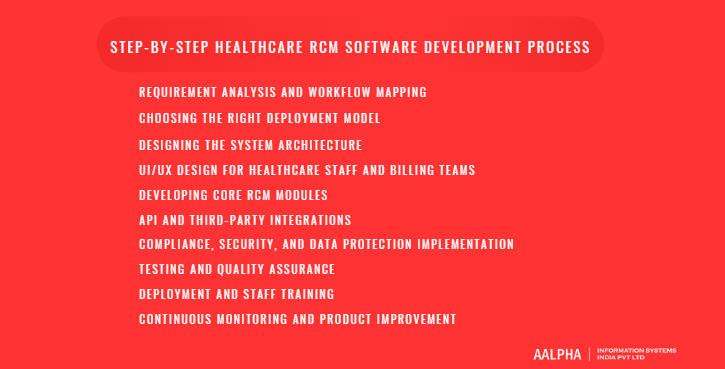
Step-by-Step Healthcare RCM Software Development Process
Developing healthcare revenue cycle management software requires a deep understanding of healthcare operations, insurance workflows, financial regulations, interoperability standards, and healthcare compliance requirements. Unlike traditional enterprise software, RCM platforms must process highly sensitive patient and financial data while integrating seamlessly with clinical systems, insurance networks, and government reimbursement infrastructures.
Healthcare RCM systems also need to support complex billing workflows, evolving payer regulations, and high-volume transaction processing environments. A poorly designed platform can result in claim denials, reimbursement delays, compliance violations, and operational inefficiencies that directly affect healthcare provider profitability.
To build a scalable and compliant healthcare RCM platform successfully, organizations must follow a structured development process that balances technical architecture, healthcare workflow optimization, security, and long-term scalability.
-
Requirement Analysis and Workflow Mapping
The first step in healthcare RCM software development is conducting detailed requirement analysis and workflow mapping. This phase is critical because healthcare financial operations vary significantly depending on provider type, specialty, payer relationships, patient volume, and reimbursement models.
Development teams must thoroughly understand how hospitals, clinics, physician groups, billing departments, coders, insurers, and finance teams interact throughout the revenue cycle. This includes analyzing patient registration workflows, insurance verification processes, coding operations, claims submission procedures, denial handling, payment reconciliation, and reporting requirements.
Healthcare organizations may also operate under different billing models, including fee-for-service, value-based care, bundled payments, capitation, or hybrid reimbursement structures. Each model introduces unique financial workflows and reporting requirements that the platform must support.
Workflow mapping helps identify operational bottlenecks, repetitive manual tasks, integration dependencies, and automation opportunities. During this stage, software architects also define system roles, user permissions, workflow approvals, reporting requirements, and compliance obligations.
A detailed requirement analysis phase reduces development risks and ensures the final RCM platform aligns with real-world healthcare financial operations rather than generic billing assumptions.
-
Choosing the Right Deployment Model
Selecting the appropriate deployment model is an important architectural decision during healthcare RCM software development. Healthcare organizations typically choose between cloud-based, on-premise, or hybrid deployment infrastructures depending on operational needs, compliance requirements, scalability goals, and internal IT capabilities.
Cloud-based RCM platforms are becoming increasingly popular because they provide scalability, lower infrastructure costs, automatic updates, remote accessibility, and simplified maintenance. Healthcare providers can access cloud-based systems securely from multiple locations while reducing dependence on internal hardware management.
On-premise deployment models are often preferred by large hospitals or highly regulated healthcare institutions that require complete control over infrastructure, security configurations, and data storage environments. While on-premise systems provide greater customization and data ownership, they also involve higher infrastructure and maintenance costs.
Hybrid healthcare infrastructures combine both approaches by storing sensitive healthcare data on local servers while using cloud services for analytics, remote access, or scalability purposes.
The chosen deployment strategy must support healthcare compliance requirements, disaster recovery planning, scalability needs, and long-term operational flexibility.
-
Designing the System Architecture
Healthcare revenue cycle management platforms require highly scalable and modular system architectures capable of supporting large transaction volumes, complex integrations, and evolving healthcare workflows. System architecture design directly affects platform performance, reliability, maintainability, and future scalability.
Modern healthcare RCM platforms are increasingly built using microservices architecture, where independent modules handle specific functionalities such as patient registration, claims processing, coding, payment reconciliation, analytics, and reporting. This modular design improves scalability and allows individual services to be updated or expanded independently without disrupting the entire platform.
Interoperability is another critical architectural consideration. The system must support healthcare communication standards such as HL7, FHIR, and ANSI X12 to enable seamless data exchange with EHR systems, insurance payers, laboratories, pharmacies, and clearinghouses.
Scalable architecture design also requires load balancing, distributed databases, API gateways, failover mechanisms, and real-time processing capabilities to handle growing patient and transaction volumes.
Healthcare RCM platforms must additionally support secure role-based access, audit trails, data redundancy, and high-availability infrastructure to ensure operational continuity in mission-critical healthcare environments.
-
UI/UX Design for Healthcare Staff and Billing Teams
Healthcare RCM software is used daily by front-desk staff, billing teams, medical coders, finance departments, claims specialists, compliance officers, and healthcare administrators. As a result, UI/UX design plays a major role in operational efficiency and user adoption.
Healthcare financial workflows are often complex and time-sensitive, requiring interfaces that minimize confusion and reduce repetitive manual tasks. Well-designed RCM platforms provide role-based dashboards tailored to different user responsibilities. For example, billing teams may require claims status tracking and denial management tools, while executives need financial analytics dashboards and reimbursement reports.
Workflow optimization is essential in healthcare software design. Interfaces should simplify navigation, reduce clicks, automate repetitive actions, and surface critical alerts proactively. Features such as bulk processing, automated notifications, smart filtering, and contextual workflows help improve productivity significantly.
Modern healthcare platforms also increasingly support mobile responsiveness and remote accessibility to accommodate distributed healthcare operations and hybrid work environments.
A well-designed UI/UX system reduces training time, minimizes operational errors, and improves overall workflow efficiency across healthcare financial departments.
-
Developing Core RCM Modules
The core development phase involves building the primary functional modules that power the healthcare revenue cycle management platform. These modules form the operational backbone of the system and must work together seamlessly to support end-to-end financial workflows.
One of the most important components is the claims management engine, which handles claim generation, validation, submission, tracking, adjudication monitoring, and denial processing. The claims engine must support payer-specific rules and electronic claims standards.
Medical coding modules are another essential component. These systems support ICD-10, CPT, and HCPCS coding workflows while integrating with clinical documentation systems to improve coding accuracy.
Billing and payment modules manage invoices, patient balances, payment posting, reimbursement reconciliation, and collections workflows. Many platforms also include patient-facing payment portals and installment management systems.
Analytics and reporting modules provide financial dashboards, reimbursement metrics, denial tracking, accounts receivable monitoring, and operational performance insights. Advanced systems may also include predictive analytics and AI-driven forecasting tools.
Additional modules often include insurance eligibility verification, audit management, compliance monitoring, contract management, provider management, and workflow automation engines.
Each module must be designed with scalability, interoperability, and compliance readiness in mind to support future healthcare operational growth.
-
API and Third-Party Integrations
Healthcare RCM software rarely operates in isolation. Modern healthcare ecosystems rely heavily on interconnected systems that exchange financial, clinical, and operational data continuously. As a result, API development and third-party integration capabilities are fundamental components of healthcare RCM platforms.
RCM systems commonly integrate with Electronic Health Records (EHRs), Electronic Medical Records (EMRs), laboratory systems, pharmacy platforms, radiology systems, insurance payer networks, clearinghouses, payment gateways, and accounting systems.
Healthcare interoperability standards such as HL7, FHIR, and ANSI X12 enable secure and standardized data exchange across healthcare environments. API-driven architectures simplify integration management and improve scalability while reducing manual data entry and synchronization errors.
Payment gateway integration is also critical for supporting patient billing portals, digital payments, recurring billing, and installment plans. Clearinghouse integrations streamline claims transmission and reimbursement tracking.
Insurance provider integrations enable real-time eligibility verification, authorization validation, and claims adjudication monitoring. These integrations help healthcare providers automate financial workflows and improve reimbursement efficiency significantly.
Well-designed integration infrastructure improves operational continuity while enabling healthcare organizations to centralize financial and clinical workflows into a unified ecosystem.
-
Compliance, Security, and Data Protection Implementation
Healthcare revenue cycle management platforms handle highly sensitive patient, financial, and insurance data, making compliance and security implementation one of the most critical stages of development.
In the United States, healthcare software must comply with HIPAA regulations, which define strict standards for patient data privacy, access control, and secure information exchange. Additional compliance requirements may include HITECH regulations, CMS billing guidelines, and regional healthcare data protection laws such as GDPR.
Modern RCM platforms implement multiple layers of security controls, including end-to-end encryption, multi-factor authentication, secure API communication, role-based access management, intrusion detection systems, and network segmentation.
Audit logging is another essential feature. Healthcare organizations must maintain detailed records of user activities, billing changes, claim submissions, payment modifications, and access history for regulatory audits and compliance reporting.
Data backup and disaster recovery planning are equally important. Healthcare systems require high-availability infrastructure and secure redundancy mechanisms to ensure operational continuity during outages or cyberattacks.
Security and compliance implementation must be integrated throughout the development lifecycle rather than treated as an afterthought.
-
Testing and Quality Assurance
Healthcare RCM software requires extensive testing and quality assurance because even minor operational issues can disrupt billing workflows, delay reimbursements, or create compliance risks.
Performance testing ensures the platform can handle high transaction volumes, concurrent users, and real-time processing requirements without system failures or latency issues. This is especially important for hospitals and enterprise healthcare organizations processing thousands of claims daily.
Workflow testing validates that billing operations, coding workflows, claims submissions, reimbursement tracking, payment reconciliation, and denial management processes function accurately across different user scenarios.
Interoperability testing verifies that integrations with EHR systems, payer networks, clearinghouses, laboratories, and payment gateways exchange data correctly using healthcare interoperability standards.
Security testing includes vulnerability assessments, penetration testing, encryption validation, authentication testing, and access control verification to ensure patient and financial data remain protected.
Comprehensive QA processes reduce deployment risks and improve long-term platform reliability in healthcare production environments.
-
Deployment and Staff Training
Once testing is completed, the healthcare RCM platform is deployed into the production environment. Deployment strategies may include phased rollouts, pilot implementations, or organization-wide migrations depending on the complexity of the healthcare infrastructure.
Healthcare organizations often require data migration from legacy billing systems, payer databases, and patient management platforms. Careful migration planning is necessary to maintain data integrity and operational continuity.
Staff training is equally important during deployment. Billing teams, coders, front-desk staff, finance departments, and administrators must understand how to use the new platform effectively. Training programs typically include workflow demonstrations, role-based onboarding, compliance education, and operational simulations.
Proper deployment and user adoption planning significantly improve implementation success rates and reduce operational disruptions.
-
Continuous Monitoring and Product Improvement
Healthcare financial operations and payer regulations evolve continuously, making ongoing monitoring and product improvement essential after deployment. Modern RCM platforms require regular updates to support changing reimbursement rules, coding standards, compliance requirements, and operational workflows.
Continuous monitoring systems track application performance, security events, claims processing efficiency, denial trends, user activity, and infrastructure health in real time. AI-driven analytics can also identify workflow inefficiencies and recommend optimization opportunities proactively.
Healthcare organizations often gather user feedback from billing teams, administrators, and patients to improve usability and operational efficiency over time.
Regular software updates may include new automation capabilities, security enhancements, interoperability improvements, analytics features, and AI-powered workflow optimization tools. Continuous product improvement ensures healthcare RCM systems remain scalable, compliant, and operationally efficient in rapidly evolving healthcare environments.
Technologies Used in Healthcare RCM Software Development
Healthcare revenue cycle management software requires a highly reliable and scalable technology stack capable of handling sensitive healthcare data, high transaction volumes, complex integrations, and strict regulatory requirements. Unlike traditional business applications, healthcare RCM platforms must support interoperability with clinical systems, insurance networks, clearinghouses, and financial infrastructures while maintaining strong security and compliance standards.
The technology stack selected for healthcare RCM software directly affects platform scalability, performance, integration capabilities, security posture, and long-term maintainability. Modern healthcare organizations increasingly demand cloud-native, AI-enabled, and API-driven RCM systems that can adapt to evolving payer regulations and healthcare operational workflows.
Developers building healthcare revenue cycle platforms typically combine modern frontend frameworks, enterprise-grade backend technologies, scalable database systems, cloud infrastructure, AI technologies, and healthcare interoperability standards to create robust financial management ecosystems.
-
Frontend Technologies
Frontend technologies are responsible for the user interface and overall user experience of healthcare RCM software. Since these platforms are used extensively by billing teams, coders, front-desk staff, healthcare administrators, and finance departments, frontend performance and usability play a major role in operational efficiency.
Modern healthcare RCM systems commonly use frontend frameworks such as React, Angular, and Vue.js. React is widely preferred for building dynamic and highly interactive healthcare dashboards because of its component-based architecture and scalability. Angular is often used in enterprise healthcare systems that require structured architecture, strong TypeScript support, and large-scale application management. Vue.js is valued for its simplicity, lightweight structure, and rapid UI development capabilities.
These frameworks support responsive interfaces, real-time workflow updates, role-based dashboards, and seamless API integration while improving maintainability and frontend scalability.
-
Backend Technologies
Backend technologies power the core business logic, claims processing engines, billing workflows, API services, and data management infrastructure of healthcare revenue cycle management systems. The backend architecture must support high reliability, secure transaction processing, scalability, and interoperability with external healthcare systems.
Node.js is commonly used for healthcare RCM platforms requiring real-time processing, asynchronous workflows, and scalable API-driven architectures. Its event-driven model makes it effective for handling concurrent insurance claims and transaction-heavy environments.
Microsoft .NET is widely adopted in enterprise healthcare systems due to its strong security framework, performance optimization, Windows ecosystem integration, and long-term enterprise support. Many large hospitals and healthcare institutions rely on .NET-based infrastructures for mission-critical financial operations.
Java remains a preferred choice for highly scalable healthcare platforms because of its stability, portability, and mature ecosystem. It is frequently used in large healthcare enterprise systems and payer infrastructures.
Python is increasingly used for AI-driven healthcare RCM applications because of its strong machine learning, analytics, and natural language processing libraries. Many predictive analytics and AI-assisted coding systems are built using Python-based frameworks.
-
Database Infrastructure
Healthcare RCM platforms process large volumes of patient, billing, claims, reimbursement, and financial analytics data daily. Database infrastructure must therefore support high availability, fast transaction processing, scalability, and secure healthcare data management.
Relational databases such as PostgreSQL and MySQL are commonly used because healthcare financial workflows require strong transactional consistency and structured data relationships. PostgreSQL is particularly popular for enterprise healthcare systems due to its advanced indexing, scalability, and support for complex financial queries and analytics. MySQL is widely used in smaller healthcare platforms because of its reliability, simplicity, and broad community support.
MongoDB and other NoSQL databases are increasingly used in modern healthcare applications that require flexible schema management, large-scale document storage, and real-time analytics processing. These databases are useful for storing unstructured healthcare documents, logs, and AI-generated insights.
Modern RCM platforms often combine relational and NoSQL databases within hybrid architectures to balance transactional accuracy and scalability.
-
Cloud and DevOps Infrastructure
Cloud computing and DevOps infrastructure have become central to modern healthcare RCM software development. Healthcare organizations increasingly prefer cloud-native platforms because they provide scalability, high availability, disaster recovery, remote accessibility, and lower infrastructure management costs.
Amazon Web Services (AWS), Microsoft Azure, and Google Cloud Platform (GCP) are the most commonly used cloud providers in healthcare software development. AWS offers a broad ecosystem of healthcare-compliant services, AI tools, analytics platforms, and scalable infrastructure solutions. Azure is heavily used by enterprise healthcare organizations because of its strong Microsoft ecosystem integration and healthcare compliance capabilities. Google Cloud is widely adopted for healthcare analytics, machine learning, and large-scale data processing workloads.
Containerization technologies such as Docker and orchestration platforms like Kubernetes enable healthcare RCM systems to scale efficiently across distributed cloud environments. Kubernetes simplifies workload management, automated deployment, failover handling, and infrastructure scaling.
DevOps practices including CI/CD pipelines, automated testing, infrastructure-as-code, and continuous monitoring help healthcare organizations deploy updates faster while maintaining system reliability and compliance readiness.
-
AI and Machine Learning Technologies
Artificial intelligence and machine learning technologies are rapidly transforming healthcare revenue cycle management by automating complex workflows and improving financial decision-making. Modern RCM systems increasingly use AI-driven tools to reduce claim denials, improve coding accuracy, optimize billing workflows, and forecast reimbursement trends.
Predictive analytics models analyze historical claims data, payer behavior, denial patterns, and reimbursement histories to identify high-risk claims before submission. This proactive approach helps healthcare providers reduce revenue leakage and accelerate reimbursement cycles.
Natural Language Processing (NLP) technologies are commonly used in AI-assisted coding systems. NLP engines can analyze physician notes, clinical documentation, and treatment records to recommend ICD-10, CPT, and HCPCS codes automatically while identifying documentation gaps or compliance risks.
AI-assisted billing systems also automate repetitive administrative tasks such as payment posting, claims validation, eligibility verification, and denial categorization. Conversational AI chatbots further improve patient financial engagement by handling billing inquiries and payment workflows automatically.
As healthcare financial operations become increasingly data-driven, AI technologies are becoming core components of advanced RCM platforms.
-
Healthcare Interoperability Standards
Healthcare interoperability standards are essential for enabling secure and standardized communication between healthcare RCM systems and external platforms such as EHRs, insurance payers, laboratories, pharmacies, and clearinghouses.
HL7 (Health Level Seven) is one of the most widely used healthcare messaging standards for exchanging patient, clinical, and operational information between healthcare applications. HL7 enables systems to communicate consistently across healthcare organizations and technology vendors.
FHIR (Fast Healthcare Interoperability Resources) is a newer interoperability standard designed to simplify healthcare data exchange using modern API-driven architectures. FHIR supports faster integration development, improved scalability, and real-time healthcare data access across digital healthcare ecosystems.
ANSI X12 Electronic Data Interchange (EDI) standards are heavily used in healthcare billing and insurance claims processing. X12 standards define the electronic format for transactions such as claims submission, payment processing, eligibility verification, remittance advice, and authorization requests.
Support for interoperability standards is critical in healthcare RCM development because healthcare organizations operate within highly interconnected digital ecosystems where seamless data exchange directly affects operational efficiency and reimbursement accuracy.
Compliance, Security, and Regulatory Considerations
Healthcare revenue cycle management software handles highly sensitive patient information, insurance records, billing data, payment transactions, and clinical documentation. Because of the critical nature of this data, healthcare RCM platforms must comply with strict regulatory, security, and privacy requirements designed to protect patient information and maintain healthcare operational integrity.
Non-compliance can lead to severe financial penalties, legal liabilities, reimbursement disruptions, operational downtime, and reputational damage for healthcare organizations. In addition, healthcare systems have become major targets for cyberattacks due to the high value of medical and financial records on the black market.
As healthcare organizations increasingly adopt cloud-based infrastructure, AI-driven automation, remote access systems, and third-party integrations, security and compliance requirements have become even more complex. Modern healthcare RCM software must therefore incorporate strong security controls, audit capabilities, interoperability compliance, and data protection mechanisms from the earliest stages of development.
Below are the most important compliance and security considerations involved in healthcare revenue cycle management software development.
-
HIPAA Compliance Requirements
The Health Insurance Portability and Accountability Act (HIPAA) is one of the most important regulatory frameworks governing healthcare software systems in the United States. HIPAA establishes strict standards for protecting Protected Health Information (PHI), including patient medical records, insurance details, billing data, and personally identifiable information.
Healthcare RCM platforms must comply with HIPAA Privacy Rules, Security Rules, and Breach Notification Rules. These regulations define how healthcare organizations collect, store, process, transmit, and secure patient data across digital environments.
HIPAA compliance requires healthcare software developers to implement administrative, physical, and technical safeguards. This includes secure authentication systems, encrypted communication channels, access controls, audit logging, data integrity protections, and secure backup mechanisms.
Role-based access control is particularly important because healthcare staff should only access information relevant to their responsibilities. Healthcare organizations must also maintain detailed audit records of who accessed patient information and when those actions occurred.
In the event of a data breach, HIPAA regulations require organizations to notify affected individuals and regulatory authorities within specific timeframes. As a result, healthcare RCM systems must include breach detection, incident response, and monitoring capabilities as part of their security infrastructure.
-
Healthcare Data Encryption and Access Control
Healthcare revenue cycle management systems process highly confidential financial and patient information, making data encryption and access management fundamental security requirements.
Encryption protects healthcare data both at rest and in transit. Modern RCM platforms typically use strong encryption protocols such as AES-256 for stored data and TLS encryption for data transmitted between users, healthcare systems, insurance networks, and third-party services. Encrypted communication channels reduce the risk of unauthorized interception or data exposure during claims processing and reimbursement workflows.
Access control mechanisms ensure that only authorized users can access specific healthcare information. Role-based access control (RBAC) allows organizations to define permissions based on employee responsibilities. For example, front-desk staff may only access patient registration information, while finance teams can access billing and reimbursement records.
Multi-factor authentication (MFA), session management controls, and identity verification systems further strengthen platform security. These measures help healthcare organizations prevent unauthorized access, insider threats, and credential-based cyberattacks.
Strong encryption and access management frameworks are essential for maintaining regulatory compliance and protecting healthcare financial ecosystems.
-
Audit Trails and Activity Monitoring
Audit trails and activity monitoring are critical components of healthcare compliance and operational security. Healthcare organizations must maintain complete visibility into how patient and financial data is accessed, modified, processed, and transmitted across the RCM platform.
Modern healthcare RCM systems automatically log user activities such as patient record access, coding changes, claims submissions, payment modifications, denial handling, and administrative actions. These logs provide accountability and create traceable records for compliance audits, security investigations, and operational reviews.
Activity monitoring systems also help identify suspicious behavior, unauthorized access attempts, unusual billing activities, or potential insider threats. Automated alerts can notify administrators when abnormal activity patterns are detected.
Comprehensive audit logging improves transparency, strengthens compliance readiness, and supports healthcare organizations during regulatory audits or payer investigations.
-
Data Backup and Disaster Recovery
Healthcare organizations cannot afford prolonged system outages or data loss because disruptions directly affect patient care operations, claims processing, reimbursement cycles, and financial stability. As a result, healthcare RCM software must include robust data backup and disaster recovery mechanisms.
Modern healthcare platforms use automated backup systems that replicate critical data across multiple secure environments to prevent permanent data loss caused by hardware failures, cyberattacks, or natural disasters. Cloud-based infrastructures often provide geographically distributed backup redundancy for improved resilience.
Disaster recovery planning defines how healthcare systems restore operations during outages or security incidents. This includes recovery time objectives (RTOs), failover infrastructure, backup restoration procedures, and emergency operational continuity plans.
Healthcare organizations must regularly test backup and recovery systems to ensure business continuity and compliance with regulatory requirements. Reliable disaster recovery infrastructure helps maintain uninterrupted healthcare financial operations even during unexpected system failures.
-
Compliance with Insurance and Billing Standards
Healthcare RCM platforms must comply with multiple insurance, billing, and reimbursement standards to ensure accurate claims processing and payer communication. Insurance providers and government healthcare programs use highly standardized electronic transaction formats that healthcare systems must support consistently.
ANSI X12 Electronic Data Interchange (EDI) standards are widely used for healthcare billing transactions such as claims submission, eligibility verification, payment processing, remittance advice, and authorization requests. RCM platforms must generate and process these transactions accurately to avoid claim rejections and reimbursement delays.
Medical coding compliance is equally important. Healthcare organizations must follow coding standards such as ICD-10, CPT, and HCPCS when documenting diagnoses, procedures, and treatments for insurance reimbursement.
Payer-specific billing rules, authorization requirements, and reimbursement policies further increase operational complexity. Modern RCM systems therefore include automated validation tools that detect coding inconsistencies, missing documentation, and billing compliance issues before claims are submitted.
Compliance with billing standards helps healthcare organizations improve claim acceptance rates while reducing audit risks and reimbursement delays.
-
Regional Healthcare Compliance Regulations
Healthcare organizations operating internationally or across multiple jurisdictions must comply with regional healthcare privacy and financial regulations beyond HIPAA. Regulatory requirements vary significantly depending on country, healthcare system structure, and data protection laws.
The General Data Protection Regulation (GDPR) governs how organizations collect, process, store, and transfer personal data for individuals within the European Union. Healthcare RCM platforms serving EU patients must support consent management, data portability, privacy rights, and strict breach notification requirements under GDPR.
The Health Information Technology for Economic and Clinical Health (HITECH) Act expanded HIPAA enforcement in the United States and introduced stricter penalties for healthcare data breaches and non-compliance. HITECH also promoted broader adoption of electronic health record systems and healthcare interoperability standards.
Centers for Medicare & Medicaid Services (CMS) regulations define reimbursement policies, billing procedures, and compliance requirements for healthcare providers participating in government healthcare programs in the United States.
Healthcare RCM platforms must remain adaptable because healthcare regulations evolve continuously. Compliance-ready architectures help organizations respond quickly to changing legal and operational requirements across different healthcare markets.
Cost of Healthcare Revenue Cycle Management Software Development
The cost of developing healthcare revenue cycle management software varies significantly depending on platform complexity, deployment architecture, integration requirements, compliance obligations, and automation capabilities. Unlike standard business applications, healthcare RCM platforms must support secure healthcare data management, interoperability with insurance systems, high transaction processing volumes, and strict regulatory compliance frameworks.
Healthcare organizations also require customized financial workflows based on specialties, payer contracts, reimbursement models, and operational structures. As a result, RCM software development involves substantial planning, engineering, testing, integration, and long-term maintenance investment.
Organizations planning to build healthcare RCM software should evaluate both initial development expenses and long-term operational costs, including infrastructure, security management, compliance updates, integrations, analytics systems, and ongoing product improvements.
The final investment required depends largely on whether the organization is building a basic MVP platform for limited workflows or a fully scalable enterprise-grade healthcare financial management ecosystem.
-
Factors Affecting RCM Software Development Costs
Several technical and operational factors influence the overall cost of healthcare revenue cycle management software development. One of the biggest cost drivers is feature complexity. Basic RCM systems may only include patient registration, billing, and claims submission workflows, while advanced platforms often support AI-assisted coding, denial prediction, analytics dashboards, workflow automation, and multi-location management.
Third-party integrations also significantly increase development complexity and cost. Healthcare RCM systems frequently integrate with EHR platforms, insurance payers, clearinghouses, payment gateways, laboratories, and accounting systems using interoperability standards such as HL7, FHIR, and ANSI X12.
Compliance and security requirements are another major factor. HIPAA compliance, encryption implementation, audit logging, role-based access control, and secure infrastructure development require specialized engineering expertise and additional testing.
AI and machine learning capabilities further affect development budgets. Features such as predictive analytics, NLP-based coding assistance, conversational AI, and automated denial management require advanced data engineering and model training infrastructure.
Scalability expectations, cloud infrastructure selection, user volume, reporting requirements, and custom workflow configurations also influence overall development costs significantly.
-
MVP vs Enterprise-Grade RCM Platform Costs
The cost difference between a Minimum Viable Product (MVP) and an enterprise-grade healthcare RCM platform can be substantial because the level of functionality, scalability, compliance readiness, and integration complexity varies greatly.
An MVP healthcare RCM platform typically focuses on essential workflows such as patient registration, insurance verification, claims submission, billing management, payment tracking, and basic reporting. MVP systems are designed to validate product concepts, support limited provider operations, or launch early-stage healthcare startups. Depending on features and integrations, MVP development costs may range from approximately $40,000 to $120,000.
Enterprise-grade RCM platforms are significantly more complex. These systems often include multi-location management, AI-powered analytics, predictive denial prevention, advanced reporting, payer contract management, automation engines, enterprise security infrastructure, and large-scale interoperability support. Enterprise platforms also require high availability, scalability, role-based workflow management, and advanced compliance capabilities.
Development costs for enterprise healthcare RCM systems can range from $250,000 to well over $1 million depending on platform scope, customization requirements, AI functionality, and integration complexity.
Long-term scalability and operational goals largely determine whether organizations should begin with an MVP or invest directly in enterprise-grade infrastructure.
-
Third-Party Integration and Infrastructure Costs
Third-party integrations represent a major portion of healthcare RCM software development costs because healthcare financial ecosystems depend heavily on external systems and real-time data exchange.
Healthcare RCM platforms commonly integrate with EHR and EMR systems, clearinghouses, insurance payer networks, laboratories, radiology systems, pharmacies, payment gateways, identity verification systems, and accounting software. Each integration requires API development, interoperability validation, workflow mapping, and long-term maintenance.
Healthcare interoperability standards such as HL7, FHIR, and ANSI X12 introduce additional implementation complexity because systems must exchange highly structured healthcare and billing data accurately.
Infrastructure costs also vary depending on deployment architecture. Cloud-based RCM platforms incur recurring expenses related to hosting, storage, data transfer, backup systems, monitoring tools, load balancing, and disaster recovery infrastructure. Enterprise healthcare systems often require high-availability cloud environments with strict compliance controls and redundancy planning.
Organizations implementing AI-driven analytics or machine learning capabilities may also require additional infrastructure for data processing, model training, and real-time analytics workloads.
-
Maintenance and Ongoing Operational Costs
Healthcare revenue cycle management software requires continuous maintenance and operational support after deployment. Unlike static software products, healthcare financial systems must adapt continuously to changing payer rules, coding standards, reimbursement regulations, compliance updates, and cybersecurity threats.
Ongoing software maintenance costs typically includes bug fixes, performance optimization, infrastructure monitoring, compliance updates, security patching, API maintenance, and feature enhancements. Healthcare organizations also need continuous interoperability support as insurance providers, EHR vendors, and healthcare systems evolve their APIs and data exchange standards.
Cloud infrastructure costs continue throughout the platform lifecycle and may increase as patient volume, transaction processing, analytics workloads, and data storage requirements grow.
Cybersecurity management is another ongoing operational expense. Healthcare systems require regular vulnerability assessments, penetration testing, audit reviews, and security monitoring to maintain compliance and protect sensitive healthcare data.
In most cases, annual maintenance costs for healthcare RCM software range between 15% and 25% of the original development cost depending on infrastructure scale and operational complexity.
-
In-House Development vs Outsourcing
Healthcare organizations building RCM software must decide whether to develop the platform internally or partner with an external healthcare software development company. Both approaches involve different cost structures, operational responsibilities, and scalability considerations.
In-house development provides greater control over architecture, workflows, intellectual property, and long-term product strategy. Organizations with dedicated engineering teams can closely align the platform with internal operational requirements. However, building healthcare RCM software internally often requires substantial investment in developers, UI/UX designers, DevOps engineers, QA specialists, cybersecurity experts, healthcare compliance consultants, and project managers.
Outsourcing development to an experienced healthcare software company can significantly reduce hiring costs and accelerate project timelines. Specialized healthcare development firms already understand healthcare interoperability standards, billing workflows, payer integrations, and compliance requirements, reducing implementation risk.
Outsourcing is often more cost-effective for startups and mid-sized healthcare organizations that lack large internal engineering teams. However, successful outsourcing requires careful vendor selection, strong communication processes, and clear project governance.
Many organizations now adopt hybrid approaches where external development partners build the core platform while internal teams manage long-term operational customization and strategic direction.
Challenges in Healthcare RCM Software Development
Healthcare revenue cycle management software development is significantly more complex than building standard enterprise applications because healthcare financial systems operate within highly regulated, data-intensive, and interconnected ecosystems. RCM platforms must support diverse payer rules, complex reimbursement models, strict compliance standards, and large-scale interoperability requirements while maintaining operational reliability and security.
Healthcare organizations also rely heavily on legacy systems, fragmented workflows, and manual administrative processes that complicate modernization efforts. In addition, evolving regulations, changing billing standards, and rising patient expectations require healthcare RCM platforms to remain flexible and continuously adaptable.
Below are some of the most important challenges organizations face when developing healthcare revenue cycle management software.
-
Complex Healthcare Billing Ecosystems
Healthcare billing ecosystems are highly fragmented and involve multiple stakeholders, including hospitals, clinics, physicians, insurance providers, government healthcare programs, clearinghouses, laboratories, and patients. Each payer may have unique billing rules, reimbursement structures, authorization requirements, and claim submission standards.
Healthcare organizations must also support different payment models such as fee-for-service, bundled payments, capitation, and value-based care arrangements. This creates substantial operational complexity for RCM software platforms.
The challenge becomes even greater for multi-specialty healthcare providers because each specialty often uses different coding workflows, payer contracts, and reimbursement rules. RCM systems must therefore support highly customizable workflows while maintaining billing accuracy and operational scalability across diverse healthcare environments.
-
Frequent Regulatory Changes
Healthcare regulations and reimbursement policies change frequently, creating ongoing development and compliance challenges for healthcare RCM platforms. Government agencies, insurance providers, and healthcare regulators regularly update coding standards, billing procedures, privacy laws, reimbursement structures, and reporting requirements.
For example, changes to ICD coding systems, CMS reimbursement policies, HIPAA regulations, or payer authorization rules may require immediate software updates to maintain operational compliance. Failure to adapt quickly can lead to claim denials, reimbursement delays, compliance violations, or financial penalties.
Healthcare software developers must therefore design flexible architectures capable of supporting continuous updates without disrupting operational workflows. Maintaining compliance readiness requires constant monitoring of regulatory changes and ongoing collaboration between engineering teams, healthcare consultants, compliance specialists, and billing experts.
-
Integration with Legacy Healthcare Systems
Many healthcare organizations still rely on outdated legacy infrastructure that was not designed for modern interoperability or cloud-native healthcare operations. These systems often use proprietary formats, outdated APIs, or fragmented databases that complicate integration efforts.
Healthcare RCM software must integrate seamlessly with EHR systems, laboratory systems, pharmacy platforms, insurance payer networks, accounting software, and clearinghouses. Legacy environments frequently lack standardized communication protocols, making data synchronization difficult and time-consuming.
Inconsistent data formats, duplicate records, incomplete documentation, and outdated infrastructure can create operational bottlenecks during integration projects. Developers often need to build custom middleware, API translation layers, or interoperability bridges to connect modern RCM systems with legacy healthcare applications.
Integration complexity significantly increases development time, testing requirements, maintenance overhead, and long-term operational support costs.
-
Data Accuracy and Claim Denials
Data accuracy is one of the most critical challenges in healthcare revenue cycle management because even small errors can result in denied claims, delayed reimbursements, compliance issues, or revenue loss. Incorrect patient demographics, incomplete insurance information, coding inaccuracies, missing documentation, and authorization failures are common causes of claim denials.
Healthcare organizations process large volumes of patient and financial data daily, increasing the likelihood of manual entry errors and workflow inconsistencies. RCM software must therefore include strong validation mechanisms, automated checks, and intelligent error detection systems.
Maintaining coding accuracy is particularly challenging because healthcare coding standards such as ICD-10, CPT, and HCPCS are highly detailed and frequently updated. AI-assisted coding and automated claim validation tools can help reduce errors, but achieving consistent billing accuracy remains a major operational challenge.
Reducing claim denial rates requires continuous workflow optimization, real-time validation, and proactive financial monitoring across the revenue cycle.
-
User Adoption and Staff Training Challenges
Healthcare revenue cycle management software is used by multiple departments, including front-desk staff, coders, billing teams, finance departments, administrators, and compliance officers. Ensuring successful user adoption across these groups can be challenging, especially when organizations transition from legacy workflows or manual systems.
Healthcare staff often resist operational changes if new systems appear overly complex, disrupt established workflows, or increase administrative workload. Poorly designed interfaces and insufficient training can reduce productivity and increase operational errors during implementation phases.
Training healthcare staff on billing workflows, coding systems, automation tools, compliance requirements, and reporting dashboards requires substantial organizational effort. Large healthcare organizations may also face challenges standardizing workflows across multiple locations and provider groups.
Successful RCM implementation therefore depends not only on technical performance but also on effective onboarding, role-based training, workflow optimization, and long-term user support strategies.
Why Choose Aalpha Information Systems for Healthcare RCM Software Development
Aalpha Information Systems brings strong expertise in healthcare software development, AI integration, enterprise application engineering, and scalable SaaS platform development. The company understands the complexities of healthcare billing workflows, insurance processing, interoperability standards, and compliance requirements involved in modern revenue cycle management systems.
Aalpha helps healthcare organizations build secure and scalable RCM platforms with features such as automated claims processing, AI-assisted coding, denial management, patient billing portals, reimbursement analytics, and workflow automation. The company also has experience working with healthcare interoperability standards such as HL7, FHIR, and HIPAA-compliant infrastructure to ensure secure and compliant healthcare financial operations.
With expertise across technologies such as React, Node.js, Python, .NET, cloud infrastructure, Kubernetes, AI/ML, and API-driven ecosystems, Aalpha can develop modern RCM solutions tailored to hospitals, clinics, physician groups, and healthcare startups.
From requirement analysis and UI/UX design to development, integration, deployment, and long-term support, Aalpha provides end-to-end healthcare software development services focused on scalability, security, compliance, and operational efficiency.
If you are planning to build a healthcare revenue cycle management platform, partnering with an experienced healthcare software development company such as Aalpha Information Systems can help accelerate development, improve reimbursement workflows, and modernize healthcare financial operations.
Conclusion
Healthcare revenue cycle management software plays a critical role in improving financial efficiency, reducing claim denials, streamlining billing workflows, and enhancing patient payment experiences. As healthcare systems continue adopting digital transformation and AI-driven automation, modern RCM platforms are becoming essential for hospitals, clinics, and healthcare providers looking to improve operational visibility and reimbursement performance.
Building a scalable and compliant healthcare RCM platform requires strong expertise in healthcare workflows, interoperability standards, security, compliance, cloud infrastructure, and AI technologies.
If you are planning to develop a secure and scalable healthcare revenue cycle management solution, partnering with an experienced healthcare software development company such as Aalpha Information Systems can help accelerate development, improve compliance readiness, and modernize healthcare financial operations. To discuss project requirements or implementation strategies, connect with us now.