





The real estate industry operates in a highly dynamic, relationship-driven environment where timing, communication, and data accuracy directly influence revenue. Unlike many other industries, real estate transactions involve long sales cycles, multiple stakeholders, frequent follow-ups, and continuous engagement across different channels such as calls, WhatsApp, email, and property portals. Managing all of this manually or through fragmented tools often leads to missed opportunities, delayed responses, and poor customer experiences.
This is where real estate CRM software becomes a critical business system rather than just an optional tool. It acts as a centralized platform that captures, organizes, and automates every interaction across the property lifecycle, from the first inquiry to final deal closure and even post-sale engagement. As property businesses scale and lead volumes increase, questions naturally arise: how do you track hundreds of inquiries daily, ensure timely follow-ups, and avoid losing high-intent buyers? A purpose-built CRM answers these operational challenges by structuring workflows and enabling data-driven decision-making.
Today, with the rise of digital property platforms, paid lead generation campaigns, and AI-driven marketing, real estate companies are no longer competing only on listings but on responsiveness and customer experience. A well-designed CRM system ensures that no lead is ignored, every interaction is tracked, and agents can focus on closing deals rather than managing spreadsheets.
What is Real Estate CRM Software?
Real estate CRM software is a specialized customer relationship management system designed specifically for property businesses, including brokers, developers, and agencies. It goes beyond basic contact management by handling the entire real estate sales lifecycle, including lead capture from multiple sources, property matching, follow-up automation, and deal tracking.
Unlike generic CRM platforms, a real estate CRM is structured around how property transactions actually work. It allows businesses to manage buyer and seller profiles, track property preferences, monitor site visits, and maintain a complete communication history with each prospect. For example, when a potential buyer inquires about a 2BHK apartment, the system can automatically map their requirements, assign the lead to an agent, and trigger follow-up reminders.
At its core, real estate CRM software answers a practical business need: how to manage high volumes of inquiries while maintaining personalized communication and improving conversion rates.
Why Traditional CRMs Don’t Work for Real Estate
Generic CRM systems are designed for broad use cases such as SaaS sales, retail customer management, or B2B pipelines. While they offer basic features like contact storage and task tracking, they lack the domain-specific capabilities required in real estate operations.
One of the primary limitations is the absence of property-centric workflows. Traditional CRMs do not support listing management, unit availability tracking, or property-to-client matching, which are essential for real estate businesses. As a result, teams are forced to rely on multiple disconnected tools, increasing complexity and reducing efficiency.
Another challenge is lead handling. Real estate businesses receive inquiries from diverse sources such as property portals, social media ads, website forms, and offline campaigns. Generic CRMs often require heavy customization to capture and route these leads effectively. Even after setup, they fail to support automated follow-ups tailored to buyer intent, which is critical in a market where response time directly impacts conversion.
In practice, using a traditional CRM in real estate creates operational gaps rather than solving them, leading to missed follow-ups, poor visibility into sales pipelines, and inconsistent customer experiences.
Why Real Estate Businesses Need Specialized CRM
Real estate businesses deal with a unique combination of high lead volume, long decision cycles, and multi-stage interactions. A single lead may require multiple follow-ups over weeks or even months, including calls, site visits, negotiations, and documentation. Without a structured system, it becomes difficult to track where each prospect stands in the journey.
A specialized real estate CRM addresses this complexity by organizing the entire lifecycle into clearly defined stages. From initial inquiry to site visit scheduling and final deal closure, every interaction is recorded and accessible. This ensures that agents never lose context when communicating with clients, even if multiple team members are involved.
Another critical factor is follow-up management. Studies consistently show that a large percentage of real estate deals are lost due to delayed or missed follow-ups. A dedicated CRM automates reminders, schedules communication, and even enables automated responses through channels like WhatsApp or email. This ensures consistent engagement without overloading agents with manual tasks.
Additionally, real estate CRM software supports intelligent lead distribution and prioritization. High-intent leads can be identified based on behavior and assigned to top-performing agents, increasing the likelihood of conversion. Over time, analytics and reporting features provide insights into which marketing channels, property types, or agent strategies deliver the best results.
In a competitive market where speed and personalization define success, a specialized CRM is not just a productivity tool. It becomes the backbone of sales operations, enabling real estate businesses to scale efficiently while maintaining a high-quality customer experience.
Market Overview and Industry Trends
The real estate CRM software market sits at the intersection of two rapidly expanding industries: global real estate and enterprise CRM technology. As property businesses become increasingly digital, the need to manage leads, automate communication, and analyze customer behavior has shifted from optional to essential. The market is no longer driven only by large brokerages or developers. Small agencies, independent agents, and property managers are now adopting CRM systems to stay competitive in a market where speed, data, and personalization determine success.
A common question decision-makers ask is whether investing in real estate CRM development is justified by market demand. The answer is clear when examining industry growth patterns. Rising property transactions, increasing digital lead generation, and the shift toward data-driven decision-making are creating sustained demand for CRM solutions tailored specifically to real estate workflows. This demand is further accelerated by the emergence of AI, mobile-first operations, and omnichannel communication strategies.
-
Global Real Estate CRM Market Size and Growth
The real estate CRM software market is experiencing strong and consistent growth, reflecting the broader expansion of real estate technology. In 2026, the global real estate CRM market is expected to reach approximately $5.31 billion, with projections indicating it could grow to nearly $14.97 billion by 2035, at a compound annual growth rate (CAGR) of over 12%.
This growth aligns with the broader real estate software market, which is projected to exceed $14 billion in 2026 and continue expanding at a double-digit CAGR. Additionally, the overall CRM industry itself is scaling rapidly, expected to surpass $334 billion globally, highlighting the increasing reliance on customer data platforms across industries.
The implication is straightforward. Real estate CRM is no longer a niche category. It is becoming a core component of modern property businesses, driven by increasing transaction volumes, digital lead sources, and the need for structured sales processes.
-
Digital Transformation in Real Estate
The real estate industry has traditionally relied on offline processes, including manual record-keeping, phone-based communication, and in-person interactions. However, over the past decade, there has been a significant shift toward digital-first operations. Property discovery now primarily happens online through portals, social media campaigns, and targeted ads, generating large volumes of digital leads that require structured management.
This transformation is fueled by several factors. Increasing urbanization, smart city initiatives, and the expansion of online property marketplaces have pushed developers and brokers to adopt technology-driven solutions. In fast-growing regions such as Asia-Pacific, real estate firms are integrating cloud-based platforms, mobile apps, and analytics tools to streamline operations and improve decision-making.
As a result, real estate CRM systems are no longer limited to storing customer data. They now act as centralized digital infrastructure that connects marketing, sales, and customer engagement into a unified system.
-
Shift Toward Automation and AI in CRM
Automation and artificial intelligence are fundamentally reshaping how real estate CRM systems operate. Traditional CRMs required manual input and follow-up tracking, but modern systems now automate repetitive tasks such as lead assignment, follow-up reminders, and communication workflows.
For example, when a new inquiry is generated through a property listing, AI-powered CRM systems can automatically categorize the lead, assign it to the most relevant agent, and initiate a personalized follow-up sequence. This reduces response time, which is a critical factor in conversion. Industry data consistently shows that automated follow-ups and structured lead tracking significantly improve deal closure rates in real estate.
AI is also enabling predictive capabilities. CRM systems can now analyze customer behavior, such as property views, budget preferences, and interaction frequency, to predict which leads are most likely to convert. This allows sales teams to prioritize high-value prospects and optimize resource allocation.
-
Key Trends Shaping Real Estate CRM in 2026 and Beyond
Several key trends are shaping the future of real estate CRM software, and these trends directly influence how new systems are designed and developed.
One of the most significant shifts is the move toward mobile-first CRM platforms. Real estate agents operate in the field, conducting site visits and client meetings. As a result, CRM systems are increasingly optimized for mobile devices, enabling agents to access data, update lead status, and communicate with clients in real time.
Another major trend is omnichannel communication integration. Modern buyers interact across multiple platforms, including WhatsApp, email, phone calls, and social media. CRM systems are evolving to unify these channels into a single interface, ensuring consistent communication and complete visibility into every interaction.
Predictive analytics and data-driven decision-making are also becoming central features. CRM platforms are no longer just operational tools but strategic systems that provide insights into market trends, customer preferences, and sales performance. This allows businesses to refine marketing strategies and improve conversion rates.
Finally, the rise of AI-powered conversational interfaces and automation tools is transforming user interaction. Chatbots, voice assistants, and automated workflows are reducing manual effort while improving customer responsiveness. In parallel, the adoption of SaaS-based CRM solutions and no-code platforms is making advanced systems more accessible to smaller agencies.
Taken together, these trends indicate that real estate CRM software is evolving into an intelligent, fully integrated platform that not only manages relationships but actively drives business growth.
Key Features of Real Estate CRM Software
A real estate CRM is only as effective as the features it provides to manage complex workflows across lead generation, property matching, communication, and deal closure. In a business where every inquiry can translate into significant revenue, having structured systems to capture, organize, and act on data is critical. A well-built CRM not only improves operational efficiency but also directly impacts conversion rates, agent productivity, and customer satisfaction.
Below are the core features that define a high-performing real estate CRM software.
-
Lead Management System
Lead management is the foundation of any real estate CRM, as the entire sales process begins with capturing and nurturing prospects. Real estate businesses typically generate leads from multiple channels such as property portals, landing pages, paid advertisements, social media campaigns, and offline inquiries. A CRM consolidates all these inputs into a single unified system, ensuring that no inquiry is lost or overlooked.
Once captured, leads are automatically categorized based on criteria such as budget, preferred location, property type, and urgency. This segmentation allows agents to quickly understand the context of each lead and respond with relevant property options. Advanced CRM systems also include lead scoring mechanisms that evaluate engagement signals such as repeat visits, inquiry frequency, or scheduled site visits to identify high-intent prospects.
Another critical aspect is automated lead assignment. Instead of manually distributing leads, the CRM routes them to the most suitable agents based on predefined logic such as territory, specialization, or availability. This reduces response time and ensures better lead handling efficiency.
In practical terms, this feature solves one of the biggest problems in real estate operations: managing high lead volumes without compromising on speed or personalization.
-
Property Management Integration
Real estate CRM software must integrate property data directly into the sales workflow, often working in tandem with real estate project management to align inventory, timelines, and sales activity. Unlike generic CRMs that focus only on customer records, real estate systems need to manage listings alongside leads and communication.
This feature enables businesses to maintain a centralized repository of all properties, including detailed information such as location, price, configuration, amenities, and availability status. When a new lead enters the system, the CRM can automatically map their requirements to relevant listings, allowing agents to respond quickly with suitable options.
Real-time availability tracking is another essential component. Agents can instantly check whether a unit is available, booked, or sold, reducing the risk of misinformation. Similarly, any pricing updates or inventory changes are reflected across the system, ensuring consistency.
By combining property data with customer interactions, this feature eliminates dependency on spreadsheets or external tools and creates a more streamlined sales experience.
-
Contact and Client Management
Real estate transactions are built on long-term relationships and repeated interactions. A CRM must therefore provide comprehensive contact and client management capabilities that go beyond basic data storage.
This includes maintaining detailed profiles for buyers, sellers, investors, and tenants. Each profile captures essential information such as contact details, preferences, budget, past interactions, and communication history. Over time, this creates a complete view of the customer journey, enabling agents to deliver personalized communication.
Segmentation plays a crucial role here. Clients can be grouped based on behavior, investment interests, or lifecycle stage. For example, first-time homebuyers can be handled differently from high-value investors or returning clients. This segmentation allows for targeted engagement and more effective communication strategies.
With all client data centralized and accessible, agents can maintain continuity in conversations, even when multiple team members interact with the same prospect.
-
Sales Pipeline and Deal Tracking
A structured sales pipeline is essential for managing deals in a predictable and measurable way. Real estate CRM software provides a visual representation of the entire sales process, from initial inquiry to final closure.
Each lead moves through defined stages such as inquiry, qualification, site visit, negotiation, and booking. This structured flow allows teams to track progress, identify bottlenecks, and prioritize high-value opportunities. Agents and managers can instantly see where each deal stands and what actions are required next.
Forecasting is another important capability. By analyzing pipeline data, the CRM can estimate potential revenue, expected closures, and conversion rates. This helps businesses plan resources, set realistic targets, and improve decision-making.
In practice, pipeline tracking answers a key business question: how many deals are likely to close and what needs to be done to accelerate them.
-
Automated Follow-Ups and Notifications
One of the most common reasons real estate deals are lost is inconsistent or delayed follow-ups. A CRM eliminates this issue by automating communication and reminders across multiple channels.
The system can trigger follow-up messages based on predefined actions, such as sending a WhatsApp message after an inquiry, scheduling an email reminder after a site visit, or notifying agents when a lead becomes inactive. This ensures that every prospect receives timely communication without relying on manual tracking.
Notifications and alerts also play a critical role. Agents are reminded of upcoming calls, meetings, and pending tasks, ensuring that no opportunity slips through the cracks. Automation reduces the administrative burden on agents, allowing them to focus more on closing deals.
In a market where response time directly affects conversion rates, automated follow-ups provide a significant competitive advantage.
-
Task and Activity Management
Managing daily activities efficiently is essential for agent productivity. Real estate CRM software includes task and activity management features that help agents organize their work and stay on track.
Agents can create and manage tasks such as follow-up calls, property visits, document collection, and client meetings. Each task can be assigned deadlines, priorities, and reminders, ensuring accountability. Managers can also monitor activity levels across the team, gaining visibility into performance and workload distribution.
This feature ensures that operational workflows are structured and measurable, reducing the chances of missed actions and improving overall efficiency.
-
Marketing Automation Tools
Marketing automation is a key component of modern real estate CRM systems, especially as businesses rely heavily on digital campaigns to generate leads. A CRM enables automated marketing workflows that nurture leads over time without manual intervention.
This includes email campaigns, SMS outreach, and drip marketing sequences tailored to different customer segments. For example, a prospect who shows interest in luxury apartments can receive a series of curated property recommendations over time. Similarly, inactive leads can be re-engaged through targeted campaigns.
Campaign performance can also be tracked within the CRM, allowing businesses to measure open rates, engagement levels, and conversions. This helps in optimizing marketing strategies and improving return on investment.
By automating repetitive marketing tasks, businesses can maintain consistent engagement while scaling their outreach efforts.
-
Reporting and Analytics Dashboard
Data-driven decision-making is critical in real estate, and a CRM provides comprehensive reporting and analytics capabilities to support this. The dashboard offers insights into key performance metrics such as lead sources, conversion rates, sales performance, and agent productivity.
Managers can identify which channels generate the highest quality leads, which agents are performing best, and where drop-offs occur in the sales pipeline. These insights enable businesses to refine strategies and allocate resources more effectively.
Real-time reporting ensures that decisions are based on accurate and up-to-date data rather than assumptions, making the CRM a strategic tool rather than just an operational system.
-
Mobile CRM Capabilities
Real estate is a field-driven industry where agents spend a significant amount of time outside the office. Mobile CRM capabilities ensure that agents can access critical information anytime, anywhere.
Through mobile applications, agents can view lead details, update statuses, schedule follow-ups, and communicate with clients while on the move. This eliminates delays caused by limited access to desktop systems and improves responsiveness.
Mobile-first CRM design also enhances usability, ensuring that agents can perform tasks quickly and efficiently during site visits or client meetings.
-
Third-Party Integrations
A real estate CRM must integrate seamlessly with external systems to create a unified ecosystem. This includes integration with property portals, MLS platforms, marketing tools, communication channels, and payment gateways.
For example, leads generated from listing platforms can be automatically pushed into the CRM, eliminating manual data entry. Similarly, integration with communication tools allows agents to manage calls, messages, and emails directly from the system.
These integrations ensure that all business operations are connected, reducing redundancy and improving efficiency. A well-integrated CRM becomes the central hub that brings together marketing, sales, and customer engagement into a single platform.
Types of Real Estate CRM Software
Choosing the right type of real estate CRM software is a strategic decision that directly impacts operational efficiency, scalability, and long-term costs. Not all CRM solutions are built the same, and the right choice depends on factors such as business size, customization needs, budget, and growth plans. Many real estate companies initially adopt off-the-shelf tools and later realize the need for more tailored solutions as their operations become more complex.
Understanding the different types of CRM systems available helps businesses avoid costly mistakes and align their technology with their business model.
-
SaaS-Based CRM Solutions
SaaS (Software-as-a-Service) CRM solutions are the most commonly used option, especially for small to mid-sized real estate businesses. These platforms are cloud-based and accessible through a subscription model, allowing companies to get started quickly without heavy upfront investment.
One of the main advantages of SaaS CRM is ease of deployment. Businesses can sign up, configure basic settings, and start managing leads almost immediately. These systems typically offer standard features such as lead tracking, pipeline management, communication tools, and reporting dashboards. Regular updates, security maintenance, and hosting are handled by the provider, reducing the need for in-house technical expertise.
However, SaaS CRMs come with limitations. Customization is often restricted, and businesses must adapt their workflows to the platform rather than the other way around. As operations scale or become more complex, these limitations can create inefficiencies.
SaaS solutions are best suited for companies looking for a quick, cost-effective way to digitize their sales processes without requiring deep customization.
-
Custom-Built CRM Software
Custom-built CRM software is designed and developed specifically for a business’s unique workflows, processes, and growth strategy. Unlike SaaS solutions, which offer generic features, a custom CRM is tailored to match how a real estate company operates.
This approach allows businesses to define their own lead pipelines, property management workflows, automation rules, and reporting structures. For example, a developer managing multiple projects across different locations can build a CRM that tracks inventory at the unit level, integrates with internal sales teams, and supports complex pricing structures.
Another major advantage is flexibility. Custom CRM systems can integrate seamlessly with existing tools such as marketing platforms, ERP systems, or communication channels. As the business grows, new features can be added without being constrained by third-party limitations.
The primary consideration is cost and development time. Custom CRM development requires a higher initial investment and a structured development process. However, for businesses with high lead volumes, complex operations, or long-term scalability goals, it often delivers significantly higher return on investment.
-
Open-Source CRM Solutions
Open-source CRM solutions provide access to the source code, allowing businesses to modify and customize the software according to their needs. These systems are typically free to use, which makes them attractive for startups or companies with limited budgets.
The main benefit of open-source CRM is flexibility at a lower cost compared to fully custom-built systems. Businesses can add features, modify workflows, and integrate with other tools as required. However, this flexibility comes with a trade-off.
Open-source solutions require technical expertise for setup, customization, and maintenance. Without a skilled development team, managing the system can become challenging. Security updates, hosting, and performance optimization also need to be handled internally.
This option is suitable for businesses that want customization but have the technical capability to manage and maintain the system independently.
-
Hybrid CRM Models
Hybrid CRM models combine elements of SaaS and custom-built solutions. Typically, businesses start with a SaaS platform and extend its functionality through custom integrations, plugins, or additional modules.
This approach offers a balance between speed and flexibility. Companies can leverage the stability and ready-to-use features of SaaS systems while customizing specific aspects of the CRM to suit their workflows. For example, a real estate agency might use a SaaS CRM for lead management but build custom modules for property matching or advanced analytics.
Hybrid models are particularly useful for businesses transitioning from basic systems to more advanced operations. They allow gradual customization without the need for a complete system overhaul.
However, over time, managing multiple layers of customization can become complex, especially if the underlying SaaS platform has limitations.
Which Type is Right for Your Business?
Selecting the right CRM type depends on your business goals, operational complexity, and long-term vision. There is no one-size-fits-all solution, and the decision should be based on both current needs and future scalability.
For small agencies or startups with limited budgets and simple workflows, SaaS-based CRM solutions provide a practical starting point. They enable quick adoption and require minimal technical involvement. However, as lead volumes increase and workflows become more sophisticated, these systems may start to feel restrictive.
Custom-built CRM software is the ideal choice for businesses that require full control over their processes, have complex sales cycles, or aim to scale aggressively. It allows for complete alignment between technology and business operations, making it a long-term strategic investment.
Open-source solutions can work well for companies with strong technical capabilities that want customization without the cost of building from scratch. Meanwhile, hybrid models offer a middle path for businesses that want to evolve gradually without committing to a fully custom system upfront.
Ultimately, the right CRM is not just about features or cost. It is about how well the system supports your sales process, improves efficiency, and helps you convert more leads into closed deals.
Benefits of Real Estate CRM Software
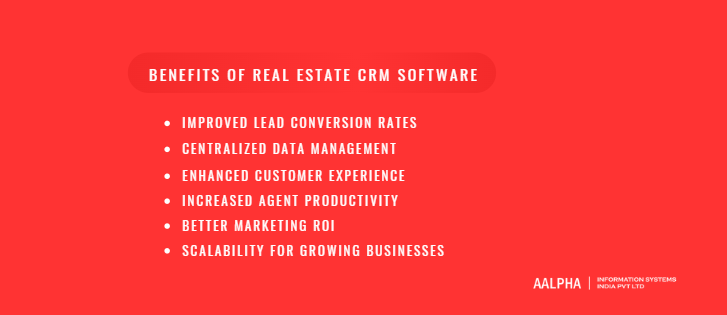
Real estate CRM software delivers measurable business value by transforming how leads are managed, how teams operate, and how customers experience the buying journey. In an industry where timing, personalization, and consistency directly influence deal closure, a CRM system becomes a critical growth engine rather than just a management tool. Businesses often evaluate CRM adoption by asking whether it will actually increase revenue or simply add another layer of complexity. In practice, the right CRM implementation improves efficiency across every stage of the sales cycle, leading to higher conversions, better resource utilization, and long-term scalability.
-
Improved Lead Conversion Rates
One of the most immediate and impactful benefits of a real estate CRM is the improvement in lead conversion rates. Real estate businesses deal with a high volume of inquiries, but only a small percentage of these leads typically convert into actual deals. The difference between a lost lead and a closed deal often comes down to response time, follow-up consistency, and relevance of communication.
A CRM ensures that every lead is captured, tracked, and nurtured systematically. Automated lead assignment reduces delays in response, while structured pipelines ensure that no prospect is forgotten during the sales journey. Features such as lead scoring help prioritize high-intent buyers, allowing agents to focus their efforts where it matters most.
For example, a prospect who has visited multiple listings or scheduled a site visit is far more likely to convert than a casual inquiry. A CRM identifies such signals and highlights these opportunities. Over time, this structured approach significantly increases conversion rates by eliminating gaps in follow-up and improving engagement quality.
-
Centralized Data Management
Real estate businesses generate large volumes of data, including customer details, property information, communication history, and transaction records. Managing this data across spreadsheets, emails, and multiple tools often leads to fragmentation and inefficiencies.
A real estate CRM centralizes all this information into a single system, creating a unified source of truth. Every interaction, whether it is a phone call, message, or site visit, is recorded and accessible to the entire team. This eliminates duplication, reduces errors, and ensures that everyone operates with consistent and up-to-date information.
Centralized data also improves collaboration. Multiple agents or departments can work on the same lead without losing context, which is especially important in larger organizations. By organizing data effectively, businesses can make faster and more informed decisions while maintaining operational clarity.
-
Enhanced Customer Experience
Customer experience plays a decisive role in real estate transactions, where buyers often evaluate multiple options before making a decision. A CRM enables businesses to deliver personalized and timely communication, which significantly improves the overall experience.
By maintaining detailed customer profiles, agents can tailor their interactions based on individual preferences, budget, and past behavior. For instance, instead of sending generic property listings, agents can share highly relevant options that align with the client’s requirements. This level of personalization builds trust and increases engagement.
Additionally, consistent follow-ups and timely responses ensure that prospects feel valued and supported throughout their journey. Automated communication workflows further enhance this experience by ensuring that no inquiry goes unanswered. Over time, a better customer experience not only improves conversion rates but also drives referrals and repeat business.
-
Increased Agent Productivity
Real estate agents often spend a significant portion of their time on administrative tasks such as data entry, follow-up tracking, and coordination. These activities, while necessary, reduce the time available for high-value tasks like client interaction and deal closure.
A CRM automates many of these repetitive processes, allowing agents to focus on what matters most. Tasks such as lead assignment, follow-up scheduling, and communication tracking are handled by the system, reducing manual effort and minimizing the risk of human error.
Activity management features also help agents stay organized by providing clear visibility into their daily tasks and priorities. Managers can monitor performance, identify bottlenecks, and ensure that workloads are distributed efficiently.
By streamlining operations and reducing administrative overhead, a CRM significantly improves productivity and enables teams to handle larger volumes of leads without increasing headcount.
-
Better Marketing ROI
Marketing is a major investment for real estate businesses, with significant spending on digital ads, property portals, and promotional campaigns. Without proper tracking, it becomes difficult to measure which channels are delivering results and which are underperforming.
A real estate CRM provides detailed insights into lead sources, campaign performance, and conversion rates. Businesses can track the entire journey of a lead, from the initial click on an advertisement to final deal closure. This level of visibility allows for accurate calculation of return on investment.
Marketing automation features further enhance efficiency by enabling targeted campaigns based on customer segmentation. Instead of sending mass communications, businesses can create personalized campaigns for specific audiences, improving engagement and conversion rates.
Over time, data-driven marketing decisions help optimize budgets, reduce waste, and maximize the impact of every campaign.
-
Scalability for Growing Businesses
As real estate businesses grow, managing operations manually or through disconnected tools becomes increasingly difficult. A CRM provides the scalability required to handle higher lead volumes, larger teams, and more complex workflows without compromising efficiency.
The system can support expansion across multiple projects, locations, or business units, while maintaining centralized control and visibility. New agents can be onboarded quickly, and standardized processes ensure consistency in operations.
Scalability also extends to technology integration. As businesses adopt new tools or expand their digital presence, a CRM can integrate with these systems to create a unified ecosystem. This ensures that growth does not lead to operational chaos.
In the long term, a scalable CRM acts as a foundation for sustainable business expansion, enabling companies to grow without losing control over their processes or customer experience.
Step-by-Step Process to Develop Real Estate CRM Software
Developing a real estate CRM software system requires a structured, business-first approach rather than a purely technical one. Many projects fail not because of poor coding but due to unclear requirements, misaligned workflows, and lack of planning. A CRM must reflect how real estate operations actually function, including lead handling, property matching, agent workflows, and customer communication.
This section outlines a practical, step-by-step process that businesses and development teams can follow to build a scalable and high-performing real estate CRM system.
-
Define Business Goals and Requirements
The foundation of any successful CRM development project begins with clearly defined business goals. Before writing a single line of code, stakeholders must identify what they want the system to achieve. This includes understanding operational pain points such as missed follow-ups, poor lead tracking, lack of visibility into sales pipelines, or inefficient communication processes.
A critical question to address at this stage is: what specific outcomes should the CRM deliver? For some businesses, the goal may be improving lead conversion rates. For others, it could be streamlining multi-project property management or enhancing agent productivity.
Requirements should be documented in detail, covering functional needs such as lead management, property tracking, automation workflows, and reporting, as well as non-functional aspects like scalability, security, and performance. It is also important to define success metrics early, such as reduced response time, increased conversions, or improved team efficiency.
This stage ensures that the CRM is aligned with business objectives rather than being built as a generic system with unnecessary features.
-
Identify Target Users and Use Cases
A real estate CRM is used by multiple stakeholders, each with different needs and workflows. Identifying these users and their use cases is essential for building a system that is both practical and intuitive.
Typical users include sales agents, sales managers, marketing teams, property developers, and sometimes even customers or partners. Each group interacts with the system differently. For example, agents focus on managing leads and follow-ups, while managers require visibility into performance metrics and pipeline health.
Use cases should be mapped for each user type. For instance, an agent may need to capture a lead, schedule a site visit, and update deal status, while a marketing team may want to track campaign performance and generate reports. These use cases define how the system will be used in real-world scenarios.
By clearly understanding user behavior, the CRM can be designed to support specific workflows rather than forcing users to adapt to a rigid structure. This significantly improves adoption and usability.
-
Feature Planning and Prioritization
Once requirements and use cases are defined, the next step is to translate them into a structured feature set. However, not all features should be developed at once. Prioritization is essential to avoid overengineering and to ensure faster time to market.
A common approach is to start with a Minimum Viable Product (MVP), focusing on core features such as lead management, pipeline tracking, and basic automation. These features address the most critical business needs and allow the system to be tested in real-world conditions.
Features can be categorized into must-have, should-have, and nice-to-have. Must-have features include lead capture, assignment, and follow-up tracking. Should-have features may include marketing automation and reporting dashboards, while advanced capabilities such as AI-driven insights can be planned for later phases.
Prioritization also helps in managing development costs and timelines. By delivering value early and iterating based on feedback, businesses can build a CRM that evolves with their needs rather than attempting to create a perfect system from the start.
-
UI/UX Design for Real Estate CRM
User interface and user experience design play a critical role in the success of a CRM system. Even the most feature-rich software can fail if it is difficult to use or does not align with user workflows.
The design process should focus on simplicity, clarity, and efficiency. Real estate agents often work under time constraints and need quick access to information. The interface should provide clear navigation, intuitive dashboards, and minimal steps to complete tasks.
For example, capturing a new lead or updating a deal stage should take only a few clicks. Visual elements such as pipeline views, activity timelines, and property cards can improve usability and make information easier to understand.
Mobile usability should also be a key consideration during the design phase, as agents frequently operate outside the office. Responsive design and mobile-friendly layouts ensure that the CRM can be used effectively on different devices.
A well-designed UI/UX reduces training time, increases adoption rates, and improves overall productivity.
-
Backend Development and Database Design
The backend forms the core of the CRM system, handling data processing, business logic, and system performance. A strong backend architecture ensures that the system can handle large volumes of data and users without performance issues.
Database design is particularly important in real estate CRM development due to the complexity of relationships between entities such as leads, properties, agents, and transactions. The database must be structured to support efficient data retrieval, updates, and reporting.
Key considerations include data normalization, indexing for faster queries, and ensuring data integrity. For example, a single lead may be associated with multiple properties, interactions, and activities, and the system must be able to manage these relationships seamlessly.
Scalability is another critical factor. As the business grows, the CRM should be able to handle increasing data volumes and user activity without requiring a complete redesign. This requires careful planning of architecture, including the use of scalable cloud infrastructure and modular design patterns.
Security must also be integrated at this stage, ensuring that sensitive customer and transaction data is protected through encryption, access controls, and secure APIs.
-
Frontend Development and Mobile Compatibility
The frontend is the layer that users interact with, and it must be designed to provide a seamless and responsive experience. Frontend development focuses on translating UI/UX designs into functional interfaces that work across devices and browsers.
A key requirement in real estate CRM systems is speed and responsiveness. Agents should be able to load data quickly, update information in real time, and navigate between features without delays. This requires efficient coding practices and optimization techniques.
Mobile compatibility is especially important. Many agents rely on smartphones during site visits and client meetings, so the CRM must function effectively on mobile devices. This can be achieved through responsive web applications or dedicated mobile apps.
Features such as offline access, push notifications, and quick data entry forms further enhance mobile usability. By ensuring a consistent experience across platforms, businesses can improve adoption and enable agents to work efficiently from anywhere.
-
Integration with Third-Party Tools
A real estate CRM does not operate in isolation. It must integrate with various external tools and platforms to create a unified ecosystem.
Common integrations include property listing portals, marketing platforms, communication channels such as email and messaging apps, and payment gateways. For example, leads generated from online listings can be automatically imported into the CRM, eliminating manual data entry and reducing errors.
Communication integrations allow agents to manage calls, messages, and emails directly within the CRM, ensuring that all interactions are recorded and accessible. Marketing integrations enable campaign tracking and performance analysis.
API-driven architecture plays a key role in enabling these integrations. By designing the CRM with flexible APIs, businesses can easily connect new tools and services as their needs evolve.
This interconnected approach improves efficiency, reduces redundancy, and ensures that all business operations are aligned.
-
Testing, QA, and Deployment
Testing and quality assurance are critical steps in CRM development, ensuring that the system functions correctly and meets business requirements. This stage involves multiple types of testing, including functional testing, performance testing, security testing, and user acceptance testing.
Functional testing verifies that all features work as intended, while performance testing ensures that the system can handle high volumes of users and data without slowdowns. Security testing identifies vulnerabilities and ensures that sensitive information is protected.
User acceptance testing is particularly important, as it involves real users interacting with the system to validate usability and workflows. Feedback from this stage helps identify issues that may not be apparent during development.
Once testing is complete, the CRM is deployed to a production environment. This process includes setting up servers, configuring databases, and ensuring that all integrations are functioning correctly.
Post-deployment monitoring is also essential. Continuous tracking of system performance and user behavior helps identify areas for improvement and ensures that the CRM continues to meet business needs over time.
Technology Stack for Real Estate CRM Development
Selecting the right technology stack is a critical decision in real estate CRM development, as it directly impacts performance, scalability, security, and long-term maintainability. A well-architected stack ensures that the CRM can handle high volumes of leads, real-time updates, multi-user access, and integrations with external systems without performance degradation.
Technical decision-makers often ask which technologies are best suited for building a scalable CRM that can evolve with business growth. The answer lies in choosing a flexible, modular, and widely supported stack that balances development speed with long-term reliability.
-
Frontend Technologies
The frontend is responsible for delivering a seamless and intuitive user experience. Modern real estate CRM systems typically use frameworks such as React.js, Angular, or Vue.js to build dynamic and responsive interfaces.
These frameworks enable the creation of interactive dashboards, real-time updates, and smooth navigation across features such as lead management, pipeline tracking, and reporting. React.js, in particular, is widely preferred due to its component-based architecture, which allows developers to build reusable UI elements and maintain consistency across the application.
For mobile compatibility, businesses often adopt responsive web design or develop dedicated mobile applications using technologies like React Native or Flutter. This ensures that agents can access the CRM on smartphones and tablets without compromising usability.
A strong frontend stack improves user adoption by making the system fast, visually clear, and easy to use in real-world scenarios.
-
Backend Technologies
The backend forms the core of the CRM, handling business logic, data processing, authentication, and integrations. Popular backend technologies include Node.js, Django (Python), Ruby on Rails, and Java-based frameworks such as Spring Boot.
Node.js is commonly used for real-time applications due to its non-blocking architecture, making it suitable for handling concurrent user requests and live updates. Django offers a robust and secure framework with built-in features for rapid development, while Java-based solutions are often chosen for enterprise-grade scalability and performance.
The backend should be designed using a modular architecture, allowing different components such as lead management, property data, and communication services to function independently. This improves maintainability and enables future enhancements without disrupting the entire system.
A well-built backend ensures reliability, scalability, and the ability to handle complex workflows efficiently.
-
Database Solutions
Real estate CRM systems manage large volumes of structured and unstructured data, including leads, properties, interactions, and transaction records. Choosing the right database solution is essential for performance and data integrity.
Relational databases such as PostgreSQL and MySQL are commonly used due to their ability to handle structured data and complex relationships. For example, linking leads to multiple properties, tracking interactions, and managing user roles requires strong relational capabilities.
In some cases, NoSQL databases such as MongoDB are used for handling flexible or unstructured data, such as activity logs or communication records. A hybrid approach combining relational and NoSQL databases can provide both structure and flexibility.
Proper indexing, query optimization, and data normalization are critical to ensure fast data retrieval and efficient system performance, especially as the CRM scales.
-
Cloud and Hosting Infrastructure
Cloud infrastructure plays a key role in ensuring that the CRM is scalable, secure, and accessible from anywhere. Leading cloud providers such as AWS, Microsoft Azure, and Google Cloud offer robust hosting solutions tailored for enterprise applications.
Cloud-based deployment allows businesses to scale resources dynamically based on demand, ensuring consistent performance even during peak usage. It also provides built-in features such as load balancing, automated backups, and disaster recovery.
Containerization technologies like Docker and orchestration tools such as Kubernetes are often used to manage application deployment and scaling efficiently. This approach improves reliability and simplifies updates.
By leveraging cloud infrastructure, businesses can reduce operational overhead while ensuring high availability and performance.
-
APIs and Integrations
APIs are essential for connecting the CRM with external systems and creating a unified digital ecosystem. Real estate CRM software must integrate with various platforms, including property portals, marketing tools, communication services, and payment gateways.
RESTful APIs are commonly used to enable data exchange between systems, ensuring that information flows seamlessly across different applications. For example, leads generated from property listing websites can be automatically pushed into the CRM, eliminating manual data entry.
Integration with communication platforms allows agents to manage calls, emails, and messages directly within the CRM, ensuring that all interactions are recorded. Payment gateway integrations enable tracking of transactions and bookings.
A well-designed API architecture ensures flexibility, allowing businesses to add new integrations as their needs evolve. This makes the CRM a central hub that connects all aspects of real estate operations into a cohesive system.
Cost of Developing Real Estate CRM Software
The cost of developing real estate CRM software varies significantly depending on the scope, complexity, and strategic goals of the business. Decision-makers often ask a straightforward question: how much does it actually cost to build a real estate CRM? The answer depends on multiple variables, including feature depth, level of customization, development team location, and long-term scalability requirements.
A simple CRM with basic lead tracking can cost a fraction of a fully customized, enterprise-grade system with automation, integrations, and analytics. Understanding the cost structure in detail helps businesses make informed investment decisions and avoid underestimating budgets.
-
Factors Affecting Development Cost
Several key factors influence the overall cost of developing a real estate CRM system. The most significant factor is the complexity of features. A CRM that includes basic lead management and contact storage will require far less investment compared to a system with advanced automation, AI-driven insights, and multi-channel communication capabilities.
Customization level is another major driver. Off-the-shelf or lightly customized solutions are more affordable, while fully custom-built CRMs require more time, planning, and development effort. Businesses with unique workflows, multiple projects, or large sales teams often require deeper customization, which increases cost.
The number of integrations also plays a critical role. Connecting the CRM with property portals, marketing platforms, communication tools, and payment systems adds to development time and complexity. Each integration requires API development, testing, and ongoing maintenance.
UI/UX design quality, scalability requirements, and security measures further impact costs. For example, building a CRM that supports thousands of concurrent users or handles sensitive financial data requires more advanced architecture and security protocols.
Finally, development timelines influence cost. Faster delivery often requires larger teams, which increases overall expenses. A well-planned approach balances speed, quality, and cost effectively.
-
Cost Breakdown by Features
The cost of a real estate CRM can be better understood by analyzing how individual features contribute to the total budget. Core features such as lead management, contact management, and pipeline tracking typically form the base cost of the system. These are essential components and are included in almost every CRM.
Mid-level features such as property management integration, automated follow-ups, and reporting dashboards add to the development effort. These features require additional backend logic, UI components, and data processing capabilities.
Advanced features significantly increase the cost. These include AI-based lead scoring, predictive analytics, omnichannel communication systems, and custom workflow automation. Each of these requires specialized development and testing.
For example, integrating WhatsApp or SMS automation involves API configuration, message templates, and real-time communication handling. Similarly, building advanced analytics dashboards requires data aggregation, visualization tools, and performance optimization.
By breaking down costs at the feature level, businesses can prioritize development based on budget and business impact, ensuring that critical functionalities are delivered first.
-
Cost Based on Team Location
The location of the development team has a substantial impact on overall cost. Development rates vary widely across regions due to differences in labor costs, expertise availability, and market demand.
Teams based in North America or Western Europe typically charge higher hourly rates, often ranging from $80 to $150 per hour or more. These teams are often preferred for projects requiring close collaboration, advanced expertise, or strict compliance requirements.
In contrast, development teams in regions such as Eastern Europe, India, or Southeast Asia offer more cost-effective rates, typically ranging from $20 to $50 per hour. These teams often provide a strong balance between cost and quality, making them a popular choice for startups and mid-sized businesses.
However, cost should not be the only factor in decision-making. Communication, project management, technical expertise, and reliability are equally important. Choosing the right partner involves evaluating both cost efficiency and the ability to deliver high-quality solutions.
-
MVP vs Full-Scale CRM Cost Comparison
One of the most effective ways to manage development costs is by starting with a Minimum Viable Product (MVP). An MVP focuses on core functionalities such as lead capture, assignment, pipeline tracking, and basic communication tools. This approach allows businesses to launch quickly, validate their requirements, and gather user feedback before investing in advanced features.
The cost of an MVP real estate CRM typically ranges from moderate to manageable, depending on feature scope and design complexity. It provides immediate value while minimizing upfront investment.
In contrast, a full-scale CRM includes advanced automation, integrations, analytics, and customization. While this approach delivers a comprehensive solution, it requires significantly higher investment and longer development timelines.
The key difference lies in risk management. An MVP reduces risk by allowing iterative development, while a full-scale build requires a larger upfront commitment. Many successful CRM projects follow a phased approach, starting with an MVP and expanding gradually based on business needs.
-
Ongoing Maintenance and Upgrade Costs
Development cost is only part of the total investment. Ongoing maintenance and upgrades are essential to ensure that the CRM remains functional, secure, and aligned with evolving business requirements.
Maintenance includes bug fixes, performance optimization, server management, and security updates. As the system scales, additional resources may be required to handle increased data volume and user activity.
Regular upgrades are also necessary to introduce new features, improve user experience, and integrate emerging technologies. For example, adding AI capabilities or new communication channels may require continuous development.
Typically, annual maintenance costs range from 15% to 25% of the initial development cost. This investment ensures system reliability and long-term sustainability.
Businesses that plan for maintenance and upgrades from the beginning are better positioned to scale their CRM effectively and maintain a competitive edge in the market.
Challenges in Real Estate CRM Development
While real estate CRM software offers significant operational and revenue benefits, developing and implementing such a system comes with its own set of challenges. Many businesses underestimate these complexities, leading to delays, budget overruns, or low adoption after launch. Addressing these challenges early in the planning and development process is essential to ensure long-term success.
Understanding these obstacles also helps decision-makers set realistic expectations and build systems that are resilient, scalable, and aligned with real-world usage.
-
Data Management Complexity
Real estate CRM systems handle highly complex and interconnected data. This includes leads, properties, customer interactions, site visits, transactions, and agent activities, all of which are linked in different ways. Managing this data efficiently requires a well-structured database and clear data relationships.
One of the key challenges is maintaining data accuracy and consistency. Duplicate entries, incomplete records, and outdated information can quickly reduce the effectiveness of the system. For example, if a lead is incorrectly categorized or linked to the wrong property, it can result in poor communication and missed opportunities.
Additionally, handling large volumes of data while ensuring fast retrieval and updates requires careful database design and optimization. Without proper planning, performance issues can arise as the system scales.
-
Integration Challenges
A real estate CRM must connect with multiple external systems, including property portals, marketing platforms, communication tools, and payment gateways. Each integration introduces complexity, as different systems may use different data formats, APIs, and protocols.
Ensuring seamless data flow between these systems is a major challenge. For instance, leads generated from a property portal must be accurately captured, mapped, and assigned within the CRM without delays or errors. Any failure in this process can result in lost leads.
Another challenge is maintaining these integrations over time. External platforms frequently update their APIs, which can break existing connections if not managed properly. Continuous monitoring and updates are required to ensure reliability.
Integration challenges highlight the importance of designing a flexible, API-driven architecture from the beginning.
-
User Adoption Issues
Even the most advanced CRM system can fail if users do not adopt it effectively. Real estate agents are often accustomed to traditional methods such as spreadsheets, phone-based tracking, or personal note-taking. Transitioning to a structured CRM system requires a change in behavior.
One common issue is resistance to change. Agents may perceive the CRM as an additional burden rather than a productivity tool, especially if the system is not intuitive or requires excessive data entry. Poor UI/UX design can further reduce adoption rates.
Training and onboarding are critical to overcoming this challenge. Users must understand how the CRM benefits their daily work, such as reducing manual tasks or improving follow-up efficiency. Continuous support and feedback loops also help improve usability and encourage consistent usage.
-
Security and Compliance
Real estate CRM systems store sensitive information, including personal customer data, financial details, and transaction records. Ensuring data security is therefore a critical requirement.
One of the main challenges is protecting this data from unauthorized access, breaches, or loss. This requires implementing strong security measures such as encryption, secure authentication, and role-based access control. For example, not all users should have access to sensitive financial data or administrative functions.
Compliance with data protection regulations is another important aspect. Depending on the region, businesses may need to adhere to laws related to data privacy and storage. Failure to comply can result in legal and financial consequences.
Building a secure CRM requires continuous monitoring, regular updates, and adherence to best practices in cybersecurity.
-
Scalability Challenges
As real estate businesses grow, their CRM systems must handle increasing volumes of data, users, and transactions. A system that works well for a small team may struggle when scaled to support multiple projects, locations, or large sales teams.
Scalability challenges often arise from poor initial architecture. If the system is not designed to handle growth, performance issues such as slow response times, system crashes, or data inconsistencies can occur.
Another aspect of scalability is feature expansion. As businesses evolve, they may require new functionalities such as advanced analytics, AI-driven insights, or additional integrations. The CRM must be flexible enough to accommodate these changes without requiring a complete rebuild.
Addressing scalability from the beginning ensures that the system can support long-term growth without compromising performance or reliability.
How to Choose the Right Real Estate CRM Development Company
Selecting the right real estate CRM development company is one of the most critical decisions in the entire process. The quality of your development partner directly impacts not only the technical outcome but also how well the system aligns with your business workflows, scales over time, and delivers measurable ROI.
Many businesses focus only on cost or timelines, but a CRM is not a one-time project. It is a long-term operational system that evolves with your business. Choosing the right partner requires evaluating experience, technical capability, communication practices, and long-term support.
-
Industry Experience
Industry experience is one of the most important factors when selecting a CRM development company. Real estate workflows are fundamentally different from other industries, involving property lifecycle management, multi-stage deal processes, and high-frequency customer interactions.
A company with prior experience in real estate CRM development understands these nuances. They are familiar with challenges such as lead duplication, property mapping, follow-up automation, and multi-channel communication. This reduces the learning curve and ensures that the system is built around real-world use cases rather than generic assumptions.
For example, an experienced partner will already know how to structure pipelines for site visits, negotiations, and bookings, or how to handle multiple property inventories across projects. This domain knowledge translates into faster development, fewer iterations, and a more effective end product.
-
Technical Expertise
Technical expertise determines whether the CRM will be scalable, secure, and future-ready. A reliable development company should have strong capabilities across frontend, backend, database architecture, and cloud infrastructure.
Beyond basic development skills, the team should be able to design systems that handle high volumes of leads, real-time updates, and multiple integrations. They should also follow best practices in performance optimization, data security, and API design.
Another key aspect is architectural thinking. Instead of building a rigid system, the company should design a modular and flexible CRM that can evolve as your business grows. This includes the ability to add new features, integrate additional tools, and support increasing user loads without major rework.
Evaluating past projects, technical stack expertise, and system design approach provides a clear indication of a company’s technical strength.
-
Customization Capabilities
Real estate businesses rarely operate in identical ways, which makes customization a critical requirement. The right development company should be able to build a CRM tailored to your specific workflows rather than forcing you to adapt to predefined structures.
Customization includes everything from defining unique sales pipelines and lead scoring models to building custom dashboards and automation workflows. For example, a developer handling multiple residential projects may require a different system structure compared to a brokerage focusing on resale properties.
A capable development partner will take the time to understand your business processes and translate them into system functionality. This ensures that the CRM aligns with your operations and delivers maximum value.
-
Communication and Transparency
Clear communication is essential for the success of any software development project. A lack of transparency can lead to misunderstandings, delays, and misaligned expectations.
The right development company follows structured communication processes, including regular updates, milestone tracking, and clear documentation. They should provide visibility into progress, challenges, and timelines, allowing stakeholders to stay informed and involved.
Transparency also extends to requirement discussions and feedback loops. A good partner will ask detailed questions, challenge assumptions when necessary, and ensure that all requirements are clearly understood before development begins.
Consistent and open communication reduces risks and ensures that the final product meets business expectations.
-
Pricing and Engagement Model
Pricing should be evaluated not just in terms of cost but also in terms of value and flexibility. Different companies offer various engagement models, including fixed-price, time-and-material, and dedicated team models.
A fixed-price model works well for clearly defined projects with limited scope changes, while a time-and-material model is more suitable for evolving requirements and iterative development. Dedicated teams are often preferred for long-term projects that require continuous development and support.
It is important to ensure that pricing is transparent, with a clear breakdown of costs for development, integrations, and maintenance. Hidden costs or unclear terms can lead to budget overruns.
The right partner will help you choose an engagement model that aligns with your project scope and long-term goals.
-
Post-Launch Support
CRM development does not end with deployment. Ongoing support and maintenance are essential to ensure that the system remains functional, secure, and aligned with changing business needs.
A reliable development company provides post-launch support that includes bug fixes, performance monitoring, system updates, and feature enhancements. As your business grows, you may need to add new functionalities, integrate additional tools, or optimize existing workflows.
Long-term support also ensures that the CRM adapts to new technologies and market trends, such as AI-driven automation or advanced analytics. Without proper support, even a well-built system can become outdated over time.
Experienced providers such as Aalpha Information Systems bring value not only in development but also in long-term partnership, helping businesses continuously improve and scale their CRM systems as requirements evolve.
Choosing the right real estate CRM development company is ultimately about finding a partner who understands your business, has the technical capability to deliver, and is committed to supporting your growth over time.
Final Thoughts
Real estate CRM software is no longer optional for businesses aiming to scale efficiently and improve conversions. From managing high lead volumes to automating follow-ups and gaining data-driven insights, a well-built CRM becomes the backbone of modern real estate operations.
The key is not just adopting a CRM, but building or choosing one that aligns with your specific workflows, growth plans, and customer engagement strategy. The right solution can directly impact how efficiently your team operates and how effectively you convert leads into closed deals.
If you are planning to develop a real estate CRM tailored to your business needs, working with an experienced partner can make a significant difference. Aalpha Information Systems brings deep expertise in building scalable, customized CRM solutions for real-world business use cases.
Connect with us to discuss your requirements and explore how a tailored real estate CRM can help you streamline operations, improve conversions, and support long-term growth.