





On-demand apps have changed how customers access everyday services. Whether someone wants to order food, book a taxi, schedule a home cleaning service, buy groceries, consult a doctor, send a parcel, hire a beautician, or connect with a professional service provider, they now expect fast access through a mobile app. This shift has created strong demand for on-demand app development across industries such as food delivery, taxi booking, grocery delivery, healthcare, logistics, home services, beauty and wellness, laundry, fuel delivery, pet care, and professional services. For startups, SMEs, and enterprises, an on-demand app is no longer just a digital product. It is a business platform that manages customers, service providers, payments, bookings, tracking, notifications, support, and operational workflows from one system.
However, one of the first questions every business asks is: how much does on-demand app development cost? The answer depends on several factors. A simple MVP with customer registration, service listing, booking, payment, and basic admin controls will cost much less than a full-scale platform with real-time GPS tracking, multiple user roles, provider dashboards, vendor panels, automated dispatching, wallet systems, subscriptions, advanced analytics, and third-party integrations. The cost also changes based on whether the app is built for Android, iOS, web, or all platforms, and whether the business chooses native development or a cross-platform framework such as Flutter or React Native.
On-demand app development cost is also affected by backend complexity. These apps need strong server-side systems to handle user requests, provider assignment, live order status, payments, location data, notifications, refunds, commissions, reports, and admin controls. Long-term expenses such as hosting, maintenance, app updates, security patches, payment gateway charges, SMS or WhatsApp notifications, map API usage, and technical support must also be considered before starting the project.
This pricing guide is designed to help startups, small and medium businesses, and enterprise teams understand realistic on-demand app development cost ranges before hiring an on-demand app development company. It explains the major cost factors, app types, feature-wise pricing, hidden expenses, technology choices, maintenance costs, and practical ways to reduce development cost without compromising product quality.
What Is an On-Demand App?
An on-demand app is a digital platform that connects customers with service providers, vendors, drivers, professionals, or businesses in real time. Instead of calling a company, visiting a store, or waiting for manual coordination, users can open an app, choose the service they need, place a request, pay online, track the status, and receive the service at their preferred location or time. This model is widely used in industries such as ride booking, food delivery, grocery delivery, home services, logistics, beauty and wellness, healthcare, laundry, pet care, and professional services.
Basic Definition of an On-Demand App
At its core, an on-demand app works as a real-time marketplace between demand and supply. On one side, there are customers who need a product or service. On the other side, there are service providers, delivery partners, vendors, professionals, or businesses ready to fulfill that request. The app acts as the connecting layer that manages discovery, booking, payment, communication, tracking, ratings, and operational control.
For example, in a ride-booking app, the customer requests a ride and the platform connects them with a nearby driver. In a food delivery app, the customer places an order and the platform connects the restaurant, delivery partner, and customer. In a home services app, the customer books a plumber, electrician, cleaner, or technician, and the platform assigns the request to a suitable professional. The same model can be adapted for healthcare consultations, parcel delivery, grocery shopping, beauty services, and many other business categories.
How On-Demand Apps Work
Most on-demand apps follow a structured workflow. First, the customer creates an account and searches for a service, product, vendor, or professional. The user then places a request by selecting details such as location, service type, schedule, quantity, delivery address, or preferred provider. Once the request is submitted, the platform sends it to the relevant provider, driver, vendor, or service professional.
After the provider accepts the request, the service fulfillment process begins. In delivery-based apps, this may include order preparation, pickup, route tracking, and final delivery. In service-based apps, it may include appointment confirmation, professional arrival, task completion, and customer approval. Payment can happen before the service, after completion, or through a wallet, card, cash, or other payment method, depending on the business model.
Tracking and notifications play a major role in on-demand apps. Customers expect real-time updates on order status, driver location, estimated arrival time, payment confirmation, cancellations, refunds, and support messages. After the service is completed, users can rate the provider and share feedback. The admin panel gives the business complete control over users, providers, pricing, commissions, orders, disputes, refunds, reports, and platform settings.
Common Examples of On-Demand Apps
Popular examples of on-demand apps include Uber for ride booking, DoorDash for food delivery, Instacart for grocery delivery, Taskrabbit for home and local services, Postmates for local delivery, and Teladoc Health for virtual healthcare consultations. These platforms show how the on-demand model can be applied across different industries while using the same core principle: connect users with the right service provider quickly, conveniently, and through a technology-driven platform.
For businesses, this model creates opportunities to serve customers faster, manage operations digitally, improve service visibility, collect payments more efficiently, and build scalable marketplace platforms. This is why understanding on-demand app development cost is important before starting the project, because every industry, workflow, and feature set directly affects the final budget.
Average On-Demand App Development Cost
The average on-demand app development cost usually ranges from $15,000 to $250,000+, depending on the size of the product, number of user roles, platform selection, feature complexity, backend requirements, integrations, and long-term support needs. A simple on-demand MVP for one business category will cost much less than a multi-service platform that supports thousands of users, real-time tracking, advanced automation, multiple cities, and complex payment workflows. For this reason, businesses should treat cost estimates as planning ranges rather than fixed prices. The final development budget can only be calculated after defining the exact scope, user journeys, app modules, technical architecture, and launch requirements.
-
Basic MVP Cost
A basic on-demand MVP can cost around $15,000 to $40,000, depending on the features included and the development region. This type of app is usually suitable for startups or small businesses that want to test an idea in the market before investing in a full-scale platform. A typical MVP may include customer registration, service or product listing, basic search, booking or order placement, payment integration, simple notifications, provider acceptance, order status updates, and a basic admin panel.
For example, a startup building an on-demand home service app may begin with customer login, service categories, provider profiles, booking slots, online payment, and admin controls. A delivery startup may begin with pickup and drop details, delivery partner assignment, basic tracking, payment, and order history. The goal of an MVP is not to include every possible feature from day one. The goal is to launch a functional product, validate demand, collect user feedback, and improve the platform in phases.
The MVP cost can increase if the app requires real-time GPS tracking, custom UI design, multiple payment methods, multilingual support, complex provider onboarding, or separate apps for customers and service providers. Even at the MVP stage, businesses should not compromise on code quality, security, payment reliability, and backend structure, because poor technical decisions can become expensive to fix later.
-
Mid-Level App Cost
A mid-level on-demand app usually costs around $40,000 to $90,000. This budget range is common for businesses that need a more complete platform with a customer app, provider or delivery partner app, admin panel, payment gateway integration, real-time tracking, push notifications, ratings, reports, and basic analytics. Unlike a simple MVP, a mid-level app is designed for active business operations and can support more users, more service categories, and more internal workflows.
For example, a food delivery platform may require customer apps, restaurant panels, delivery partner apps, menu management, order tracking, refunds, coupons, commissions, and settlement reports. A taxi booking app may require rider apps, driver apps, fare calculation, trip matching, route tracking, wallet management, cancellation rules, and driver earnings. A grocery delivery app may require inventory management, delivery slots, product substitutions, store panels, and order scheduling.
This cost range also allows for better UI/UX design, cleaner dashboards, more reliable backend development, and stronger operational controls. Businesses choosing this level usually have a clearer market plan and want an app that can handle real customers, live transactions, support requests, and daily admin activities.
-
Advanced On-Demand Platform Cost
An advanced on-demand platform can cost $90,000 to $250,000+, especially when the product is built for enterprise use, multi-city operations, or high-volume marketplace activity. These platforms often include advanced dashboards, AI-based matching, automated dispatching, route optimization, subscription plans, wallet systems, fraud detection, dynamic pricing, advanced analytics, loyalty programs, business accounts, custom workflows, and role-based access control.
Enterprise-grade platforms may also need integrations with CRM systems, accounting tools, warehouse software, third-party logistics systems, identity verification services, customer support tools, and marketing automation platforms. In some cases, the app may need to support multiple countries, currencies, languages, tax rules, compliance requirements, and vendor-specific pricing models.
The higher cost is usually connected to deeper backend architecture, scalability planning, stronger security, advanced reporting, automation, and custom business logic. These platforms are not just mobile apps. They are complete digital operating systems that manage users, providers, vendors, payments, support, performance, analytics, and business growth from one central platform.
-
Why Exact Cost Cannot Be Fixed Without Scope
The exact cost of on-demand app development cannot be fixed without a clear project scope. Two apps may look similar to users but require completely different backend systems, admin controls, integrations, and business rules. For example, a simple booking app with manual provider assignment will cost much less than an app with automated matching, live tracking, dynamic pricing, provider scoring, wallet settlements, and refund workflows.
Several factors directly affect the final price, including the number of apps required, user roles, feature list, UI/UX design depth, database structure, payment flows, third-party integrations, platform choice, development team location, testing requirements, and post-launch support. A cross-platform app built for Android and iOS may reduce cost compared to two separate native apps, but the right choice depends on performance needs and product complexity.
Post-launch expenses must also be considered. On-demand apps require maintenance, server monitoring, app updates, bug fixes, payment gateway updates, map API usage, notification costs, security improvements, and technical support. Therefore, businesses should prepare a complete budget that includes both initial development and ongoing operational costs. A proper discovery phase with feature documentation, user flow mapping, technical planning, and milestone-based estimation is the best way to arrive at a realistic on-demand app development cost.
On-Demand App Development Cost by App Type
On-demand app development cost changes significantly based on the type of app being built. A food delivery app, grocery delivery platform, taxi booking app, healthcare app, home services marketplace, and parcel delivery app may all follow the on-demand model, but their workflows, user roles, integrations, backend logic, and admin requirements are different. For example, a taxi booking app needs real-time ride matching and fare calculation, while a grocery delivery app needs inventory management, product catalogs, delivery slots, and substitutions. Similarly, a healthcare on-demand app may require stronger privacy controls, patient records, appointment scheduling, and compliance-focused architecture. Understanding cost by app type helps businesses prepare a more accurate budget before starting development.
-
Food Delivery App Development Cost
Food delivery app development usually costs between $25,000 and $120,000+, depending on whether the business needs a basic MVP, a single-restaurant ordering app, or a full marketplace similar to large food delivery platforms. A basic food ordering app may include customer registration, restaurant listing, menu browsing, cart, checkout, order status, payment, and basic admin controls. A more complete food delivery platform requires separate customer apps, restaurant panels, delivery partner apps, admin dashboards, coupon management, refund handling, commission settings, live order tracking, and settlement reports.
The restaurant panel is one of the most important cost-driving modules. It allows restaurants to manage menus, prices, availability, working hours, order acceptance, preparation time, offers, and cancellations. The delivery partner app adds another layer of cost because it needs order assignment, pickup confirmation, navigation, earnings, delivery status updates, and proof of delivery. If the business wants automatic delivery assignment, zone-based pricing, surge pricing, restaurant commissions, customer refunds, and driver payouts, backend development becomes more complex.
Live order tracking also affects cost. Customers expect to see order accepted, preparing, picked up, on the way, and delivered statuses in real time. This requires map integration, GPS tracking, notification systems, and strong backend communication between restaurant, delivery partner, customer, and admin. For businesses planning to run a food delivery marketplace, the cost is higher because the app is not just a menu ordering system. It is a full operational platform that manages restaurants, customers, delivery partners, commissions, payments, refunds, and support.
-
Grocery Delivery App Development Cost
Grocery delivery app development usually costs between $30,000 and $150,000+, depending on the number of stores, product categories, inventory workflows, delivery options, and backend complexity. A simple grocery app may include product listings, search, cart, checkout, payment, order status, and basic delivery management. A more advanced grocery delivery platform requires store panels, product catalog management, real-time stock updates, delivery slot booking, substitutions, product variants, offers, refunds, and detailed reporting.
Inventory management is the main cost factor in grocery delivery apps. Unlike food delivery, grocery products have stock quantities, product weights, brands, variants, expiry dates, discounts, and availability changes. If the app shows products that are out of stock, the customer experience suffers. That is why grocery apps often need real-time or near real-time inventory updates from store panels or backend systems.
Delivery slots also add complexity. Customers may want same-day delivery, scheduled delivery, express delivery, or next-day delivery. The admin panel must allow the business to manage delivery zones, time slots, order capacity, minimum order value, delivery charges, and store-level availability. Substitution workflows are another key feature. If a selected product is unavailable, the app may allow the customer to approve an alternate item, reject substitution, or request a refund.
A grocery delivery app with multiple stores and real-time availability will cost more than a simple single-store app. The budget increases further if the business needs barcode scanning, warehouse integration, loyalty points, wallet payments, product recommendations, recurring orders, or enterprise reporting.
-
Taxi Booking App Development Cost
Taxi booking app development usually costs between $35,000 and $180,000+, depending on the number of platforms, ride types, driver workflows, location accuracy, fare rules, and dispatch automation. A basic taxi app requires a rider app, driver app, and admin dashboard. The rider app includes registration, pickup and drop location, fare estimate, ride request, driver tracking, payment, ride history, ratings, and support. The driver app includes availability status, ride acceptance, navigation, trip start and end controls, earnings, payout history, and document management.
Trip matching is one of the most important technical features in a taxi booking app. The system must identify nearby drivers, send ride requests, manage acceptance or rejection, assign the ride, and update both rider and driver in real time. GPS tracking is also critical because users expect accurate driver location, estimated arrival time, route display, and trip progress.
Fare calculation can increase development cost because pricing may depend on distance, time, base fare, waiting charges, cancellation charges, surge pricing, taxes, tolls, vehicle type, and city-specific rules. Driver payouts are another important module. The platform may need to calculate driver earnings, commissions, incentives, penalties, wallet balances, and settlement reports.
Taxi booking apps require strong backend architecture because location updates and trip status changes happen continuously. A poorly built system can lead to delayed ride assignment, incorrect fare calculation, driver location errors, or payment disputes. For this reason, taxi apps usually have a higher development cost than simpler booking apps.
-
Home Services App Development Cost
Home services app development usually costs between $25,000 and $130,000+, depending on the number of service categories, provider workflows, booking logic, pricing rules, and dispute management features. These apps connect customers with professionals such as cleaners, plumbers, electricians, appliance repair technicians, pest control experts, beauticians, tutors, fitness trainers, and other local service providers.
A basic home services app includes customer registration, service categories, provider profiles, booking slots, location selection, payment, notifications, ratings, and admin management. More advanced platforms include quote requests, provider verification, package pricing, service add-ons, recurring bookings, cancellation rules, job completion verification, customer support, and dispute handling.
Service provider profiles are an important part of the platform. Customers often want to see experience, skills, pricing, ratings, reviews, availability, service area, and completed jobs before booking. Booking slots also affect cost because the system must manage provider availability, customer schedules, service duration, travel time, and rescheduling.
Some home services platforms use fixed pricing, while others use quote-based pricing. Quote-based workflows increase development cost because the customer submits a request, providers respond with estimates, the customer compares offers, and the selected provider completes the job. Job completion, reviews, and dispute handling are also important. The app must allow customers to confirm service completion, raise complaints, request refunds, and rate providers. These operational controls make the platform more reliable but also increase backend and admin development effort.
-
Healthcare On-Demand App Development Cost
Healthcare on-demand app development usually costs between $40,000 and $200,000+, depending on features, compliance requirements, user roles, integrations, and data security needs. A basic healthcare app may include doctor profiles, appointment booking, online consultations, patient registration, payment, reminders, and admin controls. A more advanced healthcare platform may include video consultations, electronic health records, prescription management, medicine delivery, lab test booking, patient history, secure messaging, insurance integration, and compliance-focused audit logs.
Appointment booking is usually the core feature. Patients should be able to search for doctors by specialty, availability, location, consultation type, fee, and rating. Doctors need a dashboard to manage schedules, consultations, prescriptions, follow-ups, and patient notes. If the app supports online consultations, it may require video calling, chat, file sharing, payment confirmation, and consultation history.
Medicine delivery adds another layer of complexity. The app may need prescription upload, pharmacy verification, medicine catalog, stock management, payment, delivery tracking, and order status updates. Patient records and privacy controls are especially important in healthcare apps. Sensitive data must be stored securely, access must be controlled, and the system should follow applicable healthcare privacy and data protection requirements.
Healthcare apps often cost more than regular on-demand apps because errors can directly affect patient trust, privacy, and service quality. Strong security, reliable infrastructure, compliance planning, and careful testing are essential.
-
Logistics and Parcel Delivery App Development Cost
Logistics and parcel delivery app development usually costs between $30,000 and $160,000+, depending on delivery types, tracking requirements, route logic, rider assignment, proof of delivery, and business dashboard needs. A basic parcel delivery app may include pickup and drop location, package details, delivery pricing, payment, rider assignment, tracking, delivery status, and customer support. A more advanced logistics platform may include multi-stop delivery, route optimization, fleet management, business accounts, scheduled pickups, bulk orders, wallet systems, proof of delivery, and analytics.
The pickup and drop flow is central to parcel delivery apps. Customers should be able to enter sender details, receiver details, package type, weight, instructions, pickup time, and payment method. Rider assignment can be manual, automatic, distance-based, zone-based, or priority-based. Automatic assignment and route optimization increase development cost because they require location logic, rider availability checks, distance calculation, and real-time status updates.
Package tracking is another major feature. Customers and businesses want to know when the rider is assigned, when the parcel is picked up, where it is in transit, and when it has been delivered. Proof of delivery may include customer signature, OTP confirmation, photo upload, timestamp, and receiver details. These features improve accountability but add more work to the rider app, customer app, backend, and admin dashboard.
Business dashboards are especially useful for B2B logistics platforms. They allow companies to place multiple orders, track all deliveries, download invoices, manage users, view spending, and access delivery reports. For startups and enterprises building parcel delivery platforms, the final cost depends on whether the app is designed for simple local deliveries or full logistics operations with route planning, fleet tracking, business accounts, and advanced reporting.
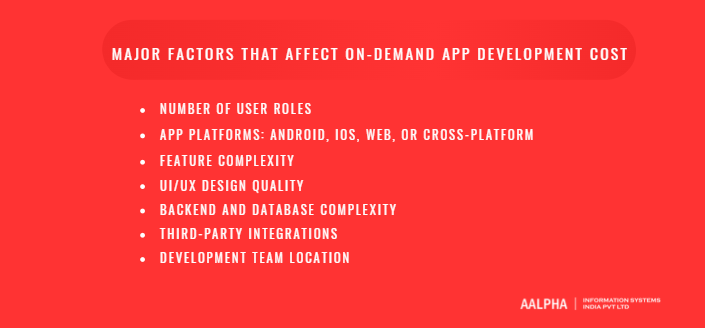
Major Factors That Affect On-Demand App Development Cost
On-demand app development cost is not decided by one single feature or one fixed pricing formula. The final budget depends on how the platform is planned, how many users it serves, how many apps or panels are required, what level of automation is needed, and how complex the backend operations are. A simple booking app with manual admin control can be built at a lower cost, while a marketplace with live tracking, automated matching, provider earnings, vendor panels, business accounts, refunds, analytics, and multi-location operations requires a larger investment. Before estimating the cost, businesses must clearly define the app type, user roles, feature list, revenue model, technology stack, integrations, and maintenance expectations.
-
Number of User Roles
The number of user roles is one of the biggest factors that affects on-demand app development cost. Every user role usually needs separate screens, permissions, workflows, dashboards, notifications, and backend logic. A basic on-demand app may only have a customer app, service provider app, and admin panel. However, a more advanced platform may include customers, service providers, delivery partners, vendors, admins, sub-admins, support agents, finance teams, operations teams, and business account users.
For example, in a food delivery app, the customer needs ordering, payment, tracking, refunds, support, and review features. The restaurant or vendor needs menu management, order acceptance, preparation status, pricing, offers, and reports. The delivery partner needs order pickup details, navigation, delivery status updates, earnings, and payout history. The admin needs complete control over users, restaurants, drivers, commissions, refunds, disputes, reports, and platform settings. If the app also supports business accounts, then companies may need bulk ordering, monthly billing, employee access, GST invoices, spending limits, and centralized reports.
Each added role increases design, development, testing, and maintenance effort. It also increases backend complexity because the system must manage different permissions, data access rules, notifications, and workflows for each user type. This is why a single-role booking app costs much less than a multi-sided marketplace platform.
-
App Platforms: Android, iOS, Web, or Cross-Platform
Platform selection has a direct impact on development cost. If a business wants separate native apps for Android and iOS, the cost is usually higher because each platform requires separate development work. Android apps are commonly built using Kotlin or Java, while iOS apps are built using Swift. Native development can deliver strong performance, better device-level control, and platform-specific user experience, but it usually needs more time, larger teams, and higher budgets.
For many startups and SMEs, cross-platform development is a practical option. Frameworks such as Flutter and React Native allow developers to build one shared codebase for both Android and iOS. This can reduce development time and cost compared to building two fully separate native apps. Cross-platform development is often suitable for MVPs, marketplace apps, booking apps, delivery apps, and service apps where speed, budget control, and consistent design across platforms are important.
Web platforms also affect the cost. Some businesses only need a mobile app and admin dashboard, while others need customer websites, vendor portals, business dashboards, and internal web panels. A full on-demand ecosystem may include Android app, iOS app, customer web app, provider web portal, vendor panel, admin dashboard, and support console. The more platforms included in the project scope, the higher the overall development cost.
-
Feature Complexity
Feature complexity is another major cost driver. Basic features such as registration, profile management, category listing, booking, payment, order history, and ratings are relatively straightforward compared to advanced features that require real-time data, automation, or custom business logic. A simple appointment booking system may only need available slots, confirmation, payment, and reminders. A more advanced on-demand platform may need real-time GPS tracking, automated dispatching, route optimization, dynamic pricing, AI-based recommendations, fraud detection, wallet systems, subscription plans, and advanced search.
Real-time tracking increases cost because the app must collect live location data, update maps, calculate estimated arrival time, and sync status changes between customer, provider, and admin. Advanced search and filtering also require more development effort when users need to filter by location, price, rating, availability, service category, delivery time, brand, or provider type. AI recommendations can increase cost further because the system may need to analyze user behavior, order history, preferences, and location data.
Automation also adds backend complexity. Features such as automatic provider assignment, smart order routing, recurring bookings, loyalty rules, subscription billing, commission calculation, refund workflows, and driver payout logic require careful planning and testing. Every advanced feature increases cost not only during development but also during QA, maintenance, and future updates.
-
UI/UX Design Quality
UI/UX design quality has a strong impact on on-demand app development cost. A basic app with standard screens and simple layouts will cost less than a custom-designed product with detailed user journeys, branded interface, smooth interactions, design systems, animations, and accessibility improvements. However, design should not be treated as a minor part of the project. On-demand apps depend heavily on fast user actions, clear navigation, and trust. Poor design can increase drop-offs, support tickets, booking errors, and payment failures.
The design process usually includes user flow planning, wireframes, clickable prototypes, visual design, iconography, typography, color systems, and responsive layouts. For example, a delivery app must make it easy for the customer to enter pickup and drop locations, choose delivery type, confirm pricing, make payment, and track the delivery. A taxi app must make location selection, fare visibility, driver tracking, and trip completion simple. A home service app must help users compare providers, view pricing, select time slots, and confirm bookings without confusion.
Custom branding, micro-interactions, animations, dark mode, accessibility support, and multi-language design can increase cost. Still, investing in good UI/UX design often reduces long-term friction because it makes the app easier to use, easier to scale, and easier to improve after launch.
-
Backend and Database Complexity
The backend is the operational engine of an on-demand app. It handles user management, service requests, provider assignment, order processing, payments, notifications, analytics, reports, logs, dashboards, APIs, and business rules. The more complex the backend, the higher the development cost. Many businesses focus only on mobile app screens, but the backend usually takes a large share of the budget because it controls how the platform actually works.
A basic backend may support users, bookings, payments, and admin controls. A more advanced backend may need real-time order updates, location tracking, commission calculation, refunds, wallet balances, provider availability, subscription billing, role-based permissions, audit logs, support tickets, fraud checks, and detailed analytics. If the platform has multiple vendors, cities, warehouses, service categories, pricing rules, or business accounts, the database structure becomes more complex.
API development is also important. The mobile apps, web panels, admin dashboard, payment gateway, map service, notification system, and third-party tools must communicate through secure APIs. Poor backend architecture can lead to slow performance, incorrect order status, failed payments, tracking issues, and expensive rework. For this reason, backend planning should be done carefully before development starts.
-
Third-Party Integrations
Third-party integrations can significantly affect on-demand app development cost. Most on-demand apps need external services for maps, payments, SMS, WhatsApp, email, CRM, accounting, identity verification, analytics, customer support, and marketing automation. These integrations save development time because the business does not need to build everything from scratch, but they still require API setup, testing, error handling, security checks, and ongoing monitoring.
Map integration is common in taxi, logistics, food delivery, grocery delivery, and home services apps. It supports location search, geocoding, distance calculation, route display, estimated arrival time, and live tracking. Payment gateway integration is also essential for online transactions, refunds, wallets, cards, bank transfers, and payout workflows. SMS, email, and WhatsApp integrations are often used for OTP login, booking confirmation, reminders, order updates, delivery alerts, and promotional messages.
Some platforms may also need CRM integration for lead management, accounting tools for invoices and settlements, identity verification for provider onboarding, and analytics tools for user behavior tracking. Each integration adds cost because developers must connect APIs, manage data exchange, handle failures, and test real-life scenarios. Integration costs may also continue after launch through monthly usage fees, transaction fees, or API charges.
-
Development Team Location
Development team location also affects the final cost. Hourly rates vary widely across India, Eastern Europe, Western Europe, the USA, and Australia. India is often preferred by startups and SMEs because it offers experienced mobile app developers, backend engineers, UI/UX designers, QA testers, and project managers at more cost-effective rates compared to Western markets. Eastern Europe is also popular for strong engineering talent at moderate pricing. Western Europe, the USA, and Australia usually have higher hourly rates, which increases the total project budget.
However, the lowest hourly rate should not be the only deciding factor. Businesses should also evaluate technical experience, portfolio, communication quality, project management, documentation, testing process, and post-launch support. An inexperienced team may offer a lower estimate but can increase the long-term cost through delays, poor architecture, bugs, missing features, and weak maintenance.
A good development partner will first understand the business model, define the scope, map user roles, recommend the right technology stack, estimate feature-wise effort, and provide a realistic cost range. The right team can help businesses avoid unnecessary features, reduce technical risk, and build an on-demand app that is scalable, secure, and practical for real operations.
MVP vs Full-Scale On-Demand App Cost
One of the most important cost decisions in on-demand app development is whether to build a minimum viable product or a full-scale platform from the beginning. Both approaches can be useful, but they serve different business goals. An MVP is designed to launch faster, test the market, collect real customer feedback, and reduce initial investment. A full-scale on-demand platform is designed for businesses that already have strong demand, funding, operational readiness, or an existing customer base. Choosing the right approach can help businesses control development cost, avoid unnecessary features, and build the product in a practical way.
-
What to Include in an MVP
An on-demand app MVP should include only the core features required to make the service work from start to finish. The main goal is to allow users to register, find a service or product, place a request, make payment, track the status, receive notifications, and complete the transaction. For most on-demand business models, the must-have MVP features include customer login, basic profile management, service or product listing, booking or order placement, payment gateway integration, basic tracking, push notifications, order history, ratings, and a simple admin panel.
For example, a food delivery MVP may include customer registration, restaurant listing, menu browsing, cart, checkout, payment, order status, delivery partner assignment, and admin controls. A taxi booking MVP may include rider login, pickup and drop location, ride request, driver acceptance, fare estimate, GPS tracking, payment, and trip history. A home services MVP may include service categories, provider profiles, time slot booking, online payment, service status, and customer reviews.
The admin panel is essential even in an MVP because the business needs control over users, providers, orders, payments, pricing, cancellations, refunds, and basic reports. Without an admin panel, the business will struggle to manage operations after launch. A well-planned MVP may cost less than a full platform, but it should still be built with a proper backend structure so that new features can be added later without rebuilding the product from scratch.
-
What to Avoid in the First Version
Startups should avoid adding too many advanced features in the first version because it increases cost, delays launch, and makes the product harder to test. Features such as complex loyalty systems, advanced AI recommendations, heavy automation, multilingual support, referral engines, subscription plans, advanced analytics, custom CRM tools, wallet systems, and multi-module dashboards may be useful later, but they are not always required for the first launch.
The first version should prove the business model, not attempt to copy a mature market leader. Many startups make the mistake of building every feature they see in established on-demand platforms. This often leads to higher development costs, longer timelines, more bugs, and delayed customer validation. For example, an early-stage grocery delivery startup does not need advanced demand forecasting, warehouse automation, and AI-based substitution logic before it has confirmed customer demand and store operations. A home services startup does not need a complex bidding engine, loyalty program, and multi-city provider management before it has steady bookings in one launch market.
Avoiding unnecessary features also makes the app easier to maintain. A smaller MVP allows the team to identify what users actually need, which service categories perform better, where customers drop off, which providers are reliable, and what operational problems need to be solved first. This creates a stronger foundation for future development.
-
When to Build a Full-Scale Platform
A full-scale on-demand platform is a better choice when the business has validated demand, funding, operational capacity, or enterprise-level requirements. Funded startups that are preparing for a multi-city launch may need a more complete product from the beginning because they must support larger user volumes, multiple service areas, provider onboarding, automated assignment, advanced dashboards, marketing campaigns, and support operations. Enterprises may also need a full-scale platform because they already have customers, vendors, internal teams, compliance needs, and business workflows that must be connected from day one.
A full-scale platform is also suitable when the app is not just a market test but a core business system. For example, a logistics company building an on-demand delivery platform may need business accounts, bulk orders, proof of delivery, route optimization, driver payouts, invoice management, and operational analytics from the first version. A healthcare company may need appointment booking, online consultations, patient records, prescription management, privacy controls, and compliance-focused access management. These features require deeper planning and higher investment, but they may be necessary for the business to operate properly.
A full platform should be planned with scalability, security, performance, and long-term maintenance in mind. It should include a strong backend, clean database structure, reliable APIs, role-based access control, reporting tools, and proper testing across user flows.
-
Cost Difference Between MVP and Full Product
The cost difference between an MVP and a full-scale on-demand app can be significant. A basic MVP development may cost around $15,000 to $40,000, depending on the app type, platforms, design quality, and development region. This budget usually covers essential customer features, basic provider workflows, payment integration, simple tracking, notifications, and an admin panel. It is suitable for businesses that want to launch quickly and improve the product based on real usage.
A mid-level on-demand app may cost around $40,000 to $90,000 and usually includes separate customer and provider apps, improved UI/UX, live tracking, payment workflows, ratings, reports, coupon management, refunds, and better admin controls. This option is suitable for businesses that are ready for active operations and need a more polished product than a basic MVP.
A full-scale or enterprise-grade on-demand platform may cost $90,000 to $250,000+ because it includes advanced features such as automation, AI-based matching, route optimization, multi-city support, subscriptions, wallet systems, business accounts, fraud detection, advanced analytics, vendor panels, and custom workflows. The higher cost comes from deeper backend development, more user roles, stronger security, more integrations, and extensive testing.
For most startups, the practical approach is to begin with an MVP, launch in one market, measure user behavior, and then add features in phases. This reduces risk and keeps development cost under control. For enterprises and funded startups with proven demand, a full-scale platform may be the better investment because it supports larger operations from the start.
On-Demand App Development Cost by Region
On-demand app development cost varies widely by region because hourly development rates, team availability, project management standards, communication models, and operating costs differ from country to country. The same app scope can have very different budgets depending on whether the development team is based in India, the USA, Western Europe, Eastern Europe, Australia, or the Middle East. For example, an on-demand MVP that costs $25,000 to $40,000 with an experienced offshore team may cost significantly more if built by a local agency in the USA or Australia. This does not always mean one region is better than another. The right choice depends on budget, technical complexity, communication expectations, delivery timeline, and long-term support needs.
-
Development Cost in India
India is one of the most preferred destinations for cost-effective on-demand app development because it offers a strong combination of technical talent, competitive pricing, English-speaking development teams, and experience across global software projects. Businesses often choose Indian development companies when they need mobile app developers, backend engineers, UI/UX designers, QA testers, DevOps engineers, and project managers at a more affordable cost compared to the USA, UK, Australia, or Western Europe.
For startups and SMEs, India is especially attractive because the same budget can usually cover more development work. A business can build a customer app, provider app, admin dashboard, backend APIs, payment integration, map integration, and basic tracking features at a lower cost than in many Western markets. Indian teams also have experience building food delivery apps, taxi booking apps, grocery delivery apps, home service platforms, healthcare apps, logistics apps, and marketplace products for global clients.
A basic on-demand MVP developed in India may cost around $15,000 to $40,000, while a mid-level platform may cost $40,000 to $90,000. Advanced platforms with complex workflows, automation, AI features, analytics, and multi-city support can cost more, depending on scope. India is a practical option for businesses that want a balance between affordability, technical capability, and long-term development support.
-
Development Cost in the USA
On-demand app development in the USA is usually more expensive because hourly rates are higher, agency operating costs are higher, and local engineering talent is priced at a premium. A US-based team may be a good choice for businesses that need close time-zone collaboration, in-person workshops, highly specialized product strategy, or strict local vendor requirements. However, the total project budget can be much higher compared to offshore or nearshore development.
A basic MVP developed by a US agency may cost around $50,000 to $100,000+, while a mid-level on-demand app can cost $100,000 to $200,000+. Enterprise-grade platforms with AI, automation, advanced dashboards, compliance needs, and multiple integrations can go beyond $250,000. These higher costs are mainly driven by hourly rates for product managers, designers, mobile developers, backend developers, QA engineers, and DevOps specialists.
For funded startups and enterprises, the higher cost may be acceptable if they need local consulting, deeper product discovery, or ongoing strategic support. For early-stage startups, however, a fully US-based development model may stretch the initial budget unless the scope is very limited.
-
Development Cost in Europe
Europe has two broad pricing categories: Western Europe and Eastern Europe. Western European countries such as the UK, Germany, France, Netherlands, Sweden, and Switzerland generally have higher development costs. Agencies in these markets often work with enterprises, regulated industries, and businesses that require strong documentation, product consulting, and compliance-oriented development. A mid-level on-demand app in Western Europe can cost $80,000 to $180,000+, while enterprise platforms can cost much more depending on complexity.
Eastern Europe, including countries such as Poland, Ukraine, Romania, Bulgaria, Serbia, and the Baltic region, is often seen as a strong nearshore development destination for European and US businesses. Development costs are usually lower than Western Europe and the USA, while engineering quality is often strong. Many Eastern European teams have experience in SaaS platforms, marketplace apps, fintech systems, logistics software, and enterprise-grade backend development.
An on-demand MVP in Eastern Europe may cost around $30,000 to $70,000, while a mid-level platform can cost $70,000 to $140,000+. This region is often preferred by businesses that want strong technical execution at a moderate cost, especially when time-zone overlap with Europe is important.
-
Development Cost in Australia and the Middle East
Australia is generally a higher-cost market for on-demand app development. Local agencies and development teams usually charge premium rates due to higher labor costs and business expenses. A basic on-demand app in Australia may cost $50,000 to $120,000+, while a full-scale platform can cost $150,000 to $300,000+. Australian businesses often choose local teams when they want close collaboration, local market understanding, or enterprise-level consulting. However, many companies also outsource the projects to India, Southeast Asia, or Eastern Europe to reduce costs while keeping project management local.
The Middle East has a mixed pricing structure. Countries such as the UAE, Saudi Arabia, and Qatar have growing demand for on-demand platforms across delivery, transport, healthcare, home services, logistics, and professional services. Local development agencies can be expensive, especially for enterprise and government-linked projects. A mid-level on-demand app developed locally in the Middle East may cost $60,000 to $160,000+, while advanced platforms can cost more. At the same time, many Middle Eastern businesses outsource development to India or Eastern Europe to control budgets and access larger technical teams.
Regional pricing differences show why businesses should not evaluate app development cost only by location. A lower-cost region can still deliver high-quality software if the team has strong experience, clear processes, and reliable support. Similarly, a higher-cost region may be valuable when the project needs local consulting, industry-specific knowledge, or close collaboration. The best approach is to compare teams based on relevant portfolio, technical skills, communication quality, project clarity, pricing transparency, and post-launch support.
On-Demand App Maintenance Cost
On-demand app maintenance cost is an important part of the total project budget. Many businesses focus only on the initial development cost, but the actual cost of running an on-demand app continues after launch. These platforms handle live orders, bookings, payments, provider assignment, customer support, notifications, tracking, and admin operations every day. Because of this, regular maintenance is necessary to keep the app secure, stable, fast, and compatible with changing technology standards.
In general, on-demand app maintenance may cost around 15% to 25% of the initial development cost per year, depending on the size and complexity of the platform. For example, if the initial on-demand app development cost is $60,000, the yearly maintenance budget may range from $9,000 to $15,000. This can be paid as a monthly support retainer, prepaid support hours, or a dedicated maintenance contract. More complex platforms with real-time tracking, multiple apps, payment workflows, business dashboards, integrations, and high user traffic may need a higher maintenance budget.
-
Monthly Maintenance Cost
Monthly app maintenance cost depends on how much technical support the app needs after launch. A basic MVP with limited users, simple booking features, and a small admin panel may need only light maintenance. A larger on-demand platform with customer apps, provider apps, vendor panels, admin dashboards, payment integrations, live tracking, notifications, analytics, and server infrastructure will need more regular monitoring and updates.
For smaller apps, monthly maintenance may include bug fixing, minor improvements, app updates, server checks, and basic technical support. For growing platforms, maintenance may also include performance monitoring, database optimization, third-party API updates, payment gateway changes, app store updates, security checks, and feature enhancements. Enterprise-grade apps may require dedicated support teams, uptime monitoring, DevOps support, SLA-based response times, and regular security reviews.
Businesses should plan maintenance from the beginning instead of treating it as an optional expense. If the app grows quickly, maintenance needs will increase as more users, orders, payments, and support cases enter the system.
-
What Maintenance Includes
On-demand app maintenance usually includes several technical and operational activities. Bug fixes are the most common requirement because real users may report issues that were not found during testing. These issues may involve login errors, payment failures, booking problems, incorrect order status, notification delays, map issues, or provider assignment errors.
Maintenance also includes operating system updates for Android and iOS. Mobile platforms regularly release new versions, and apps must remain compatible with updated devices, permissions, security rules, and app store policies. Payment updates are also important because payment gateways may change APIs, compliance rules, transaction flows, refund systems, or authentication requirements.
Security patches are another major part of maintenance. On-demand apps store sensitive data such as customer profiles, provider details, addresses, payment references, order history, and communication records. Regular security updates help protect the platform from vulnerabilities, unauthorized access, data leaks, and fraud attempts.
Server optimization is also required as traffic grows. The backend may need database tuning, API performance improvements, caching, load balancing, backup management, log monitoring, and cloud cost optimization. Maintenance can also include feature improvements based on user feedback, admin requests, provider issues, customer behavior, and business expansion plans. App store compliance updates are necessary to keep the app approved and available on Google Play and the Apple App Store.
-
Why Maintenance Is Critical for On-Demand Apps
Maintenance is critical because on-demand apps operate in real time. A normal website issue may cause inconvenience, but an on-demand app issue can directly stop revenue. If the payment system fails, customers cannot complete orders. If live tracking stops working, customers may lose trust in the service. If notifications are delayed, providers may miss requests and customers may not receive updates. If the admin dashboard is slow, the operations team may struggle to manage orders, refunds, cancellations, and disputes.
Downtime can be especially damaging for delivery, taxi, logistics, healthcare, home services, and grocery platforms because customers expect immediate service. Even a short outage during peak hours can lead to lost orders, refund requests, bad reviews, provider frustration, and customer churn. Payment errors, wrong pricing, failed refunds, duplicate orders, and incorrect provider assignment can also create financial and operational problems.
A strong maintenance plan keeps the platform reliable after launch. It helps businesses fix issues quickly, improve performance, update features, maintain security, support new devices, and adapt to changing user needs. For any business investing in on-demand app development, maintenance should be included in the long-term budget from day one.
How to Reduce On-Demand App Development Cost
Reducing on-demand app development cost does not mean building a weak or incomplete product. It means making better product decisions, avoiding unnecessary features, choosing the right technology stack, using reliable third-party services, and working with a team that understands on-demand business models. Many startups increase their own development cost by trying to build too many features at once, changing requirements during development, choosing the wrong architecture, or hiring an inexperienced team only because the initial quote looks cheaper. A smarter approach is to build the product in phases, launch with the most important features, and improve the platform based on real users, real transactions, and real operational data.
-
Start With an MVP
Starting with an MVP is one of the best ways to reduce on-demand app development cost. A minimum viable product focuses only on the features needed to launch the service and validate the business model. Instead of building a large platform with every advanced feature from day one, an MVP allows the business to test whether customers are willing to use the service, whether providers can fulfill requests, whether payments work smoothly, and whether the operational model is practical.
For most on-demand apps, an MVP should include customer login, service or product listing, booking or order placement, payment integration, basic tracking, notifications, order history, provider acceptance, ratings, and an admin panel. These features are enough to support the core transaction between customer and provider. For example, a home services startup can begin with service categories, provider profiles, booking slots, payment, and admin controls instead of adding subscriptions, loyalty points, AI recommendations, and advanced provider scoring in the first version.
An MVP reduces upfront cost, shortens development time, and lowers business risk. It also gives the company a chance to collect customer feedback before investing in advanced features. This prevents wasted development effort on features that users may not actually need.
-
Use Cross-Platform Development
Cross-platform development can reduce both time and budget for many on-demand app projects. Instead of building separate native apps for Android and iOS, businesses can use frameworks such as Flutter or React Native to create one shared codebase for both platforms. This approach can reduce duplicate development work, simplify maintenance, and make it easier to launch the app on Android and iOS within a controlled budget.
Cross-platform development is especially useful for MVPs, startup platforms, delivery apps, marketplace apps, booking apps, and service apps where the main requirement is fast launch and consistent user experience. A single development team can build customer apps, provider apps, and app updates faster compared to maintaining separate Android and iOS teams.
However, cross-platform development should be chosen based on project requirements. If the app needs very advanced device-level features, heavy animation, complex background location tracking, or platform-specific performance optimization, native development may still be suitable. For many on-demand platforms, though, Flutter or React Native offers a practical balance between cost, speed, and quality.
-
Prioritize Must-Have Features
Feature prioritization is essential for reducing development cost. Every feature adds design, development, testing, backend logic, and maintenance effort. Businesses should separate must-have features from nice-to-have features before development begins. Must-have features are required for the app to function properly. Nice-to-have features improve convenience, engagement, or automation but are not necessary for the first launch.
For example, login, service browsing, booking, payment, order status, notifications, tracking, ratings, and admin management are core features for most on-demand apps. Features such as loyalty programs, referral campaigns, advanced analytics, AI recommendations, multi-language support, subscriptions, complex coupons, wallet systems, and chatbot support can be added later if the business model requires them.
A simple prioritization method is to ask whether the feature is required to complete the main customer transaction. If the answer is yes, it belongs in the first version. If the answer is no, it can usually be moved to a later phase. This helps businesses launch faster, reduce initial cost, and avoid unnecessary complexity.
-
Use Ready Integrations Where Practical
Using ready third-party integrations can reduce development cost when compared to building everything from scratch. On-demand apps commonly need payment gateways, map APIs, push notifications, SMS, WhatsApp, email, analytics, customer support, identity verification, and communication tools. Building custom versions of all these systems would be expensive, time-consuming, and difficult to maintain.
Payment gateways can manage online payments, refunds, cards, wallets, bank transfers, and transaction records. Map APIs can handle geocoding, route display, distance calculation, live tracking, and estimated arrival time. Notification services can send push alerts, booking confirmations, delivery updates, and reminders. Analytics tools can track user behavior, conversions, app performance, and retention.
Ready integrations help businesses launch faster because the development team can connect proven APIs instead of creating every system manually. However, these integrations should still be selected carefully. The team must check pricing, reliability, scalability, documentation, support, compliance, and long-term usage cost. Poorly selected third-party tools can create problems later, especially if API pricing increases or the service does not support required features.
-
Work With an Experienced Development Team
Hiring an experienced development team can reduce long-term cost even if the initial quote is not the cheapest. On-demand apps require more than basic mobile app development. They need customer apps, provider apps, admin dashboards, backend APIs, payments, tracking, notifications, reports, security, and operational workflows. A team that has already built marketplace, delivery, taxi, grocery, healthcare, or service booking platforms will understand these requirements better.
Experienced teams reduce cost by planning the architecture correctly, choosing the right technology stack, documenting requirements clearly, avoiding unnecessary features, and building scalable backend systems from the start. They also know common problems such as failed payments, inaccurate tracking, delayed notifications, provider assignment issues, refund disputes, and app store rejection risks. This experience helps prevent expensive rework.
Inexperienced teams may offer a low price but can increase the final cost through poor code quality, unclear communication, missed features, weak testing, slow delivery, and lack of post-launch support. Fixing a badly built on-demand app can cost more than building it correctly the first time. The best approach is to choose a development partner with relevant experience, transparent pricing, milestone-based delivery, strong QA practices, and reliable maintenance support.
Businesses can reduce on-demand app development cost by making practical decisions from the beginning. Start with an MVP, choose cross-platform development where suitable, focus on must-have features, use trusted integrations, and work with a team that understands real on-demand operations. This approach keeps the first version affordable while leaving enough room to scale the product as the business grows.
Monetization Models for On-Demand Apps
A strong monetization model is essential for recovering on-demand app development cost and building a profitable business. Since on-demand apps usually connect customers with vendors, service providers, restaurants, delivery partners, drivers, or professionals, there are several ways to generate revenue from the platform. The right model depends on the app category, customer behavior, transaction volume, provider margins, service frequency, and market competition. Some businesses use one revenue stream, while mature on-demand platforms often combine commissions, customer fees, subscriptions, featured listings, and advertising to increase overall income.
-
Commission-Based Model
The commission-based model is one of the most common monetization methods for on-demand apps. In this model, the platform earns a fixed percentage or fixed amount from every completed transaction. The commission may be charged to vendors, service providers, restaurants, drivers, professionals, or delivery partners depending on the business type.
For example, a food delivery platform may charge restaurants a commission on every order. A home services app may deduct a percentage from each completed booking. A taxi booking platform may charge drivers a platform fee from every ride. A grocery delivery marketplace may charge stores or sellers based on order value. This model works well because revenue increases as transaction volume grows. The platform does not need to charge users upfront and can earn continuously from successful orders or bookings.
However, commission rates must be planned carefully. If the commission is too high, vendors and providers may avoid the platform or increase prices for customers. If it is too low, the business may struggle to cover technology, support, marketing, payment, and operational costs. A balanced commission structure should consider provider margins, customer pricing, competition, and long-term platform sustainability.
-
Delivery or Convenience Fees
Delivery fees and convenience fees are customer-side charges added to orders, bookings, rides, or service requests. These fees help the platform cover operational expenses such as delivery partner payouts, payment processing, support, technology usage, packaging coordination, service management, and last-mile fulfillment.
In a food delivery or grocery delivery app, customers may pay a delivery fee based on distance, order value, delivery speed, weather conditions, or peak-hour demand. In a taxi booking app, the platform may include service charges, waiting charges, cancellation fees, or booking fees. In a home services app, customers may pay a convenience fee for instant booking, verified professionals, secure payment, or customer support.
This model is useful because it allows the platform to earn from the customer side without depending only on vendor commissions. However, the fee must feel fair and transparent. Unexpected charges at checkout can increase cart abandonment and reduce repeat usage. The app should clearly show delivery fees, convenience fees, taxes, cancellation charges, and total payable amount before the user confirms the transaction.
-
Subscription Plans
Subscription plans can create predictable recurring revenue for on-demand platforms. These plans can be offered to customers, vendors, service providers, or business users. A customer subscription may include benefits such as free delivery, reduced convenience fees, priority support, exclusive discounts, faster service, or premium access. This model is common in delivery, grocery, mobility, fitness, healthcare, and home services apps.
Vendor or provider subscriptions work differently. A restaurant, store, driver, professional, or service provider may pay a monthly fee to access better visibility, premium leads, advanced reports, lower commission rates, or additional business tools. For B2B on-demand platforms, business accounts may subscribe to monthly plans that include centralized billing, multiple team members, spending controls, reports, priority support, and invoice management.
Subscriptions are valuable because they reduce dependence on one-time transactions. They also improve user loyalty when the benefits are clear. However, the subscription must offer real value. Customers will not pay monthly unless the savings, speed, convenience, or service quality justify the cost.
-
Featured Listings and Promotions
Featured listings allow vendors, service providers, restaurants, stores, or professionals to pay for better visibility inside the app. This can include top placement in search results, category highlights, promoted service cards, banner placements, sponsored recommendations, or priority ranking in local searches.
For example, a restaurant may pay to appear at the top of the food delivery app during lunch hours. A beauty professional may pay for premium placement in a salon service category. A grocery store may sponsor a product category during festive demand. A home service provider may pay to appear higher for urgent repair searches.
This model works best when the platform already has meaningful customer traffic. Vendors are more likely to pay for promotion when the visibility can generate real leads, bookings, or sales. The platform should also maintain fairness by clearly marking sponsored listings and not damaging the user experience with too many paid placements.
-
Advertising Revenue
Advertising revenue can become an additional monetization stream for on-demand apps with strong user engagement. The app can display in-app ads, sponsored banners, brand promotions, product placements, coupon campaigns, or location-based offers. Advertising is especially useful for food delivery, grocery delivery, lifestyle, mobility, and local services apps because brands want access to active buyers.
For example, a grocery delivery app can promote packaged food brands, household products, or personal care items. A food delivery app can run sponsored restaurant banners. A taxi app can show local offers or brand campaigns inside the app. A healthcare app can promote wellness packages, diagnostics services, or pharmacy offers where legally appropriate.
Advertising should be used carefully. Too many ads can make the app feel crowded, slow, or less trustworthy. The best approach is to make ads relevant to the user’s intent and place them in areas that do not interrupt the main transaction. Sponsored placements, category promotions, and partner offers usually perform better than random display ads.
A profitable on-demand app often combines multiple monetization models instead of relying on only one. For example, a delivery app can earn from vendor commissions, delivery fees, customer subscriptions, promoted listings, and sponsored campaigns. The right mix should be selected based on the app category, user behavior, provider economics, and long-term growth strategy.
Choosing the Right On-Demand App Development Company
Choosing the right on-demand mobile app development company is one of the most important decisions in the entire project. The development partner you select will influence the app’s cost, quality, launch timeline, scalability, user experience, security, and long-term performance. On-demand apps are not simple mobile apps. They usually require multiple user roles, real-time operations, payment processing, location tracking, backend workflows, admin controls, reports, support tools, and ongoing maintenance. A company with relevant experience can help you avoid costly mistakes and build a product that works well in real business conditions.
-
Check Relevant Industry Experience
Industry experience matters because every on-demand business model has different operational requirements. A delivery app is different from a taxi booking app. A grocery delivery platform is different from a healthcare consultation app. A home services marketplace is different from a logistics or parcel delivery platform. Although all of them use the on-demand model, the user flows, pricing logic, provider workflows, tracking needs, and admin controls are not the same.
For example, a food delivery app may need restaurant panels, menu management, order preparation status, delivery partner assignment, refund handling, and commission reports. A taxi booking app may need live ride matching, GPS tracking, fare calculation, driver earnings, and cancellation rules. A healthcare on-demand app may need appointment booking, secure patient records, online consultations, prescription handling, privacy controls, and compliance-focused development. A company that has already worked on similar platforms will understand these details better and can suggest practical solutions during planning.
-
Review Technical Capabilities
A reliable on-demand app development company should have strong technical capabilities across mobile app development, backend systems, admin dashboards, cloud infrastructure, payments, maps, notifications, analytics, and security. The team should be able to build customer apps, provider apps, vendor panels, delivery partner apps, and admin dashboards based on the business model.
Backend development is especially important because it controls the real-time operations of the platform. The backend must manage users, bookings, payments, provider assignment, notifications, tracking, commissions, refunds, reports, and support workflows. The company should also have experience with cloud hosting, database design, API development, payment gateway integration, map integration, push notifications, SMS or email alerts, analytics tools, and app store deployment.
Technical capability should not be judged only by design samples. Businesses should ask how the company handles app performance, backend scalability, data security, API documentation, testing, server monitoring, and future upgrades. A good-looking app with a weak backend can fail quickly when real users, payments, and live orders start entering the system.
-
Ask for a Clear Cost Estimate
Before hiring an on-demand app development company, ask for a clear and detailed cost estimate. The estimate should explain what is included in the quoted price, which platforms will be built, which user roles are covered, what features are included, what integrations are required, and what will be delivered at each milestone. A vague quote can create confusion later and may lead to unexpected costs during development.
A proper estimate should include feature-wise pricing, project timeline, development phases, payment milestones, testing scope, deployment support, and maintenance terms. It should also clarify whether the cost includes Android app development, iOS app development, web panels, admin dashboard, backend APIs, UI/UX design, third-party integrations, and post-launch support. This level of detail helps businesses compare vendors more accurately instead of choosing only based on the lowest price.
-
Evaluate Long-Term Support
Long-term support is essential for on-demand apps because the work does not end after launch. These apps need regular bug fixes, security patches, payment gateway updates, app store updates, server monitoring, performance optimization, feature improvements, and user feedback-based changes. If the development company does not provide reliable post-launch support, the business may struggle with downtime, payment errors, tracking issues, failed notifications, and unresolved customer complaints.
On-demand apps operate in real time, so even small technical issues can directly affect revenue and customer trust. For example, if a driver assignment feature fails, orders may remain unfulfilled. If payment confirmation is delayed, customers may abandon the app. If tracking stops working, support tickets may increase. A development company with proper maintenance support can fix issues faster and keep the platform stable as usage grows.
-
Work With an Experienced Development Partner
Businesses planning to build an on-demand app can work with experienced software development companies such as Aalpha Information Systems, especially when the project requires customer apps, provider apps, admin dashboards, real-time tracking, payment integration, backend development, third-party integrations, and long-term technical support. The right development partner should understand both technology and business operations so the final product is not just functional, but practical for real users, service providers, vendors, and internal teams.
A good company will help define the project scope, recommend the right technology stack, plan the MVP, estimate cost realistically, and support the app after launch. This reduces rework, prevents wrong architecture decisions, and improves the chances of building an on-demand platform that can grow with the business.
Conclusion
On-demand app development cost depends on the app type, number of user roles, features, platforms, backend complexity, integrations, design quality, and maintenance needs. A basic MVP may cost around $15,000 to $40,000, while a mid-level app can range from $40,000 to $90,000. Advanced on-demand platforms with automation, AI, multi-city support, real-time tracking, business dashboards, and custom workflows can cost $90,000 to $250,000+.
The best approach is to start with a clear scope, build only the essential features first, choose the right technology stack, and plan future upgrades in phases. This helps reduce upfront cost while keeping the product scalable for long-term growth.
If you are planning to build an on-demand app for delivery, taxi booking, grocery, healthcare, home services, logistics, or any marketplace model, Aalpha Information Systems can help you plan, design, develop, and launch a custom on-demand app with customer apps, provider apps, admin dashboards, payment integration, real-time tracking, and long-term technical support. Contact now!