


A Minimum Viable Product (MVP) is the most basic version of a product that includes only the core features required to solve a specific user problem and deliver measurable value. Instead of building a fully-featured application from the start, businesses use an MVP to validate ideas quickly, test assumptions in real market conditions, and gather user feedback before investing heavily in development. This approach is rooted in lean product development principles, where learning and iteration take priority over perfection.
Many founders and businesses ask a critical question early: how long does it take to build an MVP? In most real-world scenarios, an MVP development timeline typically ranges from 6 to 16 weeks, depending on the product’s complexity, industry requirements, and scope. A simple SaaS tool or internal workflow automation product may be built in as little as 4–6 weeks, while more complex platforms such as marketplaces, fintech applications, or healthcare solutions often require 12–16 weeks or more due to integrations, compliance, and scalability considerations.
The reason businesses prioritize MVP development instead of building a full product is straightforward: it significantly reduces risk. Developing a complete product without validation often leads to wasted resources, delayed launches, and products that fail to meet user expectations. An MVP allows teams to test demand early, confirm product-market fit, and refine the solution based on actual user behavior rather than assumptions. This approach not only saves development costs but also accelerates time-to-market, which is critical in competitive industries.
Understanding the MVP development timeline is equally important as defining the product itself. Without a clear timeline, teams often face scope creep, missed deadlines, and inefficient resource allocation. A well-structured timeline provides clarity on what needs to be built, when it should be delivered, and how progress should be measured. It also helps stakeholders align expectations and ensures that development efforts remain focused on delivering core value rather than unnecessary features.
From idea to launch, the MVP development process follows a structured sequence of stages. It begins with idea validation and market research to confirm that a real problem exists. This is followed by defining the MVP scope and prioritizing essential features. The next phase involves UX/UI design and prototyping, where the product experience is mapped out. Development then brings the product to life, followed by testing to ensure functionality and usability. Finally, the MVP is launched to real users, where feedback drives future iterations and product evolution.
In essence, an MVP is not just a simplified product; it is a strategic tool for learning, validating, and scaling efficiently. A clearly defined timeline ensures that this process remains focused, cost-effective, and aligned with business goals from the very first idea to the final launch.
Typical MVP Development Timeline at a Glance
Understanding how long it takes to build an MVP is one of the most common and practical concerns for founders, product managers, and business stakeholders. While timelines vary depending on scope and complexity, most MVPs follow a structured development cycle that typically spans 6 to 16 weeks. This section provides a clear, high-level roadmap so teams can set realistic expectations, plan resources effectively, and avoid common delays.
-
Average MVP Timeline Breakdown
The total duration of MVP development depends largely on the product’s complexity, feature set, and technical requirements. In practice, MVP timelines generally fall into three categories.
A simple MVP, such as a basic SaaS dashboard, internal tool, or landing page-driven product, can often be built within 4 to 6 weeks. These projects usually involve limited features, minimal integrations, and straightforward user flows. For example, a basic appointment booking system or a simple task management app fits this category.
A moderate complexity MVP, which includes platforms like marketplaces, subscription-based apps, or customer portals, typically takes 8 to 12 weeks. These products require multiple user roles, integrations such as payment gateways or APIs, and more structured backend logic. The added complexity increases both development and testing time.
A complex or regulated MVP, such as fintech platforms, healthcare applications, or enterprise-grade systems, often requires 12 to 16+ weeks. These products involve strict compliance requirements, advanced security protocols, scalability planning, and complex integrations. For instance, a telemedicine platform or digital payments system cannot be rushed due to regulatory and data protection considerations.
This tiered understanding helps answer a key question many teams ask early: how long should an MVP take to build? The answer depends not just on features, but on risk, compliance, and technical depth.
-
Timeline by Stage (High-Level)
Regardless of complexity, most MVPs follow a consistent sequence of stages. Each stage plays a critical role in ensuring that the final product is both functional and aligned with user needs.
The process begins with ideation, which typically takes 1 to 2 weeks. During this phase, teams define the core problem, identify the target audience, and outline the product vision. This stage sets the foundation for everything that follows.
Next comes validation, also lasting 1 to 2 weeks, where assumptions are tested through market research, user interviews, or early prototypes. Skipping or rushing this stage often leads to building products that lack real demand.
The planning and design phase usually spans 2 to 4 weeks. This includes defining the MVP scope, creating user flows, developing wireframes, and building interactive prototypes. Strong design at this stage reduces rework during development and improves overall efficiency.
The development phase, which is the most time-intensive, typically takes 4 to 8 weeks. This is where the product is built, including frontend interfaces, backend systems, and integrations. Agile methodologies are commonly used to enable iterative progress and continuous feedback.
Following development, testing and quality assurance take around 1 to 2 weeks. This phase ensures that the product is stable, usable, and free from critical bugs before release.
Finally, the launch phase usually takes about 1 week, including deployment, final checks, and initial user onboarding. Some teams opt for a soft launch to gather early feedback before a wider release.
-
Factors That Influence MVP Timeline
Although these timelines provide a general framework, several factors can significantly impact how long MVP development actually takes.
Product complexity is the most obvious factor. The more features, integrations, and user roles involved, the longer development will take. A simple single-user app will always be faster than a multi-sided platform.
Team size and expertise also play a critical role. Experienced teams with clear workflows can move significantly faster than less coordinated or inexperienced teams. However, adding more developers does not always speed up progress, as coordination overhead can increase.
The technology stack influences both speed and flexibility. Using pre-built frameworks, no-code tools, or existing APIs can accelerate development, while custom-built systems require more time but offer greater control and scalability.
Industry requirements can introduce additional layers of complexity. Sectors like healthcare and fintech often require compliance with regulations such as data protection laws, security standards, and audit requirements, which extend timelines.
Finally, feedback loops and iteration cycles affect overall duration. MVP development is not a linear process; it involves continuous testing, feedback, and refinement. Teams that actively incorporate user insights may extend timelines slightly but achieve significantly better product-market fit.
While most MVPs fall within a 6 to 16-week timeline, the actual duration depends on strategic decisions, technical requirements, and how effectively teams manage each stage of the process.
Stage 1: Idea Validation and Market Research
Before writing a single line of code, the most critical step in MVP development is validating the idea. This stage determines whether the product solves a real problem, serves a defined audience, and has actual market demand. A large percentage of startups fail not because of poor execution, but because they build products that users do not need. Idea validation and market research eliminate this risk by grounding decisions in evidence rather than assumptions.
-
Identifying the Core Problem
Every successful MVP begins with a clearly defined problem. The goal is not to build features, but to solve a specific, urgent pain point that users actively experience. A strong problem statement is precise, measurable, and tied to real-world behavior.
A weak problem statement often sounds vague or generic, such as “people want a better way to manage tasks.” This lacks urgency and does not indicate whether users are currently struggling enough to seek a solution. In contrast, a validated problem statement is specific and actionable, such as “freelancers struggle to track billable hours across multiple clients, leading to lost revenue.” This type of problem is measurable, relatable, and tied directly to a business outcome.
To identify a real problem, teams should focus on observable signals. Are users already using workarounds, such as spreadsheets or manual processes? Are they spending time or money to solve the issue? If users are actively trying to address the problem, it indicates demand. If not, the problem may not be significant enough to justify a product.
The key question to answer at this stage is simple: would users be disappointed if this solution did not exist? If the answer is unclear, further validation is required before proceeding.
-
Target Audience and User Personas
Once the core problem is defined, the next step is identifying who experiences it. Not every user is equally important during the MVP stage. The focus should be on early adopters, those who feel the pain most strongly and are willing to try new solutions.
Defining a target audience involves segmenting users based on behavior, needs, and context rather than broad demographics. For example, instead of targeting “small businesses,” a more effective audience definition would be “e-commerce store owners managing inventory manually across multiple platforms.”
User personas help bring clarity to this process. A strong persona includes specific details such as daily workflows, challenges, motivations, and existing tools. This allows product decisions to be grounded in real user needs rather than assumptions.
Early adopters are particularly important because they provide fast feedback and are more tolerant of incomplete products. These users are not looking for perfection; they are looking for solutions. Identifying them early accelerates learning and improves product direction.
-
Competitive Analysis
No product exists in isolation. Even if a direct competitor does not exist, users are already solving the problem in some way. Competitive analysis helps teams understand the current landscape and identify opportunities for differentiation.
This process begins by mapping both direct and indirect competitors. Direct competitors offer similar solutions, while indirect competitors may include alternative approaches such as manual processes or unrelated tools. For example, a new expense tracking app competes not only with other apps but also with spreadsheets and accounting software.
The goal is not to replicate competitors but to identify gaps. These gaps may include poor user experience, high pricing, lack of automation, or missing features. By focusing on these weaknesses, teams can position their MVP as a better or more focused solution.
A practical approach is to analyze competitors across key dimensions such as features, pricing, onboarding experience, and customer reviews. User complaints, in particular, provide valuable insights into unmet needs. If multiple users consistently highlight the same issues, it signals an opportunity for improvement.
-
Market Demand Validation Methods
After defining the problem, audience, and competitive landscape, the next step is validating demand through real-world signals. This ensures that the product idea is not based solely on internal assumptions.
One effective method is conducting user interviews. Speaking directly with potential users helps uncover pain points, behaviors, and willingness to adopt a solution. Open-ended questions such as “How are you currently solving this problem?” provide deeper insights than simple yes-or-no questions.
Surveys can complement interviews by gathering quantitative data at scale. However, they should focus on behavior rather than opinions. Asking “How often do you face this issue?” is more reliable than asking “Would you use this product?”
Another widely used approach is creating a landing page that explains the product concept and measures user interest. Metrics such as sign-ups, click-through rates, and time spent on the page indicate whether the idea resonates with the target audience.
More advanced validation methods include pre-orders and waitlists. If users are willing to sign up or even pay before the product is built, it is a strong signal of demand. For example, companies like Dropbox and Buffer validated their ideas using simple landing pages before developing full products.
These methods answer a crucial question: are users willing to take action, not just express interest? Action-based validation is far more reliable than verbal feedback.
-
Timeline for This Stage
The idea validation and market research phase typically takes 1 to 2 weeks, depending on the depth of research and access to users. While this may seem like a short timeframe, it is one of the most impactful stages in the entire MVP development process.
Rushing through validation is a common mistake that leads to costly consequences. Skipping interviews, ignoring market signals, or relying solely on internal assumptions often results in building products that fail to gain traction. The time saved during validation is often lost later in redevelopment, pivoting, or complete product failure.
On the other hand, a well-executed validation phase provides clarity, reduces uncertainty, and sets a strong foundation for all subsequent stages. It ensures that development efforts are focused on solving real problems for real users, which is ultimately the core objective of any successful MVP.
Idea validation is not just an initial step; it is a strategic checkpoint that determines whether the product is worth building at all.
Stage 2: Defining MVP Scope and Feature Prioritization
Once the idea has been validated, the next critical step is deciding what exactly to build. This stage determines the scope of the MVP and ensures that development efforts are focused on delivering core value rather than unnecessary complexity. Many products fail not because the idea is weak, but because teams attempt to build too much too early. Defining a clear scope and prioritizing the right MVP features is essential to keeping timelines, costs, and outcomes under control.

-
What Features Should an MVP Include?
An MVP is not a smaller version of a full product; it is a focused solution designed to solve one core problem effectively. The goal is to include only the features that are absolutely necessary to deliver that value. This requires a clear distinction between core and non-essential features.
Core features are those without which the product cannot function. These are directly tied to the primary problem identified during validation. For example, in a ride-hailing MVP, core features would include user registration, ride booking, and driver matching. Without these, the product cannot fulfill its purpose.
Non-essential features, on the other hand, enhance the experience but are not required for initial validation. Examples include advanced analytics, multiple payment options, or gamification elements. While these may be important in the long term, they should not be part of the initial MVP unless they are critical to the core value proposition.
One of the most common mistakes at this stage is feature bloat, where teams continue adding “nice-to-have” features under the assumption that more functionality will attract users. In reality, this leads to longer development cycles, increased costs, and diluted product focus. A well-defined MVP should feel minimal yet complete in solving a specific problem.
A useful approach is to ask: if we remove this feature, does the product still solve the core problem? If the answer is yes, the feature is likely non-essential and can be postponed.
-
Feature Prioritization Frameworks
To make objective decisions about what to include, teams often rely on structured prioritization frameworks. These frameworks help balance business value, user needs, and development effort.
The MoSCoW method is one of the simplest and most widely used approaches. It categorizes features into four groups: Must-have, Should-have, Could-have, and Won’t-have. Must-have features form the backbone of the MVP, while Should-have features are important but not critical. Could-have features are optional, and Won’t-have features are explicitly excluded from the current release. This method provides clarity and prevents scope creep by setting clear boundaries.
The RICE scoring model offers a more quantitative approach. It evaluates features based on Reach (how many users it impacts), Impact (the level of benefit), Confidence (certainty of estimates), and Effort (resources required). By assigning scores to each factor, teams can rank features objectively and prioritize those that deliver the highest value relative to effort.
Another effective technique is the Value vs Effort matrix, which visually maps features based on their expected value and implementation effort. Features that offer high value with low effort are prioritized first, while low-value, high-effort features are typically avoided in the MVP stage. This approach is particularly useful for quick decision-making and stakeholder alignment.
Using these frameworks ensures that prioritization decisions are not driven by opinions or assumptions but by structured evaluation. This is critical in maintaining focus and delivering a lean, effective MVP.
-
Writing Clear Product Requirements
Once features are prioritized, they need to be translated into clear and actionable product requirements. Poorly defined requirements are a major cause of delays, miscommunication, and rework during development.
Functional requirements describe what the system should do. These include specific actions such as user registration, data processing, or transaction handling. Each requirement should be precise, measurable, and testable. For example, instead of stating “the system should be fast,” a clear requirement would specify response time limits or performance benchmarks.
User stories provide a user-centric way of defining features. They typically follow a simple structure: “As a [user], I want to [action], so that I can [benefit].” This format ensures that every feature is tied to a real user need. For instance, “As a customer, I want to book a service in under two minutes, so that I can save time.”
Use cases go a step further by outlining step-by-step interactions between the user and the system. These help developers and designers understand workflows, edge cases, and dependencies. Well-documented use cases reduce ambiguity and ensure that all stakeholders have a shared understanding of how the product should behave.
Clear documentation at this stage acts as a blueprint for development. It minimizes misunderstandings, accelerates execution, and ensures that the final product aligns with the original vision.
-
Defining Success Metrics
An MVP is not just about building and launching a product; it is about learning from real user interactions. To measure success effectively, teams must define clear metrics before development begins.
Success is typically defined in terms of user behavior rather than technical completion. Key performance indicators (KPIs) help evaluate whether the MVP is achieving its intended goals.
User adoption is one of the primary metrics. This includes the number of sign-ups, active users, or downloads within a specific timeframe. It indicates whether the product is attracting interest.
Engagement metrics, such as session duration, feature usage, or frequency of use, reveal how users interact with the product. High engagement suggests that the product is delivering value.
Retention rates measure how many users return after their initial interaction. This is a strong indicator of product-market fit. If users do not return, it often signals that the product is not solving the problem effectively.
Other metrics may include conversion rates, customer acquisition cost, or user feedback scores, depending on the nature of the product. The key is to align metrics with the core objective of the MVP, which is validation and learning.
-
Timeline for Scope Definition
The scope definition and feature prioritization stage typically takes 1 to 2 weeks, depending on the complexity of the product and the level of stakeholder involvement. While this may seem like a short phase, it has a significant impact on the overall success of the project.
Spending adequate time on this stage ensures that development begins with clarity and focus. It reduces the likelihood of scope changes, minimizes delays, and improves team efficiency. Conversely, rushing through scope definition often leads to unclear requirements, frequent revisions, and extended timelines during later stages.
In practice, this stage should be treated as a strategic planning phase rather than a quick checklist exercise. The decisions made here determine not only what gets built, but also how efficiently the entire MVP development process unfolds.
Stage 3: UX/UI Design and Prototyping
Once the MVP scope is clearly defined, the next step is translating that vision into a tangible user experience. UX/UI design is not just about aesthetics; it directly impacts how users interact with the product, how quickly they understand it, and whether they continue using it. A well-designed MVP accelerates development, reduces rework, and significantly improves user adoption. In contrast, poor design leads to confusion, increased churn, and costly iterations after launch.
-
Importance of UX in MVP Success
User experience plays a decisive role in whether an MVP succeeds or fails. When users interact with a product for the first time, they form an opinion within seconds. If the interface is confusing, cluttered, or unintuitive, they are unlikely to return, regardless of how strong the underlying idea is.
First impressions are shaped by clarity and ease of use. Users should immediately understand what the product does and how to achieve their goal without instructions. For example, in a booking app, the primary action such as “book now” should be clearly visible and accessible within a few steps. If users struggle to navigate or complete basic actions, it indicates a usability issue rather than a feature gap.
UX design also has a measurable impact on conversion and retention. A streamlined onboarding flow can increase sign-up rates, while intuitive navigation ensures users complete key actions. Products that reduce friction in the user journey tend to see higher engagement and lower drop-off rates. For an MVP, where every user interaction provides valuable feedback, optimizing usability is essential.
It is important to recognize that users do not compare your MVP to other MVPs; they compare it to the best digital experiences they have encountered. This makes usability a non-negotiable aspect of product development, even in early stages.
-
Wireframing and User Flows
Wireframing is the process of creating a structural blueprint of the product. It focuses on layout, navigation, and functionality without getting distracted by visual details. This allows teams to define how the product works before deciding how it looks.
Low-fidelity wireframes are simple sketches or grayscale layouts that outline key screens and interactions. They are quick to create and ideal for early-stage discussions. At this stage, the goal is to validate structure and flow rather than design elements. For example, a low-fidelity wireframe might show the placement of buttons, forms, and navigation menus without specifying colors or typography.
High-fidelity wireframes add more detail, including visual hierarchy, spacing, and basic styling. These are closer to the final product and help stakeholders visualize the experience more clearly. However, they should still remain flexible enough to accommodate changes.
User flows are equally important during this phase. A user flow maps the step-by-step journey a user takes to complete a specific task, such as signing up, making a purchase, or booking a service. Mapping these flows helps identify potential friction points and ensures that the experience is logical and efficient.
For example, if a user needs to complete five steps to perform a simple action, it may indicate unnecessary complexity. Optimizing user flows at this stage reduces development effort and improves overall usability.
-
Interactive Prototypes
Once wireframes and user flows are finalized, the next step is creating interactive prototypes. These prototypes simulate the actual product experience, allowing users and stakeholders to interact with the design before development begins.
Tools such as Figma and Adobe XD are commonly used to build these prototypes. They enable designers to link screens, define interactions, and create clickable experiences that closely resemble the final product. This makes it possible to test usability without writing any code.
Interactive prototypes are particularly valuable for validating assumptions. Instead of asking users to imagine how the product will work, teams can observe real interactions. For instance, users can navigate through onboarding flows, complete actions, and provide feedback on what feels intuitive or confusing.
This approach answers a critical question early in the process: can users achieve their goal without guidance? If the answer is no, design adjustments can be made before development begins. This significantly reduces the risk of building features that require rework later.
-
Design Iterations Based on Feedback
Design is not a one-time activity; it is an iterative process driven by feedback. Early feedback loops are essential for refining the product experience and ensuring alignment with user expectations.
During the prototyping phase, feedback can be gathered from multiple sources, including internal stakeholders, potential users, and usability testing sessions. Observing how users interact with the prototype often reveals issues that are not apparent during design. For example, users may struggle to locate key actions, misunderstand labels, or abandon flows midway.
Incorporating this feedback early reduces the likelihood of major changes during development. Fixing design issues at the prototype stage is significantly faster and more cost-effective than making changes after the product has been built.
Iteration also helps prioritize improvements. Not all feedback requires immediate action. Teams should focus on issues that directly impact usability and core functionality. This ensures that design efforts remain aligned with the MVP’s primary objective: delivering value quickly.
A structured feedback and iteration process leads to a more refined and user-friendly product, which in turn improves adoption and engagement after launch.
-
Timeline for Design Phase
The UX/UI design and prototyping phase typically takes 2 to 3 weeks, depending on the complexity of the product and the number of iterations required. This timeline includes wireframing, user flow mapping, prototype creation, and feedback-driven refinements.
While it may be tempting to shorten this phase to accelerate development, doing so often results in unclear requirements and increased rework during later stages. Investing time in design ensures that developers have a clear blueprint, which speeds up implementation and reduces errors.
In practice, this phase should balance speed with thoroughness. The goal is not to create a perfect design but to establish a clear, usable, and validated foundation for development. A well-executed design phase enables faster development, smoother testing, and a stronger initial user experience.
Ultimately, UX/UI design is not just about how the product looks; it is about how effectively it works. In the context of MVP development, good design is a strategic advantage that directly influences both speed and success.
Stage 4: MVP Development (Core Build Phase)
The development phase is the most resource-intensive and technically complex stage of the MVP lifecycle. This is where validated ideas, defined features, and approved designs are translated into a working product. Unlike earlier stages, where the focus is on planning and validation, this phase involves execution, coordination across teams, and continuous iteration. Decisions made here directly impact product performance, scalability, and time-to-market.
A common question at this stage is: how long does it take to actually build an MVP once design is complete? In most cases, the development phase takes 4 to 8 weeks, but this can vary based on architecture choices, integrations, and team efficiency. Understanding how to approach development strategically is key to staying within this timeline.
-
Choosing the Right Development Approach
One of the first decisions in the build phase is selecting the appropriate development approach. The choice between no-code, low-code, and custom development has a direct impact on speed, cost, and scalability.
No-code development platforms allow teams to build applications using visual interfaces without writing code. These are ideal for simple MVPs such as internal tools, basic marketplaces, or workflow automation systems. No-code enables rapid prototyping and can reduce development time to a few weeks. However, it comes with limitations in customization, scalability, and performance, making it less suitable for complex or high-growth products.
Low-code development offers a balance between speed and flexibility. It allows developers to use pre-built components while still writing custom logic where needed. This approach is suitable for moderately complex MVPs that require integrations, user authentication, or dynamic workflows. Low-code can significantly reduce development time while maintaining a reasonable level of control over the system.
Custom development involves building the product from scratch using programming languages and frameworks. This approach provides maximum flexibility, scalability, and control, making it ideal for complex products such as fintech platforms, healthcare systems, or multi-sided marketplaces. While custom development requires more time and resources, it ensures that the product can evolve without technical limitations.
The choice depends on the product’s long-term vision. If the goal is rapid validation with minimal investment, no-code or low-code may be sufficient. If scalability and performance are critical from the start, custom development is the better option.
-
Backend Development
The backend forms the foundation of the MVP. It handles data processing, business logic, and communication between different parts of the system. A well-designed backend ensures that the product is reliable, secure, and capable of handling growth.
At the core of backend development are APIs (Application Programming Interfaces), which enable communication between the frontend and backend. APIs define how data is requested, processed, and returned. For example, when a user submits a form or makes a request, the frontend sends data to the backend through an API, which then processes the request and responds accordingly.
Databases are used to store and manage data. Choosing the right database structure is essential for performance and scalability. Relational databases are suitable for structured data with clear relationships, while non-relational databases are often used for flexible or high-volume data scenarios.
The core logic of the application is implemented in the backend. This includes workflows such as user authentication, transaction processing, and data validation. Clear and efficient logic ensures that the system behaves predictably and meets user expectations.
Scalability should be considered even at the MVP stage. While the initial user base may be small, the architecture should allow for growth without requiring a complete rebuild. This includes designing modular systems, using scalable infrastructure, and avoiding tightly coupled components. Poor backend decisions at this stage often lead to performance issues and costly refactoring later.
-
Frontend Development
The frontend is the user-facing layer of the MVP. It determines how users interact with the product and directly influences their perception of its quality. A well-built frontend ensures that the product is intuitive, responsive, and visually consistent.
One of the key decisions is whether to build a web-based MVP or a mobile application. Web applications are typically faster to develop and easier to maintain, making them a common choice for early-stage products. They can be accessed across devices without requiring installation, which lowers the barrier to entry for users.
Mobile applications, on the other hand, provide a more tailored experience and can leverage device-specific features such as push notifications or location services. However, developing native mobile apps requires more time and resources, especially if both iOS and Android platforms are targeted. In many cases, businesses start with a web MVP and expand to mobile after validation.
Performance and responsiveness are critical aspects of frontend development. Users expect fast load times and smooth interactions. Delays or glitches can lead to frustration and drop-offs. Ensuring that the interface works seamlessly across different screen sizes and devices is equally important.
The frontend should closely follow the approved design prototypes. Any deviation can lead to inconsistencies and usability issues. Clear communication between designers and developers helps maintain alignment and reduces rework.
-
Third-Party Integrations
Most MVPs rely on third-party services to accelerate development and reduce complexity. Instead of building everything from scratch, teams can integrate existing solutions for common functionalities.
Payment gateways are a common integration for products that involve transactions. These services handle payment processing, security, and compliance, allowing teams to focus on core features.
Authentication systems enable secure user login and account management. Using established authentication providers reduces the risk of security vulnerabilities and simplifies implementation.
External APIs are used to add functionality such as mapping, messaging, analytics, or data retrieval. For example, a logistics app may use mapping APIs to track deliveries, while a SaaS product may integrate analytics tools to monitor user behavior.
While integrations save time, they also introduce dependencies. Teams must ensure that third-party services are reliable, well-documented, and scalable. Poorly chosen integrations can lead to performance issues or require replacement later, which can disrupt the product.
-
Agile Development and Sprint Planning
MVP development is rarely a linear process. Instead of building the entire product at once, most teams use Agile methodologies, which break development into smaller, manageable iterations known as sprints.
A typical sprint lasts one to two weeks and focuses on delivering a specific set of features. At the start of each sprint, the team defines goals, assigns tasks, and sets priorities. At the end of the sprint, progress is reviewed, and feedback is incorporated into the next iteration.
This approach offers several advantages. It allows teams to adapt to changes, address issues early, and continuously improve the product. It also ensures that stakeholders have visibility into progress and can provide input throughout the development process.
Continuous feedback loops are a key component of Agile development. Instead of waiting until the end of the project, teams gather feedback at every stage. This reduces the risk of building features that do not meet user needs and ensures that the product evolves in the right direction.
Effective sprint planning requires clear communication, realistic timelines, and well-defined tasks. Overloading sprints with too many features can lead to delays and reduced quality. Maintaining a balanced workload helps ensure consistent progress.
-
Timeline for Development
The MVP development phase typically takes 4 to 8 weeks, depending on the complexity of the product and the chosen development approach. Simple MVPs with limited features and integrations can be completed on the lower end of this range, while more complex systems require additional time.
Development timelines often slip due to several common factors. One of the primary reasons is scope creep, where new features are added during development without proper evaluation. This disrupts planning and extends timelines.
Another factor is unclear requirements. If requirements are not well-defined, developers may need to revisit and revise their work, leading to delays. Strong documentation from earlier stages helps mitigate this issue.
Integration challenges can also impact timelines. Third-party services may have limitations, compatibility issues, or unexpected changes that require additional effort to resolve.
Finally, communication gaps between teams can slow down progress. Misalignment between designers, developers, and stakeholders often results in rework and inefficiencies.
To stay within the planned timeline, teams must maintain focus, prioritize effectively, and adhere to structured development practices. The goal is not to build a perfect product, but to deliver a functional MVP that can be tested and improved based on real user feedback.
The development phase is where strategy meets execution. A well-planned approach, combined with efficient processes and clear communication, ensures that the MVP is built on time, within scope, and ready for the next stage of testing and validation.
Stage 5: Testing and Quality Assurance
Once development is complete, the next critical step is ensuring that the MVP works as expected in real-world conditions. Testing and quality assurance (QA) are not optional checkpoints; they are essential to delivering a reliable, usable product. Even a well-built MVP can fail if users encounter bugs, confusing workflows, or performance issues during their first interaction.
At this stage, the objective is not to achieve perfection but to ensure that the product is stable, functional, and ready for real users. The focus should remain on identifying critical issues, validating usability, and confirming that the core features perform consistently.
-
Types of Testing
Testing an MVP involves multiple layers, each addressing a different aspect of the product. Together, these ensure that the system functions correctly, delivers a smooth user experience, and performs reliably under expected conditions.
Functional testing verifies that each feature works according to the defined requirements. This includes checking user registration, login flows, data submission, and any core functionality specific to the product. For example, in a booking application, functional testing ensures that users can search, select, and confirm bookings without errors. Every user action should produce the expected outcome, and edge cases such as invalid inputs or incomplete data must also be tested.
Usability testing focuses on how easy and intuitive the product is to use. Even if all features work correctly, a confusing interface can lead to poor adoption. This type of testing involves observing how users interact with the product, identifying friction points, and assessing whether they can complete tasks without guidance. For instance, if users struggle to find a key action or abandon a process midway, it indicates a usability issue that needs to be addressed.
Performance testing evaluates how the product behaves under different conditions, such as varying user loads or network speeds. Users expect fast and responsive applications, and delays can significantly impact engagement. Performance testing ensures that pages load quickly, APIs respond within acceptable timeframes, and the system remains stable during peak usage. Even at the MVP stage, basic performance benchmarks should be met to avoid negative user experiences.
Each type of testing plays a distinct role, and together they provide a comprehensive view of product readiness.
-
Identifying and Fixing Bugs
During testing, it is inevitable that issues will be identified. The key is not to eliminate every minor imperfection but to prioritize and address the most impactful problems.
Bugs are typically categorized based on severity. Critical issues are those that prevent the product from functioning or completing its core purpose. For example, if users cannot sign up, log in, or perform the main action, the product is not viable. These issues must be resolved before launch.
Major issues affect usability or cause inconsistent behavior but do not completely block functionality. These should also be addressed before release if they significantly impact user experience.
Minor issues, such as visual inconsistencies or non-critical glitches, can often be deferred to future iterations, especially if they do not affect core functionality. Attempting to fix every minor issue can delay the launch without adding proportional value.
A structured bug-tracking process helps manage this effectively. Each issue should be documented, prioritized, assigned, and tracked until resolution. Clear communication between QA teams and developers ensures that fixes are implemented quickly and accurately.
The goal is to reach a stable version of the product where users can complete key tasks without disruption.
-
Beta Testing with Real Users
Internal testing provides valuable insights, but real-world usage often reveals issues that are not apparent in controlled environments. This is where beta testing becomes essential.
Beta testing involves releasing the MVP to a limited group of real users, often early adopters identified during the validation stage. These users interact with the product in real conditions, providing feedback on usability, performance, and overall experience.
This phase answers important questions that internal testing cannot fully address. Are users able to understand the product without guidance? Do they find value in the core features? Where do they drop off or encounter difficulties?
Gathering feedback during beta testing should be structured and actionable. This can include user interviews, feedback forms, session recordings, or analytics data. Observing actual user behavior often highlights gaps between intended design and real usage.
One of the key advantages of beta testing is the ability to iterate quickly. Since the MVP is still in its early stage, teams can make adjustments based on feedback before a full-scale launch. This iterative approach improves product quality and increases the likelihood of user adoption.
-
Timeline for Testing
The testing and quality assurance phase typically takes 1 to 2 weeks, depending on the complexity of the product and the number of issues identified. While this may seem like a short duration compared to development, it is a critical stage that should not be rushed.
Compressing the testing phase often leads to unresolved issues being discovered after launch, which can damage user trust and require urgent fixes. On the other hand, extending testing unnecessarily can delay time-to-market without delivering significant additional value.
The key is to maintain a balanced approach. Focus on validating core functionality, ensuring usability, and addressing critical issues. Minor improvements can be scheduled for post-launch iterations.
In practice, testing is not a one-time activity but part of a continuous process. Even after launch, ongoing monitoring and feedback collection will drive further improvements.
Testing and quality assurance act as the final checkpoint before the product reaches users. A well-executed testing phase ensures that the MVP delivers a reliable experience, supports user needs, and provides a strong foundation for future iterations.
Stage 6: MVP Launch and Deployment
Launching an MVP is a critical milestone, but it is not the end of the development process. It is the beginning of real-world validation. The goal of launch is not to achieve perfection or scale immediately, but to expose the product to real users, observe behavior, and gather actionable insights. A well-executed launch ensures that the product reaches the right audience, performs reliably, and provides a strong foundation for iteration.
Many teams underestimate the importance of this stage and treat it as a simple release step. In reality, launch and deployment require careful planning, technical readiness, and a clear strategy for user acquisition and monitoring.
-
Preparing for Launch
Before going live, the product must be thoroughly prepared to handle real user interactions. This involves final checks across functionality, performance, and infrastructure.
From a technical standpoint, deployment readiness includes setting up production environments, configuring servers, and ensuring that databases and APIs are stable. Infrastructure should be capable of handling expected traffic without performance degradation. Even for an MVP, basic scalability planning is essential to prevent crashes or slowdowns during initial usage.
Final checks should include verifying that all core features work as expected, critical bugs have been resolved, and integrations are functioning properly. Security measures, such as data protection and authentication mechanisms, must also be validated to prevent vulnerabilities.
Another important aspect is ensuring that analytics and tracking systems are in place. Tools for monitoring user behavior, tracking events, and measuring performance should be configured before launch. Without these, it becomes difficult to evaluate how users interact with the product.
Operational readiness is equally important. Teams should be prepared to respond to user queries, handle issues, and make quick fixes if needed. Having a clear support process in place ensures that early users have a positive experience.
-
Soft Launch vs Public Launch
One of the key decisions during this stage is whether to conduct a soft launch or a full public release. For most MVPs, a soft launch is the preferred approach.
A soft launch involves releasing the product to a limited audience, such as early adopters, beta users, or a specific geographic segment. This controlled release allows teams to monitor performance, identify issues, and gather feedback without exposing the product to a large audience. It reduces risk and provides an opportunity to refine the product before scaling.
A public launch, on the other hand, involves making the product available to a broader audience from the start. While this approach can generate immediate visibility and traction, it also increases the risk of negative user experiences if issues arise.
Gradual scaling is a practical strategy. Teams can start with a small user base, validate performance, and expand access in phases. This approach ensures that infrastructure, support systems, and product functionality can handle increasing demand.
The choice between soft and public launch depends on the product’s readiness, target audience, and risk tolerance. However, for most MVPs, a controlled rollout provides better outcomes.
-
Marketing and Early User Acquisition
Launching an MVP without a user acquisition strategy limits its effectiveness. The goal at this stage is not mass marketing but targeted outreach to attract relevant users who can provide meaningful feedback.
Platforms like Product Hunt are commonly used to introduce new products to early adopters and tech-savvy audiences. A well-prepared launch on such platforms can generate visibility, user interest, and valuable feedback within a short period.
Social media channels provide another avenue for reaching potential users. Sharing the product story, highlighting the problem being solved, and demonstrating key features can attract attention and drive initial traffic. Consistent messaging and clear value propositions are essential for engagement.
Waitlists built during earlier stages can be leveraged during launch. These users have already expressed interest and are more likely to engage with the product. Converting waitlist users into active users provides an immediate feedback loop.
Other strategies include targeted outreach to specific communities, partnerships, or direct engagement with potential users. The focus should remain on quality rather than quantity. A smaller group of engaged users provides more valuable insights than a large number of inactive users.
Early traction is not just about numbers; it is about learning. Every interaction provides data that can inform future decisions.
-
Monitoring Performance Post-Launch
Once the MVP is live, continuous monitoring becomes essential. This stage provides the first real insights into how users interact with the product in a natural environment.
Tracking user behavior helps identify patterns such as which features are used most frequently, where users drop off, and how they navigate through the product. These insights reveal whether the product is delivering value and where improvements are needed.
Performance monitoring ensures that the system remains stable under real usage conditions. Metrics such as load times, error rates, and server performance should be tracked continuously. Any issues should be identified and resolved quickly to maintain user trust.
User feedback is another critical component. Direct feedback from users, combined with behavioral data, provides a comprehensive understanding of the product’s strengths and weaknesses. This information feeds directly into the next iteration cycle.
The ability to respond quickly to issues is a key advantage at the MVP stage. Rapid fixes and updates demonstrate responsiveness and improve user experience.
-
Timeline for Launch
The launch and deployment phase typically takes around 1 week, including final preparations, deployment, and initial monitoring. While the actual release may occur within a day, the surrounding activities require careful coordination.
This timeline includes setting up infrastructure, conducting final checks, preparing marketing efforts, and ensuring operational readiness. It also allows time for a controlled rollout and initial performance evaluation.
Rushing the launch can lead to unresolved issues, poor user experiences, and missed opportunities for feedback. Conversely, delaying launch in pursuit of perfection contradicts the purpose of an MVP, which is to learn quickly.
A well-planned launch balances readiness with speed. The objective is to release a functional, stable product to real users, gather insights, and iterate based on actual usage.
The launch stage is not about completing the product; it is about starting the learning process. A strategic approach to deployment, user acquisition, and performance monitoring ensures that the MVP delivers meaningful insights and sets the stage for future growth.
Post-Launch: Iteration and Scaling
Launching an MVP is not the finish line; it is the starting point of continuous product evolution. The real value of an MVP lies in what happens after launch, when real users interact with the product, generate data, and reveal insights that no amount of pre-launch planning can fully predict. This stage determines whether the product moves toward product-market fit or stalls due to lack of direction.
The focus shifts from building to learning, refining, and scaling. Teams that treat post-launch as an ongoing process rather than a one-time phase are far more likely to succeed.
-
Collecting User Feedback
The first priority after launch is gathering meaningful feedback. Without structured feedback, teams are left making assumptions, which defeats the purpose of building an MVP.
Feedback should come from multiple sources to provide a complete picture. Analytics tools track user behavior, showing how users navigate the product, which features they use, and where they drop off. For example, if a large percentage of users abandon a process midway, it indicates a usability or value issue.
User interviews provide qualitative insights that analytics cannot capture. Speaking directly with users helps uncover motivations, frustrations, and expectations. Questions should focus on behavior rather than opinions, such as how users are using the product and what challenges they face.
Surveys can be used to collect structured feedback at scale. Short, targeted surveys help identify trends and prioritize improvements. However, they should be designed carefully to avoid biased or vague responses.
Combining these methods ensures that decisions are based on real user data rather than internal assumptions. The goal is to understand not just what users are doing, but why they are doing it.
-
Iterative Product Improvement
Once feedback is collected, the next step is translating it into actionable improvements. Iteration is the core principle of MVP development, where the product evolves continuously based on user insights.
Improvements typically fall into two categories: feature enhancements and bug fixes. Feature enhancements involve refining existing functionality or adding new capabilities that align with user needs. For example, if users consistently request a specific feature, it may indicate a gap that needs to be addressed.
Bug fixes remain a priority, especially for issues that affect usability or performance. Even minor issues, if left unresolved, can accumulate and impact overall user experience.
The key to effective iteration is prioritization. Not all feedback should be implemented immediately. Teams must evaluate changes based on impact, feasibility, and alignment with the product’s core objective. This prevents unnecessary complexity and ensures that development efforts remain focused.
Iteration cycles should be structured and consistent. Instead of making random updates, teams should plan improvements in defined cycles, ensuring that each release delivers measurable value.
-
Deciding What to Build Next
One of the most important decisions after launching an MVP is determining the product roadmap. This decision should be driven by data rather than assumptions.
A data-driven roadmap prioritizes features and improvements based on user behavior, engagement metrics, and feedback. For example, if analytics show that a specific feature is widely used, enhancing that feature may provide more value than introducing new functionality.
Key questions to guide this process include: which features drive the most engagement, where users face the most friction, and what changes would improve retention. These insights help teams focus on high-impact improvements rather than spreading resources across low-value features.
It is also important to recognize when to pivot. If user feedback consistently indicates that the product is not solving the intended problem, it may require a shift in direction. This is a common outcome in MVP development and should be viewed as a learning opportunity rather than a failure.
A well-defined roadmap ensures that the product evolves strategically, with each iteration moving closer to product-market fit.
-
Transition from MVP to Full Product
As the product gains traction and user validation, the focus gradually shifts from experimentation to scaling. Transitioning from an MVP to a full product involves both technical and strategic changes.
From a technical perspective, scaling infrastructure becomes essential. Systems must be able to handle increased traffic, larger data volumes, and more complex operations. This may involve optimizing databases, improving API performance, and adopting scalable architectures.
Feature expansion is another key aspect of this transition. While the MVP focuses on core functionality, the full product includes additional features that enhance user experience and support broader use cases. However, these features should still be guided by data and user needs, not assumptions.
Operational processes also evolve during this stage. Customer support, onboarding, and user engagement strategies become more structured as the user base grows. This ensures that the product continues to deliver a consistent experience at scale.
The transition is not a single step but a gradual process, where the product evolves based on continuous validation and improvement.
-
Timeline for Iteration Cycles
Post-launch iteration is an ongoing process rather than a fixed phase. Most teams operate in 2 to 4 week cycles, where each cycle includes feedback analysis, prioritization, development, and release.
Shorter cycles enable faster learning and quicker adjustments, which is critical in the early stages. Instead of waiting months for updates, teams can respond to user feedback in near real time. This agility provides a competitive advantage and accelerates product improvement.
Over time, as the product stabilizes and matures, iteration cycles may become longer and more structured. However, the principle of continuous improvement remains constant.
Post-launch is where the true value of MVP development is realized. By collecting feedback, iterating strategically, and scaling based on real data, teams can transform an initial idea into a successful, market-ready product.
Real-World MVP Timeline Examples
Understanding MVP timelines becomes significantly clearer when viewed through real-world scenarios. While theoretical timelines provide structure, practical examples illustrate how different types of products translate into actual development timelines. The duration of an MVP depends not only on features but also on architecture, integrations, and regulatory requirements. This section breaks down three common categories of MVPs and highlights lessons from some of the most successful products built using MVP principles.
-
Simple MVP Example (4–6 Weeks)
A simple MVP typically focuses on solving a narrow problem with minimal features and limited technical complexity. A common example is a basic SaaS tool designed to address a specific workflow, such as a task tracker, appointment scheduler, or internal dashboard.
In such cases, the product usually includes a small number of core features, such as user authentication, a dashboard interface, and basic data management. Development can be accelerated by using pre-built components, no-code or low-code platforms, and minimal integrations.
A typical timeline for a simple MVP might look like this: the first week is spent refining scope and preparing design assets, followed by two to three weeks of development, and one week for testing and deployment. Because the product has fewer dependencies and simpler logic, teams can move quickly without compromising stability.
The advantage of this approach is speed. Businesses can validate their idea in the market within a short timeframe and start collecting feedback almost immediately. However, the trade-off is limited scalability and functionality, which may require rework if the product gains traction.
-
Medium Complexity MVP (8–12 Weeks)
A medium complexity MVP includes more advanced features, multiple user roles, and integrations. Examples include marketplaces, booking platforms, or subscription-based services. These products require more structured architecture and a deeper focus on user experience.
For instance, a booking platform MVP might include features such as user registration, search functionality, booking management, payment integration, and notifications. Each of these components adds to the overall complexity and development effort.
The timeline for this category typically spans 8 to 12 weeks. The first two weeks are dedicated to validation and scope definition, followed by two to three weeks of design and prototyping. Development takes the majority of the time, usually four to six weeks, due to the need for backend logic, frontend interfaces, and third-party integrations. Testing and launch preparation add another one to two weeks.
This type of MVP strikes a balance between speed and functionality. It allows businesses to validate not just the core idea but also user workflows and monetization models. However, it requires careful planning to avoid scope creep and ensure that development remains focused on essential features.
-
Complex MVP (12–16+ Weeks)
Complex MVPs are typically found in industries such as fintech, healthcare, or enterprise software, where regulatory requirements, security, and scalability play a significant role. These products often involve sensitive data, advanced workflows, and multiple integrations.
For example, a fintech MVP may include features such as user verification, transaction processing, compliance checks, and integration with financial systems. Similarly, a healthcare MVP may require secure data handling, patient management systems, and adherence to regulatory standards.
The timeline for such products usually extends to 12 to 16+ weeks. Additional time is required for compliance validation, security implementation, and thorough testing. Development itself is more complex due to the need for robust backend systems and reliable integrations.
While these timelines are longer, they are necessary to ensure that the product meets industry standards and user expectations. Attempting to accelerate development in these cases can lead to security vulnerabilities, compliance issues, and system instability.
The key takeaway is that complexity is not just about features; it is about risk, regulation, and long-term scalability.
-
Lessons from Successful MVPs
Some of the most successful companies started with simple MVPs that focused on validating a core idea rather than building a complete product.
Airbnb began as a basic website that allowed users to rent out air mattresses in their apartments. The initial version did not include advanced features or automation. Instead, it focused on validating whether people were willing to pay for short-term accommodations in a peer-to-peer model. This simple approach provided enough validation to justify further development.
Uber’s early version was a limited service that allowed users to book black cars in a single city. It did not include features such as dynamic pricing, multiple ride options, or global coverage. By starting small, the company was able to test demand and refine its model before scaling.
Dropbox validated its concept using a simple explainer video rather than building a full product. The video demonstrated how the product would work and attracted significant interest, proving demand before development began.
These examples highlight a consistent pattern. Successful MVPs focus on solving one problem effectively, launch quickly, and evolve based on user feedback. They do not attempt to build complete solutions from the start.
Another important lesson is that MVP timelines are not fixed. They are influenced by strategic decisions about scope, technology, and validation methods. Companies that prioritize learning and adaptability tend to achieve better outcomes than those that focus solely on speed or feature completeness.
Real-world MVP timelines vary widely based on complexity, but the underlying principle remains the same. Start with a focused solution, validate it quickly, and iterate based on real user insights.
Common Mistakes That Delay MVP Development
Even with a clear roadmap and defined timelines, MVP development often takes longer than expected. These delays are rarely caused by technical challenges alone. In most cases, they stem from strategic and process-related mistakes that compound over time. Understanding these pitfalls is essential for maintaining momentum, controlling costs, and ensuring timely delivery.
-
Overbuilding Features
One of the most common reasons MVP timelines slip is the tendency to overbuild. Teams often try to include too many features in the initial version, driven by the desire to impress users or compete with established products.
This approach contradicts the core principle of an MVP, which is to validate a single idea with minimal functionality. Adding non-essential features increases development time, introduces complexity, and delays feedback from real users. For example, instead of focusing on a core booking flow, a team might add advanced analytics, customization options, or secondary features that are not critical to initial validation.
Overbuilding also makes testing and maintenance more difficult. Each additional feature introduces new dependencies and potential points of failure. This leads to longer testing cycles and higher chances of bugs.
A disciplined approach to scope is essential. Teams should continuously ask whether a feature is necessary for validating the core hypothesis. If the answer is no, it should be deferred to later iterations.
-
Poor Requirement Definition
Unclear or incomplete requirements are another major cause of delays. When requirements are not well-defined, developers are forced to make assumptions, which often leads to rework.
For example, if a feature is described vaguely without specifying user flows, edge cases, or expected outcomes, the implementation may not align with stakeholder expectations. This results in revisions, additional development time, and frustration across teams.
Clear product requirements should include detailed functional descriptions, user stories, and acceptance criteria. This ensures that everyone involved in the project has a shared understanding of what needs to be built.
Investing time in requirement definition during earlier stages significantly reduces delays during development. It creates a clear blueprint that guides execution and minimizes ambiguity.
-
Lack of Clear Timeline Planning
A well-defined timeline is critical for managing expectations and ensuring progress. Without a structured plan, teams may lose focus, prioritize tasks inconsistently, and struggle to track progress.
In many cases, timelines are either too optimistic or not clearly communicated. This leads to missed deadlines and misalignment between stakeholders. For instance, if development is expected to be completed in four weeks without accounting for testing, integrations, and feedback cycles, delays are inevitable.
Effective timeline planning involves breaking the project into stages, setting realistic durations, and accounting for dependencies. It also requires regular tracking and adjustments based on progress.
A clear timeline not only keeps the team aligned but also helps identify potential bottlenecks early. This enables proactive decision-making and reduces the risk of unexpected delays.
-
Inefficient Communication
Communication gaps between team members are a significant source of inefficiency. MVP development involves collaboration between designers, developers, product managers, and stakeholders. Miscommunication at any stage can lead to errors, rework, and delays.
For example, if design changes are not clearly communicated to developers, the implemented features may not match the intended experience. Similarly, if developers encounter issues but do not communicate them promptly, problems can escalate and impact timelines.
Regular communication is essential to maintain alignment. This includes daily check-ins, progress updates, and clear documentation of decisions. Using structured workflows and collaboration tools helps ensure that information is shared effectively.
Transparent communication also builds accountability. When teams have visibility into progress and challenges, they can respond quickly and maintain momentum.
-
Ignoring User Feedback
An MVP is designed to learn from users, yet many teams delay or ignore feedback during development. This often results in building features that do not align with user needs, leading to wasted effort and additional iterations.
For example, if early feedback indicates that users find a feature confusing or unnecessary, continuing to invest in that feature delays progress and reduces overall product effectiveness. Ignoring feedback also increases the risk of launching a product that fails to resonate with users.
Incorporating feedback early and continuously helps refine the product and prevent unnecessary work. It ensures that development efforts are focused on features that deliver real value.
Feedback should not be treated as optional or secondary. It is a critical input that guides decision-making and improves outcomes.
Delays in MVP development are often the result of avoidable mistakes rather than unavoidable challenges. Overbuilding features, unclear requirements, poor planning, communication gaps, and neglecting user feedback all contribute to extended timelines. By addressing these issues proactively, teams can maintain focus, improve efficiency, and deliver MVPs within the intended timeframe.
How to Speed Up MVP Development Without Compromising Quality
Speed is one of the primary goals of MVP development, but moving fast should never come at the cost of product quality. A poorly built MVP can damage user trust, generate misleading feedback, and require extensive rework. The key is not simply to build faster, but to build smarter by optimizing processes, reducing unnecessary effort, and focusing on what truly matters.
This section outlines practical strategies that help teams accelerate MVP development while maintaining reliability, usability, and scalability.
-
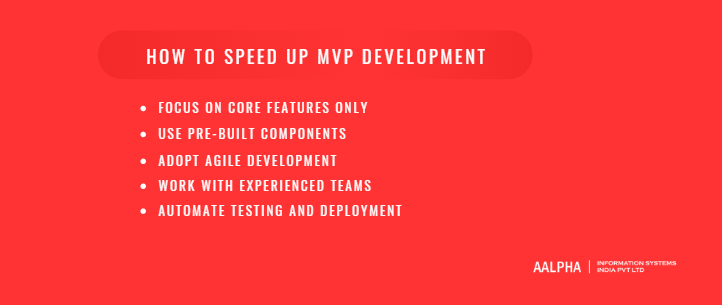
Focus on Core Features Only
The most effective way to speed up development is to limit the scope to essential features. Every additional feature increases complexity, development time, and testing effort.
An MVP should focus on solving a single core problem. For example, if the product is a delivery platform, the MVP should prioritize core flows such as placing an order, assigning a delivery partner, and completing the transaction. Features like advanced analytics, loyalty programs, or customization can be added later.
This approach not only reduces development time but also simplifies decision-making. Teams can concentrate on building and refining the most important functionality without being distracted by secondary features.
A useful guideline is to evaluate each feature based on its ability to validate the core hypothesis. If a feature does not directly contribute to that goal, it should be postponed. This disciplined focus ensures that resources are used efficiently and timelines remain realistic.
-
Use Pre-Built Components
Building everything from scratch is one of the most common causes of delays. Leveraging pre-built components, frameworks, and third-party services can significantly accelerate development.
Pre-built components are available for common functionalities such as authentication, payments, notifications, and data visualization. Instead of developing these features internally, teams can integrate reliable solutions that are already tested and widely used.
For example, using an existing authentication system eliminates the need to implement complex security protocols from scratch. Similarly, integrating a payment gateway simplifies transaction handling and compliance requirements.
This approach reduces development effort, minimizes risk, and allows teams to focus on core product logic. However, it is important to choose components that are reliable, well-documented, and scalable. Poorly selected tools can create dependencies that are difficult to manage later.
Strategic use of pre-built components strikes a balance between speed and flexibility, enabling faster delivery without compromising quality.
-
Adopt Agile Development
Agile development methodologies are designed to improve speed and adaptability. Instead of building the entire product in one phase, Agile breaks development into smaller iterations, allowing teams to deliver incremental progress.
Each iteration, or sprint, focuses on a specific set of features and includes planning, development, testing, and review. This structured approach enables teams to identify issues early, incorporate feedback, and adjust priorities as needed.
Agile also improves transparency and collaboration. Regular check-ins and progress reviews ensure that all stakeholders are aligned and aware of the project’s status. This reduces the likelihood of miscommunication and delays.
Another advantage of Agile is its ability to handle change. MVP development often involves evolving requirements based on feedback. Agile frameworks allow teams to adapt quickly without disrupting the overall timeline.
By maintaining short, focused cycles, teams can deliver consistent progress and reduce the risk of large-scale rework.
-
Work with Experienced Teams
The experience and expertise of the development team have a direct impact on speed and quality. Experienced teams are better equipped to anticipate challenges, make informed decisions, and execute efficiently.
For example, an experienced team can quickly identify the most suitable architecture, choose the right tools, and avoid common pitfalls. They are also more likely to follow best practices in coding, testing, and documentation, which reduces errors and improves maintainability.
In contrast, inexperienced teams may require more time to resolve issues, leading to delays and increased costs. They may also make decisions that need to be revisited later, further extending timelines.
Working with a skilled team ensures that development is not only faster but also more reliable. It also improves communication and coordination, which are critical for maintaining momentum.
For businesses without in-house expertise, partnering with a specialized development provider can provide access to experienced professionals and established workflows.
-
Automate Testing and Deployment
Manual processes can slow down development and increase the risk of errors. Automating testing and deployment helps streamline workflows and ensures consistent quality.
Automated testing allows teams to verify functionality quickly and repeatedly. Instead of manually testing each feature, automated tests can run continuously, identifying issues as soon as they occur. This reduces the time required for quality assurance and improves reliability.
Deployment automation simplifies the process of releasing updates. Continuous integration and continuous deployment (CI/CD) pipelines enable teams to deploy changes quickly and consistently. This reduces downtime and ensures that updates are delivered efficiently.
Automation also supports rapid iteration. As new features are developed and tested, they can be deployed without delays, allowing teams to gather feedback and make improvements faster.
While setting up automation requires an initial investment, it pays off by reducing manual effort, minimizing errors, and accelerating the overall development process.
Speeding up MVP development is not about cutting corners but about making strategic decisions that optimize efficiency. By focusing on core features, leveraging pre-built components, adopting Agile practices, working with experienced teams, and automating processes, businesses can reduce development time while maintaining high standards of quality.
How to Choose the Right MVP Development Partner
Selecting the right MVP development company is one of the most critical decisions in the product journey. The partner you choose will directly influence your product’s speed to market, quality, scalability, and long-term success. While many companies offer development services, not all are equipped to handle the unique demands of MVP development, which requires speed, strategic thinking, and adaptability.
A strong MVP partner does more than write code. They help refine ideas, prioritize features, avoid costly mistakes, and guide the product toward product-market fit. The following factors should be carefully evaluated before making a decision.
-
Technical Expertise and Experience
Technical capability is the foundation of any development partnership. An experienced team brings not only coding skills but also architectural knowledge, problem-solving ability, and familiarity with best practices.
A capable partner should be proficient in building scalable backend systems, responsive frontend interfaces, and integrating third-party services efficiently. They should also understand how to balance speed with quality, ensuring that the MVP is both functional and maintainable.
Experience with similar types of products is particularly valuable. For example, building a SaaS platform requires different expertise than developing a marketplace or a real-time logistics system. Teams that have worked on comparable projects can anticipate challenges and avoid common pitfalls.
It is also important to assess how the partner approaches decision-making. Do they recommend practical solutions, or do they default to over-engineering? A good partner focuses on building what is necessary for validation rather than adding unnecessary complexity.
-
Industry Knowledge
Industry-specific knowledge can significantly impact development efficiency and product quality. Different industries have unique requirements, user expectations, and regulatory constraints.
For example, products in healthcare or fintech must comply with strict data protection and security standards. A partner with experience in these domains will already understand compliance requirements, reducing the learning curve and preventing delays.
Similarly, understanding user behavior within a specific industry helps in designing better workflows and features. A partner familiar with eCommerce, logistics, or SaaS products can provide valuable insights into what works and what does not.
Industry knowledge also improves communication. When the development team understands the business context, they can make more informed decisions and contribute strategically rather than just executing instructions.
-
Communication and Collaboration
Effective communication is essential for maintaining momentum and avoiding misunderstandings. MVP development involves continuous iteration, which requires close collaboration between stakeholders and the development team.
A reliable partner should provide clear and consistent updates on progress, challenges, and next steps. Regular check-ins, structured reporting, and transparent workflows ensure that everyone remains aligned.
Collaboration tools and processes play an important role here. Teams should have a defined system for tracking tasks, sharing feedback, and managing changes. This reduces confusion and ensures that updates are implemented correctly.
Responsiveness is another key factor. Delays in communication can slow down decision-making and impact timelines. A partner who is proactive, accessible, and transparent helps maintain efficiency throughout the project.
Strong communication also builds trust. When teams work collaboratively, issues are resolved faster, and the overall development process becomes smoother.
-
Portfolio and Case Studies
A partner’s portfolio provides direct insight into their capabilities and experience. Reviewing past projects helps assess the quality of their work, the types of products they have built, and their ability to deliver results.
Case studies are particularly valuable because they go beyond visuals and explain the problem, approach, and outcomes. They demonstrate how the partner has handled real-world challenges and delivered solutions.
When evaluating a portfolio, it is important to look for diversity and relevance. Have they worked on products similar to yours? Do their projects show a clear understanding of user experience and functionality?
Client testimonials and success stories can also provide additional context. Positive feedback from previous clients indicates reliability and professionalism.
An experienced partner with a strong portfolio is more likely to deliver consistent results and handle unexpected challenges effectively.
-
Scalability and Long-Term Support
MVP development is only the first step in the product lifecycle. As the product evolves, it will require ongoing improvements, feature additions, and scaling.
A suitable development partner should be capable of supporting this growth. This includes maintaining the codebase, optimizing performance, and expanding functionality as needed. Choosing a partner who only focuses on short-term delivery can lead to challenges when transitioning to a full product.
Scalability also applies to the technical architecture. The partner should design systems that can handle increased traffic and complexity without requiring a complete rebuild. This ensures that the product can grow seamlessly as user demand increases.
Long-term support includes monitoring, updates, and continuous improvement. A partner who remains involved beyond the initial launch can provide continuity and ensure that the product evolves in the right direction.
For businesses looking for a reliable partner, working with experienced providers such as Aalpha Information Systems can offer a balanced approach. Such teams combine technical expertise, industry experience, and structured processes to deliver MVPs efficiently while supporting long-term growth.
Choosing the right MVP development partner requires careful evaluation of technical skills, industry knowledge, communication practices, proven experience, and long-term capabilities. The right partner does not just build your MVP; they contribute to its success by guiding decisions, improving efficiency, and enabling scalable growth.
Final Thoughts and CTA
An MVP is not about building fast alone; it is about building the right product with speed and clarity. A structured timeline, disciplined feature selection, and continuous user feedback are what turn an idea into a validated, scalable product. Most successful MVPs follow a focused path: validate early, build lean, launch quickly, and iterate based on real data.
If you are planning to build an MVP and want to reduce risk while accelerating time-to-market, connect now and consider working with an experienced team like Aalpha Information Systems to move from idea to launch efficiently and with confidence.
FAQs: MVP Development Timeline
How long does it take to build an MVP?
Most MVPs take 6 to 16 weeks depending on complexity. Simple products can be built in 4–6 weeks, while more complex or regulated solutions require 12+ weeks.
What is the fastest way to build an MVP?
The fastest approach is to focus only on core features, use pre-built components, and adopt Agile development. No-code or low-code tools can further reduce timelines for simple products.
Can an MVP be built in 2 weeks?
Yes, but only for very simple ideas using no-code tools or pre-built templates. For most business-grade MVPs, 2 weeks is not realistic if quality and scalability are considered.
What is the cost of MVP development?
Costs vary widely based on scope and complexity. A basic MVP may cost a few thousand dollars, while complex products with integrations and compliance requirements can cost significantly more.
What features should an MVP include?
An MVP should include only core features that solve the primary problem. Non-essential features should be excluded to keep development fast and focused.
How do I validate an MVP idea?
Validation can be done through user interviews, surveys, landing pages, waitlists, or pre-orders. The goal is to confirm real demand before investing in development.
Should I build an MVP in-house or outsource?
In-house development offers control, while outsourcing provides speed and access to experienced teams. Many startups choose external partners like Aalpha Information Systems for faster and more efficient execution.
What happens after MVP launch?
After launch, the focus shifts to collecting user feedback, analyzing behavior, fixing issues, and iterating on features. This stage is critical for achieving product-market fit.
Why do MVP timelines often get delayed?
Delays are usually caused by scope creep, unclear requirements, poor communication, or unexpected integration challenges rather than technical issues alone.
How do I know if my MVP is successful?
Success is measured through metrics such as user adoption, engagement, retention, and feedback. If users find value and continue using the product, the MVP is moving in the right direction.