



Financial technology, commonly known as fintech, has transformed how individuals and businesses interact with financial services. Banking, payments, lending, insurance, and investment management are increasingly delivered through digital platforms rather than traditional institutions. As financial services move online, companies must develop sophisticated software systems capable of handling transactions securely, processing large volumes of financial data, and complying with strict regulatory requirements. Building such platforms requires deep technical expertise, specialized financial knowledge, and strong cybersecurity capabilities. Because of these demands, many organizations choose to outsource fintech development to experienced external teams.
Fintech development outsourcing refers to the practice of partnering with specialized software development companies to design, build, and maintain financial technology solutions. Instead of creating large in-house engineering teams, businesses collaborate with external fintech developers who already possess experience building secure financial applications. These partnerships allow organizations to accelerate product development while accessing highly skilled engineers familiar with payment infrastructure, regulatory compliance, and financial data security.
This approach has become increasingly common among fintech startups, banks, payment providers, insurance companies, and financial institutions launching digital products. The rapid pace of innovation in financial technology requires companies to move quickly while maintaining high standards of security and reliability. Outsourcing allows organizations to focus on strategy, customer experience, and financial services innovation while experienced development partners handle the technical implementation of complex software platforms.
For startups, outsourcing can significantly reduce the time and cost required to launch a fintech product. Instead of spending months recruiting engineers and building development infrastructure, founders can collaborate with fintech development companies that already have established teams and proven processes. Large enterprises also use outsourcing to accelerate digital transformation initiatives, modernize legacy financial systems, and build new customer-facing applications.
As fintech adoption continues to grow worldwide, outsourcing has become a practical and strategic solution for organizations seeking to build secure, scalable, and innovative financial technology products. Understanding how fintech development outsourcing works, why the industry is expanding so rapidly, and what motivates businesses to adopt this approach is essential for companies planning to build digital financial services.
What is Fintech Development Outsourcing?
Fintech development outsourcing is the process of hiring an external software development partner to design, build, and maintain financial technology solutions. These solutions can include digital banking platforms, payment processing systems, mobile banking applications, digital wallets, lending platforms, trading systems, insurance technology platforms, and financial analytics tools. Instead of relying entirely on an internal development team, organizations collaborate with specialized fintech developers who bring experience in building secure financial software and integrating with banking systems, payment gateways, and financial data providers.
Financial software development requires a high level of expertise in areas such as data encryption, financial regulations, transaction processing, and secure API integrations. Outsourcing allows companies to access this specialized knowledge without the time-consuming process of building large internal teams. Fintech development companies typically provide multidisciplinary teams consisting of software engineers, security specialists, system architects, and compliance experts who work together to deliver reliable financial platforms.
It is important to distinguish between several related development models commonly used in fintech outsourcing. Outsourcing refers broadly to hiring an external company to perform software development tasks. The outsourcing provider may handle the entire project or specific components such as mobile app development, backend infrastructure, or payment integrations.
Offshore development is a specific type of outsourcing where development teams are located in another country, often in regions with strong technical talent and lower development costs. Many fintech companies outsource development to offshore teams in countries with well-established software engineering ecosystems.
Dedicated fintech development teams represent another common outsourcing model. In this approach, a development company assigns a full team of engineers exclusively to a client’s fintech product. These teams operate as an extension of the client’s organization, working closely with internal stakeholders while maintaining the flexibility and efficiency of an outsourced structure.
Through these models, fintech outsourcing enables organizations to build sophisticated financial software systems while benefiting from specialized expertise, scalable development capacity, and faster product delivery.
Why the Fintech Industry is Rapidly Growing
The fintech industry has experienced remarkable expansion over the past decade, driven by rapid digital transformation in financial services. Consumers and businesses increasingly expect financial products to be accessible through mobile applications, online platforms, and automated systems rather than traditional physical banking channels. This shift has created significant demand for innovative financial technology solutions that simplify payments, lending, investments, and financial management.
One of the major drivers of fintech growth is the global adoption of digital payments. Mobile payment platforms, contactless transactions, and peer-to-peer payment systems have become common in both developed and emerging markets. Consumers now expect to transfer money instantly, pay bills digitally, and complete transactions through mobile devices. According to data from global financial research organizations, digital payment volumes continue to increase annually as cash usage declines and mobile banking adoption rises.
Another factor accelerating fintech expansion is the emergence of neobanks, which are fully digital banks operating without physical branches. These institutions provide modern banking experiences through mobile apps, offering features such as instant account setup, automated budgeting tools, and real-time financial insights. Neobanks rely heavily on technology infrastructure and often outsource large portions of their software development to specialized fintech development companies.
The growth of blockchain technology and decentralized finance (DeFi) has also contributed to the fintech industry’s rapid evolution. Blockchain-based systems enable secure peer-to-peer transactions without traditional intermediaries, supporting new financial products such as cryptocurrency exchanges, digital asset wallets, and decentralized lending platforms. These technologies require advanced development expertise, which many organizations obtain through outsourcing partnerships.
Additionally, there is increasing demand for financial automation across industries. Businesses and individuals seek tools that automate financial tasks such as expense management, fraud detection, loan approvals, and investment analysis. Artificial intelligence and machine learning technologies are increasingly used to analyze financial data and improve decision-making processes.
Together, these trends are transforming financial services and creating a strong demand for fintech software development. As organizations compete to deliver innovative digital financial products, outsourcing has become an effective way to access the specialized engineering capabilities required to build modern fintech platforms.
Why Businesses Outsource Fintech Development
Developing financial technology platforms requires extensive technical expertise, strict security standards, and deep knowledge of financial regulations. Many organizations find that outsourcing fintech development provides a strategic advantage when building digital financial products. By partnering with specialized fintech development companies, businesses can accelerate innovation while maintaining high levels of reliability and security.
One of the most important reasons companies outsource fintech development is faster product development. Financial markets evolve rapidly, and organizations must launch new digital services quickly to remain competitive. Outsourcing allows companies to access experienced development teams immediately rather than spending months recruiting engineers and building internal development infrastructure. Experienced fintech development teams already have established workflows, technical frameworks, and development tools that significantly reduce product development timelines.
Another key motivation is access to fintech specialists. Financial technology development requires expertise in areas such as payment processing, banking APIs, encryption technologies, fraud detection systems, and regulatory compliance. Many outsourcing providers employ engineers who specialize specifically in financial software development. This expertise helps ensure that fintech platforms are built according to industry standards and regulatory requirements.
Cost efficiency is also a major factor. Building an in-house fintech engineering team can be expensive due to high salaries, recruitment costs, and infrastructure requirements. Outsourcing allows companies to access highly skilled development teams while managing operational costs more effectively. Many organizations choose outsourcing partners located in regions with strong engineering talent but lower operational costs, allowing them to maintain development quality while optimizing budgets.
Finally, outsourcing enables businesses to focus on core business operations. Financial institutions and fintech startups often prefer to concentrate on product strategy, customer experience, and financial services innovation rather than managing large technical teams. By delegating software development to experienced fintech development companies, organizations can allocate internal resources to areas that directly drive business growth.
As digital financial services continue to expand globally, fintech development outsourcing has become a strategic approach for organizations seeking to build secure, scalable, and innovative financial technology products efficiently.
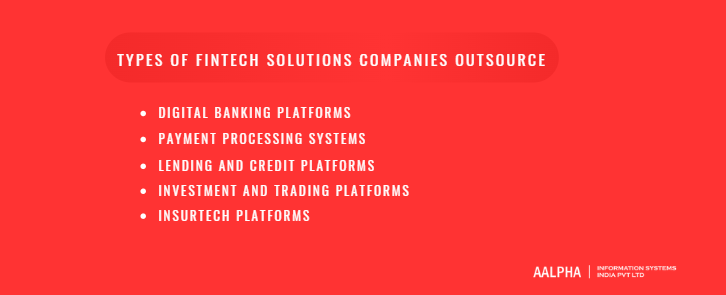
Types of Fintech Solutions Companies Outsource
Financial technology products are complex software systems that require secure infrastructure, regulatory compliance, and reliable financial data processing. Because of these technical and operational demands, many financial institutions and fintech startups outsource the development of their platforms to specialized fintech development companies. Outsourcing allows organizations to build sophisticated financial systems using experienced teams that understand banking integrations, payment processing infrastructure, financial data security, and regulatory requirements.
Different segments of the financial industry rely on different types of fintech platforms. Banks may require digital banking systems, payment providers need transaction processing infrastructure, lenders rely on loan management platforms, and investment companies build trading systems and portfolio management applications. Insurance companies also depend on digital platforms that automate policy management and claims processing. Each of these solutions requires specialized engineering knowledge, which is why outsourcing fintech development has become a widely adopted strategy.
Organizations typically outsource the development of fintech platforms that involve complex integrations with financial institutions, high transaction volumes, advanced data analytics, and strict compliance requirements. By partnering with experienced fintech development companies, businesses can build secure financial products while reducing development risk and accelerating time to market. The following sections explain the most common types of fintech solutions that organizations outsource.
-
Digital Banking Platforms
Digital banking platforms are among the most commonly outsourced fintech solutions. These platforms enable banks and financial institutions to provide online and mobile banking services to customers without requiring physical branch visits. As consumers increasingly prefer managing finances through digital channels, banks must develop reliable digital banking systems capable of handling large volumes of transactions while maintaining strong security standards.
A typical digital banking platform includes several core features designed to provide customers with convenient access to financial services. Online banking functionality allows users to access their accounts through web or mobile applications, view balances, review transaction history, and manage financial activities in real time. These systems must operate with high availability and strong encryption protocols to protect sensitive financial data.
Another important component is account management functionality. Digital banking platforms allow customers to open accounts, update personal information, manage cards, and configure account preferences through digital interfaces. These features require integration with core banking systems that store customer financial records.
Fund transfer capabilities are also essential. Digital banking platforms enable users to transfer money between accounts, send payments to other individuals, and conduct domestic or international transactions. These transfers often rely on integration with payment networks, banking APIs, and real-time settlement systems.
Modern digital banking solutions also include digital onboarding processes, which allow customers to open accounts remotely without visiting a bank branch. Digital onboarding systems typically include identity verification tools, document uploads, biometric authentication, and automated compliance checks. Because these systems must meet strict financial regulations, many banks outsource their development to fintech companies experienced in secure digital identity verification and regulatory compliance.
-
Payment Processing Systems
Payment processing systems form the backbone of digital financial transactions. Businesses across industries rely on payment infrastructure that can securely process transactions through multiple payment channels, including credit cards, debit cards, mobile wallets, and digital payment networks. Developing reliable payment processing systems requires expertise in financial transaction protocols, fraud prevention technologies, and secure data transmission.
Payment gateways are a key component of modern payment infrastructure. A payment gateway acts as an intermediary between merchants, customers, and financial institutions during online transactions. It securely collects payment information from customers and transmits the data to payment processors and banks for authorization. Payment gateways must comply with strict security standards and support multiple payment methods, which makes their development technically complex.
Another important component of payment infrastructure is card payment processing systems. These systems handle transactions made through credit cards and debit cards. Card processing platforms must integrate with global payment networks, support real-time transaction authorization, and ensure secure communication between merchants and issuing banks. These systems also require advanced fraud detection mechanisms to prevent unauthorized transactions.
The rise of mobile wallets has further increased demand for advanced payment platforms. Mobile wallets allow users to store payment credentials digitally and make transactions through smartphones or wearable devices. These systems require secure tokenization technology that replaces sensitive card information with encrypted digital tokens to protect financial data.
In addition, many fintech companies outsource the development of peer-to-peer payment systems, which allow individuals to send money directly to one another using mobile applications. Peer-to-peer platforms require real-time payment infrastructure, user authentication systems, and integration with banking networks to facilitate instant transfers. Because payment processing systems operate under strict security and regulatory requirements, many organizations rely on specialized fintech development partners to build and maintain these platforms.
-
Lending and Credit Platforms
Digital lending platforms have transformed the way individuals and businesses access credit. Traditional lending processes often involve lengthy paperwork and manual approval procedures. Fintech lending platforms automate these processes using data analytics, machine learning, and digital workflows. Many financial institutions and fintech startups outsource the development of lending platforms to experienced fintech developers who understand financial risk management and regulatory requirements.
One of the most important components of digital lending infrastructure is the loan management system. Loan management platforms allow financial institutions to manage the entire lifecycle of a loan, from application and approval to repayment and loan closure. These systems track borrower information, calculate interest rates, manage payment schedules, and monitor loan performance. They also integrate with financial databases and payment systems to automate loan disbursement and repayment processing.
Another critical element of modern lending platforms is credit scoring technology. Credit scoring platforms analyze financial data to evaluate a borrower’s creditworthiness. These systems often use machine learning models to analyze multiple variables such as income history, transaction behavior, and credit history. Automated credit scoring helps lenders make faster and more accurate lending decisions.
Many fintech companies also develop buy now pay later (BNPL) systems, which allow consumers to purchase products and pay for them in installments over time. BNPL platforms require sophisticated risk assessment systems, payment scheduling infrastructure, and integration with merchants and payment processors. Because lending systems must comply with financial regulations and handle sensitive financial data, organizations often outsource their development to fintech development companies with experience in building compliant lending platforms.
-
Investment and Trading Platforms
Investment and trading platforms enable individuals and institutions to buy and sell financial assets through digital interfaces. These platforms must provide reliable access to financial markets, real-time data processing, and secure transaction execution. Due to the technical complexity of financial market integrations, many organizations outsource the development of investment and trading systems.
One of the most common types of fintech trading software is stock trading platforms. These applications allow users to buy and sell equities through online interfaces or mobile apps. Trading systems must connect with financial exchanges and brokerage networks to execute orders in real time. They also require advanced infrastructure capable of handling large volumes of transactions while maintaining low latency.
Another rapidly growing area within fintech investment platforms is robo advisory services. Robo advisors are automated investment platforms that use algorithms to manage investment portfolios based on user preferences and risk tolerance. These systems analyze market data and automatically allocate assets across different investment categories. Robo advisory platforms require sophisticated data analytics engines and machine learning algorithms to optimize portfolio management.
The expansion of digital assets has also increased demand for cryptocurrency trading platforms. Cryptocurrency exchanges allow users to trade digital currencies such as Bitcoin and Ethereum. These platforms require secure wallet infrastructure, blockchain integrations, transaction verification systems, and strong cybersecurity protections. Because investment platforms involve complex integrations with financial markets and digital asset networks, outsourcing fintech development helps organizations build reliable trading systems efficiently.
-
Insurtech Platforms
Insurance technology, often referred to as insurtech, uses digital platforms to modernize insurance services and improve operational efficiency. Traditional insurance processes often involve manual paperwork, slow claims processing, and complex policy management systems. Insurtech platforms automate these processes using digital workflows and data analytics.
One of the most important insurtech solutions is the policy management platform. Policy management systems allow insurance companies to create, manage, and update insurance policies digitally. These systems track customer policy details, premium payments, and coverage information. Policy management platforms also integrate with underwriting systems and customer relationship management tools to streamline insurance operations.
Another important insurtech solution is claims automation systems. Claims processing platforms automate the evaluation and settlement of insurance claims. These systems use digital document processing, data verification tools, and automated workflows to reduce the time required to approve and process claims. Advanced insurtech platforms also use artificial intelligence to detect fraudulent claims and improve claims assessment accuracy.
Insurance companies also outsource the development of insurance marketplaces, which allow customers to compare insurance products from multiple providers through a single platform. Insurance marketplaces enable consumers to evaluate coverage options, obtain quotes, and purchase policies online. These platforms require integrations with multiple insurance providers, pricing engines, and digital payment systems.
By outsourcing insurtech development to specialized fintech development companies, insurance providers can modernize their operations, improve customer experiences, and deploy scalable digital insurance platforms capable of supporting modern financial services.
Benefits of Outsourcing Fintech Development
Building financial technology platforms requires more than standard software engineering capabilities. Fintech systems must handle financial transactions reliably, protect sensitive financial data, comply with complex regulations, and integrate with banking infrastructure and payment networks. Developing such platforms internally can be challenging for many organizations because it requires highly specialized technical expertise, extensive security infrastructure, and experienced engineering teams.
For this reason, outsourcing fintech development has become a strategic approach adopted by fintech startups, banks, payment providers, and financial institutions. By partnering with experienced fintech development companies, organizations can accelerate innovation while maintaining strong security and compliance standards. Outsourcing also allows companies to access specialized expertise, reduce operational complexity, and scale development efforts more efficiently.
Financial technology markets are highly competitive and evolve rapidly as new digital financial products emerge. Companies that are able to build reliable platforms quickly while maintaining high levels of security and performance often gain a competitive advantage. Outsourcing enables organizations to access teams that already understand financial systems, allowing them to develop fintech solutions more efficiently than building everything internally.
The benefits of outsourcing fintech development extend beyond simple cost savings. It also enables businesses to access specialized fintech knowledge, reduce time to market, scale development capacity when needed, and implement advanced financial technologies. Understanding these advantages helps organizations determine whether outsourcing is the right approach for building their fintech platforms.
-
Access to Fintech Development Expertise
Financial technology development requires a unique combination of technical and regulatory expertise that is not always readily available within a typical software engineering team. Fintech platforms must operate within strict financial regulations, support complex financial transactions, and maintain extremely high standards of security and reliability. These requirements make fintech software development significantly more specialized than many other types of software projects.
One of the most significant advantages of outsourcing fintech development is access to teams with deep expertise in financial technology systems. Fintech development companies typically employ engineers and architects who specialize in financial software architecture, payment infrastructure, and secure transaction processing. These professionals understand how financial systems operate and how to design platforms that can process financial data accurately and securely.
A major area of expertise required in fintech development involves financial regulations and compliance frameworks. Financial institutions must comply with regulatory requirements such as know-your-customer procedures, anti-money laundering regulations, and financial data protection laws. Developers working on fintech platforms must design systems that support these regulatory processes while maintaining a seamless user experience.
Another important area of expertise involves payment infrastructure and banking integrations. Fintech applications often connect with banks, payment gateways, and financial data providers through APIs and financial networks. Building these integrations requires knowledge of transaction protocols, financial messaging standards, and real-time payment systems.
Equally critical is security architecture. Fintech systems store and process highly sensitive financial data, making them attractive targets for cyberattacks. Developers must implement encryption mechanisms, multi-factor authentication, fraud detection systems, and secure data storage infrastructure. Outsourcing fintech development allows organizations to work with teams that have experience designing secure financial platforms capable of protecting sensitive customer data.
-
Faster Time to Market
Speed is a critical factor in the fintech industry. Financial technology markets evolve rapidly as new digital payment systems, lending platforms, investment tools, and financial services continue to emerge. Companies that launch innovative products quickly often gain a competitive advantage by capturing market share before competitors introduce similar solutions. Outsourcing fintech development enables organizations to accelerate product development timelines and bring new financial products to market more quickly.
One reason outsourcing accelerates development is that experienced fintech development teams already have established development processes in place. These teams typically follow structured workflows for requirements analysis, system architecture design, development, testing, and deployment. Because these processes have been refined through previous fintech projects, outsourcing partners can move efficiently through the product development lifecycle.
Another factor that improves development speed is the availability of reusable technical frameworks and infrastructure components. Fintech development companies often maintain libraries of reusable modules for features such as authentication systems, payment integrations, transaction processing engines, and compliance workflows. Using these existing frameworks allows development teams to avoid building common features from scratch, significantly reducing development time.
Additionally, outsourcing provides access to experienced engineers who understand financial systems. Engineers who have previously worked on fintech platforms can quickly identify technical challenges, design efficient system architectures, and implement reliable financial workflows. Their experience helps prevent development delays caused by architectural mistakes or inefficient coding practices.
In highly competitive fintech markets, launching a product even a few months earlier can have a substantial impact on customer adoption and market positioning. Outsourcing fintech development enables companies to move faster while maintaining the high standards required for financial software.
-
Cost Efficiency
Developing fintech platforms internally can be expensive, particularly for organizations that need to build large engineering teams and invest in specialized infrastructure. Recruiting experienced fintech developers often requires significant financial resources, as engineers with expertise in financial systems, security architecture, and regulatory compliance are in high demand. Outsourcing fintech development offers a more cost-efficient alternative for many organizations.
When building an in-house fintech development team, companies must invest in recruitment, salaries, employee benefits, office infrastructure, and development tools. In addition to these costs, organizations must also allocate resources to project management, security infrastructure, testing environments, and continuous system maintenance. These expenses can significantly increase the total cost of developing and maintaining financial software platforms.
Outsourcing allows companies to access highly skilled fintech development teams without the overhead associated with building an internal team. Development companies already have experienced engineers, established development environments, and specialized infrastructure required for building financial platforms. By leveraging these existing resources, businesses can significantly reduce operational costs while maintaining development quality.
Another cost advantage comes from outsourcing to regions with strong technical talent but lower operational costs. Many fintech companies collaborate with development partners located in countries with mature software engineering ecosystems where development services are more cost-effective than hiring locally.
Cost efficiency does not simply mean reducing expenses. It also involves improving resource allocation. By outsourcing fintech development, organizations can focus internal resources on business strategy, financial product design, and customer acquisition while experienced development teams handle the technical aspects of building the platform.
-
Scalability and Flexibility
Fintech product development often involves fluctuating resource requirements. During certain phases of development, such as building core platform infrastructure or launching new features, companies may require large engineering teams. During other periods, fewer developers may be needed once the product reaches stability. Outsourcing fintech development provides flexibility that allows organizations to scale development capacity based on project requirements.
Outsourcing partners can quickly expand development teams when additional engineers are required for new features, integrations, or product expansions. Conversely, organizations can reduce development capacity once major milestones have been completed. This flexibility allows companies to manage development resources more efficiently without maintaining a large permanent engineering team.
This scalability is particularly valuable for fintech startups that are still validating their products and business models. Startups can begin with a small development team during the early stages of product development and expand the team as the platform gains traction and new features are required.
Flexibility also allows companies to bring in specialized experts when needed. For example, organizations may require blockchain engineers, cybersecurity specialists, or financial data analysts for specific phases of development. Outsourcing partners often provide access to these specialists without requiring long-term hiring commitments.
-
Access to Advanced Technologies
The fintech industry is driven by continuous technological innovation. Emerging technologies such as artificial intelligence, blockchain systems, and large-scale financial data analytics are transforming how financial services operate. Implementing these technologies effectively requires specialized expertise that many organizations may not possess internally. Outsourcing fintech development enables businesses to access teams that are already experienced in working with advanced financial technologies.
One of the most important technologies shaping fintech innovation is artificial intelligence in finance. AI-powered systems are widely used for fraud detection, credit scoring, customer support automation, and financial risk analysis. Machine learning models can analyze large datasets to identify patterns that help financial institutions make better lending decisions or detect suspicious transaction behavior.
Another important technology is blockchain development, which enables decentralized financial applications and secure digital asset transactions. Blockchain systems are used in cryptocurrency exchanges, digital wallets, cross-border payments, and decentralized finance platforms. Building blockchain-based financial systems requires expertise in distributed ledger technologies and cryptographic protocols.
Fintech development companies also bring experience in big data analytics, which allows financial organizations to analyze massive volumes of transaction data to gain insights into customer behavior, financial risk, and market trends. Data-driven decision-making has become a critical capability for modern financial institutions.
Finally, outsourcing partners often provide expertise in cybersecurity systems, which are essential for protecting financial platforms from fraud, hacking attempts, and data breaches. Advanced security technologies such as behavioral authentication, biometric verification, and AI-powered fraud detection help ensure that fintech platforms remain secure in an increasingly complex threat environment.
Access to these advanced technologies enables organizations to build innovative fintech solutions while maintaining high levels of security, performance, and regulatory compliance.
Fintech Development Outsourcing Models
Organizations that outsource fintech software development can choose from several engagement models depending on their technical needs, project scope, and long-term product strategy. Each outsourcing model provides a different structure for collaboration between the client and the development team. Selecting the right model is an important strategic decision because it affects development speed, communication efficiency, cost structure, and long-term product scalability.
Fintech platforms often require continuous development, regulatory updates, and infrastructure improvements. For this reason, companies must choose an outsourcing model that aligns with their product lifecycle and operational goals. Some organizations require full development teams working long term on complex financial platforms, while others only need short-term support for specific projects such as payment integrations or compliance modules.
The most common fintech outsourcing models include offshore development, nearshore development, dedicated development teams, and project-based outsourcing. Each model offers unique advantages depending on the organization’s geographic location, technical requirements, and collaboration preferences. Understanding how these models work helps financial institutions and fintech startups choose the most effective outsourcing approach for their product development initiatives.
-
Offshore Development Model
The offshore development model involves outsourcing fintech software development to teams located in another country, often in regions with well-established technology industries and large pools of skilled software engineers. Many companies adopt offshore outsourcing to access highly qualified developers while reducing operational costs compared to hiring engineers locally.
One of the primary advantages of offshore development is cost efficiency. Software development costs vary significantly across different regions of the world. Companies located in North America or Western Europe often face high engineering salaries and operational expenses. By outsourcing fintech development to offshore teams in countries with strong technical talent and lower development costs, organizations can significantly reduce their development budgets while maintaining high-quality engineering standards.
Another important benefit of offshore outsourcing is access to large global talent pools. Certain regions have built strong reputations for producing highly skilled software engineers with expertise in financial technology development, cybersecurity, blockchain systems, and payment infrastructure. Offshore development allows companies to tap into these global talent markets rather than being limited to the talent available in their local region.
Offshore teams often operate as fully integrated development partners that collaborate with internal stakeholders through digital communication tools, project management platforms, and scheduled meetings. Although teams may be located in different time zones, many offshore development companies have established workflows designed to ensure smooth collaboration and efficient communication with international clients.
Because fintech systems require strong security and compliance standards, many offshore development companies specialize specifically in financial technology projects and maintain dedicated teams experienced in building secure financial platforms.
-
Nearshore Development Model
The nearshore development model involves outsourcing fintech software development to teams located in nearby countries, typically within the same geographic region or within similar time zones. Many companies choose nearshore outsourcing when they want to benefit from outsourcing while maintaining close collaboration with their development teams.
One of the main advantages of nearshore outsourcing is easier collaboration. When development teams operate in similar time zones, communication between stakeholders and developers becomes more efficient. Meetings can be scheduled during normal working hours for both parties, allowing for real-time discussions, faster decision-making, and quicker resolution of technical challenges.
Another benefit is the reduction of communication barriers. Nearshore development teams often share similar cultural and business practices with the client’s organization, which can improve collaboration and reduce misunderstandings. Language compatibility is also typically stronger in nearshore arrangements, which helps streamline project discussions and documentation processes.
Nearshore development also allows companies to maintain closer oversight of fintech development projects. In some cases, companies may conduct occasional in-person meetings or workshops with their development partners due to the shorter geographic distance. This level of interaction can help strengthen collaboration and improve alignment between business goals and technical implementation.
For financial institutions that prioritize close communication and regulatory alignment, nearshore outsourcing provides a balance between cost efficiency and strong collaborative relationships. Many organizations choose nearshore models when building fintech platforms that require frequent stakeholder involvement and iterative development cycles.
-
Dedicated Development Team Model
The dedicated development team model is one of the most widely used outsourcing approaches for fintech product development. In this model, a development company assigns a team of engineers, designers, and technical specialists who work exclusively on a client’s fintech platform. This team operates as an extension of the client’s internal organization while remaining employed and managed by the outsourcing provider.
Dedicated development teams are particularly valuable for long-term fintech product development. Financial platforms often require continuous updates, security improvements, feature expansions, and regulatory adjustments. A dedicated team provides consistent engineering resources that can support the product throughout its lifecycle.
In this model, the client typically defines the product roadmap, business requirements, and development priorities, while the outsourcing partner provides the technical team responsible for implementing the platform. The team may include software engineers, system architects, user interface designers, quality assurance specialists, and security experts. These professionals collaborate closely with the client’s product managers and stakeholders.
Another advantage of the dedicated team model is deep product familiarity. Because the same engineers remain involved in the project over time, they develop a strong understanding of the platform’s architecture, infrastructure, and business logic. This familiarity allows the team to make improvements more efficiently and maintain system stability.
Dedicated development teams are often structured using agile development methodologies, allowing companies to release new fintech features regularly while continuously improving system performance and security.
-
Project-Based Outsourcing
Project-based outsourcing is a model where a company hires an external development partner to complete a specific fintech project with a clearly defined scope, timeline, and deliverables. Unlike the dedicated team model, project-based outsourcing focuses on completing a particular development task rather than maintaining a long-term engineering partnership.
This approach is commonly used when organizations need support for fixed-scope fintech projects. For example, a fintech startup may outsource the development of its initial minimum viable product (MVP) to test a new financial service concept before investing in a full-scale platform. In this scenario, the outsourcing partner builds the MVP based on defined product requirements, after which the company may decide whether to continue development internally or expand the platform further.
Project-based outsourcing is also frequently used for payment integrations. Companies that want to add new payment capabilities to existing platforms may outsource the integration of payment gateways, card processing systems, or digital wallet infrastructure to fintech developers with experience in financial transaction systems.
Another common use case involves compliance and regulatory modules. Financial institutions sometimes outsource the development of compliance features such as identity verification systems, anti-money laundering monitoring tools, or transaction reporting modules. These systems require specialized expertise in financial regulations and secure data processing.
Project-based outsourcing allows companies to complete specific fintech development initiatives efficiently without committing to long-term development partnerships. This model works well for clearly defined technical projects that require specialized expertise but do not involve ongoing platform development.
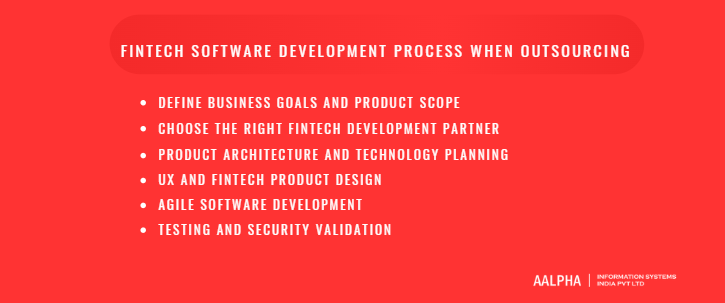
Fintech Software Development Process When Outsourcing
Outsourcing fintech software development involves more than simply hiring an external engineering team. Financial technology platforms require careful planning, strong security architecture, regulatory compliance, and reliable infrastructure capable of handling financial transactions. Because fintech products operate in highly regulated environments and manage sensitive financial data, the development process must follow a structured framework that minimizes risks while ensuring product scalability and security.
Organizations that outsource fintech development typically follow a multi-stage development process that begins with defining business goals and selecting the right development partner. From there, teams work through system architecture design, user experience planning, iterative development, and comprehensive security testing. Each stage plays a critical role in ensuring that the final fintech platform meets both technical and regulatory requirements.
Unlike many other types of software products, fintech systems must integrate with banking networks, payment processors, financial data providers, and regulatory systems. These integrations require specialized technical planning and careful coordination between development teams and financial service providers. A well-structured development process helps ensure that these integrations function reliably while maintaining strong security protections.
The following step-by-step framework outlines how fintech companies typically outsource software development and collaborate with external development teams to build secure and scalable financial platforms.
-
Define Business Goals and Product Scope
The first step in outsourcing fintech software development is clearly defining the business goals and product scope. Before engaging a development partner, organizations must determine what financial problem the product aims to solve and how the platform will deliver value to users. A well-defined product vision ensures that both the client and the development team have a clear understanding of the platform’s objectives.
One important aspect of this stage is defining product objectives. These objectives may include launching a digital payment platform, building a lending system, developing a mobile banking application, or creating an investment management platform. Each objective influences the platform’s technical architecture, required integrations, and compliance requirements.
Another critical step is identifying the target users of the fintech product. The platform may serve individual consumers, small businesses, financial institutions, or investors. Understanding the target audience helps determine key product features, user experience requirements, and security measures needed to protect user data.
Organizations must also determine the core fintech features that will form the foundation of the platform. These features might include digital account management, payment processing, loan application workflows, investment portfolio tracking, or automated financial analytics. Defining these features early in the development process helps create a structured roadmap for the product.
Clear product scope documentation helps outsourcing partners estimate development timelines, identify required technologies, and allocate the appropriate development resources. It also ensures that the development process remains focused on delivering the most important features first.
-
Choose the Right Fintech Development Partner
Selecting the right fintech development partner is one of the most important decisions in the outsourcing process. Because fintech platforms handle financial transactions and sensitive customer data, organizations must work with development companies that have proven experience in building secure financial systems.
One of the first evaluation criteria is industry experience. Companies should review the outsourcing partner’s previous fintech projects, case studies, and portfolio to determine whether they have successfully built financial platforms such as payment systems, digital banking applications, or lending platforms. Experience with financial software development demonstrates that the team understands the technical and regulatory challenges associated with fintech products.
Another important factor is regulatory and compliance knowledge. Financial platforms must comply with numerous regulatory frameworks related to identity verification, anti-money laundering requirements, payment security standards, and data protection regulations. Development partners should have experience designing systems that support regulatory compliance and financial reporting requirements.
Organizations should also evaluate the development company’s technology expertise. Fintech platforms rely on complex technical infrastructure that may include cloud computing systems, payment APIs, financial data integrations, blockchain technologies, and artificial intelligence models for fraud detection or risk analysis. The development partner should demonstrate expertise in these technologies and provide clear explanations of how they will design the system architecture.
In addition to technical capabilities, companies should also assess the vendor’s communication practices, project management methodologies, and long-term support capabilities. A strong fintech development partner will provide transparent communication, structured development workflows, and ongoing technical support after the product is launched.
-
Product Architecture and Technology Planning
Once a development partner has been selected, the next stage involves designing the product’s technical architecture and technology infrastructure. Fintech platforms must be built with reliability, scalability, and security in mind because they often process large volumes of financial transactions and sensitive customer information.
The development team begins by designing the system architecture, which defines how different components of the fintech platform interact with each other. The architecture may include backend transaction processing systems, user authentication services, financial data storage infrastructure, and integrations with banking networks or payment gateways. A well-designed architecture ensures that the platform can handle increasing transaction volumes as the business grows.
Another critical aspect of fintech architecture planning involves API integrations. Many fintech platforms rely on application programming interfaces to connect with banks, payment processors, credit bureaus, and financial data providers. These integrations enable features such as account verification, payment processing, financial data aggregation, and credit risk assessment.
Development teams must also plan the cloud infrastructure that will host the fintech platform. Cloud environments allow fintech systems to scale dynamically based on user demand and transaction volumes. Cloud infrastructure also provides redundancy and disaster recovery capabilities that help ensure system reliability.
Equally important is designing the security framework for the platform. Fintech systems must implement encryption protocols, multi-factor authentication systems, secure data storage mechanisms, and fraud detection tools. Security architecture must be integrated into the platform from the earliest stages of development to protect financial transactions and customer information.
-
UX and Fintech Product Design
User experience design plays a crucial role in the success of fintech platforms. Financial services can involve complex processes such as transferring funds, applying for loans, managing investments, or verifying identity information. A well-designed user interface simplifies these processes and helps users complete financial tasks quickly and confidently.
Fintech UX design focuses on creating clear, intuitive interfaces that guide users through financial workflows. For example, digital banking applications must present account information, transaction history, and payment options in a way that is easy to understand and navigate. Similarly, lending platforms must provide straightforward application processes that allow users to submit financial information and receive loan decisions efficiently.
Another important aspect of fintech UX design is trust and transparency. Because financial applications involve sensitive data and financial transactions, users must feel confident that the platform is secure and reliable. Designers often incorporate visual cues such as security indicators, transaction confirmations, and clear financial summaries to build trust.
Good fintech design also emphasizes accessibility and mobile optimization. Many users access financial services through mobile devices, so interfaces must be responsive and optimized for smaller screens while maintaining usability and security.
-
Agile Software Development
Fintech platforms are typically developed using agile development methodologies, which allow teams to build and improve products through iterative development cycles. Instead of developing the entire platform in a single long development phase, agile development divides the process into smaller iterations called sprints.
During each sprint, the development team focuses on building specific product features such as user authentication systems, payment processing modules, or transaction monitoring tools. At the end of each development cycle, the team reviews progress with stakeholders, gathers feedback, and prioritizes the next set of features to develop.
This iterative approach provides several advantages in fintech development. It allows companies to test new features quickly, identify technical challenges early, and adjust product strategies based on user feedback or regulatory changes. Agile development also helps ensure that security and compliance features are integrated throughout the development process rather than added later.
Agile methodologies also promote strong collaboration between development teams and business stakeholders. Product managers, designers, and engineers work closely together to ensure that the platform evolves in alignment with business goals and regulatory requirements.
-
Testing and Security Validation
Testing and security validation are critical steps in fintech software development. Financial platforms must operate with extremely high reliability because errors or vulnerabilities can lead to financial losses, regulatory violations, or security breaches. As a result, fintech systems undergo extensive testing before they are deployed.
One important aspect of testing involves security testing, which ensures that the platform can protect sensitive financial data from unauthorized access. Security testing evaluates encryption mechanisms, authentication systems, and data storage practices to identify potential vulnerabilities.
Another essential testing method is penetration testing, where cybersecurity specialists simulate attacks on the platform to identify weaknesses in the system’s defenses. These tests help ensure that the platform can withstand real-world cyber threats.
Fintech platforms must also undergo compliance validation to ensure that they meet financial regulatory requirements. Compliance testing verifies that the system supports processes such as identity verification, transaction monitoring, and financial reporting according to regulatory guidelines.
Through comprehensive testing and security validation, fintech companies can ensure that their platforms operate securely, reliably, and in compliance with financial regulations before launching them to customers.
Security and Compliance in Fintech Development Outsourcing
Security and regulatory compliance are among the most critical considerations when outsourcing fintech software development. Financial technology platforms handle highly sensitive information, including personal financial data, payment credentials, transaction histories, and identity verification records. Because of the value of this data, fintech systems are frequent targets for cyberattacks, fraud attempts, and data breaches. At the same time, financial institutions must comply with strict regulatory frameworks designed to protect consumers and maintain the integrity of financial systems.
When companies outsource fintech development, they must ensure that their development partners follow strong security practices and understand financial regulations. Security and compliance requirements influence nearly every aspect of fintech system design, from data storage architecture to transaction processing workflows and identity verification mechanisms. A fintech development partner must design platforms that not only function reliably but also meet regulatory standards across multiple jurisdictions.
Regulatory compliance is particularly important because financial services operate under strict government oversight. Financial regulators impose rules related to data protection, payment processing, fraud prevention, and financial reporting. Failure to comply with these regulations can lead to severe financial penalties and reputational damage. As a result, fintech platforms must be built with compliance mechanisms integrated into the system architecture from the beginning.
Outsourcing fintech development does not reduce the responsibility of the organization to maintain regulatory compliance. Instead, companies must work closely with development partners to ensure that security standards and compliance requirements are embedded throughout the development lifecycle. This includes implementing strong data protection measures, adhering to global payment security standards, supporting regulatory identity verification processes, and ensuring secure integrations with financial institutions.
The following sections explain the most important security and compliance considerations when outsourcing fintech development.
-
Financial Data Security
Financial data security is the foundation of every fintech platform. Digital financial services involve the transmission and storage of sensitive information such as customer identities, bank account details, payment credentials, and transaction histories. Protecting this data is essential not only for maintaining user trust but also for complying with financial regulations.
One of the most important aspects of financial data security is protecting customer data. Fintech applications store personal information such as names, addresses, identification documents, and financial records. This information must be encrypted both during transmission and while stored in databases. Encryption technologies ensure that even if unauthorized parties access the data, it cannot be interpreted without the appropriate decryption keys.
Another critical component of financial security involves protecting financial transactions. Transaction processing systems must verify the authenticity of each transaction and ensure that funds are transferred accurately between accounts. Security mechanisms such as transaction authentication, fraud detection systems, and anomaly monitoring help prevent unauthorized financial activities.
Fintech systems must also safeguard payment credentials, including credit card numbers, bank account details, and digital wallet tokens. These credentials are highly sensitive and must be handled using secure storage practices and tokenization techniques that replace actual payment data with encrypted tokens.
When outsourcing fintech development, organizations must ensure that development teams implement strong security architectures that include encryption protocols, secure access controls, multi-factor authentication systems, and continuous monitoring tools to detect suspicious activity.
-
PCI DSS Compliance
Payment Card Industry Data Security Standard (PCI DSS) is one of the most important security frameworks for fintech platforms that process card payments. PCI DSS is a global standard designed to protect credit card and debit card information during payment transactions. Any organization that stores, processes, or transmits cardholder data must comply with PCI DSS requirements.
The PCI DSS framework defines a set of security practices that ensure payment information is handled securely. These practices include encrypting cardholder data, restricting access to sensitive information, implementing strong authentication mechanisms, and maintaining secure network environments. Payment systems must also undergo regular security testing and vulnerability assessments to identify potential risks.
Fintech development partners working on payment processing systems must design infrastructure that supports PCI DSS compliance. This often involves implementing secure payment gateways, tokenization systems that replace card numbers with encrypted tokens, and monitoring systems that detect unauthorized access attempts. Compliance with PCI DSS is essential for maintaining trust in digital payment platforms and protecting consumers from payment fraud.
-
GDPR and Data Privacy Regulations
Data privacy regulations play a significant role in fintech development because financial platforms handle large volumes of personal information. One of the most influential global data protection frameworks is the General Data Protection Regulation (GDPR), which governs how organizations collect, process, and store personal data of individuals within the European Union.
GDPR establishes strict requirements for how personal data must be managed. Fintech companies must ensure that users understand how their data is being used and must obtain clear consent before collecting personal information. Organizations must also provide mechanisms that allow users to access their personal data, request corrections, or request deletion of their data.
Outsourcing fintech development requires careful coordination to ensure that development teams follow data privacy requirements when designing system architecture. This includes implementing data protection measures such as encryption, anonymization techniques, and access control policies that limit who can view sensitive information.
In addition to GDPR, many countries have introduced their own data privacy regulations. Fintech development partners must understand how these laws apply to financial platforms and ensure that systems are designed to support data protection obligations across different jurisdictions.
-
KYC and AML Compliance
Financial institutions are required to implement identity verification and transaction monitoring systems to prevent financial crimes such as fraud, money laundering, and terrorist financing. Two of the most important regulatory frameworks supporting these efforts are Know Your Customer (KYC) and Anti-Money Laundering (AML) compliance requirements.
KYC regulations require financial institutions to verify the identity of customers before providing financial services. Fintech platforms must include digital identity verification systems that collect and validate user identification documents, confirm personal information, and assess potential risk factors. These systems often use technologies such as biometric verification, document scanning, and automated identity matching to verify customer identities.
AML compliance focuses on detecting and preventing suspicious financial activities. Fintech platforms must monitor transactions to identify unusual patterns that could indicate money laundering or financial fraud. Automated monitoring systems analyze transaction data in real time and flag suspicious activities for further investigation.
Outsourced fintech development teams must design systems that support KYC and AML compliance processes. This includes integrating identity verification services, implementing transaction monitoring algorithms, and maintaining secure audit trails that record financial activities for regulatory review.
-
Secure API Integrations
Modern fintech platforms rely heavily on application programming interfaces (APIs) to connect with external financial systems. APIs enable fintech applications to interact with banks, payment processors, financial data providers, and regulatory services. While APIs enable powerful integrations, they also introduce security challenges that must be carefully managed.
When fintech systems connect with banks, APIs allow applications to retrieve account information, initiate payments, and verify financial data. These integrations must be secured using authentication mechanisms that ensure only authorized systems can access financial services.
APIs are also commonly used to integrate with payment processors, enabling fintech platforms to process digital payments, card transactions, and cross-border transfers. These integrations must follow strict security protocols to ensure that transaction data is transmitted securely and cannot be intercepted by unauthorized parties.
Fintech platforms also integrate with financial data providers, such as credit bureaus or financial analytics services. These integrations enable platforms to access financial information needed for credit scoring, financial analysis, and lending decisions.
To secure these integrations, development teams implement strong authentication systems, encrypted communication channels, API rate limiting, and monitoring tools that detect suspicious activity. Secure API architecture is essential for maintaining the integrity of financial systems and ensuring that external integrations do not introduce vulnerabilities into the platform.
Fintech Development Outsourcing Cost
Cost is one of the most important considerations when organizations decide whether to outsource fintech software development. Building financial technology platforms requires significant investment because these systems must meet high standards of security, reliability, and regulatory compliance. Unlike many consumer applications, fintech platforms often involve complex integrations with banks, payment networks, credit bureaus, and regulatory systems. These requirements increase the complexity of development and influence the overall cost of building a fintech product.
Outsourcing fintech development can provide significant financial advantages compared to building large in-house engineering teams. Instead of hiring full-time developers, security specialists, and infrastructure engineers, organizations can partner with experienced fintech development companies that already have the technical expertise and development infrastructure required to build financial platforms. This approach allows companies to control development costs while still maintaining high development quality.
However, the total cost of outsourcing fintech development varies widely depending on several factors. The complexity of the platform, the required security and compliance features, the number of integrations with financial systems, and the geographic location of the development team all play important roles in determining the final cost. A simple fintech application may cost significantly less to build than an enterprise-grade digital banking platform that requires advanced transaction processing infrastructure and regulatory compliance systems.
Understanding typical cost ranges and the factors that influence development expenses helps organizations make informed decisions when planning fintech product development. The following sections provide an overview of average fintech development costs, cost variations based on project complexity, regional development rates, and the key factors that affect overall development budgets.
-
Average Fintech Software Development Cost
The average cost of developing a fintech platform varies significantly depending on the scope of the product and the complexity of its financial infrastructure. Fintech applications must support secure financial transactions, reliable data processing, and regulatory compliance, which makes development costs higher than many other types of software projects.
For smaller fintech products such as basic payment applications, digital wallet systems, or simple financial management tools, development costs typically range from $50,000 to $150,000. These platforms usually include core features such as account creation, payment processing, transaction history, and user authentication systems. While these products still require strong security practices, their infrastructure is generally less complex than larger financial systems.
More advanced fintech platforms, such as digital lending systems or investment management applications, often require more sophisticated features including financial data integrations, credit scoring algorithms, automated workflows, and regulatory reporting capabilities. Development costs for these platforms typically range from $150,000 to $500,000, depending on the level of customization and system architecture required.
Enterprise-level fintech systems such as digital banking platforms, large-scale payment processing systems, or financial trading platforms may require significantly larger investments. These platforms must support high transaction volumes, advanced security frameworks, and complex integrations with multiple financial networks. The cost of developing enterprise fintech platforms can exceed $500,000 to several million dollars, depending on the scale of the system and the number of features involved.
-
Cost by Project Complexity
One of the most significant factors influencing fintech development costs is the complexity of the platform being built. Fintech systems can vary widely in terms of functionality, infrastructure requirements, and regulatory obligations. As a result, development costs increase as the complexity of the system grows.
Simple fintech applications are typically designed to deliver a limited set of financial features. Examples include personal finance tracking apps, basic digital wallet platforms, or simple peer-to-peer payment applications. These products usually require user authentication systems, payment integrations, and transaction tracking capabilities. Because their infrastructure is relatively straightforward, development costs for simple fintech applications often range between $50,000 and $150,000.
Medium-complexity fintech platforms include systems such as lending platforms, financial data aggregation tools, or investment management applications. These products require more advanced infrastructure, including financial data integrations, credit scoring algorithms, automated workflows, and enhanced security mechanisms. They may also require compliance features such as identity verification systems and regulatory reporting capabilities. Development costs for medium-complexity fintech platforms typically range between $150,000 and $500,000.
Enterprise-grade financial systems represent the most complex category of fintech platforms. These systems include digital banking platforms, global payment processing networks, large-scale trading systems, and financial infrastructure used by banks or financial institutions. Enterprise fintech systems must support large transaction volumes, high system availability, complex integrations with multiple financial networks, and strict regulatory compliance frameworks. Development costs for these platforms can range from $500,000 to several million dollars, depending on system scale and customization requirements.
The complexity of the fintech platform directly influences development timelines, team size, infrastructure requirements, and testing processes, all of which contribute to the overall development cost.
-
Cost by Outsourcing Region
The geographic location of the development team is another major factor influencing fintech development outsourcing costs. Software development rates vary widely across different regions of the world due to differences in labor markets, economic conditions, and the availability of skilled engineering talent.
North America typically has the highest software development costs. Fintech developers in the United States and Canada often charge between $120 and $200 per hour, depending on their experience and specialization. While North American development teams often provide strong industry expertise, the high cost of engineering talent can significantly increase the total development budget.
Western Europe also has relatively high development costs, though they are generally slightly lower than those in North America. Development rates in countries such as Germany, the United Kingdom, and the Netherlands typically range between $80 and $150 per hour. These regions offer highly skilled developers with strong experience in financial technology development and regulatory compliance.
Eastern Europe has become a popular outsourcing destination for fintech development due to its strong technical talent and moderate development costs. Countries such as Poland, Ukraine, and Romania offer experienced fintech engineers with hourly rates typically ranging between $40 and $80 per hour. Many fintech startups and financial institutions collaborate with development teams in this region.
India and other Asian countries are widely recognized for offering cost-effective fintech development services while maintaining strong engineering capabilities. Development rates in these regions often range between $25 and $60 per hour, depending on the experience of the development team and the complexity of the project. These regions have large pools of skilled software engineers experienced in fintech development, cloud computing, and financial system integrations.
-
Key Factors That Influence Cost
Several technical and operational factors influence the overall cost of outsourcing fintech development. One of the most significant cost drivers is security requirements. Fintech platforms must implement advanced security mechanisms such as encryption systems, multi-factor authentication, fraud detection tools, and secure data storage infrastructure. Implementing these security features requires additional development effort and specialized expertise.
Another important factor is the number of integrations with external financial systems. Fintech platforms often connect with banks, payment gateways, credit bureaus, financial data providers, and regulatory systems. Each integration requires development time, testing, and ongoing maintenance to ensure reliable communication between systems.
Regulatory compliance requirements also influence development costs. Fintech platforms must incorporate compliance mechanisms for identity verification, transaction monitoring, financial reporting, and data protection. Implementing these compliance features increases the complexity of the system architecture.
Finally, infrastructure requirements play a role in determining development costs. Fintech platforms often rely on scalable cloud infrastructure, transaction processing systems, and real-time data analytics platforms. Designing and maintaining this infrastructure requires specialized technical planning and continuous system monitoring.
By understanding these cost factors, organizations can better estimate the investment required to build secure, scalable fintech platforms through outsourcing partnerships.
Challenges of Outsourcing Fintech Development
Outsourcing fintech software development offers many advantages, including access to specialized expertise, reduced development costs, and faster product development timelines. However, fintech platforms operate in a highly regulated and security-sensitive environment, which means outsourcing also introduces certain challenges that organizations must carefully manage. Understanding these potential risks helps companies implement proper governance frameworks and establish effective partnerships with fintech development vendors.
Financial technology platforms handle sensitive customer data, process financial transactions, and operate under strict regulatory oversight. When development work is outsourced, organizations must ensure that their partners follow the same security and compliance standards required by financial institutions. This requires careful vendor selection, strong contractual agreements, and clear operational processes to ensure that outsourced development aligns with regulatory and business requirements.
In addition to regulatory and security concerns, outsourcing can also create operational challenges related to communication, collaboration, and long-term vendor relationships. Development teams may operate across different geographic locations and time zones, which can affect project coordination and decision-making processes. Companies must implement effective communication frameworks and project management practices to ensure smooth collaboration.
Another challenge is the long-term dependency that may develop between organizations and their outsourcing partners. If the development partner plays a central role in building and maintaining the fintech platform, the organization may become reliant on that vendor for future updates and technical support. Managing this dependency requires careful planning and well-structured development agreements.
Despite these challenges, many organizations successfully outsource fintech development by implementing strong governance frameworks, conducting thorough vendor evaluations, and maintaining active collaboration with their development partners. The following sections explore the most common challenges associated with outsourcing fintech development and explain how organizations can address them effectively.
-
Regulatory Compliance Complexity
One of the most significant challenges in outsourcing fintech development is navigating the complexity of financial regulations. Financial services operate under strict regulatory oversight, and compliance requirements vary across countries and jurisdictions. When fintech development is outsourced to teams located in different regions, organizations must ensure that the development process aligns with the regulatory frameworks governing their target markets.
Financial regulations often cover areas such as identity verification, anti-money laundering procedures, payment security standards, consumer protection requirements, and financial reporting obligations. These regulations influence how fintech platforms collect user information, process financial transactions, and store financial data. Development teams must design systems that support these compliance requirements from the earliest stages of product architecture.
Outsourcing introduces additional complexity because regulatory requirements may differ between the client’s country and the development partner’s location. Development teams must understand the specific regulations that apply to the fintech product’s target market rather than relying on local regulatory frameworks.
To address these challenges, organizations should work with development partners that have demonstrated experience building fintech platforms in regulated environments. Companies should also involve legal and compliance specialists during the development process to ensure that regulatory requirements are integrated into system design, testing procedures, and operational workflows.
-
Data Security Risks
Data security is a critical concern when outsourcing fintech software development. Financial platforms store and process highly sensitive information, including customer identities, financial transaction records, payment credentials, and banking details. If this data is not properly protected, it can become vulnerable to cyberattacks, unauthorized access, or data breaches.
When development is outsourced, sensitive financial data may be accessed by external teams responsible for building and maintaining the platform. This introduces potential risks if appropriate security controls are not implemented. Organizations must ensure that development partners follow strict security protocols when handling financial data during development, testing, and deployment.
Security risks may arise from inadequate data encryption, weak access control mechanisms, insecure development environments, or improper storage of financial information. If these vulnerabilities are not addressed, they can expose fintech platforms to cyber threats such as identity theft, financial fraud, and unauthorized transactions.
To mitigate these risks, companies should implement comprehensive security policies when outsourcing fintech development. These policies may include encrypted communication channels, secure development environments, restricted access to production data, and regular security audits. Development partners should also follow secure coding practices and perform continuous security testing to identify vulnerabilities before the platform is deployed.
Strong cybersecurity governance and strict security agreements between the client and the development partner are essential to protecting sensitive financial information throughout the outsourcing process.
-
Communication and Collaboration Issues
Effective communication and collaboration are essential for successful fintech development projects. When development teams are distributed across multiple geographic locations, coordinating product development can become more complex. Differences in time zones, communication styles, and work practices can sometimes slow down decision-making and project coordination.
For example, when development teams operate in significantly different time zones, scheduling meetings or resolving technical issues may take longer than when teams are located in the same region. This can affect development timelines and make real-time collaboration more challenging.
Cultural differences and language barriers can also influence communication between teams. Misunderstandings in product requirements or technical specifications may occur if communication processes are not clearly structured.
To overcome these challenges, organizations should establish clear communication frameworks and project management systems. Regular progress meetings, structured documentation, and collaboration tools can help ensure that all stakeholders remain aligned throughout the development process.
-
Vendor Dependency
Another potential challenge of outsourcing fintech development is long-term dependency on the development partner. When an outsourcing company builds the core architecture of a fintech platform, it may become the primary source of technical knowledge about the system. This can create a situation where the client organization relies heavily on the vendor for ongoing maintenance, feature updates, and system improvements.
Vendor dependency can create risks if the outsourcing relationship ends unexpectedly or if the development partner becomes unavailable. Without sufficient documentation or internal technical expertise, the organization may face difficulties continuing platform development or maintaining system stability.
To reduce this risk, companies should ensure that development partners provide detailed technical documentation, system architecture descriptions, and code repositories that remain accessible to the client organization. Knowledge transfer processes should also be implemented to ensure that internal teams understand the platform’s architecture.
Establishing clear contractual agreements, maintaining internal technical oversight, and planning for long-term platform ownership can help organizations manage vendor dependency while still benefiting from outsourced fintech development.
How to Choose the Right Fintech Development Partner
Selecting the right fintech development company or partner is one of the most important decisions for companies planning to outsource financial software development. Fintech platforms operate in a highly sensitive environment where security, regulatory compliance, system reliability, and financial data protection are critical. Choosing an inexperienced development vendor can result in security vulnerabilities, regulatory risks, system instability, or costly redevelopment efforts.
A reliable fintech development partner should possess a combination of industry expertise, technical capabilities, regulatory knowledge, and a structured development methodology. Financial technology projects require developers who understand how banking systems operate, how payment networks process transactions, and how regulatory frameworks influence system architecture. Therefore, organizations should evaluate outsourcing partners carefully before entering into development agreements.
The selection process typically involves reviewing the vendor’s previous fintech projects, assessing their security practices, evaluating their technical expertise, and understanding how they manage development workflows. Organizations should also consider whether the development partner can support the product beyond the initial launch, since fintech platforms often require continuous updates, regulatory adjustments, and infrastructure improvements.
By conducting a thorough evaluation of potential development partners, businesses can establish long-term partnerships that support the successful development and growth of fintech products. The following factors are particularly important when selecting a fintech development outsourcing partner.
-
Fintech Industry Experience
Industry experience is one of the most critical factors when evaluating a fintech development partner. Financial technology platforms are significantly more complex than standard software applications because they must support secure financial transactions, integrate with banking infrastructure, and comply with strict financial regulations. Development teams that have previously built fintech systems are better equipped to handle these complexities.
Companies should review the vendor’s portfolio to determine whether they have experience developing financial platforms such as digital banking applications, payment processing systems, lending platforms, trading systems, or financial analytics tools. Previous project experience demonstrates that the development team understands the technical architecture required for financial software systems.
Experienced fintech development companies are also more familiar with common challenges that arise during financial software development. For example, they understand how to integrate with banking APIs, implement secure transaction processing workflows, and design infrastructure capable of handling high transaction volumes. This knowledge helps prevent architectural mistakes that can compromise system reliability or security.
In addition to reviewing portfolios, organizations should examine case studies and client references. Successful fintech development projects demonstrate that the vendor has the expertise required to deliver secure and scalable financial systems. Working with experienced fintech developers reduces development risk and increases the likelihood of building a stable and compliant financial platform.
-
Security and Compliance Expertise
Security and regulatory compliance are fundamental requirements for any fintech platform. Financial software systems must protect sensitive customer data, prevent fraudulent transactions, and comply with regulatory frameworks governing financial services. Development partners must therefore demonstrate strong expertise in security architecture and regulatory compliance.
Organizations should verify whether the development partner understands financial regulations such as identity verification requirements, anti-money laundering rules, payment security standards, and data protection laws. Fintech platforms must include features that support regulatory compliance, such as transaction monitoring systems, identity verification workflows, and secure data storage practices.
Security architecture is equally important. Fintech platforms must implement encryption protocols, secure authentication mechanisms, fraud detection tools, and strong access control systems. Development teams should follow secure coding practices and perform regular security testing to identify vulnerabilities before the platform is deployed.
Companies evaluating fintech development partners should also review the vendor’s internal security policies, data protection procedures, and compliance certifications where applicable. Development partners that prioritize security and compliance can significantly reduce the risk of financial fraud, regulatory violations, and data breaches.
-
Technical Capabilities
Strong technical capabilities are essential when developing fintech platforms because financial systems require complex infrastructure and integrations. Organizations should evaluate whether the development partner has experience with the technologies commonly used in financial software development.
One key area of expertise is payment system development. Many fintech platforms involve processing digital payments, integrating payment gateways, and managing transaction authorization workflows. Development teams must understand payment network protocols and secure transaction processing.
Another important technical capability is blockchain development, particularly for fintech products involving digital assets, decentralized finance platforms, or cross-border payment systems. Blockchain technology requires specialized knowledge of distributed ledger systems and cryptographic protocols.
Fintech platforms also rely heavily on financial APIs that enable integration with banks, payment processors, financial data providers, and credit bureaus. Development partners should have experience building secure API integrations and managing real-time financial data exchanges.
Evaluating these technical capabilities ensures that the development partner can design and implement the complex infrastructure required for fintech products.
-
Transparent Development Process
A transparent development process is essential for successful collaboration between organizations and outsourcing partners. Fintech development projects involve multiple stakeholders, technical teams, and regulatory considerations, making clear communication and structured project management extremely important.
Development partners should follow well-defined development methodologies, such as agile development practices, that allow stakeholders to track progress throughout the project lifecycle. Regular project updates, sprint reviews, and clear documentation help ensure that both the client and the development team remain aligned on product goals and timelines.
Transparency also involves providing visibility into development milestones, timelines, and technical decisions. Organizations should work with development partners that prioritize open communication and collaborative planning.
-
Long-Term Product Support
Fintech platforms require continuous updates, security improvements, and regulatory adjustments after launch. A reliable development partner should provide long-term product support and maintenance services to ensure the platform remains secure, scalable, and compliant as financial regulations and technologies evolve.
Many organizations choose to collaborate with experienced fintech development companies such as Aalpha, which provide ongoing technical support alongside initial product development.
Final Thoughts
Outsourcing fintech development allows organizations to build secure, scalable financial platforms while accessing specialized engineering expertise and reducing development complexity. However, the success of any fintech project depends heavily on choosing the right development partner. Companies should carefully evaluate potential vendors based on their fintech experience, security and compliance expertise, technical capabilities, and development processes.
Working with an experienced fintech development partner helps ensure that financial systems are built with strong security architecture, reliable infrastructure, and regulatory compliance from the start. Businesses planning to build digital banking platforms, payment systems, lending platforms, or investment applications should prioritize development partners with a proven track record in financial technology.
If you are planning to build a fintech product, connect with the experts at Aalpha to discuss your fintech development requirements and turn your idea into a secure and scalable platform.