



Modern digital businesses rely heavily on software to deliver services, manage operations, and create competitive advantages. As a result, companies increasingly require skilled engineering teams capable of building scalable applications, integrating complex technologies, and maintaining digital platforms over time. However, recruiting, training, and retaining in-house developers can be costly and time-consuming. To address these challenges, many organizations adopt the dedicated developer model, which allows them to work with external engineering professionals who focus exclusively on their projects for an extended period.
The dedicated developer model has become a widely adopted approach among startups, enterprises, and fast-growing technology companies. Instead of hiring developers as permanent employees, businesses partner with specialized software development companies that provide experienced engineers who work remotely as part of the client’s team. These developers follow the same workflows, tools, and communication practices as internal employees while remaining employed by the development provider.
Companies often evaluate this model when they want to scale development capacity quickly without increasing long-term operational costs. For example, a startup building a SaaS product may need a team of backend developers, frontend engineers, and DevOps specialists within weeks. Hiring and onboarding such talent internally could take months. A dedicated development team can be assembled much faster, enabling businesses to accelerate product launches and reduce time to market.
Another major advantage of hiring dedicated developers is cost efficiency. Organizations avoid expenses related to recruitment, office infrastructure, employee benefits, and training programs. Instead, they pay a predictable monthly or hourly fee for the engineering resources they use. This makes budgeting easier and allows companies to scale development teams up or down depending on project requirements.
The growing demand for digital transformation across industries has further increased the popularity of dedicated development teams. Companies building mobile apps, enterprise platforms, AI systems, and ecommerce solutions frequently rely on distributed engineering teams to maintain continuous innovation. As remote collaboration tools and agile development practices become standard across the software industry, working with dedicated developers has become a practical and highly effective strategy for organizations worldwide.
What Are Dedicated Developers?
Dedicated developers are software engineers who work exclusively on a specific client’s project while being employed by a third-party development company. Unlike freelancers who may juggle multiple projects simultaneously, dedicated developers focus entirely on one organization’s product, infrastructure, or digital platform for the duration of the engagement. This arrangement creates a long-term collaboration where developers function as an extension of the client’s internal engineering team.
In a typical dedicated developer setup, a company partners with a software development firm that provides pre-vetted developers with expertise in specific technologies such as web development, mobile applications, cloud infrastructure, or artificial intelligence. These developers are integrated into the client’s workflow, using the same communication channels, project management tools, and development processes as internal staff. They participate in sprint planning, daily standups, and product reviews, ensuring seamless collaboration.
This hiring model differs significantly from both freelancers and in-house teams. Freelancers usually operate independently and may work with multiple clients simultaneously, which can limit their availability and long-term commitment. In-house developers, on the other hand, are permanent employees who require recruitment efforts, onboarding processes, office resources, and employee benefits.
Dedicated developers offer a middle ground between these two models. Companies gain access to experienced engineers who are fully committed to their projects without the administrative and financial responsibilities associated with full-time employment. This structure allows businesses to maintain strong development continuity while benefiting from the flexibility of external talent.
Why Businesses Hire Dedicated Developers
Businesses across industries increasingly rely on dedicated development teams to accelerate software innovation while maintaining operational efficiency. Building a strong internal engineering department requires significant investment in recruitment, infrastructure, and long-term employee management. Many organizations therefore explore alternatives that allow them to scale technical capabilities quickly without increasing permanent overhead. The dedicated developer model has emerged as one of the most effective approaches because it combines the reliability of a full-time team with the flexibility of outsourcing.
Companies often ask what practical advantages dedicated developers provide compared with freelancers or traditional outsourcing. The answer lies in the combination of long-term collaboration, consistent engineering capacity, and access to specialized technical expertise. Dedicated developers integrate into the company’s internal workflows and contribute continuously to product development, infrastructure improvements, and ongoing maintenance. This model allows organizations to focus on business growth while experienced engineers handle technical implementation.
- Access to Global Talent
One of the primary reasons businesses hire dedicated developers is the ability to access a global pool of highly skilled engineering talent. Many companies struggle to recruit experienced developers locally, particularly when they require specialists in technologies such as artificial intelligence, cloud computing, cybersecurity, or complex backend architectures. Hiring internationally through a dedicated development partner removes geographic limitations and enables organizations to work with engineers who have the precise skills required for their projects.
For example, a startup developing a machine learning platform may require data scientists, backend engineers, and DevOps specialists. Recruiting these roles internally could take months and significantly delay product development. By working with a dedicated development provider, the company can assemble a specialized team much faster and begin building its platform immediately.
Access to global talent also allows businesses to build diverse engineering teams with varied technical experience. Developers from different regions often bring expertise gained from working on multiple industries and complex software systems. This exposure can significantly improve the quality and scalability of the final product.
- Faster Product Development
Speed is another major reason companies choose the dedicated developer model. Software markets evolve rapidly, and organizations that release products or features faster often gain a competitive advantage. However, internal hiring processes can slow down development timelines because recruiting engineers involves advertising roles, conducting interviews, negotiating salaries, and completing onboarding procedures.
Dedicated development teams eliminate many of these delays. Development companies typically maintain a large pool of pre-screened engineers who can be assigned to new projects quickly. As a result, businesses can start development within days or weeks rather than months.
Faster development is especially important for startups and technology-driven companies launching new digital products. Whether building a mobile application, SaaS platform, ecommerce system, or enterprise automation tool, early market entry often determines long-term success. Dedicated developers help organizations maintain continuous development cycles and deliver features to users more efficiently.
- Reduced Operational Overhead
Managing an internal development team requires far more resources than simply paying salaries. Organizations must also handle recruitment costs, office infrastructure, employee benefits, training programs, and ongoing human resource management. These operational responsibilities can significantly increase the total cost of maintaining an in-house engineering department.
Hiring dedicated developers reduces many of these administrative burdens. The development provider manages employee recruitment, contracts, payroll, workspace, and equipment. Businesses only pay for the development resources they use, usually through a predictable monthly or hourly rate.
This simplified structure makes financial planning easier for organizations. Instead of managing multiple operational expenses, companies can allocate a clear development budget and scale resources according to project requirements. If the product roadmap expands, additional developers can be added quickly. If development demand decreases, team size can be reduced without long-term employment obligations.
Reduced operational overhead allows businesses to focus on strategic priorities such as product innovation, customer acquisition, and market expansion while dedicated engineers handle the technical execution.
Industries That Frequently Hire Dedicated Development Teams
Several industries rely heavily on dedicated development teams due to their continuous need for software innovation and digital transformation. Startups and SaaS companies are among the most frequent users of this model. These organizations often operate with limited internal resources but require high-quality engineering capabilities to build scalable platforms, integrate APIs, and deliver new product features. Dedicated developers help startups accelerate development while controlling operational costs.
Healthcare and fintech companies also rely extensively on dedicated development teams. These industries require specialized technical expertise to build secure, compliant software systems that handle sensitive data. Healthcare platforms may involve telemedicine applications, electronic health record systems, or AI-powered diagnostic tools. Fintech solutions often include payment gateways, digital wallets, trading platforms, and fraud detection systems. Dedicated developers with experience in regulatory frameworks such as HIPAA, PCI-DSS, and GDPR enable organizations to build compliant technology solutions efficiently.
Ecommerce businesses and large enterprises represent another major segment that hires dedicated developers. Online retailers continuously upgrade their platforms to improve user experience, integrate payment systems, optimize logistics, and analyze customer behavior. Dedicated engineering teams help ecommerce companies implement these improvements without disrupting daily operations.
Enterprises undergoing digital transformation also rely on dedicated developers to modernize legacy systems, migrate infrastructure to cloud platforms, and build internal automation tools. In many cases, these organizations require large engineering teams for extended periods, making the dedicated developer model a practical and scalable solution for long-term technology initiatives.
Average Cost to Hire Dedicated Developers
Understanding the average cost of hiring dedicated developers is one of the first questions businesses explore when evaluating external development teams. Software development pricing varies widely depending on factors such as geographic location, developer experience, technology specialization, and engagement model. Despite these variations, global market benchmarks provide a clear starting point for estimating the budget required to hire dedicated engineers.
The dedicated developer model typically involves hiring developers on either an hourly basis or a monthly full-time engagement. In most cases, companies working on long-term projects prefer monthly contracts because developers function as part of the core engineering team. Hourly engagement is more common for short-term development tasks, consulting assignments, or specialized technical work.
Globally, hourly developer rates can range from around $20 per hour in cost-efficient regions to more than $150 per hour in high-cost markets such as North America and Western Europe. These differences are largely driven by local labor markets, cost of living, and demand for specialized skills. For example, a senior backend developer in Silicon Valley may command a significantly higher hourly rate than an equally skilled developer working in India or Eastern Europe.
When businesses calculate the full cost of hiring dedicated developers, they typically convert hourly rates into monthly engagement costs. A full-time developer working approximately 160 hours per month can cost anywhere from $3,000 to more than $20,000 per month depending on experience level and location. This wide range reflects the global diversity of software development talent and explains why many organizations choose offshore or nearshore development partners to optimize costs while maintaining high engineering quality.
Another important consideration is the complexity of the technology stack. Developers working with widely used technologies such as PHP or basic frontend frameworks may have lower hourly rates compared with specialists in artificial intelligence, blockchain, cybersecurity, or advanced cloud infrastructure. Companies building highly technical products often allocate larger budgets because these specialized skills are in high demand worldwide.
Understanding these cost benchmarks helps organizations make informed hiring decisions and plan realistic software development budgets before starting a project.
-
Average Hourly Rates for Dedicated Developers
Hourly rates are one of the most commonly used pricing structures in software development because they provide flexibility and transparency for both clients and developers. When businesses hire dedicated developers through development companies, hourly rates typically reflect several variables including geographic location, developer experience, and technical specialization.
Across the global market, the average hourly rate for dedicated developers typically falls within three broad price brackets. In cost-efficient regions such as India, Southeast Asia, and parts of Eastern Europe, hourly rates often range between $20 and $50 per hour. These regions have large pools of skilled software engineers and well-established outsourcing industries, allowing companies to access high-quality development services at competitive prices.
Mid-range markets such as Latin America and parts of Eastern Europe generally charge between $40 and $80 per hour. These regions offer a balance between cost efficiency and time-zone compatibility for companies in North America and Western Europe.
In high-cost regions such as the United States, Canada, the United Kingdom, Germany, and other Western European countries, hourly rates can range from $80 to $150 per hour or more. Developers in these markets often have extensive experience working on enterprise systems, advanced infrastructure, and large-scale technology platforms.
Several factors influence hourly development costs beyond location. The developer’s level of experience plays a major role, as senior engineers with deep expertise command higher rates. The complexity of the technology stack also affects pricing. For example, developers specializing in artificial intelligence, machine learning, or blockchain development may charge significantly higher hourly rates than developers working with standard web technologies.
Project requirements also impact pricing. Applications requiring complex integrations, real-time data processing, or advanced security systems may require highly specialized developers whose hourly rates reflect their expertise.
-
Monthly Cost of Hiring Dedicated Developers
While hourly pricing is useful for estimating short-term development work, most companies hiring dedicated developers prefer monthly engagement models. In this arrangement, developers work full-time for a single client, typically contributing around 160 hours per month. This structure provides greater stability, predictable budgeting, and stronger collaboration between developers and product teams.
The monthly cost of hiring dedicated developers varies depending on the region and experience level. In cost-efficient development markets such as India or Southeast Asia, businesses can often hire a full-time developer for approximately $3,000 to $6,000 per month. Developers in Eastern Europe or Latin America may cost between $5,000 and $10,000 per month depending on their expertise.
In high-cost markets such as North America or Western Europe, the monthly cost for experienced developers can range from $10,000 to $20,000 or more. These higher costs reflect stronger local demand for engineering talent and higher living expenses in these regions.
For example, consider a company hiring a dedicated mid-level backend developer at an hourly rate of $40. If the developer works approximately 160 hours per month, the monthly development cost would be around $6,400. In contrast, a senior developer charging $90 per hour would cost approximately $14,400 per month.
Monthly hiring often provides better value for companies building long-term products. Because developers work consistently with the same team, they gain a deeper understanding of the product architecture, business logic, and development roadmap. This continuity improves productivity and reduces the time spent on onboarding or context switching.
Another advantage of monthly engagement is scalability. Companies can easily expand their development teams by adding more developers as product requirements grow. Similarly, team size can be reduced once certain development phases are completed.
-
Cost Estimates by Developer Seniority
Developer experience is one of the most significant factors influencing the cost of hiring dedicated engineers. Software developers are generally categorized into three primary seniority levels: junior developers, mid-level developers, and senior developers. Some organizations also hire technical leads or software architects who provide strategic guidance for complex systems.
Junior developers typically have one to two years of professional experience and are often responsible for implementing smaller development tasks under the supervision of more experienced engineers. Because they are still building their technical expertise, their hourly rates tend to be lower. Globally, junior developers may charge between $20 and $40 per hour depending on location.
Mid-level developers usually have three to five years of experience and are capable of handling more complex development responsibilities. They can build application features independently, troubleshoot technical issues, and contribute to system architecture decisions. Mid-level developers typically charge between $40 and $80 per hour depending on the region and technology stack.
Senior developers generally have more than five years of professional experience and possess deep expertise in software architecture, performance optimization, and complex system design. They often mentor junior developers and play a key role in technical decision-making. Senior developers may charge anywhere from $70 to $150 per hour depending on their specialization and geographic location.
For large-scale technology projects, companies often hire technical leads or software architects. These professionals oversee system architecture, guide development teams, and ensure that software platforms remain scalable and secure as they grow. Tech leads or architects typically command the highest rates, which may exceed $150 per hour in some markets.
Choosing the appropriate mix of junior, mid-level, and senior developers is essential for optimizing development costs while maintaining high product quality. Many successful software teams combine multiple experience levels to balance affordability with technical expertise.
Cost by Developer Location
One of the most important factors influencing the cost of hiring dedicated developers is geographic location. Software engineering talent exists worldwide, but developer salaries vary significantly between regions due to differences in labor markets, living costs, demand for technology skills, and the maturity of local tech ecosystems. These regional differences directly affect hourly and monthly development rates.
Companies evaluating global development partners often compare developer rates across multiple regions to find the right balance between cost efficiency and technical expertise. For example, hiring developers in North America typically involves higher costs due to competitive labor markets and higher living expenses. In contrast, regions such as India or Southeast Asia offer significantly lower development costs while maintaining strong technical capabilities.
Another factor influenced by location is time zone compatibility. Organizations sometimes choose nearshore development teams located within similar time zones to simplify communication and real-time collaboration. However, offshore development has become increasingly popular because modern collaboration tools make distributed teams easier to manage.
The maturity of the local outsourcing industry also plays a role in determining pricing. Regions with well-established software development sectors often have standardized pricing models, strong talent pipelines, and experienced development providers. These markets provide a stable environment for companies looking to hire dedicated developers for long-term projects.
Understanding regional pricing differences helps businesses make informed decisions about where to source development talent. Below is an overview of typical developer rates across major global regions.
-
North America Developer Rates
North America is one of the most expensive regions for hiring software developers. Countries such as the United States and Canada have highly developed technology ecosystems, with major tech companies competing aggressively for skilled engineering talent. This demand drives developer salaries significantly higher compared with most other parts of the world.
Dedicated developers in North America typically charge between $100 and $180 per hour depending on their experience and specialization. Developers with expertise in advanced technologies such as artificial intelligence, cybersecurity, or cloud architecture may command rates exceeding $200 per hour. On a monthly basis, hiring a full-time developer in North America can cost between $15,000 and $25,000 or more.
Despite the high cost, North American developers are often chosen for projects requiring deep industry expertise, advanced product engineering, or close collaboration with local teams. Many enterprise organizations prefer working with developers in the same region to ensure real-time communication and regulatory compliance.
However, the high cost of development in North America has led many companies to explore offshore and nearshore alternatives. While North American developers provide strong technical capabilities, businesses focused on cost optimization often combine smaller local teams with larger offshore development teams in more affordable regions.
-
Western Europe Developer Rates
Western Europe is another region known for high software development costs. Countries such as Germany, the United Kingdom, France, and the Netherlands have mature technology industries and strong demand for experienced engineers. This demand results in developer salaries that are comparable to those in North America, although slightly lower in some cases.
The average hourly rate for dedicated developers in Western Europe generally ranges between $80 and $150 per hour. Monthly development costs for full-time engineers often fall between $12,000 and $20,000 depending on the developer’s experience level and technology specialization.
Western European developers are often valued for their strong technical education, experience working with enterprise systems, and familiarity with strict regulatory standards such as GDPR. Many companies operating in finance, healthcare, and government sectors prefer developers within the European region due to regulatory compliance requirements.
However, similar to North America, the high cost of hiring developers in Western Europe encourages many companies to consider nearshore outsourcing to Eastern Europe or offshore development in Asia. These alternatives provide comparable technical expertise at significantly lower costs while maintaining acceptable time-zone alignment for European businesses.
-
Eastern Europe Developer Rates
Eastern Europe has become one of the most popular regions for outsourcing software development. Countries such as Poland, Ukraine, Romania, Bulgaria, and Hungary have established strong technology industries supported by well-developed engineering education systems. As a result, Eastern Europe offers a large pool of skilled developers with experience in modern software technologies.
Dedicated developer rates in Eastern Europe typically range between $40 and $80 per hour. Monthly costs for full-time developers generally fall between $6,000 and $12,000 depending on experience level and specialization.
One reason Eastern Europe is attractive to companies in Western Europe and North America is its balance between cost efficiency and technical expertise. Many developers in this region have extensive experience working with international clients and are proficient in widely used programming languages such as Java, Python, JavaScript, and .NET.
Time zone proximity to Western Europe is another advantage. Businesses in countries such as Germany, the United Kingdom, and France can collaborate with Eastern European development teams during overlapping working hours, which simplifies communication and project coordination.
Because of these advantages, Eastern Europe has become a preferred destination for companies seeking nearshore development partners who can provide high-quality engineering services at moderate costs.
-
India Developer Rates
India is widely recognized as one of the most cost-effective and mature software outsourcing destinations in the world. The country has a vast pool of engineering talent, with millions of software developers specializing in technologies such as web development, mobile applications, cloud computing, and artificial intelligence.
Dedicated developers in India typically charge between $20 and $50 per hour depending on experience level and technical expertise. On a monthly basis, companies can hire full-time developers for approximately $3,000 to $7,000. These rates are significantly lower than those in North America or Western Europe while still providing access to highly skilled engineers.
Another advantage of hiring developers in India is the well-established outsourcing ecosystem. Many Indian software development companies have decades of experience delivering projects for global clients across industries such as healthcare, fintech, ecommerce, and enterprise software. These companies often follow international development standards, agile methodologies, and robust quality assurance processes.
India’s large talent pool also allows businesses to scale development teams quickly. Whether a company needs a single developer or an entire engineering team, Indian development providers can typically assemble resources within a short timeframe.
Because of these factors, India remains one of the most popular destinations for companies seeking dedicated developers with strong technical expertise at competitive prices.
-
Southeast Asia Developer Rates
Southeast Asia has emerged as another growing region for software development outsourcing. Countries such as Vietnam, the Philippines, Indonesia, and Thailand are rapidly developing their technology sectors and producing skilled software engineers capable of supporting global development projects.
Dedicated developer rates in Southeast Asia typically range between $25 and $50 per hour. Monthly costs for full-time developers usually fall between $3,500 and $7,500 depending on experience and specialization.
Vietnam has become particularly prominent in the outsourcing industry due to its strong engineering education programs and competitive pricing. Many Vietnamese development companies work extensively with clients in North America, Europe, and Asia-Pacific markets.
Companies often choose Southeast Asia for its combination of affordable development costs, growing technical talent, and increasing experience with international software projects. As the region’s technology ecosystem continues to mature, Southeast Asia is expected to play an even larger role in the global software development market.
-
Latin America Developer Rates
Latin America has gained popularity as a nearshore outsourcing destination for companies based in the United States and Canada. Countries such as Brazil, Argentina, Mexico, and Colombia have expanding technology industries and a growing number of skilled software engineers.
Hourly rates for dedicated developers in Latin America generally range between $40 and $80 per hour. Monthly development costs typically fall between $6,000 and $12,000 depending on experience and technical specialization.
One of the key advantages of hiring developers from Latin America is time zone compatibility with North American businesses. Developers in this region often work within similar working hours as companies in the United States, enabling real-time collaboration and faster communication.
In addition to time zone alignment, many Latin American developers have strong English language proficiency and experience working with international clients. These factors make the region an attractive option for companies seeking a balance between cost savings and seamless communication with distributed development teams.
Cost by Technology Stack
The technology stack used in a software project significantly influences the cost of hiring dedicated developers. Different programming languages and frameworks require varying levels of expertise, and the availability of skilled developers in each technology area affects market rates. When companies evaluate development budgets, they often consider not only the developer’s experience level but also the complexity and demand associated with specific technologies.
Some technologies have large developer communities and extensive documentation, which helps maintain relatively stable pricing. Others require specialized knowledge and advanced mathematical or infrastructure expertise, which can increase hourly rates substantially. For example, a developer specializing in machine learning algorithms or distributed cloud systems may command a higher rate than a developer working with standard web technologies.
Technology stack selection also impacts project scalability, performance, and long-term maintenance costs. Businesses building simple marketing websites may only require frontend developers and basic backend infrastructure. In contrast, companies developing enterprise platforms, real-time data processing systems, or artificial intelligence applications often need specialized engineers with deep technical expertise.
Another factor influencing pricing is market demand. Technologies that dominate the industry, such as React or Node.js, have large developer ecosystems that help stabilize costs. Emerging or niche technologies, however, may have fewer specialists available, which can drive up developer rates.
Understanding how technology stacks influence pricing helps businesses allocate development budgets more effectively and select the right combination of engineering talent for their projects.
-
Frontend Developers (React, Angular, Vue)
Frontend developers focus on building the visual and interactive components of software applications that users interact with directly. These developers design and implement the user interface, ensuring that websites and applications are responsive, intuitive, and visually appealing across different devices and browsers.
Modern frontend development relies heavily on JavaScript frameworks such as React, Angular, and Vue. React, developed by Meta, is one of the most widely used frontend frameworks and is commonly chosen for building scalable web applications and single-page applications. Angular, maintained by Google, is often used in enterprise-level projects that require structured architecture and robust development frameworks. Vue has gained popularity for its simplicity and flexibility, particularly in smaller and mid-sized applications.
The cost of hiring dedicated frontend developers depends largely on their experience with these frameworks and their ability to build complex user interfaces. Junior frontend developers may charge between $20 and $40 per hour in cost-efficient regions, while mid-level developers typically charge between $40 and $70 per hour. Senior frontend engineers with expertise in performance optimization, accessibility, and advanced UI architecture may command rates between $70 and $120 per hour.
Frontend developers are essential for creating engaging digital experiences. Businesses investing in ecommerce platforms, SaaS products, or customer-facing web applications often prioritize experienced frontend developers to ensure their products deliver smooth and responsive user interactions.
-
Backend Developers (Node.js, Python, Java, .NET)
Backend developers are responsible for building the server-side logic that powers software applications. Their work involves designing APIs, managing databases, implementing authentication systems, and ensuring that applications process and store data efficiently. Backend developers also play a crucial role in maintaining application security, performance, and scalability.
Several programming languages dominate backend development. Node.js, built on JavaScript, is widely used for real-time applications, APIs, and scalable web platforms. Python is another popular backend language, particularly in projects involving data analysis, artificial intelligence, and automation. Java remains a common choice for enterprise-level applications because of its stability and extensive ecosystem. .NET, developed by Microsoft, is widely used for building secure enterprise software, financial systems, and cloud applications.
Because backend systems form the core infrastructure of most applications, experienced backend developers often command higher rates than many frontend specialists. Junior backend developers may charge between $25 and $50 per hour depending on location. Mid-level backend developers typically charge between $50 and $90 per hour, while senior backend engineers with expertise in distributed systems, microservices architecture, and high-performance infrastructure may charge between $90 and $150 per hour.
The complexity of backend systems directly affects development costs. Applications that require real-time processing, complex data management, or large-scale cloud infrastructure often require highly skilled backend engineers capable of designing scalable and secure architectures.
-
Mobile App Developers (iOS, Android, Flutter, React Native)
Mobile application development is another major category of software engineering, and businesses building mobile-first products often require specialized developers with experience in mobile platforms. Mobile developers build applications that run on smartphones and tablets while ensuring compatibility with various operating systems and device specifications.
Native mobile development typically involves building separate applications for different platforms. iOS developers use programming languages such as Swift and Objective-C to build applications for Apple devices, while Android developers commonly use Kotlin or Java. Native development offers strong performance and deep integration with device features, but it often requires maintaining separate codebases for different platforms.
Cross-platform frameworks such as Flutter and React Native allow developers to build mobile applications that run on both iOS and Android using a single codebase. These frameworks have gained popularity because they reduce development time and cost while still delivering high-quality user experiences.
The hourly rates for mobile developers depend on their platform specialization and experience. Junior mobile developers may charge between $25 and $45 per hour. Mid-level developers generally charge between $50 and $90 per hour, while senior mobile engineers with extensive experience in app architecture, performance optimization, and mobile security may charge between $90 and $140 per hour.
Because mobile applications often require ongoing updates, performance improvements, and compatibility adjustments for new operating system versions, companies frequently hire dedicated mobile developers for long-term product maintenance and development.
-
Full-Stack Developers
Full-stack developers are engineers who have expertise in both frontend and backend development. These developers can build entire web applications independently, handling everything from user interface design to server-side logic and database management.
Many startups and smaller companies prefer hiring full-stack developers because they provide versatility and can contribute to multiple aspects of a project. A single full-stack developer may be capable of building the frontend using frameworks such as React or Vue while simultaneously developing backend APIs using Node.js, Python, or other server-side technologies.
Because full-stack developers require expertise across multiple technologies, their rates are often higher than those of developers who specialize in a single area. Junior full-stack developers may charge between $30 and $50 per hour, while mid-level developers typically charge between $60 and $100 per hour. Senior full-stack engineers capable of designing entire application architectures may charge between $100 and $150 per hour depending on location and technical expertise.
Full-stack developers are particularly valuable during the early stages of product development. Startups building minimum viable products often hire full-stack engineers who can rapidly prototype applications and iterate on features without requiring large development teams.
-
AI and Machine Learning Developers
Artificial intelligence and machine learning have become some of the most in-demand fields in software development. Developers working in this domain typically have specialized skills in data science, statistical modeling, and machine learning frameworks such as TensorFlow, PyTorch, and Scikit-learn.
Because these skills require advanced mathematical knowledge and significant research experience, AI and machine learning developers are among the highest-paid engineers in the technology industry. Hourly rates for these specialists often range from $80 to $180 depending on their experience and the complexity of the project.
Companies building AI-powered products such as recommendation systems, predictive analytics platforms, or computer vision applications frequently require experienced machine learning engineers to develop and maintain complex models. As demand for AI expertise continues to grow, the cost of hiring dedicated developers in this field is expected to remain relatively high.
-
DevOps and Cloud Engineers
DevOps and cloud engineers play a critical role in modern software development by managing infrastructure, deployment pipelines, and system reliability. These specialists work with platforms such as AWS, Microsoft Azure, and Google Cloud to design scalable and secure cloud architectures.
DevOps engineers typically charge between $70 and $150 per hour depending on their experience and certifications. Their responsibilities include automating deployment processes, monitoring system performance, and ensuring that applications remain stable as user demand increases. Because reliable infrastructure is essential for large-scale digital products, many organizations hire dedicated DevOps engineers to support their development teams and maintain production environments.
Hiring Models and Their Cost Structure
The cost of hiring dedicated developers does not depend solely on the developer’s skills or geographic location. The engagement model chosen by a business also plays a significant role in determining overall development costs. Different hiring models offer varying levels of flexibility, control, scalability, and financial commitment. Understanding these models helps organizations select the most suitable approach based on their project requirements, budget constraints, and long-term development goals.
Software and web development services are typically offered through several common engagement models. The most widely used options include the dedicated team model, staff augmentation, and project-based development. Each model structures pricing differently and serves different types of development needs. Some businesses also compare dedicated developers with freelancers when exploring development options, especially for smaller projects.
Choosing the correct hiring model is not only a financial decision but also a strategic one. Projects requiring long-term product development, continuous updates, and evolving features often benefit from a dedicated team model. Short-term tasks or specialized technical needs may be better suited to staff augmentation or freelance engagement. Understanding the cost implications of each model helps companies plan development budgets more effectively and avoid unexpected expenses during the project lifecycle.
-
Dedicated Team Model
The dedicated team model is one of the most popular hiring approaches for companies building long-term digital products. In this model, a business hires a group of developers who work exclusively on its project for an extended period. These developers remain employees of the development provider but function as an integrated part of the client’s internal engineering team.
Pricing in the dedicated team model is usually structured as a monthly fee based on the number of developers and their experience levels. Each developer works full-time, typically around 160 hours per month, focusing entirely on the client’s product development roadmap. This model provides predictable costs because companies pay a fixed monthly rate for each developer.
For example, if a company hires a team consisting of two backend developers, one frontend developer, and a DevOps engineer, the monthly cost will reflect the combined rates of these specialists. Depending on location and expertise, such a team may cost anywhere from $15,000 to $50,000 per month.
The primary advantage of the dedicated team model is continuity. Developers become familiar with the product architecture, business logic, and development processes over time, which improves efficiency and code quality. This model is commonly used by startups, SaaS companies, and enterprises that require ongoing product development, maintenance, and feature updates.
Another benefit is scalability. Companies can easily expand or reduce their development teams as project requirements change, allowing them to maintain flexibility without committing to permanent employment contracts.
-
Staff Augmentation Model
The staff augmentation model is designed to complement an existing internal development team rather than replace it. In this approach, companies hire external developers to temporarily fill skill gaps within their in-house engineering department. These developers work alongside internal employees and follow the same project management processes and communication workflows.
Staff augmentation is particularly useful when businesses require specialized expertise for a limited period. For example, a company may need an experienced DevOps engineer to set up cloud infrastructure or a machine learning specialist to develop a predictive analytics module. Instead of hiring full-time employees for these roles, organizations can temporarily augment their teams with external experts.
Pricing in the staff augmentation model is typically based on hourly or monthly rates similar to the dedicated developer model. However, the duration of engagement is often shorter. Companies may hire augmented developers for several months until the required tasks are completed.
The key advantage of staff augmentation is flexibility. Organizations maintain full control over project management while gaining access to specialized skills when needed. This model allows companies to strengthen their development capacity without permanently expanding their internal workforce.
-
Project-Based Development
Project-based development is another common engagement model used in software development outsourcing. In this approach, a company contracts a development provider to deliver a specific project within a defined scope, timeline, and budget. Instead of hiring individual developers, the client pays for the completion of the entire project.
Pricing for project-based development is usually structured as a fixed project cost or milestone-based payments. The development provider estimates the total effort required to build the application and provides a comprehensive cost proposal before the project begins.
This model is particularly suitable for well-defined projects with clear requirements and limited scope changes. For example, businesses building simple websites, mobile applications, or internal automation tools may choose project-based development because it provides predictable costs and clear delivery timelines.
However, project-based development can become less efficient when project requirements evolve frequently. Software products often require continuous updates, feature improvements, and architectural changes. In such cases, the dedicated team model or staff augmentation may offer greater flexibility because developers remain available for ongoing development work.
-
Freelancers vs Dedicated Developers
Many businesses evaluating development options compare freelancers with dedicated developers because both models involve external talent. However, these two approaches differ significantly in terms of reliability, scalability, and long-term collaboration.
Freelancers are independent professionals who typically work on short-term contracts or individual tasks. They often handle multiple projects simultaneously and may not be fully committed to a single client. While freelancers can be cost-effective for small tasks or limited development work, managing multiple freelancers can become challenging for larger projects.
Freelancers typically charge hourly rates ranging from $20 to $120 depending on their experience and specialization. Although these rates may appear attractive initially, freelancers often work independently without structured processes for project management, quality assurance, or long-term maintenance.
Dedicated developers, on the other hand, work as part of a structured development team provided by a software development company. They focus exclusively on the client’s project and follow established development workflows, including agile methodologies, version control systems, and quality testing processes.
Another important difference is team scalability. With freelancers, companies must recruit and manage each individual developer independently. Dedicated development providers, however, can quickly expand teams by adding additional engineers, designers, or DevOps specialists when needed.
For businesses building complex software platforms, dedicated developers generally provide greater reliability, better collaboration, and stronger long-term support compared with freelancers. As a result, many organizations choose the dedicated development model when working on large or evolving digital products.
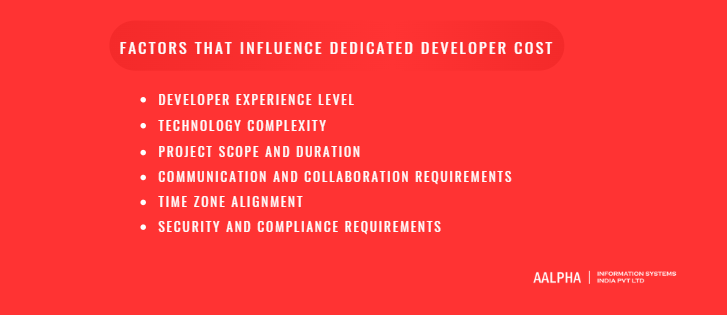
Factors That Influence Dedicated Developer Cost
The cost of hiring dedicated developers varies significantly across projects, even when developers work with similar technologies or are located in the same region. This variation occurs because multiple underlying factors influence software development pricing. Companies evaluating development budgets often ask why the cost of hiring developers differs so widely across projects. The answer lies in several key variables that shape developer rates and overall project expenses.
Software development involves much more than writing code. Developers must design system architecture, integrate third-party services, optimize application performance, maintain security standards, and ensure scalability as products grow. Each of these requirements increases the level of expertise needed for the project. As a result, the complexity of the work directly affects developer pricing.
Another important factor is the structure of the development team itself. Projects involving large-scale platforms or enterprise systems often require multiple developers with different skill sets, including frontend engineers, backend developers, DevOps specialists, and quality assurance professionals. The more specialized the roles within a team, the higher the overall cost of development.
Project timelines also influence developer costs. Short-term projects with aggressive deadlines may require larger teams working simultaneously to meet launch targets. In contrast, long-term product development may spread costs over several months or years while maintaining consistent development capacity.
In addition, operational considerations such as communication practices, time-zone alignment, and compliance requirements can affect development budgets. Projects requiring frequent collaboration with stakeholders, strict regulatory compliance, or continuous real-time communication may involve higher development costs due to additional coordination and expertise requirements.
Understanding these underlying factors helps businesses estimate realistic development budgets and choose the most efficient hiring strategy for their software projects.
-
Developer Experience Level
One of the most influential factors affecting the cost of hiring dedicated developers is the level of experience required for the project. Software developers are typically categorized into junior, mid-level, and senior engineers, and each level commands different rates based on their skills and responsibilities.
Junior developers generally have one to two years of professional experience. They typically work on smaller development tasks, implement basic features, and assist more experienced developers with coding and debugging. Because they are still developing their technical expertise, their hourly rates tend to be lower compared with more experienced engineers.
Mid-level developers usually have three to five years of experience and can work independently on complex development tasks. They are capable of designing application features, integrating APIs, and troubleshooting technical problems without constant supervision. As a result, their rates are higher than junior developers but still lower than senior specialists.
Senior developers often have more than five years of experience and possess deep knowledge of system architecture, performance optimization, and large-scale software design. These engineers frequently lead development teams, mentor junior developers, and make critical technical decisions that influence the entire application architecture. Because of their expertise and strategic role in projects, senior developers command the highest rates.
Selecting the appropriate mix of developer experience levels allows businesses to optimize development costs while maintaining high-quality software engineering standards.
-
Technology Complexity
The complexity of the technology stack used in a project has a direct impact on developer pricing. Applications built using common web technologies may require developers with standard programming skills, while more advanced systems demand specialized expertise in complex technical domains.
For example, a basic web application using widely adopted technologies such as HTML, CSS, JavaScript, and standard backend frameworks can typically be developed by a broad pool of developers. Because these technologies are widely taught and used across the industry, developer rates for such projects tend to remain relatively stable.
However, projects involving advanced technologies such as artificial intelligence, blockchain infrastructure, real-time data processing, or large-scale cloud systems often require developers with specialized expertise. Engineers working with these technologies must understand complex algorithms, distributed computing architectures, and advanced data management techniques. As a result, their hourly rates are usually significantly higher.
Technology complexity also affects development time. Highly technical systems often require additional research, testing, and optimization to ensure reliability and scalability. For example, building an AI-powered recommendation engine involves data preparation, model training, algorithm optimization, and infrastructure scaling. Each of these tasks adds complexity to the development process and increases the cost of hiring dedicated developers.
-
Project Scope and Duration
The overall scope and duration of a software project also play a significant role in determining development costs. Projects with clearly defined requirements and limited functionality are typically easier to estimate and manage. In such cases, development teams can plan tasks efficiently and complete work within predictable timeframes.
However, many software products evolve continuously as businesses introduce new features, integrate additional systems, and respond to user feedback. These evolving requirements increase development complexity and extend project timelines. As the project scope expands, additional developers may be required to maintain development speed, which increases overall costs.
Project duration also affects developer pricing in subtle ways. Long-term engagements often allow companies to negotiate stable monthly rates for dedicated developers, resulting in more predictable budgets. Developers who work on a product for extended periods also develop a deeper understanding of the system architecture and codebase, which improves efficiency and reduces onboarding time.
Short-term projects, on the other hand, may require developers to work intensively within limited timeframes. In some cases, development teams must allocate additional resources to meet tight deadlines, which can increase hourly rates or project costs.
Carefully defining project scope and planning development timelines helps businesses control costs while maintaining consistent development progress.
-
Communication and Collaboration Requirements
Effective communication is essential for successful software development, particularly when teams are distributed across different locations. Projects requiring frequent communication with stakeholders, product managers, designers, and other technical teams often involve additional coordination efforts that influence development costs.
For example, complex enterprise software projects may involve regular meetings, sprint planning sessions, code reviews, and product demonstrations. Developers must collaborate closely with product owners to ensure that new features align with business goals and user requirements. These collaboration activities require time and structured communication processes, which contribute to overall development costs.
Projects involving multiple teams or departments may also require experienced developers who can coordinate across various stakeholders. Senior engineers or technical leads often handle these responsibilities, ensuring that development tasks remain aligned with the broader project roadmap.
Language proficiency and cultural compatibility also play a role in communication efficiency. Developers who can communicate effectively with clients and team members help reduce misunderstandings, improve collaboration, and accelerate development progress.
Companies hiring dedicated developers often consider communication practices as an important factor when selecting development partners, as effective collaboration directly influences project success.
-
Time Zone Alignment
Time zone differences between development teams and client organizations can affect project management efficiency and collaboration speed. When developers work in significantly different time zones, communication delays may occur, particularly when urgent decisions or troubleshooting tasks arise.
Some companies prefer hiring developers in regions with overlapping working hours to facilitate real-time communication. For example, businesses in the United States may choose development teams in Latin America because they operate within similar time zones. This alignment allows teams to hold meetings, resolve technical issues, and review progress during regular working hours.
However, offshore development teams located in regions such as India or Southeast Asia often provide cost advantages despite time zone differences. Many development companies address this challenge by scheduling overlapping working hours or assigning dedicated project managers who coordinate communication between teams.
While time zone alignment does not directly change developer hourly rates, it can influence operational efficiency and project timelines. Companies must balance cost savings with collaboration convenience when selecting development partners in different regions.
-
Security and Compliance Requirements
Security and regulatory compliance requirements can significantly influence the cost of hiring dedicated developers, particularly in industries that handle sensitive data. Sectors such as healthcare, finance, and government require strict adherence to data protection regulations and industry standards.
For example, healthcare applications often need to comply with regulations such as HIPAA in the United States, which governs the protection of patient health information. Financial platforms may need to follow standards such as PCI DSS to ensure secure payment processing. Applications operating in Europe must also comply with the General Data Protection Regulation (GDPR), which establishes strict guidelines for handling personal data.
Meeting these compliance requirements requires developers with specialized knowledge of secure software development practices. Engineers must implement encryption mechanisms, secure authentication systems, data access controls, and audit logging to ensure regulatory compliance.
Security testing, vulnerability assessments, and penetration testing may also be necessary to protect applications from cyber threats. These additional technical requirements increase the level of expertise needed for development teams and can raise the cost of hiring dedicated developers.
Businesses operating in regulated industries must therefore allocate sufficient development budgets to ensure that their applications meet security standards while protecting user data and maintaining legal compliance.
Hidden Costs When Hiring Dedicated Developers
When businesses estimate the cost of hiring dedicated developers, they often focus primarily on hourly rates or monthly developer salaries. While these figures provide a baseline for development budgets, they rarely represent the complete financial picture of building and maintaining a software product. Several operational expenses can arise throughout the development lifecycle that organizations may overlook during initial planning.
Software development involves a wide range of activities beyond writing code. Teams must onboard new developers, configure infrastructure, manage development tools, coordinate project management activities, and conduct continuous testing to ensure product quality. Each of these processes contributes to the total cost of software development.
Another factor that contributes to hidden costs is team scalability. As products evolve and user demand grows, development teams often need to expand to support new features, integrations, or performance improvements. These expansions may introduce additional coordination efforts and infrastructure requirements that increase operational expenses.
Recognizing these hidden costs early allows organizations to build more accurate budgets and avoid financial surprises during the development process. Businesses that understand the full scope of development expenses can plan their hiring strategies more effectively and allocate resources where they deliver the most value.
-
Onboarding and Training Costs
Onboarding new developers is an essential step in integrating them into an existing development team. Even experienced engineers require time to understand the architecture, workflows, and technical standards used in a project. During this onboarding phase, productivity may initially be lower while developers familiarize themselves with the codebase and development environment.
Training also involves introducing developers to the company’s development processes, version control systems, project management tools, and documentation standards. In many cases, senior developers or technical leads must spend time guiding new team members through these processes, which temporarily reduces the availability of senior engineers for other development tasks.
For complex software systems, onboarding may also include reviewing system architecture diagrams, understanding third-party integrations, and learning how various components interact within the platform. These activities are necessary to ensure that developers can contribute effectively to the project while maintaining consistent code quality.
Although onboarding costs are often temporary, they still represent an investment of time and resources that organizations should consider when hiring dedicated developers.
-
Infrastructure and Tools
Modern software development relies heavily on a wide range of infrastructure services and development tools. These resources support tasks such as code management, deployment automation, monitoring, and collaboration among development teams.
Common development tools include version control platforms such as GitHub or GitLab, project management systems such as Jira or Trello, communication tools like Slack, and continuous integration platforms that automate testing and deployment processes. Many of these tools operate on subscription-based pricing models, which add to the ongoing operational costs of development.
Infrastructure services also play a crucial role in software development. Applications often require cloud environments for hosting development, staging, and production systems. Platforms such as AWS, Microsoft Azure, or Google Cloud provide scalable infrastructure but involve usage-based costs for computing resources, storage, and network bandwidth.
Development teams may also require specialized tools for code quality analysis, security scanning, performance monitoring, and error tracking. While each individual tool may appear inexpensive, the combined cost of development infrastructure can become significant over time, especially for large-scale projects.
-
Project Management Overhead
Effective project management is critical for coordinating software development teams, particularly when working with dedicated developers across multiple locations. Project managers play an essential role in organizing development tasks, setting priorities, monitoring progress, and ensuring that projects remain aligned with business objectives.
Project management activities typically include sprint planning, task allocation, progress tracking, stakeholder communication, and risk management. These responsibilities require experienced professionals who understand both software development processes and business requirements.
In agile development environments, project managers or scrum masters facilitate regular team meetings such as daily standups, sprint reviews, and retrospective sessions. These meetings help maintain transparency and ensure that development teams remain focused on delivering incremental improvements to the product.
Although project management may not involve direct coding, it is essential for maintaining productivity and preventing delays. Without proper coordination, development teams may experience miscommunication, duplicated work, or missed deadlines. As a result, the cost of project management is an important component of the overall expense associated with hiring dedicated developers.
-
Quality Assurance and Testing
Quality assurance is another essential component of professional software development that can significantly influence overall project costs. Testing ensures that applications function correctly, meet user expectations, and operate reliably across different environments and devices.
Dedicated quality assurance engineers perform several types of testing throughout the development lifecycle. Functional testing verifies that application features work as intended. Performance testing evaluates how systems behave under heavy user loads. Security testing identifies vulnerabilities that could expose applications to cyber threats.
In addition to manual testing, many development teams implement automated testing frameworks that run continuous tests whenever new code changes are introduced. These automated tests help detect issues early in the development process and reduce the risk of software defects reaching production environments.
Although testing adds additional costs to development projects, it significantly improves product reliability and user satisfaction. Investing in quality assurance also reduces the likelihood of expensive bug fixes and system failures after a product is launched.
-
Scaling and Team Expansion Costs
As software products grow, development teams often need to expand to support new features, handle increased user traffic, or integrate additional systems. Scaling development teams involves recruiting additional developers, onboarding new members, and coordinating larger engineering groups.
Larger teams may require additional project management, communication processes, and infrastructure resources. These factors contribute to incremental costs that organizations should anticipate when planning long-term product development strategies. Proper planning for team expansion helps businesses scale their products efficiently while maintaining development quality and productivity.
Cost Comparison: Dedicated Developers vs In-House Teams
Businesses planning to build digital products often face an important strategic decision: whether to hire in-house developers or work with dedicated development teams. Both approaches offer advantages depending on the organization’s size, product strategy, and long-term technology goals. However, the cost structure of these two hiring models differs significantly.
In-house development teams require companies to recruit, train, and manage engineers as full-time employees. This approach offers complete control over development processes but also introduces substantial operational costs. Dedicated development teams, on the other hand, allow companies to work with external developers who operate as part of their engineering team without the administrative responsibilities associated with permanent employment.
Organizations evaluating these two models frequently ask which option is more cost effective. The answer depends on several variables including project duration, development complexity, team size, and the availability of technical talent in the local market. Understanding how costs are structured in each model helps businesses choose the most efficient approach for their specific development needs.
-
In-House Development Cost Breakdown
Building an in-house software development team involves significantly more expenses than simply paying developer salaries. While salaries represent the largest component of internal development costs, several additional operational expenses contribute to the total financial commitment required to maintain an internal engineering department.
Recruitment is one of the first costs organizations encounter when hiring in-house developers. The hiring process typically involves job advertising, recruitment agencies, technical interviews, background verification, and onboarding procedures. These activities require time and financial resources before a developer even begins contributing to a project.
Employee benefits represent another major cost category. In-house developers typically receive benefits such as health insurance, retirement plans, paid leave, and performance bonuses. These benefits can add a substantial percentage to the total employment cost beyond base salaries.
Office infrastructure also contributes to development expenses. Companies must provide workspace, computers, software licenses, and other resources necessary for developers to perform their work effectively. For organizations located in major technology hubs, office space and operational overhead can be particularly expensive.
Training and professional development are additional considerations. Technology evolves rapidly, and developers often require continuous training to stay updated with new programming frameworks, cloud platforms, and development methodologies. Companies investing in internal teams must allocate resources for ongoing learning and skill development.
When all these expenses are combined, the total cost of maintaining an in-house development team can be significantly higher than the base salary of developers alone.
-
Dedicated Developer Team Cost Breakdown
The dedicated developer model offers a different cost structure that eliminates many of the operational expenses associated with internal hiring. Instead of employing developers directly, companies work with external development providers who supply skilled engineers on a long-term basis.
In this model, businesses typically pay a predictable monthly fee for each developer or development team member. This fee usually includes the developer’s salary, workspace, infrastructure, and administrative costs handled by the development provider. As a result, companies do not need to manage recruitment, payroll, employee benefits, or office infrastructure.
Another advantage of dedicated development teams is scalability. Organizations can expand or reduce their development teams depending on project requirements without committing to permanent employment contracts. This flexibility allows companies to adjust development capacity as products evolve.
Dedicated developers also benefit from the operational structure of established development companies. These providers often supply additional resources such as project managers, quality assurance engineers, and DevOps specialists who support the development process. Because these roles are shared across multiple projects, their costs are distributed more efficiently than in an internal development environment.
For many companies, particularly startups and mid-sized businesses, the dedicated developer model provides access to experienced engineers at significantly lower operational costs compared with building a full internal engineering department.
-
Which Model Is More Cost Efficient?
Determining which hiring model is more cost efficient depends largely on the organization’s long-term technology strategy and operational priorities. Both in-house teams and dedicated developers offer advantages in different scenarios.
In-house development teams may be preferable for organizations that require deep institutional knowledge, strict control over internal systems, or continuous collaboration between engineering and other departments. Large enterprises with stable budgets and long-term technology roadmaps often maintain internal development teams for critical software infrastructure.
However, for many companies, particularly startups and rapidly growing businesses, dedicated developers offer a more cost-effective solution. This model eliminates recruitment overhead, reduces operational expenses, and allows organizations to scale engineering teams quickly as product requirements evolve.
Dedicated developers also provide access to global technical talent without geographic limitations. Companies can work with highly skilled engineers from regions where development costs are lower while still maintaining high development quality.
Ultimately, the most efficient approach often involves a hybrid strategy. Some businesses maintain a small internal engineering team responsible for product strategy and system architecture while relying on dedicated developers to handle implementation and feature development. This combination allows organizations to balance cost efficiency with strong technical leadership and long-term product continuity.
How to Reduce the Cost of Hiring Dedicated Developers
Hiring dedicated developers can be a highly cost-effective strategy compared with building and maintaining a full in-house development team. However, businesses still need to plan their hiring approach carefully to ensure development budgets remain under control. Poor planning, unclear requirements, and inefficient development processes can quickly increase project costs, even when working with external development teams.
Many companies exploring dedicated development services ask how they can reduce costs without compromising product quality or long-term scalability. The key lies in making strategic decisions about team structure, development methodology, and project scope. By adopting efficient development practices and selecting the right partners, organizations can significantly lower development expenses while maintaining strong technical outcomes.
Cost optimization does not necessarily mean choosing the cheapest developers available. Instead, it involves identifying the most efficient way to build and maintain software products while minimizing unnecessary overhead and rework. Businesses that focus on efficient project planning, scalable architectures, and experienced development teams are often able to achieve better results at lower overall cost.
Several practical strategies can help organizations reduce the cost of hiring dedicated developers while ensuring projects remain successful.
-
Hire Developers from Cost-Efficient Regions
One of the most effective ways to reduce development costs is to hire developers from regions where engineering talent is available at competitive rates. Software developer salaries vary significantly across countries due to differences in living costs, local demand for technical skills, and the maturity of regional technology ecosystems.
Regions such as India, Southeast Asia, and parts of Eastern Europe offer highly skilled developers at rates that are often significantly lower than those in North America or Western Europe. Despite the lower costs, many developers in these regions possess strong technical expertise and extensive experience working on international software projects.
Companies choosing developers from cost-efficient regions can often reduce development budgets by a substantial margin while still maintaining high code quality and engineering standards. In addition, many development providers in these regions operate within structured development environments that follow global best practices such as agile development, continuous integration, and automated testing.
Access to global talent allows businesses to balance cost savings with technical expertise, making offshore development a widely adopted strategy among startups and enterprises alike.
-
Start with an MVP
Another important strategy for reducing development costs is to begin with a minimum viable product. An MVP focuses on building the core functionality required to solve a specific user problem rather than developing a fully featured product from the start.
Many software projects become expensive because businesses attempt to build too many features during the initial development phase. Each additional feature increases development complexity, testing requirements, and integration challenges. By focusing on essential features first, companies can launch products faster while keeping development budgets manageable.
Once the MVP is launched, real user feedback provides valuable insights into which features are most important. Businesses can then prioritize future development based on actual customer needs rather than assumptions made during early planning stages.
This iterative approach helps companies avoid spending resources on features that users may not need. It also allows development teams to refine product direction gradually, reducing the risk of costly redesigns later in the development process.
-
Use Agile Development
Adopting agile development methodologies is another effective way to control development costs. Agile development emphasizes iterative progress, continuous feedback, and flexible planning. Instead of attempting to build an entire product in a single development cycle, agile teams divide projects into smaller increments called sprints.
Each sprint typically lasts two to four weeks and focuses on delivering specific features or improvements. This structured approach allows businesses to monitor development progress closely and adjust priorities based on new insights or changing market conditions.
Agile development also reduces the risk of major project delays. Because features are delivered incrementally, problems can be identified and resolved earlier in the development process. Early issue detection prevents expensive rework that often occurs when problems are discovered late in large development cycles.
The transparency provided by agile methodologies also improves collaboration between development teams and business stakeholders. Regular sprint reviews and progress updates help ensure that development efforts remain aligned with product goals and customer expectations.
-
Work with Experienced Development Partners
Choosing an experienced development partner is another critical factor in controlling software development costs. Companies with strong development expertise can often deliver projects more efficiently because they follow proven processes, maintain structured workflows, and employ experienced engineers.
Experienced development partners typically provide well-organized teams that include developers, quality assurance engineers, project managers, and DevOps specialists. These teams work together using established development methodologies, reducing the risk of delays, technical errors, or inefficient development practices.
Another advantage of working with experienced providers is their ability to anticipate technical challenges early in the project. Experienced engineers can recommend appropriate technology stacks, scalable system architectures, and efficient development strategies that prevent costly redesigns later in the product lifecycle.
Reliable development partners also offer long-term support and maintenance services, ensuring that applications continue to operate efficiently as businesses grow. By working with experienced teams, organizations can reduce development risks, maintain high product quality, and ultimately achieve better cost efficiency throughout the entire software development process.
How to Choose the Right Dedicated Developer Team
Selecting the right dedicated developer team is one of the most important decisions businesses make when outsourcing software development. While many companies focus primarily on hourly rates or location when evaluating development partners, long-term project success depends on several additional factors. Technical capability, industry expertise, communication practices, security standards, and long-term support all influence whether a development partnership will deliver reliable results.
Companies planning to hire dedicated developers often ask how they can identify a trustworthy vendor among the many development providers available globally. The most effective approach is to evaluate potential partners through a structured process that examines their engineering expertise, project delivery experience, and operational processes. A reliable development team should not only possess strong technical skills but also demonstrate organized workflows, transparent communication, and the ability to scale resources as product requirements evolve.
Organizations that carefully assess development partners before hiring are more likely to build long-term relationships with teams capable of delivering scalable, high-quality software products. The following factors provide a practical framework for choosing the right dedicated developer team.
-
Evaluate Technical Expertise
Technical expertise is the foundation of any successful software development partnership. Businesses should ensure that the development team possesses strong knowledge of the technologies required for their project. Software development involves complex engineering processes including system architecture design, API development, cloud infrastructure configuration, and performance optimization. Developers must be able to handle these responsibilities effectively while maintaining high coding standards.
One of the most effective ways to evaluate technical capability is by reviewing a development company’s portfolio and case studies. Previous projects reveal the types of applications the team has built, the industries they have served, and the technology stacks they commonly use. Companies should look for evidence that the team has successfully delivered projects similar in complexity to their own.
Another useful evaluation method is technical interviews or skill assessments for the developers who will be assigned to the project. Many professional development companies allow clients to interview engineers before finalizing the engagement. This process helps confirm that developers possess the required technical knowledge and problem-solving skills.
A strong dedicated development team should also include multiple technical roles, such as frontend developers, backend engineers, DevOps specialists, and quality assurance professionals. This multidisciplinary approach ensures that projects are built using comprehensive engineering practices rather than relying on individual contributors working in isolation.
-
Check Industry Experience
Industry experience can significantly improve the efficiency and quality of a software development project. Developers who have previously worked in a particular industry are often familiar with its common challenges, technical requirements, and regulatory considerations.
For example, healthcare applications often involve secure patient data management and compliance with healthcare privacy regulations. Financial technology platforms require strong security mechanisms, payment gateway integrations, and fraud prevention systems. Ecommerce applications must handle product catalogs, payment processing, logistics systems, and high-traffic performance requirements.
Development teams that understand these industry-specific requirements can design more efficient software architectures and anticipate potential challenges earlier in the development process. Reviewing case studies and client testimonials helps businesses determine whether a development partner has successfully delivered solutions within their industry.
-
Assess Communication and Collaboration Process
Effective communication is essential when working with dedicated developers, especially when teams operate remotely. Clear communication channels help ensure that project requirements, priorities, and progress updates remain transparent throughout the development process.
Professional development teams typically rely on modern collaboration tools such as Slack or Microsoft Teams for daily communication. Project management platforms such as Jira, Trello, or Asana are commonly used to track development tasks and monitor project progress.
Businesses should also understand how the development team manages agile workflows. Many software teams operate using agile methodologies, which include sprint planning, daily stand-up meetings, sprint reviews, and retrospectives. These processes help maintain transparency, encourage continuous improvement, and ensure that development work remains aligned with product goals.
Reliable communication processes reduce the risk of misunderstandings and enable development teams to respond quickly to changing requirements.
-
Review Security and Compliance Standards
Security should be a critical consideration when choosing a dedicated developer team. Modern software systems often process sensitive data such as customer information, financial transactions, or healthcare records. Development teams must follow secure coding practices to protect applications from potential vulnerabilities.
Businesses should evaluate whether development partners implement security best practices such as encrypted data transmission, secure authentication systems, and vulnerability testing. Companies operating in regulated industries should also ensure that development teams are familiar with relevant compliance standards such as GDPR, HIPAA, or PCI DSS.
Working with developers who prioritize security reduces the risk of data breaches and ensures that applications meet regulatory requirements.
-
Look for Long-Term Development Support
Software development is an ongoing process rather than a one-time project. After an application is launched, businesses typically require continuous maintenance, updates, performance improvements, and new feature development. Choosing a development partner capable of providing long-term support ensures that the product remains stable and scalable as the business grows.
Reliable development companies offer ongoing maintenance services, technical support, and the ability to scale development teams as product requirements evolve. They can also assist with infrastructure management, security updates, and performance optimization over time.
Companies such as Aalpha Information Systems, which specialize in dedicated development teams and custom software solutions, illustrate how experienced development partners can support organizations throughout the entire product lifecycle. Working with established providers that offer strong engineering capabilities and long-term collaboration models helps businesses build sustainable digital products while maintaining consistent development quality.
Final Thoughts
Hiring dedicated developers has become one of the most effective ways for businesses to build scalable digital products while controlling development costs. Compared with maintaining large in-house engineering teams, the dedicated developer model provides access to global talent, flexible team scaling, and predictable development budgets. Companies can assemble experienced development teams quickly and accelerate product development without the operational overhead associated with full-time hiring.
However, the overall cost of hiring dedicated developers depends on several factors including developer location, experience level, technology stack, project complexity, and engagement model. Businesses that carefully evaluate these variables and select the right development partner are more likely to achieve successful outcomes while maintaining cost efficiency.
If you are planning to hire dedicated developers for your next software project, partnering with an experienced development company can make the process significantly more efficient. Aalpha Information Systems provides dedicated development teams with expertise in web, mobile, cloud, and AI technologies, helping businesses build scalable digital solutions across industries.
Contact the Aalpha team today to discuss your project requirements and explore how dedicated developers can accelerate your product development.