


Mobile applications have become a central component of modern digital strategy. Businesses across industries rely on mobile apps to engage customers, deliver services, manage operations, and generate revenue. Among mobile platforms, Android holds the largest global market share, powering billions of devices worldwide. Because of this massive reach, many organizations prioritize Android applications when launching new digital products. However, building and maintaining a high-quality Android app requires specialized expertise in design, development, testing, and deployment. For many companies, maintaining an in-house mobile engineering team can be expensive and time-consuming. As a result, outsourcing Android app development has become a widely adopted strategy.
Android app development outsourcing refers to the practice of delegating the design, development, and maintenance of an Android application to an external development company or specialized team. Instead of hiring full-time developers internally, businesses collaborate with experienced technology partners who already possess the required technical skills, tools, and infrastructure. This model allows organizations to accelerate development while reducing operational complexity. Companies can access skilled Android engineers, designers, and quality assurance specialists without investing heavily in recruitment, training, and long-term employment costs.
The outsourcing model has gained significant traction because it provides flexibility and scalability. Organizations can quickly assemble development teams tailored to the needs of a specific project, whether building a startup MVP or developing a large enterprise platform. This approach is especially beneficial in industries where rapid innovation and faster time-to-market are critical. As mobile usage continues to grow globally, outsourcing Android development enables businesses to focus on product strategy and market expansion while experienced development partners handle the technical implementation.
What Android App Development Outsourcing Means
Android app development outsourcing involves partnering with an external mobile app development company or remote engineering team to design, build, test, and maintain an Android application. Instead of building a dedicated internal development department, organizations delegate technical responsibilities to a specialized partner with expertise in Android technologies such as Kotlin, Java, Android SDK, and mobile architecture frameworks.
In a traditional in-house model, companies must recruit developers, manage infrastructure, handle training, and maintain long-term employee commitments. Outsourcing changes this dynamic by allowing businesses to leverage pre-existing development teams that already possess the necessary experience and tools. The external team may handle multiple aspects of development, including user interface design, backend integration, quality assurance testing, app store deployment, and post-launch support.
This model is commonly used for building new mobile applications, modernizing existing apps, or scaling development capacity during periods of high demand. For example, a startup launching its first mobile product may outsource the entire development process, while an enterprise organization may outsource specific components such as UI design or API integrations. By outsourcing Android development, businesses gain access to specialized expertise while maintaining strategic oversight of the product.
Why Businesses Choose to Outsource Android Development
Organizations adopt Android app development outsourcing for several strategic reasons, with cost efficiency being one of the most significant factors. Hiring and maintaining an in-house mobile development team requires substantial investment in salaries, benefits, office infrastructure, and continuous training. Outsourcing allows companies to convert these fixed operational costs into flexible project-based expenses, making it easier to manage budgets and scale resources according to project requirements.
Another important reason is faster development cycles. Experienced outsourcing partners already have established development workflows, testing frameworks, and deployment processes. This allows projects to move from concept to launch more quickly compared to building a new internal team from scratch. Faster time-to-market is especially important in competitive industries where launching early can determine product success.
Access to global talent also plays a crucial role. Skilled Android developers are in high demand, and finding experienced engineers locally can be difficult or expensive in many regions. Outsourcing enables organizations to collaborate with highly qualified developers from technology hubs around the world, gaining expertise in advanced technologies such as AI integration, cloud-based mobile architectures, and scalable backend systems.
Who Typically Outsources Android App Development
Android app development outsourcing is used by a wide range of organizations, from early-stage startups to large multinational enterprises. Startups frequently outsource development because it allows them to build their initial product without hiring a full engineering team. This approach helps founders focus on product validation, customer acquisition, and business growth while experienced developers handle the technical implementation.
Enterprises also rely on outsourcing when they need to accelerate innovation or expand their mobile capabilities. Large organizations often outsource specific modules or features to external teams in order to speed up development while maintaining internal control over core systems.
Several industries regularly outsource Android app development due to high demand for mobile solutions. SaaS companies outsource mobile extensions of their software platforms, healthcare organizations develop telemedicine and patient management apps, fintech firms build secure mobile banking solutions, and eCommerce businesses create shopping applications that enhance customer engagement. In each case, outsourcing allows organizations to access specialized mobile development expertise while focusing on their primary business operations.
What Android App Development Outsourcing Includes
Android app development outsourcing involves far more than simply writing application code. In most professional outsourcing engagements, the external development team handles the entire mobile product lifecycle, from initial concept and design to development, integration, testing, deployment, and long-term maintenance. Businesses that outsource Android development typically gain access to multidisciplinary teams that include mobile developers, UI designers, backend engineers, QA specialists, and DevOps professionals.
A well-structured outsourcing partner provides end-to-end development services, ensuring that every component of the mobile product functions seamlessly. This includes designing intuitive user interfaces, building scalable application architecture, integrating cloud services, implementing security protocols, and optimizing the app for performance across thousands of Android device configurations.
The scope of Android app outsourcing also extends beyond initial development. Most modern mobile applications require ongoing updates, feature improvements, performance monitoring, and compatibility updates as Android operating system versions evolve. Because of this, many companies outsource not only the development of Android apps but also the long-term technical management of their mobile platforms.
Understanding what services are typically included in Android app development outsourcing helps organizations evaluate vendors effectively and ensures that all technical requirements are covered throughout the development lifecycle.
-
Android App Design and UI/UX Development
User experience plays a critical role in the success of any mobile application. Android app outsourcing typically begins with UI and UX design, which focuses on creating intuitive, visually appealing, and easy-to-navigate interfaces. A well-designed mobile application ensures that users can interact with the platform effortlessly, reducing friction and improving engagement.
Professional Android development teams conduct user research, create wireframes, and build interactive prototypes before the development phase begins. These early design steps help businesses visualize the app structure, screen flows, and user interactions. Designers also follow Android design principles such as Material Design guidelines developed by Google, ensuring consistency with Android user interface standards.
UI design focuses on the visual elements of the application, including layout, typography, colors, and animations. UX design focuses on usability, ensuring that navigation flows are logical and user tasks can be completed efficiently. When these elements are properly implemented, they improve customer satisfaction, reduce user drop-off rates, and increase the overall effectiveness of the application.
-
Native Android App Development (Kotlin/Java)
Native Android development refers to building applications specifically for the Android operating system using programming languages and tools designed for the platform. The most commonly used languages for native Android development are Kotlin and Java. Kotlin has become the preferred language for modern Android development because it offers improved safety, concise syntax, and strong compatibility with existing Java codebases.
Native Android applications are built using the Android Software Development Kit (SDK) and development environments such as Android Studio. These tools provide developers with libraries, frameworks, and debugging utilities required to build high-performance applications.
The advantage of native development is that it provides full access to Android device capabilities, including camera functions, sensors, GPS services, and hardware acceleration. This enables developers to build highly responsive applications with optimized performance. Native apps are particularly important for complex applications such as fintech platforms, real-time logistics systems, gaming applications, and enterprise mobility solutions where performance and security are critical.
-
Cross-Platform Android App Development
In some cases, businesses choose cross-platform development to build applications that run on both Android and iOS using a shared codebase. Cross-platform frameworks allow developers to write application logic once and deploy it across multiple mobile platforms, reducing development time and cost.
Popular cross-platform frameworks include Flutter and React Native. These frameworks allow developers to build mobile interfaces using reusable components while still delivering near-native performance.
Cross-platform development is often suitable for startups and businesses that need to launch products quickly across multiple platforms without maintaining separate development teams for Android and iOS. However, the choice between native and cross-platform development depends on project requirements. Highly complex applications with intensive hardware interactions may still benefit from native Android development, while content-driven or service-based apps often perform well using cross-platform frameworks.
-
Backend Development and API Integration
Most Android applications rely on backend infrastructure to manage data, authentication, and server-side logic. Outsourced Android development teams often build or integrate backend systems that support the mobile application. These backend services handle tasks such as user account management, payment processing, real-time notifications, and database management.
Backend systems typically communicate with Android applications through APIs (Application Programming Interfaces). APIs enable secure data exchange between the mobile application and cloud services. Developers may integrate third-party services such as payment gateways, analytics tools, or cloud storage platforms through these APIs.
Scalable backend architecture is essential for applications expecting high user traffic, ensuring that performance remains stable as the user base grows.
-
Testing, Deployment, and Maintenance
Professional outsourcing teams perform extensive testing across multiple Android devices and operating system versions to ensure stability and performance. After testing, the app is deployed to the Google Play Store. Ongoing maintenance includes updates, bug fixes, security patches, and performance improvements to keep the application reliable and compatible with future Android updates.
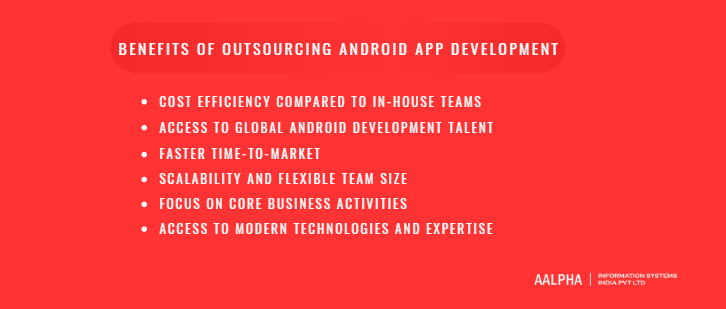
Benefits of Outsourcing Android App Development
Outsourcing Android app development has become a strategic decision for many businesses seeking to build high-quality mobile applications without the operational challenges of managing large internal engineering teams. The rapid growth of the mobile ecosystem, combined with increasing technical complexity, has made mobile development both expensive and resource-intensive. Organizations often require expertise in multiple areas including mobile architecture, cloud infrastructure, security implementation, and user experience design. Building and maintaining this level of expertise internally can be difficult, especially for startups and mid-sized companies.
By outsourcing Android development to experienced software partners, businesses gain access to specialized development teams capable of delivering complex mobile products efficiently. Outsourcing allows organizations to optimize costs, accelerate product development, and scale engineering resources according to project requirements. It also reduces the risks associated with recruiting and managing highly specialized technical talent.
In addition, outsourcing partners typically bring extensive experience from working on multiple projects across different industries. This exposure enables them to recommend proven development practices, modern technologies, and scalable architectures that improve the long-term performance of mobile applications. As mobile platforms continue to evolve rapidly, outsourcing Android development enables companies to remain competitive while focusing on innovation and customer experience.
-
Cost Efficiency Compared to In-House Teams
One of the most significant advantages of outsourcing Android app development is cost efficiency. Building an in-house mobile development team involves substantial expenses that go far beyond developer salaries. Companies must also invest in recruitment, training, office infrastructure, employee benefits, and long-term retention strategies. These costs can be particularly challenging for startups and growing businesses with limited resources.
Outsourcing converts these fixed operational costs into flexible project-based investments. Instead of maintaining a permanent internal team, organizations pay for development services only when needed. This approach allows businesses to allocate resources more efficiently while maintaining control over project budgets.
Another major factor influencing cost efficiency is geographic labor differences. Android developers in regions such as North America and Western Europe typically command higher salaries due to market demand and cost of living. Outsourcing to development hubs in countries like India or Eastern Europe allows companies to access highly skilled engineers at significantly lower rates without compromising quality.
Additionally, outsourcing companies often already possess development infrastructure, testing environments, and project management systems. Businesses do not need to invest in expensive tools or software licenses because these resources are included as part of the outsourcing partnership. This overall reduction in overhead makes outsourcing a financially attractive strategy for organizations seeking to develop mobile applications efficiently.
-
Access to Global Android Development Talent
The demand for experienced Android developers continues to exceed supply in many regions. Finding and hiring qualified engineers locally can be difficult, especially for companies that require expertise in modern technologies such as Kotlin development, cloud integration, or AI-powered mobile applications. Outsourcing Android development provides immediate access to a global talent pool of skilled engineers.
Technology hubs around the world host thousands of experienced mobile developers who specialize in Android development frameworks and tools. By partnering with outsourcing companies located in these regions, businesses can quickly assemble development teams with the exact technical expertise required for their projects. These teams often include mobile architects, UI designers, backend engineers, and quality assurance specialists working collaboratively.
Access to global talent also allows businesses to benefit from developers who have experience building applications across multiple industries. Developers who have worked on fintech, healthcare, logistics, or eCommerce applications bring valuable domain knowledge that can improve product design and functionality. Their previous experience helps avoid common technical pitfalls and accelerates problem-solving during development.
Another advantage is the ability to build diverse teams with specialized skills. For example, an Android app that includes machine learning capabilities, real-time data processing, and advanced security features may require multiple types of engineers. Outsourcing partners can assemble these specialized teams quickly, ensuring that the project benefits from the required expertise from the beginning.
-
Faster Time-to-Market
Speed is often a critical factor in the success of digital products. Companies launching new mobile applications must move quickly to capture market opportunities and respond to changing customer expectations. Outsourcing Android development can significantly accelerate product development timelines.
Experienced outsourcing companies already have established workflows, development frameworks, and testing processes in place. These teams are accustomed to collaborating efficiently and can begin development almost immediately after project requirements are defined. In contrast, building an in-house team requires weeks or months of recruitment, onboarding, and infrastructure setup before development even begins.
Outsourced development teams also use agile development methodologies that enable continuous iteration and faster delivery of features. Agile frameworks break projects into smaller development cycles, allowing teams to release updates frequently and respond quickly to user feedback. This approach helps companies launch minimum viable products (MVPs) faster and refine their applications based on real-world usage.
-
Scalability and Flexible Team Size
Mobile development requirements often change throughout the lifecycle of a project. During early stages, companies may require a small team focused on building core functionality. As the project grows, additional developers, designers, or testing specialists may be needed to handle increased complexity.
Outsourcing provides the flexibility to scale development teams up or down based on project demands. If a project requires additional developers to meet tight deadlines, outsourcing partners can allocate more engineers to the project. Similarly, once the development workload decreases, the team size can be reduced without affecting business operations.
This flexibility is particularly valuable for startups and growing companies that experience fluctuating development needs. Instead of maintaining a large internal team during periods of low activity, organizations can rely on outsourcing partners to adjust resources dynamically. This approach ensures efficient use of technical resources while maintaining development momentum.
-
Focus on Core Business Activities
Developing mobile applications requires significant technical expertise and management attention. When companies attempt to handle all development internally, leadership teams often spend substantial time managing technical processes rather than focusing on strategic business priorities.
Outsourcing Android development allows organizations to concentrate on core activities such as product strategy, marketing, customer acquisition, and business growth. The external development partner handles the technical implementation, project management, and quality assurance processes required to build the application.
This separation of responsibilities enables businesses to operate more efficiently. Product owners and stakeholders can focus on defining product features and user experience while experienced developers manage the technical architecture and implementation.
-
Access to Modern Technologies and Expertise
Mobile technologies evolve rapidly, and keeping internal teams updated with the latest tools and frameworks requires continuous investment in training and research. Outsourcing partners typically stay current with emerging technologies because their business depends on delivering modern solutions to multiple clients.
Professional Android development companies regularly adopt advanced technologies such as AI integration, cloud-based architectures, advanced security frameworks, and performance optimization tools. Their experience with these technologies enables them to implement best practices that improve application scalability, reliability, and long-term maintainability.
By outsourcing Android app development, businesses gain access to this technical expertise without investing heavily in internal training programs. This ensures that their mobile applications remain competitive in an increasingly technology-driven marketplace.
Types of Android App Development Outsourcing Models
When companies decide to outsource Android app development, one of the most important decisions involves choosing the right engagement model. The outsourcing model determines how the development team will be structured, how communication will occur, and how project responsibilities will be distributed between the business and the development partner.
Different outsourcing models are designed to accommodate different types of projects. For example, a startup building its first mobile application may prefer a full project-based outsourcing model where the entire development lifecycle is handled externally. On the other hand, an enterprise organization may require additional developers to support an internal engineering team, making staff augmentation a more suitable approach.
Understanding these engagement models helps businesses align their outsourcing strategy with their technical requirements, budget constraints, and long-term product roadmap. Each model offers distinct advantages depending on project complexity, timeline, and internal technical capacity.
-
Project-Based Outsourcing
Project-based outsourcing is one of the most common models used for Android app development. In this approach, a company hires an external development team to build an entire mobile application based on predefined project requirements. The outsourcing partner takes responsibility for delivering the complete project, including design, development, testing, and deployment.
This model typically begins with detailed requirement gathering and documentation. Businesses provide specifications describing the app’s features, user flows, integrations, and expected outcomes. Based on these requirements, the outsourcing partner estimates development timelines, resource allocation, and project costs.
Project-based outsourcing works particularly well for organizations that do not have an internal development team or those launching a new mobile product for the first time. The external partner manages the technical execution while the client focuses on product vision and strategic decisions.
Another advantage of this model is cost predictability. Because the project scope is defined in advance, companies can often agree on a fixed-price contract or milestone-based payment structure. This makes budgeting easier and reduces the risk of unexpected development expenses. However, this model requires clearly defined requirements to avoid scope changes during development.
-
Dedicated Development Teams
The dedicated development team model provides businesses with a full-time external team that works exclusively on their project. Unlike project-based outsourcing, where the outsourcing company manages the entire development process, dedicated teams operate as an extension of the client’s internal organization.
In this model, the outsourcing partner assembles a team that may include Android developers, UI designers, backend engineers, quality assurance specialists, and project managers. These professionals work exclusively on the client’s project and collaborate directly with internal stakeholders.
The dedicated team model is particularly useful for long-term projects or products that require continuous development. Businesses maintain greater control over the development process, including feature prioritization, product roadmap decisions, and development timelines.
This model also offers flexibility in scaling the team size. If the project requires additional developers during peak development phases, the outsourcing partner can quickly allocate more resources. Conversely, team size can be reduced during maintenance phases, allowing businesses to manage development costs efficiently.
Many companies choose the dedicated team model when building complex mobile platforms that require ongoing innovation, regular feature updates, and long-term product evolution.
-
Staff Augmentation
Staff augmentation is an outsourcing model designed to complement an existing in-house development team. Instead of outsourcing the entire project, businesses hire external developers to fill specific skill gaps or temporarily expand their engineering capacity.
For example, a company with an internal product development team may require additional Android developers during critical development phases. Rather than hiring full-time employees, the company can temporarily augment its team with experienced developers provided by an outsourcing partner.
This model offers several advantages. It allows organizations to access specialized expertise without committing to long-term employment contracts. Businesses can also quickly scale their engineering capacity when needed and reduce team size when project demands decrease.
Staff augmentation is particularly useful when companies require niche technical expertise, such as Android performance optimization, advanced security implementation, or integration with complex backend systems. Because augmented developers work closely with the internal team, communication and project alignment remain strong.
However, this model requires effective internal project management because the client organization retains responsibility for coordinating development tasks and ensuring overall project progress.
-
Offshore vs Nearshore vs Onshore Outsourcing
In addition to engagement models, outsourcing can also be categorized based on the geographic location of the development team. The three primary geographic outsourcing models are offshore, nearshore, and onshore outsourcing.
Offshore outsourcing involves working with development teams located in distant countries, often in regions known for strong technical talent and lower development costs. Countries such as India, Ukraine, and Vietnam have become major offshore development hubs. Offshore outsourcing offers significant cost advantages and access to large pools of experienced developers, although it may require careful coordination due to time zone differences.
Nearshore outsourcing refers to collaborating with development teams located in nearby or neighboring countries. For example, a company in Western Europe may work with developers in Eastern Europe. Nearshore partnerships often provide better time zone alignment and easier communication while still offering cost savings compared to local development teams.
Onshore outsourcing involves hiring development companies located within the same country as the client. This model offers the highest level of communication convenience and cultural alignment but typically comes with higher development costs.
Each geographic model offers unique advantages depending on a company’s priorities, including cost efficiency, communication preferences, and project complexity. Many businesses choose offshore outsourcing to access global talent and reduce development costs while maintaining structured communication processes to ensure project success.
Android App Development Outsourcing Process (Step-by-Step)
Outsourcing Android app development can significantly accelerate product development and reduce operational costs, but success depends heavily on following a structured process. Businesses that approach outsourcing without clear planning often encounter delays, budget overruns, and communication challenges. A systematic outsourcing strategy ensures that the right Android app development company is selected and that the project progresses efficiently from concept to launch.
The outsourcing process typically involves defining product requirements, preparing detailed documentation, evaluating development partners, selecting an appropriate engagement model, and establishing clear contractual agreements before development begins. Once the project starts, effective collaboration practices such as agile development cycles, continuous communication, and milestone-based progress tracking help ensure successful delivery.
By following these structured steps, businesses can reduce risk and ensure that their outsourced Android development project aligns with both technical requirements and business goals.
-
Define Your App Requirements and Goals
The first step in outsourcing Android app development is clearly defining the purpose and objectives of the application. Before approaching development partners, businesses should understand the problem the app intends to solve and the value it will deliver to users.
This stage involves identifying the core functionality of the application. Companies should determine the key features that will be included in the initial release, commonly referred to as the Minimum Viable Product (MVP). For example, an eCommerce app may include product browsing, shopping cart functionality, and payment integration as its core features, while additional features such as loyalty programs or advanced recommendations may be planned for future updates.
Businesses should also define their target audience and user experience expectations. Understanding user behavior helps shape design decisions, feature prioritization, and performance requirements. A healthcare application designed for patient monitoring, for example, may require strict security compliance and real-time data synchronization.
In addition to functional requirements, technical considerations should also be defined at this stage. These may include integration with existing systems, cloud infrastructure requirements, and expected scalability. Clear goals and well-defined requirements provide a strong foundation for outsourcing discussions and help development partners deliver accurate project estimates.
-
Prepare Product Documentation (PRD / SOW)
Once requirements are defined, the next step is preparing structured documentation that outlines the project in detail. Two of the most common documents used in software outsourcing are the Product Requirements Document (PRD) and the Scope of Work (SOW).
A PRD describes how the product should function from both a business and user perspective. It typically includes app features, user flows, functional requirements, and system behavior. The PRD may also include wireframes or screen mockups that illustrate how users will interact with the application.
The Scope of Work document focuses on the technical and operational aspects of the project. It defines project deliverables, development milestones, timelines, and responsibilities for both the client and the development partner. The SOW also outlines communication expectations, reporting structures, and change management procedures.
Well-prepared documentation helps eliminate ambiguity and ensures that both parties share a clear understanding of project expectations. It also allows outsourcing companies to provide more accurate cost estimates and development timelines. Businesses that invest time in preparing detailed documentation significantly improve the chances of successful project delivery.
-
Research and Shortlist Android Development Companies
Selecting the right outsourcing partner is one of the most important decisions in the entire process. Businesses should begin by researching Android development companies that specialize in mobile application development and have experience delivering projects similar to their requirements.
Online platforms that evaluate technology vendors can be useful for identifying reputable companies. Websites such as Clutch and GoodFirms provide client reviews, project portfolios, and company ratings that help businesses assess vendor credibility.
When researching potential partners, companies should evaluate factors such as industry experience, project case studies, and development methodologies. A development company with prior experience building applications in the client’s industry often understands regulatory requirements, common user expectations, and technical challenges.
Another important factor is technical capability. Businesses should verify that the development company has expertise in modern Android technologies, including Kotlin-based development, scalable cloud integration, and performance optimization.
After evaluating multiple vendors, businesses should shortlist three to five companies that appear to match their technical requirements, budget expectations, and communication preferences. These shortlisted vendors can then be contacted for further evaluation and proposal discussions.
-
Evaluate Technical Expertise and Portfolio
After creating a shortlist of potential vendors, the next step is evaluating each company’s technical expertise and previous work. Reviewing a development partner’s portfolio provides valuable insight into their capabilities, design standards, and experience with complex mobile projects.
A strong Android development portfolio should demonstrate experience building applications across different industries and complexity levels. Companies should examine case studies that highlight features similar to those required for their own project. For example, if a company is developing a fintech application, reviewing prior projects involving payment integration, secure authentication, and financial transaction systems can be highly relevant.
Technical expertise should also be assessed through discussions with the development company’s technical leadership. Businesses should ask questions about development frameworks, architecture decisions, security practices, and testing methodologies.
It is also important to evaluate the development company’s design capabilities. High-quality user interface design plays a major role in mobile app success, and the vendor’s portfolio should demonstrate visually appealing and user-friendly applications.
Evaluating both technical and design expertise ensures that the selected outsourcing partner can deliver an application that meets both functional and user experience expectations.
-
Conduct Technical Interviews and Team Assessment
Before finalizing an outsourcing partner, businesses should conduct technical interviews with the developers who will actually work on the project. This step helps verify the expertise of the team and ensures that they possess the skills required to deliver the application successfully.
Technical interviews may include discussions about Android development frameworks, architectural patterns, and problem-solving approaches. Companies may also ask developers to explain how they would implement specific features or handle potential technical challenges.
Evaluating the development team’s communication skills is equally important. Because outsourcing often involves remote collaboration, developers must be able to communicate technical concepts clearly and respond effectively to feedback.
Businesses should also assess the structure of the development team. A well-balanced team typically includes Android developers, UI designers, backend engineers, quality assurance specialists, and project managers. Understanding how these roles interact helps ensure that the project will be managed efficiently.
Team assessment provides confidence that the outsourcing partner not only has strong company credentials but also possesses the individual expertise required for successful project execution.
-
Choose the Engagement Model and Pricing Structure
Once a suitable development partner has been identified, businesses must select an engagement model and pricing structure that aligns with their project goals and budget.
Common pricing structures include fixed-price contracts, time-and-materials agreements, and dedicated team models. Fixed-price contracts are often used when project requirements are clearly defined and unlikely to change significantly during development. This model provides cost predictability but may offer less flexibility if new features are introduced.
Time-and-materials agreements are more flexible and allow businesses to adjust project scope as development progresses. In this model, companies pay for the actual time spent by developers on the project.
The dedicated team model involves hiring a full-time external team that works exclusively on the project. This model is often preferred for long-term projects that require continuous development and feature updates.
Selecting the right pricing structure ensures that development resources are used efficiently while maintaining financial transparency throughout the project.
-
Sign Contracts, NDAs, and Security Agreements
Before development begins, businesses should formalize their partnership through legal agreements that protect both parties. These agreements typically include contracts, non-disclosure agreements (NDAs), and intellectual property protection clauses.
An NDA ensures that confidential business information, technical designs, and product strategies are not shared with third parties. This is particularly important when developing innovative mobile applications that contain proprietary technology.
Contracts should clearly define project scope, deliverables, payment schedules, and dispute resolution mechanisms. They should also specify ownership of intellectual property to ensure that the client retains full rights to the application after development is completed.
Security agreements may also outline data protection responsibilities, particularly when the application involves sensitive user information.
-
Start Development and Agile Collaboration
After agreements are finalized, the development phase begins. Most modern Android outsourcing projects follow agile development methodologies, which divide the project into short development cycles called sprints. Each sprint focuses on delivering specific features that can be tested and reviewed.
Regular communication between the client and the development team ensures that progress remains aligned with business objectives. Continuous feedback allows teams to refine features and resolve issues early in the development process, resulting in a more efficient and successful product launch.
Android App Development Outsourcing Cost
Cost is one of the most important factors organizations consider when outsourcing Android app development. Mobile app development costs can vary widely depending on multiple variables, including the complexity of the application, required features, development timeline, and the geographic location of the development team. Businesses evaluating outsourcing options often compare development costs with the expense of building an internal engineering team.
The cost of outsourcing Android development is typically determined by the number of development hours required and the hourly rates charged by developers in different regions. A simple mobile application may require a few hundred hours of development, while a large enterprise platform with complex integrations may require thousands of hours of engineering work.
In addition to development costs, businesses should also consider expenses related to testing, infrastructure, security implementation, third-party integrations, and long-term maintenance. Understanding these factors helps organizations estimate the total investment required to build and sustain a successful Android application.
Outsourcing can often reduce development expenses significantly compared to maintaining an in-house development team. Companies gain access to experienced engineers, established development processes, and technical infrastructure without investing in recruitment, training, and long-term employee management.
Average Android App Development Cost
The average cost of developing an Android application varies depending on the project scope and development complexity. Industry estimates suggest that most Android apps fall within a development range of $20,000 to $250,000 or more, depending on the required functionality and scale of the product.
Small startup applications with limited functionality typically require fewer development hours and may cost between $20,000 and $40,000 when outsourced. These apps usually include basic features such as user authentication, simple data storage, and straightforward user interfaces.
Mid-range applications that include more advanced features such as payment processing, third-party integrations, and complex user flows often cost between $40,000 and $120,000. These apps typically require larger development teams and longer development cycles.
Large enterprise applications, particularly those involving high security requirements, advanced analytics, or real-time data processing, can exceed $150,000 to $250,000 depending on system complexity.
The final cost also depends on factors such as design complexity, backend infrastructure requirements, API integrations, and the experience level of the development team.
Cost by App Complexity
One of the most significant variables influencing Android development cost is application complexity. Mobile apps vary widely in terms of features, performance requirements, and integration needs. These differences directly impact development time and cost.
Simple Android Apps
Simple applications generally include basic functionality and minimal backend integration. Examples include informational apps, small business apps, or basic content platforms. These applications typically feature simple user interfaces, limited data processing, and minimal third-party integrations.
Simple apps usually require 300 to 600 development hours and can cost between $20,000 and $50,000 depending on the design and development requirements.
Medium Complexity Applications
Medium complexity applications include more advanced features such as user accounts, payment systems, real-time notifications, and cloud database integration. Many startup applications fall into this category because they must provide a functional and engaging user experience while supporting growing user bases.
These applications may require 800 to 1,500 development hours, resulting in costs ranging from $50,000 to $120,000 depending on feature complexity.
Examples include eCommerce apps, booking platforms, subscription-based services, and marketplace applications.
Enterprise-Level Android Applications
Enterprise-grade Android applications involve complex architectures, large databases, high security requirements, and advanced integrations with enterprise systems. These applications often support thousands or millions of users and must maintain high performance and reliability.
Enterprise applications typically require 2,000 to 4,000 development hours or more, which can result in costs exceeding $150,000 to $250,000 or higher.
Examples include financial trading platforms, healthcare systems with regulatory compliance requirements, large logistics management systems, and enterprise SaaS mobile platforms.
Cost by Outsourcing Region
The geographic location of the development team significantly influences outsourcing costs. Developer hourly rates vary widely across regions due to differences in labor markets, cost of living, and local technology ecosystems.
North America
Android development companies in the United States and Canada typically charge between $100 and $200 per hour. These rates reflect the high demand for software engineers and the relatively high cost of operating technology businesses in these markets.
While North American companies often offer strong communication and local market expertise, the higher development costs can make them less attractive for startups and cost-sensitive projects.
Western Europe
Western European countries such as Germany, the United Kingdom, and France typically charge $80 to $150 per hour for Android development services. These companies often provide high-quality engineering and strong regulatory compliance experience, particularly for industries such as fintech and healthcare.
Eastern Europe
Eastern European countries including Ukraine, Poland, and Romania have become major technology outsourcing hubs. Developer rates in this region typically range from $40 to $80 per hour, offering a balance between quality and cost efficiency.
Many companies choose Eastern Europe because of its strong engineering education systems and cultural alignment with Western markets.
India and Asia
Countries such as India, Vietnam, and the Philippines offer some of the most competitive development rates globally, typically ranging from $20 to $50 per hour. India in particular has become one of the largest global outsourcing destinations due to its vast pool of experienced software engineers and established IT services industry.
Businesses outsourcing to Asia can often reduce development costs significantly while still accessing highly skilled Android developers.
Ongoing Maintenance and Support Costs
Launching an Android application is only the beginning of the product lifecycle. Continuous maintenance and support are required to ensure that the application remains secure, functional, and compatible with new operating system updates.
App maintenance costs typically range between 15% and 25% of the initial development cost annually. These expenses include bug fixes, performance improvements, security updates, and compatibility updates when new Android operating system versions are released.
In addition to technical maintenance, many applications require ongoing feature enhancements based on user feedback and market demands. Businesses often allocate budgets for continuous product development to ensure that their mobile applications remain competitive in rapidly evolving digital markets.
How to Choose the Right Android App Development Outsourcing Partner
Selecting the right outsourcing partner is one of the most critical decisions when building an Android application. The success of the entire project depends on the expertise, reliability, and collaboration capabilities of the development company. While many organizations offer Android development services, not all of them possess the technical depth, industry understanding, and operational discipline required to deliver high-quality mobile applications.
Businesses evaluating outsourcing vendors should look beyond basic pricing comparisons. A reliable development partner must demonstrate strong technical expertise, a proven development methodology, and the ability to deliver scalable mobile solutions that align with long-term business goals. In addition, companies must ensure that the outsourcing provider follows modern development practices, maintains strong communication standards, and provides ongoing support after the application is launched.
The following criteria can help organizations evaluate Android development vendors effectively and select a partner capable of delivering a successful mobile application.
-
Proven Android Development Experience
One of the most important factors when selecting an outsourcing partner is proven experience in Android development. A company that has successfully built multiple Android applications is more likely to understand the complexities of the platform and deliver reliable solutions.
Businesses should review the vendor’s portfolio to evaluate the types of Android apps they have previously developed. Case studies that demonstrate real-world applications provide valuable insight into the company’s design capabilities, technical architecture decisions, and overall development quality. Ideally, the outsourcing partner should have experience working on applications with varying levels of complexity, from startup MVPs to large enterprise systems.
Another important indicator of expertise is the development technologies used by the company. Modern Android development typically relies on programming languages such as Kotlin and Java, along with frameworks and architectural patterns designed for scalable mobile applications. Development teams that stay updated with current Android technologies are better positioned to build efficient and future-ready applications.
Companies should also examine the experience level of individual developers within the outsourcing team. Senior engineers with experience in performance optimization, mobile security, and scalable backend integration can significantly improve the reliability and long-term success of a mobile application.
-
Industry-Specific Knowledge
While general Android development expertise is important, industry-specific experience can provide an additional advantage. Mobile applications in different industries often require specialized features, regulatory compliance, and domain-specific workflows.
For example, healthcare applications may need to comply with strict patient data protection regulations and secure communication protocols. Fintech applications require advanced security frameworks, encryption mechanisms, and payment system integrations. Logistics applications often rely on real-time tracking systems, route optimization algorithms, and large-scale data processing.
A development partner that has previously worked in the same industry is more likely to understand these requirements and anticipate potential technical challenges. This knowledge allows the team to recommend practical solutions and implement features more efficiently.
Industry familiarity also helps developers design user experiences that align with the expectations of the target audience, improving usability and adoption rates.
-
Transparent Development Process
A reliable outsourcing partner should maintain a transparent and structured development process. Transparency ensures that businesses can monitor project progress, provide feedback, and address potential issues before they escalate.
Professional development companies typically follow agile methodologies that divide projects into short development cycles known as sprints. Each sprint focuses on delivering specific features that can be reviewed and tested before moving on to the next stage. This approach allows clients to stay involved in the development process and ensures that the final product aligns with business requirements.
Transparency also includes regular communication through scheduled meetings, progress reports, and collaborative project management tools. Businesses should confirm that the development partner provides clear visibility into development timelines, milestone achievements, and resource allocation.
A transparent development process reduces uncertainty and builds trust between the client and the development team, which is essential for successful long-term collaboration.
-
Security and Compliance Expertise
Mobile applications frequently handle sensitive user data, including personal information, payment details, and account credentials. As a result, security must be a top priority when selecting an Android development outsourcing partner.
The development company should follow industry-standard security practices, including secure authentication methods, encrypted data transmission, and protection against common vulnerabilities such as unauthorized data access or injection attacks.
In industries such as healthcare and finance, compliance with regulatory frameworks is also essential. Development partners must understand the relevant data protection regulations and ensure that the application architecture supports secure data handling.
Evaluating a vendor’s approach to mobile security helps ensure that the application will remain reliable and trustworthy once deployed to users.
-
Post-Launch Support and Maintenance
Launching an Android application is only the beginning of its lifecycle. Mobile platforms evolve continuously, and applications must be updated regularly to remain compatible with new operating system versions and device configurations.
A reliable outsourcing partner should provide long-term support and maintenance services after the initial development phase. These services may include performance monitoring, bug fixes, security updates, and feature enhancements based on user feedback.
Working with an experienced development partner such as Aalpha Information Systems can help businesses ensure that their Android applications continue to evolve and perform effectively as user demands and technology standards change. A development partner that offers comprehensive post-launch support enables organizations to maintain a stable and competitive mobile platform over the long term.
Conclusion
Outsourcing Android app development has become a practical strategy for businesses that want to build high-quality mobile applications without the operational burden of maintaining large internal engineering teams. By partnering with experienced development companies, organizations can reduce development costs, access global technical talent, accelerate product launches, and scale their mobile platforms more efficiently. However, successful outsourcing requires careful planning, clear product requirements, and selecting a development partner with proven Android expertise, transparent workflows, and strong security practices.
As mobile applications continue to play a central role in digital business models across industries such as healthcare, fintech, logistics, and retail, choosing the right development partner becomes critical for long-term success.
If you are planning to outsource Android app development, working with an experienced technology partner like Aalpha Information Systems can help you transform your idea into a scalable, secure, and high-performing Android application. Their team of experienced mobile engineers and product specialists can support every stage of development, from product strategy and design to deployment and long-term maintenance. Connect now to discuss your project requirements and explore the right development approach for your business.
Frequently Asked Questions (FAQs)
Is outsourcing Android app development a good idea?
Yes, outsourcing Android app development can be a smart approach for many businesses. It allows companies to access experienced developers, reduce operational costs, and launch mobile applications faster without building a large internal engineering team. Outsourcing is especially beneficial for startups and organizations that need specialized mobile development expertise.
How much does it cost to outsource Android development?
The cost of outsourcing Android development depends on app complexity, required features, and the development region. Simple apps may cost $20,000–$50,000, medium complexity apps may range from $50,000–$120,000, while large enterprise applications can exceed $150,000 depending on integrations, scalability, and security requirements.
How long does it take to build an Android app?
Development timelines vary based on application complexity. A basic Android app can take 2–4 months to develop. Medium complexity apps typically require 4–6 months, while enterprise-grade applications with advanced features and integrations may take 6–12 months or longer.
Should startups outsource Android development?
Many startups outsource Android development to accelerate product launch and reduce upfront hiring costs. Outsourcing allows founders to build a minimum viable product (MVP) quickly while focusing on validating their business idea, attracting users, and securing funding before expanding internal engineering teams.