





The healthcare industry is undergoing a major digital transformation, creating strong demand for specialized healthcare software developers. Hospitals, clinics, diagnostic centers, insurers, and healthtech startups are increasingly adopting digital platforms to improve care delivery, operational efficiency, and patient engagement. Traditional paper-based and fragmented healthcare systems are being replaced with connected digital ecosystems capable of managing clinical, administrative, and financial workflows.
Several technologies are accelerating this shift. Telemedicine platforms have become mainstream, allowing remote consultations and virtual care delivery. Electronic Health Records (EHR) and Electronic Medical Records (EMR) systems continue to expand as healthcare providers seek centralized patient information and streamlined clinical documentation. Artificial intelligence is also becoming a critical component of healthcare innovation, supporting diagnostic assistance, predictive analytics, medical imaging analysis, and workflow automation. Remote patient monitoring and wearable health devices further increase demand for software capable of securely handling continuous health data.
Investment in healthcare technology continues to rise globally as healthcare organizations prioritize modernization and patient-centered care. As a result, businesses are not simply looking for developers who can write code. They need healthcare software developers who understand the industry’s clinical, technical, and regulatory complexities.
Why Hiring the Right Healthcare Developers Matters
Hiring healthcare software developers is fundamentally different from hiring developers for general business applications. Healthcare software directly affects patient care, medical decision-making, and operational continuity. A poorly designed or insecure system can lead to medical errors, workflow disruptions, data breaches, and regulatory penalties.
Patient safety is one of the most important considerations. Healthcare applications often support appointment scheduling, medication management, clinical documentation, laboratory reporting, or real-time monitoring. Even minor software defects or usability issues can affect care quality and create serious consequences for patients and providers.
Compliance and security requirements add another layer of complexity. Healthcare systems must protect sensitive patient information and comply with regulations such as HIPAA, GDPR, and regional healthcare data laws. Developers need experience implementing secure authentication, role-based access controls, encryption, audit trails, and data protection practices that align with healthcare standards.
The right developers also influence long-term product success. Healthcare software is rarely static. Products must scale, integrate with third-party systems, adapt to regulatory changes, and support evolving clinical workflows. Hiring developers with healthcare expertise helps reduce rework, lower technical debt, and create systems capable of supporting long-term growth.
Understanding Healthcare Software Development
What Is Healthcare Software Development?
Healthcare software development refers to the design, development, testing, deployment, and maintenance of digital solutions created specifically for the healthcare industry. These solutions support clinical care, patient engagement, medical administration, diagnostics, billing, and healthcare operations. Unlike standard software products designed primarily for convenience or business efficiency, healthcare software often plays a direct role in medical decision-making and patient care delivery.
Healthcare development involves unique industry-specific requirements that extend beyond coding and interface design. Developers must understand medical workflows, healthcare terminology, patient data handling, and regulatory obligations. Systems often need to comply with privacy and security regulations while supporting interoperability standards that allow healthcare providers, laboratories, pharmacies, insurers, and medical devices to exchange information securely.
This makes healthcare software development significantly different from general software development. A retail or logistics platform may prioritize speed and user experience, but healthcare platforms must balance usability with clinical accuracy, patient safety, regulatory compliance, and secure data management. Reliability becomes especially critical because software failures or security gaps may directly affect patient outcomes and healthcare operations.
Types of Healthcare Software Applications
Healthcare software covers a broad range of applications designed to serve patients, healthcare providers, administrators, and insurers. Each category has distinct technical and operational requirements.
Electronic Health Record (EHR) and Electronic Medical Record (EMR) systems are among the most widely used healthcare applications. These systems digitally store patient histories, prescriptions, diagnoses, treatment plans, laboratory reports, and physician notes. EHR and EMR platforms help healthcare providers access patient information quickly and improve continuity of care.
Telemedicine applications have grown rapidly as virtual healthcare becomes more accepted. These platforms enable remote consultations, appointment scheduling, video conferencing, e-prescriptions, and secure communication between patients and clinicians. They help reduce geographic barriers and expand access to care.
Hospital Management Systems (HMS) handle administrative and operational activities within healthcare facilities. These platforms may include appointment management, admissions, inventory control, staff scheduling, pharmacy management, and financial operations.
Patient portals are designed to improve engagement and communication. Through these systems, patients can view medical records, book appointments, access test results, pay bills, and communicate with healthcare providers.
Remote patient monitoring platforms collect and analyze data from connected medical devices and wearable technologies. These systems support chronic disease management, post-discharge monitoring, and real-time health tracking.
Healthcare AI tools are becoming increasingly common. These solutions assist with medical imaging analysis, clinical decision support, predictive analytics, symptom assessment, and workflow automation.
Medical billing and Revenue Cycle Management (RCM) systems streamline insurance claims, coding, billing, reimbursement tracking, and payment processing. These platforms are essential for improving financial performance and reducing claim denials.
Because healthcare organizations often use multiple systems simultaneously, developers must build software capable of secure integration and seamless data exchange.
Why Healthcare Development Is Different From Other Industries
Healthcare software development operates within a highly regulated and risk-sensitive environment. This creates challenges rarely seen in industries such as retail, travel, or entertainment.
The regulatory environment is one of the biggest differentiators. Healthcare applications frequently handle protected patient information and must comply with laws such as HIPAA, GDPR, and regional healthcare privacy standards. Compliance affects architecture, authentication methods, data storage, access control, and audit capabilities.
Healthcare data is also exceptionally sensitive. Medical records contain personal, financial, and clinical information that must remain confidential. Security failures may lead to identity theft, legal consequences, financial penalties, and loss of patient trust. Developers must therefore prioritize encryption, secure APIs, monitoring, and cybersecurity from the earliest stages of development.
Integration complexity further distinguishes healthcare software. Healthcare providers often rely on multiple legacy systems, medical devices, laboratories, pharmacy platforms, and insurer networks. Software must exchange information using standards such as HL7, FHIR, DICOM, and ICD while maintaining accuracy and reliability.
Clinical workflows add another layer of difficulty. Healthcare professionals work in time-sensitive environments where software must support efficient decision-making without increasing administrative burden. Developers must understand how clinicians interact with technology and design systems that fit naturally into medical workflows rather than disrupt them.
Current Trends Driving Healthcare Development Hiring
Several technology trends are increasing demand for healthcare software developers with specialized expertise.
Artificial intelligence is one of the most influential drivers. Healthcare organizations are investing in AI-powered diagnostics, predictive analytics, medical imaging support, automated documentation, and intelligent patient engagement systems. These initiatives require developers with experience in AI, machine learning, and healthcare data processing.
Wearable devices and connected health technologies continue to expand. Smartwatches, remote monitoring devices, and sensor-enabled medical equipment generate large volumes of health data that require secure collection, analysis, and integration.
Interoperability has become a strategic priority across healthcare systems. Providers increasingly expect software platforms to exchange data seamlessly across hospitals, laboratories, pharmacies, and insurers. This creates demand for developers familiar with healthcare interoperability standards and API-driven architectures.
Digital therapeutics are also emerging as an important healthcare category. These software-based treatment solutions support mental health, chronic disease management, behavioral therapy, and patient adherence programs through evidence-based digital interventions.
Cloud healthcare systems continue to accelerate development hiring as organizations migrate from legacy infrastructure to scalable cloud environments. Cloud platforms improve accessibility, disaster recovery, analytics, and collaboration while supporting modern healthcare applications across multiple locations and care settings. As healthcare technology becomes more interconnected and intelligent, demand for experienced healthcare software developers is expected to remain strong.
When Do You Need to Hire Healthcare Software Developers?
Healthcare organizations hire software developers at different stages of their digital journey. Some require development teams to build entirely new products, while others seek specialized expertise to modernize infrastructure, improve compliance, or introduce intelligent automation. Understanding when to hire healthcare software developers helps organizations make better investment decisions and avoid technical or regulatory setbacks.
-
Building a New Healthcare Product
One of the most common reasons to hire healthcare software developers is the creation of a new healthcare product. This may include telemedicine platforms, patient engagement apps, hospital management systems, remote monitoring tools, or digital health marketplaces. Early-stage healthcare startups and innovation teams within hospitals often begin with a Minimum Viable Product (MVP) to validate demand, test workflows, and gather user feedback before committing to full-scale development.
Healthcare product development requires more than standard engineering skills. Developers must design systems that account for patient privacy, secure medical data handling, and integration with healthcare ecosystems from the outset. Even MVPs must be built with scalability and compliance considerations in mind.
As products mature, organizations typically transition from MVP development to enterprise-grade platforms with advanced features, multi-user environments, analytics capabilities, and broader integrations. Hiring healthcare developers at the early planning stage helps establish a strong technical foundation and reduces costly redesigns later.
-
Modernizing Legacy Healthcare Systems
Many hospitals and healthcare organizations continue to rely on legacy software systems developed years or even decades ago. While these systems may still support daily operations, they often suffer from outdated interfaces, limited scalability, poor interoperability, and growing maintenance costs.
Healthcare software developers are frequently hired to modernize these environments. Modernization legacy healthcare systems may involve migrating on-premise systems to cloud infrastructure, redesigning outdated applications, improving performance, or replacing fragmented systems with unified platforms. In some cases, organizations pursue gradual modernization by integrating newer technologies alongside existing systems to minimize operational disruption.
Legacy migration requires careful planning because healthcare environments cannot tolerate prolonged downtime or data loss. Developers must ensure historical patient records, billing information, and operational data remain accurate and accessible throughout the transition process. Hiring experienced healthcare developers helps organizations modernize safely while preserving business continuity and maintaining regulatory compliance.
-
Scaling Existing Healthcare Platforms
Healthcare software hiring is also common when organizations need to scale existing platforms. Many healthcare products initially serve a limited user base but later experience rapid growth driven by market demand, geographic expansion, or new service offerings.
Scaling often requires feature expansion. Organizations may add appointment management tools, e-prescriptions, multilingual interfaces, analytics dashboards, provider networks, or patient communication capabilities. These enhancements require developers who understand both technical architecture and healthcare workflows.
Infrastructure scaling becomes equally important as user volumes and transaction loads increase. Systems supporting thousands of patients, providers, or medical records must maintain performance, availability, and reliability under heavy usage. Healthcare developers may redesign backend systems, optimize databases, strengthen APIs, and implement cloud-native infrastructure to support growth.
Without proper scaling strategies, healthcare platforms may experience slow performance, service interruptions, or poor user experiences that affect patient satisfaction and operational efficiency.
-
Healthcare Compliance and Security Upgrades
Healthcare regulations and cybersecurity risks continue to evolve, creating another important reason to hire healthcare software developers. Compliance is not a one-time requirement but an ongoing process that demands continuous monitoring and system improvement.
Regulatory updates may require modifications to consent management, audit logging, data retention, identity verification, or information-sharing processes. Organizations operating across multiple jurisdictions may face additional requirements involving patient privacy and cross-border data handling.
Security hardening has become particularly critical as healthcare organizations increasingly face cyberattacks, ransomware incidents, and data breaches. Developers are often hired to strengthen encryption, implement role-based access controls, secure APIs, enhance authentication mechanisms, and establish continuous monitoring systems.
Healthcare organizations that delay compliance or security improvements risk operational disruption, financial penalties, reputational damage, and compromised patient trust. Hiring specialized healthcare developers helps address these vulnerabilities proactively rather than reactively.
-
AI and Automation Initiatives in Healthcare
The growing adoption of artificial intelligence and automation is creating substantial demand for healthcare software developers with advanced technical capabilities. Healthcare organizations increasingly seek AI-driven solutions to improve care delivery, operational efficiency, and clinical decision-making.
AI agents and virtual assistants are being deployed to support appointment scheduling, patient communication, symptom assessment, and administrative workflows. Clinical automation tools help reduce repetitive tasks such as medical documentation, coding assistance, and workflow coordination.
Predictive healthcare systems are another major area of investment. These platforms analyze large volumes of clinical and operational data to identify risk patterns, predict patient deterioration, optimize resource allocation, and support preventive care strategies.
Building AI-powered healthcare systems requires developers with expertise in machine learning, healthcare data management, cloud infrastructure, and regulatory compliance. Because AI in healthcare carries clinical and ethical implications, organizations often need highly specialized development teams to design solutions that are accurate, transparent, secure, and clinically reliable.
Skills to Look for in Healthcare Software Developers
Hiring healthcare software developers requires evaluating far more than programming ability. Healthcare technology operates within a complex environment where patient safety, regulatory obligations, and operational efficiency intersect. A technically strong developer without healthcare expertise may struggle to design compliant and clinically relevant systems. For this reason, organizations should assess healthcare developers across domain knowledge, compliance understanding, technical capability, and collaboration skills.
-
Healthcare Domain Knowledge
Healthcare domain knowledge is one of the most valuable qualities in a healthcare software developer. Developers who understand how healthcare environments operate can design systems that align with clinical realities rather than forcing providers to adapt to poorly designed software.
Clinical workflows are central to this expertise. Healthcare developers should understand how physicians, nurses, laboratories, pharmacists, and administrative staff interact throughout the care process. Appointment scheduling, diagnosis, treatment planning, medication management, and discharge procedures each involve time-sensitive workflows that software must support efficiently.
Hospital operations knowledge is equally important. Healthcare facilities involve interconnected departments such as admissions, pharmacy, radiology, billing, and patient care units. Developers familiar with these operational structures can build systems that improve coordination and reduce workflow friction.
Understanding the patient journey also matters. Patients interact with healthcare systems across multiple touchpoints, including registration, consultation, diagnostics, treatment, follow-up care, and billing. Developers with healthcare domain awareness can create applications that support smoother patient experiences while reducing administrative complexity for providers.
-
Healthcare Compliance and Regulatory Expertise
Healthcare software development is heavily influenced by legal and regulatory requirements. Developers who lack compliance expertise may create systems that expose organizations to financial penalties, legal disputes, and reputational damage.
HIPAA compliance is often essential for healthcare software handling patient information in the United States. Developers should understand protected health information (PHI), access restrictions, breach prevention, and secure information handling requirements.
GDPR knowledge becomes important when healthcare systems process personal health data connected to European users or organizations. GDPR introduces strict rules governing consent, data portability, storage practices, and patient privacy rights.
HITRUST frameworks are also increasingly relevant because many healthcare organizations use them to demonstrate strong security and compliance practices. Developers familiar with HITRUST controls can contribute to more secure system design and easier compliance management.
Certain healthcare applications may involve FDA considerations, particularly software classified as medical devices or clinical decision-support tools. Developers working on these products must understand documentation, validation, and quality requirements associated with regulated healthcare technologies.
Regional compliance requirements further increase complexity. Countries and healthcare systems often maintain unique healthcare privacy laws and regulatory frameworks, making local regulatory awareness an important hiring consideration.
-
Healthcare Data Standards Knowledge
Healthcare systems rarely function in isolation. Hospitals, laboratories, pharmacies, insurers, and medical devices exchange information continuously, making interoperability a critical capability. Developers should therefore understand major healthcare data standards.
HL7 remains one of the most widely used healthcare messaging standards for exchanging clinical and administrative information between systems. Developers familiar with HL7 can support communication between electronic health records, laboratories, and hospital systems.
FHIR, or Fast Healthcare Interoperability Resources, has become increasingly important because it enables modern API-based healthcare data exchange. FHIR supports easier integration, mobile health applications, and connected healthcare ecosystems.
ICD standards play a major role in diagnosis coding and billing processes. Developers working on billing, RCM, and clinical documentation platforms should understand how ICD codes are used for classification and reimbursement.
DICOM knowledge becomes essential when building radiology, imaging, or diagnostic systems. This standard governs how medical images are stored, transmitted, and accessed across healthcare systems.
E-prescription standards are another important area. Healthcare applications supporting medication management and pharmacy integrations require secure and standardized prescription workflows that comply with healthcare regulations and clinical practices.
-
Security and Privacy Skills
Security and privacy skills are non-negotiable in healthcare development. Medical records are highly sensitive and increasingly targeted by cybercriminals, making secure software architecture a top priority.
Developers should understand encryption practices used to protect healthcare data both at rest and during transmission. Strong encryption helps prevent unauthorized access and reduces exposure during security incidents.
Access control mechanisms are equally important. Healthcare systems often involve multiple user roles, including physicians, nurses, administrators, pharmacists, and patients. Developers must implement role-based permissions that ensure users only access information relevant to their responsibilities.
Audit logs play a critical role in healthcare accountability and compliance. Proper logging enables organizations to track system activity, identify suspicious behavior, investigate incidents, and satisfy regulatory reporting requirements.
Secure authentication is another core skill area. Developers should understand multi-factor authentication, identity management, session security, and secure credential handling. Weak authentication systems create significant risk, particularly in remote healthcare and cloud-based environments.
Security in healthcare should not be treated as an afterthought added near deployment. Strong healthcare developers incorporate privacy and cybersecurity principles into the architecture and development process from the beginning.
-
Technical Development Skills
Healthcare software developers still require strong technical foundations alongside industry-specific expertise. The exact technical stack varies depending on the project, but several capabilities are consistently important.
Frontend development skills help create intuitive and accessible interfaces for patients, clinicians, and administrators. Healthcare interfaces must prioritize usability because providers often work under time pressure and patients may have varying levels of digital literacy.
Backend development expertise supports business logic, database management, workflow processing, and system reliability. Healthcare applications frequently manage large datasets and complex transactions that require robust backend architecture.
Mobile development has become increasingly important as healthcare services expand through smartphones and wearable devices. Patient engagement apps, telemedicine platforms, and monitoring tools frequently depend on mobile-first experiences.
API development skills are critical for interoperability and integration. Healthcare software commonly exchanges data with laboratories, insurance providers, pharmacies, and third-party platforms.
Cloud expertise has also become highly valuable. Modern healthcare systems increasingly use cloud infrastructure to support scalability, disaster recovery, analytics, and distributed care delivery.
-
AI and Healthcare Analytics Expertise
Artificial intelligence and data analytics are reshaping healthcare technology hiring priorities. Organizations increasingly seek developers who understand how to build and deploy intelligent healthcare systems.
Predictive models are widely used to identify patient risk, forecast outcomes, and support preventive interventions. Developers working in this area need experience managing healthcare datasets and training reliable models.
Natural Language Processing (NLP) supports clinical documentation, medical transcription, symptom analysis, and healthcare chatbots. NLP expertise is particularly useful for reducing documentation burdens and improving workflow efficiency.
Medical AI applications extend into imaging analysis, decision support, and diagnostic assistance. Developers building these systems must balance innovation with transparency, reliability, and clinical safety.
Healthcare automation is another rapidly growing area involving intelligent scheduling, coding assistance, workflow coordination, and patient communication systems.
-
Communication and Cross-Functional Collaboration
Strong healthcare developers are effective collaborators, not isolated technical contributors. Healthcare projects involve diverse stakeholders with different priorities and expertise.
Developers often work closely with doctors and clinical staff to understand workflow challenges and translate medical requirements into usable software features. Clear communication helps avoid misunderstandings that may lead to poor system design.
Collaboration with compliance and security teams is equally important. Regulatory requirements must be interpreted and implemented correctly throughout the development lifecycle.
Product teams also play a central role in defining features, timelines, and business priorities. Developers who communicate effectively across technical and non-technical teams help accelerate development and reduce project risk.
Healthcare software development succeeds when technical expertise and collaborative problem-solving work together. Organizations that prioritize both skill sets are more likely to build effective, compliant, and user-friendly healthcare solutions.
Types of Healthcare Software Developers You Can Hire
Healthcare software development involves multiple technical disciplines, and the type of developer you hire depends largely on your product goals, architecture, and long-term roadmap. A telemedicine platform, hospital management system, AI diagnostic tool, or remote monitoring solution rarely relies on a single technical role. Instead, successful healthcare products are usually built through collaboration between specialized developers who handle different layers of the system. Understanding these roles helps organizations build stronger teams and make more informed hiring decisions.
-
Frontend Healthcare Developers
Frontend healthcare developers focus on building the user-facing components of healthcare applications. Their work shapes how patients, doctors, nurses, and administrators interact with software systems.
Patient-facing interfaces often include appointment scheduling portals, telemedicine dashboards, medical record access, payment systems, and communication tools. Clinician-facing interfaces may support medical documentation, patient monitoring, laboratory reviews, and treatment workflows. Because healthcare users frequently operate in high-pressure environments, frontend developers must prioritize clarity, accessibility, and ease of use.
Healthcare interfaces require more than visual design skills. Developers must understand how to present medical information accurately while minimizing workflow friction. Poor interface design can slow clinical decision-making and increase operational inefficiencies.
Frontend healthcare developers commonly work with modern web frameworks while ensuring responsive performance, accessibility compliance, and seamless integration with backend services. Organizations building patient-centric or clinician-focused platforms often require experienced frontend specialists to create intuitive and reliable user experiences.
-
Backend Healthcare Developers
Backend healthcare developers manage the server-side logic, databases, and core processing infrastructure that power healthcare applications. They are responsible for ensuring that systems function reliably, securely, and efficiently behind the scenes.
Healthcare applications process large amounts of sensitive information, including patient records, medical histories, prescriptions, claims data, and diagnostic reports. Backend developers design the logic that stores, retrieves, validates, and processes this information securely.
They also build APIs and integration layers that connect healthcare platforms with laboratories, pharmacies, insurance systems, and electronic health records. Because healthcare environments often involve complex workflows and high data volumes, backend developers must design systems capable of handling scalability, reliability, and interoperability demands.
Strong backend healthcare developers understand database architecture, transaction management, and secure data processing. Their work directly influences system performance, uptime, and information accuracy, making them essential for virtually every healthcare software project.
-
Mobile Healthcare App Developers
Mobile healthcare app developers specialize in building applications for smartphones, tablets, and connected devices. Mobile health technology continues to expand as patients and healthcare providers increasingly rely on portable digital tools.
Patient applications may support appointment booking, medication reminders, teleconsultations, symptom tracking, wellness programs, and health record access. These apps are often designed to improve engagement and encourage ongoing communication between patients and providers.
Doctor and clinician applications support remote consultations, clinical updates, scheduling, secure messaging, and mobile access to patient information. In fast-moving healthcare environments, mobile accessibility helps improve responsiveness and continuity of care.
Mobile developers also work with wearable technologies and remote monitoring systems. Devices such as smartwatches, glucose monitors, and connected medical sensors generate health data that must be collected, processed, and displayed accurately. Developers building wearable-connected systems need experience handling device integrations, real-time synchronization, and secure mobile data transmission.
-
Full-Stack Healthcare Developers
Full-stack healthcare developers work across both frontend and backend systems, enabling end-to-end product development. These professionals are especially valuable for startups, MVP projects, and smaller healthcare teams where flexibility and speed are important.
A full-stack developer may design patient interfaces, develop server-side logic, manage databases, and build APIs within the same project. This broad technical capability allows them to oversee product development more holistically and maintain consistency across application layers.
Healthcare full-stack developers are particularly useful during early product development stages when organizations need rapid prototyping and faster iteration cycles. They can help validate ideas and accelerate MVP delivery without requiring large specialized teams.
However, healthcare systems often become more complex as they scale. Enterprise-grade platforms involving interoperability, AI, cloud infrastructure, or regulatory requirements may eventually require dedicated specialists. Even in these environments, full-stack developers remain valuable contributors because of their ability to coordinate across technical domains and support end-to-end problem solving.
-
Healthcare AI Developers and Data Engineers
Healthcare AI developers and data engineers focus on building intelligent systems that analyze healthcare data and support automated decision-making. Demand for these specialists is increasing rapidly as healthcare organizations adopt AI-driven solutions.
AI developers build medical algorithms and predictive systems capable of supporting diagnostics, risk assessment, symptom analysis, and clinical decision support. They may work with medical imaging tools, patient triage systems, healthcare chatbots, or personalized treatment models.
Data engineers play a complementary role by preparing, organizing, and maintaining healthcare datasets used by AI systems. Healthcare data is often fragmented, inconsistent, and generated from multiple sources, making data engineering critical for successful AI deployment.
These professionals must understand data pipelines, machine learning workflows, and healthcare information structures. Because healthcare AI systems may influence clinical outcomes, developers in this field must also prioritize transparency, accuracy, and regulatory considerations.
-
DevOps and Cloud Healthcare Engineers
DevOps and cloud healthcare engineers manage the infrastructure that supports healthcare applications in production environments. As healthcare organizations increasingly migrate toward cloud-based systems, these specialists have become essential.
Cloud healthcare engineers design and maintain secure infrastructure that supports application deployment, storage, disaster recovery, and distributed healthcare services. They help organizations build scalable systems capable of handling fluctuating demand and multi-location operations.
DevOps professionals focus on deployment automation, monitoring, system reliability, and continuous delivery practices. Their work reduces downtime and accelerates software updates while maintaining operational stability.
Monitoring and performance management are particularly important in healthcare because system failures may disrupt clinical operations and patient care. DevOps teams implement alerts, logging systems, and recovery processes to maintain availability.
Scalability is another major responsibility. Healthcare platforms experiencing growth must support larger user bases and expanding datasets without compromising performance. DevOps and cloud engineers help ensure that healthcare applications remain resilient, secure, and ready for long-term expansion.
Hiring Models for Healthcare Software Development
Choosing the right hiring model is one of the most important decisions in healthcare software development. The model you select affects development speed, costs, technical quality, communication, scalability, and long-term project success. Healthcare projects often involve compliance obligations, complex integrations, and evolving requirements, which means there is rarely a universal hiring approach that works for every organization. The best model depends on project complexity, budget, internal capabilities, and strategic goals.
-
In-House Healthcare Developers
Hiring in-house healthcare developers involves building an internal team employed directly by the organization. These developers work closely with internal stakeholders and become deeply integrated into company operations and culture.
One of the primary benefits of the in-house model is control. Organizations maintain direct oversight of development priorities, workflows, and communication. Internal teams often develop strong institutional knowledge about clinical processes, operational challenges, and product goals, allowing them to build software aligned with long-term business strategy.
In-house teams may also provide better collaboration with medical staff, compliance teams, and operational leadership. This proximity can accelerate decision-making and improve alignment between technology and healthcare delivery requirements.
However, this model has limitations. Recruiting experienced healthcare developers can be time-consuming and expensive. Salaries, infrastructure, benefits, training, and retention costs often create significant financial commitments. Hiring delays may also slow innovation.
In-house development is usually best suited for large healthcare organizations, enterprise platforms, or businesses with ongoing product roadmaps requiring continuous development and internal ownership.
-
Freelancers and Independent Contractors
Freelancers and independent contractors provide another hiring option, particularly for organizations seeking flexibility and rapid access to specialized skills. These professionals are usually engaged for defined projects or short-term development requirements.
One major advantage is speed. Freelancers can often be hired quickly without lengthy recruitment processes. Organizations may use them to address temporary development gaps, build prototypes, or complete specialized tasks such as UI design, API integrations, or mobile application features.
The freelance model also provides cost flexibility. Businesses avoid long-term employment commitments and can scale engagement based on workload.
Despite these advantages, freelancers present several risk factors in healthcare development. Individual contractors may lack deep healthcare domain expertise or compliance experience. Availability can also become unpredictable, especially when freelancers manage multiple clients simultaneously.
Knowledge continuity is another challenge. If a contractor leaves midway through development, organizations may struggle with documentation gaps or unfinished work. Healthcare projects involving sensitive data, complex workflows, or long-term maintenance requirements may therefore face increased operational risk under purely freelance arrangements.
Freelancers are generally most suitable for narrowly scoped projects, specialized tasks, or short-term technical support.
-
Dedicated Development Teams
Dedicated development teams represent a team extension model where external developers work exclusively or primarily on a client’s project over an extended period. Unlike freelancers, dedicated teams usually include multiple specialists such as frontend developers, backend engineers, QA professionals, and project managers.
This model combines external flexibility with long-term collaboration. Dedicated teams become familiar with the client’s business objectives, workflows, and healthcare requirements while maintaining consistent engagement.
One of the key benefits is scalability. Organizations can expand or reduce team size depending on development needs without handling internal recruitment or workforce management challenges. Dedicated teams also provide continuity and stronger project ownership compared with short-term contractors.
Because these teams work closely with internal stakeholders over time, they often develop deeper healthcare domain understanding and better communication processes.
Dedicated teams are particularly valuable for healthcare startups and growing digital health platforms requiring continuous feature development, product iteration, and strategic collaboration without the overhead of building internal engineering departments.
This model works well for medium- to long-term projects where ongoing development and technical partnership are essential.
-
Healthcare Software Development Agencies
Healthcare software development agencies provide fully managed delivery services and typically oversee the entire software lifecycle. These organizations bring structured development processes, specialized teams, and healthcare industry expertise.
Managed delivery is one of the strongest advantages of agency engagement. Agencies often handle project planning, architecture, development, quality assurance, deployment, and maintenance through coordinated teams and established workflows. This reduces operational burden for healthcare organizations lacking internal technical leadership.
Healthcare-focused agencies also provide domain expertise that general software vendors may not possess. Many have experience working with healthcare regulations, interoperability standards, and clinical systems, enabling faster development and reduced compliance risk.
However, agency engagement may involve higher project costs compared with independent hiring models. Success also depends heavily on selecting an agency with proven healthcare experience and transparent communication practices.
Healthcare agencies are often the preferred choice for organizations building complex healthcare systems, launching new digital health products, or seeking end-to-end delivery supported by experienced multidisciplinary teams.
-
Offshore vs Nearshore vs Onshore Hiring
Location-based hiring models create another important decision for healthcare organizations. Offshore, nearshore, and onshore hiring each offer different advantages and trade-offs.
Offshore hiring involves working with developers located in distant countries, often chosen for cost efficiency and access to large talent pools. Countries such as India have become major destinations for healthcare software outsourcing because they provide experienced developers at comparatively lower costs. Offshore teams can significantly reduce development expenses while offering access to specialized technical expertise.
However, offshore engagement may introduce time zone differences, communication challenges, and cultural variations that require careful management. Healthcare projects involving frequent collaboration or urgent operational requirements may need stronger coordination frameworks.
Nearshore hiring refers to teams located in neighboring or nearby countries with smaller time zone differences. This model often balances cost savings with easier communication and overlapping work hours. Nearshore teams may provide smoother collaboration while remaining more affordable than local hiring.
Onshore hiring involves developers located within the same country as the client organization. This approach offers the greatest communication ease, regulatory familiarity, and real-time collaboration. However, it is usually the most expensive option and may limit access to broader talent markets.
Risk analysis is essential across all three models. Healthcare organizations should evaluate data security practices, compliance capabilities, communication processes, and operational reliability rather than making decisions based solely on cost.
Which Hiring Model Is Right for You?
The right hiring model depends on project scope, budget, internal expertise, and long-term goals. Small pilot projects or narrowly defined tasks may benefit from freelancers, while healthcare startups developing scalable products often gain more value from dedicated teams or specialized agencies.
Organizations requiring full ownership and continuous innovation may prefer in-house teams despite higher costs. Complex healthcare systems involving compliance, interoperability, and multi-disciplinary coordination frequently perform best under managed agency or dedicated team models.
Rather than viewing hiring models as fixed choices, many healthcare organizations adopt hybrid strategies that combine internal leadership with external expertise. The most effective decision is usually the one that balances technical capability, healthcare knowledge, scalability, and operational control with the realities of budget and timeline requirements.
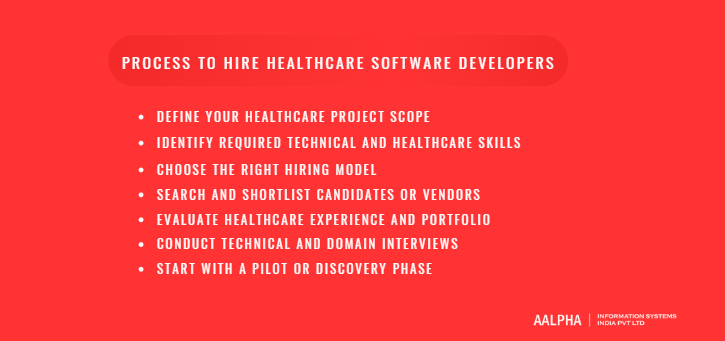
Step-by-Step Process to Hire Healthcare Software Developers
Hiring healthcare software developers requires a structured and methodical approach. Unlike conventional software recruitment, healthcare hiring involves evaluating technical expertise alongside domain understanding, regulatory awareness, and long-term product alignment. A rushed hiring decision can lead to compliance gaps, technical debt, security risks, and expensive redevelopment. Following a defined process helps healthcare organizations reduce uncertainty and identify development partners capable of delivering secure and scalable healthcare solutions.
-
Define Your Healthcare Project Scope
The hiring process should begin with a clearly defined healthcare project scope. Many organizations start recruitment before fully understanding what they intend to build, which often leads to changing requirements, inaccurate budgets, and mismatched developer selection.
The first step is defining product goals. Organizations should clarify the business and clinical objectives driving development. A telemedicine platform designed to expand rural healthcare access has different requirements than an AI diagnostic assistant or a hospital management system. Clear goals help developers understand project priorities and architectural needs.
User identification is equally important. Healthcare products typically involve multiple user groups, including patients, physicians, nurses, hospital administrators, insurance teams, and caregivers. Each audience interacts with software differently and requires tailored workflows and interfaces. Defining users early helps shape both technical and design requirements.
Compliance requirements should also be documented from the beginning. Healthcare applications often involve protected health information and therefore require privacy safeguards, consent management, secure storage, and audit capabilities. Identifying applicable regulations early prevents costly redesign later.
Feature definition completes the scoping process. Organizations should distinguish between essential functionality and future enhancements. Core features may include appointment booking, EHR access, payment processing, video consultations, or analytics. Prioritizing features enables more realistic hiring and development planning.
A clearly defined scope improves communication with candidates and vendors while helping organizations estimate timelines, costs, and required expertise more accurately.
-
Identify Required Technical and Healthcare Skills
After defining project scope, organizations must determine the skills required to execute it successfully. Healthcare development rarely depends on a single developer profile, making skill mapping an essential planning activity.
The first step involves identifying technical requirements. Different healthcare products demand different capabilities. A telemedicine platform may require video streaming expertise, secure APIs, and mobile development skills. EHR platforms may require interoperability expertise and database-heavy architecture. AI healthcare systems demand machine learning, analytics, and healthcare data processing capabilities.
Skill mapping should extend beyond programming languages and frameworks. Healthcare projects frequently require security engineering, cloud infrastructure management, DevOps, QA testing, UI/UX design, and integration expertise. Organizations should assess whether these capabilities are needed internally or through external partners.
Healthcare-specific skills are equally important. Developers should understand regulatory requirements, patient privacy expectations, healthcare workflows, and medical data standards. Teams lacking this expertise may build technically functional products that fail to meet clinical or operational requirements.
Team composition planning helps translate skill mapping into hiring decisions. Smaller projects may rely on full-stack developers or lean dedicated teams. More complex platforms often require specialized frontend developers, backend engineers, cloud architects, QA professionals, compliance specialists, and project managers.
A thoughtful assessment of technical and healthcare competencies prevents under-hiring, over-hiring, and costly capability gaps later in development.
-
Choose the Right Hiring Model
Once required skills are identified, organizations must select an appropriate hiring model. The right model depends on project complexity, timeline, internal expertise, and budget.
Short-term projects or specialized tasks may align with freelance engagement. Freelancers can provide flexibility and fast onboarding for narrowly defined work such as UI design or API development. However, they may not provide the continuity or domain expertise required for larger healthcare systems.
Dedicated development teams often work well for growing healthcare platforms requiring sustained collaboration and feature expansion. These teams function as long-term technical partners while remaining more scalable than internal hiring.
Healthcare software agencies are typically better suited for end-to-end development requiring architecture planning, compliance expertise, and managed delivery. Organizations lacking strong technical leadership may benefit from this structured approach.
In-house hiring becomes more practical when healthcare products represent core strategic assets requiring long-term ownership and internal knowledge retention.
Project characteristics should drive the decision rather than assumptions about cost alone. A simple patient engagement app may not require the same hiring structure as a multi-hospital interoperability platform.
Many organizations adopt hybrid approaches combining internal leadership with external delivery teams. Matching the hiring model to project requirements helps optimize speed, quality, and operational control.
-
Search and Shortlist Candidates or Vendors
After determining the hiring model, the next step involves identifying and shortlisting qualified candidates or vendors. Healthcare hiring requires targeted sourcing rather than broad technical recruitment.
Online hiring platforms can help locate developers and contractors with healthcare experience. However, technical profiles alone rarely reveal sufficient information about regulatory knowledge or clinical understanding. Organizations should review portfolios and domain-specific experience carefully.
Healthcare software agencies represent another sourcing channel. Specialized agencies often provide pre-assembled teams and healthcare delivery experience. While agencies may involve higher investment, they can significantly reduce recruitment effort and project risk.
Professional networks and healthcare technology communities are valuable but sometimes overlooked sources. Industry conferences, LinkedIn networks, healthtech associations, and technology forums frequently connect organizations with experienced healthcare developers and trusted partners.
Referrals often produce stronger candidates than open recruitment. Recommendations from hospitals, healthtech founders, investors, or healthcare technology leaders may provide access to developers with proven healthcare delivery experience.
Shortlisting should prioritize relevance rather than volume. Instead of reviewing dozens of general software profiles, organizations should identify a smaller group of candidates or vendors demonstrating clear healthcare expertise, communication ability, and technical alignment.
A disciplined shortlisting process improves hiring efficiency and increases the likelihood of finding qualified healthcare talent.
-
Evaluate Healthcare Experience and Portfolio
Healthcare development experience should be evaluated carefully before making hiring decisions. Strong technical resumes do not automatically indicate healthcare capability.
Case studies provide one of the most reliable evaluation tools. Organizations should review whether developers have delivered healthcare platforms similar in complexity or purpose to the proposed project. Experience building telemedicine systems, EHR platforms, AI healthcare tools, or hospital software may provide relevant indicators.
Healthcare product relevance matters more than generic development volume. A developer with extensive eCommerce experience may still struggle with healthcare interoperability or regulatory requirements. Organizations should prioritize experience involving patient workflows, medical information management, and healthcare system integrations.
Regulatory experience deserves particular attention. Candidates should demonstrate familiarity with privacy laws, secure architecture principles, healthcare documentation requirements, and compliance-driven design approaches.
Portfolio review should also examine usability, scalability, and technical sophistication. Products should show evidence of secure authentication, stable architecture, and user-centered healthcare workflows.
Rather than asking whether developers have worked in healthcare, organizations should ask how they addressed healthcare-specific challenges and what lessons emerged from prior projects.
A strong portfolio provides practical evidence of healthcare competence beyond marketing claims or interview performance.
-
Conduct Technical and Domain Interviews
Interviews should evaluate both technical ability and healthcare understanding. Traditional software interviews focused exclusively on coding challenges may overlook critical healthcare competencies.
Technical testing remains important. Developers should demonstrate architecture planning, secure coding practices, API development, database design, and relevant framework expertise. Assessments should reflect real healthcare scenarios rather than generic programming puzzles.
Compliance evaluation is equally necessary. Organizations should explore how candidates approach privacy, authentication, encryption, audit logging, and secure information exchange. Developers should explain how they would implement regulatory requirements within healthcare systems.
Problem-solving scenarios provide deeper insight into practical capability. Interviewers may present challenges such as integrating EHR systems, handling patient consent workflows, scaling telemedicine infrastructure, or responding to healthcare security incidents.
Communication should also be assessed during interviews. Healthcare projects involve collaboration with doctors, operational staff, compliance teams, and non-technical stakeholders. Developers who explain complex ideas clearly often perform better in multidisciplinary healthcare environments.
Technical interviews should therefore balance engineering evaluation with healthcare context and collaboration assessment.
-
Start With a Pilot or Discovery Phase
Before committing to full-scale engagement, organizations should consider starting with a pilot or discovery phase. This approach reduces hiring risk and validates team compatibility.
A pilot project may involve prototype development, architecture planning, workflow mapping, or limited feature delivery. These activities provide insight into technical capability, communication style, and problem-solving quality without requiring long-term commitment.
Discovery phases are particularly valuable for complex healthcare systems where requirements may evolve during planning. Early collaboration helps identify technical challenges, compliance considerations, and integration risks before significant resources are committed.
Pilot engagement also helps validate cultural and operational compatibility. Healthcare development involves sustained collaboration and trust. Teams that communicate effectively during early phases are generally better positioned for long-term success.
Risk reduction is one of the strongest advantages of this approach. Organizations can evaluate delivery quality, documentation practices, responsiveness, and strategic thinking under real working conditions.
Rather than viewing pilots as delays, healthcare organizations should see them as investment protection mechanisms. Starting with a structured discovery or pilot phase often leads to stronger partnerships, more realistic planning, and more successful healthcare software outcomes.
Questions to Ask Before Hiring Healthcare Software Developers
Hiring healthcare software developers involves more than verifying technical credentials. The interview and evaluation process should uncover how well candidates understand healthcare environments, manage compliance risks, design scalable systems, and collaborate with multidisciplinary teams. Asking the right questions helps organizations identify genuine healthcare expertise while avoiding costly hiring mistakes. The following areas provide a practical framework for evaluating healthcare developers and development partners.
-
Questions About Healthcare Experience
Healthcare experience should be one of the first areas explored during the evaluation process. Developers with prior healthcare exposure are generally better equipped to understand medical workflows, regulatory expectations, and user requirements.
Organizations should ask candidates about their previous healthcare projects and the specific role they played. Questions such as What healthcare platforms have you developed? or Can you describe a healthcare project similar to ours? help reveal relevant experience and technical involvement.
Domain familiarity should also be assessed beyond surface-level claims. Interviewers may ask how developers approached patient workflows, provider requirements, or healthcare integrations in past projects. Developers should be able to discuss challenges involving medical data, clinical usability, or healthcare operations rather than speaking only about technology stacks.
Additional questions may include Have you worked with hospitals, clinics, or healthtech startups? and What healthcare-specific problems did you solve? These discussions help determine whether candidates understand the operational realities of healthcare software development or are approaching the industry from a purely technical perspective.
-
Questions About Compliance and Security
Compliance and security questions are essential because healthcare applications handle highly sensitive patient information. Developers must demonstrate practical understanding of healthcare privacy and cybersecurity rather than relying on general security knowledge alone.
Organizations should ask directly about HIPAA or relevant healthcare regulations depending on project geography. Questions such as How have you implemented HIPAA-compliant systems? or What privacy controls do you typically include in healthcare applications? help evaluate regulatory familiarity.
Security architecture should also be examined in detail. Developers should explain how they approach encryption, authentication, secure API design, and access management. Useful questions include How do you secure patient information during transmission and storage? and What strategies do you use to prevent unauthorized access?
Incident response and security monitoring are equally important discussion areas. Asking How do you design audit logging and breach monitoring systems? provides insight into long-term security thinking.
Developers who provide detailed, process-oriented answers often demonstrate stronger healthcare security maturity than those offering vague or purely theoretical responses.
-
Questions About Technical Architecture
Technical architecture determines whether healthcare software remains reliable, scalable, and adaptable over time. Interview questions should therefore explore how developers design systems capable of supporting future growth and healthcare integration requirements.
Scalability is a critical discussion point. Healthcare platforms frequently evolve from limited deployments into systems supporting thousands of users and large volumes of medical data. Organizations may ask How would you scale a healthcare platform experiencing rapid growth? or How do you design infrastructure to support increased patient and provider activity?
Integration capability deserves equal attention. Healthcare environments depend heavily on interoperability between EHR systems, laboratories, pharmacies, insurance providers, and third-party services. Questions such as Have you worked with HL7 or FHIR integrations? and How do you approach complex healthcare API integrations? help assess practical interoperability experience.
Architecture discussions should also address reliability and system resilience. Candidates may be asked how they handle downtime prevention, backup strategies, and performance optimization for healthcare environments where system availability is critical.
Strong technical candidates typically explain architectural decisions in terms of both technical performance and healthcare operational impact.
-
Questions About Team and Communication
Healthcare software projects involve collaboration across technical and non-technical teams. Developers rarely work in isolation, making communication and workflow management important hiring considerations.
Organizations should begin by understanding how developers organize work and manage project communication. Questions such as What development workflow do you typically follow? and How do you manage changing requirements? help reveal process maturity.
Reporting practices should also be discussed. Healthcare organizations often need regular visibility into project progress, compliance activities, and risk management. Asking How do you provide project updates and status reporting? helps clarify communication expectations early.
Collaboration with multidisciplinary stakeholders is another important area. Developers may need to work closely with physicians, nurses, compliance officers, product managers, and administrators. Questions such as How do you gather requirements from medical stakeholders? or Describe a situation where you resolved conflicting stakeholder priorities can reveal problem-solving and interpersonal capabilities.
Technical expertise alone does not guarantee project success. Teams that communicate transparently and collaborate effectively generally deliver stronger healthcare outcomes.
-
Questions About Post-Launch Support
Hiring decisions should consider the full software lifecycle rather than focusing only on initial development. Healthcare systems require ongoing maintenance, monitoring, and optimization after deployment.
Organizations should ask candidates what happens after launch. Questions such as Do you provide post-deployment maintenance and support? and How do you manage bug fixes and software updates? help clarify long-term engagement expectations.
Service Level Agreements (SLAs) are particularly important for healthcare platforms where downtime may affect patient care or operational continuity. Interviewers should ask about response times, escalation procedures, and support availability during critical incidents.
Ongoing optimization should also be discussed. Healthcare software often evolves through new features, security updates, compliance modifications, and performance improvements. Questions like How do you support product evolution after launch? and What monitoring tools and performance metrics do you use? help assess long-term technical commitment.
Developers or vendors with structured post-launch processes are generally better positioned to support healthcare organizations as their systems and operational requirements continue to grow.
Cost of Hiring Healthcare Software Developers
The cost of hiring healthcare software developers varies widely depending on project complexity, technical requirements, geography, and regulatory obligations. Healthcare software development generally costs more than conventional software development because it demands specialized expertise, strong security practices, and healthcare domain knowledge. Organizations evaluating budgets should therefore look beyond hourly rates and consider the full cost of delivering secure, compliant, and scalable healthcare solutions.
Factors Affecting Hiring Costs
Several factors influence the cost of hiring healthcare software developers, and understanding these variables helps organizations budget more accurately.
Developer experience is one of the biggest cost drivers. Junior developers may charge lower rates but often require supervision and may lack healthcare-specific expertise. Senior healthcare developers with experience in interoperability, security, and clinical systems command higher rates because they reduce project risk and accelerate delivery.
Project complexity also significantly affects pricing. A basic patient scheduling app requires fewer resources than an enterprise hospital platform integrating EHR systems, medical devices, and analytics. Advanced workflows, AI functionality, and multi-platform support naturally increase development effort and cost.
Geography influences pricing as well. Developer rates vary considerably across regions due to labor costs, market demand, and talent availability. Organizations often balance cost considerations with communication and operational requirements when selecting development locations.
Compliance requirements create another major cost variable. Healthcare projects involving HIPAA, GDPR, medical device regulations, or advanced security controls require additional planning, testing, documentation, and validation. Compliance expertise increases development investment but helps avoid far more expensive legal and operational problems later.
Healthcare software budgets should therefore be based on total project complexity and risk rather than developer rates alone.
Hourly Rates by Region and Developer Type
Healthcare developer pricing differs substantially across global markets and hiring models. While rates fluctuate depending on expertise and specialization, regional comparisons provide useful budgeting benchmarks.
In the United States, healthcare software developers typically command some of the highest rates. Senior developers and healthcare specialists may charge anywhere between $100 and $250+ per hour, particularly when working on regulated healthcare platforms, enterprise systems, or AI-driven solutions. In-house hiring in the US may involve even higher total costs once salaries, benefits, and recruitment expenses are included.
European developer rates vary by region. Western European healthcare developers often charge between $70 and $180 per hour, while Eastern European markets may offer more moderate pricing ranging from $40 to $100 per hour. Many organizations choose European talent for a balance of technical expertise and proximity.
India remains one of the most prominent destinations for healthcare software outsourcing. Experienced healthcare developers and dedicated teams commonly range between $25 and $80 per hour, depending on technical specialization and vendor maturity. Many healthcare organizations use Indian teams to access specialized expertise while maintaining cost efficiency.
Developer type also affects pricing. Freelancers may offer lower hourly rates but often work independently with limited scalability. Agencies generally charge higher rates because they provide managed delivery, project management, QA, and multidisciplinary expertise. In-house teams may appear cost-effective over long periods but involve substantial recruitment, infrastructure, and retention expenses.
Comparing hourly rates alone can therefore be misleading without evaluating delivery capability and project scope.
Cost by Healthcare Project Type
Healthcare project type has a direct influence on hiring and healthcare product development costs because different systems involve different technical and regulatory requirements.
Telemedicine platforms are often considered moderate-complexity healthcare products. These systems usually involve video consultations, scheduling, secure communication, and payment integrations. Depending on features and scale, development may require moderate investment and specialized security expertise.
EMR and EHR systems are generally more expensive because they involve extensive patient data management, interoperability requirements, and clinical workflow complexity. These platforms frequently require advanced integration capabilities and strong compliance controls.
AI healthcare platforms can represent some of the most expensive healthcare projects. Predictive analytics, diagnostic support systems, medical imaging analysis, and intelligent automation require machine learning expertise, healthcare datasets, cloud infrastructure, and rigorous testing. AI systems often demand highly specialized development teams.
Hospital management systems also involve significant investment due to their operational complexity. These platforms may include admissions, pharmacy management, laboratory workflows, billing, inventory management, and staff coordination. Large-scale hospital systems typically require multidisciplinary teams and longer development timelines.
Project scope and feature depth often matter more than category alone when estimating healthcare software costs.
Hidden Costs of Hiring Healthcare Developers
Many healthcare organizations underestimate hiring costs by focusing only on development pricing while overlooking secondary expenses.
Recruitment itself creates cost. Internal hiring involves sourcing, interviewing, onboarding, and training expenses that may delay development and increase overhead. Even outsourced projects require time spent evaluating and managing vendors.
Project delays represent another hidden cost. Poor hiring decisions, unclear communication, or inexperienced teams can extend timelines and create revenue losses or missed market opportunities. Delays frequently cost more than the difference between low-cost and experienced developers.
Compliance remediation can become especially expensive. Systems developed without proper healthcare expertise may require major redesign to address privacy gaps, security weaknesses, or regulatory failures. Retrofitting compliance after deployment is typically far more expensive than building securely from the start.
Infrastructure and operational costs are also commonly overlooked. Healthcare applications require hosting, monitoring, backup systems, cloud services, cybersecurity tools, and performance optimization. These ongoing expenses continue beyond initial development.
Understanding these hidden costs helps organizations evaluate hiring decisions more realistically and avoid misleadingly low project estimates.
Cost Optimization Without Compromising Quality
Healthcare organizations can manage development costs effectively without sacrificing quality or compliance by adopting smarter hiring strategies.
Smart outsourcing remains one of the most effective approaches. Partnering with experienced healthcare development teams in cost-efficient regions often provides access to specialized expertise while maintaining delivery standards.
Dedicated teams can also improve cost efficiency because they provide continuity and scalability without requiring extensive internal hiring infrastructure. Long-term collaboration frequently reduces onboarding and coordination costs.
An MVP strategy is another proven optimization method. Rather than building enterprise-scale platforms immediately, organizations can launch core functionality first, validate assumptions, and expand gradually. This approach reduces financial exposure and supports more informed investment decisions.
Cost optimization in healthcare development should focus on maximizing long-term value rather than minimizing initial spend. Lower pricing rarely compensates for weak architecture, compliance failures, or unreliable delivery when patient data and healthcare operations are involved.
Common Mistakes to Avoid When Hiring Healthcare Developers
Hiring healthcare software developers is a high-impact decision that affects product quality, compliance, security, and long-term business performance. While many organizations focus heavily on timelines and budgets, they often overlook factors that determine whether a healthcare project succeeds or struggles after deployment. Avoiding common hiring mistakes can reduce risk, protect investment, and improve the chances of building secure and scalable healthcare solutions.
-
Hiring Based Only on Cost
One of the most common hiring mistakes is choosing developers solely based on the lowest price. While budget management is important, healthcare software development involves specialized requirements that cannot be evaluated through cost alone.
Low-cost developers may lack healthcare experience, regulatory understanding, or the technical depth required for secure and scalable systems. In some cases, organizations initially save money but later face higher expenses caused by poor architecture, missed deadlines, rework, or security vulnerabilities.
Healthcare software often supports critical workflows and sensitive patient data. A poorly designed platform can create operational disruptions and increase legal or reputational risk. Cost-driven hiring decisions may therefore create hidden expenses far exceeding the original savings.
Organizations should evaluate total value rather than hourly rates alone. Experience, delivery capability, healthcare expertise, and long-term reliability frequently provide stronger returns than the lowest initial pricing.
-
Ignoring Healthcare Domain Expertise
Another major mistake is assuming that strong general software developers can automatically handle healthcare projects. Although technical skills remain essential, healthcare software development requires industry-specific knowledge that many general developers may not possess.
Healthcare systems operate within complex clinical and operational environments. Developers must understand how providers document care, how patients move through treatment workflows, and how healthcare organizations manage information exchange and operational processes.
Ignoring healthcare domain expertise often leads to products that are technically functional but poorly aligned with clinical reality. Complicated interfaces, inefficient workflows, and impractical system design can reduce adoption among medical professionals and create operational inefficiencies.
Organizations should therefore prioritize developers with relevant healthcare exposure or proven experience working on medical platforms, patient applications, or healthcare integrations. Domain familiarity reduces misunderstandings and helps ensure software reflects real-world healthcare needs rather than purely technical assumptions.
-
Overlooking Compliance Knowledge
Compliance failures remain one of the most expensive risks in healthcare software development. Yet many organizations fail to evaluate regulatory knowledge adequately during the hiring process.
Healthcare applications handling patient information must comply with privacy and security requirements such as HIPAA, GDPR, and other regional regulations. Compliance influences architecture, authentication, consent management, data storage, and access controls.
Developers lacking compliance understanding may unintentionally create systems exposing organizations to regulatory penalties or legal complications. Problems often emerge late in development or after launch, when remediation becomes far more costly.
Organizations should not assume compliance can be added later as a separate activity. Instead, developers should understand how regulatory requirements influence system design from the beginning.
Interview processes should therefore include specific questions about healthcare privacy, audit logging, secure information handling, and prior compliance-related work. Verifying this expertise early reduces both technical and legal risk.
-
Failing to Verify Security Practices
Security verification is another area frequently overlooked during hiring. Many organizations ask whether developers understand security but fail to examine how they actually implement it.
Healthcare data is highly sensitive and increasingly targeted by cyberattacks. Developers responsible for healthcare systems must demonstrate practical cybersecurity capabilities rather than relying on generic claims of secure coding.
Organizations should evaluate how candidates approach encryption, secure authentication, role-based access control, API security, monitoring, and breach prevention. Security should be embedded into development processes rather than treated as a final-stage checklist.
Failure to verify security practices can result in serious consequences, including ransomware attacks, unauthorized access, data exposure, and operational disruption. Beyond financial losses, security incidents may damage patient trust and healthcare reputation.
Practical security discussions, architecture reviews, and technical assessments help organizations confirm whether developers possess real-world security competence appropriate for healthcare environments.
-
No Long-Term Support Planning
Many healthcare organizations focus heavily on launch while giving insufficient attention to long-term maintenance and support. This creates problems once systems enter production and require ongoing updates.
Healthcare software is rarely static. Regulatory requirements evolve, security threats change, user expectations grow, and clinical workflows adapt over time. Systems therefore require continuous maintenance, monitoring, optimization, and feature enhancement.
Organizations that fail to plan for post-launch support may struggle with unresolved bugs, outdated infrastructure, and delayed security patches. Support uncertainty can become particularly problematic for applications supporting patient services or hospital operations where downtime carries serious implications.
Hiring decisions should therefore include clear discussions about maintenance responsibilities, Service Level Agreements (SLAs), update procedures, and long-term collaboration models.
Healthcare software should be viewed as an evolving operational asset rather than a one-time development project. Teams capable of supporting products beyond launch often provide significantly greater long-term value and operational stability.
Why Choose the Right Healthcare Development Partner
Selecting the right healthcare software development company or partner can significantly influence the success of a healthcare technology initiative. Beyond technical execution, healthcare software development requires industry knowledge, regulatory understanding, long-term thinking, and the ability to deliver reliable solutions within complex clinical environments. Organizations that choose experienced healthcare partners are often better positioned to reduce risk, accelerate delivery, and build products capable of supporting both patient and business needs.
-
Importance of Industry Experience
Industry experience is one of the strongest indicators of a healthcare development partner’s capability. Healthcare environments operate differently from most industries, involving complex workflows, privacy obligations, and high expectations around reliability and usability.
Partners with healthcare experience understand how clinicians, administrators, and patients interact with technology. They are more familiar with challenges such as workflow efficiency, medical documentation, patient engagement, and interoperability requirements. This experience often leads to better product planning and fewer misunderstandings during development.
Healthcare experience also helps teams anticipate common implementation challenges before they become costly problems. Developers who have previously built healthcare systems tend to make stronger architectural and usability decisions because they understand the operational realities of medical environments.
Choosing a partner with proven healthcare delivery experience often reduces project uncertainty and improves overall execution quality.
-
End-to-End Healthcare Development Capability
Healthcare software development frequently involves more than coding. Projects may require research, product strategy, architecture planning, UX design, development, testing, deployment, and post-launch optimization. Partners with end-to-end capability can manage these interconnected activities more effectively.
An end-to-end approach reduces coordination challenges that often occur when organizations work with multiple disconnected vendors or contractors. Unified teams typically maintain stronger communication, clearer accountability, and more consistent development standards.
Healthcare projects also benefit from multidisciplinary collaboration. Product strategists, designers, engineers, QA specialists, and infrastructure experts contribute different perspectives that improve software quality and reliability.
This capability becomes especially valuable for healthcare startups and providers building complex platforms such as telemedicine systems, patient portals, AI healthcare tools, or hospital management solutions. Partners capable of managing the full software lifecycle can often accelerate delivery while maintaining technical and operational consistency.
-
Security and Compliance Expertise
Security and compliance should be central evaluation criteria when selecting a healthcare development partner. Healthcare applications manage highly sensitive information and must operate within strict legal and regulatory frameworks.
Experienced healthcare partners understand how to build systems with privacy and security embedded into architecture rather than added later as isolated controls. They typically implement secure authentication, role-based access management, encryption, audit logging, and secure API practices as part of standard delivery processes.
Compliance expertise is equally important. Partners familiar with HIPAA, GDPR, healthcare privacy standards, and regional regulations can help organizations avoid costly remediation and regulatory exposure. They are often better prepared to manage documentation, validation, and compliance-related development requirements.
Security and compliance maturity help protect patient information while creating stronger foundations for sustainable healthcare software growth.
-
Long-Term Product and Support Vision
Healthcare software should be viewed as a long-term operational asset rather than a short-term project. Clinical requirements, security threats, regulations, and user expectations continue to evolve after launch, making ongoing support and strategic planning essential.
Strong healthcare partners understand this reality and approach development with long-term sustainability in mind. They design systems that can scale, adapt, and support future integration or expansion requirements.
Long-term vision also involves maintenance, monitoring, performance optimization, and continuous improvement. Healthcare organizations benefit from partners who remain engaged beyond deployment and provide structured support processes.
Without long-term planning, software may become difficult to maintain or unable to evolve alongside healthcare operational needs. Partners focused on lifecycle management often deliver greater stability and stronger long-term value.
-
Why Businesses Work With Experienced Healthcare Technology Partners
Organizations often choose experienced healthcare technology partners because healthcare software development involves risks and complexities that extend beyond technical implementation. Experienced partners bring proven workflows, regulatory awareness, and healthcare-specific problem-solving capabilities that reduce uncertainty throughout development.
These partnerships often accelerate time to market while improving software quality and operational readiness. Experienced teams can identify challenges earlier, recommend practical solutions, and support better decision-making during planning and execution.
Businesses also value partners capable of aligning technical delivery with healthcare outcomes rather than focusing only on feature development. For this reason, many healthcare organizations work with established healthcare-focused technology companies such as Aalpha that combine software engineering expertise with healthcare domain understanding and long-term delivery capability.
The right healthcare development partner does more than build software. They contribute expertise, strategic guidance, and execution discipline that help organizations create secure, scalable, and clinically relevant healthcare solutions.
Conclusion
Hiring healthcare software developers requires balancing technical expertise with healthcare domain knowledge, regulatory understanding, and long-term product vision. The right developers or development partners can help healthcare organizations build secure, scalable, and user-focused solutions while reducing compliance and operational risks.
Whether you are building a telemedicine platform, modernizing healthcare systems, or developing AI-driven healthcare tools, careful hiring decisions play a major role in project success. Working with experienced healthcare technology teams can simplify development and improve outcomes.
If you are planning a healthcare software project and need expert guidance, connecting with an experienced healthcare development partner like us can help you move forward with greater confidence and clarity.