






Clone App Development: TL;DR
Clone apps are custom-built platforms inspired by successful business models (Uber, Airbnb, DoorDash, Amazon, etc.), not copies. They reduce product discovery risk and accelerate time-to-market because users already understand the category and the basic user flow is proven.
Key differences: Clone apps are custom-built (unlike white-label platforms which are fixed, rigid templates). They support localized pricing, vendor rules, commission logic, multi-role workflows, and operational customization. Unlike fully custom apps built from scratch, clone apps leverage an existing playbook to move faster.
Common types: Taxi booking, food delivery, grocery delivery, eCommerce marketplaces, accommodation booking, social media, on-demand services, and fintech platforms.
Development includes: Separate customer apps, provider/vendor apps (restaurant panels, driver apps, host panels), admin dashboards, secure backend systems, real-time features (GPS tracking, live order updates), payment handling, notifications, ratings, analytics, and third-party integrations (maps, SMS, payment gateways).
Costs vary: Basic MVP (limited features, simple UI, ~$20-40K) to mid-level (multiple roles, custom design, real-time features, ~$60-120K) to advanced (AI, multi-language, high scalability, compliance, $150K+). Offshore development teams can reduce costs 40-60% versus US/UK-based teams. Hidden costs include hosting, payment processing, SMS/email, analytics tools, and ongoing maintenance.
Legal requirements: Original code (never copied source), unique branding and design, licensed APIs, data privacy compliance (GDPR, CCPA), and industry-specific regulations (fintech KYC, healthcare HIPAA, taxi driver verification). Clone app does not mean legal copy.
Challenges: Scalability, real-time feature reliability, payment/refund logic, user trust and safety systems, app store approval, and continuous maintenance after launch.
Why professional development matters: Clone apps are complete digital platforms requiring backend architecture, multiple user roles, operational workflows, security, and long-term support, not just mobile app screens. Working with experienced development partners like Aalpha helps define MVP scope, choose suitable tech stacks, design original UX, build secure systems, integrate payments/APIs, ensure compliance, and provide post-launch technical support.
Success depends on customization around real business operations, not on copying appearance. A well-built clone app launches faster, reduces early planning risk, and scales gradually with new features.
Clone app development is the process of building a mobile or web application based on the core idea, business model, and functional flow of an already successful digital platform. Instead of starting with a completely unknown concept, businesses use an existing app model as a reference and then create their own customized version with original branding, design, features, technology architecture, and monetization logic. For example, a business may want to build an Uber-like taxi booking app, an Airbnb-like rental marketplace, a DoorDash-like food delivery platform, or an Amazon-like eCommerce marketplace. In each case, the goal is not to copy the original product, but to create a similar business solution adapted to a specific market, audience, and operational requirement.
Businesses choose clone app development because it reduces many of the uncertainties involved in launching a digital product. A successful reference app already proves that users understand the model, there is demand in the market, and the basic user journey works. This gives startups and enterprises a clearer foundation for planning their own platform. Instead of spending months validating every part of the idea from scratch, businesses can study what already works, identify gaps in the existing market, and launch a tailored version faster. Clone apps are especially useful for industries such as taxi booking, food delivery, grocery delivery, online marketplaces, social networking, healthcare, fintech, logistics, and on-demand services, where the user flow and revenue models are already familiar to customers.
Another major reason businesses prefer clone apps is faster time to market. Since the main concept, user roles, feature categories, and transaction flows are already known, the development team can move quickly from planning to design and development. This can reduce product discovery effort, shorten the MVP timeline, and help businesses test their app with real users earlier. It also makes investor presentations, internal planning, and stakeholder discussions easier because the business model can be explained with a known market reference.
However, clone app development does not mean creating an exact copy of another app. A legally developed clone app should never copy source code, logos, trademarks, brand names, copyrighted content, proprietary UI screens, or protected business assets. It should be built as an original product inspired by a proven app model. The design, user experience, backend logic, features, content, and branding must be customized. The most successful clone apps are not duplicate versions of popular platforms. They are improved, localized, and business-ready solutions that take inspiration from a proven idea while solving specific problems for a new market.
What Is a Clone App?
Simple Definition of a Clone App
A clone app is a mobile or web application built using the core business model and functional structure of an existing successful platform as a reference. In simple business terms, it means creating an app similar to a proven digital product, but with your own brand, design, features, user experience, pricing rules, and market-specific requirements. For example, a company may want to build an Uber-like ride-hailing app for a local transport market, an Airbnb-like rental booking platform for holiday homes, or a DoorDash-like food delivery app for restaurants in a specific city or region. The original app acts as a reference point, while the final product is developed as a separate, customized business platform.
Clone App vs Custom App
A clone app is different from a fully custom app. In custom app development, the idea may be completely new, and the development team usually starts from the ground up by defining the business model, user journeys, features, monetization strategy, workflows, and technology architecture. This approach is useful when the product is highly unique or when the business is solving a problem that does not already have a clear digital model. Clone app development, on the other hand, starts with an existing app concept that users already understand. The development team studies the reference platform, identifies its main features and user roles, and then builds a customized version for the client’s business. This usually makes planning faster because the product structure is already easier to visualize.
Clone App vs White-Label App
A clone app is also different from a white-label app. A white-label app is usually a ready-made software product that is rebranded and sold to multiple businesses. The design, features, backend flow, and flexibility may be limited because the same base product is used by many clients. A clone app is often more flexible because it can be custom-built according to the business model, target market, revenue plan, operational process, and future growth requirements. For example, a food delivery startup may need custom commission rules, restaurant settlements, delivery zones, driver assignment logic, refund workflows, and local payment methods. These requirements are difficult to manage with a rigid white-label system but can be handled better through custom clone app development.
Examples of Clone App Models
There are many popular clone app models across the US, UK, European, and Middle East markets. In the ride-hailing segment, businesses often refer to Uber, Lyft, Bolt, Careem, and Free Now-style apps. In accommodation and travel booking, Airbnb, Booking.com, Vrbo, and Plum Guide are common reference models. In food delivery, DoorDash, Uber Eats, Deliveroo, Just Eat, Talabat, HungerStation, and Wolt-style apps are widely used as examples. In eCommerce and marketplace development, Amazon, eBay, Etsy, Noon, Zalando, and Farfetch are popular models. Social and communication app references include Instagram, TikTok, Snapchat, Telegram, and WhatsApp-style platforms. These examples show how clone app development can be used across industries, but the final app must always be legally built, market-ready, and customized for the business that owns it.
How Clone App Development Works
-
Business Model Analysis
Clone app development starts with a detailed analysis of the reference app’s business model. The development team studies how the original platform works, who the main users are, how transactions happen, how revenue is generated, and what operational systems support the app in the background. For example, a ride-hailing clone app may include passengers, drivers, fleet owners, and admins, while a food delivery clone app may include customers, restaurants, delivery partners, and platform managers. Each user role has a different purpose, workflow, and feature requirement. The team also studies monetization methods such as commissions, subscription plans, service charges, listing fees, delivery fees, advertising, premium access, or transaction-based revenue. This step helps the business understand whether the app should follow the same model as the reference platform or adapt it for a specific market, region, or customer segment.
-
Feature Mapping
After the business model is clear, the next step is feature mapping. Not every feature from the reference app needs to be included in the first version. A strong clone app development plan separates features into must-have, good-to-have, and future-phase requirements. Must-have features are essential for the app to function, such as user registration, search, booking or ordering, payments, notifications, admin management, and basic reporting. Good-to-have features may include coupons, reviews, chat, loyalty programs, multi-language support, or wallet options. Future-phase features may include AI recommendations, advanced analytics, dynamic pricing, automation, subscription plans, or multi-country support. This structure helps businesses launch with a practical MVP instead of spending too much time and budget on features that may not be required on day one.
-
UI/UX Planning
UI/UX planning is a critical part of clone app development because the app should not look like a direct copy of the reference platform. The design must be original, brand-specific, and suitable for the target users. A good design process includes user journey mapping, wireframes, clickable prototypes, visual design, and usability testing. The app’s colors, typography, icons, screen layouts, navigation flow, and content style should match the business identity. For example, a luxury travel booking app will need a very different design approach from a budget food delivery app, even if both are inspired by successful platforms. The main goal is to make the app familiar enough for users to understand quickly, but original enough to create a separate brand identity.
-
Technology Selection
Once the features and design direction are finalized, the development team selects the technology stack. This includes choosing the mobile app framework, backend language, database, cloud hosting platform, APIs, and third-party integrations. For mobile apps, businesses may choose native development using Swift and Kotlin or cross-platform frameworks such as Flutter and React Native. Backend systems may be built using Node.js, Python, Laravel, Java, .NET, or other technologies depending on performance, scalability, and integration needs. The database may include PostgreSQL, MySQL, MongoDB, Redis, or Firebase based on the app’s data structure. Clone apps may also need integrations for payments, maps, SMS, email, WhatsApp, analytics, identity verification, cloud storage, and customer support tools.
-
Development, Testing, and Launch
The final stage includes development, testing, deployment, and launch. Developers build the frontend apps, backend APIs, admin dashboards, web panels, databases, and integrations according to the approved scope. Quality assurance teams then test the app across different devices, browsers, user roles, payment flows, and real-life scenarios. Testing usually includes functional testing, performance testing, security testing, usability testing, and bug fixing before launch. Once the app is stable, it is deployed to cloud servers and submitted to the App Store and Google Play Store if mobile apps are included. After launch, the work continues with monitoring, user feedback, bug fixes, performance optimization, and new feature releases. This complete process turns a proven app concept into a customized, legally built, and business-ready digital product.
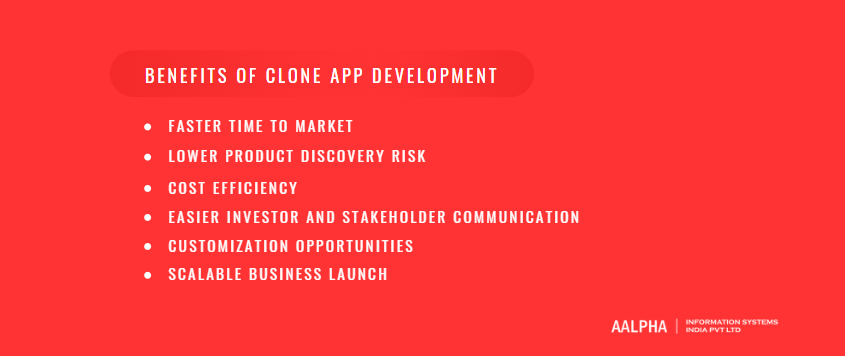
Benefits of Clone App Development
-
Faster Time to Market
One of the biggest benefits of clone app development is faster time to market. When a business builds an app from a proven reference model, the basic concept, user flow, feature structure, and monetization approach are already easier to understand. The development team does not need to spend excessive time defining every workflow from scratch because the reference app provides a clear direction. For example, a DoorDash-like food delivery app already has familiar user roles such as customers, restaurants, delivery partners, and admins. Similarly, an Uber-like ride-hailing app already has clear flows for ride booking, driver assignment, fare calculation, live tracking, and payments. This helps the team move faster from planning to wireframes, development, testing, and launch.
-
Lower Product Discovery Risk
Clone app development also reduces product discovery risk because businesses can learn from an app category that has already been tested in the market. A successful reference platform shows that users are willing to use that type of service, pay for it, and return to it when the experience is convenient. This does not mean every clone app will succeed automatically, but it gives businesses a stronger starting point. Instead of guessing whether users understand the model, businesses can focus on improving the experience, pricing, local availability, service quality, and operational execution. For startups, this is especially valuable because early-stage decisions can be based on proven market behavior rather than assumptions alone.
-
Cost Efficiency
Clone app development can be cost-efficient because many important decisions are already guided by the reference model. The business does not need to spend heavily on lengthy concept discovery, uncertain feature experiments, or unclear product flows in the initial stage. User roles, app screens, transaction flows, and revenue models can be planned faster because similar platforms have already established a working structure. For example, an Airbnb-like app will usually need guest profiles, host profiles, property listings, availability calendars, booking requests, payments, reviews, and admin controls. A clear feature structure helps the development team estimate scope, timeline, and cost more accurately. It also helps businesses avoid unnecessary features in the first version and focus on what is required for launch.
-
Easier Investor and Stakeholder Communication
Clone apps are easier to explain to investors, internal teams, and business stakeholders because the reference model is already familiar. When a founder says they are building an Uber-like platform for a specific transport niche or an Airbnb-like booking app for a regional market, stakeholders can quickly understand the basic idea. This improves pitch clarity and reduces the time needed to explain the product from zero. It also helps during budget discussions, product planning, sales presentations, and partnership meetings. A known reference model gives everyone a common understanding of the app’s purpose, while the business can highlight how its version will be different through better pricing, niche targeting, local operations, stronger service quality, or unique features.
-
Customization Opportunities
A clone app does not have to follow the reference platform exactly. In fact, the real value comes from customization. Businesses can modify the app for a specific industry, geography, audience, language, pricing model, compliance requirement, or operational process. A food delivery clone app for the Middle East may need Arabic language support, cash-on-delivery options, restaurant-specific commission rules, and local payment gateways. A ride-hailing clone app for Europe may need stricter driver verification, VAT handling, region-wise regulations, and privacy-focused data management. An eCommerce clone app for the UK or US may need seller onboarding, tax logic, delivery partner integrations, refund workflows, and loyalty programs. This flexibility allows businesses to build a platform that reflects their market reality instead of simply duplicating another company’s product.
-
Scalable Business Launch
Clone app development also supports scalable business launch. A business can begin with an MVP development that includes only the core features required to test the market, then expand the platform based on customer feedback and revenue growth. For example, a marketplace app may start with buyer registration, seller listings, search, checkout, payments, and admin management. Later, it can add seller subscriptions, promoted listings, AI-based recommendations, loyalty programs, advanced analytics, mobile apps, and multi-country support. This phased approach helps businesses control initial investment while still building a foundation for growth. A well-developed clone app can start as a focused MVP and gradually become a complete business platform with advanced features, stronger automation, better reporting, and larger market coverage.
Popular Types of Clone Apps
-
Taxi Booking Clone Apps
Taxi booking clone apps are among the most common types of clone app development projects because the ride-hailing model is already familiar to users across the US, UK, Europe, and the Middle East. Apps inspired by Uber, Lyft, Bolt, Careem, and Free Now usually include separate interfaces for passengers, drivers, and administrators. The customer app allows users to enter pickup and drop-off locations, view estimated fares, select vehicle types, track drivers in real time, make payments, and rate the ride. The driver app includes trip requests, navigation, earnings, availability status, ride history, and payout details. The admin panel manages users, drivers, vehicles, fares, commissions, service areas, cancellations, disputes, and reports. Important features include GPS tracking, route optimization, fare calculation, surge pricing, wallet support, driver verification, and automated trip assignment.
-
Food Delivery Clone Apps
Food delivery clone apps are built for businesses that want to launch platforms similar to DoorDash, Uber Eats, Deliveroo, Just Eat, Talabat, HungerStation, or Wolt. These apps usually require four major components: a customer app, restaurant panel, delivery partner app, and admin dashboard. Customers can browse restaurants, search dishes, view menus, apply offers, place orders, make payments, and track delivery status. Restaurants can accept orders, manage menus, update item availability, set preparation time, view earnings, and handle order history. Delivery partners receive pickup and drop-off tasks, follow navigation, update delivery status, and track their earnings. The admin dashboard controls restaurant onboarding, commissions, delivery zones, refunds, promotions, customer support, payment settlements, and analytics. A food delivery clone app must be built around operational accuracy because late deliveries, incorrect availability, poor restaurant coordination, or weak driver assignment can directly affect customer retention.
-
Grocery Delivery Clone Apps
Grocery delivery clone apps are designed for businesses that want to offer scheduled or instant delivery of groceries and daily essentials. Popular reference models include Instacart, Gopuff, Getir, Gorillas, Ocado, and Carrefour-style grocery platforms. These apps need strong inventory handling because customers expect real-time product availability, accurate pricing, substitutions, and delivery slot visibility. A typical grocery delivery clone app includes customer apps, store panels, picker or delivery staff apps, inventory management systems, and admin dashboards. Customers can search products, add items to cart, choose delivery slots, make payments, and receive order updates. Stores can manage stock, product categories, pricing, offers, packing status, and unavailable items. Admins can control service locations, delivery charges, order allocation, refunds, customer complaints, and store-wise performance. Grocery clone app development requires careful planning around inventory sync, low-stock alerts, order batching, delivery scheduling, and real-time availability.
-
eCommerce Marketplace Clone Apps
eCommerce marketplace clone apps are used by businesses that want to build platforms similar to Amazon, eBay, Etsy, Noon, Zalando, Farfetch, or ASOS Marketplace. These apps connect buyers and sellers through a managed digital marketplace. The buyer side includes product browsing, search, filters, product details, cart, wishlist, checkout, payments, order tracking, returns, and reviews. The seller side includes product uploads, inventory, pricing, order management, shipping updates, seller earnings, and customer communication. The admin panel handles seller approvals, commissions, product moderation, disputes, refunds, logistics integrations, tax settings, and marketplace reports. Unlike a single-vendor eCommerce app, marketplace clone development needs strong vendor management and commission logic. It also requires product catalog controls, scalable search, secure checkout, shipping partner integration, return management, and fraud prevention.
-
Accommodation Booking Clone Apps
Accommodation booking clone apps are built for travel, rental, and hospitality businesses that want platforms similar to Airbnb, Booking.com, Vrbo, Plum Guide, or Sonder. These platforms usually include guest apps, host panels, booking management systems, and admin dashboards. Guests can search stays by destination, date, price, property type, amenities, ratings, and availability. Hosts can list properties, upload photos, manage pricing, update availability calendars, set booking rules, approve or reject bookings, and track payouts. Admins can manage users, listings, commissions, cancellations, refunds, verification, disputes, and reviews. These apps need accurate calendar management because double bookings can damage trust. They may also include seasonal pricing, cleaning fees, deposits, location-based search, identity verification, secure messaging, and review moderation. A successful accommodation booking clone app must balance convenience for guests with operational control for hosts and platform owners.
-
Social Media Clone Apps
Social media clone apps are inspired by platforms such as Instagram, TikTok, Snapchat, Twitter/X, Facebook, Reddit, Telegram, and Discord. These apps focus on user-generated content, community engagement, profiles, feeds, messaging, and media sharing. A basic social media clone app may include user profiles, follow or friend systems, posts, likes, comments, shares, notifications, direct messaging, stories, hashtags, and search. Video-based apps may require short video uploads, editing tools, music integration, recommendation feeds, and content moderation. Community-based apps may include groups, channels, forums, threaded conversations, admin roles, and reporting tools. Social media clone development is technically demanding because the app must handle large media files, fast feeds, privacy settings, abuse reporting, spam prevention, and scalable cloud storage. Moderation is especially important because user-generated content can create legal, brand, and safety risks if not managed properly.
-
On-Demand Service Clone Apps
On-demand service clone apps are built for businesses that connect customers with service providers. Common reference models include TaskRabbit, Thumbtack, Handy, Angi, Rover, and Helpling-style platforms. These apps can be used for home cleaning, repairs, beauty services, pet care, moving help, handyman jobs, tutoring, fitness training, and other local services. Customers can search services, compare providers, check availability, book slots, make payments, track job status, and leave reviews. Service providers can manage profiles, availability, service categories, pricing, bookings, earnings, and customer communication. Admins control provider verification, service listings, commission rules, refunds, cancellations, complaints, and reports. A strong on-demand service clone app must handle scheduling, provider matching, location coverage, pricing rules, trust signals, and customer support. Since service quality depends heavily on individual providers, verification, ratings, and dispute handling are critical.
-
Fintech Clone Apps
Fintech clone apps include digital wallets, payment apps, lending apps, investment apps, neobanking apps, expense tracking apps, and money transfer platforms. Reference models may include PayPal, Cash App, Venmo, Revolut, Wise, Monzo, N26, Klarna, Robinhood, eToro, and Coinbase-style platforms, depending on the business category. These apps usually require secure registration, identity verification, wallet management, bank account linking, transaction history, payment processing, fund transfers, notifications, analytics, and customer support. Lending apps may need credit scoring, loan applications, repayment schedules, risk checks, and document verification. Investment apps may need portfolio tracking, market data, order execution, compliance disclosures, and risk warnings. Fintech clone app development requires stronger security, compliance, and regulatory planning than many other app categories. Businesses must consider data protection, anti-money laundering checks, KYC, payment regulations, financial licensing, audit logs, encryption, fraud detection, and secure infrastructure before launch.
Key Features of a Clone App
-
User Registration and Login
User registration and login are the first functional layers of any clone app. The process should be simple, secure, and suitable for the app’s target users. Most clone apps include email registration, phone number login, OTP verification, password login, and social login through accounts such as Google, Apple, or Facebook. In apps that involve financial transactions, driver onboarding, property listings, marketplace selling, or regulated services, KYC verification may also be required. This can include identity documents, business registration details, address proof, bank details, tax information, or license verification. Secure authentication is important because clone apps usually manage sensitive user data, payments, bookings, communication, and transaction history. Features such as password encryption, multi-factor authentication, session management, device verification, and role-based access help protect the app from unauthorized access.
-
User Profiles
Clone apps usually include different profile types based on the business model. A taxi booking app may need customer profiles, driver profiles, and admin profiles. A food delivery app may need customer, restaurant, delivery partner, and admin profiles. An eCommerce marketplace may include buyer, seller, and admin profiles, while an accommodation booking app may include guest, host, and platform manager profiles. Each profile should contain only the information required for that role. For example, a customer profile may include name, contact details, saved addresses, payment preferences, order history, and support requests. A vendor or seller profile may include business details, products, pricing, documents, bank details, and performance reports. A driver or service provider profile may include availability, service area, ratings, earnings, and verification status.
-
Search and Filters
Search and filters help users find what they need quickly. Depending on the app type, search can include keyword search, location search, category filters, price filters, rating filters, availability filters, distance filters, delivery time filters, and date-based filters. In an eCommerce clone app, users may search by product name, brand, category, price range, seller, discount, or delivery option. In an accommodation booking app, users may filter by destination, date, property type, number of guests, amenities, and price. In a food delivery app, users may search by restaurant, cuisine, dish, delivery time, rating, or offer. A strong search experience improves conversion because users are more likely to complete a transaction when they can quickly find relevant results.
-
Booking or Ordering Flow
The booking or ordering flow is the core transaction journey of a clone app. In a taxi booking app, this flow includes entering pickup and drop-off locations, checking fare estimates, selecting ride type, confirming the ride, tracking the driver, completing the trip, and making payment. In a food delivery app, the flow includes selecting a restaurant, adding items to cart, applying offers, choosing an address, making payment, tracking preparation and delivery, and rating the order. In a marketplace app, it includes product browsing, cart, checkout, shipping details, payment, order confirmation, delivery tracking, returns, and reviews. This flow must be clear, fast, and reliable because any confusion at this stage can lead to abandoned bookings, failed orders, or customer complaints.
-
Payments and Wallets
Payments are a critical feature in most clone apps. Depending on the market, businesses may integrate card payments, bank transfers, digital wallets, Apple Pay, Google Pay, PayPal, local payment gateways, or other region-specific payment methods. In some regions, UPI or similar instant payment methods may also be required. Wallet functionality can be useful for refunds, loyalty credits, cashback, prepaid balances, driver earnings, seller payouts, or customer rewards. Clone apps also need proper payment status tracking, failed payment handling, refund workflows, invoices, commissions, service fees, and payout management. For marketplace, delivery, taxi, fintech, and booking apps, the payment system should be planned carefully because it directly affects user trust, accounting, and platform revenue.
-
Real-Time Tracking
Real-time tracking is essential for taxi booking, delivery, logistics, field service, grocery delivery, and on-demand service clone apps. GPS tracking allows users to view driver location, order movement, service provider arrival, route progress, and estimated delivery or arrival time. For drivers and delivery partners, tracking supports navigation, task assignment, proof of delivery, and route optimization. For admins, live tracking helps monitor active orders, delayed trips, service areas, driver availability, and operational issues. Real-time tracking must be accurate, battery-efficient, and reliable across different network conditions. It may require map APIs, location permissions, background tracking, geofencing, ETA calculation, and status updates.
-
Ratings and Reviews
Ratings and reviews help build trust between users, providers, sellers, drivers, restaurants, hosts, and platform owners. They also create a feedback system that improves service quality over time. A taxi app may allow passengers to rate drivers and drivers to rate passengers. A marketplace app may allow buyers to review products and sellers. A food delivery app may collect ratings for restaurants, delivery partners, and individual orders. Reviews help future users make better decisions and help admins identify poor service quality, fake listings, delayed delivery, or customer dissatisfaction. To maintain quality, the app should include review moderation, abuse reporting, verified purchase reviews, and rating-based performance tracking.
-
Notifications
Notifications keep users informed throughout the app journey. Clone apps can use push notifications, SMS, email alerts, WhatsApp messages, and in-app notifications depending on the type of update and market preference. Common notifications include OTPs, booking confirmations, payment updates, order status changes, delivery updates, driver arrival alerts, refund confirmations, promotional offers, support replies, and account alerts. Transactional notifications should be timely and reliable because users depend on them for important updates. Promotional notifications should be controlled carefully so users do not feel spammed. A strong notification system improves engagement, reduces support queries, and keeps users connected with the platform.
-
Admin Dashboard
The admin dashboard is the control center of a clone app. It allows the business team to manage users, vendors, sellers, drivers, service providers, listings, orders, bookings, payments, refunds, disputes, commissions, content, promotions, and reports. In a food delivery clone app, the admin dashboard may manage restaurants, menus, delivery zones, partner payouts, coupons, and complaints. In a marketplace app, it may control seller approvals, product moderation, commissions, returns, and disputes. In a taxi app, it may manage drivers, vehicles, fares, zones, cancellations, and earnings. A strong admin dashboard reduces manual work and gives the business better control over daily operations.
-
Analytics and Reports
Analytics and reports help businesses understand how the clone app is performing. Important reports may include revenue, orders, bookings, active users, repeat users, conversion rates, abandoned carts, vendor performance, driver performance, refunds, cancellations, complaints, and app usage trends. App performance reports can show crashes, loading time, API failures, device issues, and server response time. User behavior reports help businesses identify popular products, peak hours, high-value customers, weak conversion points, and underperforming categories. For platform-based businesses, analytics is not optional. It helps improve pricing, marketing, operations, customer experience, and long-term growth decisions.
Clone App Development Process
-
Requirement Discovery
The clone app development process starts with requirement discovery. This stage defines what the business wants to build, who the app is for, which market it will serve, and how the platform will generate revenue. The development team works with the business owner to understand the app type, target users, geographic coverage, service model, core transactions, operational challenges, and launch priorities. For example, a ride-hailing clone app may target passengers and drivers in a specific city, while a marketplace clone app may connect sellers and buyers across multiple regions. At this stage, the team also identifies the revenue model, such as commission, subscription, delivery charges, listing fees, service fees, advertising, or premium access. The goal is to convert a broad app idea into a clear product scope with defined user roles, key features, business rules, and technical requirements.
-
Competitor and Reference App Analysis
Once the requirements are clear, the development team studies the reference app and its competitors. This analysis helps identify the user journeys, feature categories, monetization methods, service flows, design patterns, and operational logic that make the reference platform successful. However, this step must be handled carefully. Clone app development should not involve copying source code, trademarks, logos, copyrighted content, app screens, proprietary workflows, or protected brand assets. The reference app should be used only to understand the market model and user expectations. The development team can study how users book rides, place orders, list products, make payments, receive updates, or leave reviews, but the final product must have original branding, custom design, independent code, and business-specific workflows.
-
MVP Feature Planning
After studying the business model and reference apps, the next step is MVP feature planning. An MVP, or minimum viable product, includes the essential features required to launch the first working version of the app. The aim is to test the business model with real users without building every advanced feature at the beginning. For example, a food delivery clone MVP may include customer registration, restaurant listing, menu browsing, cart, order placement, payment integration, delivery status, restaurant panel, delivery partner app, and admin dashboard. Advanced features such as loyalty programs, AI recommendations, subscriptions, live chat, and advanced analytics can be planned for later phases. This approach helps control cost, reduce development time, and collect real market feedback before expanding the platform.
-
UI/UX Design
UI/UX design turns the product scope into a usable and branded digital experience. The design team creates user journeys, wireframes, clickable prototypes, visual screens, and design systems for all app roles. A clone app should feel familiar enough for users to understand quickly, but it should not look like a direct copy of the reference platform. The app’s colors, typography, buttons, icons, navigation, layout, and content style should reflect the business brand. For example, a premium accommodation booking app may need a clean and elegant interface, while a local delivery app may need a faster, simpler, and more action-focused design. A strong design system also helps maintain consistency across customer apps, provider apps, admin panels, and web dashboards.
-
Backend Architecture
Backend architecture is the technical foundation of the clone app. It manages user data, app logic, payments, notifications, bookings, orders, search, reports, and integrations. The backend usually includes APIs, databases, authentication systems, admin tools, cloud infrastructure, file storage, server-side business logic, and security controls. For platform-based apps, the backend must support multiple user roles and complex workflows. For example, a marketplace app must manage buyers, sellers, product catalogs, orders, commissions, payouts, refunds, and disputes. A taxi app must manage driver availability, location tracking, ride assignment, fare calculation, trip history, and payments. Scalability planning is important at this stage so the app can handle more users, higher traffic, and larger data volumes as the business grows.
-
Mobile App Development
Mobile app development involves building the customer-facing and provider-facing apps for iOS and Android. Businesses can choose native development using Swift for iOS and Kotlin for Android, or cross-platform development using frameworks such as Flutter or React Native. Native apps are often preferred for high-performance products with complex device-level features, while cross-platform frameworks can reduce development time and cost by using a shared codebase. The right choice depends on the app’s complexity, budget, timeline, performance needs, and long-term roadmap. During this stage, developers build login flows, profiles, search, booking or ordering screens, payments, notifications, tracking, chat, and other user-facing features based on the approved design and backend APIs.
-
Web Panel Development
Most clone apps need web panels to manage operations. These panels can include admin dashboards, vendor panels, seller panels, restaurant panels, driver panels, service provider panels, or host panels depending on the app type. The admin dashboard gives the platform owner control over users, transactions, payments, disputes, content, commissions, refunds, reports, and settings. Vendor or seller panels allow businesses to manage products, prices, inventory, orders, availability, earnings, and customer communication. Restaurant panels help restaurants update menus, accept orders, manage preparation time, and view settlements. Host panels help property owners manage listings, calendars, booking rules, pricing, and payouts. These panels are important because the success of a clone app depends not only on the customer app, but also on the business tools that support daily operations.
-
Third-Party Integrations
Third-party integrations connect the clone app with external services required for real-world use. Common integrations include payment gateways, map APIs, SMS providers, email services, WhatsApp messaging, analytics tools, cloud storage, CRM systems, customer support tools, identity verification services, and accounting software. A taxi or delivery app may need maps, live location tracking, push notifications, and payment processing. A fintech app may need KYC, bank APIs, fraud detection, and secure payment infrastructure. A marketplace app may need logistics APIs, tax tools, email automation, and seller communication tools. These integrations should be selected carefully because they affect reliability, cost, compliance, user experience, and future scalability.
-
Testing and Quality Assurance
Testing and quality assurance help confirm that the clone app works correctly before launch. QA teams test every user role, feature, screen, payment flow, notification, API, and admin function. Functional testing checks whether the app behaves as expected. Performance testing checks speed, load handling, and server response time. Security testing checks authentication, access control, data protection, API safety, and payment security. Device testing verifies that the app works properly across different phones, screen sizes, browsers, and operating system versions. User acceptance testing allows stakeholders or pilot users to test the product in realistic scenarios. This stage is important because even small issues in payments, booking, tracking, or notifications can affect customer trust after launch.
-
Deployment and App Store Launch
The final stage is deployment and app store launch. The backend is deployed to cloud servers, databases are configured, SSL certificates are added, domains are connected, and monitoring tools are enabled. Mobile apps are prepared for submission to the Google Play Store and Apple App Store with app descriptions, screenshots, privacy details, category selection, and compliance information. Web panels are deployed with secure login access for admins, vendors, restaurants, sellers, drivers, or hosts. After launch, the team monitors server health, app crashes, API errors, user feedback, payment issues, and performance metrics. Clone app development does not end at deployment. Post-launch support, bug fixing, performance optimization, security updates, and new feature releases are essential for keeping the app stable and ready for growth.
Clone App Development Cost
-
Basic Clone App Cost
The cost of clone app development depends on the app type, feature scope, design quality, technology stack, integrations, and development team location. A basic clone app usually refers to an MVP with limited features, a simple user interface, a basic admin panel, and standard third-party integrations. This version is suitable for startups that want to test the market before investing in a larger platform. For example, a basic food delivery clone app may include customer registration, restaurant listing, menu browsing, cart, order placement, payment gateway integration, order status updates, and a simple admin dashboard. A basic marketplace clone app may include buyer registration, seller listing, product catalog, cart, checkout, order history, and basic seller management. The main goal of a basic clone app is to launch quickly with core functionality, not to include every feature available in the reference app.
-
Mid-Level Clone App Cost
A mid-level clone app costs more because it includes multiple user roles, custom UI/UX design, real-time features, payment workflows, notifications, reports, and stronger admin control. This type of app is suitable for businesses that already have a clear operating model and want a more polished launch version. For example, a taxi booking clone app may include separate customer and driver apps, fare calculation, live driver tracking, trip history, cancellation rules, wallet support, ratings, push notifications, and an admin panel for managing drivers, users, commissions, locations, and payments. A food delivery clone app may include customer apps, restaurant panels, delivery partner apps, delivery assignment logic, coupons, refunds, payment settlements, and reports. Mid-level apps require more planning because the system must support real transactions, multiple workflows, and operational control from the first release.
-
Advanced Clone App Cost
Advanced clone app development involves a higher investment because the platform includes complex features, automation, advanced dashboards, multi-language support, high scalability, and stronger security. These apps are usually built for funded startups, enterprises, multi-city platforms, or businesses entering competitive markets. Advanced features may include AI-based recommendations, dynamic pricing, fraud detection, automated dispatch, smart search, loyalty programs, subscription plans, CRM integration, advanced analytics, role-based dashboards, multi-currency payments, and regional compliance settings. For example, an advanced accommodation booking clone app may include host verification, seasonal pricing, calendar sync, guest screening, damage deposit handling, automated payout rules, and dispute management. A fintech clone app may need KYC, transaction monitoring, audit logs, encryption, risk scoring, and regulatory reporting. These requirements increase cost because they demand more backend engineering, security planning, testing, and long-term maintenance.
-
Cost by App Type
Clone app development cost also changes based on the app category. Taxi booking apps usually require GPS tracking, driver assignment, fare logic, navigation, ride history, and payment handling, which increases backend and real-time feature complexity. Food delivery apps need customer apps, restaurant panels, delivery partner apps, admin dashboards, menu management, delivery zones, order tracking, commissions, refunds, and settlements. Marketplace apps need seller onboarding, product catalog management, cart, checkout, shipping, returns, commissions, and dispute handling. Social media apps can become expensive because they require feeds, media uploads, chat, notifications, content moderation, cloud storage, and scalable infrastructure. Fintech apps are usually more costly due to security, compliance, KYC, payment processing, audit logs, and risk monitoring. Booking apps need calendars, availability rules, pricing logic, cancellation policies, payments, reviews, and host or provider management.
-
Cost by Development Team Location
The location of the development team has a major impact on clone app development cost. Development companies in the US, UK, Western Europe, and the Middle East often charge higher hourly rates because of local salary levels, operating costs, and market pricing. Offshore development teams in regions such as India, Eastern Europe, Southeast Asia, and Latin America may offer lower hourly rates while still providing experienced developers, UI/UX designers, QA engineers, backend specialists, and project managers. This is one reason many startups and enterprises outsource clone app development. Outsourcing can help reduce development cost, especially when the project needs several roles, such as mobile developers, backend developers, frontend developers, UI/UX designers, testers, DevOps engineers, and business analysts. However, cost should not be the only factor. Businesses should also evaluate technical capability, communication quality, portfolio, code ownership, documentation, and post-launch support.
-
Factors That Affect Cost
Several factors affect the final cost of clone app development. Feature complexity is one of the biggest cost drivers because simple login and profile features are easier to build than real-time tracking, AI recommendations, advanced search, subscription billing, or multi-vendor settlement systems. Design quality also affects cost because custom UI/UX design, prototypes, user testing, and design systems require more time than basic template-based screens. The number of platforms matters as well. A project that includes iOS app, Android app, web app, admin panel, vendor panel, and provider app will cost more than a single mobile app. Backend complexity, database structure, API development, third-party integrations, scalability planning, security, compliance, and reporting requirements also increase the budget. Maintenance is another important factor because every app needs bug fixes, security updates, server monitoring, OS compatibility updates, and new feature development after launch.
-
Hidden Costs to Consider
Many businesses focus only on development cost and forget the hidden expenses involved in running a clone app. Cloud hosting is one of the most important ongoing costs, especially for apps with high traffic, media uploads, live tracking, or real-time data. App Store and Google Play developer accounts may also be required for mobile app launch. SMS costs, email costs, WhatsApp messaging charges, push notification tools, payment gateway fees, map API usage, cloud storage, analytics tools, CRM software, and customer support tools can add to monthly expenses. Businesses should also account for payment gateway transaction fees, refund costs, chargebacks, server backups, SSL certificates, domain renewals, monitoring tools, security audits, and version updates. A realistic budget should include both initial development and ongoing operating costs so the app can remain stable, secure, and ready for future growth.
Legal and Ethical Considerations in Clone App Development
-
Do Not Copy Source Code
The most important legal rule in clone app development is that the source code must be original, properly licensed, or developed specifically for the business that owns the app. A clone app can be inspired by the business model and user flow of a successful platform, but it should not use stolen, copied, reverse-engineered, or unauthorized code from another application. Copying source code can create serious intellectual property issues and may lead to legal claims, app store rejection, security risks, and ownership disputes. A professional clone app development company should write clean custom code or use open-source components only when the license allows commercial use. The client should also receive proper documentation, code ownership terms, and licensing details before launch.
-
Avoid Trademark and Brand Copying
A clone app should never copy another company’s name, logo, icon style, tagline, slogan, color identity, mascot, app icon, brand tone, or visual identity. Trademarks exist to protect brand recognition and prevent user confusion. For example, building a taxi booking app inspired by Uber does not mean the app can use Uber’s name, black-and-white branding, app icon, or any brand element that may confuse users into thinking it is connected to Uber. The same rule applies to marketplace, food delivery, social media, fintech, and booking apps. A legally safe clone app needs its own brand name, logo, visual identity, design system, marketing copy, app store listing, and customer communication style.
-
Do Not Copy UI Exactly
The user interface of a clone app should be original and customized. It is acceptable to study common usability patterns such as search bars, checkout flows, booking calendars, map-based tracking, bottom navigation, product cards, or profile screens because users are already familiar with these patterns. However, directly copying another app’s screen layout, icons, button styles, animation patterns, color combinations, or visual hierarchy can create legal and ethical problems. A good UI/UX team uses the reference app only to understand user expectations and then creates a fresh design suited to the client’s brand, audience, and market. The final app should feel intuitive without looking like a duplicate of the original platform.
-
Respect Copyrighted Content
Copyrighted content must also be handled carefully during clone app development. Businesses should not copy images, videos, written content, product descriptions, app store text, help center articles, screenshots, icons, illustrations, or marketing assets from the reference app. Product data, restaurant menus, property listings, user reviews, creator content, and marketplace catalogs may also be protected or restricted by platform terms. All content used in the clone app should be created originally, supplied by the business, uploaded by authorized users, purchased from licensed sources, or generated under clear usage rights. This is especially important for marketplace, social media, travel, food delivery, and eCommerce clone apps where content volume can be high.
-
Use Licensed APIs and Libraries
Most clone apps depend on third-party APIs, SDKs, frameworks, and libraries. These may include payment gateways, map services, SMS providers, cloud storage, analytics tools, chat systems, email platforms, KYC providers, or open-source packages. Every third-party tool must be used according to its license, pricing policy, API terms, data rules, and commercial usage conditions. For example, map APIs may charge based on location requests, payment gateways may have transaction fees and compliance requirements, and open-source libraries may have license obligations. Ignoring these terms can lead to service suspension, unexpected costs, legal issues, or technical disruption. A reliable development team should review third-party terms before integration and choose tools that match the app’s business model and region.
-
Data Privacy Compliance
Clone apps often collect personal data such as names, phone numbers, emails, addresses, payment details, location data, identity documents, messages, order history, health data, or financial information. This makes data privacy compliance an essential requirement. Depending on the target market and industry, the app may need to follow regulations such as GDPR for users in the European Union, CCPA or CPRA for California users, HIPAA for certain healthcare-related apps in the United States, and other local data protection laws. Privacy compliance usually includes clear user consent, transparent privacy policies, secure data storage, limited data collection, access control, deletion requests, breach response planning, and safe handling of third-party data sharing. Apps that collect sensitive data should also include encryption, audit logs, role-based permissions, and strong authentication.
-
Industry-Specific Regulations
Some clone app categories require additional legal and regulatory checks before launch. Fintech clone apps may need KYC, anti-money laundering checks, payment licenses, financial disclosures, transaction monitoring, fraud controls, and audit trails. Healthcare clone apps may need patient consent, secure medical data handling, healthcare provider verification, appointment privacy, and compliance with applicable health data rules. Transportation and taxi booking clone apps may need driver verification, vehicle documents, insurance checks, local transport permits, safety features, and fare compliance. Food delivery clone apps may need restaurant verification, food safety documentation, invoice rules, refund policies, and consumer protection compliance. Marketplace clone apps may need seller verification, product moderation, tax handling, prohibited item controls, dispute policies, and return rules. Legal review should happen before launch, not after the app starts serving real users. A legally built clone app is not just safer; it also builds stronger trust with customers, partners, investors, and app stores.
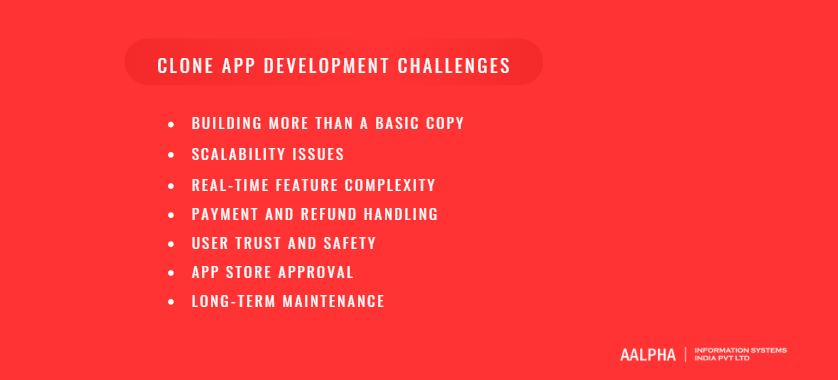
Clone App Development Challenges
-
Building More Than a Basic Copy
One of the biggest challenges in clone app development is building a product that solves real business and operational problems, not just an app that looks similar to a popular platform. Many businesses assume that copying the visible features of a successful app is enough to enter the market. In reality, most successful apps work because of strong backend systems, operational planning, customer support, pricing rules, vendor management, logistics, data tracking, and continuous improvement. For example, a food delivery clone app is not only about listing restaurants and accepting orders. It also needs restaurant coordination, delivery partner availability, order assignment, refunds, menu accuracy, delivery zones, and customer issue handling. A clone app must be designed around the business model, not only around the screen layout.
-
Scalability Issues
Scalability becomes a serious challenge when the app starts receiving more users, more transactions, and more data. An MVP may work well with a small user base, but performance issues can appear when traffic increases. Common problems include slow loading screens, database overload, delayed notifications, failed API responses, poor search performance, and payment delays. Apps with high transaction volume, such as taxi booking, food delivery, eCommerce, social media, and fintech platforms, need scalable backend architecture from the beginning. The development team should plan database structure, caching, server capacity, API performance, cloud infrastructure, load balancing, backups, and monitoring tools carefully. Without this planning, the app may fail during peak hours, marketing campaigns, or sudden user growth.
-
Real-Time Feature Complexity
Many clone apps depend on real-time features, and these are often more complex than they appear. Taxi apps need live driver tracking, ride matching, route updates, fare calculation, and trip status changes. Delivery apps need real-time order updates, delivery partner assignment, restaurant preparation status, location tracking, and estimated delivery times. Service apps may need live booking updates, provider availability, and customer-provider chat. Social apps may need instant messaging, notifications, live feeds, and media updates. Real-time systems require reliable APIs, background location handling, socket connections, map integrations, push notifications, and proper error handling. If these systems are not built correctly, users may see delayed statuses, wrong locations, duplicate assignments, missed notifications, or failed communication.
-
Payment and Refund Handling
Payments are another major challenge in clone app development because they affect customer trust, platform revenue, vendor payouts, and accounting. A clone app may need card payments, wallets, bank transfers, local payment methods, refunds, partial refunds, failed payment recovery, chargeback handling, split payments, commissions, taxes, invoices, and payout settlements. For example, a marketplace app must calculate seller earnings after commissions, discounts, refunds, shipping charges, and taxes. A food delivery app may need restaurant settlements, delivery partner payouts, customer refunds, cancellation fees, and promotional adjustments. Poorly planned payment logic can lead to incorrect balances, delayed payouts, accounting errors, and customer complaints. Payment workflows should be tested thoroughly before launch.
-
User Trust and Safety
Trust and safety are essential for any clone app that connects users, sellers, drivers, hosts, restaurants, service providers, or financial accounts. Users need confidence that the platform is secure, reliable, and fair. Important trust features include verified profiles, secure login, ratings and reviews, fraud detection, dispute handling, transaction protection, customer support, and clear cancellation or refund policies. In taxi and delivery apps, safety may include driver verification, location sharing, emergency contacts, and trip records. In marketplace apps, trust may depend on seller verification, product moderation, return policies, and buyer protection. In accommodation booking apps, host verification, guest reviews, payment security, and dispute resolution are important. Without trust systems, even a well-designed app can struggle to retain users.
-
App Store Approval
Clone apps must be original enough to pass app store review policies. Apple App Store and Google Play Store can reject apps that appear to be copied, low quality, misleading, spam-like, or too similar to existing apps without clear differentiation. This is why clone app development should include original branding, unique design, clear business purpose, proper privacy policies, working features, accurate app descriptions, and compliant use of permissions. Apps that request unnecessary permissions, use copied content, misuse trademarks, or provide a weak user experience may face approval delays or rejection. Before submission, the development team should review store guidelines, test the app properly, prepare screenshots and descriptions, and make sure the app works smoothly on supported devices.
-
Long-Term Maintenance
Clone app development does not end after launch. Long-term maintenance is one of the most important challenges because apps need continuous updates to remain stable, secure, and compatible with changing technology. Mobile operating systems release updates, third-party APIs change, payment gateways update requirements, map services modify pricing or policies, and users expect better performance over time. Maintenance includes bug fixes, security patches, server monitoring, database optimization, app store updates, crash fixing, API updates, feature improvements, and performance tracking. Businesses should also monitor user feedback, support tickets, failed transactions, app crashes, slow screens, and conversion issues. A clone app that is not maintained properly can lose users even if the first version was launched successfully.
Why Work With a Clone App Development Company
-
Clone Apps Need More Than Basic Coding
Clone app development requires much more than writing mobile app code. A serious clone app is usually a complete digital business platform with multiple apps, web panels, backend systems, third-party integrations, security layers, and operational tools. For example, a taxi booking clone app may require a customer app, driver app, admin dashboard, GPS tracking, fare calculation, payments, notifications, trip history, driver verification, and analytics. A food delivery clone app may need a customer app, restaurant panel, delivery partner app, admin dashboard, order tracking, menu management, commission settings, refunds, and payout reports. These systems must work together smoothly because one weak area can affect the entire user experience. A professional clone mobile app development company can plan the complete architecture instead of treating the project as a set of disconnected screens.
-
Custom Development Helps Build a Real Business Platform
Custom development is important because every clone app has its own business rules. Two businesses may both want an Uber-like, Airbnb-like, DoorDash-like, or Amazon-like app, but their pricing, user roles, service areas, commissions, refund policies, vendor rules, and operational processes may be different. A custom-built clone app can include role-based access for customers, vendors, sellers, drivers, hosts, service providers, and admins. It can also support commission logic, vendor onboarding, rider assignment, booking rules, pricing rules, coupons, cancellation charges, wallet credits, refunds, settlements, and multi-city expansion. For example, a delivery app operating in one city may start with simple delivery zones, but later it may need city-wise pricing, branch-level operations, vendor-wise commissions, and automated delivery assignment. A custom development approach makes this growth easier because the platform is built around the business model from the beginning.
-
Long-Term Support Is Important
Clone apps need continuous support after launch. The first release may help the business enter the market, but the app must be monitored, fixed, updated, and improved regularly. Mobile operating systems change, app store policies are updated, payment gateways release new requirements, map APIs change, and security risks keep increasing. Long-term support usually includes server monitoring, bug fixing, security patches, app store updates, API updates, payment issue resolution, database optimization, performance monitoring, and new feature development. Businesses also need support for user feedback, crash reports, failed transactions, slow screens, and admin panel improvements. Without regular maintenance, even a well-built clone app can become unstable, outdated, or difficult to scale.
-
Working With an Experienced Development Partner
Businesses planning clone app development can work with experienced software development companies such as Aalpha Information Systems, especially when the project requires branded mobile apps, backend systems, admin dashboards, third-party integrations, scalable architecture, and long-term technical support. An experienced development partner can help define the right MVP scope, choose suitable technologies, design original user experiences, build secure backend systems, integrate payments and APIs, and prepare the app for launch. This is especially useful for businesses building marketplace apps, delivery apps, taxi apps, booking platforms, social apps, or fintech products where multiple user roles and operational workflows must be handled carefully. The right company does not simply recreate a popular app’s appearance. It helps build a legally safe, customized, and business-ready platform that can support real users, real transactions, and future growth.
Conclusion
Clone app development is a practical way for businesses to launch digital products based on proven app models while still building a unique, branded, and legally safe platform. Whether it is a taxi booking app, food delivery app, marketplace, booking platform, social media app, or fintech solution, success depends on customization, original design, secure development, scalable backend architecture, and long-term technical support.
A well-built clone app can help businesses launch faster, reduce early planning risks, control development costs, and scale gradually with new features. However, the app must be developed around real business operations, user expectations, compliance needs, and future growth.
If you are planning to build a clone app for your business, connect with us to discuss your app idea, required features, budget, timeline, and launch strategy.