






TL;DR
Backend developer hourly rates in 2026 span roughly $20 to $150+ per hour, and the gap comes down to four levers: experience level, geography, project complexity, and hiring model.
Geography sets the floor and ceiling. US developers run $80 to $150+ per hour, UK $60 to $120, Western Europe $70 to $130, Eastern Europe $40 to $80, India $20 to $50 (up to $60 to $80 for senior specialists), Southeast Asia $25 to $60, Latin America $30 to $70, and Australia/Canada $70 to $140.
Experience matters more than location alone. Junior developers charge $20 to $40 per hour and need supervision. Mid-level developers, $40 to $80, can run most projects independently. Senior developers, $80 to $150+, handle architecture, performance, and high-load systems, and are worth the premium on anything mission-critical.
Tech stack pricing follows supply and demand rather than difficulty alone. PHP and Node.js sit at the affordable end ($20 to $80) because the talent pool is large. Java, .NET, and Ruby on Rails run $40 to $120 depending on enterprise depth required. Golang commands $50 to $130 because experienced developers are scarce relative to demand. AI/ML backend work tops the list at $60 to $150+, since it requires both backend engineering and model deployment skills.
Hiring model changes the math again. Freelancers are cheapest ($20 to $80) but carry availability and accountability risk. Agencies charge $50 to $150 for structured process, QA, and team continuity. In-house developers are not billed hourly, but salary, benefits, and overhead usually put their effective cost at $50 to $120+ per hour, which only pays off for ongoing core product work.
For budgeting: multiply estimated hours by the relevant rate, then add 15 to 30 percent for risk. A basic MVP (200 to 300 hours) lands around $8,000 to $18,000 with buffer. A mid-complexity SaaS or marketplace (400 to 800 hours) runs $16,000 to $64,000. Enterprise-grade systems exceeding 1,000 hours at senior rates can reach $80,000 to $150,000 or more.
The cheapest hourly rate rarely produces the cheapest project. A lower rate that leads to rework, poor architecture, or scaling problems later costs more than paying for the right expertise up front. Aalpha, founded in 2008 with 5,500+ projects delivered across 45+ countries and a 4.9/5 rating from 215+ Clutch reviews, positions its pricing this way: transparent hourly or dedicated-team rates tied to the actual complexity of the build, not a flat offshore number that hides scope gaps later.
Backend developer hourly rates vary widely depending on location, experience, and engagement model, but in 2026, most businesses can expect to pay anywhere between $20 to $150+ per hour globally. This wide range often creates confusion for decision-makers. Why does one developer charge $25 per hour while another charges $120 for similar work? The answer lies in a combination of factors such as expertise, geography, project complexity, and the type of hiring model used.
For startups, product teams, and enterprises alike, backend development is not just a technical necessity. It is the foundation that powers application performance, scalability, security, and data management. Whether you are building a SaaS platform, a marketplace, or an AI-powered system, backend developers handle everything from APIs and databases to server logic and integrations. This makes their pricing a critical component of overall project budgeting.
Understanding backend developer hourly rates is not simply about finding the cheapest option. It is about aligning cost with value. A lower hourly rate may seem attractive initially, but it can lead to higher long-term costs if the code is inefficient, insecure, or difficult to scale. On the other hand, higher rates often reflect deeper expertise, better architectural decisions, and faster delivery.
Many business owners also ask how backend developer pricing differs across regions or hiring models. The reality is that global talent markets have made it possible to optimize costs without compromising quality, but only if you understand how pricing works at a deeper level. This guide breaks down those factors so you can make informed, cost-effective decisions when hiring backend developers.
What is a Backend Developer?
A backend developer is responsible for building and maintaining the server-side logic that powers applications. While users interact with the frontend interface, the backend handles everything behind the scenes, including databases, APIs, authentication systems, and business logic.
From a business perspective, backend developers ensure that your application works reliably, processes data correctly, and scales as user demand grows. For example, when a user places an order on a delivery app, the backend manages inventory checks, payment processing, order routing, and notifications. Without a robust backend, even the most visually appealing application fails to function effectively.
Backend development typically involves technologies such as Node.js, Python, Java, PHP, or .NET, along with database systems like PostgreSQL or MongoDB. The complexity of these systems directly influences the developer’s hourly rate, as more advanced architectures require deeper expertise.
Why Understanding Hourly Rates Matters
Backend developer hourly rates play a direct role in determining the total cost of software development. Even small differences in hourly pricing can significantly impact budgets when projects span hundreds or thousands of hours. For instance, a 500-hour project billed at $30 per hour costs $15,000, while the same project at $80 per hour reaches $40,000. This gap highlights why pricing clarity is essential from the start.
Beyond budgeting, hourly rates also influence scalability decisions. Businesses often begin with a minimum viable product and then expand features over time. If backend costs are not planned correctly, scaling the system can become financially unsustainable. This is especially relevant for SaaS platforms, marketplaces, and AI-driven applications where backend complexity increases rapidly.
Another critical consideration is risk management. Lower hourly rates may indicate limited experience, which can lead to poor architecture, technical debt, and higher maintenance costs later. Conversely, experienced developers may charge more upfront but reduce long-term expenses by writing efficient, secure, and scalable code.
Understanding these pricing dynamics helps businesses answer practical questions such as how much backend development will cost, whether to hire locally or offshore, and how to balance quality with budget constraints.
Quick Overview of Global Hourly Rates
Backend developer hourly rates vary significantly across regions and hiring models. In North America, particularly the United States, experienced backend developers typically charge between $80 and $150+ per hour, reflecting high living costs and strong demand for senior talent. In the United Kingdom and Western Europe, rates generally range from $60 to $120 per hour, depending on expertise and specialization.
Eastern Europe has emerged as a popular outsourcing destination, offering skilled developers at $40 to $80 per hour. Countries such as Poland, Ukraine, and Romania are known for strong technical education and competitive pricing. In India, backend developers typically charge between $20 and $50 per hour, making it one of the most cost-effective regions without necessarily compromising on quality when working with experienced teams.
Southeast Asia and Latin America also provide competitive options, with hourly rates ranging from $25 to $60, depending on the developer’s experience and the country.
The engagement model further affects pricing. Freelancers often offer lower rates due to reduced overhead, while development agencies charge higher fees, typically $50 to $150 per hour, because they provide structured processes, project management, and quality assurance. In-house developers, while not billed hourly in the traditional sense, often represent the highest long-term cost when factoring in salaries, benefits, and operational expenses.
This global variation allows businesses to optimize costs strategically, but only when they understand the trade-offs between price, quality, and reliability.
Average Backend Developer Hourly Rates in 2026
Backend developer hourly rates in 2026 reflect a globalized talent market where pricing is influenced by experience, geography, and hiring model. While businesses often look for a single “average rate,” the reality is more nuanced. The cost of hiring a backend developer depends on what level of expertise is required, how critical the system is, and whether the engagement is short-term or long-term. A simple CRUD-based application will fall at the lower end of the pricing spectrum, while scalable, high-performance systems such as SaaS platforms or AI-driven backends demand significantly higher rates due to architectural complexity.
When evaluating backend developer costs, decision-makers frequently ask how much they should realistically budget per hour. In most cases, the global average sits between $30 and $120 per hour, but this range expands further when factoring in senior specialists, niche technologies, and enterprise-grade requirements. Understanding how these averages are structured helps businesses avoid underestimating costs or overpaying for mismatched expertise.
Global Average Hourly Rates
Globally, backend developer hourly rates can be categorized into three broad tiers based on market demand and expertise. At the lower end, developers typically charge between $20 and $40 per hour, commonly found in regions such as India and Southeast Asia. These developers are often suitable for straightforward projects, maintenance work, or early-stage MVPs where budget constraints are a priority.
The mid-range, which represents the largest segment of the market, falls between $40 and $80 per hour. Developers in this category often have solid experience, can handle moderate complexity, and are capable of building scalable systems with proper guidance. This range is commonly associated with Eastern Europe, Latin America, and experienced offshore teams.
At the higher end, backend developers charge between $80 and $150+ per hour, typically seen in North America, Western Europe, and among highly specialized professionals. These developers bring deep expertise in system architecture, distributed systems, cloud infrastructure, and performance optimization. Businesses building mission-critical platforms often rely on this tier to ensure reliability and long-term scalability.
It is important to note that these averages are not just about geography. Developers with expertise in high-demand areas such as microservices architecture, real-time systems, or AI backend integration often command premium rates regardless of location. As a result, global averages provide a baseline, but the final cost depends heavily on project requirements and technical depth.
Freelance vs Agency vs In-House Rates
The hiring model plays a significant role in determining backend developer hourly rates. Freelancers typically offer the most competitive pricing, with rates ranging from $20 to $80 per hour depending on their experience and location. They are often ideal for small projects, quick fixes, or early-stage development. However, freelancers may lack structured processes, long-term availability, or the ability to handle large-scale systems independently.
Development agencies, on the other hand, charge higher hourly rates, generally between $50 and $150 per hour. This premium reflects the additional value they provide, including project management, quality assurance, team scalability, and standardized development practices. Agencies are particularly suitable for businesses that need end-to-end development support or want to reduce operational risk.
In-house backend developers represent a different cost structure altogether. While they are not typically billed hourly, their effective hourly cost often exceeds $50 to $120+ per hour when factoring in salaries, benefits, infrastructure, and overhead. Hiring in-house is a long-term investment that makes sense for companies building core products or requiring continuous development and maintenance.
Choosing between these models depends on business goals. A startup building an MVP may prioritize cost efficiency through freelancers or offshore teams, while an enterprise developing a complex platform may prefer agencies or in-house teams for consistency and reliability.
Junior, Mid-Level, and Senior Developer Rates
Backend developer hourly rates increase significantly with experience level, as expertise directly impacts productivity, code quality, and system scalability. Junior developers typically charge between $20 and $40 per hour. They are suitable for basic tasks such as bug fixes, simple API development, or assisting senior developers. However, they often require supervision and may not be equipped to handle complex architectural decisions.
Mid-level developers fall within the $40 to $80 per hour range and represent a balanced option for most projects. They can independently develop backend systems, integrate APIs, and manage databases with reasonable efficiency. Businesses often rely on mid-level developers for building MVPs, scaling existing applications, or handling moderately complex systems.
Senior backend developers command rates between $80 and $150+ per hour, reflecting their ability to design scalable architectures, optimize performance, and handle high-load systems. They play a critical role in decision-making, ensuring that applications are secure, maintainable, and future-proof. For projects involving microservices, cloud-native systems, or enterprise-grade platforms, senior developers are often essential rather than optional.
In practical terms, many successful projects use a mix of experience levels. Senior developers define architecture and oversee implementation, mid-level developers handle core development, and junior developers support execution. This blended approach helps optimize costs while maintaining high-quality outcomes.
Backend Developer Hourly Rates by Region
Backend developer hourly rates vary significantly by region due to differences in cost of living, talent availability, education systems, and market demand. For businesses, this regional variation creates an opportunity to optimize costs without compromising on quality, provided the trade-offs are clearly understood. Many companies today operate with distributed teams, combining high-cost senior talent with cost-effective offshore developers to balance quality and budget.
Understanding regional pricing is essential when deciding where to hire backend developers, especially for projects that require long-term scalability, reliability, and performance.
-
United States
Backend developers in the United States command some of the highest hourly rates globally, typically ranging between $80 and $150+ per hour, with top-tier engineers and specialists exceeding $180 per hour in some cases. These rates reflect high living costs, strong demand for experienced developers, and a mature tech ecosystem.
From a talent perspective, the U.S. is known for producing highly skilled developers with deep expertise in system architecture, cloud infrastructure, distributed systems, and large-scale applications. Many developers have experience working with leading technology companies or high-growth startups, which translates into strong problem-solving capabilities and advanced technical knowledge.
Businesses often choose U.S.-based backend developers for mission-critical systems, enterprise applications, and products requiring strict compliance, security, and performance standards. Industries such as FinTech, healthcare, and SaaS frequently rely on this talent pool due to the complexity of their backend requirements.
However, the high cost can be a limiting factor for startups or small businesses. As a result, many companies adopt a hybrid model, using U.S.-based senior developers for architecture and offshore teams for execution to reduce overall costs while maintaining quality.
-
United Kingdom
Backend developer hourly rates in the United Kingdom typically range between $60 and $120 per hour, depending on experience and specialization. London-based developers, in particular, often charge at the higher end of this range due to the city’s status as a major global tech and financial hub.
The UK offers a strong talent pool with expertise in enterprise systems, financial technologies, and regulatory-compliant applications. Developers here are often experienced in building secure, scalable systems that meet strict industry standards, especially in sectors such as banking, insurance, and healthcare.
Businesses choose UK-based backend developers when they require high-quality development combined with strong communication and alignment with European and North American markets. Time zone compatibility also makes the UK an attractive option for companies operating across both regions.
Typical use cases include FinTech platforms, enterprise SaaS products, and systems requiring compliance with regulations such as GDPR. While rates are lower than in the United States, they are still considered premium, making the UK a mid-to-high-cost hiring destination.
-
Western Europe (Germany, France, Netherlands)
In Western Europe, backend developer hourly rates generally fall between $70 and $130 per hour, with countries like Germany and the Netherlands often at the higher end of the spectrum. These rates reflect strong economies, high living standards, and a well-established technology sector.
The region is known for producing highly skilled developers with a strong focus on engineering quality, system reliability, and adherence to best practices. Developers in Western Europe often emphasize clean architecture, documentation, and long-term maintainability, which can significantly reduce technical debt over time.
Companies typically hire backend developers from this region for enterprise-grade applications, industrial systems, and products requiring high reliability. Germany, for example, is known for engineering-heavy applications, while the Netherlands has a strong startup ecosystem with expertise in scalable SaaS platforms.
Western Europe is particularly suitable for businesses that prioritize quality, compliance, and long-term stability over cost savings. However, the relatively high hourly rates can make it less attractive for early-stage startups with limited budgets.
-
Eastern Europe (Ukraine, Poland, Romania)
Eastern Europe has become one of the most popular outsourcing destinations for backend development, with hourly rates typically ranging from $40 to $80 per hour. Countries such as Ukraine, Poland, and Romania offer a strong balance between cost and quality.
The region is widely recognized for its solid technical education systems and a large pool of experienced developers. Many backend engineers in Eastern Europe are proficient in modern technologies such as Node.js, Python, Java, and cloud platforms. Additionally, developers often have experience working with international clients, making collaboration smoother.
Businesses frequently choose Eastern Europe for building scalable applications, SaaS platforms, and complex backend systems at a more affordable cost compared to Western markets. The region is particularly attractive for startups and mid-sized companies that need high-quality development without the premium pricing of the U.S. or Western Europe.
Typical use cases include MVP development, product scaling, and long-term development partnerships. Eastern Europe is often considered a “sweet spot” for companies seeking both affordability and strong technical expertise.
-
India
India remains one of the most cost-effective regions for backend development, with hourly rates typically ranging from $20 to $50 per hour, although highly experienced developers and specialized teams may charge up to $60–$80 per hour.
The country has one of the largest pools of software developers globally, with expertise across a wide range of technologies, including Node.js, Python, Java, PHP, and cloud-based systems. Over the years, Indian developers have built a strong reputation for delivering scalable solutions, especially when working with established companies and experienced teams.
Businesses often choose India for cost-sensitive projects such as MVP development, maintenance, and large-scale application development where budget optimization is critical. It is also a preferred destination for long-term outsourcing partnerships due to the availability of talent at scale.
However, outcomes can vary depending on the provider. While top-tier companies deliver high-quality results comparable to global standards, lower-cost options may present challenges in communication, consistency, or project management. This makes vendor selection a critical factor when hiring in India.
-
Southeast Asia (Vietnam, Philippines)
Backend developer hourly rates in Southeast Asia typically range between $25 and $60 per hour, with countries like Vietnam and the Philippines emerging as competitive outsourcing destinations.
The region offers a growing pool of skilled developers, particularly in web and mobile backend development. Vietnam, in particular, has gained recognition for its strong engineering talent and increasing expertise in modern frameworks and cloud technologies. The Philippines, while slightly more focused on support and outsourcing services, also has capable backend developers, especially for less complex systems.
Businesses often choose Southeast Asia for cost-effective development, especially for startups and small to mid-sized projects. The region is suitable for building MVPs, maintaining applications, and handling standard backend requirements.
One advantage of Southeast Asia is its relatively strong English communication skills, particularly in the Philippines, which can improve collaboration. However, for highly complex or enterprise-grade systems, companies may still prefer regions with deeper specialization.
-
Latin America (Brazil, Argentina)
Latin America has gained popularity as a nearshore outsourcing destination for North American companies, with backend developer hourly rates typically ranging from $30 to $70 per hour. Countries such as Brazil and Argentina offer a strong combination of technical skills and time zone alignment with the United States.
The region’s talent pool is known for its adaptability, strong programming skills, and growing experience with modern backend technologies. Developers in Latin America often work closely with U.S. companies, making them familiar with international standards and workflows.
Businesses choose Latin America when they want a balance between cost savings and real-time collaboration. The overlapping time zones make it easier to manage projects, conduct meetings, and maintain continuous communication.
Typical use cases include SaaS development, API development, and ongoing product maintenance. While rates are higher than in India or Southeast Asia, the improved collaboration and cultural alignment often justify the cost for many companies.
-
Australia & Canada
Backend developer hourly rates in Australia and Canada typically range between $70 and $140 per hour, placing them in the higher-cost category similar to Western Europe. These countries have strong tech ecosystems and a high standard of living, which directly influences pricing.
Developers in these regions are known for their expertise in modern backend technologies, cloud infrastructure, and scalable system design. Canada, in particular, has become a major technology hub, attracting global companies and producing highly skilled developers. Australia also has a growing startup ecosystem with strong engineering talent.
Businesses often hire backend developers from these regions for high-quality development, especially when working within similar time zones or regulatory environments. Projects that require strong communication, compliance, and reliability are well-suited for developers from Australia and Canada.
Typical use cases include enterprise applications, SaaS platforms, and government or compliance-heavy systems. While the cost is relatively high, the quality of work and reliability often make these regions a preferred choice for critical projects.
Backend Developer Rates by Technology Stack
Backend developer hourly rates are not determined by geography and experience alone. The technology stack plays a critical role in pricing because it directly reflects market demand, availability of skilled developers, and the complexity of systems built using that stack. Businesses often ask why a Node.js developer might charge less than a Golang or AI backend engineer. The answer lies in supply-demand dynamics and the level of specialization required.
Widely adopted technologies with large developer communities tend to have more competitive pricing, while niche or high-performance stacks command premium rates due to limited talent availability and higher complexity. Choosing the right stack is therefore not just a technical decision but also a financial one that can significantly influence development costs.
-
Node.js Developer Rates
Node.js backend developers typically charge between $25 and $80 per hour, depending on experience and region. As one of the most popular backend technologies, Node.js benefits from a large global talent pool, which keeps pricing relatively competitive.
The widespread adoption of Node.js for building scalable, event-driven applications has increased demand, but the equally high supply of developers balances the rates. This makes Node.js a cost-effective option for startups and businesses building real-time applications, APIs, and SaaS platforms.
Node.js developers are commonly used for applications requiring high concurrency, such as chat systems, streaming platforms, and delivery apps. While basic Node.js development is affordable, developers with expertise in microservices architecture, performance optimization, and cloud-native systems can command higher rates within this range.
-
Python (Django/Flask) Developer Rates
Python backend developers, particularly those experienced with Django and Flask, typically charge between $30 and $100 per hour. Python’s versatility and growing dominance in data-driven applications contribute to its strong demand.
The pricing for Python developers varies based on specialization. Standard web backend development using Django or Flask is moderately priced due to a healthy talent supply. However, developers who combine backend expertise with data processing, automation, or AI integration often charge premium rates.
Python is widely used in SaaS platforms, fintech systems, and analytics-driven applications. Its clean syntax and rapid development capabilities make it a preferred choice for startups. The increasing overlap between backend development and AI/ML workloads has also driven up demand for Python developers, particularly those who can build scalable data pipelines and integrate machine learning models into backend systems.
-
Java Backend Developer Rates
Java backend developers generally charge between $40 and $120 per hour, with enterprise-level specialists commanding even higher rates. Java has long been the backbone of large-scale enterprise systems, which contributes to its premium pricing.
The demand for Java developers remains strong in industries such as banking, insurance, and large-scale enterprise software. These systems require high reliability, performance, and security, which increases the value of experienced Java engineers.
While the global supply of Java developers is substantial, true expertise in enterprise frameworks such as Spring Boot, microservices architecture, and distributed systems is less common. This gap between generalists and specialists drives pricing differences. Businesses building complex, high-traffic systems often prefer Java despite its higher cost due to its proven scalability and stability.
-
PHP (Laravel) Developer Rates
PHP backend developers, particularly those working with Laravel, typically charge between $20 and $70 per hour, making it one of the more affordable backend technologies.
PHP has a large global developer base, which increases supply and keeps rates competitive. Laravel, as a modern PHP framework, has improved developer productivity and code quality, making it a popular choice for web applications, content-driven platforms, and eCommerce systems.
Businesses often choose PHP for projects where cost efficiency and rapid development are priorities. It is especially suitable for small to mid-sized applications that do not require highly complex architectures.
However, lower rates do not necessarily indicate lower value. Experienced PHP developers who specialize in scalable systems, API development, and performance optimization can still command mid-range pricing. The key factor is the level of expertise rather than the technology itself.
-
.NET Developer Rates
.NET backend developers typically charge between $40 and $110 per hour, depending on experience and region. The .NET ecosystem, backed by Microsoft, is widely used for enterprise applications and cloud-based systems.
Demand for .NET developers remains strong, particularly in organizations that rely on Microsoft technologies such as Azure, SQL Server, and enterprise software integrations. This demand, combined with a moderate supply of experienced developers, keeps rates in the mid-to-high range.
.NET is often chosen for building secure, scalable applications in industries such as healthcare, finance, and enterprise SaaS. Developers with expertise in modern frameworks like ASP.NET Core and cloud-native architectures tend to command higher rates due to the increasing complexity of enterprise systems.
-
Ruby on Rails Developer Rates
Ruby on Rails developers typically charge between $40 and $100 per hour. Rails is known for enabling rapid development, making it a popular choice for startups and MVPs.
While Rails was once one of the most dominant backend frameworks, its popularity has declined slightly compared to newer technologies. This has created an interesting dynamic where experienced Rails developers are fewer in number, which can drive up rates for senior talent.
Businesses often use Rails for quickly launching products and iterating on features. It remains a strong choice for startups that prioritize speed over long-term scalability in the early stages. However, finding highly experienced Rails developers can sometimes be more challenging compared to more widely adopted stacks.
-
Golang Developer Rates
Golang backend developers typically charge between $50 and $130 per hour, reflecting its position as a high-performance, specialized technology.
Go is widely used for building scalable, high-concurrency systems such as cloud infrastructure, microservices, and real-time applications. The demand for Golang developers has increased significantly due to the rise of cloud-native architectures and distributed systems.
However, the supply of experienced Golang developers is relatively limited compared to more established technologies. This imbalance between demand and supply drives higher hourly rates. Businesses building performance-critical systems or handling large-scale data processing often prefer Golang despite the higher cost.
-
Backend Developers for AI/ML Systems
Backend developers working on AI and machine learning systems typically charge between $60 and $150+ per hour, making them among the highest-paid in the backend domain.
These developers require a combination of backend engineering skills and knowledge of data pipelines, model deployment, and scalable infrastructure. The growing adoption of AI across industries has significantly increased demand for such hybrid expertise.
The supply of developers who can effectively integrate machine learning models into production systems remains limited, which drives premium pricing. Businesses building AI-powered applications, recommendation systems, or predictive analytics platforms often require this level of expertise.
As AI continues to expand into mainstream applications, backend developers with AI integration skills are expected to remain in high demand, sustaining higher hourly rates compared to traditional backend roles.
Factors That Influence Backend Developer Hourly Rates
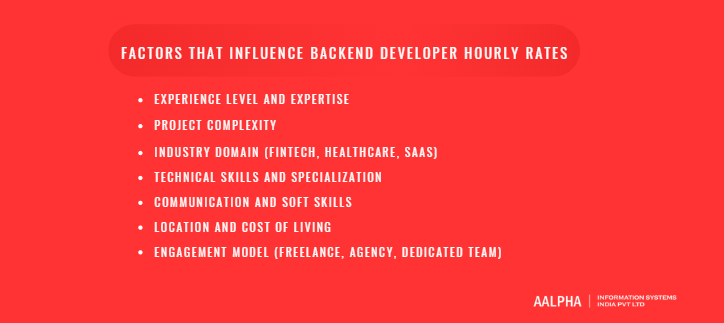
Backend developer hourly rates are shaped by a combination of technical, business, and market-driven factors. Many businesses initially assume that pricing depends only on location or experience, but in reality, multiple variables interact to determine the final cost. Understanding these factors helps organizations make informed hiring decisions, avoid underestimating budgets, and ensure that they are paying for the right level of expertise.
When evaluating backend development costs, decision-makers often ask why two developers with similar resumes charge significantly different rates. The answer typically lies in differences in project complexity, domain expertise, communication ability, and the hiring model used. Each of these factors directly affects productivity, risk, and long-term scalability.
-
Experience Level and Expertise
Experience remains one of the most influential factors in backend developer pricing. Developers with several years of hands-on experience not only write code faster but also make better architectural decisions that reduce long-term costs. A junior developer may complete a task at a lower hourly rate, but the same task might take longer or require rework, ultimately increasing the total cost of development.
Senior backend developers command higher rates because they bring expertise in system design, performance optimization, and scalability. They are capable of identifying potential bottlenecks early, preventing costly issues such as downtime or system failures. For example, designing a scalable database architecture from the beginning can save thousands of dollars in future infrastructure and maintenance costs.
Expertise in specific domains or technologies further increases rates. A developer with proven experience in microservices, cloud infrastructure, or high-traffic systems is more valuable than a generalist. Businesses building complex platforms often prioritize expertise over cost, as the impact of poor backend decisions can be significant and long-lasting.
-
Project Complexity
The complexity of a project directly influences backend developer hourly rates. Simple applications, such as basic CRUD systems or small internal tools, require less technical depth and can be handled by developers with moderate experience at lower rates.
In contrast, complex systems demand higher expertise and therefore higher pricing. Applications that involve real-time processing, high concurrency, distributed architectures, or large-scale data handling require developers who understand advanced concepts such as load balancing, caching strategies, and system resilience. These skills are not common among entry-level developers, which increases the cost.
For example, building a basic API for a small application is relatively straightforward, but designing the backend for a large marketplace or a SaaS platform with thousands of users requires careful planning and advanced engineering. The risk of failure in complex systems is also higher, which justifies the need for experienced developers who charge premium rates.
Ultimately, as project complexity increases, businesses should expect a corresponding increase in hourly rates to ensure reliability and scalability.
-
Industry Domain (FinTech, Healthcare, SaaS)
The industry in which the backend system operates significantly affects developer pricing. Certain domains, such as FinTech, healthcare, and enterprise SaaS, require specialized knowledge, compliance standards, and higher levels of security, which increase the demand for experienced developers.
In FinTech applications, backend developers must understand secure payment processing, fraud detection, and financial regulations. Similarly, healthcare systems require compliance with standards such as HIPAA or GDPR, along with secure handling of sensitive patient data. These requirements add complexity and risk, which leads to higher hourly rates.
SaaS platforms often require scalable, multi-tenant architectures and high system reliability. Developers working in this domain need to design systems that can handle growth, ensure uptime, and support continuous feature updates. This level of responsibility increases the value of experienced backend engineers.
Developers with proven experience in these industries often command premium rates because they reduce the risk of compliance violations, data breaches, and system failures. Businesses operating in regulated or high-stakes industries should prioritize domain expertise over cost savings.
-
Technical Skills and Specialization
Backend developer rates are heavily influenced by the depth and breadth of technical skills. Developers who possess only basic programming knowledge typically charge lower rates, while those with advanced skills in system architecture, cloud computing, and performance optimization command higher fees.
Specialization in high-demand areas significantly increases pricing. For instance, developers experienced in microservices architecture, containerization, and cloud platforms such as AWS or Azure are more valuable because they can build scalable and resilient systems. Similarly, expertise in real-time systems, distributed databases, or event-driven architectures is less common and therefore more expensive.
Another factor is the ability to work across multiple layers of the backend ecosystem. Developers who can handle API design, database optimization, DevOps integration, and security implementation provide more value than those limited to a single area. This versatility often justifies higher hourly rates.
As technology evolves, demand for specialized skills continues to rise. Businesses that require advanced backend capabilities should be prepared to invest in developers with niche expertise to ensure long-term success.
-
Communication and Soft Skills
While technical ability is critical, communication and soft skills also play a meaningful role in backend developer pricing. Developers who can clearly understand requirements, ask the right questions, and provide proactive suggestions are often more efficient and deliver better outcomes.
Poor communication can lead to misunderstandings, delays, and rework, all of which increase project costs. Developers who are able to collaborate effectively with product managers, designers, and stakeholders help streamline the development process and reduce friction.
Experienced developers with strong communication skills often charge higher rates because they contribute beyond coding. They participate in decision-making, provide strategic input, and help align technical solutions with business goals. For distributed teams, especially those working across different time zones, clear communication becomes even more important.
In many cases, businesses find that paying slightly higher rates for developers with strong soft skills results in faster delivery and fewer errors, ultimately reducing the overall cost of development.
-
Location and Cost of Living
Geographic location remains one of the most visible factors influencing backend developer hourly rates. Developers in regions with a high cost of living, such as the United States, Western Europe, and Australia, typically charge significantly higher rates than those in countries like India or Southeast Asia.
However, location is not just about cost. It also reflects market demand, availability of talent, and exposure to complex projects. Developers in high-cost regions often have experience working on large-scale systems and advanced technologies, which can justify their higher rates.
At the same time, globalization has made it possible for businesses to access skilled developers from lower-cost regions without compromising quality. Many companies now build distributed teams, combining senior developers from high-cost regions with cost-effective developers from offshore locations.
The key is not to assume that lower cost automatically means lower quality. Instead, businesses should evaluate developers based on skills, experience, and track record, while using location as a factor for cost optimization.
-
Engagement Model (Freelance, Agency, Dedicated Team)
The engagement model significantly impacts backend developer hourly rates and overall project costs. Freelancers typically offer the lowest rates because they operate independently and have minimal overhead. They are suitable for small projects, short-term tasks, or early-stage development. However, relying solely on freelancers can introduce risks related to availability, consistency, and scalability.
Development agencies charge higher rates because they provide structured processes, team collaboration, and additional services such as project management and quality assurance. While the upfront cost is higher, agencies often reduce risk and ensure smoother project execution, particularly for complex systems.
Dedicated development teams offer a middle ground between freelancers and agencies. Businesses hire a team of developers who work exclusively on their project, often at a predictable monthly cost. This model provides better control, scalability, and long-term continuity compared to freelancers.
Choosing the right engagement model depends on project size, budget, and long-term goals. Businesses that prioritize speed and cost may prefer freelancers, while those building complex or mission-critical systems often benefit from agencies or dedicated teams.
Freelance vs Agency vs In-House Backend Developers
Choosing how to hire backend developers is as important as choosing the developers themselves. The engagement model directly affects cost, speed, quality, and long-term scalability. Many businesses focus only on hourly rates, but the real decision lies in balancing cost vs control vs risk.
A freelancer may offer the lowest rate, but can they handle a complex system independently? An agency may charge more, but does it reduce execution risk? An in-house team provides control, but is it financially sustainable? These are the practical questions that determine the right approach.
Understanding the trade-offs between freelancers, agencies, and in-house developers helps businesses align their hiring strategy with project goals, timelines, and budget constraints.
-
Freelancers: Cost vs Risk
Freelance backend developers are often the most cost-effective option, with hourly rates typically ranging from $20 to $80, depending on experience and location. This makes them an attractive choice for startups, small businesses, and short-term projects where budget constraints are a priority.
The primary advantage of freelancers is flexibility. Businesses can hire them quickly, scale up or down as needed, and avoid long-term commitments. Freelancers are particularly useful for tasks such as building MVPs, fixing bugs, adding small features, or handling specific modules of a backend system.
However, this cost advantage comes with notable risks. Freelancers usually work independently, which means there is limited oversight, no structured processes, and minimal accountability compared to agencies or in-house teams. If a freelancer becomes unavailable, it can disrupt the project timeline significantly.
Another challenge is scalability. While a single freelancer may be capable of building a simple system, complex projects often require collaboration across multiple developers, DevOps engineers, and QA specialists. Coordinating this as a business owner can be difficult without technical expertise.
Freelancers are best suited for clearly defined, low-risk tasks where requirements are stable. For larger or mission-critical systems, relying solely on freelancers can increase the likelihood of delays, inconsistent code quality, and long-term maintenance challenges.
-
Development Agencies: Cost vs Value
Development agencies typically charge between $50 and $150 per hour, making them more expensive than freelancers. However, this higher cost reflects the additional value they bring in terms of structure, reliability, and end-to-end service delivery.
Agencies provide access to a team rather than an individual. This includes backend developers, frontend developers, QA engineers, project managers, and sometimes DevOps specialists. This team-based approach ensures that projects are executed systematically, with proper planning, testing, and documentation.
One of the key advantages of agencies is reduced risk. They follow established development processes, maintain timelines, and ensure continuity even if individual team members change. For businesses without in-house technical expertise, this structured approach is critical to successful project delivery.
Agencies are particularly suitable for complex projects such as SaaS platforms, enterprise applications, and systems requiring integrations, scalability, and security. They also handle project management, which reduces the burden on business owners.
While the upfront cost is higher, agencies often deliver better long-term value by minimizing rework, avoiding technical debt, and ensuring scalability. Businesses that prioritize reliability and quality over short-term cost savings often find agencies to be the most efficient option.
-
In-House Developers: Long-Term Investment
Hiring in-house backend developers represents a long-term investment rather than a short-term cost. While developers are not billed hourly in the traditional sense, their effective hourly cost often ranges between $50 and $120+ when factoring in salaries, benefits, infrastructure, and operational expenses.
The biggest advantage of in-house developers is control. They are fully aligned with the company’s vision, culture, and long-term goals. This makes them ideal for building core products, maintaining proprietary systems, and continuously improving backend infrastructure.
In-house teams also enable faster communication and collaboration, especially when working on complex or evolving projects. Developers can closely interact with product managers, designers, and stakeholders, leading to better decision-making and faster iterations.
However, the cost of hiring and maintaining an in-house team is significant. Beyond salaries, businesses must account for recruitment costs, onboarding, training, and ongoing management. Additionally, scaling an in-house team takes time, which can slow down project timelines.
In-house developers are best suited for companies with ongoing development needs, such as SaaS businesses, marketplaces, or enterprise platforms. For short-term or one-time projects, this model may not be cost-effective.
When to Choose Each Model
The choice between freelancers, agencies, and in-house developers depends on the nature of the project, budget, and long-term objectives. Businesses building a quick MVP or handling small, well-defined tasks often benefit from freelancers due to their lower cost and flexibility. However, this approach works best when the scope is limited and does not require extensive coordination or long-term maintenance.
For projects that involve multiple components, integrations, or scalability requirements, development agencies provide a more reliable solution. Their structured processes and team-based approach reduce execution risk and ensure consistent quality, making them ideal for startups transitioning to growth or companies launching new products.
In-house developers become the preferred option when backend development is a core part of the business. Companies that require continuous development, frequent updates, and full control over their technology stack benefit the most from this model.
In practice, many successful businesses adopt a hybrid approach. They use agencies or freelancers for initial development and then transition to an in-house team as the product matures. This strategy allows them to balance cost, speed, and long-term scalability effectively.
How to Estimate Backend Development Cost for Your Project
Estimating backend development cost is one of the most critical steps in planning any software project. Many businesses struggle with budgeting because they rely on rough assumptions rather than a structured approach. The result is often cost overruns, missed deadlines, or underbuilt systems that cannot scale.
A reliable estimate requires breaking the process into clear, measurable steps. Instead of asking a vague question like how much backend development costs, it is more effective to define scope, calculate effort, and align that effort with realistic hourly rates. This method provides clarity, reduces risk, and helps stakeholders make informed decisions before development begins.
-
Define Project Scope Clearly
The foundation of accurate cost estimation is a clearly defined project scope. Without this, any estimate is essentially a guess. Scope defines what the backend system is expected to do, including core features, integrations, user roles, and performance requirements.
A well-defined scope should answer practical questions such as what functionalities the backend must support, how users will interact with the system, and what external services need to be integrated. For example, a simple backend for a delivery app may include user authentication, order management, and notifications. A more complex system might also include real-time tracking, payment processing, and analytics dashboards.
Ambiguity in scope often leads to scope creep, where new requirements are added during development, increasing both cost and timeline. This is one of the most common reasons projects exceed their budgets.
Businesses that invest time in defining scope upfront reduce uncertainty and create a strong foundation for accurate estimation. Even if the scope evolves later, having a clear starting point significantly improves cost predictability.
-
Break Down Features into Tasks
Once the scope is defined, the next step is to break down features into smaller, manageable tasks. This process transforms high-level requirements into actionable development units that can be estimated individually.
For instance, a feature like user authentication can be divided into tasks such as database schema design, API development, password encryption, token management, and testing. Similarly, an order management system can include tasks like creating APIs, handling order states, integrating notifications, and validating inputs.
Breaking features into tasks provides two key benefits. First, it makes estimation more accurate because smaller tasks are easier to evaluate. Second, it highlights dependencies between different parts of the system, helping teams plan development more effectively.
This step also helps businesses understand the true complexity of their project. What initially appears to be a simple feature often involves multiple layers of backend logic, which becomes visible only when tasks are clearly defined.
-
Estimate Development Hours
After breaking down tasks, the next step is to estimate the number of hours required for each task. This is where technical expertise plays a crucial role. Experienced developers can provide more accurate estimates based on similar past projects.
Each task should be evaluated based on its complexity, dependencies, and potential challenges. For example, building a simple API endpoint may take a few hours, while implementing a secure payment integration could take several days. Tasks involving third-party services, real-time processing, or complex data handling typically require more time.
It is important to avoid overly optimistic estimates. Many projects fail because initial timelines are underestimated. A practical approach is to use a range, such as best-case and worst-case estimates, and then average them for planning purposes.
By summing up the estimated hours for all tasks, businesses can arrive at a realistic approximation of the total development effort required for the backend.
-
Multiply by Hourly Rate
Once the total development hours are estimated, calculating the base cost becomes straightforward. The total hours are multiplied by the hourly rate of the backend developer or team.
For example, if a project requires 400 hours of development and the average hourly rate is $50, the base cost would be $20,000. If the same project is handled by a senior developer charging $100 per hour, the cost would double to $40,000.
This step highlights the importance of choosing the right balance between cost and expertise. Lower hourly rates may reduce initial expenses but can increase total hours due to slower development or rework. Higher rates may seem expensive upfront but can result in faster delivery and better quality.
The goal is not to minimize the hourly rate but to optimize the total cost of development.
-
Add Buffer for Risks
No backend development project is free from uncertainty. Unexpected challenges such as integration issues, performance bottlenecks, or changing requirements can increase both time and cost. This is why adding a buffer is essential for realistic estimation.
A typical buffer ranges from 15% to 30% of the total estimated cost, depending on project complexity. For simpler projects, a smaller buffer may be sufficient, while complex systems with multiple integrations may require a larger margin.
This buffer accounts for unforeseen issues and ensures that the project can continue without financial strain. It also provides flexibility to accommodate minor changes without disrupting the overall budget.
Businesses that skip this step often face budget overruns, as initial estimates rarely account for all real-world variables.
Sample Cost Estimation Scenarios
To understand how backend development cost estimation works in practice, consider a few common scenarios.
A basic MVP backend for a startup might include user authentication, simple APIs, and a database. Such a project may require around 200 to 300 hours. At an average rate of $30 to $50 per hour, the estimated cost would range between $6,000 and $15,000, with an additional buffer bringing the total closer to $8,000 to $18,000.
A mid-level application, such as a marketplace or SaaS platform with multiple features, integrations, and user roles, may require 400 to 800 hours of backend development. At rates between $40 and $80 per hour, the cost could range from $16,000 to $64,000, depending on complexity and developer expertise.
For a complex, enterprise-grade backend, involving real-time processing, advanced security, and scalable architecture, development effort can exceed 1,000 hours. With senior developers charging $80 to $120+ per hour, total costs can range from $80,000 to $150,000 or more.
These scenarios illustrate that backend development cost is not fixed but varies significantly based on scope, complexity, and expertise. Businesses that follow a structured estimation process can plan more effectively, allocate budgets accurately, and avoid unexpected financial challenges during development.
How to Choose the Right Backend Development Partner
Selecting the right backend development company is a decision that directly impacts the success, scalability, and long-term viability of your product. While hourly rates often dominate the conversation, the real differentiator lies in expertise, execution capability, and alignment with business goals. Many projects fail not because of poor ideas, but because they are executed by teams that lack the right combination of technical depth, domain understanding, and communication clarity.
When evaluating backend development partners, businesses should focus on measurable capabilities rather than marketing claims. The goal is to find a partner who not only builds what is required today but also anticipates future scalability, performance, and integration needs. A strong partner reduces risk, accelerates development, and ensures that the backend system remains maintainable as the product evolves.
-
Technical Expertise and Stack Experience
Technical expertise is the most critical factor when choosing a backend development partner. The team should have proven experience in the specific technologies required for your project, whether that includes Node.js, Python, Java, .NET, or cloud platforms like AWS and Azure.
Beyond familiarity with a tech stack, it is important to assess how deeply the partner understands system design. Can they architect scalable systems? Do they follow best practices for database design, API development, and security? These are the questions that determine whether your backend will perform reliably under growth.
Experienced backend teams also bring a problem-solving mindset. Instead of simply implementing requirements, they evaluate trade-offs, suggest better approaches, and optimize performance. For example, they may recommend microservices over a monolithic architecture if scalability is a concern, or introduce caching mechanisms to improve response times.
Choosing a partner with strong technical expertise ensures that your system is not only functional but also efficient, secure, and future-ready.
-
Industry Experience
Industry experience plays a significant role in backend development, especially for projects in regulated or complex domains. A partner who has worked in your industry understands the unique challenges, compliance requirements, and user expectations associated with it.
For example, backend development in FinTech requires expertise in secure transactions, fraud prevention, and regulatory compliance. In healthcare, developers must handle sensitive data and adhere to strict privacy standards. SaaS platforms demand scalable architectures and multi-tenant systems.
A partner with relevant industry experience reduces the learning curve and minimizes the risk of costly mistakes. They can anticipate challenges early, implement best practices, and deliver solutions that align with industry standards.
Businesses often overlook this factor and focus solely on technical skills. However, domain knowledge can significantly improve development efficiency and ensure that the final product meets both technical and business requirements.
-
Communication and Transparency
Clear communication is essential for successful backend development, particularly in distributed or offshore teams. A reliable development partner should provide regular updates, maintain transparency in progress, and clearly communicate risks or delays.
Poor communication often leads to misunderstandings, missed requirements, and rework. On the other hand, teams that communicate effectively can identify issues early, adapt to changes quickly, and maintain alignment with business goals.
Transparency also extends to project management practices. A strong partner will define timelines, share progress reports, and provide visibility into development workflows. This level of openness builds trust and ensures that stakeholders remain informed throughout the project lifecycle.
In many cases, businesses find that communication quality is just as important as technical expertise. A technically strong team that cannot communicate effectively can still lead to project failure.
-
Portfolio and Case Studies
A backend development partner’s portfolio provides direct evidence of their capabilities. Reviewing past projects helps businesses assess the complexity, scale, and quality of systems the partner has built.
Case studies are particularly valuable because they go beyond showcasing features. They explain the problem, the approach taken, and the outcomes achieved. For example, a case study might demonstrate how a team improved system performance, reduced downtime, or scaled an application to handle increased user traffic.
When evaluating a portfolio, businesses should look for projects similar to their own in terms of industry, complexity, and technology stack. This indicates that the partner has relevant experience and can handle similar challenges.
A strong portfolio also reflects consistency. Partners who have successfully delivered multiple projects across different domains are more likely to provide reliable results.
-
Pricing Clarity
Transparent pricing is a key indicator of a trustworthy backend development partner. Businesses should have a clear understanding of how costs are structured, whether it is hourly, fixed-price, or dedicated team-based pricing.
Hidden costs or vague estimates can lead to budget overruns and strained relationships. A reliable partner provides detailed breakdowns of costs, including development hours, resource allocation, and any additional expenses such as infrastructure or maintenance.
It is also important to evaluate pricing in the context of value. The cheapest option is not always the most cost-effective. A slightly higher rate may include better processes, higher-quality code, and faster delivery, which ultimately reduces total project cost.
Companies like Aalpha Information Systems, for example, position themselves by offering transparent pricing combined with strong technical expertise, helping businesses balance cost efficiency with high-quality delivery. This type of clarity allows decision-makers to plan budgets with confidence.
-
Long-Term Support and Scalability
Backend development does not end at deployment. Ongoing maintenance, performance optimization, and feature expansion are essential for long-term success. Choosing a partner who provides post-launch support ensures that your system remains stable and scalable as your business grows.
A strong backend partner plans for scalability from the beginning. They design systems that can handle increased traffic, integrate new features, and adapt to changing requirements without major rework. This forward-thinking approach reduces technical debt and avoids costly redesigns in the future.
Long-term support also includes monitoring, bug fixes, and updates. Businesses should ensure that their partner offers maintenance services and is available to address issues as they arise.
Ultimately, the right backend development partner is not just a vendor but a long-term collaborator. By focusing on expertise, communication, transparency, and scalability, businesses can build systems that support growth and deliver sustained value over time.
Final Thoughts
Backend developer hourly rates vary widely, but the right decision is never about choosing the lowest price. It is about aligning cost with expertise, project complexity, and long-term scalability. Businesses that focus on value rather than just hourly rates consistently achieve better outcomes, faster delivery, and lower total cost of ownership.
Whether you choose freelancers, agencies, or a dedicated team, the key is to work with partners who understand your business goals and can build a backend that grows with your product.
If you are planning to build or scale a backend system, working with an experienced team can help you avoid costly mistakes and accelerate development. Consider connecting with experts like Aalpha to get a clear estimate, the right technical approach, and a backend built for performance and scalability.