



The global automotive industry is undergoing a structural shift, and the used car segment is at the center of this transformation. As vehicle prices rise, ownership patterns change, and digital trust improves, online used car marketplaces have moved from being secondary channels to becoming primary transaction platforms. Today, founders and automotive businesses are no longer asking whether a digital marketplace is viable, but how to build one that scales, earns trust, and sustains liquidity on both sides of the market. Used car marketplace development has therefore become a strategic product discipline that blends marketplace economics, automotive domain knowledge, regulatory compliance, and modern software architecture.
Unlike traditional dealership websites or listing portals, a used car marketplace is designed to orchestrate multi-party transactions at scale. It must handle inventory discovery, pricing transparency, buyer confidence, seller credibility, and post-sale workflows in a single system. This guide approaches used car marketplace development as a full-stack business and product challenge rather than a narrow software exercise, addressing the realities faced by founders, CTOs, and operators building platforms for competitive global markets.
What Is a Used Car Marketplace?
A used car marketplace is a digital platform that enables the buying and selling of pre-owned vehicles through structured, technology-driven workflows rather than informal listings or static catalogs. At its core, the platform connects supply and demand while providing trust mechanisms, pricing intelligence, and transaction support that reduce friction for all participants.
There are three dominant models. Consumer-to-consumer marketplaces allow individual car owners to sell directly to buyers. These platforms focus heavily on identity verification, fraud prevention, messaging, and discovery while typically avoiding direct involvement in payments or logistics. Dealer-to-consumer marketplaces aggregate inventory from professional dealerships and offer buyers a centralized destination to compare vehicles, pricing, financing options, and warranties. Hybrid marketplaces combine both models, allowing private sellers and licensed dealers to coexist within the same ecosystem while applying different rules, fees, and trust signals to each category.
What separates a true marketplace from a classifieds website is operational depth. Classifieds simply publish listings and step out of the transaction. A used car marketplace actively manages pricing guidance, vehicle verification, lead routing, buyer intent signals, and often inspections, financing, or delivery. Compared to dealership websites, marketplaces are inventory-agnostic, multi-seller by design, and optimized for discovery and comparison rather than brand-specific promotion. This distinction is critical when designing the product architecture and revenue model, as marketplaces must solve liquidity and trust at scale rather than optimize for a single seller’s conversion funnel.
Why Used Car Marketplaces Are Growing Globally
The growth of used car marketplaces is driven by structural forces that extend well beyond short-term economic cycles. One of the most significant drivers is vehicle affordability. New car prices have increased steadily across the US, Europe, and the UK due to inflation, supply chain constraints, and the rising cost of technology-heavy vehicles. As a result, buyers are increasingly turning to used vehicles, especially those that are professionally inspected, fairly priced, and backed by digital guarantees.
Digital trust infrastructure has also matured. Secure payments, identity verification, vehicle history databases, and standardized inspection processes have reduced the historical risks associated with buying used cars online. Buyers who previously relied on local dealers now feel comfortable transacting through platforms that provide transparent pricing, documentation, and dispute resolution. Financing and insurance access has further accelerated adoption. Marketplaces that integrate loan approvals, EMI calculators, and insurance comparisons shorten the decision cycle and make high-value transactions feasible entirely online.
Another important factor is the shift in ownership models. Younger buyers are less brand-loyal and more value-conscious, prioritizing usage, flexibility, and total cost of ownership over first ownership status. Subscription services, short-term ownership, and resale-friendly vehicles have increased vehicle churn, feeding marketplace inventory. On the supply side, dealers are under pressure to digitize inventory distribution and reduce dependence on physical footfall. Marketplaces offer them qualified leads, pricing intelligence, and faster inventory turnover, making participation economically rational rather than optional.
Together, these forces explain why used car marketplaces are scaling faster than traditional automotive channels and why the opportunity is global rather than region-specific.
Used Car Market Overview and Industry Landscape
The used car market has evolved from a fragmented, locally driven industry into a globally structured digital ecosystem. What was once dominated by physical dealerships, newspaper classifieds, and word-of-mouth referrals is now shaped by large-scale platforms, data-driven pricing, and cross-border inventory movement. Understanding the current market landscape is essential before making product, technology, or investment decisions, because used car marketplaces are deeply influenced by regional economics, consumer behavior, and regulatory environments. This section examines the size and growth of the global used car market, compares offline and online sales models, and analyzes how modern marketplace platforms structure their businesses without relying on individual brand names.
Global Used Car Market Size and Growth Trends
The global used car market is significantly larger than the new car market in terms of transaction volume, and in many regions it is also growing faster. In mature automotive economies such as the United States, Western Europe, and the United Kingdom, used car sales typically outnumber new car sales by a factor of two to three. This imbalance is structural rather than cyclical. Vehicles remain roadworthy for longer due to improved manufacturing quality, while rising new car prices push a growing share of buyers toward the secondary market.
In the US, used car demand is driven by affordability pressures, long vehicle lifespans, and a highly developed credit ecosystem that supports financing for older vehicles. Digital discovery has become the default starting point for buyers, even when the final transaction still occurs offline. Europe presents a more fragmented picture due to regulatory variation and cross-border vehicle movement, but the overall trend is similar. Used vehicles frequently move between countries based on taxation, emissions rules, and demand-supply mismatches, creating opportunities for platforms that can manage compliance and logistics digitally. The UK market shows strong online adoption, driven by standardized vehicle records, centralized registration systems, and a buyer base that expects transparency around history and condition.
Emerging markets add another layer of growth. In regions across Asia, Latin America, and parts of Eastern Europe, first-time car buyers increasingly enter the market through used vehicles rather than new ones. Urbanization, rising middle-class income, and smartphone penetration have accelerated digital adoption, even where physical dealership infrastructure remains uneven. In these markets, marketplaces often act not just as discovery platforms but as trust intermediaries, providing inspections, documentation support, and pricing benchmarks where institutional trust is weaker.
Across all regions, two macro trends stand out. First, inventory turnover is increasing as ownership cycles shorten and resale becomes part of the purchase decision. Second, data availability has improved, enabling more accurate pricing, demand forecasting, and risk assessment. These trends collectively create a favorable environment for scalable, technology-led used car marketplaces.
Online vs Offline Used Car Sales Models
Offline used car sales have historically been dominated by local dealerships and independent brokers. These models rely heavily on physical inventory, face-to-face negotiation, and location-based demand. Pricing is often opaque, shaped by negotiation skill rather than market data, and inventory discovery is limited to what a buyer can physically access. While this model still accounts for a large share of transactions, it suffers from structural inefficiencies, including slow inventory turnover, high overhead costs, and limited buyer reach.
Online marketplaces fundamentally alter this structure by decoupling discovery from location. Buyers can search, compare, and evaluate vehicles across cities or regions, while sellers gain access to a much broader demand pool. Pricing becomes more transparent because listings exist in a competitive digital environment where similar vehicles can be compared instantly. This transparency shifts power dynamics, reducing information asymmetry that traditionally favored sellers.
Another key difference lies in scalability. Offline models scale linearly with physical expansion, requiring more lots, staff, and capital. Online marketplaces scale through software, data, and network effects. Once liquidity is established, each additional listing increases platform value for buyers, and each additional buyer increases value for sellers. This feedback loop is absent in purely offline models.
However, online marketplaces do not eliminate offline components entirely. Inspections, test drives, and deliveries still involve physical processes. The most successful platforms treat offline operations as extensions of the digital experience rather than separate channels. The structural advantage of online models lies in orchestration rather than replacement. They coordinate fragmented offline activities through centralized systems, standardized workflows, and shared data, resulting in higher efficiency and better buyer confidence.
Leading Used Car Marketplace Business Models and Platform Patterns
Modern used car marketplaces tend to converge around a few dominant business patterns, regardless of geography. One common model focuses on lead monetization, where sellers pay for visibility, premium placement, or access to qualified buyer inquiries. This model prioritizes traffic growth and seller acquisition, often emphasizing content, SEO, and comparison tools to attract high-intent buyers. Trust is built through reviews, vehicle data enrichment, and seller ratings rather than direct transaction control.
Another pattern centers on transaction facilitation. Platforms operating under this model insert themselves deeper into the buying process by offering inspections, pricing guarantees, financing integration, and sometimes escrow-like payment handling. Revenue is generated through commissions, service fees, or bundled offerings. Inventory sourcing may include both professional sellers and individuals, but platform rules are stricter, and listings are more standardized. Trust systems here are operational rather than reputational, relying on inspections, documentation checks, and enforceable platform policies.
A third pattern emphasizes wholesale and dealer-to-dealer liquidity. These platforms focus less on end consumers and more on enabling rapid inventory movement among professional sellers. Auctions, bulk listings, and data-driven pricing tools dominate, and monetization is typically subscription-based or transaction-based. While less visible to consumers, these platforms play a critical role in balancing supply across regions and stabilizing prices.
Across all these models, trust systems are a defining differentiator. Successful platforms invest heavily in verification workflows, dispute resolution processes, and data integrity. Inventory sourcing strategies are equally important. Some platforms rely on organic seller uploads, while others actively acquire inventory through partnerships, buyback programs, or dealer integrations. Monetization models are closely tied to these choices. Platforms that control more of the transaction can justify higher fees, while those that act primarily as discovery layers must compete on volume and efficiency.
Taken together, the industry landscape shows a clear direction. Used car marketplaces are moving away from passive listing models toward active orchestration of supply, demand, and trust. Any new platform entering this space must position itself deliberately within this spectrum, as business model decisions made early will shape product architecture, operational complexity, and long-term defensibility.
Types of Used Car Marketplaces You Can Build
Used car marketplaces are not a single, uniform product category. The structural design of a marketplace depends on who supplies inventory, who purchases vehicles, and how deeply the platform participates in the transaction. Choosing the right marketplace type is one of the most consequential decisions in used car marketplace development because it directly affects trust mechanisms, revenue models, operational complexity, and scalability. This section breaks down the four primary marketplace types that founders and automotive businesses can build, along with the strategic trade-offs associated with each.

-
Peer-to-Peer (C2C) Used Car Marketplace
A peer-to-peer used car marketplace enables individual vehicle owners to sell directly to buyers without involving professional dealers. These platforms typically position themselves as open, accessible, and cost-efficient alternatives to traditional resale channels. Sellers list their vehicles, upload photos and documents, and communicate with interested buyers through the platform’s messaging system.
The core challenge in C2C marketplaces is trust. Private sellers vary widely in credibility, documentation quality, and pricing expectations. As a result, buyer verification and fraud mitigation become foundational rather than optional features. Identity verification, phone and email validation, and behavioral monitoring are essential to reduce fake listings and scams. Many platforms also introduce optional or mandatory vehicle inspections, standardized photo requirements, and document uploads to improve listing quality.
Pricing dynamics in C2C marketplaces are often volatile. Private sellers tend to overprice vehicles based on emotional attachment or outdated market perceptions. To counter this, successful platforms provide data-driven pricing guidance and comparable listings to anchor expectations. Buyer-side challenges include uncertainty around vehicle condition, title transfer, and payment security. Since most C2C platforms avoid holding inventory or handling payments directly, they must rely on strong education, warnings, and dispute-handling processes.
C2C marketplaces are relatively lighter to launch from an operational perspective, but they scale only when trust systems mature. Without robust safeguards, liquidity suffers because buyers hesitate to engage at scale.
-
Dealer-to-Consumer (B2C) Marketplace
D2C marketplaces aggregate inventory from licensed dealerships and professional sellers, offering buyers a curated and standardized purchasing experience. Unlike C2C platforms, inventory quality and documentation tend to be more consistent, which simplifies trust-building and reduces buyer anxiety. These marketplaces are often positioned as discovery and comparison engines, allowing buyers to browse thousands of vehicles across locations while interacting with verified sellers.
The primary operational focus in B2C marketplaces is inventory aggregation and dealer onboarding. Dealers require tools to upload inventory in bulk, synchronize pricing, manage availability, and track leads. Platform success depends on making dealer participation economically attractive through high-quality leads, analytics, and predictable exposure. Lead distribution models vary, with some platforms routing inquiries directly to dealers while others centralize communication to control response quality.
Monetization in B2C marketplaces typically revolves around subscriptions, lead fees, or premium visibility. Since the platform does not usually own inventory, margins depend on volume and retention rather than per-transaction commissions. Trust systems are largely reputational, relying on dealer ratings, reviews, and platform-enforced standards.
While B2C marketplaces scale faster than C2C models due to inventory consistency, they face competitive pressure from dealers building their own digital channels. Differentiation therefore hinges on superior demand aggregation, pricing intelligence, and buyer experience.
-
Hybrid Marketplace (C2C + Dealers)
Hybrid marketplaces combine private sellers and professional dealers within a single platform, applying different rules, fees, and trust signals to each group. This model has emerged as the most scalable approach because it maximizes inventory breadth while allowing the platform to segment experiences intelligently.
In hybrid systems, private sellers may go through additional verification steps, inspections, or delayed publishing, while dealers benefit from faster listing approvals and enhanced visibility. Buyers can filter listings by seller type, inspection status, or warranty availability, aligning risk tolerance with purchase intent. From a liquidity perspective, hybrid models perform well because they capture supply from multiple channels and adapt as market conditions change.
The complexity of hybrid marketplaces lies in governance. Platform rules must clearly distinguish between seller categories to avoid trust erosion. Pricing models, dispute resolution workflows, and content moderation all become more nuanced. However, this complexity is often justified by network effects. As inventory grows, buyer engagement increases, which in turn attracts more sellers of both types.
-
Auction-Based and Wholesale Used Car Platforms
Auction-based and wholesale platforms operate primarily in the B2B segment, connecting dealers, fleet operators, rental companies, and institutional sellers. These marketplaces focus on speed, volume, and pricing efficiency rather than consumer experience. Vehicles are typically sold through timed auctions, sealed bids, or bulk listings, with limited emotional considerations.
Trust systems here are built around seller accreditation, inspection reports, and standardized grading. Since participants are professionals, compliance and payment enforcement are stricter, and disputes are resolved through predefined contractual mechanisms. Monetization models often include subscription fees, per-auction charges, or transaction commissions.
While these platforms are less visible to end consumers, they play a critical role in balancing inventory across regions and maintaining price stability. For founders targeting this model, domain expertise and operational rigor matter more than brand marketing or UX polish.
Core Business Models for Used Car Marketplaces
A used car marketplace is not just a product. It is a revenue engine whose sustainability depends on how value is extracted from transactions, attention, and ancillary services without damaging trust or liquidity. Business model selection directly influences platform architecture, seller behavior, buyer experience, and long-term defensibility. Most successful marketplaces do not rely on a single revenue stream but combine multiple models that activate at different stages of marketplace maturity. This section explains the four most proven business models used in used car marketplaces and the conditions under which each model performs best.
-
Commission-Based Sales Model
The commission-based model generates revenue by taking a percentage or fixed fee from each successful vehicle sale completed through the platform. This model aligns platform incentives closely with transaction success because revenue is earned only when value is delivered. As a result, platforms operating on commissions tend to invest more deeply in trust systems, pricing accuracy, inspections, and transaction orchestration.
Commission models are most effective when the platform has a high degree of control over the transaction lifecycle. This may include verified inspections, standardized documentation, financing facilitation, escrow-style payments, or logistics coordination. Buyers are more willing to complete high-value transactions when the platform assumes responsibility for risk mitigation, and sellers accept commissions when the platform demonstrably improves conversion rates or sale velocity.
However, commission-based models introduce operational complexity. The platform must manage disputes, cancellations, and post-sale issues, all of which increase cost and liability. This model also requires sufficient transaction volume to offset higher operational overhead. For early-stage marketplaces, commissions can slow adoption if sellers perceive fees as too high relative to perceived value. As a result, many platforms introduce commissions gradually, starting with optional services and moving toward mandatory transaction fees as trust and demand mature.
-
Subscription Plans for Dealers
Subscription-based monetization is common in dealer-focused marketplaces where professional sellers pay a recurring fee to list inventory and access platform tools. This model provides predictable revenue and reduces dependency on transaction volume, making it attractive for platforms focused on discovery and lead aggregation rather than transaction control.
Dealer subscriptions typically bundle multiple benefits, including inventory uploads, analytics dashboards, pricing insights, and access to buyer inquiries. The platform’s value proposition lies in consistent exposure to qualified demand rather than guaranteed sales. This model works best in markets with a high density of dealerships and frequent inventory turnover, where dealers view the platform as an essential distribution channel rather than a discretionary marketing expense.
The challenge with subscription models is balancing pricing with perceived value. If lead quality declines or buyer demand weakens, dealers quickly reassess renewal decisions. Platforms must therefore invest continuously in traffic acquisition, buyer intent filtering, and performance reporting to justify recurring fees. Subscription fatigue can also occur if dealers are forced to maintain multiple platform subscriptions to reach sufficient demand, increasing churn risk.
-
Lead Generation and Featured Listings
Lead generation models monetize buyer intent rather than completed transactions. Sellers pay for access to inquiries, contact details, or call connections generated by the platform. Featured listings and promoted placements are often layered on top, allowing sellers to pay for increased visibility within search results or category pages.
This model is particularly effective in marketplaces that prioritize scale and traffic growth. Because the platform does not need to manage payments or logistics, operational complexity remains relatively low. Revenue scales with buyer activity rather than transaction completion, making it attractive during early growth phases.
The primary risk in lead-based models is quality dilution. If buyers submit low-intent inquiries or sellers compete aggressively for visibility, trust erodes on both sides. Platforms must implement lead scoring, inquiry throttling, and performance transparency to prevent abuse. Over-commercialization of search results can also damage buyer experience if promoted listings dominate relevance-based rankings.
When executed well, lead monetization creates a flexible revenue stream that complements subscriptions or commissions without forcing full transaction ownership.
-
Ancillary Revenue Streams (Finance, Insurance, Warranty)
Ancillary services represent some of the highest-margin opportunities in used car marketplaces. Financing, insurance, extended warranties, inspections, and logistics can be offered directly or through partnerships, generating referral fees or revenue sharing arrangements. These services enhance buyer convenience while unlocking incremental revenue beyond the vehicle sale itself.
Financing integration reduces purchase friction by enabling buyers to assess affordability in real time. Insurance and warranty offerings address risk concerns that are particularly acute in used car transactions. From a platform perspective, these services deepen engagement and increase lifetime value without requiring inventory ownership.
The key to successful ancillary monetization is contextual relevance. Offers must be embedded naturally within the buying journey rather than presented as aggressive upsells. Platforms that position themselves as neutral facilitators rather than commission-driven sellers tend to achieve higher conversion and trust.
Over time, ancillary revenue often becomes a stabilizing force, smoothing fluctuations in marketplace activity and reducing reliance on any single monetization channel.
Key User Roles and Marketplace Stakeholders
A used car marketplace succeeds or fails based on how well it balances the needs of multiple stakeholders whose incentives often conflict. Buyers want transparency and low risk, sellers want speed and fair pricing, dealers want predictable demand, and internal teams want control and scalability. Marketplace development therefore requires a role-driven design approach, where each user group is clearly understood and supported through tailored workflows, permissions, and trust mechanisms. This section breaks down the core stakeholders in a used car marketplace and explains how their expectations shape platform design and operations.
-
Buyers and Their Expectations
Buyers are the demand engine of any used car marketplace, and their expectations are shaped by both the emotional weight of vehicle purchases and the financial risk involved. Unlike low-ticket eCommerce transactions, buying a car involves long-term commitment, safety concerns, and resale considerations. As a result, buyers expect far more than basic listings.
Transparency is the primary expectation. Buyers want clear pricing, comparable alternatives, verified vehicle details, and honest disclosure of condition. Inconsistent information, missing images, or vague descriptions immediately reduce trust. Buyers also expect tools that support decision-making, such as filters, comparisons, saved searches, and alerts for price drops or new listings.
Trust signals play a central role in buyer behavior. Inspection reports, seller verification, reviews, and platform-backed guarantees significantly influence conversion. Buyers increasingly expect digital-first journeys that allow them to evaluate options before any physical interaction. Even when test drives or inspections occur offline, buyers want the platform to coordinate scheduling and communication.
Speed and convenience are equally important. Buyers expect quick responses to inquiries, simple booking flows, and clarity around next steps such as documentation, payment, or delivery. Marketplaces that fail to manage response times or leave buyers navigating fragmented communication channels tend to lose high-intent users despite having strong inventory.
-
Individual Sellers
Individual sellers enter the marketplace with a fundamentally different mindset than buyers. Most are occasional sellers with limited experience, emotional attachment to their vehicles, and uncertainty around pricing. Their primary goals are selling quickly, achieving a fair price, and avoiding complex processes.
Ease of listing is critical. Sellers expect simple workflows to upload vehicle details, images, and documents without requiring technical knowledge. Pricing guidance plays an outsized role, as private sellers often lack access to reliable market data. Platforms that provide realistic price ranges and explain trade-offs between price and time-to-sale tend to see higher listing success.
Trust works both ways for sellers. They want protection from fraud, time-wasting inquiries, and unsafe interactions. Buyer verification, inquiry filtering, and controlled communication channels help address these concerns. Many sellers also value optional services such as inspections or assisted selling, especially when the platform positions these as credibility boosters rather than mandatory hurdles.
Because individual sellers are not repeat users at high frequency, retention is less important than satisfaction and reputation. A smooth, respectful selling experience directly influences word-of-mouth growth and marketplace credibility.
-
Car Dealers and Dealership Networks
Dealers represent the supply backbone of many used car marketplaces and behave more like business customers than casual users. Their expectations are centered on return on investment, operational efficiency, and control. Dealers want predictable lead flow, accurate reporting, and tools that integrate smoothly with their existing processes.
Inventory management is a top priority. Dealers expect bulk uploads, real-time availability updates, and pricing control across multiple listings. They also value analytics that show listing performance, inquiry quality, and conversion outcomes. Unlike individual sellers, dealers are sensitive to lead quality rather than raw volume, and they quickly disengage if inquiries do not convert.
Trust and reputation are strategic assets for dealers. Marketplaces must enforce consistent standards across sellers to prevent brand dilution. Review systems, response-time tracking, and dispute resolution mechanisms help maintain a level playing field. Dealers also expect clarity around platform rules, fees, and ranking logic, as opaque systems erode long-term participation.
For large dealership networks, scalability matters. Multi-location support, role-based access, and API integrations often become deciding factors when choosing a marketplace partner.
-
Admin, Moderation, and Operations Teams
Internal teams are the invisible operators who keep the marketplace functional, compliant, and trustworthy. Their role expands as the platform grows, moving from basic moderation to complex orchestration of workflows, disputes, and policy enforcement.
Admins require visibility and control. This includes approval queues for listings, seller verification tools, pricing rule enforcement, and content moderation capabilities. Fraud detection, duplicate listings, and suspicious behavior monitoring are essential to maintain platform integrity at scale.
Operations teams handle edge cases that automation cannot fully resolve. This includes dispute mediation, document verification, seller escalations, and coordination with inspection or logistics partners. As transaction involvement increases, operational tooling must evolve to support efficiency without compromising fairness.
Well-designed admin systems are not just internal conveniences. They are foundational to buyer trust, seller satisfaction, and regulatory compliance, making them a strategic component of marketplace development rather than a back-office afterthought.
Essential Features of a Used Car Marketplace
The feature set of a used car marketplace defines how effectively the platform converts traffic into transactions while maintaining trust, liquidity, and operational control. Unlike simple listing websites, a marketplace must support multiple user roles with distinct goals and risk profiles. Feature decisions therefore cannot be generic or copied blindly from other platforms. They must be intentionally designed to reduce uncertainty, accelerate decision-making, and enforce consistent standards at scale. This section breaks down the essential features required on the buyer side, seller side, dealer dashboards, and the admin control layer.
-
Buyer-Side Features
Buyer-side features are responsible for demand generation and conversion. Since purchasing a used car is a high-consideration decision, buyers expect tools that help them evaluate options confidently rather than browse passively. Search and filtering form the foundation. Buyers should be able to narrow inventory using structured parameters such as make, model, year, mileage, price range, fuel type, transmission, location, and seller type. Advanced filters, including inspection status, warranty availability, and ownership history, significantly improve buyer confidence and reduce wasted inquiries.
Comparison tools play a critical role in decision clarity. Buyers often shortlist multiple vehicles before engaging with a seller. Side-by-side comparisons of pricing, mileage, condition indicators, and seller ratings help buyers understand trade-offs objectively. This reduces hesitation and shortens the buying cycle. Saved cars and wishlists allow buyers to return to listings without repeating discovery, while alerts for price drops or new matches keep engagement high over longer decision windows.
Real-time communication features are equally important. In-platform chat systems protect buyer privacy while enabling quick clarification of details. Structured inquiry prompts improve response quality by guiding buyers to ask relevant questions. Booking features for test drives, inspections, or virtual walkarounds reduce friction by turning interest into scheduled actions. Buyers increasingly expect platforms to coordinate these interactions rather than pushing responsibility onto sellers.
Trust reinforcement is woven throughout the buyer experience. Visible inspection badges, verified seller indicators, transparent pricing explanations, and clear next-step guidance all contribute to confidence. When buyer-side features are designed around clarity rather than volume, marketplaces see higher-quality engagement and better conversion outcomes.
-
Seller-Side Features
Seller-side features determine inventory quality and supply liquidity. For individual sellers in particular, the listing experience must balance simplicity with accuracy. Car listing flows should guide sellers step by step through entering vehicle details, uploading images, and submitting documentation. Structured forms reduce incomplete or misleading listings, while contextual help explains why specific information is required.
VIN decoding and automated data enrichment are critical features for accuracy. By extracting vehicle specifications directly from standardized identifiers, platforms reduce manual errors and improve buyer trust. This also allows listings to be normalized, making search and comparison more reliable. Pricing guidance tools are equally important. Sellers often struggle to price vehicles realistically, leading to stagnant inventory. Platforms that provide market-based price ranges, demand indicators, and expected time-to-sale insights help sellers make informed decisions.
Image validation improves listing credibility. Automated checks for image clarity, completeness, and relevance prevent low-quality listings from undermining marketplace trust. Some platforms enforce minimum image counts or require specific angles to ensure consistency. Optional services such as inspections or assisted selling can be offered as credibility enhancers rather than mandatory steps, giving sellers flexibility while improving overall quality.
Communication controls protect sellers from spam and low-intent inquiries. Buyer verification, inquiry limits, and structured messaging help sellers focus on serious prospects. Since many individual sellers are first-time users, clear guidance and responsive support significantly influence satisfaction and platform reputation.
-
Dealer Dashboard Features
Dealer dashboards are built for repeat usage, operational efficiency, and performance tracking. Dealers expect tools that help them manage inventory at scale while maximizing return on platform participation. Inventory management features should support bulk uploads, real-time availability updates, pricing adjustments, and listing status controls. Integration with dealer management systems or inventory feeds reduces manual effort and prevents inconsistencies.
Lead tracking is a core dealer requirement. Dealers need visibility into inquiry sources, buyer intent signals, response times, and follow-up outcomes. Dashboards that categorize leads by quality and urgency help sales teams prioritize effectively. Analytics features provide insights into listing performance, conversion rates, and market demand trends, enabling dealers to optimize pricing and inventory mix.
CRM integration is increasingly expected rather than optional. Dealers want marketplace leads to flow into existing sales pipelines without duplication or manual export. Role-based access within dealer accounts allows multi-location teams to operate independently while maintaining centralized oversight. Transparency around billing, subscription usage, and performance metrics strengthens long-term dealer relationships and reduces churn.
-
Admin Panel and Platform Controls
The admin layer is the control center of a used car marketplace and directly impacts trust, compliance, and scalability. Admin panels must provide visibility across users, listings, transactions, and system health. Moderation tools allow teams to review listings, verify documents, approve sellers, and enforce content standards. Automated rules handle routine cases, while manual overrides address edge scenarios.
Pricing rules and policy enforcement protect marketplace integrity. Admins may set limits on price deviations, flag suspicious patterns, or restrict certain seller behaviors. Fraud detection systems monitor duplicate listings, abnormal inquiry patterns, and identity inconsistencies. These controls are essential as platforms scale, where manual review alone becomes impractical.
Reporting and analytics support strategic decision-making. Admin teams need access to metrics on liquidity, conversion funnels, fraud incidents, seller performance, and revenue streams. Operational tooling for dispute resolution, user communication, and escalation management ensures issues are resolved consistently and fairly.
A well-designed admin system is not merely an internal convenience. It is a trust infrastructure that enables the marketplace to grow without compromising quality, compliance, or user confidence.
Advanced Features That Drive Competitive Advantage
As used car marketplaces mature, baseline functionality quickly becomes commoditized. Search, listings, and messaging alone are no longer enough to sustain growth or defend against competitors. Platforms that win at scale differentiate themselves through advanced features that reduce uncertainty, accelerate decisions, and lower operational friction across the transaction lifecycle. These features are not cosmetic enhancements. They directly influence liquidity, pricing efficiency, and trust, which are the three pillars of a successful used car marketplace. This section examines the advanced capabilities that consistently separate high-performing platforms from generic listing portals.
-
AI-Based Price Estimation and Valuation
AI-driven price estimation is one of the most impactful competitive features in used car marketplaces. Pricing in the used car market is inherently complex due to variations in mileage, condition, location, demand cycles, and ownership history. Static price guides or manual estimates fail to capture these nuances, leading to overpricing, underpricing, and stalled inventory.
AI-based valuation systems analyze large volumes of historical transaction data, active listings, regional demand signals, and vehicle attributes to generate dynamic price ranges rather than single-point estimates. For sellers, this reduces guesswork and emotional bias. Clear explanations around how pricing affects time-to-sale help sellers choose between faster liquidation and higher price targets. For buyers, AI-backed pricing builds confidence by signaling whether a vehicle is fairly priced relative to the market.
Advanced systems go beyond listing price suggestions. They continuously adjust valuations based on inventory velocity, seasonality, fuel prices, and macroeconomic trends. This allows marketplaces to surface insights such as price drop recommendations, demand surges for specific models, or alerts when a vehicle is likely to sell below market value. Importantly, AI pricing must remain transparent. Black-box outputs without explanation erode trust. Platforms that expose valuation logic in plain language see higher adoption and better outcomes on both sides of the marketplace.
-
Vehicle History Reports and VIN Integration
Vehicle history data is a foundational trust mechanism in used car transactions. Buyers want assurance that a vehicle has not been involved in major accidents, title disputes, or fraudulent activity. VIN-based integration enables marketplaces to automatically enrich listings with standardized vehicle information, reducing reliance on seller-provided claims.
Advanced marketplaces integrate multiple data sources to build comprehensive vehicle profiles. These profiles may include ownership changes, service records, reported damages, recalls, and registration events. Presenting this information in a structured, readable format allows buyers to quickly assess risk without technical knowledge. Highlighting verified data alongside seller disclosures also discourages misrepresentation.
From a platform perspective, VIN integration improves data consistency and search accuracy. Normalized vehicle attributes enable better filtering, comparison, and recommendation algorithms. It also simplifies moderation by flagging discrepancies between reported and verified information. While access to vehicle history data may involve licensing or partnerships, the trust dividend is significant. Marketplaces that fail to provide credible history insights often lose high-intent buyers late in the decision process, increasing bounce rates and lowering conversion.
-
Smart Search, Recommendations, and Personalization
As inventory scales, discovery becomes a challenge. Smart search and personalization features address this by shifting marketplaces from static catalogs to adaptive systems that respond to user behavior. Traditional keyword-based search is insufficient when buyers are exploring options rather than searching for a specific model.
Smart search systems interpret intent rather than exact terms. They account for browsing behavior, saved listings, price sensitivity, and engagement patterns to surface relevant results. Recommendation engines suggest alternatives based on comparable vehicles, buyer preferences, and market availability. For example, if a buyer consistently views vehicles within a certain budget and mileage range, the platform can prioritize similar listings even if search filters are broad.
Personalization extends beyond listings. Alert timing, content ordering, and even messaging prompts can adapt to individual users. Buyers at early research stages may receive educational content and comparisons, while high-intent users receive prompts to book inspections or test drives. The goal is to reduce cognitive overload and guide users toward confident decisions.
Importantly, personalization must respect transparency. Users should understand why certain listings are recommended, and relevance should not be distorted by aggressive monetization. Platforms that balance personalization with fairness maintain trust while increasing engagement and conversion rates.
-
Inspection, Logistics, and Doorstep Delivery Integrations
Physical execution remains a critical barrier in used car transactions. Advanced marketplaces differentiate themselves by integrating offline services into the digital journey rather than leaving coordination to buyers and sellers. Inspection integrations allow buyers to verify vehicle condition through standardized, third-party or platform-managed processes. Clear inspection summaries and condition scores reduce ambiguity and support pricing decisions.
Logistics and delivery integrations further streamline the experience. Doorstep test drives, vehicle transport, and home delivery reduce friction for buyers who are unwilling or unable to travel. For sellers and dealers, coordinated logistics increase reach beyond local demand, expanding liquidity.
These integrations require operational partnerships and robust scheduling systems. Marketplaces must manage availability, service quality, and exception handling. While this adds complexity, it also creates defensibility. Platforms that control more of the transaction experience can enforce standards, resolve disputes more effectively, and justify premium pricing or commissions.
When executed thoughtfully, inspection and logistics integrations transform the marketplace from a discovery platform into a transaction enabler. This shift significantly increases buyer confidence, seller satisfaction, and overall marketplace efficiency.
Together, these advanced features move used car marketplaces beyond basic aggregation toward intelligent orchestration. They reduce uncertainty, align incentives, and create measurable advantages that are difficult for competitors to replicate quickly.
User Experience and Marketplace Design Considerations
User experience in a used car marketplace is not a visual exercise. It is a trust and risk management system expressed through interface design, content structure, and interaction flows. Because used car transactions involve high financial stakes and emotional commitment, small UX failures compound quickly into hesitation, abandonment, or distrust. Successful marketplaces treat design as a strategic function that reduces uncertainty, clarifies decisions, and guides users confidently through complex journeys. This section outlines the core UX considerations that directly impact trust, accessibility, and conversion.
-
Building Trust in Used Car Transactions
Trust is the primary currency of any used car marketplace. Buyers and sellers enter the platform with inherent skepticism, shaped by decades of opaque pricing, inconsistent disclosures, and informal practices in offline markets. UX design must actively counter this skepticism through clarity, consistency, and visible safeguards.
Transparency begins at the listing level. Clear separation between verified data and seller-provided information helps users understand what is objectively known versus subjectively claimed. Visual trust indicators such as inspection badges, verification labels, and disclosure summaries should be prominent but not overwhelming. Overuse of badges can dilute credibility, while underuse leaves users uncertain.
Process clarity is equally important. Users should always know what happens next. Whether booking a test drive, requesting an inspection, or initiating contact, the platform must explain steps, timelines, and responsibilities in simple language. Ambiguity creates anxiety, which is especially damaging in high-value purchases.
Reputation systems reinforce trust over time. Reviews, ratings, and response-time indicators help users assess seller reliability. However, these systems must be designed carefully to avoid manipulation or bias. Balanced presentation of feedback, including context and volume, prevents users from overreacting to outliers. Trust-focused UX is not about persuasion. It is about making risk visible, manageable, and proportionate.
-
Mobile-First and Multi-Device UX
Used car marketplaces are increasingly accessed through mobile devices, even when transactions involve offline steps. Buyers often browse listings during short sessions, compare options on the go, and return later on larger screens to finalize decisions. A mobile-first UX approach ensures that core discovery and evaluation tasks are effortless regardless of device.
Mobile design must prioritize speed and readability. Filters, images, and key details should load quickly and adapt to limited screen space without sacrificing clarity. Progressive disclosure is critical. Instead of overwhelming users with dense information, the interface should reveal details as interest deepens. This approach reduces cognitive load and improves engagement.
Multi-device continuity is another essential consideration. Users expect saved searches, shortlisted vehicles, and conversation history to sync seamlessly across devices. A buyer who starts exploring on a phone and continues on a desktop should experience continuity rather than friction. Design systems and interaction patterns should remain consistent, even if layouts adapt to screen size.
Accessibility also plays a role. Clear typography, touch-friendly controls, and intuitive navigation are not optional. They directly affect how confidently users interact with the platform, especially in markets where digital literacy varies widely.
-
Conversion Optimization for Listings and Checkout
Conversion optimization in used car marketplaces is less about aggressive calls to action and more about reducing hesitation at each decision point. Listing pages are the most critical conversion surfaces. They must present essential information in a logical hierarchy, starting with price and key attributes, followed by condition details, history, and seller credibility.
High-quality images and structured content increase engagement, but context matters. Buyers should understand why a vehicle is priced the way it is and how it compares to similar listings. Subtle prompts such as price competitiveness indicators or demand signals can encourage action without creating pressure.
Checkout or transaction initiation flows must be friction-aware. Whether the next step is booking an inspection, submitting an inquiry, or starting financing, the process should be short, predictable, and reversible. Clear explanations of commitments, fees, and timelines prevent drop-offs caused by uncertainty.
Importantly, conversion optimization should never compromise trust. Dark patterns, hidden fees, or misleading urgency signals may increase short-term metrics but damage long-term liquidity and brand credibility. Sustainable conversion comes from confidence, not coercion.
In used car marketplaces, good UX does not persuade users to buy. It empowers them to decide with clarity and confidence.
Technology Architecture for Used Car Marketplace Development
Technology architecture determines whether a used car marketplace can scale predictably, adapt to regulatory and market changes, and maintain trust under growing transaction volumes. Unlike simple content platforms, marketplaces must orchestrate real-time interactions between buyers, sellers, dealers, and operations teams while integrating data from multiple external sources. Architectural decisions made early influence development velocity, operating costs, and the ability to introduce advanced features such as dynamic pricing, inspections, and logistics. This section outlines the core architectural principles behind a robust used car marketplace.
-
Marketplace Architecture Overview
At a high level, a used car marketplace architecture is a multi-layered system designed to manage discovery, interaction, and orchestration rather than just content delivery. The architecture typically consists of a presentation layer for users, an application layer that handles business logic, a data layer for persistence and analytics, and an integration layer for third-party services.
The presentation layer serves multiple user roles, including buyers, individual sellers, dealers, and administrators. Each role interacts with the same underlying system through distinct workflows and permissions. This role-based access model must be enforced consistently across the stack to prevent data leakage and unauthorized actions.
The application layer acts as the control center. It manages listing workflows, pricing logic, search indexing, messaging, scheduling, and policy enforcement. This layer is where marketplace-specific rules live, such as how listings are ranked, how inquiries are routed, and how disputes are escalated. Decoupling business logic from the user interface is essential to support future expansion into mobile apps, partner portals, or APIs.
The data layer stores structured vehicle data, user profiles, transaction events, and operational logs. Because used car marketplaces rely heavily on historical data for pricing, recommendations, and fraud detection, the architecture must support both transactional workloads and analytical queries. The integration layer connects the platform to external systems such as vehicle data providers, inspection partners, payment services, and identity verification tools. Clear boundaries between layers reduce coupling and make the platform easier to evolve.
-
Frontend, Backend, and Database Considerations
Frontend architecture must support complex, data-rich interfaces without overwhelming users. Buyers expect fast search, image-heavy listings, and interactive tools, while sellers and dealers need dashboards with real-time updates. Component-based design systems help maintain consistency across web and mobile experiences. Performance optimization at the frontend level, such as lazy loading images and caching search results, directly impacts engagement and conversion.
The backend is where marketplace complexity concentrates. Core services typically include user management, listing management, search and filtering, messaging, scheduling, pricing logic, and notifications. A service-oriented or modular backend architecture allows teams to evolve individual components without disrupting the entire system. For example, pricing logic can be refined independently as more data becomes available.
Databases must be chosen with both structure and flexibility in mind. Vehicle listings and user profiles benefit from structured schemas that enforce consistency. At the same time, marketplaces generate large volumes of semi-structured data, such as search logs, clickstreams, and behavioral signals. A combination of relational databases for core transactions and document or event stores for activity data is common. Indexing strategies are critical for search performance, especially as inventory grows.
Data integrity is non-negotiable. Inconsistent vehicle attributes or duplicated listings undermine trust and search relevance. Validation rules, normalization processes, and audit trails should be built into the data layer rather than handled ad hoc at the interface level.
-
Scalability, Performance, and Reliability
Scalability in a used car marketplace is not just about handling more users. It is about supporting uneven growth across regions, inventory spikes, and seasonal demand fluctuations. Architectural scalability requires both horizontal scaling capabilities and intelligent resource allocation.
Search and discovery are typically the most performance-sensitive components. As listings increase, search latency can quickly degrade if indexing and caching are not designed correctly. Pre-computed search indexes, regional partitioning, and query optimization help maintain responsiveness. Messaging and notifications must also scale reliably, as delayed communication directly affects trust and conversion.
Reliability is closely tied to user confidence. Downtime during peak browsing hours or data inconsistencies during transactions erode credibility. Fault tolerance, graceful degradation, and clear error handling are essential. For example, if an external inspection service is temporarily unavailable, the platform should communicate delays clearly rather than failing silently.
Monitoring and observability complete the reliability picture. Real-time metrics on system health, response times, and error rates allow teams to detect issues before they impact users. Logging and alerting systems should be designed from the start, not added reactively after incidents occur.
-
Third-Party APIs and Integrations
Used car marketplaces depend heavily on external data and services. Third-party integrations enrich listings, reduce manual work, and improve trust, but they also introduce dependencies that must be managed carefully.
Common integrations include vehicle data services for specifications and history, identity verification for sellers and buyers, inspection providers for condition reports, and communication services for messaging and notifications. Financing, insurance, and logistics integrations add transactional depth but also require compliance and error handling.
Architecturally, integrations should be isolated behind well-defined interfaces. This allows providers to be swapped or upgraded without rewriting core logic. Rate limits, data freshness, and failure scenarios must be accounted for. Caching external data where appropriate reduces cost and improves performance, but stale data risks misinformation.
The goal of the integration layer is not to outsource responsibility, but to extend platform capabilities while maintaining control over user experience and data integrity.
A well-designed technology architecture gives a used car marketplace the flexibility to evolve from a listing platform into a full transaction ecosystem. It enables growth without sacrificing trust, performance, or operational clarity.
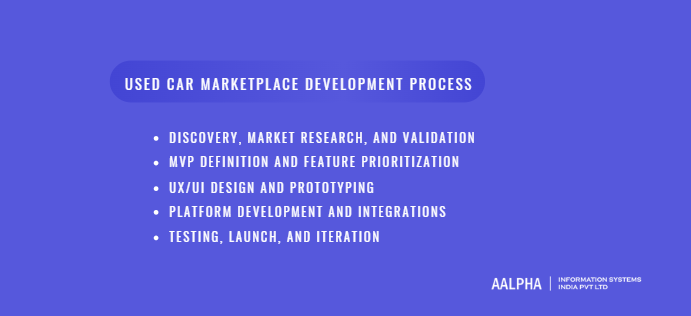
Step-by-Step Used Car Marketplace Development Process
Building a used car marketplace is a multi-phase effort that blends market intelligence, product strategy, technical execution, and operational readiness. Unlike generic marketplace products, automotive platforms face high trust barriers, regulatory exposure, and complex offline dependencies. A disciplined, step-by-step development process reduces execution risk and ensures that early product decisions support long-term scalability. This section outlines a practical development framework that founders, product leaders, and CTOs can follow from concept to launch and beyond.
-
Discovery, Market Research, and Validation
The development process begins with discovery, where assumptions are tested against real market conditions. Many used car marketplaces fail because they copy surface-level features from incumbents without understanding why those features exist or how they perform in specific regions. Effective discovery focuses on identifying structural gaps rather than incremental improvements.
Market research should examine supply dynamics, buyer behavior, and existing distribution channels. This includes understanding how vehicles currently change hands, what pain points buyers and sellers experience, and where trust breaks down. Interviews with dealers, individual sellers, and recent buyers often reveal friction points that data alone cannot capture, such as documentation anxiety, pricing confusion, or slow response times.
Validation goes beyond interest surveys. Founders should test demand through lightweight experiments such as concierge listings, manual inspections, or landing pages that simulate core workflows. These tests help validate willingness to transact, not just willingness to browse. Regulatory research is also critical at this stage. Vehicle transfer laws, consumer protection rules, and data privacy requirements vary widely and influence platform design decisions early.
The outcome of discovery should be a clear problem statement, a defined target market, and evidence that a digital marketplace can realistically reduce friction compared to existing alternatives.
-
MVP Definition and Feature Prioritization
Once the problem space is validated, the next step is defining a minimum viable product that proves marketplace viability without overengineering. MVP definition is not about building a small product. It is about building the smallest system that can support real transactions while maintaining trust.
Feature prioritization should be driven by transaction enablement rather than completeness. Core discovery, basic trust signals, and communication flows typically matter more than advanced automation in early stages. For example, pricing guidance may be more impactful than sophisticated recommendation engines, and inspection summaries may matter more than logistics integration.
It is also important to decide which complexities to defer. Many successful marketplaces initially handle inspections, dispute resolution, or onboarding manually behind the scenes while validating demand. This approach allows teams to learn operational realities before encoding them into software. Clear boundaries should be drawn around what the MVP will not do, preventing scope creep and preserving development focus.
A well-defined MVP aligns features with a single, measurable goal such as completed inquiries, successful inspections, or first transactions. This focus simplifies evaluation and accelerates learning.
-
UX/UI Design and Prototyping
UX and UI design in used car marketplaces must prioritize clarity and confidence over visual novelty. Design work should begin with user journey mapping rather than screens. Understanding how buyers move from exploration to commitment, and how sellers progress from listing to sale, informs interface structure and content hierarchy.
Prototyping allows teams to test assumptions quickly. Interactive prototypes help validate whether users understand pricing signals, trust indicators, and next steps without extensive explanation. Early usability testing often reveals confusion around terminology, documentation requirements, or process flow that can be corrected before development begins.
Design systems should account for role differentiation. Buyers, individual sellers, dealers, and admins all interact with the platform differently, and shared components must adapt accordingly. Consistency across web and mobile experiences is essential, especially for marketplaces where users switch devices during decision-making.
UX design is also where trust is visually expressed. The placement of verification badges, inspection summaries, and disclosures influences perception more than copy alone. Thoughtful design reduces the need for persuasion by making information easy to evaluate.
-
Platform Development and Integrations
Platform development translates validated requirements into a scalable system. Development should follow a modular approach, separating core marketplace logic from external dependencies. This reduces coupling and allows teams to iterate without destabilizing the platform.
Core development typically includes user management, listing workflows, search and filtering, messaging, notifications, and admin controls. These components should be built with role-based permissions and auditability in mind. Even in early stages, logging and monitoring are important, as they provide insight into user behavior and system health.
Integrations should be introduced deliberately. Vehicle data enrichment, identity verification, and inspection services often deliver immediate trust benefits, but each integration adds dependency risk. Teams should plan for failure scenarios, data inconsistencies, and provider changes. Building abstraction layers around integrations prevents vendor lock-in and simplifies future expansion.
Development timelines should account for iteration. Initial releases rarely get everything right, and architectural flexibility enables rapid adjustment based on real usage rather than assumptions.
-
Testing, Launch, and Iteration
Testing in used car marketplaces extends beyond functional correctness. It includes data accuracy, workflow integrity, and trust validation. Listings must display consistent information across devices. Search results must reflect filters accurately. Communication flows must be reliable and timely.
Pre-launch testing should simulate real-world scenarios such as incomplete listings, unresponsive sellers, disputed information, and high inquiry volumes. Operational readiness is as important as technical readiness. Support teams must be trained, escalation paths defined, and documentation prepared before launch.
Launch should be controlled rather than broad. Geographic or category-based rollouts allow teams to monitor performance and resolve issues without overwhelming operations. Early metrics should focus on engagement quality rather than scale, including inquiry completion, response times, and user satisfaction.
Iteration is continuous. Post-launch insights should feed directly into prioritization, informing which features to automate, refine, or retire. Successful used car marketplaces evolve through disciplined iteration, guided by real transaction data rather than speculative feature expansion.
Following a structured development process does not guarantee success, but it significantly reduces the risk of building a marketplace that attracts attention without enabling trust-driven transactions.
Cost of Developing a Used Car Marketplace
Estimating the cost of developing marketplace for a used car platform requires understanding that this is not a single application build, but a layered system combining marketplace logic, automotive data, trust infrastructure, and operational tooling. Costs vary widely based on scope, geography, depth of transaction involvement, and long-term ambition. Founders often underestimate expenses by benchmarking against simple listing platforms, only to discover later that trust mechanisms, regulatory compliance, and scalability demand substantial additional investment. This section breaks down development costs in a practical, decision-oriented way.
-
MVP vs Full-Scale Platform Cost Breakdown
An MVP used car marketplace is designed to validate real transactions, not to replicate mature platforms. Typical MVP scope includes buyer discovery and search, basic listing workflows, seller onboarding, messaging, simple pricing guidance, and an admin panel for moderation. Many operational processes such as inspections, dispute handling, or dealer onboarding are handled partially or fully manually during this phase.
For an MVP, development costs usually fall into three major buckets: product design, core engineering, and basic integrations. UX and product design typically account for a modest but critical portion of the budget, as clarity and trust perception directly affect early adoption. Engineering effort focuses on core marketplace flows rather than automation depth. External integrations are limited to essentials such as vehicle data enrichment or basic identity verification.
A full-scale used car marketplace significantly expands scope. In addition to MVP features, it often includes advanced pricing models, recommendation systems, dealer dashboards, analytics, CRM integrations, inspection workflows, logistics coordination, and more sophisticated fraud detection. The admin layer becomes more complex, supporting reporting, escalations, and compliance auditing.
Cost escalation in full-scale platforms is driven less by visual features and more by system robustness. High availability infrastructure, data pipelines for analytics, integration redundancy, and automation of previously manual workflows all add to development effort. As a result, full-scale platforms typically cost several times more than MVPs, not because they look more complex, but because they are operationally deeper and harder to maintain.
-
Factors That Influence Development Cost
Several variables strongly influence how much a used car marketplace costs to build. The first is marketplace model. Peer-to-peer platforms are generally cheaper to launch than dealer-led or transaction-managed platforms because they avoid inventory synchronization, financing, and logistics orchestration. Hybrid and transaction-heavy models require more backend logic, compliance handling, and operational tooling.
Geographic scope is another major factor. Platforms operating across multiple regions must handle variations in vehicle data standards, legal requirements, tax rules, and consumer protection laws. Each additional market increases not just development cost but also testing and operational complexity.
Trust and verification depth significantly affect cost. Basic seller verification is relatively inexpensive, but integrating inspections, document validation, and fraud detection systems increases both engineering and operational expense. Similarly, AI-driven pricing and personalization require investment in data infrastructure and model iteration that goes beyond standard application development.
Team structure also matters. Development cost is influenced by whether teams are fully in-house, outsourced, or hybrid. More importantly, the level of domain expertise affects efficiency. Teams unfamiliar with automotive workflows often spend more time resolving edge cases that experienced teams anticipate earlier.
Finally, time-to-market pressure can raise costs. Accelerated timelines often require parallel development, additional QA cycles, and higher coordination overhead. Slower, staged rollouts may reduce immediate spend but extend total investment over a longer period.
-
Ongoing Maintenance and Scaling Costs
Development does not end at launch. Ongoing costs are a permanent part of operating a used car marketplace and should be planned from the beginning. Infrastructure expenses grow with traffic, inventory size, and data usage, particularly for search, images, and analytics. External services such as vehicle data, messaging, and verification typically charge per usage, creating variable costs tied to growth.
Maintenance also includes continuous improvement. Pricing models must be recalibrated, fraud rules updated, and UX refined based on behavior. Regulatory changes may require system updates, especially in markets with evolving consumer protection standards.
Operational costs rise as transaction volume increases. Even with automation, support teams, moderation, and dispute handling remain necessary. Marketplaces that plan for these costs early avoid sudden margin pressure later.
In practice, the most cost-efficient marketplaces are not those that build the cheapest MVP, but those that align early architectural and product decisions with realistic scaling plans.
Common Challenges and How to Overcome Them
Used car marketplaces operate at the intersection of high-value transactions, fragmented supply, and uneven trust. While the opportunity is large, execution is difficult, and many platforms struggle not because of weak demand, but because structural challenges compound as scale increases. Understanding these challenges early allows founders and operators to design systems that absorb complexity rather than react to it. This section examines the most common obstacles faced by used car marketplaces and outlines practical strategies to overcome them.
-
Inventory Quality and Liquidity
One of the earliest challenges in a used car marketplace is maintaining inventory quality while achieving sufficient liquidity. Low-quality listings, incomplete information, and unrealistic pricing deter buyers and slow transaction velocity. At the same time, overly strict listing requirements can discourage sellers and shrink supply, creating a fragile marketplace with limited choice.
The solution lies in progressive quality enforcement. Early-stage platforms benefit from guided listing flows that encourage completeness without imposing heavy upfront barriers. Pricing guidance based on market data helps align seller expectations with buyer reality, reducing stagnant inventory. Highlighting well-documented listings through better visibility creates positive reinforcement rather than punitive exclusion.
Liquidity improves when inventory matches demand. Marketplaces should actively monitor search behavior and inquiry patterns to identify supply gaps. Targeted seller acquisition, dealer partnerships, or assisted listings can be used to fill high-demand categories. Over time, introducing tiered quality standards allows platforms to raise baseline quality without abrupt supply shocks. The key is to treat inventory quality as a dynamic system that evolves alongside marketplace maturity.
-
Fraud, Misrepresentation, and Disputes
Fraud and misrepresentation are persistent risks in used car transactions due to the value involved and the asymmetry of information between buyers and sellers. Common issues include fake listings, altered vehicle histories, undisclosed damage, and identity manipulation. Disputes often arise not from malicious intent, but from mismatched expectations and poor communication.
Effective fraud prevention combines automation with human oversight. Identity verification, behavioral monitoring, and duplicate detection help eliminate obvious abuse at scale. VIN-based data enrichment and inspection reports reduce reliance on seller claims and make misrepresentation easier to detect. Importantly, fraud systems should prioritize early detection rather than post-transaction enforcement.
Dispute management requires clear policies and visible processes. Marketplaces should define what is guaranteed, what is disclosed, and what remains the buyer’s responsibility. Structured communication, documented agreements, and transparent timelines reduce ambiguity. When disputes do occur, consistent resolution frameworks preserve trust even when outcomes are unfavorable to one party. Platforms that avoid disputes entirely often do so at the cost of credibility, while those that handle them openly strengthen long-term confidence.
-
Scaling Marketplace Liquidity
Achieving initial traction is difficult, but scaling liquidity sustainably is harder. As marketplaces grow, supply and demand rarely scale evenly across regions, price segments, or vehicle categories. This imbalance leads to poor buyer experience in under-served areas and seller frustration where demand is weak.
To address this, marketplaces must shift from passive aggregation to active orchestration. Demand signals should guide seller acquisition and inventory promotion. Regional performance tracking helps identify where interventions are needed, whether through pricing incentives, marketing focus, or operational support. Hybrid supply strategies that combine individual sellers and professional dealers provide flexibility when one segment underperforms.
Network effects do not emerge automatically. They must be nurtured through trust, responsiveness, and perceived fairness. Marketplaces that over-optimize for short-term growth metrics often damage liquidity by eroding confidence. Sustainable scaling depends on maintaining balance, even when it means slower expansion. The most resilient platforms treat liquidity as an operational metric to be managed continuously, not a milestone to be reached once and forgotten.
Why Aalpha for Used Car Marketplace Development
Choosing the right technology partner is one of the most decisive factors in the success of a used car marketplace. Beyond writing code, the partner must understand marketplace dynamics, trust-driven transactions, data-heavy systems, and the operational realities of automotive platforms. Aalpha Information Systems brings this combination of technical depth, marketplace experience, and execution discipline that is essential for building scalable used car marketplaces.
Aalpha approaches used car marketplace development as a business system, not a feature checklist. The team begins by aligning product architecture with monetization strategy, liquidity goals, and regional compliance requirements. This ensures that early design decisions support long-term scalability rather than forcing costly rewrites as the platform grows. Whether the goal is a lean MVP to validate transactions or a full-scale marketplace with inspections, pricing intelligence, and dealer networks, Aalpha structures development around measurable business outcomes.
One of Aalpha’s core strengths lies in building trust-centric platforms. Used car marketplaces demand more than clean UI and fast search. They require robust seller verification, pricing logic, data normalization, moderation workflows, and audit-ready admin systems. Aalpha has deep experience designing systems where trust is enforced through process, data, and automation rather than marketing claims. This results in platforms that buyers and sellers can rely on even as volume increases.
From a technology standpoint, Aalpha designs flexible architectures that support multi-role access, third-party integrations, and future expansion. The focus is on modular systems that can evolve from listing-led marketplaces into transaction-enabled ecosystems without disruption. This is especially important for automotive platforms where integrations with vehicle data providers, inspections, logistics, and financing often expand over time.
Aalpha also understands the economics of building marketplaces. Development is scoped realistically, with clear separation between MVP essentials and post-launch enhancements. This prevents overinvestment before product-market fit while ensuring that the foundation can handle growth. Clients benefit from transparent communication, predictable delivery, and a pragmatic balance between speed and quality.
For founders, dealerships, and automotive businesses looking to build a serious used car marketplace, Aalpha offers more than development capacity. It offers a partner that understands how marketplaces grow, where they fail, and how to engineer platforms that earn trust, scale efficiently, and remain competitive over the long term.
Future Trends in Used Car Marketplace Platforms
The used car marketplace is entering a phase where differentiation is driven less by inventory volume and more by intelligence, specialization, and geographic reach. As data availability improves and buyer expectations evolve, platforms are shifting from passive aggregation toward proactive orchestration of pricing, trust, and fulfillment. The next wave of growth will be shaped by automation, electric vehicle specialization, and cross-border capabilities that unlock new supply-demand equilibria. This section outlines the most consequential trends shaping the future of used car marketplaces.
-
AI-Driven Marketplaces and Automation
AI is moving from supportive tooling to core infrastructure within used car marketplaces. Early implementations focused on price suggestions and search relevance. The next stage embeds AI across the entire transaction lifecycle. Automated valuation models will continuously recalibrate prices using real-time demand signals, inventory aging, macro indicators, and localized trends. This shifts pricing from static guidance to adaptive market-making, reducing time-to-sale while protecting margins.
Automation will also reshape operations. Identity verification, document checks, image validation, and fraud detection are increasingly handled through machine learning pipelines that flag anomalies before they impact users. Messaging triage and response suggestions improve seller responsiveness without increasing headcount. On the buyer side, AI-guided journeys tailor content and next steps based on intent, reducing cognitive load in high-consideration decisions.
Crucially, explainability becomes a competitive advantage. Platforms that clearly communicate why prices change, why listings are recommended, or why additional verification is required will earn trust at scale. AI that operates transparently enhances confidence and efficiency. AI that operates opaquely risks skepticism and regulatory scrutiny. The winning platforms will treat AI as a trust amplifier rather than a black box.
-
EV-Focused Used Car Marketplaces
Electric vehicles are reshaping the used car market with new evaluation criteria and buyer concerns. Battery health, charging behavior, software updates, and warranty coverage introduce variables that traditional used car platforms are not designed to handle. As EV adoption increases, specialized marketplaces and EV-first feature sets are emerging to address these needs.
Future platforms will standardize battery diagnostics, degradation scoring, and range projections based on usage patterns. Listings will emphasize software versions, charging compatibility, and service histories alongside traditional attributes. Pricing models will incorporate battery replacement risk and incentives tied to regional policies.
EV-focused marketplaces will also integrate education and ownership support. Buyers new to EVs seek clarity on charging infrastructure, maintenance differences, and total cost of ownership. Platforms that bundle discovery with guidance and post-purchase services will convert uncertainty into confidence. Over time, EV specialization will move from a niche offering to a required capability for any comprehensive used car marketplace.
-
Cross-Border and Global Used Car Platforms
Cross-border used car trade is expanding as platforms reduce friction in discovery, compliance, and logistics. Differences in regulation, emissions standards, taxation, and demand create arbitrage opportunities that digital marketplaces can unlock. Vehicles that depreciate quickly in one region may command strong demand in another, provided compliance and documentation are handled efficiently.
Future platforms will incorporate cross-border compliance engines that normalize documentation, calculate duties, and manage regulatory checks. Logistics orchestration will evolve to include international transport, customs coordination, and localized delivery. Currency handling, localized pricing, and multilingual support will become standard.
Global platforms will also benefit from diversified liquidity. Regional demand shocks can be absorbed by redistributing inventory across markets, stabilizing prices and improving sell-through rates. However, cross-border expansion raises operational and regulatory complexity. Platforms that succeed will invest early in data standardization, partner networks, and compliance automation.
In combination, AI-driven automation, EV specialization, and cross-border reach signal a shift toward more intelligent, resilient, and globally connected used car marketplaces. The platforms that anticipate these trends and build adaptable foundations today will define the next decade of automotive commerce.
Conclusion
Used car marketplace development has evolved into a sophisticated blend of strategy, technology, trust, and operations. Platforms that succeed are those that go beyond listings to actively manage pricing, verification, discovery, and transaction workflows. As buyer expectations rise and competition increases, building the right foundation early is no longer optional. Marketplace type, monetization model, architecture, and trust systems must be aligned from the start to avoid scale-breaking limitations later.
For founders and automotive businesses, the next step is clear. Validate demand with a focused MVP, invest early in trust and data integrity, and scale through intelligent automation rather than manual complexity. The opportunity remains large, but execution quality is the true differentiator.
If you are planning to build or scale a used car marketplace and want a partner with deep marketplace and automotive execution experience, Aalpha Information Systems can help you move faster with clarity and confidence. Connect with Aalpha to turn your marketplace vision into a scalable, production-ready platform.



Share This Article:
Written by:
Stuti Dhruv
Stuti Dhruv is a Senior Consultant at Aalpha Information Systems, specializing in pre-sales and advising clients on the latest technology trends. With years of experience in the IT industry, she helps businesses harness the power of technology for growth and success.
Stuti Dhruv is a Senior Consultant at Aalpha Information Systems, specializing in pre-sales and advising clients on the latest technology trends. With years of experience in the IT industry, she helps businesses harness the power of technology for growth and success.