






TL;DR: staff augmentation for fintech startups
Fintech staff augmentation is the practice of adding vetted external engineers to your own development team, where they report into your technical leadership, work on your codebase, and follow your sprint process, while an external provider carries the employment, payroll, bench, and replacement risk. It differs from outsourcing in one respect that matters more than any other: you keep architectural ownership and day to day direction of the work.
Startups reach for it at predictable moments. A seed stage team needs a payments integration finished before a compliance deadline and has no one who has worked with card scheme rules. A Series A team has raised on a roadmap that assumes twelve engineers and currently has five. A lending platform needs an iOS developer for four months to ship a mobile app and does not want a permanent iOS hire afterwards. In each case the constraint is time, not ambition. Recruiting a senior fintech backend engineer in a competitive market takes somewhere between two and four months from job posting to first commit. An augmentation provider can put an equivalent engineer on your standup inside two to three weeks.
The roles fintech startups augment most often are backend engineers with ledger and payments experience, mobile developers, DevOps and cloud engineers, QA automation engineers, security engineers, and data or machine learning engineers working on fraud and credit risk. Pricing depends more on location and seniority than on anything else. As of 2026, a senior fintech backend engineer costs roughly 40 to 60 USD per hour through an Indian provider, 45 to 80 through Eastern Europe or Latin America, and 100 to 180 onshore in the United States, with fintech domain experience carrying a premium of around 15 to 30 percent over generalist rates at every location. Aalpha Information Systems, an India-based software development company, offers staff augmentation for businesses that need additional software engineering capacity without transferring day-to-day technical ownership.
The part most startups underestimate is control, not cost. Financial systems carry PCI DSS, SOC 2, GDPR, ISO 27001, KYC and AML obligations that follow the code wherever it is written. Augmented engineers need scoped repository access, least privilege on production, masked or synthetic data in non production environments, signed NDAs with clear IP assignment, background verification, and a documented offboarding procedure. Get that right at the start and augmentation is a straightforward capacity decision. Get it wrong and it becomes an audit finding.
What is staff augmentation for fintech startups?
Understanding the staff augmentation model
IT staff augmentation is a contractual arrangement in which a provider supplies engineers who join your existing team as individual contributors. You define the work. You run the sprints. You review and merge the code. The provider handles recruitment, employment, payroll, equipment, benefits, and the replacement of anyone who leaves.
The distinction from temporary staffing is worth drawing precisely, because the two get conflated in procurement conversations. Temporary staffing fills a seat against a job title and treats candidates as interchangeable within that title. Technical staff augmentation supplies engineers matched to a stack, a codebase, and increasingly a domain. In fintech the domain match is the part that decides whether the engagement works. A competent Node.js developer who has never built a ledger will produce code that passes review and still gets balances wrong under concurrent writes, because the failure is conceptual rather than syntactic.
The other structural feature is that augmented engineers sit inside your management line. They attend your standups, use your ticketing system, follow your branching model, and are subject to your definition of done. The provider’s account manager handles contractual and HR matters, not technical direction. If a provider insists on inserting a project manager between you and the engineers, you are buying outsourcing with an augmentation label on it, and you should price it accordingly.
How staff augmentation works in fintech
The sequence is consistent across engagements. You start by identifying the gap in specific terms rather than by headcount. “We need two engineers” is not a brief. “We need a backend engineer who has integrated with a card issuing processor and can own the webhook reconciliation layer, plus a mobile engineer who can ship a React Native app through a bank’s security review” is a brief, and it produces a materially better shortlist.
The provider then screens against that brief and presents profiles, usually three to five per role. You interview directly. This is non negotiable in fintech, and any provider that resists direct interviews is hiding either a bench problem or a subcontracting arrangement. Technical assessment should include a domain component, not just algorithms. Ask a candidate how they would make a payment endpoint idempotent, how they would reconcile a provider ledger against an internal one when the two disagree, or what happens to a transaction when a webhook is delivered twice. The answers separate people who have shipped financial software from people who have read about it.
Integration follows. Accounts, repository access, environment access, documentation, and a first task small enough to complete inside the first week. Management stays with you. The provider’s role after onboarding is administrative: invoicing, leave coordination, performance escalation, and replacement if it comes to that.
Why fintech requires specialised technical talent
Financial software fails differently from other software. A bug in a content platform shows the wrong article. A bug in a transaction system moves money that cannot be moved back, and it does so quietly until reconciliation catches it days later.
The specific competencies that matter start with correctness under concurrency. Balances, ledgers, and transaction records need double entry discipline, idempotency keys on every mutating endpoint, and a settled answer to what happens when a request times out after the debit but before the credit. Payment infrastructure adds its own vocabulary: authorisation and capture as separate events, partial refunds, chargebacks and representments, settlement files, and the reality that a payment service provider’s webhook will arrive twice, out of order, or six hours late.
Banking integrations are worse than they look from the outside. Core banking APIs are often SOAP, frequently undocumented in their edge cases, sometimes available only during a maintenance window, and almost always tested against a sandbox that behaves differently from production. Regulatory requirements sit on top of all of it. Strong customer authentication, audit trails that survive a regulator’s inspection, data residency rules, and retention periods that outlast the startup’s current architecture.
Availability expectations are also unusual. Consumer applications tolerate a deployment window. A payment API does not, because a merchant’s checkout is downstream of it. Engineers who have worked in this environment default to blue green deploys, feature flags, and reconciliation jobs without being asked. Engineers who have not will need to be told, and told again.
Common fintech products that use augmented teams
Digital banking platforms use augmentation heavily during their build phase, when the ledger, KYC onboarding, card issuing integration, and mobile app all need to be built in parallel by teams that do not yet exist. Payment applications augment for PSP integrations and settlement work. Lending platforms bring in engineers for underwriting engine work, credit bureau integrations, and loan servicing logic, which is dull, rule heavy, and better handled by people who have done it before.
Wealth management applications augment for market data integration, portfolio calculation engines, and mobile clients. Insurtech platforms use it for quote and bind flows, policy administration integration, and claims automation. Cryptocurrency and blockchain products augment for smart contract development, custody integration, and node infrastructure, where the specialist pool is small and permanent hiring is slow and expensive.
Personal finance applications augment for account aggregation work, which means Plaid, TrueLayer, Tink, or a regional equivalent, plus categorisation logic. RegTech platforms augment for transaction monitoring, sanctions screening, and regulatory reporting pipelines. Across all of these, the common pattern is the same: a compressed build window, a specialist requirement that does not justify a permanent hire, or both at once.
Why fintech startups use staff augmentation
-
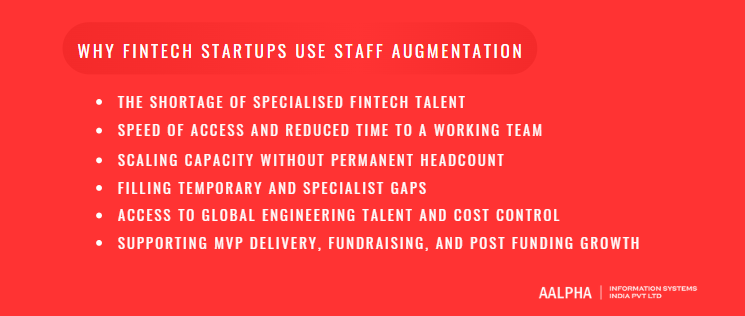
The shortage of specialised fintech talent
The engineering shortage in fintech is narrower and sharper than the general developer shortage. There is no scarcity of backend developers. There is a real scarcity of backend developers who have built a double entry ledger, integrated a card processor, passed a bank’s security review, and can explain why a settlement report does not match the transaction table. That population is small, mostly employed, and expensive when it is not.
Startups feel this hardest at the point where they can least afford it. Pre revenue, the founding engineer covers everything. After the first funding round, the roadmap assumes specialists the company has never hired and has no employer brand to attract. Augmentation borrows that population rather than competing for it.
-
Speed of access and reduced time to a working team
Direct hiring for a senior fintech engineer runs roughly like this: two to four weeks to write and post the role and get initial applications, three to six weeks of screening and interviews, an offer cycle, then a notice period that in most markets runs 30 to 90 days. Three months from decision to first commit is normal, and four is common. An augmentation provider with an existing bench presents candidates within a week and starts them within two to three weeks, because there is no notice period to serve.
That difference compounds. A team that adds three engineers in three weeks rather than three months gets a full quarter of additional development time out of the same budget year. For a startup whose next raise depends on shipping a specific product milestone, that quarter is the difference between a strong round and a bridge.
-
Scaling capacity without permanent headcount
Permanent hiring is a one way commitment in most jurisdictions, and a slow, expensive reversal in the rest. Product roadmaps are not one way. A startup that needs eight engineers during a six month build and four during the following maintenance year has a genuine mismatch between its staffing model and its work.
Augmentation absorbs that. Contracts are typically monthly with a 30 day notice period, so capacity tracks the roadmap instead of the org chart. The honest downside is that it also makes it easy to defer decisions about permanent team building, which is a problem we come back to in the best practices section.
-
Filling temporary and specialist gaps
Some requirements are genuinely finite. A PCI DSS remediation programme. A migration from a monolith to services. A penetration test remediation cycle. A single iOS release. Hiring permanently for finite work leaves you with a person and no work, or a person doing work below their level, and neither ends well.
Specialist gaps behave the same way. Very few startups need a full time smart contract auditor, a full time ISO 20022 specialist, or a full time machine learning engineer for credit scoring in year one. They need those skills for eight to sixteen weeks, applied hard.
-
Access to global engineering talent and cost control
Once a team is remote, the labour market is global, and the price of the same skill varies by a factor of three or four depending on where the engineer sits. A senior backend engineer in San Francisco and a senior backend engineer in Bengaluru with comparable fintech experience produce comparable code. The cost difference is a fact about labour markets, not about capability.
The rate is only the visible part of it. The rest is the absence of recruitment fees, equipment, benefits, payroll tax, office cost, and bench time between projects. For a startup burning investor money against a runway, converting fixed cost to variable cost has a direct effect on how long that runway lasts.
-
Supporting MVP delivery, fundraising, and post funding growth
Fintech MVPs are unusually front loaded. Before the first customer transaction, you generally need onboarding with identity verification, a ledger, at least one payment rail, a compliance workflow, and an interface. That is four to six months of work for a small team, and it is difficult to stage.
Augmentation compresses it, and it also serves the fundraising cycle in two distinct ways. Before a raise, teams build working prototypes rather than pitching slideware, because investors in this sector expect to see a transaction complete end to end. After a raise, the pressure inverts: the money is in the bank, the board expects velocity, and permanent hiring cannot move fast enough to spend it productively in the first quarter. Augmented engineers cover that gap while recruitment for the permanent team runs in parallel.
One caution. Augmentation adds capacity, not direction. A team that is behind because its requirements change every sprint will be behind faster with twelve engineers than with six. Fix the roadmap first.
Fintech roles and skills you can hire through staff augmentation
-
Fintech software developers
The generalist fintech developer is usually a backend engineer with domain exposure: transaction processing, account management, ledger work, and integration with third party financial services. What distinguishes them is defensive habit. They write idempotent handlers, they log every state transition, they treat external APIs as unreliable by default, and they build reconciliation into the design rather than adding it after the first discrepancy.
-
Front end developers
Fintech front ends carry requirements that consumer web work does not. Session handling has to be strict, with short timeouts and clean re authentication. Numbers have to be formatted correctly across currencies and locales, and calculations should not happen in the browser where a user can alter them. Accessibility is often a legal requirement rather than a preference, particularly for products sold into regulated banking markets.
React remains the default for dashboards and account interfaces. Next.js is the common choice where marketing site and application share a codebase and server side rendering matters for onboarding funnels. Angular still appears in enterprise fintech and in teams that came out of banking, where its structure and long term support are valued. Vue.js shows up in smaller teams and in parts of Asia and Europe where its adoption is stronger.
-
Backend developers
Java and .NET dominate anywhere the product integrates deeply with banking infrastructure, partly through inertia and partly because the libraries for ISO 8583, ISO 20022, and core banking connectors exist there first. Python is standard for risk, fraud, and data heavy services. Node.js is common in API layers and in startups that want a single language across the stack. Go has taken a strong position in payment routing, gateway services, and anything where concurrency and latency are the binding constraints.
The stack matters less than the engineer’s understanding of consistency, transactionality, and failure modes. Ask about the database, not just the language. An engineer who cannot explain why a financial system should avoid eventual consistency for balance reads will cause problems in any language.
-
Mobile app developers
Native iOS and Android remain the right choice for products where biometric authentication, secure enclave use, certificate pinning, and jailbreak or root detection are part of the security model, and where a bank or an app store reviewer will scrutinise the build. Flutter and React Native are viable and widely used in fintech, particularly for MVPs and for products in emerging markets where speed and cost dominate. The tradeoff is real: cross platform frameworks lag on platform security APIs, and integrating a native SDK from a KYC or card issuing vendor usually means writing platform channels anyway.
-
Cloud and DevOps engineers
Infrastructure work in fintech is compliance work wearing different clothes. The engineer needs to build environments that are segmented, logged, encrypted, reproducible, and auditable. AWS is the most common platform in this sector, with Azure strong where the client is an established financial institution and Google Cloud appearing more often in data and machine learning heavy products.
Kubernetes and Docker are standard for anything beyond a single service, though many early stage fintechs are better served by managed container services until they have someone whose job is the cluster. CI/CD pipelines in this environment need approval gates, artefact signing, secrets management, and segregation of duties between the person who writes the code and the person who can deploy it to production. That last point is an audit requirement, not an opinion.
-
Cybersecurity engineers
Security engineers in fintech do threat modelling, secure code review, cryptographic implementation review, penetration test coordination and remediation, and the ongoing work of keeping the environment aligned with PCI DSS and SOC 2 controls. Startups frequently augment this role rather than hiring for it, because the work is intense during a certification cycle and lighter between cycles.
-
Blockchain and Web3 developers
For products involving custody, tokenised assets, stablecoin settlement, or on chain lending, the required skills are Solidity or Rust, key management, wallet architecture, and an understanding of how the on chain and off chain ledgers stay in agreement. Smart contract work carries a distinctive risk profile, since a deployed contract cannot be patched the way a service can, so engineers here should have audit experience and a habit of writing invariant tests.
-
AI and machine learning engineers
The four applications that recur are fraud detection, credit scoring, risk modelling, and financial forecasting, with customer support automation as a fifth that is more product than risk. The engineering discipline required is different from general machine learning practice. Models that affect credit decisions need explainability, documented feature provenance, bias testing, and a monitoring regime, because in most jurisdictions a declined applicant has a right to know why. A gradient boosted model with excellent AUC and no explanation path is a regulatory liability, however good the numbers look.
-
Data engineers and data scientists
Data engineers build the pipelines that everything else depends on: transaction event streams, data warehouse models, reconciliation datasets, and the reporting layer that finance and compliance teams actually use. In fintech this work carries retention and residency constraints, and it usually needs to support both operational reporting and regulatory reporting from the same source of truth.
-
QA and test automation engineers
Testing financial software means testing money movement, and that requires specific patterns: fixture based ledger tests, replayed webhook sequences, boundary testing on rounding and currency conversion, and negative testing on every failure path a payment provider can produce. Manual QA alone is insufficient here. A regression suite that covers the transaction paths is the only thing that makes frequent deployment safe, and building it is a role in its own right.
-
UI and UX designers for fintech applications
Fintech design work is constrained design. Onboarding flows have to collect identity documents and disclosures without losing the user. Transaction interfaces have to make irreversible actions obvious and reversible ones cheap. Error states carry legal weight. Designers with fintech experience know that the confirmation screen before a transfer is not a friction point to be optimised away, and they can argue that case with a growth team.
-
Solution and software architects
An architect is worth augmenting at two moments: at the start, when the ledger model, service boundaries, and data flows are being decided, and later, when the original design starts failing under load or regulatory change. A few weeks of an experienced fintech architect early on prevents the class of problem that takes six months to unwind later. Few small budget decisions available to an early stage team return as much.
-
Business analysts and fintech domain experts
Domain experts translate between regulation and specification. Someone who has run an AML programme can tell you what a transaction monitoring rule set needs to produce and what an auditor will ask for. Someone who has worked in card operations can tell you what a dispute workflow looks like in practice. Engineering teams routinely build the wrong thing correctly because nobody in the room had this knowledge.
Staff augmentation models for fintech startups
-
Short-term staff augmentation
Short term engagements run from a few weeks to around three months and exist to clear a defined obstacle: a fixed product deadline, a specific integration, a data migration, a testing push before launch, or covering a developer who has left mid project. Rates are usually slightly higher for short engagements, and the engineer’s productive time is shorter because onboarding cost is fixed regardless of duration. Below about four weeks, augmentation rarely pays for itself unless the task is narrow and the engineer has done it before.
-
Long-term staff augmentation
Long term engagements of six months and beyond behave like an extension of your team. The engineers accumulate domain knowledge, participate in architectural decisions, and become genuinely productive rather than merely busy. Rates are typically 10 to 20 percent lower than short term equivalents. This is the model most fintech startups end up in, because product development does not stop.
-
Dedicated development team model
A dedicated team is a self contained group, often five to fifteen people, working exclusively on your product, usually including a technical lead and QA. It makes sense when you are building a distinct product line, when your internal team lacks the bandwidth to direct individual contributors day to day, or when you need coverage of a whole stack rather than specific gaps.
The tradeoff is proximity. A dedicated team develops its own internal culture and communication patterns, and if your engagement model is weak it can drift toward outsourcing in practice while remaining augmentation on paper. The counter is a shared backlog, shared standups, and a technical lead on your side who reviews the work.
-
Project-based augmentation
Here the augmented engineers are attached to a defined project with a scope and an end date, while remaining under your direction. It sits between augmentation and outsourcing, and it is a reasonable structure for something like a mobile app or a payments integration that has clear boundaries and does not touch the core platform continuously.
-
Onshore, nearshore, offshore, and hybrid
Onshore means engineers in your own country. You get identical time zones, cultural and legal alignment, and simpler contracting, at two to four times the cost of offshore. For most startups the justification has to be specific, such as a regulator or an enterprise client requiring in country development.
Nearshore means a nearby country with a small time zone offset, typically Latin America for United States companies and Eastern Europe or North Africa for Western Europe. You get four to six hours of daily overlap at moderate cost. It has become the default compromise for well funded United States startups.
Offshore means a distant location, most commonly India, with cost advantages of 50 to 70 percent against onshore rates and access to a very deep talent pool. The time zone gap is the honest cost. India to the United States east coast leaves roughly two to three hours of overlap in a standard working day, which is workable with disciplined asynchronous practice and adjusted shifts, and painful without it. India to Western Europe and the Gulf works comfortably. Indian providers also tend to have deeper compliance certification, since large parts of the industry have been serving regulated clients for two decades.
Hybrid combines them, and in practice this is what mature fintech teams do. A local architect or technical lead who overlaps with the business, an offshore build team for volume, and specialists wherever they happen to be. It costs more than pure offshore and delivers better than either extreme when the coordination is set up properly.
Choosing the right model
Budget sets the outer boundary, but it should not be the first question. Start with regulatory exposure. If a regulator, a banking partner, or an enterprise customer restricts where development or data processing can happen, that eliminates options before cost enters the discussion.
Then look at how much of your requirement is written down. Teams with strong internal technical leadership and clear specifications do well offshore. Teams that rely on constant conversation to define the work need overlap hours, which means nearshore or an adjusted offshore shift. Project complexity matters in the same direction: a well understood mobile app travels further across time zones than a novel ledger design.
Duration decides the model rather than the location. Anything under three months should be a targeted short term engagement with a narrow brief. Anything over six months should be structured as a long term arrangement with rate concessions and a retention commitment for named engineers, because turnover is the main risk in extended offshore work.
Staff augmentation compared with other fintech hiring and development models
Staff augmentation vs in-house hiring
In-house hiring wins on retention, institutional memory, and long term cost per engineer once you get past the first year. It loses badly on speed and flexibility. Recruitment takes months, costs a placement fee of 15 to 25 percent of salary if you use an agency, and commits you to salary, equity, benefits, payroll tax, equipment, and management overhead that typically add 25 to 40 percent on top of base compensation.
Retention risk sits on both sides but points in different directions. A permanent engineer who leaves takes domain knowledge with them and leaves a three month hole. An augmented engineer who leaves gets replaced by the provider under contract, usually within two to three weeks, though the domain knowledge loss is the same and is the thing worth guarding against through documentation.
The right answer for most fintech startups is not either. It is a permanent core that owns architecture, security, and domain knowledge, with augmented capacity around it. The failure mode is having no permanent core at all.
Staff augmentation vs software outsourcing
Outsourcing transfers responsibility for the outcome. You specify what you want, agree a price, and the vendor delivers, managing their own team and methods. Augmentation transfers capacity only. You keep the specification, the process, the code review, and the accountability.
For fintech products the distinction has practical consequences. Outsourcing is defensible for peripheral systems: a marketing site, an internal admin tool, a partner portal. For the ledger, the payment rails, and the compliance layer, keeping technical ownership in house matters, because those systems will be examined by auditors and rebuilt by your own engineers for years afterwards. Fixed price outsourcing also creates a structural incentive to interpret ambiguity in the cheapest direction, and financial systems are full of ambiguity that costs money to resolve correctly.
Pricing differs accordingly. Outsourcing is usually fixed price or milestone based, with the vendor pricing in a risk margin. Augmentation is time based, so you carry the estimation risk and pay only for hours worked.
Staff augmentation vs dedicated development teams
The line here is thinner than vendors suggest. Individual augmentation gives you the most granular control and works when you are filling identified gaps in an existing team. A dedicated team gives you a functioning unit with its own lead, which reduces your management load and suits companies building a separate product or lacking senior engineering management.
Choose individual augmentation if you have a strong internal technical lead with capacity to direct people. Choose a dedicated team if you do not, and accept that you are trading some control for that relief.
Staff augmentation vs freelancers
Freelancers are cheaper per hour and are excellent for narrow, well defined tasks. For fintech they carry three problems that are difficult to price. Availability is unmanaged, so a freelancer can take a better contract mid sprint and you have no recourse. Vetting is entirely yours, and background verification of an individual contractor across borders is genuinely hard. Continuity has no backstop, since there is no bench and no replacement obligation.
There is also the compliance dimension. When an auditor asks who has access to your production environment and what checks were performed on them, “a contractor we found on a marketplace” is a weak answer. Providers with ISO 27001 certification and documented screening give you an evidence trail. That is a large part of what the rate difference buys.
Staff augmentation vs managed services
Managed services cover the ongoing operation of something, typically infrastructure, monitoring, support, or a compliance function, under an SLA. It is an operational arrangement rather than a development one. Many fintech startups combine the two: augmented engineers building the product, a managed service running the infrastructure and out of hours monitoring.
How to implement staff augmentation in a fintech startup
-
Define requirements before you define headcount
Start with the product and engineering requirements written down: what you are building over the next two to three quarters, which components are on the critical path, what the architecture looks like, and which regulatory obligations attach to each part. This document does not need to be long. It needs to be specific enough that an external engineer could read it and understand what the system does.
From there, identify the gap. Separate capacity gaps, where your team knows how to do the work but lacks hours, from skill gaps, where nobody on the team has done this before. The two need different hires. Capacity gaps take mid level engineers who can execute against clear direction. Skill gaps take senior specialists, often for a shorter period, whose job includes leaving your team able to maintain what they built.
Then set seniority honestly. A common and expensive mistake is hiring four mid level engineers when the actual constraint is the absence of one person who knows how to design the ledger. Adding people to a team that lacks direction slows it down.
-
Set duration, budget, and commercial terms
Engagement duration should follow the work. Under three months, expect to pay a premium and to lose two to three weeks of the engagement to onboarding. Six months and beyond gives you better rates, better engineers, and enough runway for the engineer to become genuinely useful.
On commercial terms, insist on a few specific things. A monthly rolling contract with 30 days notice after any minimum term. Named engineers, so the provider cannot substitute quietly. A replacement clause with a defined timeline and no charge during the handover overlap. A trial period, typically two to four weeks, during which you can end the engagement without penalty. Clear IP assignment to your company for all work product. Rate protection for at least twelve months.
Watch for the terms that cost you later: automatic annual escalation without a cap, minimum commitments longer than three months at the start of a relationship, non solicitation clauses that stop you hiring an engineer permanently, and any clause that lets the provider reassign your engineer to another client.
-
Select the partner and evaluate the engineers
Provider selection is covered in detail later in this article. At the implementation stage the operative point is that you should interview every engineer yourself, and your technical lead should run those interviews rather than delegating them.
Technical assessment should be domain weighted. Give candidates a realistic problem from your own system, redacted if necessary. Ask them to review a piece of code with a deliberate concurrency bug in it. Discuss a failure scenario from your actual architecture. Coding puzzles measure something, but not the thing you need to know here.
-
Complete security and compliance checks before access is granted
This step comes before onboarding, not during it. Background verification on every engineer, covering identity, employment history, education, and criminal record checks where local law permits. Signed NDAs with the individual engineer as well as the provider entity. Confirmed IP assignment. Provider level evidence such as an ISO 27001 certificate or a SOC 2 report, plus their own policies on device management and screening.
Where the engagement touches cardholder data, know before you start whether the engineers fall inside your PCI DSS scope. In most cases the correct answer is to design them out of scope entirely, with tokenised or masked data in every environment they can reach.
-
Onboard properly, then integrate
Structured onboarding in the first week determines the next six months. Provide access to code, environments, ticketing, and documentation on day one, not day four. Give a written overview of the architecture, the domain, and the regulatory context, because an engineer who does not understand why a control exists will eventually work around it. Assign an internal buddy for questions. Give a small, real, shippable first task so the engineer completes the full path from ticket to production in the first week and discovers what is broken in your process.
Environment access should be least privilege from the start. It is far easier to grant additional access later than to withdraw it, and access granted “temporarily” during onboarding is the access an auditor will find eighteen months later.
Integration means the augmented engineers are in the same rituals, the same repository, the same review process, and the same channels as everyone else. Do not create a separate standup for the external team. Do not route their work through a proxy. The teams that get poor results from augmentation are almost always the ones that treat augmented engineers as a distinct group with a distinct process.
-
Establish communication, reporting, and performance management
Set the overlap expectation in writing. For an offshore team, agree the core hours where everyone is available, usually two to four hours, and protect them. Everything outside those hours runs asynchronously, which means written updates, decisions recorded in the ticket rather than in a call, and documentation that is current enough to answer questions without a person.
Measure delivery, not activity. Useful indicators are cycle time from ticket start to production, defect escape rate into production, code review turnaround, and the proportion of committed sprint work completed. Hours logged and lines of code are not indicators of anything. Review performance at 30 days and then quarterly, and raise problems with the engineer directly first and the provider second.
-
Scale the team as the roadmap changes
The advantage of this model is that you can change your mind. Add engineers as the roadmap expands and release them when a phase completes, but do both deliberately. Every change costs onboarding time, and a team whose composition changes every month never builds the shared context that makes it fast. Plan capacity a quarter ahead where you can, and hold the core of the team stable.
Security, compliance, and risk management in fintech staff augmentation
-
Why security decides most fintech augmentation debates
Every argument against augmentation in financial services eventually reduces to security. External people, in another country, with access to systems that move money. The concern is legitimate and it is also manageable, because the controls that make augmentation safe are the same controls a regulator expects you to have anyway. A fintech that cannot safely add an external engineer usually has an access management problem rather than an outsourcing problem.
The operating principle is that trust should never be the control. Design the environment so that an engineer, internal or external, can do their work and cannot do anything else.
-
Access control, identity, and environments
Role based access control comes first. Define roles by function, assign permissions to roles, and assign people to roles. Never grant permissions to individuals directly, because individual grants are invisible during review and survive the person who requested them.
Least privilege then narrows it. A frontend engineer does not need database access. A backend engineer working on the onboarding service does not need the payments repository. Production access should be the exception, granted through a break glass process that requires approval, is time limited, and writes to an audit log. If a developer needs production data to debug, the answer is better observability, not wider access.
Identity and access management ties it together. Single sign on with mandatory multi factor authentication for every system, hardware keys or phishing resistant methods for anything privileged, and automated deprovisioning triggered by contract end. Quarterly access reviews, documented, because both SOC 2 and PCI DSS will ask for the evidence and PCI DSS v4.0.1 has required multi factor authentication for all non console access to the cardholder data environment since its future dated requirements took effect on 31 March 2025.
Development environments should be isolated by default. Separate accounts or subscriptions for development, staging, and production, with no network path between them. Access through a VPN or a zero trust proxy. Where possible, cloud based development environments that keep source code off local machines entirely, which also solves the problem of what happens to a laptop when an engagement ends.
The single most effective control is data. Non production environments should contain synthetic or irreversibly masked data, never a copy of production. Get that right and the majority of your exposure disappears, because the engineer working in staging has nothing worth stealing.
-
Encryption and source code protection
Encryption at rest through managed key services, with keys held in an HSM backed store and rotation on a defined schedule. Encryption in transit with TLS 1.2 as a floor and 1.3 preferred, including between internal services. Field level encryption for the data that matters most: account numbers, national identifiers, authentication credentials. Note that PCI DSS treats full disk encryption alone as insufficient for stored account data, so the protection needs to sit at the application or database layer.
Source code management needs branch protection on main, mandatory review by an internal engineer before merge, signed commits, and secret scanning in the pipeline. Repository access follows least privilege, so an augmented engineer sees the repositories they work on and no others. Dependency scanning and software composition analysis run on every build. Most real world breaches of this kind involve credentials committed to a repository rather than a malicious engineer.
-
Contracts, verification, and vendor assurance
NDAs need to bind the individual engineer as well as the provider company, and should survive the engagement by several years. IP assignment must be explicit, must cover all work product including work that predates a formal statement of work, and must confirm that the provider has valid assignment from its own employees. This is worth having a lawyer read, because a defective chain of assignment surfaces during acquisition due diligence, which is the worst possible moment.
Background verification should cover identity, right to work, employment history, education, and criminal record checks where local law allows. Ask for the provider’s screening policy and evidence that it was applied to your specific engineers, not a general statement that screening happens.
Vendor assessment itself is a control. Ask for the ISO 27001 certificate with its scope statement, or the SOC 2 Type II report with the exceptions section intact. Ask about their internal access model, device management, incident history, and cyber liability cover. A provider that has been through this exercise with other financial clients will produce the documents quickly. One that has not will send marketing material.
-
Compliance obligations that follow the code
Which frameworks apply depends on your product and market, but the engineering consequences are what matter here.
PCI DSS applies if you touch cardholder data. As of 2026 every assessment is against v4.0.1 with all previously future dated requirements in force, and the ones that reach furthest into development are the application and API controls: an inventory of custom applications and APIs, protection of public facing applications, payment page script integrity monitoring, and authenticated vulnerability scanning. The strategic move for a startup is to keep card data out of your systems entirely through a tokenising provider, which reduces scope dramatically.
SOC 2 Type II is what enterprise and banking partners ask for. It is not a technical standard but an audit of the controls you claim to operate, which means your access reviews, change management, and offboarding records need to exist as evidence over a period of six to twelve months.
GDPR applies to EU and UK personal data wherever it is processed. For augmentation this means a data processing agreement with the provider, appropriate transfer mechanisms for engineers outside the EEA, and a defensible position on data minimisation in non production environments. ISO 27001 is the international information security management standard and is the certification to ask a provider for, since it covers their own operations.
In European payments, PSD2 remains the operative law today, with strong customer authentication and open banking access requirements built into it. Its successor package, PSD3 and the directly applicable Payment Services Regulation, reached political agreement in November 2025 and final compromise texts in April 2026, with application expected around 2028 after transition. Anyone building payment flows for the EU market now should design for the direction of travel: harmonised fraud liability, payee verification on credit transfers, and stronger API obligations for account servicing providers.
KYC and AML obligations shape the product rather than the infrastructure. Identity verification at onboarding, sanctions and politically exposed person screening, transaction monitoring, suspicious activity reporting, and record retention that commonly runs five years or more. These are engineering requirements with legal deadlines attached, and they are where a domain experienced augmented engineer saves the most time.
-
Secure development, testing, and incident response
A secure development lifecycle means threat modelling at design time, security requirements in the ticket rather than in a separate document, static analysis and dependency scanning in the pipeline, security focused code review for anything touching authentication, authorisation, or money movement, and periodic penetration testing.
API security deserves separate attention because APIs are where fintech breaches happen. Authenticate every call with short lived tokens, authorise every object access at the object level rather than the endpoint level, rate limit by client, validate every input against a schema, and never expose internal identifiers that can be enumerated. Broken object level authorisation remains the most common serious flaw in financial APIs, and it is invisible to scanners because every request looks valid.
Penetration testing should be annual at minimum and after any significant architectural change, with remediation tracked to closure rather than logged and forgotten. Incident response needs a written plan, defined roles, and a rehearsal, because the first time you run it should not be during an incident. Regulatory notification windows are short, and in several jurisdictions they are measured in hours.
Audit trails are the backbone of all of it. Every authentication, permission change, configuration change, and financial transaction should write an immutable, timestamped record with the actor identified, retained for the period your regulator requires and monitored in a way that would actually surface anomalous behaviour.
-
Offboarding
Offboarding is the control most often neglected and the one most often found during audit. When an engagement ends, revoke all access the same day, across every system including the ones outside single sign on. Rotate any shared credentials the engineer had access to. Retrieve or wipe devices. Confirm that no code or data remains on local storage, and get that confirmation in writing. Complete a documented knowledge handover before the last day, not after it. Record the whole thing.
Run the same procedure when an engineer moves to a different project inside the same provider. Access that is never revoked accumulates, and an old account belonging to someone who no longer works on your product is exactly the account an attacker wants.
Fintech staff augmentation cost and ROI
What it costs
Rates are quoted hourly or monthly and vary mainly by location and seniority. The fintech developer rates below reflect typical 2026 ranges for engineers supplied through an established provider, in US dollars, for general software engineering. Fintech domain experience adds roughly 15 to 30 percent at every level, while security or blockchain specialists typically sit above that range.
Region | Hourly range | Monthly range (full time) |
United States | 100 to 180 | 16,000 to 29,000 |
Western Europe | 85 to 150 | 14,000 to 24,000 |
Eastern Europe | 45 to 80 | 7,200 to 13,000 |
Latin America | 40 to 75 | 6,400 to 12,000 |
India | 25 to 55 | 4,000 to 8,800 |
Southeast Asia | 25 to 50 | 4,000 to 8,000 |
By seniority, working from offshore rates as the base, a junior engineer runs roughly 18 to 28 USD per hour, a mid level engineer 28 to 40, a senior engineer 40 to 60, and an architect or named specialist 60 to 90. The gap between junior and senior looks large until you compare output on a system where correctness matters. On ledger, payments, and security work, a senior engineer at twice the rate is routinely more than twice as productive, and the difference shows up in defects that never reach production.
Beyond location and seniority, the variables that move the number are the technology stack, with Go, Rust, and specialised security skills commanding more than PHP or standard JavaScript work, the length of the engagement, with long term contracts attracting discounts of 10 to 20 percent, team size, since a team of five typically prices better than a single engineer, and the security overhead of the engagement, since background checks, dedicated environments, and compliance evidence carry real cost for the provider.
Hourly versus monthly pricing
Hourly billing suits part time and variable engagements, and it means you pay for exactly what you use. Monthly billing for a full time engineer is usually 5 to 15 percent cheaper on an equivalent hours basis, guarantees availability, and removes the administrative friction of timesheet disputes. For anything above half time, take the monthly rate.
Watch how the provider handles holidays, sick leave, and local public holidays under a monthly arrangement. A contract that bills a full month regardless of an engineer taking two weeks off is a different price than it appears.
The costs startups forget
Onboarding is the largest of them. Expect two to four weeks before an engineer is fully productive, which is real money already spent. Internal management time is the second: augmented engineers consume your senior engineers’ hours in review, direction, and questions, typically 10 to 20 percent of a lead’s time per few engineers.
Then there are tooling and infrastructure costs, since every additional engineer needs licences, cloud environments, and security tooling seats. Compliance adds background checks, legal review, and audit evidence work. Replacement is the one that hurts: an engineer who leaves at month four costs you their onboarding again plus the knowledge that left with them. And knowledge transfer at the end of an engagement is work that has to be scheduled and paid for, or it does not happen.
A reasonable planning assumption is to add 20 to 30 percent to the quoted rate to arrive at true cost. That still leaves offshore augmentation substantially cheaper than onshore permanent hiring.
Comparing against a full-time hire
Take a senior backend engineer in the United States at 180,000 USD base. Add 30 percent for benefits, payroll tax, equipment, and workspace, and you are at 234,000. Add a recruitment fee of 20 percent of base in the first year and the first year total lands near 270,000, with the first commit arriving three months after you started looking.
An offshore senior fintech engineer at 50 USD per hour costs about 96,000 USD for a full year at 160 hours a month, with a start date two to three weeks out and no termination cost beyond notice. The comparison is not a like for like judgement on capability, and it should not be read as one. It is a statement about what the same engineering hour costs in different labour markets, and about who carries the risk if the roadmap changes.
The honest counterpoint is that permanent employees accumulate domain knowledge that stays, and after two or three years a stable in house team is both cheaper per unit of output and more valuable to an acquirer. Augmentation buys time. It does not substitute for building a core team.
Calculating return
The measurable components are straightforward. Time to market, valued at whatever a quarter of earlier revenue or an earlier funding milestone is worth to you. Avoided recruitment cost, which is the agency fee plus the internal hours spent interviewing. Avoided bench cost, meaning the salary you would have paid a specialist during the months when there was no specialist work. Reduced employment overhead. And the capacity effect, where a team that ships its committed roadmap holds its enterprise pipeline instead of renegotiating dates.
Put a number on the first one before you start. For most fintech startups, shipping a quarter earlier is worth several times the difference between offshore and onshore rates, which usually settles the argument.
Benefits, challenges, and practical guidance
What you actually gain
The gains that hold up in practice are speed of access, flexibility of capacity, and reach into specialist skills that a startup cannot justify hiring permanently. Alongside those sits a less discussed benefit: augmentation lets you test a working relationship before committing to it. Many of the strongest permanent hires in fintech startups started as augmented engineers who had already proven themselves on the codebase.
Compared with outsourcing, you keep control of architecture and code quality. Compared with freelancing, you get continuity and an evidence trail for auditors. Compared with permanent hiring, you get a start date measured in weeks.
What goes wrong
Knowledge concentration is the most damaging failure. An augmented engineer becomes the only person who understands the reconciliation service, then the engagement ends. Prevent it with mandatory documentation, paired work on critical components, and internal review of every significant change.
Communication and time zones cause the second cluster of problems, and they are usually process failures rather than distance failures. Teams that write things down survive a ten hour offset. Teams that make decisions verbally do not survive a three hour one.
Turnover is a genuine risk in offshore markets where engineers change employers frequently. Address it commercially: retention commitments for named engineers, notice requirements before reassignment, and a replacement clause with overlap at the provider’s cost.
Security concerns are real but tractable through the controls covered earlier. Cultural differences show up most often as reluctance to disagree with a client or to report bad news early, which is a management problem you can solve by making it explicitly safe to raise risks and by asking direct questions rather than open ones. Dependency is the slow one: a company where all engineering knowledge sits with a vendor has a strategic exposure that will surface during due diligence.
How to run it well
Define ownership before anyone starts. Every component should have a named owner, and for anything that touches money, security, or regulatory obligation, that owner should be an internal employee.
Hire for the domain as well as the stack. A Python engineer with three years in lending will outperform a stronger generalist on a lending product, because they already know what the credit bureau response looks like when the applicant has a thin file.
Keep internal technical leadership. This is the single most important structural rule in this article. Architecture, security decisions, and data model ownership stay in house, whatever the ratio of augmented to permanent engineers.
Enforce standards mechanically rather than socially. Linting, formatting, test coverage thresholds, and static analysis in the pipeline mean nobody has to argue about style in review, and reviews stay focused on logic and correctness.
Document the architecture and the domain, in the repository, kept current. Treat onboarding documentation as a product with the augmented engineer as its user. Run regular security reviews and access audits on a schedule rather than in response to events. Measure delivery with a small number of honest metrics. And write the offboarding plan at the start of the engagement, when nobody is under pressure.
Mistakes that cost the most
Choosing on hourly rate alone is the most expensive decision available in this market. The difference between a 25 dollar engineer and a 45 dollar engineer on a payments system is not 20 dollars an hour, it is the reconciliation defect that takes three weeks to find.
Ignoring fintech domain experience produces code that is syntactically fine and conceptually wrong. Weak access controls create audit findings that block enterprise deals. Poor documentation guarantees a knowledge cliff at the end of every engagement. Undefined ownership means nobody fixes the thing that breaks at 2am. Inadequate screening is a regulatory problem, not just a hiring one. And treating augmented engineers as a separate outside group, excluded from planning and context, reliably produces the disengaged output that people then cite as evidence that augmentation does not work.
How to choose a fintech staff augmentation company
Start with fintech experience, and test it specifically. Ask for named projects in payments, lending, banking, or wealth management, with the technical challenges described. A fintech development company with genuine financial product experience will talk fluently about reconciliation, idempotency, and compliance scope. One that has not will talk mainly about their process.
Technical capability should be assessed across the stack you actually need, including infrastructure and security rather than application development alone. Ask how they keep engineers current and what their internal architecture review looks like.
Screening standards deserve a direct question: what is the acceptance rate from applicants, what does the technical assessment cover, and is domain knowledge tested separately from coding ability. Ask to see how a candidate was evaluated, not just their CV.
Security practices and compliance experience are where fintech buyers should spend the most diligence time. Ask for the ISO 27001 certificate or SOC 2 report, their access control model, device management approach, incident history, and whether they have supported clients through a PCI DSS assessment or a SOC 2 audit. Experience with GDPR data processing agreements and cross border transfer mechanisms should be routine for them.
Then look at the commercial and operational terms. The developer replacement policy should specify a timeline, usually two to three weeks, with overlap at the provider’s cost and no charge during the transition. Communication should include a named escalation contact and agreed overlap hours. Pricing should be transparent, with no hidden charges for onboarding, equipment, or management. Scalability should be evidenced by their ability to add two or three engineers in a specific stack within a month, which you can verify by asking for current bench composition.
Before signing, ask these questions and write down the answers.
- Have your developers worked on regulated financial systems, and on which regulations specifically?
- How do you protect client source code and financial data, and what happens on an engineer’s device?
- How quickly can you add two more engineers in this stack, and who is currently available?
- Can we interview every developer directly and reject candidates without penalty?
- What happens if a developer leaves mid engagement, and who pays for the overlap?
- Who owns the intellectual property, and can you evidence assignment from your employees?
- How is developer performance measured, and what is the escalation path when it falls short?
- Do you subcontract any part of the engagement, and if so, to whom?
That last question matters more than it looks. Subcontracting breaks your screening chain and your NDA chain at the same time.
Why choose Aalpha Information Systems for fintech staff augmentation
Aalpha has been building software since 2008, with more than 5,500 completed projects for clients in over 55 countries, a 4.9 out of 5 rating from more than 215 Clutch reviews, and ISO 9001:2015 certification. Our client base ranges from early stage startups to institutions such as the World Bank, Bausch and Lomb, Swiss Re, Zee5, and Emaar, which means our teams are used to working under enterprise security and audit expectations rather than encountering them for the first time on your project.
For fintech engagements specifically, we supply engineers with experience in payment integrations, ledger and transaction systems, lending platforms, digital banking, and compliance driven workflows including KYC, AML, and audit trail design. Available skills span front end work in React, Next.js, Angular, and Vue, backend development in Java, .NET, Python, Node.js, and Go, native and cross platform mobile development, cloud and DevOps across AWS, Azure, and Google Cloud, cybersecurity, data engineering, machine learning for fraud and credit risk, QA automation, and product design.
Engagements are structured around your control rather than ours. You interview every engineer before they join. Engineers work in your repositories, your sprints, and your review process, under your technical direction. Contracts name individuals, assign all intellectual property to you, and include a replacement commitment with overlap at our cost. Teams scale up or down against your roadmap with 30 days notice.
Where you need more than individual engineers, we provide dedicated teams with a technical lead, and we support the full delivery path from architecture and development through testing, deployment, and ongoing maintenance. For startups this often begins as an MVP build and continues as an extended engineering team after funding.
Hire fintech developers or build your extended development team with Aalpha
Tell us what you are building, the roles you need, and your timeline, and Aalpha will come back with matched profiles and a suitable commercial structure within a few working days. Get in touch with Aalpha to start the conversation.
Frequently asked questions about fintech staff augmentation
What is staff augmentation in fintech?
It is the practice of adding external engineers with financial software experience to your in house team, where they work under your technical direction on your codebase while an external provider handles employment, payroll, and replacement.
Why do fintech startups use staff augmentation?
Mainly speed and specialist access. Hiring a senior fintech engineer permanently takes two to four months. An augmented engineer starts in two to three weeks, and the arrangement scales down again when the work finishes.
How much does fintech staff augmentation cost?
Typically 25 to 55 USD per hour through an Indian provider, 40 to 80 through Latin America or Eastern Europe, and 100 to 180 onshore in the United States, with fintech domain experience adding roughly 15 to 30 percent. Budget an extra 20 to 30 percent for onboarding, management, tooling, and compliance overhead.
Is staff augmentation cheaper than hiring full-time developers?
Usually yes over one to two years, once recruitment fees, benefits, payroll tax, equipment, and bench time are counted. Over three years and beyond, a stable in house team can be more economical, and it holds domain knowledge that augmentation does not.
What fintech developers can I hire through staff augmentation?
Backend, front end, mobile, cloud and DevOps, security, blockchain, machine learning, data, QA automation, designers, architects, and business analysts with financial domain knowledge.
How quickly can a fintech startup build an augmented team?
Profiles within a week, interviews in the second week, and engineers working by week three is a realistic timeline for common stacks. Rare specialisations such as smart contract security can take longer.
Is staff augmentation secure for financial applications?
It can be, and the controls are the ones you should have anyway: role based access, least privilege, multi factor authentication, masked or synthetic data in non production environments, signed NDAs with individual engineers, background verification, audit logging, and same day access revocation at offboarding.
What compliance standards should augmented fintech developers understand?
PCI DSS for card data, SOC 2 for enterprise and banking partners, GDPR for European personal data, ISO 27001 for information security management, PSD2 and open banking rules in Europe with PSD3 and the Payment Services Regulation following later this decade, and KYC and AML obligations wherever you onboard customers.
What is the difference between staff augmentation and outsourcing?
Augmentation gives you capacity while you keep control of the work and the outcome. Outsourcing transfers responsibility for the outcome to the vendor. For core financial systems, keeping control in house is usually the better call.
Should fintech startups choose offshore staff augmentation?
Offshore works well when you have clear internal technical leadership, written requirements, and disciplined asynchronous communication. If your team defines work through constant conversation, nearshore or an adjusted offshore shift will serve you better.
How do I manage an augmented fintech development team?
Treat them as part of your team. Same standup, same board, same review process. Agree core overlap hours, write decisions down, measure delivery rather than hours, and give feedback directly and early.
Can staff augmentation be used to build a fintech MVP?
Yes, and it is one of the most common uses. A typical MVP team is four to six engineers covering backend, front end, mobile, and QA, with an architect involved at the start, delivering in three to five months.
Can I scale an augmented team after receiving funding?
Yes, and this is where the model earns its place. Additional engineers in an established stack can usually start within two to four weeks, which is faster than permanent recruitment can absorb new funding.
Who owns the source code created by augmented developers?
You do, provided the contract says so explicitly and the provider can evidence valid IP assignment from its own employees. Have a lawyer confirm the chain, because gaps surface during acquisition diligence.
How do I choose a fintech staff augmentation company?
Weight fintech project experience, developer screening standards, security certification such as ISO 27001 or SOC 2, and the replacement policy above headline rate. Interview every engineer yourself, and ask directly whether any part of the work is subcontracted.