






Fintech developer hourly rates typically range from $25 to $200+ per hour globally, depending on location, expertise, and project complexity. Businesses often ask why there is such a wide pricing gap and what actually justifies these costs. The short answer is that fintech development sits at the intersection of software engineering, financial systems, and regulatory compliance, making it one of the most specialized and high-stakes areas in software development.
What is fintech development and why it is specialized
Fintech development refers to building software solutions for financial services, including digital payments, banking platforms, lending systems, trading applications, insurance platforms, and wealth management tools. Unlike general-purpose applications, fintech systems deal directly with money movement, sensitive user data, and financial decision-making. This introduces a level of complexity that goes beyond standard web or mobile development.
A fintech developer must understand not only programming languages and frameworks but also financial workflows such as payment processing, transaction reconciliation, risk assessment, and fraud detection. For example, building a payment gateway is not just about creating an API; it requires integration with banking networks, handling transaction failures, ensuring real-time processing, and maintaining strict data security standards. These requirements significantly narrow the talent pool, which directly impacts hourly rates.
Why fintech developers are more expensive than general developers
One of the most common questions decision-makers ask is why fintech developers command higher rates than typical software engineers. The answer lies in risk, compliance, and domain expertise.
First, fintech applications must comply with strict regulatory frameworks such as PCI DSS for payment security, KYC (Know Your Customer), AML (Anti-Money Laundering), and GDPR for data protection. Developers working in this space must be familiar with these standards and design systems that meet legal requirements. Non-compliance can lead to financial penalties, reputational damage, or even business shutdowns.
Second, fintech systems demand high reliability and accuracy. A small bug in a social media app might cause inconvenience, but an error in a financial system can lead to incorrect transactions, financial loss, or legal liability. This increases the need for experienced developers who can build robust, fault-tolerant systems.
Third, fintech projects often involve complex integrations with third-party services such as banks, payment processors, credit bureaus, and financial data providers. These integrations require deep technical knowledge and careful handling of edge cases, which further increases development complexity and cost.
Typical questions businesses ask before hiring fintech developers
Before hiring fintech developers, businesses usually try to understand both cost and value. Questions often arise such as how much it costs to build a fintech app, whether it is better to hire locally or outsource, and what level of expertise is required for a specific product.
Founders building a startup might wonder whether they can launch a fintech MVP on a limited budget or if they need senior engineers from the beginning. CTOs and product managers often ask how to balance cost with security and compliance, especially when scaling a platform. Another common concern is how to evaluate whether a developer or agency truly has fintech experience rather than general software development experience.
These questions highlight a key challenge: fintech hiring decisions are not purely about cost but about risk management, long-term scalability, and regulatory readiness.
Overview of hourly rate ranges globally
Fintech developer rates vary significantly based on geography and expertise. In North America and Western Europe, hourly rates typically range from $100 to $200+, driven by high demand and strict regulatory environments. In contrast, regions such as Eastern Europe and Latin America offer rates between $50 and $120 per hour, often balancing cost and quality.
Asia, particularly countries like India and Vietnam, provides more cost-effective options, with rates ranging from $25 to $80 per hour, making it a popular choice for outsourcing fintech development. However, lower rates do not always mean lower quality. Many highly skilled developers and specialized fintech teams operate in these regions, offering strong technical capabilities at competitive pricing.
The variation in rates is influenced by factors such as talent availability, cost of living, local demand for fintech expertise, and experience level. Understanding these variables is essential for making informed hiring decisions.
What this guide will help you understand
This guide is designed to give a complete and practical understanding of fintech developer hourly rates so you can make informed decisions when planning your project. It explains how pricing differs across regions, roles, and experience levels, and what factors drive these differences.
It also helps answer critical decision-making questions such as how to estimate the total cost of a fintech project, how to choose between freelancers, agencies, and in-house teams, and how to optimize costs without compromising on security or quality. By the end, you will have a clear framework to evaluate fintech development costs based on your business goals, product complexity, and growth plans.
Average Fintech Developer Hourly Rates Globally
Fintech developer hourly rates vary widely, but most businesses evaluating costs want a clear benchmark before making hiring decisions. At a global level, fintech development typically falls within a $25 to $200+ per hour range, depending on geography, experience, and engagement model. However, these numbers only become meaningful when broken down into skill level, hiring structure, and real-world use cases.
Global average hourly rate range
The table below provides a simplified benchmarking view of fintech developer hourly rates across different regions. These ranges reflect typical market pricing for experienced fintech developers and teams in 2026.
Region | Hourly Rate (USD) | Typical Use Case |
North America | $100 – $200+ | Enterprise fintech, high compliance systems |
Western Europe | $80 – $150 | Scalable fintech platforms, neobanks |
Eastern Europe | $50 – $120 | Cost-effective, high-quality development |
Latin America | $40 – $100 | Nearshore teams for US companies |
Asia (India, Vietnam) | $25 – $80 | MVPs, startups, outsourcing at scale |
Middle East | $60 – $130 | Regional fintech platforms |
These ranges highlight a key reality: fintech pricing is not standardized. A developer in the US working on a regulated banking platform may charge four to five times more than a developer in India working on a fintech MVP, even if both have comparable technical skills. The difference is driven by market demand, regulatory exposure, and operational costs, not just coding ability.
Entry-level vs mid-level vs senior fintech developers
Another major factor influencing hourly rates is experience level. Fintech is not a domain where junior developers can independently handle complex systems, which is why senior talent commands a premium.
- Entry-level fintech developers ($25 – $60/hour):
These developers typically have 1–3 years of experience and can assist with frontend components, basic APIs, or internal tools. However, they usually require supervision and are not suited for building core financial systems independently. - Mid-level fintech developers ($50 – $120/hour):
With 3–6 years of experience, mid-level developers can handle standard fintech modules such as payment integrations, dashboards, and backend services. They are often the backbone of development teams and provide a balance between cost and productivity. - Senior fintech developers ($100 – $200+/hour):
Senior developers bring deep expertise in financial systems, security, and architecture. They are responsible for designing scalable systems, ensuring compliance, and handling mission-critical components such as transaction processing and fraud detection. In fintech, senior talent is often non-negotiable because the cost of failure is extremely high.
For most projects, especially those involving payments or regulatory requirements, a mix of mid-level and senior developers is required to maintain both cost efficiency and system reliability.
Freelancers vs agencies vs dedicated teams
Hourly rates also vary significantly depending on how you hire fintech developers. Businesses often compare freelancers, agencies, and dedicated teams, but each comes with distinct cost structures and trade-offs.
- Freelancers ($25 – $100/hour):
Freelancers are the most cost-effective option, especially in regions like Asia and Eastern Europe. They are suitable for small tasks, prototypes, or early-stage MVPs. However, fintech projects often require coordination across multiple components, and relying solely on freelancers can introduce risks in terms of consistency, security, and long-term scalability. - Development agencies ($50 – $200+/hour):
Agencies provide structured teams, including developers, QA engineers, project managers, and compliance experts. While their rates are higher, they offer end-to-end accountability, which is critical in fintech. Agencies are typically the preferred choice for startups building regulated products or enterprises scaling complex systems. - Dedicated teams ($40 – $150/hour per resource):
Dedicated teams combine the benefits of outsourcing and in-house development. You get a consistent team working exclusively on your project, often at lower rates than Western agencies. This model is widely used by fintech startups that need long-term development support without the overhead of hiring full-time employees.
Choosing the right model depends on the stage of your product and the level of risk you are willing to manage.
Sample cost scenarios: startup MVP vs enterprise system
To better understand how hourly rates translate into actual budgets, it helps to look at real-world scenarios.
A startup fintech MVP, such as a basic payment app or lending platform, typically requires 400 to 800 development hours. At an average rate of $40 to $80 per hour (common in outsourcing regions), the total development cost ranges from $20,000 to $60,000. This includes core features such as user onboarding, transaction processing, and basic security.
In contrast, a mid-scale fintech product with advanced features such as analytics dashboards, multi-currency support, and third-party integrations can require 1,000 to 2,000 hours. At blended rates of $60 to $120 per hour, costs can range from $80,000 to $200,000.
For enterprise-grade fintech platforms, such as digital banking systems or trading platforms, development efforts often exceed 3,000 to 5,000 hours. With senior-heavy teams charging $100 to $200+ per hour, total costs can easily reach $300,000 to $1 million+, especially when compliance, security audits, and infrastructure are included.
These scenarios illustrate that hourly rates are only one part of the equation. Total cost depends heavily on scope, complexity, and regulatory requirements.
Fintech Developer Hourly Rates by Region
Fintech developer hourly rates vary significantly across regions due to differences in talent availability, regulatory exposure, cost of living, and maturity of fintech ecosystems. Businesses often search for “fintech developer cost by country” because geography remains one of the most decisive factors in budgeting and hiring strategy. Understanding regional pricing helps organizations balance cost efficiency, expertise, and compliance readiness when building financial products.
-
North America
Fintech developer hourly rates in the United States and Canada typically range from $100 to $200+ per hour, making this region the most expensive globally. This pricing is driven by a combination of high demand for fintech talent, strict regulatory environments, and elevated operational costs.
North America hosts some of the world’s largest fintech companies and financial institutions, which increases competition for skilled developers. As a result, experienced fintech engineers with expertise in areas such as payment systems, digital banking, and financial compliance command premium rates. Developers in this region are also expected to have a strong understanding of regulatory frameworks such as PCI DSS, SOC 2, and regional financial compliance standards, which further increases their value.
Another factor contributing to higher rates is the expectation of enterprise-grade delivery standards. Projects often require robust architecture, advanced security implementations, and seamless integration with banking infrastructure. This level of complexity demands senior-level expertise, which is scarce and expensive.
While North America offers top-tier talent and reliability, many startups and mid-sized businesses find these rates prohibitive. As a result, companies often adopt a hybrid model where core architecture is handled by North American experts, while development execution is outsourced to more cost-effective regions.
-
Western Europe
Western Europe, including countries such as the United Kingdom, Germany, and France, typically sees fintech developer rates ranging from $80 to $150 per hour. While slightly lower than North America, pricing remains relatively high due to the region’s strong fintech ecosystem and regulatory sophistication.
Cities like London, Berlin, and Paris are recognized fintech hubs, attracting both startups and established financial institutions. This concentration of fintech activity drives demand for specialized developers, particularly those experienced in open banking, digital payments, and financial APIs.
European fintech development is heavily influenced by regulatory frameworks such as PSD2 (Payment Services Directive 2) and GDPR, which require developers to build secure, compliant systems with features like strong customer authentication and data protection. These requirements increase development complexity and justify higher hourly rates.
Western Europe is often chosen by companies targeting the European market because developers in this region have a deep understanding of local financial regulations and user expectations. However, similar to North America, businesses looking to optimize costs frequently combine Western European expertise with offshore development teams.
-
Eastern Europe
Eastern Europe, including Poland, Ukraine, and Romania, offers a compelling balance between cost and expertise, with hourly rates typically ranging from $50 to $120 per hour. This region has emerged as one of the most attractive destinations for fintech outsourcing.
One of the key advantages of Eastern Europe is its strong technical education system, which produces highly skilled engineers with expertise in backend development, cybersecurity, and financial systems. Many developers in this region have experience working with global fintech companies, making them well-versed in international standards and best practices.
Another factor driving the popularity of Eastern Europe is its proximity to Western Europe, both geographically and culturally. Time zone alignment and strong English proficiency make collaboration smoother compared to more distant offshore locations.
Fintech developers in Eastern Europe are particularly known for their strengths in complex backend systems, blockchain development, and secure infrastructure design. This makes the region suitable for both startups and enterprises building scalable fintech products.
For businesses seeking high-quality development at a lower cost than Western Europe or North America, Eastern Europe often represents an optimal middle ground.
-
Asia
Asia, particularly countries such as India, the Philippines, and Vietnam, offers some of the most competitive fintech developer rates globally, typically ranging from $25 to $80 per hour. This region has become a dominant force in fintech outsourcing due to its large talent pool, cost efficiency, and growing expertise in financial technologies.
India stands out as the leading destination for fintech development outsourcing. With a vast number of software engineers and a mature IT services industry, India provides access to developers experienced in payment gateway integration, digital wallets, lending platforms, and banking systems. Many Indian development firms specialize in fintech and have extensive experience working with international clients, including startups and enterprises.
The cost advantage in India is driven by lower operational costs and high talent availability, allowing companies to build scalable fintech solutions at a fraction of the cost compared to Western markets. Despite lower rates, many Indian developers deliver high-quality work, particularly when working within structured teams or established agencies.
The Philippines and Vietnam are also gaining traction as fintech development hubs. The Philippines offers strong English communication skills and is often chosen for frontend development and customer-facing applications. Vietnam, on the other hand, is known for its rapidly growing tech ecosystem and competitive pricing, making it an emerging alternative for backend and full-stack development.
However, outsourcing to Asia requires careful vendor selection to ensure quality, security, and compliance standards are met. Time zone differences and communication challenges can be mitigated by working with experienced teams that follow structured development processes.
Overall, Asia is the preferred choice for startups and businesses aiming to optimize costs while maintaining technical capability, particularly during the MVP and scaling phases.
-
Middle East
The Middle East, particularly the United Arab Emirates and Saudi Arabia, is an emerging fintech hub with hourly rates ranging from $60 to $130 per hour. Governments in this region are actively investing in fintech innovation, creating opportunities for both local and international development teams.
Cities like Dubai and Riyadh have established fintech ecosystems supported by regulatory sandboxes, funding initiatives, and digital transformation programs. This has increased demand for developers skilled in financial technologies, particularly in areas such as digital payments, Islamic finance solutions, and blockchain applications.
While the talent pool in the Middle East is still developing compared to more mature regions, many companies rely on a mix of local expertise and international outsourcing to deliver fintech projects. Rates are higher than in Asia but lower than in Western markets, reflecting the region’s transitional stage.
-
Latin America
Latin America, including Brazil, Argentina, and Mexico, offers fintech developer rates typically ranging from $40 to $100 per hour. This region has become increasingly popular for companies in the United States seeking nearshore development options.
One of the main advantages of Latin America is its time zone alignment with North America, which enables real-time collaboration and faster communication. This is particularly valuable for agile development processes where frequent interaction is required.
Latin America also has a growing fintech ecosystem, with developers experienced in building solutions for digital banking, remittances, and financial inclusion platforms. Countries like Brazil and Mexico have large fintech markets, which contributes to the availability of domain-specific expertise.
While rates are higher than in Asia, the combination of proximity, cultural alignment, and technical capability makes Latin America an attractive choice for US-based companies looking to balance cost and collaboration efficiency.
Choosing the right region for fintech development is not just about finding the lowest hourly rate. It involves evaluating expertise, compliance knowledge, communication efficiency, and long-term scalability. Businesses that align their regional hiring strategy with their product complexity and regulatory requirements are more likely to achieve both cost efficiency and successful project outcomes.
Fintech Developer Rates by Role and Expertise
Fintech development is not a single discipline. It is a combination of specialized roles working together to build secure, scalable, and compliant financial systems. When businesses ask how much fintech developers cost, the answer depends heavily on the type of expertise required, not just geography or experience level.
Each role in a fintech project contributes differently to system reliability, compliance, and performance. Understanding these roles and their associated hourly rates helps decision-makers allocate budgets effectively and avoid underinvesting in critical areas.
-
Backend Fintech Developers
Backend fintech developers typically charge between $50 and $180 per hour, depending on experience and region. These developers are responsible for building the core logic of financial systems, including payment processing, transaction management, APIs, and microservices architecture.
In fintech, backend systems must handle high volumes of transactions with zero tolerance for errors. Developers working in this area design systems that ensure consistency, accuracy, and fault tolerance. For example, a payment processing system must handle retries, prevent duplicate transactions, and maintain audit trails for compliance purposes.
Backend developers also integrate with external services such as banks, payment gateways, credit scoring systems, and financial data providers. These integrations require deep understanding of protocols, security standards, and error handling.
Because backend systems directly impact financial operations and regulatory compliance, experienced backend developers are among the most critical and often command higher rates within fintech teams.
-
Frontend Developers
Frontend fintech developers typically charge between $40 and $120 per hour. Their primary responsibility is to build user-facing interfaces such as dashboards, mobile apps, and customer portals.
While frontend development is generally less complex than backend systems, fintech applications require a high level of usability, clarity, and trust. Users must be able to understand financial data, transaction histories, and account balances without confusion. Poor user experience can lead to user errors, which in fintech can have financial consequences.
Frontend developers often work with frameworks like React or Angular to create responsive, real-time interfaces. They also integrate with backend APIs to display live financial data securely.
Although frontend roles may have lower hourly rates compared to backend or security specialists, their contribution is critical in building user trust and product adoption, especially for consumer-facing fintech applications.
-
Blockchain Developers
Blockchain developers are among the highest-paid specialists in fintech, with hourly rates ranging from $80 to $200+ per hour. They work on decentralized systems, including smart contracts, cryptocurrency platforms, and DeFi (Decentralized Finance) applications.
Blockchain development requires expertise in platforms such as Ethereum, Solana, or Hyperledger, as well as programming languages like Solidity. Developers must understand concepts such as consensus mechanisms, gas optimization, and cryptographic security.
One of the defining challenges in blockchain development is that code is often immutable once deployed. This means errors in smart contracts can lead to irreversible financial losses. As a result, blockchain developers must write highly secure and thoroughly tested code.
The high demand for blockchain expertise, combined with the risks involved in decentralized finance systems, drives up hourly rates. Businesses entering crypto or Web3 fintech segments should expect to allocate a significant portion of their budget to this role.
-
AI/ML Engineers in Fintech
AI and machine learning engineers in fintech typically charge between $70 and $180 per hour. These professionals focus on building intelligent systems for fraud detection, risk scoring, credit evaluation, and predictive analytics.
In fintech, AI models are used to analyze large volumes of transaction data to identify suspicious patterns or assess user creditworthiness. For example, fraud detection systems must operate in real time, flagging anomalies without blocking legitimate transactions.
Developing these systems requires expertise in data science, machine learning algorithms, and large-scale data processing frameworks. Engineers must also ensure that models are explainable and compliant with regulatory requirements, especially in areas like credit scoring.
AI/ML engineers are increasingly in demand as fintech companies adopt data-driven decision-making. Their ability to improve security, reduce risk, and enhance user experience makes them a high-value addition to fintech teams.
-
DevOps & Cloud Engineers
DevOps and cloud engineers typically charge between $60 and $150 per hour and play a critical role in ensuring that fintech systems are scalable, reliable, and secure.
These engineers design and manage cloud infrastructure using platforms such as AWS, Azure, or Google Cloud. They implement CI/CD pipelines, containerization, and automated deployment processes, which are essential for maintaining system stability and accelerating development cycles.
In fintech, infrastructure must be designed to handle high transaction volumes, low latency requirements, and strict uptime guarantees. DevOps engineers also implement monitoring systems to detect anomalies and prevent outages.
Security is another key responsibility. Cloud environments must be configured to meet compliance standards, with features such as encryption, access control, and audit logging.
Without strong DevOps practices, fintech systems can become unreliable or vulnerable, making this role essential for both startups and enterprise-level platforms.
-
Cybersecurity Specialists
Cybersecurity specialists are among the most critical roles in fintech, with hourly rates ranging from $80 to $200+ per hour. Their primary responsibility is to protect financial systems from threats and ensure compliance with security standards.
These professionals conduct penetration testing, vulnerability assessments, and security audits to identify weaknesses in the system. They also implement security measures such as encryption, multi-factor authentication, and intrusion detection systems.
Fintech applications are prime targets for cyberattacks because they handle sensitive financial data. As a result, security is not optional but a core requirement. Developers must ensure compliance with standards such as PCI DSS, ISO 27001, and regional data protection regulations.
The cost of hiring cybersecurity specialists is justified by the potential risks they mitigate. A single security breach can result in financial losses, legal consequences, and damage to brand reputation.
-
Full-Stack Fintech Developers
Full-stack fintech developers typically charge between $50 and $150 per hour and offer a combination of frontend and backend expertise. They are often preferred in early-stage projects where flexibility and cost efficiency are important.
These developers can build end-to-end features, from user interfaces to backend logic, making them valuable for MVP development and small teams. For example, a full-stack developer might handle user authentication, transaction flows, and dashboard interfaces within a single workflow.
However, there are trade-offs. While full-stack developers provide versatility, they may not have the deep specialization required for complex areas such as security, blockchain, or AI systems. As fintech products scale, businesses often need to supplement full-stack developers with specialized roles.
For startups, full-stack developers offer a practical way to reduce costs and accelerate development. For larger projects, they are best used alongside specialists to ensure both efficiency and technical depth.
Fintech developer rates are closely tied to role-specific expertise and the level of risk associated with each function. Backend, security, and blockchain roles tend to command higher rates due to their direct impact on financial operations and compliance. Frontend and full-stack roles offer cost efficiency but may require support from specialists in complex systems.
A well-balanced fintech team typically combines multiple roles, ensuring that cost optimization does not compromise system integrity, security, or scalability.
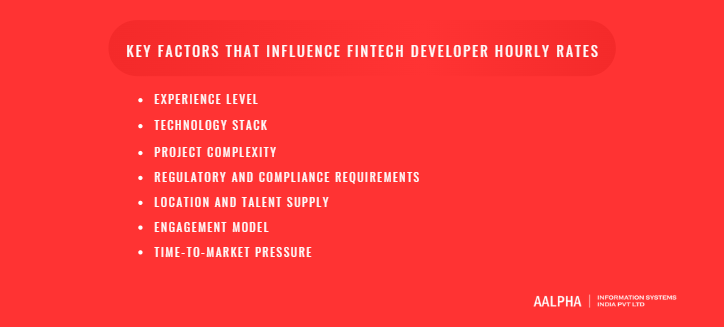
Key Factors That Influence Fintech Developer Hourly Rates
Fintech developer hourly rates are not fixed because they are shaped by a combination of technical, regulatory, and business variables. Many businesses initially focus on geography or headline pricing, but the real drivers of cost are deeper. Understanding these factors allows decision-makers to estimate budgets more accurately and avoid underpricing or overpaying for critical expertise.
-
Experience Level
Experience level is one of the most significant determinants of fintech developer hourly rates. Developers are typically categorized into entry-level, mid-level, and senior, but in fintech, the gap between these levels is more pronounced than in general software development.
Entry-level developers may charge lower rates, but they usually lack exposure to financial systems, security practices, and regulatory requirements. They can contribute to UI development or basic modules but are not suitable for handling transaction logic or compliance-sensitive features independently.
Mid-level developers offer a balance between cost and productivity. They can implement payment integrations, build APIs, and manage standard workflows. However, they still rely on guidance for architectural decisions and complex problem-solving.
Senior fintech developers command the highest rates because they bring domain expertise, architectural thinking, and risk awareness. They design systems that ensure accuracy, scalability, and compliance. In fintech, this is critical because errors can result in financial loss or regulatory penalties. A senior developer can often prevent costly mistakes early in the development lifecycle, which reduces long-term expenses.
In practice, most fintech projects require a combination of mid-level and senior developers, with senior talent leading architecture and compliance-critical components.
-
Technology Stack
The choice of technology stack has a direct impact on hourly rates because different technologies require different levels of expertise and market demand.
For example, widely used technologies such as Node.js, Python, or Java have a large talent pool, which keeps rates relatively stable. In contrast, specialized technologies such as blockchain frameworks, real-time trading systems, or AI-driven analytics platforms require niche expertise, which increases hourly costs.
Cloud platforms also influence pricing. Developers experienced in AWS, Azure, or Google Cloud with a focus on secure financial infrastructure often charge more because they handle deployment, scalability, and compliance-related configurations.
Another factor is the use of modern architectures such as microservices and event-driven systems, which are common in fintech. These architectures improve scalability and reliability but require experienced developers to implement correctly.
Choosing the right technology stack is not just a technical decision. It directly affects hiring costs, development speed, and long-term maintenance. Businesses that select widely supported technologies can often reduce costs without compromising performance.
-
Project Complexity
Project complexity is a major driver of fintech development costs. Simple applications with limited functionality require fewer hours and lower expertise, while complex systems demand advanced skills and longer development timelines.
A basic fintech application, such as a simple payment interface or wallet, may involve straightforward user authentication, transaction processing, and minimal integrations. In contrast, complex platforms such as digital banks, trading systems, or lending platforms require multi-layered architectures, real-time data processing, and advanced security mechanisms.
Complexity increases when systems need to support features such as multi-currency transactions, real-time analytics, high-frequency trading, or large-scale user bases. These features require optimized performance, fault tolerance, and extensive testing.
Another aspect of complexity is integration. Fintech systems often connect with banks, payment processors, credit bureaus, and third-party APIs. Each integration introduces potential points of failure and requires careful handling.
As complexity increases, businesses need more senior developers, specialized roles, and longer development cycles. This leads to higher hourly rates and overall project costs.
-
Regulatory and Compliance Requirements
Regulatory compliance is one of the defining characteristics of fintech development and a major factor influencing hourly rates. Developers working in this domain must build systems that comply with financial regulations, which adds both complexity and responsibility.
Standards such as PCI DSS ensure secure handling of payment data, requiring encryption, secure storage, and strict access controls. KYC (Know Your Customer) and AML (Anti-Money Laundering) regulations require systems to verify user identities and monitor transactions for suspicious activity. GDPR and other data protection laws mandate how user data is collected, stored, and processed.
Implementing these requirements is not straightforward. Developers must design workflows that integrate identity verification services, maintain audit trails, and enforce data privacy rules. They also need to ensure that systems can pass security audits and compliance checks.
Because compliance failures can lead to legal penalties, financial loss, and reputational damage, businesses cannot afford to compromise in this area. As a result, developers with proven experience in regulatory-compliant systems command higher hourly rates.
In many cases, compliance requirements also necessitate additional roles such as security specialists and compliance consultants, further increasing overall costs.
-
Location and Talent Supply
Geographic location plays a critical role in determining fintech developer rates due to differences in cost of living, demand for talent, and availability of skilled professionals.
Regions such as North America and Western Europe have high rates because of strong demand for fintech expertise and higher operational costs. In contrast, regions like Asia and Eastern Europe offer lower rates due to larger talent pools and lower living costs.
However, location is not just about cost. It also affects communication, time zone alignment, and understanding of local regulations. For example, developers in a specific region may have better knowledge of local financial systems and compliance requirements.
Talent supply also impacts pricing. In regions where fintech expertise is scarce, rates increase due to competition among employers. Conversely, regions with large numbers of skilled developers offer more competitive pricing.
Businesses often adopt a hybrid approach, combining onshore expertise for strategy and compliance with offshore teams for development execution, to optimize both cost and efficiency.
-
Engagement Model
The engagement model determines how developers are hired and managed, which directly influences hourly rates and total project costs.
Freelancers typically offer the lowest hourly rates because they operate independently and have minimal overhead. They are suitable for small tasks or short-term projects but may lack the structure required for complex fintech systems.
Development agencies charge higher rates because they provide end-to-end services, including project management, quality assurance, and compliance support. While more expensive, agencies offer reliability and accountability, which are critical in fintech projects.
Dedicated teams provide a middle ground. Businesses can hire a team of developers working exclusively on their project at a fixed monthly or hourly rate. This model offers consistency and scalability without the overhead of building an in-house team.
Choosing the right engagement model depends on project size, complexity, and long-term goals. For most fintech projects, structured teams or agencies are preferred over individual freelancers.
-
Time-to-Market Pressure
Time-to-market pressure can significantly influence fintech developer rates. When businesses need to launch quickly, they often require larger teams, senior developers, and extended working hours, which increases costs.
Accelerated timelines may involve parallel development processes, rapid prototyping, and continuous testing. These approaches require experienced teams that can deliver quickly without compromising quality or security.
In fintech, speed must be balanced with compliance and reliability. Rushing development without proper validation can lead to costly errors or regulatory issues. As a result, businesses often pay a premium for developers who can deliver high-quality work within tight deadlines.
Time-to-market is ultimately a trade-off between speed and cost. Faster delivery typically requires higher investment, but it can also provide competitive advantages in rapidly evolving fintech markets.
Fintech developer hourly rates are influenced by multiple interconnected factors, including experience, technology, complexity, compliance, location, engagement model, and project timelines. Businesses that understand these variables can make more informed decisions, allocate budgets effectively, and build fintech products that are both cost-efficient and robust.
Freelancers vs Agencies vs In-House Fintech Developers
Choosing how to hire fintech developers is as important as deciding where to hire them. Businesses often evaluate three primary models: freelancers, development agencies, and in-house teams. Each option has distinct implications for cost, speed, control, and risk. In fintech, where security, compliance, and reliability are critical, the choice of hiring model directly impacts both project success and long-term scalability.
-
Freelancers
Freelancers typically charge between $25 and $100 per hour, making them the most cost-effective option at first glance. They are independent professionals who can be hired for specific tasks such as UI development, API integration, or short-term feature implementation.
One of the main advantages of freelancers is flexibility. Businesses can quickly onboard talent for small projects or MVP development without long-term commitments. This makes freelancers attractive for startups that are testing ideas or working with limited budgets. Additionally, freelance platforms provide access to a global talent pool, allowing companies to find developers with niche skills at competitive rates.
However, fintech projects introduce challenges that freelancers may not always be equipped to handle. Financial systems require consistent architecture, strong security practices, and compliance awareness, which can be difficult to maintain when working with multiple independent contributors. Coordination becomes a major issue if several freelancers are involved, leading to fragmented development and potential integration problems.
Reliability is another concern. Freelancers may work on multiple projects simultaneously, which can affect availability and timelines. In fintech, where delays or errors can have financial consequences, this risk must be carefully considered.
Freelancers are best suited for non-critical components, prototypes, or early-stage MVPs, but they are rarely the ideal choice for building full-scale fintech platforms.
-
Development Agencies
Development agencies typically charge between $50 and $200+ per hour, depending on their location, expertise, and reputation. While more expensive than freelancers, agencies provide a structured and reliable approach to fintech development.
An agency offers a complete team that includes developers, project managers, quality assurance engineers, and sometimes compliance specialists. This structure ensures that all aspects of the project are handled professionally, from planning and design to testing and deployment. For fintech applications, this level of organization is critical because it reduces the risk of errors and ensures adherence to regulatory requirements.
Agencies also bring domain expertise. Established fintech development firms often have experience building systems such as payment gateways, digital banking platforms, lending systems, and financial analytics tools. This experience allows them to anticipate challenges and implement best practices from the outset.
Another advantage is accountability. Agencies operate under contracts with defined deliverables, timelines, and service-level agreements. This provides businesses with greater confidence in project outcomes compared to working with individual freelancers.
However, agencies come at a higher cost due to overhead expenses such as management, infrastructure, and operational support. For some startups, this may seem expensive, but in fintech, the cost of reliability often outweighs the savings from cheaper alternatives.
Agencies are generally the preferred choice for businesses building scalable, compliant, and production-ready fintech products, especially when internal technical expertise is limited.
-
In-House Teams
Building an in-house fintech development team involves hiring full-time employees, with effective hourly costs often ranging from $60 to $150+ per hour when salaries, benefits, infrastructure, and overhead are considered.
The primary advantage of in-house teams is control. Businesses have direct oversight of development processes, priorities, and decision-making. This is particularly valuable for companies building core fintech products that require long-term iteration and continuous innovation.
In-house teams also develop deep familiarity with the product and business goals. Over time, this leads to better alignment between technical implementation and strategic objectives. For fintech companies operating in regulated environments, having an internal team ensures that knowledge of compliance and security practices is retained within the organization.
However, building an in-house team is both time-consuming and expensive. Recruiting skilled fintech developers can take months, especially in competitive markets. In addition to salaries, companies must invest in training, tools, infrastructure, and employee retention.
Scalability is another challenge. Expanding or reducing team size is less flexible compared to outsourcing models. This can lead to inefficiencies, particularly during early-stage development when requirements are still evolving.
In-house teams are best suited for established fintech companies or startups with sufficient funding, where long-term control and product ownership outweigh the higher upfront costs.
Freelancers are ideal for quick, low-risk tasks but lack structure for complex systems. Agencies provide reliability, expertise, and end-to-end delivery, making them suitable for most fintech projects. In-house teams offer maximum control and long-term value but require significant investment.
There is no one-size-fits-all approach to hiring fintech developers. The right choice depends on project complexity, budget, timeline, and long-term goals. Businesses that prioritize short-term cost savings may opt for freelancers, while those focused on reliability and compliance often choose agencies. For companies building long-term fintech products, in-house teams provide the control and continuity needed for sustained growth.
Cost Breakdown: How Much Does a Fintech Project Really Cost?
Understanding fintech developer hourly rates is only the first step. Decision-makers ultimately need to translate those rates into real project budgets. The total cost of a fintech product depends on multiple variables, including scope, complexity, compliance requirements, and team composition. A common mistake is to estimate cost purely based on hourly rates without considering development hours, integrations, and regulatory overhead.
In practice, fintech project costs can range from $20,000 for a basic MVP to $1 million or more for enterprise-grade platforms. The sections below break down what businesses can realistically expect at different stages of development.
-
MVP Fintech App Cost
A fintech MVP (Minimum Viable Product) is designed to validate a business idea with essential features only. Typical MVPs include digital wallets, basic payment apps, peer-to-peer transfers, or simple lending platforms.
An MVP generally requires 400 to 800 development hours, depending on feature scope. At average blended rates of $40 to $80 per hour (common in outsourcing regions), the total cost typically falls between $20,000 and $60,000.
Key features included in a fintech MVP usually cover:
- User registration and authentication
- Basic KYC integration
- Payment or transaction processing
- Simple dashboard or transaction history
- Integration with one or two third-party APIs
At this stage, the focus is not on building a fully scalable system but on testing product-market fit and validating core functionality. Businesses often ask whether it is possible to build a fintech app with a limited budget, and the answer is yes, but only by limiting scope and avoiding unnecessary complexity.
However, even MVPs must meet minimum security standards. Skipping essential safeguards can lead to vulnerabilities that become expensive to fix later. A well-built MVP balances cost efficiency with foundational security and scalability.
-
Mid-Scale Product Cost
Once a fintech product is validated, businesses move toward building a more robust system with additional features and improved user experience. A mid-scale fintech product typically requires 1,000 to 2,000 development hours.
At blended hourly rates of $60 to $120 per hour, the total cost ranges from $80,000 to $200,000. This stage often involves a combination of mid-level and senior developers, along with dedicated QA and DevOps support.
Typical features at this stage include:
- Advanced user dashboards and analytics
- Multi-currency or multi-region support
- Enhanced KYC and AML workflows
- Integration with multiple financial APIs
- Role-based access control and admin panels
- Improved performance and scalability
Mid-scale systems are designed for growing user bases and real-world usage, which introduces new challenges such as handling higher transaction volumes and ensuring system reliability.
Businesses at this stage also begin investing more in security, monitoring, and infrastructure, as the risk of operational issues increases with scale. The focus shifts from validation to performance, compliance, and user retention.
-
Enterprise Fintech Platform Cost
Enterprise fintech platforms, such as digital banking systems, trading platforms, or large-scale payment infrastructures, represent the highest level of complexity and cost.
These systems typically require 3,000 to 5,000+ development hours, often involving cross-functional teams that include senior developers, architects, security specialists, and compliance experts. At hourly rates of $100 to $200+, total costs can range from $300,000 to $1 million or more.
Enterprise-level features include:
- High-volume transaction processing with low latency
- Advanced fraud detection and risk management systems
- Complex integrations with banks, regulators, and financial networks
- Real-time data processing and reporting
- Enterprise-grade security and compliance frameworks
- Disaster recovery and high-availability infrastructure
At this level, fintech systems must meet strict requirements for scalability, uptime, and regulatory compliance. Development is often accompanied by extensive testing, auditing, and documentation processes.
For enterprises, the question is not just how much development costs, but how to ensure the system is reliable, secure, and capable of supporting long-term growth. This justifies the significantly higher investment.
-
Hidden Costs in Fintech Development
One of the most overlooked aspects of fintech budgeting is hidden costs. These are expenses that are not immediately visible when calculating hourly rates but can significantly impact the total project cost.
Compliance-related costs are among the most substantial. Implementing standards such as PCI DSS, KYC, AML, and GDPR requires additional development effort, third-party services, and ongoing monitoring. Many fintech applications also require security audits and penetration testing, which can add thousands of dollars to the budget.
Integrations are another major cost driver. Connecting with payment gateways, banking APIs, credit bureaus, and identity verification services often involves setup fees, usage-based pricing, and additional development time.
Infrastructure costs must also be considered. Hosting, cloud services, data storage, and monitoring tools contribute to ongoing operational expenses. As user volume grows, these costs can increase significantly.
Finally, maintenance and updates are continuous expenses. Fintech systems require regular updates to address security vulnerabilities, regulatory changes, and performance improvements.
Fintech project costs vary widely, but they are best understood as a function of scope, complexity, and compliance requirements, not just hourly rates. MVPs offer a cost-effective way to validate ideas, mid-scale products focus on growth and reliability, and enterprise platforms require substantial investment to meet industry standards.
Businesses that plan for both visible and hidden costs are better positioned to build fintech solutions that are secure, scalable, and financially sustainable.
How to Reduce Fintech Development Costs Without Compromising Quality
Reducing fintech development costs is not about choosing the lowest hourly rate. It is about making strategic decisions that optimize effort, minimize risk, and prevent expensive rework. In financial software, cutting corners in the wrong areas can lead to security vulnerabilities, compliance failures, and long-term technical debt. The goal is to reduce unnecessary spending while preserving system integrity, scalability, and regulatory readiness.
The following strategies are widely used by successful fintech startups and enterprises to control costs without sacrificing quality.
-
Build an MVP First
Starting with a Minimum Viable Product allows businesses to validate their fintech idea before committing to full-scale development. Instead of building a complete platform upfront, an MVP focuses on core functionality such as user onboarding, basic transactions, and essential integrations.
This approach reduces initial development hours and avoids investing in features that may not be needed. It also enables faster market entry, allowing businesses to gather real user feedback and refine the product based on actual usage.
Many founders ask whether they can reduce fintech development costs significantly, and the most effective way is to limit scope early. By launching with a focused MVP, companies can allocate resources more efficiently and expand only after validating demand.
-
Use Pre-Built APIs and SDKs
Building financial infrastructure from scratch is both time-consuming and expensive. Instead, fintech companies can leverage pre-built APIs and SDKs for critical functions such as payments, identity verification, and fraud detection.
For example, integrating with established payment providers or KYC services eliminates the need to develop and maintain complex systems internally. These solutions are already tested, secure, and compliant with industry standards, which reduces both development time and risk.
Using APIs also accelerates development cycles. Developers can focus on building unique product features rather than reinventing standard financial components. This not only lowers costs but also improves reliability, as third-party providers often offer continuous updates and compliance support.
-
Choose the Right Development Location
Geographic location has a significant impact on fintech development costs. Hiring developers in regions such as North America or Western Europe can be expensive, while regions like Asia or Eastern Europe offer more competitive rates.
However, cost savings should not come at the expense of quality. The key is to choose a location that provides a balance between affordability, technical expertise, and communication efficiency. Many businesses adopt a hybrid approach, combining local leadership with offshore development teams.
For example, strategic planning and compliance oversight can be handled by senior experts, while implementation is executed by cost-effective teams. This model allows companies to reduce costs without compromising on critical aspects such as security and architecture.
-
Work with Experienced Fintech Teams
Hiring experienced fintech developers or specialized teams may seem expensive initially, but it often reduces overall costs in the long run. Experienced professionals understand financial workflows, compliance requirements, and best practices, which helps avoid costly mistakes.
In fintech, errors are not just technical issues. They can lead to financial losses, regulatory penalties, and reputational damage. Fixing these issues after deployment is significantly more expensive than building systems correctly from the start.
Experienced teams also work more efficiently. They can anticipate challenges, choose the right technologies, and implement scalable solutions. This reduces development time and minimizes rework, resulting in better cost control over the entire project lifecycle.
-
Prioritize Core Features
One of the most common reasons fintech projects exceed budgets is feature overload. Businesses often try to include too many functionalities in the initial version, which increases complexity, development time, and cost.
A more effective approach is to focus on core features that deliver immediate value to users. For example, a payment app does not need advanced analytics or multiple integrations at launch. These features can be added later based on user demand.
Prioritization helps streamline development and ensures that resources are allocated to the most critical components. It also simplifies testing and reduces the risk of bugs in complex systems.
By maintaining a clear feature roadmap and avoiding unnecessary additions, businesses can control costs while still delivering a high-quality product that meets user expectations.
Reducing fintech development costs requires strategic planning rather than cost-cutting. By focusing on MVP development, leveraging existing technologies, choosing the right talent, and prioritizing essential features, businesses can build secure and scalable fintech solutions without overspending.
How to Choose the Right Fintech Development Partner
Choosing the right fintech development company is one of the most critical decisions in building a financial product. Unlike general software projects, fintech systems involve regulatory compliance, financial risk, and security-sensitive operations, which means the margin for error is extremely low. Businesses often focus on hourly rates, but the more important question is whether the partner can deliver a secure, scalable, and compliant solution.
A strong fintech development partner not only builds the product but also helps you avoid costly mistakes, accelerate time-to-market, and ensure long-term sustainability.
-
Technical Expertise
Technical expertise is the foundation of any fintech development partnership. A reliable partner should have deep experience in building scalable architectures, secure APIs, and high-performance financial systems.
Fintech applications often require handling real-time transactions, integrating with multiple external systems, and ensuring data consistency across distributed environments. Developers must be proficient in backend technologies such as Node.js, Java, or Python, along with modern architectures like microservices and event-driven systems.
Another important consideration is infrastructure expertise. The partner should be capable of deploying and managing systems on cloud platforms such as AWS, Azure, or Google Cloud, ensuring high availability and performance.
Businesses frequently ask how to evaluate technical capability before hiring. The most effective approach is to assess past projects, architectural decisions, and problem-solving ability, rather than relying solely on technology claims. A technically strong partner can design systems that scale efficiently while minimizing long-term maintenance costs.
-
Fintech Domain Knowledge
Technical skills alone are not sufficient in fintech. Domain knowledge plays a crucial role in ensuring that the product aligns with financial workflows, user expectations, and industry standards.
A fintech development partner should understand how systems such as payment gateways, lending platforms, digital wallets, and banking applications operate. This includes familiarity with transaction lifecycles, reconciliation processes, and financial data flows.
For example, building a payment system requires knowledge of how transactions move through banks, how failures are handled, and how to ensure idempotency to prevent duplicate charges. Without this understanding, even technically sound systems can fail in real-world scenarios.
Domain expertise also helps in anticipating challenges early. An experienced fintech partner can recommend the right integrations, identify potential bottlenecks, and design workflows that align with industry best practices.
Companies like Aalpha, which have experience delivering fintech solutions across different markets, often bring this domain knowledge into the development process. This reduces learning curves and improves execution quality from the start.
-
Security and Compliance Experience
Security and compliance are non-negotiable in fintech. A development partner must have proven experience in implementing standards such as PCI DSS, KYC, AML, and GDPR.
This involves more than basic security practices. Developers must design systems with data encryption, secure authentication, access control, and audit logging. They should also be capable of preparing the system for security audits and regulatory reviews.
A common mistake businesses make is underestimating compliance requirements during the early stages. This often leads to expensive rework later. A partner with strong compliance experience ensures that security and regulatory considerations are built into the system from the beginning.
When evaluating partners, businesses should look for evidence of previous compliance-driven projects, security certifications, and experience with financial data protection.
-
Communication and Transparency
Effective communication is essential for successful fintech development, especially when working with external teams. A reliable partner should provide clear timelines, regular updates, and transparent reporting.
Fintech projects often involve evolving requirements, regulatory changes, and technical challenges. Without proper communication, these factors can lead to delays and misunderstandings. Structured processes such as weekly updates, sprint reviews, and documented workflows help maintain alignment between business and technical teams.
Transparency also extends to pricing and project scope. The partner should clearly define deliverables, timelines, and cost structures to avoid unexpected expenses. This is particularly important in fintech, where changes in scope can significantly impact both cost and compliance.
Strong communication practices ensure that businesses remain in control of the project while benefiting from external expertise.
-
Portfolio and Case Studies
A partner’s portfolio provides concrete evidence of their ability to deliver fintech solutions. Businesses should review past projects to understand the types of systems built, industries served, and technical challenges handled.
Case studies are especially valuable because they demonstrate how the partner approached real-world problems. For example, a case study might show how a team built a secure payment platform, integrated with multiple financial APIs, or implemented fraud detection systems.
When evaluating portfolios, businesses should look for:
- Experience with similar fintech use cases
- Evidence of scalable and secure system design
- Successful delivery of compliance-driven projects
Partners with a strong track record in fintech are more likely to deliver reliable outcomes. Experienced providers such as Aalpha often showcase diverse fintech projects, which helps build confidence in their ability to handle complex requirements.
Choosing the right fintech development partner requires evaluating more than just cost. Businesses must assess technical expertise, domain knowledge, security capabilities, communication practices, and proven experience. A well-qualified partner reduces risk, accelerates development, and ensures that the final product meets both technical and regulatory standards.
Investing in the right partner is not an expense but a strategic decision that directly impacts the success and sustainability of your fintech product.
FAQs: Fintech Developer Hourly Rates
How much does a fintech developer charge per hour?
Fintech developers typically charge between $25 and $200+ per hour, depending on location, experience, and specialization. Developers in regions like North America charge higher rates, while countries such as India or Vietnam offer more cost-effective options. Senior developers and specialists in areas like security or blockchain are usually at the higher end of the range.
Why are fintech developers expensive?
Fintech developers are more expensive because they work on financial systems that require high security, accuracy, and regulatory compliance. They must understand standards like PCI DSS, KYC, and AML, and build systems that handle real money transactions. The risk associated with errors or security breaches increases the demand for highly skilled professionals.
What is the cheapest country to hire fintech developers?
Countries in Asia, particularly India and Vietnam, generally offer the most competitive fintech development rates, starting as low as $25 per hour. These regions have large talent pools and lower operational costs, making them popular for outsourcing. However, quality and experience should always be evaluated alongside pricing.
Is outsourcing fintech development safe?
Outsourcing fintech development is safe if you choose a reputable and experienced partner. The key is to ensure that the team follows security best practices, complies with regulations, and has a proven track record in fintech projects. Proper contracts, NDAs, and security audits further reduce risk.
How long does fintech app development take?
The timeline depends on complexity. A basic fintech MVP can take 2 to 4 months, while mid-scale products may take 4 to 8 months. Enterprise-level platforms with advanced features and compliance requirements can take 9 to 12+ months or longer.
What skills should a fintech developer have?
A fintech developer should have expertise in backend development, API integrations, security practices, and cloud infrastructure. They should also understand financial workflows and compliance requirements. Skills in areas like blockchain or AI can be an added advantage depending on the product.
Can I build a fintech app with a small budget?
Yes, it is possible to build a fintech app on a limited budget by focusing on an MVP with essential features only. Using pre-built APIs, outsourcing to cost-effective regions, and prioritizing core functionality can help reduce costs while maintaining quality.
How do I estimate fintech development cost?
To estimate cost, multiply the total development hours by the average hourly rate of your team. Then add additional expenses such as compliance, third-party integrations, infrastructure, and testing. A clear scope and feature list are essential for accurate estimation.
Should I hire freelancers or a fintech development company?
Freelancers are suitable for small tasks or early-stage prototypes, while fintech development companies or agencies are better for full-scale, compliance-driven projects. Agencies provide structured teams, better reliability, and end-to-end delivery.
What factors increase fintech development costs the most?
The biggest cost drivers include project complexity, regulatory requirements, security needs, and integration with external financial systems. Hiring senior developers and accelerating timelines can also increase overall costs.
Final Thoughts
Fintech developer hourly rates vary widely, but cost alone should never be the deciding factor. The real priority is building a solution that is secure, compliant, and scalable from day one. Whether you are launching an MVP or developing a full-scale financial platform, the right mix of expertise and strategy will determine long-term success.
If you are planning a fintech product and need guidance on cost estimation, architecture, or development, working with an experienced fintech development partner can help you move faster with confidence. A team like Aalpha can support you in building reliable, high-quality fintech solutions tailored to your business goals. Contact now to discuss your requirements and get a detailed cost estimate.