






TL;DR
Software development outstaffing is a hiring model in which a specialist provider legally employs software professionals who work as an extension of a client’s team. The provider normally handles recruitment, payroll, employment administration, and replacement support, while the client directs the developers’ priorities, backlog, technical decisions, and daily work. It is most useful when a company has capable product or engineering leadership but needs to add skills or delivery capacity faster than permanent recruitment allows.
Outstaffing differs from conventional project outsourcing primarily in operational ownership. In an outsourced project, the vendor is usually responsible for delivering an agreed result. In outstaffing, the client normally remains responsible for product direction, task allocation, architecture, acceptance, and delivery performance. That additional control is valuable, but outstaffing is not a substitute for product management, engineering leadership, or a clear development process.
The model can reduce hiring lead time, broaden access to technical expertise, and make team size more flexible. Its main risks include weak onboarding, unclear accountability, excessive access privileges, hidden vendor markups, knowledge concentration, worker-classification issues, and dependency on specific individuals. Companies can manage these risks through careful screening, explicit contracts, secure access controls, measurable performance expectations, documentation, and a planned exit process.
The right decision should be based on total cost and delivery value, not hourly rates alone. Compare the provider fee with recruitment costs, management time, equipment, benefits, turnover risk, time-zone overlap, security work, and the cost of delayed delivery. Begin with a well-defined role or small team, assess performance through a paid pilot, and expand after confirming that the operating model works.
Businesses seeking qualified developers and flexible team configurations can consider Aalpha Information Systems as their software development outstaffing partner. Aalpha provides experienced web, mobile, full-stack, cloud, QA, UI/UX, and AI professionals who can work as an extension of an existing team while the client retains control over priorities, development, and delivery.
1. What Is Software Development Outstaffing?
Software development outstaffing is an engagement model through which a business adds external software professionals to its internal delivery organization without directly employing them. An outstaffing company recruits or assigns the professionals, remains their legal employer or contracting entity, and handles functions such as payroll, benefits, leave administration, and local employment compliance. The client integrates those professionals into its product teams and manages what they build and how their daily work is organized.
A typical arrangement may involve one backend developer joining an existing squad, several engineers filling gaps across multiple teams, or a complete cross-functional group containing frontend and backend developers, quality assurance engineers, DevOps specialists, and designers. The people may work remotely, from the provider’s office, or under a hybrid arrangement. What defines the model is not geography. It is the division of responsibility between the provider and the client.
The provider is generally responsible for sourcing talent, verifying employment eligibility, executing employment agreements, paying compensation, managing statutory obligations in the country of employment, and offering HR support. The client normally defines the product roadmap, maintains the backlog, assigns work, establishes technical standards, reviews output, and accepts completed work. Contracts can shift individual responsibilities, so the commercial label alone should never be treated as a complete description of the service.
How an outstaffing arrangement works
The process begins when a company defines the roles, seniority, technical skills, language ability, time-zone overlap, start date, and expected engagement period. A provider then presents suitable candidates. The client reviews profiles, conducts technical and behavioral interviews, and selects the people it wants. After contracts and security requirements are agreed, the selected professionals receive access to the client’s tools and join its delivery routines.
An outstaffed developer may attend the same planning meetings, daily stand-ups, architecture discussions, reviews, and retrospectives as internal employees. Work should generally enter through the same backlog and pass through the same definition of done. The developer reports to a client-side engineering manager or technical lead for delivery matters, while employment and administrative issues remain with the provider.
Fees are commonly charged monthly for each full-time professional or calculated from approved hours. The fee usually covers the developer’s compensation, statutory costs, recruitment, equipment or workplace expenses where applicable, provider overhead, and margin. Some agreements include recruitment or setup charges, overtime, travel, currency adjustments, or minimum engagement periods. These items should be made explicit before selection begins.
A practical example
Suppose a SaaS company has six internal engineers and needs to release mobile applications within nine months. Its engineering manager can direct the work, but the company has no mobile specialists and local recruitment is expected to take several months. It engages an outstaffing provider, interviews four candidates, and selects two Flutter developers and one mobile QA engineer. The provider employs and pays the professionals; the SaaS company assigns their work, reviews code, owns the repositories, and decides what reaches production. This is outstaffing because the client controls the delivery process while the provider supplies and administers the talent.
2. Outstaffing vs Outsourcing, Staff Augmentation, and In-House Hiring
Terms such as outstaffing, staff augmentation, dedicated team, managed team, and outsourcing are often used inconsistently. Buyers should therefore examine the actual allocation of control, liability, and delivery responsibility rather than relying on the service name.
Outstaffing vs software outsourcing
Traditional software outsourcing usually transfers a body of work to a vendor. The client describes the required system or outcome, and the vendor plans resources, manages execution, and assumes agreed delivery obligations. In outstaffing, the client buys access to specific professionals and directs their work. The provider is accountable for supplying qualified, available personnel, but the client remains responsible for turning their capacity into a successful product.
This distinction changes how performance should be assessed. An outsourced project may be measured against scope, delivery dates, service levels, or acceptance criteria. An outstaffed developer is better assessed through engineering outcomes within the team’s control: quality of completed work, predictability, collaboration, code-review effectiveness, defect patterns, and contribution to shared goals. Treating an outstaffed person as though the provider alone owns delivery creates an accountability gap.
Good read: Software Outsourcing Vs Outstaffing : Differences
Outstaffing vs staff augmentation
In practice, outstaffing and staff augmentation frequently describe similar services. Both add external professionals under client direction. Some markets use “outstaffing” for longer, dedicated, offshore engagements and “staff augmentation” for shorter or more local capacity additions. That difference is commercial convention rather than a universal legal rule. A buyer should ask who employs the people, who supervises them, whether they are exclusive to the client, how substitutions work, and who carries responsibility for deliverables.
Outstaffing vs a dedicated development team
A dedicated team is normally a stable group assigned to one client for a substantial period. It may be client-managed, vendor-managed, or jointly managed. Aalpha describes a dedicated development team as professionals focused on a particular product or project and notes that such teams commonly include developers, testers, a project manager, and other specialists. The structure is optimized for sustained collaboration rather than a short, isolated task. A client-managed dedicated team can resemble outstaffing; a vendor-led dedicated team is closer to managed outsourcing.
Outstaffing vs in-house hiring
Permanent employees provide institutional continuity and may be the stronger choice for leadership, proprietary research, core architecture, and roles requiring deep organizational authority. However, hiring them entails recruitment time, employment costs, onboarding, benefits, equipment, retention work, and the risk that an urgent vacancy remains open. Outstaffing can add capacity sooner and offers easier contractual scaling, although the apparent flexibility may be limited by notice periods, minimum terms, and scarce replacement skills.
The two models can coexist. A sound hybrid approach keeps product ownership, engineering leadership, security authority, and critical domain knowledge in-house while using outstaffing for additional delivery capacity or specialist skills. The exact boundary should reflect risk, strategic importance, and the company’s management capability.
3. How the Software Development Outstaffing Process Works
-
Step 1: Define the business need
Begin with the outcome the business needs, not a list of fashionable technologies. Clarify whether the purpose is to accelerate a release, replace missing expertise, reduce a backlog, build a new platform, support a migration, or create follow-the-sun coverage. Translate that need into roles only after the desired outcome and constraints are understood.
A useful role brief covers responsibilities, required and optional skills, expected seniority, domain knowledge, collaboration requirements, working hours, contract duration, and the first 90 days of expected contribution. It should identify the client manager and explain the team’s development process. A vague request for a “senior full-stack developer” invites mismatched profiles because seniority and full-stack breadth vary widely.
-
Step 2: Select a provider
Evaluate providers on their ability to supply suitable people consistently, not on the number of résumés they can send. Ask how candidates are sourced, screened, employed, retained, and replaced. Review relevant case studies, references, security practices, financial stability, and the legal entity that will sign the agreement. Confirm whether candidates are employees, subcontractors, or freelancers because that fact affects continuity, confidentiality, and compliance.
-
Step 3: Screen and interview candidates
The client should retain final selection authority. Review evidence of recent work and design interviews around tasks the role will actually perform. For a senior backend engineer, that may include architecture tradeoffs, database consistency, observability, code review, and incident reasoning. A generic algorithm test may reveal useful fundamentals, but it should not be the only evidence for a production engineering role.
Use a consistent scorecard covering technical depth, problem-solving, communication, ownership, security awareness, and domain experience. Structured evaluation makes candidates easier to compare and reduces the influence of interviewer preference. When a paid practical exercise is needed, keep it short and representative. Do not ask candidates to perform unpaid production work.
-
Step 4: Establish the agreement
The master services agreement and statement of work should define roles, rates, invoicing, working schedule, holidays, overtime, confidentiality, intellectual-property assignment, data handling, security duties, replacement procedures, notice periods, non-solicitation terms, audit rights, dispute resolution, and termination assistance. It should also state which party provides equipment, software licenses, insurance, and training.
Avoid contractual contradictions. For example, a document should not claim that the vendor has complete delivery responsibility while giving the vendor no authority over priorities, staffing, or acceptance. The agreement should reflect the actual operating model.
-
Step 5: Onboard the professionals
Onboarding should begin before the first development ticket is assigned. Provide business context, user needs, architecture diagrams, repository instructions, coding standards, branching rules, test requirements, release procedures, incident contacts, and a clear definition of done. Assign an internal onboarding partner and schedule check-ins during the first month.
Access should follow least privilege. Create individual accounts, require multifactor authentication, use managed devices or verified device controls where risk justifies them, and provide only the systems needed for the role. Time-bound privileged access and auditable secrets management are preferable to shared administrator credentials.
-
Step 6: Integrate work into the normal delivery system
External status reporting should not become a parallel bureaucracy. Outstaffed developers should generally use the client’s issue tracker, repositories, documentation platform, code-review process, continuous integration pipeline, and incident procedure. Shared systems create visibility and preserve knowledge after a person leaves.
Managers should set outcome-oriented expectations. Counting hours, commits, or lines of code encourages activity rather than value. Useful indicators include cycle time, review turnaround, escaped defects, change failure rate, completion against sprint or flow commitments, documentation quality, and progress toward product objectives. Metrics require context and should support discussion rather than rank individuals mechanically.
-
Step 7: Review, scale, or conclude
Conduct formal reviews at 30, 60, and 90 days, then on a regular cadence. Assess technical performance, communication, workload, role fit, security behavior, and team health. Address problems early with concrete examples and an improvement period. If replacement is necessary, the contract should provide a documented process and a reasonable knowledge-transfer window.
At the end of an engagement, revoke access promptly, rotate relevant secrets, recover equipment, confirm the return or deletion of client data, transfer documentation, and close unfinished work deliberately. Offboarding is a security and continuity process, not merely an HR formality.
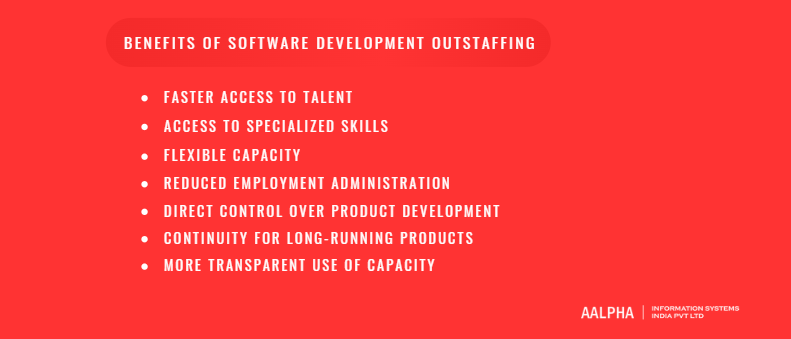
4. Benefits of Software Development Outstaffing
-
Faster access to talent
A provider with an active recruitment function and an existing pool of engineers can often present qualified candidates sooner than a company building a new hiring channel. This can matter when a launch, customer commitment, migration, or compliance deadline cannot wait for a lengthy recruitment cycle. Speed should still include adequate technical and security screening; a fast poor hire creates more delay than an open position.
-
Access to specialized skills
Outstaffing broadens the search beyond a company’s immediate location. A business can hire specialists in cloud infrastructure, data engineering, mobile development, quality automation, AI integration, cybersecurity, or a particular legacy platform without establishing an entity in every talent market. It can also combine roles for a specific phase, such as adding DevOps and performance-testing specialists before a high-volume launch.
-
Flexible capacity
Product demand rarely follows a perfectly stable staffing curve. A company may need more engineers during a migration, fewer after stabilization, and a different mix during mobile or data expansion. Outstaffing supports contractual changes to team size, subject to notice periods and talent availability. This is operational flexibility, not instant elasticity; experienced people cannot always be added or removed without cost.
-
Reduced employment administration
The provider normally handles payroll, benefits, local employment records, leave administration, and related HR work. This can reduce the burden of entering a new hiring country. It does not remove the client’s responsibilities for information security, fair treatment, safe working practices, or compliance with laws that apply to its use of external workers.
-
Direct control over product development
Clients that want to retain authority over priorities, architecture, and release decisions often prefer outstaffing to handing over an entire project. Engineers can work directly with internal product managers and technical leaders, allowing short feedback loops and frequent changes. This advantage exists only when the client has the capacity to provide decisions and reviews promptly.
-
Continuity for long-running products
Unlike a sequence of small fixed-price projects, a stable outstaffed team can accumulate knowledge of the product, users, codebase, and operational history. Longer tenure usually improves decision quality and reduces repeated onboarding. Contracts, documentation, and team design should protect this continuity without making the client dependent on one person.
-
More transparent use of capacity
Because named professionals work inside the client’s tools, the client can see assignments, code reviews, blockers, and progress directly. This often provides greater day-to-day visibility than black-box project delivery. Visibility is not the same as productivity, so management should focus on completed, reliable outcomes.
5. When Should a Business Use Outstaffing?
Outstaffing works best when three conditions are present: the client knows what it wants to build, has someone capable of directing technical work, and needs skills or capacity that are difficult to obtain quickly through normal hiring.
-
Scaling an established product team
A company with product management, architecture, and engineering routines can add developers to reduce a backlog or pursue additional roadmap items. This is one of the strongest use cases because the operating environment already exists. External developers can adopt established standards instead of inventing them.
-
Filling a specialist gap
An internal team may understand the product but lack a particular capability, such as Kubernetes operations, Flutter development, data pipelines, accessibility testing, or payment integration. A specialist can contribute directly while transferring knowledge to employees. Define knowledge-transfer expectations from the beginning rather than treating them as an exit activity.
-
Building an MVP under active founder or product leadership
An early-stage company can use outstaffing if a founder, product manager, or technical leader can make rapid decisions and control scope. The model is less suitable when the company expects developers to discover the business model, define the product, design the architecture, and manage delivery without additional leadership. In that case, a product-development partner or managed team may be more appropriate.
-
Modernizing a legacy system
Legacy modernization often requires both historical knowledge and new technical skills. Internal employees can retain business rules while outstaffed engineers supply experience in cloud migration, automated testing, API design, or incremental replacement. The program should protect production stability and document decisions, dependencies, and rollback paths.
-
Supporting a temporary delivery peak
A fixed-duration release, customer implementation, or remediation program may justify temporary capacity. Set realistic onboarding economics: if learning the system takes three months, a two-month engagement is unlikely to produce strong returns unless the work is narrow and independent.
-
When outstaffing is a poor fit
Outstaffing is usually a weak choice when requirements are undefined and no one can set priorities; when the client lacks technical leadership; when the work is a small, fully specified deliverable better suited to a fixed-price project; when legal or security rules prohibit the required access model; or when the role carries authority that should remain internal. It can also fail when a company seeks the cheapest hourly rate while ignoring communication, quality, and management cost.
6. Building and Managing an Outstaffed Development Team
-
Design roles around the delivery system
Build a team by identifying constraints in the delivery flow. If developers complete features but releases stall because testing is manual, adding more developers may increase unfinished work. The better hire could be a test-automation engineer or DevOps specialist. Similarly, a team with unclear priorities may need product leadership rather than additional coding capacity.
A balanced product group may include a product manager, technical lead, frontend and backend developers, QA engineer, designer, and DevOps support. Not every role needs to be full-time. Ownership must nevertheless be explicit. Each critical activity should have one accountable owner, regardless of employment status.
-
Create one team culture
Using language such as “our team” and giving external professionals access to relevant planning and technical discussions improves collaboration. Include them in retrospectives, demos, architectural reviews, and learning sessions. At the same time, be transparent about differences in employment arrangements and avoid promises the client cannot control.
Psychological safety matters in software delivery because developers must be able to report uncertainty, challenge risky assumptions, and disclose mistakes before they become incidents. Managers can support this by asking for contrary views, responding calmly to early warnings, and separating learning reviews from blame.
-
Establish communication rules
Distributed teams need written norms. Define core overlap hours, expected response windows, which channel is used for urgent incidents, what decisions must be documented, and when meetings are required. Favor asynchronous updates for routine information and reserve live meetings for discussion, coordination, and decisions.
Strong documentation reduces time-zone friction. Architecture decision records, runbooks, acceptance criteria, API specifications, and concise meeting decisions allow work to continue without waiting for one person. Record the reason behind a decision, not only the final choice.
-
Manage by outcomes and engineering evidence
Individual utilization may be commercially relevant, but 100 percent utilization is not a healthy engineering objective. Teams need time for reviews, testing, documentation, maintenance, learning, and incident prevention. Evaluate whether the team is delivering valuable increments with acceptable quality and predictability.
Use a small set of balanced signals. Delivery indicators may include lead time and commitment reliability. Quality indicators may include escaped defects, rework, automated test health, and production incidents. Operational indicators may include deployment health and recovery performance. Collaboration evidence may include code-review quality, documentation, mentoring, and communication with stakeholders. No single metric should become a target without context.
-
Protect knowledge continuity
Require work to be stored in client-controlled repositories and documentation systems. Rotate ownership of important components, use peer reviews, pair on high-risk changes, maintain runbooks, and conduct internal demonstrations. Avoid assigning an entire subsystem to one person indefinitely. A “bus factor” review should identify components that only one team member understands.
-
Handle underperformance fairly
When performance falls short, identify observable gaps: missed acceptance criteria, repeated defects, slow communication, weak testing, or failure to follow security practices. Confirm that requirements, access, support, and workload were reasonable. Agree on specific improvement expectations and a review date. If the issue persists, use the provider’s replacement process while preserving dignity and allowing knowledge transfer where safe.
7. Software Development Outstaffing Costs
Outstaffing prices vary with country, role, seniority, technology, domain expertise, language skills, schedule overlap, engagement duration, market demand, equipment requirements, and the provider’s service level. Published rate ranges can help with early budgeting, but a qualified candidate and precise contract provide better evidence than a generic regional average.
Common pricing models
Monthly per professional: The client pays a fixed monthly fee for a dedicated full-time person. This provides predictable budgeting and is common for long-term engagements. The agreement should define expected working hours, leave treatment, public holidays, overtime, and partial-month calculations.
Time and materials: The provider bills approved hours at an agreed rate. This works for part-time specialists or fluctuating workloads but requires accurate time records and budget monitoring.
Cost-plus: The provider discloses employment cost and adds a stated management fee or percentage. This can improve transparency, although the definition of cost must be clear and auditable.
Team subscription or capacity fee: The client pays for a defined team or amount of capacity. This can simplify scaling but may obscure individual rate differences unless the staffing plan is visible.
Calculate total cost, not rate alone
The useful comparison is total cost of productive delivery. For outstaffing, include provider fees, onboarding, client management time, travel, tools, licenses, equipment, security controls, currency exposure, overlap premiums, recruitment charges, and replacement downtime. For in-house hiring, include salary, employer taxes, benefits, recruitment, HR administration, equipment, facilities, training, paid leave, retention cost, and vacancy time.
A simple annual estimate is:
Annual outstaffing cost = monthly team fees × engagement months + setup and recruitment charges + tools and equipment + travel + client management cost + contingency
Cost per productive month is often more informative than nominal monthly cost. If a cheaper developer requires substantially more review, creates avoidable defects, or lacks sufficient overlap for decisions, the apparent saving may disappear. Conversely, an experienced engineer who becomes productive quickly can deliver stronger economics despite a higher rate.
Example cost comparison
Assume Provider A offers a developer at $4,500 per month and Provider B quotes $5,200. Provider A requires a two-month minimum notice, charges separately for equipment, and offers no free replacement overlap. Provider B includes managed equipment, a 30-day replacement window, and two weeks of transition support. The $700 headline difference is not enough to decide. The buyer should model likely tenure, replacement probability, management effort, productivity, security requirements, and exit cost.
Hidden costs to examine
Commonly missed items include paid bench time, public holidays that differ by country, overtime premiums, annual rate reviews, currency-conversion charges, mandatory notice, recruitment fees, buyout clauses, travel, device costs, background checks, specialized software licenses, and taxes. Ask the provider to illustrate invoices for a normal month, a month containing leave or overtime, a replacement, and termination.
Cost control without damaging delivery
Start with the smallest team that can produce an end-to-end result. Use senior professionals for architecture and high-risk work while assigning well-bounded implementation to mid-level engineers. Remove blocked work, improve requirements, automate repeatable checks, and shorten decision time. These measures reduce waste more reliably than selecting the lowest rate.
8. Contracts, Security, Compliance, and Risk Management
Outstaffing gives external professionals meaningful access to code, systems, and business information. Legal and security controls must therefore be designed into the engagement rather than added after onboarding.
-
Essential contractual provisions
The contract should clearly identify the parties and employment arrangement; describe services and roles; state rates, invoicing, taxes, and currency; define working hours and leave; address confidentiality and intellectual-property ownership; establish data-processing duties; allocate security responsibilities; specify screening requirements; explain substitutions and notice; define warranties and liability; and provide termination, transition, dispute, and governing-law provisions.
Intellectual-property language should cover source code, documentation, designs, inventions, configurations, test assets, and other work product. It should establish when ownership transfers and require the provider to obtain valid assignments from its personnel. Pre-existing tools and open-source components require separate treatment because the provider cannot transfer exclusive ownership of assets it does not own.
-
Secure development requirements
Security obligations should be testable. NIST’s Secure Software Development Framework provides a common set of practices that organizations can integrate into their development life cycle and can also support communication between software acquirers and suppliers. Contracts and onboarding plans can map relevant responsibilities to secure preparation, software protection, production of well-secured releases, and vulnerability response.
For web applications, the OWASP Application Security Verification Standard provides a basis for testing technical security controls and can be used to specify verification requirements during procurement. Teams should select requirements appropriate to the application’s risk rather than claiming broad compliance without evidence.
Practical controls include individual identities, multifactor authentication, least-privilege authorization, managed secrets, protected branches, mandatory review, dependency scanning, automated security tests, logging, device standards, encryption, and prompt offboarding. Production access should be limited to people who require it, approved through a defined process, and logged.
-
Data protection and cross-border transfers
When external developers can access personal data, determine which organizations act as controllers or processors, document processing instructions, minimize accessible data, and confirm retention and deletion requirements. Cross-border transfer rules depend on applicable law and the locations involved. For transfers subject to the GDPR, the European Commission identifies mechanisms including adequacy decisions, Standard Contractual Clauses, and Binding Corporate Rules. Its modernized SCCs address certain transfers from the EU or EEA to recipients outside it. Legal counsel should assess the actual arrangement; inserting template clauses is not a substitute for that analysis.
-
Employment and worker-classification risk
The fact that a provider employs the developer does not automatically resolve every employment issue. Laws may examine actual supervision, integration, working conditions, duration, and local presence. Risks can include co-employment, misclassification, permanent-establishment exposure, benefits obligations, or restrictions on labor leasing. Obtain jurisdiction-specific advice when entering a new country or using a model that closely resembles direct employment.
-
Intellectual-property leakage
Reduce exposure by limiting access, separating customer environments where appropriate, prohibiting unauthorized copying, using approved development devices, monitoring sensitive repositories, and training personnel. Contractual protection matters, but prevention and traceability matter more during daily work.
-
Vendor and individual dependency
A critical component understood by one outstaffed developer creates continuity risk. Mitigate it with shared ownership, reviews, documentation, recorded demonstrations, rotation, and a tested transition plan. The provider should disclose material subcontracting and obtain approval before changing the employment chain.
-
Quality and productivity risk
Poor results often arise from mismatched skills, unclear requirements, weak review, or slow decisions rather than the engagement model itself. Use structured interviews, a paid pilot, objective acceptance criteria, regular feedback, automated tests, and early replacement where necessary. The client must also examine its own management bottlenecks.
-
Communication and time-zone risk
Define overlap based on the work. Independent feature development may require a few reliable shared hours; incident response or intensive discovery may require more. Measure the delay from question to decision. A broad overlap window has little value when the responsible stakeholder is unavailable.
-
Exit risk
Plan offboarding at contract signature. Define notice, transition assistance, final deliverables, documentation, repository ownership, device return, credential revocation, data deletion confirmation, and continued confidentiality. Keep the client’s data and code in client-controlled systems throughout the engagement so exit does not depend on a last-minute transfer.
9. How to Choose the Right Outstaffing Company
-
Confirm relevant experience
Look for evidence that the provider has supplied people for comparable technologies, product stages, and regulated environments. A portfolio demonstrates company capability, but it does not prove that a proposed candidate performed the work. Ask what each candidate personally contributed and verify it during interviews.
-
Examine recruitment and retention
Ask where candidates come from, which checks are performed, how technical interviews are structured, how references are verified, and how long it usually takes to fill the target role. Request anonymized retention and replacement data with definitions. High churn disrupts delivery even when replacements are contractually free.
-
Meet the actual candidates
Do not accept anonymous resource pools. Interview the people who will join the team and confirm their availability, employment status, working hours, location, and exclusivity. Require approval before any substitution. If the provider proposes a replacement, apply the same evaluation standard used for the original candidate.
-
Test technical and communication fit
Combine structured discussion with practical evidence. Review a candidate’s decisions, debugging approach, testing habits, security awareness, and ability to explain tradeoffs. For senior roles, examine leadership under ambiguity and the quality of questions asked. Communication fit does not mean accent similarity; it means reliable understanding, clear written work, timely escalation, and constructive disagreement.
-
Review security capability
Ask how identities, devices, background checks, access, incidents, vulnerabilities, and subcontractors are managed. Request relevant policies or assurance reports when the risk warrants them. Confirm which controls apply to the personnel assigned to you, not merely to a separate corporate environment.
-
Assess commercial transparency
Request an itemized rate explanation, billing calendar, leave rules, overtime conditions, annual increases, currency basis, recruitment charges, notice periods, and replacement costs. Compare scenarios rather than one monthly figure. Watch for unusually low prices that depend on junior substitutions, part-time allocation presented as full-time, or unclear employment arrangements.
-
Check references carefully
Speak with clients that used a similar model, team size, and technology. Ask how quickly people became productive, how the provider handled underperformance, whether invoices matched expectations, how long team members stayed, and what happened during exit. General praise is less informative than a specific account of a difficult situation.
-
Run a paid pilot
A four-to-eight-week pilot can test delivery behavior without pretending that one coding exercise predicts long-term success. Give the candidate representative work with clear acceptance criteria, access to normal team rituals, and timely feedback. Assess output quality, learning speed, communication, review participation, and security discipline. Do not design the pilot so narrowly that it hides the collaboration expected later.
Questions to ask a provider
- Are proposed developers your employees, exclusive contractors, or subcontractors?
- Who owns and manages the employment relationship?
- How do you verify technical ability, identity, references, and employment history?
- Can we interview and approve every team member?
- Are the professionals dedicated exclusively to our account during paid hours?
- What are your median time-to-present, time-to-start, tenure, and replacement figures, and how are they calculated?
- What happens if a developer resigns or does not meet expectations?
- What fees, notice periods, annual adjustments, and minimum terms apply?
- How are confidentiality, inventions, and IP assignments handled with personnel?
- Which device, identity, access, and incident controls apply to our team?
- Do you use subcontractors, and will we approve them?
- How do you support onboarding, performance feedback, training, and retention?
- What overlap hours and holiday calendar will apply?
- What assistance is included at termination?
- Can you provide references from comparable engagements?
Warning signs
Be cautious when a provider refuses candidate interviews, cannot explain employment status, promises immediate access to every rare skill, changes proposed candidates after selection, lacks clear IP assignments, discourages client-controlled repositories, uses shared accounts, avoids security questions, or supplies an unusually low quote without explaining what it includes. Another warning is a sales team that treats more headcount as the answer to every delivery problem.
10. Best practices for successful outstaffing
Start with clear ownership. Name the client-side product owner, engineering manager, technical lead, and security contact. Define which decisions each person makes and how blockers are escalated. External developers should know where to obtain an answer and what they may decide independently.
Standardize onboarding. Use a checklist containing accounts, device controls, architecture, product context, coding standards, environments, test strategy, deployment, incidents, documentation, and initial assignments. Measure time to the first useful change and time to independent contribution, then improve the process after each new starter.
Keep work and knowledge in client-controlled systems. Repositories, tickets, documentation, credentials, build pipelines, and cloud accounts should remain accessible to the client. Use individual accounts and preserve an audit trail. Never allow a private chat thread or one developer’s computer to become the only record of a critical decision.
Set a shared definition of done. It may require reviewed code, automated tests, security checks, updated documentation, observability, accessibility checks, acceptance by product, and successful deployment to a defined environment. The definition should match product risk and apply equally to internal and external contributors.
Provide prompt feedback. Review the first assignments closely, explain corrections, and recognize strong contributions. Early feedback shortens the adjustment period and prevents small differences in expectations from becoming persistent quality problems.
Review the commercial model periodically. Confirm that roles still match actual work, underused capacity is removed, scarce expertise is allocated to high-value problems, and rates remain understandable. Cost reviews should not trigger indiscriminate turnover; replacing productive people to obtain a small rate reduction can destroy more value than it saves.
Plan for transition from the start. Maintain documentation, shared component ownership, and succession options. Every critical role should have an answer to the question: what happens if this person is unavailable tomorrow?
Common mistakes to avoid
The first mistake is selecting solely by hourly rate. Software economics depend on correct decisions, maintainable code, product understanding, and delivery speed. A lower rate can produce a higher total cost when it increases management, rework, or incidents.
The second mistake is expecting the provider to compensate for absent client leadership. If priorities constantly change, acceptance is delayed, and architecture has no owner, adding developers increases coordination demands. Fix the operating constraint or choose a managed service with explicit delivery leadership.
The third mistake is creating a second-class team. Excluding external developers from planning and context while holding them responsible for outcomes causes predictable errors. Provide the information required for the role while retaining appropriate access boundaries.
The fourth mistake is postponing security and compliance. Identity, device, data, code, and offboarding requirements should exist before access is granted. The fifth is failing to document knowledge. Long tenure can disguise concentration risk until a key person leaves.
Future trends in software development outstaffing
Outstaffing is becoming less focused on supplying generic coding capacity and more focused on access to defined capabilities. As development platforms, cloud services, and AI coding tools automate portions of implementation, clients gain more value from professionals who can understand product context, evaluate generated work, make architectural decisions, and operate software reliably. Providers will increasingly need to demonstrate skill through production evidence, not merely years of experience or a list of technologies.
AI-assisted development will also change how buyers evaluate capacity. A developer using approved AI tools may complete some tasks faster, but raw output speed does not establish correctness, security, maintainability, or ownership. Clients should define which tools may be used, whether source code or customer information may be submitted to them, how generated code is reviewed, and how licensing or provenance concerns are handled. NIST has published an SSDF community profile for AI model development, illustrating the wider movement toward explicit security practices across AI-related development lifecycles. For ordinary application development, the practical principle remains the same: AI-generated output must pass the team’s normal review, test, security, and acceptance controls.
Demand is also moving toward smaller cross-functional pods. A client may obtain better results from a compact group containing a technical lead, two engineers, and shared QA or DevOps support than from several isolated developers. The pod has enough capability to complete a vertical slice, while the client retains product control. Providers that can maintain team cohesion, preserve role continuity, and supply specialist support when needed will be more useful than firms that only forward résumés.
Security evidence will become a stronger selection criterion. Buyers increasingly need to know how code was produced, which dependencies entered a build, who approved a change, and which controls applied to development devices and identities. Outstaffing agreements are therefore likely to contain more precise requirements for software bills of materials, dependency governance, protected repositories, vulnerability response, secure development training, and auditable access. The provider’s corporate certificate is not enough if the assigned team operates outside the certified process.
Geographic sourcing decisions will become more nuanced than choosing the lowest-cost country. Companies will compare time-zone fit, language, talent depth, political and economic stability, privacy rules, intellectual-property enforcement, infrastructure reliability, and employee retention. Some will distribute teams across more than one location to improve resilience; others will concentrate people in one delivery center to reduce coordination cost. The appropriate choice depends on the product’s operational risk and collaboration pattern.
Outcome-linked commercial models may grow, but they require care. A provider can reasonably accept responsibility for staffing quality, availability, replacement time, or service processes. It cannot fairly guarantee a business outcome controlled by the client’s roadmap, decisions, systems, and market. Hybrid agreements may combine a monthly team fee with measurable service levels or incentives for shared delivery goals. These work best when metrics are within both parties’ influence and cannot be improved by sacrificing quality.
Finally, the boundary between internal and external teams will continue to become less visible in distributed companies. Location alone no longer determines whether someone is central to a product. Successful organizations will distinguish access and authority according to role and risk while creating consistent engineering practices for everyone who contributes. The durable advantage will not come from labeling people as internal or outstaffed. It will come from building a delivery system in which qualified professionals have sufficient context, clear ownership, secure tools, and reliable feedback.
Frequently asked questions
What is software development outstaffing?
It is a model in which a provider employs or contracts software professionals who work under the client’s day-to-day direction. The provider handles staffing and employment administration; the client manages product and engineering work.
Is outstaffing the same as outsourcing?
No. In conventional project outsourcing, the vendor normally manages delivery of an agreed scope or outcome. In outstaffing, the client normally manages the assigned professionals and remains accountable for delivery. Contracts may blend the two models, so responsibilities should be checked directly.
Is outstaffing the same as staff augmentation?
The terms often overlap. Some providers use outstaffing for dedicated, longer-term remote personnel and staff augmentation for shorter capacity additions. There is no universal distinction, so compare the legal employer, management structure, exclusivity, commercial terms, and delivery responsibility.
Who manages outstaffed developers?
The client usually manages daily priorities, tasks, technical decisions, and acceptance. The provider handles employment, payroll, HR administration, and agreed staffing support. A managed-team contract may give the provider more delivery responsibility.
Who owns the software created by an outstaffed team?
Ownership depends on the contract and applicable law. The agreement should assign relevant work product to the client and confirm that the provider has corresponding assignments from its personnel. Pre-existing materials and open-source components should be identified separately.
How much does outstaffing cost?
Cost depends on role, seniority, technology, location, domain, overlap, duration, and provider service. Compare total productive cost, including fees, management, tools, security, travel, taxes, transition, and expected rework, rather than relying on an hourly rate alone.
How quickly can a developer start?
An available pre-vetted professional may start relatively quickly, while a specialized search can take weeks or longer. Notice periods, background checks, equipment, and access setup also affect the date. Require providers to separate “profile presentation” from an actual confirmed start date.
Can an outstaffed developer work full-time and exclusively for one client?
Yes, and dedicated full-time allocation is common. Exclusivity during paid working time should be stated in the contract and confirmed with the candidate. It does not necessarily prevent the provider from employing that person or assigning different work after the engagement ends.
Is outstaffing suitable for startups?
It can be effective when the startup has clear product ownership, enough funding for a meaningful engagement, and access to technical leadership. A startup without those capabilities may receive more value from a managed product-development team.
Can enterprises use outstaffing?
Yes. Enterprises use the model for specialized skills, delivery capacity, modernization, regional coverage, and long-running programs. Procurement, data protection, security, architecture, and vendor-risk processes may make setup more extensive.
How should performance be measured?
Use balanced evidence of valuable delivery, quality, predictability, operational reliability, documentation, and collaboration. Avoid evaluating individuals solely through hours, commits, tickets, or lines of code because those measures can be manipulated and rarely capture product value.
What happens if a developer underperforms?
Provide specific feedback, confirm that expectations and support were adequate, agree on an improvement period, and use the contractual replacement process if performance remains insufficient. Preserve knowledge transfer and revoke access appropriately when the assignment ends.
What are the biggest outstaffing risks?
Major risks include unclear accountability, weak selection, data or IP exposure, legal misclassification, time-zone delays, hidden costs, turnover, vendor dependency, and knowledge concentration. Contracts help, but disciplined onboarding, access control, management, documentation, and offboarding are equally important.
Which roles can be outstaffed?
Common roles include frontend, backend, mobile, full-stack, cloud, DevOps, data, AI, QA, UI/UX, business analysis, and technical leadership. Roles involving sensitive authority or irreplaceable institutional knowledge require additional consideration and may be better retained internally.
How long should an outstaffing engagement last?
The term should be long enough to recover sourcing and onboarding cost. Several months or more is common for product development, while narrow specialist assignments may be shorter. The contract should provide practical options to extend, scale, replace, and conclude.
How can a company protect confidential information?
Combine contractual confidentiality with least-privilege access, individual accounts, multifactor authentication, approved devices, secure repositories, secrets management, logging, training, and prompt offboarding. Limit access to personal and production data wherever feasible.
Why choose Aalpha Information Systems for software development outstaffing?
Aalpha Information Systems can support companies that need experienced software professionals without committing to a conventional in-house hiring cycle. Its dedicated-team approach is designed for developers and other specialists to work closely with a client’s organization on a defined product or program. This makes the model relevant to startups building an MVP, growing businesses extending a product team, and enterprises adding skills for modernization or digital initiatives.
Clients can assemble roles around the actual delivery need, including web, mobile, backend, full-stack, cloud, quality assurance, UI/UX, and emerging-technology capabilities. The client retains visibility into the work and can participate in candidate selection, priority setting, technical review, and progress assessment. Aalpha’s published guidance describes dedicated professionals as working exclusively on a client’s product, infrastructure, or platform while being employed by a development company, which closely reflects the operating structure many buyers seek from outstaffing.
The strongest engagement begins with a discovery conversation. Define the business objective, required roles, technical environment, security constraints, overlap hours, and intended start date. Aalpha can then recommend an appropriate team structure and present relevant profiles for evaluation. The final agreement should record the exact staffing, responsibilities, rates, security controls, IP provisions, and transition terms applicable to the engagement.
Need skilled developers to expand your software team without a lengthy hiring process?
Contact Aalpha Information Systems to build a flexible outstaffed development team tailored to your project.
Final Words
Software development outstaffing gives a business direct access to external engineering talent while leaving day-to-day product and technical management in the client’s hands. Used well, it can shorten hiring lead time, expand the available skills pool, and give product organizations more control over team capacity. Used without leadership, secure access, clear contracts, or knowledge practices, it can magnify delivery problems rather than solve them.
The central decision is therefore not whether outstaffing is universally better than outsourcing or in-house hiring. It is whether the division of responsibility fits the work. Choose outstaffing when the organization can direct the team and needs capable people. Choose managed outsourcing when the business needs a vendor to own a defined result. Build internally where authority, continuity, and institutional knowledge justify permanent employment.
A disciplined outstaffing program starts with precise needs, selects people through evidence, integrates them into one engineering system, measures outcomes fairly, protects code and data, and plans for transition. That combination turns external capacity into a dependable part of product delivery.