





A real estate mobile app is a digital platform designed to simplify how users buy, sell, rent, or manage properties directly from their smartphones. Unlike traditional real estate systems that rely heavily on offline processes, paperwork, and fragmented communication, these apps centralize the entire property lifecycle into a single, accessible interface. From browsing listings and comparing prices to scheduling visits and closing deals, everything can now be initiated and often completed through a mobile device. This shift reflects a broader transformation in consumer behavior, where convenience, speed, and real-time access to information are no longer optional but expected.
Mobile apps are fundamentally reshaping the real estate industry because they remove friction from what has historically been a slow and opaque process. Buyers no longer need to rely on agents for basic information, as they can instantly explore thousands of listings, filter results based on precise criteria, and view high-resolution images or virtual tours. Sellers benefit from increased visibility and faster lead generation, while agents gain access to tools that help them manage clients, track interactions, and close deals more efficiently. The result is a more transparent and data-driven ecosystem where decisions are made faster and with greater confidence.
Understanding the key stakeholders involved in real estate mobile apps is essential to building a product that delivers real value. Buyers and renters are primarily focused on discovering properties that match their budget, location, and lifestyle preferences. Sellers and landlords aim to showcase their properties effectively and connect with serious prospects. Real estate agents and brokers require tools to manage listings, communicate with clients, and streamline transactions. Property managers, on the other hand, focus on operational efficiency, including tenant management, maintenance tracking, and rent collection. A well-designed real estate app must cater to all these groups while maintaining a seamless user experience across roles.
One of the most common questions businesses ask is how a real estate mobile app differs from a traditional property listing website. The distinction lies in usability, engagement, and functionality. While websites serve as static directories where users search for properties, mobile apps are designed for continuous interaction. They leverage device-specific capabilities such as GPS for location-based search, push notifications for real-time updates, and camera integration for uploading property images. Apps also offer faster performance, personalized recommendations, and offline capabilities, making them more suitable for modern users who expect instant access and tailored experiences.
The demand for mobile-first property discovery continues to grow at a rapid pace, driven by the widespread adoption of smartphones and changing user expectations. Today, a significant percentage of property searches begin on mobile devices, often during commutes, breaks, or casual browsing sessions. Users expect to receive alerts about new listings, price drops, or nearby properties without actively searching for them. They also prefer intuitive interfaces that allow them to navigate maps, compare properties, and contact agents within seconds. This shift has made mobile apps not just an extension of real estate platforms but the primary channel through which users interact with the market.
In practical terms, this means that businesses entering the real estate space must prioritize mobile app development as a core strategy rather than an afterthought. Whether the goal is to build a marketplace like Zillow, a rental platform, or a property management solution, the success of the product increasingly depends on how well it performs on mobile devices. Companies that fail to adopt a mobile-first approach risk losing relevance in an industry where speed, accessibility, and user experience are key differentiators.
Market Overview and Industry Trends
The real estate mobile app ecosystem is evolving rapidly, driven by digital transformation, changing buyer expectations, and the growing influence of data-driven decision-making. What was once a fragmented, offline-heavy industry is now increasingly powered by mobile platforms that deliver speed, transparency, and personalization. Understanding market size, adoption trends, and emerging technologies is essential for businesses planning to invest in real estate app development, as these factors directly influence product strategy, feature prioritization, and long-term scalability.
Global Real Estate App Market Size and Growth
The global real estate technology (PropTech) market, which includes mobile applications, has experienced consistent growth over the past decade. Industry reports estimate that the PropTech market was valued at over $30 billion in the early 2020s and is projected to exceed $80–100 billion by 2030, with a compound annual growth rate (CAGR) ranging between 15% and 18%. A significant portion of this growth is driven by mobile applications, as smartphones have become the primary medium for property discovery and engagement.
Mobile adoption trends further reinforce this shift. Studies indicate that more than 60% of property searches globally now begin on mobile devices, and in urban markets, this figure can exceed 70%. Users increasingly rely on apps for real-time updates, location-based searches, and instant communication with agents. The rise of on-demand platforms across industries has also conditioned users to expect similar convenience in real estate. As a result, businesses that invest in mobile-first solutions are better positioned to capture market share and meet evolving customer expectations.
Rise of PropTech and Digital Transformation
The emergence of PropTech has fundamentally changed how real estate businesses operate, shifting the industry from manual processes to technology-driven workflows. PropTech encompasses a wide range of innovations, including mobile apps, AI analytics, digital transaction platforms, and smart property management systems. These technologies are not just improving efficiency but are redefining the entire value chain of real estate.
For example, property discovery, which once depended on physical visits and agent networks, is now largely digital. Transactions that required extensive paperwork are increasingly handled through digital documentation and e-signatures. Property management tasks such as rent collection, maintenance tracking, and tenant communication are now automated through mobile platforms. This transformation reduces operational costs, minimizes human error, and enhances transparency for all stakeholders.
From a business perspective, adopting digital solutions is no longer optional. Real estate companies that fail to integrate technology into their operations risk losing competitiveness in a market where speed, accessibility, and user experience are critical. Mobile apps serve as the central interface for this transformation, connecting users with data, services, and transactions in a seamless manner.
Changing User Behavior in Property Search
User behavior in property search has shifted significantly toward mobile-first and on-demand experiences. Modern buyers and renters expect to access property listings instantly, compare options efficiently, and make decisions based on comprehensive, real-time information. Instead of relying solely on agents, users now prefer to conduct independent research through mobile apps before engaging with professionals.
One of the most noticeable changes is the preference for advanced search and filtering capabilities. Users want to narrow down options based on specific criteria such as price range, location, property type, amenities, and proximity to key landmarks. Map-based search has become a standard expectation, allowing users to visualize properties in relation to schools, workplaces, and transportation hubs.
Speed and convenience also play a critical role. Users expect immediate access to new listings, notifications about price changes, and the ability to contact agents directly within the app. This behavior reflects a broader trend seen across digital platforms, where users prioritize efficiency and personalization. Real estate apps that fail to deliver fast, intuitive, and tailored experiences struggle to retain engagement in a highly competitive market.
Emerging Trends in Real Estate Apps
Several technological trends are shaping the future of real estate mobile applications, with a strong focus on enhancing user experience and decision-making.
Artificial intelligence is becoming a core component of modern real estate apps, enabling personalized property recommendations based on user behavior, preferences, and search history. Instead of manually browsing through hundreds of listings, users are presented with curated options that align closely with their needs. AI also powers predictive analytics, helping users understand market trends, price fluctuations, and investment potential.
Augmented reality (AR) and virtual reality (VR) are transforming how properties are viewed. Virtual tours allow users to explore homes remotely, reducing the need for physical visits and saving time for both buyers and agents. This is particularly valuable in international or long-distance property transactions, where in-person visits may not be feasible.
Blockchain technology is gradually being introduced to improve transparency and security in property transactions. By enabling secure, tamper-proof records of ownership and transactions, blockchain can reduce fraud and streamline the buying process. While still in early stages of adoption, it holds significant potential for the future of real estate.
Smart home integrations are also gaining traction, allowing users to view and control connected devices such as security systems, lighting, and energy management tools directly through real estate platforms. This integration adds another layer of value, particularly for tech-savvy buyers who prioritize modern living environments.
Together, these trends indicate that real estate mobile apps are evolving beyond simple listing platforms into comprehensive ecosystems that combine discovery, decision-making, and transaction capabilities in a single interface.
Types of Real Estate Mobile Apps
Real estate mobile applications are built around specific use cases, and each category reflects a different business model, user journey, and operational requirement. Choosing the right type of app is not just a product decision but a strategic one, as it determines how users interact with the platform, how revenue is generated, and how the system scales over time. Some apps focus purely on discovery, while others handle transactions, operations, or investments. A clear understanding of these categories helps businesses avoid building overly complex products and instead focus on delivering targeted value.

-
Property Listing Apps
Property listing apps are designed primarily for discovery. They aggregate property data from various sources and present it in a structured, searchable format, allowing users to browse available properties with ease. A well-known example is Zillow, which provides detailed listings, pricing insights, images, and neighborhood information.
The core functionality revolves around enabling users to search, filter, and compare properties based on criteria such as price, location, property type, and amenities. These apps are highly user-centric and focus on delivering fast, intuitive search experiences. Users often rely on them to conduct initial research before contacting agents or visiting properties.
From a business standpoint, property listing apps typically monetize through featured listings, advertisements, and lead generation for real estate agents. However, they usually do not support full transaction workflows, which limits their role to being an information gateway rather than a complete real estate solution.
-
Real Estate Marketplace Apps
Real estate marketplace apps extend beyond discovery by enabling direct interaction between buyers, sellers, renters, and agents within a single platform. These apps function as digital ecosystems where users can search for properties, communicate with stakeholders, schedule visits, and in some cases, complete transactions.
Unlike listing apps, marketplace platforms are designed for engagement and conversion. They integrate messaging systems, booking tools, and transaction management features, allowing users to move seamlessly from browsing to decision-making. This creates a more dynamic and interactive experience, similar to online marketplaces in other industries.
Marketplace apps offer multiple revenue streams, including commission on transactions, subscription plans for agents, and premium listing placements. They also benefit from network effects, where the value of the platform increases as more users and listings are added. For businesses aiming to build a scalable and high-revenue platform, marketplace apps represent a more comprehensive but also more complex solution.
-
Rental and Leasing Apps
Rental and leasing apps are focused specifically on the needs of tenants and landlords. These platforms simplify the process of finding rental properties, applying for leases, and managing tenant-landlord interactions. Users can search for available rentals, submit applications, upload documents, and communicate directly with property owners.
For landlords and property managers, these apps provide tools to list properties, screen tenants, and track lease agreements. Features such as digital contracts and automated reminders reduce administrative effort and improve efficiency. The value of rental apps lies in streamlining what is often a repetitive and time-sensitive process, particularly in urban markets with high tenant turnover.
-
Agent/Broker Apps
Agent and broker apps function as specialized tools designed to improve productivity and client management for real estate professionals. These apps often resemble customer relationship management systems, enabling agents to manage leads, track client interactions, and organize property listings.
Agents can use these platforms to communicate with prospects, schedule appointments, and monitor the status of deals in progress. Advanced versions may include analytics dashboards that provide insights into client behavior, helping agents prioritize leads and improve conversion rates. By centralizing workflows, these apps reduce manual effort and allow agents to focus on closing deals rather than managing fragmented processes.
-
Property Management Apps
Property management apps are built for landlords, property managers, and real estate firms that oversee multiple properties. These platforms focus on operational efficiency by automating tasks such as rent collection, maintenance requests, tenant communication, and financial reporting.
Tenants can use the app to pay rent, report issues, and receive updates, while property managers can track payments, schedule repairs, and manage multiple units from a single interface. This reduces the need for manual coordination and improves transparency for both parties. As property portfolios grow, these apps become essential for maintaining efficiency and ensuring consistent service quality.
-
Investment and Crowdfunding Apps
Investment and crowdfunding apps open up real estate opportunities to a broader audience by enabling fractional ownership and collective investment models. Instead of purchasing an entire property, users can invest smaller amounts and own a share of real estate assets.
These platforms provide detailed insights into property performance, expected returns, and risk factors, allowing users to make informed investment decisions. They often include features such as portfolio tracking, dividend distribution, and market analytics. For businesses, this model creates new revenue streams by attracting investors who may not have the capital to participate in traditional real estate transactions.
As real estate continues to evolve into a more accessible and data-driven industry, investment apps are playing a key role in democratizing property ownership and expanding participation beyond traditional buyers and institutional investors.
Key Features of a Real Estate Mobile App
The success of a real estate mobile app depends largely on how well its features align with user expectations and business objectives. Unlike generic mobile applications, real estate platforms must handle complex workflows involving discovery, evaluation, communication, and transactions. Each feature should reduce friction, improve decision-making, and increase user engagement. When businesses ask what features are essential in a real estate app, the answer lies in building a system that not only displays listings but also enables users to move seamlessly from search to action.
-
User Registration and Profiles
User registration is the foundation of personalization and engagement in a real estate app. The platform should support multiple user roles, including buyers, sellers, agents, and property managers, each with tailored experiences and permissions. For example, buyers need the ability to save searches, bookmark properties, and receive recommendations, while sellers require tools to upload listings and track inquiries.
Agent profiles play a critical role in building trust. They should include professional details, past transactions, client reviews, and contact information. This allows users to evaluate credibility before initiating communication. A well-designed profile system also enables role-based dashboards, ensuring that each user interacts with the app in a way that aligns with their goals. Without structured user profiles, it becomes difficult to deliver personalized experiences or manage interactions effectively.
-
Advanced Property Search and Filters
Search functionality is the core of any real estate app, and its effectiveness directly impacts user retention. Modern users expect highly refined search capabilities that allow them to narrow down properties based on specific criteria such as location, price range, property type, size, number of rooms, and amenities.
Advanced filtering should go beyond basic parameters. Users often look for proximity to schools, public transport, workplaces, or recreational facilities. Map-based search is particularly important, as it allows users to visually explore neighborhoods and understand spatial relationships between properties and key locations. Real-time filtering ensures that results update instantly as users adjust criteria, creating a smooth and intuitive experience.
An effective search system also incorporates intelligent suggestions and predictive inputs, helping users refine their queries without manual effort. This level of sophistication is essential in a market where users may be comparing dozens of properties before making a decision.
-
Property Listings with Rich Media
Property listings are the centerpiece of the app, and their quality directly influences user engagement. A basic listing with text descriptions is no longer sufficient. Users expect high-resolution images, detailed descriptions, floor plans, and video walkthroughs that provide a comprehensive understanding of the property.
Rich media enhances transparency and reduces uncertainty, allowing users to evaluate properties more effectively before scheduling visits. For example, a listing that includes multiple images from different angles, a short video tour, and a clear layout plan is far more compelling than one with limited information.
Structured data is equally important. Listings should include essential details such as price, location, size, amenities, and availability status in a clear and consistent format. This ensures that users can quickly compare properties and make informed decisions without having to interpret unstructured information.
-
Interactive Maps and Geolocation
Interactive maps are a critical feature that enhances property discovery by providing geographic context. By integrating GPS and location services, real estate apps allow users to search for properties based on their current location or a selected area.
Map-based interfaces enable users to view multiple listings simultaneously, identify clusters of properties, and understand neighborhood dynamics. This is particularly useful when users are unfamiliar with a location and need to assess factors such as accessibility, nearby amenities, and overall environment.
Geolocation features can also provide additional insights, such as distance to schools, hospitals, shopping centers, and public transport. This contextual information helps users evaluate properties beyond just price and size, making the decision-making process more holistic and informed.
-
Virtual Tours and AR/VR Integration
Virtual tours and AR/VR integration are transforming how users experience properties. Instead of relying solely on images or physical visits, users can explore properties remotely through immersive 3D environments.
Virtual tours allow users to navigate through rooms, view layouts, and get a realistic sense of space and design. This is especially valuable for long-distance buyers or international investors who may not be able to visit properties in person. Augmented reality features can further enhance the experience by allowing users to visualize furniture placement or interior modifications.
These technologies not only improve user experience but also reduce the time and cost associated with property visits. For agents and sellers, this means fewer unqualified visits and more serious inquiries, leading to higher conversion rates.
-
Chat and Communication Tools
Effective communication is essential in real estate transactions, and in-app messaging systems play a key role in facilitating interactions between users. Real estate apps should include features such as instant messaging, voice calls, and even video calls to enable seamless communication.
In-app chat allows buyers to ask questions, request additional details, and negotiate directly with sellers or agents without leaving the platform. This reduces dependency on external communication channels and keeps all interactions centralized.
Advanced communication tools may also include automated responses, chatbots, and conversation history tracking. These features improve responsiveness and ensure that no inquiry is missed. By streamlining communication, the app enhances user satisfaction and accelerates the decision-making process.
-
Booking and Scheduling Visits
Scheduling property visits is a critical step in the buying or renting process, and real estate apps should make this as simple as possible. Integrated booking systems allow users to select available time slots and confirm appointments directly within the app.
Calendar integration ensures that both users and agents can manage their schedules efficiently. Automated confirmations and reminders reduce the likelihood of missed appointments and improve coordination between parties.
This feature eliminates the need for back-and-forth communication, saving time and creating a more professional and organized experience for all stakeholders involved.
-
Push Notifications and Alerts
Push notifications are a powerful tool for maintaining user engagement and driving timely actions. Real estate apps can use notifications to inform users about new listings, price drops, saved search updates, and upcoming appointments.
For example, if a property that matches a user’s preferences becomes available, the app can instantly notify them, increasing the chances of early engagement. Similarly, alerts about price reductions can prompt users to reconsider properties they may have previously overlooked.
Personalization is key to effective notifications. Users should receive updates that are relevant to their interests, ensuring that notifications add value rather than becoming intrusive.
-
Payment Integration
Payment integration enables users to complete financial transactions directly within the app, adding convenience and reducing friction. This can include booking fees, security deposits, or even partial payments for property purchases.
Secure payment gateways ensure that transactions are safe and compliant with financial regulations. Users should have access to multiple payment options, including credit cards, digital wallets, and bank transfers, to accommodate different preferences.
By integrating payments into the app, businesses can streamline the transaction process and create a more cohesive user experience, reducing the need for external systems.
-
Reviews and Ratings
Reviews and ratings play a crucial role in building trust within the platform. Users rely on feedback from others to evaluate properties, agents, and overall service quality. A transparent review system helps users make informed decisions and reduces the risk of fraudulent or misleading listings.
Agent ratings can highlight professionalism, responsiveness, and success rates, while property reviews can provide insights into factors such as neighborhood quality and maintenance conditions. This user-generated content adds an additional layer of credibility that cannot be achieved through listings alone.
For businesses, reviews also serve as a feedback mechanism, helping identify areas for improvement and maintain service standards. A well-implemented rating system contributes to a more trustworthy and reliable platform, which is essential for long-term success in the real estate market.
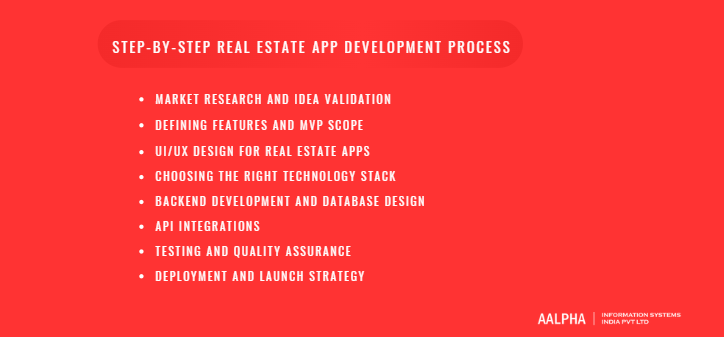
Step-by-Step Real Estate App Development Process
Building a real estate mobile app requires a structured, execution-driven approach that balances user needs, technical feasibility, and business goals. Unlike simple applications, real estate platforms must handle large datasets, multiple user roles, real-time interactions, and secure transactions. A well-defined development process ensures that the final product is scalable, user-friendly, and aligned with market demand. Each stage, from research to launch, plays a critical role in determining whether the app succeeds or fails in a highly competitive environment.
-
Market Research and Idea Validation
Every successful real estate app begins with a clear understanding of the market it intends to serve. Market research is not limited to identifying competitors but extends to analyzing user behavior, regional demand, and unmet needs. Businesses must define their target audience early, whether they are first-time homebuyers, rental seekers in urban areas, property investors, or real estate agents.
A common mistake is building a generic app that tries to serve everyone. Instead, focusing on a specific niche leads to better product-market fit. For example, an app designed for rental properties in tier-2 cities will have different requirements compared to a luxury property marketplace in metropolitan regions.
Validation is equally important. This involves testing assumptions through surveys, interviews, or pilot versions of the product. Questions such as what problems users face when searching for properties, why existing apps fall short, and what features users value most should be answered before development begins. Without validation, businesses risk investing in features that do not solve real problems, leading to poor adoption and wasted resources.
-
Defining Features and MVP Scope
Once the idea is validated, the next step is defining the feature set and establishing a minimum viable product (MVP). The MVP should include only the essential features required to deliver core value, such as property listings, search filters, user profiles, and basic communication tools.
Overbuilding at the initial stage is a common pitfall. Adding advanced features like AI recommendations, AR tours, or complex analytics too early can increase development time and cost without guaranteeing user adoption. Instead, the focus should be on solving the primary problem effectively and gathering feedback from early users.
A well-defined MVP allows businesses to launch faster, test real-world usage, and iterate based on actual data. For example, if users engage heavily with map-based search but ignore advanced filters, future development can prioritize enhancing mapping features rather than expanding filters. This iterative approach reduces risk and ensures that resources are allocated to features that deliver measurable value.
-
UI/UX Design for Real Estate Apps
User experience is a critical differentiator in real estate apps, where users often browse multiple listings and spend significant time evaluating options. A poorly designed interface can lead to frustration and high drop-off rates, even if the app offers valuable features.
Real estate apps should prioritize intuitive navigation and a clean, visually structured layout. A map-first interface is particularly effective, allowing users to explore properties geographically while accessing detailed information with minimal effort. Search and filter options should be easily accessible, and listing pages should present key information clearly without overwhelming the user.
Consistency in design elements, such as icons, colors, and typography, enhances usability and builds familiarity. Fast loading times and smooth transitions are equally important, as users expect seamless interactions. The goal is to create an experience where users can move effortlessly from browsing to decision-making without encountering friction.
-
Choosing the Right Technology Stack
Selecting the appropriate mobile app technology stack is a foundational decision that affects performance, scalability, and development speed. Businesses must decide whether to build native apps for platforms like iOS and Android or use cross-platform frameworks such as React Native or Flutter.
Native development offers superior performance and access to device-specific features, making it suitable for apps with complex functionalities or high-performance requirements. However, it requires separate codebases for each platform, increasing development time and cost.
Cross-platform development, on the other hand, allows a single codebase to be used across multiple platforms, reducing time-to-market and maintenance effort. For many real estate apps, which focus on data display and user interaction rather than heavy processing, cross-platform solutions provide a balanced approach.
The choice should be guided by factors such as budget, timeline, target audience, and long-term scalability. A well-chosen tech stack ensures that the app can handle growing user demand without requiring frequent reengineering.
-
Backend Development and Database Design
The backend is the engine that powers a real estate app, handling data storage, user management, and business logic. Given the large volume of property listings and user interactions, the backend must be designed for scalability and performance.
Database design plays a crucial role in organizing property data, user profiles, transactions, and communication logs. Structured databases such as PostgreSQL are often used for relational data, while NoSQL databases like MongoDB can handle flexible data structures and high-volume queries.
Scalability considerations include the ability to handle increasing numbers of users, listings, and concurrent requests. Cloud-based infrastructure allows the system to scale dynamically based on demand, ensuring consistent performance even during peak usage.
Security is another critical aspect. Sensitive data, such as user information and transaction details, must be protected through encryption, authentication mechanisms, and secure APIs. A robust backend architecture ensures that the app remains reliable, fast, and secure as it grows.
-
API Integrations
API integrations extend the functionality of a real estate app by connecting it with external services. These integrations are essential for delivering features that users expect in modern applications.
Mapping APIs, such as Google Maps, enable location-based search and visualization. Payment gateway APIs allow users to complete transactions securely within the app. Communication APIs support messaging, voice, and video interactions.
In some regions, integration with Multiple Listing Services (MLS) provides access to a comprehensive database of property listings, ensuring that users receive accurate and up-to-date information. Without such integrations, maintaining data accuracy becomes significantly more challenging.
APIs should be selected based on reliability, scalability, and ease of integration. Proper implementation ensures that the app can deliver advanced features without building everything from scratch, reducing development time and cost.
-
Testing and Quality Assurance
Testing is a critical phase that ensures the app functions as intended and delivers a smooth user experience. Real estate apps must undergo multiple levels of testing, including functional, usability, performance, and security testing.
Functional testing verifies that all features, such as search, filters, messaging, and payments, work correctly. Usability testing focuses on the user experience, identifying areas where navigation may be confusing or inefficient. Performance testing ensures that the app can handle high traffic and large datasets without slowing down.
Security testing is particularly important, as real estate apps often handle sensitive user data and financial transactions. Identifying and addressing vulnerabilities before launch prevents potential breaches and builds user trust.
A comprehensive testing strategy reduces the risk of post-launch issues, ensuring that users have a reliable and consistent experience from the start.
-
Deployment and Launch Strategy
The final stage involves deploying the app to platforms such as the Apple App Store and Google Play Store, followed by a well-planned launch strategy. Deployment includes preparing the app for submission, ensuring compliance with platform guidelines, and optimizing app store listings with relevant keywords and descriptions.
A successful launch goes beyond simply making the app available. Businesses must implement a go-to-market strategy that includes marketing campaigns, partnerships, and user acquisition efforts. Early user feedback is invaluable, as it provides insights into how the app performs in real-world conditions.
Post-launch monitoring is equally important. Analytics tools should be used to track user behavior, engagement, and performance metrics. This data informs future updates and feature enhancements, ensuring that the app continues to evolve based on user needs.
In practice, launching a real estate app is not the end of the development process but the beginning of continuous improvement. Businesses that actively iterate and refine their product based on feedback are more likely to achieve long-term success in a competitive market.
Technology Stack for Real Estate App Development
Selecting the right technology stack is a strategic decision that directly impacts performance, scalability, development speed, and long-term maintenance. Real estate mobile apps handle large datasets, real-time interactions, location services, and secure transactions, which means the underlying technologies must be robust, flexible, and capable of scaling with user growth. For technical decision-makers, the goal is not just to choose popular tools but to build an architecture that supports high availability, fast response times, and seamless user experiences across devices.
-
Frontend Technologies
Frontend technologies define how users interact with the app, making them critical for performance and usability. Cross-platform frameworks such as React Native and Flutter have become the preferred choice for real estate app development due to their ability to deliver near-native performance while maintaining a single codebase.
React Native allows developers to build mobile apps using JavaScript and React, making it ideal for teams with web development expertise. It offers a rich ecosystem, reusable components, and strong community support, which accelerates development and reduces costs. Flutter, on the other hand, uses Dart and provides highly customizable UI components with consistent performance across platforms. Its rendering engine ensures smooth animations and visually appealing interfaces, which are particularly important for image-heavy real estate apps.
Both frameworks support rapid development and easier maintenance compared to native approaches. For most real estate applications that prioritize data display, search functionality, and user interaction, cross-platform frameworks provide a practical balance between performance and efficiency.
-
Backend Technologies
The backend is responsible for handling business logic, managing user data, processing requests, and ensuring seamless communication between the frontend and database. Technologies like Node.js and Django are widely used for building scalable real estate platforms.
Node.js is known for its non-blocking, event-driven architecture, making it highly efficient for handling multiple concurrent requests. This is particularly useful in real estate apps where users frequently search, filter, and interact with listings in real time. Its compatibility with JavaScript across both frontend and backend simplifies development and improves productivity.
Django, built on Python, offers a robust and secure framework with built-in features for authentication, database management, and admin interfaces. It is well-suited for applications that require rapid development with strong security measures. Django’s structured approach also makes it easier to maintain and scale complex systems.
The choice between these technologies depends on team expertise, project requirements, and scalability needs, but both provide reliable foundations for real estate app development.
-
Database Options
Real estate apps require efficient data storage and retrieval systems to manage large volumes of property listings, user data, and transaction records. Relational databases like PostgreSQL are commonly used for structured data, offering strong consistency, reliability, and support for complex queries.
For applications that require flexibility and high scalability, NoSQL databases such as MongoDB are often preferred. MongoDB allows developers to store data in a flexible, JSON-like format, making it suitable for handling dynamic property attributes and large datasets.
In many cases, a hybrid approach is used, combining relational and NoSQL databases to leverage the strengths of both systems. The choice of database should align with the app’s data structure, query requirements, and expected growth.
-
Third-Party Integrations
Third-party integrations play a crucial role in extending the functionality of real estate apps without building everything from scratch. Services like Google Maps enable location-based search, map visualization, and geolocation features, which are essential for property discovery.
Payment gateways such as Stripe allow secure handling of transactions, including booking fees and deposits. Communication platforms like Twilio provide APIs for messaging, voice, and video interactions, enabling seamless communication between users.
These integrations reduce development time, improve reliability, and ensure that the app can offer advanced features with minimal effort. Choosing well-established services also enhances scalability and security.
-
Cloud and Hosting
Cloud infrastructure is essential for ensuring that real estate apps can handle varying levels of traffic and scale efficiently. Platforms such as Amazon Web Services and Microsoft Azure provide a wide range of services, including computing power, storage, databases, and networking.
Cloud hosting allows applications to scale resources dynamically based on demand, ensuring consistent performance during peak usage. It also supports high availability, data redundancy, and disaster recovery, which are critical for maintaining reliability.
In addition to scalability, cloud platforms offer built-in security features, monitoring tools, and analytics capabilities. These features help businesses maintain performance, detect issues early, and optimize resource usage. For real estate apps that expect growth and require reliable uptime, cloud-based deployment is not just an option but a necessity.
Cost of Real Estate Mobile App Development
The cost of building a real estate mobile app varies widely depending on features, complexity, development approach, and geographic location of the development team. Businesses often ask how much it costs to build a real estate app similar to Zillow or a rental platform, but there is no fixed answer. Instead, costs are determined by the scope of functionality, the level of customization, and the quality expectations. Understanding how these factors influence pricing helps decision-makers plan budgets realistically and avoid unexpected expenses during development.
-
Cost Breakdown by Features
Each feature in a real estate app contributes to the overall app development cost, and prioritizing the right set of features is essential for budget control. Core features such as user registration, property listings, and search filters form the foundation and typically account for a significant portion of the initial cost. These features require backend logic, database design, and frontend interfaces.
Advanced features increase complexity and cost. For example, map-based search and geolocation require integration with mapping services and optimization for performance. Chat systems involve real-time communication infrastructure, while virtual tours and AR/VR features demand specialized development and higher processing capabilities.
Payment integration, push notifications, and analytics dashboards also add to the cost but are often necessary for a complete user experience. The key is to distinguish between essential features and enhancements. Businesses that focus on building a lean feature set initially can reduce costs while still delivering value, then expand functionality based on user feedback and demand.
-
Cost by App Complexity
The overall cost of a real estate app is closely tied to its complexity. A basic app with limited features, such as simple property listings and search functionality, may cost between $20,000 and $40,000. These apps are suitable for startups testing an idea or targeting a specific niche.
Mid-level apps, which include features like user profiles, map integration, chat functionality, and booking systems, typically range from $40,000 to $80,000. These apps offer a more complete user experience and are suitable for businesses aiming to compete in established markets.
Advanced apps, such as full-scale marketplaces with AI recommendations, virtual tours, and integrated transaction systems, can cost $80,000 to $150,000 or more. These platforms require sophisticated architecture, high scalability, and extensive testing. While the investment is higher, advanced apps have greater potential for revenue generation and long-term growth.
-
Development Cost by Region
Development costs vary significantly based on the geographic location of the development team. In the United States, hourly rates for experienced developers typically range from $100 to $200, making it one of the most expensive regions for app development. Projects developed in the US often prioritize high-end quality and close collaboration but come with a premium price.
In Europe, rates are slightly lower, generally ranging from $60 to $120 per hour depending on the country and expertise level. Western European countries tend to be more expensive, while Eastern Europe offers competitive pricing with strong technical expertise.
India has emerged as a leading destination for cost-effective app development, with hourly rates typically ranging from $25 to $60. Despite lower costs, many applications development firms in India deliver high-quality solutions, making it an attractive option for startups and businesses looking to optimize budgets without compromising on quality.
-
Ongoing Maintenance Costs
Building the app is only part of the investment. Ongoing maintenance is essential to ensure performance, security, and relevance over time. Maintenance costs typically range from 15% to 25% of the initial development cost annually.
These app maintenance costs include regular updates to fix bugs, improve performance, and add new features based on user feedback. Hosting and infrastructure expenses are another key component, especially for apps with large user bases and high data usage. Cloud services, storage, and bandwidth all contribute to recurring costs.
Support and monitoring are equally important. Businesses need to track user behavior, resolve issues promptly, and ensure that the app remains compatible with new operating system updates. Neglecting maintenance can lead to performance issues, security vulnerabilities, and declining user engagement.
In practice, planning for maintenance from the beginning ensures that the app remains competitive and continues to deliver value long after its initial launch.
Challenges in Real Estate App Development
Real estate mobile app development involves more than just building features and launching a product. It requires addressing a set of complex challenges that can directly impact user trust, operational efficiency, and long-term scalability. Businesses entering this space often underestimate these risks, which can lead to poor user adoption, legal complications, or technical failures. Identifying and proactively managing these challenges is essential for building a reliable and competitive real estate platform.
-
Data Accuracy and Listing Management
One of the most critical challenges in real estate apps is maintaining accurate and up-to-date property data. Listings can quickly become outdated due to price changes, availability status, or property modifications. If users encounter incorrect information, such as properties that are no longer available, it leads to frustration and loss of trust.
Managing large volumes of listings across multiple sources further complicates this issue. Without proper validation and synchronization mechanisms, duplicate or inconsistent data can appear in the system. Implementing automated updates, real-time synchronization, and verification workflows is essential to ensure data reliability. A platform that consistently delivers accurate information gains a significant competitive advantage.
-
User Trust and Verification
Trust is a fundamental factor in real estate transactions, where users are dealing with high-value assets and long-term commitments. Ensuring that listings, agents, and property owners are genuine is a major challenge for app developers.
Fraudulent listings, misleading property descriptions, and unverified agents can damage the platform’s reputation. To address this, apps must implement robust verification processes, including identity checks, document validation, and manual moderation where necessary. User reviews and ratings also play a role in building trust by providing social proof.
Without strong verification mechanisms, even a well-designed app can struggle to retain users, as trust is often the deciding factor in whether users engage with a platform or move to a competitor.
-
Scalability Issues
As a real estate app grows, it must handle increasing numbers of users, listings, and interactions without compromising performance. Scalability is a significant challenge, particularly for platforms that experience rapid growth or seasonal spikes in activity.
High traffic can lead to slow loading times, delayed search results, and system crashes if the architecture is not designed to scale. Real estate apps also process large amounts of data, including images, videos, and geolocation information, which adds to the complexity.
To address scalability, developers must use cloud infrastructure, load balancing, and efficient database management. Planning for scalability from the beginning ensures that the app can grow without requiring major architectural changes later.
-
Integration with Legacy Systems
Many real estate businesses still rely on legacy systems for managing property data, transactions, and customer relationships. Integrating modern mobile apps with these outdated systems can be challenging due to differences in technology, data formats, and system capabilities.
Legacy systems often lack APIs or standardized interfaces, making integration time-consuming and prone to errors. In some cases, data migration is required, which introduces additional risks related to data loss or inconsistency.
Despite these challenges, integration is often necessary to maintain continuity and leverage existing data. A well-planned integration strategy, including middleware solutions and gradual system upgrades, can help bridge the gap between old and new technologies.
-
Regulatory and Compliance Issues
Real estate is a highly regulated industry, and compliance requirements vary by region. Mobile apps must adhere to local laws related to property transactions, data privacy, and financial operations. Failure to comply can result in legal penalties and loss of user trust.
For example, data protection regulations require secure handling of personal information, while financial transactions must comply with payment and taxation laws. In some regions, property listings must meet specific disclosure requirements to ensure transparency.
Developers and businesses must stay informed about relevant regulations and incorporate compliance measures into the app from the outset. This includes implementing secure data storage, encryption, and audit trails. Addressing regulatory requirements early reduces risk and ensures that the platform operates within legal boundaries as it scales.
Future of Real Estate Mobile Apps
Real estate mobile apps are evolving from simple listing platforms into intelligent, data-driven ecosystems that guide users through discovery, evaluation, and transactions with minimal friction. The next phase of innovation is centered on automation, immersive experiences, and personalized interactions. As technology matures, real estate apps will not just respond to user inputs but anticipate needs, reduce decision complexity, and enable faster, more confident transactions. Businesses that align their product strategy with these emerging trends will be better positioned to capture long-term value in an increasingly competitive market.
-
AI and Predictive Analytics
Artificial intelligence is becoming a foundational component of real estate applications, enabling platforms to move beyond static listings toward intelligent decision support systems. Predictive analytics can analyze user behavior, market trends, and historical data to recommend properties that closely match individual preferences. Instead of manually filtering through listings, users are presented with options that align with their budget, location preferences, and lifestyle needs.
AI also enhances pricing insights by forecasting property value trends and identifying investment opportunities. For example, users can understand whether a property is likely to appreciate based on market dynamics. For businesses, AI-driven insights improve user engagement and conversion rates by delivering relevant and timely recommendations.
-
AR/VR Property Experiences
Augmented reality and virtual reality are redefining how users interact with properties. Virtual tours allow users to explore homes remotely, providing a realistic sense of space, layout, and design without requiring physical visits. This is particularly valuable for international buyers or users exploring properties in different cities.
AR features go a step further by enabling users to visualize changes within a property, such as furniture placement or interior modifications. These immersive experiences reduce uncertainty and help users make more informed decisions. As technology becomes more accessible, AR and VR are expected to become standard features rather than optional enhancements in real estate apps.
-
Blockchain and Smart Contracts
Blockchain technology has the potential to transform property transactions by introducing greater transparency and security. Real estate deals often involve multiple intermediaries, extensive documentation, and complex verification processes. Blockchain can streamline these workflows by providing a decentralized and tamper-proof record of ownership and transaction history.
Smart contracts further enhance this process by automating agreements between parties. Once predefined conditions are met, transactions can be executed automatically without the need for manual intervention. This reduces delays, minimizes the risk of fraud, and lowers transaction costs. While adoption is still in its early stages, blockchain is expected to play a significant role in the future of real estate transactions.
-
Hyper-Personalization
Hyper-personalization is becoming a key differentiator in real estate apps, driven by advancements in data analytics and machine learning. Users no longer want generic property suggestions; they expect platforms to understand their preferences and deliver tailored experiences.
This includes personalized property recommendations, customized search results, and targeted notifications based on user behavior. For example, if a user frequently searches for properties in a specific neighborhood, the app can prioritize listings from that area and notify them of new opportunities.
Hyper-personalization not only improves user satisfaction but also increases engagement and conversion rates. By delivering relevant content at the right time, apps can guide users more effectively through the decision-making process.
-
Voice Search and Conversational Interfaces
Voice search and conversational interfaces are emerging as powerful tools for enhancing user interaction. With the growing adoption of voice assistants, users are increasingly comfortable using natural language to search for information.
In real estate apps, this means users can search for properties by speaking queries such as finding a two-bedroom apartment near a specific location within a certain budget. Conversational interfaces, including chatbots, further simplify interactions by guiding users through the app, answering questions, and assisting with tasks such as scheduling visits.
These technologies make real estate apps more accessible and user-friendly, particularly for users who prefer intuitive and hands-free interactions. As voice and conversational AI continue to improve, they are expected to become integral components of modern real estate platforms.
How to Choose the Right Real Estate App Development Company
Selecting the right mobile app development company or partner is one of the most critical decisions in building a successful real estate mobile app. The choice directly impacts product quality, scalability, time-to-market, and long-term maintenance. Many businesses focus only on cost, but experienced decision-makers understand that expertise, process, and reliability play a far greater role in determining success. A strong development partner does not just execute requirements but contributes strategic input, anticipates challenges, and builds a product aligned with business goals.
-
Experience in Real Estate Domain
Domain experience is a key differentiator when evaluating development companies. Real estate apps involve unique workflows such as property listing management, map-based search, multi-user roles, and transaction handling. A company that has previously worked on similar projects understands these complexities and can avoid common pitfalls.
For example, an experienced team will already know how to structure property data, manage listing updates, and design search systems that reflect real user behavior. They will also understand industry-specific challenges such as data accuracy, compliance, and user trust. Without this experience, development teams often spend additional time learning the domain, which can delay timelines and increase costs.
Choosing a company with proven real estate expertise ensures faster execution, better feature alignment, and a more reliable final product.
-
Technical Expertise and Scalability
A real estate app must be built with scalability in mind from the beginning. As the number of users, listings, and interactions grows, the system should handle increased load without performance issues. This requires strong technical expertise in backend architecture, database design, and cloud infrastructure.
The development company should be capable of building systems that support high traffic, real-time search, and large media content such as images and videos. They should also have experience with API integrations, security protocols, and performance optimization.
Scalability is not just about handling growth but also about maintaining speed and reliability under varying conditions. A technically strong partner ensures that the app performs consistently, even as usage increases, reducing the need for costly reengineering in the future.
-
UI/UX Capabilities
User experience plays a decisive role in the success of real estate apps, where users often compare multiple platforms before choosing one. A development company must have strong UI/UX capabilities to design intuitive, visually appealing, and easy-to-navigate interfaces.
This includes creating efficient search flows, map-based navigation, and well-structured listing pages. The design should minimize friction and allow users to move quickly from browsing to action. Poor UI/UX can lead to high drop-off rates, regardless of how powerful the underlying features are.
A company with a strong design focus ensures that the app not only functions well but also delivers a seamless and engaging user experience.
-
Transparent Pricing and Process
Transparency in pricing and development processes is essential for building trust and avoiding unexpected costs. A reliable development company provides clear estimates, detailed breakdowns of costs, and a structured development roadmap.
The process should include defined milestones, regular updates, and clear communication channels. This allows businesses to track progress, provide feedback, and ensure that the project stays aligned with expectations.
Hidden costs and unclear timelines are common issues in poorly managed projects. Choosing a partner that emphasizes transparency reduces risk and ensures better control over the development process.
-
Post-Launch Support and Maintenance
Launching the app is only the beginning. Ongoing support and maintenance are critical for ensuring long-term success. A reliable development company should offer post-launch services, including bug fixes, performance optimization, feature updates, and security enhancements.
Real estate apps require continuous updates to remain compatible with new operating system versions and evolving user expectations. Without proper maintenance, even a well-built app can become outdated and lose users over time.
Partnering with an experienced provider like Aalpha Information Systems ensures not only high-quality development but also long-term support and scalability. Aalpha’s experience in building custom software solutions allows businesses to focus on growth while relying on a trusted partner for ongoing technical excellence.
In practice, the right development company acts as a strategic partner rather than just a service provider. By combining domain expertise, technical strength, design capabilities, and long-term support, businesses can build real estate apps that are not only functional but also competitive, scalable, and aligned with market demands.
Final Thoughts
Real estate mobile apps have become essential platforms for property discovery, transactions, and management. Success depends on building a solution that combines the right features, scalable architecture, and a strong user experience while aligning with real market needs.
If you are planning to develop a real estate app, working with an experienced partner can significantly reduce risk and accelerate execution. Aalpha Information Systems offers end-to-end development expertise to help you design, build, and scale high-performance real estate applications.
Get in touch to discuss your idea and turn it into a market-ready product.