





1. TL;DR
A pickup and delivery app is software that takes a request from point A to point B: a customer or business books a pickup, the platform assigns a delivery partner, and both sides track the job until proof of delivery is captured. A working platform needs four pieces, not one app: a customer app, a delivery partner app, a vendor or business dashboard, and an admin panel with a dispatch engine behind them. A single-city MVP with all four, built cross-platform, typically runs USD 25,000 to 45,000 over 12 to 16 weeks at offshore rates of USD 25 to 45 per hour. A mid-level platform with scheduling, wallets, multi-stop routing and reporting lands between USD 50,000 and 90,000. Maps, payments, SMS and cloud add a recurring bill from the first day of the pilot. The approach that survives contact with real riders is a narrow MVP in one service zone, instrumented for cost per delivery, then expanded once the unit economics hold. Aalpha Information Systems builds these platforms end to end, and also offers DeliveryStack, a white-label on-demand delivery product that turns most of the build into a configuration and branding exercise for teams that want to be live in weeks rather than months.
2. Understanding pickup and delivery apps
What is a pickup and delivery app?
A pickup and delivery app connects three parties: the sender who wants something moved, the delivery partner who moves it, and the operator who prices the job and guarantees it happens. The customer enters a pickup address, a drop address and a time window. The platform calculates distance, quotes a fare, finds a nearby partner and streams location updates until the item is handed over and confirmed.
The distinction worth holding on to is that the app is the thin part. Most of the product is dispatch logic, pricing rules, exception handling and payout accounting. Teams that treat the project as “two mobile apps” usually discover this in month three, when a rider cancels after pickup and nobody has decided what the system should do next.
How the pickup and delivery model works
The flow has seven states, and almost every feature request maps onto one of them. A booking is created. The system prices it. A partner is offered the job and accepts or declines. The partner travels to pickup and verifies the handover. The item is in transit. Delivery is verified at the drop point. Money settles: customer charged, partner credited, commission retained.
Everything difficult sits in the gaps between those states. What happens when nobody accepts for four minutes. What happens when the recipient is not home. What happens when the partner’s phone loses signal inside a basement parking lot with an undelivered parcel. Build the happy path in week two and spend the rest of the project on the gaps.
Types of pickup and delivery applications
Parcel and courier apps move documents and small packages within a city, usually priced by distance. Food delivery is a subset with tight time constraints and prepared-order pickups. Grocery and retail delivery adds batch picking and substitutions. Laundry, pharmacy and service pickups involve a return leg, which changes the data model because one booking now has two legs. Freight and heavy goods apps deal in vehicle types, load capacity and loading time rather than minutes. Intracity B2B distribution moves stock between a warehouse and retail outlets on fixed routes.
Pick one and build for it. A platform designed for parcels can be extended to groceries later; one designed for “everything” on day one tends to ship a booking screen that fits nothing well.
On-demand versus scheduled delivery
On-demand means the job is dispatched within minutes of booking, so the system optimises for partner availability near the pickup point. Scheduled means the job is placed into a future slot, so the system optimises for route density and slot capacity. These are different products under the same skin.
Scheduled delivery is cheaper to operate because you can batch, and easier to staff because you know tomorrow’s volume tonight. It is also the harder build: slot management, capacity limits per zone, and reassignment when a partner calls in sick. On-demand is simpler to code and more expensive to run, since idle partners still cost money. Most successful platforms end up supporting both, with scheduled volume subsidising the cost of on-demand coverage.
Single-vendor versus multi-vendor platforms
A single-vendor platform serves one business: a pharmacy chain, a furniture retailer, a cloud kitchen group. Orders originate from that business, so there is no marketplace, no vendor onboarding, and no commission engine. Development is faster and the roadmap is driven by one stakeholder.
A multi-vendor platform runs a marketplace where independent businesses list and customers order across them. That adds vendor onboarding, per-vendor catalogues, commission tiers, split settlements, vendor payouts and dispute handling. Expect 40 to 60 percent more build effort for the same feature depth. The trade is growth: a marketplace can add supply without adding your own capital, but you now carry the cost of acquiring both sides of the market.
Pickup and delivery apps versus courier management software
Courier management software is built for an existing logistics operation: it digitises manifests, hubs, linehaul, sorting and proof of delivery for a fleet that already exists. A pickup and delivery app is built for demand capture: it acquires customers, prices jobs and assigns them to loosely coupled partners.
The difference runs through every layer. A pickup and delivery app serves a consumer or an SME booking a single job, drawing on gig or hybrid supply whose availability changes by the hour, and its core logic is real-time dispatch and pricing. Courier management software serves operations staff running a network of employed drivers on fixed routes, and its core logic is manifesting, hub routing and SLA tracking against a contract. Payment differs as much as dispatch does: in-app and per order in the first case, monthly invoices against agreed rates in the second. On timelines, an MVP of the first is a 12 to 16 week build. The second rarely lands inside 20 to 30 weeks, because the manifest and hub model carries far more state.
If you already run vans on fixed routes, you need the second thing. Many buyers ask for the first and describe the second.
3. Pickup and delivery app market and business opportunities
Demand for pickup and delivery software comes from a shift in what customers treat as normal. Same-day has moved from premium service to baseline expectation in most urban markets, and businesses without a delivery option lose orders to those that have one. The opportunity is largest in intracity logistics, where incumbents are fragmented and local operators still coordinate by phone.
Market growth and customer expectations
Food and quick-commerce operators trained an entire customer base to expect a live map, an accurate ETA and a refund policy. That expectation now applies to a tailor picking up a suit and a lab collecting a blood sample. Customers judge a delivery app against the best one on their phone, not against the phone call it replaced.
Two consequences for anyone building now. Tracking is not a differentiator, it is a requirement, and an app without it reads as unfinished. And ETA accuracy matters more than ETA speed: a reliable 90 minutes beats an optimistic 30 that slips to 70.
Industries using pickup and delivery platforms
Retail and D2C brands use them for local fulfilment and returns pickup. Restaurants and cloud kitchens use them when aggregator commissions stop making sense. Pharmacies and diagnostic labs need sample and prescription pickup with chain-of-custody records. Laundry, dry cleaning and repair services need two-leg jobs. Furniture, appliance and building-material dealers need vehicle-type selection and loading time. Document-heavy businesses such as law firms, banks and insurers still move physical paper daily. Agriculture and produce wholesalers move stock from mandi to retailer before dawn.
The pattern across all of them: the delivery was already happening, informally, at unknown cost. The software’s first job is to make that cost visible.
Hyperlocal and last-mile opportunities
Hyperlocal means a service radius small enough that a two-wheeler completes a round trip inside an hour. Inside that radius the economics change: no hubs, no sorting, no linehaul, and a partner can complete eight to fourteen jobs per shift. Last-mile in the wider sense includes the final leg of a long-haul shipment, which requires integration with a 3PL’s systems rather than your own pickup flow.
Tier-2 and tier-3 cities are underserved because national operators price for volume they cannot find there. A local operator who knows which streets flood in monsoon and which markets close on Thursday has a real advantage, provided the software lets them encode that knowledge as zones, buffers and cut-off times.
Business benefits for startups and enterprises
For a startup, the platform is the business: it captures demand, sets price and controls the partner relationship. For an enterprise, the platform is a cost and control instrument. Bringing delivery in-house typically cuts per-order cost against aggregator commissions of 18 to 30 percent, and it returns customer data that aggregators keep.
The honest downside for enterprises: you inherit operations. Rider recruitment, attrition, insurance, shift planning and customer complaints about a late parcel all become yours. Several brands have built the app, run it for a year, and gone back to aggregators for peak hours while keeping their own fleet for base load. That hybrid is a legitimate target state and worth designing for from the start.
Common operational challenges
Supply liquidity is the first wall. Below a certain partner density, acceptance times stretch, customers cancel, and the remaining partners earn too little to stay. Fraud is the second: fake deliveries marked complete, collusion between partner and customer on cash orders, and referral abuse. Cash on delivery creates a reconciliation problem, since money sits in a rider’s pocket and has to be deposited. Address quality in Indian and African cities defeats geocoding regularly, so the system needs a landmark field and a way to save corrected pins.
None of these is solved by a feature. They are solved by policy, enforced by the software.
Successful pickup and delivery app examples
Dunzo built intracity pickup and drop in Indian cities before adding merchant categories, and its cost per delivery problem is well documented. Uber Connect and Lalamove show the vehicle-class approach, where the customer selects a two-wheeler, three-wheeler or van rather than a service type. Porter focused on goods and mini-trucks rather than parcels, which let it price by vehicle and distance instead of racing on delivery time. Shadowfax and Delhivery built partner-facing networks and sell capacity to brands rather than to consumers.
The useful lesson from all four is sequencing: each started with one job type in a limited geography and added categories only after dispatch and pricing were stable.
4. Pickup and delivery app business models
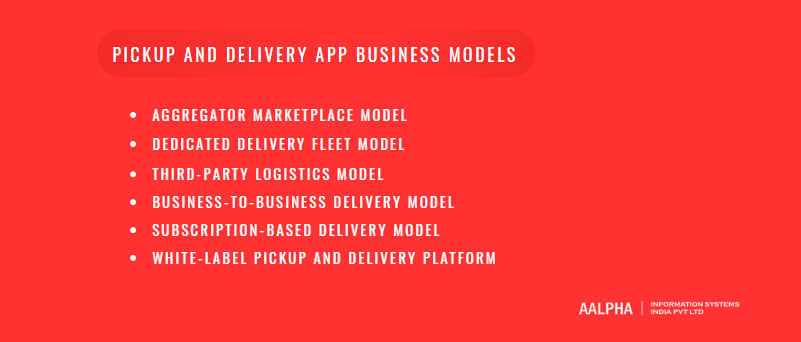
Your business model decides your data model, so choose it before design starts. The five that work are aggregator marketplace, dedicated fleet, third-party logistics, B2B contract delivery and subscription. A sixth route, licensing a white-label platform, trades control for speed.
-
Aggregator marketplace model
You own demand and match it to independent partners who use their own vehicles. Revenue is a delivery fee from the customer plus a commission from the partner or vendor. Capital needs are low and supply scales with incentives rather than hiring.
The weakness is loyalty. Partners run three apps at once and take whichever job pays best at that minute, so your acceptance rate is a function of your incentive spend. Budget for partner incentives as a permanent line item, not a launch campaign.
-
Dedicated delivery fleet model
You employ riders, own or lease vehicles, and control uniforms, training and service quality. Per-delivery cost is predictable and quality is defensible, which matters for pharmacy, high-value goods and brand-sensitive retail.
Fixed cost is the trade. Idle riders during off-peak hours cost the same as busy ones, so this model only works with steady base demand or a paying B2B contract underneath it. Software-wise it is the simpler build: shift scheduling and assignment replace open-market broadcasting and incentives.
-
Third-party logistics model
You act as a layer over existing courier and delivery companies, routing each job to whichever partner network is cheapest or fastest for that lane. Revenue is the margin between what you charge and what you pay.
This model lives or dies on integrations. Each 3PL has its own API, status codes, and definition of “out for delivery”, so you need a normalisation layer and a reconciliation process for billing disputes. Build the integration framework once, properly, or you will maintain nine special cases.
-
Business-to-business delivery model
Contracts with businesses for recurring delivery volume: a distributor supplying 60 retail outlets, a lab collecting from 25 clinics, a bakery serving cafés each morning. Pricing is monthly or per-drop under an agreement, with invoices instead of card payments.
Revenue is predictable and customer acquisition cost is low relative to consumer delivery. The requirements are different: bulk upload, route plans, delivery windows, per-location contacts, credit terms and a monthly reconciliation report the client’s accounts team will actually accept. A consumer app bolted onto this use case fails on the reporting alone.
-
Subscription-based delivery model
Customers or businesses pay a recurring fee for free or discounted deliveries, priority dispatch, or a fixed number of monthly pickups. Subscriptions lift order frequency and make revenue forecastable.
The risk is adverse selection: your heaviest users subscribe, and if the fee is set below their marginal cost you lose money at scale. Price the tier off observed order frequency after a few months of real data, not off a launch guess, and cap included deliveries.
-
White-label pickup and delivery platform
Licensing a ready platform puts you live in weeks instead of months, at USD 5,000 to 20,000 in setup plus recurring licence fees. It suits operators validating a market or running a single straightforward service.
Two limits are worth stating plainly. Dispatch logic and pricing rules are the licensor’s, so any rule specific to your city usually cannot be expressed. And the data and roadmap are not yours, which matters if you intend to raise capital on the strength of the platform. Aalpha offers DeliveryStack for operators who want a white-label base that can later be extended with custom modules, which removes the usual dead end where the licensed product cannot grow with the business.
Choosing the right business model
Capital requirement, margin stability and build complexity separate the six routes cleanly, and each suits a different starting position.
An aggregator marketplace needs little capital and scales supply through incentives, but margins stay thin and incentive-dependent, and it is the heaviest build of the six because of commissions, payouts and dispute handling. A dedicated fleet inverts that: high fixed cost, predictable per-delivery economics that improve with density, and a simpler build since shift scheduling replaces open-market broadcasting. It is the right model for pharmacy, high-value goods and brand-led retail where service quality is the product.
Third-party logistics needs almost no capital and earns a resale margin, with medium to high complexity concentrated in partner integrations rather than in the apps. B2B contract delivery needs low to medium capital, produces the most stable revenue of the six because contracts underwrite it, and carries a medium build weighted towards bulk upload and reporting rather than consumer polish. Subscriptions are not a standalone model but a layer that improves retention on any of the others, at low build cost. A white-label licence is the cheapest and fastest route of all, which is why it suits market validation and single straightforward services, and its limit is that your dispatch and pricing rules are the licensor’s.
If you have paying businesses waiting, start with B2B contract delivery. It funds the fleet that later serves consumer demand, which is a far easier sequence than acquiring consumers first and hoping businesses follow.
5. How pickup and delivery apps make money
Revenue comes from seven places: delivery charges, vendor commissions, surge and distance pricing, subscriptions, express fees, advertising, and cancellation charges. Most platforms earn 70 to 85 percent from the first three. The others matter once volume exists.
-
Delivery charges
The base fee plus a per-kilometre rate, sometimes with a per-minute component for waiting time. Set the base to cover the partner payout for the shortest viable job, because that is where margin leaks. A flat citywide fee is simple to communicate and loses money on every long trip, so most operators move to distance bands within the first few months.
-
Vendor commissions
On a marketplace, a percentage of order value from the merchant, commonly 10 to 25 percent depending on category and who bears the delivery cost. Commission works when you supply demand. If the merchant brings its own customers and only uses you for logistics, they will refuse a percentage of order value and expect a per-delivery rate instead, so support both in the pricing engine.
-
Surge and distance-based pricing
Surge multiplies fares when demand outruns available partners, which both rations supply and pulls more partners online. It needs a visible explanation in the app and a cap, or it becomes a support problem. Distance banding is less controversial and more predictable. Both require accurate road distance rather than straight-line distance, which is the single most common source of pricing loss in poorly built platforms.
-
Customer and business subscriptions
A monthly plan covering delivery fees for consumers, or a volume plan for businesses. Business plans are the stronger bet: a retailer committing to 400 monthly deliveries at a fixed rate gives you the demand floor that makes fleet planning possible.
-
Priority or express delivery fees
An upcharge of 30 to 60 percent for a guaranteed shorter window. Customers do pay for this, particularly businesses sending documents. Only sell it if dispatch can actually prioritise the job and you are willing to refund when the window is missed. An express tier without enforcement produces refunds and bad reviews at the same time.
-
Advertising and featured listings
Merchants pay for placement in search results or home-screen banners. This only becomes real revenue above a few thousand daily orders, and it competes with relevance. Treat it as a later-stage line, not part of the launch model.
-
Cancellation and waiting charges
A fee when a customer cancels after a partner has begun travelling, and a per-minute charge after a grace period at pickup or drop. These are cost recovery rather than profit, and they protect partner earnings, which protects supply. State the grace period and the rate in the booking screen, not in the terms document.
6. Essential features of a pickup and delivery app
Four applications make up the platform. The feature lists below are the working MVP scope for a single-city launch, and each item earns its place by being needed on day one of live operations.
Customer app features
- Registration and secure login by phone with OTP, plus social or email as an option
- Pickup and drop-off location selection with map pin, saved addresses and a landmark field
- Instant and scheduled bookings with slot selection
- Multiple stops in one booking, with per-stop contact details
- Fare estimation shown before confirmation, broken into base, distance and surcharges
- Real-time order tracking on a map with partner name, vehicle and ETA
- Multiple payment methods: UPI, cards, wallets, net banking and cash on delivery where permitted
- Delivery instructions and item details, including size, weight class and fragility
- Order history and one-tap repeat booking
- Ratings, reviews and in-app support with an order-linked ticket
Delivery partner app features
- Registration with document upload for licence, vehicle papers and identity
- Availability controls, shift start and stop, and a break state
- Order request with distance, payout and pickup area shown before acceptance
- Navigation handoff to Google Maps or in-app routing with turn-by-turn directions
- Pickup and delivery verification by OTP, QR scan or signature
- Earnings and wallet with daily summary, incentives and cash-collected balance
- Proof of delivery photo with timestamp and geotag
- Performance dashboard showing acceptance rate, completion rate and rating
- Emergency assistance button that alerts the operations team with live location
Vendor or business dashboard features
- Order creation, editing and cancellation with reason codes
- Bulk delivery upload by CSV or spreadsheet for next-day routes
- Customer and address book with correction history
- Delivery scheduling across slots and recurring route templates
- Staff accounts with role-based permissions per branch or location
- Wallet top-up, credit limit and billing statements
- Reports and downloadable invoices per period and per location
- API and webhook access so the vendor’s own order system can create deliveries
Admin panel features
- User, vendor and delivery partner management with document verification and blocking
- Live order monitoring on a map with filters by status, zone and delay
- Service-zone configuration with polygon drawing, per-zone pricing and cut-off times
- Pricing and commission management by zone, vehicle type and customer segment
- Manual driver assignment and reassignment override for exceptions
- Payment, payout and refund management with settlement reports
- Promotions, coupons and push notification campaigns with audience filters
- Analytics covering order volume, cost per delivery, partner utilisation and zone performance
- Dispute and support management with a full order audit trail
If budget forces cuts, cut the vendor dashboard before the admin panel. Vendors can be onboarded by your operations team for the first hundred accounts. Nobody can run live deliveries without an admin console.
7. Advanced features for a competitive delivery platform
These belong in phase two, after dispatch and pricing are stable. Added early, they slow the build and obscure whether the core model works.
-
AI-based driver assignment
A scoring model that ranks candidate partners by distance to pickup, direction of travel, current load, historical acceptance behaviour, rating and idle time, instead of broadcasting to everyone within three kilometres. Good assignment cuts pickup time by several minutes and reduces rejections, which compounds across a day.
Start with a weighted rules engine, not machine learning. You will not have enough labelled outcomes to train anything useful until several thousand deliveries have run, and a tuned rules engine gets most of the benefit.
-
Dynamic pricing
Fares that respond to live supply and demand per zone, with configurable floors and ceilings. It protects delivery times during peaks and lifts revenue in the same hours. It also generates customer anger when unexplained, so show the multiplier and the reason before confirmation.
-
Route optimisation
Ordering multiple stops to minimise total distance and time, with vehicle capacity and time-window constraints. For two or three stops, a simple nearest-neighbour ordering is enough. Above roughly eight stops with time windows, use a solver such as Google OR-Tools rather than writing your own. The cost of optimisation is rigidity: an optimised route that fails on stop three needs a re-plan, so pair it with live re-sequencing.
-
Predictive delivery-time estimation
An ETA model trained on your own completed deliveries, accounting for zone, hour, weather, vehicle type and pickup dwell time. Mapping APIs give travel time; they do not know that this particular apartment complex takes nine minutes from gate to door. Dwell time is usually the biggest error term, and it is the cheapest to fix because you are already recording it.
-
Multi-stop and batch deliveries
Batching combines jobs with compatible pickups and drops into one trip, which is the largest single lever on cost per delivery. Two batched orders can cut per-order cost by 30 to 40 percent. The trade is delivery time for the first customer in the batch, so cap batch size and set a maximum acceptable detour before you enable it.
-
Geofencing
Polygons that define service areas, pricing zones, restricted areas and partner allocation boundaries. Geofencing also drives automatic status transitions: arrived at pickup, arrived at drop. Those automatic events remove a tap from the partner’s workflow and give you honest arrival timestamps rather than rider-reported ones.
-
Contactless delivery
Drop at door with photo confirmation and no signature, controlled per order and per item category. Simple to build and still expected by a meaningful share of customers. Do not offer it for cash orders or high-value items.
-
OTP, QR code and photo verification
Three levels of handover proof. OTP is standard for parcels and prepaid orders. QR codes suit vendor pickups where a batch of orders is collected at once. Photo with geotag covers unattended drops. Each adds friction, so map verification method to item value rather than applying the strictest one everywhere.
-
In-app chat and masked calling
Partners and customers need to talk about a gate code, and neither should get the other’s phone number. Masked calling through Twilio, Exotel or Plivo costs a few paise to a few cents per minute and prevents a category of harassment complaints that will otherwise reach you. Chat alone is not sufficient, since riders are on a vehicle and cannot type.
-
Fraud detection and risk scoring
Rules that flag suspicious patterns: deliveries completed implausibly fast, proof photos reused across orders, GPS jumps, repeated cancellations after pickup, cash orders that never reconcile, and referral clusters sharing a device. Start with five rules and a review queue. Fraud in delivery platforms is not exotic; it is a handful of repeated behaviours that anyone can catch once the data is being logged.
-
Voice-based booking
Voice input for pickup and drop details, useful for low-literacy users and for vendors booking while working. In markets like India it needs regional language support to be worth anything, and accuracy on street names remains poor. Treat it as an accessibility feature rather than a primary flow.
-
Automated customer support
A bot handling the four questions that make up most tickets: where is my order, why is it late, how do I cancel, and where is my refund. Wire it to live order data so it can answer specifically. Route anything involving money or a damaged item to a human immediately, since an automated refusal on a refund produces a chargeback.
8. Pickup and delivery app development process
The sequence that works runs from business definition to a pilot in one zone, with the product requirements document written before design and the MVP scope fixed before development. Roughly 12 to 16 weeks from kickoff to pilot for a single-city launch, assuming decisions arrive on time.
-
Define the business and service area
Write down the service type, the vehicle classes, the exact geographic boundary, the operating hours and the payment methods accepted. This one page constrains everything downstream. A boundary drawn on a map with a cut-off time is a specification; “we will serve the city” is not.
-
Research customers and competitors
Install every competing app in your city and book real deliveries. Note quoted fare against actual distance, time to assignment, ETA accuracy against actual, and how each handles a failed delivery. Two days of this produces better requirements than a month of market reports. Talk to twenty potential vendors about what they pay now and what breaks in their current arrangement.
-
Establish the operational workflow
Decide, on paper, who does what when a delivery goes wrong. Partner does not accept within five minutes: what happens. Customer absent at drop: how long does the rider wait, who pays, where does the parcel go. Item damaged: who assesses, who refunds, who recovers from whom. These decisions become software rules, and deciding them during development is what turns a 14-week project into a 22-week one.
-
Create the product requirements document
The PRD carries user roles, states and transitions per order, pricing rules with worked examples, notification triggers for every state change, edge cases with expected behaviour, and integration specifics. Pricing deserves arithmetic, not description: a 6.4 km delivery at 2 pm on a Tuesday costs exactly this much, itemised. Aalpha’s project data across 5,500-plus builds shows that scope disputes almost always trace to a pricing or exception rule that was described in prose rather than computed in an example.
-
Prioritise MVP features
Everything in the four lists in section 6, nothing else. Cut multi-stop, subscriptions, loyalty, referrals, chat and analytics dashboards beyond basic counts. The test for MVP inclusion is whether a delivery can complete and settle without the feature. Ratings survive that test only because supply quality is unmanageable without them.
-
Design user journeys and interfaces
Wireframe the booking flow, the partner job flow and the admin live-orders screen first, since those three carry the product. Then prototype the booking flow clickably and put it in front of eight people who are not on the team. Expect the address entry screen to be redesigned at least twice. It is the highest-abandonment screen in every delivery app ever built.
-
Build the backend and mobile applications
Backend first, by two to three weeks: order state machine, pricing service, dispatch engine, notification service, wallet and settlement ledger. Mobile apps follow against a stable API contract. Building apps and backend in lockstep from day one produces a lot of rework when the dispatch logic changes, which it will.
-
Integrate maps, payments and notifications
Maps for geocoding, autocomplete, routing, distance and ETA. A payment gateway with wallet and refund support. Push through Firebase, plus SMS as the fallback for partners whose notifications are throttled by aggressive battery savers. Budget real time here: payment reconciliation and Android background location behaviour are the two integrations that consistently take longer than estimated.
-
Test the complete delivery workflow
Run end-to-end deliveries with staff on real vehicles in the real service area before any external user sees the app. Test the failure paths deliberately: kill the network mid-delivery, force a cancellation after pickup, fail a payment, attempt a duplicate OTP. Section 14 covers this in detail.
-
Launch in a pilot area
One zone, a fixed number of partners, a capped daily order volume, and an operations person watching the live board. A pilot exists to find the gap between designed policy and actual behaviour, so keep volume low enough that a human can inspect every exception.
-
Measure performance and expand
After four to six weeks you will have real numbers for cost per delivery, acceptance rate, on-time rate and partner earnings per hour. Fix whichever is worst before adding a zone. Expanding on broken unit economics multiplies the loss rather than diluting it.
9. Technology stack and system architecture
A pickup and delivery platform is a real-time system with a transactional core. The stack that holds up: cross-platform mobile, a Node.js or Java backend, PostgreSQL with PostGIS for spatial data, Redis for live driver locations, and a managed cloud with autoscaling behind the dispatch service.
-
Native versus cross-platform development
Cross-platform development with Flutter or React Native gives you one codebase for iOS and Android at roughly 60 to 70 percent of the cost of two native builds, and it gets you to an MVP faster. Native Swift and Kotlin means two codebases at full cost each, with a slower path to launch.
Cost is not the only axis that matters here. Background location reliability is where cross-platform charges you back: it works, but it needs platform-specific plugins and real tuning per device family, whereas native gives direct control and fewer surprises. Map rendering with several hundred live markers on the admin side is smoother natively too, though most teams never hit that ceiling. For the customer app and the vendor app, cross-platform is the obvious choice and the trade-offs barely register.
The pragmatic split many teams land on is Flutter for the customer app and native Kotlin for the partner app when riders run long shifts with continuous tracking. Android background location restrictions are where cross-platform costs you the most, and the partner app is the one that must keep reporting for nine hours on a mid-range phone.
-
Frontend technologies
Flutter or React Native for mobile. React or Next.js for the admin panel and vendor dashboard, with a mature data grid component, because those screens are tables and filters rather than marketing pages. Server-side rendering matters little here; both consoles sit behind a login.
-
Backend technologies
Node.js with NestJS suits the real-time and I/O-heavy parts. Java with Spring Boot or Go suits high-volume dispatch where predictable latency under load matters more than development speed. Python with Django works well when the same team will build the pricing and ETA models, though its concurrency story for location streaming is weaker. Any of the three is defensible. Choose the one your team can operate at 2 am.
-
Database selection
PostgreSQL with the PostGIS extension as the primary store. It handles orders, users, ledger entries and geospatial queries such as “partners within 3 km of this point” without a second database. Redis holds the live location of every online partner, along with dispatch offer state and rate limits, since that data is written constantly and needed for milliseconds.
MongoDB appears in a lot of delivery tutorials. Avoid it as the primary store. Your settlement, commission and payout queries are relational, and denormalised order documents become painful around month four when finance asks for a reconciliation report.
-
Cloud infrastructure
AWS, Google Cloud or Azure, with managed database, managed Redis, object storage for proof-of-delivery photos, a queue for notifications and background jobs, and container orchestration for the API and dispatch services. A pilot-scale deployment costs roughly USD 300 to 900 per month. At a few thousand daily orders, expect USD 1,500 to 4,000, dominated by database, data transfer and map calls rather than compute.
-
Real-time location and communication
Partners publish location every five to fifteen seconds while on a job, and less often when idle. Use MQTT or WebSockets rather than HTTP polling, write to Redis, and persist a downsampled track to PostGIS for audit and disputes. Sending every ping to the primary database is the classic mistake, and it shows up as database load long before it shows up as a bug.
Battery is the constraint that decides your interval. Every second you shave off the reporting interval costs rider battery, and a partner whose phone dies at 4 pm stops earning and blames your app.
-
Mapping and navigation APIs
Google Maps Platform gives the best geocoding and routing quality in most Asian and African markets, and it is the most expensive. Mapbox costs less and handles styling and offline better. OpenStreetMap with a self-hosted OSRM or Valhalla routing engine is nearly free at the infrastructure level and requires someone to own it.
Google restructured its Maps Platform pricing and free-tier allowances in 2025, so verify current per-API rates against your projected call volume before committing. Whichever provider you pick, cache geocoding results and never call the distance API twice for the same fare estimate. Uncached map calls are the most common runaway cost in delivery platforms.
-
Payment gateway integration
In India, Razorpay, Cashfree or PayU for UPI, cards and wallets, with UPI carrying most consumer volume at low or zero merchant cost. Stripe for the US, UK and Europe. Paystack or Flutterwave for African markets. Requirements beyond accepting money: partial refunds, a wallet ledger, split settlement if merchants are paid directly, and payout rails for partner earnings.
Build your own double-entry ledger for wallets and payouts. Reconstructing balances from gateway webhooks alone works until the first dispute, and then it does not.
-
Push notifications, SMS and email
Firebase Cloud Messaging for push on both platforms, at no cost. SMS through Twilio, MSG91 or a local provider for OTPs and critical partner alerts, at a per-message cost that becomes visible at volume. Email for invoices and reports. Every order state change should have a defined notification policy per role, including the ones you choose not to send. Notification spam is the most common uninstall reason cited in delivery app reviews.
-
API-first and microservices architecture
Build API-first. Four clients consume the same backend, and a vendor will ask for API access within the first quarter. A modular monolith is the right starting architecture: clear internal boundaries around orders, dispatch, pricing, payments and notifications, deployed as one service.
Split out dispatch first when you do need microservices, since it has a different scaling profile and different latency requirements from everything else. Starting with nine microservices for a pre-launch product buys you distributed debugging with no users, and it is the most expensive architectural mistake in this category.
-
Scalability and high availability
Order volume in delivery is spiky: lunch, evening, weekends, festivals. Autoscale the API layer on request latency, keep the dispatch service warm, and use read replicas for reporting so an analytics query cannot slow live assignment. Queue notifications and settlement jobs. Target 99.9 percent uptime for the order API and design for graceful degradation: if the ETA service fails, show a distance-based estimate rather than blocking the booking.
10. UI/UX design for pickup and delivery apps
Design decides conversion in this category more than features do. Three screens carry the product: booking, tracking and the partner job screen. The booking flow should complete in under 30 seconds for a repeat customer with saved addresses.
-
Simplifying the booking process
Target four taps for a repeat booking: open, pick saved pickup, pick saved drop, confirm. Default aggressively. Pickup should default to current location, time to now, payment to the last method used, and vehicle to the last one chosen. Every field that can be inferred is a field that should not be asked.
Progressive disclosure for the rest. Item details, instructions and receiver contact belong on a second screen that only appears when the basics are set.
-
Designing an effective location search
Address entry is where bookings die. Give autocomplete with recent and saved addresses ranked above API suggestions, a draggable map pin with a confirm step, a separate field for flat, floor and landmark, and the ability to save a corrected pin against a saved address so the error never repeats.
Show the pin on a map with a nearby street name before accepting it. Indian and African address data defeats geocoding often enough that a pin-confirmation step pays for itself in reduced failed pickups.
-
Displaying transparent pricing
Show base fare, distance charge, surge if applied, taxes and total, itemised, before confirmation. If surge is active, say why in one line. Hidden charges discovered at payment produce cancellations and one-star reviews in the same session.
State the waiting charge and the cancellation policy on the confirmation screen, not in a terms link. Customers who see the rule up front dispute it far less often afterwards.
-
Presenting real-time tracking
The tracking screen needs the partner’s vehicle moving on a map, an ETA that updates, a clear status label, and call and chat buttons. Update position at least every ten seconds and interpolate movement between updates so the marker glides rather than teleporting.
When the ETA slips, change it and say so. Customers tolerate a revised estimate and do not tolerate a frozen one, which is the behaviour that generates the “where is my order” ticket.
-
Designing for delivery partners
The partner app is used one-handed, outdoors, in sunlight, often while wearing gloves, by someone who wants to finish the job. Large tap targets, high contrast, minimum text, no nested navigation. The current job should occupy the whole screen with one primary action visible at all times.
Show earnings prominently. Partners open the app to see money, and a visible daily total is the single most effective retention feature in the product.
-
Accessibility and multilingual support
Support the languages your partners actually speak, which in most Indian cities means Hindi plus one or two regional languages in the partner app before the customer app. Keep font scaling working, maintain contrast ratios at 4.5:1 for body text, and label icon-only buttons for screen readers. Design layouts that survive a 40 percent longer string, because translated labels will be longer than the English ones.
-
Reducing booking abandonment
Instrument the funnel per step, then fix the largest drop. In practice it is usually one of three things: address entry failing, fare shown too late, or a login wall before the fare estimate. Let users see a price before signing up, and defer registration to the confirmation step.
-
Building customer trust through design
Show the partner’s name, photo, vehicle number and rating on assignment. Show proof-of-delivery photos in order history. Keep a support entry point on the live order screen rather than buried in a menu. For first-time users, a visible service-area map and an honest ETA range do more for conversion than any amount of promotional copy.
11. Security, privacy and regulatory compliance
A delivery platform holds home addresses, live locations, identity documents and payment data, which makes it a higher-risk application than its feature list suggests. The controls that matter: scoped authentication, encryption in transit and at rest, role-based access, location data minimisation, and verified partners.
-
Secure authentication and authorisation
Phone plus OTP for customers and partners, with rate limiting per number and per device, and OTP expiry inside five minutes. Short-lived JWT access tokens with refresh tokens, revocable server-side. Admin accounts get mandatory two-factor authentication and separate credentials per person, never a shared login. Bind partner sessions to a device so a stolen credential cannot run deliveries from elsewhere.
-
Customer and driver data protection
Encrypt in transit with TLS 1.2 or higher and at rest with AES-256. Store partner identity documents in private object storage with pre-signed, expiring URLs rather than public links. Mask phone numbers in the apps and in exports. Set retention periods: proof-of-delivery photos for 90 days, location tracks for 12 months, financial records per statutory requirement. India’s Digital Personal Data Protection Act, 2023 requires stated purpose and consent for personal data processing, and GDPR applies if you serve EU users, including the right to erasure.
-
Payment security
Never store card data. Use the gateway’s tokenisation and hosted fields so card numbers never touch your servers, which keeps you in PCI DSS SAQ-A scope instead of full certification. Validate payment status server-side from webhooks, not from the client’s success callback. Idempotency keys on every payment and refund call, or a retried request will double-charge someone.
-
Role-based access control
Define roles explicitly: customer, partner, vendor staff, vendor admin, support agent, operations manager, finance, super admin. Support agents need order data and no payout permissions. Operations need reassignment rights and no refund rights above a threshold. Enforce every check server-side. Hiding a button in the admin UI is not access control.
-
Location data privacy
Collect partner location only while they are online, and say so in the app with a visible indicator. Stop collection when a shift ends. Expose customer location to the partner only for the duration of the active job, and revoke access on completion. Downsample stored tracks. A continuous 24-hour location history of every rider is a liability with no operational use.
-
API and infrastructure security
Rate limit per user and per endpoint. Validate and sanitise all input server-side. Keep the database in a private subnet with no public address. Rotate secrets through a managed secret store, never in the repository. Run dependency scanning in CI and patch on a schedule. Log authentication events, privilege changes and money movements to an append-only store.
-
Driver verification and background checks
Verify identity documents, driving licence, vehicle registration and insurance at onboarding, with expiry tracking that blocks assignment when a document lapses. Where local law permits, run a police verification or use a background-check service. Re-verify annually.
This is also a commercial requirement. Enterprise clients and pharmacies will ask for your verification process during procurement, and an undocumented process loses the contract.
-
Delivery restrictions and prohibited items
Maintain a prohibited-items list covering alcohol where unlicensed, tobacco to minors, controlled drugs, live animals, hazardous materials, cash above a threshold and anything illegal locally. Enforce it in the booking flow by category, require customer declaration, and give partners a documented right to refuse with a reason code that does not penalise their acceptance rate. Prescription medicine delivery requires a valid prescription record and pharmacist involvement in most jurisdictions.
-
Tax, insurance, and local transport requirements
In India, GST registration and correct invoicing apply, with e-invoicing thresholds to check against your turnover. Commercial goods movement may require specific vehicle permits depending on vehicle class and state. Carry third-party liability and goods-in-transit insurance, and decide in writing whether partners are contractors or employees, since misclassification carries retrospective liability. Payment aggregation and wallet balances can attract RBI conditions, so if you plan to hold customer funds, get that structure reviewed by counsel before building it.
-
Audit logs and incident response
Immutable logs for order state changes, assignment overrides, refunds, payout adjustments and permission changes, each with actor, timestamp and previous value. Written incident response: who is called, how customers are notified, what the disclosure timeline is. DPDP Act breach notification requirements apply in India, and GDPR sets 72 hours for EU users. Rehearse it once. An untested plan fails at the worst moment.
12. Pickup and delivery app development cost
A single-city MVP with customer app, partner app, vendor dashboard and admin panel costs USD 25,000 to 45,000 and takes 12 to 16 weeks at offshore rates of USD 25 to 45 per hour. A mid-level platform runs USD 50,000 to 90,000. Enterprise-grade multi-city builds start around USD 120,000. All figures below assume cross-platform mobile and an offshore team.
Major factors affecting development cost
Number of applications is the largest driver, since each of the four has its own screens, states and testing. Then the dispatch and pricing logic, where a rules engine with zones, vehicle classes and surge costs several times a fixed-fare calculator. Then integrations: every payment method, mapping feature and third-party system adds build and test time. Native versus cross-platform changes mobile effort by 40 to 60 percent. Team location changes the rate by a factor of three to five.
What does not drive cost as much as buyers expect: the visual design, and the number of feature names in the requirements list. What drives it more than they expect: exception handling, reporting and settlement.
Cost by platform and application component
Component | Effort (hours) | Cost at USD 30 per hour |
Customer app, iOS and Android, cross-platform | 380 to 600 | 11,400 to 18,000 |
Delivery partner app | 300 to 480 | 9,000 to 14,400 |
Vendor or business dashboard | 180 to 400 | 5,400 to 12,000 |
Admin panel | 260 to 450 | 7,800 to 13,500 |
Backend, APIs, dispatch and pricing engine | 420 to 800 | 12,600 to 24,000 |
UI/UX design | 120 to 220 | 3,600 to 6,600 |
QA and testing, 15 to 20 percent of build | 250 to 480 | 7,500 to 14,400 |
Project management, 10 to 12 percent | 170 to 300 | 5,100 to 9,000 |
Building all components at the top of each range would exceed the MVP figure quoted above, which is the point: an MVP is the lower end of each row, with the vendor dashboard deferred entirely.
MVP development cost
USD 25,000 to 45,000 over 12 to 16 weeks buys a customer app, a partner app, an admin panel, one payment gateway, Google Maps integration, distance-based pricing, OTP delivery verification and basic reporting, in one city with one vehicle class. That is a launchable operation.
Expect to spend a further 15 to 25 percent of the build cost in the three months after launch on fixes and adjustments the pilot reveals. Teams that budget only to launch end up freezing the product at exactly the moment they finally have real data.
Cost of a mid-level platform
USD 50,000 to 90,000 over 5 to 7 months adds the vendor dashboard with bulk upload, scheduled deliveries and slots, wallets and a settlement ledger, multi-stop routing, multiple vehicle classes, zone-based pricing and surge, promotions, masked calling, analytics and multi-language support. This is the right target for an operator with committed B2B volume or funding through a first year.
Cost of an enterprise-grade solution
USD 120,000 to 250,000 and up, over 9 to 14 months. What the money buys: microservices with independent scaling, multi-city and multi-currency support, AI dispatch and ETA models, route optimisation with capacity constraints, 3PL integrations, ERP and WMS connectors, an SSO-enabled B2B portal, fraud scoring, a data warehouse with BI, and hardening for a security audit.
The trade at this tier is time to market. Nine months of building before a first delivery is a real risk, so most enterprises do better to launch a mid-level platform in one city and fund the enterprise build from its operating data.
Third-party API and infrastructure expenses
At pilot scale, recurring third-party costs land somewhere between USD 600 and USD 2,100 a month before payment processing. Maps are the largest line at USD 150 to 600, covering geocoding, autocomplete, routing and distance calls. Cloud hosting with a managed database and managed Redis runs USD 300 to 900. SMS and OTP add USD 50 to 250 depending on volume and country, masked calling another USD 30 to 150 at per-minute rates, and error monitoring with analytics USD 50 to 200 per month. Push notifications through Firebase cost nothing at any realistic volume. App store fees are USD 124 in the first year, combining Apple’s annual developer fee and Google’s one-off registration.
Payment gateway charges sit outside that range because they scale with transaction value rather than order count, at zero to 2.5 percent depending on method and market. UPI is the cheapest rail in India by a wide margin.
Map calls dominate as volume grows, and they grow faster than orders because each booking makes several calls during estimation. Cache geocoding, debounce autocomplete, and compute a single route per job.
Maintenance and support costs
Budget 15 to 20 percent of build cost per year for maintenance: OS and SDK updates, library upgrades, API deprecations, bug fixes and store compliance. Two mandatory Android and iOS release cycles per year make this non-optional. Dedicated support staff, 24/7 operations cover and ongoing feature development are separate lines.
Hidden costs to consider
Partner acquisition and incentives, often the largest operating cost in year one. Customer acquisition. Cash handling and reconciliation staff. Insurance premiums. Refunds and compensation for failed deliveries. Payment gateway chargebacks. App store rejection cycles, since delivery apps get scrutinised on background location permissions. Legal and accounting for the operating structure. Data migration if you start on a white-label platform and move to custom later, which routinely costs more than the licence saved.
Ways to control the development budget
Cut the vendor dashboard from phase one and onboard vendors manually. Use cross-platform for both apps and accept the background-location tuning cost. Use one payment gateway, one vehicle class and one city. Buy rather than build for masked calling, notifications, error tracking and analytics. Use managed cloud services instead of self-managed infrastructure.
What not to cut: QA, the admin panel, the settlement ledger and exception handling. Every one of those gets paid for eventually, at a higher price, usually during a live incident.
13. Development timeline and team requirements
A 12 to 16 week MVP breaks into two weeks of discovery, two to three weeks of design running partly in parallel, eight to ten weeks of development, two to three weeks of integration and testing, and one to two weeks of deployment and pilot. A team of seven to nine people, with a product owner on the client side who can decide within a day.
-
Discovery and planning
Weeks one and two. Output: the PRD, the order state machine, pricing rules with worked examples, the exception playbook, the integration list and the fixed MVP scope. Nothing about this phase is optional. Every week skipped here reappears as three weeks of rework later, and this is the single most reliable pattern in delivery platform projects.
-
UI/UX design
Weeks two to four. Wireframes for all four applications, a clickable prototype of the booking and partner job flows, then visual design and a component library. Design continues into development for admin screens, which is fine because those users are trainable and the consumer-facing flows are not.
-
Backend and application development
Weeks three to twelve. Backend leads: database schema, order state machine, pricing service, dispatch engine, notification service, wallet ledger, admin APIs. Mobile development starts in week four or five against the API contract. Ship to internal testers from week six so problems surface while there is still time to act on them.
-
Integration and testing
Weeks eleven to fourteen, overlapping development. Maps, payments, SMS, push, and the full end-to-end delivery workflow across devices and network conditions. This is where payment reconciliation and Android background location eat the schedule, so protect the buffer here rather than in development.
-
Deployment and pilot launch
Weeks fifteen and sixteen. Production infrastructure, monitoring and alerting, app store submission with three to seven days for review and a real chance of one rejection on location permissions, partner onboarding and training, then a capped pilot in one zone with operations watching live.
-
Typical team composition
Seven to nine people cover an MVP, and most of them are not needed for the full sixteen weeks. One product manager or business analyst runs the whole timeline full time. A UI/UX designer is full time from week two to week six and part time after that, since admin screens can be designed while development runs. Two backend developers work weeks three to fourteen, two mobile developers weeks four to fourteen, and one frontend developer covers the admin and vendor consoles from week five to week thirteen. One or two QA engineers join full time from week six, which is earlier than most plans assume and is the single change that most improves a delivery build. A DevOps engineer is part time throughout, heavier at the start for environments and at the end for production.
On the client side, one decision-maker with authority over scope and pricing rules. Committee decisions on fare structure are the most common cause of timeline slip in this project type.
-
Factors that can delay development
Late or changing pricing rules. Payment gateway account approval, which can take two to four weeks for a new entity and is frequently started too late. App store rejection. Undecided exception policies. Changes to the service area after zone logic is built. Adding a vehicle class or a second city mid-build. Client-side review cycles longer than 48 hours. Start the payment gateway application in week one, before a line of integration code exists.
14. Testing and quality assurance
Testing a delivery platform means testing movement, money and failure, not just screens. Plan 15 to 20 percent of build effort for QA, and include real deliveries on real vehicles in the real service area before any external user gets access.
-
Functional testing
Every order state transition, in both directions where reversal is allowed, across all four applications. Role permission matrices. Pricing arithmetic against the worked examples in the PRD, including zone boundaries, minimum fares, surge caps and waiting charges. Test the transitions nobody wants to think about: cancel after acceptance, cancel after pickup, reassign mid-transit, partial delivery on a multi-stop job.
-
Location and GPS testing
Mock routes to verify tracking, geofence entry and exit, and distance calculation against known road distances. Then test the failures: signal loss in a basement, GPS drift in a dense market, a phone that kills the app after 20 minutes in the background, airplane mode mid-delivery, and a manufacturer battery optimiser that suspends location updates. Verify queued events sync correctly when connectivity returns, without duplicating or losing a delivery completion.
-
Payment testing
Every method in sandbox and then with small real-money transactions: success, failure, timeout, duplicate submission, partial refund, full refund, chargeback simulation. Verify the wallet ledger balances after each scenario and that a retried request with the same idempotency key does not double-charge. Reconcile a test day’s transactions against gateway settlement reports manually, once, end to end. That exercise finds problems no automated test catches.
-
Performance and load testing
Simulate peak: 500 concurrent partners publishing location, a burst of bookings in one zone, and the admin live map open with a thousand active orders. Watch dispatch assignment latency, database connection saturation and Redis memory. Target assignment inside two seconds at expected peak and know where the system starts to bend.
-
Security testing
Authentication and authorisation bypass attempts, horizontal privilege escalation between customer accounts, OTP brute force, injection and XSS, insecure direct object references on order and document endpoints, and verification that identity document URLs expire. Run a dependency vulnerability scan. For enterprise or pharmacy contracts, commission an external penetration test, because the client will ask for the report.
-
Device and network compatibility
Test on the devices your partners actually own, which in India means mid-range and entry-level Android at 4 to 6 GB RAM with older OS versions, not the team’s flagship phones. Cover the two most recent iOS versions and Android 11 and up. Throttle to 3G and to intermittent connectivity. Check battery drain across a four-hour simulated shift and fix it if the app costs more than 15 to 20 percent of battery per hour.
-
Real-world delivery testing
Staff run 50 to 100 actual deliveries across the service area, at peak and off-peak, in whatever weather occurs. Compare quoted fare to actual distance, promised ETA to actual, and designed exception policy to what the rider actually did. Debrief the riders. They will report three usability problems in ten minutes that no test plan would have surfaced.
-
Acceptance testing and release preparation
Client walks the documented acceptance criteria per role and signs off. Then the release checklist: production configuration and secrets verified, monitoring and alerts live, error tracking connected, database backups tested by restoring one, rollback plan written, store listings and privacy declarations complete, support contacts published, and an operations runbook in the hands of the people running the pilot.
15. Launching and scaling the platform
Launch small, in one zone, with capped volume and a named person watching the live board. Scale only after cost per delivery, on-time rate and partner earnings per hour hold steady for four to six weeks. Adding zones before that multiplies whatever is broken.
-
Selecting a pilot market
Pick the densest area you can serve with 15 to 25 partners: a few square kilometres with high order potential, short average trip distance and addresses that geocode reasonably. Density beats size. A tight zone produces short trips, high completion rates and enough repeat customers to measure retention, all of which make your early numbers legible.
-
Onboarding delivery partners
Recruit through existing rider groups, local aggregator communities and referrals from your first ten. Verify documents, train on the app in person for the first cohort, and guarantee minimum earnings for the first two to four weeks while order volume is thin. Recruit 30 to 50 percent more partners than the math requires, because attrition in the first month runs high across every platform in this category.
-
Establishing service zones
Draw zones as polygons matched to how the city actually moves, not to administrative boundaries. A river, a rail line or a level crossing that adds 20 minutes belongs on a zone edge. Set per-zone pricing, operating hours and cut-off times. Review the boundaries after the first month with actual trip data, which will show at least one edge in the wrong place.
-
Balancing supply and demand
Watch two numbers hourly: partners online per zone and orders per hour per zone. When demand outruns supply, acceptance time stretches and cancellations rise, which is the moment to use surge or a partner bonus. When supply outruns demand, partner earnings per hour fall and your good riders leave for another app. Both failures are expensive, and the second is the one operators notice too late.
-
Managing failed and delayed deliveries
Write the policy before launch and enforce it in software. Recipient absent: rider waits ten minutes, calls twice, then the item returns to the pickup point with a return fee, or goes to a holding location. Wrong address: customer pays a redelivery charge. Damaged item: photo evidence at pickup and drop decides liability. Every exception gets a reason code, because after a month those codes tell you which problem is worth engineering against.
-
Monitoring delivery economics
Compute contribution per delivery daily: customer fee plus commission, minus partner payout, minus payment gateway charges, minus map and messaging cost, minus allocated support cost. Segment it by zone, hour and vehicle type. Most platforms discover that a specific corridor or time band accounts for the majority of losses, and that a pricing change fixes more of it than any dispatch improvement.
-
Expanding to new locations
Treat each new city as a fresh pilot with its own zones, pricing and partner supply, not a configuration change. What transfers is the software and the playbook. What does not transfer is the pricing, since fuel cost, rider wage expectations, traffic and address quality all differ. Copying city one’s fare card into city two is a reliable way to lose money in a new market.
-
Scaling infrastructure and support
Scale support staffing off ticket rate per hundred orders, which starts near 8 to 12 percent and should fall to 2 to 4 percent as the product matures. On the infrastructure side, add read replicas before reporting queries slow live dispatch, split the dispatch service out when assignment latency creeps past two seconds at peak, and set alert thresholds on business metrics as well as system ones. A queue of unassigned orders is a more urgent signal than CPU load.
16. Key performance indicators to track
Ten numbers tell you whether a delivery platform is working. Cost per delivery and on-time rate decide whether the business survives. The rest explain why those two move.
Start with fulfilment. Order completion rate, completed orders divided by orders created, should hold above 92 percent; anything lower usually means assignment is too slow rather than that customers changed their minds. On-time delivery rate, the share of deliveries inside the promised window, should clear 90 percent. Average delivery time, measured from pickup confirmation to delivery confirmation, runs 30 to 60 minutes in hyperlocal operations, and what matters is that it sits inside the window you advertised rather than that it is low in absolute terms.
Then supply. Driver acceptance rate is accepted offers divided by offers sent, and healthy is above 80 percent. Driver utilisation, deliveries per online hour per partner, runs 2 to 4 in hyperlocal work and higher once batching is live. Track partner earnings per online hour as a KPI even though it is a cost to you, because it predicts attrition weeks before acceptance rate starts falling.
Then money. Cost per delivery is all variable delivery cost divided by completed orders, computed daily, and it has to sit below revenue per order, which is the delivery fee plus commission plus surcharges. Customer acquisition cost, marketing and promotion spend divided by new ordering customers, should be recovered inside three months of contribution. Repeat order rate, customers ordering twice or more in 30 days, should pass 40 percent by month three. Customer satisfaction is the average rating plus ticket rate per hundred orders, and a mature operation holds above 4.3 with tickets under 5 percent.
Two notes on using these. Segment everything by zone and hour, because citywide averages hide the corridor that is losing money. And read the supply numbers before the demand numbers when something goes wrong, since most completion and on-time failures start as an acceptance problem.
17. Common development mistakes and how to avoid them
The failures in this category repeat with unusual consistency. Nine of them account for most of the rework, and all nine are decisions rather than bugs.
-
Building too many features initially
A first release with loyalty points, subscriptions, referrals, chat, scheduled deliveries and three vehicle classes takes eight months and teaches you nothing you could not have learned in four. Ship the four applications in section 6 and nothing else. Every additional module is also permanent maintenance, which is the cost nobody prices at the start.
-
Ignoring delivery operations
Software built without an operations perspective produces an admin panel that cannot reassign an order, no reason codes on cancellation, and no way to find the parcel a rider left at the wrong gate. Put someone who has run deliveries in the requirements room, or run a week of deliveries yourself with a spreadsheet before writing the PRD.
-
Using inaccurate distance calculations
Straight-line distance between two pins is shorter than the road, sometimes by 40 percent in a city with a river or a one-way grid. Charge on straight-line distance and pay riders on road distance and you lose money on every long trip. Use the routing API’s road distance for both, cache the result against the order, and never recompute it after the fare is quoted.
-
Poor driver assignment logic
Broadcasting every order to every partner in a radius produces rejections, race conditions and annoyed riders. Offer to one partner at a time with a short timeout, cascade down a ranked list, and cap simultaneous offers per partner at one. Rank on distance, direction, current load and acceptance history rather than proximity alone.
-
Inadequate network-failure handling
Riders lose signal constantly. Every partner action, including delivery completion, must queue locally and sync when connectivity returns, with idempotency so a retried sync does not create two completions. Test this deliberately by putting a phone in airplane mode mid-delivery. Platforms that skip it produce deliveries that are complete on the rider’s phone and pending in the database, which is the worst possible state for a support agent.
-
Unclear pricing and cancellation policies
Charges the customer did not expect produce disputes, refunds and one-star reviews. Show the itemised fare, the waiting charge and the cancellation rule on the confirmation screen. Decide the partner compensation rule for a post-pickup cancellation before launch and encode it, since improvised decisions here damage rider trust fast.
-
Weak security controls
The recurring findings: authorisation checks only in the UI, publicly accessible URLs for rider identity documents, no rate limiting on OTP endpoints, admin credentials shared across a team, and payment confirmation trusted from the client. Each is cheap to fix during the build and expensive after a breach involving customer home addresses.
-
Failing to plan for customer support
Support tooling is not a phase-two concern. From day one an agent needs to search orders, see the full timeline, view proof photos, contact both parties, reassign, and issue a bounded refund without a developer. Without it, every problem becomes a database query and your response time is measured in hours.
-
Scaling before establishing unit economics
The most expensive mistake. If a delivery loses money in zone one, ten zones lose ten times as much, and growth hides the problem in aggregate revenue for exactly as long as the funding lasts. Hold at one zone until contribution per delivery is positive, or until you can state precisely which lever will make it positive and by when.
18. How to choose a pickup and delivery app development company
When choosing a mobile app development company for a pickup and delivery platform, judge the development partner on delivery-specific experience, not on a general portfolio. Ask to see a dispatch engine they built, a live tracking implementation they maintain, and a settlement ledger they designed. Then check how they handle exceptions, because that is what separates a working platform from a demo.
-
Relevant industry experience
Ask for two or three delivery or logistics platforms they have shipped, with the service model, city count and order volume. Ask what broke after launch and what they changed. A team that has run a real pilot will answer that question in detail; a team that has only built screens will change the subject to technology choices.
-
Technical and architectural capabilities
They should be able to explain, without prompting, how they would model order states, rank partners for assignment, store and query live locations, and keep a wallet ledger consistent. Ask what they would deliberately not build in phase one. A partner who agrees to every feature in your list is not evaluating your project.
-
UI/UX and product strategy expertise
Design for a rider app is a different discipline from design for a consumer app. Ask to see partner-facing screens they have designed and what usability changes came out of field testing. Ask whether they will push back on scope. A team that only takes instructions leaves the hard prioritisation decisions with you.
-
Integration experience
Specific questions: which payment gateways have they integrated and what reconciliation approach did they use, which mapping providers and how did they control call costs, have they built masked calling, have they integrated a 3PL API. Ask how they handle Android background location on Chinese-brand devices. The answer separates teams who have shipped a rider app from teams who have read about it.
-
Security and compliance practices
Ask about code review and branching, secret management, dependency scanning, penetration test history, data retention policy and their position on DPDP or GDPR obligations. If they have ISO 9001:2015 or ISO 27001 certification, ask what it changed about how they work. Certification without process is paperwork.
-
Pricing and engagement models
Fixed price suits a locked MVP scope and shifts risk to the vendor, at a 15 to 25 percent premium and with rigidity on changes. Time and materials suits evolving scope and requires you to manage priorities actively. Dedicated team suits long roadmaps at 3 to 12 month commitments. For a first delivery platform, a fixed-price MVP followed by a dedicated team for iteration works well, because the MVP scope is knowable and the iteration scope is not.
-
Post-launch support
Get the terms in writing before signing: warranty period for defects, response and resolution times by severity, monthly maintenance cost, hourly rate for new work, who holds the app store accounts, and who owns the code and infrastructure. Confirm source code and IP transfer on payment, in the contract. The weeks after launch are when you need the team most, and that is when an unspecified support arrangement becomes a negotiation.
Questions to ask before hiring
Ask how their dispatch algorithm decides between two equally close partners. Ask what happens in their system when a rider cancels after pickup. Ask what they would cut from your feature list to launch four weeks sooner. Ask for a reference client running live deliveries today, and call them. Ask who specifically will write the code, and whether those people are available for the whole timeline.
19. Why choose Aalpha Information Systems?
Aalpha Information Systems has built custom software since 2008, with 5,500-plus completed projects across 55-plus countries and a 4.9 out of 5 rating from 215-plus reviews on Clutch. For delivery platforms specifically, the relevant experience is in real-time dispatch, mapping, payments and the operational tooling that keeps a live fleet running.
-
Pickup and delivery app development expertise
Aalpha has built on-demand and logistics platforms covering customer booking, partner dispatch, vendor portals and admin operations, including work in Indian, Gulf and African markets where address quality, cash handling and payment rails differ from Western assumptions.
The team also runs one. Zumy is a hyperlocal delivery, payments and mobility platform operating in Hubli-Dharwad, built and owned by Aalpha’s founding team, which means the operational side of this product category is first-hand rather than theoretical: recruiting and retaining riders, reconciling cash collections, redrawing zones after monsoon, setting waiting charges that riders accept, and deciding what actually happens to a parcel when a recipient is absent. That experience shows up in the parts buyers rarely specify, such as reason-coded exceptions, offline sync on the rider app, and a settlement ledger that reconciles at month end.
-
Custom mobile, web, and backend development
Flutter and React Native for cross-platform, native Kotlin and Swift where background reliability requires it, Node.js and Java on the backend, and PostgreSQL with PostGIS for spatial data. Admin and vendor consoles in React or Next.js. The stack recommendation follows the project, including the case where a client is better served licensing a white-label base such as DeliveryStack and extending it, rather than paying for a custom build they do not yet need.
-
Experience with maps, payments, and real-time tracking
Google Maps Platform, Mapbox and OSRM for geocoding, routing and ETA, with caching strategies that keep map spend proportionate to order volume. Payment integrations across Razorpay, Cashfree, Stripe, Paystack and Flutterwave, including wallet ledgers, split settlement and partner payouts. Live tracking over MQTT and WebSockets with Redis-backed location state, tuned for mid-range Android phones on patchy networks rather than for a demo on office wifi.
-
Flexible hiring and engagement options
Fixed-price for a defined MVP, time and materials for iterative work, and dedicated teams or staff augmentation for longer roadmaps. Invoicing in USD carries no Indian tax since fees are received in foreign exchange; INR invoicing attracts 18 percent GST. Engagement terms cover source code and IP transfer, so the platform and its data remain the client’s.
-
Development process and quality controls
ISO 9001:2015 certified delivery process, with a written PRD before design, code review on every merge, QA at 15 to 20 percent of build effort, and field testing of real deliveries before a pilot opens to external users. Clients get a named product manager and direct access to the developers writing the code, not an account layer in between.
-
Maintenance and scaling support
Post-launch warranty, a defined maintenance retainer covering OS and SDK updates, dependency upgrades and defect fixes, and optional operations support during pilot weeks when live issues need same-day resolution. Scaling decisions are planned against measured numbers from your own pilot, using the same metric set Zumy runs on, rather than against projected volume.
20. Future trends in pickup and delivery app development
Three shifts are already affecting build decisions: dispatch is becoming model-driven, fleets are becoming electric, and unattended delivery is becoming a mainstream drop option. Autonomous delivery and drones remain narrow in practice, whatever the announcements suggest.
-
AI-powered dispatching
Assignment models trained on a platform’s own completion data outperform rules engines on pickup time and rejection rate once there is enough history to learn from. The practical requirement is data discipline from day one: log every offer, every rejection, every dwell time and every route actually taken. Platforms that log only completions cannot train anything later, and that is the constraint most often discovered too late.
-
Autonomous delivery vehicles and drones
Sidewalk robots work in a small number of controlled environments, mostly campuses and planned suburbs. Drone delivery operates in limited corridors under specific regulatory approvals, including medical supply routes. Neither is a near-term factor in dense Indian or African cities, where road conditions, pedestrian density and airspace rules all argue against it. Build the dispatch layer so vehicle type is a configurable attribute, and you will be able to add an autonomous class later without redesign.
-
Electric delivery fleets
Electric two-wheelers and three-wheelers already beat petrol on cost per kilometre for high-utilisation urban delivery, which is why fleet operators are switching faster than consumers. The software implications are concrete: range and state of charge become assignment constraints, charging and swap stops need to sit in the route plan, and partner earnings calculations change when fuel reimbursement disappears. If you expect an electric fleet, model battery state as a first-class attribute rather than bolting it on.
-
Smart lockers and unattended delivery
Parcel lockers in apartment complexes, offices and retail sites remove the failed-delivery problem for a large share of parcels and let riders complete drops without waiting. Integration means locker APIs, access codes issued to the recipient, and a defined dwell period before the parcel returns. For platforms with a high absent-recipient rate, a locker network is usually a better investment than any improvement to dispatch.
-
Sustainable route planning
Route planning that optimises for emissions or energy rather than pure time, which in practice means batching more aggressively and accepting slightly longer individual delivery windows. Enterprise clients with reporting obligations have started asking for per-delivery emissions data in tenders, so the ability to compute and export it is becoming a procurement requirement rather than a marketing feature.
-
Predictive demand management
Forecasting order volume by zone and hour so partner shifts and incentives are planned ahead rather than reacted to with surge. Even a simple model on a year of your own data beats manual planning, and it reduces the incentive spend that surge pricing otherwise requires. The prerequisite is again historical data at zone and hour granularity.
-
Connected logistics ecosystems
Delivery platforms are increasingly one node in a chain: an e-commerce platform creates the order, a warehouse system picks it, your platform moves the last mile, and the retailer’s ERP reconciles it. That makes API quality and webhook reliability commercial features. The platforms winning B2B contracts now are the ones a client’s developer can integrate in a day, using documentation that is accurate.
21. Final words
Build the smallest platform that can complete and settle a delivery, launch it in one dense zone, and let the numbers decide what comes next. The software problem in this category is solved; the operational problem is not, and the operational problem is what the software has to encode.
Three decisions matter more than the rest. Get the pricing and dispatch rules written down with arithmetic before design starts. Build the admin panel and settlement ledger properly, because you cannot run a fleet without them. And hold expansion until contribution per delivery is positive in one zone, since scaling a loss is the failure mode that ends most delivery startups.
If you are starting now, the sensible next step is a two-week discovery that produces a PRD, a fixed MVP scope, and a firm quote, followed by a 12- to 16-week build to a pilot. To discuss your scope and get an estimate for your service area, get in touch with Aalpha.
22. Frequently asked questions
How much does it cost to develop a pickup and delivery app?
A single-city MVP with customer app, delivery partner app and admin panel costs USD 25,000 to 45,000 at offshore rates of USD 25 to 45 per hour. Adding a vendor dashboard, scheduling, wallets and multi-stop routing takes it to USD 50,000 to 90,000. Enterprise multi-city platforms with AI dispatch start around USD 120,000.
How long does pickup and delivery app development take?
Twelve to sixteen weeks to a pilot for an MVP: two weeks of discovery, two to three weeks of design, eight to ten weeks of development, two to three weeks of integration and testing, and one to two weeks of deployment. Mid-level platforms take five to seven months. The most common cause of delay is undecided pricing and exception rules.
What features should an MVP include?
Customer app with address selection, fare estimate, booking, live tracking and payment. Partner app with availability, job acceptance, navigation, OTP verification and earnings. Admin panel with live order monitoring, zone and pricing configuration, manual reassignment and refunds. One payment gateway, one city, one vehicle class. The vendor dashboard can wait; the admin panel cannot.
Which technology stack is suitable for a delivery platform?
Flutter or React Native for mobile, with native Kotlin considered for the partner app if riders run long tracking shifts. Node.js or Java for the backend. PostgreSQL with PostGIS for orders and spatial queries, Redis for live partner locations. React or Next.js for admin and vendor consoles. Managed cloud on AWS or Google Cloud.
Can one app support parcels, food, groceries, and other deliveries?
Yes, if the booking flow and pricing engine are built around configurable service types from the start, with per-type fields, vehicle classes and fare rules. Retrofitting this onto a single-purpose app usually means rebuilding booking and pricing. Launch with one service type, but design the data model to accept more.
How does real-time delivery tracking work?
The partner app publishes GPS coordinates every five to fifteen seconds over MQTT or WebSockets. The backend writes current position to Redis and pushes updates to the customer app, which interpolates movement between points so the marker glides. A downsampled track is persisted for disputes. ETA comes from a routing API, adjusted by your own historical dwell times.
How can the platform automatically assign delivery partners?
A dispatch engine ranks available partners by distance to pickup, direction of travel, current load, acceptance history and idle time, then offers the job to the top candidate with a short timeout before cascading to the next. Start with a weighted rules engine. Machine learning needs several thousand completed deliveries before it beats tuned rules.
Can businesses schedule multiple deliveries at once?
Yes, through a vendor dashboard with bulk upload by CSV or spreadsheet, slot selection per delivery, and recurring route templates. API access lets a business create deliveries directly from its own order system. This is usually a phase-two feature, though B2B-led platforms should build it in phase one since contract clients will not enter orders one by one.
How can a pickup and delivery app generate revenue?
Delivery fees with a base plus per-kilometre rate, vendor commissions of 10 to 25 percent on marketplace orders, surge pricing during peaks, customer and business subscriptions, express delivery upcharges of 30 to 60 percent, cancellation and waiting charges, and merchant advertising once daily volume is in the thousands. Most platforms earn the bulk of revenue from the first three.
Is it better to build a custom app or use a white-label solution?
White-label costs USD 5,000 to 20,000 plus licence fees and launches in weeks, which suits market validation and single straightforward services. Custom costs more and takes months but gives you your own dispatch logic, pricing rules, data and roadmap. A middle route is a white-label base such as DeliveryStack extended with custom modules, which avoids the migration cost of switching platforms later.
How can the platform protect customer and driver data?
TLS in transit and AES-256 at rest, identity documents in private storage behind expiring URLs, masked phone numbers, server-side role checks, location collection only while a partner is online, and defined retention periods per data type. India’s DPDP Act 2023 requires consent and stated purpose, and GDPR applies to EU users. Never store card data; use gateway tokenisation.
How should the application be scaled to additional cities?
Treat each city as a fresh pilot with its own zones, fare card and partner supply, since fuel costs, wage expectations and address quality all differ. The software and the operating playbook transfer; the pricing does not. On infrastructure, add read replicas before reporting slows dispatch, and split the dispatch service out when assignment latency passes two seconds at peak.