



A marketplace app is a digital platform that facilitates transactions between two or more independent parties, typically buyers and sellers, without owning the inventory or directly delivering the core service itself. Unlike a single-vendor ecommerce app, where one business sells its own products or services to customers, a marketplace app acts as an intermediary that enables discovery, matching, transactions, and trust between participants. The platform’s primary role is coordination rather than production.
This distinction is critical. A marketplace is not merely a technical pattern where multiple sellers are added to an app. It is a business model designed to create value by reducing friction in fragmented markets. Sellers gain access to demand they could not efficiently reach on their own, while buyers gain choice, price transparency, and convenience. The platform monetizes this interaction through commissions, subscriptions, listing fees, or transaction-based charges.
From a strategic perspective, marketplace apps exist because they scale in a fundamentally different way. Growth is driven by participation rather than inventory expansion. As more sellers join, the platform becomes more attractive to buyers, and as buyer demand increases, seller participation accelerates. This compounding dynamic is what separates marketplaces from traditional ecommerce or SaaS products.
Core Marketplace Participants and Roles
Every marketplace app is built around a clearly defined set of participants, each playing a distinct role in value creation and exchange. Buyers are the demand side of the platform. They browse listings, compare options, place orders or bookings, make payments, and leave feedback. Their primary expectation is convenience, choice, trust, and predictable outcomes.
Sellers, vendors, or service providers form the supply side. They create listings, define pricing and availability, fulfill orders or services, and receive payouts. For sellers, the marketplace reduces customer acquisition costs, provides operational tooling, and often handles payments and dispute resolution. In return, sellers share a portion of their revenue with the platform or pay for access.
Admins represent the platform owner and operate the back office. Their responsibilities include user management, commission configuration, dispute handling, fraud prevention, content moderation, and regulatory compliance. Admins also control marketplace rules, onboarding criteria, and quality standards, which directly influence trust and long-term sustainability.
In many marketplaces, additional roles exist. Delivery partners handle logistics in commerce and hyperlocal models. Service professionals perform tasks in on-demand marketplaces. Payment processors, verification partners, and support teams operate behind the scenes. Value flows across this ecosystem through transactions, data, fees, ratings, and incentives, with the platform orchestrating interactions rather than executing them.
How Marketplace Apps Generate Network Effects
Marketplace apps are defined by network effects, which occur when the value of the platform increases as more participants join. On the demand side, buyers benefit from having more sellers because it increases choice, improves price competition, and raises the likelihood of finding a suitable option quickly. On the supply side, sellers benefit from more buyers because it increases sales opportunities and justifies their investment in the platform.
These two growth loops reinforce each other. More sellers attract more buyers, and more buyers attract more sellers. This dynamic is known as a cross-side network effect and is the primary reason successful marketplaces can scale rapidly once liquidity is achieved. Liquidity refers to the point where users on both sides can reliably complete transactions without excessive waiting or effort.
Marketplaces scale differently from SaaS or traditional ecommerce because marginal growth does not depend on linear increases in internal resources. A SaaS company scales by selling more licenses, and an ecommerce company scales by managing more inventory and fulfillment. A marketplace scales by enabling external participants to transact with each other more efficiently. Once trust, discovery, and payment infrastructure are established, growth becomes increasingly driven by user participation rather than internal operations.
Typical Marketplace App Workflow
A standard marketplace app workflow begins with user onboarding. Buyers typically register with minimal friction, while sellers undergo a more detailed onboarding process that may include identity verification, business documentation, skill validation, or compliance checks. This asymmetry is intentional, as platform quality depends heavily on supply-side credibility.
Once onboarded, sellers create listings that describe their products or services, pricing, availability, delivery terms, and policies. Buyers then discover these listings through search, filters, categories, recommendations, or location-based matching. Discovery quality is a critical success factor, as poor matching directly reduces conversion and retention.
The transaction phase includes order placement or booking, payment authorization, and confirmation. Many marketplaces use escrow-like payment flows where funds are collected upfront but released to sellers only after fulfillment milestones are met. Fulfillment varies by model and may involve shipping, service delivery, or digital access.
After fulfillment, buyers may leave ratings or reviews, which feed back into trust and ranking systems. Dispute handling comes into play when expectations are not met, requiring structured workflows for refunds, cancellations, or mediation. Finally, payouts are processed to sellers according to predefined settlement cycles, completing the transaction loop.
Real-World Marketplace App Examples by Industry
In ecommerce, platforms like Amazon enable millions of third-party sellers to reach global buyers while the platform manages discovery, payments, and trust mechanisms. In services, Uber connects riders with drivers in real time, solving matching and pricing through algorithmic coordination rather than ownership of vehicles.
In hospitality, Airbnb allows property owners to monetize unused space while offering travelers flexible accommodation options backed by reviews and guarantees. In professional services, Upwork connects businesses with independent talent across skill categories, managing contracts, payments, and dispute resolution.
Healthcare and B2B marketplaces are also emerging rapidly, connecting patients with providers, clinics with specialists, and businesses with verified suppliers. Despite differences in regulation and complexity, all these platforms share the same foundational principle: they create value by enabling trusted transactions between independent participants at scale.
Types of Marketplace Apps You Can Build
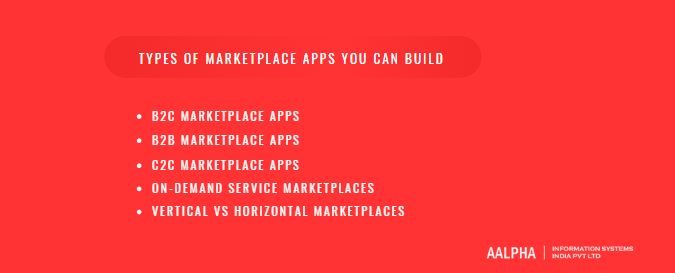
Marketplace apps are not a single, uniform product category. They vary significantly based on who participates, how transactions occur, and what problems the platform is designed to solve. Understanding these types is essential because each model carries different technical requirements, growth dynamics, trust challenges, and monetization constraints. Choosing the wrong marketplace type for a given problem often leads to poor liquidity, stalled growth, or unsustainable unit economics.
-
B2C Marketplace Apps
B2C marketplace apps connect businesses or service providers directly with end consumers. This is the most familiar marketplace model and includes platforms that sell physical products, digital goods, or consumer services. The defining characteristic is that buyers are individuals making personal purchase decisions, often driven by price, convenience, availability, and brand perception.
From a product perspective, B2C marketplaces must prioritize discovery, speed, and user experience. Advanced search, filters, recommendations, reviews, and seamless checkout flows are critical because consumers compare options quickly and abandon platforms that introduce friction. Trust mechanisms such as ratings, guarantees, and transparent policies play a central role in conversion.
On the supply side, sellers expect access to demand, simplified operations, and predictable payouts. The platform typically handles payments, tax calculations, and customer communication, allowing sellers to focus on fulfillment. Monetization is commonly commission-based, sometimes combined with sponsored listings or subscription plans.
B2C marketplaces work best in fragmented consumer markets where buyers value choice and sellers struggle to reach customers efficiently on their own.
-
B2B Marketplace Apps
B2B marketplace apps facilitate transactions between businesses rather than individual consumers. These platforms often support wholesale purchasing, procurement workflows, recurring orders, contract-based pricing, or access to specialized services and software add-ons. Compared to B2C, B2B marketplaces involve fewer transactions but significantly higher order values and longer decision cycles.
The complexity of B2B marketplaces lies in workflow depth rather than user volume. Features such as bulk pricing, negotiated rates, approval hierarchies, invoicing, credit terms, and compliance documentation are often mandatory. Buyers may represent teams or departments, not individuals, which introduces role-based access and audit requirements.
Trust in B2B marketplaces is built through verification, reputation, certifications, and long-term relationships rather than impulse purchases. Liquidity grows more slowly, but once established, switching costs are high, leading to strong retention.
Monetization models vary widely and may include commissions, subscription access, transaction fees, or value-added services such as analytics and integrations. B2B marketplaces are particularly effective in industries where sourcing is inefficient, opaque, or highly relationship-driven.
-
C2C Marketplace Apps
C2C marketplace apps enable individuals to transact directly with other individuals. These peer-to-peer platforms allow users to sell goods, rent assets, or exchange services without operating as formal businesses. The appeal lies in unlocking underutilized assets and enabling flexible, informal commerce.
The primary challenge in C2C marketplaces is trust. Unlike B2C or B2B platforms, sellers are not professional entities, which increases the risk of fraud, low-quality listings, and disputes. As a result, strong moderation systems, identity verification, rating mechanisms, and clear dispute resolution workflows are essential from day one.
Operationally, C2C marketplaces must handle high variability in listing quality, pricing consistency, and fulfillment reliability. Growth can be rapid due to low barriers to entry, but retention depends heavily on perceived safety and fairness.
Monetization is usually lightweight, relying on listing fees, transaction commissions, or optional promotional tools. Successful C2C marketplaces focus relentlessly on community trust and platform governance.
-
On-Demand Service Marketplaces
On-demand service marketplaces are designed for real-time or near-real-time service fulfillment. These platforms match customers with service providers based on availability, location, skills, and timing. Examples include local services, logistics, home services, and professional assistance delivered within defined time windows.
Technically, on-demand marketplaces are among the most complex to build. They require real-time matching algorithms, location intelligence, dynamic pricing, availability management, and robust notification systems. Latency directly impacts user satisfaction, making performance and reliability non-negotiable.
Workforce management is a core concern. The platform must handle provider onboarding, scheduling, incentives, cancellations, and performance tracking. From the buyer’s perspective, transparency around arrival times, pricing, and service quality is critical.
Monetization typically involves commissions per task or per hour, sometimes combined with surge pricing or subscription benefits. On-demand online service marketplaces succeed when they balance speed, reliability, and provider satisfaction without sacrificing unit economics.
-
Vertical vs Horizontal Marketplaces
Horizontal marketplaces attempt to serve a wide range of categories, products, or services under a single platform. While they benefit from large addressable markets, they often struggle with relevance, differentiation, and quality control as they scale. Discovery becomes generic, and trust signals weaken when too many unrelated use cases coexist.
Vertical marketplaces, by contrast, focus on a specific industry, niche, or use case. By specializing, they can design workflows, features, and trust mechanisms tailored precisely to their audience. This leads to higher conversion rates, stronger retention, and better unit economics despite a smaller total market.
Niche marketplaces often outperform generic platforms because they solve deeper problems. They speak the language of their users, enforce higher standards, and build defensibility through domain expertise rather than sheer scale. For most founders, vertical marketplaces offer a more realistic and sustainable path to traction and long-term growth.
Marketplace Business Models and Monetization Strategies
Monetization in a marketplace app is not an afterthought. It is a structural decision that shapes seller behavior, buyer trust, and long-term scalability. Unlike traditional ecommerce or SaaS products, marketplaces must balance value extraction from multiple sides without disrupting liquidity. A model that maximizes short-term revenue but discourages participation will stall growth. The most successful marketplaces align monetization with outcomes, charging for value delivered rather than access alone. The following sections explain the most common marketplace business models, their mechanics, and the trade-offs founders must evaluate.
-
Commission-Based Marketplace Model
The commission-based model is the most widely used and intuitively aligned monetization strategy for marketplaces. In this model, the platform earns a percentage of each completed transaction. Commissions are typically charged to sellers, though in some cases they may be split between buyers and sellers or embedded within pricing.
Commissions work because they scale directly with marketplace success. The platform earns more only when sellers earn more, which aligns incentives and reduces resistance during onboarding. Average commission benchmarks vary widely by industry, transaction value, and service complexity. High-volume, low-margin marketplaces tend to operate on lower commission percentages, while service-based or high-trust platforms can sustain higher rates due to added value such as demand generation, payment handling, and dispute resolution.
Margin considerations are critical. Commissions must cover payment processing costs, support operations, infrastructure, and customer acquisition while leaving room for profit. Overpricing commissions leads to off-platform leakage or seller churn, while underpricing limits reinvestment in growth and quality controls. Successful platforms treat commissions as a dynamic lever, adjusting rates by category, geography, or seller performance to maintain balance as the marketplace matures.
-
Subscription-Based Seller Access Models
Subscription-based models charge sellers a recurring fee for access to the marketplace rather than, or in addition to, per-transaction commissions. These subscriptions are often tiered, with higher plans unlocking benefits such as increased visibility, advanced analytics, lower commissions, or premium tools.
This model is particularly effective in B2B and professional marketplaces where sellers value predictable costs and long-term customer relationships. Subscriptions create stable, recurring revenue for the platform and reduce dependence on transaction volume alone. However, they introduce a higher barrier to entry for new sellers, which can slow early-stage supply growth.
Retention mechanics are central to success. Sellers must consistently perceive value in remaining subscribed, which requires ongoing improvements to demand quality, tooling, and insights. Tiering logic should be simple and outcome-driven, avoiding artificial feature gating that feels extractive. When executed well, subscription models increase seller commitment and reduce churn, but they require a marketplace that already delivers reliable demand.
-
Listing Fees and Featured Placements
Listing fees charge sellers for creating or maintaining listings on the platform, while featured placements allow sellers to pay for enhanced visibility in search results or category pages. These models monetize attention rather than transactions and are often used as secondary revenue streams.
Featured placements can be effective when discovery competition is high and sellers are willing to pay for exposure. However, they introduce ethical and product design considerations. Over-prioritizing paid visibility can degrade buyer experience if relevance and quality are sacrificed for revenue. This can erode trust and reduce long-term engagement.
To mitigate this, many marketplaces limit featured placements to clearly labeled sections or combine paid boosts with relevance scoring. Listing fees are more common in peer-to-peer or classifieds-style platforms, where transactions may occur off-platform. In such cases, fees compensate the platform for hosting and moderation rather than transaction facilitation. Transparency and restraint are key to preventing monetization from undermining marketplace integrity.
-
Transaction and Convenience Fees
Transaction and convenience fees are typically charged to buyers as a flat amount or percentage added at checkout. These fees may cover payment processing, platform operations, customer support, or service guarantees. Buyer-side monetization must be handled carefully, as it directly impacts conversion rates.
The most effective approach is transparency. Buyers are more accepting of fees when they understand what they are paying for and see consistent value in return. Bundling fees into the total price rather than surfacing multiple line items can reduce friction, but hidden fees often lead to abandonment and distrust.
Convenience fees work best when the marketplace provides clear advantages over direct transactions, such as faster fulfillment, secure payments, or dispute protection. Monitoring elasticity is essential. Even small increases can have outsized effects on demand, especially in price-sensitive markets. Successful platforms test and optimize fees continuously rather than treating them as fixed.
-
Hybrid Monetization Models
Most mature marketplaces adopt hybrid monetization models that combine multiple revenue streams. A common approach is pairing transaction commissions with optional seller subscriptions, featured placements, or value-added services. This diversification reduces reliance on any single source and improves resilience as the platform scales.
Hybrid models allow marketplaces to tailor monetization to different participant segments. High-volume sellers may prefer subscriptions with lower commissions, while occasional sellers may accept higher per-transaction fees. Buyers may pay convenience fees for premium experiences while standard transactions remain competitively priced.
The key challenge is complexity. Overlapping fees can confuse users and create perceptions of unfairness. Sustainable hybrid models are designed around clarity and alignment, ensuring that each fee corresponds to a specific benefit. When monetization reinforces platform value rather than extracting it indiscriminately, hybrid strategies become a powerful driver of long-term profitability and marketplace health.
Marketplace App Features and Functional Requirements
A marketplace app succeeds or fails based on how well it serves three distinct audiences simultaneously: buyers, sellers, and platform operators. Each group has different goals, expectations, and tolerance for friction. The functional requirements of a marketplace must therefore be designed as an interconnected system rather than isolated feature lists. Poorly designed buyer flows reduce demand, weak seller tooling degrades supply quality, and limited admin controls expose the platform to fraud, disputes, and operational chaos. The sections below outline the core features required for a production-grade marketplace app, with emphasis on real-world scalability and governance.
-
Buyer App Features
The buyer app is the primary demand engine of a marketplace. Account management forms the foundation, allowing users to register, authenticate, manage profiles, save preferences, and track order history. Authentication must balance security with convenience, as excessive friction at this stage directly impacts conversion.
Search and discovery are central to buyer experience. Buyers expect fast, relevant results supported by category browsing, keyword search, filters, and sorting options. Filters typically include price ranges, availability, ratings, location, delivery speed, and seller attributes. As the marketplace grows, relevance becomes more important than completeness, requiring intelligent ranking rather than simple keyword matching.
Personalized recommendations play a growing role in engagement and retention. These recommendations are based on browsing behavior, past purchases, location, and real-time availability. Even basic recommendation logic can significantly increase conversion when aligned with buyer intent.
Checkout and payments must be seamless and transparent. Buyers expect clear pricing breakdowns, taxes or fees shown upfront, multiple payment options, and instant confirmation. Order tracking, status updates, and notifications reduce post-purchase anxiety and support trust.
Reviews and ratings close the feedback loop. Buyers rely heavily on social proof to make decisions, so review systems must be credible, abuse-resistant, and context-aware. Finally, integrated customer support features such as order-level help, chat support, and dispute initiation are essential to resolve issues without pushing users off-platform.
-
Seller/Vendor Panel Features
The seller or vendor panel is where supply quality is created and maintained. Onboarding is the first critical step and often includes identity verification, business details, bank information, and compliance documentation. This process should be thorough but structured, as weak onboarding standards directly correlate with fraud and poor buyer experiences.
Listing management enables sellers to create, edit, and manage their offerings. This includes product or service descriptions, images, pricing, availability, fulfillment terms, and policies. For marketplaces with large catalogs, bulk uploads and template-based listing creation become essential for efficiency.
Inventory and availability management are crucial for preventing failed orders. Sellers must be able to update stock levels, manage time slots, pause listings, and handle seasonal or capacity-based constraints. Pricing tools may include base pricing, discounts, surge logic, or negotiated rates depending on the marketplace model.
Order management features allow sellers to accept, reject, fulfill, or cancel orders within defined rules. Clear visibility into order status, buyer details, and fulfillment deadlines is necessary to maintain service levels. Communication tools, whether messaging or structured updates, help coordinate with buyers when needed.
Analytics and reporting give sellers insight into performance. Metrics such as views, conversions, revenue, cancellations, and ratings help sellers optimize their offerings. Payout management completes the cycle, providing visibility into earnings, fees, settlement schedules, and transaction histories, which is essential for trust and retention.
-
Admin Panel and Back-Office Features
The admin panel is the operational backbone of a marketplace. User management capabilities allow platform operators to approve, suspend, verify, or segment buyers and sellers based on behavior, compliance status, or performance. Role-based access controls are essential for internal teams managing different responsibilities.
Commission and fee configuration tools define how the platform earns revenue. Admins must be able to set global or category-specific commissions, manage promotional fee structures, and adjust pricing rules without deploying new code. This flexibility is critical as the marketplace evolves.
Dispute and refund management systems enable structured resolution of conflicts between buyers and sellers. Admins need full transaction visibility, communication logs, evidence attachments, and decision workflows to resolve issues fairly and consistently.
Content moderation tools help maintain quality and trust. These include listing reviews, image moderation, keyword filters, and automated flagging of suspicious behavior. Reporting and analytics provide insights into platform health, including liquidity, conversion rates, churn, fraud signals, and operational bottlenecks.
System controls cover configuration, feature toggles, compliance settings, audit logs, and integrations. A well-designed admin panel reduces manual intervention, supports scalability, and enables governance without slowing down growth.
-
Advanced Marketplace Features
Advanced features differentiate mature marketplaces from basic platforms. AI-driven recommendations improve discovery by predicting buyer intent and matching it with the most relevant supply. Over time, these systems learn from transactions, ratings, and behavioral data to optimize outcomes for both sides.
Dynamic pricing allows prices to adjust based on demand, supply, timing, or location. This is especially valuable in on-demand and capacity-constrained marketplaces, where static pricing leads to inefficiencies.
In-app chat and communication tools enable coordination while keeping interactions on-platform. Structured messaging, masked contact details, and automated prompts help balance flexibility with safety.
Notifications across email, SMS, and in-app channels keep users informed about key events, reducing drop-offs and missed actions. Fraud detection systems monitor behavior patterns, payment anomalies, and abuse signals to prevent losses and protect trust.
Finally, workflow automation reduces operational overhead. Automated approvals, payouts, reminders, and compliance checks allow the marketplace to scale without linear increases in support staff, preserving margins and platform reliability.
Marketplace App Architecture and Technology Stack
Marketplace apps are architecturally more complex than single-vendor applications because they must support multiple user roles, concurrent transactions, real-time interactions, and evolving business rules at scale. The architecture is not just a technical foundation but a strategic enabler that determines how quickly the platform can grow, adapt to new marketplace dynamics, and remain reliable under load. Poor architectural decisions early on often lead to performance bottlenecks, security risks, and costly rewrites. A well-designed marketplace architecture prioritizes modularity, scalability, and operational control from the outset.
-
Frontend Architecture for Marketplace Apps
The frontend layer of a marketplace app serves multiple audiences, typically buyers, sellers, and administrators, each with distinct workflows and expectations. Buyer-facing interfaces prioritize speed, simplicity, and discovery, while seller and admin interfaces focus on data density, control, and efficiency. These differences often justify separate frontend applications that share a common design system but are optimized for specific use cases.
Web applications are commonly used for admin panels and seller dashboards due to their flexibility, ease of updates, and suitability for complex workflows. Buyer experiences may be delivered through web apps, mobile apps, or both, depending on usage patterns and engagement goals. Mobile apps are particularly valuable for marketplaces that rely on frequent interactions, location awareness, or real-time notifications.
Cross-platform frameworks can accelerate development by sharing code across platforms, but they introduce trade-offs in performance, platform-specific behavior, and long-term maintainability. Native development offers tighter integration with device capabilities and smoother user experiences but requires higher investment. The architectural decision should be driven by expected usage intensity, feature complexity, and the importance of platform-specific optimizations rather than development speed alone.
A robust frontend architecture emphasizes component reusability, state management discipline, and clear separation between presentation and business logic, enabling the marketplace to evolve without constant refactoring.
-
Backend Architecture and Core Services
The backend is the operational core of a marketplace app, responsible for orchestrating interactions between users, enforcing business rules, and ensuring data consistency. A service-oriented or modular architecture is typically preferred, as it allows independent scaling and evolution of core functions.
User services handle authentication, profiles, roles, and permissions across buyers, sellers, and admins. Order or booking services manage the lifecycle of transactions, including creation, updates, cancellations, and fulfillment milestones. Payment orchestration services coordinate payment authorization, escrow handling, refunds, and settlements while abstracting external payment dependencies from core logic.
Notification services deliver real-time and asynchronous updates through multiple channels, ensuring users are informed at every critical step. These services must be resilient to spikes in activity, particularly during promotions or peak demand periods.
Scalability is achieved through horizontal scaling, stateless service design, and asynchronous processing where possible. Background workers handle non-blocking tasks such as payouts, analytics aggregation, and compliance checks. Clear service boundaries and well-defined contracts reduce coupling and make it easier to introduce new marketplace features without destabilizing existing functionality.
-
Database Design and Data Modeling
Marketplace data models are inherently relational, reflecting the interactions between users, listings, transactions, and feedback. User entities must support multiple roles, verification states, and historical activity. Listings represent products or services and include attributes such as pricing, availability, metadata, and seller associations.
Orders or bookings form the transactional backbone, linking buyers, sellers, listings, payments, and fulfillment status. These entities require careful versioning and auditability to support disputes, refunds, and regulatory requirements. Transaction records track financial flows, fees, and settlement states, often requiring immutability once finalized.
Reviews and ratings introduce additional complexity, as they must be tied to completed transactions to prevent abuse while remaining performant at scale. Audit logs capture administrative actions, configuration changes, and sensitive events, providing traceability and compliance support.
A well-structured data model prioritizes consistency and integrity while allowing efficient querying for analytics and reporting. As the marketplace grows, read-heavy workloads and historical data volumes often necessitate thoughtful indexing, partitioning, and archival strategies.
-
APIs, Integrations, and Third-Party Services
Marketplace apps rarely operate in isolation. APIs serve as the connective tissue between frontend applications, backend services, and external systems. Internal APIs enable modular development and clear ownership boundaries, while external APIs facilitate integrations that extend platform capabilities.
Payment integrations support transaction processing, refunds, and compliance requirements. Mapping and location services enable proximity-based discovery, routing, and delivery tracking. Messaging and communication services support in-app chat, notifications, and support interactions without exposing personal contact details.
Analytics integrations collect behavioral and operational data, enabling performance monitoring, experimentation, and business intelligence. Compliance-related services assist with identity verification, fraud prevention, and regulatory obligations, reducing operational risk.
API design should emphasize consistency, versioning discipline, and clear error handling. As the ecosystem expands, API governance becomes critical to prevent fragmentation and ensure backward compatibility across client applications and integrations.
-
Security, Scalability, and Performance Considerations
Security in a marketplace app extends beyond basic authentication. Authorization mechanisms must enforce role-based access controls, ensuring users can only perform actions permitted by their role and state. Sensitive operations such as payouts, refunds, and configuration changes require additional safeguards and auditability.
Rate limiting and abuse prevention protect the platform from automated attacks, scraping, and denial-of-service scenarios. Input validation and data sanitization reduce the risk of injection attacks and data corruption. Secure handling of payment-related data is mandatory, even when external providers manage transaction processing.
Scalability and performance are addressed through caching, asynchronous processing, and load balancing. Fault tolerance is achieved by designing for partial failures, with retries, circuit breakers, and graceful degradation. A resilient architecture assumes that components will fail and ensures that failures do not cascade across the system.
When these considerations are embedded into the architecture from the beginning, the marketplace can grow confidently without compromising reliability, trust, or user experience.
Step-by-Step Marketplace App Development Process
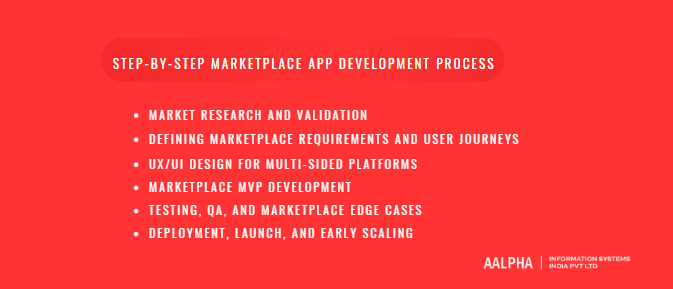
Building a marketplace app is not a linear software project. It is a coordinated progression of business validation, product design, technical execution, and operational readiness. Each step compounds the next, and mistakes made early, especially around market fit and liquidity assumptions, are difficult to correct later. The process below reflects how successful marketplaces are built in practice, not just how apps are coded.
-
Market Research and Validation
Marketplace development must begin with problem selection, not technology selection. The first question is whether a real coordination problem exists between two sides of a market. Strong marketplace opportunities usually emerge in fragmented industries where demand and supply struggle to find each other efficiently, pricing lacks transparency, or trust is difficult to establish.
Demand validation focuses on buyer pain. This involves identifying how buyers currently solve the problem, what friction they experience, and how often the problem occurs. Interviews, surveys, and observational research help determine whether the pain is frequent and severe enough to justify a new platform. Will buyers switch behavior, or is the inconvenience tolerable?
Supply validation is equally critical and often overlooked. Sellers must have a clear incentive to join the platform and remain active. This includes access to incremental demand, reduced acquisition costs, operational tooling, or faster payments. If sellers can already reach customers easily through existing channels, convincing them to adopt a new marketplace becomes expensive and slow.
Competitive analysis goes beyond listing alternatives. It examines how incumbents solve the problem, where they fail, and which segments are underserved. The goal is not to copy features but to identify structural gaps, such as poor regional coverage, weak trust mechanisms, or inefficient workflows. Validation is successful when both sides express willingness to participate under realistic conditions.
-
Defining Marketplace Requirements and User Journeys
Once validation confirms a viable opportunity, the next step is translating insights into clear requirements. Marketplace requirements must account for multiple personas, typically buyers, sellers, and administrators, each with distinct goals and constraints. Defining personas clarifies who the platform is for and whose problems take priority in early stages.
User journeys map how each persona interacts with the platform from entry to outcome. For buyers, this may include discovery, comparison, purchase, fulfillment, and feedback. For sellers, it includes onboarding, listing creation, order management, and payouts. Admin journeys cover moderation, dispute handling, and system configuration. Mapping these flows exposes dependencies and failure points that are not obvious from feature lists alone.
Feature prioritization is where many teams go wrong. Marketplaces should prioritize features that directly enable transactions and trust. Anything that does not contribute to liquidity, reliability, or governance should be delayed. This often means deferring advanced analytics, complex promotions, or secondary monetization features.
Clear requirements documentation aligns product, design, and engineering teams around a shared understanding of scope and sequencing. It also creates a reference point for evaluating trade-offs as constraints inevitably emerge during development.
-
UX/UI Design for Multi-Sided Platforms
Designing UX for a marketplace is fundamentally about reducing friction on both sides without favoring one at the expense of the other. Buyers want speed and simplicity, while sellers need control and clarity. Admins require oversight without micromanagement. Balancing these needs requires deliberate design choices rather than generic templates.
Buyer UX should minimize cognitive load. Discovery must be intuitive, with clear signals for quality, price, and availability. Decision-making is accelerated through comparison tools, reviews, and predictable flows. Any uncertainty at checkout, such as unclear fees or fulfillment terms, directly reduces conversion.
Seller UX emphasizes efficiency and predictability. Onboarding flows should guide sellers through required steps without ambiguity. Listing creation must be structured to enforce quality while remaining easy to complete. Dashboards should surface actionable insights rather than raw data.
Consistency across interfaces is essential, but uniformity is not. Each user type benefits from interfaces optimized for their tasks. Effective marketplace design makes the platform feel fair, transparent, and dependable to all participants, reinforcing trust through interaction rather than explanation.
-
Marketplace MVP Development
Marketplace MVP development is about proving liquidity, not building a complete product. The MVP should include only what is necessary to enable real transactions between real users under controlled conditions. Anything that does not directly support this goal is a distraction.
For buyers, the MVP typically includes basic onboarding, discovery, ordering or booking, payments, and order tracking. For sellers, it includes onboarding, listing management, order handling, and payouts. Admin capabilities are often underestimated but must include user approvals, transaction visibility, and basic dispute handling.
What to delay is as important as what to build. Advanced recommendations, dynamic pricing, complex promotions, and automation can wait until transaction volume justifies them. MVPs fail when teams overbuild features instead of validating behavior, or when they launch without sufficient supply or operational support.
A successful MVP is not polished; it is functional, reliable, and monitored closely. It generates real usage data that informs the next phase of development, revealing where friction exists and which assumptions were incorrect.
-
Testing, QA, and Marketplace Edge Cases
Testing a marketplace app goes beyond validating individual features. The primary risks lie in edge cases that emerge from interactions between multiple users acting simultaneously. Concurrency issues arise when multiple buyers attempt to book the same slot or purchase limited inventory. Systems must handle these scenarios deterministically to avoid conflicts and dissatisfaction.
Cancellations and refunds introduce additional complexity. Rules must be clearly enforced and tested across timing thresholds and partial fulfillment scenarios. Dispute workflows should be exercised with realistic data to ensure evidence, communication, and decisions are traceable.
Payment failures are inevitable and must be handled gracefully. This includes retries, reversals, and reconciliation processes that keep financial records consistent. QA efforts should prioritize these high-risk flows over cosmetic issues, as failures here directly damage trust.
-
Deployment, Launch, and Early Scaling
Marketplace launches are operational events, not just technical releases. A soft launch allows the platform to operate with limited users, often within a specific geography or category. This controlled environment makes it easier to observe behavior, identify bottlenecks, and intervene manually when necessary.
City-by-city or segment-by-segment rollout is common for marketplaces because liquidity is local. Expanding too quickly dilutes supply and degrades experience. Early scaling focuses on deepening engagement within a defined market before expanding outward.
Operational readiness is critical. Support teams, seller onboarding processes, dispute resolution protocols, and monitoring systems must be in place before growth accelerates. Metrics such as transaction completion rates, response times, and churn provide early signals of platform health.
When deployment and early scaling are approached deliberately, the marketplace builds momentum without sacrificing quality. This disciplined execution sets the foundation for sustainable growth rather than short-lived traction.
Marketplace App Development Cost Breakdown
Estimating the cost of building a marketplace app requires understanding that expenses are driven less by screens and more by complexity. Marketplaces involve multi-sided workflows, payments, trust systems, and operational tooling that go far beyond standard ecommerce apps. Costs vary significantly based on scope, geography, compliance needs, and scalability expectations. A realistic breakdown helps founders plan budgets, sequence investments, and avoid underfunding critical components that directly affect liquidity and trust.
-
MVP Marketplace App Cost
An MVP marketplace app is designed to validate real transactions between buyers and sellers, not to showcase a complete feature set. Costs at this stage are primarily determined by the minimum functionality required to enable discovery, transactions, and basic governance.
A typical MVP includes buyer onboarding, search and listing views, order or booking flow, payments, basic seller onboarding, listing management, order handling, and a lightweight admin panel. Depending on design depth and integration complexity, MVP development costs usually fall within a moderate range rather than at the low end of app development budgets.
Feature-based cost drivers include multi-role authentication, payment orchestration, and admin tooling. Payment flows alone introduce complexity due to escrow handling, refunds, and settlement logic. Admin features, often underestimated, are essential even at MVP stage to manage users, approve sellers, and resolve disputes manually.
Design and UX costs are also meaningful, as poor early experiences distort validation results. An MVP that is unreliable or confusing can fail even if the underlying market demand exists. As a result, realistic MVP budgets prioritize functional completeness and stability over polish, accepting limited automation in exchange for faster learning.
-
Full-Scale Marketplace Platform Cost
A full-scale marketplace platform introduces significantly higher costs due to expanded scope and operational maturity. These platforms typically support multiple regions, large seller bases, high transaction volumes, and automation across onboarding, payouts, and compliance.
Additional cost drivers include advanced search and recommendation systems, dynamic pricing logic, multi-currency and multi-tax handling, localization, and robust analytics. Multi-region deployments require infrastructure redundancy, data residency considerations, and more sophisticated monitoring. Automation-heavy builds reduce manual operations but require upfront investment in workflow engines, rules management, and exception handling.
Seller tooling becomes more advanced at this stage, with detailed analytics, bulk operations, promotional controls, and integrations. Buyer-facing features expand to include personalization, loyalty mechanisms, and richer support experiences. Admin panels evolve into full operational dashboards with fine-grained controls and reporting.
Because of these factors, full-scale marketplace development costs are often several times higher than MVP budgets. The investment reflects not just more features, but a shift from experimentation to reliability, scalability, and defensibility.
-
Ongoing Maintenance and Scaling Costs
Marketplace costs do not end at launch. Ongoing expenses are a function of transaction volume, user growth, and operational complexity. Infrastructure costs scale with usage, including compute, storage, bandwidth, and third-party services such as payments, messaging, and verification.
Support and operations represent a significant portion of recurring costs. As transaction volume increases, so do disputes, edge cases, and user inquiries. While automation can reduce per-transaction overhead, human intervention remains necessary for high-trust scenarios and regulatory compliance.
Feature expansion is another continuous cost. Marketplaces must evolve in response to user behavior, competition, and regulatory changes. This includes improving discovery, optimizing pricing, enhancing fraud detection, and expanding into new categories or regions. Regular updates, security patches, and performance optimizations are non-negotiable for maintaining trust.
Maintenance budgets should account for both predictable expenses and contingency capacity. Underfunding post-launch operations often leads to degraded experiences and stalled growth, even if initial development was successful.
-
Cost Optimization Strategies
Cost optimization in marketplace development is primarily about sequencing and architectural discipline rather than cutting corners. Phased development allows teams to invest heavily only in features that have proven impact. Early stages focus on transaction enablement and trust, while automation and optimization are added as volume grows.
Technical decisions have long-term cost implications. Modular architectures reduce rewrite costs, and choosing scalable infrastructure patterns early prevents expensive migrations later. Avoiding premature optimization is as important as avoiding shortcuts that create technical debt.
Operational strategies also matter. Manual processes can be acceptable during early stages if they accelerate learning, but they should be designed with automation in mind. Clear metrics help identify which parts of the system deserve further investment and which features can remain simple.
Ultimately, the most cost-efficient marketplaces are not the cheapest to build initially. They are the ones that allocate resources deliberately, validate assumptions early, and scale investment in proportion to demonstrated demand and platform health.
Challenges in Marketplace App Development and How to Solve Them
Marketplace apps fail more often due to execution challenges than technical limitations. The difficulty lies in coordinating independent participants, maintaining trust at scale, and growing without destabilizing operations. These challenges are structural, not temporary, and must be addressed deliberately from the earliest stages. Understanding where marketplaces break down, and why, allows founders and product teams to design systems that absorb complexity rather than amplify it.
-
Solving the Chicken-and-Egg Problem
The chicken-and-egg problem refers to the difficulty of attracting buyers without sellers and sellers without buyers. This is the defining challenge of every marketplace and cannot be solved through technology alone. The solution lies in choosing which side of the market to seed first based on incentives and constraints.
Supply-first strategies focus on onboarding sellers before attracting buyers. This approach works when supply is scarce, highly fragmented, or difficult to access. By curating high-quality sellers and ensuring availability, the marketplace creates immediate value for early buyers. However, this strategy requires strong seller incentives, such as reduced fees, guaranteed demand, or operational support.
Demand-first strategies prioritize buyer acquisition before scaling supply. This is effective when demand is concentrated and buyers are actively searching for solutions. In such cases, sellers are motivated to join because demand already exists. The risk is disappointing early buyers if supply cannot meet expectations.
Successful marketplaces often use hybrid approaches, seeding supply in targeted segments while driving demand through controlled launches. The key is local liquidity, ensuring that users can reliably transact within a defined scope before expanding.
-
Trust, Safety, and Quality Control
Trust is the currency of a marketplace. Without it, transactions do not occur, and growth stalls regardless of demand. Trust challenges increase as the platform scales, making early investment in safety and quality control essential.
Reviews and ratings are foundational but insufficient on their own. They must be tied to verified transactions to prevent manipulation and ensure credibility. Poorly designed review systems create noise rather than clarity, undermining confidence instead of reinforcing it.
Verification processes establish baseline trust. These may include identity checks, business documentation, skill validation, or compliance verification depending on the marketplace model. While verification introduces friction, it filters out low-quality participants and reduces downstream costs associated with disputes and fraud.
Moderation systems maintain standards over time. This includes monitoring listings, enforcing policies, and responding to reports of abuse or misconduct. Automation can assist by flagging suspicious behavior, but human oversight remains necessary for nuanced decisions. Trust systems must evolve continuously, adapting to new forms of abuse as the marketplace grows.
-
Marketplace Liquidity and Retention
Liquidity refers to how easily users can complete transactions without excessive waiting or effort. A marketplace with low liquidity feels empty or unreliable, leading to churn on both sides. Improving liquidity is not about adding more users indiscriminately but about improving matching efficiency.
Matching speed is critical. Buyers must find relevant options quickly, and sellers must receive opportunities that align with their capacity and preferences. Poor matching increases cancellations, reduces satisfaction, and discourages repeat usage.
User experience directly influences retention. Clear communication, predictable outcomes, and timely updates reduce anxiety and build confidence. Even when issues occur, how the platform handles them often matters more than the issue itself.
Retention strategies should focus on habit formation and perceived fairness. Buyers return when the marketplace consistently saves time or money. Sellers stay when they receive steady demand, transparent fees, and responsive support. Liquidity improves when both sides see the platform as dependable rather than opportunistic.
-
Scaling Without Breaking Operations
Scaling a marketplace amplifies existing weaknesses. Processes that work at low volume often collapse under growth if they rely heavily on manual intervention. The challenge is introducing automation without losing control or transparency.
Process automation should target repetitive, rules-based tasks such as onboarding approvals, payouts, notifications, and basic dispute handling. This reduces operational overhead and response times while allowing human teams to focus on complex cases. However, automation must be observable and reversible, with clear audit trails and override mechanisms.
Governance becomes increasingly important as the marketplace expands. Clear policies, consistent enforcement, and documented workflows prevent ad hoc decisions that erode trust. Role-based access controls and separation of duties reduce risk and support compliance.
Scaling successfully requires continuous investment in monitoring and metrics. Early detection of issues such as rising cancellations, delayed payouts, or support backlogs allows corrective action before problems become systemic. Marketplaces that scale sustainably treat operations as a core product, not a back-office afterthought.
How to Choose the Right Marketplace App Development Partner
Choosing a marketplace app development partner is a strategic decision that has long-term consequences for product stability, scalability, and business viability. Marketplaces are not standard applications. They combine product strategy, operational workflows, financial logic, and governance into a single system. Many marketplace failures can be traced back to selecting development partners who underestimated this complexity and treated the project as a routine app build. The criteria below outline how to evaluate partners realistically and avoid costly misalignment.
-
Marketplace-Specific Experience Matters
Marketplace apps fail when they are built by teams that have only delivered single-vendor ecommerce apps or generic SaaS products. While these experiences provide technical skills, they do not prepare teams for the structural challenges of marketplaces, such as multi-sided incentives, liquidity constraints, dispute resolution, and payment orchestration.
Marketplace-specific experience means understanding how buyers and sellers interact indirectly, how platform rules shape behavior, and how operational edge cases surface at scale. Developers who lack this exposure often design features that look complete but break under real-world usage, such as simplistic order flows that cannot handle cancellations, partial fulfillment, or concurrent bookings.
An experienced marketplace partner anticipates these challenges early. They ask questions about supply acquisition, trust mechanisms, payout timing, and moderation workflows before writing code. They design systems that assume failure scenarios will occur and build safeguards accordingly. This mindset reduces rework and accelerates learning.
Evaluating experience should go beyond portfolios and screenshots. Founders should probe how the team handled past marketplace failures, what trade-offs they made at MVP stage, and how they supported platforms through growth phases. Depth of understanding matters more than the number of apps delivered.
-
Technical and Product Evaluation Criteria
A strong marketplace development partner demonstrates architectural thinking, not just implementation ability. They should be able to explain how the system will scale, where complexity will increase over time, and which components are likely to require refactoring as volume grows. Vague assurances about scalability without concrete reasoning are a warning sign.
From a product perspective, the partner should understand prioritization. They must be able to distinguish between features that enable transactions and those that can wait. This includes advising against overbuilding early and articulating why certain features should be delayed until liquidity is proven.
Documentation quality is a critical but often overlooked criterion. Clear requirements, user flows, API contracts, and operational runbooks indicate maturity and reduce dependency on individual developers. Well-documented systems are easier to maintain, extend, and hand over as internal teams grow.
Finally, evaluation should include how the partner handles ambiguity. Marketplaces evolve rapidly, and requirements will change. Teams that rely strictly on rigid specifications struggle to adapt, while those with structured but flexible processes are better suited for long-term collaboration.
-
Engagement Models and Long-Term Support
The engagement model determines how effectively the development partner can support the marketplace beyond initial launch. Fixed-price engagements are suitable for well-defined MVPs with controlled scope, but they often discourage iteration once development begins. Any change becomes a negotiation rather than a product decision.
Dedicated team models offer greater flexibility and are often better aligned with marketplace development, where learning from real users drives continuous change. In this model, the partner functions as an extension of the founding team, adapting priorities as data emerges. While this approach requires stronger governance and communication, it supports faster iteration and better outcomes.
Long-term support is especially important for marketplaces because operational issues surface post-launch. Payout delays, dispute workflows, performance bottlenecks, and compliance updates require ongoing attention. A partner who disengages after delivery leaves founders exposed during the most critical growth phase.
Roadmap alignment is the final consideration. The right partner understands the business trajectory and can plan technical evolution accordingly. Teams like Aalpha, which work closely with founders on marketplace strategy as well as execution, typically deliver more resilient platforms because decisions are made with both short-term validation and long-term scalability in mind.
Selecting the right partner is ultimately about trust, competence, and alignment. When these elements are present, the development relationship becomes a competitive advantage rather than a constraint.
Future Trends in Marketplace App Development
Marketplace apps are evolving from simple transaction facilitators into intelligent coordination platforms. As competition increases and user expectations rise, future marketplaces will differentiate themselves through deeper personalization, operational efficiency, and domain-specific expertise. The trends below reflect structural shifts in how marketplaces are built, operated, and scaled rather than short-term feature fads.
-
AI-Driven Marketplaces
AI is becoming a core layer in modern marketplace platforms, influencing how demand and supply are matched, how prices are set, and how operational decisions are made. Personalization is the most visible application. Instead of generic search results, AI-driven marketplaces tailor discovery based on user behavior, context, timing, and historical outcomes. This improves conversion by reducing the effort required for buyers to find suitable options.
Automation is another critical impact. AI systems increasingly handle tasks such as onboarding verification, listing quality checks, fraud detection, and customer support triage. By automating repetitive and rules-based processes, marketplaces reduce operational costs while improving response times and consistency. This allows human teams to focus on complex cases that require judgment.
Decision intelligence represents a more advanced use case. Marketplaces generate large volumes of data across transactions, interactions, and outcomes. AI models can analyze this data to inform pricing strategies, supply incentives, capacity planning, and risk management. Rather than reacting to issues after they occur, platforms can anticipate demand spikes, identify underperforming segments, and intervene proactively. In this sense, AI shifts marketplaces from reactive systems to adaptive ones.
-
Verticalized and Hyperlocal Marketplaces
The future of marketplaces is increasingly vertical rather than horizontal. Broad, generic platforms struggle to maintain relevance and quality as they scale, while verticalized marketplaces focus on a specific industry, profession, or use case. By specializing, these platforms design workflows, trust mechanisms, and monetization models that align closely with user needs.
Depth beats breadth because specialized marketplaces solve harder problems. They incorporate domain-specific requirements such as compliance, certifications, or complex pricing structures that generic platforms cannot easily support. This creates defensibility and stronger network effects within a defined segment.
Hyperlocal marketplaces represent a related trend, particularly in services and logistics. By focusing on specific geographies, they achieve faster matching, better availability, and stronger community trust. Local density improves liquidity and reduces operational complexity. As a result, many successful marketplaces grow city by city or region by region rather than pursuing national scale from day one.
-
No-Code, Low-Code, and API-First Marketplaces
No-code and low-code tools are lowering the barrier to entry for marketplace experimentation. These platforms allow founders to prototype workflows, test demand, and validate assumptions quickly without heavy upfront investment. For early-stage validation, this speed can be a significant advantage.
However, speed comes with trade-offs. No-code solutions often struggle with complex business logic, scalability, and customization. As transaction volume increases, limitations around performance, data control, and integrations become apparent. Many marketplaces eventually outgrow these tools and require custom architectures.
API-first approaches offer a middle ground. By designing systems around well-defined APIs, marketplaces gain flexibility to integrate with external services, support multiple client applications, and evolve components independently. This approach supports long-term scalability while preserving the ability to iterate quickly.
The future lies in combining rapid experimentation with architectural discipline. Successful marketplaces will use no-code and low-code tools strategically while investing in API-first, modular systems that support growth without sacrificing control or reliability.
Final Verdict
Building a marketplace app is one of the most powerful ways to create a scalable, defensible digital business, but it is also one of the most complex products to execute well. Success depends far less on flashy features and far more on disciplined problem selection, liquidity-driven design, robust architecture, and operational maturity. Marketplaces that win are those that solve a real coordination problem, earn trust on both sides, and scale with governance and automation built into their core. When done right, a marketplace becomes more valuable with every transaction, creating compounding advantages that traditional apps cannot replicate.
If you are serious about building a marketplace, the key is to approach it as a long-term platform, not a one-time app build. Validate the market deeply, start narrow, invest in the right foundations, and choose partners who understand marketplace dynamics beyond just development. If you are exploring a marketplace idea and want expert guidance from strategy through execution, working with an experienced team like Aalpha can significantly reduce risk and accelerate your path to a scalable, production-ready marketplace platform. Connect now!