



Cross-platform development refers to the practice of building a single application that runs seamlessly across multiple operating systems such as iOS, Android, and the web. Instead of creating separate codebases for each platform, developers use unified frameworks to write code once and deploy it everywhere. This approach has gained widespread adoption because businesses are under increasing pressure to launch faster, reduce costs, and reach users across diverse devices without compromising user experience.
For startups, cross-platform development makes it possible to validate ideas quickly without investing heavily in multiple engineering teams. For enterprises, it reduces long-term maintenance complexity by consolidating development efforts into a single codebase. As mobile usage continues to dominate global internet traffic, businesses often ask whether they should build separate apps for each platform or adopt a unified approach. In most cases, cross-platform development offers a practical balance between speed, cost, and performance.
Understanding how cross-platform development works, why companies prefer it, and how it compares to native development is essential before hiring a developer or choosing a technology stack. The following sections break down these aspects in a structured and practical way.
What is Cross-Platform Development?
Cross-platform development is a software development approach where a single codebase is used to create applications that run on multiple platforms such as iOS, Android, and web browsers. Instead of writing separate code for each operating system, developers use frameworks like Flutter or React Native to build applications that adapt to different environments.
At its core, the idea is simple: write once, deploy everywhere. The framework acts as a bridge between the shared code and the platform-specific components. For example, a button defined in the codebase can automatically render appropriately on both Android and iOS, following each platform’s design conventions.
This approach significantly reduces duplication of effort. Without cross-platform tools, businesses would need separate teams for iOS (Swift), Android (Kotlin), and possibly web development. With a unified codebase, a single team can handle all platforms while maintaining consistency in functionality and user experience.
Cross-platform development does not mean compromising entirely on platform-specific features. Modern frameworks allow developers to integrate native modules when required, ensuring access to device capabilities such as camera, GPS, and push notifications.
Why Businesses Prefer Cross-Platform Development
Businesses increasingly choose cross-platform development because it aligns with key operational goals: reducing cost, accelerating delivery, and maximizing market reach. One of the most immediate benefits is cost efficiency. Maintaining a single codebase reduces the need for multiple specialized teams, which lowers both development and long-term maintenance expenses.
Speed is another critical factor. Companies often need to launch quickly to stay competitive or validate a product idea. Cross-platform development enables simultaneous deployment across platforms, significantly reducing time-to-market. Instead of building and testing separate applications, teams can release updates across all platforms at once.
Market reach also plays a major role in adoption. Users today access applications on a wide range of devices, including smartphones, tablets, and desktops. A cross-platform approach ensures consistent availability and experience across all these touchpoints, which directly impacts user acquisition and retention.
Additionally, businesses benefit from easier updates and scalability. When changes are required, developers can implement them once and deploy across platforms, reducing operational friction. This unified approach simplifies product evolution and ensures consistent performance as the application grows.
Cross-Platform vs Native Development
The decision between cross-platform and native development depends on factors such as performance requirements, budget, and long-term scalability. Native development involves building separate applications for each platform using platform-specific languages such as Swift for iOS and Kotlin for Android. This approach provides maximum performance and deep integration with device features.
Cross-platform development, on the other hand, prioritizes efficiency and speed. By using a shared codebase, businesses can significantly reduce development time and cost. For most standard applications such as eCommerce apps, booking platforms, and business tools, cross-platform frameworks deliver performance that is sufficient for real-world usage.
However, native development still has an advantage in performance-intensive applications such as gaming or advanced graphics systems. Native apps can fully leverage hardware capabilities without the abstraction layers used in cross-platform frameworks.
From a scalability perspective, cross-platform development simplifies maintenance and updates, especially for growing products. Native development can become resource-intensive as the product expands across multiple platforms.
In practice, many businesses start with cross-platform development for speed and cost efficiency, and then selectively use native components when higher performance or platform-specific functionality becomes necessary.
When Do You Need a Cross-Platform Developer?
A cross-platform developer becomes essential when your product strategy requires speed, cost control, and broad device compatibility without the overhead of managing multiple codebases. Businesses often struggle with the decision of whether to build separate native applications or adopt a unified development approach. The answer depends on the stage of the product, available budget, and the need to reach users across multiple platforms efficiently.
If your goal is to launch quickly, test a concept, or expand an existing application to new platforms, cross-platform development provides a practical solution. It allows you to maintain consistency across platforms while minimizing duplication of effort. Many companies begin by asking whether they truly need separate teams for iOS and Android, especially when the core functionality of the app remains the same across platforms. In most scenarios, a cross-platform developer can deliver the required functionality faster and at a lower cost.
The following use cases clearly define when hiring a cross-platform developer is the right decision.
-
Startup and MVP Development
Startups operate under constraints that demand rapid execution and careful allocation of resources. When building a minimum viable product, the primary objective is to validate the business idea as quickly as possible with real users. Cross-platform development enables startups to launch applications on both iOS and Android simultaneously without doubling development effort.
Instead of investing in separate teams and extended timelines, a single cross-platform developer or small team can build a functional product that covers all major platforms. This significantly reduces time-to-market, which is critical when testing product-market fit.
Another important factor is iteration speed. Startups often refine their product based on user feedback. With a shared codebase, updates can be implemented once and deployed across platforms, allowing faster experimentation and improvement. This approach helps startups conserve capital while still delivering a competitive user experience across devices.
-
Scaling Existing Applications
Many businesses start with a single-platform application, often due to initial budget or market focus. However, as the product gains traction, expanding to additional platforms becomes necessary to reach a wider audience. This is where cross-platform development becomes highly valuable.
Instead of rebuilding the application from scratch for another platform, a cross-platform developer can reuse a significant portion of the existing logic and design. This accelerates expansion while maintaining consistency in features and user experience.
For example, a company that initially launched an Android app may later need an iOS version to capture a premium user base. Rather than managing two completely separate codebases, a cross-platform approach simplifies development and ongoing maintenance.
This method also ensures that new features and updates remain synchronized across platforms, reducing fragmentation and improving overall product quality as the application scales.
-
Budget-Constrained Projects
Budget limitations are one of the most common reasons businesses choose cross-platform development. Building separate native applications requires hiring specialized developers for each platform, which significantly increases both development and operational costs.
A cross-platform developer can deliver a multi-platform solution with a smaller team, reducing upfront investment. This is particularly beneficial for small businesses, early-stage startups, or companies testing new digital initiatives.
Beyond initial development, app maintenance costs are also lower. With a single codebase, updates, bug fixes, and feature enhancements only need to be implemented once. This reduces ongoing engineering effort and minimizes the risk of inconsistencies between platforms.
For businesses that need to maximize return on investment while maintaining a strong digital presence, cross-platform development provides a cost-effective alternative without sacrificing essential functionality.
-
Multi-Device Ecosystem Needs
Modern users interact with applications across multiple devices, including smartphones, tablets, and web browsers. Businesses that aim to provide a seamless experience across these touchpoints need a development approach that supports consistency and scalability. Cross-platform development is well-suited for this requirement.
A cross-platform developer can build applications that adapt to different screen sizes and operating systems while maintaining a unified user experience. This is particularly important for industries such as eCommerce, logistics, healthcare, and SaaS platforms, where users expect to switch between devices without disruption.
For example, a user may browse products on a mobile device, complete a purchase on a tablet, and track orders on a web dashboard. Ensuring a consistent experience across these interactions is critical for user satisfaction and retention.
By using a shared codebase, businesses can efficiently manage this multi-device ecosystem while reducing complexity and ensuring uniform functionality across all platforms.
Key Skills to Look for in a Cross-Platform Developer
Hiring a cross-platform developer is not just about finding someone familiar with a specific framework. The role demands a combination of technical depth, architectural thinking, and the ability to balance performance with efficiency across multiple platforms. A strong candidate should be capable of building scalable applications that behave consistently across devices while still respecting platform-specific nuances.
Businesses often assume that cross-platform development is simpler than native development. In reality, it requires broader expertise. The developer must understand how different operating systems behave, how to bridge shared code with native components, and how to ensure performance does not degrade as the application scales. Evaluating the following skill areas helps ensure you hire a developer who can deliver both speed and quality.
-
Proficiency in Frameworks
A competent cross-platform developer must have deep expertise in at least one major framework and working knowledge of others. Framework proficiency is not limited to syntax; it involves understanding architecture, lifecycle management, performance implications, and ecosystem tools.
Cross-platform Frameworks such as Flutter, React Native, Xamarin, and Ionic each follow different approaches. Flutter uses a rendering engine and Dart language to create highly consistent UI across platforms. React Native relies on JavaScript and bridges to native components, making it suitable for teams already familiar with web technologies. Xamarin and .NET MAUI integrate closely with the Microsoft ecosystem, while Ionic focuses on web-based hybrid applications using HTML, CSS, and JavaScript.
A skilled developer knows when to use each framework based on project requirements. For example, if your application demands high-performance UI with custom animations, Flutter may be the preferred choice. If your team already works extensively with JavaScript, React Native offers faster onboarding and integration.
Beyond selecting a framework, the developer should understand project structuring, state management solutions, plugin ecosystems, and version control practices within that framework. They should also be able to extend the framework using native modules when necessary, ensuring the application can access device-specific features without limitations.
-
Strong Programming Fundamentals
Frameworks evolve, but strong programming fundamentals remain constant. A capable cross-platform developer must have a solid understanding of core programming languages such as JavaScript, Dart, C#, and TypeScript, depending on the chosen framework.
This includes knowledge of data structures, algorithms, asynchronous programming, memory management, and modular code design. For example, understanding how asynchronous operations work is critical when handling API calls, user interactions, and background processes. Poor handling of asynchronous code can lead to performance bottlenecks and unpredictable behavior across platforms.
Clean code practices are equally important. The developer should be able to write maintainable, readable, and reusable code that can scale as the application grows. This includes following design patterns, separating concerns, and structuring the application logically.
Strong fundamentals also enable developers to adapt quickly. If your project requires switching frameworks or integrating new technologies, a developer with solid programming knowledge can transition efficiently without compromising quality.
-
UI/UX Consistency Across Platforms
One of the most challenging aspects of cross-platform development is maintaining a consistent user experience while respecting platform-specific design guidelines. A skilled developer must understand how design systems differ between platforms and how to implement UI components that feel natural on each device.
For example, navigation patterns, gestures, typography, and animations often differ between iOS and Android. A cross-platform developer should be able to adapt the UI so that it aligns with each platform’s expectations without creating entirely separate designs.
This requires close collaboration with designers and a strong understanding of responsive design principles. The developer should be able to build layouts that adjust seamlessly across different screen sizes, including mobile phones, tablets, and web interfaces.
Consistency does not mean identical appearance. It means delivering a cohesive experience where users feel comfortable regardless of the platform they are using. Achieving this balance is a key indicator of an experienced cross-platform developer.
-
API Integration and Backend Knowledge
Modern applications rely heavily on backend services for data storage, authentication, and business logic. A cross-platform developer must be proficient in integrating APIs and understanding how frontend and backend systems interact.
This includes working with REST APIs and GraphQL, handling authentication mechanisms such as OAuth or JWT, and managing data synchronization between the client and server. The developer should also understand error handling, caching strategies, and network optimization to ensure reliable performance.
Basic backend knowledge is essential even if the developer is not responsible for building the server-side logic. They should be able to collaborate effectively with backend teams, understand API contracts, and troubleshoot integration issues.
Cloud platforms such as AWS, Google Cloud, or Azure are commonly used for hosting backend services. Familiarity with these environments allows the developer to implement features such as push notifications, file storage, and real-time updates more efficiently.
-
Performance Optimization Skills
Performance is often cited as a concern in cross-platform development, which makes optimization skills critical. A strong developer should know how to identify and resolve issues related to lag, memory usage, and rendering inefficiencies.
This includes optimizing component rendering, reducing unnecessary re-renders, managing state efficiently, and minimizing the use of heavy libraries that can slow down the application. The developer should also understand how to profile performance and use debugging tools to identify bottlenecks.
In scenarios where cross-platform frameworks introduce limitations, the developer should be capable of implementing native modules to improve performance. This hybrid approach ensures that the application maintains responsiveness even under demanding conditions.
-
Testing and Debugging Expertise
Cross-platform applications must function reliably across a wide range of devices, operating systems, and screen sizes. This makes testing and debugging a critical skill for any developer in this domain.
A competent developer should be familiar with unit testing, integration testing, and end-to-end testing frameworks. They should also understand how to test applications on real devices and simulators to identify platform-specific issues.
Debugging skills are equally important. The developer must be able to trace errors across multiple layers, including the framework, native modules, and backend integrations. This requires a systematic approach to problem-solving and familiarity with debugging tools.
Automation plays a key role in maintaining quality. Developers who implement automated testing pipelines can ensure that updates do not introduce regressions, which is especially important when managing a shared codebase across multiple platforms.
A cross-platform developer who possesses these skills can significantly reduce development risks while delivering scalable, high-quality applications. Evaluating candidates against these criteria ensures that you hire someone capable of balancing efficiency, performance, and long-term maintainability.
Popular Cross-Platform Technologies Explained
Choosing the right cross-platform technology is one of the most critical decisions before hiring a developer. The framework you select directly impacts development speed, performance, scalability, and long-term maintenance. Each technology follows a different architecture and is suited for specific use cases. Businesses often ask which framework is best, but the more accurate question is which framework aligns with your product requirements, team expertise, and long-term goals.
A clear understanding of the most widely used cross-platform technologies helps you evaluate developers more effectively. It also ensures that your hiring decision is aligned with the technical direction of your product rather than based on trends or assumptions.
-
Flutter
Flutter is a cross-platform framework developed by Google that has gained strong adoption due to its performance and UI capabilities. It uses the Dart programming language and a unique rendering engine that allows developers to build highly consistent interfaces across platforms without relying heavily on native components.
One of Flutter’s strongest advantages is its ability to deliver near-native performance. Since it renders UI using its own engine rather than relying on platform-specific components, it avoids many of the performance bottlenecks associated with traditional hybrid frameworks. This makes it particularly suitable for applications that require smooth animations, complex interfaces, or custom designs.
Flutter also offers a rich set of pre-built widgets that follow modern design principles. Developers can create visually consistent applications across iOS, Android, and even web platforms. The framework supports hot reload, which allows developers to see changes instantly during development, significantly improving productivity.
Another key advantage is its growing ecosystem and strong backing from Google. Regular updates, extensive documentation, and a rapidly expanding developer community make Flutter a reliable choice for long-term projects. It is commonly used for startups, enterprise applications, and products that require a polished, high-performance user interface.
-
React Native
React Native, developed by Meta, is one of the most widely used cross-platform frameworks, especially among teams familiar with web development. It uses JavaScript and the React library, allowing developers to build mobile applications using a familiar programming model.
Unlike Flutter, React Native relies on native components for rendering. This approach enables applications to maintain a native look and feel while still sharing a significant portion of the codebase across platforms. It also allows developers to integrate native modules when needed, making it flexible for projects that require platform-specific functionality.
One of React Native’s biggest strengths is its large ecosystem and community support. With a vast number of libraries, plugins, and third-party tools available, developers can accelerate development and solve common challenges efficiently. This ecosystem also makes it easier to find experienced developers, which can simplify the hiring process.
React Native is particularly well-suited for applications that need rapid development and frequent updates. Its JavaScript foundation makes it accessible to a wide pool of developers, and its compatibility with web technologies allows businesses to reuse existing knowledge and resources. Many well-known companies have adopted React Native for production applications, demonstrating its reliability at scale.
-
Xamarin / .NET MAUI
Xamarin and its successor, .NET MAUI, are cross-platform frameworks backed by Microsoft. They allow developers to build applications using C# and the .NET ecosystem, making them a strong choice for organizations already invested in Microsoft technologies.
These frameworks provide deep integration with native APIs, enabling developers to access platform-specific features while still sharing a large portion of the codebase. This balance between shared code and native capabilities makes them suitable for enterprise-grade applications that require reliability and performance.
One of the key advantages of Xamarin and .NET MAUI is their alignment with enterprise development practices. They integrate seamlessly with tools such as Visual Studio, Azure, and other Microsoft services, providing a cohesive development environment. This is particularly beneficial for companies that already use Microsoft infrastructure for backend systems and cloud services.
While the community is smaller compared to Flutter or React Native, the framework is known for its stability and strong support from Microsoft. It is often used in enterprise applications, internal business tools, and projects where long-term maintainability and integration with existing systems are critical.
-
Ionic and Hybrid Frameworks
Ionic represents a different approach to cross-platform development by focusing on web technologies such as HTML, CSS, and JavaScript. It is commonly used to build hybrid applications that run inside a web view, allowing developers to reuse web development skills to create mobile applications.
This approach is highly efficient for projects that prioritize speed and cost over high-performance requirements. Developers can build applications quickly by leveraging existing web frameworks such as Angular, React, or Vue.
Hybrid frameworks like Ionic are particularly suitable for content-driven applications, internal tools, or business applications that do not require intensive graphics or complex interactions. They also simplify deployment across platforms, including mobile and web.
However, because these applications rely on a web view, performance may not match that of frameworks like Flutter or React Native. For applications with heavy animations or real-time interactions, this limitation must be carefully considered.
Choosing the Right Framework for Your Project
Selecting the right cross-platform framework depends on several factors, including performance requirements, team expertise, project complexity, and long-term scalability. There is no one-size-fits-all solution, and the best choice varies based on the specific needs of your application.
If your project requires high-performance UI and custom design, Flutter is often a strong choice. If your team has experience with JavaScript and you need rapid development, React Native provides a flexible and widely supported option. For enterprise environments already using Microsoft technologies, Xamarin or .NET MAUI offers seamless integration and stability. If your goal is to build a simple application quickly using web technologies, Ionic can be a practical solution.
The key is to align the framework with your business objectives rather than choosing based on popularity. A well-informed decision at this stage ensures that your development process remains efficient and scalable as your product evolves.
Step-by-Step Process to Hire a Cross-Platform Developer
Hiring a cross-platform developer is a structured process that goes beyond reviewing resumes or conducting basic interviews. The goal is to identify a developer who can translate your business requirements into a scalable, high-performing application that works seamlessly across platforms. Many businesses choose to partner with a mobile app development company to ease this process and ensure access to experienced cross-platform talent.
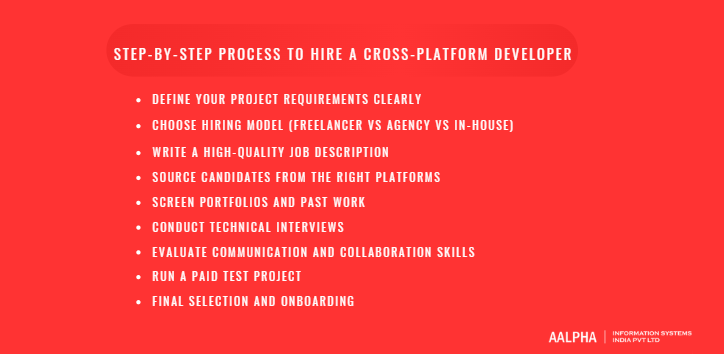
Businesses often face challenges such as unclear requirements, mismatched expectations, or hiring based solely on cost. A systematic approach ensures that you evaluate candidates based on capability, relevance, and alignment with your product goals. The following step-by-step roadmap provides a practical framework for hiring the right cross-platform developer.
-
Define Your Project Requirements Clearly
Before you begin searching for developers, you must clearly define what you are building. Vague requirements lead to poor hiring decisions and costly revisions later. Start by outlining the scope of your application, including core features, user flows, and expected functionality.
Identify which platforms your application needs to support. This could include iOS, Android, web, or all three. Each platform may introduce specific requirements such as performance expectations, UI behavior, or integration with device features. Clearly defining these early helps you select developers with the right expertise.
You should also document technical expectations such as preferred frameworks, backend integration needs, and scalability requirements. For example, if your application requires real-time updates, offline functionality, or third-party integrations, these must be specified upfront.
Another critical aspect is defining success metrics. Whether your goal is rapid MVP launch, high user engagement, or enterprise-grade scalability, the developer should understand what success looks like.
A well-defined requirement document not only improves hiring accuracy but also sets clear expectations for the developer, reducing misunderstandings during development.
-
Choose Hiring Model (Freelancer vs Agency vs In-house)
Selecting the right hiring model is as important as choosing the developer. Each model offers distinct advantages and trade-offs depending on your project size, budget, and timeline.
Freelancers are suitable for small to medium projects, MVPs, or short-term tasks. They are cost-effective and flexible, making them ideal for startups or businesses testing new ideas. However, freelancers may lack the bandwidth or long-term availability required for complex projects.
Development agencies provide a complete team, including developers, designers, testers, and project managers. This model is ideal for businesses that need end-to-end development with structured processes. Agencies bring experience, scalability, and reliability, but they typically come at a higher cost compared to freelancers.
In-house developers offer full control and long-term alignment with your business. This model works best for companies building core products that require continuous development and iteration. However, hiring in-house involves higher costs, longer recruitment cycles, and ongoing operational overhead.
The choice depends on your priorities. If speed and cost are critical, freelancers can be effective. If quality, scalability, and structured execution are important, agencies are often the better choice. For long-term product development, building an in-house team may provide the most control.
-
Write a High-Quality Job Description
A well-crafted job description is essential to attract the right candidates. It should clearly communicate your project requirements, expectations, and the skills needed to succeed in the role.
Start by defining the role and responsibilities. Specify whether the developer will be responsible for end-to-end development, UI implementation, API integration, or ongoing maintenance. Clarity at this stage helps filter out candidates who do not match your needs.
List the required technical skills, including preferred frameworks such as Flutter or React Native, programming languages, and tools. Be specific about experience level, such as years of experience or types of projects completed.
Include details about your project, such as industry, target users, and key features. This helps candidates understand the context and evaluate whether they are a good fit.
It is also important to outline expectations around communication, availability, and collaboration. For remote roles, specify time zone overlap requirements and preferred communication tools.
A strong job description acts as a filter, attracting qualified candidates while discouraging irrelevant applications, which ultimately saves time during the hiring process.
-
Source Candidates from the Right Platforms
Finding the right candidates requires using the appropriate sourcing channels. Different platforms attract different types of developers, and choosing the right one can significantly improve hiring outcomes.
Freelance platforms such as Upwork and Toptal are useful for quickly finding developers with verified experience and client reviews. These platforms are particularly effective for short-term projects or when you need to hire quickly.
Professional networks such as LinkedIn allow you to search for developers based on skills, experience, and location. This approach is useful for both freelance and full-time hiring, especially when you want to evaluate candidates’ professional backgrounds in detail.
Platforms like Clutch provide access to development agencies with verified portfolios and client feedback. This is valuable when you are looking for a reliable partner rather than an individual developer.
GitHub is another important resource, especially for evaluating technical skills. Reviewing a developer’s open-source contributions can provide insights into their coding practices, problem-solving abilities, and consistency.
Using multiple sourcing channels increases your chances of finding high-quality candidates while allowing you to compare options effectively.
-
Screen Portfolios and Past Work
A developer’s portfolio is one of the most reliable indicators of their capability. Instead of focusing solely on resumes, evaluate real-world applications they have built.
Start by reviewing the apps they have developed. If possible, download and test these applications on different devices. Pay attention to performance, responsiveness, and overall user experience. Look for consistency across platforms and how well the application handles edge cases.
Examine the complexity of the projects. A developer who has built applications with features such as real-time updates, payment integrations, or offline functionality is more likely to handle complex requirements effectively.
Client feedback and case studies also provide valuable insights. They can reveal how the developer handles deadlines, communication, and problem-solving.
It is important to verify the developer’s actual contribution to the project. In team-based projects, clarify their specific role to ensure their experience aligns with your requirements.
A thorough portfolio review helps you shortlist candidates who have demonstrated practical expertise rather than theoretical knowledge.
-
Conduct Technical Interviews
Technical interviews are critical for assessing a developer’s problem-solving ability, coding skills, and understanding of cross-platform development principles. This step should go beyond theoretical questions and focus on practical evaluation.
Start with fundamental questions related to the chosen framework, such as how state management works, how to optimize performance, or how to handle platform-specific features. This helps assess their depth of knowledge.
Include coding tests that simulate real-world scenarios. For example, you can ask candidates to build a small feature, fix a bug, or optimize an existing piece of code. This provides direct insight into their coding style and efficiency.
Scenario-based questions are particularly effective. Ask how they would handle challenges such as integrating third-party APIs, managing offline data, or resolving performance issues. Their responses reveal their approach to problem-solving and decision-making.
You should also evaluate their understanding of architecture. Questions about structuring applications, managing dependencies, and ensuring scalability help identify developers who can build long-term solutions.
A well-structured technical interview ensures that you hire a developer who can handle both current requirements and future growth.
-
Evaluate Communication and Collaboration Skills
Technical skills alone are not sufficient for successful project execution. A cross-platform developer must be able to communicate effectively, especially in remote or distributed teams.
Clear communication ensures that requirements are understood correctly and that issues are resolved quickly. During the interview process, assess how well the candidate explains technical concepts and responds to questions.
Collaboration is equally important. Developers often work with designers, backend engineers, and product managers. The ability to work within a team, provide updates, and adapt to feedback is essential for maintaining project momentum.
Time zone alignment and availability should also be considered. For remote teams, overlapping working hours can significantly improve coordination and reduce delays.
Strong communication and collaboration skills reduce misunderstandings, improve efficiency, and contribute to a smoother development process.
-
Run a Paid Test Project
A paid test project is one of the most effective ways to evaluate a developer before making a long-term commitment. It allows you to assess their skills in a real-world context without significant risk.
The test project should be small but representative of your actual requirements. It could involve building a feature, integrating an API, or improving an existing component. This helps you evaluate their coding quality, problem-solving approach, and ability to follow instructions.
Paying for the test project ensures fairness and increases the likelihood of receiving high-quality work. It also demonstrates professionalism and builds trust with the candidate.
This step often reveals insights that interviews cannot, such as attention to detail, adherence to deadlines, and ability to handle feedback.
-
Final Selection and Onboarding
Once you have identified the right candidate, the final step is to formalize the engagement and ensure a smooth onboarding process.
Start by defining clear terms in the contract, including scope of work, timelines, payment structure, and ownership of code. This prevents disputes and sets expectations from the beginning.
Provide comprehensive documentation, including project requirements, design guidelines, and technical architecture. This helps the developer get started quickly and reduces the learning curve.
Set up communication channels, project management tools, and reporting mechanisms. Regular updates and structured workflows ensure transparency and accountability throughout the project.
Onboarding is not just about access to tools; it is about aligning the developer with your vision, goals, and processes. A well-executed onboarding process lays the foundation for a successful long-term collaboration.
Following this structured approach significantly increases your chances of hiring a cross-platform developer who can deliver high-quality results while aligning with your business objectives.
Cost of Hiring a Cross-Platform Developer
The cost of hiring a cross-platform developer varies significantly based on the hiring model, geographic location, experience level, and project complexity. Businesses often ask how much they should budget for development, but the answer depends on multiple variables rather than a fixed number. A clear understanding of these cost drivers helps you plan realistically and avoid unexpected expenses.
Cross-platform development is generally more cost-effective than building separate native applications, but the total investment still depends on how you structure your team and the level of expertise required. Whether you hire a freelancer, engage an agency, or build an in-house team will have a direct impact on both short-term costs and long-term financial commitments.
-
Cost Based on Hiring Model
The hiring model you choose is one of the most significant factors influencing cost. Each model comes with its own pricing structure, level of control, and long-term implications.
Freelancers are typically the most cost-effective option. They charge either hourly or on a project basis and are ideal for smaller projects, MVPs, or short-term requirements. Since freelancers operate independently, there are no additional overhead costs such as benefits or infrastructure. However, the trade-off is that you may need to manage the project yourself, and availability can sometimes be inconsistent for long-term engagements.
Development agencies are more expensive but provide a complete solution. Agencies include a team of developers, designers, testers, and project managers, which ensures structured execution and higher reliability. This model is well-suited for businesses that require end-to-end development, faster delivery, and reduced management effort. While the upfront cost is higher, agencies often deliver better consistency and scalability.
In-house hiring involves the highest long-term investment. Salaries, benefits, infrastructure, and recruitment costs all contribute to the overall expense. However, this model provides full control over development and is ideal for companies building core products that require continuous updates and long-term support. In-house teams also align closely with business goals, which can improve efficiency over time.
-
Hourly Rates by Region
Geographic location plays a major role in determining the cost of hiring a cross-platform developer. Rates vary widely across regions due to differences in living costs, talent availability, and market demand.
In the United States, developers typically command the highest rates. Experienced cross-platform developers can charge anywhere between $80 to $150 per hour or more, depending on their expertise and the complexity of the project. These developers often bring strong experience and familiarity with advanced technologies, but the cost can be prohibitive for many businesses.
European developers offer a mid-range option. Rates generally fall between $50 to $100 per hour, with Western Europe on the higher end and Eastern Europe offering more competitive pricing. Many European developers are known for strong technical skills and adherence to quality standards, making them a reliable choice for businesses seeking a balance between cost and expertise.
India and other parts of Asia provide some of the most cost-effective options. Developers in India typically charge between $20 to $50 per hour, depending on their experience and specialization. Despite lower rates, many developers in this region have extensive experience working with global clients and delivering high-quality applications.
Choosing the right region is not just about cost. It also involves considering communication, time zone alignment, and the complexity of your project.
-
Cost Based on Experience Level
A developer’s experience level directly impacts both cost and the quality of output. Hiring decisions should balance budget constraints with the level of expertise required for your project.
Junior developers are the most affordable option, typically handling basic tasks such as UI implementation, minor feature development, and bug fixes. While they are cost-effective, they may require supervision and are not ideal for complex or large-scale projects.
Mid-level developers offer a balance between cost and capability. They can handle most development tasks independently, including API integration, feature development, and performance optimization. For many projects, mid-level developers provide the best value for money.
Senior developers command higher rates but bring significant advantages. They can design application architecture, solve complex problems, and ensure scalability. Senior developers are particularly valuable for projects that require long-term planning, high performance, or integration with multiple systems.
Investing in the right experience level is critical. Hiring a less experienced developer to save costs can lead to delays, rework, and higher expenses in the long run.
-
Hidden Costs to Consider
Beyond development costs, there are additional expenses that businesses often overlook. Maintenance is one of the most significant ongoing costs, as applications require regular updates, bug fixes, and performance improvements.
Testing and quality assurance also add to the overall budget, especially when ensuring compatibility across multiple devices and platforms. Tools and infrastructure, such as cloud services, development environments, and third-party integrations, can further increase costs.
Planning for these hidden expenses ensures that your budget reflects the true cost of building and maintaining a cross-platform application.
Challenges in Hiring Cross-Platform Developers
While cross-platform development offers clear advantages in cost and speed, hiring the right developer is not without challenges. Businesses often assume that a single developer can easily handle multi-platform development, but in reality, the skill set required is broad and specialized. From identifying qualified talent to managing long-term technical risks, each stage of the hiring process introduces potential obstacles.
Understanding these challenges early allows you to make informed decisions, set realistic expectations, and implement strategies to mitigate risks. The following sections outline the most common issues businesses face when hiring cross-platform developers and how they impact project outcomes.
-
Finding Skilled Developers
One of the most significant challenges is identifying developers who possess true expertise in cross-platform development rather than superficial familiarity with frameworks. While many developers claim experience with tools like Flutter or React Native, fewer have the depth required to build scalable, production-ready applications.
The demand for cross-platform developers has increased rapidly as more businesses adopt this approach. However, the supply of highly skilled professionals has not kept pace, particularly for advanced use cases such as performance-intensive applications or complex integrations. This creates a competitive hiring environment where experienced developers are in high demand.
Another issue is distinguishing between developers who can build basic applications and those who can handle architectural decisions, optimize performance, and manage long-term scalability. Without proper evaluation, businesses risk hiring candidates who may struggle with real-world challenges.
To address this, companies must implement rigorous screening processes, including portfolio reviews, technical assessments, and practical evaluations. Investing time in identifying the right talent reduces the likelihood of project delays and costly rework.
-
Performance Trade-offs
Cross-platform frameworks have improved significantly, but performance trade-offs still exist compared to fully native applications. This becomes a critical consideration when hiring developers, as not all candidates have the expertise to manage these limitations effectively.
Applications that involve heavy animations, real-time processing, or complex user interactions may experience performance issues if not optimized properly. Cross-platform frameworks often introduce abstraction layers that can impact rendering speed and responsiveness.
A skilled developer must understand how to mitigate these challenges by optimizing code, reducing unnecessary re-renders, and leveraging native modules when required. However, not all developers have experience with these advanced techniques.
Businesses must also evaluate whether cross-platform development is suitable for their specific use case. For many applications, the performance difference is negligible, but for high-performance systems such as gaming or advanced graphics applications, native development may still be the better option.
Failing to consider performance requirements during hiring can lead to applications that struggle under real-world conditions, ultimately affecting user experience and retention.
-
Framework Dependency Risks
Choosing a cross-platform framework introduces a level of dependency that can impact the long-term sustainability of your application. Each framework evolves at its own pace, and changes in support, community adoption, or technology direction can influence your product’s future.
For example, if a framework loses popularity or receives limited updates, maintaining and scaling your application may become more difficult. This risk is particularly relevant for businesses planning long-term products that require continuous development and updates.
Hiring a developer who understands these risks is essential. They should be able to evaluate the maturity of a framework, its community support, and its roadmap. This helps ensure that your technology choice remains viable over time.
Additionally, developers should design applications in a way that minimizes dependency on specific frameworks. This includes writing modular code and maintaining flexibility for future transitions if needed.
Ignoring framework dependency risks can lead to technical debt and increased costs if migration becomes necessary in the future.
-
Communication and Time Zone Issues
Remote hiring has become common in cross-platform development, but it introduces challenges related to communication and coordination. Developers may be located in different time zones, which can create delays in feedback, decision-making, and issue resolution.
Clear and consistent communication is critical for project success. Misunderstandings in requirements or expectations can lead to errors that are costly to fix later. This is particularly important in cross-platform projects, where even small inconsistencies can affect multiple platforms simultaneously.
Time zone differences can also impact collaboration. Limited overlap in working hours may slow down progress, especially when quick iterations or real-time discussions are required. This can be a significant challenge for projects with tight deadlines.
To mitigate these issues, businesses should establish structured communication processes, including regular updates, clear documentation, and defined escalation channels. Selecting developers who demonstrate strong communication skills and adaptability is equally important.
Addressing communication and time zone challenges proactively ensures smoother collaboration and reduces the risk of delays or misalignment during development.
Best Platforms to Hire Cross-Platform Developers
Finding the right cross-platform developer depends not only on your evaluation process but also on where you search. Different platforms attract different types of talent, ranging from independent freelancers to full-service development agencies and full-time professionals. Choosing the right hiring channel can significantly improve the quality of candidates and reduce the time required to find the right fit.
Businesses often ask where they can find reliable cross-platform developers quickly without compromising quality. The answer depends on your project scope, budget, and whether you need short-term support or a long-term partner. The following channels provide practical and proven options for sourcing developers.
-
Freelance Platforms
Freelance platforms are one of the fastest ways to hire cross-platform developers, especially for short-term projects or MVP development. Platforms such as Upwork, Freelancer, and Toptal allow businesses to access a global talent pool with varying levels of expertise.
Upwork and Freelancer provide a large selection of developers across different price ranges. These platforms are suitable for businesses that want flexibility and cost control. You can review profiles, client feedback, and past work before making a decision. However, the wide range of options means you need to carefully screen candidates to identify high-quality developers.
Toptal, on the other hand, focuses on pre-vetted developers and offers a more curated talent pool. While the cost is higher compared to other freelance platforms, it reduces the time spent on screening and increases the likelihood of finding experienced professionals.
Freelance platforms are ideal when you need quick hiring, flexibility, and cost efficiency, but they require active management to ensure consistent quality and communication.
-
Development Agencies
Development agencies are the preferred choice for businesses that require end-to-end execution, structured processes, and long-term scalability. Agencies provide dedicated teams that include developers, designers, testers, and project managers, ensuring a more organized and reliable development process.
Platforms like Clutch list verified development companies with detailed profiles, client reviews, and case studies. This makes it easier to evaluate agencies based on their experience, industry expertise, and past performance.
Outsourcing firms are particularly beneficial for complex projects that involve multiple integrations, advanced features, or long-term maintenance. They bring established workflows, quality assurance processes, and the ability to scale resources as needed.
For businesses looking for a reliable technology partner, experienced companies such as Aalpha Information Systems offer cross-platform development services tailored to specific business requirements. Working with an agency reduces the burden of project management while ensuring consistent delivery and accountability.
Although agencies typically involve higher costs than freelancers, the added reliability, expertise, and scalability often justify the investment, especially for critical projects.
-
Direct Hiring Channels
Direct hiring channels are ideal for businesses looking to build long-term teams or establish deeper collaboration with developers. Platforms such as LinkedIn, job boards, and professional networks provide access to candidates seeking full-time or contract roles.
LinkedIn is one of the most effective platforms for sourcing experienced developers. It allows you to filter candidates based on skills, experience, and location while also reviewing their professional history and endorsements. This makes it easier to identify candidates who align with your technical and business requirements.
Job boards such as Indeed, Glassdoor, and specialized tech hiring platforms are also useful for reaching a broader audience. Posting a well-defined job description can attract candidates actively looking for new opportunities.
Referrals remain one of the most reliable hiring methods. Developers recommended through trusted networks often come with verified experience and a higher level of credibility.
Direct hiring channels require more time and effort compared to freelance platforms, but they provide greater control over the hiring process and are well-suited for building long-term development capabilities within your organization.
How to Choose the Right Cross-Platform Development Partner
Selecting the right cross-platform development partner is a strategic decision that directly impacts the success of your application. Beyond technical execution, the partner you choose should understand your business goals, adapt to your workflows, and support your product throughout its lifecycle. Many projects fail not because of poor ideas, but due to misalignment between the business and the development team.
When evaluating potential partners, businesses often focus heavily on cost or portfolio size. While these factors are important, they do not provide a complete picture. A reliable partner must demonstrate domain expertise, strong technical capabilities, transparent processes, and long-term commitment. The following criteria help you assess whether a development partner can deliver consistent and scalable results.
-
Industry Experience
Industry experience plays a critical role in how effectively a development partner can execute your project. A team that understands your domain can anticipate challenges, recommend best practices, and build solutions that align with real-world use cases.
For example, developing a healthcare application requires knowledge of compliance, data privacy, and user workflows that differ significantly from an eCommerce platform. Similarly, logistics or fintech applications involve complex integrations and performance requirements that demand domain-specific expertise.
A partner with relevant experience can reduce the learning curve and accelerate development. They are more likely to ask the right questions, identify potential risks early, and propose solutions that improve efficiency.
When evaluating partners, review their past projects and case studies to ensure they have worked on similar applications. This not only validates their capability but also increases confidence in their ability to deliver results tailored to your industry.
-
Technical Expertise
Technical expertise is the foundation of any successful cross-platform project. A strong development partner should have deep knowledge of frameworks such as Flutter, React Native, or .NET MAUI, along with the ability to select the most appropriate technology for your specific requirements.
Beyond framework knowledge, the team should understand application architecture, scalability, and performance optimization. This includes designing modular systems, handling large volumes of data, and ensuring smooth performance across devices.
The ability to integrate backend services, third-party APIs, and cloud infrastructure is equally important. Modern applications rely on seamless communication between frontend and backend systems, and any gaps in this area can lead to performance issues or limited functionality.
A technically competent partner does not simply build what is requested. They provide guidance on technology choices, suggest improvements, and ensure that the application is built for long-term growth rather than short-term delivery.
-
Development Process Transparency
Transparency in the development process is essential for maintaining control and visibility throughout the project. A reliable partner should follow structured methodologies, such as Agile or Scrum, to ensure continuous progress and adaptability.
Regular communication is a key component of transparency. This includes scheduled updates, progress reports, and access to project management tools where you can track tasks and milestones. Clear communication helps prevent misunderstandings and ensures that the project stays aligned with your expectations.
Documentation is another important aspect. A professional development partner provides detailed documentation for features, APIs, and workflows, making it easier to manage the application in the future.
Transparency also extends to timelines and cost estimates. A trustworthy partner sets realistic expectations and communicates any potential delays or changes proactively. This level of openness builds trust and reduces the risk of unexpected issues during development.
-
Post-Launch Support
The development process does not end with the launch of your application. Ongoing support and maintenance are critical for ensuring stability, performance, and continuous improvement.
A reliable development partner should offer post-launch services such as bug fixes, performance monitoring, feature updates, and compatibility improvements as operating systems evolve. Without proper maintenance, even a well-built application can quickly become outdated or unstable.
Scalability is another important consideration. As your user base grows, your application must handle increased traffic and additional features. A partner who understands your long-term goals can help you plan and implement these changes effectively.
Experienced development companies, including firms like Aalpha, often provide structured support models that ensure your application remains functional and competitive over time. Choosing a partner with strong post-launch capabilities ensures that your investment continues to deliver value well beyond the initial release.
Final Thoughts
Hiring the right cross-platform developer comes down to clarity, evaluation, and alignment with your business goals. When you define your requirements clearly, choose the right hiring model, and assess candidates based on real-world skills, the entire process becomes more predictable and effective. Cross-platform development offers a strong advantage in terms of speed, cost efficiency, and scalability, but the outcome depends heavily on the expertise of the developer or partner you choose.
Whether you are building an MVP, scaling an existing product, or launching a multi-platform application, taking a structured approach to hiring reduces risk and ensures better results.
If you are looking for experienced cross-platform developers who can deliver scalable, high-quality applications tailored to your business needs, working with a trusted development partner can make a significant difference.
Contact now to discuss your project and get expert guidance on building your cross-platform application.