





Bike rental apps are becoming an important part of modern mobility because people now want transport options that are flexible, affordable, and easy to access from a mobile phone. Instead of visiting a local rental shop, calling an operator, checking availability manually, or completing paperwork at the counter, users can open an app, find a nearby bike, compare rental prices, complete verification, make payment, and start their ride with minimum friction. This convenience has created strong demand for bike rental app development among startups, travel companies, fleet operators, local rental agencies, hotels, campuses, and mobility businesses.
The use cases for bike rental apps are wide. In busy cities, people use rented bikes for short-distance commuting, office travel, quick errands, and last-mile connectivity from metro stations, bus stops, railway stations, and commercial areas. In tourist destinations, travelers prefer bikes because they are cheaper than taxis, easier to park, and better suited for exploring local attractions at their own pace. Students also use bike rental services around universities and hostels where owning a vehicle may not be practical. In many cities, rented bikes are also useful for delivery workers, freelancers, and temporary workers who need two-wheeler access without the long-term cost of ownership.
For businesses, a bike rental app is not just a booking tool. It is a complete digital system that connects customers, vehicles, payments, location tracking, support, and operations in one place. A well-built app can help rental companies manage bike availability, pricing, security deposits, user verification, booking history, cancellations, late returns, maintenance schedules, vendor settlements, and customer complaints. This is especially important when the business operates across multiple pickup points, tourist zones, campuses, corporate locations, or cities.
This guide explains everything businesses need to know about bike rental app development, including how bike rental apps work, different business models, must-have features, advanced features, and development process, . It also covers why businesses need more than a basic mobile app to run a successful bike rental platform. A reliable bike rental business requires a strong customer app, secure backend system, fleet tracking, digital payments, KYC verification, admin control, reports, notifications, and ongoing technical support. When these elements are planned properly, a bike rental app can help businesses build a scalable mobility service for daily commuters, students, tourists, and short-distance travelers.
What Is a Bike Rental App?
A bike rental app is a digital platform that allows users to find, book, pay for, and use bikes on a short-term or long-term rental basis through a mobile app or web platform. Depending on the business model, the bikes may be owned by a rental company, listed by individual bike owners, managed by local vendors, or operated as part of a larger urban mobility network. The app connects users with available two-wheelers, shows rental pricing, manages booking duration, collects payments, tracks usage, and helps the business control the complete rental process from a central dashboard.
A traditional bike rental business usually depends on physical outlets, manual paperwork, phone-based reservations, cash payments, and staff-managed vehicle handovers. Customers often need to visit the store, check available bikes in person, submit documents manually, negotiate prices, and return the bike within store working hours. This model can work for small local operators, but it becomes difficult to scale when the business has multiple locations, large fleets, high tourist demand, or frequent short-duration bookings.
An app-based bike rental system solves many of these limitations by digitizing the complete rental journey. Users can check bike availability in real time, view photos and specifications, compare hourly or daily prices, upload KYC documents, make secure online payments, receive booking confirmations, track ride duration, extend rentals, and contact support directly from the app. For the business owner, the system provides better control over bookings, fleet utilization, payments, deposits, cancellations, refunds, maintenance, and customer records.
The key users of a bike rental app include customers who need quick access to a bike, tourists who want convenient local transport, daily commuters who prefer flexible two-wheeler access, students who need affordable travel around campuses, delivery workers who require bikes for temporary work, and businesses that manage rental fleets. In marketplace models, individual bike owners and vendors can also use the platform to list their bikes, manage availability, accept bookings, and receive payouts.
A complete bike rental app usually includes several connected components. The customer app allows users to register, search for bikes, book rides, pay online, manage trips, and raise support requests. The admin panel gives the business team control over users, vehicles, pricing, bookings, payments, reports, and complaints. Fleet management tools help track bike condition, availability, documents, maintenance schedules, insurance status, and service history. A payment system manages rental fees, deposits, refunds, late charges, cancellation fees, and vendor settlements. GPS tracking helps monitor vehicle location, prevent misuse, support route visibility, and improve operational safety. Together, these components make the bike rental app a complete business management system, not just a simple booking interface.
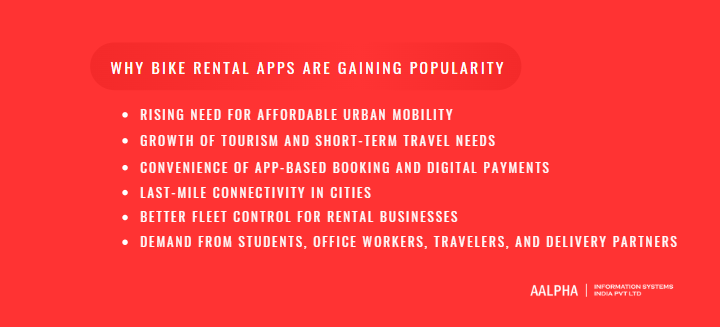
Why Bike Rental Apps Are Gaining Popularity
Bike rental apps are gaining popularity because they solve practical transportation problems for both users and rental businesses. People want mobility options that are cheaper than taxis, easier than vehicle ownership, and faster than waiting for unreliable local transport. At the same time, rental companies want better control over bookings, payments, vehicle availability, customer verification, and fleet performance. A bike rental app brings both sides into one digital system, making short-term two-wheeler access easier, safer, and more organized.
-
Rising Need for Affordable Urban Mobility
Urban transport costs have increased in many cities due to fuel prices, traffic congestion, parking limitations, and growing dependence on private vehicles. For short-distance travel, users often do not want to pay high taxi fares or deal with the cost of owning and maintaining a bike. A rental bike gives them access to personal mobility only when they need it. This is especially useful for people who travel occasionally, work in different parts of the city, or need a vehicle for a few hours instead of the full day. Bike rental apps make this model easier by showing nearby bikes, clear pricing, booking duration, pickup points, and payment options in one place.
-
Growth of Tourism and Short-Term Travel Needs
Tourism is one of the strongest drivers of bike rental demand. Travelers often prefer rented bikes because they offer freedom, flexibility, and cost savings compared to taxis or guided transport. A tourist can rent a scooter or motorcycle for a few hours, a full day, or an entire trip and explore local attractions at their own pace. Bike rental apps also help rental operators serve tourists more efficiently by allowing online bookings, document uploads, digital deposits, route assistance, and return reminders. This reduces manual coordination and improves the customer experience, especially in destinations with seasonal demand.
-
Convenience of App-Based Booking and Digital Payments
The biggest advantage of bike rental apps is convenience. Users no longer need to call multiple rental shops, ask for availability, negotiate prices, or complete every step manually. They can register, complete KYC, select a bike, choose rental duration, pay online, receive booking confirmation, and manage the trip from the app. Digital payments also reduce cash handling for rental businesses and make refunds, deposits, cancellation charges, and late return fees easier to manage. For customers, the process feels faster and more transparent because they can see pricing, policies, and booking details before confirming the rental.
-
Last-Mile Connectivity in Cities
Bike rental apps are also useful for last-mile connectivity. Many people need a quick way to travel from metro stations, bus stops, railway stations, hostels, offices, campuses, and residential areas to their final destination. Public transport may cover the main route, but the last few kilometers can still be inconvenient. Rental bikes help fill this gap by giving users a flexible option for short city rides. In dense urban areas, bikes are easier to park, faster in traffic, and more practical for short-distance movement.
-
Better Fleet Control for Rental Businesses
For rental companies, an app-based system improves daily operations. Instead of maintaining bookings in notebooks, spreadsheets, phone calls, or disconnected software, businesses can manage everything from an admin dashboard. They can track available bikes, active bookings, pending payments, customer documents, deposits, maintenance schedules, damage reports, and vehicle utilization. GPS tracking adds another layer of operational control by helping businesses monitor vehicle location, reduce misuse, and respond faster during disputes or emergencies.
-
Demand from Students, Office Workers, Travelers, and Delivery Partners
Bike rental apps serve multiple customer groups. Students need affordable transport around campuses and hostels. Office workers may need bikes for daily commuting or temporary travel. Travelers need flexible transport in new cities. Delivery partners and gig workers may need two-wheelers for short-term earning opportunities without buying a vehicle. This wide customer base makes bike rental app development attractive for startups, fleet owners, local rental businesses, tourism companies, and mobility operators. As demand grows across use cases, bike rental apps are becoming a practical business opportunity in urban mobility, tourism, and last-mile transportation.
Types of Bike Rental Apps
Bike rental apps can be built in different formats depending on the target market, fleet model, rental duration, pricing strategy, and operational structure. A startup serving tourists in one city will need a different app model than a company managing electric scooters across multiple cities. Similarly, a peer-to-peer rental marketplace will require different features compared to a company-owned fleet rental platform. Choosing the right type of bike rental app is important because it directly affects the app features, backend architecture, payment flow, admin controls, and overall development cost.
-
Hourly Bike Rental Apps
Hourly bike rental apps allow users to rent bikes for a short duration, usually for a few minutes or a few hours. This model is popular in urban areas where users need quick transport for errands, meetings, short commutes, campus travel, or last-mile connectivity. The app usually calculates charges based on time, distance, or a combination of both. In some cases, users can pick up a bike from one station and return it to the same or another designated location.
This type of app requires accurate time tracking, real-time bike availability, GPS location, digital payment, security deposits, extension options, and late return rules. Hourly rentals are useful for high-frequency usage, but they need strong operational control because bikes may move frequently throughout the day.
-
Daily and Weekly Bike Rental Apps
Daily and weekly bike rental apps are common in tourist destinations, business travel locations, university towns, and cities where users need temporary two-wheeler access for more than a few hours. Customers can book a bike for one day, several days, or a full week based on their travel needs. This model is especially useful for travelers, students, temporary workers, and people who need a vehicle while their own bike is unavailable.
These apps usually include document verification, booking calendar, pickup and drop scheduling, deposit handling, return reminders, damage reporting, and rental extension options. For businesses, daily and weekly rentals are easier to manage than hourly rentals because vehicle movement is lower and booking periods are longer.
-
Subscription-Based Bike Rental Apps
Subscription-based bike rental apps allow users to rent bikes for a fixed recurring fee. The subscription may be monthly, quarterly, or annual. This model is suitable for students, office workers, delivery partners, and regular commuters who need consistent access to a two-wheeler but do not want to purchase one.
A subscription bike rental app requires plan management, recurring billing, user verification, renewal reminders, usage limits, maintenance schedules, and customer support workflows. Some businesses also offer bike replacement, service support, insurance, and roadside assistance as part of the subscription. This model gives rental businesses predictable revenue and better fleet planning.
-
Peer-to-Peer Bike Rental Marketplaces
A peer-to-peer bike rental marketplace connects individual bike owners with users who want to rent bikes. Instead of owning the full fleet, the platform allows owners to list their bikes, set availability, define pricing, upload documents, and receive bookings. The platform earns revenue through commission, listing fees, insurance fees, or service charges.
This model requires more complex app development because it involves multiple user roles. The app must support customer accounts, bike owner profiles, listings, availability calendars, booking requests, payment splitting, owner payouts, reviews, dispute handling, and verification. Trust and safety features are very important in this model because both customers and bike owners need confidence in the platform.
-
Electric Bike and Scooter Rental Apps
Electric bike and scooter rental apps are built for businesses offering e-bikes, electric scooters, or shared micro-mobility services. These apps are commonly used in urban mobility, campuses, business parks, tourist zones, and smart city projects. Users can locate a nearby electric vehicle, unlock it through the app, ride it, and end the trip at an approved parking location.
This type of app often requires IoT integration, smart locks, QR code unlocking, battery monitoring, GPS tracking, geofencing, charging station management, and automated billing. The backend must track battery levels, vehicle health, ride duration, location, parking compliance, and maintenance alerts. Electric rental apps are more technically advanced than standard rental apps because vehicle connectivity plays a major role.
-
Corporate Bike Rental Apps
Corporate bike rental apps are designed for companies that provide bikes to employees, field teams, sales staff, or delivery teams. Businesses may use this model to support employee commuting, office campus mobility, field operations, or corporate travel. The app can be customized for a specific organization or offered as a B2B rental service to multiple companies.
Important features include employee login, company account management, approval workflows, usage reports, billing cycles, ride policies, department-wise allocation, and admin-level reporting. Corporate bike rental apps may also include access control, monthly invoicing, service records, and vehicle assignment rules. This model is useful for rental companies that want stable business clients instead of depending only on individual customers.
-
Tourist Bike Rental Apps
Tourist bike rental apps focus on travelers who need two-wheelers for local sightseeing and flexible short-term travel. These apps are popular in hill stations, beach towns, pilgrimage destinations, heritage cities, and vacation locations. Tourists often prefer renting bikes because it gives them more freedom than taxis and lower travel costs for local movement.
A tourist-focused bike rental app should have simple onboarding, multilingual support, map-based pickup locations, document upload, local travel guidance, helmet and accessory add-ons, security deposit management, and clear return policies. Businesses can also add hotel pickup, airport pickup, guided route suggestions, and tourist package bundles to improve revenue.
-
Multi-City Bike Rental Platforms
Multi-city bike rental platforms are built for businesses that operate across several cities, tourist destinations, campuses, or franchise locations. These apps need a scalable backend because pricing, fleet availability, taxes, pickup locations, vendor rules, and operating policies may differ from one city to another.
A multi-city bike rental app usually includes city-wise inventory control, location-based pricing, branch management, vendor panels, franchise management, analytics, payout tracking, customer support routing, and regional reports. This model is ideal for established rental businesses, mobility startups, and companies planning to expand beyond a single location. However, it requires strong architecture from the beginning because managing multiple cities through manual processes can quickly become difficult.
Each type of bike rental app serves a different business goal. Hourly rentals focus on short city movement, daily rentals serve travelers and temporary users, subscriptions support regular users, peer-to-peer marketplaces reduce fleet ownership costs, and electric rental apps support connected urban mobility. The right choice depends on the target audience, fleet ownership model, operating city, investment budget, and long-term growth plan.
How a Bike Rental App Works
A bike rental app works by connecting users with available bikes through a structured digital booking flow. The app handles everything from registration and vehicle selection to payment, pickup, ride tracking, return, billing, and support. For customers, the process feels simple because they only interact with a mobile app. Behind the scenes, the platform depends on a backend system that manages users, bikes, locations, availability, pricing, payments, KYC, fleet status, and admin operations.
-
User Registration and KYC
The process usually starts with user registration. Customers create an account using their mobile number, email address, social login, or OTP-based login. Since bike rentals involve physical assets and legal responsibility, most platforms also require KYC verification before confirming a booking. Users may need to upload identity proof, driving license, address proof, or other documents depending on local regulations and the type of vehicle being rented.
KYC helps rental businesses reduce fraud, prevent misuse, and verify that the customer is eligible to ride the selected bike. In advanced apps, document verification can be handled manually by the admin team or through third-party verification APIs. Once the user is verified, they can search for bikes, make bookings, and manage rentals from the app.
-
Bike Search and Location Selection
After registration, users select their preferred city, pickup location, rental station, or nearby area. The app may show available bikes on a map or in a list format. Users can filter bikes by type, brand, price, fuel type, electric range, seating comfort, transmission, availability, and rental duration. For tourist destinations, the app may also show bikes near hotels, railway stations, airports, bus stands, or popular travel zones.
Location selection is important because bike availability changes based on pickup points, branch inventory, vendor stock, and active bookings. A good app should show only bikes that are available for the selected location and time slot.
-
Bike Availability and Pricing Display
Once the user selects a location and duration, the app displays available bikes with rental prices. Pricing may be hourly, daily, weekly, monthly, subscription-based, or distance-based depending on the business model. The app should clearly show the rental fee, refundable deposit, taxes, helmet charges, fuel policy, delivery charges, late return charges, cancellation rules, and any add-on costs.
Transparent pricing builds trust and reduces disputes after the ride. For rental companies, the backend must calculate pricing accurately based on duration, vehicle category, demand, season, location, coupons, and membership plans.
-
Booking Confirmation
After selecting a bike, the user confirms the booking by choosing the rental date, pickup time, return time, and required add-ons. The app then creates a booking record and updates the bike’s availability in the system. In some models, bookings are confirmed instantly. In vendor or peer-to-peer models, the bike owner may need to approve the request before final confirmation.
The user receives a booking confirmation through the app, SMS, email, or WhatsApp notification. The confirmation usually includes bike details, pickup address, booking ID, payment summary, required documents, and return instructions.
-
Digital Payment or Wallet Payment
Most bike rental apps support online payments through credit cards, debit cards, UPI, wallets, net banking, or payment gateways. Some platforms also allow users to pay through an in-app wallet or use stored balance from previous refunds. Payments may include rental charges, security deposits, insurance fees, platform fees, or add-on services.
The payment system must also handle refunds, partial refunds, cancellation fees, late charges, deposit holds, failed payments, and vendor settlements. A secure and reliable payment flow is essential because payment disputes can directly affect customer trust.
-
Pickup, Unlock, or Handover Process
Once the booking is confirmed, the user collects the bike from a pickup point, rental store, vendor location, parking station, or delivery address. In traditional rental models, staff may inspect documents and hand over the bike manually. In advanced app-based systems, users may unlock the bike using a QR code, OTP, smart lock, Bluetooth lock, or IoT-based access system.
Before the ride starts, the app may ask the user or staff to upload bike photos to record the vehicle condition. This helps avoid disputes related to scratches, dents, fuel level, accessories, or existing damage.
-
Ride Tracking and Booking Duration
During the rental period, the system tracks booking duration and, in some cases, vehicle location. GPS tracking helps the business monitor active rides, prevent unauthorized movement, support customers during emergencies, and recover bikes if needed. For electric bikes and scooters, the system may also track battery level, range, charging status, and geofence compliance.
The app can send reminders before the return time, allow users to extend the booking, and notify the admin if the bike is overdue. Accurate duration tracking is important for calculating final billing and late return charges.
-
Return, Inspection, and Final Billing
At the end of the rental, the user returns the bike to the selected drop location, station, vendor, or pickup point. The bike is inspected for fuel level, battery level, physical damage, missing accessories, helmet return, and cleanliness. If the platform uses a smart lock model, the user may end the ride in the app and upload return photos.
The final bill is calculated based on the actual rental duration, extensions, late fees, damage charges, fuel charges, add-ons, discounts, and refundable deposit. If no extra charges apply, the deposit can be released or refunded as per the business policy.
-
Ratings, Support, Refunds, and Damage Handling
After the ride ends, users can rate the bike, vendor, pickup experience, and overall service. Ratings help businesses identify poor-quality vehicles, unreliable vendors, and service issues. The app should also provide customer support for payment issues, booking changes, refund delays, accident reporting, breakdowns, and damage disputes.
Damage handling is one of the most sensitive parts of bike rental operations. A strong app should support photo evidence, inspection records, admin notes, customer communication, and transparent billing. When the full process is managed digitally, bike rental businesses can reduce manual errors, improve customer experience, and operate rentals with better control.
Core Features of a Bike Rental App
The core features of a bike rental app depend on the business model, fleet size, rental duration, and target users. However, most bike rental platforms need four important layers: a customer app, a vendor or bike owner panel, an admin panel, and a fleet management system. These layers must work together so that customers can book bikes easily, vendors can manage listings, admins can control operations, and the business can track bikes, payments, maintenance, and user activity in one place.
-
Customer App Features
The customer app is the main interface users interact with when they want to rent a bike. It should be simple, fast, and easy to understand because most users open the app with a clear goal: find a bike, book it, pay, and start the ride. Registration and login should support mobile number, email, OTP, or social login. In markets where two-wheeler rentals require identity verification, the app should also allow users to upload KYC documents such as driving license, identity proof, address proof, and selfie verification.
Bike search is one of the most important customer-side features. Users should be able to search bikes by location, rental duration, bike type, brand, price range, fuel type, electric range, availability, and pickup point. A location filter helps users find bikes near railway stations, airports, hotels, campuses, offices, tourist spots, or rental hubs. The app should show bike photos, specifications, rental price, deposit amount, pickup location, cancellation rules, and return instructions before the booking is confirmed.
The booking feature should allow users to choose pickup date, pickup time, return date, return time, rental plan, add-ons, and payment method. Once the booking is confirmed, the user should receive clear booking details inside the app. Payment features should support cards, UPI, wallets, net banking, saved payment methods, and wallet balance depending on the target market. The app should also show ride history, invoices, active bookings, cancelled bookings, refund status, and previous rental details.
Support, ratings, coupons, notifications, and refunds are also essential for a good customer experience. Users should be able to raise complaints, request refunds, report breakdowns, contact support, rate the bike, rate the vendor, and apply coupons during checkout. Push notifications, SMS, email, or WhatsApp alerts can be used for booking confirmation, payment updates, KYC approval, return reminders, extension reminders, refund updates, and promotional campaigns.
-
Bike Owner or Vendor Panel Features
A bike owner or vendor panel is important for platforms that work with multiple rental partners, local vendors, franchise operators, or individual bike owners. This panel allows vendors to list bikes, upload documents, manage availability, accept bookings, update pricing, view earnings, and track settlement status. Without a proper vendor panel, marketplace-style bike rental businesses often depend on phone calls, manual records, and offline coordination, which becomes difficult as bookings increase.
Bike listing features should allow vendors to add bike name, brand, model, registration details, images, rental price, deposit amount, fuel policy, pickup address, included accessories, and availability calendar. Document upload features should support vehicle registration certificate, insurance documents, pollution certificate, permit documents, and owner identity documents where required. These records help the platform verify listings and reduce operational risk.
Availability management helps vendors mark bikes as available, booked, under maintenance, inactive, damaged, or blocked for personal use. Pricing controls allow vendors to set hourly, daily, weekly, monthly, seasonal, or special event pricing if the business model allows vendor-level pricing. In controlled platforms, the admin may define base pricing while vendors only manage availability.
Booking request management is another key feature. Vendors should be able to accept or reject booking requests, view customer details, see pickup and return timing, confirm handover, and update return status. Earnings and settlements help vendors track completed bookings, platform commission, pending payouts, deductions, refunds, cancellation charges, and payout history. Bike status updates help the admin and customer see whether a bike is ready for booking, in use, under inspection, or unavailable.
-
Admin Panel Features
The admin panel is the control center of a bike rental app. It gives the business owner complete visibility and control over users, bikes, bookings, payments, pricing, reports, disputes, promotions, and city-level operations. A strong admin panel is necessary because bike rental is not only a digital booking business; it also involves physical assets, customer verification, deposits, damage claims, refunds, maintenance, and vendor coordination.
User management allows admins to view customer profiles, KYC status, booking history, payment history, complaints, blocked users, and refund requests. Bike management allows the team to approve listings, add company-owned bikes, edit bike details, remove unavailable vehicles, update bike documents, and track status. Booking management should show active bookings, upcoming bookings, completed bookings, cancelled bookings, overdue rentals, extensions, and disputes.
Payment control is essential because bike rentals involve multiple financial events. Admins should be able to track rental fees, deposits, security charges, refunds, failed payments, late fees, damage deductions, cancellation fees, and vendor payouts. Pricing rules allow the business to define hourly pricing, daily pricing, weekend pricing, peak season rates, coupon rules, city-wise pricing, deposit values, and penalty structures.
Reports help the business understand revenue, booking volume, fleet utilization, customer retention, vendor performance, refund volume, cancellation trends, and city-wise performance. Dispute management features help admins handle damage claims, late returns, payment issues, refund complaints, and vendor-customer disagreements. Promo code management allows businesses to create discounts for new users, repeat customers, festivals, tourist seasons, campus users, corporate users, or specific cities. City management is especially important for platforms operating in multiple locations because every city may have different pickup points, vendors, pricing, taxes, service rules, and fleet capacity.
-
Fleet Management Features
Fleet management features help rental businesses monitor the condition, availability, and operational health of every bike. A bike rental business cannot depend only on booking data. It also needs to know whether a bike is road-ready, insured, serviced, fueled, charged, damaged, under repair, or due for inspection. This is where fleet management becomes one of the most important backend modules.
Bike status tracking allows the system to mark vehicles as available, booked, in use, returned, under inspection, under maintenance, damaged, inactive, or retired. Maintenance schedule management helps the business plan regular servicing, oil changes, tire checks, brake checks, battery checks, washing, and inspection routines. This reduces breakdowns and improves customer safety.
For fuel bikes, the system can record fuel level at handover and return. For electric bikes and scooters, the system can show battery level, charging status, estimated range, charging history, and battery health if IoT integration is available. Availability management helps prevent double bookings by syncing vehicle status with live bookings and blocked dates.
Insurance details and service records are also important. The system should store registration details, insurance validity, pollution certificate, permit documents, previous service records, accident history, repair costs, and inspection notes. These records help the business stay organized and make better decisions about repairs, replacements, vendor quality, and fleet expansion.
-
Payment and Wallet Features
Payment and wallet features must be secure, transparent, and flexible. A bike rental app usually handles more complex payments than a simple eCommerce app because the final amount may change after the ride. The customer may pay a rental fee, refundable deposit, security fee, helmet charge, delivery charge, insurance add-on, late return fee, cancellation fee, or damage charge.
Online payments should support the payment methods preferred in the target region, such as cards, UPI, net banking, wallets, bank transfers, or local payment gateways. Refund management should allow full refunds, partial refunds, deposit refunds, coupon-adjusted refunds, and manual admin-approved refunds. Deposits and security fees should be clearly shown before booking so users understand what is refundable and what can be deducted.
Late charges and cancellation fees should be calculated automatically based on business rules. For example, if a user returns a bike two hours late, the system should calculate the extra charge according to the selected rental plan. If a bike is damaged, the admin should be able to deduct an approved amount from the deposit with proper notes and evidence.
Vendor payouts are important in marketplace and franchise models. The system should calculate vendor earnings after platform commission, refunds, discounts, taxes, penalties, and deductions. A clear payout dashboard reduces confusion and helps vendors trust the platform.
-
Notification Features
Notifications keep users, vendors, and admins updated throughout the rental journey. A bike rental app should send booking alerts when a booking is created, confirmed, rejected, cancelled, extended, or completed. Payment notifications should update users about successful payments, failed payments, refund processing, deposit release, late fee charges, and vendor settlements.
Return reminders are especially important in bike rental apps because late returns affect the next booking and reduce fleet availability. The app should remind users before the scheduled return time and allow them to request an extension if the bike is not already booked by another customer. Extension reminders and approval alerts help both customers and vendors manage the rental period without manual follow-ups.
KYC notifications should inform users when documents are submitted, approved, rejected, or require re-upload. Vendors should receive alerts for new booking requests, bike approval status, payout updates, customer pickup timing, return confirmation, and dispute updates. Admins should receive alerts for overdue bikes, failed payments, refund requests, low fleet availability, expiring insurance, pending KYC approvals, and high-priority complaints.
Promotional notifications can also help increase bookings during weekends, holidays, tourist seasons, festivals, and low-demand periods. However, promotional campaigns should be controlled carefully so users receive relevant offers instead of too many messages. When designed properly, notification features improve communication, reduce support workload, and make the rental experience smoother for all users.
Advanced Features to Add in a Bike Rental App
Advanced features make a bike rental app more efficient, secure, and scalable. A basic bike rental app can manage bookings, payments, users, and vehicles, but advanced features help businesses improve automation, reduce manual work, prevent misuse, and offer a better customer experience. These features are especially useful for companies operating across multiple locations, managing large fleets, offering electric bikes, or building a marketplace with vendors and bike owners.
-
GPS Tracking
GPS tracking is one of the most important advanced features in a bike rental app. It helps the business monitor active rentals, view vehicle movement, check pickup and drop locations, and reduce the risk of theft or misuse. For customers, GPS can improve navigation, pickup accuracy, and ride safety. For admins, it provides visibility into where each rented bike is located during the booking period.
GPS tracking can also support geofencing. For example, the business can define allowed riding zones, parking zones, restricted areas, and out-of-city limits. If a user moves outside the permitted area, the system can send an alert to the customer and the admin team. This is useful for electric scooter rentals, campus mobility, tourist zones, and city-based rental services where vehicles must remain within approved boundaries.
-
Smart Lock Integration
Smart lock integration allows users to unlock and lock bikes without manual staff involvement. This feature is common in self-service bike rental apps, electric scooter platforms, campus mobility systems, and station-based rental models. Users can book a bike through the app and unlock it using Bluetooth, IoT connectivity, OTP, or QR-based access.
For businesses, smart locks reduce the need for physical handovers and allow rentals to operate beyond standard store timings. However, this feature requires strong backend connectivity, lock status monitoring, battery status checks, and fallback processes in case the lock does not respond. Smart lock integration increases development complexity, but it can make the rental model more scalable.
-
QR Code Unlock
QR code unlock is a simple and user-friendly way to start a rental. Each bike can have a unique QR code attached to it. After booking, the user scans the QR code through the app to verify the vehicle and unlock or activate the ride. This feature reduces confusion at pickup points because users can confirm they are using the correct bike.
QR code unlock can be used with smart locks, station-based rentals, or staff-assisted rentals. In a basic model, QR scanning can simply confirm pickup. In an advanced model, it can trigger IoT-based unlocking, start ride tracking, activate billing, and update the vehicle status in the backend.
-
AI-Based Pricing
AI-based pricing helps rental businesses adjust prices based on demand, location, season, vehicle type, booking duration, availability, and customer behavior. For example, prices may increase during weekends, tourist seasons, festivals, peak commuting hours, or high-demand locations. Prices may be reduced during low-demand periods to improve fleet utilization.
This feature is useful for businesses with large fleets or multi-city operations. Instead of manually changing prices, the system can recommend or automatically apply pricing rules. AI-based pricing should be used carefully because customers expect transparency. The app should clearly show the final price, deposit, taxes, penalties, and add-on charges before booking confirmation.
-
Damage Detection Using Image Upload
Damage detection using image upload helps rental companies reduce disputes related to scratches, dents, broken parts, missing accessories, and fuel or battery condition. Before pickup, the customer or staff can upload photos of the bike from different angles. At return, new photos can be uploaded again for comparison.
In a basic version, admins manually review the uploaded images. In an advanced version, computer vision models can assist by identifying visible damage or highlighting differences between pickup and return photos. This feature is useful for protecting both the customer and the business because it creates a digital condition record for every rental.
-
In-App Wallet
An in-app wallet makes repeat bookings faster and helps businesses manage refunds, deposits, promotional credits, and cashback. Users can add money to the wallet, receive refunds as wallet balance, use credits for future bookings, or pay partial amounts from wallet funds.
For the business, a wallet can improve customer retention because users with wallet balance are more likely to book again. The wallet system should support transaction history, refunds, failed payment handling, promotional credits, expiry rules, and clear balance visibility.
-
Subscription Passes
Subscription passes are useful for regular users such as students, office workers, delivery partners, and long-term commuters. Instead of paying for every booking separately, users can purchase a weekly, monthly, or quarterly pass. The pass may include a fixed number of rides, discounted rental rates, priority booking, free extensions, or selected bike categories.
Subscription features require plan management, renewal reminders, usage limits, billing rules, cancellation policies, and upgrade options. For rental businesses, subscriptions create predictable revenue and improve fleet planning.
-
Route Suggestions
Route suggestions can improve the user experience by helping riders find safer, faster, or more convenient paths. This feature can recommend routes based on distance, traffic, road type, parking points, tourist attractions, charging stations, fuel stations, or restricted zones.
For tourist bike rental apps, route suggestions can include sightseeing routes, beach routes, hill routes, heritage routes, and local attraction maps. For city rental apps, the feature can support last-mile travel and short-distance commuting.
-
Fuel and Battery Monitoring
Fuel and battery monitoring is important for both petrol bikes and electric vehicles. For fuel-based bikes, the app can record fuel level during pickup and return. This helps calculate fuel charges or confirm whether the customer returned the bike as per the fuel policy.
For electric bikes and scooters, battery monitoring is even more important. The app can show battery percentage, estimated range, charging status, battery health, and nearest charging points. Admins can use this data to decide which vehicles are ready for rental and which need charging or maintenance.
-
Multi-Language Support
Multi-language support is useful for tourist destinations, multi-city platforms, and markets with regional language users. Customers should be able to use the app in their preferred language for registration, booking, payment, support, return instructions, and notifications.
This feature improves accessibility and reduces support calls caused by language confusion. It is especially useful in countries with diverse languages and for rental companies serving international tourists.
-
SOS and Emergency Support
SOS and emergency support features improve rider safety. The app can include an emergency button that allows users to contact the support team, share live location, call emergency contacts, report an accident, or request roadside assistance. For long-distance rentals or tourist locations, this feature can be a major trust factor.
The admin dashboard should also show emergency alerts with user details, bike details, live location, booking ID, and contact information so the support team can respond quickly.
-
Analytics Dashboard
An analytics dashboard helps business owners make better operational decisions. It can show booking trends, revenue, fleet utilization, cancellation rates, refund volume, popular locations, peak demand hours, customer retention, vendor performance, and maintenance costs.
For multi-city platforms, analytics can show city-wise performance and help decide where to add more bikes, reduce fleet size, change pricing, or launch promotions. Without analytics, rental businesses often depend on assumptions instead of real booking data.
-
Fraud Detection and Risk Scoring
Fraud detection and risk scoring help protect the business from fake accounts, document misuse, payment fraud, repeated cancellations, suspicious riding behavior, and theft risk. The system can assign risk scores based on user history, KYC quality, payment behavior, location patterns, booking frequency, and dispute history.
High-risk bookings can be flagged for manual approval, higher deposits, additional verification, or restricted vehicle categories. This feature is especially important for marketplace apps, high-value bikes, electric vehicles, and long-duration rentals. When implemented properly, fraud detection helps reduce losses while still keeping the booking experience smooth for genuine users.
Bike Rental App Development Process
Bike rental app development should follow a structured process because the platform has to manage both digital workflows and physical fleet operations. A basic app may look simple from the customer side, but the backend must handle users, bikes, locations, availability, pricing, KYC, payments, deposits, refunds, vendor payouts, maintenance, disputes, and reports. If the development process is not planned properly, the business may face issues such as double bookings, inaccurate pricing, payment errors, poor fleet visibility, delayed refunds, and weak admin control. A clear development process helps build a stable app that can support real-world rental operations from the first launch and scale as the business grows.
-
Requirement Analysis
The first step is requirement analysis. At this stage, the development team studies the business idea, target users, rental model, operating locations, fleet size, booking duration, payment rules, KYC requirements, vendor involvement, and long-term growth plan. A tourist bike rental business may need daily bookings, hotel pickup, document verification, and deposit management. A city-based hourly rental app may need GPS tracking, real-time availability, QR code unlock, and automatic billing. A peer-to-peer bike rental marketplace may need vendor onboarding, bike owner verification, commission management, and settlement workflows.
Requirement analysis also covers operational rules such as cancellation policy, late return charges, fuel policy, damage inspection, insurance handling, refund process, and customer support flow. This step is important because bike rental app development is not only about building screens; it is about converting the complete rental process into a reliable digital system.
-
Business Model Selection
After gathering requirements, the business model must be finalized. The app can be built for a company-owned fleet, vendor-based rental operations, peer-to-peer bike rentals, electric scooter rentals, corporate rentals, tourist rentals, or subscription-based rentals. Each model needs different features and backend logic.
For example, a company-owned fleet app may need strong fleet management and internal admin control, while a marketplace model needs bike owner panels, commission rules, vendor payouts, dispute management, and listing approvals. A subscription model needs recurring billing, plan limits, renewal reminders, and customer eligibility checks. Choosing the right business model early helps the development team design the correct user roles, payment flow, database structure, and admin modules.
-
Market and Competitor Research
Market and competitor research helps identify what users expect from a bike rental app in the target city or country. The research should cover pricing models, popular vehicle types, pickup methods, user pain points, competitor features, customer reviews, deposit policies, refund timelines, and support standards. This helps the business avoid copying features blindly and instead build an app that solves local problems.
For example, users in tourist locations may care more about daily pricing, easy pickup, route suggestions, and flexible return timing. Students may prefer monthly plans, low deposits, and affordable pricing. Office commuters may want quick booking, reliable bike availability, and wallet payments. Competitor research also helps decide which features should be included in the MVP and which can be added later.
-
Feature Planning
Feature planning converts business requirements into clear app modules. The team defines the must-have features for the first version and separates them from advanced features that can be added after launch. The MVP may include customer registration, KYC upload, bike search, location filter, booking, online payment, booking history, admin panel, bike management, basic reports, notifications, and refund management.
Advanced features such as smart lock integration, AI-based pricing, GPS-based geofencing, damage detection, route suggestions, subscription passes, IoT battery monitoring, and fraud scoring can be planned for later stages if the business wants to launch faster. Clear feature planning keeps development cost under control and helps the business enter the market without unnecessary delays.
-
UI/UX Design
UI/UX design defines how users interact with the bike rental app. The customer app should be easy to use because users usually want to find and book a bike quickly. The design should include simple onboarding, clear location selection, bike cards with photos and pricing, transparent booking summary, easy payment flow, return instructions, ride history, and support access.
The admin panel and vendor panel should focus on operational clarity. Admin users need dashboards that show bookings, active rentals, available bikes, overdue returns, payment status, pending KYC approvals, refund requests, disputes, and maintenance alerts. A good UI/UX design reduces confusion for customers, vendors, and internal teams. It also lowers support workload because users can complete most actions without assistance.
-
Backend Architecture Planning
Backend architecture is one of the most important parts of bike rental app development. The backend manages user accounts, bike inventory, booking logic, pricing rules, KYC records, payment status, vendor earnings, fleet status, notifications, reports, and admin controls. It must be designed to prevent double bookings, calculate prices correctly, track booking duration, manage refunds, and update vehicle status in real time.
For a single-city MVP, the backend can be simple but still reliable. For a multi-city or marketplace platform, the architecture must support city-wise pricing, vendor roles, branch management, payout rules, multi-location inventory, and scalable reporting. Security also matters because the platform stores user documents, payment records, identity details, and vehicle data. Role-based access, encrypted data storage, audit logs, secure APIs, and backup systems should be planned from the beginning.
-
Customer App Development
Customer app development focuses on building the mobile app or web app used by renters. The app should support registration, login, KYC upload, bike search, filters, booking, payments, wallet, coupons, ride history, notifications, refunds, ratings, and support. The development team must also connect the customer app with backend APIs so that availability, pricing, booking status, payment updates, and refund information remain accurate.
The app should be optimized for speed and usability. Slow loading, unclear pricing, payment failures, or confusing return instructions can quickly reduce customer trust. Since bike rental users often book while traveling, commuting, or standing near a pickup point, the app must work smoothly on mobile networks and different device sizes.
-
Admin Panel and Vendor Panel Development
The admin panel is built to manage the complete business operation. It should allow the business team to manage users, bikes, bookings, payments, pricing rules, refunds, reports, disputes, promo codes, cities, vendors, and fleet status. Admin users should also be able to approve KYC documents, review bike listings, check active rentals, process refunds, manage deposits, and handle late returns.
The vendor panel is required when the platform works with bike owners, rental shops, franchise partners, or local vendors. Vendors should be able to add bikes, upload documents, manage availability, accept booking requests, update bike status, view earnings, and track settlement history. A well-built vendor panel reduces manual coordination and makes marketplace-style bike rental operations easier to scale.
-
GPS, Payment, Map, and Notification Integration
Third-party integrations make the bike rental app functional in real-world conditions. GPS and map integrations help users find nearby bikes, pickup points, drop locations, and routes. They also help admins track active rides, monitor vehicle movement, and apply location-based rules. Payment gateway integration allows customers to pay rental fees, deposits, security charges, late fees, and cancellation charges online.
Notification integration is required for booking confirmation, payment updates, KYC status, pickup reminders, return reminders, extension alerts, refund updates, and promotional campaigns. The app may use push notifications, SMS, email, or WhatsApp messages depending on the market. These integrations should be tested carefully because small failures in payment, location, or notification systems can directly affect bookings and customer satisfaction.
-
Testing and Quality Assurance
Testing is critical before launching a bike rental app. The QA team should test user registration, KYC upload, bike search, filters, availability, booking confirmation, payment flow, refund process, wallet balance, promo codes, cancellation rules, late fee calculation, admin actions, vendor actions, notifications, and reports. Testing should also cover edge cases such as failed payments, expired bookings, unavailable bikes, duplicate booking attempts, rejected KYC, cancelled rentals, and overdue returns.
Performance testing is also important if the app expects high demand during weekends, holidays, tourist seasons, or campus events. Security testing should check data protection, user document access, payment safety, admin permissions, and API vulnerabilities. A properly tested app reduces launch risk and improves user confidence.
-
App Deployment
Once the app is tested, it is deployed to production. The customer app is published on app stores or launched as a web app, while the backend, admin panel, database, APIs, and storage systems are hosted on cloud infrastructure. Deployment also includes setting up server monitoring, domain configuration, SSL certificates, database backups, analytics tools, crash reporting, payment gateway production keys, and notification credentials.
Before launch, the business should also prepare operational content such as terms and conditions, privacy policy, refund policy, cancellation policy, damage policy, KYC instructions, and customer support flows. These details are important because bike rental operations involve legal responsibility, payment disputes, and physical asset usage.
-
Maintenance and Continuous Improvement
Bike rental app development does not end after launch. The app needs continuous maintenance, bug fixes, payment gateway updates, map API updates, app store updates, security patches, server monitoring, and performance improvements. Customer feedback should be reviewed regularly to identify issues in booking flow, payment experience, pickup process, return handling, refund timing, and support quality.
As the business grows, new features can be added based on actual usage. These may include subscription passes, smart locks, AI-based pricing, route suggestions, advanced analytics, fraud detection, multi-city management, vendor automation, and IoT-based fleet monitoring. Continuous improvement helps the app stay reliable, competitive, and aligned with real business operations. A strong development process gives bike rental companies the foundation they need to launch confidently, manage daily operations, and grow into a scalable mobility platform.
Bike Rental App Development Cost
The cost of bike rental app development depends on the app type, number of user roles, feature complexity, platform choice, UI/UX quality, backend architecture, third-party integrations, and development team location. A simple bike rental app with basic booking and payment features will cost much less than a multi-city platform with vendor panels, GPS tracking, smart locks, IoT connectivity, AI-based pricing, subscriptions, analytics, and automated fleet management. Businesses should not estimate cost only by the number of screens. A bike rental app also needs secure backend logic, real-time bike availability, payment handling, KYC workflows, admin controls, reporting, and long-term technical support.
-
Basic MVP Cost
A basic bike rental app MVP usually costs between $10,000 and $25,000, depending on the design quality, development region, and exact feature set. This version is suitable for startups, local rental agencies, tourist bike rental businesses, and companies that want to test demand before investing in a larger platform. A basic MVP generally includes a customer app, admin panel, bike listing module, booking flow, payment gateway integration, user registration, KYC upload, basic notifications, and booking history.
The customer app allows users to register, search available bikes, view bike details, select rental duration, confirm bookings, make payments, and check booking status. The admin panel allows the business team to add bikes, manage users, view bookings, confirm payments, process basic refunds, and update vehicle availability. This type of app may not include vendor panels, smart locks, complex pricing rules, or advanced analytics in the first version.
A basic MVP is useful when the business has a small fleet and limited locations. It helps validate customer demand, pricing strategy, and operational workflows before adding advanced features. However, even an MVP should have a reliable backend because incorrect availability, payment errors, or weak admin control can create serious operational issues.
-
Mid-Level Bike Rental App Cost
A mid-level bike rental app usually costs between $25,000 and $55,000. This version is more suitable for businesses managing multiple vendors, larger fleets, multiple pickup points, or growing city-level operations. Along with the features included in an MVP, a mid-level app can include a bike owner or vendor panel, GPS tracking, coupon management, wallet, advanced booking management, customer support tools, reports, and better admin controls.
The vendor panel allows bike owners or rental partners to list bikes, upload vehicle documents, manage availability, update pricing, accept booking requests, view earnings, and track settlements. GPS tracking helps admins monitor active rides, reduce misuse, and improve support during emergencies or disputes. Coupon and wallet features improve customer retention and make repeat bookings easier. Reports help the business understand revenue, cancellations, refunds, fleet utilization, vendor performance, and location-wise demand.
A mid-level app is a better choice for companies that want to move beyond manual operations. It helps reduce phone-based coordination, spreadsheet tracking, and offline payment confusion. The development cost is higher than an MVP because the platform has more user roles, more business rules, more database relationships, and more integration points.
-
Advanced Bike Rental App Cost
An advanced bike rental app can cost between $55,000 and $150,000 or more, depending on the scale and technical complexity. This type of platform is suitable for large rental companies, electric scooter rental businesses, peer-to-peer marketplaces, multi-city operators, franchise-based models, and companies planning to build a full mobility platform.
Advanced features may include smart lock integration, IoT-enabled bike access, QR code unlock, battery monitoring, AI-based pricing, subscription plans, fraud detection, multi-city operations, route suggestions, advanced analytics, automated settlements, geofencing, damage detection using image uploads, and automated maintenance alerts. These features require deeper backend architecture and stronger testing because the app must communicate with hardware devices, payment systems, map services, notification tools, and admin workflows in real time.
Smart lock and IoT integration can significantly increase cost because the development team has to connect the app with physical locking systems, vehicle sensors, Bluetooth modules, SIM-based devices, or third-party IoT platforms. Multi-city operations also increase development effort because the platform must support location-wise pricing, city-specific rules, branch-level inventory, vendor management, tax rules, regional reports, and different operating policies.
-
Cost by Platform
Platform selection also affects bike rental app development cost. An Android-only app is often the most affordable option, especially in markets where Android has a larger user base. An Android-only MVP may be suitable for local rental businesses that want to launch quickly and keep initial investment low. An iOS-only app may cost a similar amount or slightly more depending on design standards, payment requirements, and target audience.
A cross-platform app built using technologies such as Flutter or React Native is often a practical choice because one shared codebase can support both Android and iOS. This can reduce development time and cost compared to building two separate native apps. Cross-platform development is especially useful for startups and businesses that want to launch on both platforms without doubling the budget.
A native app built separately for Android and iOS usually costs more because it requires separate development teams or separate codebases. However, native development may be preferred for apps that require high performance, complex GPS tracking, Bluetooth communication, IoT integrations, advanced animations, or deep platform-specific features. For many bike rental businesses, cross-platform development provides a good balance between cost, speed, and functionality.
-
Cost by Development Region
The development team’s location has a major impact on cost. In India, bike rental app development is generally more cost-effective, with hourly rates often ranging from $15 to $40 per hour, depending on the company’s experience and team structure. This makes India a popular destination for startups and businesses looking for custom app development at a controlled budget.
In Eastern Europe, development rates are usually higher, often ranging from $35 to $70 per hour. Teams in this region are known for strong technical skills, but the total project cost may be higher than India. In Western Europe, hourly rates may range from $70 to $120 or more, depending on the agency and country. In North America, development costs are usually the highest, with hourly rates commonly ranging from $100 to $180 or more.
The lowest hourly rate is not always the best choice. Businesses should evaluate experience, communication quality, backend expertise, UI/UX capability, testing process, post-launch support, and understanding of rental operations. A poorly built low-cost app can become expensive later if it needs major rework, security fixes, or backend restructuring.
-
Ongoing Maintenance Cost
Bike rental app development cost does not end after launch. Businesses should plan for ongoing app maintenance, which usually costs around 15% to 25% of the initial development cost per year. Maintenance includes hosting, server monitoring, bug fixes, payment gateway updates, third-party API updates, app store updates, security patches, performance optimization, database backups, and compatibility updates for new Android and iOS versions.
There are also recurring third-party costs. These may include cloud hosting, SMS charges, WhatsApp notifications, email services, payment gateway fees, map API usage, GPS tracking services, analytics tools, document verification APIs, and IoT platform charges. As bookings increase, server usage, notification volume, and API consumption can also increase.
Maintenance is especially important for bike rental apps because the platform handles payments, user documents, vehicle data, booking records, deposits, refunds, and live operations. If the app crashes, payment fails, GPS tracking stops, or the admin panel becomes slow, the business can lose bookings and customer trust. A reliable maintenance plan keeps the app stable, secure, and ready for future feature upgrades.
Overall, a bike rental app can cost anywhere from $10,000 for a basic MVP to $150,000 or more for an advanced multi-city platform. The right budget depends on the business model, target users, fleet size, operating locations, and growth plan. For most businesses, the best approach is to start with a strong MVP, validate the market, improve operations, and then add advanced features based on real user demand.
Challenges in Bike Rental App Development
Bike rental app development comes with several operational and technical challenges because the platform manages both digital transactions and physical vehicles. Unlike a simple booking app, a bike rental platform must handle real-time availability, user verification, fleet condition, vehicle location, deposits, refunds, vendor coordination, and asset safety. These challenges should be planned during the development stage because fixing them after launch can be costly and disruptive.
-
Real-Time Bike Availability
Real-time availability is one of the biggest challenges in bike rental apps. The system must always show accurate information about which bikes are available, booked, under maintenance, damaged, or blocked for future reservations. If two users are allowed to book the same bike for the same time slot, the business can face customer complaints, refund requests, and operational confusion. To avoid this, the backend must update bike status instantly after every booking, cancellation, extension, return, and admin action. The app should also block bikes that are pending inspection or scheduled for maintenance.
-
GPS Accuracy and Tracking Issues
GPS tracking is useful for monitoring active rentals, preventing misuse, and helping users find pickup or drop locations. However, GPS accuracy can be affected by poor network connectivity, device permissions, battery-saving settings, dense buildings, tunnels, and low-quality tracking hardware. If tracking data is inaccurate, admins may not know the correct vehicle location during disputes or emergencies. A strong bike rental app should use reliable map APIs, location permission checks, periodic location updates, geofencing rules, and fallback support when live tracking is unavailable.
-
KYC and User Verification
Bike rental businesses need proper user verification because customers are renting valuable physical assets. Weak KYC can increase the risk of fake accounts, stolen identities, misuse, theft, and unpaid damage claims. The app should support driving license upload, identity proof, selfie verification, address proof, and admin approval workflows where required. For advanced platforms, third-party KYC verification APIs can reduce manual review time. However, the system must also protect sensitive user documents through secure storage, access control, and clear data retention policies.
-
Damage, Theft, and Misuse Prevention
Damage and theft prevention is a major concern for bike rental companies. Users may return bikes with scratches, broken parts, missing helmets, low fuel, battery drain, or mechanical issues. In some cases, vehicles may be taken outside approved zones or used for purposes not allowed by the rental policy. To reduce these risks, the app can include pickup and return photo uploads, GPS tracking, geofencing, deposit management, damage reporting, inspection records, and user risk scoring. Clear policies and digital evidence help the business handle claims more fairly.
-
Payment Disputes and Refund Handling
Bike rental apps often involve rental charges, refundable deposits, late fees, cancellation charges, fuel charges, damage deductions, and vendor payouts. This makes payment handling more complex than a standard booking app. Users may dispute refund delays, deposit deductions, failed payments, or late return fees. The platform should maintain a complete transaction history, invoice records, payment gateway references, admin notes, and refund status tracking. A transparent payment system reduces support workload and builds customer trust.
-
Maintenance and Fleet Downtime
Fleet maintenance directly affects customer experience. If bikes are not serviced on time, users may face breakdowns, safety issues, or poor ride quality. The app should include maintenance schedules, service history, inspection logs, insurance details, repair status, and automatic alerts for due service. Bikes under maintenance should be removed from available inventory until they are ready for rental. Proper fleet maintenance helps reduce downtime, improve safety, and increase the useful life of each vehicle.
-
Vendor and Owner Management
In marketplace or franchise-based bike rental apps, vendor and bike owner management can become difficult as the platform grows. Vendors need tools to list bikes, upload documents, update availability, manage bookings, view earnings, and track settlements. Admins need approval workflows, commission rules, payout tracking, vendor performance reports, and dispute management. Without a strong vendor panel, the business may depend heavily on phone calls and manual coordination, which limits growth.
-
Smart Lock Reliability
Smart locks, QR unlock, and IoT-based access can make bike rentals more automated, but they also introduce technical risks. Locks may fail due to low battery, weak connectivity, hardware defects, Bluetooth issues, or delayed server response. If a user cannot unlock or lock a bike, the rental experience is immediately affected. The app should include fallback options such as OTP unlock, support override, manual verification, and lock status monitoring. Hardware testing is as important as software testing when smart locks are part of the platform.
-
Multi-City Operational Complexity
Managing bike rentals across multiple cities adds another layer of complexity. Each city may have different pricing, pickup points, vendors, taxes, demand patterns, operating rules, and customer behavior. The admin panel must support city-wise inventory, branch-level controls, local pricing, regional reports, vendor mapping, and support routing. If multi-city architecture is not planned early, the business may struggle when expanding from one location to several markets.
-
Data Security and Compliance
Bike rental apps collect personal data, identity documents, driving licenses, payment details, ride history, and location information. This makes data security a critical development requirement. The platform should use secure authentication, encrypted storage, role-based access, secure APIs, audit logs, regular backups, and strict admin permissions. Businesses must also follow applicable privacy laws, payment security requirements, and local transport regulations. Strong data protection is not only a technical requirement; it is essential for customer trust and long-term business credibility.
Why Work With a Bike Rental App Development Company
Building a bike rental app requires more than creating a mobile interface where users can select and book vehicles. A real bike rental business needs a connected digital system that can manage customers, bikes, payments, availability, verification, vendors, refunds, maintenance, and daily operations. This is why many startups, fleet owners, rental agencies, travel companies, and mobility businesses prefer working with a bike rental mobile app development company instead of building a basic app with limited functionality.
-
Bike Rental Apps Need More Than Mobile Development
A bike rental platform usually includes multiple applications and dashboards. The customer app allows users to register, upload KYC documents, search bikes, choose rental duration, make payments, track bookings, request refunds, and contact support. The admin dashboard helps the business manage users, bikes, bookings, payments, pricing, complaints, reports, coupons, cities, and operational rules. If the platform works with bike owners, local vendors, or franchise partners, a vendor panel is also needed for bike listing, document upload, availability management, booking requests, earnings, and settlements.
The backend is equally important. It must handle booking logic, real-time bike availability, rental duration, deposits, late fees, cancellation policies, payment confirmation, refund flows, GPS tracking, KYC status, fleet records, and notification triggers. If the backend is weak, the business may face double bookings, wrong pricing, payment disputes, refund delays, inaccurate bike status, and poor admin control. A development company with experience in marketplace apps, mobility apps, payment systems, and backend operations can help design the platform correctly from the beginning.
-
Custom Development Helps With Real Operations
Every bike rental business has different operating rules. Some businesses rent bikes hourly, while others focus on daily, weekly, monthly, or subscription-based rentals. Some operate from one location, while others manage multiple pickup points, vendors, cities, tourist zones, campuses, or franchise branches. Custom development helps convert these real business rules into app logic.
For example, the app can support custom pricing by bike type, rental duration, city, season, weekend demand, or customer category. It can manage refundable deposits, security fees, late return penalties, cancellation charges, damage deductions, and fuel or battery policies. It can also support city-wise rules, location-wise availability, maintenance workflows, owner settlements, vendor commissions, and multi-location inventory.
A custom-built platform gives the business more control than a generic rental software product. The admin team can manage operations according to its own policies instead of adjusting the business around fixed software limitations. This becomes especially important when the company wants to expand, add new cities, introduce electric bikes, work with vendors, offer subscriptions, or build a branded mobility experience.
-
Long-Term Support Is Important
Bike rental apps need regular technical support after launch. The app must be monitored continuously because it handles live bookings, payment transactions, user documents, vehicle data, location tracking, and customer support requests. Bugs, server issues, map errors, payment failures, notification delays, and app crashes can directly affect bookings and revenue.
Long-term support includes bug fixes, server monitoring, app performance optimization, map API updates, payment gateway updates, security patches, database backups, app store updates, and compatibility fixes for new Android and iOS versions. As the business grows, the development team may also need to improve admin reports, add new payment methods, refine booking rules, upgrade GPS tracking, automate vendor settlements, or introduce advanced features such as smart locks, subscriptions, analytics, and fraud detection.
-
Working With an Experienced Development Partner
Businesses planning to build a bike rental app can work with experienced mobile app development teams such as Aalpha, especially when the project requires branded mobile apps, backend development, GPS tracking, payment integration, admin dashboards, vendor panels, fleet management, and long-term technical support. The right development partner can help plan the app architecture, define the MVP, build scalable modules, test critical workflows, and support the platform after launch. This gives bike rental businesses a stronger foundation to manage operations, serve customers better, and grow from a small rental service into a scalable mobility platform.
Conclusion
Bike rental app development is a strong opportunity for businesses that want to enter the urban mobility, tourism, student transport, or last-mile travel market. As users look for affordable and flexible two-wheeler access, rental companies need more than offline bookings and manual fleet control. A well-built bike rental app helps manage customers, bikes, bookings, payments, KYC, deposits, refunds, maintenance, vendors, and reports through one connected platform.
The success of a bike rental app depends on choosing the right business model, building the right features, using reliable technology, and planning for long-term operations. Whether the business is starting with a small rental fleet or planning a multi-city mobility platform, the app must be secure, scalable, and easy to manage.
Businesses planning to build a custom bike rental app can connect with Aalpha to create branded mobile apps, admin dashboards, vendor panels, GPS tracking, payment systems, fleet management tools, and backend solutions tailored to their rental model and growth plans.