


Backend development cost varies widely because no two software systems operate under the same technical, operational, or business constraints. A simple backend that supports a basic web application with user login and data storage may require limited infrastructure and minimal business logic. In contrast, a high-traffic SaaS platform serving thousands of concurrent users demands advanced database architecture, distributed services, caching layers, security controls, and fault-tolerant infrastructure. The difference in technical scope directly impacts engineering time, infrastructure investment, and long-term maintenance costs. When business leaders ask how much backend development costs, the accurate response is that pricing depends on system complexity, scalability requirements, compliance needs, and expected user growth.
Backend development is the most critical technical investment because it controls the core logic of an application. While frontend interfaces determine user experience, the backend governs authentication, data management, performance, integrations, analytics, and security. Every transaction, user action, API call, and database query is processed at the backend layer. If this foundation is poorly architected, performance bottlenecks, security vulnerabilities, and scaling failures emerge as usage grows. Many organizations underestimate backend planning during early development stages, only to incur significant refactoring costs later. A robust backend architecture protects long-term business stability, supports feature expansion, and enables smooth infrastructure scaling.
Pricing depends heavily on architectural decisions. A monolithic backend may cost less to build initially but can become difficult to scale or modify. A microservices architecture increases initial engineering effort yet provides flexibility and resilience for large-scale systems. Serverless architectures may reduce infrastructure management costs but require careful design to control usage-based cloud expenses. Similarly, choosing between relational and non-relational databases affects development time, query optimization complexity, and hosting costs. Architecture is not just a technical choice; it is a financial decision that shapes the total cost of ownership.
Scale is another primary cost driver. A backend designed for 1,000 monthly users differs substantially from one built to handle 1 million concurrent requests. High-scale systems require load balancing, horizontal scaling strategies, database replication, caching mechanisms, content delivery networks, monitoring systems, and advanced DevOps automation. Each layer adds engineering time and operational cost. Businesses planning aggressive growth must budget for scalable infrastructure from the outset rather than retrofitting scalability later.
The business model also influences backend development cost. Subscription-based SaaS platforms require recurring billing systems, user management modules, analytics dashboards, and API integrations. eCommerce platforms require inventory management, payment gateways, order processing logic, and fraud detection. AI-powered applications demand high-performance data pipelines and integration with machine learning services. Enterprise systems often require compliance with regulations such as GDPR or HIPAA, which increases development and security costs. Backend pricing reflects not only technical complexity but also regulatory and operational requirements.
This pricing guide provides a comprehensive breakdown of backend development cost from multiple angles: project type, complexity level, and pricing models. It explains average cost ranges, regional developer rates, and strategies to reduce unnecessary spending without compromising scalability or security.
This guide is written for startup founders evaluating MVP budgets, CTOs planning scalable architecture, product managers defining technical scope, and enterprise decision-makers assessing long-term infrastructure investment. Whether you are building a new product or modernizing an existing system, understanding backend development cost is essential for making informed, financially sound decisions.
What Is Backend Development? A Clear Breakdown
Understanding backend development is essential before analyzing its cost structure. Backend systems are the operational engine of any digital product. They process data, enforce business rules, manage infrastructure, and enable communication between user interfaces and databases. Every user action inside an application triggers backend operations, making it the foundational layer that determines performance, scalability, and reliability.
-
Definition and Role of Backend in Software Systems
Backend development refers to the server-side engineering that powers an application’s functionality behind the scenes. It includes servers that host application logic, databases that store structured or unstructured data, APIs that facilitate communication between systems, and business logic that governs workflows and transactions.
When a user logs into an application, the backend validates credentials against a database. When a payment is made, the backend processes the transaction, communicates with payment gateways, updates records, and confirms success. When data is displayed on a dashboard, the backend retrieves, filters, aggregates, and formats it before sending it to the frontend.
The key difference between frontend and backend development lies in responsibility. Frontend development focuses on visual interfaces, layout, and user interactions. Backend development handles logic, computation, security, data storage, and system orchestration. While frontend affects user perception, backend determines operational stability. A visually polished application cannot function without a reliable backend. In cost terms, backend development often represents a larger share of engineering investment because it involves architecture planning, database design, performance optimization, and infrastructure setup.
-
Core Backend Components That Affect Cost
Several backend components directly influence development cost because they increase engineering complexity, security requirements, and infrastructure demands.
The API layer defines how different parts of the system communicate. REST or GraphQL APIs must be structured for performance, versioning, error handling, and scalability. Complex API ecosystems with multiple endpoints increase development and testing effort.
Authentication and authorization systems add significant cost when multi-role access, token management, social logins, two-factor authentication, or enterprise-level permissions are required. Secure identity management requires encryption, session handling, and compliance with privacy standards.
Databases represent a major cost driver. Choosing between relational databases like PostgreSQL or MySQL and non-relational systems like MongoDB affects design complexity. High-performance indexing, replication, backup strategies, and optimization all increase engineering time.
Third-party integrations introduce external dependencies. Payment gateways, SMS services, CRM systems, analytics platforms, and AI services require secure API integration, error handling, monitoring, and ongoing maintenance.
Admin panels and internal tools also add backend workload. Role-based dashboards, reporting systems, and data management interfaces require custom APIs and secure access controls. These elements increase both development and long-term maintenance costs.
-
Backend vs Full-Stack Development Cost
Backend development cost allocation differs from full-stack development because backend work typically demands deeper architectural expertise. Full-stack development combines frontend and backend tasks under a single developer or team, which may reduce coordination overhead but does not necessarily reduce backend complexity.
In small MVP projects, backend may represent 40 to 50 percent of the total development budget. However, in data-intensive systems, SaaS platforms, fintech applications, or AI-driven products, backend development can dominate the budget, sometimes accounting for 60 to 70 percent of total technical investment. This is because scalability planning, performance optimization, database modeling, and security engineering require specialized expertise.
Backend costs tend to increase disproportionately as scale grows. While frontend complexity may remain relatively stable, backend systems must evolve to handle concurrency, data growth, system monitoring, load balancing, and fault tolerance. In enterprise systems, backend engineering often becomes the primary cost center due to compliance requirements, infrastructure redundancy, and advanced security architecture.
Understanding this cost allocation dynamic is critical for decision-makers planning software budgets. Backend development is not merely a supporting function; it is the structural core that determines long-term scalability and operational reliability.
Backend Development Cost Overview (High-Level Pricing)
Backend development cost varies significantly depending on system complexity, feature depth, security requirements, and scalability expectations. Organizations evaluating backend pricing often ask a straightforward question: how much does it cost to build a backend? The answer depends on scope, infrastructure design, performance targets, and long-term growth plans. High-level pricing provides a practical starting point before diving into detailed feature breakdowns.
-
Average Backend Development Cost Ranges
An MVP backend is typically designed to validate a product idea with essential functionality. It includes user authentication, basic database structure, core APIs, and minimal integrations. These systems are often monolithic, designed for fast deployment rather than extreme scalability. The cost of building an MVP backend generally ranges between $8,000 and $25,000, depending on complexity, integrations, and security requirements. For startups testing market demand, this range provides a functional yet controlled investment.
A mid-scale backend supports growing user bases, more advanced workflows, and integration layers. It typically includes role-based access control, payment processing, analytics tracking, reporting dashboards, caching mechanisms, and infrastructure configured for moderate concurrency. These systems are engineered with scalability in mind, often incorporating structured database indexing and load management. Development costs for mid-scale backends typically fall between $25,000 and $75,000. The variation depends on real-time features, data volume, and compliance considerations.
An enterprise backend is architected for high availability, fault tolerance, and large-scale user traffic. It may include microservices architecture, distributed databases, load balancers, redundancy planning, monitoring systems, automated deployment pipelines, and advanced security frameworks. Enterprise systems also often require regulatory compliance such as GDPR or HIPAA. Backend development costs at this level generally start around $75,000 and can exceed $200,000 depending on scale, industry, and performance requirements.
An API-only backend focuses primarily on building robust APIs for third-party consumption or frontend applications. It may not include full administrative dashboards or user-facing logic but demands strong API versioning, authentication layers, and performance optimization. API-only backend projects typically range from $10,000 to $40,000 depending on endpoint complexity and integration scope.
These ranges reflect development costs and do not include ongoing hosting, infrastructure, or maintenance expenses.
-
Backend Developer Hourly Rates by Region
Backend development pricing is also influenced by geographic location. Developer hourly rates vary based on experience level, market demand, and regional economic conditions.
In the United States, backend developers typically charge between $100 and $200 per hour. Senior engineers and architects with cloud infrastructure expertise may exceed this range. US-based teams often provide strong communication alignment and deep enterprise experience, but at a premium cost.
Western Europe, including countries such as Germany, France, and the Netherlands, generally sees hourly rates between $70 and $150. Pricing varies depending on technical specialization and project complexity.
Eastern Europe, including Poland, Ukraine, and Romania, has become a popular outsourcing destination. Backend developers in this region typically charge between $40 and $80 per hour while offering strong engineering capabilities and experience with modern frameworks.
India remains one of the most competitive markets for backend development services. Rates generally range between $25 and $60 per hour depending on expertise level and project scope. Many global startups and enterprises leverage Indian backend teams for cost-effective scalability.
Latin America offers rates between $35 and $80 per hour. Proximity to US time zones and improving technical talent pools make LATAM increasingly attractive for North American companies.
Regional pricing differences significantly influence total backend development cost, especially in large projects that require hundreds or thousands of engineering hours. Selecting the right geographic mix can optimize cost without compromising quality or scalability.
Backend Development Cost by Project Type
Backend development cost varies significantly depending on the type of digital product being built. A web application, mobile app, SaaS platform, eCommerce system, and AI-powered solution each impose different architectural demands. The backend must align with usage patterns, concurrency levels, integrations, data volume, and monetization logic. When organizations evaluate backend development pricing, the first step is identifying the project category because each category introduces unique technical requirements that directly influence cost.
-
Cost to Build Backend for a Web Application
The backend cost for a web application depends on the complexity of user interactions, database structure, and integration requirements. A basic web application backend typically includes user authentication, CRUD operations, API endpoints, session management, and database connectivity. For simple dashboards, booking systems, or internal tools, backend costs generally range between $10,000 and $30,000.
As complexity increases, additional features such as role-based permissions, reporting modules, notification systems, payment integrations, or analytics tracking raise development effort. Performance optimization becomes critical when handling concurrent users, particularly in B2B platforms or public-facing portals. Mid-level web application backends typically range between $25,000 and $60,000 depending on feature depth.
Scalability planning also affects cost. If the application anticipates growth, engineers may implement caching layers, background job processing, and infrastructure automation from the beginning. This proactive planning increases initial investment but reduces long-term refactoring expenses.
-
Cost to Build Backend for a Mobile App
Mobile applications often require more specialized backend architecture than web applications because they must support cross-platform APIs, real-time synchronization, and higher security standards. A mobile app backend typically manages user authentication, push notifications, media storage, geolocation services, and data synchronization across devices.
For a simple mobile app with login, user profiles, and basic content management, backend development costs generally range from $15,000 to $35,000. Mobile applications frequently rely heavily on APIs, which must be optimized for performance and low latency. In apps with chat systems, live tracking, or social features, backend complexity increases due to real-time processing requirements. This can raise costs into the $40,000 to $80,000 range.
Mobile backends must also consider offline data synchronization, device token management, and integration with third-party services such as payment gateways or cloud messaging platforms. Because mobile apps often target rapid user growth, backend scalability and load balancing are essential components of initial design, contributing to overall cost.
-
Cost of Backend for SaaS Platforms
SaaS platforms typically demand more sophisticated backend systems because they operate on subscription-based business models and must support multi-tenant architectures. A SaaS backend requires user management, billing systems, subscription plans, analytics dashboards, administrative controls, API integrations, and robust access management.
A basic SaaS backend MVP may cost between $30,000 and $60,000 depending on feature scope. However, production-grade SaaS systems often exceed $75,000 due to the need for secure billing workflows, recurring payment processing, usage tracking, and reporting systems.
Multi-tenant architecture adds complexity because the backend must isolate user data while maintaining operational efficiency. SaaS systems also require scalable infrastructure to handle fluctuating workloads and performance spikes. Additional components such as audit logs, automated notifications, and compliance mechanisms increase engineering effort.
The backend for SaaS products frequently becomes the primary technical investment because it directly supports revenue generation, subscription management, and long-term scalability.
-
Backend Cost for eCommerce Platforms
eCommerce platforms require backend systems capable of managing product catalogs, inventory tracking, pricing logic, order processing, payment gateway integrations, and fraud detection. Even small eCommerce backends require structured database design to handle transactions accurately.
A basic eCommerce backend generally ranges from $25,000 to $50,000 depending on customization level. However, larger platforms with advanced inventory logic, multi-vendor support, tax calculation engines, shipping integrations, and real-time stock updates can exceed $80,000.
Performance is critical in eCommerce environments. Backend systems must handle high traffic during promotional events without latency or downtime. Load balancing, caching strategies, and database optimization significantly influence total development cost.
-
Backend Cost for AI-Powered Applications
AI-powered applications introduce additional backend complexity because they integrate data pipelines, model inference services, and often external machine learning APIs. The backend must handle data preprocessing, model calls, storage of prediction results, and performance optimization.
A basic AI-enabled backend may start around $40,000, particularly when integrating third-party AI services. If custom model training, large-scale data ingestion, or real-time inference is required, costs can exceed $100,000 depending on infrastructure scale.
AI systems often require high-performance cloud environments, background processing queues, and advanced monitoring tools. Because AI workloads can be resource-intensive, infrastructure costs must be factored into the overall backend development budget.
In all cases, backend development cost reflects not just feature count but operational reliability, performance expectations, and scalability requirements specific to each project type.
Backend Development Cost by Complexity Level
Backend development cost increases in direct proportion to system complexity. Complexity is not measured only by the number of features, but by architectural depth, scalability requirements, integration layers, concurrency expectations, and security standards. A simple CRUD-based system requires fundamentally different engineering effort compared to a distributed enterprise backend serving millions of users.
When organizations ask how backend development cost changes with complexity, the most accurate framework is to evaluate three tiers: simple backend systems, moderate complexity platforms, and high-complexity enterprise architectures.
-
Simple Backend (Basic CRUD Systems)
A simple backend typically supports basic Create, Read, Update, and Delete operations. These systems are common in early-stage MVPs, internal tools, prototypes, and low-traffic web applications.
At this level, the backend usually includes a login system with session handling or token-based authentication. Password encryption, basic validation, and minimal user role separation are implemented. Security standards are present but not deeply layered. For example, two-factor authentication or advanced identity federation is rarely required in this category.
The database structure is straightforward. A relational database such as PostgreSQL or MySQL may be used with clearly defined tables and simple relationships. Query optimization is minimal because traffic volume is low. Backup strategies may exist but are often automated using managed cloud services rather than custom-built infrastructure.
Simple APIs are built to connect the frontend and database. These APIs typically expose endpoints for user registration, profile management, and core data transactions. API versioning, throttling, and complex validation layers are limited in scope.
Development cost for a simple backend generally ranges between $8,000 and $20,000 depending on feature count and developer location. The lower end of this range applies to basic internal systems, while higher costs emerge if additional authentication safeguards or third-party integrations are included.
Although simple backends appear inexpensive, underestimating future scalability can create technical debt. Systems built without considering growth often require later restructuring, increasing total cost of ownership.
-
Moderate Complexity Backend
Moderate complexity backends represent the most common category for startups and growing businesses. These systems support multiple user roles, transactional workflows, third-party integrations, and structured reporting.
A multi-role system significantly increases backend complexity. Instead of a single user type, the backend must enforce role-based access control across administrators, customers, vendors, and internal staff. Each role may have different permissions, data visibility rules, and workflow privileges. Implementing secure role hierarchies requires careful architectural planning and extensive testing.
Payment integration introduces another layer of complexity. Secure integration with payment gateways such as Stripe or PayPal requires encrypted communication, webhook handling, transaction logging, refund processing, and error management. Compliance standards such as PCI-DSS must be respected. Payment logic must be tightly synchronized with subscription models or order systems, increasing development effort.
Notification systems further expand backend scope. Email notifications, SMS alerts, push notifications, and in-app messaging require queue management and background processing. Real-time notification delivery often relies on event-driven architecture and message brokers.
Reporting dashboards add analytical requirements. The backend must aggregate data, perform calculations, and expose structured reporting APIs. This may involve complex database queries, indexing strategies, and caching mechanisms to maintain performance.
Infrastructure planning becomes more strategic at this stage. Moderate complexity systems often require load management, caching layers such as Redis, background job queues, and structured logging.
Backend development cost for moderate complexity systems typically ranges from $25,000 to $75,000 depending on integration count, real-time features, and scalability requirements. The range expands when compliance requirements or high user growth projections are involved.
This complexity tier often represents the transition point where backend engineering becomes the primary driver of technical investment.
-
High-Complexity Enterprise Backend
High-complexity enterprise backends are engineered for scale, resilience, and regulatory compliance. These systems are designed to support large concurrent user bases, high transaction volumes, and distributed operations.
Microservices architecture is commonly implemented at this level. Instead of a single monolithic codebase, the system is divided into independent services that communicate through APIs or message queues. While microservices improve scalability and fault isolation, they significantly increase architectural design effort, deployment orchestration, and monitoring complexity.
High concurrency requirements demand advanced load balancing, horizontal scaling strategies, auto-scaling groups, and traffic management systems. Backend systems must handle thousands or millions of simultaneous requests without degradation.
Distributed databases are often deployed to ensure high availability and geographic redundancy. Data replication, sharding, and failover strategies require careful configuration. These systems must maintain consistency while minimizing latency.
Compliance requirements such as GDPR, HIPAA, SOC 2, or ISO standards introduce additional engineering layers. Encryption at rest and in transit, audit logs, access monitoring, and secure data retention policies increase development and operational cost.
Enterprise backend development typically starts around $75,000 and can exceed $200,000 depending on industry and scale. Infrastructure, DevOps automation, and security auditing further contribute to total cost.
In enterprise environments, backend development is not merely a coding exercise. It becomes an infrastructure investment designed to ensure reliability, security, and long-term scalability across global operations.
Backend Development Pricing Models
Backend development cost is not determined only by technical complexity. The commercial engagement model between the client and the development partner significantly affects budgeting, risk distribution, flexibility, and long-term scalability. Choosing the wrong pricing model can lead to budget overruns, delayed timelines, or architectural compromises. Choosing the right one aligns incentives, clarifies accountability, and supports predictable delivery.
Organizations typically choose between four primary backend development pricing models: fixed price, time and material, dedicated backend team, and build-operate-transfer. Each model serves different business scenarios depending on scope clarity, technical uncertainty, and growth plans.
-
Fixed Price Model
The fixed price model defines the entire backend scope, timeline, and cost before development begins. Both parties agree on deliverables, milestones, and payment terms in advance. This model is best suited for clearly defined backend requirements with minimal expected changes.
For example, a startup building a simple MVP backend with predefined features, limited integrations, and basic scalability expectations may prefer a fixed price contract. Budget certainty becomes the primary advantage. Financial planning is easier because total backend development cost is known upfront.
However, fixed price models require extremely detailed requirement documentation. Any change in scope may trigger change requests and additional billing. Backend systems often evolve during development, especially when new integrations or performance adjustments are needed. This reduces flexibility under fixed pricing.
From a cost perspective, development agencies often include a risk buffer in fixed price contracts to protect against unforeseen complexity. As a result, fixed pricing may appear higher than initial time-based estimates. This model works best when backend architecture and feature scope are stable and unlikely to evolve significantly during implementation.
-
Time and Material Model
The time and material model bills clients based on actual hours worked and resources used. Backend development cost under this model fluctuates depending on evolving requirements and engineering effort.
This approach is ideal when backend requirements are not fully defined at the start or when iterative development is expected. SaaS platforms, AI-powered systems, and high-growth products often benefit from time and material contracts because architecture evolves based on user feedback and performance testing.
Flexibility is the main advantage. Scope can expand or adjust without renegotiating entire contracts. This enables experimentation with architectural decisions such as caching strategies, database optimizations, or third-party integrations.
The primary challenge is budget variability. Without strong project governance and transparent reporting, costs can exceed initial projections. However, when managed correctly with sprint planning and milestone tracking, time and material provides a balanced approach between flexibility and financial control.
This model is particularly suitable for moderate to high-complexity backend systems where architectural discovery is part of the process.
-
Dedicated Backend Team Model
The dedicated backend team model provides clients with a full-time engineering team assigned exclusively to their project. Instead of paying per task or milestone, the client pays a monthly retainer for backend developers, architects, and sometimes DevOps engineers.
This dedicated team model works well for long-term product development, continuous feature expansion, and systems requiring ongoing optimization. Enterprise platforms, SaaS products, and rapidly scaling applications often adopt this approach.
The primary advantage is alignment. The dedicated team develops deep product knowledge, understands architectural decisions, and maintains consistency across iterations. This reduces onboarding time and improves long-term backend stability.
Cost-wise, this model offers predictable monthly expenditure while maintaining flexibility in feature prioritization. It eliminates the need for repeated contract renegotiations as backend scope evolves.
However, this model requires long-term commitment. It is less suitable for short-term MVP projects with clearly defined endpoints. For growth-stage companies or enterprises investing in scalable backend infrastructure, the dedicated team model often provides the best balance of control, continuity, and scalability.
-
Build-Operate-Transfer Model
The build-operate-transfer model involves a development partner building the backend system, operating it for a defined period, and eventually transferring full ownership and control to the client.
This model is suitable for enterprises that want to establish internal backend capabilities but lack immediate technical resources. During the operate phase, the partner manages infrastructure, DevOps, and system optimization before transitioning operations to the client’s in-house team.
While initial costs may be higher, this model supports long-term autonomy and knowledge transfer, making it attractive for organizations planning sustainable internal backend operations.
Selecting the appropriate backend development pricing model is as critical as choosing the right architecture. Budget structure, flexibility requirements, long-term scalability plans, and internal technical maturity all influence which engagement model delivers the most value.
How to Reduce Backend Development Cost Without Compromising Quality
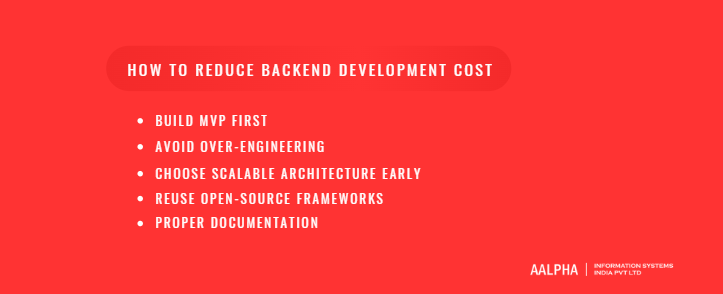
Reducing backend development cost does not mean cutting corners on security, performance, or scalability. In fact, poorly planned cost reductions often lead to higher long-term expenses due to refactoring, infrastructure inefficiencies, or security incidents. The goal is not to spend less at any cost, but to invest intelligently. Strategic planning, architectural discipline, and phased development can significantly lower backend expenditure while maintaining technical integrity.
-
Build MVP First
One of the most effective ways to control backend development cost is to start with a minimum viable product. An MVP backend focuses only on core functionality required to validate the business idea. Instead of implementing advanced automation, analytics modules, or multi-region deployment from the beginning, the system is designed to support essential workflows.
For example, rather than building a complex microservices architecture on day one, a monolithic backend with modular design can serve initial user demand. Once traction is validated, scaling decisions can be made based on real usage patterns rather than assumptions. This approach reduces upfront engineering hours and avoids investing in infrastructure that may not be needed immediately.
Building an MVP also limits scope creep. By clearly defining critical features, organizations prevent unnecessary additions that inflate backend development pricing.
-
Avoid Over-Engineering
Over-engineering is one of the most common causes of inflated backend cost. Teams sometimes design for hypothetical scale or edge cases that may never occur. Implementing distributed systems, advanced caching layers, or heavy abstraction patterns without clear necessity increases both development and maintenance effort.
Backend architecture should match current and near-term business needs. If the application expects moderate traffic, implementing global data replication or advanced microservices orchestration may not provide immediate value. Overly complex systems also increase debugging difficulty and operational overhead.
A disciplined architectural review process helps ensure that every technical component serves a defined business requirement. Engineering decisions should be data-driven rather than assumption-driven.
-
Choose Scalable Architecture Early
While over-engineering should be avoided, ignoring scalability entirely creates future cost risks. The balance lies in selecting an architecture that can evolve without requiring a complete rebuild.
Designing clean API structures, modular codebases, and normalized database schemas from the beginning allows the system to scale gradually. For example, separating business logic from infrastructure layers makes it easier to introduce caching, background job queues, or load balancing later without rewriting core functionality.
Cloud-native design principles also help manage long-term backend cost. Leveraging managed cloud services for databases, authentication, and monitoring reduces custom infrastructure engineering and operational burden.
Scalability planning is not about building everything upfront. It is about building in a way that future expansion does not require structural replacement.
-
Reuse Open-Source Frameworks
Open-source frameworks significantly reduce backend development time and cost. Mature frameworks such as Node.js ecosystems, Django, Spring Boot, and .NET provide built-in authentication modules, ORM systems, routing layers, and validation tools.
Instead of developing custom solutions for common features such as user management or API routing, leveraging tested libraries accelerates development while maintaining reliability. Open-source communities also contribute regular security patches and performance improvements, reducing maintenance overhead.
However, framework selection should prioritize long-term support and ecosystem stability. Choosing obscure or poorly maintained libraries can increase risk and future refactoring costs.
-
Proper Documentation
Documentation is often overlooked as a cost-saving mechanism, yet it plays a critical role in reducing long-term backend expenses. Clear documentation of API endpoints, database schemas, infrastructure setup, and deployment workflows enables faster onboarding of new developers and reduces debugging time.
Poorly documented systems create dependency on specific engineers, increasing operational risk and slowing feature expansion. Structured documentation ensures knowledge transfer and continuity.
In addition, well-documented backend architecture reduces misunderstandings between stakeholders and development teams, minimizing rework and scope changes that inflate project budgets.
Reducing backend development cost without compromising quality requires strategic prioritization, disciplined architecture, and operational foresight. Intelligent planning prevents unnecessary spending while preserving scalability, performance, and security.
How to Choose the Right Backend Development Partner
Selecting the right backend development partner / software development company directly influences system stability, scalability, and long-term cost efficiency. Backend architecture decisions are foundational. Once implemented, they are difficult and expensive to reverse. A capable partner does more than write code. They design infrastructure that supports growth, protects sensitive data, and adapts to evolving business requirements. Evaluating technical depth, architectural thinking, and operational maturity is critical before committing to any engagement.
-
Technical Architecture Expertise
A qualified backend partner must demonstrate strong architectural capabilities rather than only framework-level proficiency. This includes experience designing scalable APIs, structuring databases for performance, implementing caching strategies, and planning cloud infrastructure.
During evaluation, organizations should assess whether the partner can explain architectural trade-offs clearly. For example, when is a monolithic backend sufficient, and when is microservices architecture justified? How should database normalization be handled for high-traffic systems? How should background processing be managed for data-intensive applications?
Architecture expertise reduces the risk of technical debt. A partner with proven backend system design experience can align technical decisions with business growth objectives rather than short-term convenience.
-
Experience in Scaling Products
Backend systems rarely remain static. User growth, data expansion, and feature additions require scalable design from the beginning. A strong backend partner should demonstrate prior experience handling performance optimization, concurrency management, load balancing, and distributed database systems.
Ask how they have scaled systems under increasing traffic. Have they implemented auto-scaling cloud environments? Have they optimized slow database queries or redesigned APIs for performance efficiency? Real-world scaling experience separates theoretical developers from production-ready engineering teams.
Scalability planning prevents costly rebuilds. Choosing a partner who has navigated product growth cycles ensures backend architecture remains stable under operational pressure.
-
Security-First Development Practices
Security must be embedded into backend development from day one. Authentication mechanisms, encryption protocols, access control policies, and compliance frameworks must be architected proactively rather than added as an afterthought.
A reliable backend partner should follow secure coding standards, implement encryption for data at rest and in transit, and design role-based access systems with least-privilege principles. Experience handling compliance requirements such as GDPR, HIPAA, or SOC 2 further demonstrates maturity.
Security failures are among the most expensive backend mistakes. Evaluating a partner’s security mindset is essential to mitigating long-term operational risk.
-
Documentation Maturity
Well-structured documentation reflects disciplined engineering practices. API documentation, database schema definitions, infrastructure diagrams, and deployment workflows should be maintained throughout the project lifecycle.
Documentation maturity ensures maintainability. It enables new developers to onboard quickly, reduces reliance on specific individuals, and supports smoother feature expansion. Poor documentation increases hidden costs through inefficiency and knowledge silos.
A strong backend partner prioritizes clarity and maintainability alongside technical execution.
-
Post-Launch Support
Backend development does not end at deployment. Ongoing monitoring, performance optimization, security patching, and infrastructure scaling are continuous processes. A dependable partner offers structured post-launch support, maintenance planning, and proactive system monitoring.
Backend systems evolve with user behavior and market demands. Having access to experienced engineers who understand the architecture reduces downtime risk and accelerates feature enhancements.
Organizations seeking long-term backend stability often benefit from partnering with established engineering teams experienced in building scalable, production-grade systems. For example, companies such as Aalpha have delivered backend architectures across SaaS, enterprise, AI-driven, and high-traffic applications, emphasizing scalability, security, and performance optimization from initial design through post-launch growth.
Choosing the right backend development partner is a strategic decision. It shapes not only the initial build cost but the long-term reliability, scalability, and operational efficiency of the entire digital product.
Final Words
Backend development is not simply a line item in a project budget. It is the structural foundation that determines scalability, performance, security, and long-term operational cost. Decisions made at the backend layer influence how efficiently your product handles growth, how securely it protects user data, and how easily new features can be introduced. Investing in well-architected backend systems today prevents expensive refactoring, downtime, and security risks tomorrow. Whether you are building an MVP, scaling a SaaS platform, or modernizing enterprise infrastructure, backend planning must be deliberate and technically sound.
If you are evaluating backend development cost and want clarity before committing resources, partnering with an experienced engineering team makes the difference. Aalpha Information Systems delivers scalable, secure, and performance-optimized backend solutions tailored to startups, growing businesses, and enterprises. From architecture consulting to full-scale backend development and long-term support, Aalpha ensures your system is built to handle real-world growth.
If you would like a detailed cost estimate or technical consultation for your backend project, contact the team at Aalpha to discuss your requirements.