





TL;DR
An AI-first marketplace is a platform where artificial intelligence is built into the core structure from day one, not added later as a chatbot or recommendation widget. AI runs across search, matching, personalization, seller tools, fraud detection, pricing, support, and admin decision-making. The result is faster discovery for buyers, better visibility and pricing insight for sellers, and lower manual workload for marketplace operators.
Key points:
- How it differs: Traditional marketplaces rely on keyword search, fixed filters, and rule-based operations. AI-first marketplaces understand intent, rank results by relevance, flag suspicious activity, and predict demand.
- Where it applies: B2C retail, B2B procurement, service booking, rental, and hyperlocal delivery marketplaces, each with different AI use cases.
- Core features: Semantic and natural language search, personalized recommendations, smart buyer-seller matching, conversational shopping assistants, dynamic pricing, fraud and KYC risk scoring, listing optimization, review sentiment analysis, and AI-powered admin dashboards.
- Cost: Roughly $25,000 to $60,000 for a basic MVP, $60,000 to $150,000 for a mid-level platform, and $150,000 to $400,000 or more for an advanced enterprise build. Annual maintenance typically runs 15% to 25% of initial development cost.
- Important caveat: AI-first does not mean fully automated. Account suspensions, refund disputes, and high-value transactions still need human review and admin override.
- How to control budget: Start with an MVP, use existing AI APIs before custom models, and roll out advanced AI in phases once real transaction data exists.
Aalpha Information Systems, founded in 2008 with 5,500+ projects delivered across 45+ countries and a 4.9/5 rating from 215+ verified Clutch reviews, builds AI-first marketplaces end to end, covering marketplace architecture, seller panels, admin dashboards, payment and KYC integration, AI model planning, mobile apps, and post-launch AI tuning.
Marketplace businesses are no longer built only around listings, search filters, payments, and vendor dashboards. Buyers now expect faster discovery, more relevant recommendations, smoother support, safer transactions, and a personalized experience from the first visit. Sellers expect better visibility, pricing insights, automated listing support, and tools that help them compete without depending completely on manual platform operations. This is where AI-first marketplace development becomes important.
An AI-first marketplace is a digital marketplace where artificial intelligence is built into the core structure of the platform. Instead of adding AI later as a chatbot or recommendation widget, the marketplace is designed from the beginning to use AI across search, product matching, personalization, fraud detection, customer support, seller onboarding, pricing, analytics, and operational decision-making. In a traditional marketplace, users often depend on keyword search, category filters, manual browsing, and fixed rules. In an AI-first marketplace, the platform understands user intent, learns from behavior, ranks results intelligently, detects unusual activity, and helps both buyers and sellers make better decisions.
For example, a normal marketplace may show products based on exact keyword matches or basic popularity. An AI-first marketplace can understand that a buyer searching for “affordable office chair for back pain” may need ergonomic chairs within a certain price range, with good reviews, quick delivery, and return flexibility. Similarly, in a service marketplace, AI can match a customer with the right professional based on location, availability, ratings, skills, budget, and past service quality. This makes the marketplace more useful, faster, and more commercially effective.
Marketplaces are moving toward AI-first models because user expectations have changed. Customers are used to personalized feeds, instant answers, smart suggestions, and fast search experiences. They do not want to scroll through hundreds of irrelevant listings. AI helps marketplaces improve discovery, recommend better products or services, automate repetitive support queries, flag suspicious sellers, detect fake reviews, predict demand, and give administrators better operational visibility. For marketplace owners, AI can reduce manual workload, improve conversion rates, strengthen trust, and make the platform easier to scale across categories, vendors, and locations.
AI-first marketplace development is useful for many business models. Startups can use it to launch differentiated platforms with smarter user experiences from day one. Retail marketplaces can use AI for product recommendations, search ranking, inventory insights, and promotional offers. B2B marketplaces can use AI for supplier matching, quotation support, product comparison, and procurement assistance. Service marketplaces can use AI to match users with the right experts, tutors, consultants, healthcare providers, technicians, or freelancers. Rental marketplaces can use AI for availability prediction, pricing suggestions, and demand forecasting. Healthcare, logistics, hyperlocal delivery, and multi-vendor eCommerce platforms can also benefit from AI-powered automation, risk control, personalization, and real-time decision support.
In simple terms, an AI-first marketplace is not just a marketplace with AI features. It is a marketplace where AI improves the way users search, sellers operate, admins manage, and the business grows.
What Makes a Marketplace “AI-First”?
A marketplace becomes AI-first when artificial intelligence is not treated as a secondary feature but as a core part of how the platform works. In a traditional marketplace, the platform mainly connects buyers and sellers through listings, categories, filters, payments, and basic order workflows. In an AI-first marketplace, the system does more than display available products or services. It learns from user behavior, understands search intent, ranks results intelligently, supports sellers with automation, assists administrators with decision-making, and improves marketplace performance through data-driven insights.
The first sign of an AI-first marketplace is the user experience. Search is no longer limited to exact keywords or fixed filters. AI-powered search can understand natural language queries, spelling errors, product intent, location context, previous behavior, and similar product relationships. For example, a buyer searching for “budget laptop for office work” may not know the exact model or specifications. An AI-first marketplace can interpret the need and show laptops suitable for office productivity, video calls, battery life, price range, warranty, and seller reliability. This creates a faster and more useful buying journey compared to a normal search results page.
Recommendations are another major part of the AI-first experience. Instead of showing the same products to every customer, the marketplace can personalize homepages, product suggestions, service providers, offers, and repeat purchase reminders based on browsing history, past orders, location, budget, preferences, and similar user patterns. In a service marketplace, AI can recommend the most suitable tutor, technician, consultant, doctor, freelancer, or home service provider based on skills, ratings, availability, distance, price, and previous performance. Guided buying also becomes easier because AI assistants can ask questions, compare options, explain differences, and help users choose the right product or service without forcing them to browse manually for a long time.
AI-first marketplaces also use artificial intelligence in operations. Seller verification can be supported through document checks, identity risk scoring, duplicate account detection, and suspicious behavior alerts. Product moderation can be improved by detecting incomplete listings, prohibited items, misleading images, duplicate products, poor-quality descriptions, and incorrect categories. Pricing suggestions can help sellers understand market demand, competitor pricing, stock movement, and seasonal changes. Demand forecasting can help marketplace owners predict which categories, cities, vendors, or services may need more supply. Customer support can also be automated through AI chatbots, ticket routing, suggested responses, refund assistance, and escalation workflows.
The difference between a traditional marketplace and an AI-first marketplace is clear. A traditional marketplace depends heavily on manual discovery, basic filters, fixed workflows, static categories, and rule-based operations. Buyers must know what to search for, sellers must manage listings manually, and admins must depend on reports, manual review, and predefined rules. An AI-first marketplace uses intelligent search, ranking algorithms, automated recommendations, predictive analytics, and decision support. It helps users discover better options, helps sellers improve performance, and helps admins identify risks or growth opportunities faster.
However, AI-first does not mean fully automated. A responsible AI-first marketplace still needs human review, admin controls, approval workflows, and clear governance. AI can recommend actions, flag suspicious activity, summarize reviews, suggest prices, or detect fraud patterns, but sensitive decisions should not always be left entirely to automation. Account suspensions, refund disputes, medical service listings, financial transactions, legal services, and high-value orders often require human oversight. Admin teams should be able to approve, reject, override, audit, and fine-tune AI decisions.
This balance is important because marketplaces depend on trust. AI can make a marketplace faster, smarter, and more scalable, but human control helps maintain fairness, accuracy, compliance, and accountability. The strongest AI-first marketplaces combine intelligent automation with responsible platform management.
Core Types of AI-First Marketplaces
AI-first marketplace development can be applied across many business models, but the way AI is used depends on the type of marketplace being built. A retail marketplace will use AI differently from a B2B procurement platform, a service booking marketplace, a rental marketplace, or a hyperlocal delivery platform. The core idea remains the same: AI should improve discovery, matching, personalization, trust, automation, and operational control. However, each marketplace category has its own users, workflows, data points, and revenue logic.
-
AI-First B2C Marketplace
An AI-first B2C marketplace connects businesses, sellers, or brands directly with individual consumers. This model is common in retail, fashion, grocery, electronics, beauty, home products, furniture, and consumer goods. In a traditional B2C marketplace, customers browse categories, use filters, compare prices, and place orders. In an AI-first B2C marketplace, the platform becomes much more personalized and intent-driven. It can recommend products based on browsing history, past purchases, location, budget, size preferences, brand interest, delivery speed, and similar buyer behavior.
For example, in a fashion marketplace, AI can recommend outfits based on style, size, occasion, color preference, season, and return history. In a grocery marketplace, AI can suggest weekly essentials, repeat orders, healthy alternatives, frequently purchased combinations, and offers based on household buying patterns. In electronics, AI can help compare product specifications, summarize reviews, suggest compatible accessories, and guide users toward the best product for their use case. For consumer-focused marketplaces, AI improves conversion by reducing the effort required to find the right product.
-
AI-First B2B Marketplace
An AI-first B2B marketplace serves businesses that buy products, raw materials, supplies, tools, components, or professional services from other businesses. These platforms often involve larger order values, longer buying cycles, multiple decision-makers, custom pricing, quotations, credit terms, and supplier verification. AI can play a major role in making B2B buying faster and more accurate.
Supplier discovery is one of the strongest use cases. Instead of forcing buyers to manually search through hundreds of vendors, AI can recommend suppliers based on product category, location, certifications, delivery capacity, pricing history, minimum order quantity, ratings, and past fulfillment performance. AI can also support bulk pricing, quotation automation, product matching, and procurement workflows. For example, a business buyer searching for industrial packaging material can receive supplier suggestions, estimated bulk rates, alternative products, and automated RFQ recommendations. Vendor recommendation engines can also help procurement teams compare suppliers based on price, reliability, lead time, and previous transaction records.
-
AI-First Service Marketplace
An AI-first service marketplace connects customers with professionals or service providers. This model can be used for freelancers, consultants, tutors, healthcare providers, home service professionals, legal experts, repair technicians, designers, accountants, fitness trainers, and many other service categories. Unlike product marketplaces, service marketplaces require stronger matching because the customer is not only buying an item but choosing a person or team based on skill, trust, availability, experience, location, and price.
AI can improve service matching by analyzing customer requirements, provider profiles, ratings, certifications, response time, availability, budget, and previous job outcomes. In a freelancer marketplace, AI can recommend developers, designers, writers, or marketers based on project requirements and portfolio relevance. In a healthcare marketplace, AI can help users find suitable doctors or specialists based on symptoms, location, consultation type, availability, and language preference, while still keeping medical decisions under professional control. In home services, AI can assign technicians based on distance, skill level, workload, and service history.
-
AI-First Rental Marketplace
An AI-first rental marketplace allows users to rent products, assets, spaces, vehicles, equipment, furniture, tools, or properties instead of buying them. This model is common in equipment rental, construction machinery, vehicle rental, property rental, event equipment, furniture rental, camera rental, and industrial tools. Rental marketplaces need strong availability management because the same asset can be booked by different users across different dates, locations, and conditions.
AI can support inventory availability prediction, demand forecasting, dynamic pricing, maintenance alerts, and asset utilization tracking. For example, a vehicle rental marketplace can predict demand during weekends, holidays, airport traffic peaks, or local events. An equipment rental marketplace can recommend alternative machines if the preferred item is unavailable. Furniture rental platforms can use AI to suggest packages based on room size, rental duration, budget, and style preference. AI can also help owners decide when to raise prices, schedule maintenance, or move inventory to a higher-demand location.
-
AI-First Hyperlocal Marketplace
An AI-first hyperlocal marketplace focuses on city-level or neighborhood-level transactions. This can include local delivery, food delivery, grocery delivery, courier services, ride booking, bike taxi, pharmacy delivery, local services, and same-city commerce. These marketplaces depend heavily on real-time location, supply availability, delivery capacity, demand density, route efficiency, and time-sensitive operations.
AI can improve city-level supply-demand matching by predicting where orders are likely to come from, which delivery partners should be assigned, which stores need more visibility, and where service availability may fall short. In food delivery, AI can personalize restaurant recommendations, estimate preparation time, optimize delivery assignment, and identify high-demand zones. In courier or local delivery marketplaces, AI can match orders with nearby riders based on distance, vehicle type, workload, delivery urgency, and route direction. In ride and bike taxi marketplaces, AI can support driver allocation, fare suggestions, demand prediction, and location-based availability.
Hyperlocal AI-first marketplaces are especially useful in dense cities and tier-2 markets where speed, affordability, and operational control directly affect customer trust. When built properly, AI helps these platforms reduce delays, improve matching, support local sellers, and create smoother buyer, vendor, and delivery partner experiences.
Key Features of an AI-First Marketplace
An AI-first marketplace needs more than standard marketplace modules. It still requires listings, payments, vendor panels, user accounts, order management, ratings, and admin controls, but the real difference comes from how AI improves discovery, matching, personalization, support, pricing, risk control, and operational decision-making. These features help the platform move beyond static browsing and manual workflows. Instead of simply showing users what is available, an AI-first marketplace understands what users are trying to do, recommends better options, helps sellers perform better, and gives administrators clearer visibility into marketplace activity.
-
AI-Powered Search
Search is one of the most important features of any marketplace because it directly affects product discovery and conversions. In a traditional marketplace, search often depends on exact keywords, product titles, tags, and filters. This creates friction when users do not know the exact product name, make spelling mistakes, search in different languages, or describe their need in a conversational way. AI-powered search solves this problem by understanding meaning, context, and intent instead of only matching keywords.
Semantic search allows the marketplace to understand what a user means, even when the search phrase does not exactly match the listing title. For example, a customer searching for “comfortable shoes for standing all day” may be shown walking shoes, orthopedic shoes, cushioned sneakers, or work shoes, even if those exact words are not present in every listing. Natural language search helps users type queries the way they speak, such as “best phone under ₹25,000 for camera and battery” or “freelance designer for a restaurant logo.” AI can break down the intent, budget, category, quality indicators, and use case to show more useful results.
Typo tolerance is another important feature, especially for mobile users and multilingual markets. If a customer types a misspelled brand name, product category, medicine name, service type, or local term, the search engine can still understand the likely intent. Voice search and multilingual search are also valuable for marketplaces serving wider audiences. A grocery, hyperlocal, healthcare, or service marketplace can allow users to search in English, Hindi, regional languages, or voice-based commands, making the platform more accessible and easier to use.
-
Personalized Recommendations
Personalized recommendations help marketplaces increase engagement, repeat purchases, and average order value. Instead of showing the same homepage, same products, or same service providers to every user, an AI-first marketplace can personalize the experience based on browsing history, previous orders, location, budget, category interest, ratings, cart behavior, and similar customer patterns. This makes the marketplace feel more relevant and reduces the time users spend searching manually.
Product recommendations are useful in retail, grocery, fashion, electronics, furniture, beauty, and multi-vendor eCommerce marketplaces. A customer who frequently buys baby products may receive diaper, baby food, toy, and healthcare recommendations. A customer browsing laptops may see laptop bags, wireless mice, keyboards, extended warranties, or comparison suggestions. In fashion, AI can suggest size-relevant products, matching accessories, seasonal collections, and style-based combinations.
Seller recommendations and service provider recommendations are equally important. In a B2B marketplace, AI can recommend suppliers based on price, delivery time, location, order capacity, certifications, and past performance. In a service marketplace, AI can recommend tutors, doctors, consultants, freelancers, technicians, or lawyers based on skills, availability, reviews, language, distance, and customer requirements. Repeat purchase suggestions are especially useful for grocery, medicines, office supplies, pet products, and business inventory. Personalized feeds can also help users discover new vendors, trending products, nearby services, and offers that match their interests.
-
Smart Product and Service Matching
Matching is the core engine of many AI-first marketplaces. In a product marketplace, matching means connecting customers with the most relevant products and sellers. In a service marketplace, it means connecting customers with the right professionals. In a B2B marketplace, it means connecting buyers with suitable suppliers. In a hyperlocal delivery or ride marketplace, it means matching orders or ride requests with the best available delivery partner or rider.
AI matching uses multiple signals at the same time. These can include location, price, availability, delivery time, seller reliability, rating, inventory status, service skills, order urgency, past behavior, and marketplace rules. For example, a home service marketplace can match a customer with a repair professional based on service type, distance, time slot, customer rating, technician skill, and previous completion rate. A B2B procurement marketplace can match a manufacturer with suppliers who meet quantity, certification, lead time, and pricing requirements. A hyperlocal courier platform can match a delivery request with a nearby rider based on distance, vehicle type, current workload, route direction, and estimated pickup time.
Smart matching improves both user satisfaction and operational efficiency. Buyers get better options, sellers receive more relevant leads, service providers get jobs that match their skills, and marketplace owners can reduce failed transactions, cancellations, delays, and support issues.
-
AI Chatbot and Conversational Shopping
AI chatbots are becoming a practical feature for marketplaces because users often need guidance before making a purchase or booking a service. A conversational shopping assistant can help users compare products, understand features, check availability, find offers, select the right service package, or complete a booking. This is especially useful in categories where customers need advice, such as electronics, healthcare, insurance, home services, education, travel, and B2B procurement.
For example, a customer buying a washing machine may ask which model is suitable for a family of four, which brands have better service coverage, and whether a front-load or top-load machine is better. The AI assistant can use product data, reviews, specifications, and marketplace rules to provide guidance. In a service marketplace, a chatbot can ask questions about the customer’s requirement and suggest suitable service providers. In a B2B marketplace, it can help buyers prepare quotation requests, compare vendors, and understand delivery timelines.
AI chatbots can also support order help, customer FAQs, seller onboarding, return requests, refund status, and vendor support. However, chatbot workflows should include escalation logic so that complex, sensitive, or high-value issues can be transferred to a human support team.
-
Dynamic Pricing and Offer Optimization
Dynamic pricing helps marketplaces adjust prices, commissions, fees, or offers based on demand, supply, competition, location, seasonality, and user behavior. This feature is especially useful in rental platforms, travel marketplaces, ride marketplaces, hyperlocal delivery, grocery, ticketing, hotels, equipment rental, and high-volume retail categories.
Demand-based pricing can help sellers raise or lower prices depending on inventory movement, peak demand, or low-demand periods. Competitor-aware pricing can help vendors understand how their prices compare with similar sellers. Discount suggestions can help marketplace owners run better promotional campaigns without blindly reducing margins. Vendor pricing support can guide sellers on whether a product is overpriced, underpriced, or suitable for a bundled offer.
Offer personalization is another valuable use case. A marketplace can show different offers based on customer loyalty, cart value, purchase history, location, or likelihood of conversion. For example, a repeat customer may receive a reorder discount, while a first-time buyer may receive a category-specific welcome offer. The goal is not just to reduce prices but to use pricing and offers more intelligently.
-
Fraud Detection and Risk Scoring
Trust is one of the biggest challenges in marketplace development. AI can help detect fraud, abuse, and suspicious activity faster than manual monitoring alone. Fraud detection systems can analyze seller behavior, buyer activity, payment patterns, review behavior, return history, account creation patterns, login activity, and transaction anomalies.
Fake sellers can be detected through duplicate documents, suspicious listing patterns, poor fulfillment history, mismatched business details, or unusual account behavior. Fake reviews can be flagged when multiple reviews come from related accounts, similar wording, abnormal timing, or unusual rating patterns. Payment fraud can be identified through mismatched billing information, repeated failed transactions, high-risk locations, or unusual order values. Return abuse and refund fraud can also be detected by analyzing customer history, product categories, claim frequency, and seller disputes.
KYC risk scoring can support seller verification by assigning risk levels based on documents, identity checks, business information, bank details, and account behavior. AI should not automatically block every suspicious user, but it can help admins prioritize cases for review and reduce platform abuse.
-
AI-Based Product Listing Optimization
Good product data is essential for marketplace growth. Poor titles, missing attributes, wrong categories, weak descriptions, duplicate listings, and low-quality images can hurt search ranking, user trust, and conversions. AI-based listing optimization helps sellers create better listings while reducing manual admin work.
AI can generate or improve product titles, descriptions, tags, bullet points, attributes, and category suggestions. It can extract important details from uploaded images, documents, invoices, or product specifications. In fashion, it can identify color, pattern, clothing type, sleeve length, and style. In electronics, it can extract model number, storage, warranty, processor, screen size, or compatibility. In B2B marketplaces, it can structure technical specifications and match products with the right industrial category.
Image checks are also useful. AI can detect blurry images, duplicate images, watermarks, prohibited content, wrong product photos, and poor image quality. Duplicate listing detection helps prevent catalog clutter and improves the customer experience.
-
Review and Sentiment Analysis
Reviews contain valuable marketplace intelligence, but they are difficult to analyze manually at scale. AI can summarize reviews, identify common complaints, detect fake reviews, score sentiment, and highlight product or seller performance trends. This helps buyers make faster decisions and helps marketplace owners understand quality issues.
Review summarization can show users the main positives and negatives of a product, seller, or service provider. For example, instead of reading hundreds of reviews, a customer can quickly understand that buyers like the product quality but complain about delayed delivery. Sentiment analysis can classify feedback as positive, neutral, or negative and track changes over time. Fake review detection can identify suspicious review clusters, repeated wording, abnormal rating behavior, or reviews from linked accounts.
For sellers, review analytics can reveal what needs improvement. A restaurant may learn that customers like the food but complain about packaging. A service provider may learn that customers appreciate skill quality but dislike late arrivals. These insights help the marketplace improve quality across categories.
-
AI-Powered Admin Dashboard
An AI-powered admin dashboard helps marketplace owners move from basic reporting to active decision support. Instead of only showing total users, orders, revenue, vendors, and commissions, the dashboard can highlight marketplace health, risk areas, growth opportunities, and operational recommendations.
Marketplace health indicators can include buyer activity, seller activity, order completion rate, cancellation rate, repeat purchase rate, support load, search success rate, and category-level performance. Revenue forecasts can help owners estimate future sales, commission income, subscription revenue, or seasonal demand. Churn alerts can identify users, sellers, or service providers who may stop using the platform. Seller quality scores can combine ratings, fulfillment speed, cancellation rate, complaints, refund history, and listing quality.
The admin dashboard can also show fraud alerts, category performance, demand gaps, pricing opportunities, low-stock warnings, and support trends. These insights help the admin team make better decisions without manually checking every report.
-
AI for Customer Support
Customer support is one of the most practical areas for AI adoption in marketplaces. High-volume platforms receive many repetitive queries related to order status, refunds, returns, delivery delays, account issues, payment failures, cancellations, and seller communication. AI can reduce support workload by automating first-level responses, routing tickets, suggesting replies, and identifying urgent cases.
Automated ticket routing sends each issue to the right team based on category, urgency, value, user type, and issue history. Response suggestions help support agents reply faster while maintaining consistency. Refund assistance can help check order status, return eligibility, seller policy, delivery proof, and payment details before recommending the next action. Order status replies can be automated through chatbot, email, WhatsApp, SMS, or in-app support.
Escalation logic is important because not every issue should be handled by AI. High-value orders, legal complaints, medical services, fraud disputes, payment issues, and repeated complaints should move to human agents. Support quality tracking can measure response time, resolution rate, customer satisfaction, reopened tickets, and agent performance. When used correctly, AI support improves speed without removing human accountability.
Benefits of AI-First Marketplace Development
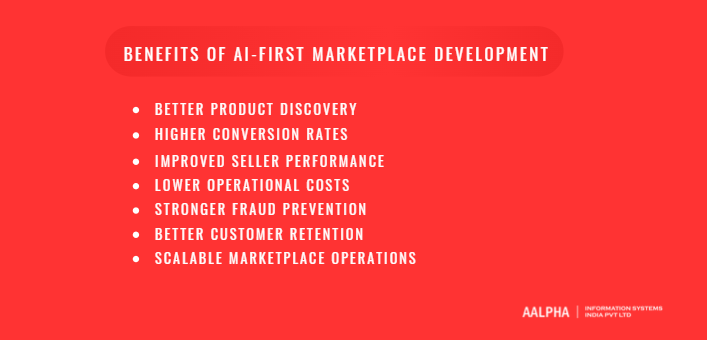
AI-first marketplace development gives marketplace owners a stronger foundation for growth because it improves both user experience and backend operations. A marketplace has to serve many stakeholders at the same time: buyers want fast discovery and trusted transactions, sellers want visibility and better sales tools, admins need control and operational clarity, and support teams need faster ways to resolve issues. AI helps connect these needs by using data, automation, prediction, and intelligent decision support across the platform. When implemented properly, AI can improve conversion, reduce manual work, prevent fraud, improve seller quality, and make marketplace operations easier to scale.
-
Better Product Discovery
Product and service discovery is one of the biggest reasons to build an AI-first marketplace. In a traditional marketplace, users often depend on exact keywords, filters, categories, and manual browsing. This works only when users know exactly what they want and the marketplace has clean, well-structured data. In reality, customers may search with incomplete phrases, spelling mistakes, local terms, voice queries, or broad intent-based requests such as “affordable laptop for students” or “best plumber near me today.” AI reduces this search friction by understanding user intent, product meaning, service context, location, price preference, and previous behavior.
Better discovery means users can reach relevant products or services faster. A fashion marketplace can recommend clothing based on style, size, season, occasion, and purchase history. A B2B marketplace can show suppliers that match quantity, location, certification, and delivery expectations. A service marketplace can match customers with providers based on skills, availability, ratings, and budget. This reduces the number of irrelevant results and makes the marketplace more useful from the first interaction.
-
Higher Conversion Rates
AI-first marketplaces can improve conversion rates because they help users make decisions with less effort. Personalized recommendations, smart ranking, guided buying, and product comparison tools reduce the confusion that often occurs when customers face too many choices. Instead of showing the same listings to every user, AI can prioritize products, sellers, or service providers that are more likely to match the user’s intent and buying stage.
For example, a customer browsing mobile phones may receive recommendations based on camera quality, gaming performance, battery life, price range, and brand preference. A customer looking for a tutor may see profiles ranked by subject expertise, language preference, time availability, and past student ratings. Guided buying assistants can ask simple questions and narrow down options, which helps users feel more confident before checkout. This is important because customers are more likely to complete a purchase when they understand why a product or service is suitable for them. AI also supports checkout confidence through review summaries, seller trust scores, return policy highlights, delivery estimates, and personalized offers.
-
Improved Seller Performance
A marketplace grows faster when sellers perform well. AI can help sellers improve listing quality, pricing, inventory planning, response times, and customer satisfaction. Listing suggestions are one of the most practical benefits. AI can recommend better product titles, descriptions, tags, attributes, images, and categories, helping sellers create listings that are easier to find and more likely to convert.
Pricing insights also help sellers make better commercial decisions. AI can compare similar products, demand levels, customer behavior, stock movement, and competitor pricing to suggest whether a product is priced too high, too low, or suitable for a discount. Demand forecasting helps sellers understand which products or services may see higher demand during weekends, festivals, seasonal periods, local events, or business cycles. Inventory alerts can warn sellers before popular products go out of stock or before slow-moving inventory affects profitability. Seller quality scoring can combine ratings, cancellations, response time, delivery performance, refund history, and complaint patterns to help marketplace owners identify top-performing sellers and those needing improvement.
-
Lower Operational Costs
AI can reduce operational costs by automating repetitive and time-consuming marketplace tasks. Customer support is a clear example. Many support requests are related to order status, refunds, returns, cancellations, delivery delays, account issues, and payment confirmations. AI chatbots and support assistants can answer common questions, route tickets to the right team, suggest agent responses, and escalate complex cases when needed.
Moderation is another area where AI reduces manual workload. The system can detect incomplete listings, duplicate products, prohibited items, misleading images, suspicious reviews, and incorrect categories before they create larger problems. AI can also support seller onboarding by checking documents, identifying missing information, assigning risk scores, and guiding vendors through setup. Reporting becomes more useful because AI can highlight trends, anomalies, and action items instead of forcing admins to review large dashboards manually. Workflow automation across refunds, approvals, alerts, catalog checks, and vendor communications can help teams manage more users and transactions without increasing headcount at the same rate.
-
Stronger Fraud Prevention
Fraud prevention is essential for marketplace trust. AI can identify suspicious behavior faster by analyzing patterns across users, sellers, payments, listings, reviews, devices, locations, and transaction history. Fake sellers may show signs such as duplicate business details, suspicious document patterns, poor listing behavior, high cancellation rates, unusual bank information, or repeated customer complaints. AI can flag these accounts for review before they damage customer trust.
Payment fraud can be detected through unusual order values, repeated failed payment attempts, mismatched account details, risky login behavior, or abnormal transaction frequency. Fake reviews can be identified by repeated wording, review clusters from related accounts, sudden rating spikes, or unnatural timing patterns. Duplicate accounts, return abuse, refund misuse, spam listings, and policy violations can also be flagged through risk scoring. AI does not remove the need for admin review, but it helps teams identify risky activity earlier and focus their attention on the most serious cases.
-
Better Customer Retention
AI-first marketplaces can retain customers by making every visit more relevant. Personalization allows the platform to remember what users browse, buy, compare, save, reorder, and ignore. This helps the marketplace recommend products, services, sellers, offers, and reminders that match the customer’s actual needs. Repeat purchase suggestions are especially useful in grocery, medicines, office supplies, pet care, beauty products, subscriptions, and B2B consumables.
Loyalty insights help marketplace owners understand which users are frequent buyers, which users are at risk of becoming inactive, and which offers may bring them back. Churn prediction can identify customers who have stopped browsing, abandoned carts repeatedly, reduced purchase frequency, or had unresolved support issues. Automated re-engagement through email, push notifications, WhatsApp, SMS, or in-app messages can bring users back with relevant recommendations rather than generic promotions. This creates a more meaningful retention strategy and reduces dependence on constant paid acquisition.
-
Scalable Marketplace Operations
As a marketplace grows, operational complexity increases across users, vendors, listings, categories, payments, support requests, locations, and transactions. Manual systems that work at an early stage often become slow and expensive at scale. AI helps marketplace owners handle this growth by improving automation, prediction, monitoring, and decision support.
A growing marketplace can use AI to detect demand gaps, recommend new categories, identify weak sellers, forecast revenue, flag operational risks, monitor support load, and improve search quality. Multi-city marketplaces can use AI to compare location-level performance, identify high-demand zones, predict supply shortages, and recommend expansion priorities. Multi-vendor platforms can use AI to manage catalog quality, seller performance, fraud alerts, and customer satisfaction across thousands or millions of listings.
The real benefit of AI-first marketplace development is not only automation. It is the ability to make the marketplace smarter as it grows. With better discovery, higher conversion, stronger seller tools, lower operational workload, better fraud control, improved retention, and scalable admin systems, AI-first marketplaces are better prepared to compete in markets where speed, relevance, and trust directly affect growth.
AI-First Marketplace Development Process
Building an AI-first marketplace requires a structured development process because the platform is not limited to standard buyer, seller, and admin workflows. The project must combine marketplace strategy, user experience design, backend architecture, payment systems, data planning, AI integration, testing, and post-launch improvement. A successful AI-first marketplace is not built by adding a chatbot or recommendation engine at the end. It is planned from the beginning around marketplace data, user behavior, operational rules, automation opportunities, and long-term scalability.
-
Business Discovery and Marketplace Strategy
The first step is business discovery. Before development begins, the marketplace owner needs to define what type of marketplace is being built, who it will serve, how transactions will happen, and how the platform will earn revenue. A B2C retail marketplace, B2B procurement marketplace, service marketplace, rental marketplace, healthcare marketplace, and hyperlocal marketplace all require different workflows, user journeys, commission rules, data structures, and AI use cases.
At this stage, the team should identify the business model, target users, buyer segments, seller segments, service providers, product categories, locations, and transaction types. For example, a B2B marketplace may need supplier verification, bulk pricing, quotation workflows, purchase approvals, and credit terms. A hyperlocal delivery marketplace may need live location tracking, delivery partner assignment, store-level availability, and city-wise pricing rules. A rental marketplace may need booking calendars, deposits, asset availability, cancellation policies, and maintenance workflows.
Competitive research is also important. The team should study existing marketplace platforms, pricing models, seller onboarding flows, search experience, category structure, app ratings, customer complaints, and operational gaps. This helps define the marketplace’s positioning and priority features. User journeys should be mapped for buyers, sellers, admins, support teams, and any delivery or service partners involved in the platform. These journeys become the base for feature planning, UI/UX design, backend development, and AI implementation.
-
Feature Planning and MVP Scope
Once the marketplace strategy is clear, the next step is feature planning. A common mistake is trying to build every feature in the first version. AI-first marketplace development works better when the project is divided into must-have MVP features, priority AI features, advanced features, and future roadmap items.
Must-have marketplace features usually include user registration, profile management, listing pages, search, filters, cart or booking flow, payments, order management, seller panel, admin dashboard, notifications, ratings, reviews, and support workflows. These features form the operational foundation of the marketplace.
AI features should be selected based on business value, data availability, and launch priorities. For an MVP, the most useful AI features may include AI-powered search, basic recommendations, listing optimization, chatbot support, or fraud flagging. More advanced AI features such as dynamic pricing, predictive demand forecasting, seller quality scoring, AI agents, and custom recommendation engines can be planned for later phases. This phased approach helps control cost, reduce development risk, and launch the marketplace faster with a practical feature set.
-
Data Strategy and AI Readiness
AI-first marketplaces depend heavily on data quality. Without structured and reliable data, AI features will produce weak recommendations, poor search results, inaccurate predictions, or misleading insights. Data strategy should begin before development, not after launch.
The development team should define what data will be collected, how it will be stored, and how it will be used by the platform. Product data may include titles, descriptions, categories, images, specifications, tags, inventory, pricing, and seller details. Seller data may include business documents, location, ratings, fulfillment performance, response time, cancellation rate, and settlement history. User behavior data may include searches, clicks, wishlists, cart activity, purchases, returns, reviews, and support interactions.
Transaction history, reviews, support tickets, payment activity, refund patterns, and third-party datasets can also improve AI models. For example, review data can support sentiment analysis, support tickets can help automate customer service, and transaction data can power recommendations or fraud detection. Data governance is also important. The platform should follow secure data storage practices, permission controls, consent requirements, privacy rules, and clear policies for how AI uses customer and seller data.
-
UI/UX Design
UI/UX design plays a major role in marketplace success because buyers, sellers, and admins all interact with the platform differently. The customer experience should make search, discovery, comparison, checkout, booking, payment, order tracking, and support simple. AI should improve the journey without making the interface confusing or overly automated.
For buyers, the design should focus on fast search journeys, relevant recommendations, clean product or service pages, trust signals, easy checkout, saved preferences, and transparent order status. For sellers, the interface should make onboarding, listing creation, inventory updates, pricing changes, order management, settlement tracking, and analytics easy to manage. For admins, workflows should be designed around vendor approvals, catalog moderation, fraud alerts, commission control, refund decisions, reports, and user management.
Mobile-first design is important for most marketplaces because buyers and sellers often use mobile devices for browsing, ordering, responding to leads, updating inventory, or checking earnings. Search journeys should be designed carefully because AI-powered discovery may include natural language search, voice search, recent searches, personalized suggestions, filters, and recommended categories. Checkout should be short, clear, and trustworthy because even a smart marketplace can lose conversions if payment, address selection, booking confirmation, or delivery information is confusing.
-
Backend and Marketplace Architecture
The backend is the operational engine of an AI-first marketplace. It should be built to handle users, sellers, product catalogs, orders, payments, commissions, AI workflows, notifications, analytics, and admin controls. A weak backend can limit growth even if the frontend looks good.
Marketplace architecture usually includes APIs, databases, authentication, user roles, catalog management, order management, payment logic, seller settlement, notification systems, admin permissions, and reporting modules. APIs connect the customer app, seller panel, admin dashboard, AI services, payment gateways, logistics partners, KYC providers, communication tools, and analytics systems.
Database design is especially important. A marketplace may need relational databases for users, orders, payments, commissions, and settlements, while search systems, caching layers, file storage, and vector databases may be used for faster discovery and AI-powered retrieval. User roles should be clearly defined for buyers, sellers, vendors, admins, support agents, finance teams, delivery partners, and super admins. Admin controls should allow the platform owner to manage categories, users, sellers, commissions, refunds, disputes, featured listings, fraud alerts, and content moderation.
-
AI Model and Integration Planning
AI planning should be based on the marketplace’s actual use cases, data maturity, and budget. Not every AI feature requires a custom model. Many marketplaces can start with existing AI APIs, recommendation libraries, vector search tools, and LLM-based workflows before investing in fully custom machine learning systems.
Existing AI APIs are useful for chatbots, text generation, product description improvement, review summarization, language translation, support automation, and guided shopping. Vector search can support semantic search, natural language discovery, product similarity, and knowledge retrieval. Recommendation engines can suggest products, sellers, service providers, or repeat purchases based on user behavior, product relationships, and transaction data. LLMs can support conversational shopping, seller support, admin summaries, and automated content creation.
Custom models may be required when the marketplace has enough proprietary data and needs domain-specific results. For example, a large B2B marketplace may build custom supplier ranking models, while a hyperlocal marketplace may build demand forecasting and rider assignment models. Machine learning pipelines should be planned for data collection, training, evaluation, monitoring, and continuous improvement. AI outputs should also be logged and reviewed so that the team can measure accuracy, bias, false positives, and business impact.
-
Marketplace App and Web Development
Development usually includes the customer-facing website or mobile app, seller panel, admin dashboard, backend APIs, database systems, payment integrations, AI services, and third-party integrations. Depending on the business model, the platform may require Android and iOS apps, a responsive web application, a vendor portal, a delivery partner app, or separate dashboards for support and finance teams.
The customer app or website should include onboarding, search, recommendations, product or service pages, cart or booking, payments, order history, tracking, reviews, support, and notifications. The seller panel should include profile setup, document submission, listing management, inventory, pricing, orders, earnings, analytics, promotions, and support. The admin dashboard should provide user management, seller approval, product moderation, commission settings, refunds, disputes, reports, fraud alerts, AI insights, and marketplace configuration.
Integrations may include payment gateways, KYC tools, maps, delivery APIs, SMS, WhatsApp, email, push notifications, CRM, analytics, accounting tools, and cloud storage. Frontend development should be responsive, fast, and accessible because marketplace users may access the platform from different devices, screen sizes, and network conditions.
-
Testing and Quality Assurance
Testing is critical because marketplaces involve real users, sellers, transactions, payments, orders, and sensitive data. Functional testing should confirm that registration, search, listings, cart, bookings, payments, order management, seller workflows, admin actions, refunds, reviews, and notifications work correctly.
AI output testing is equally important. The team should test whether search results are relevant, recommendations make sense, chatbot answers are accurate, product descriptions are appropriate, fraud alerts are useful, and AI summaries do not mislead users. AI systems should be tested for edge cases, biased results, poor-quality input data, multilingual queries, offensive content, and incorrect recommendations.
Performance testing checks whether the marketplace can handle traffic spikes, high search volume, large catalogs, multiple vendors, and order surges. Payment testing should cover successful payments, failed payments, refunds, split payments, seller settlements, wallet flows, and webhook responses. Security testing should check authentication, permissions, data access, API security, payment data handling, and admin controls. User acceptance testing helps confirm that buyers, sellers, and admins can complete their real workflows without confusion.
-
Launch and Post-Launch Optimization
The launch should usually begin with a soft rollout instead of a full public release. A soft launch allows the marketplace owner to test real users, real sellers, real orders, support workflows, AI output quality, payment flows, and admin operations under controlled conditions. Feedback from early users helps identify gaps in search, onboarding, checkout, vendor management, support, and marketplace rules.
After launch, AI-first marketplace development becomes an ongoing improvement process. AI models and workflows should be tuned based on search behavior, click-through rates, conversion data, support tickets, reviews, fraud alerts, and seller performance. Marketplace analytics should track active users, repeat purchases, seller activity, order volume, cancellation rate, average order value, support load, conversion rate, and revenue performance.
Conversion optimization may include improving search ranking, product pages, checkout steps, offers, recommendation placements, and onboarding flows. Support monitoring helps identify frequent issues and automate more responses over time. Scaling may involve adding new categories, locations, vendors, mobile apps, AI models, cloud infrastructure, or third-party integrations. A strong post-launch plan helps the marketplace improve continuously and become more valuable as more users, sellers, data, and transactions are added.
AI-First Marketplace Development Cost
The cost of AI-first marketplace development depends on the marketplace model, number of user roles, platform complexity, AI features, integrations, data maturity, compliance needs, and long-term scalability requirements. A simple AI-assisted marketplace can be built with ready-made APIs, basic recommendation logic, standard payment integration, and limited automation. A large enterprise-grade marketplace may require custom AI models, advanced fraud detection, dynamic pricing, multilingual search, seller automation, mobile apps, vendor settlement systems, and large-scale cloud infrastructure. As a practical estimate, an AI-first marketplace can cost anywhere from $25,000 to $60,000 for a basic MVP, $60,000 to $150,000 for a mid-level platform, and $150,000 to $400,000 or more for an advanced enterprise marketplace, depending on scope, development location, AI complexity, and integrations.
-
Basic AI Marketplace MVP Cost
A basic AI marketplace MVP usually includes a customer-facing web platform or mobile app, vendor panel, admin dashboard, product or service listings, basic search, category filters, payment integration, notifications, ratings, reviews, order or booking management, and limited AI functionality. In this stage, the goal is not to build a fully automated marketplace but to validate the business model, user demand, seller onboarding process, and transaction flow.
For an MVP, AI features are usually kept practical and affordable. These may include basic product recommendations, AI-assisted search, simple chatbot support, automated FAQ replies, product description generation, or listing category suggestions. Many MVPs use existing AI APIs instead of custom models because they reduce development time and upfront cost. A basic AI-first marketplace MVP may cost around $25,000 to $60,000 if the scope is controlled and the platform starts with limited categories, limited user roles, and standard workflows. The cost may increase if both Android and iOS apps are required from the first phase, or if the marketplace needs complex logistics, escrow payments, vendor settlements, KYC, or real-time tracking.
-
Mid-Level AI Marketplace Cost
A mid-level AI marketplace is suitable for businesses that want to launch a more complete platform with better automation, improved admin controls, stronger seller tools, and more personalized customer experiences. This version may include advanced search, personalized recommendations, seller analytics, AI-based listing optimization, automated support workflows, better moderation, coupon management, commission logic, detailed reporting, and a scalable backend.
In this cost range, AI is more deeply connected to the marketplace experience. Search may include semantic matching, typo tolerance, product similarity, and intent-based results. Recommendations may be based on browsing history, purchase behavior, category interest, and similar user patterns. Seller analytics may show performance trends, listing quality, pricing suggestions, inventory movement, and customer feedback summaries. AI-based listing optimization can help vendors create better titles, descriptions, attributes, tags, and categories.
A mid-level AI marketplace may cost around $60,000 to $150,000, depending on whether the platform is web-only, app-first, or built across web, Android, and iOS. Costs also depend on how many integrations are needed, such as payment gateways, maps, logistics APIs, CRM tools, marketing automation, KYC systems, tax tools, or accounting software. This stage usually requires a stronger backend architecture so that the marketplace can support higher traffic, more vendors, larger catalogs, and more transaction volume.
-
Advanced AI-First Marketplace Cost
An advanced AI-first marketplace is built for scale, automation, and enterprise-grade operations. These platforms often support large catalogs, multiple cities or countries, thousands of vendors, complex payment flows, custom commission logic, multilingual users, advanced analytics, and high transaction volume. They may also need strong compliance, security, audit logs, role-based access, service-level monitoring, and high availability infrastructure.
Advanced AI features can include custom recommendation engines, fraud detection models, dynamic pricing, demand forecasting, churn prediction, seller quality scoring, automated product moderation, multilingual search, voice search, image-based search, conversational shopping, AI-powered admin dashboards, and predictive marketplace analytics. Some platforms may also use AI agents for seller onboarding, support triage, pricing recommendations, refund analysis, and operational alerts.
The cost for an advanced AI-first marketplace can range from $150,000 to $400,000 or more. The higher end usually applies when the marketplace requires custom machine learning pipelines, proprietary training data, multi-region infrastructure, mobile apps, complex vendor automation, advanced integrations, and strict security or compliance requirements. These projects are not one-time builds only; they usually require ongoing AI tuning, cloud optimization, security updates, support, and feature expansion after launch.
-
Cost by Marketplace Type
The type of marketplace has a major impact on development cost. A B2C marketplace for retail, fashion, electronics, grocery, or consumer goods may have lower complexity if it follows a standard catalog, cart, payment, and delivery model. However, costs increase with large catalogs, inventory sync, personalization, seller settlements, returns, and logistics integrations.
A B2B marketplace is usually more expensive because it may require supplier discovery, RFQ workflows, bulk pricing, negotiated rates, purchase approvals, credit terms, tax logic, business verification, and procurement dashboards. Service marketplaces can also become complex because they need provider profiles, calendars, availability, booking flows, skill-based matching, service pricing, reviews, and dispute handling. Rental marketplaces require asset availability calendars, deposits, booking duration logic, damage policies, cancellation rules, maintenance workflows, and dynamic pricing. Hyperlocal marketplaces can become expensive if they require live tracking, store-level inventory, delivery partner apps, rider assignment, route optimization, and city-wise pricing rules. Niche marketplaces may cost less if the workflow is simple, but highly regulated niches such as healthcare, finance, legal, or insurance can require additional compliance and security work.
-
Cost by Feature Complexity
Feature complexity is one of the biggest cost drivers. AI-powered search is usually more affordable when built using existing search systems, vector search, and managed AI APIs. It becomes more expensive when the marketplace needs multilingual semantic search, image search, voice search, custom ranking models, or large-scale real-time indexing. Recommendation engines can start with simple rule-based or behavior-based recommendations, but custom recommendation systems require more data engineering, testing, and tuning.
Fraud detection can begin with risk rules and anomaly alerts, but advanced fraud models require transaction history, device data, seller behavior data, payment signals, and continuous monitoring. Chatbots are affordable when they handle FAQs and order status queries, but they become more expensive when they need deep integration with payments, refunds, seller communication, inventory, bookings, and support tickets. Analytics dashboards also vary widely in cost. A basic dashboard may show users, orders, revenue, commissions, and seller reports, while a custom AI-powered dashboard may include revenue forecasts, churn alerts, seller scores, fraud alerts, demand gaps, and operational recommendations.
-
Cost of AI APIs and Infrastructure
AI-first marketplace cost is not limited to development. AI APIs and infrastructure create recurring expenses. LLM API usage is usually charged based on input tokens, output tokens, model type, and usage volume. OpenAI’s official API pricing page lists model-specific pricing and notes that certain regional processing endpoints may carry an uplift for eligible models, so production cost should be estimated using expected usage rather than fixed assumptions. AWS Bedrock also offers model-based pricing across different providers and service tiers, including on-demand, batch inference, and reserved options, while Google Vertex AI pricing varies by model family, endpoint type, and usage pattern.
Vector database cost is another important factor when building semantic search, recommendations, product similarity, or retrieval-augmented AI features. Pinecone’s pricing documentation shows plan minimums ranging from starter options to higher enterprise commitments, and its pricing page lists separate usage-based charges such as read units, write units, storage, and assistant-related token limits. This means a small marketplace may spend very little at the beginning, while a high-traffic marketplace with large catalogs and frequent searches may spend significantly more as usage grows.
Cloud hosting costs include application servers, databases, file storage, CDN, caching, monitoring, backups, queues, logs, and auto-scaling. Model training can add extra cost if the marketplace builds custom machine learning models instead of using managed APIs. Storage costs increase as the marketplace collects product images, seller documents, user activity, transaction records, support tickets, reviews, and AI logs. Monitoring and scaling costs also increase as the platform grows across users, sellers, categories, and locations.
-
Hidden and Ongoing Costs
AI-first marketplace development also includes hidden and ongoing costs that many businesses underestimate. Maintenance is required to fix bugs, improve performance, update dependencies, patch security issues, and keep the platform compatible with new device and browser versions. Mobile apps need app store updates, OS compatibility changes, crash monitoring, and performance improvements.
AI tuning is another ongoing cost. Search ranking, recommendations, fraud alerts, chatbot answers, listing suggestions, and admin insights must be monitored and improved after launch. If the marketplace receives poor data, irrelevant reviews, spam listings, or changing user behavior, AI output quality may drop unless the system is regularly reviewed. Support costs include customer service, seller support, dispute handling, content moderation, and operational monitoring. Compliance work may also be required for payment data, KYC, privacy regulations, healthcare data, financial services, or location-based services.
A practical annual maintenance budget for an AI-first marketplace is often 15% to 25% of the initial development cost, though this can be higher for platforms with custom AI models, heavy cloud usage, high transaction volume, strict compliance, or continuous feature development.
How to Reduce Marketplace Development Cost
The best way to reduce AI-first marketplace development cost is to start with an MVP and build in phases. Instead of launching with every AI feature, the first version should focus on core transactions, seller onboarding, search, payments, admin control, and one or two high-value AI features. For many marketplaces, AI-powered search, basic recommendations, listing assistance, or chatbot support are enough for the first release.
Using existing AI APIs can reduce upfront cost compared to building custom models from the beginning. Reusable marketplace modules for authentication, listings, payments, notifications, admin panels, vendor dashboards, ratings, and reviews can also reduce development effort. Cloud-managed services can reduce infrastructure setup time, especially for databases, storage, search, monitoring, and AI deployment. A phased AI rollout allows the business to collect real user and transaction data before investing in custom recommendation engines, fraud models, dynamic pricing, or demand forecasting.
Businesses should also avoid overbuilt features in the early stage. Complex AI automation, multi-country architecture, custom dashboards, advanced analytics, and full mobile apps may not be necessary for the first launch. A focused MVP with a clear roadmap helps control budget while still giving the business a strong foundation for future growth.
Why Work With an AI Marketplace Development Company
Building an AI-first marketplace is more complex than building a standard mobile app or eCommerce website. A marketplace has multiple user groups, transaction flows, payment rules, vendor operations, admin workflows, support processes, and trust requirements. When artificial intelligence is added to this structure, the project also needs data planning, AI model selection, search architecture, recommendation logic, automation workflows, and continuous optimization. This is why many businesses choose to work with an AI marketplace development company instead of relying only on basic app development resources.
-
AI-First Marketplaces Need More Than Basic App Development
A basic app development project may focus on screens, navigation, forms, user accounts, and simple backend APIs. An AI-first marketplace needs a much wider technical foundation. The platform may require a customer-facing web application or mobile app, seller panel, admin dashboard, product or service catalog, order management system, payment gateway, commission logic, settlement workflows, search engine, analytics dashboard, notification system, and third-party integrations. Depending on the business model, it may also need booking logic, inventory management, delivery tracking, KYC verification, dispute handling, refunds, subscription plans, or vendor performance reports.
AI adds another layer of complexity. The marketplace may need AI-powered search, personalized recommendations, chatbot support, product listing optimization, fraud detection, dynamic pricing, review analysis, demand forecasting, or AI-powered admin insights. These features require proper data structure, API integration, model evaluation, output testing, and monitoring. A development company with marketplace and AI experience can help define which AI features are useful for the first version and which features should be added later.
-
Custom Development Helps With Real Marketplace Operations
Every marketplace has its own operational rules. A retail marketplace may need category-wise commissions, seller discounts, product moderation, and return policies. A B2B marketplace may need quotation workflows, supplier verification, bulk pricing, negotiated rates, purchase approvals, and invoice management. A service marketplace may need provider availability, booking slots, cancellation rules, location filters, and dispute workflows. A rental marketplace may need deposits, asset availability, maintenance schedules, damage policies, and duration-based pricing. Hyperlocal marketplaces may need store-level inventory, delivery partner assignment, city-wise pricing, and real-time tracking.
Custom development helps convert these real business rules into working software. This includes commission rules, seller settlements, category logic, pricing rules, AI search, product moderation, fraud workflows, refund logic, and multi-location expansion. For example, a marketplace owner may want different commission rates for different seller categories, automatic seller settlement after order completion, manual approval for high-risk listings, AI alerts for suspicious reviews, or separate pricing rules for each city. These requirements cannot always be handled properly with generic marketplace templates. A custom-built platform gives the business more control over workflows, scaling, user experience, and revenue logic.
-
Long-Term Support Is Important
An AI-first marketplace does not stop after launch. Once real buyers, sellers, orders, payments, reviews, support tickets, and behavioral data start flowing through the platform, the system needs regular monitoring and improvement. AI-powered search may need tuning to improve result relevance. Recommendations may need adjustments based on user behavior. Chatbot responses may need refinement. Fraud detection rules may need updates as new abuse patterns appear. Product moderation and seller scoring may also need continuous review.
Apart from AI tuning, the marketplace also needs bug fixes, security updates, server optimization, payment gateway updates, API maintenance, performance monitoring, and app store updates. Mobile apps must stay compatible with new Android and iOS versions. Payment systems must be updated when gateway rules or compliance requirements change. Servers must be optimized as traffic, catalog size, and transaction volume increase. Long-term technical support helps the marketplace remain stable, secure, and ready for new features.
-
Working With the Right Development Partner
Businesses planning to build an AI-first marketplace should work with a team that understands both marketplace operations and AI integration. The right partner can help plan the architecture, select the right technology stack, build customer apps, create seller panels, develop admin dashboards, integrate payment systems, implement AI-powered features, and support the platform after launch.
Companies can work with experienced software development teams such as Aalpha when the project requires marketplace architecture, mobile app development, backend development, AI integration, admin dashboards, seller panels, payment systems, analytics, and long-term technical support. A capable development partner can help turn a marketplace idea into a scalable platform that supports buyers, sellers, admins, and future business growth.
Conclusion
AI-first marketplace development helps businesses build smarter, faster, and more scalable digital platforms. By using AI across search, recommendations, seller tools, fraud detection, support, pricing, analytics, and admin operations, marketplaces can improve user experience while reducing manual workload. Buyers find relevant products or services faster, sellers get better tools to manage performance, and marketplace owners gain stronger control over growth, quality, and risk.
However, building an AI-first marketplace requires more than adding a chatbot or recommendation feature. It needs the right marketplace architecture, clean data structure, secure payment systems, seller workflows, admin controls, AI integrations, and long-term technical support. A well-planned MVP can help businesses launch faster, validate demand, and add advanced AI features in phases.
Businesses planning to build an AI-first marketplace can connect with Aalpha for custom marketplace development, AI integration, mobile app development, backend systems, seller panels, admin dashboards, payment integration, and ongoing technical support.