






Hyperlocal delivery app development has become an important area of digital commerce because customers now expect everyday products and services to reach them faster, with better tracking and fewer manual steps. A hyperlocal delivery app connects customers with nearby stores, restaurants, pharmacies, service providers, or delivery partners within a limited geographic area. Instead of moving goods across cities, states, or countries, the focus is on fast local fulfilment within a city, neighbourhood, or specific delivery zone. This model is commonly used for food delivery, grocery delivery, medicine delivery, parcel pickup and drop, flower delivery, laundry pickup, home services, and other location-based services where speed and proximity matter.
In simple terms, hyperlocal delivery means fulfilling customer demand from the nearest available seller or service provider. For example, a customer may order groceries from a nearby store, food from a local restaurant, medicines from a pharmacy, or send a parcel across town through an on-demand delivery partner. The app handles the full workflow, including location detection, store discovery, order placement, payment, delivery partner assignment, live tracking, notifications, and delivery confirmation. This makes the entire process easier for customers, merchants, delivery partners, and platform owners.
The growth of hyperlocal delivery apps is driven by several factors. Customers prefer convenience and faster fulfilment, especially for daily-use products. Local businesses are also moving online because app-based ordering helps them reach more customers beyond walk-ins and phone orders. Smartphone usage, GPS-based tracking, digital payments, push notifications, and cloud-based backend systems have made it easier to build reliable delivery platforms for both large cities and smaller local markets. At the same time, businesses are looking for delivery models that can support real-time operations, flexible pricing, local inventory, and better customer retention.
This guide explains everything businesses need to know about hyperlocal delivery app development. It covers the meaning of hyperlocal delivery, popular app types, business models, essential features, customer app modules, delivery partner apps, merchant panels, admin dashboards, technology stack, development process, cost factors, common challenges, monetization options, and best practices for building a scalable hyperlocal delivery platform.
What Is a Hyperlocal Delivery App?
A hyperlocal delivery app is a digital platform that connects customers with nearby merchants, service providers, and delivery partners for fast local fulfilment. It brings the complete order and delivery process into one system, allowing customers to discover nearby stores or services, place orders, make payments, track deliveries, and receive real-time updates from a mobile app or website.
Hyperlocal delivery apps are commonly used for food delivery, grocery delivery, medicine delivery, parcel pickup and drop, flower delivery, cake delivery, laundry pickup, home services, and other location-based services where speed and proximity are important. Unlike standard ecommerce platforms that may ship products from a central warehouse or another city, a hyperlocal delivery app focuses on fulfilling demand from nearby sellers within a specific neighbourhood, city area, or delivery zone.
Basic Definition
A hyperlocal delivery app connects four main users: customers, local merchants, service providers, and delivery partners. Customers use the app to search for products or services available near their location. Merchants or service providers use the platform to manage orders, update products, confirm availability, and prepare items for pickup. Delivery partners use a separate app to accept delivery requests, collect orders, navigate to the customer, and complete deliveries.
The platform owner or admin manages the full operation through an admin dashboard. This dashboard controls users, stores, delivery zones, pricing, commissions, payments, refunds, support tickets, promotions, and reports. Because of this multi-user structure, hyperlocal delivery app development usually requires more than a customer-facing app. It often includes a customer app, delivery partner app, merchant panel, and admin dashboard, all connected to a strong backend system.
How Hyperlocal Delivery Apps Work
The process usually starts when a customer enters a delivery address or allows the app to detect their location through GPS. Based on this location, the app shows nearby stores, restaurants, pharmacies, products, or services that are available in that specific area. The customer selects the required items or service, adds them to the cart, chooses a payment method, and places the order.
Once the order is placed, the merchant or service provider receives a notification and confirms the order. After confirmation, the system assigns the order to a delivery partner based on factors such as pickup distance, delivery location, partner availability, current workload, service zone, and assignment rules. The delivery partner then reaches the pickup location, collects the order, and starts the delivery.
During the delivery process, the customer can track the order in real time. The app may show rider location, estimated arrival time, pickup status, route movement, payment status, and delivery updates. The order is completed after delivery confirmation, which may happen through OTP, photo proof, customer confirmation, QR code scan, or app-based status update. After completion, the customer may rate the order, delivery partner, or merchant.
Hyperlocal vs Traditional Delivery
Hyperlocal delivery is different from traditional courier delivery, marketplace logistics, and long-distance ecommerce delivery. A traditional courier model usually works through scheduled pickup, sorting centres, hub-based movement, and longer delivery timelines. It is suitable for documents, parcels, and shipments that may travel across cities, states, or countries.
Long-distance ecommerce delivery usually depends on warehouses, fulfilment centres, regional hubs, transport partners, and last-mile delivery networks. The customer may order from a seller located far away, and the product may pass through multiple logistics stages before reaching the final address. Marketplace logistics can also involve several sellers, third-party logistics providers, and central inventory systems.
Hyperlocal delivery works differently because the seller, customer, and delivery partner are usually located within the same local area. The goal is fast fulfilment from the nearest available merchant or service provider. This makes the delivery faster and more convenient, but it also increases the need for accurate GPS tracking, real-time rider assignment, delivery zone management, merchant coordination, payment handling, and live operational control.
Popular Types of Hyperlocal Delivery Apps
Hyperlocal delivery apps can be built for a single category or for multiple local services within the same platform. The right model depends on the target market, merchant network, customer demand, delivery capacity, and revenue strategy. Some businesses launch with one category, such as food or groceries, while others build a multi-service model that combines local commerce, parcel delivery, and on-demand services.
-
Food Delivery Apps
Food delivery is one of the most common types of hyperlocal delivery app models. These apps connect customers with nearby restaurants, cafes, cloud kitchens, snack outlets, bakeries, and quick-meal providers. Customers can browse menus, check prices, view preparation times, apply offers, place orders, pay online or by cash, and track the delivery partner in real time.
For restaurants, a food delivery app creates an additional sales channel beyond dine-in customers and phone orders. Cloud kitchens also depend heavily on app-based ordering because they usually do not have a customer-facing dining space. A strong food delivery app should support menu management, item availability, preparation status, delivery partner assignment, order cancellation rules, ratings, refunds, and promotional campaigns. In local markets, food delivery apps can also work well for breakfast, lunch, evening snacks, dinner, and late-night food demand.
-
Grocery Delivery Apps
Grocery delivery apps allow customers to order daily essentials, packaged foods, fruits, vegetables, dairy products, household items, and personal care products from nearby stores. These apps can support scheduled delivery, where customers choose a delivery slot, or express delivery, where orders are delivered within a short time window.
Inventory management is especially important in grocery delivery app development. Since grocery items change frequently, the platform should support stock updates, item availability, product variants, weight-based pricing, substitutions, and out-of-stock handling. For example, if a selected brand of rice or milk is unavailable, the app can allow the merchant to suggest a replacement and ask the customer to approve it. Grocery delivery apps also need careful category organization, search filters, repeat order options, and clear delivery fee logic because customers often purchase multiple items in one order.
-
Medicine Delivery Apps
Medicine delivery apps connect customers with nearby pharmacies and healthcare product sellers. These apps can be used for over-the-counter medicines, wellness products, healthcare essentials, prescription medicines, and recurring medicine orders. Since medicine delivery involves sensitive products, the app must be designed with verification, compliance, and safety in mind.
A medicine delivery app may include prescription upload, pharmacist verification, order approval, medicine availability checks, dosage-related disclaimers, and secure customer records. For prescription medicines, the pharmacy should verify the uploaded prescription before accepting the order. The delivery process must also consider safe handling, correct packaging, temperature-sensitive products where required, and proof of delivery. Depending on the country or region, medicine delivery platforms may need to follow healthcare, pharmacy, data privacy, and prescription sale regulations.
-
Parcel and Courier Delivery Apps
Parcel and courier delivery apps focus on intra-city pickup and drop services. Customers can use these apps to send documents, clothes, small electronics, business samples, keys, files, gifts, and other permitted items within a city or service area. Unlike ecommerce delivery, where the product is sold by a merchant, parcel delivery apps mainly provide the logistics layer between a sender and receiver.
This model is useful for individuals, small businesses, offices, retailers, print shops, repair stores, legal firms, clinics, and local vendors that need fast same-city delivery. A parcel delivery app should support pickup address, drop address, package type, package weight, delivery instructions, pricing based on distance, live tracking, proof of pickup, proof of delivery, and receiver confirmation. For businesses, it can also include recurring deliveries, monthly billing, delivery history, GST invoices, and internal user roles.
-
Flower, Gift, and Cake Delivery Apps
Flower, gift, and cake delivery apps are built around occasion-based local delivery. Customers use these platforms for birthdays, anniversaries, festivals, celebrations, corporate gifting, and last-minute surprises. Since these orders are often time-sensitive, same-day delivery and scheduled delivery are important features.
These apps should support product images, customization options, greeting messages, delivery slots, add-ons, and special handling instructions. For example, a cake order may require flavour selection, weight selection, custom text, candles, and delivery at a specific time. Flower and gift orders may require careful packaging and handling. The platform should also manage peak demand during Valentine’s Day, New Year, Mother’s Day, Raksha Bandhan, Diwali, Christmas, and other local events.
-
Laundry and Home Service Delivery Apps
Laundry and home service delivery apps use a pickup-and-drop model rather than a simple product delivery model. Customers schedule a pickup for clothes, shoes, appliances, devices, documents, or other serviceable items. The service provider collects the item, completes the service, and returns it to the customer.
Laundry and dry-cleaning apps usually need features such as service selection, pickup scheduling, item count, price estimation, order status, delivery slot, and payment. Home service delivery models may cover repair pickup, device servicing, tailoring, shoe cleaning, document collection, and other local services. These apps should support scheduling, service notes, customer communication, status updates, invoice generation, and return delivery tracking. Since the order may remain open for several hours or days, the workflow is different from instant delivery apps.
-
Multi-Service Hyperlocal Delivery Apps
Multi-service hyperlocal delivery apps combine several local services into one platform. A single app may offer food delivery, grocery delivery, medicine delivery, parcel pickup and drop, flower delivery, laundry pickup, and even mobility-related services. This model is often used by businesses that want to build a local super-app for a specific city, region, or customer segment.
The advantage of a multi-service app is that the same customer base, delivery partner network, payment system, and backend infrastructure can support multiple revenue streams. However, this model also requires stronger planning because each service has different workflows, pricing rules, delivery expectations, merchant requirements, and support needs. Food may require preparation time, grocery may need substitutions, medicine may need prescription verification, and parcel delivery may need sender-receiver confirmation. A successful multi-service hyperlocal app should keep the customer experience simple while giving the admin team enough control to manage different services from one dashboard.
Hyperlocal Delivery App Business Models
Choosing the right business model is one of the most important decisions in hyperlocal delivery app development. The model defines how the platform earns revenue, how merchants participate, how delivery partners are paid, how customers are charged, and how the business scales across locations. Some hyperlocal delivery apps operate as marketplaces, while others focus only on logistics, single-brand delivery, subscriptions, commissions, or white-label deployment. The best model depends on the target category, city size, merchant base, delivery density, operating costs, and long-term growth plan.
-
Marketplace Model
The marketplace model connects customers with multiple local merchants, service providers, and delivery partners through one digital platform. Customers can browse different restaurants, grocery stores, pharmacies, flower shops, bakeries, laundry providers, or local sellers based on their location. Merchants list their products or services on the platform, while delivery partners handle pickup and drop.
This model works well when the business wants to build a local commerce network rather than serve only one store or brand. The platform can earn through commissions, delivery fees, advertising, featured listings, convenience fees, and subscription plans. However, it also requires strong merchant onboarding, catalogue management, order routing, delivery partner availability, customer support, refunds, and settlement workflows. A marketplace hyperlocal delivery app usually needs a customer app, merchant panel, delivery partner app, and admin dashboard to manage the complete operation.
-
Single-Store or Brand-Owned Model
The single-store or brand-owned model is built for one business or one business group. This can include a grocery chain, restaurant chain, pharmacy chain, cloud kitchen brand, bakery, meat delivery business, or local retail store. Instead of depending on third-party delivery marketplaces, the business owns the customer relationship, app experience, pricing, promotions, customer data, and delivery process.
This model is useful for businesses that already have loyal customers and want to provide direct ordering and delivery. For example, a pharmacy chain can build an app for prescription uploads and medicine delivery, while a restaurant chain can build a branded food ordering app with loyalty rewards and direct offers. The key advantage is control. The business does not have to compete with other merchants inside the same app, and it can avoid high marketplace commissions. The app can include store selection, product catalogue, payment, delivery tracking, loyalty points, offers, customer support, and order history.
-
Delivery-Only Logistics Model
A delivery-only logistics model does not sell products directly. Instead, it provides pickup and delivery infrastructure for customers, merchants, offices, and local businesses. Customers or businesses use the app to book a delivery partner for parcel pickup and drop, document delivery, small package movement, product returns, inter-branch transfers, or same-city logistics.
This model is especially useful for small businesses that already receive orders through phone calls, WhatsApp, Instagram, websites, or offline customers but do not have their own delivery network. The platform can charge based on distance, package type, delivery speed, waiting time, business plans, or monthly usage. A strong delivery-only app should include pickup and drop addresses, package details, real-time pricing, delivery partner assignment, live tracking, proof of pickup, proof of delivery, wallet, invoices, and business delivery history.
-
Subscription-Based Model
The subscription-based model creates recurring revenue by charging customers, merchants, or businesses on a monthly, quarterly, or yearly basis. For customers, a subscription can include free deliveries, reduced delivery charges, priority delivery, exclusive discounts, or premium support. For merchants, a subscription can include access to the platform, lower commissions, better listing visibility, marketing tools, order analytics, or delivery support.
This model works well when the platform has repeat usage. Grocery delivery, food delivery, medicine delivery, laundry pickup, and business logistics can all support subscription-based plans because customers or merchants may use the service frequently. A customer membership can improve retention, while a merchant plan can reduce dependency on only per-order commissions. However, the pricing must be practical. The subscription should provide clear value, such as savings on delivery fees, faster service, better visibility, or operational convenience.
-
Commission-Based Model
The commission-based model is one of the most common revenue models for hyperlocal delivery apps. In this model, the platform charges merchants a percentage of each order value. For example, a restaurant, grocery store, pharmacy, bakery, or flower shop may pay a commission on every successful order received through the app.
Commissions can be fixed across all categories or customized by business type. Food delivery may have one commission rate, grocery may have another, and medicine delivery may require a different structure because margins vary by category. Some platforms also use a hybrid model where merchants pay a lower percentage plus a fixed fee per order. The commission model is easy to connect with order volume, but it must be balanced carefully. High commissions can discourage merchants, while very low commissions may not cover platform, support, payment, and delivery operating costs.
-
White-Label Hyperlocal Delivery Model
A white-label hyperlocal delivery model provides a ready-to-customize delivery platform that can be branded and launched by entrepreneurs, agencies, regional operators, or established businesses. Instead of building the entire system from scratch, the buyer gets a pre-built or semi-built platform with customer apps, delivery partner apps, merchant panels, admin dashboards, payment integrations, tracking, notifications, and delivery management features.
This model is useful for businesses that want to launch faster and reduce initial development effort. A local entrepreneur may use a white-label platform to start food and parcel delivery in a city. A regional business may use it to digitize grocery, pharmacy, or courier delivery. Agencies can also use white-label platforms to offer branded delivery solutions to their clients. The main advantage is faster deployment, but customization still matters. Pricing rules, delivery zones, commissions, branding, payment gateways, language support, merchant workflows, and operational rules should be adapted to the target market.
A white-label model can also work as a business opportunity for software companies that want to license their hyperlocal delivery technology to multiple clients. In that case, the platform must be built with multi-tenant architecture, configurable modules, role-based access, billing controls, and strong admin management.
Key Users in a Hyperlocal Delivery Platform
A hyperlocal delivery platform is not built for one user group alone. It usually connects customers, merchants, delivery partners, and the admin team through a shared digital system. Each user group has a different role in the order journey, and the platform must give each of them the right tools to complete their tasks with minimum friction. A successful hyperlocal delivery app depends on how smoothly these users interact with each other from order placement to final delivery.
-
Customers
Customers are the primary users of a hyperlocal delivery app. They use the platform to browse nearby stores, restaurants, pharmacies, grocery shops, service providers, or parcel delivery options based on their location. A customer app should make it easy to search products or services, compare options, view prices, check delivery availability, add items to the cart, and place orders without confusion.
Once an order is placed, customers expect clear updates. They should be able to track the order status, view delivery partner location, receive estimated arrival time, and get notifications for confirmation, pickup, delay, payment, and delivery completion. Payment options also matter. A strong customer app should support online payments, wallets, cards, UPI, cash, pay on pickup, pay on delivery, refunds, and payment failure handling where relevant. After delivery, customers should be able to rate the merchant or delivery partner, raise complaints, request support, and access order history.
-
Merchants or Vendors
Merchants or vendors are the local businesses that sell products or provide services through the platform. This group may include restaurants, grocery stores, pharmacies, bakeries, flower shops, gift stores, laundry providers, repair shops, and local retailers. They need a simple merchant panel or app to manage daily operations.
The merchant panel should allow vendors to accept or reject orders, update order preparation status, manage product catalogues, edit menu items, change prices, update stock availability, and mark items as unavailable. For grocery and retail merchants, inventory updates and substitutions are important because products may go out of stock frequently. For restaurants, menu timing, preparation time, add-ons, and item availability are important. Merchants should also be able to view settlements, commission deductions, payout history, sales reports, cancellation details, and customer feedback.
-
Delivery Partners
Delivery partners handle the physical movement of orders from pickup location to customer location. Their app must be fast, simple, and reliable because they use it while working on the road. Delivery partners should be able to go online or offline, receive order requests, view pickup and drop locations, check estimated distance, accept or reject orders, and navigate to the pickup point.
A delivery partner app should support live GPS tracking, route guidance, pickup confirmation, delivery confirmation, OTP verification, photo proof, digital signatures, and cancellation reasons. It should also show earnings, incentives, completed orders, payout history, wallet balance, penalties if applicable, and weekly or daily settlement details. Availability management is also important because the admin team needs to know which delivery partners are active in each area before assigning orders.
-
Admin Team
The admin team controls the entire hyperlocal delivery platform. Admin users manage customers, merchants, delivery partners, orders, payments, delivery zones, commissions, refunds, disputes, promotions, and reports. Without a strong admin dashboard, it becomes difficult to monitor live operations, solve delivery issues, handle failed payments, or manage multiple service areas.
The admin dashboard should provide real-time visibility into active orders, delayed orders, cancelled orders, available delivery partners, merchant performance, customer complaints, and payment status. Admins should be able to manually assign orders, adjust pricing, configure commissions, approve merchants, verify delivery partners, issue refunds, resolve disputes, and track business metrics. Analytics also plays a major role. The platform owner should be able to monitor order volume, delivery time, cancellation rate, repeat customers, revenue, merchant sales, delivery partner performance, and city-wise growth from one dashboard.
Must-Have Features of a Hyperlocal Delivery Customer App
The customer app is the main entry point of a hyperlocal delivery platform. It is where users search for nearby stores or services, place orders, make payments, track deliveries, raise complaints, and build trust with the brand. A good customer app should be fast, simple, location-aware, and reliable because hyperlocal delivery depends heavily on convenience and speed. If customers face difficulty while logging in, selecting an address, finding products, completing payment, or tracking an order, they may quickly switch to another platform. For this reason, customer-facing features must be planned carefully during hyperlocal delivery app development.
-
Easy Registration and Login
Easy registration is one of the first requirements of a hyperlocal delivery customer app. Customers should be able to create an account quickly without going through a long onboarding process. Mobile OTP login is widely used because it is fast, familiar, and suitable for repeat ordering. Email login can be useful for users who prefer account-based access, especially in business delivery or scheduled service models. Social login through Google, Apple, or other platforms can further reduce friction and help users start ordering faster.
The app should also include profile management so customers can update their name, mobile number, email address, saved addresses, payment preferences, and notification settings. For recurring users, a clean profile section improves convenience because they do not need to enter the same details every time they place an order. Account security should also be considered, especially when the app stores order history, wallet balance, payment details, invoices, or personal addresses.
-
Location Detection and Address Management
Location detection is one of the most important features in any hyperlocal delivery app. Since the platform serves customers based on local availability, the app must know where the customer is located before showing stores, services, prices, and delivery options. GPS-based location detection allows the app to identify the customer’s current location and display nearby merchants or delivery services available in that area.
Address management should allow customers to save multiple addresses such as home, office, hostel, shop, or other frequently used locations. Map pin selection is also important because typed addresses are not always accurate. A customer should be able to place a pin on the map, add house number, floor, landmark, and delivery instructions, and save the address for future use. Serviceability checks help the app confirm whether delivery is available at the selected address. This prevents customers from browsing products or placing orders that cannot be fulfilled in their location.
-
Product, Store, or Service Browsing
A hyperlocal delivery app should make discovery simple. Customers should be able to browse nearby stores, restaurants, grocery outlets, pharmacies, parcel services, laundry providers, or other service categories based on the business model. Clear categories, search, filters, sorting options, and store pages help customers find what they need faster.
For product-based apps, listings should include product name, price, image, description, quantity, variants, availability, and estimated delivery time. For food delivery, the app should show menus, add-ons, preparation time, bestsellers, offers, and item availability. For service-based models, the app should show service type, pricing, pickup slots, estimated completion time, and service instructions. Store pages should include ratings, working hours, distance, delivery time, minimum order value, offers, and cancellation terms. Availability status is especially important because customers should not be allowed to order unavailable items or from closed stores.
-
Cart and Order Placement
Cart and order placement features directly affect conversion. Customers should be able to add items to the cart, update quantities, remove items, apply coupons, choose delivery preferences, and review the complete order before payment. The cart should clearly show item price, taxes, packaging charges, delivery fee, platform fee, discounts, wallet credits, and final payable amount.
Delivery instructions are also useful in hyperlocal delivery. Customers may want to add notes such as “call before delivery,” “leave at reception,” “bring change,” “avoid plastic bag,” or “deliver to security gate.” In parcel delivery apps, the order placement flow should capture pickup address, drop address, package type, package weight, sender details, receiver details, and handling instructions. The checkout process should be short, clear, and mobile-friendly. A complicated checkout flow can reduce order completion, especially for users who want quick delivery.
-
Multiple Payment Options
A strong customer app should support multiple payment methods because customer preferences vary by market, order type, and trust level. Common options include UPI, debit cards, credit cards, wallets, net banking, cash, pay on pickup, and pay on delivery. In some categories, customers may prefer paying before delivery, while in others, cash or UPI after pickup may be more practical.
Payment flexibility is especially important for local commerce. For example, food and grocery orders may use online payment or cash on delivery, while parcel delivery may support pay on pickup or pay on delivery depending on who is responsible for payment. The app should also handle payment failures, refunds, wallet credits, partial refunds, cancellation charges, and invoice generation. A secure and reliable payment experience builds customer confidence and reduces support issues.
-
Live Order Tracking
Live tracking is one of the most valuable features in a hyperlocal delivery customer app. Customers want to know where their order is, who is delivering it, and when it will arrive. Real-time tracking should show order status from confirmation to pickup, transit, and delivery completion. For delivery-based services, the app can display delivery partner location, route movement, estimated arrival time, distance from customer, and contact options.
Order tracking is also useful for reducing customer support load. When customers can see accurate status updates, they are less likely to contact support repeatedly. However, tracking must be reliable. Incorrect rider location, delayed status updates, or unrealistic ETA can damage trust. The backend should process live location updates properly and calculate ETA based on pickup distance, route, traffic, merchant preparation time, and delivery partner movement.
-
Push Notifications and Transactional Messages
Push notifications and transactional messages keep customers informed throughout the order journey. Customers should receive alerts for order confirmation, merchant acceptance, pickup, delivery partner assignment, delivery progress, payment success, payment failure, cancellation, refund initiation, and delivery completion. These messages reduce uncertainty and improve transparency.
In addition to app push notifications, many platforms use SMS, WhatsApp, email, or in-app messages for important transaction updates. WhatsApp can be useful for order confirmations, payment links, delivery updates, and support communication in markets where customers use it actively. Promotional messages can also be sent for offers, coupons, referral rewards, new store launches, festival campaigns, and abandoned carts. However, promotional communication should be controlled carefully so users do not feel spammed.
-
Ratings, Reviews, and Support
Ratings, reviews, and support features help maintain service quality. After an order is completed, customers should be able to rate the merchant, delivery partner, product quality, packaging, delivery time, and overall experience. Reviews help the platform identify poor-performing merchants, late deliveries, wrong items, rude behaviour, and recurring operational problems.
The app should also include easy issue reporting. Customers may need help with late delivery, missing items, wrong items, damaged products, failed payments, refund delays, delivery partner complaints, cancellation requests, or address-related issues. Support can be provided through chat, call, ticket system, help center, FAQs, or WhatsApp-based assistance. A clear refund and complaint flow is important because hyperlocal delivery involves real-time operations where mistakes can happen. When users can raise issues easily and receive timely updates, they are more likely to trust the platform and order again.
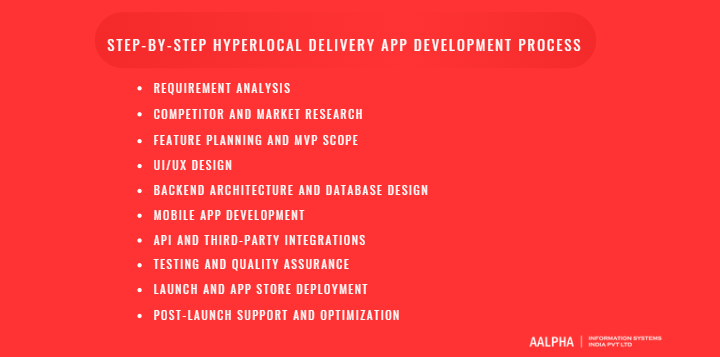
Step-by-Step Hyperlocal Delivery App Development Process
Building a hyperlocal delivery app requires more than designing a customer-facing mobile app. The platform must support real-time ordering, local merchant coordination, delivery partner assignment, payments, location tracking, settlements, refunds, customer support, and admin control. A structured development process helps reduce operational gaps and gives the business a clear path from idea validation to market launch.
-
Requirement Analysis
The first step in hyperlocal delivery app development is requirement analysis. This stage defines what the platform will do, who it will serve, and how the business will operate. The team must identify the business model, target market, service categories, customer segments, order types, pricing rules, and delivery workflows. A food delivery app, grocery app, pharmacy delivery app, parcel delivery app, and multi-service platform all require different operational logic.
The requirement phase should also define user roles. Most hyperlocal delivery platforms need a customer app, delivery partner app, merchant or vendor panel, and admin dashboard. The business must decide whether merchants will accept orders manually, whether delivery partners will be assigned automatically, whether customers can pay online or offline, and how cancellations and refunds will be handled. Service area planning is equally important. The platform may operate within a fixed radius, selected zones, specific pin codes, or city-wise delivery boundaries. Clear operational rules at this stage prevent confusion during development and launch.
-
Competitor and Market Research
Before building the app, businesses should study local competition and customer behavior. Hyperlocal delivery is strongly influenced by city-level habits, merchant density, rider availability, payment preferences, and delivery expectations. A platform that works in a metro city may not work the same way in a smaller city or semi-urban market.
Competitor research should cover delivery pricing, average delivery time, merchant commissions, customer offers, delivery partner payouts, cancellation rules, and customer complaints. Businesses should also speak with local merchants to understand their pain points. Restaurants may need fast order confirmation and menu control, grocery stores may need inventory and substitution options, pharmacies may need prescription verification, and small retailers may need simple parcel pickup support. Rider availability should also be studied carefully because delivery speed depends on how many active delivery partners are available in each zone and during peak hours.
-
Feature Planning and MVP Scope
After research, the next step is feature planning. Many businesses make the mistake of trying to build every advanced feature in the first version. A better approach is to start with a focused minimum viable product that covers the core order journey. The MVP should allow customers to register, select a location, browse stores or services, place orders, make payments, track deliveries, and contact support. Delivery partners should be able to accept orders, navigate to pickup and drop locations, update status, and view earnings. Merchants should be able to manage orders, update products or menus, and view reports. Admins should be able to manage users, orders, pricing, commissions, refunds, and delivery zones.
Advanced features such as AI-based assignment, loyalty programs, wallets, subscription plans, route optimization, multi-city control, and predictive analytics can be added after the core system is stable. This phased approach reduces development time, controls cost, and helps the business learn from real users before investing in complex modules.
-
UI/UX Design
UI/UX design plays a major role in customer adoption and operational efficiency. The customer app should be simple, fast, and location-first. Customers should be able to choose an address, find nearby stores, add items to cart, apply offers, pay, and track orders without unnecessary steps. A clean checkout flow is especially important because delivery apps often lose users when order placement becomes confusing.
The delivery partner app should be even more practical. Riders need large buttons, clear order information, readable maps, fast status updates, and simple navigation because they use the app while moving. The merchant panel should help vendors accept orders, update preparation status, edit catalogue details, and manage availability quickly. The admin dashboard should provide clear visibility into live orders, delivery delays, active riders, customer complaints, merchant performance, payments, refunds, and reports. Good UI/UX design should focus on real operational use, not only visual appeal.
-
Backend Architecture and Database Design
The backend is the core of a hyperlocal delivery platform. It manages user accounts, order flows, merchant data, delivery partner assignment, pricing, payments, tracking, notifications, refunds, commissions, settlements, and admin control. Backend architecture should be planned carefully because delivery apps deal with real-time transactions and multiple user roles.
Database design should support customers, merchants, delivery partners, service areas, product catalogues, orders, payments, wallet transactions, ratings, support tickets, invoices, and reports. Pricing logic must handle distance-based delivery fees, fixed charges, surge pricing, merchant commissions, taxes, platform fees, discounts, and cancellation charges. The backend should also support order status changes, live location updates, notification triggers, payment confirmations, and refund workflows. If the platform is expected to support multiple cities or categories, the architecture should be flexible enough to add new service zones, pricing rules, and business modules later.
-
Mobile App Development
Mobile app development usually includes the customer app and delivery partner app. Depending on the business model, the merchant side may be built as a mobile app, web panel, or both. Cross-platform frameworks such as React Native and Flutter are often used when businesses want to launch on Android and iOS with a shared codebase. Native development using Kotlin for Android and Swift for iOS may be preferred for complex performance-heavy applications.
The customer app must support browsing, cart, checkout, payments, tracking, notifications, ratings, and support. The delivery partner app must support order alerts, availability status, navigation, pickup confirmation, delivery proof, earnings, and payout history. The merchant app or panel must support order management, catalogue updates, item availability, preparation status, settlements, and reports. Platform-specific requirements such as app permissions, push notification setup, location access, background tracking, and app store rules should be handled carefully during development.
-
API and Third-Party Integrations
Hyperlocal delivery apps depend on multiple third-party integrations. Maps and location APIs are required for address selection, geocoding, distance calculation, route tracking, delivery partner location, and ETA estimation. Payment gateway integration is required for online payments, refunds, wallet credits, settlements, and payment failure handling.
SMS, WhatsApp, email, and push notification integrations help send order updates, OTPs, delivery alerts, payment messages, refund updates, and promotional campaigns. Analytics tools can track user behavior, order conversion, repeat usage, cancellation rate, and revenue performance. Support tools such as live chat, ticketing systems, call masking, and helpdesk integrations can improve customer service. Each integration should be selected based on market needs, cost, reliability, compliance, and future scalability.
-
Testing and Quality Assurance
Testing is critical because hyperlocal delivery apps involve live payments, real-time tracking, location accuracy, and time-sensitive orders. Functional testing checks whether registration, browsing, cart, payments, order placement, merchant confirmation, rider assignment, tracking, cancellations, refunds, and ratings work correctly. Location testing verifies GPS accuracy, map pin selection, service area validation, distance calculation, and route display.
Payment testing should cover successful payments, failed payments, refunds, partial refunds, cash orders, wallet credits, and invoice generation. Load testing helps check how the backend performs during peak order periods. Security testing is required to protect user data, payment information, admin access, and merchant records. Real-device testing is also important because delivery apps must work across different screen sizes, network conditions, Android versions, iOS versions, and background location settings.
-
Launch and App Store Deployment
Once development and testing are complete, the platform can move toward launch. Backend deployment should be configured on a reliable cloud server with proper database setup, SSL, backups, monitoring, logging, and security controls. The customer app and delivery partner app must be prepared for Play Store and App Store submission with correct app descriptions, screenshots, permissions, privacy policy, and compliance details.
A soft launch is often better than a full public launch. The business can start with one city, one delivery zone, selected merchants, and a limited rider network. This helps the team test real orders, pricing, rider assignment, merchant readiness, payment flow, and customer support before scaling to a larger audience. Early launch data is valuable because it shows what works in actual operations, not just in development testing.
-
Post-Launch Support and Optimization
Post-launch support is an ongoing part of hyperlocal delivery app development. After launch, the platform will need bug fixes, performance improvements, payment issue resolution, app updates, security patches, pricing changes, and feature improvements. Customer feedback, merchant complaints, delivery partner behavior, cancellation patterns, and order data should be reviewed regularly.
Optimization may include improving delivery partner assignment, reducing checkout friction, changing delivery fees, updating merchant commissions, adding new payment methods, improving ETA accuracy, or expanding service zones. The admin team should monitor key metrics such as order volume, delivery time, active riders, repeat customers, failed payments, refunds, cancellation rate, support tickets, and merchant performance. A hyperlocal delivery platform becomes stronger when the technology team and operations team continue improving it based on real usage.
How Much Does Hyperlocal Delivery App Development Cost?
The cost of hyperlocal delivery app development depends on the business model, number of user apps, feature complexity, technology stack, integrations, development team location, and level of customization required. A simple local delivery MVP will cost much less than a multi-service delivery platform with customer apps, delivery partner apps, merchant panels, admin dashboards, live tracking, wallets, analytics, subscriptions, and AI-based assignment. Businesses should estimate cost based on the actual workflow they want to support, not only the number of screens in the app.
-
Cost by App Complexity
A basic hyperlocal delivery MVP usually includes customer registration, location selection, store or service listing, order placement, basic payment integration, order status updates, delivery partner assignment, and a simple admin panel. This type of app is suitable for early-stage startups, local businesses, and companies that want to test demand in one city or category before investing heavily. A basic MVP may cost around $15,000 to $35,000, depending on design quality, backend logic, and the number of apps included.
A mid-level hyperlocal delivery app usually includes a customer app, delivery partner app, merchant panel, admin dashboard, live order tracking, payment gateway, push notifications, ratings, reports, refunds, and basic promotional features. This is suitable for food delivery, grocery delivery, medicine delivery, parcel delivery, or single-city marketplace models. A mid-level app may cost around $35,000 to $80,000.
An advanced hyperlocal delivery platform includes multi-category support, advanced admin control, real-time tracking, merchant settlements, delivery partner payouts, wallet, coupons, subscriptions, analytics, route optimization, service zones, and automated order assignment. This type of platform may cost around $80,000 to $180,000.
An enterprise-grade platform can cost $180,000 to $300,000 or more. Enterprise platforms often require multi-city support, high-volume infrastructure, role-based admin access, custom reporting, advanced security, SLA-based operations, multi-tenant architecture, complex integrations, and custom workflows for different business units.
-
Cost by Feature Set
Features have a direct impact on development cost. A simple customer app with basic ordering is easier to build than a complete platform with real-time operations. Live tracking increases cost because it requires GPS permissions, location updates, map APIs, route display, ETA calculation, and backend location processing. Payment integration adds cost because the system must handle successful payments, failed payments, refunds, wallets, invoices, and payment gateway callbacks.
Admin dashboards also affect cost significantly. A basic admin panel may only manage users and orders, while an advanced dashboard may include delivery zones, pricing rules, commissions, refunds, disputes, merchant settlements, delivery partner payouts, campaign management, and analytics. Merchant panels add another layer because vendors need tools to manage catalogues, inventory, pricing, order status, settlements, and reports.
Advanced features such as wallet systems, loyalty programs, subscription plans, route optimization, AI-based delivery partner assignment, predictive ETA, and multi-service workflows increase the development budget further. These features require deeper backend logic, more testing, and ongoing optimization after launch.
-
Cost by Development Team Location
Development team location also affects cost. India is often a cost-effective destination for hyperlocal delivery app development because experienced teams can build mobile apps, backend systems, admin dashboards, and integrations at competitive rates. Eastern Europe is usually more expensive than India but may still be lower than Western Europe or North America. Western European and North American teams generally charge higher hourly rates, which can increase the total project cost substantially.
As a broad estimate, development rates in India may range from $20 to $50 per hour, Eastern Europe from $40 to $80 per hour, Western Europe from $70 to $120 per hour, and North America from $100 to $180 or more per hour. The final cost depends not only on hourly rate but also on team experience, project management quality, delivery speed, code quality, and post-launch support.
-
Cost by Development Approach
Custom development gives the highest level of flexibility. It is suitable when the business needs unique pricing rules, custom delivery zones, merchant workflows, assignment logic, settlement rules, or multi-service operations. Custom development costs more than ready-made options, but it gives better control over product direction and long-term scalability.
A white-label solution is usually faster and more affordable because the base platform is already built. It can be customized with branding, payment gateways, service categories, pricing rules, and selected features. This approach is useful for entrepreneurs, agencies, and regional operators that want to launch faster.
A SaaS delivery platform may have lower upfront cost but limited customization. It is useful for basic use cases, but businesses may face restrictions in workflows, branding, data ownership, integrations, or scaling. In-house development gives full control, but it requires hiring developers, designers, testers, DevOps engineers, product managers, and support staff, which can make it expensive over time.
-
Ongoing Maintenance Cost
The development budget should also include ongoing maintenance. Hyperlocal delivery apps require continuous updates after launch because they depend on payments, maps, mobile operating systems, notifications, backend performance, and live operations. Typical maintenance costs may range from 15% to 25% of the initial development cost per year, depending on platform complexity.
Maintenance includes hosting, database management, bug fixes, app updates, payment gateway fixes, API updates, security patches, server monitoring, backups, performance improvements, and technical support. Businesses should also budget for third-party costs such as map APIs, SMS, WhatsApp messages, email services, payment gateway charges, analytics tools, cloud hosting, and customer support tools. A hyperlocal delivery platform is not a one-time software purchase. It needs regular technical and operational improvement to remain reliable, fast, and profitable.
Monetization Models for Hyperlocal Delivery Apps
A hyperlocal delivery app can generate revenue through multiple monetization models. The right approach depends on the service category, customer order frequency, merchant margins, delivery cost, city size, and platform positioning. Many successful platforms do not depend on one revenue source alone. They combine delivery fees, merchant commissions, subscriptions, advertising, convenience fees, and business delivery plans to improve unit economics. However, monetization should be balanced carefully. If charges are too high, customers may stop ordering and merchants may avoid the platform. If charges are too low, the platform may struggle to cover delivery partner payouts, payment costs, support, technology, and operations.
-
Delivery Fees
Delivery fees are one of the most direct ways for a hyperlocal delivery app to earn revenue. The platform can charge customers a fixed delivery fee for every order, especially when the delivery radius is small and operational costs are predictable. For example, a food delivery app may charge a flat delivery fee within a specific zone or for orders below a certain value.
Distance-based delivery pricing is more flexible because the fee changes based on pickup and drop distance. This model is commonly used in parcel delivery, courier apps, grocery delivery, and multi-service delivery platforms. It helps the business recover higher delivery costs when the distance is longer. Some platforms also use surge pricing during peak hours, bad weather, high-demand periods, festivals, or rider shortages. Express delivery fees can be charged when customers want faster delivery, priority assignment, or immediate pickup. Delivery fees should be transparent at checkout so customers understand the final cost before placing the order.
-
Merchant Commissions
Merchant commissions are widely used in marketplace-based hyperlocal delivery apps. In this model, the platform charges merchants a percentage of each order value. Restaurants, grocery stores, pharmacies, bakeries, florists, and local retailers pay the commission because the platform brings them online orders, delivery support, visibility, and customer reach.
Commission rates can vary by category because margins are different across businesses. Food delivery may support a higher commission than grocery because grocery margins are usually thinner. Medicine delivery, flower delivery, and cake delivery may require different commission structures depending on local regulations, order values, and product margins. Some platforms charge a fixed fee per order instead of a percentage. Others use a hybrid model where the merchant pays a smaller percentage plus a fixed platform fee. The commission model works best when the platform can deliver consistent order volume to merchants.
-
Subscription Plans
Subscription plans help create recurring revenue and improve customer or merchant retention. For customers, a subscription can include free delivery, reduced delivery fees, priority delivery, exclusive discounts, cashback, or premium support. This model works well when users order frequently, such as for groceries, food, medicines, laundry, or office deliveries.
Merchant monthly plans can include access to the platform, lower commissions, better listing visibility, analytics, promotional tools, and settlement support. A merchant may prefer a fixed monthly fee if it reduces per-order commission and helps them control costs. Business delivery memberships are also useful for offices, retailers, print shops, clinics, repair stores, and local sellers that need repeated pickup and drop services. These plans can include monthly delivery credits, invoice billing, priority support, and business dashboards.
-
Advertising and Featured Listings
Advertising can become an important revenue source once the platform has regular customer traffic. Merchants can pay for promoted stores, sponsored listings, banner ads, category placement, push notification campaigns, or homepage visibility. For example, a restaurant may pay to appear at the top during lunch hours, while a bakery may promote cakes before festivals or weekends.
Featured listings are useful because they give merchants better visibility inside the app. However, advertising should not damage the customer experience. Promoted stores should still be relevant to the customer’s location, search intent, and delivery availability. The platform can also sell in-app visibility packages to local brands, stores, service providers, and merchants that want to reach customers in a specific area.
-
Convenience Fees and Platform Fees
Convenience fees and platform fees are small charges added to support technology, payments, customer support, and operational costs. These fees are usually shown separately at checkout and may apply to every order or only to selected categories. For example, a platform may charge a small service fee to cover payment gateway costs, refund handling, customer support, app maintenance, or delivery coordination.
Although these fees may look small, they can become a meaningful revenue source at scale. However, transparency is important. Customers should clearly see what they are paying before checkout. Hidden or confusing fees can reduce trust and increase cart abandonment. The best monetization strategy is usually a balanced mix of delivery fees, merchant commissions, subscriptions, advertising, and platform fees, designed around real operating costs and customer willingness to pay.
Challenges in Hyperlocal Delivery App Development
Hyperlocal delivery app development is challenging because the business depends on real-time coordination between customers, merchants, delivery partners, payments, maps, and support teams. Unlike standard ecommerce platforms, where delivery may happen through scheduled logistics, hyperlocal delivery usually works within short time windows. Customers expect fast assignment, accurate tracking, quick merchant response, smooth payment, and timely delivery. Even a small failure in one part of the system can create delays, cancellations, refund requests, and poor reviews. Understanding these challenges early helps businesses design a stronger platform and avoid operational problems after launch.
-
Delivery Partner Availability
Delivery partner availability is one of the most common challenges in hyperlocal delivery. Demand is not evenly distributed throughout the day. Food orders may increase during lunch, dinner, and weekends. Grocery orders may rise in the morning or during household shopping hours. Parcel delivery may be stronger during office hours. Medicine delivery can be urgent and unpredictable. Because of this demand variation, the platform may have too many delivery partners during slow hours and too few during peak hours.
This supply-demand imbalance directly affects customer experience. If there are not enough active delivery partners in a zone, orders may remain unassigned, delivery times may increase, and customers may cancel. Shift planning becomes important because the platform must know when and where delivery partners are needed. Incentive management also plays a major role. Bonuses for peak hours, busy zones, rain, festivals, and high-demand periods can bring more delivery partners online. However, incentives must be controlled carefully because excessive payouts can reduce profitability.
-
Accurate Location Tracking
Accurate location tracking is critical for hyperlocal delivery apps. The app must correctly identify the customer address, merchant location, delivery partner position, and delivery route. GPS errors, weak signals, poor mobile networks, incorrect map data, and device permission issues can affect tracking accuracy. These problems are common in crowded city areas, apartment complexes, business parks, rural edges, gated communities, and newly developed layouts.
Wrong map pins are another serious issue. A customer may type the correct address but place the pin at the wrong location. This can send the delivery partner to the wrong building, street, or gate. To reduce this problem, the app should allow manual pin adjustment, landmark entry, saved addresses, floor details, building names, and address notes. Address correction tools, reverse geocoding, and delivery partner feedback can also improve location accuracy over time.
-
Order Assignment Complexity
Order assignment is one of the most complex parts of a hyperlocal delivery platform. Poor assignment logic can increase delivery time, reduce acceptance rates, cause cancellations, and frustrate delivery partners. If the system assigns orders only to the nearest rider, it may ignore other important factors such as current workload, rider acceptance rate, merchant preparation time, traffic, delivery distance, and reliability.
Sequential assignment can also create customer delays because each delivery partner may get several seconds to accept before the order moves to the next person. On the other hand, broadcasting every order to too many riders can create dissatisfaction because several riders may keep seeing orders they cannot win. A strong assignment system should balance customer speed, rider fairness, pickup distance, delivery capacity, and service quality. It should also include fallback rules for rider rejection, timeout, cancellation, merchant delay, and no-rider situations.
-
Payment and Refund Issues
Payment and refund handling can become complicated in hyperlocal delivery apps because the platform may support multiple payment modes. These can include online payments, UPI, cards, wallets, net banking, cash on delivery, pay on pickup, and pay on delivery. Each payment type needs proper tracking, confirmation, and reconciliation. Failed payments, duplicate deductions, delayed gateway callbacks, and incomplete transactions can create customer complaints.
Refunds are equally sensitive. Customers may need refunds because of cancellations, missing items, unavailable products, late deliveries, wrong orders, or failed payments. The app should clearly show refund amount, refund status, original payment method, and expected processing time. COD reconciliation, wallet balance updates, merchant settlements, and delivery partner payouts must also be handled accurately. Without strong payment logs and settlement reports, the admin team may struggle to resolve financial disputes.
-
Merchant Readiness and Inventory Issues
Merchant readiness has a direct impact on delivery performance. If merchants delay order acceptance, prepare orders late, reject orders frequently, or forget to update item availability, customers face a poor experience. Inventory issues are especially common in grocery, pharmacy, flower, cake, and retail delivery because stock changes throughout the day.
The merchant panel should make it easy to update products, prices, stock, working hours, preparation time, and order status. If an item is unavailable, the merchant should be able to suggest substitutions, offer partial fulfilment, or cancel the item according to platform rules. Wrong pricing is another major issue because customers may lose trust if the price shown in the app does not match the actual merchant price. Merchant training, simple interfaces, and strong admin monitoring can reduce these problems.
-
Customer Support and Dispute Handling
Customer support is unavoidable in hyperlocal delivery operations. Common issues include late delivery, missing items, damaged products, failed payments, refund delays, merchant cancellations, rider complaints, and wrong address problems. If the platform does not provide quick support, small issues can turn into negative reviews and customer churn.
The app should allow customers to report issues, upload photos, request refunds, contact support, and track complaint status. The admin team should be able to review order history, payment records, rider location, merchant actions, pickup proof, delivery proof, and support notes. Clear dispute policies help the platform decide when to refund, when to charge cancellation fees, and when to take action against a merchant or delivery partner.
-
Scaling Across Multiple Cities
Scaling a hyperlocal delivery app across multiple cities is difficult because every city has different operating conditions. Delivery distances, traffic patterns, merchant margins, customer expectations, payment preferences, rider density, and pricing sensitivity can vary widely. A delivery fee or commission model that works in one city may not work in another.
The platform should support city-specific pricing, delivery zones, rider payouts, merchant commissions, taxes, promotions, and operational rules. Merchant onboarding also becomes more complex because each city may require a different sales and support process. Rider density must be planned carefully so that new cities have enough delivery partners without creating high idle time. Multi-city scaling requires strong admin controls, zone-wise analytics, local support workflows, and flexible backend configuration.
Why Work With a Hyperlocal Delivery App Development Company
Building a hyperlocal delivery app is very different from building a basic mobile application. The product may look simple to the customer, but the backend operation involves real-time ordering, location tracking, delivery partner assignment, merchant coordination, payment processing, refunds, reporting, and support workflows. A specialized hyperlocal delivery mobile app development company can help businesses plan the product properly, avoid common operational mistakes, and build a platform that can support real orders, real users, and real-time delivery movement.
-
Hyperlocal Apps Need More Than Mobile Development
A hyperlocal delivery platform usually requires multiple connected systems, not just one customer app. The customer app allows users to browse stores, place orders, make payments, track deliveries, and raise support requests. The delivery partner app allows riders to accept orders, navigate to pickup and drop locations, update delivery status, confirm pickup, complete delivery, and view earnings. The merchant panel allows vendors to manage orders, update menus or catalogues, control inventory, change pricing, and track settlements. The admin dashboard gives the platform owner control over users, orders, delivery zones, commissions, refunds, payouts, disputes, promotions, and analytics.
These modules must work together without delays or data mismatches. For example, when a customer places an order, the merchant should receive it instantly, the delivery partner should be assigned correctly, the payment status should update in the backend, and the customer should receive real-time notifications. This requires strong backend development, database design, APIs, map integration, payment gateway setup, push notifications, reporting tools, and server infrastructure. A team with hyperlocal delivery experience can plan these parts from the beginning instead of treating them as add-ons later.
-
Custom Development Helps With Real-World Delivery Operations
Every delivery business has different operational rules. A food delivery platform may need restaurant preparation time, menu availability, packaging charges, and category-wise commissions. A grocery delivery platform may need inventory sync, substitutions, scheduled delivery, and item-level refunds. A parcel delivery app may need pickup and drop pricing, package weight rules, sender-receiver confirmation, proof of pickup, and proof of delivery. A multi-service delivery platform may need all of these workflows in one system.
Custom development helps the platform match real business operations. It allows businesses to define custom pricing, distance slabs, delivery zones, rider assignment logic, merchant commission rules, refund policies, settlement cycles, cancellation charges, payout structures, and support workflows. It also helps when the business wants to operate across multiple services, cities, or customer segments. Instead of forcing the business to adjust to a fixed software system, custom development allows the software to support how the business actually runs.
-
Long-Term Support Is Critical
A hyperlocal delivery app needs continuous technical support after launch. Mobile operating systems change, app store policies get updated, payment gateway APIs may require fixes, map APIs may change, and customer expectations keep increasing. Delivery platforms also generate live operational issues such as failed payments, delayed refunds, wrong location tracking, app crashes, slow order assignment, notification failures, and merchant panel errors.
Long-term support helps keep the platform stable as order volume grows. It includes bug fixes, performance monitoring, server maintenance, database optimization, app updates, security patches, payment fixes, third-party API updates, and new feature development. Operational improvements are also important. The platform may need better rider assignment, new pricing rules, improved ETA logic, merchant performance reports, customer retention campaigns, or city-wise dashboards after launch. A reliable development partner can help the business keep improving the platform based on real usage data.
-
Working With Aalpha
Businesses planning to build a hyperlocal delivery app can work with experienced software development teams such as Aalpha, especially when the project requires branded customer apps, delivery partner apps, merchant panels, admin dashboards, backend development, real-time tracking, payment gateway integration, notifications, reporting, and long-term technical support. A custom development partner can help define the right architecture, build the required modules, integrate maps and payments, set up admin controls, and support the product after launch. This is especially useful for startups, local delivery operators, restaurant chains, grocery businesses, courier platforms, and enterprises that want to launch a scalable hyperlocal delivery platform instead of relying on generic software.
Conclusion
Hyperlocal delivery apps are becoming essential for businesses that want to serve customers faster within a specific city, neighbourhood, or delivery zone. Whether the goal is food delivery, grocery delivery, medicine delivery, parcel pickup and drop, laundry pickup, or a multi-service local delivery platform, success depends on more than a mobile app. Businesses need strong backend systems, real-time tracking, payment integration, delivery partner management, merchant panels, admin dashboards, support workflows, and reliable post-launch maintenance.
A well-built hyperlocal delivery platform can help local businesses increase reach, improve customer convenience, reduce manual coordination, and create a scalable delivery operation. The right development approach should match the business model, target market, service categories, pricing rules, delivery zones, and long-term growth plan.
If you are planning to build a custom hyperlocal delivery app, white-label delivery platform, or multi-service delivery solution, connect with Aalpha. Our team can help you design and develop branded customer apps, delivery partner apps, merchant panels, admin dashboards, real-time tracking systems, payment integrations, and scalable backend infrastructure for your delivery business.