





Sentiment analysis has become one of the most practical and widely adopted applications of Natural Language Processing (NLP). At its core, it helps businesses, researchers, and systems understand how people feel about a product, service, brand, or topic by analyzing textual data. Whether it is customer reviews, social media conversations, survey responses, or support tickets, sentiment analysis converts unstructured text into structured insights that can directly influence decisions.
Organizations today deal with massive volumes of user-generated content. Manually analyzing this data is neither scalable nor efficient. This is where NLP-driven sentiment analysis becomes critical. It enables automated classification of opinions, detection of emotional tone, and identification of patterns across large datasets. For example, a company launching a new product can instantly analyze thousands of online reviews to determine whether customer sentiment is positive, negative, or neutral. Similarly, support teams can prioritize complaints by detecting negative sentiment in real time.
As digital communication continues to grow, understanding user sentiment is no longer optional. It is a foundational capability for businesses that want to remain competitive, customer-focused, and data-driven.
What is Sentiment Analysis?
Sentiment analysis, also known as opinion mining, is a technique used to determine the emotional tone behind a piece of text. It classifies text into categories such as positive, negative, or neutral, and in more advanced systems, it can detect specific emotions like satisfaction, frustration, or anger.
At a practical level, sentiment analysis answers questions such as: Are customers happy with a product? Is a brand receiving negative attention on social media? Are users satisfied with customer support interactions? For instance, a product review stating “The delivery was fast and the quality is excellent” would be classified as positive, while “The product stopped working after two days” would be identified as negative.
This technique is widely used across digital platforms. E-commerce companies analyze product reviews, social media platforms monitor public sentiment around trends, and customer support systems evaluate user feedback to improve service quality. By transforming qualitative text into measurable insights, sentiment analysis allows organizations to quantify opinions at scale and act on them efficiently.
What is NLP and Its Role in Sentiment Analysis?
Natural Language Processing (NLP) is a branch of artificial intelligence that enables machines to understand, interpret, and process human language. Unlike structured data, human language is complex, ambiguous, and context-dependent. NLP provides the tools and algorithms needed to convert this unstructured text into meaningful data that machines can analyze.
In sentiment analysis, NLP plays a central role at every stage of the process. It begins with preprocessing, where text is cleaned and broken down into smaller components such as words or phrases. It then applies linguistic techniques to understand grammar, context, and meaning. Finally, machine learning or deep learning models use this processed data to classify sentiment.
For example, NLP helps a system recognize that “not good” carries a negative sentiment despite the presence of the word “good.” It also enables more advanced capabilities such as identifying sarcasm, understanding context across sentences, and analyzing domain-specific language. Without NLP, sentiment analysis would be limited to simple keyword matching, which is often inaccurate. With NLP, systems can interpret language in a way that closely resembles human understanding, making sentiment classification far more reliable and scalable.
Why Sentiment Analysis Matters in Modern Business
Sentiment analysis has evolved into a strategic tool that directly impacts business performance. In a data-driven environment, understanding customer perception is essential for making informed decisions. Sentiment analysis provides real-time insights into how customers feel, enabling organizations to respond quickly and effectively.
One of its most significant advantages is improving customer experience. By analyzing feedback from reviews, surveys, and support interactions, businesses can identify pain points and address them proactively. For example, if a large number of users express frustration about delivery delays, the company can investigate logistics issues and implement improvements.
It also plays a crucial role in brand monitoring and reputation management. Businesses can track how their brand is perceived across social media and online platforms, allowing them to detect negative trends early and take corrective action. In marketing, sentiment analysis helps measure campaign effectiveness by evaluating audience reactions.
Beyond insights, sentiment analysis supports automation. Customer support systems can automatically prioritize negative messages, chatbots can respond more intelligently based on user sentiment, and recommendation systems can personalize experiences. In essence, sentiment analysis transforms raw text into actionable intelligence, helping businesses operate more efficiently, improve customer satisfaction, and maintain a competitive edge.
Types of Sentiment Analysis
Sentiment analysis is not a single technique but a collection of methods designed to interpret opinions at different levels of depth and precision. Depending on the business objective, organizations may require simple polarity classification or more advanced analysis that captures emotions, intent, and contextual meaning. Understanding the different types of sentiment analysis helps in selecting the right approach for specific use cases, whether it is analyzing product reviews, monitoring brand perception, or automating customer support. Each method offers a different layer of insight, moving from basic classification to nuanced interpretation of human language.
-
Fine-Grained Sentiment Analysis
Fine-grained sentiment analysis focuses on classifying text into multiple levels of sentiment intensity rather than just broad categories like positive or negative. The most common classifications include positive, negative, and neutral, but more advanced systems extend this into multi-level scoring such as very positive, positive, neutral, negative, and very negative.
This approach is particularly useful in scenarios where understanding the degree of sentiment matters. For example, in product reviews, a 5-star rating indicates strong satisfaction, while a 3-star rating may reflect mixed feelings. Fine-grained analysis aligns closely with such rating systems, allowing businesses to quantify sentiment more precisely.
It answers questions like: Is customer feedback mildly positive or strongly enthusiastic? Is dissatisfaction occasional or severe? By capturing sentiment intensity, organizations can prioritize actions more effectively, focusing on highly negative feedback while leveraging strongly positive feedback for marketing and testimonials.
-
Aspect-Based Sentiment Analysis
Aspect-based sentiment analysis goes beyond overall sentiment and examines opinions related to specific features or components of a product or service. Instead of labeling an entire review as positive or negative, it identifies individual aspects and determines sentiment for each one.
For instance, a restaurant review might state, “The food was excellent, but the service was slow.” A traditional model may struggle with this mixed sentiment, but aspect-based analysis separates it into two insights: positive sentiment for food quality and negative sentiment for service.
This approach is highly valuable for businesses seeking actionable insights. It enables product teams to identify which features are performing well and which need improvement. In e-commerce, it can reveal whether customers are dissatisfied with pricing, delivery, or product durability. By breaking down feedback into granular components, aspect-based sentiment analysis provides a clearer understanding of customer expectations and priorities, making it a critical tool for product development and quality improvement.
-
Emotion Detection
Emotion detection is an advanced form of sentiment analysis that identifies specific human emotions expressed in text rather than just general sentiment polarity. Instead of classifying text as positive or negative, it categorizes emotions such as joy, anger, sadness, frustration, fear, or excitement.
This method is particularly useful in understanding the emotional drivers behind customer behavior. For example, a message like “I’m really disappointed with the delay” conveys frustration and dissatisfaction, while “I love how fast this arrived” reflects joy and satisfaction. These emotional nuances provide deeper insights than simple sentiment labels.
Emotion detection is widely used in customer experience management, mental health analysis, and social media monitoring. Businesses can use it to detect frustration in support conversations and respond proactively, or identify enthusiastic customers who may become brand advocates. By capturing emotional context, this approach enables more personalized and empathetic interactions, which are essential for building strong customer relationships.
-
Intent-Based Sentiment Analysis
Intent-based sentiment analysis focuses on understanding the purpose behind a piece of text in addition to its emotional tone. It answers not just how a user feels, but what they intend to do or achieve. This is particularly important in customer interactions where similar sentiments may reflect different intentions.
For example, a statement like “This product isn’t working” could indicate a complaint, while “Can you help me fix this issue?” reflects a request for assistance. Both may carry negative sentiment, but the intent differs significantly. Identifying whether the user is complaining, requesting support, giving feedback, or making a purchase decision is crucial for appropriate response handling.
This approach is widely used in chatbots, virtual assistants, and customer support automation. By combining sentiment with intent, systems can route queries more effectively, prioritize urgent issues, and deliver context-aware responses. It improves operational efficiency while enhancing user experience, as responses become more relevant and aligned with user expectations.
-
Multilingual Sentiment Analysis
Multilingual sentiment analysis enables systems to analyze text across multiple languages while accounting for linguistic and cultural differences. As businesses operate globally, customer feedback is often received in various languages, making it essential to process and interpret sentiment accurately regardless of language.
This type of analysis involves handling language-specific grammar, vocabulary, idioms, and cultural expressions. For example, certain phrases may carry positive sentiment in one language but be neutral or even negative in another. Direct translation is often insufficient, as it may lose context or nuance.
Advanced multilingual models use techniques such as cross-lingual embeddings and pretrained transformer models to understand sentiment across languages without requiring separate models for each one. This capability is especially valuable for global brands, international customer support systems, and social media monitoring tools. By enabling consistent sentiment analysis across regions, businesses can gain a unified view of customer perception while respecting linguistic diversity.
How NLP Works for Sentiment Analysis
At a practical level, NLP-powered sentiment analysis follows a structured pipeline that transforms raw, unstructured text into meaningful predictions. This process begins with cleaning and preparing text, continues with converting language into numerical representations, and ends with applying machine learning or deep learning models to classify sentiment. While the underlying algorithms can be complex, the overall workflow can be understood as a sequence of logical steps designed to mimic how humans interpret language. Each stage contributes to improving accuracy, context awareness, and scalability, enabling systems to analyze thousands or even millions of text inputs efficiently.
-
Text Preprocessing
Text preprocessing is the foundational step in sentiment analysis, where raw text is cleaned and standardized to make it suitable for analysis. Human language often contains noise such as punctuation, special characters, inconsistent casing, and irrelevant words, all of which can reduce model accuracy if not handled properly.
The process begins with tokenization, which breaks text into smaller units such as words or phrases. For example, a sentence like “The product is very good” is split into individual tokens like “The,” “product,” “is,” “very,” and “good.” Next, stopword removal eliminates common words such as “is,” “the,” and “and,” which do not carry significant meaning in sentiment classification.
Stemming and lemmatization further refine the text by reducing words to their base or root forms. For instance, “running,” “runs,” and “ran” can be normalized to “run.” Lemmatization is generally more context-aware, ensuring grammatical correctness while simplifying words.
This preprocessing stage ensures that the text is consistent, concise, and focused on meaningful components, which significantly improves the performance of downstream models.
-
Feature Extraction Techniques
Once the text is preprocessed, it must be converted into a numerical format that machine learning models can understand. This transformation is known as feature extraction, and it plays a critical role in determining how well the model captures linguistic patterns.
One of the simplest methods is Bag-of-Words (BoW), which represents text as a collection of word frequencies without considering word order. While effective for basic tasks, it lacks contextual understanding. TF-IDF (Term Frequency–Inverse Document Frequency) improves upon this by assigning weights to words based on their importance in a document relative to a larger dataset. This helps highlight words that carry more meaningful information.
More advanced approaches involve word embeddings, which represent words as dense vectors in a continuous space. Techniques such as Word2Vec and GloVe capture semantic relationships between words, allowing models to understand that words like “good” and “excellent” are closely related.
Feature extraction is a crucial step because it determines how language is represented mathematically, directly influencing the model’s ability to detect sentiment accurately.
-
Machine Learning Models
Traditional machine learning models have been widely used for sentiment analysis due to their simplicity, efficiency, and effectiveness on structured text data. These models rely on extracted features to classify sentiment into predefined categories.
Naive Bayes is one of the most commonly used algorithms, particularly for text classification tasks. It assumes independence between features and uses probability to determine the most likely sentiment class. Despite its simplicity, it performs well for many sentiment analysis applications.
Logistic Regression is another popular method that predicts the probability of a text belonging to a specific sentiment class. It is particularly effective when combined with features like TF-IDF, offering a good balance between performance and interpretability.
Support Vector Machines (SVM) are more advanced and work by finding the optimal boundary that separates different sentiment classes. SVMs are known for their ability to handle high-dimensional data, making them suitable for text classification tasks.
While these models are less sophisticated than deep learning approaches, they remain valuable for smaller datasets and applications where computational efficiency is important.
-
Deep Learning Models
Deep learning models have significantly advanced the capabilities of sentiment analysis by enabling systems to understand context, sequence, and complex language patterns. Unlike traditional models, deep learning architectures can learn features automatically from raw text, reducing the need for manual feature engineering.
Recurrent Neural Networks (RNNs) are designed to process sequential data, making them suitable for analyzing sentences where word order matters. However, standard RNNs struggle with long-term dependencies, which led to the development of Long Short-Term Memory (LSTM) networks. LSTMs can retain information over longer sequences, allowing them to capture context more effectively.
Transformers represent a major breakthrough in NLP. Unlike RNNs, they process entire sequences simultaneously and use attention mechanisms to focus on the most relevant parts of the text. This enables a deeper understanding of context, even in complex sentences.
Deep learning models are particularly effective for handling nuanced language, sarcasm, and context-dependent sentiment. However, they require larger datasets and higher computational resources compared to traditional methods.
-
Role of Pretrained Models
Pretrained models have transformed sentiment analysis by making advanced NLP capabilities accessible without requiring massive datasets or extensive training from scratch. These models are trained on large corpora of text and can be fine-tuned for specific tasks such as sentiment classification.
Models like BERT (Bidirectional Encoder Representations from Transformers) understand context by analyzing words in relation to both preceding and following text. This bidirectional approach allows for more accurate interpretation of meaning, especially in complex or ambiguous sentences.
GPT-based models take this further by leveraging generative capabilities and deep contextual understanding. They can analyze sentiment, generate responses, and even summarize opinions with high accuracy.
Transfer learning plays a key role here. Instead of building a model from the ground up, developers can adapt pretrained models to their specific domain, whether it is e-commerce, healthcare, or finance. This reduces development time, improves accuracy, and lowers costs.
The adoption of pretrained models has made sentiment analysis more scalable, reliable, and accessible, enabling businesses to deploy advanced NLP solutions with significantly reduced effort.
NLP Techniques Used in Sentiment Analysis
Beyond high-level models and workflows, sentiment analysis relies on a set of core NLP techniques that enable machines to interpret language with greater accuracy. These techniques focus on understanding the structure, meaning, and relationships within text, which is essential for capturing sentiment correctly. Without these foundational methods, sentiment analysis would remain limited to surface-level keyword detection, often leading to incorrect classifications. By combining linguistic analysis with statistical modeling, these techniques allow systems to process language in a way that reflects real-world usage, including context, tone, and subtle variations in meaning.
-
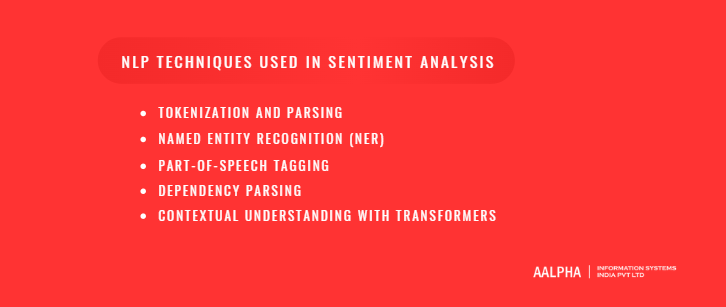
Tokenization and Parsing
Tokenization is the process of breaking down text into smaller units called tokens, typically words, phrases, or sentences. It is one of the first steps in NLP and plays a critical role in preparing text for analysis. For example, the sentence “The service was not good” is split into individual tokens such as “The,” “service,” “was,” “not,” and “good.” This allows the system to analyze each component separately.
Parsing builds on tokenization by analyzing the grammatical structure of a sentence. It helps identify how words are organized and related to each other. For instance, parsing can determine which words form phrases and how they contribute to the overall meaning.
Together, tokenization and parsing provide the structural foundation for sentiment analysis. They ensure that text is segmented and organized in a way that allows subsequent techniques to interpret meaning accurately, especially in complex or multi-clause sentences.
-
Named Entity Recognition (NER)
Named Entity Recognition (NER) is a technique used to identify and classify specific entities within text, such as names of people, organizations, locations, dates, and brands. In sentiment analysis, NER helps associate opinions with the correct subjects, which is essential for extracting meaningful insights.
For example, in the sentence “The battery life of the iPhone is great, but Samsung’s camera is better,” NER can identify “iPhone” and “Samsung” as entities. This allows the system to link positive sentiment with one brand and comparative sentiment with another.
NER is particularly valuable in applications like brand monitoring, competitive analysis, and social media tracking. It enables businesses to understand not just what sentiment is being expressed, but who or what it is directed toward. Without entity recognition, sentiment analysis may produce generalized results that lack actionable context.
-
Part-of-Speech Tagging
Part-of-Speech (POS) tagging involves assigning grammatical labels to each word in a sentence, such as noun, verb, adjective, or adverb. This technique helps systems understand the role each word plays in conveying meaning.
In sentiment analysis, POS tagging is especially important because certain parts of speech carry stronger sentiment signals. Adjectives like “excellent,” “poor,” or “disappointing” often indicate sentiment directly, while adverbs such as “very” or “slightly” modify the intensity of that sentiment. For example, “very good” expresses stronger positivity than “good.”
POS tagging also helps distinguish between different meanings of the same word based on context. For instance, the word “like” can function as a verb or a preposition, depending on its usage. By understanding grammatical roles, sentiment models can interpret text more accurately.
Overall, POS tagging enhances the system’s ability to capture sentiment nuances, improving both precision and contextual understanding.
-
Dependency Parsing
Dependency parsing focuses on identifying relationships between words in a sentence, showing how they are connected and how meaning is constructed. It goes beyond simple structure to analyze how words influence each other.
This technique is particularly important for handling negation and complex sentence structures. For example, in the sentence “The product is not good,” dependency parsing helps the model understand that “not” modifies “good,” reversing its sentiment from positive to negative. Without this understanding, the model might incorrectly classify the sentence as positive.
Dependency parsing also helps interpret comparative and conditional statements. For instance, “The phone is better than the previous version” conveys a relative sentiment that depends on the relationship between entities.
By capturing these relationships, dependency parsing enables more accurate sentiment classification, especially in cases where meaning depends on word interactions rather than individual terms.
-
Contextual Understanding with Transformers
Traditional NLP techniques often struggle with context, especially in cases involving sarcasm, ambiguity, or long-range dependencies. Transformer-based models address these limitations by using attention mechanisms to analyze the entire sentence or document simultaneously, rather than processing words sequentially.
This allows transformers to determine which words are most relevant to each other, regardless of their position in the text. For example, in the sentence “I thought the movie would be great, but it turned out to be disappointing,” a transformer model can correctly associate “disappointing” with the overall sentiment, even though it appears later in the sentence.
Transformers are also more effective at handling sarcasm and subtle language cues. A statement like “Great, another delay” may appear positive based on the word “great,” but context reveals a negative sentiment. Transformer models can capture this nuance by analyzing surrounding words and patterns.
Models such as BERT and similar architectures have significantly improved sentiment analysis accuracy by incorporating deep contextual understanding. This capability is essential for real-world applications, where language is rarely straightforward and often depends on context for correct interpretation.
Applications of Sentiment Analysis Across Industries
Sentiment analysis has moved beyond academic research into a core business capability used across industries to extract actionable insights from large volumes of text data. Its value lies in converting subjective opinions into structured intelligence that can inform strategy, improve operations, and enhance customer experience. From monitoring brand perception to predicting financial trends, sentiment analysis enables organizations to respond to real-world signals quickly and effectively. Each industry applies it differently based on its priorities, but the underlying objective remains the same: understanding human opinions at scale and turning them into measurable outcomes.
-
Social Media Monitoring
Social media platforms generate vast amounts of real-time data where users openly share opinions about brands, products, and events. Sentiment analysis allows organizations to track and interpret these conversations at scale, providing a clear picture of public perception. By analyzing posts, comments, and hashtags, businesses can identify whether sentiment around their brand is positive, negative, or neutral.
For example, during a product launch, companies can monitor audience reactions across platforms like Twitter and Instagram to assess reception instantly. If negative sentiment spikes due to complaints or issues, teams can respond quickly before it escalates into a larger reputation problem. Similarly, positive sentiment can be leveraged for marketing campaigns and brand promotion.
This capability is essential for reputation management, crisis detection, and trend analysis. It answers critical questions such as how people feel about a brand in real time and whether public perception is improving or declining. As social media continues to influence consumer behavior, sentiment analysis has become a key tool for maintaining brand visibility and trust.
-
Customer Feedback Analysis
Customer feedback is one of the most valuable sources of insight for any business, but it often exists in unstructured formats such as reviews, survey responses, and ratings. Sentiment analysis enables organizations to process this data efficiently and extract meaningful patterns without manual effort.
For instance, an e-commerce platform can analyze thousands of product reviews to determine overall satisfaction levels. Instead of reading each review individually, businesses can identify trends such as recurring complaints about product quality or consistent praise for fast delivery. This helps prioritize improvements and refine offerings based on actual customer experiences.
Sentiment analysis also enhances survey analysis by categorizing open-ended responses into sentiment groups, making it easier to quantify qualitative feedback. It answers questions like whether customers are satisfied with a service or what specific issues are affecting their experience.
By systematically analyzing feedback, organizations can make data-driven decisions that improve products, services, and overall customer satisfaction, ultimately leading to higher retention and loyalty.
-
Customer Support Automation
Customer support teams handle large volumes of queries, complaints, and requests daily. Sentiment analysis plays a critical role in automating and optimizing these interactions by identifying the emotional tone of incoming messages.
For example, a support ticket containing phrases like “very frustrated” or “not working at all” can be automatically classified as high priority. This ensures that critical issues are addressed quickly, reducing customer dissatisfaction. At the same time, neutral or informational queries can be handled through automated systems such as chatbots.
Sentiment analysis also enables more intelligent automation. Chatbots can adapt their responses based on user sentiment, offering empathetic replies when negative emotions are detected. For instance, a frustrated customer may receive a more personalized and supportive response compared to a standard query.
This approach improves response efficiency while maintaining a human-like interaction experience. It helps businesses reduce operational costs, improve resolution times, and enhance customer satisfaction by ensuring that the right issues receive attention at the right time.
-
Market Research and Competitive Analysis
Understanding how customers perceive products, services, and competitors is essential for strategic decision-making. Sentiment analysis provides a scalable way to gather insights from online discussions, reviews, and industry-related content.
Businesses can analyze sentiment around their own brand as well as competitors to identify strengths and weaknesses. For example, if customers consistently express dissatisfaction with a competitor’s pricing but praise their product quality, this insight can inform pricing strategies and positioning.
Sentiment analysis also supports trend identification by tracking changes in public opinion over time. This allows organizations to detect emerging preferences, shifting consumer expectations, and potential market opportunities.
It answers key questions such as what customers like or dislike about a product category and how a brand compares to its competitors in terms of perception. By leveraging these insights, companies can refine their marketing strategies, improve product offerings, and gain a competitive advantage in the market.
-
Financial Market Sentiment Analysis
In the financial sector, sentiment analysis is used to interpret market sentiment from news articles, social media, and investor discussions. The underlying idea is that public opinion and emotional reactions can influence market behavior and price movements.
For example, positive sentiment around a company in financial news or social media may indicate increased investor confidence, potentially leading to stock price growth. Conversely, negative sentiment related to regulatory issues or poor earnings reports can signal potential declines.
Investment firms and traders use sentiment analysis to complement traditional financial indicators. By combining quantitative data with sentiment insights, they can make more informed decisions and identify opportunities or risks earlier.
This application answers questions such as how the market feels about a particular stock or whether investor sentiment is shifting in response to recent events. While not a standalone predictor, sentiment analysis provides an additional layer of intelligence that enhances decision-making in financial markets.
-
Healthcare and Patient Feedback Analysis
In healthcare, patient feedback is a critical factor in improving service quality and patient outcomes. With the growing adoption of NLP in healthcare, sentiment analysis enables healthcare providers to analyze feedback from surveys, online reviews, and patient interactions more efficiently. By applying natural language processing techniques, organizations can identify patterns, detect patient concerns, and uncover areas that require improvement, helping enhance overall care quality and patient satisfaction.
For instance, hospitals can analyze patient reviews to detect common concerns such as long waiting times, staff behavior, or treatment effectiveness. Positive feedback can highlight strengths, while negative sentiment can indicate areas that require immediate attention.
Sentiment analysis is also used in monitoring patient communication channels, helping healthcare providers identify dissatisfaction or distress early. This allows for timely intervention and better patient care.
Additionally, it supports large-scale analysis of healthcare data, enabling institutions to track patient satisfaction trends over time and evaluate the impact of changes in services or policies.
By turning qualitative feedback into structured insights, sentiment analysis helps healthcare organizations enhance patient experience, improve operational efficiency, and deliver better outcomes.
Tools and Libraries for NLP Sentiment Analysis
Selecting the right tools is a critical step in implementing sentiment analysis effectively. The choice depends on factors such as project complexity, available expertise, scalability requirements, and integration needs. From lightweight Python libraries for quick prototyping to enterprise-grade APIs and no-code platforms, the ecosystem offers a wide range of options. Understanding how these tools differ helps businesses and developers choose the most appropriate solution for their use case, whether it involves building a custom model, deploying at scale, or enabling non-technical teams to analyze sentiment.
-
Python Libraries (NLTK, TextBlob, spaCy)
Python libraries form the foundation of many sentiment analysis implementations, especially during experimentation and early-stage development. These libraries provide prebuilt functions for text processing, linguistic analysis, and basic sentiment classification.
NLTK (Natural Language Toolkit) is one of the most widely used libraries for NLP research and education. It offers tools for tokenization, stemming, tagging, and classification. While it requires more manual configuration, it is highly flexible and suitable for building custom sentiment pipelines.
TextBlob is built on top of NLTK and simplifies many NLP tasks, including sentiment analysis. It provides an easy-to-use interface for polarity and subjectivity scoring, making it ideal for quick prototypes or small-scale applications.
spaCy is designed for production use and offers high performance with efficient processing capabilities. It supports advanced NLP features such as named entity recognition and dependency parsing, making it suitable for more complex sentiment analysis systems.
These libraries are best suited for developers who want control over preprocessing, feature engineering, and model customization.
-
Deep Learning Frameworks
Deep learning frameworks are essential for building advanced sentiment analysis models that can handle complex language patterns and large datasets. They provide the infrastructure needed to design, train, and deploy neural networks.
TensorFlow, developed by Google, is one of the most widely adopted frameworks for machine learning and deep learning. It offers a comprehensive ecosystem that includes tools for model training, deployment, and monitoring. TensorFlow is particularly useful for large-scale production systems where scalability and performance are critical.
PyTorch, developed by Meta, is known for its flexibility and ease of use. It provides a dynamic computation graph, which makes it easier to experiment with different model architectures. This has made PyTorch a popular choice in research and development, as well as in production environments.
Both frameworks support the development of models such as RNNs, LSTMs, and transformer-based architectures. They enable developers to build highly accurate sentiment analysis systems but require expertise in machine learning and access to computational resources such as GPUs.
-
Pretrained Models and APIs
Pretrained models and APIs have significantly lowered the barrier to entry for sentiment analysis by providing ready-to-use solutions with high accuracy. These tools are trained on large datasets and can be fine-tuned or directly applied to specific use cases.
Hugging Face offers a wide range of pretrained transformer models, including BERT and RoBERTa, which can be easily integrated into applications. It also provides tools for fine-tuning models on domain-specific data, making it a popular choice among developers.
Google Cloud Natural Language API provides sentiment analysis as a managed service. It can analyze text and return sentiment scores and magnitudes without requiring model training. This is ideal for businesses that want quick deployment with minimal technical effort.
AWS Comprehend offers similar capabilities, enabling sentiment analysis across large volumes of text with built-in scalability and integration with other AWS services. It supports multiple languages and is suitable for enterprise applications.
These solutions are best suited for organizations that need reliable performance without investing heavily in model development.
-
No-Code and SaaS Tools
For businesses without dedicated technical teams, no-code and SaaS-based sentiment analysis tools provide an accessible way to leverage NLP capabilities. These platforms eliminate the need for programming and allow users to analyze text through intuitive interfaces.
Tools such as MonkeyLearn, Lexalytics, and similar platforms enable users to upload data, define categories, and generate sentiment insights with minimal setup. Many of these platforms also offer customization options, allowing businesses to tailor models to their specific domain.
No-code tools are particularly useful for marketing teams, customer experience managers, and analysts who need quick insights without relying on developers. They can be integrated with existing systems such as CRM platforms, social media dashboards, and survey tools.
While these solutions may offer less flexibility compared to custom-built models, they provide speed, ease of use, and scalability. For many organizations, especially small and mid-sized businesses, they represent a practical starting point for implementing sentiment analysis and deriving immediate value from textual data.
Challenges in NLP Sentiment Analysis
While sentiment analysis has made significant progress, it is far from a solved problem. Human language is inherently complex, shaped by context, culture, emotion, and intent. Even advanced NLP models can struggle to interpret subtle nuances that humans understand intuitively. Recognizing these challenges is essential for setting realistic expectations and building more reliable systems. Businesses that rely on sentiment analysis must account for these limitations, continuously refine their models, and combine automated insights with human judgment where necessary.
-
Sarcasm and Irony Detection
Sarcasm and irony remain some of the most difficult aspects of language for machines to interpret. In these cases, the literal meaning of words is often the opposite of the intended sentiment. For example, a statement like “Great, another delayed delivery” may contain the word “great,” which typically indicates positive sentiment, but the actual intent is negative.
The challenge arises because sarcasm depends heavily on tone, context, and sometimes external knowledge. Humans can detect sarcasm through subtle cues such as prior experience, conversational context, or even vocal tone in spoken language. However, text-based systems lack access to these signals.
Even advanced models struggle because sarcasm often requires understanding implied meaning rather than explicit wording. While transformer-based models have improved performance by analyzing context, they are still not consistently reliable in detecting sarcasm across different domains.
This limitation can lead to misclassification, particularly in social media analysis where sarcasm is common, affecting the overall accuracy of sentiment insights.
-
Context Understanding Issues
Context plays a critical role in determining sentiment, but it is one of the most challenging aspects for NLP systems to handle accurately. The same word or phrase can carry different meanings depending on how it is used within a sentence or conversation.
For example, the word “light” can be positive in the context of a laptop (“light and easy to carry”) but negative when referring to food (“too light, not filling”). Similarly, phrases like “not bad” convey a positive sentiment despite containing a negative word.
Traditional models that rely on keywords or frequency-based features often fail to capture such nuances. Even with advanced techniques, understanding context across multiple sentences or longer conversations remains difficult. Sentiment may depend on earlier statements, implied meaning, or shifts in tone within the same text.
Accurate context interpretation requires models to consider relationships between words, sentence structure, and broader discourse. While modern NLP models have improved in this area, context-related errors still occur, particularly in complex or ambiguous text.
-
Multilingual and Cultural Variations
Language is deeply influenced by culture, region, and local expressions, making multilingual sentiment analysis a complex challenge. Words, phrases, and idioms often carry different meanings across languages, and direct translation may not preserve sentiment accurately.
For instance, certain expressions that are considered positive in one culture may be neutral or even negative in another. Slang, abbreviations, and regional dialects further complicate analysis, especially in informal communication such as social media.
Additionally, many languages have limited annotated datasets compared to widely used languages like English. This imbalance affects model performance, as systems trained on large English datasets may not generalize well to other languages.
Handling multilingual sentiment analysis requires models that can understand linguistic diversity and cultural context. While cross-lingual models and multilingual embeddings have improved capabilities, achieving consistent accuracy across languages remains a significant challenge for global applications.
-
Data Quality and Bias
The quality of data used to train sentiment analysis models has a direct impact on their performance. Poorly labeled, incomplete, or noisy datasets can lead to inaccurate predictions and unreliable insights. For example, inconsistent labeling of sentiment in training data can confuse models and reduce their ability to generalize.
Bias is another critical issue. If a dataset overrepresents certain opinions, demographics, or language styles, the model may develop biased predictions. For instance, it may associate specific words or phrases with negative sentiment based on skewed training data, even when the context does not justify it.
Bias can also arise from cultural or linguistic imbalances, where models perform well for certain groups but poorly for others. This is particularly problematic in applications such as customer support or social media monitoring, where fairness and accuracy are essential.
Addressing these challenges requires careful dataset curation, diverse training data, and continuous evaluation. Organizations must also implement monitoring mechanisms to detect and correct bias over time, ensuring that sentiment analysis systems remain accurate, fair, and reliable.
Step-by-Step Process to Build a Sentiment Analysis Model
Building a sentiment analysis system requires a structured approach that combines data preparation, model development, and real-world deployment. While modern tools have simplified implementation, achieving reliable and business-ready results still depends on careful planning and execution. In many cases, organizations refer to practices commonly followed by an NLP solutions company to guide implementation and maintain consistency in results. Each step in the workflow contributes directly to model accuracy, scalability, and usability. Whether the goal is analyzing customer reviews, automating support, or monitoring brand sentiment, following a systematic approach helps ensure the final solution delivers meaningful and actionable insights.
-
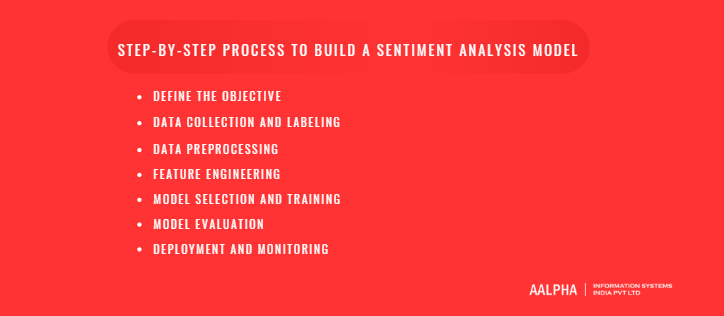
Define the Objective
The first and most critical step is clearly defining the objective of the sentiment analysis system. Without a well-defined goal, it becomes difficult to choose the right data, model, and evaluation criteria. The objective should answer what problem is being solved and how the output will be used.
For example, a business may want to classify customer reviews as positive or negative to measure satisfaction, while another may need aspect-based sentiment analysis to evaluate specific product features. Similarly, a customer support system might require real-time sentiment detection to prioritize urgent issues.
Defining the objective also involves determining the level of granularity required, such as binary classification, multi-class sentiment, or emotion detection. It is equally important to identify the domain, whether it is e-commerce, healthcare, finance, or social media, as language patterns vary across industries.
A clearly defined objective ensures alignment between business needs and technical implementation, reducing unnecessary complexity and improving overall effectiveness.
-
Data Collection and Labeling
Once the objective is established, the next step is gathering relevant data. Sentiment analysis models rely heavily on the quality and diversity of data, making this stage crucial for achieving accurate results.
Data can be collected from multiple sources, including product reviews, social media posts, customer support tickets, surveys, and feedback forms. The choice of data source should align with the defined objective. For instance, analyzing brand sentiment requires social media data, while improving product quality may rely on review data.
After collection, the data must be labeled to indicate sentiment categories such as positive, negative, or neutral. Labeling can be done manually by human annotators or semi-automatically using existing tools. High-quality labeling is essential, as inconsistencies can lead to poor model performance.
In some cases, publicly available datasets can be used as a starting point, but domain-specific data often yields better results. A well-curated dataset ensures that the model learns relevant patterns and generalizes effectively to real-world scenarios.
-
Data Preprocessing
Raw text data is often noisy and inconsistent, requiring preprocessing before it can be used for model training. This step focuses on cleaning and standardizing the data to improve model performance.
Common preprocessing tasks include converting text to lowercase, removing punctuation, eliminating special characters, and handling missing values. Tokenization is used to split text into individual words or phrases, while stopword removal eliminates common words that do not contribute to sentiment.
Stemming and lemmatization are applied to reduce words to their base forms, ensuring consistency across variations. For example, “running,” “runs,” and “ran” can be normalized to a common root.
Additional preprocessing steps may include handling negations, correcting spelling errors, and removing irrelevant content such as URLs or HTML tags. These refinements help the model focus on meaningful patterns rather than noise.
Effective preprocessing significantly improves the quality of input data, leading to better feature representation and more accurate sentiment predictions.
-
Feature Engineering
Feature engineering involves transforming preprocessed text into numerical representations that machine learning models can understand. This step bridges the gap between human language and computational analysis.
Traditional methods such as Bag-of-Words and TF-IDF convert text into vectors based on word frequency and importance. While these approaches are simple and effective, they do not capture context or semantic relationships between words.
More advanced techniques use word embeddings, which represent words as dense vectors in a continuous space. These embeddings capture semantic similarity, allowing models to understand relationships between words like “good” and “excellent.”
Feature engineering may also include extracting additional signals such as sentiment lexicons, n-grams, or syntactic features. The choice of features depends on the complexity of the problem and the selected model.
Well-designed features enhance the model’s ability to detect sentiment patterns, making this step a key factor in achieving high accuracy.
-
Model Selection and Training
Selecting the right model is essential for balancing accuracy, complexity, and computational efficiency. The choice depends on factors such as dataset size, problem complexity, and available resources.
For simpler tasks, traditional machine learning models such as Naive Bayes, Logistic Regression, or Support Vector Machines can deliver reliable results with relatively low computational cost. These models work well with structured features like TF-IDF.
For more complex scenarios involving large datasets or nuanced language, deep learning models such as LSTMs or transformer-based architectures are more suitable. These models can capture context, sequence, and subtle language patterns more effectively.
During training, the model learns from labeled data by identifying patterns that distinguish different sentiment classes. Hyperparameter tuning is often performed to optimize performance.
The goal is to select a model that meets accuracy requirements while remaining scalable and efficient for real-world deployment.
-
Model Evaluation
Evaluating the model is a critical step to ensure that it performs well on unseen data. Relying solely on accuracy can be misleading, especially in cases where class distribution is imbalanced.
Key evaluation metrics include precision, recall, and F1-score. Precision measures how many predicted positive instances are actually correct, while recall measures how many actual positive instances are correctly identified. The F1-score provides a balanced measure of both precision and recall.
Confusion matrices are also used to analyze model performance by showing the distribution of correct and incorrect predictions across classes. This helps identify specific areas where the model may be underperforming.
Cross-validation techniques can further improve reliability by testing the model on different subsets of data. Proper evaluation ensures that the model generalizes well and avoids issues such as overfitting or underfitting.
-
Deployment and Monitoring
Once the model is trained and evaluated, it must be deployed into a real-world environment where it can process live data and generate insights. Deployment involves integrating the model into applications such as customer support systems, analytics dashboards, or APIs.
For example, a deployed model may analyze incoming customer messages in real time and classify sentiment to prioritize responses. It can also be integrated into social media monitoring tools or business intelligence platforms.
However, deployment is not the final step. Continuous monitoring is essential to maintain performance over time. Language evolves, user behavior changes, and new data patterns emerge, which can affect model accuracy.
Monitoring involves tracking key metrics, identifying performance degradation, and retraining the model when necessary. Feedback loops can be implemented to incorporate new labeled data and improve the system continuously.
A well-deployed and actively monitored sentiment analysis model ensures long-term reliability, scalability, and alignment with business objectives.
Cost of Implementing NLP Sentiment Analysis
The cost of implementing sentiment analysis varies significantly based on technical complexity, scale, and business requirements. Organizations can choose between building custom models, using pretrained APIs, or adopting SaaS tools, each with different cost implications. Understanding the cost structure is essential for making informed decisions and aligning investment with expected outcomes. While initial expenses may seem substantial, sentiment analysis often delivers measurable returns through improved efficiency, better customer insights, and enhanced decision-making capabilities.
-
Factors Affecting Cost
Several factors influence the overall cost of implementing sentiment analysis. One of the primary drivers is data size. Large datasets require more storage, processing power, and time for training, which increases costs. Additionally, the quality of data plays a role, as poorly labeled or unstructured data may require significant preprocessing and annotation effort.
Model complexity is another key factor. Simple machine learning models are relatively inexpensive to develop and deploy, while advanced deep learning or transformer-based models require more computational resources, specialized expertise, and longer development cycles. The choice of model should align with the level of accuracy and sophistication required.
Integration requirements also impact cost. Embedding sentiment analysis into existing systems such as CRM platforms, customer support tools, or analytics dashboards may involve additional development and testing. Real-time processing capabilities further increase complexity and infrastructure demands.
These factors collectively determine the scope of investment, making it essential to balance technical ambition with practical business needs.
-
Custom Development vs Prebuilt APIs
Organizations must decide whether to build a custom sentiment analysis solution or use prebuilt APIs. Each approach has distinct cost implications and trade-offs.
Custom development involves designing, training, and deploying a model tailored to specific business requirements. This approach offers greater control, higher accuracy for domain-specific use cases, and flexibility in customization. However, it requires significant upfront investment in data collection, model development, and ongoing maintenance. It is best suited for enterprises with unique requirements or large-scale operations.
Prebuilt APIs, such as those offered by cloud providers, provide ready-to-use sentiment analysis capabilities. These solutions are cost-effective for quick deployment, as they eliminate the need for model training and infrastructure setup. Pricing is typically based on usage, such as the number of API calls or volume of text processed.
While APIs reduce initial costs and time to market, they may offer limited customization and may not perform optimally for specialized domains. The choice depends on whether the priority is speed and simplicity or precision and control.
-
Infrastructure and Maintenance Costs
Infrastructure is a significant component of sentiment analysis costs, particularly for large-scale or real-time applications. Cloud platforms are commonly used to handle computation, storage, and deployment, offering scalability and flexibility. However, costs can increase with higher usage, especially when processing large volumes of text or running complex models.
Storage costs arise from maintaining datasets, model checkpoints, and logs. As data grows, efficient storage management becomes essential to control expenses. Additionally, real-time systems may require low-latency processing, which demands more advanced infrastructure.
Maintenance is an ongoing cost that is often underestimated. Models need to be monitored, updated, and retrained as new data becomes available or as language patterns evolve. This requires continuous effort from data scientists and engineers.
Other operational costs include monitoring tools, security measures, and compliance requirements. A well-planned infrastructure strategy ensures that the system remains scalable, reliable, and cost-efficient over time.
-
ROI and Business Impact
Despite the associated costs, sentiment analysis often delivers strong returns on investment by improving operational efficiency and enabling data-driven decision-making. One of the most immediate benefits is the ability to process large volumes of text automatically, reducing the need for manual analysis and saving time and resources.
In customer experience management, sentiment analysis helps identify issues early, allowing businesses to address problems before they escalate. This leads to higher customer satisfaction and retention. In marketing, it provides insights into campaign performance and audience perception, enabling more effective strategies.
Operational efficiency is another key advantage. Automated prioritization of customer support queries ensures that critical issues are resolved quickly, improving response times and reducing workload.
From a strategic perspective, sentiment analysis provides actionable insights that inform product development, pricing strategies, and competitive positioning. By turning unstructured data into measurable intelligence, it empowers organizations to make informed decisions with greater confidence.
When implemented effectively, the long-term benefits of sentiment analysis often outweigh the initial investment, making it a valuable addition to modern business operations.
How to Choose the Right NLP Development Partner
Selecting the right NLP development partner is a critical decision that directly impacts the success of your sentiment analysis initiative. Beyond technical implementation, a reliable partner brings domain understanding, strategic guidance, and long-term support. Businesses often underestimate the importance of choosing a team that not only builds the model but also ensures it delivers measurable business outcomes. The ideal partner should combine technical depth with practical experience, enabling them to translate complex NLP capabilities into scalable, real-world solutions. Careful evaluation across multiple factors helps ensure that the chosen partner aligns with your goals, budget, and operational requirements.
-
Experience in NLP and AI Projects
A proven track record in NLP and AI projects is one of the most important factors to consider. Sentiment analysis is highly domain-specific, and experience across industries such as e-commerce, healthcare, finance, or customer support can significantly improve implementation quality.
An experienced partner understands common challenges such as handling noisy data, managing multilingual inputs, and improving model accuracy over time. They are also more likely to follow best practices in data preparation, model selection, and evaluation. Reviewing case studies, past projects, and client success stories provides insight into their capabilities.
It is important to assess whether the partner has worked on similar use cases, such as sentiment analysis for customer feedback or social media monitoring. Practical experience ensures that the solution is not just technically sound but also aligned with business objectives and real-world requirements.
-
Technical Capabilities
Strong technical expertise is essential for building robust and scalable sentiment analysis systems. The partner should have deep knowledge of machine learning, deep learning, and modern NLP techniques, including transformer-based models and large language models.
They should be proficient in handling the full NLP pipeline, from data preprocessing and feature engineering to model training and deployment. Familiarity with frameworks and tools such as TensorFlow, PyTorch, and Hugging Face is a key indicator of technical strength.
In addition, the ability to optimize models for performance, accuracy, and efficiency is critical, especially for large-scale or real-time applications. A technically capable partner can evaluate whether a simple model is sufficient or if a more advanced architecture is required.
This expertise ensures that the final solution is not only accurate but also scalable, maintainable, and aligned with evolving technology trends.
-
Customization and Scalability
Every business has unique requirements, and a one-size-fits-all solution rarely delivers optimal results. The right NLP partner should offer customization capabilities to tailor sentiment analysis models to your specific domain, data, and objectives.
For example, sentiment analysis for healthcare feedback differs significantly from e-commerce reviews. A customized model can better understand domain-specific terminology, leading to higher accuracy and more relevant insights.
Scalability is equally important. As your business grows, the system should be able to handle increasing volumes of data without performance degradation. This includes supporting real-time processing, expanding to new languages, and adapting to new use cases.
A partner that prioritizes both customization and scalability ensures that the solution remains effective and relevant over time.
-
Integration Expertise
Sentiment analysis systems rarely operate in isolation. They need to integrate seamlessly with existing business tools such as CRM systems, customer support platforms, analytics dashboards, and enterprise applications.
A capable development partner should have experience in integrating NLP solutions into complex environments. This includes designing APIs, ensuring data flow between systems, and maintaining compatibility with existing workflows.
For example, integrating sentiment analysis into a customer support platform allows automatic prioritization of tickets, while integration with a CRM system enables better customer profiling. These integrations enhance the overall value of the solution by embedding insights directly into business processes.
Strong integration expertise ensures that the sentiment analysis system becomes a functional part of your operations rather than a standalone tool.
-
Pricing and Engagement Model
Transparent pricing and flexible engagement models are essential for building a long-term partnership. Businesses should clearly understand the cost structure, including development, deployment, and ongoing maintenance expenses.
Different partners may offer fixed-price, time-and-material, or subscription-based models. The choice depends on project scope, complexity, and budget constraints. A reliable partner will provide detailed estimates and clearly define deliverables, timelines, and milestones.
It is also important to evaluate the value provided rather than focusing solely on cost. Lower-cost solutions may compromise on quality, while higher investment in a capable partner can lead to better outcomes and long-term savings.
A well-structured engagement model ensures predictability, accountability, and alignment between both parties.
-
Post-Deployment Support
Sentiment analysis systems require continuous monitoring, updates, and optimization to maintain performance over time. Language evolves, new data patterns emerge, and business requirements change, making ongoing support a critical factor.
A strong development partner will offer post-deployment services such as model retraining, performance monitoring, and system optimization. They should also provide support for scaling the solution, adding new features, and adapting to changing business needs.
Regular updates ensure that the model remains accurate and relevant, while proactive monitoring helps identify issues before they impact performance. Additionally, support for handling new languages, domains, or data sources can extend the system’s capabilities.
Working with an experienced provider such as Aalpha, which offers end-to-end AI and NLP development services along with long-term support, can ensure that your sentiment analysis solution continues to deliver value well beyond initial deployment.
Final Thoughts
Sentiment analysis powered by NLP has become a practical tool for turning unstructured text into actionable business insights. From understanding customer feedback to improving decision-making and automating workflows, its impact spans across industries and use cases. The key to success lies in choosing the right approach, using high-quality data, and implementing solutions that align with specific business objectives.
If you are planning to adopt sentiment analysis or enhance your existing capabilities, working with an experienced partner can significantly reduce complexity and accelerate results. Aalpha offers tailored NLP and AI solutions designed to meet real-world business needs, from model development to deployment and ongoing optimization.
Connect with us to explore how sentiment analysis can help you gain deeper insights, improve customer experience, and drive smarter decisions.