





Manufacturing is entering a new phase of digital transformation where artificial intelligence is becoming a core operational technology rather than an experimental innovation. Factories are no longer relying only on fixed automation systems or manual production oversight. Modern manufacturing environments are increasingly driven by intelligent systems capable of analyzing data, predicting failures, optimizing workflows, identifying defects, and making operational recommendations in real time.
The growing complexity of global supply chains, rising production costs, labor shortages, and increasing customer expectations are pushing manufacturers to adopt smarter technologies that improve efficiency and reduce operational risk. Artificial intelligence plays a major role in this shift by enabling machines and software systems to process massive amounts of industrial data and generate insights that were previously impossible to achieve manually.
From automotive assembly plants and semiconductor manufacturing units to pharmaceutical production and food processing facilities, AI is transforming how manufacturers operate at every level. Computer vision systems can detect microscopic defects within milliseconds, predictive maintenance algorithms can forecast machine failures before breakdowns occur, and AI-powered planning systems can optimize inventory and production schedules based on demand fluctuations.
Unlike traditional industrial automation, which follows predefined instructions, AI systems continuously learn from operational data and improve over time. This ability to adapt, predict, and optimize makes AI one of the most important technologies driving the future of manufacturing and Industry 4.0 initiatives worldwide.
What Is AI in Manufacturing?
Artificial intelligence in manufacturing refers to the use of machine learning, computer vision, predictive analytics, natural language processing, and intelligent automation technologies to improve manufacturing operations, production efficiency, quality control, and decision-making processes. AI systems analyze large volumes of industrial data collected from machines, sensors, cameras, robotics systems, enterprise software, and factory equipment to identify patterns, generate insights, and automate complex operational tasks.
Traditional manufacturing automation typically depends on fixed programming and rule-based workflows. For example, a robotic arm on an assembly line may repeat the same movement continuously based on predefined instructions. These systems are highly efficient for repetitive tasks but lack adaptability when production conditions change unexpectedly.
AI-driven manufacturing systems work differently. Instead of relying solely on static instructions, AI models learn from historical and real-time operational data. A computer vision system used for quality inspection can continuously improve its ability to identify product defects by analyzing thousands of production images. Similarly, predictive maintenance algorithms can detect abnormal machine behavior and forecast equipment failure before downtime occurs.
This shift from reactive automation to intelligent decision-making is one of the defining characteristics of modern manufacturing AI development. AI systems are not replacing automation; they are making automation more adaptive, accurate, and data-driven. As factories become increasingly connected through industrial IoT devices and smart sensors, AI acts as the intelligence layer that transforms raw industrial data into operational improvements.
Why Manufacturers Are Investing in AI
Manufacturers are investing heavily in AI because traditional production methods are no longer sufficient to meet modern operational demands. Rising labor costs, supply chain disruptions, competitive market pressure, and increasing quality expectations are forcing manufacturers to improve efficiency while reducing operational risks.
One of the biggest drivers of AI adoption is labor shortage. Many manufacturing sectors are struggling to recruit and retain skilled workers, particularly for repetitive, hazardous, or highly technical tasks. AI-powered automation and robotics help manufacturers maintain production continuity while reducing dependence on manual labor for routine operations.
Quality control is another major reason manufacturers are adopting AI solutions. Manual inspection processes are often inconsistent, slow, and prone to human error. AI-powered computer vision systems can inspect products in real time with significantly higher speed and accuracy. In industries such as electronics, automotive, aerospace, and pharmaceuticals, even minor defects can result in costly recalls or compliance failures, making AI-based inspection systems increasingly valuable.
Manufacturers are also under pressure to reduce downtime and maintenance costs. Unexpected equipment failures can halt production lines and cause substantial financial losses. Predictive maintenance systems powered by machine learning can analyze vibration data, temperature readings, pressure levels, and operational patterns to identify early signs of equipment failure before breakdowns occur.
Global competition is further accelerating AI investments. Manufacturers are competing not only on price but also on speed, customization, efficiency, and product consistency. Companies that implement AI-driven production optimization, smart inventory management, and intelligent forecasting systems gain operational advantages that improve profitability and scalability.
As industrial data volumes continue to grow, manufacturers increasingly view AI not as an optional innovation project, but as a long-term operational necessity for maintaining competitiveness in modern manufacturing markets.
Current State of AI Adoption in Manufacturing
AI adoption in manufacturing has accelerated significantly with the rise of Industry 4.0 and smart factory initiatives. Manufacturers across industries are integrating AI into production systems, industrial IoT networks, robotics platforms, warehouse operations, and enterprise software environments to create more connected and intelligent manufacturing ecosystems.
Industry 4.0 refers to the integration of digital technologies such as AI, cloud computing, IoT, robotics, edge computing, and advanced analytics into manufacturing operations. In smart factories, machines, sensors, and software systems continuously exchange data, allowing AI models to analyze production activities in real time and optimize operational performance automatically.
Industrial IoT has become one of the foundational technologies supporting manufacturing AI adoption. Sensors embedded in machines and production equipment collect massive amounts of operational data related to machine performance, temperature, vibration, pressure, energy consumption, and workflow efficiency. AI systems use this data to improve predictive maintenance, process optimization, and operational monitoring.
Computer vision adoption is also increasing rapidly in manufacturing environments. AI-powered cameras are now widely used for automated defect detection, packaging verification, worker safety monitoring, and production line inspection. These systems can operate continuously at speeds and accuracy levels that are difficult to achieve with manual inspection teams.
Robotics is evolving beyond traditional programmed automation into intelligent robotic systems capable of adapting to changing environments. AI-powered collaborative robots, commonly known as cobots, can work alongside human operators and dynamically adjust their actions based on production requirements and environmental conditions.
Generative AI is also beginning to influence manufacturing operations. Manufacturers are exploring AI assistants for maintenance troubleshooting, production reporting, operational knowledge management, and engineering support. AI copilots can help technicians quickly diagnose equipment issues, retrieve technical documentation, and improve operational decision-making.
Although AI adoption levels vary by industry and company size, the overall direction is clear. Manufacturing is steadily moving toward intelligent, data-driven, and highly automated production ecosystems where AI plays a central role in operational efficiency, quality improvement, predictive analytics, and smart factory management.
How AI Is Transforming the Manufacturing Industry
Artificial intelligence is fundamentally changing how manufacturing companies operate, manage production, maintain equipment, and optimize supply chains. Traditional manufacturing environments were heavily dependent on fixed automation, manual supervision, and reactive operational models. Modern AI-driven manufacturing systems are shifting the industry toward predictive, adaptive, and highly connected production ecosystems capable of making intelligent decisions in real time.
This transformation is being accelerated by the convergence of industrial IoT, cloud computing, robotics, edge computing, advanced analytics, and machine learning technologies. AI is no longer limited to isolated experimental projects inside factories. It is becoming deeply integrated into production lines, warehouse systems, maintenance operations, quality inspection workflows, procurement planning, and energy management systems.
Manufacturers are increasingly using AI to reduce downtime, improve product quality, optimize resource utilization, enhance worker safety, and increase production flexibility. As manufacturing operations generate enormous volumes of industrial data from sensors, machines, enterprise systems, and connected devices, AI acts as the intelligence layer that converts raw operational data into actionable insights and automated decision-making.
The shift toward intelligent manufacturing environments is creating what many organizations describe as smart factories, where machines, software platforms, robotics systems, and operational teams work together within interconnected digital ecosystems.
-
Smart Manufacturing and Industry 4.0
Smart manufacturing refers to digitally connected production environments where machines, software systems, sensors, robotics platforms, and operational infrastructure continuously exchange data to improve efficiency and decision-making. This concept forms the foundation of Industry 4.0, often referred to as the fourth industrial revolution.
In traditional manufacturing environments, machines often operate independently with limited communication between systems. Production decisions typically rely on manual reporting, scheduled inspections, and reactive management processes. Smart manufacturing environments operate differently by integrating industrial IoT devices, AI analytics platforms, enterprise systems, and automation technologies into a unified ecosystem.
AI plays a central role in enabling intelligent decision-making within these interconnected environments. Manufacturing systems can analyze real-time production data, detect bottlenecks, identify operational inefficiencies, and automatically recommend corrective actions. For example, AI systems can dynamically adjust production schedules based on machine availability, raw material supply, workforce allocation, or demand fluctuations.
Industry 4.0 environments also improve visibility across manufacturing operations. Production managers can monitor factory performance through centralized dashboards powered by AI analytics, enabling faster operational decisions and more accurate forecasting. As manufacturing ecosystems become increasingly connected, AI-driven smart factories are helping businesses improve agility, scalability, and operational efficiency while reducing manual intervention.
-
AI-Powered Predictive Maintenance
Predictive maintenance is one of the most widely adopted AI applications in manufacturing because of its direct impact on operational continuity and cost reduction. Traditional maintenance approaches are usually reactive or schedule-based. Reactive maintenance occurs after equipment fails, while preventive maintenance relies on fixed servicing intervals regardless of actual machine condition. Both approaches can lead to unnecessary downtime, excessive maintenance costs, or unexpected equipment breakdowns.
AI-powered predictive maintenance systems use machine learning algorithms to analyze data collected from industrial sensors, IoT devices, and historical maintenance records. These systems monitor variables such as vibration patterns, temperature fluctuations, pressure levels, acoustic signals, motor performance, and operational cycles to identify abnormal machine behavior.
By recognizing patterns associated with equipment degradation, AI models can forecast potential failures before they occur. For example, a predictive maintenance system may detect subtle vibration anomalies in a manufacturing motor that indicate bearing wear weeks before a complete breakdown happens. Maintenance teams can then schedule repairs proactively during planned downtime instead of facing unexpected production interruptions.
Predictive maintenance also helps manufacturers extend equipment lifespan, optimize spare parts inventory, reduce emergency repair costs, and improve production reliability. In industries such as automotive manufacturing, heavy machinery, oil and gas, aerospace, and semiconductor production, where equipment downtime can cause significant financial losses, AI-driven maintenance systems are becoming essential operational tools.
-
Computer Vision for Quality Inspection
Computer vision has emerged as one of the most impactful AI technologies in manufacturing quality control. Traditional manual inspection methods are often slow, inconsistent, and difficult to scale, especially in high-speed production environments where even minor defects can lead to product recalls, compliance violations, or customer dissatisfaction.
AI-powered computer vision systems use cameras, image recognition algorithms, and deep learning models to analyze products in real time during manufacturing and packaging processes. These systems can detect scratches, cracks, alignment issues, dimensional inaccuracies, color variations, missing components, surface defects, and other production inconsistencies with high precision.
Unlike rule-based image processing systems that rely on predefined parameters, AI vision models continuously improve their detection capabilities by learning from large datasets of production images. This enables them to identify complex or subtle defects that traditional inspection systems may overlook.
Computer vision systems are widely used across industries such as automotive manufacturing, electronics production, pharmaceuticals, food processing, textiles, and semiconductor fabrication. For example, electronics manufacturers use AI vision systems to inspect circuit boards for microscopic defects, while food manufacturers use computer vision to verify packaging integrity and product labeling accuracy.
In addition to quality inspection, computer vision is also being used for worker safety monitoring, robotic guidance, warehouse automation, and inventory tracking. As camera technology and AI processing capabilities continue to improve, computer vision is becoming a critical component of intelligent manufacturing operations.
-
AI in Supply Chain and Inventory Optimization
Manufacturing supply chains are becoming increasingly complex due to fluctuating demand, global sourcing challenges, transportation disruptions, and changing customer expectations. AI helps manufacturers improve supply chain visibility and optimize inventory management through predictive analytics and real-time operational insights.
AI systems analyze historical sales data, seasonal demand patterns, supplier performance metrics, production capacity, and market trends to generate more accurate demand forecasts. These insights help manufacturers reduce overproduction, minimize stock shortages, and improve procurement planning.
Inventory optimization systems powered by AI can automatically balance stock levels across warehouses and production facilities by predicting material requirements and identifying potential supply chain disruptions before they impact operations. AI also supports procurement teams by evaluating supplier reliability, delivery timelines, and pricing trends.
As supply chains become more data-driven, AI is helping manufacturers build more resilient and efficient operational ecosystems capable of adapting quickly to market changes and production demands.
-
Robotics and Autonomous Manufacturing Systems
Robotics in manufacturing is evolving from simple repetitive automation into intelligent autonomous systems powered by artificial intelligence. Traditional industrial robots typically perform fixed tasks within controlled environments using predefined programming instructions. AI-powered robotic systems can adapt to changing production conditions and make operational decisions based on real-time data.
Collaborative robots, commonly known as cobots, are designed to work alongside human operators in manufacturing environments. These robots use AI, sensors, and computer vision to detect human movement, adjust their behavior, and safely collaborate with workers on assembly, packaging, inspection, and material handling tasks.
AI-powered robotic arms are also improving manufacturing flexibility by learning from operational data and optimizing movements for speed, precision, and efficiency. Autonomous mobile robots are increasingly used for transporting materials across warehouses and production facilities without manual guidance.
By combining AI with robotics, manufacturers can reduce manual labor dependency, improve operational consistency, increase production speed, and enhance workplace safety while enabling more adaptive manufacturing environments.
-
Energy Consumption and Sustainability Optimization
Energy costs and sustainability goals are becoming major priorities for manufacturing organizations worldwide. Manufacturing facilities consume significant amounts of electricity, water, fuel, and raw materials, making operational efficiency critical for both profitability and environmental responsibility.
AI helps manufacturers optimize energy consumption by continuously monitoring equipment performance, production workflows, environmental conditions, and energy usage patterns. Machine learning systems can identify inefficiencies such as excessive machine idle time, abnormal power consumption, compressed air leaks, or inefficient production scheduling.
AI-driven analytics platforms can automatically recommend operational adjustments that reduce energy waste while maintaining production output. For example, manufacturing systems can optimize machine operating schedules during lower energy-cost periods or dynamically adjust HVAC and cooling systems based on factory conditions.
AI also supports sustainability initiatives by helping manufacturers reduce material waste, improve resource utilization, and monitor carbon emissions across production operations. As environmental regulations become stricter and sustainability reporting requirements increase, AI is becoming an important tool for building greener and more energy-efficient manufacturing ecosystems.
Core Technologies Used in Manufacturing AI Development
Artificial intelligence in manufacturing is powered by a combination of advanced technologies that work together to collect industrial data, process operational information, automate workflows, and generate predictive insights. Modern manufacturing AI systems are not built around a single technology stack. Instead, they combine machine learning, computer vision, industrial IoT, edge computing, robotics, and intelligent automation platforms to create highly connected production ecosystems.
The effectiveness of AI in manufacturing depends heavily on how these technologies interact with existing factory infrastructure, industrial equipment, enterprise systems, and operational processes. Sensors continuously collect production data, AI models analyze operational patterns, computer vision systems inspect products, and automation platforms execute actions based on AI-driven insights.
As manufacturing environments become increasingly digital, understanding these core technologies is essential for businesses planning to build scalable and intelligent manufacturing solutions. Each technology plays a specific role in enabling predictive maintenance, smart production, quality inspection, operational optimization, and intelligent factory management.
-
Machine Learning in Manufacturing
Machine learning is one of the foundational technologies behind manufacturing AI systems. It enables industrial software platforms to analyze large volumes of operational data, identify patterns, make predictions, and improve performance over time without requiring constant manual programming.
Supervised learning is commonly used in manufacturing applications where historical labeled data is available. For example, manufacturers can train machine learning models using past equipment failure records to predict future maintenance needs. Supervised learning is also widely used in quality inspection systems where AI models learn to classify products as defective or non-defective based on labeled production images.
Unsupervised learning helps manufacturers identify hidden patterns and anomalies in operational data without predefined labels. This approach is useful for detecting unusual machine behavior, production irregularities, or process inefficiencies that may indicate operational risks.
Reinforcement learning is increasingly used in advanced manufacturing automation and robotics systems. In this approach, AI models learn optimal actions through continuous interaction with production environments. For example, robotic systems can improve assembly line efficiency by learning movement patterns that reduce operational time while maintaining accuracy.
Machine learning supports a wide range of manufacturing functions including predictive maintenance, demand forecasting, process optimization, inventory planning, production scheduling, and energy management.
-
Computer Vision and Image Recognition
Computer vision is a critical AI technology in manufacturing because it enables machines to visually analyze products, equipment, workers, and production environments with high speed and accuracy. Manufacturing facilities increasingly rely on AI-powered vision systems to automate quality control, safety monitoring, packaging verification, and operational inspections.
Computer vision systems use industrial cameras, deep learning algorithms, and image recognition models to process visual information from production lines in real time. These systems can detect scratches, cracks, dimensional inconsistencies, assembly defects, missing components, labeling errors, and packaging issues more consistently than manual inspection processes.
Image recognition technology is particularly valuable in industries where precision is essential, such as automotive manufacturing, semiconductor production, electronics assembly, pharmaceuticals, and food processing. AI vision systems can identify microscopic defects that may be difficult for human inspectors to detect during high-speed production operations.
Beyond quality control, computer vision also improves workplace safety. AI-powered cameras can monitor factory environments for safety violations such as missing personal protective equipment, unsafe worker movement near machinery, or hazardous operational conditions.
Computer vision is also used for automated product classification, warehouse tracking, robotic guidance, and inventory management. As AI models become more accurate and camera technology improves, visual intelligence is becoming a central component of smart manufacturing systems.
-
Industrial IoT and Sensor Integration
Industrial IoT serves as the data collection foundation for manufacturing AI systems. AI models rely on continuous streams of operational data generated by sensors, machines, industrial controllers, robotics systems, and factory infrastructure to deliver accurate predictions and intelligent automation.
Manufacturing facilities use industrial sensors to monitor variables such as temperature, pressure, vibration, humidity, motor speed, energy consumption, machine utilization, and production output. These sensors continuously generate real-time operational data that AI systems analyze to optimize factory performance.
Programmable Logic Controllers (PLCs) and Supervisory Control and Data Acquisition (SCADA) systems play a major role in industrial automation environments. PLCs control machinery and industrial processes, while SCADA systems provide centralized monitoring and management of production operations. AI platforms integrate with these systems to access real-time manufacturing data and improve operational decision-making.
Connected manufacturing environments allow machines, robotics systems, enterprise software, and operational platforms to communicate within unified digital ecosystems. This integration enables manufacturers to monitor production activities in real time, identify operational bottlenecks, forecast equipment failures, and automate production adjustments dynamically.
Industrial IoT also improves operational visibility across multiple factory locations, enabling centralized monitoring and analytics for large-scale manufacturing enterprises.
-
Generative AI in Manufacturing
Generative AI is emerging as an important technology in manufacturing operations, particularly for improving workforce productivity, operational intelligence, and knowledge management. Unlike traditional AI models focused mainly on prediction and automation, generative AI systems can generate human-like responses, summaries, recommendations, and operational insights.
Manufacturing companies are increasingly deploying AI copilots and virtual assistants to support maintenance teams, production managers, engineers, and factory operators. These AI systems can retrieve technical documentation, troubleshoot machine issues, summarize operational reports, and provide real-time recommendations during production activities.
Generative AI also improves reporting automation by converting complex production data into understandable summaries for operational teams and executives. Maintenance assistants powered by large language models can guide technicians through equipment diagnostics, repair procedures, and troubleshooting workflows.
In manufacturing design and engineering environments, generative AI can help optimize product design concepts, simulate manufacturing scenarios, and accelerate technical documentation creation. As generative AI models continue to improve, manufacturers are exploring how conversational AI interfaces can simplify access to operational intelligence across factories and industrial systems.
-
Edge AI and Real-Time Processing
Edge AI refers to the deployment of AI models directly on industrial devices, machines, cameras, or local edge servers instead of relying entirely on centralized cloud infrastructure. This approach is especially important in manufacturing environments where real-time decision-making and low latency are critical.
Factories often require AI systems to respond instantly to operational events such as machine anomalies, safety risks, robotic movement adjustments, or production defects. Sending all operational data to cloud platforms for processing can introduce delays that are unacceptable in high-speed manufacturing environments.
Edge AI allows industrial systems to process data locally near the source of production activity. For example, a computer vision system inspecting products on a fast-moving assembly line can detect defects immediately and trigger automated rejection mechanisms without waiting for cloud-based analysis.
Edge computing also reduces bandwidth requirements, improves operational reliability in environments with limited connectivity, and enhances data privacy by minimizing external data transmission. As smart factories continue to expand, edge AI is becoming essential for enabling scalable, real-time industrial intelligence.
-
Digital Twins and Simulation Systems
Digital twins are virtual replicas of physical manufacturing assets, machines, production lines, or entire factories. These systems combine real-time sensor data, AI analytics, and simulation technologies to create dynamic digital models that mirror real-world industrial operations.
Manufacturers use digital twins to monitor equipment performance, simulate production scenarios, test operational changes, and predict maintenance needs without disrupting actual production activities. AI-powered digital twins continuously update based on live operational data collected from industrial systems.
For example, a manufacturer can simulate changes to assembly line configurations within a digital twin environment before implementing them in the real factory. This helps reduce operational risks, improve production planning, and optimize workflow efficiency.
Digital twins are also valuable for predictive maintenance because they allow AI systems to simulate machine wear patterns, equipment stress conditions, and performance degradation over time. In large manufacturing facilities, digital twins improve operational visibility and support more informed decision-making across engineering, maintenance, and production management teams.
-
Robotics Process Automation (RPA) in Manufacturing Operations
Robotics Process Automation focuses on automating repetitive digital workflows and administrative processes within manufacturing organizations. Unlike physical industrial robots used on production lines, RPA software bots automate rule-based business operations across enterprise systems and manufacturing platforms.
Manufacturing companies use RPA to automate procurement workflows, invoice processing, supplier communication, inventory updates, production reporting, compliance documentation, and quality assurance record management. These tasks often involve repetitive data entry and cross-system interactions that consume significant administrative time.
RPA systems integrate with ERP platforms, MES systems, procurement software, and document management platforms to streamline operational workflows and reduce manual processing errors. For example, an RPA bot can automatically generate compliance reports using production data collected from manufacturing systems and distribute them to regulatory teams.
When combined with AI technologies such as machine learning and natural language processing, RPA becomes more intelligent and capable of handling semi-structured data, document interpretation, and operational decision support. This combination helps manufacturers improve operational efficiency while reducing administrative overhead and processing delays.
Key Use Cases of AI in Manufacturing
Artificial intelligence is no longer limited to experimental pilot projects in manufacturing. It is actively being deployed across production facilities, warehouses, supply chains, maintenance departments, and industrial operations to improve efficiency, reduce operational risks, and increase production accuracy. Manufacturers are using AI to solve practical operational challenges that directly impact productivity, profitability, and scalability.
The value of AI in manufacturing comes from its ability to analyze large volumes of industrial data, automate repetitive processes, identify hidden operational patterns, and support real-time decision-making. These capabilities allow manufacturers to optimize workflows that were previously dependent on manual oversight, fixed automation rules, or reactive operational management.
From predictive maintenance and visual quality inspection to intelligent robotics and AI-powered production planning, manufacturing companies are increasingly building data-driven operations where AI supports continuous optimization across the factory ecosystem.
-
Predictive Maintenance Systems
Predictive maintenance is one of the most commercially successful AI applications in manufacturing because it directly reduces operational downtime and maintenance costs. Manufacturing equipment such as motors, compressors, conveyor systems, turbines, pumps, and CNC machines continuously generate operational data through industrial sensors. AI systems analyze this data to identify patterns associated with equipment wear, abnormal performance, and potential machine failure.
Machine learning models evaluate variables such as vibration frequency, temperature changes, pressure fluctuations, motor current, and operating cycles to predict maintenance requirements before breakdowns occur. This allows maintenance teams to replace components or repair machinery during planned maintenance windows rather than responding to unexpected failures that interrupt production.
The operational benefits are substantial. Manufacturers reduce emergency repair costs, improve equipment lifespan, minimize production interruptions, and optimize spare parts inventory management. In high-volume manufacturing environments where even a few hours of downtime can result in major financial losses, predictive maintenance systems improve production continuity and operational reliability while enabling more efficient maintenance planning.
-
AI-Based Visual Quality Inspection
AI-powered visual quality inspection systems are transforming how manufacturers detect defects and maintain product consistency across production lines. Traditional manual inspection processes are often slow, inconsistent, and difficult to scale in high-speed manufacturing environments. AI-based computer vision systems automate this process using cameras, deep learning models, and image recognition technologies.
These systems inspect products in real time and identify scratches, cracks, dimensional errors, alignment issues, missing components, packaging defects, contamination, and surface inconsistencies with high accuracy. Unlike traditional rule-based inspection systems, AI models continuously improve by learning from large datasets of production images.
In automotive manufacturing, computer vision systems inspect body panels, weld quality, paint finishes, and assembly accuracy. Electronics manufacturers use AI inspection systems to detect microscopic defects on printed circuit boards and semiconductor components. Textile manufacturers deploy computer vision for fabric defect detection and stitching consistency, while pharmaceutical companies use AI systems to verify packaging integrity, labeling accuracy, and product quality compliance.
By improving inspection speed and accuracy, AI helps manufacturers reduce product recalls, improve customer satisfaction, lower waste generation, and maintain strict quality standards across large-scale production environments.
-
Demand Forecasting and Production Planning
Demand forecasting and production planning are critical manufacturing functions that directly impact inventory costs, operational efficiency, and customer fulfillment performance. Traditional forecasting methods often rely heavily on historical trends and manual planning processes, which can struggle to adapt to rapidly changing market conditions.
AI-powered forecasting systems analyze large datasets that include historical sales data, customer demand patterns, seasonal trends, market fluctuations, supplier performance, economic indicators, and external operational variables. Machine learning models use this information to generate more accurate demand predictions and production schedules.
Manufacturers can use AI forecasts to optimize production capacity, reduce excess inventory, avoid stock shortages, and improve raw material procurement planning. AI systems can also dynamically adjust production schedules based on changing customer demand or supply chain disruptions.
In industries with highly variable demand cycles, such as consumer electronics, automotive manufacturing, retail products, and food production, AI-driven forecasting significantly improves operational agility. Better forecasting accuracy allows manufacturers to improve inventory turnover, reduce warehousing costs, and respond faster to market changes while maintaining production efficiency.
-
AI-Powered Supply Chain Optimization
Manufacturing supply chains involve complex coordination between suppliers, warehouses, transportation systems, procurement teams, and production facilities. AI is helping manufacturers improve supply chain visibility and optimize logistics operations through predictive analytics, automation, and real-time monitoring.
AI systems analyze transportation data, supplier performance, warehouse inventory levels, delivery schedules, procurement trends, and external market conditions to identify operational inefficiencies and improve decision-making. Route optimization algorithms help reduce transportation costs and improve delivery timelines by dynamically adjusting logistics plans based on traffic conditions, fuel costs, and shipment priorities.
Warehouse automation systems powered by AI improve inventory tracking, storage allocation, and material movement efficiency. Manufacturers also use AI to forecast supplier risks, identify procurement bottlenecks, and optimize inventory distribution across multiple facilities.
During supply chain disruptions caused by material shortages, geopolitical events, or transportation delays, AI systems can simulate alternative sourcing and logistics strategies. This improves operational resilience and helps manufacturers maintain production continuity even during uncertain market conditions.
-
Worker Safety Monitoring Systems
Worker safety is a major priority in manufacturing environments where employees operate around heavy machinery, hazardous materials, robotic systems, and high-risk production equipment. AI-powered safety monitoring systems help manufacturers reduce workplace accidents and improve compliance with industrial safety standards. Many manufacturers also use this camera infrastructure as a manufacturing security system to help protect facilities and equipment.
Computer vision systems equipped with AI models continuously monitor factory environments using industrial cameras and real-time video analytics. These systems can detect whether workers are wearing required personal protective equipment such as helmets, gloves, safety glasses, or reflective clothing.
AI safety platforms can also identify hazardous operational conditions, restricted-area violations, unsafe worker movement near machinery, and dangerous equipment interactions. For example, AI systems can trigger alerts if a worker enters a restricted robotic work zone or if unsafe lifting behavior is detected on the factory floor.
Some advanced systems use behavioral analysis models to identify fatigue-related risks or unusual movement patterns that may indicate potential accidents. Real-time alerts allow supervisors to respond immediately before incidents occur.
By improving proactive safety monitoring, manufacturers reduce workplace injuries, improve regulatory compliance, lower insurance costs, and create safer production environments for employees.
-
Autonomous Robots and Smart Assembly Lines
AI is significantly advancing manufacturing robotics by enabling autonomous systems that adapt dynamically to changing production conditions. Traditional industrial robots are highly efficient for repetitive tasks but typically require fixed programming and structured environments. AI-powered robots operate with greater flexibility and decision-making capabilities.
Collaborative robots, or cobots, use AI, sensors, and computer vision to work safely alongside human operators on assembly lines. These robots can adjust movements in real time based on surrounding activity and production requirements.
AI-powered robotic systems are used for welding, assembly, packaging, sorting, material handling, inspection, and palletizing operations. Smart assembly lines coordinate robotic systems, conveyors, production equipment, and inventory systems through centralized AI-driven control platforms.
Autonomous mobile robots transport materials across warehouses and production facilities without manual guidance, reducing operational delays and improving logistics efficiency. AI systems optimize robotic movement patterns, production sequencing, and assembly coordination to improve manufacturing speed and consistency.
As manufacturing becomes more flexible and customization demands increase, intelligent robotic systems are helping factories adapt quickly to changing production requirements while improving operational scalability.
-
Energy Optimization and Sustainability Monitoring
Manufacturing operations consume large amounts of electricity, fuel, water, and raw materials, making energy efficiency and sustainability increasingly important for operational profitability and regulatory compliance. AI helps manufacturers monitor and optimize energy usage across production environments.
AI-powered analytics systems continuously analyze machine performance, energy consumption patterns, environmental conditions, production schedules, and operational workloads to identify inefficiencies. These systems can detect abnormal energy usage, idle equipment consumption, compressed air leaks, inefficient cooling systems, and suboptimal production sequencing.
Manufacturers use AI to dynamically adjust energy-intensive processes based on operational demand and utility pricing fluctuations. Smart energy management systems can optimize HVAC systems, lighting controls, machine utilization schedules, and power distribution across facilities.
AI also supports sustainability monitoring by tracking carbon emissions, waste generation, water usage, and material consumption across manufacturing operations. By improving operational efficiency and reducing resource waste, AI helps manufacturers lower production costs while supporting environmental sustainability goals and ESG reporting initiatives.
-
AI Chatbots and Manufacturing Copilots
AI chatbots and manufacturing copilots are becoming valuable operational tools for factory workers, maintenance teams, engineers, and production managers. These AI systems provide conversational access to operational data, technical documentation, troubleshooting support, and production insights.
Manufacturing copilots powered by large language models can assist maintenance technicians by diagnosing equipment problems, recommending repair procedures, retrieving machine manuals, and summarizing maintenance histories. Operators can ask natural language questions about machine performance, production schedules, or inventory levels and receive real-time responses.
AI assistants also improve production reporting by automatically generating summaries from factory data, maintenance logs, and operational metrics. This reduces administrative workload and improves access to critical operational intelligence.
In large manufacturing facilities, AI copilots help standardize knowledge sharing across teams by making technical information easier to access. They also support workforce training by guiding operators through procedures and troubleshooting workflows.
As generative AI technology continues to mature, manufacturing copilots are expected to become increasingly integrated into smart factory ecosystems, improving operational efficiency, decision-making speed, and workforce productivity.
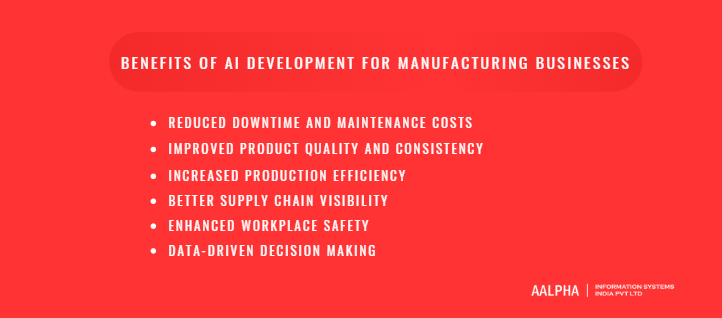
Benefits of AI Development for Manufacturing Businesses
Artificial intelligence is delivering measurable operational and financial benefits across the manufacturing industry. Manufacturers are increasingly adopting AI not only to automate repetitive tasks but also to improve production reliability, optimize decision-making, reduce operational waste, and create more intelligent production environments.
Unlike traditional automation systems that depend heavily on fixed rules and manual oversight, AI systems continuously analyze operational data and adapt to changing production conditions. This allows manufacturers to identify inefficiencies earlier, optimize workflows more effectively, and make faster operational decisions based on real-time insights.
The benefits of AI extend across every layer of manufacturing operations, including maintenance, quality control, production planning, worker safety, logistics, and supply chain management. As manufacturing environments become more connected through industrial IoT and smart factory infrastructure, AI is becoming a critical technology for achieving scalability, operational resilience, and long-term competitiveness.
-
Reduced Downtime and Maintenance Costs
Unexpected equipment failures are among the most expensive operational problems in manufacturing. Production downtime can disrupt supply chains, delay customer deliveries, increase labor costs, and reduce factory output. AI-powered predictive maintenance systems help manufacturers reduce these risks by identifying machine issues before failures occur.
Machine learning models analyze real-time sensor data such as vibration levels, temperature fluctuations, motor performance, and pressure readings to detect abnormal equipment behavior. Instead of relying on fixed maintenance schedules or reactive repairs, manufacturers can perform maintenance only when necessary and before critical failures happen.
This approach significantly reduces emergency repair costs, minimizes unplanned downtime, and extends equipment lifespan. Maintenance teams can also prioritize high-risk assets more effectively and improve spare parts inventory management based on predictive insights.
In large manufacturing facilities where production interruptions can result in substantial financial losses, AI-driven maintenance systems improve operational continuity while lowering long-term maintenance expenses and improving asset utilization.
-
Improved Product Quality and Consistency
Maintaining consistent product quality is essential for manufacturing businesses operating in competitive markets with strict customer and regulatory expectations. AI-powered quality inspection systems improve manufacturing accuracy by detecting defects and inconsistencies in real time during production processes.
Computer vision systems equipped with deep learning models can identify scratches, cracks, alignment issues, dimensional variations, contamination, packaging defects, and missing components with greater speed and precision than manual inspection methods. These systems continuously improve by learning from large datasets of production images and operational feedback.
AI also helps manufacturers identify the root causes of recurring quality problems by analyzing production variables, machine settings, environmental conditions, and material usage patterns. This allows operational teams to make process improvements that reduce defect rates over time.
Improved quality consistency reduces product recalls, customer complaints, material waste, and rework costs while strengthening brand reputation and customer satisfaction. In industries such as automotive, pharmaceuticals, electronics, aerospace, and medical manufacturing, where quality standards are extremely strict, AI-driven inspection systems provide major operational advantages.
-
Increased Production Efficiency
Manufacturing efficiency depends heavily on how effectively production resources, machines, labor, and workflows are managed. AI improves production efficiency by continuously analyzing operational data and identifying opportunities to optimize manufacturing processes.
AI systems can detect bottlenecks, monitor machine utilization, optimize production scheduling, and dynamically adjust workflows based on real-time production conditions. For example, AI-driven scheduling systems can automatically reallocate production resources when equipment downtime, material shortages, or demand fluctuations occur.
Smart manufacturing environments also improve coordination between machines, robotics systems, inventory platforms, and enterprise software. This reduces delays caused by poor communication between production systems and improves operational synchronization across factory operations.
AI-powered robotics and automation systems further increase production speed while maintaining consistency and accuracy. Manufacturers can achieve higher throughput with reduced manual intervention, fewer operational interruptions, and more efficient resource utilization.
As factories become increasingly data-driven, AI enables manufacturers to maximize output while controlling operational costs and improving overall production performance.
-
Better Supply Chain Visibility
Manufacturing supply chains are becoming more complex due to global sourcing, fluctuating demand, transportation disruptions, and supplier dependencies. AI helps manufacturers improve visibility across supply chain operations by analyzing large volumes of logistics, procurement, inventory, and production data in real time.
AI-powered analytics systems can forecast demand more accurately, monitor supplier performance, track inventory levels across facilities, and identify potential disruptions before they affect production operations. Manufacturers gain better visibility into procurement timelines, warehouse capacity, transportation efficiency, and raw material availability.
Machine learning models can also optimize inventory balancing by predicting future production requirements and reducing excess stock accumulation or material shortages. This improves working capital management and reduces warehousing costs.
During supply chain disruptions, AI systems help manufacturers evaluate alternative sourcing strategies, optimize logistics routes, and prioritize critical production activities. Better supply chain visibility improves operational agility and allows manufacturers to respond faster to market changes, supplier delays, and shifting customer demand patterns.
-
Enhanced Workplace Safety
Manufacturing environments often involve hazardous equipment, heavy machinery, high-temperature operations, and physically demanding tasks. AI-powered safety systems help manufacturers reduce workplace accidents and improve compliance with industrial safety standards.
Computer vision systems monitor factory floors using cameras and AI-based video analytics to identify unsafe conditions and worker behavior in real time. These systems can detect missing personal protective equipment, unauthorized access to restricted areas, unsafe proximity to machinery, and hazardous operational activities.
AI safety monitoring platforms can immediately trigger alerts when potential risks are detected, allowing supervisors and safety teams to intervene before accidents occur. Some advanced systems also analyze worker movement patterns and operational conditions to identify fatigue-related risks or unusual behavior that may indicate safety concerns.
AI-driven robotics and automation systems further improve safety by reducing the need for workers to perform dangerous repetitive tasks in hazardous environments. This decreases exposure to operational risks while improving workplace conditions for employees.
Enhanced safety monitoring reduces workplace injuries, lowers insurance costs, improves regulatory compliance, and supports a stronger safety culture across manufacturing organizations.
-
Data-Driven Decision Making
Manufacturing operations generate enormous amounts of data from machines, sensors, enterprise systems, production lines, and supply chain activities. AI enables manufacturers to transform this raw operational data into actionable business intelligence that supports faster and more accurate decision-making.
AI analytics platforms continuously process production metrics, maintenance records, inventory data, machine performance statistics, quality inspection results, and operational trends to identify patterns and generate insights. Manufacturing leaders can use these insights to improve production planning, optimize resource allocation, forecast operational risks, and monitor factory performance more effectively.
Real-time dashboards powered by AI provide operational visibility across manufacturing environments, allowing managers to respond quickly to production issues and changing business conditions. AI systems can also simulate different operational scenarios to support strategic planning and process optimization.
Data-driven decision-making reduces reliance on manual reporting and intuition-based management approaches. Manufacturers gain more accurate forecasting capabilities, improved operational transparency, and stronger control over production performance, costs, and business outcomes.
Step-by-Step AI Development Process for Manufacturing
Developing AI solutions for manufacturing requires far more than simply deploying machine learning models inside a factory environment. Manufacturing AI systems must integrate with industrial infrastructure, process large volumes of operational data, support real-time decision-making, and operate reliably in highly demanding production conditions. Successful AI implementation depends on a structured development process that aligns technology capabilities with operational business objectives.
Manufacturing companies often operate with legacy equipment, fragmented data environments, strict compliance requirements, and production-critical systems that cannot tolerate instability or downtime. Because of this, AI development in manufacturing must be approached systematically, with careful planning around infrastructure integration, operational scalability, and production reliability.
The development lifecycle typically involves identifying operational challenges, collecting industrial data, preparing datasets, selecting AI technologies, training models, integrating with factory systems, validating performance, and continuously optimizing deployed AI solutions. Each phase plays a critical role in ensuring the AI system delivers measurable operational improvements without disrupting manufacturing workflows.
-
Identifying Manufacturing Challenges and Objectives
The first step in manufacturing AI development is identifying operational problems that can realistically benefit from AI implementation. Many AI projects fail because organizations attempt to deploy advanced technologies without clearly defining measurable business objectives or operational use cases.
Manufacturers typically begin by analyzing existing production workflows, maintenance operations, quality control processes, supply chain inefficiencies, or workforce challenges to identify operational bottlenecks. These bottlenecks may include frequent equipment failures, excessive downtime, inconsistent product quality, production delays, energy waste, inventory imbalances, or inefficient manual processes.
The most successful AI projects focus on problems where large amounts of operational data already exist and where measurable performance improvements can be achieved. For example, predictive maintenance systems are highly effective when machines generate continuous sensor data over time. Similarly, AI-powered visual inspection systems work well in environments where historical defect images are available for training.
Manufacturers also need to define clear success metrics before development begins. Objectives may include reducing machine downtime by a specific percentage, improving defect detection accuracy, lowering energy consumption, or increasing production throughput. Establishing measurable KPIs helps organizations evaluate AI performance and calculate return on investment after deployment.
This planning stage also involves evaluating technical feasibility, infrastructure readiness, budget constraints, workforce capabilities, and integration requirements to ensure the selected AI solution aligns with broader operational goals.
-
Data Collection from Machines and Factory Systems
Data collection is one of the most important stages of manufacturing AI development because AI systems rely heavily on high-quality operational data to generate accurate predictions and insights. Manufacturing environments produce enormous volumes of industrial data from machines, sensors, enterprise software, robotics systems, and production infrastructure.
Industrial IoT sensors are commonly used to collect machine-level data such as temperature, vibration, pressure, energy consumption, motor speed, humidity, acoustic signals, and operational cycles. These sensors provide real-time visibility into equipment performance and production conditions.
Manufacturing companies also collect data from existing factory systems such as Enterprise Resource Planning (ERP) platforms, Manufacturing Execution Systems (MES), Supervisory Control and Data Acquisition (SCADA) systems, Programmable Logic Controllers (PLCs), warehouse management systems, and quality inspection databases.
MES platforms provide production-level information such as work orders, process tracking, machine utilization, and production schedules. SCADA systems monitor industrial processes and machine operations across manufacturing facilities. ERP systems contain procurement, inventory, supply chain, and operational business data that can support AI-driven planning and forecasting.
In some manufacturing environments, historical maintenance records, defect logs, inspection images, operator reports, and production reports are also integrated into AI training pipelines. Centralizing data from multiple operational systems is essential for building accurate and scalable manufacturing AI solutions.
Manufacturers must also address data accessibility challenges, system compatibility issues, and network infrastructure limitations during this stage to ensure reliable data flow across factory environments.
-
Data Cleaning and Preparation
Raw industrial data is often noisy, incomplete, inconsistent, or fragmented across multiple systems. Before AI models can be trained effectively, manufacturing data must undergo extensive cleaning and preparation processes.
Industrial sensors may generate duplicate readings, missing values, inaccurate measurements, or inconsistent timestamps due to environmental conditions, hardware limitations, or communication failures. AI development teams must remove corrupted records, standardize data formats, synchronize timestamps, and handle missing values to improve dataset reliability.
Data normalization is also important because manufacturing systems often collect information from multiple machines operating under different conditions and measurement standards. Standardized datasets improve model accuracy and reduce training inconsistencies.
For computer vision applications, image datasets must be labeled correctly to identify defects, product categories, safety violations, or operational anomalies. This often requires domain experts to manually classify thousands of production images before AI models can learn effectively.
Manufacturing AI systems also require balanced datasets that represent different operating conditions, failure scenarios, and production variations. Poor-quality training data can significantly reduce model performance and lead to inaccurate predictions during real-world operations.
Because manufacturing environments are highly dynamic, data preparation is not a one-time task. Continuous data validation and dataset updates are necessary to maintain long-term AI performance and reliability.
-
Choosing the Right AI Models and Technologies
Selecting the appropriate AI technologies is critical because different manufacturing problems require different types of machine learning models, analytics systems, and deployment architectures. The technology selection process depends on operational objectives, data availability, real-time processing requirements, and infrastructure constraints.
Predictive maintenance systems commonly use supervised machine learning models trained on historical equipment failure data. Time-series forecasting algorithms, anomaly detection models, and predictive analytics platforms are frequently used for machine monitoring applications.
Computer vision applications rely on deep learning frameworks such as convolutional neural networks for defect detection, object recognition, safety monitoring, and visual inspection tasks. These systems require high-performance image processing capabilities and optimized inference models for real-time analysis.
Natural language processing models and generative AI systems are increasingly used for manufacturing copilots, maintenance assistants, operational reporting, and knowledge management systems.
Manufacturers also need to decide between cloud-based AI infrastructure and edge AI deployment models. Factories requiring low-latency processing often deploy AI models directly on edge devices, industrial PCs, or local servers to support real-time operational decisions.
Technology selection must also account for scalability, integration compatibility, cybersecurity requirements, industrial protocol support, and long-term maintenance considerations. Choosing the wrong architecture can create operational bottlenecks and limit future expansion capabilities.
-
Building and Training AI Models
Once datasets and technologies are prepared, AI development teams begin building and training machine learning models using industrial data. The training process involves feeding large volumes of historical operational information into AI systems so they can learn patterns associated with production performance, defects, failures, or operational behavior.
For predictive maintenance systems, models are trained using historical sensor readings and maintenance records to identify early indicators of equipment failure. Computer vision systems are trained using labeled production images containing examples of defective and non-defective products.
Training workflows often involve feature engineering, model tuning, hyperparameter optimization, and iterative testing to improve prediction accuracy. Manufacturing AI models must be validated carefully because inaccurate predictions can negatively impact production operations and operational safety.
Industrial datasets also require continuous retraining because manufacturing conditions change over time. Machine wear, environmental changes, production variations, and operational adjustments can reduce model accuracy if AI systems are not updated regularly.
Validation techniques such as cross-validation, accuracy testing, confusion matrices, precision analysis, and recall measurement are used to evaluate model performance before deployment. Manufacturers typically prioritize reliability, consistency, and operational stability over experimental model complexity.
The goal is not only to build accurate AI systems but also to create models that perform reliably under real production conditions with minimal operational disruption.
-
Integrating AI with Existing Manufacturing Infrastructure
AI systems deliver the most value when they are fully integrated into existing manufacturing infrastructure rather than operating as isolated software tools. Integration is often one of the most technically challenging phases of manufacturing AI development because factories typically operate with a mix of legacy equipment, industrial protocols, enterprise systems, and automation platforms.
AI solutions must connect with ERP systems, MES platforms, SCADA systems, PLCs, robotics controllers, warehouse management software, and industrial databases to access operational data and automate workflows effectively.
For example, predictive maintenance systems may need direct integration with maintenance scheduling platforms and machine controllers to trigger alerts automatically when equipment risks are detected. AI-driven production planning systems may require synchronization with inventory management platforms, procurement systems, and production scheduling tools.
Industrial integration also involves handling real-time communication requirements, network reliability, cybersecurity protection, and industrial protocol compatibility such as OPC UA, Modbus, MQTT, or Ethernet/IP.
Manufacturers must ensure that AI systems operate reliably without disrupting critical production environments. Because downtime risks are high in industrial operations, integration testing and infrastructure validation are essential before large-scale deployment.
Well-integrated AI systems improve operational visibility, automate decision-making, and enable seamless communication across smart factory ecosystems.
-
Testing AI Systems in Real Production Environments
Before full-scale deployment, manufacturing AI systems must be tested thoroughly within controlled production environments to evaluate operational performance, accuracy, scalability, and reliability. Manufacturing facilities cannot risk operational disruptions caused by unstable or inaccurate AI systems.
Testing typically begins with pilot deployments on limited production lines, selected machines, or specific operational workflows. During this phase, manufacturers evaluate how the AI system performs under actual factory conditions rather than relying only on laboratory testing environments.
Operational benchmarking measures improvements in downtime reduction, defect detection accuracy, energy savings, forecasting precision, or production efficiency compared to existing processes. AI systems are also tested for latency, infrastructure stability, integration reliability, and fault tolerance.
Manufacturers often involve operators, maintenance teams, engineers, and production managers during pilot testing to validate usability and operational impact. Feedback collected during this phase helps improve system accuracy and workflow integration before broader deployment.
Testing also helps organizations identify edge cases, operational anomalies, or unexpected production conditions that may affect AI model performance in real-world environments.
-
Deployment, Monitoring, and Continuous Optimization
After successful testing, AI systems are deployed across manufacturing operations and integrated into daily production workflows. However, deployment is not the final stage of the AI lifecycle. Manufacturing AI systems require continuous monitoring, optimization, and retraining to maintain long-term performance.
Operational conditions inside factories constantly evolve due to equipment aging, production changes, environmental fluctuations, and shifting business requirements. AI models can experience performance degradation over time if they are not continuously updated using new operational data.
Manufacturers monitor AI systems using operational dashboards, performance metrics, alert systems, and automated monitoring tools. Key performance indicators may include prediction accuracy, downtime reduction, defect rates, production throughput, energy efficiency, and maintenance response times.
Continuous learning systems allow AI models to improve over time as they process additional production data. Manufacturers also perform periodic retraining to adapt models to changing operational conditions and new production scenarios.
Cybersecurity monitoring, infrastructure scaling, compliance updates, and software maintenance are also essential parts of long-term AI operations. Successful manufacturing AI deployment requires ongoing collaboration between operational teams, data scientists, engineers, and IT departments to ensure the system continues delivering measurable business value over time.
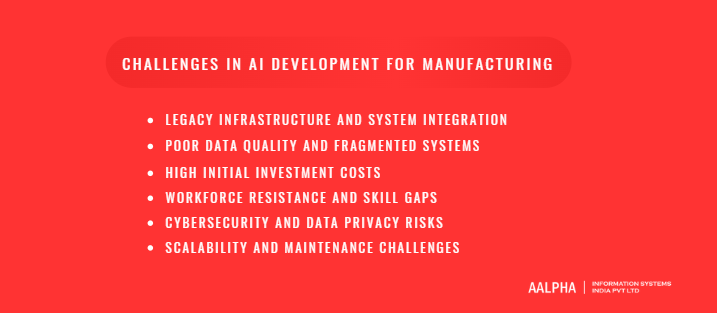
Challenges in AI Development for Manufacturing
Although artificial intelligence offers significant operational benefits for manufacturers, implementing AI successfully within industrial environments remains highly complex. Manufacturing ecosystems are often built on decades of legacy infrastructure, fragmented operational systems, and deeply interconnected production workflows that cannot tolerate instability or downtime. As a result, AI development in manufacturing involves technical, operational, financial, and organizational challenges that businesses must address carefully.
Unlike digital-first industries where software systems can be updated rapidly, manufacturing environments involve physical machinery, industrial control systems, safety requirements, and mission-critical production operations. AI systems must function reliably under real-world factory conditions while integrating seamlessly with existing infrastructure and operational processes.
Manufacturers also face challenges related to data quality, workforce readiness, cybersecurity risks, long-term scalability, and infrastructure modernization. Many organizations underestimate the complexity of integrating AI into production environments, which can lead to failed deployments, operational disruptions, or poor return on investment.
Understanding these challenges early helps manufacturing companies build realistic implementation strategies and reduce risks associated with AI adoption.
-
Legacy Infrastructure and System Integration
One of the biggest challenges in manufacturing AI development is integrating modern AI systems with legacy industrial infrastructure. Many manufacturing facilities still operate using older machines, proprietary industrial controllers, outdated software systems, and fragmented operational technologies that were not designed for AI-driven environments.
Legacy equipment may lack IoT connectivity, standardized communication protocols, or real-time data collection capabilities. Some machines operate in isolation without centralized monitoring systems, making it difficult to gather the operational data required for AI training and analytics.
Manufacturers also face integration complexity when connecting AI platforms with existing ERP systems, MES software, SCADA environments, PLCs, robotics systems, and warehouse management platforms. Different systems often use incompatible data formats and industrial communication standards.
Replacing existing infrastructure entirely is usually expensive and operationally risky, so manufacturers must build hybrid environments where modern AI systems coexist with older operational technologies. This requires careful architecture planning, middleware integration, industrial gateway deployment, and phased modernization strategies to avoid production disruptions.
-
Poor Data Quality and Fragmented Systems
AI systems depend heavily on high-quality data, but manufacturing environments often struggle with inconsistent, incomplete, and fragmented operational data. Many factories collect data across multiple disconnected systems, making it difficult to create unified datasets suitable for AI training and analysis.
Industrial sensors may generate noisy or inaccurate readings due to harsh factory conditions, equipment wear, environmental interference, or network instability. Historical production records may contain missing values, inconsistent timestamps, duplicate entries, or poorly structured operational logs.
Data fragmentation is another major issue. Production data may be spread across ERP platforms, SCADA systems, MES software, spreadsheets, machine controllers, and maintenance databases without centralized accessibility. This creates challenges when building AI systems that require integrated operational visibility.
Computer vision applications also require properly labeled image datasets, which can be time-consuming and expensive to prepare. Inaccurate or biased training data reduces model accuracy and increases the risk of incorrect predictions.
Without strong data governance, standardized collection processes, and centralized data infrastructure, manufacturing AI projects may struggle to deliver reliable operational results.
-
High Initial Investment Costs
AI implementation in manufacturing often requires significant upfront investment in infrastructure, hardware, software platforms, industrial sensors, cloud systems, integration services, and technical expertise. Many manufacturers, especially small and mid-sized businesses, view these initial costs as a major barrier to adoption.
Predictive maintenance systems may require sensor installation across large equipment fleets, while computer vision applications often involve industrial cameras, GPU-powered processing infrastructure, and edge computing devices. Smart factory initiatives may also require network upgrades, industrial IoT deployment, and cloud integration platforms.
In addition to infrastructure costs, manufacturers must invest in AI development teams, data engineers, integration specialists, cybersecurity systems, and workforce training programs. Ongoing expenses related to software licensing, cloud storage, AI model retraining, and operational maintenance further increase total implementation costs.
Calculating ROI can also be difficult during early deployment stages because operational improvements may take time to materialize. Manufacturers must balance short-term implementation expenses against long-term operational gains such as reduced downtime, lower maintenance costs, improved efficiency, and increased production reliability.
Careful project prioritization and phased AI adoption strategies help organizations manage financial risks more effectively.
-
Workforce Resistance and Skill Gaps
AI adoption in manufacturing often creates organizational challenges related to workforce resistance, skill shortages, and operational change management. Employees may fear that AI and automation technologies could replace jobs or reduce the need for human workers in manufacturing environments.
Resistance is especially common when operational teams do not fully understand how AI systems support rather than eliminate human roles. Maintenance technicians, machine operators, and production staff may hesitate to trust AI-generated recommendations or automated decision-making systems.
Manufacturers also face shortages of skilled professionals capable of developing, deploying, and maintaining industrial AI systems. Expertise is required across machine learning, industrial automation, data engineering, IoT infrastructure, cybersecurity, and manufacturing operations. Finding professionals with both AI and industrial domain knowledge can be particularly difficult.
Successful AI adoption requires workforce education, training programs, and clear communication about how AI improves operational efficiency and worker safety rather than simply replacing labor. Many manufacturers are investing in upskilling initiatives to help employees work effectively alongside AI-powered systems and automation technologies.
Building collaboration between operational teams and technical AI specialists is essential for long-term implementation success.
-
Cybersecurity and Data Privacy Risks
As manufacturing facilities become more connected through industrial IoT, cloud platforms, AI analytics systems, and remote monitoring infrastructure, cybersecurity risks increase significantly. Manufacturing environments are increasingly targeted by ransomware attacks, industrial espionage, and operational disruption attempts because production downtime can result in major financial losses.
AI systems often require integration with production equipment, industrial controllers, enterprise systems, and external cloud services. This expands the attack surface across manufacturing operations and creates additional vulnerabilities if security controls are not implemented properly.
Industrial IoT devices and legacy manufacturing systems may lack modern security protections, making them vulnerable to unauthorized access or malware attacks. Compromised AI systems could potentially disrupt production workflows, manipulate operational data, or interfere with safety-critical industrial processes.
Manufacturers must also address data privacy concerns when handling operational data, employee monitoring information, supplier records, and customer production requirements. Regulatory compliance requirements may vary depending on industry sector and geographic region.
Strong cybersecurity frameworks, encrypted communication protocols, network segmentation, access controls, continuous monitoring, and industrial security policies are essential for protecting manufacturing AI environments from operational and financial risks.
-
Scalability and Maintenance Challenges
Many manufacturing AI projects perform well during small pilot deployments but face difficulties when scaling across larger production environments, multiple facilities, or enterprise-wide operations. Scaling AI systems in manufacturing is significantly more complex than scaling traditional software platforms because industrial environments involve physical infrastructure, operational variability, and real-time processing requirements.
AI models trained on limited datasets may struggle when exposed to different machines, production conditions, environmental variables, or operational workflows across facilities. Infrastructure limitations such as network bandwidth, edge computing capacity, and sensor compatibility can also affect scalability.
Manufacturers must continuously monitor deployed AI systems to ensure models remain accurate as production conditions change over time. Equipment aging, operational modifications, material variations, and evolving production requirements can reduce model performance if retraining is not performed regularly.
Long-term AI maintenance also involves software updates, cybersecurity patching, infrastructure scaling, hardware replacement, and operational performance optimization. Without strong lifecycle management processes, manufacturing AI systems may become unreliable or operationally difficult to maintain.
Successful scalability requires standardized architectures, centralized monitoring, flexible deployment models, and long-term operational support strategies that evolve alongside manufacturing operations.
Cost of AI Development for Manufacturing
The cost of AI development for manufacturing varies significantly depending on the complexity of the solution, the scale of deployment, the quality of existing infrastructure, and the operational goals of the manufacturer. Unlike standard business software projects, manufacturing AI systems often require integration with industrial equipment, IoT infrastructure, robotics systems, factory networks, and real-time operational environments, which increases development complexity and implementation costs.
AI development expenses are influenced not only by software engineering requirements but also by industrial hardware deployment, data collection systems, cloud infrastructure, cybersecurity measures, and long-term operational maintenance. Manufacturing companies must also account for workforce training, infrastructure modernization, and AI model monitoring after deployment.
While initial investment costs can appear high, AI systems often generate long-term savings through reduced downtime, lower maintenance costs, improved production efficiency, higher product quality, and optimized resource utilization. The overall return on investment depends heavily on selecting the right use cases and implementing scalable AI architectures aligned with operational priorities.
Factors Affecting AI Development Costs
Several factors influence the total cost of AI development in manufacturing environments. One of the most important cost drivers is project complexity. Simple AI applications such as production forecasting or basic anomaly detection typically require less infrastructure and development effort than advanced systems involving computer vision, autonomous robotics, or real-time industrial analytics.
Data infrastructure readiness also affects implementation costs significantly. Manufacturers with existing IoT-enabled equipment, centralized data platforms, and integrated operational systems usually require less investment compared to facilities operating with disconnected legacy infrastructure. In many cases, organizations must install industrial sensors, upgrade networks, or modernize factory systems before AI deployment can begin.
Integration complexity is another major factor. AI systems often need to connect with ERP platforms, MES systems, SCADA environments, PLCs, robotics controllers, and warehouse management systems. Complex integration requirements increase development time and technical implementation effort.
The type of AI model being developed also impacts costs. Predictive analytics models are generally less expensive than deep learning computer vision systems or autonomous robotics platforms that require high-performance computing infrastructure and large training datasets.
Deployment scale further influences costs. Enterprise-wide smart factory implementations across multiple facilities require significantly larger investments than limited pilot deployments focused on a single production line or operational process.
AI Solution Cost by Manufacturing Use Case
Different manufacturing AI applications vary substantially in cost depending on infrastructure requirements, technical complexity, and operational scope. Predictive maintenance systems are often among the most cost-effective AI solutions because they primarily rely on sensor data analysis and machine learning models. Small-scale predictive maintenance deployments may cost tens of thousands of dollars, while enterprise-wide implementations across large equipment fleets can cost substantially more.
AI-powered visual quality inspection systems generally require higher investment due to industrial camera infrastructure, image labeling, GPU processing hardware, and deep learning model development. Industries such as automotive manufacturing, electronics production, and pharmaceuticals often invest heavily in computer vision systems because of strict quality control requirements.
Robotics AI systems involving autonomous navigation, collaborative robots, or intelligent assembly line automation are among the most expensive manufacturing AI implementations. These projects involve hardware procurement, robotics integration, real-time control systems, safety engineering, and AI model optimization.
Digital twin systems also require substantial investment because they involve real-time simulation environments, industrial data synchronization, sensor integration, and advanced analytics infrastructure. However, these systems provide significant value for large-scale manufacturing optimization and operational planning.
Manufacturers often begin with targeted AI use cases that offer faster ROI before expanding toward broader smart factory transformation initiatives.
Infrastructure and Cloud Costs
Infrastructure costs represent a major portion of manufacturing AI implementation budgets. AI systems require computing resources capable of processing large volumes of industrial data, training machine learning models, and supporting real-time operational analytics.
Cloud AI platforms are commonly used for model training, centralized analytics, data storage, and large-scale operational monitoring. Cloud providers typically charge based on storage usage, compute power, GPU utilization, API requests, and data transfer volumes. Large manufacturing operations generating continuous IoT data streams may incur significant recurring cloud expenses.
Edge computing infrastructure is increasingly important in manufacturing environments where low-latency processing is required. Edge AI deployments may involve industrial PCs, embedded AI devices, local servers, or GPU-enabled processing units installed directly inside factory environments.
Manufacturers also invest in industrial hardware such as IoT sensors, cameras, networking equipment, industrial gateways, robotics controllers, and cybersecurity infrastructure. Facilities operating older equipment may require modernization investments to support AI-enabled connectivity and real-time data collection.
Infrastructure planning must account for scalability, reliability, redundancy, and long-term operational growth to avoid performance bottlenecks as AI adoption expands.
Third-Party Integration and Licensing Costs
Manufacturing AI systems often rely on third-party software platforms, industrial tools, analytics services, and integration technologies that introduce additional licensing and implementation expenses. These costs can vary depending on the number of systems involved and the complexity of operational workflows.
Manufacturers frequently integrate AI solutions with ERP systems, MES platforms, SCADA environments, warehouse management systems, industrial IoT platforms, and robotics software. Many of these systems require API licensing, middleware platforms, industrial communication gateways, or custom connectors to support AI-driven workflows.
Computer vision applications may involve licensing industrial imaging software, annotation platforms, or pre-trained AI frameworks. Manufacturing copilots and generative AI systems may require access to enterprise AI APIs or language model platforms that operate on usage-based pricing structures.
Industrial cybersecurity tools, data governance platforms, monitoring systems, and compliance management software can further increase operational licensing costs. In large manufacturing environments, recurring subscription fees for cloud services, analytics platforms, and enterprise AI tools may become a significant part of long-term operational expenses.
Careful evaluation of licensing models and vendor dependencies is important for controlling long-term implementation costs.
Ongoing Maintenance and AI Model Retraining Costs
AI development costs do not end after deployment. Manufacturing AI systems require continuous maintenance, monitoring, optimization, and retraining to maintain operational accuracy and long-term reliability.
Production environments constantly evolve due to equipment aging, operational adjustments, environmental changes, material variations, and process improvements. These changes can reduce AI model accuracy over time if systems are not updated using new operational data.
Manufacturers must invest in periodic model retraining, data validation, infrastructure maintenance, cybersecurity updates, and operational monitoring. Predictive maintenance models may require recalibration as machine performance changes, while computer vision systems may need retraining when new product designs or packaging variations are introduced.
Ongoing maintenance also includes cloud infrastructure management, software updates, sensor replacement, edge device maintenance, and technical support services. In mission-critical manufacturing environments, downtime caused by AI system failures can create operational disruptions, making proactive maintenance essential.
Organizations should treat AI systems as long-term operational assets rather than one-time software deployments. Continuous optimization and lifecycle management are necessary to ensure manufacturing AI solutions continue delivering measurable business value as operational conditions evolve.
How to Choose the Right AI Development Company for Manufacturing
Choosing the right AI development company is one of the most important decisions for manufacturers planning to implement artificial intelligence solutions. Manufacturing AI projects are significantly more complex than standard software development initiatives because they involve industrial infrastructure, operational workflows, machine connectivity, real-time processing requirements, and production-critical systems.
A capable AI development partner should understand both advanced AI technologies and the realities of manufacturing operations. The right company will not only build machine learning models but also help manufacturers integrate AI into existing factory ecosystems, optimize operational performance, ensure system reliability, and support long-term scalability.
Manufacturers should evaluate potential AI partners based on their technical expertise, industrial domain knowledge, integration capabilities, security practices, and ability to provide post-deployment support. Companies with proven experience in enterprise software, AI engineering, industrial automation, and large-scale system integration are better positioned to deliver reliable manufacturing AI solutions that create measurable operational value.
-
Industry Experience and Technical Expertise
Manufacturing AI projects require deep technical expertise across machine learning, computer vision, predictive analytics, IoT systems, and industrial software engineering. However, technical AI knowledge alone is not enough. The development company should also understand manufacturing workflows, production environments, operational risks, and industrial automation systems.
An experienced AI development company can identify practical use cases that align with operational goals such as predictive maintenance, quality inspection, production optimization, or supply chain forecasting. They should have expertise in building scalable AI architectures capable of handling real-time industrial data and high-volume operational workloads.
Manufacturers should evaluate the company’s portfolio, industry experience, case studies, and technical capabilities before starting a project. Companies with experience delivering enterprise-grade software solutions across industries are often better equipped to manage complex manufacturing AI deployments.
-
Understanding of Manufacturing Ecosystems
Manufacturing environments involve highly interconnected operational ecosystems that include production machinery, ERP systems, MES platforms, SCADA infrastructure, PLCs, robotics systems, warehouse operations, and industrial IoT networks. A development company must understand how these systems interact inside real production environments.
AI solutions that operate independently without integration into manufacturing workflows rarely deliver meaningful business value. The development partner should understand factory operations, production planning, quality control processes, maintenance workflows, compliance requirements, and industrial communication protocols.
A strong manufacturing AI partner will evaluate operational bottlenecks, identify infrastructure limitations, and design AI architectures that fit existing factory environments rather than forcing disruptive system replacements. This reduces implementation risks and improves operational adoption.
-
AI, IoT, and Industrial Integration Capabilities
Manufacturing AI systems depend heavily on integration between AI platforms and industrial infrastructure. The selected development company should have expertise in integrating AI solutions with IoT devices, industrial sensors, ERP software, MES systems, SCADA environments, robotics platforms, and edge computing infrastructure.
Manufacturers should evaluate whether the company has experience handling industrial communication protocols, real-time data processing, edge AI deployment, cloud integration, and production monitoring systems. Integration challenges are often one of the biggest obstacles in manufacturing AI projects, particularly when legacy systems are involved.
The development company should also understand how to design scalable data pipelines capable of processing operational data from multiple factory systems simultaneously. Real-time visibility and operational reliability are essential in manufacturing environments where production downtime can create major financial losses.
-
Scalability, Security, and Compliance Expertise
Manufacturing AI systems must be designed for long-term scalability, operational reliability, and cybersecurity protection. Many AI projects begin with pilot deployments but later expand across multiple production lines, facilities, or global operations. The development company should design architectures capable of supporting future growth without requiring major redevelopment.
Security expertise is equally important because manufacturing systems are increasingly connected through IoT devices, cloud infrastructure, and remote operational monitoring platforms. AI systems often interact directly with production equipment and sensitive operational data, making cybersecurity a critical requirement.
Manufacturers should evaluate whether the company follows secure development practices, supports encrypted communication, implements access controls, and complies with relevant regulatory frameworks. Industries such as pharmaceuticals, aerospace, automotive, and medical manufacturing often have strict compliance requirements related to operational data handling and system reliability.
-
Post-Deployment Support and Optimization Services
AI deployment is not the final stage of a manufacturing AI project. Manufacturing environments constantly evolve due to production changes, equipment aging, operational adjustments, and shifting business requirements. AI systems require ongoing monitoring, retraining, optimization, and maintenance to remain effective over time.
The right AI development company should provide long-term support services that include AI model monitoring, infrastructure maintenance, cybersecurity updates, operational optimization, and periodic retraining using updated production data. Without continuous support, AI systems may experience declining accuracy and reduced operational reliability.
Manufacturers should also evaluate how the company handles issue resolution, scalability improvements, performance optimization, and future feature enhancements after deployment. A long-term partnership approach is especially valuable for enterprise manufacturing environments where operational continuity is critical.
For manufacturers looking for a reliable AI development partner, Aalpha Information Systems offers expertise in AI development, enterprise software engineering, industrial automation solutions, system integration, and scalable digital transformation services tailored to modern manufacturing environments.
Conclusion
Artificial intelligence is rapidly transforming the manufacturing industry by improving production efficiency, reducing downtime, enhancing quality control, optimizing supply chains, and enabling smarter factory operations. As Industry 4.0 adoption continues to grow, AI is becoming a critical technology for manufacturers looking to stay competitive, scalable, and operationally efficient.
From predictive maintenance and computer vision to intelligent robotics and AI-driven analytics, manufacturing businesses can use AI to make faster decisions, reduce operational costs, and improve overall productivity.
For businesses planning to implement AI-powered manufacturing solutions, working with an experienced technology partner is essential. Aalpha Information Systems helps manufacturers build scalable AI solutions tailored to modern industrial environments, enabling smarter operations and long-term digital transformation. Contact now!