


Medical insurance app development usually costs between $40,000 and $300,000+, depending on the app’s complexity, target users, compliance requirements, integrations, automation level, and development region. A basic medical insurance app with user registration, policy viewing, document upload, claim request submission, notifications, and a simple admin panel can start from around $40,000 to $80,000. A mid-level app with plan comparison, premium calculation, claim tracking, payment integration, hospital network search, customer support, and agent functionality may cost between $80,000 and $180,000. A more advanced medical insurance platform with multiple user roles, real-time insurance API integrations, AI-based claim support, fraud detection, OCR document processing, analytics dashboards, enterprise-grade security, and compliance workflows can easily exceed $300,000.
The cost to build a medical insurance app is higher than a standard mobile app because the product sits at the intersection of healthcare, insurance, finance, compliance, and customer service. A normal healthcare app may focus on appointments, teleconsultation, medicine delivery, or wellness tracking. A medical insurance app, however, must manage policy data, premium payments, claim documents, hospital bills, provider networks, reimbursement workflows, customer identity, payment records, and sensitive medical information. This means the app must be designed with stronger backend architecture, secure data handling, role-based access, audit trails, encrypted file storage, and clear claim-processing workflows from the beginning.
Medical insurance apps also require careful planning because claim-related workflows are rarely simple. A user may need to upload hospital bills, prescriptions, diagnosis reports, discharge summaries, identity documents, and policy details. The claim may then need to pass through multiple stages such as document verification, eligibility checking, hospital coordination, approval, rejection, clarification, settlement, and customer communication. If the app supports cashless claims, third-party administrators, hospitals, or insurer-side workflows, the development scope becomes even more complex. This is why businesses asking “how much does it cost to develop a medical insurance app?” should not look only at the mobile interface. The actual cost depends heavily on the backend systems, integrations, compliance design, claim automation, and admin operations behind the app.
A medical insurance app can be useful for several types of organizations. Health insurance companies use these apps to improve policyholder experience, reduce paperwork, simplify renewals, and provide faster claim updates. Insurance startups build them to launch digital-first health insurance products or comparison platforms. Third-party administrators need them to manage claims, documents, approvals, and communication between insurers, hospitals, and customers. Insurance brokers and agents can use such platforms to generate quotes, manage leads, onboard customers, and track commissions. Hospitals and healthcare networks may use insurance apps to verify patient coverage, coordinate cashless treatment, and reduce manual billing communication. Employers and corporate wellness providers can use medical insurance platforms to manage employee health benefits, group insurance plans, claims, and policy communication. Healthcare marketplaces can also integrate insurance features to offer plan comparison, claim assistance, and bundled healthcare services.
This guide explains the complete cost structure of medical insurance app development in detail. It covers the main factors that affect pricing, feature-wise cost breakdowns, MVP development cost, advanced platform cost, development stages, recommended technology stack, compliance and security expenses, hidden and ongoing costs, third-party integrations, AI features, monetization models, and practical ways to reduce development cost without compromising quality. It also explains how to choose the right medical insurance app development company, because the right technical partner can help businesses avoid expensive rework, compliance gaps, poor claim workflows, and scalability problems. For insurers, startups, brokers, TPAs, hospitals, and enterprises, the best approach is to start with a clear product scope, define the most important user journeys, build a secure MVP first, and then expand into automation, analytics, AI, and enterprise integrations as the platform grows.
What Is a Medical Insurance App?
A medical insurance app is a digital platform that allows users to buy, manage, renew, claim, and track health insurance services through a mobile app, web portal, or both. It gives policyholders a self-service interface where they can view active policies, check coverage details, download insurance cards, upload claim documents, renew plans, pay premiums, track claim status, contact support, and access healthcare provider information. For insurance companies, brokers, third-party administrators, and healthcare organizations, the app works as a centralized digital system for managing policyholder interactions, claims, documents, payments, approvals, and communication.
In simple terms, a medical insurance app replaces many manual insurance processes with digital workflows. Instead of visiting an office, calling a support center, or sending documents through email, users can complete most insurance-related actions inside the app. For example, a policyholder can open the app, check whether a specific treatment is covered, find a nearby network hospital, upload hospital bills, submit a reimbursement claim, and track whether the claim is under review, approved, rejected, or settled. This level of transparency is one of the main reasons businesses are investing in medical insurance app development.
A medical insurance app is different from a health insurance marketplace app, although both are related. A medical insurance app is usually owned by a single insurer, broker, employer, TPA, or healthcare organization. Its purpose is to serve an existing customer base by giving users access to their policies, claims, renewals, documents, and support. A health insurance marketplace app, on the other hand, allows users to compare multiple insurance providers, plan types, premiums, coverage limits, deductibles, exclusions, add-ons, and benefits in one place. A marketplace app usually focuses more on discovery, comparison, quote generation, lead capture, policy purchase, and commissions from insurance partners. In many cases, a marketplace app requires more complex plan comparison logic, insurer integrations, commission tracking, and compliance review because it deals with multiple insurance products from different providers.
A medical insurance app is also different from a general healthcare app. General healthcare apps usually focus on services such as doctor appointment booking, telemedicine, online pharmacy, lab test booking, digital prescriptions, symptom checking, wellness tracking, fitness monitoring, or chronic care management. These apps are centered on healthcare access and patient engagement. Medical insurance apps are centered on insurance operations. Their core workflows include policy management, eligibility checks, claim submission, claim tracking, billing support, reimbursement, premium payment, coverage explanation, provider network search, and document verification. While a healthcare app may help a patient book a doctor, a medical insurance app helps the same patient understand whether the treatment is covered, which hospital is in-network, what documents are needed, and how the claim will be processed.
The core users of a medical insurance app usually include several groups. Policyholders use the app to manage their insurance plans, submit claims, pay premiums, download policy documents, and get support. Insurance agents and brokers use the platform to onboard customers, generate quotes, upload KYC documents, track policy applications, manage renewals, and monitor commissions. Claim administrators review submitted documents, verify claim eligibility, request additional information, approve or reject claims, and update claim status. Healthcare providers such as hospitals, clinics, and diagnostic centers may use the system to verify coverage, coordinate cashless claims, upload treatment documents, or communicate with insurance teams. Corporate HR teams use medical insurance platforms to manage employee benefits, group policies, dependents, claim support, and renewal communication. Customer support staff use the admin tools to resolve user issues, answer policy questions, handle escalations, and maintain service records. System administrators manage user permissions, plan data, provider networks, workflows, reports, security settings, and platform operations.
Businesses are investing in medical insurance apps because customer expectations in insurance have changed. Users no longer want to wait days for basic information about coverage, claims, renewals, or documents. They expect the same convenience they get from banking, shopping, and travel apps. A well-built medical insurance app reduces paperwork, removes repetitive phone calls, gives users real-time access to claim status, and makes insurance services easier to understand. For insurers and TPAs, the app reduces support workload by allowing users to complete common tasks on their own. For brokers and agents, it improves lead management, policy tracking, and renewal follow-up. For employers, it simplifies group insurance administration and employee communication.
The business value also comes from better data access. A digital platform can help insurance teams understand claim patterns, policy usage, renewal behavior, customer support issues, document errors, and operational bottlenecks. This data can improve decision-making, reduce delays, and support automation over time. When customers can easily access policy information, submit accurate documents, and receive timely updates, they are more likely to trust the insurer and renew their plans. This is why medical insurance app development is no longer just a technology investment. It is becoming a customer experience, operations, and retention strategy for modern insurance and healthcare businesses.
Key Types of Medical Insurance Apps and Their Cost Range
Medical insurance app development cost depends heavily on the type of product being built. A simple policyholder app has a different scope from a claims management platform, and a full health insurance marketplace requires more complex workflows than an internal insurer-owned app. Before estimating the budget, businesses must first define whether they are building a customer-facing app, an agent tool, a claims automation system, a marketplace, or an enterprise-grade insurance platform. Each app type has a different cost range because the number of users, features, integrations, security layers, and backend workflows changes significantly.
-
Policyholder App
A policyholder app usually costs between $40,000 and $120,000, depending on the features, design complexity, supported platforms, and backend functionality. This type of app is built for customers who already have a medical insurance policy or want to manage their health insurance digitally. The main goal is to give policyholders a simple self-service experience where they can access insurance information without calling support or visiting a physical office.
A standard policyholder app includes secure login, user profile management, policy dashboard, digital insurance card, premium reminders, claim submission, document upload, renewal alerts, payment integration, and customer support. The policy dashboard is one of the most important features because users need a clear view of active policies, covered members, premium due dates, coverage amount, policy validity, exclusions, claim history, and downloadable documents. If the app also includes biometric login, family member management, hospital network search, multilingual support, or real-time claim tracking, the cost increases.
For insurers and brokers, a policyholder app is often the best starting point because it solves everyday customer service problems. It reduces repetitive support requests, improves policy transparency, and allows users to renew policies and submit claims from one place. A basic version can be launched as an MVP, while advanced modules such as AI support, claim automation, and personalized recommendations can be added later.
-
Insurance Agent App
An insurance agent app typically costs between $50,000 and $150,000. This app is designed for insurance agents, brokers, and sales teams that need a digital tool to manage leads, generate quotes, onboard customers, upload documents, track policy applications, and follow up on renewals. Compared with a policyholder app, an agent app often requires more sales-focused workflows and stronger admin reporting.
Core features include lead management, customer profile creation, quote generation, premium calculation, KYC document upload, plan comparison, policy application tracking, commission tracking, renewal reminders, sales pipeline management, and performance dashboards. Agents may also need access to scripts, product brochures, policy documents, eligibility rules, and customer communication history. If the app supports field sales teams, location-based activity tracking, offline data capture, or digital signature integration, the development cost can move toward the higher end of the range.
The business value of an insurance agent app is clear: it helps agents work faster, reduces manual paperwork, improves follow-up discipline, and gives management better visibility into sales performance. For insurance companies and broker networks, this type of app can directly improve conversion rates and renewal revenue because agents have the right data and tools during customer interactions.
-
Claims Management App
A claims management app usually costs between $80,000 and $200,000+ because claims are one of the most complex parts of medical insurance. The app must handle sensitive documents, multi-step verification, approval workflows, hospital coordination, claim status updates, settlement tracking, and customer communication. The cost is higher because the system must support accuracy, transparency, compliance, and operational control.
Key features include claim request creation, document intake, medical bill upload, prescription upload, discharge summary upload, claim category selection, hospital details, policy verification, claim validation, approval workflows, rejection reasons, settlement status, notifications, and support escalation. For cashless claims, the app may also need hospital coordination features, pre-authorization workflows, insurer approval, TPA involvement, and real-time updates between multiple parties.
The backend of a claims management app is often more important than the mobile interface. Claim administrators need a strong dashboard where they can review documents, request missing information, approve claims, reject invalid submissions, add internal notes, track settlement timelines, and generate reports. If the system includes OCR document reading, fraud checks, AI-based claim triage, or integration with insurer and hospital systems, the cost can exceed $200,000. For TPAs, insurers, and large healthcare networks, however, this investment can reduce manual workload and improve claim turnaround time.
-
Health Insurance Marketplace App
A health insurance marketplace app generally costs between $100,000 and $250,000+. This type of platform allows users to compare multiple insurance providers, policies, premiums, coverage limits, deductibles, add-ons, hospital networks, and benefits in one place. Unlike an insurer-owned app, a marketplace must manage data from several insurance companies and present it in a neutral, easy-to-compare format.
Core features include insurer listing, plan comparison, quote engine, premium calculator, filters, policy purchase, payment gateway, lead capture, broker support, commission management, document upload, customer onboarding, renewal alerts, and admin controls. The quote engine is one of the most important cost drivers because insurance pricing may depend on age, location, family size, pre-existing conditions, coverage amount, add-ons, and underwriting rules.
A marketplace app also requires a strong admin panel to manage insurers, plans, commissions, leads, payments, policies, support tickets, and compliance documents. If real-time insurer APIs are available, integration costs may increase but the platform becomes more accurate and scalable. If APIs are not available, the business may need semi-manual data management tools, which still require careful planning. This type of app is ideal for startups, brokers, comparison platforms, and healthcare marketplaces that want to generate revenue through commissions, lead generation, or policy sales.
-
Enterprise Medical Insurance Platform
An enterprise medical insurance platform can cost between $150,000 and $300,000+ because it is usually built for large insurers, TPAs, employers, healthcare groups, or multi-branch insurance operations. This is not just a mobile app. It is a complete digital ecosystem with multiple user roles, admin dashboards, API integrations, analytics, security controls, compliance workflows, and automation features.
An enterprise platform may include separate modules for policyholders, agents, claim officers, hospital partners, employer HR teams, customer support teams, finance teams, and system administrators. Features may include policy management, claims management, digital cards, provider network management, premium payments, renewal workflows, bulk employee enrollment, document verification, support tickets, reporting dashboards, audit logs, role-based access, and system alerts.
The higher cost comes from architecture, scalability, security, and integration requirements. Enterprise platforms often need integration with CRM systems, payment gateways, insurance core systems, hospital networks, HRMS platforms, analytics tools, and customer support platforms. They also need stronger data protection, audit logging, uptime monitoring, disaster recovery, and compliance documentation. For large organizations, this type of platform can become a long-term operational system rather than a single app project.
-
AI-Powered Medical Insurance App
An AI-powered medical insurance app usually costs between $180,000 and $400,000+, depending on the level of automation and intelligence required. AI can be added to policyholder apps, claims platforms, marketplaces, or enterprise insurance systems, but it should be implemented only where it solves real operational problems. The most common AI features include AI chatbot support, OCR-based document extraction, claim triage, fraud scoring, personalized plan recommendations, predictive risk analysis, and workflow automation.
An AI chatbot can help users understand coverage, check required claim documents, explain policy terms, guide them through claim submission, and reduce support workload. OCR can extract data from hospital bills, prescriptions, discharge summaries, ID documents, and claim forms. Claim triage can help administrators prioritize urgent, incomplete, suspicious, or high-value claims. Fraud scoring can detect duplicate claims, unusual billing patterns, mismatched documents, or abnormal provider behavior. Personalized recommendations can suggest suitable plans based on age, location, family size, medical needs, and budget.
The cost of an AI-powered medical insurance app depends on data quality, model selection, third-party AI services, workflow complexity, security controls, human review mechanisms, and integration depth. AI should not replace every insurance decision automatically, especially in sensitive claim or eligibility workflows. A practical approach is to use AI for assistance, document processing, risk flagging, and support automation, while keeping final decisions under authorized human review where required. When implemented correctly, AI can reduce processing time, improve customer experience, and help insurance teams manage higher volumes without proportionally increasing staff workload.
Medical Insurance App Development Cost by Complexity
Medical insurance app development cost can be estimated more accurately when the project is divided by complexity level. A simple customer-facing app with basic policy and claim features will cost much less than a complete insurance platform with multiple roles, claim automation, third-party integrations, advanced reporting, AI support, and enterprise security. For most businesses, the right starting point is not the most feature-heavy version, but the version that solves the highest-priority user and operational problems first. This is why medical insurance app cost is usually grouped into three levels: basic, mid-level, and advanced.
-
Basic Medical Insurance App Cost
A basic medical insurance app usually costs between $40,000 and $80,000. This version is best suited for startups, small insurance brokers, early-stage health insurance platforms, or businesses that want to digitize a limited set of customer-facing workflows. The purpose of a basic app is to give users easy access to their insurance information and reduce manual communication for simple tasks.
A basic medical insurance app generally includes secure login, user profile management, policy list, policy details, digital document access, document upload, basic claim request submission, notifications, support contact, and a simple admin panel. Users can log in, view their active policy, check basic coverage details, upload required files, submit a claim request, receive premium or renewal reminders, and contact the support team. The admin panel usually allows internal staff to view users, manage submitted documents, review basic claim requests, and update claim status manually.
This cost range usually does not include advanced automation, real-time insurer integrations, hospital coordination workflows, complex analytics, or AI features. It is suitable when the business wants to launch quickly with a functional app and validate real user demand before investing in a larger platform. However, even a basic medical insurance app must be built with secure authentication, protected document storage, role-based admin access, and clean backend architecture because it may handle sensitive personal, financial, and medical information.
-
Mid-Level Medical Insurance App Cost
A mid-level medical insurance app usually costs between $80,000 and $180,000. This version is more suitable for growing insurance companies, digital brokers, TPAs, healthcare marketplaces, and businesses that need structured insurance workflows beyond simple policy access. A mid-level app usually includes more user journeys, better admin control, and stronger integrations than a basic app.
Typical features include plan comparison, premium calculation, quote generation, detailed claim workflows, hospital network search, payment gateway integration, policy renewal, agent module, live chat or chatbot support, analytics dashboard, and stronger admin controls. Users can compare insurance plans, check coverage options, submit claims with categorized documents, search for network hospitals, pay premiums, renew policies, and track claim progress. Agents can manage leads, upload customer documents, generate quotes, and follow up on renewals. Admin users can manage plans, policyholder data, documents, claims, payments, support tickets, and reports from a more advanced dashboard.
The cost increases because a mid-level medical insurance app requires more backend logic and workflow design. For example, plan comparison needs structured insurance data, filters, eligibility rules, and premium calculation logic. Claim workflows need defined statuses, document categories, approval steps, rejection reasons, and notifications. Payment integration requires invoices, transaction tracking, failed payment handling, and reconciliation support. If the app includes agent workflows, the system must also handle lead ownership, commission visibility, customer onboarding, and sales reporting. This level is often the right choice for businesses that want a serious commercial product rather than a simple informational app.
-
Advanced Medical Insurance App Cost
An advanced medical insurance app usually costs between $180,000 and $300,000+. This type of platform is built for insurers, enterprise healthcare companies, large TPAs, broker networks, employee benefits providers, or funded startups planning to operate at scale. The app is usually part of a larger insurance ecosystem with mobile apps, web dashboards, backend systems, automation, integrations, and compliance controls.
Advanced features may include multi-role dashboards, third-party insurance API integrations, hospital and provider integrations, CRM integration, claim automation, OCR-based document processing, AI chatbot support, fraud checks, predictive analytics, enterprise-grade security, compliance workflows, audit logs, advanced reporting, and role-specific access controls. The platform may support policyholders, agents, claim officers, hospital partners, corporate HR teams, finance teams, support staff, and administrators.
The higher cost comes from technical depth and operational complexity. Claim automation requires structured validation rules, document checks, internal review workflows, and exception handling. Fraud checks may require rule-based scoring, duplicate claim detection, unusual billing alerts, and suspicious provider pattern analysis. AI features need data preparation, prompt design, model integration, user safeguards, human review options, and monitoring. Enterprise security requires encryption, secure APIs, audit trails, access control, session management, backup systems, and compliance documentation. Advanced reporting may include claim ratios, renewal rates, customer activity, agent performance, support volume, payment status, and operational bottlenecks. This version is best for businesses that already understand their workflows and need a robust platform that can support scale, reliability, and long-term growth.
-
MVP vs Full Product Cost
A medical insurance app MVP should include only the must-have workflows needed to launch, test, and improve the product. For most businesses, the MVP should include user registration, secure login, policy dashboard, policy document access, claim submission, document upload, payment or renewal flow, notifications, support contact, and admin review. These features allow the business to validate the most important user needs without spending heavily on every possible module in the first version.
A full product, on the other hand, may include advanced plan comparison, agent dashboards, claim automation, hospital coordination, insurer integrations, payment reconciliation, fraud checks, analytics, AI chatbot support, OCR, multilingual support, CRM integration, compliance workflows, and advanced admin permissions. The full product costs more because it requires deeper architecture, more testing, more integrations, and more operational planning.
The best approach is to treat the MVP as the foundation, not a low-quality version. A well-built MVP should have clean architecture, secure data handling, scalable backend design, and enough flexibility to add future modules. Cutting essential security or architecture work to reduce cost can create expensive problems later, especially in medical insurance software where data privacy, claims, payments, and compliance are involved.
Why Starting With an MVP Reduces Risk
Starting with an MVP reduces risk because it gives the business a faster launch, controlled budget, real user feedback, and clearer product direction. Instead of spending months building advanced features based on assumptions, the company can release a focused version, observe how users interact with the app, identify pain points, and decide which features deserve investment next.
An MVP also makes compliance testing easier. Smaller workflows are easier to review, test, document, and secure. For example, it is more practical to validate secure login, document upload, claim submission, payment, and admin review first before adding AI claim triage, hospital integrations, fraud scoring, and complex analytics. This staged approach reduces the chances of expensive rework.
From a business perspective, MVP development also improves budget discipline. Teams can separate essential features from optional features and avoid building modules that users may not need immediately. A medical insurance app should be developed around real workflows, not a long feature wishlist. By starting with the core user journey and expanding gradually, businesses can build a more reliable product, control development costs, and invest future budget in features that are proven to improve customer experience, claim processing, retention, or operational efficiency.
Cost Factors That Affect Medical Insurance App Development
The cost of medical insurance app development depends on more than the number of screens or mobile app features. A medical insurance app handles sensitive personal data, policy information, medical documents, payments, claims, provider networks, and regulated workflows. This means the final budget is shaped by product complexity, user roles, backend architecture, compliance needs, integrations, data migration, development location, and long-term maintenance. Two apps may look similar on the surface but have completely different development costs if one only allows users to view policies and upload documents, while the other supports automated claim validation, hospital coordination, payment reconciliation, fraud checks, and enterprise reporting.
-
App Complexity and Number of User Roles
The number of user roles is one of the biggest cost drivers in medical insurance app development. A simple policyholder app may need only two roles: customer and admin. The customer can view policies, submit documents, raise claims, and receive notifications, while the admin can review claims and manage users. This type of structure is relatively easier to build because the workflows are limited and permissions are simple.
Costs increase when the platform needs separate modules for policyholders, insurance agents, claim officers, hospitals, brokers, employers, support teams, finance teams, and system admins. Each user role needs a different dashboard, access rights, workflows, notifications, and reporting views. For example, a policyholder needs a simple claim submission flow, but a claim officer needs document verification, claim notes, approval stages, rejection reasons, settlement status, and audit history. A hospital partner may need coverage verification and cashless claim coordination, while an employer may need employee enrollment, dependent management, group policy documents, and renewal reports. Every additional role adds design work, backend logic, testing, permissions, and ongoing maintenance.
-
UI/UX Design Complexity
Medical insurance apps must be designed for clarity and trust. Users may open the app during stressful situations, such as hospitalization, emergency treatment, claim rejection, or premium renewal. Poor design can increase support requests, incomplete claims, payment errors, and user frustration. This is why UI/UX design has a direct impact on development cost.
Important design areas include onboarding, policy dashboard clarity, claim submission flows, document upload simplicity, error messages, payment screens, renewal reminders, accessibility, and support navigation. A good medical insurance app should help users understand what is covered, what documents are required, where the claim stands, and what action is needed next. For example, a claim flow should not simply ask users to upload files. It should guide them step by step, such as selecting claim type, entering hospital details, uploading bills, adding prescriptions, attaching discharge summaries, reviewing details, and confirming submission. Designing, prototyping, testing, and refining these flows takes time, but it reduces confusion after launch.
-
Platform Choice: iOS, Android, Web, or Cross-Platform
The platform choice also affects cost. Building separate native apps for iOS and Android usually costs more because each platform requires its own development, testing, optimization, and release process. Native development is suitable when the app needs platform-specific performance, advanced device features, or a highly customized user experience.
Cross-platform development using frameworks such as Flutter or React Native can reduce cost because one shared codebase can support both iOS and Android. This approach is often practical for medical insurance apps because most features involve forms, dashboards, notifications, document uploads, payments, and API-driven workflows. A web app or admin portal is usually still required because internal teams need dashboards for claims, users, payments, plans, reports, and support. A progressive web app may be suitable for early-stage products that want browser-based access before investing in full mobile apps. However, businesses should not choose the cheapest platform blindly. The right choice depends on user behavior, security needs, offline requirements, performance expectations, and long-term roadmap.
-
Backend Architecture and Database Design
The backend is one of the most important cost components in medical insurance software. A medical insurance app is not just a mobile interface. It needs a secure backend that manages policy data, customer records, claims, documents, payments, provider networks, user permissions, audit logs, notifications, and integrations.
Database design must be planned carefully because insurance data is interconnected. A single customer may have multiple policies, dependents, claims, payments, uploaded documents, support tickets, and renewal records. A claim may be linked to a hospital, policy, treatment category, claim officer, document set, payment settlement, and status history. Poor database design can lead to slow dashboards, duplicate records, reporting errors, security gaps, and expensive rework. Secure APIs are also required so mobile apps, web dashboards, third-party systems, and admin panels can communicate safely. Backend architecture becomes even more expensive when the platform needs high availability, role-based access, audit trails, encrypted storage, automated workflows, and real-time status updates.
-
Third-Party Integrations
Third-party integrations can significantly increase medical insurance app development cost because every external system has its own API structure, authentication method, documentation quality, pricing model, and testing process. Common integrations include insurance provider APIs, payment gateways, KYC services, e-signature tools, CRM platforms, hospital systems, healthcare provider databases, notification services, analytics tools, and customer support systems.
For example, payment integration is not limited to accepting premiums. The app may need to manage failed payments, refunds, invoices, receipts, settlement records, and reconciliation. KYC integration may involve identity verification, document validation, address verification, and fraud checks. Insurance APIs may be needed for policy issuance, eligibility checks, claim status, plan data, and renewals. Hospital system integrations may support cashless claims, admission verification, discharge documents, and provider coordination. Each integration adds development time, testing effort, error handling, security review, and maintenance work. If third-party APIs are poorly documented or unstable, the cost and timeline can increase further.
-
Compliance and Security Requirements
Compliance and security requirements increase the cost of planning, development, testing, documentation, and maintenance. Medical insurance apps may handle protected health information, personal identity data, financial records, medical bills, diagnosis details, prescriptions, and claim documents. Because of this, security cannot be added at the end. It must be part of the architecture from the beginning.
For U.S.-focused medical insurance apps, HIPAA may apply when app developers handle protected health information on behalf of covered entities or business associates. The exact applicability depends on the app’s role, users, data type, and business relationship, so the product must be evaluated carefully against official guidance and legal advice. Security features that affect cost include encryption, secure authentication, two-factor authentication, role-based access control, session management, audit logs, secure file storage, backup policies, data retention rules, vulnerability testing, and breach response planning. Apps serving European users may also need GDPR-aligned consent, data minimization, data access, deletion, portability, and privacy-by-design workflows. These requirements add cost, but they reduce legal, financial, and reputational risk.
-
Data Migration Requirements
Data migration can be a major cost factor when a business already has policy records, customer data, claim history, provider information, documents, and payment records stored in legacy systems, spreadsheets, CRMs, or older insurance platforms. Moving this data into a new medical insurance app requires planning, cleaning, mapping, validation, and secure transfer.
For example, old policy records may use different formats for policy numbers, customer names, family members, coverage details, premium history, and claim status. Claim documents may be stored across email, file servers, or third-party systems. Provider data may be incomplete, outdated, or duplicated. Before migration, the development team must understand the existing data structure, decide what should be migrated, remove duplicates, map old fields to the new database, test imports, and verify accuracy. Data migration becomes more expensive when the legacy system has poor documentation or inconsistent records.
-
Development Team Location
Development team location affects cost because hourly rates vary across regions. Teams in the United States and Canada usually charge the highest rates, often because of higher labor costs and strong local compliance consulting. Western Europe and the United Kingdom also tend to have higher development rates. Eastern Europe is often more cost-effective while still offering strong engineering talent. India and South Asia are widely used for healthcare and insurance software outsourcing because they offer lower hourly rates and broad access to skilled developers. Southeast Asia can also be cost-effective, though quality and healthcare domain experience vary by vendor.
However, the lowest hourly rate does not always mean the lowest final project cost. A team without healthcare, insurance, security, or integration experience may create rework, delays, and compliance gaps. For medical insurance apps, the better approach is to compare total delivery capability, not just hourly pricing.
-
Maintenance and Long-Term Product Roadmap
Post-launch maintenance is another important cost factor. A medical insurance app needs regular support, bug fixes, OS updates, security patches, cloud monitoring, compliance updates, API maintenance, database optimization, and performance improvements. Third-party APIs may change, payment gateway rules may update, app store requirements may shift, and compliance expectations may grow over time.
Businesses should also budget for feature additions after launch. Common roadmap items include AI chatbot support, OCR document extraction, fraud checks, advanced analytics, agent dashboards, hospital integrations, multilingual support, and automated claim workflows. Cloud costs may increase as users, documents, transactions, and claims grow. Monitoring, backups, server scaling, and security audits also add recurring costs. In most cases, annual maintenance can range from 15% to 25% of the initial development cost, depending on platform complexity. Planning for these costs from the beginning helps businesses avoid stalled product growth after launch and keeps the app secure, reliable, and useful for users.
Medical Insurance App Development Cost by Region
Medical insurance app development cost varies significantly by region because healthcare app development rates, healthcare domain experience, compliance knowledge, project management practices, and engineering availability differ across countries. The same medical insurance app can cost two to four times more in one region than another, even when the feature scope remains the same. However, businesses should not select a development location based only on hourly rates. Medical insurance apps involve sensitive healthcare and financial data, claims workflows, insurance integrations, document handling, payments, and compliance planning. A lower-cost team without healthcare software experience may create hidden expenses through rework, security gaps, poor architecture, and delayed delivery.
-
United States and Canada
Medical insurance app development in the United States and Canada usually costs around $80 to $180+ per hour. This is generally the most expensive region for healthcare and insurance software development because engineering salaries, product strategy costs, compliance consulting fees, and project management costs are high. Development teams in this region often have stronger access to local healthcare, insurance, HIPAA, and enterprise software expertise, which can be useful for complex U.S.-focused medical insurance platforms.
The higher cost may be justified when the project requires close collaboration with U.S. insurers, healthcare providers, legal advisors, compliance consultants, or enterprise stakeholders. For example, a medical insurance platform that handles claim automation, protected health information, insurer integrations, employer benefits, and third-party administrator workflows may benefit from regional expertise. However, for startups or mid-sized businesses, building the entire product with a North American team can make the budget very high. A basic medical insurance MVP that may cost $50,000 to $80,000 in a lower-cost region could cost $120,000 to $250,000+ in the U.S. or Canada, depending on the scope.
-
United Kingdom and Western Europe
In the United Kingdom and Western Europe, development rates usually range from $60 to $150 per hour. This region is known for strong technical quality, mature software development practices, and better awareness of healthcare privacy, financial data protection, and GDPR-related requirements. For medical insurance apps serving European users, working with a team familiar with GDPR, consent management, data minimization, user rights, and privacy-by-design can be valuable.
Costs in the UK, Germany, France, Netherlands, and other Western European markets are usually lower than top-tier North American pricing but still fall into the mid-to-high budget category. A mid-level medical insurance app with plan comparison, claim workflows, payment integration, hospital network search, and admin dashboards may cost significantly more in Western Europe than in India, South Asia, or parts of Eastern Europe. This region is often suitable for companies that want strong engineering quality, regional regulatory awareness, and structured delivery processes but are prepared for a higher project budget.
-
Eastern Europe
Eastern Europe usually offers development rates between $40 and $90 per hour, making it a cost-efficient region for mid-to-large healthcare software projects. Countries such as Poland, Ukraine, Romania, Bulgaria, Serbia, and nearby markets have strong engineering talent, especially in backend development, cloud platforms, enterprise systems, data engineering, and API integrations.
For medical insurance app development, Eastern Europe can be a practical choice when the project requires good technical execution at a lower cost than the U.S., Canada, or Western Europe. A company building a claims management app, insurance marketplace, or enterprise admin platform may find a good balance between cost and quality in this region. However, businesses should still verify domain experience carefully. A team may be technically strong but unfamiliar with healthcare claims, policy administration, insurance workflows, or compliance-sensitive software. For medical insurance products, domain understanding is as important as coding ability.
-
India and South Asia
In India and South Asia, medical insurance app development rates usually range from $25 to $60 per hour. This region is widely chosen by healthcare startups, insurers, brokers, SaaS companies, and enterprises looking for cost-effective development without compromising access to skilled software teams. India has a large pool of developers experienced in mobile apps, web platforms, backend systems, cloud infrastructure, API integrations, payment gateways, admin dashboards, and enterprise software development.
Many businesses outsource medical insurance app development to India because the cost difference can be substantial. A basic MVP that may cost over $120,000 in North America could often be built for $40,000 to $80,000 with an experienced Indian development team. A mid-level app may cost $80,000 to $180,000, while advanced platforms with claims automation, AI features, dashboards, integrations, and compliance-oriented architecture may still remain more affordable compared with Western markets. The key is to choose a vendor with healthcare, fintech, data security, API integration, and regulated workflow experience. For medical insurance apps, low cost alone is not enough. The team must understand secure architecture, document workflows, payment systems, role-based access, and long-term scalability.
How Region Impacts Final Project Budget
Region can significantly change the final project budget even when the app features are identical. For example, a basic medical insurance MVP with login, policy dashboard, document upload, claim submission, notifications, payment, and admin review may cost $40,000 to $80,000 in India or South Asia, $60,000 to $120,000 in Eastern Europe, $100,000 to $180,000 in Western Europe, and $120,000 to $250,000+ in the United States or Canada.
The difference becomes even larger for enterprise-grade medical insurance platforms. A platform with multiple user roles, insurance APIs, claim automation, AI chatbot, OCR, fraud checks, analytics, audit logs, and compliance workflows may cost $180,000 to $300,000+ with a cost-effective offshore team, but the same product may exceed $400,000 to $700,000+ with a high-cost North American or Western European team. This does not mean one region is always better than another. The right choice depends on budget, project complexity, required compliance expertise, communication needs, delivery timelines, and long-term support expectations.
For most startups and mid-sized businesses, a blended model can work well. Product strategy, compliance review, and business decision-making can remain close to the target market, while design, development, testing, and maintenance can be handled by an experienced offshore or hybrid team. This approach helps control medical insurance app development cost while still maintaining quality, security, and business alignment.
Step-by-Step Medical Insurance App Development Process
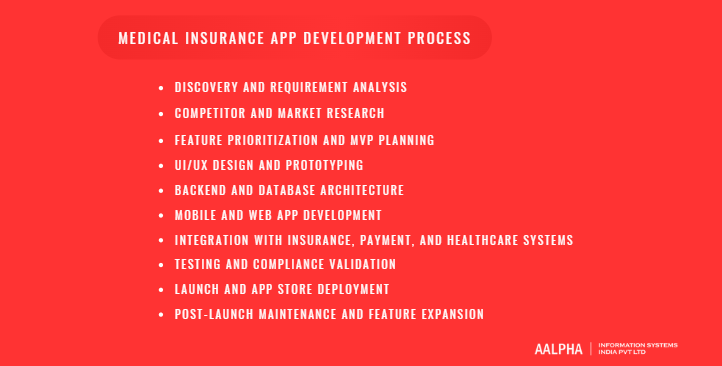
Developing a medical insurance app requires a structured process because the product must handle insurance workflows, healthcare data, claims, payments, documents, compliance, and user support in one connected system. A successful app is not built by starting directly with design or coding. It begins with understanding the business model, target users, claim process, regulatory responsibilities, integration needs, and the minimum feature set required for launch. The development process should move from discovery to MVP planning, design, backend architecture, app development, integrations, testing, launch, and continuous improvement.
-
Discovery and Requirement Analysis
The first step is discovery and requirement analysis. This stage defines what the medical insurance app must achieve, who will use it, what workflows it must support, and which business problems it must solve. The development team should work with stakeholders to understand whether the app is being built for an insurer, broker, TPA, hospital network, employer, healthcare marketplace, or insurance startup. Each business model has different requirements.
During discovery, the team identifies user roles such as policyholders, insurance agents, claim officers, hospital partners, corporate HR teams, customer support executives, finance teams, and system administrators. It also maps key workflows, including policy purchase, premium payment, policy renewal, document upload, claim submission, claim review, eligibility check, approval, rejection, settlement, and customer support. Compliance requirements must also be reviewed early, especially if the app handles medical records, claim documents, protected health information, payment data, or identity documents. The outcome of this stage should be a clear requirement document, MVP scope, user role definition, integration list, compliance checklist, and development roadmap.
-
Competitor and Market Research
The next step is competitor and market research. This helps the business understand what users already expect from medical insurance apps and where existing solutions fail. The team should study insurer apps, health insurance marketplaces, claim portals, broker platforms, hospital insurance desks, employer benefits platforms, and digital healthcare apps.
Competitor research should focus on practical user experience, not just feature lists. For example, how easy is it to submit a claim? Can users clearly understand policy coverage? Are documents easy to upload? Does the app show claim status transparently? Can users find network hospitals quickly? Are renewal reminders timely? Is customer support accessible? Reviews on app stores, customer complaints, and support forums can reveal common pain points such as confusing claim steps, unclear rejection reasons, slow updates, payment failures, and poor document handling. This research helps define what the new app must do better.
-
Feature Prioritization and MVP Planning
Once requirements and market insights are clear, the next step is feature prioritization and MVP planning. A medical insurance app can include many features, but not all of them are needed in the first version. Building too much too early increases cost, delays launch, and makes testing harder.
Features should be divided into three categories: must-have, should-have, and future features. Must-have features usually include secure login, user profile, policy dashboard, policy document access, claim submission, document upload, claim status tracking, notifications, payment or renewal flow, support contact, and admin review. Should-have features may include hospital network search, agent dashboard, plan comparison, chat support, analytics, and payment reconciliation. Future features may include AI chatbot, OCR document extraction, fraud scoring, automated claim triage, personalized recommendations, and advanced integrations. The MVP should focus on the core journey: helping users access their policy, submit claims, upload documents, pay or renew, and receive updates.
-
UI/UX Design and Prototyping
After the MVP scope is finalized, the design team creates the UI/UX structure. Medical insurance apps need simple, trustworthy, and task-focused design because users may access them during stressful situations such as hospitalization, claim filing, or policy renewal. The design should make complex insurance actions easy to understand.
The process begins with user flows. These define how a user moves from login to policy dashboard, claim submission, document upload, payment, support, or renewal. Wireframes are then created to map the layout of each screen. The dashboard should clearly show active policies, covered members, premium status, claim history, upcoming renewals, and important actions. Claim process design is especially important. Users should know which documents are required, what each claim stage means, and what to do if information is missing. After wireframes, the team creates visual designs with colors, typography, icons, buttons, forms, alerts, and accessibility considerations. A clickable prototype allows stakeholders to test the experience before development starts, reducing the risk of costly design changes later.
-
Backend and Database Architecture
The backend is the foundation of a medical insurance app. It manages user accounts, policies, claims, documents, payments, provider networks, notifications, permissions, audit logs, and third-party integrations. Poor backend planning can create serious problems later, especially when the app starts handling higher claim volumes or complex workflows.
A secure backend architecture should include structured APIs, role-based access control, encrypted data storage, protected document storage, audit trails, and clear database relationships. The database must support customer records, family members, policy details, claim history, payment records, uploaded documents, support tickets, provider information, admin actions, and status changes. Audit logs are important because insurance teams must be able to track who viewed, changed, approved, or rejected sensitive records. The architecture should also support scalability so the platform can handle more users, documents, claims, and integrations as the business grows.
-
Mobile and Web App Development
Once the architecture and design are approved, development begins. The mobile app is usually built for policyholders, agents, or both. The web app is often used for admin dashboards, claim management, support operations, policy management, and reporting. Depending on the budget and target audience, the mobile app may be developed natively for iOS and Android or through cross-platform frameworks.
Policyholder features may include registration, login, profile, policy dashboard, digital insurance card, premium reminders, renewal flow, claim request, document upload, claim tracking, notifications, and support. The admin panel may include user management, policy management, claim review, document verification, payment tracking, plan management, hospital network management, reports, and role permissions. Agent modules may include lead management, quote generation, customer onboarding, KYC uploads, renewal reminders, and commission visibility. Development should follow the approved MVP scope first, with a clean structure that allows new modules to be added later.
-
Integration With Insurance, Payment, and Healthcare Systems
Integrations are a major part of medical insurance app development. The app may need to connect with payment gateways, policy APIs, claim APIs, CRM systems, KYC providers, e-signature platforms, hospital databases, provider networks, notification services, email tools, SMS gateways, WhatsApp APIs, analytics tools, and customer support platforms.
Payment gateway integration allows users to pay premiums, renew policies, download invoices, and receive payment confirmations. Policy APIs can help fetch plan details, coverage status, policy documents, and renewal data. Claim APIs may support claim status updates, eligibility checks, or document submission. KYC integrations help verify identity and reduce fraud risk. CRM integration gives sales and support teams a complete view of customer history. Provider network integrations help users find hospitals, clinics, diagnostic centers, and cashless treatment options. Each integration must be tested carefully because errors in payments, claims, or eligibility can directly affect user trust.
-
Testing and Compliance Validation
Testing is critical for medical insurance apps because the platform handles sensitive data and high-impact workflows. Quality assurance should include functional testing, usability testing, API testing, payment testing, notification testing, device testing, browser testing, and regression testing. Claim workflows must be tested with different claim types, missing documents, invalid files, large uploads, approval stages, rejection reasons, and settlement updates.
Security testing should verify authentication, access control, session handling, data encryption, file protection, API security, admin permissions, and audit logs. Data privacy checks should confirm that users and staff can only access information they are authorized to view. Compliance validation may include reviewing consent flows, privacy notices, data retention rules, breach readiness, role-based access, and documentation. User acceptance testing should involve real stakeholders such as claim officers, support teams, agents, and policyholder representatives to confirm that workflows match business operations.
-
Launch and App Store Deployment
After testing, the app moves to production setup and deployment. This includes configuring cloud servers, databases, storage, backups, monitoring, analytics, security certificates, production APIs, payment credentials, and admin accounts. For mobile apps, the team prepares app store assets, descriptions, screenshots, privacy details, and submission packages for Apple App Store and Google Play Store.
Launch planning should also include user onboarding, support training, internal documentation, admin training, and escalation processes. Analytics should be configured to track registrations, policy views, claim submissions, payment attempts, document upload failures, support requests, and user drop-off points. Monitoring tools should track app crashes, server performance, API errors, payment failures, and notification delivery. A controlled launch or phased rollout is often better than releasing to all users at once, especially for insurance apps where support readiness matters.
-
Post-Launch Maintenance and Feature Expansion
Medical insurance app development does not end at launch. The platform needs continuous maintenance, security updates, bug fixes, performance improvements, compliance updates, cloud monitoring, and user support. App store policies, operating systems, payment gateway rules, third-party APIs, and regulatory expectations can change over time, so the product must be maintained actively.
Post-launch improvement should be based on real data and user feedback. If users abandon the claim process, the document upload flow may need redesign. If support teams receive repeated questions, the app may need better policy explanations or chatbot support. If claim teams spend too much time checking documents manually, OCR and claim triage may become a priority. Future modules may include AI chatbot, automated claim validation, fraud detection, agent dashboards, employer portals, advanced analytics, multilingual support, and deeper hospital integrations. A strong long-term roadmap helps businesses improve customer experience, reduce manual workload, and increase the value of the medical insurance app over time.
Compliance, Security, and Data Privacy Costs
Compliance, security, and data privacy are major cost components in medical insurance app development because these platforms often process highly sensitive information. A medical insurance app may handle policy data, personal identity details, health records, claim documents, hospital bills, prescriptions, diagnosis information, discharge summaries, payment records, bank details, and communication history. If this information is exposed, misused, lost, or accessed by unauthorized users, the business may face regulatory penalties, legal claims, customer distrust, reputational damage, and operational disruption. This is why compliance and security cannot be treated as optional add-ons. They must be planned from the earliest stage of product architecture.
Why Compliance Matters in Medical Insurance Apps
Medical insurance apps operate in a sensitive zone where healthcare, insurance, and financial data overlap. A single claim file may include the policyholder’s name, age, contact details, policy number, hospital name, treatment type, diagnosis information, prescription records, medical bills, identity proof, and payment information. This creates a higher risk profile than a normal consumer app because the platform is not only storing user account data but also managing medical and insurance records that may be legally protected.
Compliance matters because medical insurance platforms must define who can collect, view, edit, share, store, and delete user data. A policyholder should be able to access their own policy and claim records, but an insurance agent should not have unrestricted access to sensitive claim documents unless the role requires it. A claim officer may need to review medical bills and discharge summaries, but the system should record every action through audit logs. A hospital partner may need to verify insurance coverage but should not see unrelated customer records. These rules must be built into the app through access control, secure data flows, consent management, audit trails, and clear retention policies.
HIPAA Compliance for U.S.-Focused Apps
For U.S.-focused medical insurance apps, HIPAA compliance may apply depending on the app’s role, the type of data processed, and the relationship between the app provider and regulated healthcare entities. The U.S. Department of Health and Human Services explains that HIPAA applies to covered entities and business associates that handle protected health information. Covered entities and business associates must use appropriate safeguards to protect electronic protected health information, including administrative, physical, and technical safeguards under the HIPAA Security Rule.
In practical terms, HIPAA-related development may require secure user authentication, role-based access control, audit trails, encryption, secure transmission, data backup, breach readiness, and policies for handling protected health information. If an app developer creates, receives, maintains, or transmits PHI on behalf of a covered entity or business associate, the project may require a Business Associate Agreement and HIPAA-aligned controls. However, HIPAA applicability is not automatic for every health or insurance app, so businesses should evaluate the exact use case with legal and compliance experts before development begins.
HIPAA-focused development increases cost because the team must spend more time on secure architecture, documentation, permission design, logging, testing, hosting choices, risk assessment, and incident response planning. It is usually more expensive to retrofit HIPAA controls after launch than to build them into the product from the beginning.
GDPR for European Users
For apps serving users in the European Union or processing personal data of EU residents, GDPR compliance can also affect development cost. The European Commission describes key GDPR principles such as lawfulness, fairness and transparency, purpose limitation, data minimisation, storage limitation, accuracy, integrity and confidentiality, and accountability. It also recognizes user rights such as access, rectification, erasure, restriction of processing, data portability, objection, and rights related to automated decision-making and profiling.
For a medical insurance app, GDPR-related requirements may include clear consent flows, privacy notices, data minimization, user access requests, deletion requests, data export, processing records, and privacy-by-design architecture. For example, the app should collect only the information necessary for policy management, claim submission, payment, or support. If a user requests deletion or access to their data, the system should have workflows to process that request properly, subject to legal, insurance, and record-retention obligations. If AI is used for plan recommendations, claim triage, or fraud scoring, the business must also consider transparency and automated decision-making implications.
GDPR compliance adds cost because it affects product design, backend data structure, consent records, admin workflows, privacy documentation, data export tools, deletion logic, and vendor contracts. These controls are especially important for insurance apps because health and financial information is more sensitive than ordinary account data.
Insurance and Financial Data Security
Medical insurance apps often include payment and financial workflows. Users may pay premiums, renew policies, receive invoices, process refunds, submit bank details for reimbursement, or track settlement status. This means the app must protect transaction records, policyholder identity, KYC documents, payment references, and financial reconciliation data.
Payment security usually requires trusted payment gateway integration, secure API handling, tokenized payment flows where applicable, transaction logging, payment status validation, and protection against duplicate or fraudulent transactions. KYC workflows may require identity document upload, address verification, facial verification, or third-party identity checks. Fraud detection may include duplicate claim alerts, suspicious billing patterns, repeated provider claims, mismatched documents, abnormal claim amounts, or unusual user activity. Financial reconciliation features also add cost because the app must match premium payments, refunds, claim settlements, invoices, and accounting records accurately.
Security Features That Add to Development Cost
Several security features directly increase medical insurance app development cost because they require additional engineering, testing, monitoring, and documentation. These include encryption for data at rest and in transit, two-factor authentication, role-based access control, secure file storage, audit logging, session control, API security, vulnerability testing, backup systems, and disaster recovery planning.
Role-based access is especially important because different users need different permissions. A policyholder, agent, claim officer, hospital partner, HR manager, finance user, and system administrator should not have the same level of access. Audit logging adds cost but is essential for tracking sensitive actions such as viewing claim documents, approving claims, changing policy records, downloading files, or updating payment status. Secure file storage also matters because medical insurance apps often handle large volumes of bills, prescriptions, reports, and identity documents. Disaster recovery and backups add infrastructure cost but help protect the business from data loss, system failures, or cyber incidents.
Security testing should include vulnerability assessment, penetration testing, access control testing, API testing, file upload testing, session testing, and payment flow testing. For insurance platforms, testing should not only verify that features work but also confirm that unauthorized users cannot access restricted information.
Estimated Compliance and Security Cost
The estimated compliance and security cost for a medical insurance app can range from $10,000 to $80,000+, depending on app complexity, target geography, legal obligations, infrastructure choices, audit needs, and data sensitivity. A basic MVP may need secure login, encrypted storage, role-based admin access, basic audit logs, privacy policy support, and secure hosting, which may stay closer to the lower end of the range. A larger platform handling PHI, claims, hospital coordination, payment data, KYC, AI-based claim review, and multi-role dashboards may require a much higher security and compliance budget.
Costs can increase further if the business needs legal review, HIPAA readiness assessment, GDPR documentation, penetration testing, security audits, business associate agreements, data processing agreements, advanced monitoring, disaster recovery infrastructure, or ongoing compliance support. These costs may look high during planning, but they are usually lower than the cost of rebuilding insecure workflows after launch. For medical insurance app development, compliance-first planning protects users, reduces business risk, and creates a stronger foundation for long-term growth.
How to Choose the Right Medical Insurance App Development Company
Choosing the right medical insurance app development company is one of the most important decisions in the entire project. A medical insurance app is not a simple mobile product with login, forms, and notifications. It is a regulated, data-heavy platform that may involve policy records, claim documents, hospital bills, payment workflows, provider networks, KYC, support operations, and sensitive healthcare information. The right development partner should understand both software engineering and the practical workflows behind healthcare insurance. A weak technical partner may still be able to build an attractive interface, but poor backend architecture, unclear claim logic, weak security, and incomplete compliance planning can create expensive problems after launch.
-
Healthcare and Insurance Domain Experience
The first factor to evaluate is healthcare and insurance domain experience. A reliable partner should understand how insurance workflows function in the real world, including policy management, claim submission, claim verification, cashless and reimbursement claims, policy renewals, coverage limits, exclusions, provider networks, premium payments, and customer support. These workflows are very different from ordinary eCommerce, social media, or booking apps.
For example, claim processing is not just a form submission feature. It may require document categorization, claim type selection, hospital details, diagnosis records, prescriptions, bills, discharge summaries, eligibility checks, missing document alerts, approval stages, rejection reasons, settlement updates, and internal review notes. Similarly, policy management must support policyholders, dependents, coverage details, renewal dates, premium history, downloadable documents, and status changes. A team with domain understanding can design these workflows correctly from the beginning, reducing rework and improving user experience.
-
Technical Expertise in Mobile, Web, Backend, and APIs
A medical insurance app usually requires mobile apps, web dashboards, backend systems, databases, cloud deployment, APIs, and admin tools. The development company should have proven capability across all these areas. The mobile app may serve policyholders, agents, or both, while the web dashboard may be used by claim officers, support teams, finance teams, HR teams, hospital partners, and administrators.
Strong backend expertise is especially important because the app must manage policies, claims, documents, payments, users, notifications, provider networks, audit logs, and third-party integrations. The company should be able to design scalable backend systems, secure databases, role-based APIs, cloud infrastructure, document storage, reporting dashboards, and integration layers. Medical insurance apps often need connections with payment gateways, KYC providers, insurer systems, claim APIs, CRM platforms, hospital databases, notification tools, and analytics systems. A partner with strong API integration experience can reduce technical delays and build a more reliable platform.
-
Compliance and Security Capability
Security and compliance capability should be a non-negotiable requirement. Medical insurance apps may handle health records, claim documents, personal identity data, payment details, and sensitive insurance records. The development company should understand secure architecture, encryption, access control, audit logs, privacy-by-design, data retention, secure file storage, API security, backup systems, and compliance documentation.
Role-based access control is particularly important because different users should have different permissions. A policyholder should see only their own policy and claim records. An agent should access assigned customer information. A claim officer should review claims relevant to their role. A hospital partner should verify coverage without accessing unrelated policyholder data. System administrators should have controlled access with proper activity logging. The development partner should also support security testing, vulnerability checks, secure deployment practices, and documentation that helps the business prepare for regulatory review, legal review, or enterprise customer audits.
-
Ability to Build MVP and Scale Later
The right development company should not push businesses to build every feature in the first release. A practical partner will help define an MVP that includes the most important workflows, such as secure login, policy dashboard, document upload, claim submission, payment or renewal flow, notifications, support contact, and admin review. This allows the business to launch faster, validate user behavior, control cost, and improve the product using real feedback.
At the same time, the MVP should be built on a scalable foundation. The company should design the architecture so that future modules can be added without rebuilding the product from scratch. These future modules may include plan comparison, agent dashboards, hospital coordination, employer portals, advanced claim workflows, AI chatbot support, OCR document extraction, fraud detection, analytics, multilingual support, and third-party integrations. A good partner understands phased development: start with the core product, keep the architecture clean, and expand into enterprise-grade features as the business grows.
-
Transparent Cost Estimation and Delivery Process
Transparent cost estimation is another sign of a reliable medical insurance app development company. The vendor should provide a clear scope, feature breakdown, development phases, timeline, milestones, assumptions, exclusions, and post-launch support plan. Vague estimates can lead to budget overruns because medical insurance apps involve many hidden complexities, especially around claims, documents, integrations, security, and admin workflows.
A structured delivery process should include discovery, requirement documentation, wireframes, UI/UX design, technical architecture, sprint planning, development, QA testing, security review, deployment, app store submission, and maintenance. The company should also explain how change requests will be handled, how progress will be reported, how testing will be performed, and what support will be available after launch. Post-launch support is important because the app may need bug fixes, operating system updates, API updates, cloud monitoring, compliance changes, user feedback improvements, and feature enhancements.
Why Businesses Work With Experienced Healthcare Technology Partners
Businesses work with experienced healthcare technology partners because medical insurance apps require a balance of usability, security, compliance, workflow accuracy, and long-term scalability. The goal is not only to build an app that looks good but to create a dependable digital system that supports policyholders, agents, claim teams, healthcare providers, and administrators. Experienced teams can identify risks early, simplify complex workflows, recommend the right MVP scope, design scalable architecture, and avoid common mistakes that increase development cost.
Aalpha is one example of an experienced software development company that works with healthcare, SaaS, and enterprise software projects where security, scalability, and workflow clarity are important. For businesses planning a medical insurance app, the right partner should be able to translate insurance operations into practical digital workflows, build secure mobile and web platforms, integrate with third-party systems, and support the product after launch. This combination of domain understanding and technical execution can make the difference between a basic app and a reliable medical insurance platform that is ready for real users, real claims, and long-term growth.
Medical Insurance App Development Cost: Sample Budget Scenarios
Medical insurance app development cost becomes easier to understand when it is mapped to real project scenarios. A startup building an MVP will not need the same budget as an enterprise insurer building a multi-role platform with claim automation, AI features, compliance workflows, and advanced analytics. The right budget depends on the product type, target users, technical complexity, security requirements, integrations, and long-term roadmap. The following scenarios give businesses a practical way to estimate how much they may need to invest at different stages of medical insurance app development.
-
Startup MVP Budget
A startup MVP for a medical insurance app usually costs between $40,000 and $80,000. This budget is suitable for early-stage founders, insurance startups, small brokers, or healthcare businesses that want to validate the product idea before investing in a larger platform. The focus of this version should be on launching the most important user workflows, not building every possible insurance feature.
A typical Healthcare MVP may include a basic user app, secure login, user profile, policy dashboard, document upload, claim request submission, notifications, payment integration, and a simple admin panel. Users should be able to view policy details, upload required claim documents, receive premium reminders, submit basic claim requests, make payments, and contact support. The admin panel should allow internal staff to manage users, review uploaded documents, update claim status, and monitor basic activity.
This budget range usually does not include advanced plan comparison, AI automation, real-time insurer APIs, fraud detection, hospital coordination, complex analytics, or multi-role dashboards. However, the MVP should still be built with secure architecture, clean database design, protected document storage, and role-based admin access. A poorly built MVP may look cheaper at the start but can become expensive later if the business needs to rebuild the backend before scaling.
-
Growing Insurance Business Budget
A growing insurance business may need a budget of around $80,000 to $180,000 for a more complete medical insurance app. This scenario is suitable for digital brokers, TPAs, insurance agencies, health insurance marketplaces, or insurers that already have users and need stronger workflows.
This version may include plan comparison, quote generation, premium calculator, agent module, claim workflows, hospital network search, payment gateway integration, CRM integration, analytics, support chat, policy renewal, document verification, and stronger admin controls. Users can compare plans, check coverage, submit claims, track claim progress, search for network hospitals, pay premiums, and renew policies. Agents can manage leads, onboard customers, upload KYC documents, follow up on renewals, and track performance. Admin teams can manage plans, policies, users, claims, payments, support tickets, and reports.
The cost increases because the platform now requires more structured workflows and more connected systems. For example, plan comparison needs clean insurance data and filtering logic. Claim workflows need multiple statuses, document categories, internal review steps, and customer alerts. CRM integration helps sales and support teams manage customer relationships more effectively. Analytics helps the business understand claim volume, renewal rates, payment activity, agent performance, and support load.
-
Enterprise Medical Insurance Platform Budget
An enterprise medical insurance platform usually costs between $180,000 and $300,000+. This budget is suitable for established insurers, large TPAs, healthcare groups, employer benefit providers, or enterprise SaaS companies building a large-scale insurance solution. At this level, the product is no longer just a mobile app. It becomes a complete digital insurance system with multiple roles, dashboards, integrations, automation, security, and compliance controls.
Enterprise platforms may include separate modules for policyholders, agents, claim officers, hospital partners, corporate HR teams, finance teams, support teams, and administrators. The system may include policy management, claim automation, API integrations, payment reconciliation, advanced analytics, compliance workflows, document verification, audit logs, enterprise security, and scalable cloud infrastructure.
The higher budget is mainly due to backend complexity, integrations, data protection, and operational scale. Enterprise systems must support high volumes of users, claims, documents, payments, and reports without performance issues. They also need stronger permission controls, monitoring, backup systems, disaster recovery planning, and compliance documentation. For businesses operating across multiple regions or serving enterprise customers, this investment is often necessary to meet reliability and security expectations.
-
AI-Driven Insurance Automation Platform Budget
An AI-driven medical insurance automation platform may cost between $250,000 and $400,000+, depending on the depth of AI features, data quality, workflow complexity, and integration requirements. This type of platform is suitable for insurers, TPAs, and large insurance technology companies that want to reduce manual workload, improve claim processing speed, and support users at scale.
AI features may include an AI chatbot, OCR-based document extraction, claim triage, fraud scoring, personalized recommendation engine, predictive analytics, and workflow automation. An AI chatbot can help users understand policy coverage, required documents, claim steps, renewal options, and support questions. OCR can extract structured data from hospital bills, prescriptions, discharge summaries, identity documents, and claim forms. Fraud scoring can flag duplicate claims, unusual billing patterns, mismatched documents, or suspicious provider activity. Claim triage can help administrators prioritize urgent, incomplete, high-value, or risky claims.
Businesses should also reserve budget for post-launch maintenance, security updates, cloud hosting, compliance reviews, API changes, support, and new features. A realistic budget is not just the cost to build the first version. It should include the cost to operate, improve, and scale the platform over time. For medical insurance apps, the safest approach is to build in phases, invest early in secure architecture, avoid unnecessary features in the MVP, and expand based on measurable business value while keeping the healthcare app development cost aligned with business goals and user demand.
-
Practical Budget Planning Advice
The right medical insurance app development budget depends on the product type, target users, compliance requirements, integrations, development team location, and phased development strategy. A startup should usually avoid building an enterprise-grade platform in the first release. Instead, it should launch a secure MVP with the core workflows: policy dashboard, document upload, claim submission, notifications, payment, and admin review. Once the app has real users and operational feedback, the business can add advanced modules such as plan comparison, agent tools, hospital networks, analytics, AI chatbot, OCR, and claim automation.
Businesses should also reserve budget for post-launch maintenance, security updates, cloud hosting, compliance reviews, API changes, support, and new features. A realistic budget is not just the cost to build the first version. It should include the cost to operate, improve, and scale the platform over time. For medical insurance apps, the safest approach is to build in phases, invest early in secure architecture, avoid unnecessary features in the MVP, and expand based on measurable business value.
Conclusion:
Medical insurance app development can cost anywhere from $40,000 for a basic MVP to $300,000+ for an advanced platform with multiple user roles, claims automation, third-party integrations, AI features, analytics, and compliance-driven security. The final cost depends on the app type, feature complexity, development region, backend architecture, integrations, regulatory requirements, and long-term product roadmap.
For insurers, brokers, TPAs, hospitals, employers, and insurance startups, a medical insurance app can reduce paperwork, improve claim transparency, simplify policy renewals, lower support workload, and give users faster access to insurance services. The best approach is to start with a focused MVP that includes policy access, claim submission, document upload, payments, notifications, and admin review, then expand into advanced features such as hospital networks, agent modules, AI chatbots, OCR, fraud checks, and analytics.
If you are planning to build a secure and scalable medical insurance app, work with an experienced healthcare software development partner that understands insurance workflows, compliance, integrations, and long-term platform growth. Contact Aalpha today to discuss your medical insurance app idea and get a practical development roadmap tailored to your business goals.