


AI agents have quickly moved from experimental demos to practical business automation tools. A few years ago, most companies looked at generative AI as a way to write content, summarize information, or answer questions through chat interfaces. That has changed. Businesses now want AI systems that can do more than respond to prompts. They want AI agents that can understand goals, reason through multi-step tasks, use software tools, interact with APIs, process business data, and assist employees or customers inside real workflows.
This shift is one of the main reasons companies are actively hiring AI agent developers. An AI agent is not just a chatbot with a better interface. IBM defines AI agents as systems that can autonomously perform tasks by designing workflows with available tools, while OpenAI describes agents as applications that can plan, call tools, collaborate across specialist systems, and maintain enough state to complete multi-step work. These definitions show why AI agent development is closer to custom software engineering than basic prompt writing. A working business agent may need to read from a CRM, update a database, search internal documents, generate structured outputs, send notifications, escalate issues, and record every action for audit and review.
For businesses, the opportunity is clear. AI agents can support customer service teams, qualify sales leads, review documents, process invoices, manage internal knowledge, assist healthcare workflows, automate HR tasks, help finance teams, and support operations across departments. Instead of building isolated AI tools, companies are now looking for production-ready systems that connect with existing applications and deliver measurable business outcomes. This is where the quality of the developer matters.
Hiring an AI agent developer should not be treated as hiring someone who only knows how to write prompts. Prompt engineering is useful, but it is only one small part of AI agent development. The right developer must understand software architecture, large language model behavior, API integrations, databases, retrieval-augmented generation, vector search, authentication, permissions, workflow orchestration, security, testing, monitoring, and deployment. They should also know where human review is required, how to reduce hallucinations, how to control costs, and how to build guardrails around sensitive or high-impact actions.
The businesses that succeed with AI agents will be the ones that hire developers who can combine AI knowledge with strong engineering discipline. A good AI agent should not only produce intelligent responses. It should work reliably inside business systems, follow defined rules, respect data security, support human oversight, and improve over time through monitoring and feedback.
What Are AI Agents?
AI Agents Explained in Simple Terms
AI agents are software systems that use artificial intelligence models to understand goals, plan steps, make decisions, use tools, and complete tasks with some level of autonomy. In simple terms, an AI agent is a digital worker that can take instructions, decide what needs to happen next, and perform actions through connected systems. IBM defines an AI agent as a system or program capable of autonomously performing tasks on behalf of a user or another system by designing workflows with available tools. This is an important distinction because an AI agent is not limited to generating text. It can use business applications, retrieve data, call APIs, follow rules, and execute parts of a workflow when it has the right permissions and system access.
For example, a customer support AI agent can read a customer’s query, check the order history, verify delivery status, review refund rules, draft a response, and escalate the issue to a human support executive if the case is sensitive. A sales AI agent can qualify a lead, enrich company details, update a CRM record, write a follow-up email, and remind the sales team. A finance AI agent can check invoices, identify overdue payments, prepare reminder drafts, and notify the accounts team. These examples show why AI agents are becoming useful in business operations. They combine reasoning, data access, and action.
AI Agents vs Chatbots
The easiest way to understand AI agents is to compare them with chatbots. A chatbot mainly responds to user messages. It can answer questions, provide information, and guide users through predefined or AI-generated conversations. A chatbot can tell a finance manager, “These invoices are pending,” based on available data. An AI finance agent can go further. It can log into the accounting system through an approved API, identify pending invoices, group them by due date, draft reminder emails, update the CRM, create a follow-up task, and notify the finance team. The difference is action. Chatbots mostly communicate. AI agents can communicate, decide, and act within defined boundaries.
AI Agents vs Traditional Automation
AI agents are also different from traditional automation. Traditional automation works best when the task is fixed, predictable, and rule-based. For example, if an invoice is approved, send a payment request. If a support ticket is created, assign it to a category. If a form is submitted, send a confirmation email. These workflows are valuable, but they depend on predefined rules. AI agents are useful when the workflow involves judgment, natural language, changing inputs, multiple systems, or unstructured data. They can interpret documents, understand emails, decide which tool to use, summarize information, ask for missing details, and route the task based on context.
Main Components of an AI Agent
A business-grade AI agent usually has several core components. The large language model, or LLM, acts as the reasoning layer that understands instructions and generates responses. Prompts guide how the agent should behave, what role it should perform, and what rules it should follow. Tools and APIs allow the agent to interact with external systems such as CRMs, ERPs, email platforms, payment systems, calendars, ticketing tools, and databases. OpenAI describes agents as applications that can plan, call tools, collaborate across specialist systems, and maintain enough state to complete multi-step work.
Memory and retrieval are also important. Many agents need access to company documents, product manuals, policies, customer records, or historical conversations. Vector databases and retrieval-augmented generation help agents search relevant information before responding or acting. Orchestration logic controls how the agent moves through a workflow, when it calls a tool, when it waits for input, and when it escalates to a human. Workflow triggers can start the agent when a ticket arrives, a lead fills a form, an invoice is uploaded, or a customer sends a message.
Finally, serious AI agents need guardrails, logging, analytics, and human-in-the-loop review. Guardrails define what the agent can and cannot do. Logging records actions for debugging and audit purposes. Analytics help teams measure task completion, accuracy, cost, response time, and escalation rates. Human review allows employees to approve sensitive outputs before the agent takes action. This is why hiring AI agent developers requires more than prompt-writing skills. A real AI agent is a connected software system that must be designed, tested, monitored, and improved like any other business-critical application.
Why Businesses Are Hiring AI Agent Developers
-
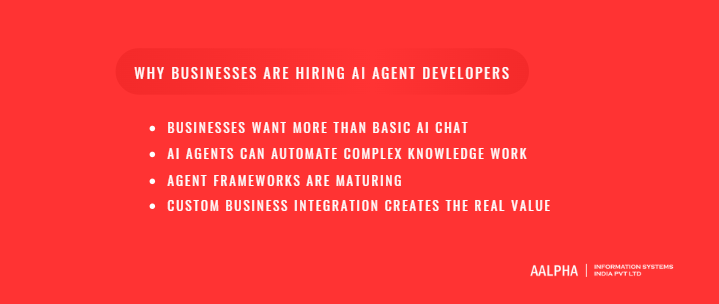
Businesses Want More Than Basic AI Chat
Businesses are hiring AI agent developers because they no longer want AI tools that only answer questions. Many companies have already tested AI chat interfaces for content writing, summarization, customer support, and internal search. These tools are useful, but they often stop at the conversation layer. Business teams now want AI systems that can perform actual work inside sales, support, HR, finance, operations, logistics, healthcare, legal, and software development workflows. This shift has created demand for developers who can build AI agents that understand instructions, retrieve relevant information, call tools, interact with APIs, complete defined tasks, and escalate decisions when human approval is required.
For example, a sales team may not need another chatbot that explains lead qualification rules. It may need an AI sales agent that reviews new leads, checks company size, enriches contact data, scores the lead, drafts a personalized email, and updates the CRM. A support team may not need an AI assistant that only suggests replies. It may need an agent that reads a ticket, checks order history, applies refund rules, drafts the response, tags the issue, and alerts a manager when the case is high-risk. This is why AI agent development has become a serious business requirement. Companies want AI to move closer to measurable productivity, not just conversational convenience.
-
AI Agents Can Automate Complex Knowledge Work
AI agents are especially valuable for knowledge work that involves reading, reasoning, checking systems, and producing structured outcomes. Many business tasks do not follow a single fixed rule. They involve documents, emails, customer messages, policies, approvals, exceptions, and multiple software systems. AI agents can help with these workflows because they can interpret natural language, summarize context, retrieve supporting information, and choose the right next action based on the task.
In finance, AI agents can assist with invoice matching, payment follow-ups, expense review, and reporting. In sales, they can qualify leads, research prospects, prepare outreach drafts, and update CRM data. In healthcare, they can support medical intake, appointment follow-ups, insurance verification, and patient communication under proper review controls. In legal teams, they can help review contracts, extract clauses, summarize case documents, and flag compliance issues. In eCommerce, they can recommend products, analyze customer queries, assist with returns, and support post-purchase service. In operations and logistics, they can check order status, identify delivery exceptions, notify teams, and prepare daily summaries.
The main reason businesses hire AI agent developers for these tasks is that generic AI tools are rarely enough. A useful agent must understand the company’s workflow, connect to the right systems, follow business rules, handle exceptions, and create outputs in a format the business can actually use. That requires custom development.
-
Agent Frameworks Are Maturing
Demand for AI agent developers is also growing because the development ecosystem has improved. Earlier AI agent projects often felt unstable, experimental, or difficult to control. Today, developers have access to more mature frameworks and orchestration tools for building production-grade agent systems. Tools such as LangGraph, Microsoft Agent Framework, OpenAI Agents SDK, CrewAI, LlamaIndex, and similar platforms help developers create agents that can use tools, maintain state, manage workflows, and support more complex business logic.
LangGraph, for example, is focused on agent orchestration capabilities such as durable execution, streaming, human-in-the-loop workflows, and long-running processes. These capabilities matter because business agents often need to pause, wait for approval, resume work, and maintain context across multiple steps. Microsoft’s Agent Framework combines AutoGen-style agent abstractions with enterprise features such as session-based state management, type safety, middleware, telemetry, and graph-based multi-agent orchestration. OpenAI’s Agents SDK also supports orchestration patterns where agents can manage turns, use tools, apply guardrails, perform handoffs, and maintain sessions.
This maturity matters for businesses because it lowers the gap between AI prototypes and working software. Developers can now design agents with better control over workflow state, tool execution, human review, logging, and operational behavior. As a result, companies are more willing to invest in AI agent development for real business use cases.
-
Custom Business Integration Creates the Real Value
Off-the-shelf AI tools can help with general productivity, but most businesses need AI agents that work inside their existing systems. A company may already use Salesforce, HubSpot, Zoho, SAP, Oracle, NetSuite, QuickBooks, Zendesk, Freshdesk, Jira, Slack, Microsoft Teams, Google Workspace, SharePoint, custom dashboards, internal databases, document repositories, and payment systems. The real value comes when an AI agent can safely interact with these tools and perform work within the company’s actual operating process.
For example, a customer support agent becomes more useful when it can check order history, verify payment status, read refund policies, create support notes, and escalate complex cases. A finance agent becomes more useful when it can connect to accounting software, compare invoice data, identify overdue payments, and prepare follow-up actions. A healthcare agent becomes more useful when it can collect intake details, check appointment availability, route requests, and maintain proper audit trails. These are not simple plug-and-play use cases. They require developers who understand APIs, databases, authentication, permissions, workflow triggers, data security, and exception handling.
This is the main reason businesses are hiring AI agent developers. The value is not in adding an AI chat box to a website. The value is in building reliable AI-powered systems that reduce manual effort, improve response time, support employees, and make business workflows more efficient without removing necessary human control. A skilled AI agent developer can turn a business process into a connected, monitored, and secure AI workflow that fits the way the company already works.
What Does an AI Agent Developer Do?
-
Understand the Business Workflow
A good AI agent developer starts by understanding the business workflow, not by choosing the AI model first. This is one of the biggest differences between a basic AI experiment and a production-ready AI agent. Before writing code, the developer must understand who will use the agent, what task the agent should complete, what systems it needs to access, what data it can use, what output is expected, and where human review is required. This discovery process helps avoid building an AI tool that looks impressive in a demo but fails inside the actual business process.
For example, if a company wants to build an AI agent for customer support, the developer must understand how tickets are created, how they are categorized, what information support executives check before replying, which cases require manager approval, and what actions the agent is allowed to perform. Some parts of the workflow may be suitable for AI, such as summarizing the issue, suggesting a reply, tagging the ticket, or checking order history. Other parts may need fixed rules, such as refund eligibility, escalation thresholds, or compliance checks. Sensitive actions, such as issuing refunds, changing medical advice, or approving financial transactions, may need human approval before execution.
-
Design Agent Architecture
Once the workflow is clear, the developer designs the AI agent architecture. This includes deciding whether the business needs a single-agent system, a multi-agent system, or a workflow where AI is used only in specific steps. A single-agent architecture may be enough for a simple support assistant, internal knowledge search agent, or lead qualification agent. Multi-agent systems may be useful when different specialist agents need to handle different tasks, such as research, document review, data validation, reporting, and final response generation.
The developer also designs tool-calling workflows, where the agent can call approved tools or APIs to complete tasks. For example, an AI sales agent may use one tool to search CRM data, another tool to enrich lead information, another tool to draft outreach, and another tool to create a follow-up reminder. Retrieval-augmented generation, or RAG, may be added when the agent needs to search company documents, policies, product manuals, contracts, or knowledge bases before responding. Event-based triggers can start the agent automatically when a form is submitted, a support ticket is created, an invoice is uploaded, or a new lead enters the CRM. Background jobs may be needed for recurring tasks such as daily reports, compliance checks, overdue invoice reminders, or customer follow-ups. A good developer also designs fallback paths so that failed API calls, unclear instructions, missing data, or risky outputs are routed to a human instead of silently failing.
-
Integrate LLMs and AI Models
An AI agent developer is responsible for selecting and integrating the right large language models and AI models for the project. This may include models from OpenAI, Anthropic, Google Gemini, Mistral, Meta Llama, or other open-source model providers. The decision should not be based only on popularity. A good developer compares models based on accuracy, latency, cost, privacy needs, context window size, structured output support, tool-calling capability, hosting requirements, and the sensitivity of the data being processed.
For example, a customer service agent may need a fast and cost-efficient model for large volumes of conversations. A legal contract review agent may need a model with stronger reasoning and a larger context window. A healthcare or finance agent may require stricter privacy controls, auditability, and sometimes private deployment or cloud-specific hosting. In some cases, the developer may use multiple models in the same system, with a lower-cost model handling simple classification and a stronger model handling complex reasoning.
-
Build Tool and API Connections
AI agents become useful when they can connect with business systems. An AI agent developer builds the tool and API connections that allow the agent to read data, write updates, trigger workflows, and communicate with other software. These integrations may include CRMs, calendars, email systems, payment gateways, databases, ticketing platforms, internal admin tools, knowledge bases, web apps, mobile apps, analytics platforms, and third-party APIs.
For example, a recruitment AI agent may connect to an applicant tracking system, email inbox, calendar, resume parser, and HR dashboard. A finance agent may connect to accounting software, invoice databases, payment systems, and internal approval tools. A logistics agent may connect to order management systems, rider tracking, customer notifications, and reporting dashboards. These integrations require strong backend development skills because the developer must handle authentication, permissions, API limits, errors, retries, data formatting, and secure storage of credentials.
-
Add Memory and Knowledge Retrieval
Many AI agents need access to business knowledge before they can produce useful answers or take the right action. An AI agent developer adds memory and knowledge retrieval features using embeddings, vector databases, RAG pipelines, document indexing, metadata filtering, and access control. This allows the agent to search relevant documents or records instead of relying only on the model’s general training data.
For example, an internal HR agent may need to retrieve leave policies, employee handbook sections, benefits documents, and location-specific rules. A product support agent may need to search user manuals, troubleshooting guides, release notes, and known issue databases. A legal agent may need to retrieve specific clauses from contracts and cite the source document. Metadata filtering helps the agent search only the right department, region, customer account, or document type. Source citation is also important because users need to know where the agent’s answer came from, especially in legal, healthcare, finance, and enterprise workflows.
-
Implement Guardrails and Human Review
A production AI agent needs strong guardrails. The developer must define what the agent is allowed to do, what it is not allowed to do, and when it must ask for human approval. Guardrails may include prompt injection protection, sensitive data filtering, role-based permissions, restricted actions, output validation, approval queues, and audit logs. Without these controls, an AI agent may expose private information, take incorrect actions, follow malicious instructions, or create compliance risks.
Human-in-the-loop review is especially important when the agent handles sensitive or high-impact tasks. A support agent may draft a refund response but require approval before sending it. A healthcare agent may collect patient intake information but route clinical advice to a licensed professional. A finance agent may identify suspicious transactions but escalate them instead of making final decisions. The developer must build these review flows into the product from the beginning.
-
Test, Monitor, and Improve Agents
AI agent development does not end after deployment. The developer must test, monitor, and improve the agent continuously. Testing includes evaluation datasets, conversation testing, task completion checks, tool-call validation, hallucination checks, edge-case testing, and security testing. The goal is to measure whether the agent completes the right task, uses the right data, follows rules, and handles failure safely.
After launch, the developer monitors latency, token usage, cost per task, escalation rate, task success rate, incorrect outputs, user feedback, and failed tool calls. These insights help improve prompts, workflows, retrieval quality, model selection, guardrails, and user experience. A reliable AI agent is not a one-time build. It is a software system that must be measured, refined, and supported as business needs, data, APIs, and AI models change.
Types of AI Agent Developers You Can Hire
-
AI Agent Engineer
An AI agent engineer is the most direct fit when a business wants to build agents that can plan, reason, use tools, retrieve knowledge, and complete tasks across connected systems. This type of developer usually works with LLM APIs, agent orchestration frameworks, tool-calling workflows, memory, retrieval-augmented generation, and multi-step agent logic. Their job is not only to connect a model to a chat interface. They design how the agent thinks through a task, which tools it can use, when it should retrieve knowledge, when it should ask for clarification, and when it should hand over the task to a human.
Businesses should hire an AI agent engineer when the project involves real workflows such as customer support automation, sales follow-up agents, document review agents, internal knowledge assistants, finance agents, HR agents, or multi-agent task automation. A strong AI agent engineer should understand frameworks such as LangGraph, CrewAI, LlamaIndex, OpenAI Agents SDK, Microsoft Agent Framework, and similar tools. More importantly, they should know how to move beyond a demo and build agent workflows that are traceable, testable, and safe for production use.
-
LLM Integration Developer
An LLM integration developer focuses on adding large language model capabilities into business applications. This role is useful when a company already has a web app, SaaS platform, mobile app, internal tool, CRM, dashboard, or enterprise system and wants to add AI features. These developers work with APIs from providers such as OpenAI, Anthropic, Google Gemini, Mistral, Azure OpenAI, AWS Bedrock, and open-source model providers. They handle prompt design, model selection, structured outputs, API integration, token usage, fallback models, and cost optimization.
For example, a SaaS company may hire an LLM integration developer to add AI-powered report generation, email drafting, document summarization, chat with data, or smart recommendations inside an existing product. This developer may not always build a fully autonomous agent, but they create the AI layer that agents often depend on. They are especially useful when the project needs reliable model responses, JSON outputs, function calling, model routing, and latency control.
-
Backend Developer With AI Experience
A backend developer with AI experience is critical for production AI agent development. Many AI agent failures happen because the AI logic is built without a strong software foundation. Backend developers handle authentication, databases, APIs, queues, logs, permissions, background jobs, dashboards, caching, error handling, and system reliability. These are the parts that make an AI agent usable in a real business environment.
For example, an AI finance agent may need secure access to invoice records, payment data, approval workflows, and accounting software. A backend developer designs how that data is accessed, what the agent is allowed to do, how actions are logged, and how errors are handled. If the agent needs to send emails, create tickets, update records, or trigger notifications, the backend developer builds the secure infrastructure behind those actions. For serious AI agent projects, this role is often as important as the AI specialist.
-
Machine Learning Engineer
A machine learning engineer is useful when the AI agent project requires more than LLM integration. Some projects need custom models, embeddings, fine-tuning, classification models, recommendation engines, document extraction models, or model evaluation pipelines. A machine learning engineer can help when the business needs domain-specific accuracy, specialized prediction, private model deployment, or advanced evaluation.
For example, an insurance company may need an AI claims agent that classifies claim types, extracts information from documents, predicts risk categories, and routes cases for review. A healthcare company may need custom document extraction from medical records. An eCommerce platform may need recommendation models connected to an AI shopping agent. In such cases, a machine learning engineer can build or tune the models that support the agent’s decisions.
-
Data Engineer
A data engineer is needed when AI agents depend on clean, structured, searchable, and governed business data. Many companies underestimate this role. An AI agent can only perform well if it can access reliable data from the right systems. Data engineers build pipelines, clean datasets, prepare knowledge sources, manage databases, organize document repositories, define metadata, and create data access rules.
For example, if a company wants an internal knowledge agent, the data engineer may need to organize PDFs, policies, spreadsheets, helpdesk articles, CRM records, product documentation, and employee resources into a searchable system. They may also set up vector databases, indexing workflows, data sync jobs, and permission filters. Without this foundation, the AI agent may retrieve outdated, incomplete, or unauthorized information.
-
Full-Stack AI Developer
A full-stack AI developer is useful for startups, MVPs, and small teams that need one developer to handle multiple parts of the product. This developer can build the AI agent logic, backend APIs, database structure, admin dashboard, user interface, and sometimes deployment. While a full-stack AI developer may not be a deep specialist in every area, they can move fast and build working prototypes or MVPs.
For example, a startup building an AI customer support MVP may hire a full-stack AI developer to create the chat interface, connect the LLM API, build the knowledge base, add ticket escalation, create an admin panel, and deploy the first version. This role works well when the goal is to validate the product before investing in a larger team.
-
AI Automation Consultant
An AI automation consultant is useful when a business is not yet sure what to build. This role focuses on workflow discovery, feasibility analysis, solution planning, ROI mapping, and automation strategy. Instead of jumping directly into development, an AI automation consultant helps identify which workflows are suitable for AI agents, which ones should remain rule-based, which systems need integration, and what risks need to be managed.
For example, a logistics company may know that operations are manual but may not know whether to build a dispatch agent, customer support agent, reporting agent, or vendor coordination agent first. An AI automation consultant can study the workflows, estimate impact, prioritize use cases, and prepare a practical roadmap. This role is valuable before hiring a development team because it helps the business avoid vague AI projects and focus on measurable outcomes.
Key Skills to Look for in AI Agent Developers
-
Strong Programming Skills
The first skill to look for in an AI agent developer is strong programming ability. AI agent development is not just about writing prompts or connecting a chatbot to an AI model. A business-grade agent is a software system that needs backend logic, APIs, databases, authentication, event handling, user interfaces, monitoring, and deployment. For this reason, the developer should be confident in languages and frameworks commonly used for AI and business application development.
Python is one of the most important languages for AI agent development because many AI frameworks, model libraries, data processing tools, and orchestration systems are Python-friendly. Developers may use FastAPI, Django, or Flask to build APIs, backend services, dashboards, admin panels, and integration layers. JavaScript and TypeScript are also valuable, especially when the project involves web applications, real-time interfaces, or SaaS platforms. Node.js, Express, NestJS, React, and Next.js are useful when the agent must be integrated into a web product, internal portal, or customer-facing dashboard. A good developer should also understand backend API development, database design, error handling, logging, and deployment because these skills determine whether the agent can run reliably in production.
-
LLM API Experience
AI agent developers should have hands-on experience working with large language model APIs. This includes models from OpenAI, Anthropic Claude, Google Gemini, Azure OpenAI, Mistral, Cohere, and open-source model providers. They should know how to send prompts, manage system instructions, receive structured outputs, handle long context windows, use function calling or tool calling, and control model behavior across different use cases.
This skill matters because every model behaves differently. Some models are better for reasoning, some are faster for high-volume support tasks, some are cost-effective for classification, and some are preferred for privacy or enterprise hosting. A developer should know how to choose the right model based on the use case, budget, latency, security, and accuracy requirements. They should also understand model routing, where simple tasks may go to a cheaper model while complex tasks go to a stronger one. This can reduce cost without weakening performance.
-
Agent Framework Experience
A strong AI agent developer should understand current agent frameworks and orchestration tools. These may include LangGraph, LangChain, Microsoft Agent Framework, Semantic Kernel, CrewAI, AutoGen, LlamaIndex, OpenAI Agents SDK, and related workflow orchestration systems. The goal is not to hire someone who simply lists these tools on a resume. The goal is to find someone who understands when to use a framework, how to structure agent workflows, how to manage state, how to connect tools, and how to make agent behavior observable and testable.
LangGraph is commonly used for agent orchestration because it supports capabilities such as durable execution, streaming, and human-in-the-loop workflows, which are important for long-running and review-based business processes. OpenAI’s Agents SDK describes agents as LLMs configured with instructions, tools, and optional runtime behavior such as handoffs, guardrails, and structured outputs. LlamaIndex also provides agent workflows that help developers create and coordinate one or multiple agents with tools for specific tasks.
Current framework awareness is especially important because the AI agent ecosystem changes fast. For example, Microsoft’s AutoGen GitHub page now states that AutoGen is in maintenance mode and recommends that new users start with Microsoft Agent Framework. A capable developer should know these changes, understand migration risks, and avoid building a new production system on a tool that may no longer receive active feature development.
-
RAG and Vector Database Knowledge
Retrieval-augmented generation, or RAG, is one of the most important skills for AI agent development. Most business agents need to work with company-specific knowledge, not only general model knowledge. This may include internal policies, product manuals, customer records, contracts, invoices, helpdesk articles, medical documents, financial reports, technical documentation, or compliance rules. RAG helps the agent retrieve relevant information before generating an answer or taking action.
An AI agent developer should understand embeddings, document chunking, indexing, metadata filtering, reranking, hybrid search, and source citation. They should also know vector databases and search systems such as Pinecone, Weaviate, FAISS, Chroma, Milvus, pgvector, Elasticsearch, and OpenSearch. This knowledge is necessary because poor retrieval leads to poor agent performance. If documents are split badly, indexed without metadata, or searched without access controls, the agent may return incomplete, outdated, or unauthorized information.
-
API and Tool-Calling Experience
AI agents become truly useful when they can interact with tools. A developer should know how to safely connect agents to internal and external systems through APIs. These systems may include CRMs, ERPs, accounting tools, payment gateways, calendars, email platforms, support desks, databases, analytics tools, HR software, inventory systems, and custom business applications.
Tool-calling experience is different from basic API integration. The developer must define what tools the agent can use, what parameters are allowed, how the agent should decide which tool to call, what happens if a tool fails, and which actions need human approval. For example, reading customer order status may be low-risk, but issuing a refund or changing a subscription plan may require approval. A good developer designs tool access with strict boundaries instead of giving the agent unrestricted system control.
-
Workflow and Automation Thinking
AI agent developers should understand workflow design and automation logic. Business tasks are rarely single-step actions. They often involve triggers, queues, retries, state machines, approval rules, background jobs, notifications, exception handling, and fallback routing. A developer who understands workflow design can build agents that work inside real operations instead of producing isolated responses.
For example, an invoice agent may start when a vendor uploads a document. It may extract the invoice data, compare it with a purchase order, check approval status, flag mismatches, send the invoice for review, and update the accounting system after approval. If a required field is missing, the agent should request clarification. If the API fails, it should retry or alert a human. This kind of workflow thinking is essential for production systems.
-
Security and Compliance Awareness
Security is a non-negotiable skill when hiring AI agent developers. AI agents may access sensitive customer information, employee records, medical data, financial data, contracts, or business systems. Developers must understand access control, encryption, audit trails, personally identifiable information handling, data retention, secure deployment, and permission-based system design.
For regulated industries, they should also understand requirements around HIPAA, GDPR, SOC 2, and internal compliance policies. Even if the developer is not a legal expert, they should know how to design systems that support compliance. This includes limiting data access, logging agent actions, masking sensitive data, managing consent, securing API keys, and preventing unauthorized tool use.
-
Evaluation and Testing Skills
Testing AI agents is different from testing normal software. Traditional software usually produces predictable outputs from fixed logic. AI agents can produce variable outputs, call different tools, interpret language differently, and fail in ways that are not always obvious. Developers must test outputs, reasoning paths, tool calls, edge cases, hallucinations, unsafe behavior, and workflow completion rates.
A strong developer should know how to create evaluation datasets, test conversation flows, measure task success, review failed cases, and monitor production behavior. They should also test for prompt injection, irrelevant retrieval, incorrect tool calls, missing citations, sensitive data exposure, and poor escalation handling. Without evaluation, a company may launch an agent that seems useful in demos but performs poorly with real users.
-
Product Thinking
The best AI agent developers also have product thinking. They understand that the goal is not to show that AI can complete a task once. The goal is to build a tool that users trust, adopt, and use repeatedly. They should ask practical questions: Who will use the agent? What problem does it solve? How much time does it save? What action should the user take next? Where should the agent be visible? What should happen when confidence is low? How will success be measured?
Product-minded developers think about user experience, business impact, reliability, adoption, and measurable outcomes. They build agents that fit naturally into existing workflows, reduce friction for employees, and produce outputs that are easy to review and act on. This skill often separates a useful business agent from a technical demo.
AI Agent Tech Stack Developers Should Know
-
Programming Languages
AI agent developers should be comfortable with programming languages that support AI integration, backend development, workflow automation, and product interfaces. Python is one of the most important languages in this area because many AI frameworks, orchestration tools, embedding libraries, data processing pipelines, and machine learning utilities are built around it. Developers often use Python with FastAPI, Django, or Flask to build APIs, agent services, admin tools, and backend workflows.
TypeScript and JavaScript are also important because many AI agents are deployed inside SaaS products, dashboards, customer portals, and web applications. TypeScript gives teams stronger type safety when building complex application logic, while JavaScript remains widely used across frontend and backend development. Node.js is often used for API services, real-time workflows, and event-driven applications. In enterprise environments, Go and Java may also be relevant because they are commonly used for high-performance services, large backend systems, internal platforms, and cloud-native applications.
-
LLM Providers
An AI agent developer should understand how to work with different large language model providers instead of depending on one model for every task. Common providers include OpenAI, Anthropic Claude, Google Gemini, Azure OpenAI, AWS Bedrock, Mistral, Meta Llama, Cohere, and other open-source models. Each provider has different strengths around reasoning, speed, cost, context length, structured output, tool use, privacy, hosting options, and enterprise controls.
For example, OpenAI’s Agents SDK describes agents as applications that can plan, call tools, collaborate across specialist systems, and maintain enough state to complete multi-step work. This is useful for businesses building task-oriented agents that must use external systems and complete defined workflows. AWS Bedrock Agents also supports autonomous agents that can orchestrate interactions between foundation models, company data sources, software applications, user conversations, APIs, and knowledge bases. A capable developer should know how to compare providers and choose models based on the project’s actual requirements rather than brand popularity.
-
Agent Frameworks
Agent frameworks help developers design, orchestrate, test, and manage AI agent workflows. Important frameworks and tools include LangGraph, LangChain, Microsoft Agent Framework, CrewAI, LlamaIndex, Semantic Kernel, OpenAI Agents SDK, and legacy AutoGen systems. These tools help developers build agents that can call tools, maintain workflow state, use memory, perform handoffs, coordinate multiple agents, and run multi-step tasks.
LangGraph is useful for developers building more controlled agent workflows because it supports durable execution, streaming, persistence, and human-in-the-loop patterns for long-running processes. Microsoft Agent Framework supports agents that use LLMs, call tools and MCP servers, and participate in graph-based workflows with type-safe routing, checkpointing, and human-in-the-loop support. OpenAI’s Agents SDK defines an agent as an LLM configured with instructions, tools, and optional runtime behavior such as handoffs, guardrails, and structured outputs. When hiring, businesses should check whether the developer understands workflow orchestration concepts, not just framework names.
-
Vector Databases and Search
Many AI agents need access to private business knowledge. This is where vector databases and search tools become important. Developers should know systems such as Pinecone, Weaviate, FAISS, Milvus, Chroma, pgvector, Elasticsearch, and OpenSearch. These tools help agents search company documents, helpdesk content, product manuals, contracts, policies, customer records, and other knowledge sources before generating responses or taking action.
A good developer should understand more than basic vector search. They should know document chunking, embeddings, metadata filtering, hybrid search, reranking, index refreshes, access control, and source citation. For example, a legal AI agent should not only retrieve a relevant clause. It should also show the source document, section, and version. A customer support agent should retrieve the latest refund policy, not an outdated document. These details make retrieval useful in production.
-
Backend and Infrastructure
AI agents need strong backend and infrastructure support because they often run as part of larger business systems. Developers should be familiar with backend frameworks such as FastAPI, Django, Flask, Node.js, Express, and NestJS. They should also understand databases and storage systems such as PostgreSQL, MongoDB, Redis, and object storage. For asynchronous workloads, they may need queues and streaming systems such as Kafka, RabbitMQ, Celery, or cloud-native queue services.
Infrastructure knowledge is equally important. Docker helps package services, Kubernetes helps run scalable workloads, and cloud platforms such as AWS, Azure, and GCP provide hosting, networking, identity management, storage, databases, monitoring, and deployment pipelines. AI agents may need background jobs, retry logic, API gateways, rate-limit handling, scheduled tasks, webhooks, and secure secrets management. Without this foundation, the agent may work in a demo but fail under real usage.
-
Monitoring and Evaluation Tools
Monitoring and evaluation are essential because AI agent behavior can vary across users, documents, prompts, and tool calls. Developers should know tools and practices such as LangSmith, OpenTelemetry, PromptLayer, custom dashboards, token usage tracking, evaluation datasets, logs, tracing, and feedback loops. LangSmith positions itself as a platform to build, debug, evaluate, and ship reliable agents from prototype to production. LangSmith observability also focuses on tracing, real-time monitoring, debugging failures, and tracking cost and latency in agent and LLM applications.
In practice, monitoring helps teams answer important questions. Did the agent complete the task? Which tool did it call? Did retrieval return the right document? How much did the task cost? Did the user accept the output? Did the agent escalate the case correctly? Good developers build these checks into the system from the beginning.
-
Security Tools
Security tools are a core part of the AI agent tech stack. Developers should understand identity management, role-based access control, API gateways, secret managers, encryption, content filters, data loss prevention systems, audit logs, and guardrail frameworks. This matters because AI agents may access sensitive customer data, financial records, healthcare information, legal documents, source code, or internal business systems.
A secure agent should only access the data and tools required for its role. It should not expose private records, ignore permissions, leak credentials, or execute high-risk actions without approval. Developers should design agents with least-privilege access, restricted tools, human approval for sensitive actions, secure deployment, and clear audit trails. In business environments, the safest AI agent is not the most autonomous one. It is the one that performs useful work while respecting permissions, compliance rules, and human oversight.
Common AI Agent Use Cases by Industry
-
Healthcare
Healthcare is one of the strongest areas for AI agent development because many workflows involve patient communication, document handling, appointment coordination, insurance checks, and administrative follow-ups. A medical intake agent can collect patient symptoms, medical history, appointment reason, insurance details, and required documents before the consultation. This helps clinics reduce front-desk workload and gives doctors better context before seeing the patient. However, healthcare agents must be designed carefully because they should assist with administrative and informational tasks, not replace licensed medical judgment.
Appointment follow-up agents can remind patients about upcoming visits, send preparation instructions, collect post-visit feedback, and follow up after consultations. Insurance verification agents can check eligibility, request missing policy information, and route unclear cases to billing staff. Clinical documentation assistants can summarize doctor-patient conversations, structure notes, and prepare drafts for review. Patient support agents can answer common questions about clinic timings, appointment status, prescription instructions, and follow-up steps using approved knowledge sources. Referral coordination agents can help route patients to specialists, collect referral documents, and update care teams. In all these cases, the agent should include human review, access control, audit logs, and strict data handling rules.
-
Finance and Banking
Finance and banking teams deal with large volumes of documents, transactions, customer requests, risk checks, and compliance requirements. AI agents can support KYC document review by reading identity documents, extracting key details, checking completeness, and flagging mismatches for human review. Customer support agents can answer account-related queries, guide users through application processes, and escalate sensitive issues to support teams. Loan application screening agents can review submitted forms, identify missing information, summarize borrower profiles, and route applications based on predefined criteria.
Fraud alert triage is another useful application. An AI agent can review suspicious activity alerts, gather transaction context, compare customer behavior, and prepare a summary for fraud analysts. Compliance assistance agents can help teams search regulations, internal policies, and audit records. Invoice reconciliation agents can compare invoices, purchase orders, payments, and vendor records to identify mismatches. Financial reporting agents can collect data from accounting tools, generate summaries, explain variances, and prepare management reports. Because financial workflows are sensitive, these agents need strong role-based access, encryption, logs, approval workflows, and clear limits on what they can execute independently.
-
eCommerce and Retail
eCommerce and retail businesses can use AI agents across customer experience, operations, marketing, and inventory management. Product recommendation agents can understand customer preferences, browsing patterns, purchase history, and product catalog data to suggest relevant items. Order support agents can answer delivery questions, check shipment status, process basic return requests, and create support tickets when needed. Returns management agents can verify return eligibility, collect customer reasons, generate return instructions, and notify warehouse or support teams.
Inventory analysis agents can monitor stock levels, identify fast-moving items, detect slow-moving products, and alert teams before stockouts. Marketing campaign agents can help prepare campaign ideas, segment customers, draft promotional messages, and analyze campaign performance. Customer review analysis agents can summarize reviews, identify recurring complaints, detect product quality issues, and share insights with merchandising or product teams. For retail businesses with many products and high customer volume, AI agents can reduce manual work while improving response speed and personalization.
-
Real Estate
Real estate companies often manage leads, property listings, appointments, documents, and client communication across multiple channels. Lead qualification agents can collect buyer or tenant requirements, budget, preferred location, property type, move-in timeline, and financing readiness. Property matching agents can compare customer requirements with available listings and suggest suitable options. Document review agents can check lease agreements, purchase documents, identification files, and application forms for missing information.
Tenant support agents can answer questions about rent payment, maintenance requests, lease terms, and property rules. Appointment scheduling agents can coordinate site visits, check agent availability, send reminders, and update calendars. CRM update automation is especially useful in real estate because leads often come from portals, ads, WhatsApp, websites, and phone calls. Real Estate AI agent can capture lead details, update CRM records, assign follow-ups, and prepare daily summaries for sales teams. This helps real estate businesses respond faster and reduce missed opportunities.
-
Legal
Legal workflows involve large volumes of text, research, documents, clauses, deadlines, and compliance requirements. AI agents can assist with contract review by reading agreements, identifying important clauses, highlighting missing terms, and preparing summaries for lawyers. Legal research assistants can search case law, internal legal notes, policy documents, and reference material to help legal teams prepare faster. Clause extraction agents can identify termination clauses, indemnity clauses, payment terms, confidentiality obligations, renewal terms, and dispute resolution clauses.
Compliance review agents can compare documents or business processes against internal policies and regulatory requirements. Matter intake agents can collect client information, case details, documents, dates, and required background before a lawyer reviews the matter. Document summarization agents can condense long case files, contracts, correspondence, and discovery documents into structured summaries. Legal AI agents should always be designed as assistants, not final legal decision-makers. They need source citation, document traceability, access restrictions, and human review because accuracy and accountability are critical.
-
Logistics
Logistics businesses deal with dispatching, delivery tracking, exceptions, vendor coordination, customer updates, and operational reporting. Dispatch support agents can help assign tasks, check available drivers, review delivery priorities, and alert dispatch teams when orders are delayed. Route exception agents can identify issues such as failed pickups, late deliveries, address problems, vehicle breakdowns, or customer unavailability. Delivery support agents can answer customer questions, provide order status, and notify teams when intervention is needed.
Order status agents can connect with order management systems, GPS tools, delivery partner apps, and customer notification systems. Vendor coordination agents can follow up with suppliers, warehouses, and delivery partners regarding pending tasks. Operational reporting agents can prepare daily summaries on completed orders, delays, cancellations, driver performance, and customer complaints. In logistics, the strongest AI agents are often those that combine real-time data, rules, and human escalation rather than trying to fully automate decision-making.
-
Education
Education businesses and institutions can use AI agents to support students, teachers, administrators, and learning platforms. AI tutors can explain concepts, answer student questions, provide practice exercises, and adapt responses based on learning level. Student support agents can answer questions about admissions, fees, class schedules, assignments, exams, and course policies. Course recommendation agents can suggest programs or lessons based on student goals, skill level, and previous performance.
Grading assistance agents can support teachers by reviewing objective answers, summarizing written responses, or preparing feedback drafts. Learning analytics agents can identify students who may need extra support by reviewing attendance, test scores, assignment submissions, and engagement data. Administrative support agents can handle routine questions, document collection, reminders, and internal coordination. In education, AI agents can improve support availability, but they should be designed to support teachers and administrators rather than replace academic judgment.
-
SaaS and Technology Companies
SaaS and technology companies are strong candidates for AI agent development because they already work with digital workflows, product data, support tickets, customer behavior, and internal tools. Customer success agents can monitor customer usage, identify low engagement, suggest renewal actions, and prepare account summaries. Onboarding agents can guide new users through setup, answer product questions, recommend next steps, and notify customer success teams when users are stuck.
Support ticket triage agents can read incoming tickets, identify the issue type, search documentation, suggest replies, assign priority, and route tickets to the right team. Product analytics assistants can answer questions about feature usage, churn signals, customer segments, and adoption trends using connected analytics tools. Engineering copilots can help developers search documentation, summarize pull requests, generate test cases, and investigate bugs. Documentation agents can keep product guides, FAQs, changelogs, and internal knowledge bases easier to search and update. For SaaS companies, AI agents can improve support, onboarding, product adoption, and internal productivity when they are deeply integrated with the product ecosystem.
In-House vs Freelance vs Dedicated AI Agent Development Team
-
Hiring In-House AI Agent Developers
Hiring in-house AI agent developers is best for companies that plan to build long-term proprietary AI infrastructure. This model works well for funded startups, SaaS companies, enterprises, and technology-led businesses where AI agents are central to the product roadmap. For example, if a company wants to build its own AI support platform, internal AI automation layer, enterprise knowledge assistant, or multi-agent system that will be improved over several years, an in-house team can provide deeper product ownership and long-term continuity.
The main benefit of hiring in-house is control. The developers work closely with internal teams, understand the company’s data, product, users, and workflows, and can continuously improve the agent after launch. They can also collaborate better with product managers, security teams, compliance teams, and department heads. This is valuable when AI agents need to be deeply embedded into core systems or when the company wants to build internal AI capabilities as a competitive advantage.
However, hiring in-house AI agent developers can be expensive and slow. Skilled AI engineers, backend developers with LLM experience, machine learning engineers, and AI infrastructure specialists are in high demand. Recruitment can take months, salaries can be high, and companies may need multiple roles before the team becomes effective. A single AI agent developer may not be enough because production-grade agents often need backend engineering, frontend development, DevOps, QA, security, data engineering, and product management support.
-
Hiring Freelance AI Agent Developers
Freelance AI agent developers are usually best for prototypes, proof of concept projects, code audits, small integrations, or short-term experiments. A business may hire a freelancer to test whether an AI support agent can answer common questions, whether a document review agent can extract data accurately, or whether an internal knowledge assistant can search company policies. This can be a cost-effective way to validate an idea before investing in a larger build.
The advantage of freelancers is speed and flexibility. Businesses can hire a specialist for a defined task, avoid long-term commitments, and move quickly on small projects. Freelancers can be useful when the scope is narrow, such as integrating an LLM API into an existing application, creating a RAG prototype, building a simple chatbot-agent workflow, or reviewing an existing AI setup.
The drawback is that freelance development may create risks around continuity, documentation, security, and maintenance. AI agent systems often become more complex after the first prototype. Once the business needs user roles, API integrations, logging, approval workflows, dashboards, testing, deployment, and support, a single freelancer may struggle to cover everything. If the freelancer moves on without proper documentation, the business may face problems maintaining or scaling the system. Freelancers can be a good starting point, but they are not always the best fit for mission-critical AI agent projects.
-
Hiring a Dedicated AI Agent Development Team
A dedicated AI agent development team is a better fit for businesses that want to build serious applications without hiring a full internal team. This model gives companies access to a focused team that may include AI engineers, backend developers, frontend developers, QA testers, DevOps engineers, and project managers. It works well when the project requires workflow discovery, user interface design, backend development, third-party integrations, agent architecture, testing, security, deployment, and ongoing improvement.
For example, a healthcare company building a patient intake agent may need secure forms, appointment integration, admin dashboards, audit logs, patient communication, and human review. A logistics company building an operations agent may need order management integration, delivery tracking, vendor notifications, and reporting. A finance company building an invoice reconciliation agent may need document extraction, accounting software integration, approval workflows, and compliance checks. These are not one-person jobs. They need coordinated development across multiple areas.
A dedicated team gives businesses more structure than a freelancer and more flexibility than hiring in-house. The company can scale the team up or down depending on the project stage, while still getting specialized skills and long-term support.
-
Hiring an AI Agent Development Company
Hiring an AI agent development company is often the most practical option for businesses that need end-to-end delivery. A development company can provide product managers, AI engineers, LLM integration specialists, backend developers, frontend developers, UI/UX designers, QA testers, DevOps engineers, security support, and maintenance teams under one engagement. This is useful when the business has a clear goal but does not want to manage multiple independent specialists.
An AI agent development company can also help with the early planning phase. This includes use case discovery, workflow mapping, feasibility analysis, architecture planning, MVP scoping, cost estimation, and development roadmap creation. Once development starts, the company can handle model integration, RAG pipelines, tool-calling workflows, dashboards, API integrations, testing, deployment, and support. For businesses that need a production-ready AI agent rather than a quick experiment, this model reduces execution risk.
Which Hiring Model Is Best?
The best hiring model depends on the project stage, budget, complexity, and long-term goal. If the company is only exploring an idea, a freelance developer or AI automation consultant may be enough to build a small proof of concept. If the business wants an MVP with a defined workflow, a full-stack AI developer or dedicated team can move faster. If the project is an internal tool with limited users, a small dedicated team may be the right balance of cost and capability.
For enterprise systems, regulated industries, customer-facing applications, or agents that access sensitive data, a dedicated team or AI agent development company is usually safer. These projects need strong security, access control, testing, monitoring, audit logs, documentation, and maintenance. For SaaS companies building AI agents as a core product feature, in-house hiring may make sense after the MVP is validated, especially if AI is part of the long-term product strategy.
In most cases, businesses should avoid choosing a hiring model only based on hourly cost. The better question is whether the developer or team can safely take the agent from idea to production. AI agent development requires workflow understanding, model integration, backend engineering, data access, security, testing, monitoring, and ongoing improvement. The right hiring model is the one that matches the risk and complexity of the business problem.
Step-by-Step Process to Hire AI Agent Developers
-
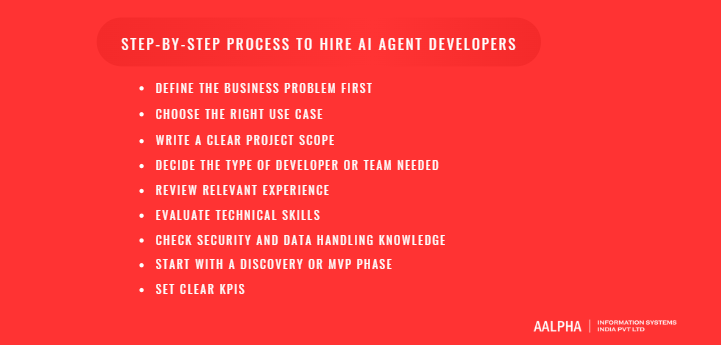
Define the Business Problem First
The first step in hiring AI agent developers is to define the business problem clearly. Many companies begin with a vague goal such as “we want to build an AI agent.” That is not enough for a successful project. A better starting point is to identify the workflow that needs improvement and the measurable result the business wants to achieve. For example, “reduce support ticket resolution time by 40%,” “automate 60% of invoice follow-ups,” or “cut manual lead qualification work by 50%” is much clearer than simply saying “build an AI agent.”
AI agent development should always start with the workflow, not the technology. The business should document how the task is handled today, which employees are involved, what tools they use, what data they check, what decisions they make, and where delays happen. This helps the developer understand whether AI should answer questions, retrieve information, classify requests, draft responses, trigger actions, or escalate cases to humans. Without this clarity, the project can easily become a technical demo that does not solve a real operational problem.
-
Choose the Right Use Case
After defining the business problem, the next step is to choose the right use case. The best first AI agent use case is usually high-volume, repetitive, measurable, and low to medium risk. It should be important enough to create business value but not so risky that a small mistake could create legal, financial, medical, or reputational damage.
Good starting use cases include support ticket triage, internal knowledge search, lead qualification, invoice data extraction, appointment follow-ups, document summarization, CRM updates, product recommendations, and routine reporting. These workflows usually involve repetitive work, clear inputs, and measurable outcomes. Businesses should avoid starting with highly sensitive decisions such as final loan approvals, medical diagnosis, legal advice, employee termination, or large financial transactions unless strong human approval flows are built from the beginning. The goal of the first use case should be to prove value safely.
-
Write a Clear Project Scope
A clear project scope helps the business hire the right AI agent developer and avoid confusion during development. The scope should explain the objective of the agent, target users, supported workflows, data sources, integrations, expected actions, approval rules, dashboards, reporting needs, security requirements, and success metrics. It should also define what the agent should not do.
For example, if the project is an AI customer support agent, the scope should mention whether the agent will only draft replies or send replies automatically. It should list the systems it needs to access, such as the helpdesk, order database, refund policy, CRM, and notification tool. It should define when the agent should escalate cases, such as refund disputes, angry customers, payment failures, or legal complaints. It should also mention reporting requirements, such as average response time, number of tickets handled, escalation rate, and customer satisfaction score. A clear scope gives developers enough information to estimate cost, timeline, team size, and technical approach.
-
Decide the Type of Developer or Team Needed
Once the scope is clear, the business can decide what type of developer or team is required. If the project is a narrow prototype or simple integration, a freelance AI agent developer or full-stack AI developer may be enough. If the project needs strong LLM integration, structured outputs, model routing, and cost control, an LLM integration developer may be suitable. If the agent needs to connect with multiple business systems, a backend developer with AI experience becomes very important.
For projects involving custom models, classification, document extraction, fine-tuning, embeddings, or model evaluation, a machine learning engineer may be required. If the project depends on large amounts of messy business data, a data engineer may also be needed. For a production-grade AI agent with dashboards, APIs, integrations, security, testing, deployment, and support, hiring a dedicated AI development team or AI agent development company is often the safer choice. The more business-critical the agent is, the more important it becomes to hire a team rather than relying on one person.
-
Review Relevant Experience
Businesses should review relevant experience before hiring an AI agent developer. General software experience is useful, but it does not automatically mean the developer can build AI agents. Ask for examples of projects involving LLM APIs, tool calling, retrieval-augmented generation, vector databases, workflow automation, API integrations, human-in-the-loop review, dashboards, and production deployment.
A strong developer should be able to explain what problem they solved, how the agent worked, which tools it used, what systems it integrated with, how errors were handled, and how the agent was tested after launch. Look for evidence of real implementation, not only screenshots or chatbot demos. If the developer has worked on agents that connect to CRMs, helpdesks, payment systems, databases, calendars, email platforms, or document repositories, that experience is more relevant than basic prompt-writing examples.
-
Evaluate Technical Skills
The hiring process should include a practical technical evaluation. Instead of asking only theory questions, give the developer a small task that reflects the real project. For example, ask them to design a simple tool-calling agent that checks customer order status and drafts a support response. Ask them to design a RAG workflow for searching company policies. Ask them to explain how they would prevent prompt injection, control hallucination risk, estimate token cost, and decide when the agent should ask for human approval.
You can also ask them to debug a failed agent workflow. For example, what should happen if the agent retrieves the wrong document, calls the wrong API, produces an unsupported answer, or receives conflicting user instructions? A capable developer should think in terms of system behavior, reliability, safety, cost, and user experience. The best candidates will not promise full automation for everything. They will explain where rules, approvals, fallback paths, and monitoring are needed.
-
Check Security and Data Handling Knowledge
Security and data handling should be checked before hiring, especially for healthcare, fintech, legal, enterprise SaaS, HR, finance, and internal business data. AI agents may access sensitive documents, customer records, employee information, payment data, contracts, medical details, or proprietary business information. The developer must understand how to protect this data throughout the workflow.
Ask how they will manage authentication, role-based access, encryption, API keys, data retention, audit trails, logs, and human approvals. Ask whether the agent will send data to third-party models, how sensitive information will be masked, and how users will be prevented from accessing unauthorized documents. Also ask how the agent will handle restricted actions such as refunds, account updates, financial approvals, document changes, or customer communication. A developer who treats security as an afterthought is not the right fit for production AI agent development.
-
Start With a Discovery or MVP Phase
Businesses should avoid building a large AI agent system in one step. A discovery or MVP phase is usually the best starting point. The first phase can include workflow mapping, technical architecture, data review, model selection, prototype development, one or two integrations, limited user access, evaluation metrics, and a deployment plan. This allows the company to test the idea before spending heavily on a larger platform.
For example, instead of building a full customer service automation system, the MVP may handle only order status tickets and refund policy questions. Instead of building a complete finance agent, the MVP may focus only on invoice extraction and mismatch detection. This phased approach helps validate accuracy, user adoption, integration complexity, and cost before expanding into more workflows.
-
Set Clear KPIs
Finally, businesses should set clear KPIs before development begins. AI agent success should not be measured only by whether the system can generate good responses. It should be measured by business outcomes. Useful KPIs include task completion rate, average handling time, human review reduction, accuracy, escalation rate, cost per task, response latency, user adoption, customer satisfaction, and number of successful tool calls.
For example, a support agent may be expected to reduce first-response time by 60%, resolve 30% of simple tickets with review, and keep escalation accuracy above a defined threshold. A finance agent may be expected to process 500 invoices per month, flag mismatches accurately, and reduce manual review time. A sales agent may be expected to qualify leads faster, update CRM records accurately, and improve follow-up consistency. Clear KPIs help the business judge whether the developer has built a useful system, not just an impressive AI demo.
Questions to Ask Before Hiring AI Agent Developers
-
Technical Questions
Before hiring AI agent developers, businesses should ask technical questions that reveal whether the candidate can build production-ready systems, not just AI demos. Start by asking what agent frameworks they have used and why they chose them. A strong developer should be able to discuss tools such as LangGraph, LangChain, Microsoft Agent Framework, CrewAI, LlamaIndex, Semantic Kernel, OpenAI Agents SDK, or similar orchestration systems. More importantly, they should explain how these tools help with state management, tool calling, memory, retrieval, human review, and workflow control.
Ask how they design tool-calling workflows. This question is important because AI agents become useful when they can interact with business systems such as CRMs, helpdesks, databases, calendars, payment platforms, and internal tools. The developer should explain how the agent decides which tool to call, what data is passed to the tool, how errors are handled, and which actions require approval. You should also ask how they prevent prompt injection, how they test agents before production, how they handle memory and retrieval, and how they monitor cost and latency. A capable developer should talk about evaluation datasets, logs, tracing, token usage, model selection, fallback models, and guardrails.
-
Business and Product Questions
The best AI agent developers do not start by forcing AI into every workflow. They first study the business process and identify where AI can create measurable value. Ask how they would identify the right workflow for AI automation. A strong answer should include workflow mapping, volume analysis, risk assessment, user interviews, data availability, integration needs, and ROI estimation.
Ask how they will measure ROI. The answer should go beyond generic productivity claims. Good metrics may include reduction in average handling time, fewer manual reviews, faster response time, improved lead follow-up, lower support workload, higher task completion rate, reduced operational delay, or improved customer satisfaction. Also ask what should be automated first. A practical developer will usually recommend starting with a high-volume, repetitive, measurable task instead of a high-risk decision. Another important question is where human approval should remain. The right developer will not recommend full autonomy for sensitive actions such as refunds, financial approvals, legal decisions, healthcare advice, or changes to critical customer records.
-
Security Questions
Security questions are essential when hiring AI agent developers because agents may access sensitive business data and take actions inside connected systems. Ask how they will protect sensitive data. The developer should discuss encryption, role-based access, secure API keys, audit logs, data masking, least-privilege access, and secure deployment. If your business handles healthcare, finance, legal, HR, or enterprise SaaS data, the developer should also understand privacy and compliance needs such as HIPAA, GDPR, SOC 2 controls, data retention, and user consent.
Ask how access control will work. A good developer should explain that the agent should only access the information and tools allowed for its role and user permissions. Ask what logs will be stored, who can access them, and how long they will be retained. Logs are useful for debugging and audits, but they must not expose sensitive information unnecessarily. Finally, ask how the agent will handle restricted actions. The answer should include approval workflows, restricted tool permissions, confirmation steps, and escalation rules for risky outputs or uncertain cases.
-
Maintenance Questions
AI agent development does not end after launch, so businesses should ask maintenance questions before signing a contract or hiring a developer. Ask how the agent will be improved after launch. A strong developer should mention feedback loops, failed task reviews, prompt updates, retrieval improvements, model upgrades, monitoring dashboards, and periodic evaluation.
Ask what happens when APIs change. Since AI agents often depend on CRMs, ERPs, calendars, payment tools, helpdesks, databases, and third-party platforms, API changes can break workflows. The developer should explain how integrations will be documented, monitored, and updated. Also ask how prompts, tools, workflows, data sources, and approval rules will be updated over time. Finally, ask what support model they offer. Serious AI agent systems need bug fixes, security updates, monitoring, performance improvements, cost optimization, and new feature development as business needs change.
How Much Does It Cost to Hire AI Agent Developers?
-
Cost by Hiring Model
The cost to hire AI agent developers depends first on the hiring model. A freelance AI agent developer is usually the most flexible option for small prototypes, proof of concept projects, audits, or narrow integrations. Freelancers may be suitable when the business wants to test a single workflow, such as a basic support assistant, internal knowledge search agent, or simple document summarization tool. The cost can be lower, but the business may need to manage scope, security, documentation, and maintenance more carefully.
Hiring an in-house AI agent developer is usually more expensive because the company must cover salary, benefits, hiring costs, onboarding, tools, infrastructure, and long-term retention. This model makes sense when AI agents are part of the company’s core product or long-term internal infrastructure. However, one in-house developer may not be enough for production-grade development. The company may also need backend developers, frontend developers, data engineers, QA testers, DevOps engineers, and product managers.
A dedicated remote AI developer or dedicated AI team can be a balanced option for companies that need serious development without building a full internal department. This model works well for MVPs, internal automation systems, and custom business agents that need APIs, dashboards, integrations, testing, and deployment. An AI development company is usually the best fit for end-to-end projects because it can provide multiple roles under one engagement, including AI engineers, backend developers, frontend developers, QA, DevOps, UI/UX, and project management.
-
Cost by Project Complexity
A simple AI agent prototype may cost around $5,000 to $15,000. This type of project may include a basic AI assistant, limited prompt design, one knowledge source, simple tool calling, and a small demo interface. It is useful for validating whether an idea is technically possible.
An MVP AI agent may cost around $15,000 to $50,000. This version usually includes a defined workflow, user interface, basic backend, one or two integrations, retrieval from business documents, simple logging, and limited user testing. For example, an MVP could be a support ticket triage agent, invoice extraction agent, or lead qualification agent.
A custom business AI agent with integrations may cost around $50,000 to $150,000. This range applies when the agent must connect with CRMs, ERPs, payment systems, databases, helpdesks, email platforms, calendars, document repositories, or internal dashboards. It may also include role-based access, approval workflows, monitoring, reporting, and stronger testing. The AI agent development cost within this range is largely influenced by the number of integrations, workflow complexity, security requirements, and the level of customization required for business operations.
An enterprise-grade multi-agent platform may cost $150,000 to $500,000 or more. These projects usually involve multiple agents, complex workflows, secure data access, custom dashboards, compliance requirements, advanced RAG, audit logs, high availability, DevOps, monitoring, and long-term support. Regulated industries such as healthcare, banking, insurance, legal, and enterprise SaaS often fall into this category when agents must handle sensitive data or mission-critical workflows.
-
Factors That Affect Cost
Several factors influence the final cost of hiring AI agent developers. The number of workflows is one of the biggest drivers. A single support workflow is simpler than a system that handles support, sales, finance, reporting, and operations. The number of integrations also affects cost because every API connection needs authentication, data mapping, permissions, error handling, testing, and maintenance.
Data quality is another major factor. If the business already has clean documents, structured databases, updated knowledge bases, and clear workflows, development becomes faster. If the data is scattered across PDFs, spreadsheets, emails, old systems, and unorganized folders, the project may require extra data engineering. RAG complexity also affects cost because document chunking, embeddings, metadata filtering, hybrid search, source citation, and permission-based retrieval need careful design.
UI and dashboard needs can increase the budget. A backend-only agent is cheaper than a full platform with admin panels, analytics, user roles, review queues, and reporting. Model choice also matters. Some models are cheaper and faster, while others cost more but provide better reasoning or larger context windows. Security, compliance, testing, hosting, and support can also increase the budget, especially for regulated or enterprise use cases.
-
Ongoing Costs
Businesses should also plan for ongoing costs after the first version is launched. AI agents usually require LLM API usage, vector database costs, cloud hosting, monitoring tools, logging, testing, and maintenance. The cost depends on the number of users, number of tasks, model selected, volume of documents, frequency of retrieval, and number of tool calls.
Prompt updates, workflow changes, model upgrades, API changes, bug fixes, and new integrations also create ongoing maintenance needs. A support agent may need updates when refund rules change. A finance agent may need changes when accounting workflows change. A healthcare agent may need new intake forms or appointment rules. Businesses should treat AI agents as living software systems, not one-time installations.
How to Control Cost
The best way to control cost is to start with one high-value workflow instead of trying to automate everything at once. Businesses should choose a task that is repetitive, measurable, and safe enough for an MVP. They should limit unnecessary autonomy in the first version and use human approval for sensitive actions. This reduces risk and lowers development complexity.
Token usage should be tracked from the beginning because model calls can become expensive at scale. Developers should use the right model for each task instead of sending every request to the most expensive model. Simple classification, routing, and formatting tasks may use lower-cost models, while complex reasoning can use stronger models. Businesses should also avoid overbuilding dashboards, multi-agent flows, and custom model training before the first workflow proves value. A focused MVP with clear KPIs is usually the smartest way to control cost while still building a foundation that can scale.
Why Choose the Right AI Agent Development Partner
-
AI Agent Development Needs More Than AI Knowledge
Choosing the right AI agent development company or partner is important because building a useful agent requires more than knowledge of AI models. A business-grade AI agent is not just a prompt connected to a chat window. It is a software system that may need to understand business rules, access databases, interact with APIs, retrieve company knowledge, update records, trigger workflows, manage permissions, and support human review. This requires a development partner with experience in AI, backend engineering, cloud infrastructure, security, user roles, dashboards, databases, and business process automation.
The right partner should understand how large language models behave, where they are useful, and where they need restrictions. They should also know how to design the surrounding software system that keeps the agent reliable. For example, a customer support agent may need access to helpdesk tickets, order history, refund policies, CRM records, and notification tools. A finance agent may need invoice data, accounting software integration, approval workflows, and audit logs. A healthcare agent may need secure intake forms, appointment systems, patient communication rules, and review flows. In each case, the AI model is only one part of the solution. The real system depends on architecture, integration, security, testing, and support.
-
Custom Development Helps When Workflows Are Complex
Many businesses start with off-the-shelf AI tools, but custom development becomes necessary when workflows involve multiple steps, different user roles, sensitive data, and several software systems. A generic AI assistant may answer questions, but it usually cannot follow company-specific approval rules, connect securely to internal systems, retrieve restricted documents, update dashboards, or complete department-specific workflows without custom engineering.
Custom AI agent development is especially valuable for multi-step workflows and multi-agent systems. For example, a document processing workflow may need one agent to extract data, another to validate it against internal records, another to summarize exceptions, and another to route the case for approval. A sales workflow may need lead enrichment, CRM updates, email drafting, follow-up scheduling, and reporting. A support workflow may need ticket classification, knowledge retrieval, response drafting, escalation, and customer sentiment analysis. These workflows need orchestration logic, retrieval-augmented generation, document indexing, source citation, approval queues, analytics, and system integrations.
Custom development also helps when businesses need SaaS dashboards, internal portals, admin panels, CRM or ERP integrations, payment system connections, and reporting tools. A well-built AI agent should fit into the company’s existing operations instead of forcing teams to change everything around a standalone AI tool. This is why the development partner should be able to design both the AI workflow and the software infrastructure around it.
-
Long-Term Support Is Critical
AI agents need long-term support after launch. Unlike a static software feature, an AI agent depends on changing models, changing prompts, changing workflows, changing APIs, and changing business data. A support agent may need updates when refund rules change. A finance agent may need new approval rules when the accounting process changes. A healthcare intake agent may need updated forms or new compliance controls. A sales agent may need new CRM fields, new lead scoring rules, or new email templates.
Continuous monitoring is also essential. Teams need to know whether the agent is completing tasks correctly, how often it escalates to humans, how much each task costs, how long responses take, which tool calls fail, and where users reject outputs. Based on these findings, developers may need to tune workflows, refine prompts, update retrieval pipelines, change model settings, improve guardrails, fix bugs, strengthen security, optimize costs, and add new features. Without long-term support, even a promising AI agent can become unreliable or outdated.
-
Working With an Experienced AI Agent Development Partner
Businesses planning to hire AI agent developers should look for a partner that can combine AI expertise with strong software development experience. This is especially important when the project requires custom AI agents, backend development, API integrations, admin dashboards, workflow automation, cloud deployment, security controls, and long-term technical support.
Companies can work with experienced software development teams such as Aalpha when they need a custom AI agent built around real business workflows rather than a basic chatbot. Aalpha can support projects that involve AI agent planning, backend architecture, API integration, SaaS dashboards, internal portals, database development, workflow automation, cloud setup, testing, deployment, and ongoing maintenance. This type of partnership is useful for businesses that want to move from AI experimentation to a production-ready system that works inside their existing tools, supports human oversight, and can improve over time.
Conclusion
Hiring AI agent developers is not about adding a basic chatbot to your website or internal system. It is about building AI-powered software that can understand workflows, use tools, retrieve business data, connect with APIs, follow rules, and support employees or customers with measurable outcomes.
The right developer should understand LLMs, backend systems, RAG, databases, security, workflow automation, testing, monitoring, and human review. Businesses should start with one clear use case, define success metrics, build an MVP, and expand only after the agent proves value in real operations.
If your business is planning to build a custom AI agent for customer support, sales, finance, healthcare, logistics, legal, SaaS, or internal automation, connect with an experienced AI agent development team. Aalpha can help you plan, build, integrate, deploy, and support AI agents designed around your business workflows.