





TL;DR: Custom Software Development Costs
Custom software development typically costs $50,000 to $200,000+, depending on software type, complexity, team structure, and integrations. Web-based business systems run $50,000–$120,000, enterprise platforms (ERP, CRM) run $100,000–$200,000+, and SaaS, marketplace, or AI-enabled systems typically start at $120,000–$150,000 and can exceed $200,000. At Aalpha, we scope every project through consultation, cost estimation, and proposal stages to arrive at an accurate, phase-wise budget.
Understanding how much custom software development costs is a key step for businesses planning to build tailored digital solutions. Unlike off-the-shelf software, custom development is shaped by specific business goals, technical requirements, and long-term scalability needs, which makes pricing less predictable at first glance.
This article explains what custom software really means, the factors that influence development costs, and how pricing varies by software type and project complexity. It also covers proven methods for estimating costs, the impact of emerging technologies, and a phase-wise cost breakdown—from planning to deployment.
You’ll also learn practical ways to control development expenses without sacrificing quality, along with a step-by-step guide to estimating costs with Aalpha Information Systems. The article concludes with key takeaways and answers to common questions businesses have about custom software development pricing.
How is Custom Software-Defined?
Custom software is distinct from off-the-shelf software such as Microsoft Office, which caters to a broad customer base. It has features that are tailored to your business’s needs. Custom software includes, but is not limited to, tailor-made banking desktop applications and enterprise resource planning (ERP) software.
Developing bespoke software includes gathering requirements, writing code, testing the program, and deploying it. Custom software provides a more customized experience for users, reduces development costs, and improves return on investment. Additionally, the scalability of bespoke software is superior to that of widely available software.
Did you know? By 2028, the global software market size is anticipated to reach a value of USD 872.72 bn.
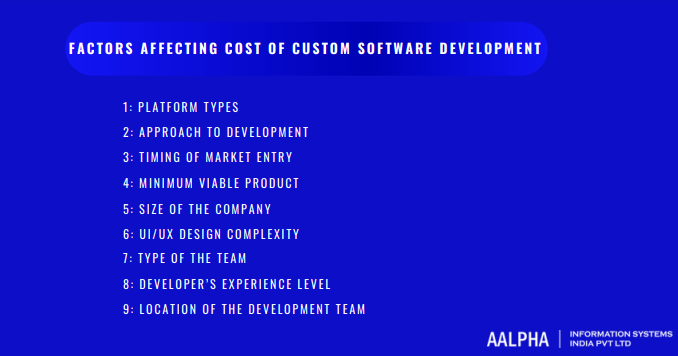
Factors Affecting Cost of Custom Software Development
To get insight into the spending, it is necessary to understand the variables that affect the development cost. For instance, a realtor determines the cost of a building based on design requirements, raw materials, labor, paperwork, validation, and finishing work.
Likewise, developing bespoke software for your business is similar. This section will outline the key factors that influence your investment and their effect on the lifetime of your project.
-
Platform Types
The cost of bespoke software development varies according to the platform used. Android, for instance, is one of the most popular platforms in the present market, having dominated other device categories such as laptops, streaming tools, wearables, and even smart appliances.
However, when a large platform like Android is used, the scalability increases significantly. To get efficient performance, you need a robust software structure, which requires more development work.
Separate development teams will be required for software distribution in various native ecosystems. Multiple development teams will be more expensive than a dedicated team. Additionally, the technologies used to distribute software influence the cost.
-
Approach to Development
From the selection of the framework to the development process, your project plan includes components that help you portray the strategy and budget. After then, you will require a fast, reliable, and error-free development process. Agile development is one such iterative process-based method. Agile Development Methodology—costs associated with bespoke software development
Additionally, Agile development enables a cost-effective lifetime of development.
The first step enables you to develop a roadmap for job clarification, resource allocation, and iteration metrics, thus minimizing team effort and technical debt.
Prototyping offers stakeholders an inside investigation of the product, allowing for revisions before the product’s launch.
-
Timing of market entry
Time-to-market is a broad phrase, and it is affected by many aspects of the development process. Everything impacts the timeframe, from the size of the program to the functionality it contains. To simplify, we’ve found three situations that will significantly increase your time-to-market:
When there are an excessive number of characteristics, some of which may be complicated
When applications with fewer features need more time due to their complexity.
Each instance involves a lengthy time-to-market. It’s a significant issue for startups and established businesses since you never know when your great concept may become obsolete. As a result, getting to market quickly becomes a priority.
-
Minimum viable product
If you want to test your goods before launching, the Minimum Viable Product (MVP) is an excellent method to get meaningful feedback.
Assume you wish to create a music streaming application that plays music at a particular time. While this seems to be an excellent concept, you may want to ascertain how people respond to this addition. Thus, you build a beta version and distribute it. While an MVP may consume up to 20%-40% of your overall development budget, it is well worth the investment since user evaluations may provide you with a comprehensive knowledge of your product’s usability. Additionally, it provides you with additional time to concentrate on your application’s more challenging features.
-
Size of the company
Different companies attract different charges for custom software development. Ideally, we have enterprise, large, medium, and startup software development projects.
Enterprise Software Project- under such a project, the developer requires a basic framework. The core interests of an enterprise software project include data integrity, logging increase, error handling, and data security.
Here, the custom software development costs are quite higher. What’s more, such companies should take note to avoid the non-compliance type of fines. Ideally, the custom software development costs under enterprise projects can reach up to $200,000 or more for the whole project. The hourly charges range between $30 to $50.
Small and Medium Enterprises (SMEs) – These are projects that require a single source of data, such as a web interface or a small mobile app. The total custom software development costs under SMEs can be more than $100,000 with 2000 hours of delivery time.
Startup -These are projects that don’t need a huge budget. Besides, the products must be launched to the market in the shortest time possible for easy market penetration. Developers don’t use pricey products here, hence minimizing the total cost of custom software development.
-
UI/UX Design Complexity
As always, user experience is a core value in software development. Developers are now using advanced methods to attain an improved user experience, a move that will see the product penetrating the market with ease.
Since a sophisticated UI/UX design requires high technology and high resources, the final software development will definitely increase, as described in the table below:
Level of Complexity | Total Cost in $ |
Basic Project | $100,000 |
Average Project | $150,000 |
Complex Project | $220,000 |
-
Type of the team
Depending on your budget and the requirements for your custom software development, you can hire different types of teams, and the prices vary depending on the team working on your custom software, as shown below:
Team-Type Development Costs | Costs |
The Local Development Company, the USA | $200,000 |
In-house team, the USA | $220,000 |
Freelancers | $60,000 |
Outsourced Agency, India | $70,000-$100,000 |
In-house teams entail developers within an organization, and these developers follow guidelines from the management to create solutions.
Local Development Company -This is a custom software development firm located in the same country as the business.
Freelancers – these are software developers who aren’t employees of any software development firm. They offer independent services at negotiated prices on a contractual basis.
Outsourced Agency – this is a team of software developers dedicated to offering software development solutions to another country.
-
Developer’s experience level
We have trainees, junior developers, middle developers, senior developers, and software architects. The higher the level of these developers, the more the charges of custom software development costs.
-
Location of the development team
The price of custom software development will vary based on the region of your team. Getting a custom software development team from the US is higher than getting a team from South Asian country like India, as simplified in the table below:
Region/Country | Approximate Custom Software Development Costs in $ |
Australia | $150,000 |
The USA | $220,000 |
The UK | $180,000 |
Western Europe | $160,000 |
Eastern Europe | $90,000 |
South Asia | $70,000-$100,000 |
Integration with other systems
In a business setup or even an organization, it is crucial to integrate the software solution with other systems for streamlined service delivery. In this case, the following factors will impact the overall costs of custom software development in relation to integration requirements:
- Number of systems – Every system you integrate with your software solution comes with diverse requirements and challenges, hence impacting the costs incurred in developing the software solution.
- Compatibility – different systems have distinct technologies, data formats, and protocols. This impacts the integration processes, including the costs incurred.
- Maintenance –depending on the complexity of the integration processes, the maintenance costs can be low or extreme, thus impacting the overall custom software development costs.
- APIs – Depending on how the APIs are structured, the integration process can be less costly & seamless or complex and costly, thus impacting the overall custom software development costs.
Custom Software development cost
The custom software development cost depends on several factors such as developers experience, use of technology in the project, complexity of the project as well as region of the developers team.
When it comes to custom software development cost at Aalpha information systems our charges ranges between $50,000–200,000+.
For info please check our: pricing
Custom Software Development Cost by Software Type
Custom software development costs vary primarily based on the type of software system being built, its functional depth, and the long-term operational expectations. To avoid confusion, the cost ranges below are derived from the same assumptions already established earlier in this article, where most custom software projects fall between USD 50,000 and USD 200,000+, depending on complexity, team structure, integrations, and scalability needs.
Rather than introducing new pricing models, this section organizes those costs by software category, helping decision-makers understand where their project realistically fits.
Custom Web-Based Software Systems
Typical cost range:
USD 50,000 to USD 120,000
Typical feature scope:
Custom web-based software systems commonly include user authentication, role-based access, dashboards, workflow automation, database-backed operations, reporting modules, admin controls, and third-party integrations. These systems are often built to support internal operations, customer portals, or business process automation.
Why the cost falls in this range:
This category aligns closely with the SME and startup-level projects discussed earlier in the article. Costs are driven by backend logic, business rules, and integrations rather than surface-level design. Since these systems operate within a single web environment, development complexity is moderate and predictable.
What increases or reduces the cost:
Costs rise when the system must handle high user concurrency, complex workflows, real-time data updates, or advanced security requirements. Costs remain closer to the lower end when the scope is well-defined, integrations are limited, and the system serves a focused business function.
Enterprise Software Systems (ERP, CRM, Internal Platforms)
Typical cost range:
USD 100,000 to USD 200,000+
Typical feature scope:
Enterprise software systems include multi-level user roles, audit logs, data integrity enforcement, workflow engines, reporting and analytics, access controls, and integration with existing enterprise tools. These systems are often business-critical and must operate reliably at scale.
Why the cost falls in this range:
This range directly reflects the enterprise cost figures already referenced earlier. Enterprise software demands more planning, documentation, testing, and governance than smaller systems. The emphasis on reliability, security, and compliance increases development effort significantly.
What increases or reduces the cost:
Costs increase when regulatory compliance, large data volumes, or multiple system integrations are involved. Costs are lower when the system serves a limited department or replaces manual workflows without extensive automation or migration.
SaaS Software Platforms (Multi-Tenant Systems)
Typical cost range:
USD 120,000 to USD 200,000+
Typical feature scope:
SaaS platforms typically include multi-tenant architecture, user and organization management, access isolation, admin dashboards, subscription logic, usage tracking, and scalability mechanisms. These platforms are designed for long-term growth and recurring usage.
Why the cost falls in this range:
SaaS platforms require architectural decisions that support future scaling, which aligns with the higher-end cost ranges discussed in your article. Unlike single-client systems, SaaS products must be stable, secure, and maintainable across many customers simultaneously.
What increases or reduces the cost:
Costs increase when the platform requires complex permissions, advanced analytics, or enterprise-grade security. Costs remain controlled when the initial release focuses on a core feature set while preserving a scalable foundation.
Marketplace Software Systems
Typical cost range:
USD 150,000 to USD 200,000+
Typical feature scope:
Marketplace software systems support multiple user roles, listings, search and filtering, order management, messaging, moderation tools, and administrative oversight. These systems must balance interactions between different parties reliably.
Why the cost falls in this range:
Marketplaces combine multiple workflows into a single system, increasing development complexity. This places them naturally toward the higher end of the cost ranges already mentioned, especially due to integration, synchronization, and operational reliability requirements.
What increases or reduces the cost:
Costs rise when real-time interactions, complex transaction flows, or large user volumes are expected early. Costs are lower when the marketplace launches with limited categories, controlled user roles, or a single-region focus.
AI-Enabled Software Systems (Automation, ML, LLM-Based Workflows)
Typical cost range:
USD 150,000 to USD 200,000+
Typical feature scope:
AI-enabled software systems may include automation engines, data processing pipelines, AI-assisted decision-making, predictive analytics, or LLM-based workflows integrated into business processes. These systems typically augment existing operations rather than replacing them entirely.
Why the cost falls in this range:
This cost range aligns with complex enterprise and SaaS projects already discussed. AI increases development effort through data preparation, model integration, monitoring, and reliability safeguards, but it does not fundamentally change the overall pricing framework established earlier.
What increases or reduces the cost:
Costs increase when custom models, large datasets, or strict accuracy requirements are involved. Costs remain manageable when AI is applied selectively to well-defined workflows using proven models and controlled data inputs.
Legacy Software System Modernization
Typical cost range:
USD 80,000 to USD 200,000+
Typical feature scope:
Legacy modernization projects focus on refactoring or rebuilding existing systems, improving performance, updating architectures, enabling integrations, and enhancing maintainability. The goal is often stability and scalability rather than new features.
Why the cost falls in this range:
This range matches the enterprise and integration-heavy cost discussions already present in your article. Legacy systems often contain undocumented logic and technical debt, which requires careful analysis before changes can be safely implemented.
What increases or reduces the cost:
Costs rise when data migration is complex, systems must remain live during transition, or legacy dependencies are poorly documented. Costs are lower when modernization is limited to specific modules or user interfaces rather than full system replacement.
Methods of estimating custom software development costs
When planning for a custom software development project, it is significant to calculate and work with an approximate budget to ensure you don’t face expense challenges in the later stages of development. Below are some of the reliable methods or approaches you can use to estimate custom software development costs:
-
Analogy method
This process involves calculating or approximating custom software development costs based on previous projects that are similar to the project at hand. However, this method can only be viable if the past and current projects share common requirements. While this method is the easiest and most accurate, it depends more on past data that should be accurate.
-
Bottom-up estimating
This method is all about approximating the costs of individual components or tasks and then adding all of them up to make the total cost of custom software development. While it is a reliable method when it comes to estimating the total cost of custom software development, it requires a detailed analysis and requirements of the project at hand.
-
Expert judgment
This is a custom software development cost estimation method where you consult experts like the Aalpha team about custom software development costs. In this case, the specialists are experienced, skilled, and knowledgeable and can approximate the exact costs of a given project.
This method is ideal when handling a new project with no traces of a similar past project or a project that requires new ideas, concepts, and technologies to accomplish it.
-
Three-point estimation method
This estimation method is based on three best-case scenarios, i.e., most optimistic (best case scenario), most pessimistic (worst case scenario), and most likely scenario. This method is applicable for a project with lots of uncertainties in terms of risks and success rates. It helps the team be prepared for any outcome and adjust the costs where necessary, ensuring the project turns out successful.
How Emerging Technologies Impact Custom Software Development Costs
Modern custom software is no longer built as a single, isolated application. Businesses increasingly expect their software to automate decisions, process data in real time, integrate seamlessly with other systems, and meet strict security and privacy standards. While these capabilities deliver long-term value, they also introduce specific cost implications that must be accounted for during estimation. This section explains how emerging technologies influence custom software development costs, using the same cost framework established earlier in this article.
-
AI and Machine Learning Features
Cost impact: Moderate to high increase in development cost
AI and machine learning features add intelligence to software systems by enabling prediction, classification, recommendation, or pattern recognition. Typical use cases include demand forecasting, anomaly detection, personalized workflows, and automated decision support.
The cost impact goes well beyond basic implementation. AI-driven software requires data preparation, feature engineering, model selection, validation, and continuous performance monitoring, all of which directly influence AI development costs. Even when pre-trained models are used, integrating them reliably into production environments demands additional architectural planning, testing, and safeguards to ensure consistent outcomes.
Costs increase further when accuracy thresholds are high, training data is unstructured, or models must adapt over time based on new inputs. Costs remain more controlled when AI is applied to narrowly defined problems using proven algorithms, clearly scoped workflows, and existing data sources.
-
LLM Integration and Automation
Cost impact: High upfront complexity with long-term operational efficiency gains
Large Language Model integration enables natural language interfaces, document processing, workflow automation, and decision assistance within software systems. These capabilities often replace manual processes and significantly improve productivity.
From a cost perspective, LLM-based systems require prompt engineering, response validation, usage controls, and fallback mechanisms. Engineering effort is focused on reliability, cost predictability, and preventing incorrect or unsafe outputs. Unlike traditional logic-based systems, LLM-powered workflows must be designed to handle uncertainty gracefully.
Costs rise when LLMs are deeply embedded across multiple workflows or must operate with strict accuracy and compliance requirements. Costs are lower when LLM usage is limited to specific automation tasks or support functions rather than core transactional logic.
-
Real-Time Data Processing
Cost impact: Noticeable increase due to performance and infrastructure demands
Real-time data processing allows software to react instantly to events such as transactions, user activity, or system changes. This capability is common in analytics platforms, operational dashboards, monitoring systems, and event-driven workflows.
Implementing real-time systems increases development cost because it requires event-based architectures, efficient data pipelines, concurrency management, and performance optimization. Testing real-time behavior is also more complex than validating batch-based processes.
Costs increase when real-time updates must scale across large user bases or integrate with multiple external systems. Costs remain manageable when real-time processing is limited to specific modules rather than applied across the entire system.
-
Cloud-Native and Microservices Architecture
Cost impact: Higher upfront development cost with reduced long-term scaling risk
Cloud-native and microservices architectures allow software to scale, evolve, and deploy independently across components. These architectures support high availability, fault isolation, and faster iteration cycles.
The initial cost impact comes from architectural planning, service decomposition, infrastructure configuration, and inter-service communication management. Microservices require disciplined design, strong monitoring, and well-defined contracts between components.
Costs increase when systems are over-engineered early without clear scaling needs. Costs are more predictable when microservices are introduced selectively, aligned with actual growth and operational requirements.
-
API-First Systems
Cost impact: Moderate increase with long-term flexibility benefits
API-first design treats APIs as core products rather than secondary interfaces. This approach enables integrations with partners, internal systems, and future applications while supporting modular development.
Developing robust APIs requires careful versioning, documentation, security controls, and backward compatibility planning. While this adds upfront cost, it reduces future redevelopment and integration friction.
Costs increase when APIs must support external consumers, strict uptime guarantees, or complex authorization rules. Costs are lower when APIs are internal-facing and tightly aligned with business workflows.
-
Security-First and Privacy-First Design
Cost impact: Essential cost increase that prevents significantly higher future losses
Security-first and privacy-first design ensures data protection, access control, compliance readiness, and resilience against threats. This includes encryption, authentication, authorization, audit logging, and secure architecture patterns.
Security is not a feature that can be added cheaply later. Building it into the system from the start increases development effort but dramatically reduces the risk of breaches, regulatory penalties, and reputational damage.
Costs increase when the software handles sensitive data, supports multiple user roles, or operates in regulated environments. Costs remain controlled when security requirements are clearly defined early and aligned with the system’s actual risk profile.
Custom Software Development Cost Breakdown by Phase
When estimating custom software development costs, one of the most common sources of confusion is not how much the project costs, but where the money actually goes. In reality, custom software budgets are distributed across multiple phases, each serving a specific purpose in reducing risk, ensuring quality, and supporting long-term usability. The percentage allocation below reflects typical cost distribution for custom software projects in the USD 50,000 to USD 200,000+ range, consistent with the pricing logic already established earlier in this article.
These percentages are indicative, not fixed. Actual allocation varies based on complexity, compliance needs, and long-term scalability goals.
Discovery and Requirement Analysis (10%–15%)
What this phase includes:
Discovery and requirement analysis focuses on understanding business objectives, defining functional and non-functional requirements, mapping workflows, identifying constraints, and aligning stakeholders. Activities often include workshops, requirement documentation, technical feasibility analysis, and high-level architecture planning.
Why this portion of the budget is necessary:
This phase prevents costly misunderstandings later in development. A well-executed discovery phase reduces scope creep, rework, and technical debt by ensuring the software is built around real business needs rather than assumptions.
What affects the cost share:
Costs increase when the domain is complex, stakeholders are distributed, or legacy systems must be analyzed. Costs remain lower when requirements are already well-documented and business processes are straightforward.
UI/UX Design (10%–15%)
What this phase includes:
UI/UX design covers user research, wireframing, interaction design, visual design, usability validation, and design system creation. The goal is to ensure the software is intuitive, efficient, and aligned with user expectations.
Why this portion of the budget is necessary:
Good design directly impacts adoption, productivity, and error reduction. In custom software, UI/UX design is not cosmetic; it defines how users interact with complex workflows and data-heavy systems.
What affects the cost share:
Costs increase when multiple user roles, complex workflows, or accessibility requirements exist. Costs are lower when the system has limited user paths or leverages established design patterns.
Backend Development (30%–40%)
What this phase includes:
Backend development involves business logic implementation, database design, API development, integrations, authentication, authorization, performance optimization, and security enforcement. This is the core engine of the software system.
Why this portion of the budget is the largest:
Backend systems handle data integrity, scalability, reliability, and integration with other platforms. Most complexity and long-term maintenance effort reside here, making it the most resource-intensive phase.
What affects the cost share:
Costs increase with complex business rules, multiple integrations, high concurrency requirements, or regulatory constraints. Costs are lower for simpler systems with limited workflows and minimal external dependencies.
Frontend Development (15%–20%)
What this phase includes:
Frontend development translates UI/UX designs into functional interfaces. It includes building dashboards, forms, workflows, data visualizations, and user interactions, while ensuring performance and cross-browser compatibility.
Why this portion of the budget is significant:
Frontend development is where users experience the software. Poor frontend implementation can undermine even the most robust backend, leading to inefficiencies and low adoption.
What affects the cost share:
Costs rise when interfaces are highly interactive, data-heavy, or require real-time updates. Costs remain lower when interfaces are simple, form-based, and aligned closely with backend workflows.
QA and Testing (10%–15%)
What this phase includes:
Quality assurance includes functional testing, integration testing, regression testing, performance testing, and security validation. The objective is to ensure the software behaves as expected under real-world conditions.
Why this portion of the budget is necessary:
Testing reduces production failures, data issues, and downtime. In custom software, defects discovered after deployment are significantly more expensive to fix than those identified during development.
What affects the cost share:
Costs increase with system complexity, integrations, compliance requirements, and high user loads. Costs are lower for simpler systems with limited workflows and fewer edge cases.
Deployment and Release (5%–10%)
What this phase includes:
Deployment covers environment setup, configuration, data migration, release planning, and go-live support. It ensures the software is stable, accessible, and operational in the target environment.
Why this portion of the budget is required:
Even well-built software can fail if deployment is poorly handled. This phase ensures a controlled transition from development to production with minimal disruption.
What affects the cost share:
Costs rise when multiple environments, phased rollouts, or live system migrations are required. Costs are lower when deployment is straightforward and infrastructure is already prepared.
Post-Launch Support and Maintenance (10%–20% annually)
What this phase includes:
Post-launch support includes bug fixes, performance monitoring, minor enhancements, security updates, and operational assistance. This phase extends beyond initial development and recurs annually.
Why this portion of the budget matters:
Custom software is a living system. Ongoing support ensures stability, adaptability to changing requirements, and long-term value from the initial investment.
What affects the cost share:
Costs increase with frequent feature updates, regulatory changes, or high usage volumes. Costs remain controlled when the software is well-architected and thoroughly tested before launch.
How to Reduce Custom Software Development Costs Without Compromising Quality
Reducing custom software development costs does not mean cutting corners or sacrificing reliability. In practice, the most successful cost optimization strategies focus on better planning, smarter prioritization, and architectural discipline, not on choosing the cheapest vendor or rushing delivery. Businesses that approach cost reduction strategically often achieve higher-quality outcomes and lower long-term ownership costs than those that focus only on short-term savings.
-
Start With Clear, Validated Requirements
Unclear or evolving requirements are the most common cause of cost overruns in custom software projects. When development begins without a shared understanding of business goals, workflows, and constraints, teams are forced into repeated rework. This rework consumes budget without adding value.
Investing time in requirement validation during the discovery phase reduces downstream costs significantly. Clearly defined use cases, acceptance criteria, and system boundaries allow development teams to build the right features once, rather than rebuilding them later. This upfront clarity consistently lowers total development spend without affecting quality.
-
Prioritize Features Based on Business Value
Not all features deliver equal value, yet many projects attempt to build everything at once. Feature prioritization ensures that development effort is focused on functionality that directly supports business outcomes.
By ranking features according to measurable impact, teams can defer low-priority functionality to later phases. This approach reduces initial development cost while preserving quality in the core system. Well-prioritized software often reaches users faster, gathers feedback earlier, and avoids unnecessary complexity that increases maintenance costs.
-
Use a Phased Delivery Approach
Phased delivery spreads development effort across manageable releases instead of attempting a large, monolithic launch. This approach allows teams to validate assumptions, adapt to real-world usage, and refine functionality incrementally.
From a cost perspective, phased delivery prevents large investments in features that may not be needed. It also reduces the risk of major redesigns late in the project, which are far more expensive than early adjustments. Quality improves because each phase can be tested and refined before moving forward.
-
Invest in Scalable Architecture Early
Scalability planning is often misunderstood as an unnecessary expense for early-stage projects. In reality, a well-designed core architecture reduces future rework and extension costs.
By designing modular systems with clear boundaries, teams can add features or scale components without rewriting existing functionality. This architectural discipline slightly increases initial planning effort but significantly lowers long-term development and maintenance costs. Poor architecture, by contrast, leads to compounding expenses over time.
-
Avoid Over-Engineering in Early Stages
While scalability is important, over-engineering is a common cost trap. Building complex systems before they are needed increases development effort and delays delivery without improving outcomes.
Cost-efficient software focuses on solving current business problems with room for controlled growth. Quality is preserved by designing extensible systems rather than implementing unnecessary complexity upfront. This balance ensures that resources are used where they create immediate value.
-
Reuse Proven Components and Frameworks
Custom software does not require reinventing every component. Reusing proven frameworks, libraries, and internal modules reduces development time and risk.
Well-supported tools and standardized components improve quality by relying on tested solutions rather than custom-built alternatives. This approach lowers cost by reducing development effort and minimizing defects, especially in areas such as authentication, logging, and error handling.
-
Plan Integrations Carefully
Integrations are a frequent source of hidden costs. Poorly planned integrations often require extensive rework, custom adapters, and ongoing maintenance.
Reducing integration costs starts with clearly defining data flows, ownership, and responsibilities between systems. When integrations are designed as stable, well-documented interfaces, development effort decreases and long-term maintenance becomes more predictable. This careful planning protects both budget and quality.
-
Allocate Sufficient Budget for Testing
Testing is sometimes viewed as a cost center, but reducing or skipping it almost always increases total project cost. Defects discovered after deployment are significantly more expensive to fix than those identified during development.
By allocating sufficient budget for quality assurance, teams reduce the risk of production failures, customer dissatisfaction, and emergency fixes. Comprehensive testing protects the quality of the software while preventing expensive post-launch issues.
-
Choose Long-Term Partners Over Short-Term Savings
Selecting development partners solely based on hourly rates often leads to higher overall costs. Inexperienced teams may deliver faster initially but create technical debt that increases maintenance and redevelopment expenses.
Working with experienced teams that understand both technology and business requirements results in better estimates, fewer revisions, and higher-quality outcomes. Over time, this partnership-based approach consistently lowers total cost of ownership.
Step-by-step estimating custom software development costs with Aalpha Information Systems
If you have your custom software development project and don’t have an idea where to start, especially with defining project requirements and budget, you can contact us at Aalpha Information Systems, and get your project moving. Our processes are clear and easy to follow, as described below:
Consultation phase – this is our first engagement, where we get to interact with the client for the very first time, collect the project requirements, analyze the success rate of accomplishing the project, and discuss all other project requirements, including possible challenges and solutions.
During the consultation stage, our team uses different approaches, such as user stories, workshops, and questionnaires, to understand every part of the project requirements.
Cost estimation – Next, we use the project details provided to estimate the required budget using different techniques. We involve different teams in this stage to ensure we cover every part of the project, thus estimating accurate costs for proper planning.
Proposal presentation – at this point, we have already collected the client’s details and understood all that is needed for the successful delivery of a custom software development project. So, our team will present to the client a detailed overview of the requirements (technical) and any other resources needed to facilitate project completion. We strive to remain transparent, ensuring the client sees the value that will be delivered in relation to the estimated costs.
Final quote refining stage – once the client agrees to our proposal presentation, the next is to sign the contract, then the team carries on with a comprehensive market research and refine the project’s details including the features and components of the project.
With all things in order, we will produce a final action plan with tasks we need to accomplish and delivery timelines. This helps us share final, accurate custom software development costs.
Final Remarks
Calculating the custom software development costs is straightforward, provided the project is well-planned. If you submit a proposal with all the required information, the vendor’s answer will reflect the whole picture.
The function of developers is one factor that determines the price of bespoke software. Therefore, whether you employ offshore developers, in-house developers, or even a freelancer, their expertise may significantly affect the success of the project.
Custom software development costs FAQs
How much does software development cost?
Software development costs typically range from USD 50,000 to USD 200,000+ for custom-built solutions, depending on the type of software, scope of features, complexity, and long-term requirements. Smaller web-based or internal business systems with well-defined functionality usually fall toward the lower end of this range, while enterprise platforms, SaaS products, marketplaces, and AI-enabled systems tend to sit at the higher end due to architectural, security, and scalability demands.
The final cost is influenced by several interconnected factors rather than a single variable. These include the depth of business logic, number of integrations, data handling requirements, security expectations, and whether the system must support future growth from day one. Projects that invest adequately in discovery, architecture, and testing often appear more expensive upfront but result in lower total cost of ownership over time by reducing rework, failures, and maintenance overhead.
How can I reduce custom software development costs?
Sometimes, custom software development projects can be complex and, hence, more costly. Luckily, there are measures you can take to cut down on the costs and expenses of a custom software development project. Below are pro tips and hacks you can adopt to reduce custom software development costs:
- Consider outsourcing custom software development teams from developed countries
- Perform testing before launching
- Prioritize the software development features
- Build an MVP
- Define your target audience
- Adopt agile methodology
- Create a clear project plan with all the project requirements
In these regards, outsourcing custom software development enables you to hire top experts who will deliver the best results without spending more. India, Ukraine, Romania, Bulgaria, and Poland are some of the countries you can outsource custom software development teams and still get top-notch results.
Performing early testing enables you to identify issues early enough and rectify them before they become costly after deployment.
Feature prioritization enables you to stick to the relevant tasks that will enhance the functionality and overall performance of the software solution. This way, you don’t need to spend time on tasks and features that aren’t of any significance or urgency in the software product you are developing.
How can I calculate and estimate custom software development costs?
There are different approaches you can use when calculating custom software development costs. However, whatever approach you use, always factor in elements such as the target platform, type & number of the development team, and size & complexity of the custom software development project, among other factors.
When calculating the costs, do the following for accurate estimations:
Determine the costs of collecting and evaluating project requirements from the conceptualization, design, development, testing, and deployment phases.
Each stage has specific tasks and requirements that contribute to the overall costs of the custom software development process. In each phase, identify possible risks and possible solutions to mitigate such risks. With each step complete, you can then add up all the costs to get an accurate estimate. Involve a custom software development expert from Aalpha if you don’t have a better understanding of the technologies, tools, and resources used in custom software development.
Outsourced custom software development team vs in-house development team: which one is better?
When hiring a custom software development team, you can either outsource or use your in-house team to complete the task. However, there are benefits and limitations to each approach.
Outsourcing custom software development is the best approach, especially if you want to save costs and get quality work in the end. This is because you don’t need to spend on overhead costs such as rent, hardware, and other overhead expenses. Besides, once you outsource a custom development team, you don’t need to figure out how to get other experts, such as designers, testers, and the QA team. They all come under the outsourced team. What’s more, outsourcing custom software development services gives you the flexibility to take on other projects and keep expanding your business.
This is contrary to when you rely on your in-house team. Here, you need to pay all the expenses, including employee salaries & benefits, hardware resources, rent, and other related expenses. Still, your in-house team may lack some skills and expertise required to complete the project, hence the need to hire more workers, thus costly and time-intensive.
Therefore, choosing an outsourced team will help you cut expenses compared to when relying on an in-house team.
Which is the best engagement model in custom software development that will reduce costs?
The engagement model you select depends on the nature and dynamics of your project, plus your budget. The available engagement models include a fixed-price model, Time & Material, and a dedicated custom software development model.
In this case, the fixed price model is ideal for projects with clear requirements that wont change when the project is already on.
The time & Material model, on the other hand, suits projects with unclear requirements, and regular adjustments and modifications will be required when the project is already on. In this case, you simply pay for the time and materials used in handling your project.
Finally, the dedicated custom software development model best suits projects that are long-term and such projects keep changing based on the emerging requirements. This model is ideal, especially when you want to keep scaling your team and resources while maintaining high-quality service delivery.
What are some of the hidden custom software development costs?
The question of hidden expenses in custom software development will always emerge. As you plan and estimate your budget, it is always crucial to factor in any hidden charges that might impact your project completion or even after the project is already deployed.
These costs include maintenance & support, and marketing costs.
In this case, the maintenance and support expenses are costs that arise as a result of performing regular adjustments to attain seamless operation and stable functionality with the software solution. Examples of these costs include adding new features & technologies to meet arising user requirements, offering technical customer support, identifying & resolving software issues or bugs, fixing security issues, and upgrading software solutions.
Marketing expenses, on the other hand, are costs incurred for promoting the software product to reach the target audience. The marketing approaches include social media outreach, email marketing, onsite & offsite SEO functionalities, PRs, and participation in industry-specific events, among many other marketing expenses.
Back to You!
Want to build custom software tailored to your needs at an affordable price? We’re here to help! Feel free to connect with us and share your project requirements, our experts will analyze them and provide a free quotation.
Also check: offshore software development rates