


An online coaching website is a purpose-built digital platform that enables coaches to deliver structured guidance, mentorship, and personalized transformation programs through the internet. Unlike a simple informational website, a true coaching platform integrates session booking, secure payments, client dashboards, communication tools, and content delivery into a single ecosystem. It functions not only as a marketing asset but also as an operational system that manages the entire coaching lifecycle, from lead capture to long-term client engagement.
As digital services become mainstream across industries, coaching has shifted from local, in-person sessions to scalable, location-independent delivery. A modern coaching website supports video consultations, automated scheduling, subscription billing, resource sharing, and progress tracking. In practical terms, it replaces spreadsheets, email threads, and manual coordination with an integrated digital workflow.
Organizations and independent professionals searching for how to build an online coaching website typically want more than a landing page. They need a conversion-optimized platform that establishes authority, simplifies booking, and ensures consistent client experience. Whether serving individual entrepreneurs or enterprise clients, a coaching website must balance credibility, usability, and operational efficiency.
An online coaching website is a digital platform designed to attract, convert, manage, and retain coaching clients through structured online interaction. At its core, it combines three essential components: marketing infrastructure, session management tools, and client engagement systems.
From a functional standpoint, it includes pages that communicate the coach’s expertise, services, methodology, and results. It also integrates technical systems such as appointment scheduling, payment gateways, automated confirmations, and secure video conferencing. More advanced platforms include dashboards where clients can track goals, access shared documents, review session recordings, and monitor progress metrics.
What qualifies a website as a true coaching platform is its ability to support ongoing transformation rather than one-time transactions. A brochure-style website that only lists services does not meet this threshold. Instead, an online coaching website acts as a digital headquarters for delivering structured programs, managing recurring sessions, and building long-term client relationships.
This model enables coaches to operate across geographic boundaries while maintaining professional workflows comparable to traditional consulting or advisory firms. It transforms coaching from an offline service into a scalable digital business.
TL;DR:
An online coaching website is a purpose-built platform that combines marketing and delivery into one system, helping coaches attract leads, convert them into paying clients, and run sessions efficiently through integrated scheduling, secure payments, video calls, client dashboards, and automated communication. The most effective coaching websites are designed around a clear niche and ideal customer profile, a defined delivery model (one-on-one, group, hybrid, recorded + live, or subscription), and a revenue structure that matches how clients buy (sessions, packages, memberships, or subscriptions). Key differentiators from e-learning platforms are personalization, live interaction, structured accountability, and progress tracking, which turn coaching into an ongoing transformation process rather than content consumption. Success depends on keeping the platform simple at first, focusing on conversion flows, building trust with authority assets and testimonials, protecting user data with strong privacy and compliance practices, and choosing a tech stack that supports growth without locking you into limitations. If you want this built as a scalable product rather than a basic site, partnering with an experienced web development company like Aalpha Information Systems helps you implement the right architecture, integrations, security, and conversion-focused UX from day one.
Types of Coaching Platforms
Online coaching platforms vary based on niche, audience expectations, delivery structure, and measurable outcomes. While the underlying technical foundation may include booking systems, payment gateways, video integration, and client dashboards, the functional priorities differ significantly depending on the type of coaching being delivered. Understanding these variations is essential when planning how to build an online coaching website that aligns with a specific business model.
-
Life Coaching Platforms
Life coaching websites are designed around personal growth, mindset transformation, habit formation, and accountability. These platforms often prioritize reflective exercises, goal-setting frameworks, journaling tools, and milestone tracking systems. The user experience typically emphasizes emotional connection, trust-building, and structured progress reviews.
Unlike transactional service websites, life coaching platforms focus on long-term engagement. Features such as session summaries, downloadable worksheets, and personal development trackers are common. The design language is often calming and supportive, reinforcing the transformation narrative central to this coaching niche.
-
Business Coaching Platforms
Business coaching websites cater to entrepreneurs, startups, and organizational leaders seeking strategic guidance. These platforms require a more structured and results-driven architecture. Core elements often include strategy session booking, KPI tracking dashboards, performance assessment templates, and structured growth frameworks.
Authority and credibility are critical in this segment. Case studies, testimonials, quantified outcomes, and industry positioning play a significant role in conversion. Many business coaching platforms also integrate proposal systems, multi-session packages, and corporate billing workflows, reflecting their enterprise-oriented nature.
-
Fitness Coaching Platforms
Fitness coaching websites are highly data-oriented. In addition to scheduling and payments, these platforms often support workout program delivery, nutrition plans, progress photos, and biometric tracking. Integration with wearable devices or fitness tracking applications may also be included.
Clients expect measurable results, so dashboards displaying weight changes, strength progression, and adherence metrics are central to user retention. Content libraries containing exercise demonstrations and instructional videos are frequently embedded within the client portal. A fitness coaching website functions not only as a booking tool but as a performance management system.
-
Career Coaching Platforms
Career coaching platforms focus on professional advancement, job transitions, resume optimization, and interview preparation. These websites often include structured career roadmaps, document sharing capabilities, mock interview scheduling, and feedback management systems.
Unlike life coaching platforms that emphasize emotional growth, career coaching websites are outcome-driven and milestone-based. Clients expect clear deliverables such as improved resumes, LinkedIn optimization, and interview readiness. Secure document exchange and feedback loops are essential functional components.
-
Executive Coaching Platforms
Executive coaching websites serve senior leaders and corporate decision-makers. Confidentiality, security, and professionalism are paramount. These platforms frequently include encrypted communication tools, structured multi-session programs, and enterprise billing options.
Given the corporate nature of this segment, branding must reflect authority and strategic depth. Executive coaching platforms may also support multi-stakeholder access, where HR teams or corporate sponsors can track engagement at a high level without compromising confidentiality. The technology stack often prioritizes compliance and data protection.
-
Language Tutoring Platforms
Language tutoring websites require interactive and session-centric infrastructure. In addition to scheduling and payments, they often integrate live video systems with screen sharing, digital whiteboards, and file-sharing capabilities.
Progress tracking may include vocabulary modules, pronunciation assessments, and structured lesson progression. Some platforms include quizzes or assignments between sessions to reinforce learning. Unlike self-paced language apps, tutoring platforms emphasize personalized instruction and real-time feedback.
-
Academic Coaching Platforms
Academic coaching platforms support students with exam preparation, subject mastery, and study strategies. These websites frequently incorporate assignment tracking, curriculum mapping, shared notes, and performance analytics.
Parents are often secondary stakeholders in academic coaching, so communication transparency becomes important. Session summaries, academic reports, and milestone updates are commonly included. The platform’s structure typically aligns with educational calendars, examination cycles, and syllabus frameworks.
Across all these categories, the core objective remains consistent: enabling structured, measurable transformation through digital interaction. However, the technical design, feature prioritization, and user experience must align precisely with the coaching niche to ensure both client satisfaction and business scalability.
How Coaching Websites Differ from E-learning Platforms
An online coaching website differs fundamentally from a traditional learning management system or course marketplace. The primary distinction lies in personalization and interaction.
E-learning platforms typically deliver pre-recorded courses in a one-to-many format. Learners consume structured modules independently, often without direct access to the instructor. The experience is asynchronous and standardized. Platforms such as SaaS course builders focus on content hosting, quizzes, and certificates rather than individualized guidance.
In contrast, coaching websites are built around human interaction. Sessions are scheduled live, feedback is personalized, and progress is monitored collaboratively. The relationship between coach and client drives value, not just the content library.
Course marketplaces aggregate multiple instructors under a shared brand, prioritizing volume and accessibility. Coaching platforms, however, are usually owned by individual coaches or firms that emphasize brand authority, trust, and long-term transformation.
Another key difference is accountability. Coaching websites typically incorporate goal-setting systems, session follow-ups, and progress reviews. E-learning platforms rarely include structured accountability mechanisms beyond automated reminders.
For professionals evaluating how to create a coaching website, understanding this distinction is critical. Coaching platforms prioritize relationship-driven outcomes, whereas LMS platforms prioritize scalable content distribution.
Why Online Coaching Is Growing Rapidly
Online coaching has experienced accelerated growth due to structural shifts in how individuals and organizations seek guidance. The global transition toward remote work normalized virtual collaboration tools, making video-based coaching widely accepted across industries.
The expansion of the creator economy also contributed significantly. Professionals increasingly monetize expertise directly through digital channels, bypassing traditional gatekeepers. Coaches can now build global audiences using content marketing, social media authority, and niche specialization.
Additionally, digital payment systems and cloud-based scheduling tools reduced operational friction. What once required physical offices and administrative staff can now be managed through integrated software systems.
Clients also prefer flexibility. Online coaching eliminates geographic constraints, reduces travel time, and provides access to specialized experts worldwide. This accessibility expanded the addressable market for coaching services.
Corporate adoption further accelerated growth. Organizations invest in executive coaching, leadership development, and remote team performance programs delivered virtually. This enterprise demand strengthens long-term sustainability of the online coaching model.
Search behavior reflects this shift. Queries such as how to build an online coaching website, best platform for coaching business, and how to accept payments for coaching sessions continue to increase as professionals formalize digital delivery models.
Online coaching is no longer experimental. It represents a structured, scalable, and commercially viable business model built on digital infrastructure and expertise-driven trust.
Planning Your Online Coaching Website
Building an online coaching website begins long before design and development. Strategic planning determines whether the platform becomes a scalable digital asset or merely an online brochure. Coaches who clearly define their niche, delivery model, monetization strategy, and compliance framework build websites that convert consistently and operate efficiently.
Planning reduces costly revisions later in development. It also ensures that technology decisions align with business objectives. Whether the goal is individual coaching at a premium price point or subscription-based access to a broader audience, clarity at this stage shapes the architecture, user journey, and feature requirements of the website.
-
Define Your Coaching Niche and Target Audience
A successful online coaching website is built around a clearly defined niche. Broad positioning such as “I help everyone improve their life” rarely converts. Specialization strengthens credibility, improves SEO targeting, and simplifies messaging.
Defining a coaching niche involves identifying a specific problem for a specific audience. For example, instead of general business coaching, a coach might focus on helping early-stage SaaS founders scale from product-market fit to recurring revenue stability. Instead of generic fitness coaching, the focus might be on strength training for busy professionals over 40.
Clarifying the Ideal Customer Profile, often referred to as ICP, is critical. This includes demographic characteristics, professional background, income range, pain points, motivations, and decision-making behavior. A well-defined ICP informs website tone, pricing structure, content strategy, and call-to-action design.
Specialization typically outperforms generalization in digital markets. Search engines reward specificity, and clients are more likely to trust coaches who demonstrate deep expertise in a narrow domain. Market positioning should communicate a clear outcome, measurable results, and a defined transformation pathway.
When planning how to build an online coaching website, the most important foundational question is not which platform to use. It is: Who exactly is this website built for, and what precise transformation does it promise?
-
Choose Your Coaching Delivery Model
The delivery model determines how clients interact with the coach and significantly influences technical requirements.
One-on-one coaching remains the most traditional format. Clients book private sessions, typically through integrated scheduling software. This model emphasizes personalization and premium pricing. It requires calendar management, secure video integration, and automated reminders.
Group coaching allows multiple participants to join structured sessions simultaneously. This format increases revenue scalability while maintaining live interaction. The website must support group booking, participant limits, and potentially shared resource access.
Hybrid coaching combines live sessions with structured resources. For example, clients may attend weekly live calls while accessing recorded materials, worksheets, and progress dashboards between sessions. This model increases perceived value and improves retention.
A recorded plus live model emphasizes structured courses complemented by periodic live Q&A or strategy calls. This format reduces scheduling dependency and enables coaches to serve larger audiences.
Subscription-based coaching offers ongoing access for a recurring fee. Members may receive monthly live sessions, community access, resource libraries, or accountability check-ins. The website must integrate recurring billing systems and membership management functionality.
Choosing the right delivery model affects website complexity. A coach offering only individual sessions needs streamlined booking and payment tools. A subscription-based program requires automated billing, content gating, and tier-based access control. Strategic clarity here prevents overbuilding or underbuilding the platform.
-
Define Business Model and Revenue Streams
Revenue architecture directly shapes website functionality and conversion design. Coaches must decide how clients pay and what value structure supports long-term growth.
Session-based pricing is straightforward. Clients pay per appointment. This model requires flexible scheduling and seamless payment integration. It works well for high-ticket executive or business coaching.
Monthly subscriptions provide predictable revenue and improve lifetime customer value. Clients pay a recurring fee in exchange for continuous access to coaching services or resources. This approach requires automated billing systems and cancellation management workflows.
Package-based pricing bundles multiple sessions into structured programs. For example, a 12-week transformation package paid upfront. This model improves commitment and simplifies outcome tracking.
Course upsells expand monetization by offering recorded programs, digital resources, or advanced modules. Even coaches primarily focused on live sessions often supplement revenue through digital products.
Membership tiers create layered value structures. A basic tier may include access to recorded content, while a premium tier adds live sessions and personalized feedback. Tiered pricing increases average revenue per user and broadens accessibility.
When planning an online coaching website, revenue logic must align with the delivery model. A mismatch between pricing structure and platform functionality creates friction, reduces conversion, and complicates user experience.
-
Legal, Compliance, and Privacy Considerations
An online coaching website handles personal data, financial transactions, and potentially sensitive information. Legal compliance is not optional.
If serving clients in the European Union, compliance with the General Data Protection Regulation, commonly referred to as GDPR, is required. This includes transparent privacy policies, explicit consent mechanisms, secure data storage, and user data access rights.
Health-related coaching, including fitness or wellness programs involving medical information, may require compliance with health data protection standards such as HIPAA in the United States. Even when not strictly regulated, strong data protection practices build trust.
Contracts and service agreements should clearly define scope, responsibilities, refund policies, confidentiality, and liability limitations. Terms and conditions pages protect both coach and client.
Disclaimers are particularly important for life, financial, or health coaching. They clarify that coaching does not replace licensed medical, legal, or financial advice.
Payment systems must comply with PCI-DSS standards to ensure secure card processing. Most modern payment gateways handle this automatically, but coaches must still verify integration practices.
Ignoring compliance during the planning stage can result in costly redesigns or legal exposure. A professionally structured coaching website incorporates privacy-first architecture from the beginning.
Planning is not simply preparatory work. It is the strategic framework that determines whether the coaching website operates as a scalable digital business or remains a basic online presence.
Essential Features of an Online Coaching Website
An online coaching website must function as more than a marketing interface. It should operate as a structured digital system that manages user onboarding, session delivery, payment processing, communication, and long-term engagement. The essential features outlined below form the operational backbone of a scalable coaching platform. When planning how to build an online coaching website, these components should be prioritized based on delivery model and revenue structure.
-
User Registration and Account Management
User registration establishes the foundation of the coaching relationship. A secure, streamlined onboarding process allows clients to create accounts, verify email addresses, set passwords, and manage profile details. The system should collect essential information such as contact details, time zone, and relevant intake data aligned with the coaching niche.
Account management functionality enables clients to update personal information, view upcoming sessions, access invoices, and manage subscriptions. For subscription-based or tiered membership models, role-based access control ensures users only access content aligned with their plan.
Security measures such as encrypted passwords, multi-factor authentication options, and session timeout protocols protect sensitive data. A well-designed registration process balances simplicity with compliance requirements, ensuring minimal friction during onboarding while maintaining strong data protection standards.
-
Coach Profile and Authority Building
The coach profile page is a conversion-critical asset. It establishes credibility, communicates expertise, and reinforces trust. This section typically includes professional biography, certifications, coaching methodology, areas of specialization, and client outcomes.
Authority-building elements such as case studies, media mentions, speaking engagements, and measurable success metrics significantly improve credibility. For business and executive coaching websites, structured proof of results is particularly important.
Video introductions enhance engagement by allowing prospects to experience communication style and tone before booking a session. Testimonials integrated within the profile further strengthen trust.
A well-structured profile page answers implicit buyer questions: What makes this coach qualified? What transformation can clients expect? Why should someone invest in this service? Clear positioning reduces hesitation and improves booking conversion rates.
-
Booking and Scheduling System
A reliable booking system is central to operational efficiency. Clients must be able to view real-time availability, select session types, and confirm appointments without manual coordination.
Advanced scheduling systems support time zone detection, calendar synchronization with tools such as Google Calendar or Outlook, and automated buffer times between sessions. This prevents double bookings and administrative errors.
Session-type configuration allows coaches to offer discovery calls, paid strategy sessions, group workshops, or recurring appointments. Automated confirmation emails and reminder notifications reduce no-show rates.
For group coaching, participant limits and waiting lists may be required. Integration with payment gateways ensures that bookings are confirmed only after successful payment processing, reducing cancellations and payment disputes.
When evaluating how to create a coaching website that scales, the booking system must be robust, automated, and reliable. Manual scheduling limits growth and increases operational friction.
-
Video Conferencing Integration (Zoom, Google Meet, WebRTC)
Video conferencing is the primary delivery mechanism for most online coaching services. Seamless integration ensures that session links are generated automatically upon booking and included in confirmation emails.
Third-party platforms such as Zoom or Google Meet provide stable infrastructure and encryption. Integration via APIs enables automatic meeting creation tied to calendar events. For advanced custom platforms, WebRTC-based solutions allow embedded video sessions directly within the website interface.
Security considerations include password-protected meetings, waiting room features, and encrypted data transmission. Session recording functionality may be offered with explicit client consent.
Integrated video infrastructure eliminates the need for manual link sharing and reduces confusion. It also enhances professionalism by creating a consistent, automated session workflow.
-
Secure Payment Gateway Integration
Secure payment processing is critical for trust and revenue reliability. A coaching website must support encrypted transactions, recurring billing where applicable, and automated invoicing.
Integration with established payment gateways such as Stripe, PayPal, or region-specific processors ensures compliance with PCI-DSS standards. The system should support multiple payment methods, including credit cards, digital wallets, and, where relevant, local banking options.
Subscription-based coaching requires recurring billing functionality, automated renewal notifications, and subscription management tools. For package-based programs, installment payment options may improve conversion rates.
The checkout process must be optimized for simplicity. Excessive steps, unclear pricing, or technical errors reduce conversion and damage credibility. Transparent pricing display, tax calculation where applicable, and clear refund policies enhance user confidence.
Payment security is not merely a technical requirement; it is a trust signal. Clients are more likely to invest in coaching services when transaction processes feel professional and secure.
-
Content Management System (Blogs, Resources, Courses)
A content management system, commonly referred to as a CMS, enables coaches to publish blogs, share resources, and host structured learning materials. This feature supports both marketing and client engagement objectives.
Blog functionality strengthens search engine visibility by targeting high-intent queries related to the coaching niche. Resource libraries may include downloadable worksheets, templates, or session recordings accessible through client accounts.
For hybrid or recorded-plus-live models, course hosting capabilities allow structured modules with video content, downloadable materials, and lesson progression tracking. Access control ensures only eligible clients can view premium resources.
An integrated CMS eliminates reliance on third-party platforms and centralizes authority within the coaching website. Content ownership strengthens brand positioning and long-term digital asset value.
-
Client Dashboard and Progress Tracking
The client dashboard is the operational center of the coaching experience. It provides a structured interface where clients can view upcoming sessions, access shared resources, review session notes, and monitor progress.
Progress tracking systems vary by niche. Fitness platforms may display weight changes or workout adherence. Business coaching dashboards may track revenue milestones or strategic goals. Life coaching platforms may include habit tracking or reflective assessments.
Structured dashboards increase accountability and reinforce perceived value. They also differentiate coaching platforms from simple appointment-booking websites.
Providing clients with clear visibility into their journey enhances engagement and retention. It transforms coaching from a series of conversations into a measurable transformation process.
-
Automated Email and CRM Integration
Automated email systems support onboarding, reminders, follow-ups, and nurturing campaigns. Integration with customer relationship management tools enables coaches to track leads, segment audiences, and manage communication workflows.
Automated sequences may include welcome emails, session reminders, post-session summaries, and renewal prompts. Lead nurturing campaigns convert prospects who book discovery calls but do not immediately purchase programs.
CRM integration centralizes client data, improving organization and scalability. Automation reduces administrative workload and ensures consistent communication.
-
Testimonials and Social Proof System
Testimonials and social proof significantly influence purchasing decisions. A structured testimonial system allows coaches to showcase written reviews, video testimonials, and case studies.
Displaying measurable outcomes, such as percentage improvements or milestone achievements, increases credibility. For corporate or executive coaching, anonymized case studies may be used where confidentiality is required.
User-generated reviews, trust badges, and ratings strengthen authority. Social proof reduces perceived risk and supports higher pricing strategies.
In competitive markets, credibility is often the deciding factor. A well-integrated testimonial system reinforces trust at critical conversion points within the website.
These essential features collectively transform an online coaching website into a scalable, secure, and conversion-optimized digital platform. The specific implementation depth depends on the chosen delivery model and target audience, but omitting core functionality can limit growth and operational efficiency.
Choosing the Right Technology Stack
Selecting the right technology stack determines how flexible, secure, and scalable an online coaching website will be over time. The technology decision is not purely technical; it is strategic. It affects speed to market, long-term maintenance costs, customization flexibility, and integration capabilities.
Many coaches initially ask which platform is best for building an online coaching website. The correct answer depends on business complexity, projected growth, required integrations, and control preferences. A solo coach offering one-on-one sessions may not require the same infrastructure as a coaching firm managing memberships, course libraries, CRM automation, and enterprise clients.
This section outlines the key technology pathways available and explains when each approach is appropriate.
Website Builders vs Custom Development
Website builders provide pre-designed templates and drag-and-drop functionality, allowing non-technical users to launch websites quickly. Platforms in this category typically include built-in hosting, security updates, and visual design tools. They are suitable for coaches seeking rapid deployment with limited technical overhead.
The primary advantage of website builders is simplicity. They reduce development time and eliminate the need for server management. However, customization options can be limited. Advanced functionality such as complex membership tiers, multi-role dashboards, or deep CRM integration may require third-party plugins or may not be supported at all.
Custom development, by contrast, offers full control over design, features, and integrations. It allows the creation of tailored workflows aligned precisely with the coaching business model. This approach is ideal for complex platforms, high-growth ambitions, or enterprise-level coaching services.
The trade-off involves cost and timeline. Custom development requires professional expertise and structured project management. However, it provides scalability and flexibility that pre-built website builders may not sustain as the business expands.
The decision should align with long-term objectives rather than short-term convenience.
Best CMS Options (WordPress, Webflow, and Others)
A content management system, commonly known as a CMS, enables coaches to manage website content without editing code directly. Selecting the right CMS influences usability, SEO capability, and integration flexibility.
WordPress remains one of the most widely adopted CMS platforms globally. It offers extensive plugin ecosystems, enabling booking systems, membership management, payment gateways, and SEO optimization. For coaches who require flexibility and content-heavy marketing strategies, WordPress provides a robust foundation. However, it requires ongoing maintenance, plugin updates, and security monitoring.
Webflow provides greater design control with a visual interface and clean code output. It appeals to coaches prioritizing branding and visual differentiation. While Webflow supports integrations, its ecosystem is more curated compared to WordPress, which can limit certain advanced functionalities without custom development.
Other SaaS-based platforms offer built-in features tailored for creators and coaches, including membership management and course hosting. These solutions reduce setup complexity but may restrict ownership and deep customization.
When evaluating CMS options, coaches should consider content strategy, SEO needs, integration requirements, and long-term scalability. A content-driven coaching business often benefits from a CMS that supports blogging, resource libraries, and structured landing page optimization.
When to Choose Custom Development
Custom development becomes appropriate when off-the-shelf solutions cannot support business requirements. This is common in multi-coach platforms, subscription ecosystems with tiered access, enterprise coaching environments, or platforms integrating proprietary assessment tools.
If the coaching model requires complex dashboards, structured goal-tracking systems, advanced analytics, or integration with third-party enterprise software, custom development provides necessary flexibility. It also allows tighter security control, which is important for executive or health-related coaching.
Another factor is brand positioning. Coaches aiming to build a differentiated digital product rather than a standard website may require unique user interfaces and workflows that template-based systems cannot deliver.
Custom development also becomes relevant when performance optimization and long-term scalability are priorities. As user volume increases, pre-built platforms may face limitations in performance tuning or infrastructure control.
Choosing custom development is not about complexity for its own sake. It is about aligning technology architecture with growth strategy and operational depth.
Hosting, Security, and Scalability Considerations
Regardless of the chosen platform, hosting infrastructure significantly affects performance, uptime, and user experience. Reliable hosting ensures fast page load times, minimal downtime, and secure data handling.
Managed hosting services simplify server maintenance by handling updates, backups, and security patches automatically. For WordPress-based platforms, managed WordPress hosting can improve stability and performance.
Security considerations include SSL encryption, secure database management, firewall protection, and routine vulnerability monitoring. Data encryption in transit and at rest is particularly important when handling payment information or sensitive client data.
Scalability refers to the system’s ability to handle increased traffic and user growth without performance degradation. Cloud-based hosting environments allow resource scaling based on demand. This is especially important for subscription-based coaching platforms or those launching marketing campaigns expected to drive high traffic volumes.
Regular backups and disaster recovery planning are also essential. A secure and scalable hosting environment protects business continuity and client trust.
Technology stack decisions should be guided by long-term operational vision rather than immediate convenience. A carefully chosen infrastructure supports sustainable growth, protects client data, and ensures that the online coaching website remains reliable as the business expands.
Step-by-Step Guide to Building an Online Coaching Website
Whether you are a solo coach or building a scalable coaching platform, these steps align technology decisions with business strategy, user experience, and revenue objectives.
When professionals search for how to build an online coaching website step by step, they typically want clarity on execution, not theory. The framework below moves from strategy to launch, ensuring nothing critical is overlooked.
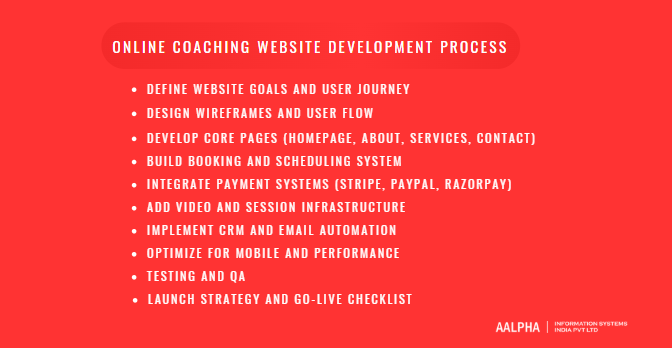
Step 1: Define Website Goals and User Journey
Before selecting tools or designing layouts, define what the website must achieve. A coaching website typically serves three primary goals: attract qualified leads, convert them into paying clients, and deliver a structured coaching experience.
Start by identifying measurable objectives. These may include a target number of discovery call bookings per month, subscription sign-ups, or program enrollments. Without clear goals, design decisions become arbitrary.
Next, map the user journey from first visit to long-term engagement. A typical journey includes awareness, consideration, booking, onboarding, active coaching, and renewal. Each stage requires specific website components.
For example, a visitor arriving through a blog post should encounter a clear call-to-action guiding them to book a consultation. After booking, the system should automatically send confirmation emails, intake forms, and payment links. During active coaching, the client dashboard must provide structured access to sessions, notes, and progress tracking.
Define friction points early. Where could users abandon the process? Common drop-offs occur during long forms, complex checkout processes, or unclear pricing. Reducing friction increases conversion rates.
Also consider different user personas. A corporate client evaluating executive coaching behaves differently from an individual seeking life coaching. Their navigation patterns, information needs, and trust triggers differ.
This step ensures that design, development, and content decisions align with business outcomes rather than aesthetic preferences.
Step 2: Design Wireframes and User Flow
Wireframing translates strategic goals into structural layouts. A wireframe is a blueprint that defines content placement, navigation structure, and call-to-action positioning without focusing on visual design details.
Begin with the homepage layout. Identify sections such as headline, value proposition, services overview, testimonials, and booking call-to-action. Ensure the primary conversion action is visible without excessive scrolling.
Next, design internal pages including service detail pages, booking pages, and dashboard layouts. Define how users navigate between pages. Navigation should be intuitive and limited to essential menu items.
User flow diagrams clarify how users move from one action to another. For example, the flow from clicking “Book a Session” to selecting time slots, completing payment, and receiving confirmation must be seamless.
For subscription-based models, map flows for membership sign-up, plan upgrades, cancellations, and account management. Each action should require minimal steps.
Wireframing also helps identify missing functionality. If the flow from blog content to consultation booking feels disjointed, it can be corrected before development begins.
Clear wireframes reduce redesign cycles and ensure alignment between business strategy and user experience architecture.
Step 3: Develop Core Pages (Homepage, About, Services, Contact)
The core pages form the marketing foundation of the coaching website.
The homepage must communicate transformation quickly. It should include a clear headline that defines the target audience and promised outcome. Supporting sections may include a concise explanation of services, testimonials, authority signals, and a prominent booking button.
The About page establishes credibility. It should articulate professional background, methodology, certifications, and measurable results. Avoid generic storytelling. Instead, emphasize client outcomes and problem-solving expertise.
The Services page requires clarity in structure. Each offering should include a description of the problem addressed, the process involved, expected outcomes, pricing structure, and a call-to-action. Ambiguous service descriptions reduce trust.
The Contact page should include a simple form, business email, and optional booking link. Overcomplicating contact forms discourages inquiries. For coaching businesses, replacing generic contact forms with direct booking links often improves lead conversion.
SEO optimization must be implemented during page development. Each page should include structured headings, meta descriptions, and clear keyword alignment with search intent such as online business coaching services or virtual fitness coaching programs.
These core pages build authority, attract organic traffic, and convert visitors into booked consultations.
Step 4: Build Booking and Scheduling System
A streamlined booking system eliminates manual coordination and supports scalability.
Start by defining session types. These may include free discovery calls, paid strategy sessions, group workshops, or subscription sessions. Each session type should have predefined duration, pricing, and availability rules.
Integrate calendar synchronization to prevent double bookings. Real-time availability ensures clients see accurate time slots based on time zone detection.
Implement automated confirmations and reminders via email or SMS. Reminders significantly reduce no-show rates. Include rescheduling and cancellation options within defined policies.
For group sessions, limit participant capacity and automate waitlist notifications if sessions are full.
Embed booking functionality directly within service pages to reduce navigation friction. The fewer clicks required to confirm a session, the higher the conversion rate.
The booking system should also connect to payment gateways so that paid sessions are confirmed only after successful transaction completion.
An efficient scheduling infrastructure allows coaches to focus on delivery rather than administrative coordination.
Step 5: Integrate Payment Systems (Stripe, PayPal, Razorpay)
Secure payment integration transforms interest into revenue.
Select payment gateways based on geographic market and supported currencies. Stripe offers flexible API integration and recurring billing features. PayPal provides global recognition and user familiarity. Razorpay is often preferred in certain regional markets due to local payment method support.
Configure one-time payments for session-based pricing and recurring billing for subscription models. Clearly display pricing before checkout to prevent cart abandonment.
Enable automated invoicing and receipt generation. Clients expect professional documentation for transactions.
Test checkout flows thoroughly. Verify successful payment confirmation, receipt delivery, subscription renewals, and cancellation workflows.
If offering installment plans, ensure the system supports scheduled payment deductions.
Transparent refund policies should be accessible before checkout. Payment clarity builds trust and reduces disputes.
A frictionless payment experience directly influences conversion rates and perceived professionalism.
Step 6: Add Video and Session Infrastructure
Video delivery is central to most online coaching models.
Integrate automated meeting creation through platforms such as Zoom or Google Meet using API connections. Upon booking, the system should generate meeting links automatically and include them in confirmation emails.
For advanced platforms, embedded video solutions using WebRTC technology allow sessions to occur directly within the website interface. This approach enhances branding and centralizes user experience.
Ensure meeting security features such as password protection and waiting rooms are enabled. For recorded sessions, obtain explicit client consent.
Store session recordings securely and provide controlled access through the client dashboard when applicable.
Reliable video infrastructure minimizes technical disruptions and reinforces a professional coaching experience.
Step 7: Implement CRM and Email Automation
Customer relationship management systems organize leads and automate communication workflows.
Connect lead forms and booking systems to a CRM platform. Segment contacts based on status such as prospect, active client, or former client.
Create automated sequences for onboarding. After booking, clients may receive welcome emails, intake forms, preparation instructions, and session reminders.
Post-session follow-ups can include recap summaries, resource links, and feedback requests.
For subscription-based models, automate renewal reminders and engagement nudges.
Email automation increases operational efficiency and maintains consistent communication without manual effort.
Step 8: Optimize for Mobile and Performance
A significant portion of users will access the coaching website through mobile devices.
Implement responsive design to ensure layouts adapt seamlessly across screen sizes. Buttons, forms, and booking interfaces must be easily accessible on smaller screens.
Optimize images and compress media files to reduce page load times. Performance directly affects search rankings and user retention.
Use caching mechanisms and content delivery networks where applicable to improve global load speeds.
Page speed testing tools can identify bottlenecks affecting performance.
Mobile-first optimization improves accessibility, engagement, and conversion rates.
Step 9: Testing and QA
Testing ensures reliability before launch.
Verify all booking flows, payment transactions, email automation sequences, and dashboard functionalities.
Test across multiple devices and browsers to ensure compatibility.
Conduct usability testing with a small group of users to identify friction points.
Check for broken links, formatting inconsistencies, and content errors.
Security testing should confirm SSL implementation and data protection compliance.
Quality assurance reduces the risk of technical failures that can damage credibility during initial launch.
Step 10: Launch Strategy and Go-Live Checklist
Launching a coaching website requires coordinated preparation.
Confirm domain configuration, hosting stability, and SSL activation. Verify analytics tracking systems such as Google Analytics and search console integration.
Prepare launch communications including email announcements, social media posts, and referral outreach.
Monitor website performance closely during the first week. Track booking rates, page load times, and user behavior analytics.
Have a rollback plan in case of unexpected technical issues.
A structured launch strategy ensures the website begins operating as a conversion engine from day one.
Following this step-by-step process transforms a conceptual coaching idea into a fully operational digital platform. Strategic planning, disciplined execution, and rigorous testing create a website that not only attracts clients but supports scalable, long-term growth.
Cost of Building an Online Coaching Website
The cost of building an online coaching website depends on complexity, customization requirements, scalability goals, and who executes the project. A basic brochure-style website with booking functionality is significantly different from a fully integrated coaching platform with subscriptions, dashboards, CRM automation, and analytics, so budgeting must start with clarity on what you are actually building.
When professionals evaluate how much it costs to build an online coaching website, they should look at both the initial build and long-term operational expenses. Total investment is not limited to design and coding. It includes hosting, payment processing, software subscriptions, maintenance, compliance, and ongoing enhancements that keep the platform secure and competitive. In practice, website development costs are shaped by the feature set, integration requirements, security expectations, and the level of customization required to match the coaching business model.
This section breaks down cost considerations across execution models and lifecycle stages so you can plan the investment realistically and avoid underestimating the total cost of ownership.
-
DIY vs Agency vs Custom Build Cost
The most affordable path is typically a do-it-yourself approach using website builders or template-based CMS platforms. Coaches can launch a functional site using pre-built themes, booking plugins, and integrated payment tools. This approach minimizes upfront investment but requires personal time, technical learning, and ongoing maintenance. While suitable for early-stage coaches validating an idea, DIY builds often face limitations as the business scales.
Working with a professional agency increases upfront investment but provides structured planning, UX design, SEO optimization, and technical reliability. Agencies typically deliver conversion-focused architecture, integrated payment systems, and automated workflows aligned with the coaching business model. This approach reduces risk and accelerates time to market, particularly for coaches seeking a polished, scalable digital presence.
A fully custom-built platform represents the highest investment tier. This model is appropriate for coaching firms offering subscriptions, multi-coach access, advanced dashboards, or proprietary assessment systems. Custom development allows complete control over user experience, scalability, and security but requires structured project management and long-term technical oversight.
The choice between DIY, agency, and custom development should align with revenue goals, growth strategy, and operational complexity rather than budget alone.
-
Development Cost Factors
Several variables directly influence development costs.
Platform complexity is the primary driver. A simple coaching website with static pages and basic scheduling requires significantly fewer development hours than a platform with membership tiers, integrated dashboards, CRM automation, and analytics reporting.
Design customization also affects cost. Template-based designs reduce expense, while unique branding, advanced UI interactions, and tailored user experiences require additional design resources.
Integration requirements add another layer of complexity. Connecting payment gateways, calendar systems, CRM platforms, email automation tools, and video conferencing APIs requires technical expertise. The more integrations required, the higher the development investment.
Content volume influences scope. Extensive service pages, blogs, gated resource libraries, and course modules increase implementation time.
Security and compliance requirements further impact cost. Coaching platforms handling health-related or sensitive client information may require additional encryption layers, secure hosting environments, and compliance documentation.
Finally, scalability planning affects architecture decisions. Building for long-term growth from the beginning may increase initial cost but reduces future redevelopment expenses.
Understanding these factors allows coaches to budget realistically and avoid underestimating project scope.
-
Ongoing Maintenance Costs
Launching a coaching website is only the beginning. Ongoing costs must be factored into financial planning.
Hosting services require recurring payments to ensure uptime, security updates, and performance optimization. Managed hosting solutions typically cost more than shared hosting but provide greater reliability.
Software subscriptions for booking systems, CRM platforms, email marketing tools, and analytics dashboards represent ongoing operational expenses. Subscription-based coaching platforms also require recurring billing management systems.
Regular updates are necessary to maintain security and compatibility with evolving browsers, payment processors, and API integrations. Websites built on CMS platforms require plugin updates and periodic performance optimization. These recurring responsibilities contribute directly to overall website maintenance costs, which should be budgeted from the outset rather than treated as unexpected expenses.
Content updates, SEO enhancements, and marketing campaigns may also require budget allocation, either internally or through outsourced support.
Ignoring maintenance planning can lead to security vulnerabilities, performance degradation, and lost revenue opportunities.
-
Hidden Costs to Consider
Hidden costs often emerge when planning is incomplete.
Payment processing fees apply to every transaction and can impact margins, especially for subscription-based models. Currency conversion fees may also apply for international clients.
Third-party integrations sometimes require premium plans to unlock necessary features. Free versions of tools may not support automation or advanced reporting.
Compliance costs may include legal consultation for drafting privacy policies, service agreements, and disclaimers.
Future redesigns can become expensive if the initial platform lacks scalability. Choosing a limited system to save upfront cost may require full redevelopment later.
Accurate cost evaluation should include both direct development expenses and indirect operational commitments. A well-planned investment ensures the coaching website functions as a sustainable revenue-generating asset rather than a recurring technical burden.
Building an online coaching website is a strategic business investment. The appropriate budget depends on growth ambitions, service complexity, and long-term scalability goals. A structured approach to cost planning ensures financial sustainability while supporting professional credibility and operational efficiency.
Common Mistakes to Avoid
Building an online coaching website is not only about adding features. Many platforms fail not because of missing technology, but because of strategic misalignment. When coaches search for why their coaching website is not converting or why clients drop off after initial sessions, the answer often lies in structural mistakes made during development.
Avoiding the following common errors ensures that your coaching platform remains focused, conversion-driven, and scalable.
-
Overcomplicating the Platform
One of the most frequent mistakes is adding too many features too early. Coaches often attempt to build a full ecosystem that includes memberships, dashboards, courses, community forums, gamification tools, and analytics before validating demand.
Complexity increases development cost, slows launch timelines, and introduces technical risks. It also confuses users. Clients visiting a coaching website primarily want clarity: What problem do you solve? How do I book? What does it cost?
A streamlined platform focused on core functionality such as booking, payments, video sessions, and essential resources often performs better than an overloaded system. Additional features can be introduced incrementally based on user feedback and growth metrics.
Minimal viable functionality is not about cutting corners. It is about aligning development with real user needs rather than hypothetical scenarios.
-
Ignoring Conversion Strategy
Many coaching websites look visually appealing but fail to convert visitors into paying clients. This usually happens when design is prioritized over conversion architecture.
A high-performing coaching website must clearly communicate transformation, authority, and next steps. Weak headlines, unclear value propositions, and buried booking buttons reduce engagement. Visitors should not have to search for how to schedule a consultation.
Call-to-action placement is critical. Booking links should appear strategically across the homepage, service pages, and blog content. Discovery call funnels should be simple and direct.
Trust signals also influence conversion. Testimonials, measurable results, certifications, and professional affiliations reduce hesitation.
Another common oversight is failing to capture leads who are not ready to book immediately. Offering downloadable resources, webinars, or free assessments can move prospects into email nurturing sequences.
Without a defined conversion pathway, even high traffic volumes may generate limited revenue.
-
Poor Payment Experience
Payment friction is a major conversion barrier. Complicated checkout processes, unclear pricing, limited payment options, or technical errors can result in abandoned transactions.
Clients expect secure, fast, and transparent payment systems. Prices should be clearly displayed before checkout. Unexpected fees damage trust.
Subscription-based coaching models must include easy-to-manage billing dashboards. Clients should be able to view invoices, update payment methods, and cancel plans without excessive friction.
Payment reliability directly affects revenue stability. A poor checkout experience undermines credibility and reduces repeat business.
-
Weak Branding
Coaching is a trust-based service. Weak branding reduces perceived authority and limits pricing power.
Generic templates, inconsistent messaging, and unclear positioning make it difficult for prospects to differentiate your services from competitors. Strong branding communicates specialization, professionalism, and clarity of outcome.
Brand consistency across website design, messaging tone, imagery, and content reinforces trust. A clearly defined niche and structured methodology strengthen credibility.
Branding is not merely aesthetic. It shapes how clients perceive expertise and transformation potential.
-
No Retention Strategy
Acquiring clients is more expensive than retaining them. Yet many coaching websites focus solely on acquisition funnels without building retention mechanisms.
Retention strategies include structured progress tracking, automated follow-ups, renewal reminders, and ongoing content updates. Subscription-based coaching platforms benefit from community access, exclusive resources, and milestone recognition systems.
Without retention planning, clients may complete a short program and disengage. Recurring revenue depends on sustained engagement and measurable progress.
A well-designed online coaching website supports long-term relationships, not just one-time transactions.
Avoiding these common mistakes improves scalability, client satisfaction, and revenue consistency. A coaching website should function as a structured growth engine, not just a digital brochure. Strategic clarity, disciplined execution, and continuous optimization ensure that the platform supports sustainable business expansion.
Why Choose Aalpha for Your Online Coaching Website
Building an online coaching website requires more than design and basic functionality. It demands a structured, scalable, and conversion-focused digital platform that supports booking automation, secure payments, client dashboards, and long-term growth. This is where Aalpha Information Systems brings measurable value.
Aalpha approaches coaching website development from a business-first perspective. Instead of simply creating pages, the team aligns the platform with your delivery model, revenue strategy, and growth roadmap. Whether you offer one-on-one sessions, subscription-based programs, or hybrid coaching models, the architecture is designed to support scalability from the beginning.
The development process includes secure payment integration, CRM automation, video infrastructure, and performance optimization. Strong emphasis is placed on user experience and conversion pathways so that visitors can move seamlessly from discovery to booking and payment.
Security and compliance are built into the development lifecycle, ensuring safe handling of client data and reliable infrastructure. With end-to-end development capabilities, Aalpha provides design, backend engineering, integration, testing, and post-launch support under one structured framework.
For coaching professionals aiming to build a high-performance, scalable digital platform rather than a basic website, Aalpha offers both technical expertise and long-term partnership.
Final Words
Building an online coaching website is not just about establishing an online presence. It is about creating a structured digital platform that attracts the right audience, converts visitors into paying clients, delivers measurable transformation, and supports long-term business growth. From defining your niche and delivery model to integrating secure payments, automation, and performance optimization, every step must align with your coaching strategy.
A well-built coaching website becomes a scalable business asset. It reduces administrative workload, strengthens brand authority, improves client experience, and enables predictable revenue through structured systems. When planned and executed correctly, it functions as a growth engine rather than a static brochure.
If you are serious about launching or scaling a high-performance online coaching website, partnering with an experienced development team makes a measurable difference. Aalpha Information Systems specializes in building secure, scalable, and conversion-focused digital platforms tailored to your business model.
Whether you need a streamlined booking-based website or a fully integrated coaching ecosystem with subscriptions, dashboards, and automation, Aalpha can help you build it the right way from day one.
Contact Aalpha today to discuss your coaching website requirements and turn your expertise into a scalable digital platform.