



A financial advisor’s website is no longer a marketing accessory. It is a primary credibility engine, client acquisition channel, compliance touchpoint, and authority platform. In wealth management, trust determines engagement. Before a prospective client schedules a consultation, shares financial information, or transfers assets, they validate the advisor online. If your digital presence lacks clarity, credibility, or structure, that evaluation ends quickly.
Today’s investors expect transparency, professional presentation, educational depth, and security assurances. They want to understand your advisory philosophy, fee structure, certifications, and planning approach before initiating contact. Whether you operate as an independent Registered Investment Advisor (RIA), a Certified Financial Planner (CFP), a wealth management firm, or a niche retirement consultant, your website shapes how prospects perceive your competence.
This guide explains how to build a website for a financial advisor step by step, from strategic positioning and compliance requirements to design, content, security, and SEO. If you are asking how to create a financial advisor website that builds authority and generates qualified leads, this framework provides a structured roadmap designed for long-term growth.
The Digital First Impression in Wealth Management
In financial services, first impressions are rarely formed in person. They are formed online. A potential client researching retirement planning, tax optimization, estate structuring, or portfolio management will likely search for local advisors before requesting referrals. When they land on your website, they assess three things immediately: professionalism, clarity, and credibility.
A dated layout, generic messaging, or missing disclosures signals risk. Conversely, a well-structured financial advisor website communicates stability, expertise, and transparency. Subtle elements influence perception: typography, color psychology, certification placement, and even how clearly you describe your advisory process.
Wealth management clients often evaluate multiple advisors simultaneously. If your competitor clearly outlines their investment philosophy, fee model, fiduciary commitment, and client onboarding process while your website remains vague, the decision becomes predictable.
Your website functions as a digital office. It should reflect the same precision and discretion you would demonstrate in a face-to-face consultation. When built correctly, it reassures visitors that their financial future is being handled by a professional with structure and accountability.
How Investors Research Financial Advisors Online
Modern investors conduct independent research before making financial decisions. They compare credentials, examine regulatory registrations, read published articles, and evaluate transparency. Searches such as “best financial advisor near me,” “fee-only financial planner,” or “retirement planning advisor in [city]” indicate high-intent prospects seeking guidance.
During this research process, investors look for specific signals:
- Professional certifications such as CFP or CFA
- Clear explanation of services
- Transparent fee models
- Educational content demonstrating subject expertise
- Regulatory disclosures and compliance clarity
- Client testimonials or case examples where permitted
They also assess depth of knowledge. Advisors who publish blog articles on tax-efficient investing, estate planning strategies, market outlook analysis, or retirement income planning establish authority. Educational content signals that the advisor understands complex financial topics and communicates them clearly.
Additionally, investors often check external credibility signals such as regulatory registrations through the U.S. Securities and Exchange Commission (SEC) Investment Adviser Public Disclosure database or the Financial Industry Regulatory Authority (FINRA) BrokerCheck system. A professional website complements these checks by presenting information in a structured, accessible format.
If your website does not answer the fundamental question, “Why should I trust this advisor with my assets?” you lose engagement before the first consultation.
This step-by-step guide explains how to build a financial advisor website that balances compliance, credibility, and conversion. It goes beyond surface-level design advice and focuses on structural decisions that influence authority and long-term scalability.
Understanding the Business Objectives of a Financial Advisor Website
A financial advisor website must be treated as a strategic business infrastructure, not a digital brochure. In a regulated and trust-sensitive industry such as wealth management, every design element, page structure, and content decision directly influences credibility, lead generation, and long-term client relationships.
When prospects search for retirement planning, tax optimization, estate structuring, or investment management support, they are not simply browsing. They are evaluating risk. Financial decisions carry emotional and economic weight. Before committing assets or sharing sensitive information, investors must feel confident that the advisor is competent, transparent, and aligned with their interests.
A well-structured financial advisor website serves four primary business objectives: building authority, generating qualified leads, educating prospective clients, and reinforcing regulatory transparency. If these objectives are not clearly defined before development begins, the website will lack strategic direction.
Advisors often ask whether a website is truly necessary if referrals already generate business. The answer lies in client behavior. Even referral-based prospects verify advisors online before scheduling meetings. If your website fails to communicate clarity, structure, and professionalism, referral momentum weakens.
The following sections break down the core business functions your website must fulfill to become an asset that strengthens trust and drives growth.
-
Building Authority and Trust in Financial Services
Authority in financial services is not claimed. It is demonstrated. A financial advisor website must systematically reinforce credibility through structure, content, and presentation.
Trust signals should be strategically integrated throughout the site. These include professional certifications such as Certified Financial Planner (CFP) or Chartered Financial Analyst (CFA), regulatory registrations, fiduciary commitments, years of experience, and clearly articulated investment philosophy. Visitors should immediately understand who you are, what you specialize in, and how you approach financial planning.
Beyond credentials, authority is reinforced through clarity. A strong financial advisor website explains services without jargon. It outlines processes step by step, from initial consultation to portfolio review cycles. When prospective clients understand how their money will be managed, perceived risk decreases.
Consistency in branding also contributes to authority. Conservative typography, structured layouts, and disciplined use of color psychology reflect stability. Financial clients associate visual precision with operational discipline.
Publishing original thought leadership further strengthens positioning. Articles on retirement income strategies, tax-efficient investing, market risk management, or estate planning frameworks demonstrate expertise. Over time, this content builds topical authority, improves search visibility, and positions the advisor as a trusted knowledge source rather than a salesperson.
Trust is cumulative. Every page must contribute to that outcome.
-
Lead Generation and Appointment Booking Strategy
A financial advisor website must convert interest into action. Without a structured lead generation system, traffic has limited business value.
The primary conversion objective for most advisory firms is consultation booking. This can include discovery calls, portfolio reviews, retirement planning sessions, or financial health assessments. The website should guide visitors toward this action through clear calls to action placed strategically across pages.
Lead capture must be intentional. Contact forms should be concise yet compliant, collecting essential information without overwhelming prospects. Appointment scheduling tools integrated directly into the website reduce friction and allow clients to select available time slots instantly. Reducing manual back-and-forth increases conversion rates.
Service pages should include conversion triggers that address common concerns. For example, a retirement planning page may conclude with an invitation to schedule a personalized retirement readiness review. Messaging must align with client intent.
Educational content can also drive lead generation. Offering downloadable retirement checklists, tax planning guides, or investment strategy reports in exchange for email registration creates a structured funnel. This enables advisors to nurture prospects through email communication while maintaining compliance standards.
When evaluating how to build a financial advisor website that generates leads, the central question becomes clear: does every page move the visitor closer to a consultation? If not, the structure requires refinement.
-
Client Education and Financial Literacy Positioning
Financial decision-making is complex. Investors seek advisors who simplify complexity without oversimplifying risk. A strong financial advisor website functions as an educational platform that builds confidence before the first meeting.
Publishing structured blog articles, market commentary, and explanatory guides demonstrates subject mastery. Topics such as asset allocation strategies, inflation hedging, tax-loss harvesting, retirement withdrawal planning, and estate transfer considerations address real investor concerns.
Educational content accomplishes two objectives. First, it builds trust by proving expertise. Second, it improves organic visibility through search engine optimization. When investors search for answers to financial questions, authoritative content increases the likelihood that they discover your advisory firm.
Positioning your firm as an educator rather than a promoter strengthens long-term brand equity. Investors prefer advisors who teach rather than sell.
Over time, a robust content library transforms your website into a knowledge hub that attracts high-intent prospects organically.
-
Compliance Transparency and Regulatory Confidence
Financial advisory services operate within strict regulatory frameworks. A website that ignores compliance risks undermines trust immediately.
Transparency begins with clear disclosures. Fee structures, fiduciary commitments, regulatory registrations, and risk disclaimers must be presented accurately and accessibly. Mandatory disclosures should not be hidden or ambiguous.
Regulatory references such as SEC registration status or FINRA oversight, where applicable, should be presented clearly without overstating claims. Transparency signals operational discipline.
Data privacy policies and secure data handling practices must also be visible. Investors are cautious about sharing financial information. Displaying privacy policies, SSL encryption indicators, and secure form messaging reduces hesitation.
Compliance transparency serves both regulatory and psychological purposes. It demonstrates that the advisory firm operates within structured governance standards.
A financial advisor website that integrates compliance thoughtfully communicates one essential message: this firm values accountability.
A financial advisor website that achieves authority, lead generation, education, and compliance alignment becomes more than a branding tool. It becomes a scalable client acquisition and trust-building engine designed to support long-term growth in a highly regulated industry.
Regulatory and Compliance Requirements
A financial advisor website operates within one of the most regulated marketing environments in the world. Unlike general business websites, advisory firm websites are considered advertising under securities laws. That means content, testimonials, performance claims, and even downloadable resources may fall under regulatory scrutiny.
If you are building a website for a Registered Investment Advisor (RIA), broker-dealer representative, or wealth management firm, compliance must be integrated into the development process from day one. Retrofitting compliance after launch creates legal risk and reputational exposure.
Regulators such as the U.S. Securities and Exchange Commission (SEC), the Financial Industry Regulatory Authority (FINRA), and data protection authorities in Europe and the United Kingdom enforce strict rules on advertising, disclosures, privacy, and recordkeeping. Understanding these requirements is not optional. It is foundational to building a compliant financial advisor website.
Below is a structured breakdown of the core regulatory considerations you must address.
-
SEC and FINRA Advertising Rules (U.S.)
In the United States, investment advisor websites are governed primarily by the SEC’s Investment Advisers Act of 1940 and, more specifically, Rule 206(4)-1, commonly referred to as the “Marketing Rule.” This rule regulates how RIAs present testimonials, endorsements, performance results, and hypothetical performance data.
Under the updated SEC Marketing Rule, testimonials and endorsements are permitted but subject to strict disclosure requirements. Advisors must clearly disclose whether compensation was provided, whether the person giving the testimonial is a client, and any material conflicts of interest. Blanket claims such as “best investment advisor” without substantiation may trigger regulatory concern.
Performance advertising is particularly sensitive. Any presentation of past performance must be fair and balanced, include net-of-fee performance where required, and avoid cherry-picking favorable time periods. Hypothetical performance, including model portfolios or back-tested data, requires additional disclosures and suitability considerations.
For broker-dealer representatives, FINRA Rule 2210 governs communications with the public. This rule requires communications to be fair, balanced, and not misleading. Certain materials may require principal approval prior to use.
When building a financial advisor website in the U.S., it is critical to:
- Avoid exaggerated claims of guaranteed returns
- Present balanced risk disclosures alongside performance data
- Clearly identify advisory registration status
- Ensure testimonials comply with SEC disclosure standards
Failure to comply can lead to enforcement actions, fines, and reputational damage.
-
GDPR and Data Privacy Considerations (Europe/UK)
If your advisory firm serves clients in the European Union or the United Kingdom, your website must comply with the General Data Protection Regulation (GDPR). GDPR governs how personal data is collected, processed, stored, and protected.
Financial advisor websites frequently collect personal data through contact forms, newsletter subscriptions, downloadable guides, and appointment scheduling tools. Under GDPR, you must obtain explicit consent before collecting personal information. Pre-checked consent boxes are not permitted. Users must clearly understand what data is being collected and how it will be used.
Your website must include:
- A detailed privacy policy explaining data processing practices
- Cookie consent mechanisms that allow users to accept or reject tracking
- Clear data retention policies
- A process for users to request access, correction, or deletion of their data
Data minimization is also required. You should collect only information that is necessary for the stated purpose. For example, if offering a retirement planning consultation, requesting excessive personal data at the initial stage may violate GDPR principles.
Non-compliance can result in significant financial penalties. More importantly, data privacy failures erode trust in a profession built on discretion and confidentiality.
-
Mandatory Disclosures, Disclaimers, and Risk Statements
Financial advisor websites must present mandatory disclosures clearly and prominently. Disclosures should not be hidden in obscure sections or written in ambiguous language.
Common disclosure elements include:
- Registration status (e.g., “Registered Investment Advisor”)
- Jurisdictional limitations on services
- Fiduciary status clarification
- Fee structure explanation (where appropriate)
- Conflict of interest disclosures
- Risk disclaimers related to investment performance
Risk statements are particularly important. Investors must be reminded that past performance does not guarantee future results and that investing involves risk, including potential loss of principal.
If you provide educational content discussing investment strategies, asset allocation, or tax planning, disclaimers should clarify that the content is for informational purposes only and does not constitute personalized investment advice unless a formal advisory relationship exists.
Transparency is critical. Disclosures should be accessible via the footer and linked appropriately from relevant pages. In regulated industries, clarity protects both the firm and the client.
-
Archiving and Recordkeeping Requirements
Under SEC Rule 204-2, registered investment advisors must maintain records of advertisements, including website content. This means your website should not be treated as static marketing material. Any updates, blog posts, or modifications may need to be archived.
Advisory firms often implement automated website archiving solutions that capture periodic snapshots for compliance records. Email newsletters, downloadable guides, and social media posts linked from the website may also fall under recordkeeping obligations.
Failing to retain copies of historical marketing materials can create issues during regulatory examinations.
-
Working with Compliance Teams During Website Development
Compliance review should occur before launch, not after publication. Advisors should collaborate with compliance officers or legal counsel throughout the content drafting and design process to ensure alignment with regulatory obligations. Early involvement prevents costly revisions and ensures the website meets both marketing and regulatory standards.
A financial advisor website must operate at the intersection of marketing strategy and regulatory discipline. When compliance is integrated properly, it enhances credibility rather than limiting growth. Regulatory transparency signals professionalism, reinforces trust, and strengthens your authority in a highly scrutinized industry.
Step-by-Step Process to Build a Website for a Financial Advisor
Building a financial advisor website requires structured execution. In a regulated, trust-sensitive industry, decisions about positioning, architecture, design, content, security, and compliance must align. A poorly planned site creates legal exposure and weak conversion performance. A well-structured site becomes a long-term authority and client acquisition asset.
Below is a comprehensive step-by-step framework to build a professional financial advisor website from strategy to launch.
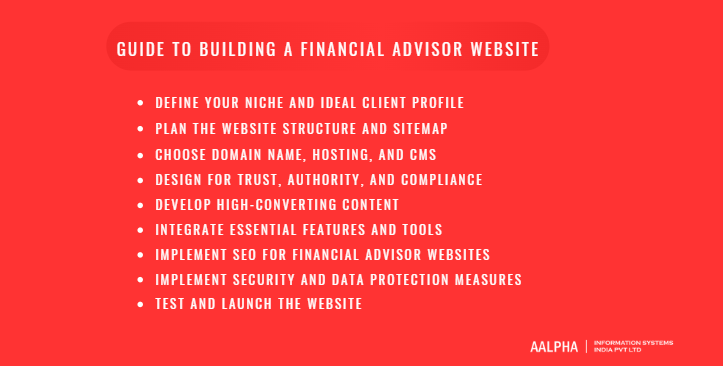
Step 1: Define Your Niche and Ideal Client Profile
Before designing pages or selecting technology, clarify positioning. Many advisory websites fail because they attempt to speak to everyone. Specificity increases trust and improves conversion rates.
Start by defining whether you operate as an independent Registered Investment Advisor (RIA) or under a broker-dealer model. Independent RIAs often emphasize fiduciary responsibility and fee-only structures. Broker-dealer representatives may focus on broader financial product access. Your website messaging must reflect your regulatory model clearly and accurately.
Next, define your primary service specialization. Are you focused on retirement income planning, tax-efficient investing, estate structuring, small business advisory, or high-net-worth portfolio management? A retirement-focused advisor should build messaging around income sustainability, Social Security strategies, and withdrawal optimization. A tax-focused advisor should emphasize tax mitigation frameworks and coordination with CPAs.
Clarify your ideal client profile. Identify age range, life stage, income bracket, and investable asset range. A website targeting pre-retirees aged 55 to 65 will look different from one targeting tech executives with equity compensation. When visitors feel the content speaks directly to their situation, trust increases.
Finally, craft a focused value proposition. Avoid generic claims such as “comprehensive financial services.” Instead, articulate a precise positioning statement, such as helping business owners transition from growth to wealth preservation through structured retirement planning. Specificity differentiates you in a competitive advisory market.
Step 2: Plan the Website Structure and Sitemap
Website structure determines clarity. A financial advisor website must present information logically, guiding visitors through a clear journey.
Every financial advisor website should include the following core pages:
Home: Introduces positioning, credibility, and primary call to action.
About: Explains background, credentials, advisory philosophy, and experience.
Services: Details specific advisory offerings with clarity.
Financial Planning Process: Outlines step-by-step engagement methodology.
Insights or Blog: Demonstrates thought leadership.
Resources: Provides downloadable guides or tools.
Contact: Enables consultation booking or inquiry.
Disclosures: Houses regulatory disclosures and disclaimers.
Optional growth pages may include case studies, retirement calculators, webinar libraries, client portals, or niche-specific landing pages.
Conversion pathway mapping is critical. Every service page should include a relevant consultation invitation. Blog articles should direct readers toward deeper resources or appointments. Navigation should remain simple, avoiding cluttered menus.
Visitors must intuitively understand where to go next. A confusing sitemap reduces engagement and increases bounce rates. When evaluating how to build a financial advisor website that converts, structure is as important as design.
Step 3: Choose Domain Name, Hosting, and CMS
Technical foundations influence credibility and security.
Selecting a professional domain name is essential. Ideally, use your firm name or a clear advisory-related domain. Avoid complex spellings or overly promotional phrases. Simplicity improves memorability and brand strength.
Hosting requirements for financial advisor websites must prioritize security and reliability. Choose hosting providers that offer strong uptime guarantees, daily backups, server-level firewalls, and secure infrastructure. Financial clients expect stability.
SSL certificates and HTTPS encryption are mandatory. Any website collecting personal data must encrypt traffic. Modern browsers flag non-secure sites, which can immediately damage trust. Encryption ensures that information submitted through contact forms remains protected in transit.
When selecting a content management system (CMS), evaluate long-term scalability. WordPress is widely used due to flexibility and SEO compatibility. Custom development offers higher control and security customization. Website builders may offer ease of use but often limit advanced compliance or integration features.
Your choice should align with budget, security needs, compliance requirements, and future expansion plans.
Step 4: Design for Trust, Authority, and Compliance
Financial advisory design must communicate stability. Excessive animation, flashy colors, or overly aggressive marketing language reduce credibility.
Trust signals should be integrated strategically. Display certifications such as CFP or CFA prominently but accurately. Highlight regulatory affiliations without exaggeration. If using testimonials, ensure compliance with applicable marketing rules and required disclosures.
Homepage structure should follow a clear hierarchy:
- Strong headline reflecting niche positioning
- Brief explanation of services
- Trust indicators such as credentials and experience
- Explanation of advisory process
- Clear consultation call to action
Color psychology plays a subtle but powerful role. Blue tones often communicate trust and stability. Neutral palettes reinforce professionalism. High-contrast combinations improve readability.
Mobile responsiveness is mandatory. Many investors research advisors via smartphones. Navigation, contact forms, and scheduling tools must function seamlessly on smaller screens.
Accessibility standards should also be considered. Clear typography, sufficient contrast ratios, and structured headings improve usability and compliance with accessibility best practices.
Design should reflect the discipline and reliability expected in financial services.
Step 5: Develop High-Converting Content
Content is the engine of authority and conversion.
A compelling homepage should immediately clarify who you serve and how you help. Avoid vague introductions. Instead of general mission statements, present specific outcomes you help clients achieve.
Service pages should be structured logically:
- Define the problem
- Explain your approach
- Outline benefits
- Clarify who the service is for
- Conclude with consultation invitation
Blogging is a powerful authority-building strategy. Publish educational articles on retirement planning strategies, tax optimization techniques, estate planning considerations, and market analysis. This builds trust and improves organic visibility.
Educational resources such as downloadable retirement checklists or investment guides strengthen lead generation funnels. When offering gated resources, ensure privacy disclosures and consent mechanisms are compliant.
Compliance-friendly content review is essential. Avoid making guarantees or exaggerated claims. Present balanced discussions of risk and return.
Effective content builds confidence before a prospect ever speaks with you.
Step 6: Integrate Essential Features and Tools
Functionality enhances professionalism.
Appointment scheduling tools reduce friction. Allow prospects to book consultations directly through integrated calendars. Automated confirmations improve efficiency.
Secure client portal integration enables document sharing and account access. While often hosted separately, linking clearly from your website improves user experience.
CRM integration ensures inquiries are captured and tracked systematically. Missed leads represent lost revenue.
Lead capture forms should collect only necessary information. Simplicity improves completion rates while respecting privacy.
Financial calculators, such as retirement income estimators, increase engagement and demonstrate value. However, include appropriate disclaimers clarifying informational use.
Email automation systems allow structured follow-up communication. Educational drip campaigns nurture prospects until they are ready to engage.
Step 7: Implement SEO for Financial Advisor Websites
Search engine visibility drives qualified traffic.
Local SEO is critical for financial planners. Optimize for location-based searches such as “financial advisor in [city].” Claim and optimize your Google Business Profile. Ensure consistent business name, address, and phone details across directories.
Develop a clear keyword strategy targeting high-intent queries related to retirement planning, wealth management, and tax advisory services. Avoid keyword stuffing. Focus on natural integration.
On-page optimization includes proper heading hierarchy, meta descriptions, internal linking, and structured URLs.
Technical SEO fundamentals such as site speed, mobile responsiveness, clean code, and secure HTTPS improve rankings.
Authority-building content clusters help demonstrate expertise. For example, a retirement planning cluster may include articles on withdrawal strategies, inflation risk, Social Security timing, and asset allocation.
SEO is a long-term strategy. Consistency produces sustainable growth.
Step 8: Implement Security and Data Protection Measures
Security reinforces trust.
Install website firewalls to protect against malicious attacks. Use strong hosting-level security configurations.
Data encryption must protect all data in transit. If storing sensitive information, consider encrypted storage solutions.
Secure form handling prevents spam and unauthorized data access. Implement CAPTCHA and validation mechanisms.
Backup systems should run automatically and frequently. Disaster recovery planning ensures continuity.
Monitoring tools help detect suspicious activity early. Proactive monitoring reduces risk exposure.
In financial services, security is not optional. It is foundational.
Step 9: Test and Launch the Website
Before launch, conduct a structured review.
Compliance review should verify disclosures, claims, testimonials, and regulatory language. Obtain written approval if required.
Cross-browser testing ensures functionality across Chrome, Safari, Firefox, and Edge. Mobile testing across devices is essential.
Performance testing should confirm fast load times. Slow websites reduce trust and search rankings.
Final deployment checklist should confirm SSL activation, analytics setup, form testing, backup configuration, and live indexing settings.
A structured launch process reduces risk and ensures professional presentation from day one.
When executed systematically, these nine steps produce a financial advisor website that builds authority, supports compliance, generates qualified leads, and positions your advisory firm for long-term digital growth.
Cost of Building a Financial Advisor Website
The cost of building a financial advisor website depends on complexity, compliance requirements, security standards, and long-term scalability goals. Unlike generic business websites, financial advisory sites operate in a regulated environment that demands structured content, secure infrastructure, and disciplined development processes, all of which directly influence overall website development costs.
When evaluating how much it costs to build a financial advisor website, advisors should consider three layers: initial build cost, integration and customization expenses, and ongoing operational investment. A basic template-based site may appear affordable initially, but insufficient compliance alignment, weak SEO structure, or limited scalability can result in costly revisions later.
Professional advisory websites are not merely design projects. They combine strategy, regulatory review, UX structure, technical security implementation, and search optimization. The total investment reflects the level of customization, integrations such as CRM and scheduling tools, and whether the site is built for growth or simply presence.
Below is a structured breakdown of cost considerations to help financial advisors make informed decisions.
-
DIY vs. Professional Development
Many financial advisors initially consider do-it-yourself website builders due to lower upfront costs. Website builders offer drag-and-drop templates, hosting, and pre-built layouts. For newly licensed advisors testing branding concepts, this approach can serve as a temporary solution.
However, DIY platforms often create limitations in compliance control, scalability, and SEO structure. Financial advisory websites require precise disclosure placement, flexible content architecture, and integration with secure tools such as CRM systems or encrypted client portals. Template builders may restrict these capabilities.
Professional development provides strategic alignment. Instead of starting with design, experienced developers begin with niche positioning, compliance requirements, conversion mapping, and security architecture. The result is a site structured for authority and long-term growth rather than appearance alone.
DIY websites may work for basic informational presence, but advisors targeting competitive markets or higher asset brackets typically require a more structured approach. Investors evaluating wealth managers often compare multiple firms. A professionally developed website signals operational maturity.
The decision should not be based solely on cost, but on long-term brand positioning and risk mitigation.
-
Custom Development Cost Breakdown
Custom financial advisor website development includes multiple components beyond visual design.
Strategy and Planning: This phase includes niche definition, sitemap development, compliance alignment, and conversion mapping. Strategic planning ensures the website aligns with business goals and regulatory standards.
Design and User Experience: Professional UI/UX design tailored for financial services builds trust and clarity. Structured homepage layouts, service page architecture, and accessibility compliance are included in this stage.
Content Development: Writing authoritative, compliance-friendly content is a significant investment. Service descriptions, process explanations, educational articles, and disclosure drafting require subject matter expertise.
Technical Development: Custom coding or CMS configuration, CRM integration, scheduling tool integration, analytics setup, and security configuration are handled in this phase. Financial advisor websites often require encryption setup, firewall configuration, and secure form handling.
Compliance Review: Legal or compliance team involvement adds cost but is essential. Revisions based on regulatory feedback may require additional development time.
Testing and Launch: Cross-device testing, performance optimization, and final deployment procedures ensure stability and credibility.
Custom development offers flexibility and long-term scalability. Advisors planning to publish ongoing educational content, expand services, or integrate advanced tools benefit from this approach.
-
Ongoing Maintenance Costs
Website investment does not end at launch. Ongoing expenses include hosting, security updates, plugin management, content updates, compliance monitoring, SEO optimization, and backup management. These recurring responsibilities form the core of long-term website maintenance costs.
Financial advisory websites require periodic review of disclosures, privacy policies, and regulatory language. Security patches must be applied consistently to prevent vulnerabilities.
Budgeting for maintenance ensures your website remains secure, compliant, and competitive.
When assessing cost, advisors should evaluate return on investment rather than expense alone. A professionally built financial advisor website can generate qualified leads consistently through organic search and structured conversion pathways.
Even a small number of new long-term clients can justify the initial development investment. Over time, the website becomes a scalable client acquisition asset, strengthening brand authority while supporting compliance and security standards.
Viewed strategically, a financial advisor website is not a marketing cost. It is a growth infrastructure designed to support sustainable advisory expansion.
Common Mistakes to Avoid
Building a financial advisor website requires precision. In a highly regulated and trust-dependent industry, small missteps can undermine credibility, reduce conversion rates, and create compliance exposure. Many advisory firms invest in design but overlook strategic alignment, resulting in websites that look professional yet fail to perform.
Understanding common web design mistakes helps prevent costly redesigns and reputational risks. Below are the most frequent errors financial advisors make when building or redesigning their websites.
-
Generic Messaging That Fails to Convert
One of the most common mistakes is using vague, interchangeable language. Statements such as “comprehensive financial solutions” or “trusted wealth management services” lack specificity. They do not clarify who you serve, what problems you solve, or how you differentiate from competitors.
Investors visiting your website are evaluating fit. If your messaging does not clearly identify your niche, such as retirement income planning for pre-retirees or tax-efficient strategies for business owners, they will not feel personally addressed.
Generic messaging also weakens SEO performance. Search engines reward specificity and depth. Content that clearly addresses retirement withdrawal strategies, estate tax mitigation, or portfolio risk management performs better than broad promotional language.
Effective financial advisor websites communicate precise positioning. Specificity builds authority and increases conversion rates.
-
Ignoring Compliance
Compliance cannot be an afterthought. Failing to include proper disclosures, risk statements, or accurate registration information can create regulatory exposure.
Advisors sometimes publish testimonials without required disclosures or present performance information without balanced risk context. Others omit privacy policies or fail to implement secure form handling when collecting personal data.
In the United States, SEC marketing rules govern advertising practices. In Europe and the United Kingdom, GDPR regulates personal data handling. Ignoring these frameworks can result in penalties and reputational damage.
A compliant website demonstrates professionalism. It reassures prospects that the advisory firm operates within structured governance standards. Compliance alignment should be integrated during development, not retrofitted after launch.
-
Poor Mobile Experience
Many investors research financial advisors using smartphones. If your website is difficult to navigate on mobile devices, credibility suffers immediately.
Common mobile errors include text that is too small to read, buttons placed too close together, slow loading times, and contact forms that are difficult to complete on smaller screens.
Mobile responsiveness also affects search rankings. Search engines prioritize mobile-friendly websites. A site that performs poorly on mobile devices may rank lower in local financial advisor searches.
Mobile optimization is not simply a technical feature. It is a user experience requirement. Scheduling tools, contact forms, and navigation menus must function seamlessly across devices.
A financial advisor website that fails on mobile creates friction at the exact moment a prospect is evaluating trust.
-
Weak Calls to Action
A financial advisor website must guide visitors toward action. Without clear calls to action, even high-quality content fails to convert.
Some advisory websites bury their contact information in the footer or rely solely on a generic “Contact Us” link. Others provide no clear next step after explaining services.
Strong calls to action are contextual. A retirement planning page should invite visitors to schedule a retirement readiness consultation. A tax planning page should encourage a tax strategy review session. Each page should move the visitor forward.
Calls to action must be visible, consistent, and easy to access on both desktop and mobile devices. Integrated scheduling tools reduce friction and increase engagement.
A website without clear direction creates hesitation. In financial services, hesitation often results in lost opportunities.
Avoiding these common mistakes ensures your financial advisor website functions as a structured, compliant, and conversion-oriented platform. Precision in messaging, regulatory alignment, mobile usability, and action-driven design separates high-performing advisory websites from those that simply exist online.
Choosing the Right Web Development Partner
Selecting the right web development company for your financial advisor website is a strategic decision that affects compliance alignment, brand positioning, security posture, and long-term scalability. In wealth management, a website is not merely a design project. It is a regulated communication channel, a client acquisition engine, and a trust-building platform.
The lowest development cost should never be the primary selection factor. Instead, advisory firms should evaluate domain expertise, understanding of regulatory constraints, technical security standards, and the ability to structure websites for sustainable organic growth. A development partner must understand that financial services operate under stricter scrutiny than most industries.
Below are the critical evaluation criteria when choosing a development partner for your advisory firm.
-
Financial Industry Experience
Financial services experience is non-negotiable. A developer who primarily builds retail or hospitality websites may produce visually appealing designs but overlook regulatory requirements, disclosure placement, and compliance workflows.
A qualified partner should understand the operational realities of Registered Investment Advisors, broker-dealer representatives, and wealth management firms. This includes familiarity with fiduciary language, fee structure transparency, advisory process documentation, and regulatory disclosures.
Industry experience also influences messaging structure. Developers who understand financial advisory positioning know how to present retirement planning, tax optimization, portfolio management, and estate advisory services clearly without triggering compliance concerns.
When evaluating a partner, review case studies or prior financial services projects. Ask how they handle testimonial disclosures, performance presentation, and privacy compliance. Advisors must work with professionals who recognize that credibility is paramount in this sector.
-
Compliance and Security Understanding
A development partner must demonstrate clear knowledge of compliance frameworks such as SEC advertising rules, FINRA communication standards, and data protection regulations like GDPR where applicable.
They should build websites with structured disclosure sections, secure form handling, encrypted data transmission, and compliant content workflows. Security measures such as SSL configuration, firewall implementation, backup systems, and monitoring tools must be standard practice, not optional add-ons.
Financial advisor websites often collect sensitive personal data through consultation forms or resource downloads. Your development partner should implement data minimization principles and secure storage practices.
Compliance errors can result in reputational damage and regulatory consequences. Partnering with a firm that prioritizes compliance from the beginning reduces long-term risk.
-
SEO and Conversion Strategy Expertise
A visually appealing website that fails to attract qualified traffic delivers limited business value. Your development partner must understand search engine optimization for financial advisors, particularly local SEO and authority-building content structures.
They should conduct keyword research aligned with advisory services such as retirement planning, tax advisory, wealth management, and estate planning. Structured internal linking, optimized page hierarchy, and performance optimization should be integrated during development rather than added later.
Conversion strategy is equally important. Every page should guide visitors toward booking a consultation or requesting information. Strategic call-to-action placement, simplified navigation, and frictionless scheduling integrations improve engagement.
A financial advisor website must generate measurable outcomes, not just online presence.
-
Long-Term Support and Scalability
Advisory practices evolve. Services expand, regulations change, and content libraries grow. Your development partner should offer ongoing support for security updates, content expansion, compliance revisions, and SEO optimization.
Scalable architecture ensures your website can accommodate future features such as secure client portals, webinar libraries, or advanced calculators without requiring a complete rebuild.
For advisory firms seeking a development partner that understands regulated industries, security-first development, and SEO-driven growth, Aalpha Information Systems provides structured web solutions tailored to financial services firms. Their experience in building scalable, secure, and conversion-oriented platforms makes them a strong partner for advisors aiming to build long-term digital authority.
Choosing the right web development partner is not a tactical decision. It is a strategic investment in your advisory firm’s digital foundation.
Final Thoughts
A financial advisor website is more than an online presence. It is a structured trust platform that communicates credibility, compliance discipline, and strategic clarity. When built correctly, it supports lead generation, reinforces authority, and aligns with regulatory standards while positioning your advisory firm for long-term growth.
From defining your niche and mapping conversion pathways to implementing security safeguards and SEO strategy, every step contributes to a digital asset that works continuously for your business. In a profession built on trust, precision matters. Your website should reflect the same rigor you apply to managing client portfolios.
If you are ready to build a secure, compliant, and growth-oriented financial advisor website, partner with an experienced development team that understands the financial services landscape.
Contact Aalpha Information Systems today to discuss your advisory website requirements and start building a platform designed for authority, security, and sustainable client acquisition.