


Financial technology products operate in one of the most complex environments in software development. Fintech platforms handle sensitive financial data, integrate with banking infrastructure, and must comply with strict regulatory frameworks. Because of these challenges, launching a full-featured financial product from the beginning is risky, expensive, and time-consuming. This is why many successful fintech startups begin with a Minimum Viable Product (MVP).
A fintech MVP is the first functional version of a financial product that includes only the core features necessary to solve a specific financial problem. Instead of building a large, complex platform with dozens of features, companies release a simplified version that allows them to test market demand, validate product assumptions, and gather real user feedback before scaling further.
The fintech industry provides many examples of MVP-driven growth. Companies such as PayPal, Revolut, and Robinhood started with relatively simple financial services before evolving into comprehensive financial ecosystems. Early versions of these platforms focused on solving a single user problem, such as peer-to-peer payments or commission-free trading. Once the product demonstrated market demand, the companies expanded their offerings.
Launching with an MVP is particularly important in fintech because development costs can increase rapidly due to compliance requirements, security infrastructure, and third-party financial integrations. By starting with a smaller product scope, startups reduce financial risk while accelerating time-to-market.
An MVP also allows fintech founders to validate key assumptions. Will users trust the platform? Do they find the financial service valuable? Are there regulatory barriers that affect scaling? These insights are difficult to predict without real-world product usage.
For fintech entrepreneurs and product teams, building an MVP is not just a development strategy. It is a structured approach to launching financial products efficiently, validating business models early, and iterating based on actual customer behavior.
What Is a Fintech MVP?
A fintech MVP, or Minimum Viable Product, is the simplest functional version of a financial technology product that delivers the core value proposition to users. It contains only the essential features required to solve a specific financial problem while excluding non-critical functionality that can be added later.
In general software development, an MVP focuses on validating product-market fit with minimal development investment. In fintech, the concept remains similar, but the execution is more complex due to financial infrastructure, regulatory requirements, and security expectations.
For example, an MVP for a digital wallet may initially include basic user registration, account creation, and peer-to-peer money transfers. Advanced capabilities such as budgeting tools, investment services, or international transfers can be added later once the core payment functionality has been validated.
Fintech MVPs differ from traditional MVPs primarily because financial products must operate within strict compliance frameworks. Regulations such as Know Your Customer (KYC), Anti-Money Laundering (AML), and data protection laws require fintech platforms to implement identity verification and transaction monitoring systems from the beginning. This means that even an MVP must meet certain regulatory and security standards before launch.
Another key difference lies in financial data security. Fintech applications handle highly sensitive user information, including bank accounts, payment credentials, and personal financial data. As a result, encryption, secure authentication, and fraud prevention mechanisms must be integrated even in early-stage products.
A well-designed fintech MVP balances minimal functionality with strong infrastructure. It focuses on solving one clear financial problem while maintaining the security and compliance standards necessary to operate within the financial ecosystem.
Why Fintech Startups Should Launch with an MVP
Launching a fintech product without validating the market can lead to significant financial losses. Developing a full-scale banking platform, payment system, or investment app requires substantial engineering effort, regulatory preparation, and infrastructure investment. If the product fails to meet real user needs, the resources spent on development may never generate returns.
A fintech MVP addresses this challenge by allowing startups to validate their business model before committing to large-scale product development. Instead of building a comprehensive financial platform, startups release a simplified version that demonstrates the core value of the service.
Consider the example of a digital wallet startup. Instead of launching with multiple payment methods, international transfers, cryptocurrency support, and financial analytics tools, the MVP may initially focus on a single feature such as instant peer-to-peer transfers between users. By observing how users interact with this feature, the company can determine whether the product solves a real financial need.
Similarly, a lending platform MVP may start by offering small personal loans with a simplified credit assessment model. Once the startup confirms demand and understands borrower behavior, it can expand into additional loan products, credit scoring models, or automated underwriting systems.
Launching with an MVP also accelerates time-to-market. Fintech startups operate in highly competitive environments where speed matters. By releasing an early version of the product, companies can begin building user traction, refining the product experience, and attracting investors.
Another important advantage is investor validation. Venture capital firms and fintech investors often prefer startups that demonstrate real user engagement rather than theoretical product concepts. An MVP with active users, transaction volume, and measurable growth signals significantly increases investor confidence.
For fintech startups, launching with an MVP is a practical strategy for reducing risk, learning from real users, and gradually expanding the product based on validated demand.
Key Benefits of Building a Fintech MVP
Building a fintech MVP provides several strategic advantages for startups and financial technology companies. One of the most important benefits is faster market entry. Developing a full-scale financial platform can take years, particularly when regulatory approvals and banking integrations are involved. An MVP allows companies to release a functional product much sooner and start interacting with real users.
Early user feedback is another critical benefit. Financial services depend heavily on user trust, usability, and reliability. By launching an MVP, fintech startups can observe how users navigate the platform, which features they use most frequently, and where friction occurs. This feedback enables product teams to improve the user experience before investing heavily in additional features.
Reduced development cost is also a significant advantage. Building a large fintech platform requires significant capital for engineering teams, compliance infrastructure, security frameworks, and cloud systems. An MVP limits the initial scope to essential functionality, allowing startups to manage development budgets more efficiently.
Investor attraction is another key benefit. Many fintech startups raise funding based on traction rather than just ideas. Demonstrating that users actively use the platform, perform transactions, or adopt the financial service provides strong evidence of product-market fit. Investors often view a working MVP as proof that the team can execute their vision.
Finally, fintech MVPs allow companies to refine their long-term product strategy. Initial user data can reveal unexpected behavior patterns, new customer segments, or additional financial needs that the product can address. Instead of building features based on assumptions, companies can expand their platforms using real-world insights.
For fintech startups operating in a competitive and highly regulated environment, building an MVP is one of the most effective strategies for launching innovative financial products while managing risk and development complexity.
Key Components of a Fintech MVP
Fintech products operate in a fundamentally different environment compared to traditional digital applications. While most software platforms focus primarily on user experience and business logic, fintech systems must also handle financial transactions, sensitive personal data, and strict regulatory compliance. Even a basic fintech MVP requires infrastructure that ensures secure financial operations, legal compliance, and reliable integration with banking systems.
For example, a social media MVP can launch with minimal infrastructure because the main objective is user engagement. In contrast, a fintech MVP must ensure that financial transactions are processed correctly, customer identities are verified, and data protection standards are met. Any failure in these areas can lead to financial losses, regulatory penalties, or loss of user trust.
Three critical components distinguish fintech MVPs from other digital products: secure financial infrastructure, regulatory compliance frameworks, and integration with banking and payment systems. These elements form the foundation of any financial platform, whether it is a digital wallet, lending platform, investment application, or payment processing service.
Understanding these components early in the product planning stage helps startups design fintech systems that are scalable, compliant, and capable of supporting real financial operations.
-
Secure Financial Infrastructure
Secure financial infrastructure is the backbone of any fintech application. Unlike typical web applications that manage user-generated content or basic transactions, fintech systems must process financial transfers, store sensitive financial data, and maintain accurate transaction records.
One of the most important elements of financial infrastructure is the transaction processing system. This system manages the movement of money between accounts, verifies balances, and ensures that financial transactions are completed accurately. Reliable transaction processing prevents issues such as duplicate payments, incorrect balances, or failed transfers.
Data protection is another critical aspect. Fintech platforms handle highly sensitive information including bank account numbers, payment credentials, and personal identity data. To protect this information, fintech systems implement strong encryption mechanisms such as end-to-end encryption and secure data storage protocols.
Authentication and access control also play an important role. Multi-factor authentication, biometric login systems, and secure session management help prevent unauthorized access to financial accounts.
Infrastructure reliability is equally important. Financial applications must maintain high uptime because users rely on them for essential transactions such as payments, transfers, and investments. Many fintech platforms use cloud-based infrastructure with redundancy, monitoring systems, and automatic failover mechanisms to ensure continuous availability.
Even at the MVP stage, fintech products must prioritize infrastructure stability, data protection, and secure transaction processing.
-
Compliance and Regulatory Requirements
Regulatory compliance is one of the most defining characteristics of fintech software. Financial services operate under strict legal frameworks designed to prevent fraud, protect consumers, and maintain financial system stability. As a result, fintech MVPs must integrate compliance mechanisms from the earliest stages of development.
One of the most common regulatory requirements is Know Your Customer (KYC). KYC regulations require financial institutions to verify the identity of their users before allowing them to access financial services. This process typically involves collecting identity documents, verifying personal information, and sometimes performing biometric checks such as facial recognition.
Another essential framework is Anti-Money Laundering (AML). AML regulations are designed to prevent financial systems from being used for illegal activities such as money laundering, terrorism financing, and fraud. Fintech platforms must monitor transactions, identify suspicious activity, and report certain transactions to regulatory authorities.
In many regions, fintech platforms must also comply with open banking regulations such as the Payment Services Directive 2 (PSD2) in Europe. PSD2 allows third-party financial service providers to access banking data through secure APIs, enabling innovations such as account aggregation and payment initiation services.
Financial licensing requirements are another critical consideration. Depending on the type of fintech product being developed, companies may need licenses related to payment processing, lending, investment management, or digital banking. These licenses are typically issued by financial regulatory authorities in each country.
Because compliance requirements vary by region, fintech startups often work with legal advisors and regulatory specialists to ensure that their MVP operates within the applicable legal frameworks.
-
Payment Processing and Banking Integrations
A fintech MVP rarely operates in isolation. Most financial applications must connect with banks, payment networks, and financial institutions to perform transactions and provide financial services. These connections are typically achieved through application programming interfaces (APIs).
Payment processing systems allow fintech platforms to move money between users, businesses, and financial institutions. For example, a digital wallet app may integrate with payment gateways to enable users to send money, pay bills, or make online purchases. These integrations handle tasks such as transaction authorization, settlement, and payment verification.
Banking integrations are equally important. Many fintech platforms rely on banking APIs to access account information, initiate transfers, and verify financial data. Open banking frameworks have made these integrations easier by providing standardized APIs that allow fintech applications to securely connect with traditional banking systems.
For example, a personal finance app may use banking APIs to aggregate a user’s financial accounts and display balances across multiple banks. Similarly, lending platforms may access banking transaction data to assess creditworthiness and evaluate loan eligibility.
Fintech platforms may also integrate with identity verification services, fraud detection systems, and payment networks such as card processors. These integrations allow startups to launch financial services without building every component from scratch.
Because financial integrations directly affect the reliability and security of the product, fintech startups must carefully select trusted financial infrastructure providers. Proper integration ensures that transactions are processed accurately, financial data remains secure, and users can rely on the platform for essential financial operations.
Planning Your Fintech MVP Strategy
Building a fintech MVP requires more than just writing code. It begins with a well-defined strategy that identifies the financial problem being solved, the target users who will benefit from the product, and the core features required to deliver value. Without a clear strategic foundation, fintech startups risk building products that are technically sophisticated but fail to address real financial needs.
Financial services operate within highly competitive markets where users expect reliability, security, and tangible benefits. Entrepreneurs must therefore approach fintech MVP development with a problem-first mindset. Instead of focusing on technology alone, successful fintech startups analyze gaps in financial services and design solutions that simplify payments, improve access to credit, streamline financial management, or reduce transaction costs.
Another important aspect of fintech strategy is defining the right customer segment. Financial products designed for retail users have different requirements compared to those targeting enterprises or banks. For example, a consumer payment app must prioritize ease of use and mobile accessibility, while a financial platform for businesses may require advanced reporting, invoicing, and transaction management capabilities.
Once the problem and audience are clearly defined, the next step is determining the MVP feature set. Fintech founders often feel tempted to build extensive functionality from the beginning. However, the purpose of an MVP is to launch with the smallest set of features that deliver meaningful financial value. This allows startups to validate product demand, gather user feedback, and improve the platform iteratively.
Strategic planning helps fintech startups balance innovation with practicality. By focusing on real financial problems, identifying the correct user segment, and selecting essential features, companies can build MVPs that are both useful and scalable.
-
Identifying the Financial Problem to Solve
Every successful fintech product begins with a clearly defined financial problem. The financial services industry contains many inefficiencies that create opportunities for innovation. Fintech startups succeed when they identify these inefficiencies and design solutions that improve accessibility, reduce costs, or simplify complex financial processes.
One common problem area is cross-border payments. Traditional international transfers can take several days to complete and often involve high fees due to intermediary banks and currency conversions. Fintech platforms can address this challenge by building faster and more transparent payment systems.
Another major opportunity lies in lending accessibility. Many individuals and small businesses struggle to obtain loans through traditional financial institutions because of strict credit requirements and lengthy approval processes. Fintech lending platforms can leverage alternative credit scoring models, digital verification systems, and automated underwriting to provide faster loan approvals.
Investment management is another area experiencing rapid fintech innovation. Traditional investment services often require significant capital and involve complex processes that discourage new investors. Fintech investment platforms simplify portfolio management, enable fractional investing, and provide automated advisory services.
Other financial challenges that fintech startups address include personal finance management, payment processing for small businesses, fraud prevention, and financial inclusion for underserved populations.
The key to identifying a valuable fintech problem is understanding user pain points. Entrepreneurs must analyze how people interact with financial services today and determine where friction exists. When a fintech product removes that friction, it has a much higher chance of achieving strong adoption.
-
Defining the Target Audience
Once the financial problem is defined, fintech startups must determine who will use the product. Financial services differ significantly depending on the target audience, and understanding the needs of specific user groups helps shape product design and functionality.
Retail users represent one of the largest fintech audiences. These are individual consumers who use financial apps for payments, budgeting, investing, or saving. Retail-focused fintech products must prioritize intuitive user interfaces, mobile accessibility, and strong security features that build trust among users.
Small businesses are another important segment. Many small business owners face challenges related to payment processing, cash flow management, invoicing, and expense tracking. Fintech platforms designed for this audience often include tools that help businesses manage transactions, automate accounting processes, and access financing options.
Enterprise customers require more advanced financial solutions. Large organizations typically need platforms that support high transaction volumes, detailed financial reporting, integration with enterprise software systems, and compliance management tools.
Banks and financial institutions also represent a growing customer segment for fintech startups. Many fintech companies build technology platforms that enable banks to modernize their digital infrastructure. These solutions may include payment processing systems, fraud detection tools, or open banking integration platforms.
Understanding the needs of each segment helps fintech startups design products that solve real problems. A well-defined target audience also improves product positioning, marketing strategies, and long-term growth planning.
-
Selecting the Core Features for an MVP
Choosing the right features is one of the most important steps in fintech MVP development. Many startups make the mistake of trying to build a complete financial ecosystem during the initial launch. This approach increases development costs, delays product release, and introduces unnecessary complexity.
Instead, fintech MVPs should focus on delivering one clear financial value proposition. The goal is to solve a single problem exceptionally well rather than attempting to provide multiple services simultaneously.
Feature prioritization usually begins with identifying the core user journey. For example, if the product is a digital wallet, the primary user journey may involve account registration, identity verification, adding funds, and sending money to another user. These features represent the essential functionality required for the platform to operate.
Additional capabilities such as budgeting tools, payment analytics, loyalty programs, or cryptocurrency support can be introduced later once the platform has validated its primary use case.
Security and compliance features must also be included in the MVP because financial applications cannot operate without them. Identity verification systems, secure authentication, and encrypted data storage are fundamental components even in early product versions.
Product teams often use prioritization frameworks to determine which features belong in the MVP. These frameworks evaluate each feature based on its impact on user value, development complexity, and regulatory requirements.
By focusing on the most important features first, fintech startups can launch their MVP faster while maintaining a stable and secure product foundation. Once the platform begins attracting users and generating transaction data, additional features can be introduced in future development iterations.
Step-by-Step Guide to Building a Fintech MVP
Building a fintech MVP requires a disciplined process that balances speed, compliance, security, and product clarity. In many software categories, a startup can launch quickly, gather feedback, and fix structural issues later. Fintech does not allow that margin for error. Even an early-stage product must handle money, personal data, identity verification, and regulated workflows with care. That is why fintech MVP development should follow a structured path rather than an ad hoc build cycle. Many startups choose to collaborate with an experienced MVP development company to ensure the product is built with the right technical foundation and compliance considerations from the beginning.
A strong fintech MVP is not simply a small version of a future product. It is a deliberate first release designed to validate one important financial use case under real market conditions. It should prove that users understand the value proposition, trust the platform enough to use it, and can complete the intended transaction or workflow without confusion. At the same time, it must be built on infrastructure that is secure enough to support real financial activity.
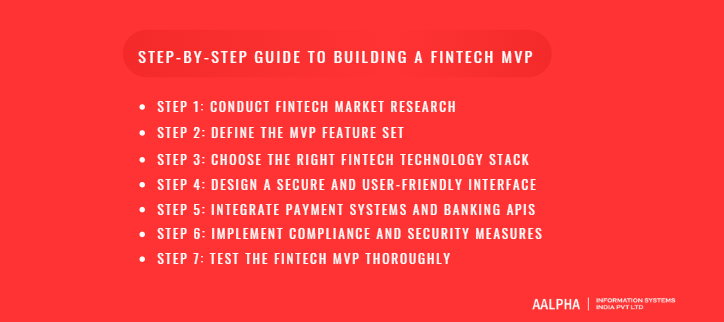
The step-by-step process below helps founders move from idea to launch with a clearer product roadmap. It starts with market understanding, then narrows the scope into a focused MVP, defines the technical foundation, shapes the user experience, connects the product with financial systems, implements compliance controls, and ends with testing. Each step plays a distinct role. Skipping any one of them usually leads to expensive rework, product delays, or avoidable compliance and security issues.
For example, a startup building a digital lending app cannot begin with interface design alone. It must first understand borrower pain points, assess competitors, define loan eligibility logic, select secure infrastructure, integrate identity verification and payment systems, and test whether the workflow behaves correctly across all scenarios. The same is true for digital wallets, expense platforms, remittance systems, or investment apps. The exact features may differ, but the development path remains similar.
When approached correctly, this process helps fintech startups reduce wasted development effort, control risk, and get to market with a product that is small in scope but strong in execution.
Step 1: Conduct Fintech Market Research
The first step in building a fintech MVP is understanding the market in which the product will operate. Fintech founders often begin with a strong idea, but an idea alone is not enough. The product must solve a real financial problem, fit into an existing market gap, and operate within regulatory boundaries. Thorough market research makes that possible.
Competitor analysis is the starting point. Founders should identify direct competitors that solve the same problem and indirect competitors that solve it differently. A remittance startup, for example, should not only study other remittance apps but also examine how traditional banks, payment processors, and digital wallets handle international transfers. The objective is to understand what features competitors offer, where users complain, how pricing works, and what trust-building mechanisms they use. This helps reveal clear differentiation opportunities. If every competitor offers basic payments but users consistently complain about slow settlement or hidden fees, that pain point becomes strategically valuable.
Customer discovery is equally important. Fintech products often fail because founders assume they understand user behavior without validating it. Interviews, surveys, workflow mapping, and early prototype feedback can reveal how users currently solve the problem, what they dislike about current options, and what would make them switch. A lending startup may assume users want lower interest rates, while interviews may show that faster approval and clearer eligibility criteria matter more. A budgeting app may assume users want analytics dashboards, while users may actually want automated spending categorization and simple alerts.
Regulatory research must happen at the same stage. Many fintech ideas appear attractive until licensing, compliance, or data handling obligations are examined. Founders need a clear view of whether the product will require KYC, AML controls, financial licensing, payment partner approvals, or region-specific compliance obligations. For instance, a product that only displays financial data has a very different legal profile from one that moves money or underwrites loans.
Strong market research produces three outputs: a validated problem, a clearly defined customer segment, and a realistic operating environment. Those insights shape every decision that follows.
Step 2: Define the MVP Feature Set
Once the market opportunity is clear, the next step is defining the MVP feature set. This is one of the most important decisions in fintech product development because early-stage teams often try to build too much. The purpose of an MVP is not to impress users with breadth. It is to validate the core financial value proposition with the smallest feature set that still feels credible, secure, and useful.
The best way to define MVP scope is to begin with the primary user journey. Ask a simple question: what is the single most important task the user must complete for the product to prove its value? In a digital wallet, that journey may be sign up, verify identity, add funds, and send money. In a lending app, it may be register, upload documents, receive an eligibility result, and apply for a loan. In an expense product for small businesses, it may be connect accounts, categorize spending, and generate a simple financial view.
Once that primary journey is identified, features should be prioritized based on necessity. Core transactional functionality comes first. Essential trust and compliance features come next. Supporting features that improve usability can follow if they are lightweight and clearly beneficial. Everything else should be deferred. This includes dashboards with unnecessary complexity, broad personalization systems, advanced reporting, loyalty programs, multi-country expansion logic, or extra product modules that do not directly support the first use case.
A practical way to make these decisions is to separate features into four groups: must-have, should-have, nice-to-have, and later. In fintech, must-have features usually include onboarding, authentication, core transaction flows, basic compliance controls, and visible security protections. Nice-to-have features are the ones that make the product feel larger but do not materially improve initial validation.
The right fintech MVP feels complete within a narrow scope. Users should be able to understand what it does, trust it enough to try it, and get the promised result without confusion. That is far more valuable than a bloated first release that delays launch and weakens focus.
Step 3: Choose the Right Fintech Technology Stack
After defining the MVP scope, the next step is selecting the MVP technology stack. In fintech, this decision is not only about development speed. It affects scalability, security, compliance readiness, integration flexibility, and long-term maintenance. The right stack should support current MVP needs without creating technical limitations that make future expansion difficult.
On the backend, fintech platforms need stable, secure, and well-structured architecture. The backend handles user accounts, financial logic, transaction records, integrations, compliance workflows, and system events. Startups often choose backend technologies based on team expertise and ecosystem maturity, but the deeper consideration should be reliability and maintainability. Financial workflows require accurate state management, auditability, and predictable performance. The system should be able to support transaction logs, reconciliation logic, role-based access, API security, and fault handling without becoming fragile.
The frontend should match the product’s usage context. Consumer fintech apps often prioritize mobile-first experiences because users expect to handle payments, balances, transfers, or spending insights on their phones. B2B fintech products may require a strong web interface with dashboards, transaction views, reporting panels, and permission-based workflows. The frontend stack should support clarity, responsiveness, secure session handling, and easy iteration as the product evolves.
Security infrastructure must be treated as part of the stack, not as an add-on. Authentication frameworks, encryption support, secrets management, audit logging, token security, and monitoring tools all need to be planned early. A fintech MVP that lacks proper security architecture may work in testing but fail under real-world use or partner review.
Cloud architecture is another key decision. Most fintech MVPs benefit from cloud environments because they provide flexibility, monitoring, redundancy, and managed infrastructure services. However, the architecture should still reflect financial-grade discipline. Separate environments for development, staging, and production are essential. Logging, alerting, backup policies, access control, and infrastructure visibility should be set up from the beginning.
A strong fintech technology stack is not the most fashionable one. It is the one that allows the team to build quickly without sacrificing stability, security, and future scalability.
Step 4: Design a Secure and User-Friendly Interface
Fintech products succeed or fail not only on functionality but also on trust. Users make decisions involving money, identity, and sensitive personal information. If the interface feels confusing, inconsistent, or unsafe, they may abandon the product immediately. That is why interface design in fintech must combine usability with visible trust signals.
The first principle is clarity. Financial workflows should be simple to understand at every step. Labels must be precise, balances must be easy to read, actions must be clearly distinguished, and key information must not be buried. Users should never have to guess whether they are transferring money, requesting funds, applying for credit, or simply previewing a screen. Confusion in a fintech interface does not just frustrate users. It creates risk.
The second principle is reassurance. Users need confirmation that the product is secure and reliable. This can be supported through familiar authentication patterns, visible verification steps, clear transaction confirmations, secure language, and transparent error states. For example, during onboarding, users should understand why identity verification is required and how their data will be used. During payments, they should see confirmation messages, timestamps, transaction references, and status updates.
Trust signals also matter visually. Clean design, consistent layout, professional typography, strong contrast, and predictable navigation all contribute to a sense of legitimacy. Poor spacing, unclear forms, or unstable interface behavior can weaken confidence, even if the underlying platform is technically sound.
Usability is equally important. Fintech users may come from very different levels of financial literacy. The product should support first-time users with simple flows, strong onboarding, and minimal friction. Forms should ask only for necessary information. Multi-step tasks should show progress. Error messages should explain what went wrong and how to fix it. Sensitive tasks such as account linking or payment confirmation should be especially clear and deliberate.
A fintech MVP does not need design excess. It needs interface discipline. The goal is to make users feel that the product is trustworthy, understandable, and safe enough to use with real money.
Step 5: Integrate Payment Systems and Banking APIs
A fintech MVP becomes functional only when it can connect with the broader financial ecosystem. Most fintech products do not operate independently. They rely on payment processors, banking partners, card networks, open banking providers, identity services, and other financial infrastructure layers to deliver real value. This is where integrations become central to product execution.
Payment system integration is one of the most common requirements. If the product allows users to transfer funds, accept payments, disburse loans, receive payouts, or process card transactions, it will need a payment processor or payment gateway. These providers handle key functions such as authorization, settlement, transaction status updates, charge handling, and in some cases fraud checks. For an MVP, startups usually rely on established infrastructure providers rather than building payment rails themselves. This reduces complexity, speeds up launch, and helps the product benefit from proven financial infrastructure.
Banking API integration is also essential for many fintech use cases. Open banking frameworks and modern financial APIs allow products to access account data, verify balances, initiate payments, retrieve transaction history, and support account linking. A personal finance app may use banking APIs to aggregate data from multiple accounts. A lending product may use them to evaluate income patterns and cash flow. A B2B treasury product may use them to automate payment operations or account reconciliation.
These integrations require careful planning because financial APIs are not all equal. Startups must evaluate coverage, reliability, documentation quality, security practices, rate limits, geographic support, and compliance standards. A provider that works well in one region may not serve another. A payment gateway suited for merchant collections may not support payout use cases. A banking API may provide read access but not payment initiation.
Teams also need strong internal integration logic. API errors, timeouts, duplicate callbacks, status mismatches, and delayed confirmations are common realities in financial systems. The product must manage these conditions cleanly. Transaction states should be tracked carefully. Reconciliation processes should verify that internal records match provider responses. Users should see accurate transaction statuses even when provider systems are asynchronous.
A good fintech MVP does not try to own the entire financial stack on day one. It connects intelligently to trusted providers, uses APIs to accelerate delivery, and builds internal safeguards so those integrations behave reliably under real-world conditions.
Step 6: Implement Compliance and Security Measures
Compliance and security are not optional layers in fintech. They are core product requirements. Even at the MVP stage, a fintech startup must show that it can protect user data, reduce the risk of abuse, and operate within applicable regulatory rules. Ignoring these measures early often leads to launch delays, partner rejection, legal exposure, or serious trust problems once users arrive.
A common starting point is KYC, or Know Your Customer. If the product allows users to open accounts, move money, borrow funds, or access regulated services, identity verification may be mandatory. KYC systems typically collect personal details, government-issued identity documents, and in some cases biometric or liveness verification. The exact requirements depend on the jurisdiction and the nature of the financial product, but the operational principle is the same: the platform must know who is using it.
AML, or Anti-Money Laundering controls, are closely related. These measures help identify suspicious transaction patterns, sanctioned individuals, unusual account behavior, or activity that requires escalation. A fintech MVP may not need a complex in-house AML engine immediately, but it must have some way to screen users, monitor risk indicators, and support reporting obligations where applicable.
Encryption is another foundational requirement. Sensitive data should be encrypted both in transit and at rest. Secure communication protocols, protected credentials, token handling, database access controls, and secrets management all matter. Access should be restricted based on role, and internal operational actions should be logged for traceability.
Fraud detection also deserves early attention. Fraud risk in fintech can appear through stolen identities, account takeover, suspicious device behavior, unusual payment activity, or synthetic onboarding patterns. Startups can begin with rule-based controls and trusted third-party services, then add more sophisticated detection layers over time.
Security also includes secure authentication, session management, audit trails, environment isolation, regular dependency reviews, and clear incident response planning. Users may never see most of these controls directly, but they shape the platform’s resilience.
The core principle is simple: a fintech MVP should be minimal in scope, but never minimal in responsibility. It must be strong enough to protect money, identity, and trust from the first real user onward.
Step 7: Test the Fintech MVP Thoroughly
Testing is the final step before launch, but in fintech it is much more than a basic quality assurance exercise. A fintech MVP must be tested across functionality, security, reliability, integrations, and compliance-sensitive workflows. Because the product handles real money and real user identities, even small defects can cause outsized consequences.
Functional QA begins with validating every core user journey. Registration, login, document upload, account linking, payment initiation, transaction confirmation, balance updates, loan application steps, notifications, and status changes should all be tested under normal and edge-case conditions. Teams need to verify not only that the workflows work, but that they behave correctly when something goes wrong. What happens if a payment callback is delayed, an account verification step fails, or a user submits incomplete KYC documents? The product must respond clearly and safely.
Financial transaction testing deserves special focus. Unlike many software categories, fintech platforms must maintain data accuracy across asynchronous systems. Test cases should validate duplicate prevention, failed transaction recovery, reconciliation logic, rounding accuracy, idempotency, and ledger integrity where relevant. A user should not be charged twice because of a retry event. A pending payment should not appear as settled before confirmation. Internal transaction states must stay aligned with provider responses.
Security testing is equally important. Authentication flows, session expiration, access permissions, API protection, encrypted data handling, secrets exposure risks, and role boundaries should all be reviewed. Depending on the product and stage, this may include vulnerability scanning, penetration testing, dependency review, and secure configuration checks.
Regulatory validation is another critical layer. The product should be tested to confirm that compliance workflows function properly. Identity verification processes should collect the required data. Suspicious activity triggers should behave as intended. Consent screens, disclosures, and data handling flows should match business and regulatory expectations.
Finally, the MVP should go through staged validation in a controlled environment before full release. Internal testing, sandbox testing with providers, and limited pilot launches help uncover issues before broader exposure. In fintech, a stable launch is worth far more than a rushed one. Testing is what turns an idea into a product that users can trust.
Essential Technologies Used in Fintech MVP Development
Building a fintech MVP requires careful technology selection because financial platforms must balance performance, scalability, security, and regulatory readiness. Unlike many consumer applications where technology decisions mainly affect speed of development, fintech systems must handle financial transactions, sensitive user data, and complex integrations with external financial institutions. As a result, the underlying technology stack becomes a critical factor in product stability and long-term scalability.
Founders and CTOs often ask an important question early in the development process: what technologies are commonly used to build fintech platforms that are secure, scalable, and reliable? The answer involves several layers of technology working together. Backend systems handle financial logic and transaction management. Frontend frameworks create intuitive user interfaces that allow customers to interact with financial services. Cloud infrastructure provides scalability, availability, and operational resilience. Security technologies protect financial data and reduce the risk of fraud or unauthorized access.
Each of these layers plays a different role in the fintech architecture. For example, the backend manages transaction processing and integrations with banking APIs, while the frontend ensures that users can easily perform tasks such as sending money, checking balances, or managing investments. Cloud infrastructure allows fintech products to scale as the user base grows, and security technologies ensure that financial data remains protected at every stage of the transaction lifecycle.
Understanding these technologies helps fintech founders make informed decisions during MVP development. The goal is not to adopt every advanced technology available but to build a reliable foundation that can support the core financial functionality of the product while allowing future expansion.
Backend Technologies for Fintech Platforms
The backend is the operational core of any fintech platform. It manages business logic, financial transactions, user accounts, integrations with financial services, and regulatory workflows. Because fintech systems must process sensitive financial operations, backend architecture must be designed for reliability, scalability, and data integrity.
Many fintech platforms rely on modern backend frameworks that support modular architectures. A modular approach allows developers to separate different components of the system such as user authentication, payment processing, transaction management, and compliance verification. This structure improves maintainability and makes it easier to scale the system as the platform grows.
Financial systems also require accurate transaction management. Backend systems must ensure that financial operations are processed correctly, even when multiple processes occur simultaneously. For example, when users transfer funds between accounts, the backend must update account balances, verify transaction status, and maintain a reliable audit trail.
APIs play a central role in backend fintech architecture. Application programming interfaces enable fintech platforms to communicate with external services such as banking APIs, payment gateways, identity verification providers, and fraud detection systems. A well-designed API layer ensures that the platform can integrate new financial services without requiring major architectural changes.
Data management is another key consideration. Fintech platforms must store transaction records, user data, and financial histories securely while maintaining high availability and fast access speeds. Scalable database systems combined with reliable data backup and monitoring mechanisms help maintain system stability.
In short, backend technologies form the foundation of fintech applications by supporting transaction processing, integrations, and reliable financial data management.
Frontend Frameworks for Financial Applications
The frontend layer of a fintech platform defines how users interact with the product. Whether the product is a digital wallet, investment application, or financial dashboard, the interface must provide a clear and responsive experience that allows users to perform financial tasks with confidence.
Modern frontend frameworks help developers create responsive web and mobile interfaces that adapt to different devices and screen sizes. These frameworks enable faster development while maintaining consistent design patterns across the platform.
For fintech products, frontend design must prioritize clarity and usability. Financial information such as account balances, transaction history, and payment confirmations must be displayed in a way that is easy to understand. Interfaces should minimize confusion and provide clear feedback when users perform actions such as transferring money or confirming payments.
Another important aspect of frontend development in fintech is real-time interaction. Many financial applications provide instant updates when transactions occur. For example, when a user sends money, the interface should immediately reflect the updated balance and transaction status.
Security is also integrated into frontend systems. Secure authentication flows, session management, and identity verification steps are often handled through frontend interfaces that communicate with backend services.
By using modern frontend frameworks, fintech startups can build intuitive user experiences that make complex financial services accessible to everyday users.
Cloud Infrastructure for Fintech Products
Cloud infrastructure has become a standard foundation for modern fintech platforms because it provides flexibility, scalability, and operational reliability. Financial applications must be capable of handling varying transaction volumes, maintaining high availability, and protecting sensitive data. Cloud environments support these requirements through distributed infrastructure and managed services.
One major advantage of cloud infrastructure is scalability. Fintech platforms often experience unpredictable user growth. For example, a successful product launch or viral marketing campaign may rapidly increase the number of transactions processed by the platform. Cloud systems allow infrastructure resources to scale dynamically based on demand, ensuring that the system remains responsive during periods of high activity.
Reliability is another key benefit. Cloud providers offer infrastructure redundancy, automatic backups, and failover mechanisms that reduce the risk of service interruptions. If one server or data center experiences an issue, traffic can be redirected to another location without affecting users.
Cloud environments also simplify infrastructure management. Instead of maintaining physical servers, fintech teams can focus on product development while relying on managed services for storage, monitoring, database management, and networking.
Compliance and data protection are also supported by cloud infrastructure. Many cloud providers offer built-in security features, access control systems, and compliance certifications that align with financial industry standards.
By leveraging cloud infrastructure, fintech startups can build scalable and resilient platforms capable of supporting financial operations from the earliest MVP stage through long-term growth.
Security Technologies for Financial Data Protection
Security technologies are essential for protecting financial data and maintaining user trust in fintech platforms. Because financial applications handle sensitive information such as payment credentials, personal identity data, and transaction histories, robust security mechanisms must be integrated throughout the system architecture.
Encryption is one of the most fundamental security technologies used in fintech. Data encryption ensures that sensitive information remains protected during transmission and storage. When users interact with a fintech application, encryption protocols secure communication between the user device and the platform’s servers. Stored data is also encrypted to prevent unauthorized access in case of system breaches.
Identity verification technologies play another important role. Many fintech platforms use digital identity verification systems to confirm that users are legitimate. These systems may analyze government-issued identity documents, perform facial recognition checks, or validate biometric data. Identity verification helps prevent fraud and ensures compliance with regulatory requirements.
Fraud detection technologies are also widely used in fintech applications. These systems monitor transaction patterns and user behavior to identify suspicious activity. For example, if a user suddenly initiates a large transaction from an unfamiliar device or location, the system may flag the transaction for additional verification.
Access control and authentication technologies further strengthen platform security. Multi-factor authentication requires users to verify their identity through multiple steps such as passwords, authentication codes, or biometric verification. This reduces the risk of unauthorized account access.
In addition to these mechanisms, fintech platforms often implement monitoring systems that track system activity and detect potential security threats. Continuous monitoring helps identify vulnerabilities and ensures that financial systems remain protected against evolving cybersecurity risks.
Security technologies are not simply technical features; they are foundational components of fintech platforms. Strong security architecture protects financial assets, ensures regulatory compliance, and builds the trust necessary for users to adopt digital financial services.
Fintech MVP Development Cost
Understanding the cost of building a fintech MVP is one of the most important considerations for founders, product leaders, and investors. Financial technology platforms require specialized infrastructure, regulatory compliance mechanisms, and integrations with financial institutions, which makes development more complex than typical web or mobile applications. As a result, fintech MVP costs can vary significantly depending on the product’s scope, regulatory requirements, and technology architecture.
A fintech MVP is designed to validate the core value proposition of a financial product while minimizing initial development investment. However, even a minimal financial platform must include certain essential components such as secure authentication, transaction management, identity verification, and integration with payment or banking systems. These requirements increase development costs compared to non-financial digital products.
When evaluating fintech MVP development costs, businesses should consider not only engineering expenses but also regulatory preparation, security infrastructure, and third-party service integrations. For example, integrating a payment gateway, identity verification service, or fraud detection system may involve licensing fees or usage-based costs in addition to development work.
Another important factor is the development approach. Startups can build fintech products using an internal engineering team, outsourced development partners, or hybrid models that combine both approaches. Each model has different cost implications depending on team location, experience level, and development timelines.
Although fintech MVP development requires a significant investment, launching with a focused MVP allows companies to test their product in the market before committing to large-scale platform development. This approach helps control risk while generating valuable insights that guide future product expansion.
Average Cost to Build a Fintech MVP
The cost of building a fintech MVP can vary widely depending on the complexity of the financial product. Simpler fintech applications with limited functionality may require significantly less investment than platforms that involve complex financial transactions, multiple integrations, or advanced compliance mechanisms.
For a basic fintech MVP with a narrow feature set, development costs typically range between $50,000 and $100,000. These types of products usually include core features such as user registration, identity verification, basic financial transactions, and integration with a payment gateway or banking API. Examples include simple digital wallets, expense tracking applications, or basic payment platforms.
A mid-level fintech MVP that includes more advanced features such as transaction history management, analytics dashboards, or multiple financial integrations may cost between $100,000 and $200,000. Products in this category often require stronger backend infrastructure and additional compliance workflows.
More complex fintech MVPs, such as lending platforms, investment management applications, or neobanking services, can cost $200,000 to $400,000 or more. These products involve complex financial workflows, regulatory considerations, and integrations with multiple financial institutions.
The final cost depends on factors such as system architecture, security requirements, development team experience, and regulatory obligations.
Cost Breakdown by Development Stage
Fintech MVP development costs are distributed across several stages of the product lifecycle. Each stage contributes to the overall budget and plays a distinct role in ensuring that the financial platform functions correctly and meets regulatory expectations.
The first stage is product planning and research, which typically accounts for around 10–15 percent of the total project cost. During this phase, teams conduct market analysis, competitor research, and regulatory assessment to define the product roadmap. Product strategy and feature prioritization also occur at this stage.
The second stage is UI/UX design, which usually represents 10–20 percent of the total development budget. Financial applications require carefully designed interfaces that present financial data clearly and guide users through secure transaction workflows. Designers focus on user journeys such as onboarding, account management, and payment interactions.
The largest portion of the budget is typically allocated to software development, which can account for 40–50 percent of the overall cost. This stage includes backend development, frontend development, API integrations, database architecture, and implementation of financial logic. Development teams also integrate external services such as payment gateways, banking APIs, identity verification systems, and fraud detection tools.
The testing and quality assurance stage generally represents around 15–20 percent of the project cost. Fintech platforms require extensive testing because financial transactions must operate accurately under different scenarios. QA teams validate system functionality, transaction processing, and integration stability.
Finally, compliance preparation and security implementation may account for 10–15 percent of the total cost. This includes implementing KYC workflows, encryption protocols, access control mechanisms, and security monitoring systems necessary for handling financial data.
Together, these stages ensure that the fintech MVP is functional, secure, and ready for market testing.
Factors That Influence Fintech MVP Cost
Several factors influence the overall cost of building a fintech MVP. One of the most significant variables is regulatory complexity. Financial services operate under strict regulatory frameworks, and products that involve lending, payments, or investment services often require additional compliance mechanisms such as identity verification, transaction monitoring, and reporting systems.
Integration requirements also have a major impact on development costs. Fintech platforms often connect with multiple third-party services including payment processors, banking APIs, identity verification providers, and fraud detection systems. Each integration requires development effort, testing, and ongoing maintenance.
Security requirements represent another major cost factor. Because fintech platforms handle sensitive financial data, they must implement strong encryption, secure authentication, and monitoring systems. These security measures require additional engineering effort and infrastructure resources.
Product complexity also plays a role. A simple financial tracking application may require relatively basic infrastructure, while a lending platform with automated credit scoring and loan management workflows involves much more complex system architecture.
The size and experience level of the development team also influence cost. Highly experienced fintech developers may command higher hourly rates, but they often deliver more efficient and secure solutions compared to general software developers without financial domain expertise.
Understanding these factors helps startups estimate development budgets and plan fintech MVP development more effectively.
Development Cost by Region
Geographic location is another major factor that influences fintech MVP development costs. Development teams in different regions have varying labor costs, which can significantly affect the overall project budget.
In North America, fintech development rates are typically the highest. Experienced fintech development teams in the United States and Canada often charge between $120 and $200 per hour, which can result in higher total project costs for MVP development.
In Western Europe, development rates generally range between $80 and $150 per hour, depending on the country and the experience level of the development team. European development teams often have strong expertise in financial regulations and enterprise-grade software systems.
Many fintech startups choose offshore development markets such as India or Eastern Europe, where offshore development rates typically range from $30 to $70 per hour. These regions provide access to highly skilled engineers at significantly lower costs while maintaining strong technical expertise.
Choosing the right development region allows fintech startups to optimize their budgets while still building secure and scalable financial platforms.
Common Challenges When Building a Fintech MVP
Building a fintech MVP offers startups the opportunity to test financial products quickly, but the process also introduces several unique challenges. Unlike most digital products, fintech platforms operate in a highly regulated environment and must manage sensitive financial data, real-time transactions, and complex integrations with external financial systems. These factors increase both technical complexity and operational risk.
Many fintech startups discover that developing a financial product involves far more than simply creating a user interface and backend logic. Regulatory compliance requirements, security obligations, and integration dependencies can significantly influence development timelines and costs. Even a small oversight in these areas may result in regulatory violations, financial losses, or reputational damage.
For example, a startup building a payment platform must ensure that every transaction complies with regional financial regulations and that the system can detect suspicious activity. Similarly, a lending platform must verify borrower identities, monitor loan transactions, and maintain secure records that comply with financial reporting standards.
Understanding the most common fintech MVP challenges helps founders anticipate risks and prepare solutions early in the development process. Three of the most significant challenges include regulatory compliance complexity, data security and fraud prevention, and integration with banking infrastructure.
-
Regulatory Compliance Complexity
Regulatory compliance is one of the most significant challenges for fintech startups. Financial services operate under strict government regulations designed to prevent fraud, protect consumers, and maintain stability in the financial system. These regulations vary across countries and often change as financial technology evolves.
Fintech products that involve payments, lending, investments, or digital banking may require specific financial licenses before they can legally operate. Obtaining these licenses can be time-consuming and expensive. Startups must often work with regulatory authorities, legal advisors, and compliance specialists to ensure that their products meet all required standards.
Another common regulatory requirement is Know Your Customer (KYC) verification. KYC rules require fintech platforms to verify the identity of their users before allowing them to access financial services. This process usually involves collecting personal information, validating identity documents, and sometimes performing biometric verification.
Anti-Money Laundering (AML) regulations add another layer of complexity. Fintech platforms must monitor transactions for suspicious activity and report certain transactions to regulatory authorities. Implementing AML systems requires specialized software and ongoing monitoring processes.
Regulatory compliance also varies depending on geographic markets. A fintech platform operating in multiple countries may need to comply with different financial regulations in each region. As a result, startups often need legal expertise to navigate regulatory frameworks and ensure their MVP can operate within the applicable laws.
-
Data Security and Fraud Prevention
Data security is another major challenge in fintech development. Financial platforms handle highly sensitive information including bank account numbers, payment credentials, personal identity documents, and transaction records. Protecting this data is essential for maintaining user trust and meeting regulatory requirements.
Cybersecurity threats in fintech can take many forms. Hackers may attempt to access user accounts, intercept financial transactions, or exploit vulnerabilities in the system architecture. If a fintech platform experiences a data breach or financial fraud incident, the consequences can include financial losses, regulatory penalties, and long-term reputational damage.
To reduce these risks, fintech platforms must implement strong security measures from the earliest stages of development. Encryption technologies protect financial data both during transmission and while stored in databases. Secure authentication methods such as multi-factor authentication help prevent unauthorized account access.
Fraud detection systems also play an important role in fintech security. These systems analyze transaction patterns and user behavior to identify unusual activity. For example, if a user suddenly attempts a large transfer from an unfamiliar location or device, the system may trigger additional verification steps.
Security challenges are particularly complex because cyber threats constantly evolve. Fintech startups must regularly update security systems, monitor potential vulnerabilities, and conduct security audits to maintain strong protection against new attack methods.
-
Integration with Banking Systems
Another common challenge in fintech MVP development involves integrating the platform with banks and financial institutions. Most fintech products rely on external financial infrastructure to process payments, access account information, or verify financial data.
These integrations are typically achieved through banking APIs and payment gateways. While APIs simplify communication between systems, integrating with financial institutions can still be complex due to differences in technology standards, documentation quality, and operational procedures.
One challenge is ensuring reliable transaction processing. Financial APIs may experience delays, timeouts, or inconsistent responses depending on the provider. Fintech platforms must be designed to handle these situations without creating duplicate transactions or incorrect account balances.
Another challenge is managing data synchronization between the fintech platform and the banking system. For example, if a payment transaction is initiated through the fintech app but confirmed later by the banking provider, the system must accurately update transaction status and account balances.
Operational dependencies can also slow development timelines. Some banking partners require approval processes or certification steps before fintech platforms can connect to their systems. These processes may involve technical validation, compliance checks, and security assessments.
Successfully integrating with banking infrastructure requires careful planning, reliable API management, and strong monitoring systems to ensure that financial transactions remain accurate and secure.
How to Choose the Right Fintech Development Partner
Selecting the right fintech development company/partner is one of the most important decisions when building a financial technology product. Unlike standard software projects, fintech platforms must operate within strict regulatory environments, handle sensitive financial data, and integrate with complex financial infrastructure such as banking APIs and payment networks. These requirements make fintech development significantly more specialized than typical web or mobile app development.
A capable fintech development partner does more than write code. They understand financial workflows, regulatory constraints, data protection standards, and transaction processing systems. They also bring experience in building scalable architectures that can support growing transaction volumes and expanding product features. Without this expertise, fintech startups may encounter serious technical or regulatory challenges during product development.
For founders and product teams evaluating development companies, the focus should not only be on cost or development speed. Instead, the evaluation process should consider domain expertise, security practices, development methodology, and the ability to support long-term product evolution.
The right fintech development partner can accelerate product launch, reduce compliance risks, and provide strategic technical guidance throughout the lifecycle of the product.
-
Experience in Financial Technology Development
Fintech development requires specialized expertise that goes beyond general software engineering. Financial applications involve complex workflows such as transaction processing, identity verification, payment settlement, and regulatory compliance monitoring. Developers who lack experience in these areas may struggle to design systems that operate reliably within the financial ecosystem.
A development partner with fintech experience understands how financial platforms interact with banks, payment networks, and regulatory systems. For example, building a digital wallet requires knowledge of payment gateway integration, transaction reconciliation, and secure fund transfers. Similarly, developing a lending platform involves credit evaluation logic, borrower verification processes, and loan management systems.
Experienced fintech developers also understand the importance of system reliability. Financial platforms must maintain accurate transaction records and prevent issues such as duplicate payments, incorrect balances, or failed transfers. Designing systems that ensure transaction integrity requires careful backend architecture and thorough testing.
Another advantage of working with fintech specialists is familiarity with financial APIs and infrastructure providers. Developers who have previously built fintech solutions often have experience integrating with banking systems, payment processors, identity verification services, and fraud detection platforms. This experience can significantly accelerate development timelines.
For these reasons, businesses building fintech products should prioritize development partners with a proven track record in financial technology projects rather than general-purpose software development teams.
-
Strong Security and Compliance Knowledge
Security and compliance are critical elements of fintech development. Financial platforms manage highly sensitive information including personal identity data, payment credentials, and transaction histories. Protecting this information is essential for maintaining user trust and meeting regulatory obligations.
A qualified fintech development partner should demonstrate strong knowledge of data protection practices, encryption standards, and secure authentication systems. For example, financial platforms often require multi-factor authentication, secure session management, and encrypted data storage to prevent unauthorized access.
Regulatory compliance is another important area of expertise. Fintech products frequently operate under regulations such as Know Your Customer (KYC), Anti-Money Laundering (AML), and regional financial regulations that govern digital payments, lending, or investment services. A development partner familiar with these frameworks can help design systems that support identity verification, transaction monitoring, and regulatory reporting requirements.
Because compliance obligations vary across countries and financial products, working with a development team that understands the regulatory landscape reduces the risk of costly compliance mistakes during product development.
-
Proven Development Process
A structured development process is essential for building reliable fintech platforms. Financial systems require careful planning, clear communication, and rigorous testing to ensure that all components function correctly before launch.
Many experienced fintech development companies follow agile development methodologies. Agile development divides the project into smaller iterations that allow teams to continuously test functionality, gather feedback, and improve the product. This approach helps reduce development risks and allows product teams to adapt quickly to changing requirements.
Transparency and communication are also key components of an effective development process. Development partners should provide regular progress updates, clear documentation, and collaborative planning sessions with stakeholders. This ensures that founders and product managers remain informed about the progress of the project and can make timely decisions about product features.
Testing procedures are another important aspect of the development process. Fintech platforms require extensive quality assurance testing to validate transaction workflows, API integrations, and security mechanisms. A development partner with a structured QA process can identify potential issues before the product reaches real users.
By working with teams that follow a disciplined development process, fintech startups can reduce development delays and improve product reliability.
-
Long-Term Support and Scalability
Fintech products rarely remain static after launch. Once an MVP is introduced to the market, startups typically continue expanding the platform with new features, integrations, and geographic markets. As transaction volumes increase and user bases grow, the underlying system architecture must also scale accordingly.
For this reason, businesses should choose a development partner capable of supporting long-term product development. Ongoing support may include performance optimization, security updates, compliance improvements, and integration with additional financial services.
Development partners with experience in scalable fintech architecture can help startups evolve their MVP into a full-featured financial platform over time. Companies such as Aalpha Information Systems, which specialize in building secure and scalable fintech solutions, provide both initial product development and long-term technical support that helps fintech businesses grow sustainably.
Conclusion
Building a fintech MVP is the most practical way for startups and businesses to validate financial product ideas before investing in full-scale development. By focusing on a specific financial problem, defining a clear target audience, and launching with essential features, companies can bring innovative financial services to market faster while reducing development risks. A well-planned fintech MVP also helps teams gather real user feedback, refine product strategy, and build investor confidence through measurable traction.
Because fintech platforms must meet strict requirements around security, compliance, and financial infrastructure, partnering with an experienced development team can significantly simplify the process. If you are planning to build a fintech product or launch a financial technology startup, working with specialists such as Aalpha Information Systems can help you design, develop, and scale secure fintech solutions tailored to your business goals.